







Abstract
Little work explores reentry needs in Trinidad and Tobago. Currently, the Trinidad and Tobago Prison System (TTPS) is designing a parole system which would allow the early release of incarcerated individuals. This work aims to inform the development of such policy by examining what offenders perceive as key needs for successful reentry. Utilizing a sample of 50 offenders who volunteered to participate and who are currently incarcerated in the TTPS, the authors assess how offenders perceive current services and perceived reentry needs. Content analysis reveals that offenders see the need for counseling, help with employment, and locating housing on release from prison. Further, acceptance by the community and a desire to be treated fairly while incarcerated are reported as critical for successfully reentering communities. Notably, a significant number of those incarcerated are dealing with related drug issues. Thus, our data suggest, like O’Connell, that drug counseling and building prosocial ties are essential for successful transition out of incarceration.
Trinidad and Tobago are island republics in the West Indies, 7 miles off the north eastern coast of Venezuela. Most of the population in Trinidad and Tobago (82%) identify as either of African descent (41%) or East Indian (41%; Central Statistical Office [CSO], 2008; U.S. Department of State, 2007). The vast majority (70%) identify as Christian; however, approximately a fourth (23%) are Hindus (CSO, 2008). Over half (65.6%) of those in the labor force are in service work (followed by construction and utilities [17.5%], manufacturing [13%], and agriculture [4%]; U.S. Department of State, 2007). A significant portion (21%) of the population lives below the poverty line (U.S. Department of State, 2007). The literacy rate in Trinidad and Tobago is high (98.4% for those over 15 years of age; CSO, 2008; U.S. Department of State, 2007).
According to Walsmeley’s (2009), the Caribbean Islands are ranked (along with Central Asia and South Africa) as having a substantial portion of its citizens serving prison sentences. Currently, there are approximately 3,656 prisoners (97.5% are men) serving time in the Trinidad and Tobago Prison Service (TTPS; International Centre for Prison Studies, 2012). Of the 218 countries, the incarceration rate (approximately 340 per 100,000 inhabitants [sentenced individuals only]) for Trinidad and Tobago was ranked at 43. Seven facilities hold prisoners in the TTPS: The Women’s Prison, The Remand Center, Port of Spain Prison, Carrera Convict Prison, Golden Grove Prison, Maximum Security Prison, and the Youth Training Centre (Correctional Management and Communications Limited [CMCL], 2008). All women incarcerated in this system are housed at The Women’s Prison regardless of age. Only young men, between the ages of 16 and 21, are sentenced to the Youth Training Centre (CMCL, 2008). Due to problems related to lack of space in current facilities and a desire to implement new policy, the TTPS is designing a parole system which would allow the early supervised release of certain incarcerated individuals.
From past research, we know that offenders often come from, and return to, disadvantaged communities (Beck & Harrison, 2007; Bogue, Nandi, & Jongsma, 2005; Clear, 2007; Clear & Karp, 1999; Petersilia, 2005; Sampson & Raudenbush, 2004; Travis, 2004; Travis & Visher, 2006; Visher & Courtney 2006; Visher, Kachnowski, La Vinge, & Travis, 2004). This social disadvantage is further exacerbated by the prison experience. Offenders tend to possess low levels of workplace skill and education. Thus, the addition of a custodial term to an ex-offender’s personal history further diminishes employability (Allen, Latessa, Ponderer, & Simonsen, 2007). Similarly, stable long-term accommodation is oftentimes hard to obtain since ex-offenders may lack the financial means to secure private housing or may be ineligible for priority public housing (Brumbaugh & Steffey, 2005; Burke & Torny, 2006; Visher & Courtney, 2006). In addition, returning offenders may have problems with drug dependence, mental health problems, and many lack prosocial networks (McClelland & Teplin, 2001; Travis, 2004; Travis & Visher, 2006; Visher & Courtney, 2006; Visher et al., 2004). In part because of these many problems, successful reentry into the community is challenging (Clear, 2007; Connelly & Larivee, 2004; Gendreau & Goggin, 1996; Gendreau, Little, & Goggin, 1996; Petersilia, 2005; Travis, 2004). Past theoretical work, by Sampson and Laub (1993), maintains that those with informal social controls, or those with ties to the community and/or individuals who have something to lose, are less likely than others to offend. Building such informal social controls, or developing prosocial networks, is a hallmark of successful reentry programs. This work aims to inform policy, especially related to the building of a parole system in Trinidad and Tobago, in an effort to facilitate successful reentry into society.
Prisoner Reentry
Prison reentry programs are critical to both the success of inmates and the whole of society because the majority of inmates will eventually be released (Andrews, Bonta, & Wormith, 2006; Aos, Miller, & Drake, 2006; Clear & Karp, 1999; MacLellan, 2004; Mears, 2007). Much work has been done, in the United States, to identify prisoner reentry needs and how to best structure reentry programs; however, the same does not hold true for the Caribbean. Understanding the reentry needs of offenders in the Republic of Trinidad and Tobago is particularly important since the country is in the process of establishing a parole system (ideally in place in 2013) as mandated by the 2002 Cabinet Task Report on Penal Reform and Transformation. As such, this work aims to aid policy makers in developing a parole system by exploring reentry needs as perceived by inmates.
To effectively transition an offender so that they are prepared for reentry requires assessing their skills, abilities, and behaviors. The current intake program, utilized when admitting offenders into the custody of the TTPS, verifies the offender’s sentencing offense and the board determines where the offender will be assigned. This assignment is based, in part, on gender, gang affiliation status, sentence length, prior prison commitments, and if there is an escape risk or threat (CMCL, 2008). Data collection is limited to asking the inmate about his or her current offense, outstanding warrants, potential separation concerns, work and program preferences, a self-report medical screening, and verification of an emergency contact person’s name, address, and telephone number (CMCL, 2008). The intake (allocation) board is made up of the Deputy Commissioner of Prisons, chief welfare officer, and medical officer with the Deputy making the final decision about institutional assignment. Therefore, in the current system, decisions about allocation are made on a subjective basis rather than through a standardized process which obtains and screens offenders for social, medical, psychological, and security information. Thus, the TTPS lacks the data necessary to identify key factors or needs, such as attitudes and beliefs, criminal associates, unemployment, lack of education, family dysfunction, and/or drug use, which may have contributed to the offender’s criminal activities. The present work follows that of Taylor-Greene, Polzer, and Lavin-Loucks (2006) and aims to better understand how offenders perceive their needs and how they evaluate current programs. Moreover, given that a standardized objective classification process is not currently being used to collect all of the necessary information to adequately prepare offenders for reentry, an alternative is to ask offenders their perceptions about reentry challenges as well as to identify their postprison needs.
Prisoner Reentry Challenges
Past work, in the United States, explores how offenders perceive reentry needs. Utilizing data from incarcerated individuals, Taylor-Green et al. (2006) reported that offenders would like to earn money while incarcerated which they could use on release, have counseling available (especially after release), and have access to job fairs in order to learn about job opportunities. Having job skills and training was the key need offenders identified as necessary for successful reentry on release (Taylor-Green et al., 2006). Notably, past research shows that maintaining a stable and legitimate job after release helps reduce the chances of recidivism (Winterfield, Lattimore, Steffey, & Braumbaugh, 2006). Thus, institutions would be wise to offer programs aimed at improving job skills and preparing for employment (Altchuler & Brash, 2004; Visher et al., 2004; Winterfield et al., 2006).
In addition to basic skills, Visher et al. (2004) argues that offenders with strong family support are more likely than others to find employment after release, not use illicit drugs, and not recidivate (see also Altchuler & Brash, 2004). Given that many adult offenders will be returning home to children, how to balance work and home needs must also be addressed in reentry programs (Altschuler & Brash, 2004; Charles, Abram, McClelland, & Teplin, 2003; Solomon, Johnson, Travis, & McBride, 2004; Spencer & Walker, 2004; Travis, 2005; Visher et al., 2004). Female offenders may present problems that male offenders may not, such as child rearing, parenting and custody battles, health problems, history of violence, sexual abuse, and corresponding trauma (Visher et al., 2004).
Besides work and family needs, Visher et al. (2004) identified attitude toward self and readiness to change as critical factors for successful reentry. The vast majority (90%) of respondents in their sample agreed that they had much to be proud of in life. Virtually all believed it was important to separate from people and things that got them in trouble (Latendresse & Cortoni, 2005).
For offenders lacking family support, the basic issue of locating housing may be difficult (Metraux & Dennis, 2004; Petersilia, 2003; Travis, 2004). Petersilia (2003) writes that locating housing is the biggest need ex-offenders face. Several researchers have reported high rates of homelessness among those in prison in the United States (Altchuler & Brash, 2004; Petersilia, 2003, 2004; Travis, 2004; Visher et al., 2004). Those with histories of mental illness and drug abuse are even more likely to be homeless (Travis, 2004). Finding suitable long-term shelter is a significant obstacle many offenders, especially those without strong family ties, face on release.
Other Reentry Issues
Earlier research, in the United States, shows that more than half of prisoners reported they were under the influence when they committed the crime that led to their imprisonment (Mumola, 1999; Visher et al., 2004). Extant work shows that involvement in the drug trade shapes incarceration in the TTPS. Having a substance abuse treatment program while institutionalized may significantly reduce the risk of recidivism among those at risk (Visher et al., 2004).
Extant research reveals that more prisoners suffer from mental disorders and health ailments compared to the general population. Mental disorders among offenders are a barrier for the reintegration process (Altchuler & Brash, 2004; Snyder, 2004). It is important to note that many offenders receive their first mental health and/or physical treatment while incarcerated. In building a parole system, it would be wise to consider the importance of such treatment after the offender is released (Altchuler & Brash, 2004).
Method
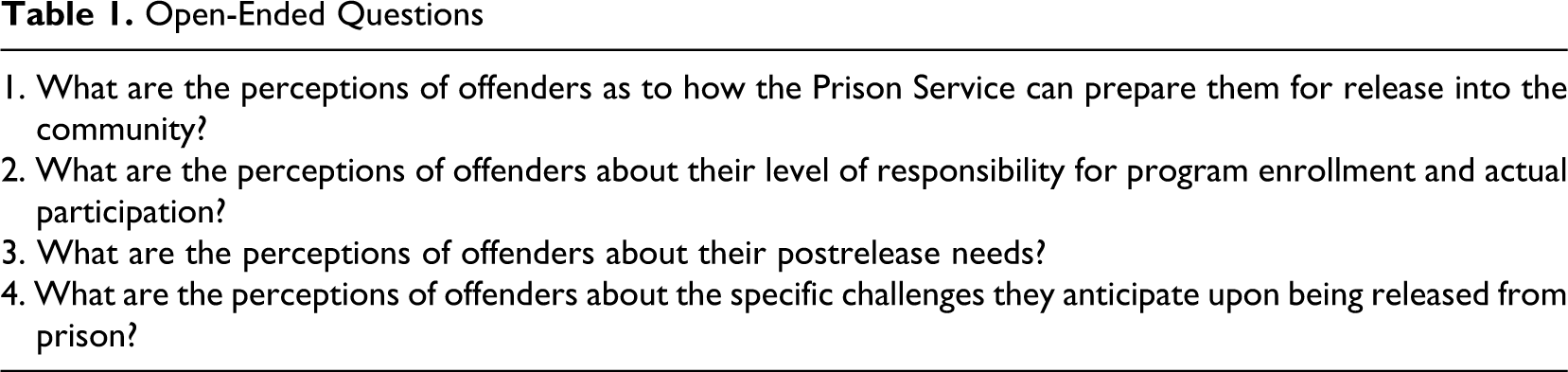
Data for this work were collected by CMCL in 2008. CMCL conducted a needs assessment of the TTPS focusing on current case management. The needs assessment aimed to identify TTPS strengths and capital (economic, human, and social) that would aid in the development of a parole system as well as to identify the challenges within the TTPS that might impede the implementation of a parole system. One author (Sumter) was part of the team that collected the data for the needs assessment. This work utilizes data from the open-ended questions that were posed to the offenders. The sample includes those offenders who volunteered to participate in the study. The final sample includes adult males housed at the maximum security and Golden Grove Prison (n = 22), female offenders housed at the women’s prison (N = 16), and youthful offenders housed at the Youth Training Centre (N = 12). Again, all participants voluntarily participated in the study. All offenders, except those in the Youth Training Centre, were serving multiple-year sentences; however, the vast majority will eventually be released into the community. Following the work of Taylor-Greene et al. (2006), offenders were asked four open-ended questions (see Table 1). Due to the size of the sample, as well as the fact that the themes which emerged from each question were similar regardless of where inmates were located in the TTPS, findings are presented in the aggregate.
Open-Ended Questions
Results
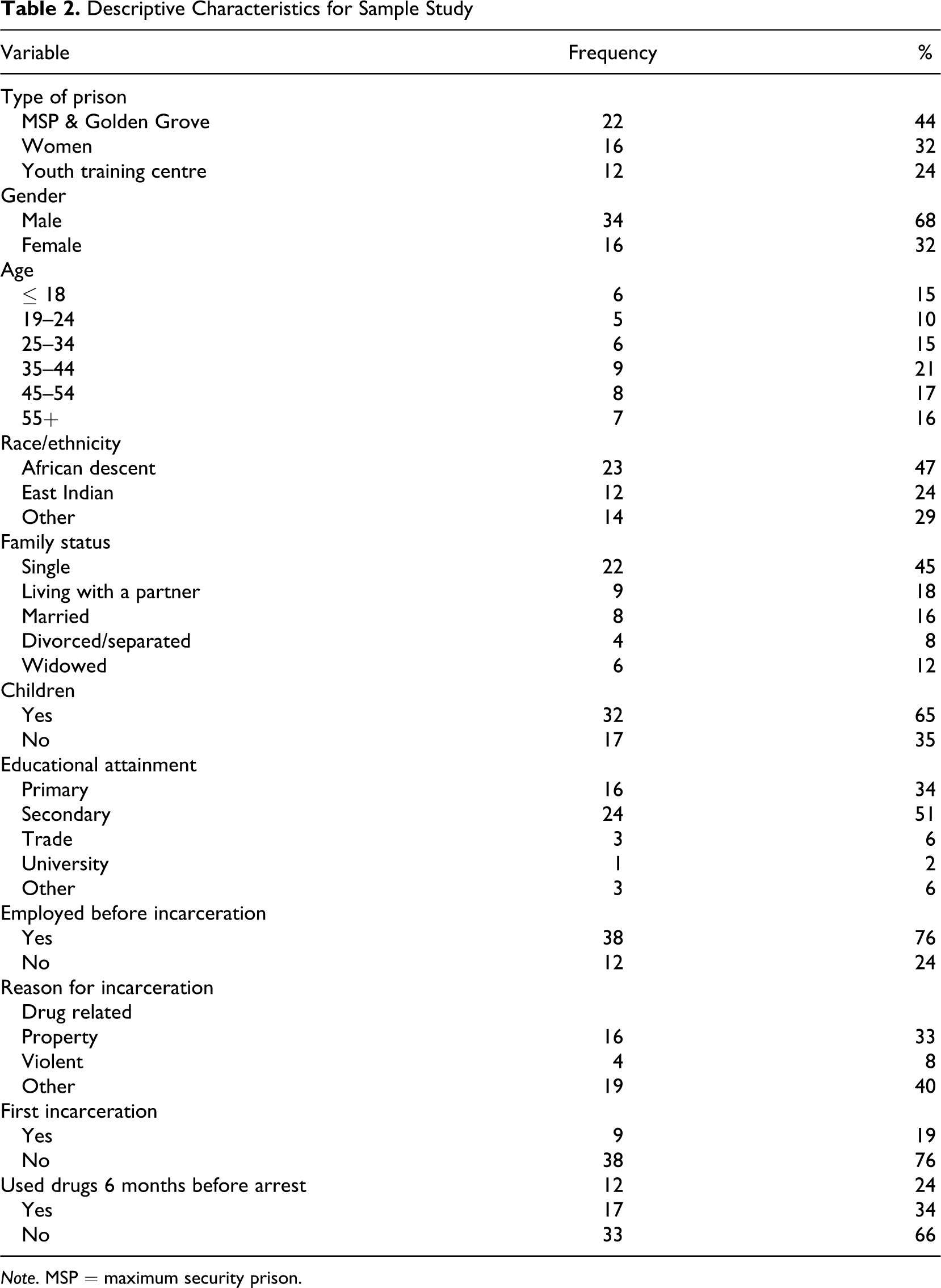
Almost half the sample was of African descent (47%; 24% were East Indian and 29% identified themselves as other; see Table 2). Respondents’ ages ranged between 18 and 70 years old, with an average age of 38. Most respondents (63%) were single, and 65% reported having children. A third of inmates (34%) had completed primary school and 51% had a secondary education. Slightly more than three fourths (76%) of respondents were employed prior to the current incarceration. Forty percent of respondents reported being incarcerated for a violent offense and another third (33%) reported a drug-related incarceration (8% were in for a property offense and 19% for other offenses). This was the first incarceration for the vast majority (76%) of respondents. Approximately one third of respondents reported using drugs during the 6 months prior to their arrest. Notably, within the whole of the prison population in Trinidad and Tobago, the National Drug Council reported that approximately 42% of adult incarcerated men volunteered that drug use was involved in some way with their offending behavior. Further, the most likely reason for incarceration for women, in all age groups except those over 50, was drug related (Drug Abuse Monitoring Project, 2005).
Descriptive Characteristics for Sample Study
Note. MSP = maximum security prison.
Qualitative Findings
First, we explore thematic units that emerged when offenders were asked how prepared they felt for release. Offenders volunteered that there were five essential things the TTPS could be doing to prepare them for release. Offenders thought that the TTPS should be offering the following programs: (a) educational and vocational, (b) cultural programs, (c) recreation, (d) faith-based initiatives, and (e) life skills programs. These were identified as necessary programs in preparing for successful reentry into society. Most offenders saw educational and vocational programs as critical for postrelease success. To date, offenders felt such programs were lacking within the institution. In addition, offenders would like to see more cultural, recreational, and faith-based programs to help deal with the stressors of being incarcerated and to learn coping mechanisms that may be used on release.
Next, offenders were asked if they felt responsible for participating in current/future programs at the institution. Perhaps not surprising, the vast majority (70%) of offenders felt enormous responsibility for program participation. One stated that their goal was “to maintain good behavior at times and maintain respect for officers and those in authority.” Another respondent echoed this sentiment saying they aimed “to abide by prisons rules and regulations and always be of good conduct.” Another wrote “controlling my anger, learning to forgive people, stop fighting, and stop using obscene language.”
With regard to work responsibility and providing for oneself economically after release, across the board offenders stated that they wanted “to get a job.” Specific job interests ranged from being a certified electrician to being a hair stylist. Likewise, offenders felt they had a responsibility to take advantage of any educational programs offered at the institution. They saw it as their duty to “go to class,” while another stated, “to obey the tutors and be very attentive.” A few offenders felt less responsibility for program participation which was characterized by the following remark: “some programs . . . I was forced to do.” A few felt no responsibility for program participation stating they were there for “just incarceration.” Identifying factors that shape why some desire to become productive members of society on release while others are “just passing the time” is important because extant theory suggests that those with prosocial ties to the community are much more likely to succeed and not recidivate on release compared to others.
The third open-ended question posed to offenders was their perception of post release needs. Offenders felt that the TTPS could be doing a better job at preparing them for release. Three theme units emerged that capture this sentiment. Offenders felt that the TTPS could (a) improve the content and delivery of existing programs, (b) offer more programs, and (c) provide better transition services. The majority of respondents (60%) felt current programs were adequate; however, other respondents (20) felt that the TTPS could prepare them for release by improving existing programs and ensuring all inmates participated in such programs. For example, inmates wanted to see “special programs and special services upon reception into the prison.” Others identified the need for ensuring that “inmates had access to all the programs that would help them to develop new skills.” Others felt the TTPS could be doing more to get “everybody in a program and help them in some way.”
Approximately 40% of the sample thought the TTPS should offer more programs. Specifically, counseling services were identified as needed while others just wanted to see more programs in general. Offenders felt additional programs would help “keep inmates occupied, and the same time, enjoying the programs that they are involved in. In short, minimize idling, to many inmates idle all day long.” Other programs offenders would like to see to prepare for postrelease success were “retraining programs,” “counseling,” and “educational programs.” For example, one offender wrote that additional programs would ensure that “your end product would be a properly reformed prisoner ready to make a worthy contribution to society.” Offenders generally valued the programs and services offered by TTPS yet also perceive the need for additional services.
Offenders would like to see better transitional services on release. Almost half of the sample (48%) felt the TTPS could provide better transitional services to ensure needs were met on release. Offenders specifically felt a need for services related to employment, housing, and strengthening prosocial community and family ties. Regarding employment needs, one offender wrote, “The prison service can prepare inmates for release by offering jobs” while another wrote, “by getting jobs for them before they leave.” Other offenders focused on what TTPS could do for them in their relationships with their family and community even before release from the institution. For example, offenders wanted to have more “family visits” and “more interaction with family.” Concerning offenders’ relations with community, respondents wrote that the TTPS could, “take some of them outside on tests . . . giving them opportunity with people on the outside but with plenty of surveillance that they cannot see but are being seen and monitored closely.” Other offenders mentioned the need to be reunited with family, specifically with children who have been left behind during the period of incarceration. For instance, one offender stated, “I strongly believe in family reunion, getting reacquainted with children that has been left to care for by immediate and extended family for years.”
Finally, offenders were asked about what challenges they perceive as critical for postrelease success. Several issues emerged with regard to perceptions about specific challenges for postrelease success. These were identified as employment, housing, community embracing, financial, protection, resource materials, and life skills. The first challenge identified was employment. Offenders are clearly concerned about their future employment (postrelease) and their ability to find a job given their current prison history. Twenty-one respondents expressed either concern or need for aid in obtaining employment. As one put it, “I will need a job to support my dreams.” Other respondents simply wrote “a job” or “work” to express their need for employment.
Another perceived challenge on release is housing. Offenders felt that they would, for instance, “[I] need help finding some place to stay.” “[S]helter” and “shelter placements” were suggested as well. When offenders were asked to provide any additional information they felt might be beneficial in determining the postrelease challenges, many repeated the need for housing. For example, a female inmate wrote, “for some women shelter is an essential need . . . half-way houses can be provided for those women.” Another offender who mentioned the need for safe living conditions (postrelease) requested “a place where there is no crime.” In efforts to build a solid strategy to avoid recidivism, this need for housing must be addressed.
Offenders also identified the need for community embracing. This challenge is important for the individual offender, as they want acceptance by the community, their family, friends, and employers. Offenders stated a need for “acceptance by employers knowing that you were in prison,” and an “international way of thinking about people and society” in general. Another offender blatantly stated a need for “family.” Offenders feel the way to ensure effective reintegration is to involve in their family and societal environment throughout the incarceration process. Some offenders believed that this was the key to minimizing social stigma and increasing community embracing. For instance, one offender wrote that a way in which this could be done was “by going into the communities and encouraging the people to accept and help those who were previously in prison by means of proper consultation also the same to [the] employer[s] of businesses who will not and must not use the stigma of being in prison as a reason to disqualify one from a position available so by doing so one will not feel discriminated.” Another respondent stated that “the community should accept me and my skills for who I am not who I have been.” A financial need was expressed by some respondents as a challenge on release. Offenders identified “money” as a postrelease need. Specifically, one respondent suggested that “I think [the prison service] should have some money for the individual.” Lack of financial resources, be that a job, familial support, or lack of money is a perceived challenge for offenders.
Some offenders, especially adult male offenders, stated that there is a need for physical protection on release. For instance, one offender said they needed “a security system on release from gunmen.” This offender said he needed “a special residence, a licensed gun for personal protection,” and a “change of environment.” Respondents also expressed a need for resource materials. Offenders need to be informed of resources in the community and begin to work on obtaining these prior to the last 6 months of incarceration. Finally, the need for basic life skills was identified as a challenge for successful reintegration into society. For example, one offender anticipated that the fact of having been incarcerated would make it difficult to have a “relationship with your children.” One female offender expressed concern with “developing a mother–son relationship” with her son. With regard to a similar issue, respondents indicated the fear of “being rejected by family & friends and being killed by victim’s family” and “dealing with prejudice in my community.”
Summary and Discussion
Sampson and Laub (1993) maintain that those with informal social controls, or those with ties to the community and/or individuals who have something to lose, are less likely than others to offend. Building such informal social controls, or developing prosocial networks, is a hallmark of successful reentry programs. Exploring prisoner reentry over the life course, O’Connell (2006) argues that the development of informal social controls is best understood within the lens of drug use. In other words, drug use among offenders may dynamically alter the success of programs which aim to build informal social controls in the hope of enhancing success on release from incarceration. The National Drug Council in Trinidad and Tobago reported that approximately 42% of adult incarcerated men volunteered that drug use was involved in some way with their offending behavior. Further, the most likely reason for incarceration for women, in all age groups except those over 50, was drug related (Drug Abuse Monitoring Project, 2005). In our sample, a third of those who volunteered to participate were incarcerated for a drug-related offense. In the modern prison population, we agree with O’Connell’s (2006) point that drug use and drug-related issues must be addressed while building prosocial networks and that this holds especially true in the TTPS.
In developing a parole system, drug-related issues and problems should be targeted, perhaps by mandatory and extended counseling, to enhance the possibility of postrelease success. Further, in building a parole system, it is imperative to recognize that offenders who are incarcerated for drug-related offenses might have unique needs and should be treated accordingly. Notably, drug-related offenses in Trinidad and Tobago could range from trafficking to relatively minor problems associated with Carnival. Finally, it is worthwhile noting that few inmates pointed to drug issues as problems in their lives.
The current work provides insight into the postprison needs and challenges of offenders under the custody and control of the TTPS. Strikingly, the reentry challenges and postrelease needs of TTPS offenders mirror those of offenders incarcerated in the United States. Overall, respondents’ major perceived needs are employment, housing, and acceptance into the community. Addressing these perceived needs helps build prosocial networks which many argue are critical for postrelease success. Other needs are dependent upon addressing these problems. For instance, financial and material needs can be met if the offender obtains and has consistent employment. Likewise, if the offender is accepted into the community, he or she will be offered the opportunities to gain employment, and therefore would not, as one offender mentioned, face the challenge “of falling in the life of crime.” As one offender anticipated upon his release “[going] back to selling drugs,” reoffending is a major outcome of lack of true rehabilitation.
While the needs are similar, it does appear that the issue of stigma is a more poignant concern of Trinidad and Tobago offenders than that of offenders incarcerated in the United States. In fact, the Trinidad and Tobago Prison service might explore alternatives to incarceration perhaps home monitoring programs. These programs, which might be offered to offenders who are evaluated as being of low risk, would avoid problems of being stigmatized by incarceration not to mention being financially attractive to the state. Given that many of those in our sample were first-time offenders and that significant numbers were involved with drugs prior to arrest, the TTPS system would be wise to explore therapeutic alternatives to incarceration. Such programs might address basic needs such as lack of education/skills, employment, and substance addition and aim to integrate individuals into mainstream society. The advantage of structuring such alternative to incarceration programs would be financially advantageous to both individuals and the society as a whole.
It is important to utilize these insights in our efforts to maximize offender rehabilitation in order to reduce reoffending. In order for an offender to become a productive and contributing member of the society from which he or she has been removed, several areas must be addressed. The first necessity is the rehabilitation of the offenders themselves. Programs and services to address the criminogenic factors that contributed to participating in criminal activity. Policy makers and prison administrators need to operate from a treatment framework as opposed to punitive framework. As one offender put it, “proper respect towards prisoners is the first order, along with those in authority to take the first step of not seeing all prisoners as a lower class.” This appears especially important in situations where large numbers of those incarcerated face drug-related issues. It appears that the TTPS is restructuring toward this model instead of a mere retribution model of incarceration. Given that most offenders will be released from incarceration, we argue that this is a very wise direction to go.
Offenders clearly perceived the need for additional programs. We must implement and enhance programs which aid the offender in making a smooth transition (i.e., reintegration into the society). Further, a stable means, whether socially, physically, or financially, of maintaining this new start, should be offered. From the current work, it appears important for the TTPS to explore programs focused on enhancing basic job skills, how to locate employment on release, how to locate suitable housing on release, substance abuse programs, and proactive ways offenders may reintegrate into communities when faced with initial rejection. The importance of successful reentry is difficult to overstate. Without proper reintegration and the proper services rendered, such as shelter, steady employment, and community acceptance, the offender population will continue to balloon and simultaneously place the neighborhoods, communities, and society as a whole at risk.
In summary, several themes emerged from the current work which merit further examination. First, interviewees expressed concerns about their ability to successfully reunite with their families. Some expressed a need for assistance with rebuilding/repairing relationships with their children as well as a need for assistance in negotiating the court system to obtain custody of their children. These comments suggest that familial ties are very important to inmates, but become weakened during incarceration. An exploration of practices that can be used to maintain familial involvement would be useful. Second, interviewees were very anxious about their employment prospects. They expressed concern for not just having adequate job skills, but direct assistance with job placement and transitional financial assistance. Further investigation is needed to determine how existing agencies may build relationships with potential employers to assist former offenders with transitional job placement. Third, the offenders are very concerned about the social stigma associated with serving a prison sentence. Offenders were especially worried about how they would be treated by family members, members of their community, and potential employers. Further study is needed to assess the extent to which stigmatization affects the reentry process as well as practices that can be used to reduce the level of stigmatization of former inmates experience. Again, given that the TTPS is in the process of structuring a parole system, they would be wise to consider alternatives to incarceration for first-time offenders who pose little risk to society. Such programs would significantly avoid problems associated with the stigma of incarceration and be financially advantageous to administrators as well. Further, the TTPS might explore methods of sealing or expunging adult criminal records of ex-offenders after a period of time has expired on release from prison (see Petersilia, 2003). Such initiatives, like alternatives to incarceration, offer methods to avoid the stigma and ensuing consequences of incarceration.
Footnotes
Declaration of Conflicting Interests
The authors declared no potential conflicts of interest with respect to the research, authorship, and/or publication of this article.
Funding
The authors received no financial support for the research, authorship, and/or publication of this article.