







Abstract
This article examines memory activism among the young generation of activists in Serbia, born during or toward the end of the wars of the 1990s. By analyzing the actions of members of the Youth Initiative for Human Rights (YIHR), a Belgrade-based nongovernmental organization, as memory activism, this article aims to deepen the analysis of and discussions about current mnemonic processes in Serbia and to point at a dynamic space of action and engaged citizenship. I discuss the actions and positions of those young activists as related to the contested memories of the wars of the breakup of Yugoslavia and to the legacies of the 1990s. More specifically, I analyze their responses to, and interactions with, the International Criminal Tribunal for the former Yugoslavia (ICTY) convicts who returned to Serbia and reclaimed their engagement in public life. The text is based on data collected in several stages of field research since 2010 that included observations of and in-depth interviews with YIHR activists in Serbia. It addresses the following main questions: What constitutes memory activism in Serbia? What new tactics do the young generation of memory activists employ and how innovative are their practices when engaging with the public on issues related to challenging silence and denial in their society? How do they articulate their claims and demands as related to the issue of returning ICTY convicts, and especially of those who are now public figures in Serbia? I conclude that at the heart of memory activism as examined in the case of Serbia stands a regional and even transnational network of mnemonic practices, revolving around similar mnemonic battles, taking place in some of the other successor states of the former Yugoslavia as well. As such, further analysis of memory activism in the postwar post-Yugoslav sphere will require additional empirical and analytical research of this region as a region of memory.
Introduction
Conflicts over the narratives, memories, commemorations, and representations of the recent past are ongoing in Serbia. More than two decades after the beginning of the wars of the breakup of Yugoslavia, mnemonic battles in the post-Yugoslav successor states are subject to local debates, as well as analysis and academic research, investigating the processes of remembering and forgetting and processes of silence, denial, and responsibility 1 among victims, perpetrators, and now among their descendants; their sons and daughters, born during and after the wars of the 1990s, often referred to in public discourse as the millennials or the Facebook generation. It was Kuljić (2009) who framed these battles of memory in the post-Yugoslav space as civil wars as he argued that “the armed civil war has been replaced by a civil war of memories” (p. 197).
In this text, I trace some of these civil wars of memory as occurring in Serbia. I discuss the actions of young activists, members of the Youth Initiative for Human Rights (YIHR), a Belgrade-based nongovernmental organization (NGO), who are involved in activism related to the contested memories of the wars of the 1990s. I focus my analysis on these members of the young generation of activists, who chose to engage with the legacies of these recent wars that they have inherited. More specifically, I analyze their responses to and interactions with the International Criminal Tribunal for the former Yugoslavia (ICTY) convicts who returned to Serbia after completing serving their sentence (or following an early release) and reclaimed their engagement in public life.
As such, this text aims to deepen our understanding of memory activism as a strand of peace activism and to contribute to the growing literature on such processes in other conflict and postconflict societies, facing their violent pasts. Below, I develop a nuanced documentation of YIHR’s forms of contestation and activism which I analyze as memory activism (Gutman, 2017). By doing so, I aim to broaden recent and ongoing discussions on “dealing with the past” processes as occurring in the field of transitional justice (Simić & Volčič, 2013; Subotić, 2009) and to encompass interdisciplinary approaches to memory politics (Dragović-Soso, 2010) and postconflict transformation.
Although memory activists in Serbia are often dismissed by state officials and by their peers, or simply unheard of, the data presented here does indicate the potential embedded in their actions to broaden the otherwise closed and limited discourse about the recent past, and even more so, to challenge the legacies of the 1990s. In her analysis, Spasić (2003, p. 446) has identified the position of civil society in Serbia as located at the level of social discourse. In that sense, I am here interested in the perspective of young memory activists who now articulate their mnemonic positions to be stemming from their statement that they are Too Young to Remember, But Are Determined Not to Forget (Premladi da se sećamo, odlučni da nikada ne zaboravimo). I argue that this determination and generational articulation, as manifested in their acts of memory activism, even when taking place within the NGO framework, can be read as political and, as such, constitute forms of engaged citizenship. It therefore may compliment, rather than contradict, what Isin (2008) argued to be “activist”citizenship 2 (Fagan & Sircar, 2017).
I first came across this slogan in 2015, as I was collecting data for my research on memory activism and alternative commemorative events as mnemonic practices in Serbia. I was able to document the shift that has occurred from antiwar activism to memory activism. The formation of alternative commemorative events, as I have previously shown, was established by members of the Women in Black, the first generation of memory activists in Serbia (Fridman, 2011, 2015). I approach the YIHR activists as the second generation of memory activists in Serbia, as I explore this generational shift and its meanings.
The analysis below is based on data collected in several stages of field research conducted since 2010, which included observations of alternative commemorative events in Belgrade, and in-depth interviews with YIHR members in Serbia. While some were employed as the regular staff of the NGO, others were engaged in the broader YIHR network of activists. 3 I ask, what is the motivation of these young people, born in mid- or late 1990s, to engage with themes related to Serbia’s recent past and the violent breakup of Yugoslavia? What new tactics do they employ and how innovative are their practices are when engaging with the public and challenging silence and denial in their society? More specifically, I document their articulation of questions, claims, and demands as related to the issue of returning ICTY convicts, and especially those who have reestablished themselves as public figures in Serbia.
In what follows, I first discuss the legacies of the wars of the 1990s in Serbia, and define memory activism, as the term I use to analyze this branch of activism the YIHR activists engage in. I then depict the generational shift among memory activists in Serbia, as I show the thread between the first generation of memory activists who began their civic engagement in antiwar activism in the early 1990s, with their slogan Not in My Name—to the younger generation of activists and the (re)framing of their social and political claims as well as political slogans. Lastly, I discuss the 2016–2017 engagement of the YIHR activists with ICTY convicts as they protest public glorification of crimes by analyzing their actions and message as forms of engaged citizenship.
In the Aftermath of the International Trials: Memory Activism and the Legacies of the Wars of the 1990s
The question of the legacies of the wars of the 1990s, as were handed to the generation growing up in Serbia after the conflicts, is at the heart of this text. Often in my conversations with young people, I encountered a sense of reluctance to engage with any information or conversations related to Serbia’s participation in the wars, or even more so, to the period of “the 1990s”in general. The most prevailing representations and memories of the 1990s among young people in Serbia today are limited to the 1999 NATO bombing and then, more broadly, to the image of the 1990s as “abnormal years” (Fridman & Hercigonja, 2017). For this generation, information comes handy and is available online and yet, many young people have little knowledge about their society’s recent past. As the 2011 survey Attitudes Toward War Crimes Issues, ICTY and the National Judiciary indicates, there is especially very little knowledge among young respondents about the ICTY. To the question “to what extent do you think that you are familiar with the organization and work of the ICTY?” 19% of the respondents said they were not familiar at all and 41% to a little extent (Belgrade Center for Human Rights & Organization for Security and Co-Operation in Europe [OSCE], 2011). Young people in Serbia profess to have very little knowledge of and interest in politics, in general, and even less so in memory politics as related to the violent breakup of Yugoslavia (Tomanović & Stanojević, 2015).
In the analysis of mnemonic approaches to Serbia’s recent past among millennials (born between 1980 and 2000), Ristić, Petrović, and Geis (2017) studied the knowledge and perceptions of the ICTY war crime trials through focus groups, particularly asking: “what do these young people know about the ICTY, the wars in the 1990s, about war crimes…how do they perceive the work of the Tribunal and its legitimacy?” (p. 49). Their data shed light on prominent mnemonic dynamics in today’s Serbia: Lack of knowledge is often coupled with very strong opinions (p. 53). This was also evident in the 2011 survey that has indicated similar patterns. Knowledge about war crimes seems to be especially limited among young people. 4 Another telling finding was related to millennials’ perceptions of human rights discourses (as central to transitional justice and dealing with the past frameworks). Human rights civil society groups were referred to as irrelevant, seen as working within “idealistic illusions with no impact in the real world” (p. 55).
I focus my analysis exactly on this group of activists of young millennials, who chose to engage in activism and mnemonic battles related to the legacies of the 1990s in their society. According to the 2011 survey, they form 22% of young respondents who thought that dealing with warfare on the territory of former Socialist Federal Republic of Yugoslavia was important for the future of their country. In their reply, these respondents stated: “It is important, because only if we face the truth and accept our part of responsibility we can expect a better future” 5 (Belgrade Center for Human Rights & OSCE, 2011, p. 67). This however does not indicate the general trend in the region.
On the eve of the last days of the works of the ICTY, at his address to the United Nations Security Council on June 7, 2017, Serge Brammertz, the ICTY chief prosecutor, openly tackled the ongoing widespread denial of crimes and refusal to accept facts established by the court in Serbia and other successor states of the former Yugoslavia. “The message of denial and revisionism is loud and clear” he stated: “we recognize our victims, but not yours. Your criminals are our heroes” (Mechanism for International Criminal Tribunal, 2017). His statement seems to reflect the legacy of the works of the tribunal as perceived by local communities in the region today. As I discuss below, questions of denial and responsibility have been at the heart of what the antiwar and memory activists in Serbia have been confronting with their actions and claims.
Even among the avid supporters of the International Criminal Tribunal for the Former Yugoslavia (ICTY), 2013 marked a low moment with the acquittal of generals Momčilo Perišić
6
and Ante Gotovina,
7
questioning its mandate to restore peace and reconciliation. “Lasting peace is not up to the ICTY: it is up to us, and it has always been,” argued Hodžić (2013), the former ICTY spokesman in a candid op-ed, We must face what we did to each other, deal with it courageously and comprehensively, and bring justice to the victims. The Gotovina and Perišić judgments have made that crystal clear: the ICTY will not do it for us; our own institutions must get to the truth and punish the perpetrators. Now more than ever we must insist that state institutions here take responsibility for dealing with the past. (Hodžić, 2013)
The research nexus of studying the legal and the mnemonic is at the heart of the inquiry of the legacies and memories of the 1990s in Serbia. The ICTY archives were analyzed as legal archives that function as a mnemonic system that produces “legal memory” through its juridical, international, and transnational structure (Campbell, 2012). I argue that these “legal memories” have become useful and important for memory activists in their engagement in local ongoing mnemonic struggles, which will continue well after the ICTY will close its operation. Ristić (2014) approached the imaginary motif of the trials by studying public discourses on war crimes trials and their usage as “sites of memory” and even “theaters of memory” in the creation of collective remembrance. In analyzing the role of the media in memory production, she distinguished between those processes in Croatia where they produced and promoted the memory of the “winners,” in Bosnia where they produced the memory of the “victims,” and in Serbia the memory of the “defeated.” In Serbia, she argues, the details of the war crimes trials were carefully omitted, and legal proceedings, indictments, and verdicts were reframed as a new threat to Serbian national interests (Ristić, 2014, p. 188). As such, the memory of victimization of the defeated was created by shifting the blame to the international community and the ICTY, while the crimes themselves were minimized, denied, decontextualized, or simply forgotten (Ristić, 2014, pp. 220–221). Such planned amnesia regarding the shadows of the past, as Kuljić (2009, p. 201) argued, creates “a black hole of irresponsibility.”
Against this backdrop, this text offers a close look at one group of the young generation of activists among other groups in Serbia’s civic civil society, 8 who in recent years have been rejecting not only politics of victimization and denial in their society but even more so, have been challenging the ongoing processes of silencing the past as part of their mnemonic work as they frame it, toward peace and reconciliation. I approach this branch of activism, as memory activism, employed as a strategy of peace activism that is oriented toward the past (Gutman, 2017, pp. 15–16). Such activism constitutes a knowledge-based effort for consciousness-raising and political change which is carried outside state channels (Gutman, 2015). Memory activism “thus brings new empirical research and conceptualization that expands the boundaries of existing categories both of peace activism and of collective-memory politics and so is valuable in the study of conflict resolution and reconciliation processes” (Gutman, 2017, p. 16).
In Serbia, memory activism has emerged as a continuation of the antiwar activism of the 1990s and post-2000 peace activism and can be traced mostly through the analysis of rituals of annual commemorations of crimes committed in the 1990s (Fridman, 2015). As the first generation of the Woman in Black activists have established some mnemonic rituals against denial off the channels of the state (Fridman, 2011), the YIHR activist discussed here continue to form their message and (re)articulate their claims aiming to enhance reconciliation. Memory activists in Serbia and in the region approach the knowledge produced in the ICTY trials as facts not to be denied or dismissed but rather confronted and worked with. 9
The Generational Claim and Their Mnemonic Position
Too Young to Remember Determined Not to Forget, a slogan now carried by the young YIHR activists in their street actions in Serbia, was dubbed as they were preparing for a street action in Tuzla, in neighboring Bosnia and Hercegovina, in 2015. On the 20th anniversary commemoration of the Kapija massacre in Tuzla, 10 where 71 people lost their lives (mostly young victims), YIHR activists collected over 500 handwritten messages from and signatures of citizens from four main cities in Serbia (Belgrade, Novi Sad, Novi Pazar, and Niš), presented to the mayor of Tuzla and to the victims’ families (Nikolić, 2015). Upon arrival in Tuzla, they stood in silence, with their new slogan printed on a large banner.
YIHR was founded in Belgrade in 2003 by a group of young people from Serbia. 11 Their aim was to enhance youth participation in the democratization of society and empowerment of the rule of law by driving the processes of facing the past and establishing new progressive connections in the postconflict region of the former Yugoslavia (as quoted in Fridman, 2013). In Serbia, the YIHR activists focus their activism around issues of human rights, transitional justice (which is analyzed here as memory activism), and regional visiting programs.
The 1995 massacre in Tuzla is only one date among others commemorated annually by the group. Other dates marking war crimes committed in the wars in Croatia, Bosnia and Herzegovina, and Kosovo appear on their alternative calendar, which they titled “Transitional Justice Calendar”—and internally they refer to as the Krvavi kalendar (the bloody calendar). This calendar consists of dates of alternative commemorative events, some of which have been established already by the Women in Black from Belgrade and attended by citizens and activists annually. As formerly argued, the emergence of alternative commemorative events and rituals in recent years has shaped new civic alternative calendars used by Serbia’s civic civil society. These rituals constitute the heart of memory activism in Serbia, forming countermemories to the current state-sponsored hegemonic memories of silence and denial of the recent wars of the 1990s and the crimes committed (Fridman, 2015). The additional forms of activism, beyond commemoration of war crimes and their victims, analyzed in this article present new tactics of the younger generation of memory activists.
Unlike their predecessors, whose slogan was Not in My Name, as members of the generation born during the 1990s, they needed to come up with their own slogan articulating their generational position.
12
They feel as though they cannot be held responsible for what happened in the 1990s. As one young activist born in 1992 framed it, I cannot be responsible for what happened in Srebrenica (in Bosnia-Herzegovina) when I was three years old, or in Suva Reka (in Kosovo) when I was seven years old. But on the other hand, I will be responsible if I do not speak about it now. (Interview with the author, Belgrade, August 31, 2016)
Kuljić (2008) portrayed this generation as the generation that came after Serbia’s defeats in the wars of the 1990s, deprived of a glorious victory,
13
left without new generational symbols and heroic vision. According to him, during the 1990s, heroic nationalistic values were the most dominant ones, while at the beginning of the 21st century, traditionalism was beginning to manifest itself through religion (Kuljić, 2008, pp. 79–99). As such, he argues: “the image of the enemy and the negative memories of the difficult 1990s, were the core stone of a new generational unity” (Kuljić, 2008, pp. 85–89). I here argue that other trajectories and practices are also available to members of this very same generation. For some of the YIHR young memory activists, the earlier models of resistance to the wars, to the Milošević regime in the 1990s, and to the denial of crimes that continued well after October 2000
14
mark a sense of continuation rather than disconnect in relation to the difficult 1990s. Building on the foundation of a decade of resistance and activism, even though extremely marginalized, the younger activists very clearly position their work as a continuation of the earlier works of the founders of the antiwar civil society in Serbia. As such, this does not only entail the mentorship role (Kurze, 2016, p. 10), but even more so, it entails the articulation and continuation of the legacy of antiwar and antinationalism struggle and practices that have emerged from the 1990s. As the YIHR director framed it: we are living the legacy of what they (antiwar activists) did during the 1990s…now we also need to leave our own legacy for the next generation, who, just like us, will not start from scratch…what we do is a continuation of their work (of groups like Women in Black, Humanitarian Law Center [HLC] and others), with our own generational pinch/tweak that we give it…and yet it is still all the same fight. (Interview with the author, Belgrade, August 19, 2016) we support the (Belgrade based group) Women in Black and we always join their silent vigils, but that is their thing and that is how they are recognized…we recognize our need to do things differently…as young people we think we should form and send our own message. (Interview with the author, Belgrade, April 18, 2016)
The Actions: Protesting the Public Glorifications of Crimes
In framing the motivation to engage with returning ICTY convicts, the activists I spoke to emphasized their sense of obligation to protest the glorification of war crimes. They referred to the time when they began noticing, according to them, that former generals and state officials, ICTY convicts, who were returning to Serbia, were receiving honorable state-sponsored ceremonies welcoming them as heroes.
16
As the YIHR director explained, we were literally witnessing the revision of history in front of our eyes as war criminals are being welcomed back home as heroes…we felt we needed to send a message against it. That was how we began to commemorate Batajnica. (Interview with the author, Belgrade, August 19, 2016)
17
The first event that the YIHR activists chose to obstruct took place in Dom Omladine (Belgrade Youth Center) in downtown Belgrade in April 2016. They found out that a round table event was about to take place, promoting a book by Momčilo Krajišnik, the former Bosnian Serb parliament speaker, who was indicted and convicted by the ICTY for the persecution and deportation of Bošniak and Croat civilians from 10 Bosnian municipalities. 18 Krajišnik was released in September 2013 after serving two thirds of his 20-year sentence. 19 That day at the Belgrade youth center, a number of activists entered the event which was open to the public, and as soon as Krajišnik was given the stage to speak, they began blowing their whistles, preventing him from talking. Outside the building, another group of activists stood with banners stating, “Home of the Criminals of Belgrade” (Dom Zločinaca Beograda; see Figure 1) contesting the hosting of such an event in such a central location designated as a public space for young people in the capital.
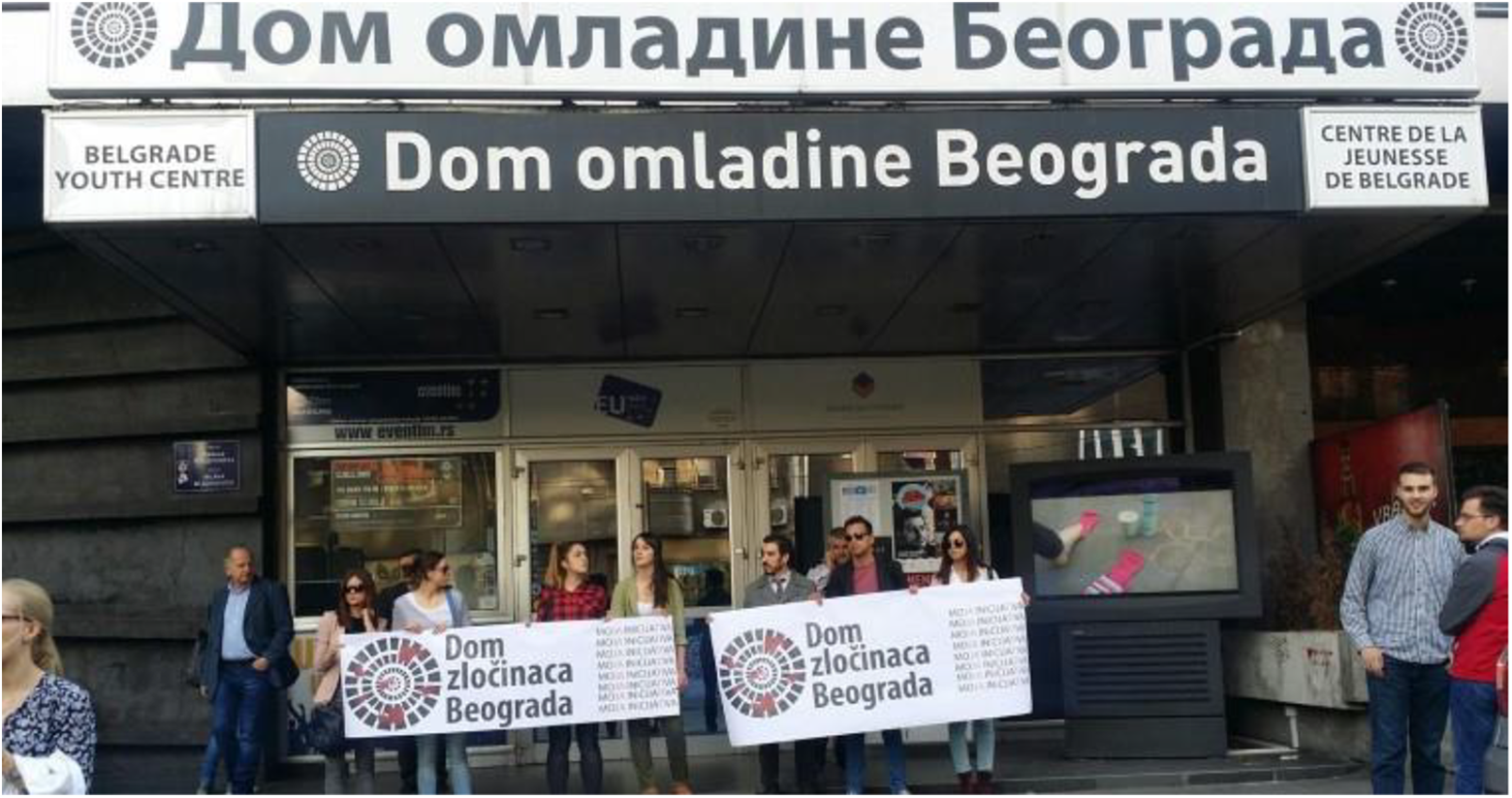
YIHR action outside of the Dom Omladine premises, Belgrade April 2016.
Following the event, they stated in a press release: “Dom Omladine must not be a ‘Home of the criminals of Belgrade’! Not today, or any other day. This is why we will always react against the rehabilitation of war criminals” (Dom Zločina Beograda, 2016).
Later in their newsletter, they also clarified their arguments and message: We consider the interrupting of the lecture and promotion of the book written by Momčilo Krajišnik, a convicted war criminal, and the protest against the glorification of crimes, our civic duty and the defense of the symbol which the Youth Center represents. Since its founding this institution has been the place of critical discussion and thought for the youth, and not a place of denial of basic civilizational values and promotion of criminals. (YIHR Newsletter, 2015/2016, pp. 37–38)
The second event, which the activists chose to attempt to obstruct, took place in Beška (a small town in Vojvodina) at a public debate organized by the local branch of the ruling Serbian Progressive Party (SNS) featuring Veselin Šljivančanin as the main speaker in January 2017. Šljivančanin, a former officer in the Yugoslav People’s Army, who was sentenced to 10 years in prison for his role in the 1991 war in Croatia in the Ovčara farm massacre (near Vukovar), was early released by The Hague Tribunal in July 2011 (Hague Frees Former Yugoslav Army Officer, 2011). At an earlier event of the Progressive Party in Vršac that month, Šljivančanin told his audience that “he came to speak the truth, and blamed his prison sentence on the authorities that came to power in Serbia after Slobodan Milošević was ousted in 2000” (Živanović, 2017a).
This time, the activists entered the hall as they blended in with the audience, and as soon as Šljivančanin was about to begin his speech, the activists in the back of the hall began blowing their whistles. Meanwhile, two activists at the front stood in front of the speakers (who were seated on stage) and raised a printed banner that read: “Ratni zločinci da zaćute da bi se progovorilo o žrtvama!” (War Criminals Should Be Silent so That the Victims Can Be Spoken About!). In response, the banner was immediately destroyed and the activists attacked and beaten. 20
In both cases, the events continued as planned, as soon as the activists were thrown out of the space violently. While in both cases, the activists were beaten by people from the audience, the Beška event did mark an escalation in their struggle and received a broader public exposure as it became a topic of debate in the media and social networks for days after. This most likely was related to the official statement delivered by the SNS asserting that “a group of fascist hooligans brutally disturbed the participants of the event, citizens who were peacefully and with dignity trying to listen to the speaker (i.e. Šljivančanin)” (SNS: Grupa huligana prekinula tribinu u Beški. N1, 2017). In the following days, attacks against YIHR activists continued, calling them “foreign mercenaries” and accusing the YIHR director on the pages of a local tabloid for receiving more than a million euros to “make chaos in Serbia” (Živanović, 2017b).
The Message: War Criminals Should Be Silent So That the Victims Can Be Spoken About!
(“Ratni zločinci da zaćute da bi se progovorilo o žrtvama!”)
At the heart of these civil wars of memories stands the question of responsibility, silencing and denial of past crimes, committed during the wars of the 1990s. Tensions only grow as Serbia’s internal divisions and struggles deepen while the narratives of the past are being institutionalized, cementing the future collective memories about the wars of the 1990s. These mnemonic battles are now taking place between state officials and the young generation of memory activists. Top down, state officials have been framing the discourses on the returning ICTY convicts for years, openly addressing them as heroes. As one minister in Serbia’s government has stated, “This is no longer a state that turns a blind eye to its heroes, but a state that is proud of its generals” (Nikolić & Collaku, 2015). Memory activists demand that returning war criminals should not be taking part in public life, promoting, according to them, the same ideas for which they were on trial to begin with (Interview with the author, Belgrade, May 5, 2017). After the Beška event they insist, “no one in Serbia should be beaten for talking openly about the wars of the 1990s, the paramilitary structures and war crimes,” demanding freedom of speech to discuss openly the facts that were proved in courts (ICTY) which they recognize and acknowledge as important institution in establishing facts (Interview with the author, Belgrade, May 5, 2017).
Among their supporters, their message received sympathy and even solidarity on social media, their methods and actions were however subject to some critique from those who argued that in their actions they were obstructing freedom of speech. By their opponents from right-wing groups, from state officials and media, they were physically and verbally attacked. The main argument the activists put forward is that the focus of the discussion after Beška has shifted. Instead of concentrating the debate on war crimes and their legacies, on the negation of crimes, the focus was all about framing their actions as nonpatriotic and blaming them for disturbing public peace in Serbia. They insist, though, on emphasizing their actions and contribution to their society even when addressed as traitors by officials, framing their actions and messages as their civic duty as young, active, and engaged citizens of Serbia. As one activist stated, “I think I contribute to Serbian society by doing these things and taking part in such actions; Serbia needs someone to deal with these issues!” (Interview with the author, Belgrade, August 31, 2016). Reframing their activism in a positive manner is the position they wish to articulate, as young people taking ownership on their message, hoping to destigmatize the image of civil society in Serbia, they are well aware of, and particularly of those organizations dealing with the past.
The weakness of civil society in post–Communist Serbia as a country in transition was well articulated and researched (Kostovicova, 2006; Spasić, 2003). Beyond the critique of the work of NGOs dealing with the past, as apolitical (Fagan & Sircar, 2017), as elitist groups preaching to the choir unable to communicate with and approach ordinary people, my data in fact show that a significant number of the young generation of YIHR activists did not necessarily grow up in very liberal households and political environment, or in Belgrade which is considered to be the base of such liberal activism. Some of the activists I interviewed often moved to Belgrade only when they started their undergraduate studies at the university, and only then they went through a process of learning about the past incidentally as they were exposed to YIHR’s work or began asking questions. Prior to joining the organization, some had quite critical and even negative opinions about NGOs in general, which are most often echoed in popular discourses in Serbia, as for their inefficacy, marginality, or profiteering. My analysis yet still points at their difficulty to enlarge the circles and reach more people, which continues to raise the question as to the extent to which they are able to communicate and articulate their message to wider audiences. This, over the years, has been the main weakness of memory activists, and not only in Serbia.
As such, most often, YIHR activists are confronted with the lack of interest of young people to engage in conversations and actions about these issues. “It is 2017,” one youngster told one of the activists I interviewed, “why should I care about war crimes?” This was a theme that came up and was discussed at length in all the in-depth interviews I conducted. While Serbia’s mnemonic battles do not seem to indicate an intergenerational struggle, YIHR activists do speak about their sense of responsibility toward the younger generation born after the 1990s, in the 2000s, in a society where almost no dialogue about the past is taking place. In work and interactions with high school youngsters, as one activist framed it, they wish to send a clear message: you are now living the consequences of the wars (of the 1990s) but you have the right to live in a better country, you have the right to think better and nicer about your neighbors, you have the right to live without hatred and prejudice. (Interview with the author, Belgrade, May 5, 2017) “I try to show them how the wars and everything that happened during the 1990s is still influencing our lives today; any question we would ask today about our country, about the economy, the weak industry, our institutions, democracy, rule of law…why human rights are not respected in our country…it all leads us to need to know more. The wars destroyed what we had before, and we now live the consequences of those wars” and she went on saying: “no one had the right to convict you to live like this today.” (Interview with the author, Belgrade, May 5, 2016)
Conclusions: Toward the Transnationalization of Memory Activism and the Formation of a Region of Memory
With the closure of the ICTY, some activists believe not only that the processes of dealing with the past are not quite over yet but even more so, that they are only beginning, by entering a new phase of their work. They highlight the importance of the continuation of their work outside of the channels of the state. As such, they express their obligation to continue and put forward and articulate their demands from the state in the name of their generation. “This is our role,” they argue, “to continue and put pressure and to demand better and more” (Interview with the author, Belgrade, May 5, 2016).
While they express clarity regarding their role and their demands, their concerns are growing in relation to recent (worldwide) waves of right-wing populism. More specifically, they see the changes in the European Union’s (EU) rules of engagement in the Western Balkans, as affecting their work and their activism. With the EU policy shift, focusing on stability at the expense of democracy (Bieber, 2017) and of meaningful processes of dealing with the legacies of recent war crimes, they insist on the need to continue and tighten regional cooperation, in challenging the silence and denial of the violent legacies of the 1990s. They emphasize the need for a regional approach to stand against the glorification of returning ICTY convicts and to strengthen the engagement of young people in these processes.
While this text centered on the local and national nature of memory activism and mnemonic battles, as in the case of Serbia, it argues for the significance of regional and even transnational networks of mnemonic practices, circulating around similar mnemonic dynamics, taking place simultaneously in some of the other successor states of the former Yugoslavia. Thus, further analysis of memory activism in the postwar post-Yugoslav sphere calls for additional empirical research that will approach the post-Yugoslav space as a Region of Memory and of networks of memory activism. 22 The analysis of memory activism as a strand of peace activism holds the potential for deepening of existing regional cooperation and, as such, linking the local to the transnational (Sierp & Wüstenberg, 2015) and allowing the circulation of transnational memory (De Cesari & Rigney, 2014). Such regional networks have the potential to form and solidify a region of memory that will allow further theorization on transnational memory activism. In the Balkans, such a region may stand as an alternative platform for action to growing state sponsored populist and nationalist memories. In the civil and regional wars of memory, local and transnational memory activists will continue and engage in reorganizing discourses about the recent past, as they create new and solidify existing transnational mnemonic communities.
Similar to the first generation of the memory activists, the young generation of memory activists emphasize the need to preserve and build regional connections as crucial for their local fight against denial and distortion of the violent legacies of the 1990s. What brings their cause together is their actions centering on the search for the truth about the past and issues of justice and responsibility, rather than ethnic categorization of victims and perpetrators.
After years of YIHR’s engagement in regional initiatives such as the Regional Commission for the Establishment of Facts about war crimes and other serious violations of human rights committed in the former Yugoslavia from January 1, 1991, until December 31, 2001, and a more recent initiative as the Regional Youth Cooperation Office of the Western Balkans, their hope is to see further development and extension of reconciliation efforts, rather than their end. Such regional platforms may provide space for transnational memory activists to interact and cooperate. Such spaces are crucial for agency and engagement of young people with the mnemonic legacies of the 1990s. The homecoming of war criminals in that sense is a shared phenomenon raising shared challenges as well as possible shared tactics to address those in acts of engaged citizenship.
Footnotes
Declaration of Conflicting Interests
The author declared no potential conflicts of interest with respect to the research, authorship, and/or publication of this article.
Funding
The author received no financial support for the research, authorship, and/or publication of this article.