







Abstract
Besides its multiple harms, corruption undermines the rule of law and impedes the effective functioning of criminal justice institutions. It involves both elites in bending rules and laws as well as police at the bottom of the hierarchy asking for bribes. We analyze corruption intentions within the framework of Brennan and Pettit’s “economy of esteem,” using three main conceptual frameworks: attachment to kinship groups, materialistic orientations, and deterrence. We draw on data from a survey of 530 university students in Ghana to examine predictors of corruption intentions of prospective elites. Our prospective elites were more inclined to resort to influence peddling rather than to pay bribes directly. We find that attitudinal patterns indicative of esteem predict intentions to engage in corrupt exchanges across different agencies and contexts—police, procurement for government, and abuse of power—as well as different types of action, whether bribe payment or nepotism. In contrast, citizenly pride (and self-esteem) motivates integrity across all types of corrupt exchange. Deterrence, in terms of certainty, had a more consistently negative impact on intentions to engage in nepotism than in bribe paying and acceptance, with public procurement being the exception; no effect was found for stigma, and only police nepotism was an exception to the otherwise non-significant effects of severity.
In 2015, the Government of Ghana entered into an agreement with a private company to rebrand 116 buses with the national colors and images of the incumbent president and his predecessors. It later emerged that the value of the contract, at 3.6 million cedis (approximately US$834,309) and awarded through sole-sourcing to a company owned by a ruling party activist, had been inflated by almost 42% (Daily Graphic, 2016). Other instances abound of corrupt exchange in public procurement, policing, and the judiciary. In 2015, an undercover journalist exposed corruption within the judiciary by secretly filming 34 judges and several court officials as they accepted bribes (Daily Graphic, 2015). Corruption is by no means unique to the global south. Recent notable examples from the global north include the Rolls-Royce global bribery scandal, which resulted in a £671 m fine (BBC News, 2017a) and the Och-Ziff Capital Management bribery case resulting a criminal fine of US$413 million by the US Department of Justice (New York Times, 2016).
The word “corruption” denotes “the misuse of public power for private benefit” (Lambsdorff, 2007, p. 1). It is axiomatic that corruption threatens the proper functioning of democracies; it undermines the rule of law and institutional legitimacy, reduces revenue generation, and stifles economic development (Mungiu-Pippidi, 2006; Nivette & Akoensi, 2017). Cross-national studies have linked levels of corruption to cultural beliefs, education, social fragmentation, size of government, and income inequality (see Heath, Richards, & de Graaf, 2016; Stevens, 2016). While there is a wealth of cross-national studies and aggregate data on corruption, we lack individual-level data on decisions to engage in corrupt transactions. This is due to the nature of the transactions themselves, as they involve at least two people and interested parties—those who pay and those who accept payment.
The present study sought to understand decisions to engage in corrupt exchange. At the individual level, corrupt decision choices have been linked to value orientations (Li, Triandis, & Yu, 2006), rational decision-making (e.g., Rose-Ackerman & Palifka, 2016), commitments to kinship networks that encourage public officials to misuse public office for the benefit of friends and family rather than for the public good (Mbaku, 2010; Szeftel, 2000), perceptions of the illegitimacy of the state (Ekeh, 1975), salaries (van Veldhuizen, 2013), and opportunity structures justifying corrupt exchange (Bohn, 2013). Individual-level studies fall broadly into three categories. First, there are laboratory and field experiments on corruption acceptance (Armantier & Boly, 2011). Second, there are perceptual studies based on general community surveys and surveys of business elites. Many national and international surveys investigate perceptions of corruption among the general population (e.g., the Global Corruption Barometer). Only a few investigate low-level direct corrupt exchanges (both victimization and active bribery), among them the European Social Survey (European Social Survey, 2004; Karstedt 2014). Transparency International’s Corruption Perception Index uses an array of population and business surveys and combines them into an index. Finally, corruption among elites has been explored using a mix of individual- and aggregate-level indicators. Fisman and Miguel (2010) analyzed violations of parking laws by United Nations diplomats in New York and related them to levels of corruption in the diplomats’ home countries (Fisman & Miguel 2010, chapter 4). In another study (Fisman & Miguel, 2010), they used the stock market value of firms owned by the Suharto family in Indonesia to estimate their involvement in corruption.
The present study addresses prospective elites and explores their reactions when presented with hypothetical opportunities for corrupt exchange. To this purpose, university students in Ghana were surveyed. University education does not guarantee elite status, although it provides qualifications for access to elite roles—what Higley and Burton (2006, p. 7) call “strategic positions in powerful organizations and movements”—in both public and private sectors. Public universities in Ghana have historically produced the country’s political, legal, and business elites. In a country where 16% are currently enrolled in tertiary education institutions (United Nations Educational, Scientific, and Cultural Organization, 2017), students stand a reasonable chance of securing such positions. University students are therefore important agents of change in Ghana. In both public and private organizations, they will occupy positions with discretionary power over the allocation of resources, and they will be able to influence decisions. University students’ orientations to corruption can therefore be used as predictors of their future behavior when in positions of power and their future commitment to integrity. We used the framework of “economy of esteem” (Brennan & Pettit, 2004) for our analysis and integrated three main theoretical perspectives, namely, primordialism—that is, the role of kinship and tribal networks in society, materialistic orientations, and of deterrence. The study used expressed intentions to engage in corruption, a common method for research into criminal and deviant behavior (see Karstedt & Farrall, 2006; Thomas, Hamilton, & Loughran, 2018). Further, it was found that messages about corruption consistently influence perceptions of corruption (Pfeiffer, 2018).
The next section discusses key theoretical perspectives and teases out hypotheses to be tested. Afterward, we report the methods and data and present and discuss our findings.
Framing Corrupt Exchanges
In 2010, the government of Ghana implemented a new salary structure for officials (including police officers), with the expectation that enhanced remuneration would reduce bribe taking. In the case of the police, however, the intervention proved counterproductive, with officers collecting more and higher bribes at roadblocks after receiving an increase in salary (Foltz & Opoku-Ageymang, 2015). Foltz and Opoku-Agyemang (2015) offered two explanations for these unexpected findings. First, they proposed that increased salaries enhance status and that “higher status may be one indirect driver…to the extent that better-paid officers feel that they ‘merit’ higher bribes” (p. 27). Second, they assumed that, given higher status and salaries, the bribe takers were confronted with increasing demands from extended family and kinship networks to share their revenues, including the bribes they had received. As the authors argue, higher salaries might “indirectly fuel these bribes” (Ibid).
This unexpected and counterproductive outcome of an anti-corruption policy draws attention to the limitations of theories of corruption based on the economy of goods and monetary exchanges (Rose-Ackerman & Palifka, 2016). We therefore posit that corruption in Ghana is embedded in an economy of “esteem” rather than one of material goods (Brennan & Pettit, 2004). This implies that corrupt exchanges are not exclusively guided by the acquisition of material goods and wealth but by the ways in which these are linked to the possession and acquisition of esteem and status.
Desire for prestige, status or esteem was recognized as a driving force of social life and the economy as early as in Adam Smith’s Theory of Moral Sentiments (1759) and later by Veblen’s (1899/2009) influential work on (conspicuous) consumption. Brennan and Pettit (2004) define esteem as an attitude that one person has toward another and also as an attitude toward oneself, that is, self-esteem. Three features of esteem are important: It is an evaluative attitude as it is based on ratings, it is a comparative attitude as it involves ranking, and it is a directive attitude as it informs and guides action. Decisions and choices about esteem are as rational as those about goods and money, hence the parallel economies of both, material goods and monetary exchanges, and esteem (Brennan & Pettit, 2004, p. 15). Different moral and normative orders provide different indicators for esteem and for status, and directives for attaining esteem.
The economic perspective on corruption, which stresses a rational exchange benefitting the parties involved, applies equally if corruption is linked to the acquisition of esteem: individuals choose to initiate and pursue corrupt exchanges—or to acquiesce in such exchanges—if the expected returns are perceived to be higher than the estimated cost of detection and punishment (Della Porta & Vannucci, 1999). Kinship networks are a major source of esteem and status, and gains in status and esteem linked to corrupt exchanges might be mainly achieved here. Against such gains, the monetary costs of detection of corruption—such as forgone salaries and pensions—as well as the loss of status and reputation by dismissal have to be set off. Consequently, as the failed anti-corruption policy demonstrates, simply to (indirectly) increase the cost of detection by raising officials’ salaries can backfire (see Becker & Stigler, 1974, p. 12). We use three frameworks to conceptualize decision-making on corrupt exchanges in terms of esteem rather than of goods and wealth: primordialism, materialistic orientations, and deterrence. As shown, each of these has been used in corruption research.
Primordialism: Kinship Networks and Particularistic Norms
A prominent explanation of corruption in sub-Saharan Africa stresses the persistence of so-called primordial and particularistic norms. Ekeh (1975) identifies a duality of publics—the “primordial” and the “civic” 1 —as a pervasive feature of public life in sub-Saharan Africa. The former is based on moral imperatives and sentiments of the extended family and ethnic or tribal group. Here, individuals view their duties as moral obligations to benefit and to sustain the “primordial public” to which they see themselves attached as members and through various bonds. Although they invest materially in this group, they gain only “intangible, immaterial benefits in the form of identity or psychological security” (p. 107). The primordial sphere contrasts with a civic sphere, constituted by the structures of the postcolonial state. Here, generalized normative commitments to the state and its institutions are dominant, and interactions are based on material benefits and rights on the one hand, and on duties to the commonweal or common good on the other hand (Ekeh, 1975). This means that the civic public of the postcolonial state is characterized by weak bonds in contrast to the strong bonds provided by kinship and tribal groups (Granovetter, 1973) and extremely fragile institutions. This leads to an emphasis on the more tangible goods provided by a person’s own kinship group rather than the more intangible “common good” of the civic public. What emerges is a neo-patrimonial system in which institutions and political relationships are formally predicated upon universal-legal principles but are actually dominated by clientelistic networks of patronage and personal loyalty (Theobald, 1999).
The two institutional patterns and regimes exist side-by-side with different types of commitment, allegiance and compliance, and generate different types of esteem. Esteem within the network of family and kin is based both on traditional rank order and ascribed status and also on contributions to the group’s well-being, wealth, and recognition. In contrast, esteem among the general public is based on achievement, rule compliance, and universal values encompassing all citizens. The difference between sources of esteem plays out at the level of individual decision-making, especially for public officials. Universalistic principles of the rule of law in the civic sphere demand impartiality in decision-making. Officials are rewarded by esteem for decisions that are “unmoved by certain sorts of consideration—such as special relationships and personal preferences…to treat people alike irrespective of personal relationships and personal likes and dislikes” (Cupit, 2000; quoted by Rothstein, 2011, p. 230). In contrast, imperatives of allegiance to family and kin compel public officials to prioritize kinship considerations over the norms of impartiality, with promise of reward in the form of esteem and status within their own groups.
According to Brennan and Pettit (2004, p. 94), people try “within any domain to behave in an esteem-winning way or to locate their efforts in those domains of activity where they are most effective in attaining esteem.” It can be assumed that esteem bestowed by the kinship group prevails over the less tangible esteem (or self-esteem) resulting from adherence to “rule of law” principles. Individuals therefore will prefer their own kinship network since esteem rewards are more likely to be generated there. Corrupt exchanges are therefore not necessarily shameful, at least, within the group. In this context, corruption may be viewed as a respectable crime (Tankebe, 2010), particularly as it has the potential to decrease the opprobrium attached to it, and to increase the “respect” and esteem that people can accrue in their networks (de Sardan, 1999).
2
Hence, contracts will be diverted away from legitimate contenders to relatives and friends, or criminal law will be selectively enforced in favor of those from one’s own group. Allegiance to family and kinship, as well as respective value orientations, therefore, will enhance intentions to engage in corrupt exchanges, as they are linked to increased esteem from the group. Such “attitudinal rewards” (Brennan & Pettit, 2004, p. 16) can be seen as generated either by all types of corrupt exchanges or only by those with particular benefit for one’s own group. We test two hypotheses:
Materialism
Status, distinction, and esteem are based on the possession of goods and wealth. Ostentatious wealth can secure and enhance esteem and status. Consequently, the economy of esteem has a material basis; desire for esteem and desire for material goods are intricately linked. Materialistic values have played a major role in explanations of corruption in sub-Saharan Africa (Brownsberger, 1983). Thus, Assimeng (1999, p. 248) refers to a “rugged materialism” that has displaced the traditional cultural values of probity and propriety. Materialism reflects: a strong desire for wealth and physical possessions. For people who are very materialistic, the satisfaction of materialistic pursuits [is] a gauge of personal accomplishments and often take precedence over other intangible goals […] Strong materialistic values reflect a predominant orientation toward the purchase, consumption, and possession of wealth and physical goals. As a value, the importance of material goods directs a person’s life choices and influences appraisals of self and others. (Kashdan & Breen, 2007, p. 521)
Deterrence
The two key elements of deterrence are certainty of punishment, which concerns the probability of being caught and punished for criminal conduct, and the severity of the punishment imposed on conviction. Deterrence is quintessentially subjective: its effects depend on potential offenders’ evaluations of risks in terms of their subjective preferences (Bottoms & von Hirsch, 2010). Most deterrence studies consistently show that the effects upon criminal conduct of perceived certainty of detection and punishment are greater than the severity of sanctions (Nagin, 2013). This applies equally to corruption. In an experimental study, Olken (2007) found that fear of detection following increased monitoring reduced the incidence of corruption in Indonesia.
Stigmatization has been identified as a key mechanism for achieving deterrence effects (Nagin, 2013). As any formal and visible punishment elicits informal reactions from the community, mostly by stigmatizing the offender, it results in “disesteem” (Brennan & Pettit, 2004, p. 15), that is, exclusion, rejection, and an otherwise negative reputation. In an analysis of corruption reforms in the U.S. police, Sherman (1978) gives a detailed description of loss of esteem through the stigmatization of misconduct: “…a new identity, a morally inferior status unworthy of trust. The new identity is…a revelation that the deviant’s identity has not been what he claimed it to be, but has really been deviant all along” (p. 64). Thus, fear of stigma will impact on decision-making in corrupt exchange, insofar, as it is expected to result in severe loss of status and esteem. We analyze the following effects of criminal deterrence on the intentions of prospective elites to engage in corruption transactions.
Data and Method
This study used cross-sectional survey data derived from a strategic sample of university students at one of the major public universities in Ghana. The in-class surveys were administered between February and March 2016 to final-year students from core courses in business and sociology. On average, the survey took about 33 min to complete. In all, 574 students were invited to take part in the study; of these, 530 responded, resulting in a response rate of 92.3%. Participants were aged between 19 and 30 years, with a mean age of 22 years; 47.5% were female, and 59.5% had previously been in employment. The majority of the students (68.7%) took courses in business, while the remaining 31.3% were from sociology.
Dependent Variables
Given the participants’ youth, their probable lack of experience of bribe paying, and general considerations of response behavior, corruption intentions rather than actual behavior were selected as the dependent variable. Data on intentions were collected through 10 scenarios, of which six are analyzed here. Two of these scenarios focused on the police, two on public procurement, while two concerned influence on decision-making from a position of power. The scenarios included not only intentions to engage in bribery by paying a sum of money but also nepotistic transactions in which a member of family or kin was favored above others by the decision maker’s transactions. In addition, in each of the scenario pairs certain characteristics were varied—for example, whether the beneficiary was the person herself or another person (friend or relative), or whether the individual was an active offender rather than a more passive victim. In each case, participants were asked if they would consider acting in those ways, on a scale from very unlikely to very likely.
The first pair of scenarios, about intentions to engage in police corruption, involved two cases: (1) “Imagine you broke a law and a police officer asked for a bribe in order to avoid arrest. How likely is it that you would agree to pay him the bribe?” (2) “Imagine you broke the law and the police decided to arrest you. How likely is it that you would consider using your friends or relatives to avoid being arrested?” In the first scenario, the respondent is victimized, that is, passive, and no relationships are involved; in the second scenario, the respondent is actively involved and using relationships; in both cases, the potential beneficiary is the respondent. The second pair of scenarios focused on public procurement. (3) “Imagine you put in a bid for a government contract, and you were asked to pay a bribe to win the contract. How likely are you to agree to pay the bribe?” (4)
Independent Variables
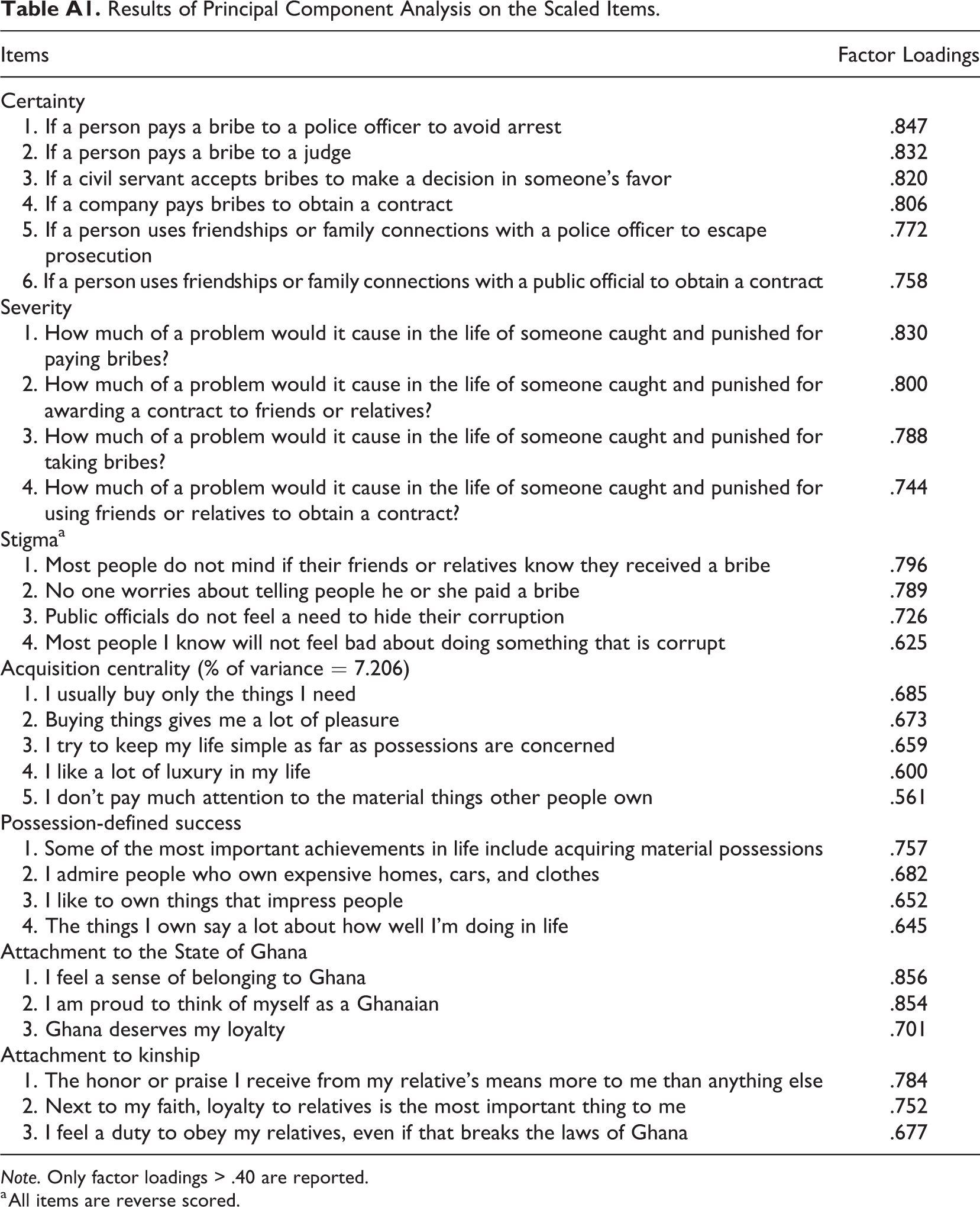
The study drew on predictors from the three conceptual frameworks outlined above: attachment to kinship, materialism and deterrence (for full list of items, see Appendix Table A1).
Primordialism includes two dimensions, allegiance and commitment to kinship networks, and the opposing normative attachment and allegiance to state institutions coupled with the common good. We measure these as two independent dimensions. Attachment to kinship was measured with three questions, including one that directly referred to esteem: “The honor or praise I receive from my relatives means more to me than anything else.” The other two questions focused on allegiance to the group: “Next to my faith, loyalty to relatives is the most important thing to me” and “I feel a duty to obey my relatives, even if that breaks the laws of Ghana.” This was measured on a 5-point scale, ranging from 0 = strongly disagree to 4 = strongly agree. “Attachment to kinship” is a summation score of responses to the 3 items (one factor; Cronbach’s α = .65), with higher scores indicating greater allegiance to kinship and relatives.
Normative attachment and allegiance to the State of Ghana, its citizenry and care about the country was operationalized using three questions: “I am proud to think of myself as a Ghanaian” measures esteem and self-esteem derived from being a citizen of Ghana. “I feel a sense of belonging to Ghana” and “Ghana deserves my loyalty” probe allegiance to the state and its institutions. This was measured on a 5-point scale, ranging from 0 = strongly disagree to 4 = strongly agree. “Attachment to the State of Ghana” is a summation score of responses to the 3 items (Cronbach’s α = .78), with higher scores indicating greater attachment to the State of Ghana.
The measurement of materialism was based on Richins and Dawson’s (1992) Materialism Scale. We focused on two of their dimensions of materialism, “acquisition centrality” and “possession-defined success,” the latter being particularly important in relation to esteem. The authors define acquisition centrality as the tendency by some people to “place possessions and their acquisitions at the center of their lives” (p. 304). Five questions were used to operationalize the concept, including: “I usually buy only the things I need (reverse scored)” and “I like a lot of luxury in my life.” This was measured on a 5-point scale, ranging from 0 = strongly disagree to 4 = strongly agree. Acquisition centrality is a summation score of responses to the 5 items (Cronbach’s α = .69), with higher scores indicating greater emphasis on the importance and acquisition of material possesses in the participant’s life. Possession-defined success refers to people’s inclination to “judge their own and others’ success by the number and quality of possessions accumulated” (p. 304), and to use material goods as an indicator of esteem. We used four questions to operationalize this dimension of materialism. These included “The things I own say a lot about how well I’m doing in life,” “I like to own things that impress people,” and “I admire people who own expensive homes, cars, and clothes.” This was measured on a 5-point scale, ranging from 0 = strongly disagree to 4 = strongly agree. Possession-defined success is a summation score of responses to the 4 items (Cronbach’s α = .68), with higher scores indicating greater belief in accumulated possessions as the definition of a successful life and related esteem and status.
We measured two elements of deterrence: certainty and severity. “Certainty” was operationalized using 6 items, which assessed participants’ views about the risk that a person would be caught for being involved in corruption, including for example: “If a person pays a bribe to a police officer to avoid arrest” or “If a person uses friendships or family connections with a public official to obtain a contract.” The response to each question ranged from 0 = no risk at all to 3 = a very great risk. Certainty is a summation score of responses to the 6 items (Cronbach’s α = .90), with higher scores indicating a greater risk of being caught for engaging in corruption. Severity was measured with four indicators adapted from Grasmick and Bryjak (1980), including “How much of a problem would it cause in the life of someone caught and punished for using friends or relatives to obtain a contract?” and “How much of a problem would it cause in the life of someone caught and punished for paying bribes?” This was measured on a 4-point scale, ranging from 0 = no a problem at all to 3 = a very big problem. “Severity” is a summation score of responses to the four questions (Cronbach’s α = .83), with higher scores indicating perception of greater severity of punishment for corruption.
Stigma was operationalized with four questions, including “Most people I know will not feel bad about doing something that is corrupt” (reverse scored) and “Public officials do not feel a need to hide their corruption” (reverse scored). This was measured on a 5-point scale, ranging from 0 = strongly disagree to 4 = strongly agree. “Stigma” is a summation score of responses to the 4 items (Cronbach’s α = .74), with higher scores indicating greater perception of stigmatization of people engaged in corruption.
Control Variables
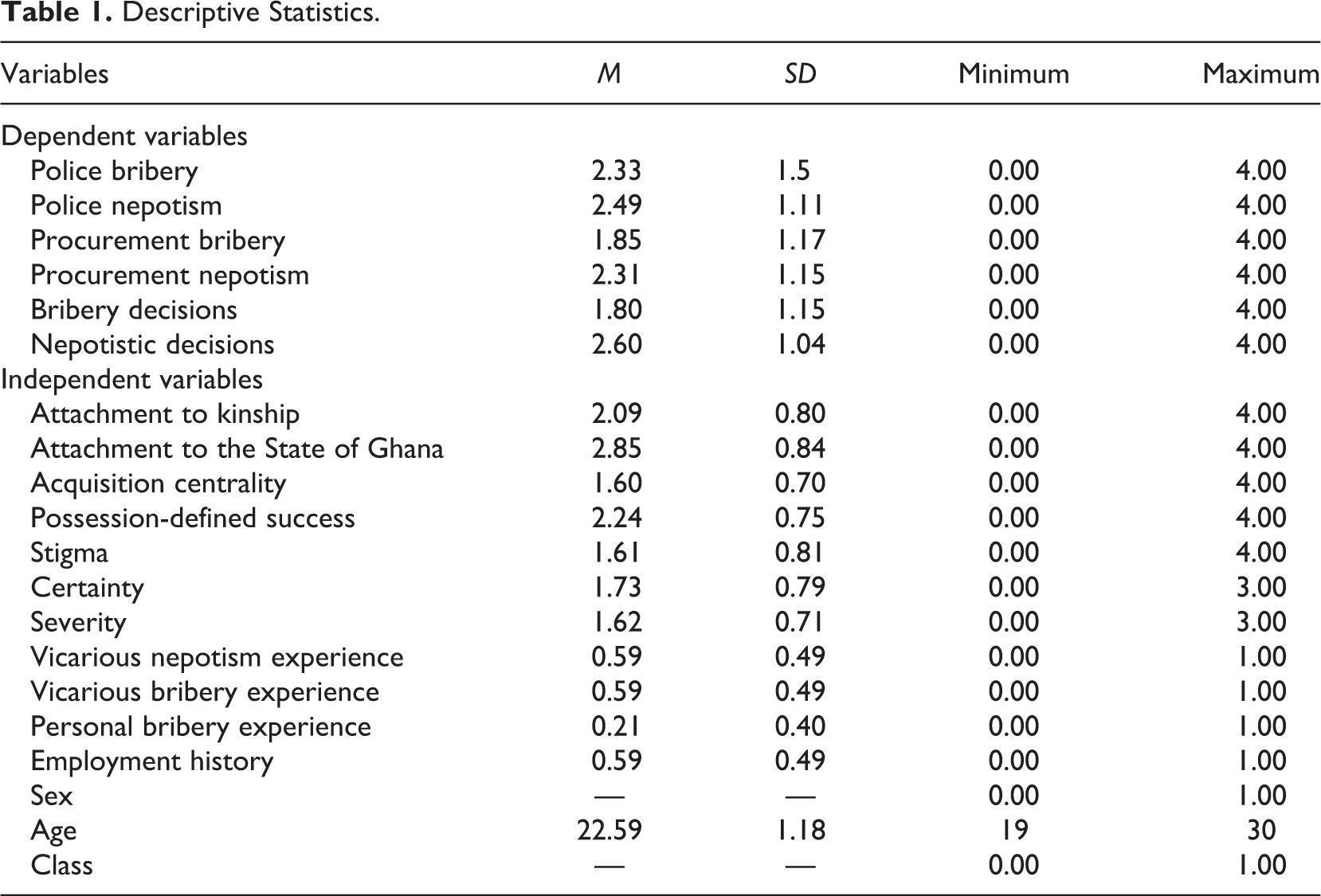
We included several variables to control for potential confounds. These included age, sex (0 = male, 1 = female), and employment status (0 = never been employed, 1 = previously employed, either part time or full time). We also measured three forms of experiences with corruption. The first is direct experience of police bribery, which is derived from the following item: “Have you ever paid a bribe to a police officer?” (0 = never paid a bribe, 1 = has paid a bribe). Second, vicarious experience of police bribery was elicited from responses to the question: “Has a member of your family or a friend ever paid a bribe to a police officer?” (0 = no, 1 = yes). Finally, vicarious experience of nepotism was derived from the following item: “Has any member of your family or any of your friends ever used their relationship with a public official to obtain a decision in their favor? (0 = no, 1 = yes). We further controlled for the subject studied, whether business or sociology degrees (business = 0; sociology = 1). Table 1 shows the means and standard deviations for each of the study variables.
Descriptive Statistics.
Findings
Even at this young age, the participants had been directly involved and/or vicariously witnessed bribe paying and nepotism in corrupt exchanges. Most common was experience of and knowledge about paying bribes to police officers. One in the five participants (20.6%) reported paying a bribe to a police officer, and three in the five participants (59.3%) reported knowledge of family or friends paying bribes to the police. The majority (59.1%) knew of situations in which family members or friends used their relationship with a public official to obtain a decision in their favor. In an environment where such exchanges are common, motivation and intentions are firmly embedded. Table 2 presents findings for intention to engage in corrupt exchanges for the six scenarios and three pairs. For the police scenarios, we found little resistance to corruption. More than half of the respondents were likely or highly likely to engage in such behavior (Scenario 1: 51.2%; Scenario 2: 57.8%). Although differences between paying a bribe and resorting to nepotism are small, pairwise t tests revealed that, on average, more participants would resort to nepotism to avoid arrest (M = 2.49, SE = 0.05) than would use bribery (M = 2.34, SE = 0.05). Accordingly, even if the difference between intentions was statistically significant, t(511) = –3.80, p < .001), the effect size was small, d = .13.
Intentions to Engage in Corruption (%).
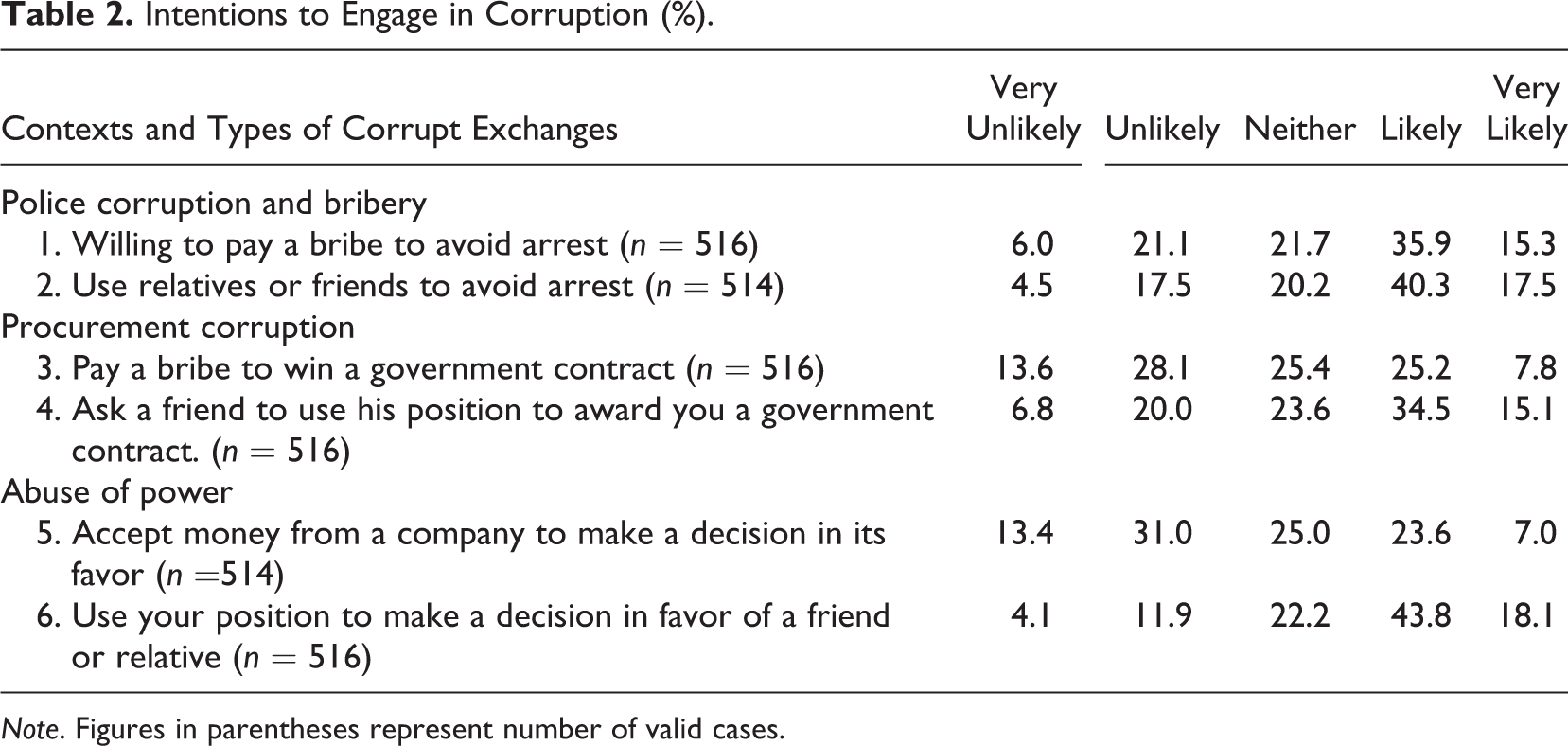
Note. Figures in parentheses represent number of valid cases.
The next pair of scenarios focused on public procurement. In contrast to police bribery, we found a distinct difference between paying a bribe (Scenario 3) and using the influence of a friend (Scenario 4). Overall, the proportion saying that they would not consider paying bribes (41.7%) was greater than the proportion who said that they would do so (33%). By contrast, about half of the participants (49.6%) said that they would use friends or relatives to procure a government contract. Further tests revealed that participants expressed a stronger intention to engage in nepotism in public procurement (M = 2.31, SE = 0.05) than to pay a bribe (M = 1.86, SE = 0.05). The difference between intentions was statistically significant, t(511) = –10.05, p < .001; it represented a medium-sized effect, d = .39.
While these two pairs of scenarios involved participants making decisions that benefited them personally, the third pair of scenarios focused on decision-making and abusing power and influence for the benefit of others. The findings show that 61.9% were likely to consider using their position to make decisions favoring friends or relatives, while only 30.6% were likely to accept bribes to award a contract to a company. The difference in intention between engaging in nepotistic and bribery transactions is statistically significant, t(511) = –14.16, p < .001, with participants expressing a stronger intention to award contracts to their friends or relatives (M = 2.60, SE = 0.05) than to accept bribes to award contracts to a company (M = 1.79, SE = 0.05); a medium-sized effect, d = .70.
In sum, the prospective elites were more inclined to resort to influence peddling, with and on behalf of friends and relatives, rather than to pay bribes directly. The friendship and kinship networks thus emerge as important channels through which corrupt exchanges take place, with direct monetary exchange less preferred. As Brennan and Pettit (2004, p. 94) argue, people “locate their efforts in those domains of activity where they are most effective in attaining esteem,” and we had assumed that kinship networks are generally more rewarding than the civil and public sphere in terms of esteem. These findings offer preliminary corroboration for this assumption. This seems to be further confirmed by finding no differences between gender and subject of study for most scenarios, with the exception of bribery for procurement of a contract. We found gender differences for bribery to win a contract, t(514) = 3.64, p < .001, and accepting bribes to award a contract, t(514) = 2.39, p < .05. In both cases, male participants expressed a stronger intention to engage in procurement bribery than female students did. With the exception of the abuse of positions of authority for bribes, we found no differences in corrupt intentions between business and sociology students: Specifically, business students (M = 1.68, SD = 1.14) were less inclined than sociology students (M = 2.06, SD = 1.12) to engage in such corrupt exchanges, t(514) = −3.43, p < .01.
In our next step, we used multivariate models to explore the factors that might drive intentions to engage in corruption. We estimated ordinary least squares regression equations for all six corruption scenarios. Table 3 shows findings from the multivariate models. An important finding across the scenarios is that if a factor had a more consistent impact across the scenarios, this was mostly independent of whether the corrupt exchange involved a direct bribe or nepotism.
Ordinary Least Squares Regression Models Predicting Intentions to Engage in Corruption.
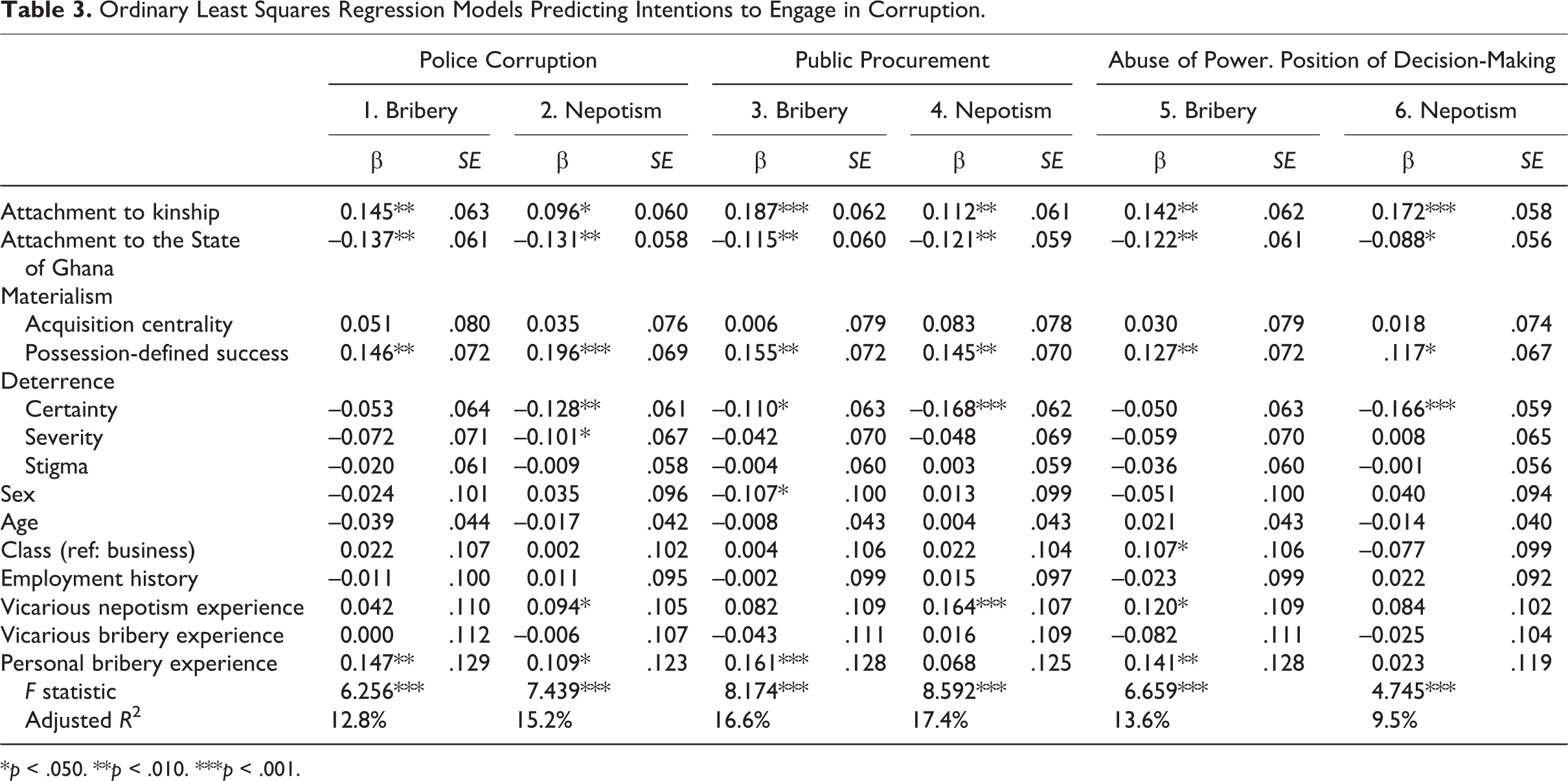
*p < .050. **p < .010. ***p < .001.
Across all scenarios, allegiance to family, kinship, and ethnic networks increased the general acceptance of (and intention to engage in) corrupt exchange, irrespective of whether it was based on monetary exchange or on kinship influence. Indeed, its influence was not limited to corrupt exchanges involving such networks but similarly supported bribe paying. This was in line with Hypothesis 1A1, which assumed an overall effect on all types of corruption. Looking at allegiance, attachment and loyalty to the universal entity of the state, nation, and citizenry, intentions were significantly reduced across all scenarios and independent of the type of exchange. This supports our assumption about two moral and social orders, linked to two different types of esteem. Thus, esteem achieved within and bestowed by kinship networks was an incentive for all types of corruption, across all contexts of corrupt exchange, whether in the public or private sector, and whether by direct monetary exchange or by mobilization of friends and relatives. This implies that esteem within family and kinship networks might take effect in two directions. Esteemed relatives and friends can be asked to bend the rules in an applicant’s favor (as in Scenario 2) or to use their influence to support the applicant (as in Scenario 4). On the other hand, individuals can enhance their esteem by establishing themselves as power brokers (as in Scenario 6). Esteem derived from allegiance to the state and to the commonweal disincentivizes corruption, whether in the public or private sector, by direct monetary transaction or the mobilization of friends and relatives. As this normative order strongly prohibits corruption, corrupt exchanges rather entail a risk of losing esteem and status as well as loss of income. The fact that this type of allegiance impacted on all types of corrupt exchange reflects the universal norm of the prohibition of corruption that is governing the public sphere.
Of the two dimensions of materialism, only possession-defined success had any impact, and no impact was found for the centrality of acquisition. Importantly, it was the dimension relating acquisition of goods and wealth to esteem which encouraged corrupt exchanges across all scenarios, independently of whether it concerned bribe paying or nepotism. Young people who saw material goods as a measure of success and esteem were more inclined to embark on corrupt exchanges of all types. This corroborates our Hypothesis 2 and demonstrates that material success is not related exclusively to the monetary economy of bribery and corruption but in equal measure to the economy of esteem. Both bribe paying and using kinship and friendship networks in corrupt exchanges play an important role in accumulating status and influence in such networks and enhancing the esteem of those involved in them. Accepting bribes (as in Scenario 5) procures the material wealth on which esteem is based, and paying bribes can be calculated as a cost of further acquisition, leading to status and esteem. Nepotistic favors are part and parcel of acquiring a high status in these networks, be it through paying bribes (Scenarios 1 and 3), accepting a bribe (Scenario 5), or using network ties (Scenarios 2, 4, and 6). Consequently, attachment to family and kinship networks, and this dimension of materialism, are significantly correlated (r = .228, p < .000). We tested but found no evidence for an interaction effect between the two attitudes, which suggests they have a linear and independent impact upon intentions to engage in corrupt exchange.
As would have been expected from research on deterrence, certainty of detection had the stronger and more consistent impact of the two deterrent factors; indeed, only police nepotism was an exception to the otherwise non-significant effects of severity. Surprisingly, certainty of detection had a more consistently negative impact on intentions in the scenarios focusing on nepotism (Scenarios 2, 4, and 6) than in scenarios focusing on bribe paying and acceptance and here only in relation to public procurement (Scenario 3). Obviously, risks of discovery in such relationships are taken more seriously than in a one-off payment in either direction. This might be caused by the lack of capacity on the part of the banking and taxation system to discover and track such payments in an economy that still relies predominantly on direct cash transactions (e.g., BBC News, 2017b). However, if public procurement were to be more tightly monitored, bribe paying would become correspondingly more dangerous. This finding is in line with our third hypothesis (Hypothesis 3A).
We did not find that the perceived stigmatization of corrupt exchanges had any impact on intentions to engage in them. Stigmatization is a decisive mechanism of informal social control, and so far as corruption is neither condemned nor seen to be deviant behavior within family, kinship, and wider networks, or indeed within institutional culture, stigma loses its power in regulating behavior. Our findings on the impact of attachment to kinship lend support to this assumption.
We controlled for both personal and vicarious experiences of corruption, which concerned active involvement, either in the form of paying a bribe or using the influence of kinship and friendship networks. Personal experience of bribery, presumably because this was police corruption, increased intentions to exploit both bribe paying and using relationships in this arena; otherwise, it solely increased intentions to pay bribes (Scenarios 3 and 5). It should be obvious that in this group of young people the actual experience of bribery encourages this type of action rather than ethical alternatives; however, experiences in one type of context (police) might encourage both types of action. Vicarious experience of nepotism increased intentions to exploit relationships in police corruption and public procurement (Scenarios 2 and 4). Equally, it increased the likelihood of bribe acceptance in the abuse of power (Scenario 5). Knowledge of such events directly or by hearsay in one’s networks made the students more inclined to branch out into different types and contexts of corruption. Given the subjects’ age range, we assume that learning directly and from models is important for engaging in such behaviors. In addition, vicarious experiences send powerful messages about corruption that have the potential to shape perceptions and intentions (Pfeiffer, 2018). In contrast to other research (e.g., Swamy, Knack, Lee, & Azfar, 2001), gender had no impact except for bribe paying in procurement; here, women were significantly less likely to engage in such behavior. The other control variables did not impact in any notable way upon intentions to engage in corrupt exchange. Whether the students were preparing for positions in the public sector or in private business did not have a notable impact on their intentions to engage in corrupt exchanges—albeit with one exception: Sociology students were more inclined to accept a bribe to favor a company in a position of power.
In sum, the predictors explained a small but nonnegligible proportion of the variance, between 9.5% (Scenario 6) and 17.4% (Scenario 4). We conducted coefficient comparison tests on all pairs of scenarios and tested for differences in the strength of impact between bribe paying/accepting and nepotism for each pair. Using the formula developed by Paternoster, Brame, Mazerolle, and Piquero (1998), the strength of the predictors did not differ significantly between these two types of corrupt exchange. In addition, no systematic patterns clearly emerged from these analyses to differentiate between the three scenario contexts—police, public procurement, and abuse of power in an unspecified position. Consequently, where experiences of corruption are pervasive, intentions to engage in it may develop independent of type, area, and exchange and be mostly independent of demographic characteristics.
Discussion
Our findings lend support to a framework explaining the surprising discovery that despite a substantial rise in salaries, police officers in Ghana increased their efforts to secure bribes, requesting and receiving higher bribes from lorry drivers at roadblocks. Foltz and Opoku-Agyemang (2015) offer two explanations, each of which is supported by our findings. First, they assumed that salary increases enhance status and esteem, which in turn act as an indirect driver of demand for higher bribes (p. 27). Second, they assumed that demands from extended family to share the monetary bribes put pressure on those whose status had increased in line with higher salaries. We argue that these findings reflect an economy of esteem (Brennan & Pettit, 2004) which encourages and facilitates corrupt exchange.
Although we did not test the role of esteem directly, we derived a set of hypotheses from three theoretical frameworks—primordialism, materialism, and deterrence—that were suitable to identify an underlying structure of esteem and its role in facilitating and encouraging corruption. First, we show that, as prospective elites in Ghana, university students were more inclined to use the power and influence of kinship and other social networks, rather than direct monetary exchange, when the possibility of a corrupt exchange arose. This difference was least pronounced in the case of police corruption, while for procurement and the abuse of a position of power a preference for kinship and other networks was significantly higher than that for monetary exchanges. We assume, following Brennan and Pettit (2004, p. 94), that esteem linked to status and power is most effective and most easily mobilized in these networks and that it is most effective in attaining esteem, for example, to become a power broker for family and friends.
Second, we demonstrate that attitudinal patterns indicative of esteem predict intentions to engage in corrupt exchanges across different agencies and contexts—police, procurement for government, and abuse of power—as well as different types of action, whether bribe payment or nepotism. Corruption offers enhanced esteem in networks of family and kin, both for the person involved and also for those who engage in corruption on behalf of others. In Ghana, it is this link between bribes and status in such networks that Foltz and Opoku-Agyemang (2015) identified as explaining the unexpected rise in demand for bribes among police officers. Successful corruption becomes a manifestation of esteem and also strengthens the normative and social order of particularistic orientations. Consequently, where allegiance to the State of Ghana and citizenship values is weak, intentions to engage in all types of corrupt exchange are enhanced. As we found no consistent and significant interactive effects between the two normative patterns, we assume that each pattern creates incentives or disincentives for corruption independently of the other. However, to a small but significant extent, citizenly pride (and self-esteem) seems to offer the motivation for integrity across all types of corrupt exchange.
Third, our models demonstrate how the parallel economies of money and goods on the one hand, and esteem on the other, might be linked in corrupt exchange. Only if material possessions are seen as a foundation of—and route toward—esteem and status, will such orientations encourage corrupt exchange, whether monetary or nepotistic. It is not merely that the acquisition and possession of wealth encourages bribes; it is also the importance of material goods as it has the potential to influence appraisals of self and others. Economic success in terms of contemporary materialistic culture interacts with group-based mechanisms affording esteem in a traditional and nonmeritocratic context. Again, these findings illustrate Foltz and Opoku-Agyemang’s (2015) analysis of the ways in which increases in bribery are related to status in family and kinship networks. Our findings generalize theirs, as we show that both monetary and nepotistic exchanges were encouraged across different institutions and contexts. Bribes allow for the acquisition of status goods and conspicuous consumption, which in turn increase esteem among family and kin. Both economies drive a willingness to engage in different corrupt exchanges in tandem and in an environment where they are joined in compromising behavioral integrity. Consequently, we found no support for Hypotheses B1 or, similarly, B2 (that the influence of particularistic values was limited to nepotistic corrupt exchanges).
Finally, the legal and social consequences of exposure seem to be of little importance. Thus, the risk of “disesteem” or stigma following detection of a corrupt exchange appears to have no impact on intentions. So far as corruption is viewed as a “respectable crime” and as a way of attaining esteem, stigma will not work within family and kinship networks; our data do not corroborate any influence in either the primordial or civic sphere. The certainty of detection has a consistent impact on nepotistic corruption, since influence peddling seems to be more easily tracked in well-known networks of kin and friendship; it can be uncovered accordingly and thus has the potential to disincentivize corrupt exchange (see Brennan & Pettit, 2004, p. 259). Monetary transactions in contrast are less easily detected in what is still a cash-economy in Ghana. 3 Since we found a deterrent impact upon both monetary and nepotistic corrupt exchanges in public procurement, we conclude that more control and oversight are anticipated in this context and might even reflect efforts to increase transparency. This might also be indicative of normative changes in the public and civic sphere that start to withdraw respectability from corruption in these exchanges. We therefore qualify Hypothesis 3A and reject Hypothesis 3B and C.
In conclusion, our findings are consistent with those of Foltz and Opoku-Agyemang (2015) in suggesting a more cautious approach to anti-corruption policies in countries sharing many characteristics with Ghana. These policies need to take into account the parallel economies of goods and of esteem and their interaction in the persistence of corruption across types, contexts, and institutions.
Limitations
The study has several limitations. First, we relied on data from students at a single university. This makes it difficult to establish how far the findings can be generalized to prospective elites in Ghana. A whole-population probability sample is required to overcome this generalizability challenge. Second, we measured intentions rather than actual behavior. Intentions can translate into behavior only insofar as individuals are offered and perceive opportunities for corrupt exchanges. Studies focusing on actual involvement in corrupt exchanges, such as Foltz and Opoku-Agyemang’s (2015) study in Ghana, will help to test the influence of the present study’s theoretical perspectives upon actual behavior. It is nevertheless noteworthy that our findings are consistent in important ways with those reported by Foltz and Opoku-Agyeman (2015) that are based on an experimental design and actual behavior. Third, we measured the decisive factors of the economy of esteem only indirectly; the most indicative measurements were those with a consistent impact on corruption intentions, namely, attachment to family and kin, attachment to the State of Ghana, and materialistic values related to success and status. Future studies should develop more direct measurements. They might also address the fact that our models make only a modest contribution to the explanation of variance in a sample of university students.
Footnotes
Appendix
Results of Principal Component Analysis on the Scaled Items.
| Items | Factor Loadings |
|---|---|
| Certainty | |
| 1. If a person pays a bribe to a police officer to avoid arrest | .847 |
| 2. If a person pays a bribe to a judge | .832 |
| 3. If a civil servant accepts bribes to make a decision in someone’s favor | .820 |
| 4. If a company pays bribes to obtain a contract | .806 |
| 5. If a person uses friendships or family connections with a police officer to escape prosecution | .772 |
| 6. If a person uses friendships or family connections with a public official to obtain a contract | .758 |
| Severity | |
| 1. How much of a problem would it cause in the life of someone caught and punished for paying bribes? | .830 |
| 2. How much of a problem would it cause in the life of someone caught and punished for awarding a contract to friends or relatives? | .800 |
| 3. How much of a problem would it cause in the life of someone caught and punished for taking bribes? | .788 |
| 4. How much of a problem would it cause in the life of someone caught and punished for using friends or relatives to obtain a contract? | .744 |
| Stigmaa | |
| 1. Most people do not mind if their friends or relatives know they received a bribe | .796 |
| 2. No one worries about telling people he or she paid a bribe | .789 |
| 3. Public officials do not feel a need to hide their corruption | .726 |
| 4. Most people I know will not feel bad about doing something that is corrupt | .625 |
| Acquisition centrality (% of variance = 7.206) | |
| 1. I usually buy only the things I need | .685 |
| 2. Buying things gives me a lot of pleasure | .673 |
| 3. I try to keep my life simple as far as possessions are concerned | .659 |
| 4. I like a lot of luxury in my life | .600 |
| 5. I don’t pay much attention to the material things other people own | .561 |
| Possession-defined success | |
| 1. Some of the most important achievements in life include acquiring material possessions | .757 |
| 2. I admire people who own expensive homes, cars, and clothes | .682 |
| 3. I like to own things that impress people | .652 |
| 4. The things I own say a lot about how well I’m doing in life | .645 |
| Attachment to the State of Ghana | |
| 1. I feel a sense of belonging to Ghana | .856 |
| 2. I am proud to think of myself as a Ghanaian | .854 |
| 3. Ghana deserves my loyalty | .701 |
| Attachment to kinship | |
| 1. The honor or praise I receive from my relative’s means more to me than anything else | .784 |
| 2. Next to my faith, loyalty to relatives is the most important thing to me | .752 |
| 3. I feel a duty to obey my relatives, even if that breaks the laws of Ghana | .677 |
Note. Only factor loadings > .40 are reported.
a All items are reverse scored.
Declaration of Conflicting Interests
The authors declared no potential conflicts of interest with respect to the research, authorship, and/or publication of this article.
Funding
The authors received no financial support for the research, authorship, and/or publication of this article.