







Abstract
In this article, we discuss the incidence of narratives on war and death in molding penitentiary experience in Colombia. Based upon the case of la Modelo National Prison in Bogotá, we illustrate the way in which penitentiary discourses are transmitted and reproduced through two rites that initiate newcomers into the local world of confinement. The first, the tale of terror, told by veteran guards, of the cemetery filled with the bodies left by the war between rebel fighters and paramilitary soldiers. The other, the dense description of the bullet holes in the glass shield at the Main Guard Post, which leads to the main cellblocks, which give proof to the guards’ endurance when faced by the violent power struggle that rages inside the penitentiary. At the same time, we show how these discourses on the horror of the war inside the penitentiary make their way from within the confines of prison out into the free world through ex-convicts’ memoirs, press accounts, and judicial documents written by court officials who visit the prison. Drawing on this case study, we argue that to achieve a contextual interpretation of carceral violence, it is indispensable to trace, reconstruct, and comprehend the trajectory of its foundational discourses, thus allowing for the assembly of the pieces that give meaning to penitentiary experience at the local level.
Prison, where guerrilla fighters and paramilitary soldiers, like colossal infantry battalions, are locked in mortal combat in their war to conquer one more cell block. Until one night the bomb went off.
Violence and Acceptance of Prison Life
In this article, we analyze the construction and rhetoric of violence in the penitentiary world as well as its impact on the acceptance of the inhuman prison conditions that distinguish the Colombian prisons system. We will make a thick description of the initiation rites, and the meanings and symbols they entail, that take place at la Modelo prison in Bogotá. 1 The narratives regarding its past, which revolve around the war for the control of the prison (an extension of the armed conflict between right-wing paramilitaries and leftist guerrillas 2 ), and the fear of being forcibly disappeared or dismembered are reproduced in prison initiation rites. Such narratives convey to newcomers the idea that, despite its cruelty, the massive and systematic violation of inmates’ human rights is the normal experience of imprisonment.
The memory of past massacres and the threat of their irruption in prison daily routines mark carceral experience in Colombia and Latin America. The extreme violence that destroys the bodies of the condemned, dismembered, burnt by the flames of prisons’ arsons, or shot dead by the bullets that seek to suppress a riot are common features of penitentiary punishment in the region. 3 The normalization of violence as a result of inhuman prison conditions is linked to the narrative on the horror of prison, which is transmitted, and learned, through initiation rites and prison symbology. As Maruna (2011, p. 11) points out, “prison is a rite of passage”; thus, going through this experience implies the acceptance of extreme violence—past and present—as a normal, defining feature of imprisonment.
To present our argument, we will use two different perspectives. First, from a methodological angle, we will discuss the advantages of ethnographic analysis to capture distinctive features of prison experience in socially and culturally established places. The thick description of prison initiation rites, and the symbology that goes together with them, is of great help to make sense of the idea of penitentiary punishment and its historical grounding. As Maruna (2001) claims, “Above all, a ritual is a medium of communication, with its own symbolic grammar and syntax” (p. 7). In this text, we attempt to underscore the significance of oral history, as passed on by long-serving guards and prisoners who accompany visitors on their walks through the penitentiary’s corridors. During these ritual walks, the prison inhabitants repeatedly recall the tales of horror that are inscribed on the prison’s walls, in its yards, and cellblocks. On every prison wall, they point out the signs of a past that refuses to go away.
This daily prison walks, like a museum tour, conducted by guards and yard leaders take the visitor to zones where emotions are disrupted when it cannot be concealed that the institution is also a graveyard full of terrifying memories (Bennett, Crewe, & Warr, 2014; Morrison, 2012). Because we have been assiduous visitors to la Modelo during the last 8 years and, as such, are recognized as being stable members of a group attentive to the issues that the local prison population confronts, we write about the stories we have been told to introduce us to the world of confinement.
As Rowe (2014, p. 411) points out, prison ethnography tends to blur the line between the observer and the participant, which leads to a process of “confrontation, disruption, and troubling of the self,” that nevertheless, “offers a source of insight into understanding the experiences and practices of actors in the field.” Even if we are still unable to fully grasp the “prison’s cultural web,” as a result of our constant visits to la Modelo during the last 8 years, we are regular visitors who “speak prison fluently” (Ugelvik, 2014, p. 477). In order to make sense of the meaning of such rites and symbols, we write about our own sensitive experience on the Colombian penitentiary field (Drake & Harvey, 2014; Jewkes, 2012). For this reason, we are trapped in “the old theological question of how to be in but not of the world” (Liebling, 2001, p. 475) of la Modelo prison.
Our thick description of prison rites and symbols outlines the importance of tracking the social flow of prison discourses in order to make sense of located and contextualized forms of imprisonment. We consider the interpretation of the “flow of social discourse” to be fundamental in the analytical process which seeks to signify cultural artifacts, in this case, prison. This presupposes the act of “attempting to rescue ‘the said’ of this discourse from those perishable occasions when it transpired and fixing it in terms that allow for its consultation” (Geertz, 1973, p. 20).
This article also sheds light on how institutional memory is transmitted and flows from the prison milieu to the open space of free society, primarily through three different communication channels: the discourses of penitentiary subjects and the narratives of long-serving prison guards and convicts, the narratives displayed by the media, and judicial decisions. 4 We particularly seek to trace the discourses of those who have been imprisoned by drawing upon texts written by several ex-convicts which make up part of a nonacademic, nonscientific sanctioned literature (Foucault, 1980) and have proven to be valuable sources in revealing la Modelo’s recent history.
Following Piché, Gaucher, and Walby (2014), we argue that inmates’ tales and nonacademic writings on prisons are crucial to understand imprisonment, and therefore, “that the ethnographic work of prisoners needs to be treated more seriously in scholarly debates” (p. 450). These penitentiary memoirs, told from the point of view of subjects who have passed through the Colombian penitentiary system and suffered its violence, whether as inmates or guards, are indispensable in understanding that shuttered world.
In the first part of the article, we will discuss the incidence of the normalization of violence on the routines and construction of social order within prison’s walls. We seek to make sense of the stability of a concrete and contextual penal social order characterized by corporal violence, which has been described as a massive and systematic violation of prisoners’ fundamental human rights (Ariza, 2013; Garces, Darke, & Martin, 2013; Iturralde, 2011). The introduction to imprisonment through initiation rites and the learning of prison symbols (which relate to a particular past) act as adaptation mechanisms to the prison’s symbolic and material violence and support the reproduction of the penitentiary social order (Ariza, 2011b).
This approach will contribute to the study of Latin American prisons, predominantly based on the instrumental analysis of informal dynamics (Darke, 2013; Garces et al., 2013); it will also encourage a kind of analysis that goes beyond the characterization of global south prisons as not fulfilling the aims that are legally assigned to them (Birkbeck, 2011)—and which are measured with global north standards.
In the second part of the article, we will develop the discussion of the first part of the article through a case study of la Modelo prison of Bogotá, one of the main Colombian prisons, where we have been doing field research for more than 8 years. We will make a thick description of a particular prison initiation rite, the tale of the ghost that points from his cell the spot where he is buried, and of a foundational symbol of the history of la Modelo—the seven bullet impacts in the glass shield of the Main Guard Post—which express and reproduce the prison’s social order.
We will argue that the narrative on past events at la Modelo (the violent deaths, the mass graves, the kidnappings, and dismembered bodies), transmitted through initiation rituals and symbols, plays a fundamental role in the normalization of prison experience, despite its indignity and violence, which reinforce class segregation and stigma inside prison walls (Ariza, 2011a). In this context, current and inhuman prison conditions (overcrowding, lack of basic services such as water supply and health care) pale when compared to the memories of horror, war, and violence of the prison’s recent past, where the fear, and possibility, of being forcibly disappeared or being dismembered was part of prison life.
Through these theoretical and ethnographic analyses, the aim of our article is to show how the concrete and contextual description of prison experience, especially form the point of view of those who work and who are forced to live in prisons, is crucial to fully grasp the social construction of prison order. This is essential to make sense of current prison conditions in Colombia, and also in Latin America, and to attempt more effective and grounded responses to such dire conditions. Public policies and judicial responses tend to acknowledge the massive violations of human rights in prisons and to confront them through legal and institutional reforms and interventions that may change the law and legal discourse, but not actual practices, embedded in a local context, which escape legal discourse. Only by taking seriously the voices of those who suffer prison conditions, it will be possible to construct more fitting tools to confront them.
Prison, Violence, and Context
Caderipo, who served prison time in la Modelo during the worst years of the confrontation between paramilitary and guerrilla inmates (see section 2), is the author of The Cemetery of Living Men, one of the few books that breathes life into the discourse on what a Colombian convict must live through. In this biographic account, he declares that deciphering the penitentiary spirit is essential to comprehending what it means to be a prisoner: “it is a difficult phenomenon to understand because it obliterates all other differences” (2003, p. 34). To understand precise and contextual prison experiences, Agudelo suggests considering the concrete disparities among correctional institutions: “la Modelo can only be la Modelo, la Picota can only be la Picota, Valledupar, which is maximum security has its unique environment, and so on, and each one has a lifestyle of its own’’ (2003, p. 34).
To capture this spirit—concrete and contextual—of the penitentiary experience, the discourse on the institution’s past provided by long-serving prisoners and guards is indispensable in improving comprehension on current prison conditions. Over the long term, this comprehension, afforded by the diversity of institutional history transmission, leads to the understanding of how the social order in a specific penal facility is transformed. The analysis of prison initiation rituals and symbols reveals the ways in which the historical, political, and social context shapes the adaptation mechanisms to prison life, as well as the construction of the prison’s social order. The identity of every penitentiary facility is transmitted and reproduced through such rituals and symbols, thus locating the experience of imprisonment in a particular context.
Yet such contextual peculiarities seem to get lost in the abstract language of legal and theoretical discussions about imprisonment in its general institutional context. Although it is true that seminal research on prison organization has dealt specifically with the penitentiary environment, the main analytical perspectives have tended to concentrate on understanding the social order from the perspective of the penitentiary administration’s dominion as opposed to the individual and collective agency of the imprisoned, thus distancing themselves from the specific context in which the prison is placed (Bottoms & Sparks, 1996, p. 301).
The institutional–governmental perspective tends to pay little attention to the specific contexts in which prison life takes place. As Sykes (1995) points out, several years after the publication of his groundbreaking work The Society of Captives, penitentiary studies were trapped by the fact that prisons “didn’t degenerate into perpetual chaos on the one hand, or, on the other, into the frozen order of masses of men locked in solitary confinement” (p. 83).
This is further exemplified in Goffman’s (1961a, 1961b) metaphor of the total institution—the governance and administration of all aspects of life. In this sense, the emphasis is placed in mainly understanding, but not exclusively, daily prison life from the perspective of social order. In turn, this is understood to be linked to penitentiary stability. The social order and governmental perspective is evident in practices such as the penitentiary administration’s reliance on gangs and organized crime to keep the peace inside the institution, 5 the tolerance of certain infractions committed by inmates and the acceptance of contraband as a means to alleviate the hardship of confinement—all of which are expressions of penal administrative power. 6 Understanding prison government presupposes understanding the social order of inmates (Dilulio, 1987). Nevertheless, these types of studies overlook the influence of the political and social context in the shaping of social relations within prisons and the key role of prison rites and symbols in the transmission and reproduction of the penitentiary social order.
The importance of understanding the prison’s symbolic universe, which has its own argot to describe daily life, is indisputable. Interpreting penitentiary culture through its argot vocabulary should be complemented by the analysis of the rites, symbols, and narrative constructions on the institution’s past and the effects they have on inmates. As Crewe (2013) notes, it is not a matter of limiting penitentiary cultural analysis to biographical events but also of understanding the importance of individuals who, deprived of their liberty, construct historical narratives that reflect on the meaning of their captivity. In this regard, discourse analysis, centered on penitentiary subjects—inmates, guards, and habitual visitors—whose narratives transmit and reproduce institutional memory, is fundamental to grasp the constitution of the penitentiary social order and to understand the role that violence plays within it.
The emphasis on the “peculiar” of the penitentiary world, which aims at discovering “strange” features that differentiate it from the world of the free, may result in a limited comprehension of how social relations develop in a prison setting. Certainly, it would be naïf to maintain that no differences exist between the free society and the society of captives, but also, it would not be advisable to assume the opposite—that they are two worlds apart. Excessive emphasis on the privations associated with punishment can obscure the contextual shaping process that evolves within the penal institution, which is related to the broader political, social, and cultural context. Thus, reconstructing the flux of prison discourses may help to bridge the symbolic gap between the world of imprisonment and that of free society.
The importation model—as opposed to the privation model—is key to understand the influence of prior exterior factors in the conformation of the penitentiary social order. 7 As Thomas and Foster claim, the importation model “is related to the assertion that factors external to the prison situation affect patterns of adjustment within the prison” (1973, p. 228). The influence of the exterior—as an instrument used to adapt to confinement—should not be interpreted exclusively as an imprisoned individual’s importation of her prior context in order to adjust to prison life.
A contextually oriented interpretation of the penitentiary world will reveal that the institution is being shaped by a wider range of features and transformations experienced by a concrete society. Therefore, the institution should be conceived as contextually defined, porous, and permeable (Cunha, 2014). From this perspective, the individual mechanisms and strategies employed to adapt to confinement may be better understood as significant social actions oriented by concrete, symbolic penitentiary universes characterized by their intense level of permeability (Goffman, 1961).
The shaping of the internal penitentiary order, drawn from the incidence of proper contextual phenomena, is fundamental to understand the meaning of violence as part of the features of penitentiary confinement in the local context. Clemmer’s idea of a prison subculture entails a semiautonomous world, both shaping inmates’ agency and reconstructed by it. Finding meaning in prison narratives, developed by the personal experience of inmates, guards, and regular visitors, presupposes the task of developing a thick description of prisons and their rituals, of understanding the penitentiary experience in a contextual and deep-rooted way, and of paying attention to the peculiarities of confinement in a given place and time.
In the case of la Modelo prison, which will be discussed in the next section, but also of different Colombian prisons, one of these contextual features, which derives from the porosity of the prison vis-à-vis the wider social, political, and cultural context, is the reminiscence of the horror of war within prison walls, which was an extension of the Colombian armed conflict. Such memory is reflected on different narratives of horrendous events, which convey to inmates the fear of a violent and horrible death and which make human rights violations, caused by inhuman prison conditions, a bearable and normal form of violence.
The Horror of Prison Life. Tales From la Modelo
In this section, we will draw on our 8 years’ fieldwork experience at la Modelo prison of Bogotá to develop a case study that exemplifies the meaning and importance of prison narratives in the construction of prison social order, as well as in the adaptation to, and acceptance of prison life in inhuman conditions. We will make a thick description of two specific narratives: a particular prison initiation rite, the tale of the ghost that points from his cell the spot where he is buried, and a foundational symbol of the history of la Modelo—the seven bullet impacts in the glass shield of the Main Guard Post, which express and reproduce the prison’s social order.
We learned about these narratives through several interviews and informal conversations with guards and inmates, which have been part of our research on the construction of social order at la Modelo. We interviewed and talked to both veteran guards and inmates, who directly experienced the events that we will describe, and to newer guards and recently arrived inmates who, although did not directly witnessed such events, have heard the stories about them and reproduce them with their own narratives.
The Ghost That Points the Spot Where He Is Buried
Looking up from the path, muddy in winter and dusty in the dry season, worn smooth by the passing of guards and inmates, it is possible to make out, to one side of the prison’s football pitch, the dark colored cellblock where, inside, prisoners are hanging out their clothes to dry on its damp, sun-starved walls. A few convicts are playing football on the green field, at the other end of which sits The Mental Health Ward fronted by a cemetery-like garden where a few red roses and white calla lilies manage to survive. The peaceful atmosphere, filled with the smell of bread being baked in the prison’s ovens, and broken only by a few happy yells coming from the improvised football game, is in sharp contrast with the legend of horror that hangs over the site and shocks the visitor who hears it for the first time.
The guard, a veteran of many prisons and witness to countless battles, who accompanies the visitor, smiles and points to a grate on the second floor of the cellblock. On closer look, one sees a small window covered with rusty bars, and then suddenly, the green football field is engulfed by the darkness that seeps out from inside the prison.
The gloom of the penitentiary overwhelms the atmosphere and brings with it a feeling of suffocation and the unbearable urge to run away. This prison block, classified as not fit to live in, has been closed off several times during the last years. Not even the asphyxiating pressure of overcrowding can open its barred doors, except on those days when inmates use it to hang out their clothes to dry and as a place to make the corn mash brew which is passed around on days of mourning or holidays.
The guard assumes an air of severe decorum and begins his tale; meanwhile, a group of rookie guards gathers around to listen closely once more to a story they have heard many times before. He recalls how both the young and old guards pass through this zone as fast as they can on their nightly rounds. The new guards—the ones who have just graduated from Penitentiary School and who still don’t know what horrors prison holds, especially this one—are always in the biggest hurry. Their rite of initiation commences with the tale and then the assignment to make the night rounds outside the Mental Health Ward. On different shifts, old and young guards alike have seen—and they have not made this up—a shadowy figure standing at the entrance of the cellblock.
Multiple conjectures exist on who the person standing behind the bars could be. Each one recalls a quintessential experience that exposes the suffering of penitentiary existence. Some say he is a convict who hanged himself when told of his sentence; others, that he is one who did the same when his family stopped visiting him; one rookie guard swears that the condemned man died alone, sad, old, and forgotten; this version is corrected by another guard who is sure that the man is one of the many dead begging to be dug up from their mass grave and given a Christian burial. That mass grave, he explains, next to the football field, hides the victims of the paramilitary soldiers’ war to take control of the prison. The man on the other side of the barred window, in the words of the guard who makes a gesture to express his horror, is the ghost of a massacre, a vanquished soul who stands pointing to the mass grave where his body lies.
The sensation that overwhelms the visitor upon discovering he is treading upon a mass grave sharpens his knowledge that imprisonment, in itself something terrible, can turn into horror, into evil. Struck by the visitor’s expression of consternation and disbelief, as he stares at the earth he is standing upon, the rookie guards smile nervously, trying to conceal their fear. A veteran guard comes forward to confirm the truth of the terrible event: A few years ago, when the football field turf was being torn up and the rotting goal posts torn down to be replaced with new ones, workers inexplicably began to unearth bones and, without meaning to, profaned the penitentiary’s mass grave. Those bones, according to what one hears from prison old wardens, most likely belong to inmates who lost their lives during the war inside Colombia’s penitentiaries between guerrilla fighters and paramilitary soldiers who battled to control the country’s prisons. They are the remains of one of a multitude of unknown convicts, who now lie in a mass grave, and who, like nighttime fog, spread their endless sorrow through the corridors of la Modelo penitentiary.
What is not known, however, is in which battle the ghostly prisoner—cloaked in the horror of prison and the tormenter of guards and inmates alike—met his death. Newspapers of the time may be another piece of the jigsaw of penitentiary horror, tracing back the flow of the discourse of punishment. The first massacre to be reported on, albeit not too clearly, took place on April 26 and 27, 2000. Under the headline, “Hell in la Modelo,” the Colombian newsweekly Semana published the testimony of a prisoner, who had spent 4 years behind bars and was still awaiting sentence: “I had never seen as much blood as what I saw on Thursday, April 27, when—in a settling of accounts—25 prisoners at la Modelo National Penitentiary were machine-gunned to death in yard four” (Infierno Modelo, 2000). This event, referred to as “the massacre in yard four,” is one of the first to be described by the local media in the penitentiary war.
This press account deals with the event as “a settling of accounts”—apparently just another display of the routine violence that rules life behind prison walls. But other versions place the massacre in Yard 4 within the context of the wider war in which each inmate must take sides against everyone else. It is all a part of the ongoing combat that rages inside the penitentiary not only of that between the traditional boss—Cacique—and the big-time drug baron but also of the lethal confrontation in the all-out war between imprisoned rebel fighters and paramilitary soldiers. Shortly after the massacre, “the government ordered the immediate transfer of four FARC members out of la Modelo for having been indirectly implicated in the slaughter of 27 people over the weekend, because of retaliations between paramilitary forces and subversives” (Ordenan traslado de presos tras masacre carcelaria, 2000).
The long list of battles, retaliatory homicides, murders, massacres, and ephemeral alliances occurred during the relatively short term of 2 years. Faced by officialdom’s total silence, it is difficult to estimate the number of dead and wounded; nevertheless, there are fragments of this infamous story that illustrate the horror of the penitentiary war.
The second massacre, wherein destruction rose to an unparalleled level, took place one Monday of July 2001. According to a press release on that day, the battle began at 5:30 p.m. after visiting hours had ended at la Modelo National Penitentiary, a murder was committed by a member of the FARC, imprisoned in block 1, who had complained about non-payment of an extortion debt to a common criminal who was known to be in the service of the paramilitary forces. (La extorsión prende la cárcel Modelo, 2001).
This scene of penitentiary warfare lasted 17 hr and resulted in 10 dead inmates and 15 wounded. Below, we transcribe the chronicle of this unfortunate event, as it appeared that day in the media: Once the common criminal had been killed, his fellow prisoners, held in cellblock 3, sought the help of the paramilitary convicts, residing in cellblocks 4 and 5. When the news reached one of the paramilitary leaders, held in maximum security at la Modelo, he gave the order to 150 of his men to attack the subversives. A number of drug-traffickers then joined forces with the paramilitary soldiers. The battle plan was to take cellblocks 1 and 2 in order to bring an end to the extortion racket which, according to both prisoners and the authorities, had been set up by the guerrilla forces years before. However, nearly 400 members of the FARC and the ELN, imprisoned in these cellblocks, caught wind of the paramilitary soldiers’ plans and were waiting for them. The guerrilleros had taken their weapons from caches hidden under floors, in bathrooms and behind walls and barricaded themselves behind prison walls and in corridors. In this case, the confrontation took place because the guerrilleros had been charging fees from 600 hundred thousand to three million pesos to anyone who came to live in the cellblocks which they controlled.
8
Similar sums were also being charged by the paramilitary groups. Speaking from his cell in la Modelo yesterday, John Jairo Veláquez Vásquez, alias “Popeye,” former head of military operations for the Medellin drug cartel, declared that the inmates were tired of what the guerrilla fighters had been doing and that was why the clash had taken place. (La extorsión prende la cárcel Modelo, 2001)
These events, which happened not so long ago, seem to have become lodged in institutional memory as just another constituent in the local context of penitentiary existence. The fear of another penitentiary war conjured up by the ghostly figure of the never-buried, unnamed prisoner makes the violence of current prison conditions seem relatively mild when compared to the recent past scarred by war, terror, and the constant threat of death. The daily violence of overcrowding is preferable to the mass grave. The seven bullets in the glass will make that clear to all who enter la Modelo prison in Bogotá. Now, we adventure to get in, walking across its white long corridor that leads to the impacted but not shattered glass surface.
The Bullet in the Glass
The worst thing about this prison is its legend of death and suffering that deeply cuts into prisoner’s memory and popular soul. (Caderipo, 2003, p. 40)
El Flaco left the head for last and fixed it without looking into its eyes. He took the bundles to the basement of Courtyard 1, where the ducts of la Modelo pass through; a dark and cold place that has seen lots of dead people pass by. (Molano, 2004, p. 13)
At the end of a long corridor that leads to the heart of la Modelo, one comes to the Main Guard Post. At this checkpoint, the visitor is registered first by having his fingerprint stamped onto a page in a worn accounting book and then by handing over his Cédula (state identity card); in exchange, he receives a numbered, blue token and can walk down the corridor that leads to the prison cellblocks. A statue of the Virgin of Mercy, patron saint of Colombian prisoners, appears to be watching over the conversations between lawyers and their clients that are taking place below her. As he pockets the token and pulls up his sleeve to have his armed stamped with invisible markings by a seated guard, the visitor catches sight of the seven bullet holes that pock the glass shield of the Main Guard Post.
Juan Antonio Monsalve®
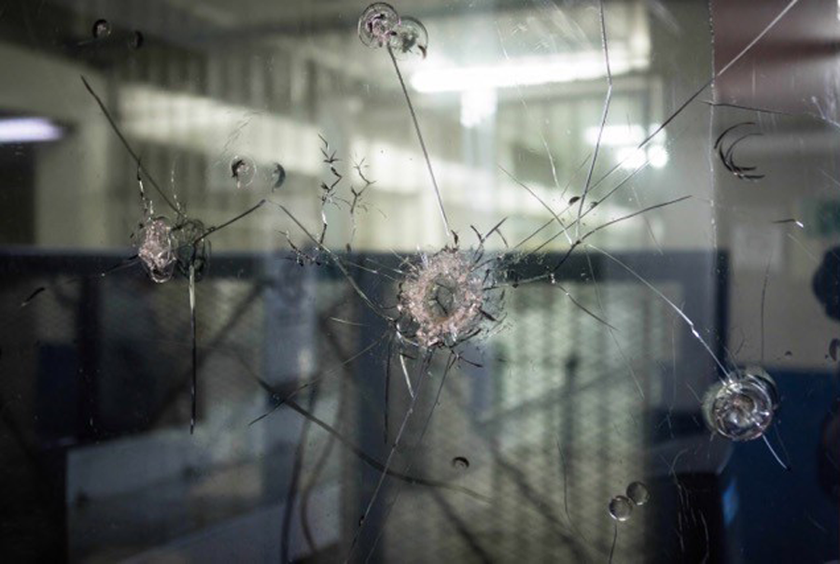
And on every visit, that shield will still be there, shattered but not broken, like the fragile prison social order. The guards have decided that the glass shield can never be removed; it stands as a reminder to the penitentiary war, to the days when it protected them from endless rounds of bullets fired from the north and south wings of the prison, by guerrilleros and paramilitares, alike. The bullet in the glass conjures up memories of the prison’s past; it casts a shadow over the daily life of prisoners who, day after day, fear the return of penitentiary violence and terror.
Nowadays, it is common to hear both guards and inmates say with relief that the prison is not what it once was. They tell the visitor not to worry, that the prison is safe now; that there are no longer kidnappings, murders, dismembered or missing bodies; that there is no danger in visiting the cellblocks; while at the same time, ironically remarking that it is best to keep that visitor’s token put well away; otherwise, the guards explain to the visitor, “you could be staying while someone else takes your place, just like in the old days.” And this joke, about the risk of staying in and not being able to get out, that produces nothing else but fear, is told almost every time the visitor receives the blue token.
Narrating the Horror as a Way of Adaptation to Prison Life
The meaning of the bullet in the glass as part of the stock of social knowledge (Berger and Luckman, 1966) shapes the objective meaning of penitentiary life, as does the tale of the unknown prisoner who points out the gravesite where he was massacred. These emotionally charged prison zones (Bennett et al., 2014) are crucial to the meaning of penitentiary existence. They mark the spots where prison initiation rites take place and evoke the horror that amounts into prisoner’s suffering. Those spaces and rites generate acceptance of daily life behind bars during a painful, but bearable, present that seems nothing compared with an even more brutal past. And these stories, which flow from the long-term warden, encrypted on prison space, stop for a moment on the prison notebook of ex-convicts which lay forgotten in some library shop of downtown Bogotá.
The available narrative sources produced by convicts who lived through the era of terror corroborate the history of what took place inside the penitentiary. In his autobiography, Modeling in Hell, which covers his years spent imprisoned in la Modelo, Agudelo (2010) provides a detailed description of the events he witnessed in the all-out war between guerrilla fighters and paramilitary soldiers for control of the prison. Under the title, “Block Four, Sixteenth Corridor,” Agudelo commences his chronicle on “the biggest massacre that ever took place” in la Modelo National Prison in Bogotá. He goes on to say that “this happened in the month of July, 2003” when paramilitary soldiers “in one day, slaughtered 130 men in the most savage manner imaginable. This was never denounced in public” (Agudelo, 2010, pp. 31–35).
Agudelo’s account continues with a “footnote” in which he mentions that “on that same day, 95 prisoners were massacred in cellblock 5, which brought the total number of convicts who were viciously murdered to 225. The fourth cellblock was declared a mass grave.” On the pages that follow, he provides a description of how in the yard of Cellblock 4, in the laundry, and garbage areas, the bodies were dismembered, stuffed into garbage bags and loaded onto the garbage trucks that come in and out of the prison (…) Other body parts were crammed into sewer drains, which, in effect, were turned into common graves. (Agudelo, 2010, pp. 35–40)
These emotionally terrifying prison zones—from the empty prison cells overlooking the football field, which is now a clandestine mass grave, to the glass shield with seven bullet holes in it, and on into Cellblocks 4 and 5 where massacres and corporal dismembering took place—remind newcomers to the penitentiary world that the past was not always better. Prisoners, guards, lawyers, members of the penitentiary’s clergy, student interns, and judicial functionaries will inevitably see the bullet holes in the glass shield and hear the story of how they got there.
This discovery of the institution’s past—through the memories passed on in the oral tradition by the veteran guard or by the long-serving prisoner or in the historical clues found on prison walls, as well as by the memories laid out in books by ex-convicts that have yet to reach the reading public—will help forge a better understanding of prison violence and contribute to greater recognition of its current state.
The Last Stop of the Flow of Prison Narratives
This is not the place to analyze the intense judicialization 10 process that has taken place in Colombian penitentiaries during recent years, particularly through the growing appropriation of the human rights discourse, both by penitentiary inmates and administrators (Ariza, 2013; Ariza and Angel, 2015). However, we do wish to refer to a key aspect of this process by briefly describing the narratives incorporated into judicial decisions that deal with the terrifying war between right-wing paramilitaries and guerrilla fighters, which have left their stamp upon the ethos of the local penitentiary.
We would like to stress the importance—in order to reach a contextual comprehension of penitentiary existence—of showing how discourses created by penitentiary subjects find their way out of the prison, into the “outside” world. These discourses have the primary function to serve as introductory rites to confinement by concretely transmitting the meaning of penitentiary existence. But they also reach the outside world by means of grey literature written by ex-convicts, in haphazard news reports on the horrors of what goes on in penitentiaries, through academic writings—such as this one—and also through judicial decisions wherein these rites and myths get drawn into legal and political representations.
These discourses strongly affect the meanings we, individually and collectively, confer to prison and punishment. In this sense, far from embarking on a process of ascertaining the truth of these penitentiary narratives, we have taken the first steps in analyzing their “true” effects (Foucault, 1980), their incidence in shaping our notions on prison, punishment, and violence. We would like to conclude our analysis by showing what we consider to be the last perceptible stop on this path that tells the tale of penitentiary war and massacres, of the discourse flow on the possibility of death and disappearance in prison. That is, when justice pays prison a visit.
Justice visits prison to learn about the horror of confinement, to write it into its sentences, thereby turning its unmarked graves into a fundamental part of Colombia’s judicial–penitentiary history. Judicial decisions related to the world of confinement become narrative sources, pieces of the puzzle that has yet to be solved on how the local penitentiary landscape is supposed to be put together. Judicial discourse incorporates the narrative of horror into its enunciations, thereby granting it veracity, and making it possible to govern it and organize it within proper judicial language (Bourdieu, 2002). Prisons’ massacres, dismemberments, and forced disappearances will now become a matter of judicial inquiry, and its narrative will be performed by a judge.
The last stop on this road was made patent in the ruling of Criminal Court 56 of the Circuit Court of Bogotá, which ordered the partial closure and suspension of prisoners’ entries to a penitentiary for the first time in Colombia’s legal history (Criminal Court 56, Circuit Court of Bogotá, 2013). This ruling was caused by the court’s visit to la Modelo in response to a suit brought by an inmate who sought “to have a mattress upon which to properly sleep, a sheet and toiletries” (Criminal Court 56, Circuit Court of Bogotá, 2013).
During this visit, the judge encountered firsthand the horror of confinement. Thenceforth, the killings, massacres, and disappearances, which had only been part of the initiation rite and the legend of war, were converted into a judicial issue. The decision reports on the prison visit which took place on “the 22nd day of the current month, at which time a judicial inspection was carried out in the facilities of la Modelo National Prison, with the collaboration of the National Institute of Legal Medicine and the Department of Technical Investigation of the Attorney General Office” (Criminal Court 56, Circuit Court of Bogotá, 2013). In the words of the judge, it is “a prison which would best be described as a concentration camp,” an impression that was further developed: (…) upon inspecting the run-down facilities, holes in the ceilings and floors, bathrooms overflowing with feces, no toilets, garbage and filth, convicts who must eat with their hands, standing up or lying down on the floor, who must wash their “chow scoops” (dishes) in urinals and drains, handmade electric hook-ups exposed to the elements, thus putting prisoners lives at risk, in sum, gross negligence. (Criminal Court 56, Circuit Court of Bogotá, 2013) As we were carrying out our judicial inspection, several prisoners drew near to denounce deeds for which they could provide no proof under penalty of murder; one of which, the gravest, was the existence of mass graves where powerful groups within the prison buried their victims after having tortured them to death. (Criminal Court 56, Circuit Court of Bogotá, 2013)
Nevertheless, judicial and legal discourses try to make sense of the horror of prison and translate it into the language of human rights and State duties. In its ruling, the Criminal Court 56 of the Circuit Court of Bogotá clearly stated that the conditions in la Modelo prison were unacceptable under the rule of law. Accordingly, it ordered the State relevant institutions to put an end to such conditions and to respect the human rights of prisoners. Meanwhile, the Court ordered that la Modelo could not receive new prisoners, unless inmates were released, opening new places, and prison conditions improved. The court’s ruling made news headlines and was object of public debate. Nonetheless, as the days passed by, it was no longer newsworthy, and the living conditions in la Modelo stubbornly remained almost unchanged. Experience showed, once again, that a judge’s ruling was not enough to transform prison reality.
However, prison does change, even if the tales it tells may not vary: the legend of the penitentiary’s mass grave and its phantom, the seven bullet holes in the glass shield, the everyday violence of prison inhuman conditions, the ex-convict’s memoirs, the articles in the press, the judicial decision, and finally, this academic paper. The war that was and the violent current stable social order inside the penitentiary are intertwined in the recent history of the Colombian penal system.
Speaking the Language of Prisons
As we have discussed in this article, public policies and courts’ decisions, all wrapped up in an abstract and formal legal discourse, only scratch the surface of prison life. Therefore, they are not able to fully grasp it, let alone transform it. Meanwhile, prison narratives, as those discussed here, even though ignored or dismissed by legal and public discourse, do capture the complexities and the changing context of prison life, which has strong connections to a broader political and social background.
The social order and relations forged in prison, together with the context of which they are part, are thus essential to understand the reality of prisons and the problems it poses. And this understanding is a precondition to device grounded and effective responses to such problems, which go beyond legal and institutional reforms. To be able to change prisons, one must speak the language of prisons.
Footnotes
Declaration of Conflicting Interests
The authors declared no potential conflicts of interest with respect to the research, authorship, and/or publication of this article.
Funding
The authors received no financial support for the research, authorship, and/or publication of this article.
