







Abstract
In Sweden, crime victims may apply for financial compensation through the Crime Victim's Authority (CVA). These payments are intended to provide both material redress and symbolic recognition of harm. Despite its widespread use, little is known about whether compensation processes shape victims’ confidence in the justice system. This study examines whether time to compensation is associated with institutional confidence and assesses the extent to which perceived meaningfulness of compensation explains variation in confidence. Using survey data from 213 compensated crime victims, with a final analytic sample of 204 for multivariate models, confidence is modeled as an ordinal outcome and estimated using ordered logistic regression with time-to-compensation categories, demographics, and a composite measure of compensation attitudes. Results indicate that waiting more than 24 months to receive compensation is associated with lower institutional confidence, while more positive evaluations of compensation as meaningful redress are strongly associated with higher confidence. Overall, the findings highlight the importance of both compensation timing and perceived meaning for institutional confidence among CVA recipients.
Introduction
In Sweden, victims of crime can apply for financial compensation through the Crime Victim's Authority (CVA), a program designed to provide both material redress and symbolic recognition of harm. Officially, qualifying criteria include “serious violations of personal integrity, medical costs, loss of income, pain and suffering, permanent injuries, and damaged clothing or similar items” (Brottsoffermyndigheten, 2022). Victims report that compensation can help improve self-esteem, relieve humiliation, signal that society acknowledges their victimization, and facilitate recovery (Brottsoffermyndigheten, 2022). Despite its widespread use, the efficacy of the CVA program in shaping victims’ confidence in the justice system remains unclear. Few studies have investigated victim attitudes following compensation, and Sweden's unique legal and cultural context limits the applicability of international comparisons. Some evidence suggests that the bureaucratic and legal processes involved may even produce negative attitudes in some recipients (Ljungwald, 2011).
This study examines how victims’ confidence in the justice system is shaped after receiving compensation from the CVA. In particular, it investigates whether the time taken to receive compensation, alongside other individual and crime-related factors, influences confidence outcomes. While the sample is modest, the analysis provides a preliminary understanding of the factors that affect victim perceptions. Additionally, this study identifies directions for future research on Sweden's compensation program.
Literature Review
The concept of the “crime victim” emerged relatively late in Swedish political discourse. It was not until the 1970s that policymakers and researchers began explicitly referring to victims as a distinct social category with specific rights and needs (Tham, 2011). This shift coincided with broader international developments in victimology, where attention was gradually moving away from offender-centered criminal justice policies and toward recognition of the harm suffered by victims (Fattah, 2010). In Sweden, the introduction of the term “crime victim” into political debate reflected a growing concern with “putting things right” and addressing the social and psychological consequences of crime, rather than focusing exclusively on offender punishment.
The legal and political recognition of victims also signaled a cultural transformation. Nils Christie's (1986) influential essay on the “ideal victim” emphasized how societal narratives construct certain victim groups as more deserving of sympathy and state support than others. Sweden's early victim discourse reflected similar dynamics, where particular categories of victimization, especially those linked to gendered violence, came to the forefront of public concern. The Swedish women's movement played a central role in advancing this agenda. In the 1980s and 1990s, feminist activists drew attention to widespread gender-based violence, particularly sexual assault and domestic abuse. This exposed the justice system's shortcomings in addressing women victim experiences (Hagerlid, 2021). Rising fear of crime among women amplified these demands, reinforcing the view that the justice system had a responsibility to acknowledge and respond to victims’ needs. Feminist scholarship has long highlighted how women's experiences of victimization are shaped by patriarchal structures and cultural attitudes (Walklate, 2007). In the Swedish context, these insights translated into concrete policy reforms, including expanded victim services and greater institutional recognition of victims’ rights (Heber, 2014). At the same time, comparative victimology reminds us that Sweden's trajectory is distinctive. Research has shown that differences in legal culture, statistical practices, definitions of crime, and citizens’ willingness to report offences complicate cross-national comparisons (von Hofer, 2000; van Dijk et al., 2019). For instance, while many European countries have adopted compensation schemes, the scope, accessibility, and symbolic meaning of these programs vary widely. In some countries, compensation is tightly linked to restitution from offenders, while in others, such as Sweden, the state itself plays a central role through the CVA. This institutional uniqueness makes it difficult to generalize findings from other contexts directly to the Swedish system.
Nevertheless, international victimology research provides valuable theoretical insights. Compensation is not only an economic mechanism but also a symbolic practice. Victims may interpret financial awards as an acknowledgment of their suffering and an affirmation of their social worth (Shapland et al., 1985). However, procedural justice research warns that when victims perceive processes as overly bureaucratic, opaque, or unfair, these mechanisms may backfire (Tyler, 1990). Wemmers (2013) has similarly shown that victims’ satisfaction depends less on outcomes such as financial sums and more on whether they feel treated with dignity, listened to, and respected by justice institutions. Keeping this in mind, compensation schemes can be seen as a double-edged sword. They have the potential to promote healing and institutional trust when implemented effectively, but they also risk deepening disillusionment if they are perceived as impersonal or unjust.
In Sweden, Ljungwald (2011) has documented cases where the process of securing compensation through the CVA led victims to feel alienated and frustrated, with some reporting more negative views of the justice system after receiving their award. These findings echo broader critiques of victim treatment policy that caution against the over-bureaucratization of governmental victim support (Doak, 2008). While compensation aims to repair harm, the process itself can sometimes reproduce feelings of marginalization, especially when victims are forced to navigate complex procedures or when monetary amounts fail to meet expectations.
This tension highlights the importance of viewing compensation not only as a financial remedy but also as part of a wider system of symbolic recognition. Scholars of therapeutic jurisprudence argue that legal processes can have profound psychological effects on participants, either contributing to recovery or compounding trauma (Wexler & Winick, 1991). From this perspective, compensation programs should be evaluated not only in terms of material outcomes but also in terms of their broader impacts on victim confidence in justice institutions and their feelings of procedural fairness.
Beyond material redress, compensation operates within a broader legitimacy framework. Victims update their beliefs about whether legal authorities are competent, fair, and act with benevolent concern. Procedural justice theory holds that voice, neutrality, respectful treatment, and trustworthy motives are central antecedents of institutional confidence (Tyler, 1990; Wemmers, 2013). In compensation settings, these dimensions map onto application clarity, reasons-giving, timeliness updates, and courteous communication. Crucially, compensation also has an expressive function: it signals a public censure of wrongdoing and communicates the moral status of the victim (Shapland et al., 1985). Where the symbolic meaning of payment aligns with victims’ expectations of acknowledgment and need-meeting, satisfaction tends to be higher—even when sums are modest. Conversely, when process cues are weak (opaque criteria, limited updates, or perceived indifference), payments can feel transactional and fail to be legitimate.
Sweden's high-trust welfare state intensifies these dynamics. In contexts where citizens expect universalistic, responsive services, perceived queueing unfairness or bureaucratic hurdles may be read not merely as inefficiency but as normative failure. This can produce sharper disappointment than in lower-trust systems, especially for victims of integrity-violating offences (assault, sexual offences) whose identity and dignity are implicated. Prior Swedish scholarship underscores how official categories and narratives construct “deserving” victims and shape policy responses (Christie, 1986; Heber, 2014; Tham, 2011). Taken together, comparative victimology and procedural justice suggest two mechanisms likely to outweigh raw timing: (1) procedural quality (how victims are treated across the legal chain), and (2) symbolic recognition (whether compensation is experienced as meaningful redress). If so, the same monetary outcome may yield divergent attitudes depending on process experience and offence type. This perspective helps explain why some compensated victims nevertheless report lower confidence: absent validating, transparent procedures, compensation may not restore status, and may even backfire by highlighting the distance between welfare-state promises and lived experience (Doak, 2008; Wemmers, 2013). The present study's emphasis on legal-process experience and perceived redress therefore aligns with an expressive-procedural account of legitimacy in a Nordic context.
Finally, it is important to recognize that Sweden's justice system operates within a broader cultural and political environment that shapes the meaning of victimhood. Victim compensation interacts with wider societal expectations about the state's role in providing welfare and security. In a country where trust in state institutions is relatively high, one might expect compensation to reinforce legitimacy. Yet paradoxically, when victims encounter difficulties in accessing benefits or perceive the system as unresponsive, the disappointment may be sharper than in contexts where expectations of state support are lower (Heber, 2014). This paradox underscores the need for empirical research to investigate how victims in Sweden actually experience compensation and how these experiences affect their attitudes toward the justice system.
In sum, Sweden's victim compensation scheme developed in response to both domestic social movements and broader international victimological trends. While compensation is intended to provide redress and recognition, its effectiveness is not well understood. Comparative and theoretical research suggests that the process by which compensation is delivered may be as important as the financial award itself in shaping victims’ perceptions of justice. This study builds on these insights by examining why some victims in Sweden report more negative views of the justice system after receiving compensation, thereby contributing to ongoing debates about victim rights, institutional legitimacy, and procedural justice.
Theory and Hypothesis
To date, no academic studies have applied relative deprivation theory to the CVA or its compensation program. Relative deprivation emphasizes that attitudes can be shaped by perceived inequities and unmet expectations, not merely objective outcomes (Runciman, 1966; Walker & Smith, 2002). In the context of victim compensation, victims may react negatively when delays violate expectations about reasonable responsiveness or when they infer that others are treated differently. Because the present survey does not measure victims’ comparisons to other recipients directly, we treat relative deprivation as a broad interpretive lens rather than a mechanism tested explicitly. Instead, we draw primarily on procedural justice research, which shows that institutional confidence is shaped by perceptions of timely, transparent, and respectful treatment (Tyler, 1990; Wemmers, 2013). Long compensation delays may therefore be interpreted as unresponsiveness or indifference, undermining confidence even when compensation is ultimately awarded.
Based on this reasoning, we propose the following hypothesis:
Data Collection and Sample
The data for this study comes from a crime victim survey conducted by the Sociology of Law Department at Lund University in collaboration with the Swedish Crime Victim Authority (CVA) as part of a replication of Violation and Satisfaction: A Sociology of Law Study of Non-Pecuniary Damages to Victims of Crime (Dahlstrand, 2022). The present study constitutes a secondary analysis of the victim component of this survey dataset (Dahlstrand, 2022). The purpose of the original data collection was to examine legal consciousness and perceptions of non-pecuniary damages among crime victims who had received criminal injury compensation in Sweden.
The victim survey targeted individuals who had received criminal injury compensation from the CVA and were identified through administrative records. A total of 918 eligible individuals who received compensation were mailed a self-administered paper questionnaire, along with a letter describing the purpose of the study and a prepaid return envelope. Data collection for the victim survey occurred between 2019 and 2020. Of the surveys mailed, 213 completed questionnaires were returned. This yielded a response rate of approximately 23%. Nonresponse was attributable primarily to refusals or lack of contact, with a smaller number of cases involving inability to participate (Dahlstrand, 2022).
All survey participation was voluntary and anonymous. Ethical approval for the original data collection was granted by the Swedish Ethical Review Authority (Approval No. 2019-01226). The mail survey was administered in Swedish; for the present analysis, all items were translated into English, with translation accuracy verified by a native Swedish speaker. Because Swedish legal crime offense categories do not match perfectly with common United States or English-language criminological classifications, offense types were converted into their closest legal equivalents for interpretation. This includes theft, violent crime (e.g., assault), sexual offenses, freedom and breach of privacy (e.g., stalking), and robbery. Respondents were able to report multiple victimizations, although all participants had received compensation for at least one offense.
The questionnaire consisted of three primary sections: (1) questions regarding the personal impact of the crime and subsequent legal process, (2) questions concerning CVA compensation values, procedures, and timing, and (3) hypothetical vignette-based questions in which respondents were asked to assign compensation amounts to described victimization scenarios. The present study draws exclusively on demographic information, items measuring the impact of victimization, and respondents’ evaluations of compensation processes and outcomes. The vignette-based items were excluded from the current analysis due to their hypothetical nature and distinct analytic purpose. To enhance transparency, the survey's introductory script, question wording, and response options for all items used in this study are provided in Appendix B.
Analytic sample size varies across models due to individual question nonresponse. The maximum sample for analyses using the institutional confidence outcome is 211 respondents (excluding only two cases missing the dependent variable). Models incorporating the compensation attitudes scale and demographic covariates include 204 respondents due to item nonresponse on scale components. Across analyses, neutral responses were retained for ordinal measures, and cases were excluded only when the outcome or model-included predictors were missing.
Analytic Scope and Inference From a Nonprobability Sample
Because the respondents were drawn from a nonprobability sample of individuals who had received criminal injury compensation from the Swedish Crime Victim Authority, the analyses are not intended to produce population-level estimates of victims’ attitudes in Sweden. Rather, the study examines associations among compensation timing, perceived meaning of compensation, and institutional confidence within a defined group of CVA-engaged victims. Nonprobability samples can yield substantively meaningful and internally valid estimates of relationships among variables when the sampling frame is clearly specified, and the analytic focus is on associations rather than prevalence (Ashayeri et al., 2024; Baker et al., 2013; Freese & Jin, 2025). Accordingly, the present analyses emphasize relational patterns and theoretical implications, while exercising caution in generalizing results beyond victims who applied for and received state compensation.
Variables and Measures
Dependent Variable: Institutional Confidence in the Justice System
The dependent variable measures respondents’ perceived change in confidence in the justice system following receipt of compensation from the Crime Victim Authority. Respondents were asked: “Has the compensation affected your confidence in the justice system?” Response options were ordinal and included: negatively impacted, somewhat negatively impacted, neither negatively nor positively impacted, somewhat positively impacted, and positively impacted. Retaining the ordinal scale preserves meaningful variation in respondents’ attitudes and allows neutral responses to be incorporated into the analysis rather than excluded.
Cases with missing responses on the dependent variable were minimal (n = 2) and were excluded from analyses requiring a valid outcome measure. After accounting for surveys’ missing responses to the dependent variable, the maximum analytic sample for models using this outcome consisted of 211 respondents. Sample size varies across models due to item nonresponse on independent variables, as described below.
Primary Independent Variable: Time to Compensation
The primary independent variable captures the amount of time respondents reported waiting to receive compensation from the Crime Victim Authority. Respondents were asked: “How long did it take from the time of the crime until the time you received a statement of infringement from the Crime Victims’ Authority?” (translated from Swedish; roughly corresponding to the CVA decision notification). Responses were originally recorded in five ordered categories ranging from under six months to more than 24 months. Given the ordinal nature of this measure and the distribution of responses across categories, time to compensation is modeled as a categorical variable in the multivariate analyses, with categories collapsed where necessary to address sparse cell sizes and to satisfy model assumptions.
The final category structure used in the analysis distinguishes compensation received within 0–12 months, 13–24 months, and more than 24 months. This specification balances substantive interpretability with statistical stability and is consistent with recommendations for modeling ordered timing variables in non-linear models. This variable reflects the hypothesized role of compensation timing in shaping institutional confidence, consistent with theoretical perspectives emphasizing expectations, delay, and procedural evaluation rather than absolute outcomes.
Demographic Variables
Age was measured categorically using five ordered groups: 15–20, 21–35, 36–50, 51–65, and 66 years or older, and is treated as an ordinal control variable in the analysis. Sex was recorded as male or female and is included in all multivariate models. Although preliminary analyses indicated no statistically significant association between sex and institutional confidence, sex is retained given its theoretical relevance to victimization experiences and justice system interactions.
Crime Impact Measures
Several variables capture the impact of the crime and respondents’ experiences with the legal process. Overall experience with the legal system was measured using a five-point Likert-type item assessing respondents’ evaluation of their interactions with legal authorities. This variable is treated as an ordinal measure rather than dichotomized, preserving information and reducing unnecessary data loss.
Respondents were also asked whether the crime involved a violation of bodily or intimate integrity, such as assault or sexual offenses. This variable is coded as a binary indicator reflecting whether the offense involved such violations.
Expectations of recognition by the state as a victim were measured using an ordinal survey item assessing whether respondents anticipated acknowledgment or validation from government authorities. Neutral responses were retained, and cases with missing responses on this item were excluded only from models in which the variable was included. Measures of overall legal-process experience, bodily integrity violations, and expectations of recognition were collected and examined in preliminary models. These variables were not retained in the final multivariate specification due to limited statistical power, collinearity with compensation attitudes, and a preference for a parsimonious model given the modest sample size. The substantive conclusions regarding compensation timing and perceived meaningfulness were robust to the inclusion of these crime-impact controls in exploratory analyses.
Although these crime-impact and legal-process measures are theoretically relevant, they are not included in the final multivariate model presented in Table 3. Preliminary ordered logit models incorporating overall legal-process experience and indicators of bodily or intimate integrity violations were estimated but yielded unstable coefficients and reduced precision due to sample size and collinearity with compensation attitudes. To preserve statistical power, the final model focuses on compensation timing, compensation attitudes, and core demographic controls.
Attitudes Toward Compensation and the CVA
Four survey items capture respondents’ evaluative orientation toward the compensation process and its perceived meaning: (1) the importance of compensation for how the respondent feels today, (2) whether compensation has symbolic meaning, (3) whether compensation could compensate for the violation experienced, and (4) whether compensation functioned as redress. Each item is measured on a four-point ordinal scale where higher values indicate more positive evaluations; “I don’t know” responses are treated as missing. Given their conceptual coherence and to reduce model complexity, these items are combined into a compensation attitudes scale. Internal consistency is acceptable for an exploratory composite (Cronbach's α = 0.625). The scale is constructed as the mean of available items, yielding a 1–4 index (M = 2.21, SD = 0.70; N = 206). The analytic sample for multivariate models is smaller due to missingness on other covariates. This approach allows the analysis to distinguish compensation timing from victims’ perceived meaningfulness of the compensation.
Analytic Sample Size
The final analytic sample size varies modestly across models due to item nonresponse on specific independent variables. The number of observations included in each model is reported directly in the corresponding tables. Differences between the total number of qualified survey respondents (n = 213) and the analytic samples reflect a combination of missing responses on individual items and analytic decisions aimed at preserving the ordinal structure of key measures. No cases were excluded solely due to neutral responses on ordinal variables, and data loss was minimized wherever possible.
Bivariate Analysis
Table 1 presents descriptive statistics for the full sample of compensation recipients, including institutional confidence in the justice system, time to compensation, demographic characteristics, and experiences with the legal process. Overall, respondents reported mixed reactions to the compensation process. Approximately 45% of respondents indicated that compensation negatively or somewhat negatively affected their confidence in the justice system, 22% reported no change, and roughly 32% reported a somewhat or strongly positive effect. Just over half of respondents (50.2%) received compensation within 12 months, while 36.6% waited between 13 and 24 months and 12.7% reported waiting more than 24 months. Evaluations of the legal process were also polarized, with nearly half of respondents describing their overall experience as unsatisfactory or very unsatisfactory.
Descriptive Characteristics of the Sample (N = 213).
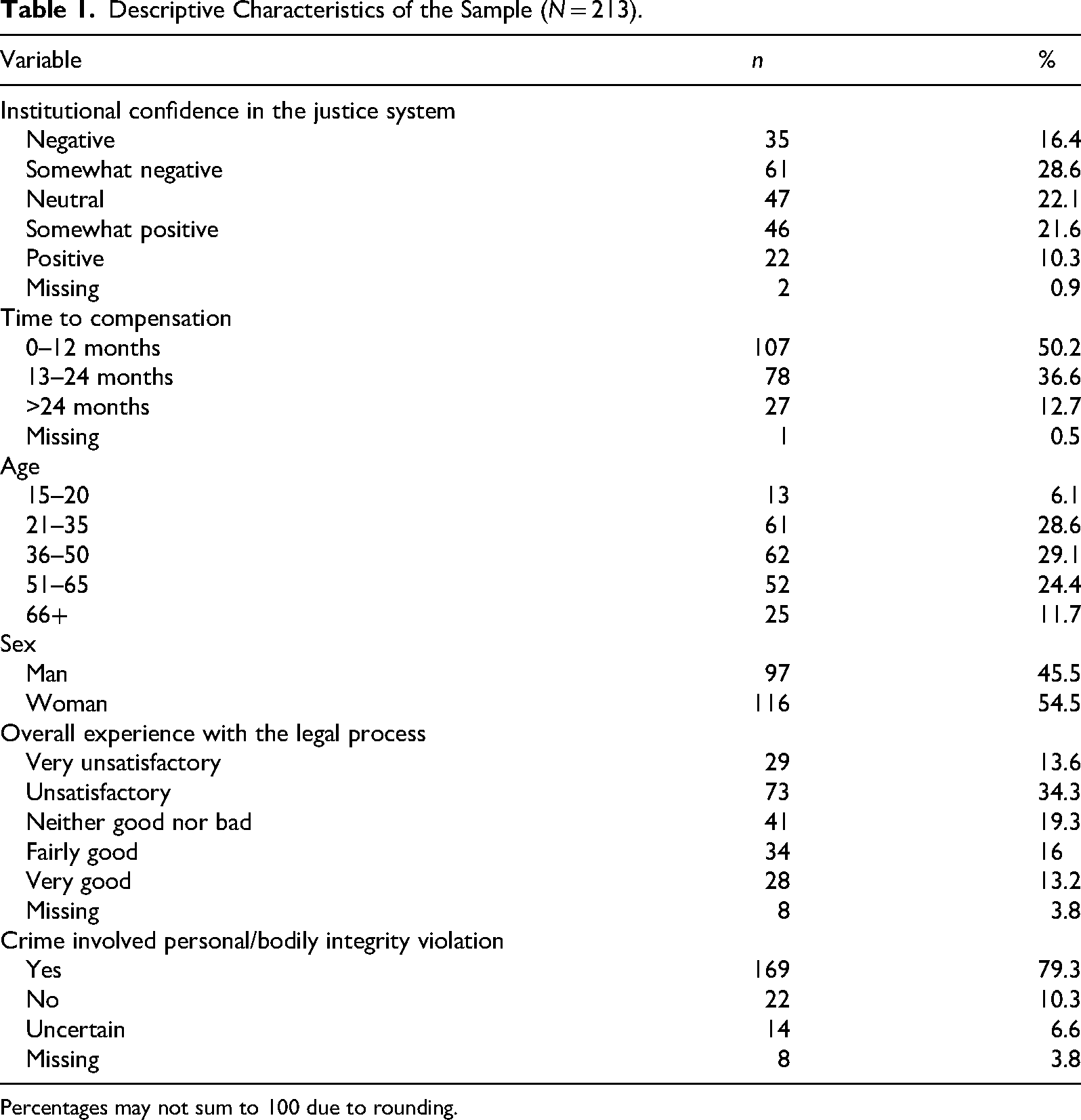
Percentages may not sum to 100 due to rounding.
For comparability with prior work and to avoid sparse cells, Table 2 presents a collapsed bivariate cross-tabulation of confidence (negative vs. positive) by compensation waiting time; multivariate models retain the full ordinal outcome. Neutral confidence responses were excluded to focus specifically on directional changes in confidence.
Confidence in the Justice System by Compensation Waiting Time.
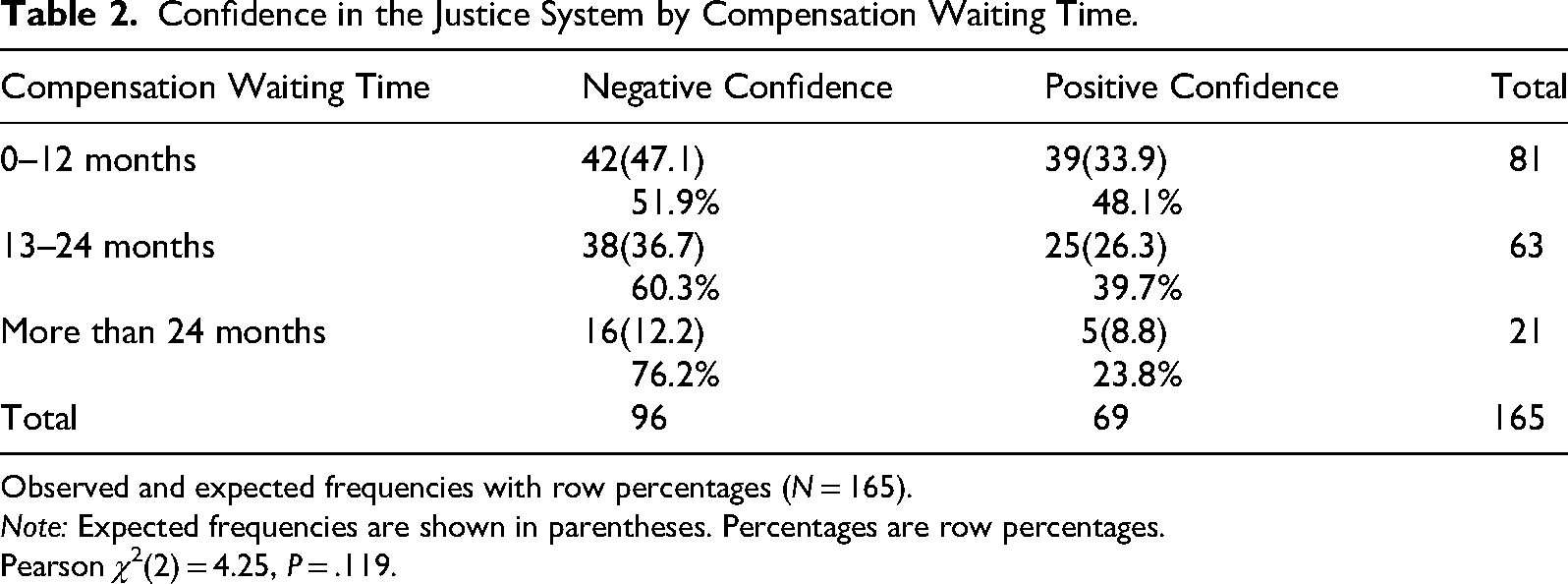
Observed and expected frequencies with row percentages (N = 165).
Note: Expected frequencies are shown in parentheses. Percentages are row percentages.
Pearson χ2(2) = 4.25, P = .119.
Overall, 58.2% of respondents (n = 96) reported that receiving compensation negatively affected their confidence in the justice system, while 41.8% (n = 69) reported a positive effect. Descriptively, longer compensation wait times were associated with higher proportions of negative confidence. Among respondents who waited more than 24 months to receive compensation, 76.2% reported negative confidence, compared to 60.3% among those waiting 13 to 24 months and 51.9% among those receiving compensation within 12 months. Conversely, positive confidence was most common among respondents with shorter wait times.
To assess whether this observed pattern reflected a statistically reliable association, a Pearson Chi-squared test was conducted. All expected cell counts exceeded the conventional threshold of five, satisfying the assumptions of the Chi-squared test. The association between compensation waiting time and confidence in the justice system was not statistically significant (χ2(2) = 4.25, P = .119). This finding indicates that, although compensation delays are descriptively associated with lower confidence, waiting time alone does not account for observed differences in confidence outcomes.
Taken together, the bivariate results suggest that compensation timing may shape victims’ perceptions in a directional sense, but that other factors, such as experiences with the legal process, crime characteristics, and the perceived meaning of compensation, are likely more influential in explaining variation in institutional confidence. Accordingly, the next section turns to multivariate analyses that incorporate these additional dimensions.
Multivariate Analysis
To evaluate whether compensation timing is associated with institutional confidence in the justice system while accounting for victims’ evaluations of compensation and respondent characteristics, we estimate ordered logistic regression models retaining the five-category confidence outcome in its ordinal form (negative → positive). Time to compensation is modeled categorically with three groups (0–12 months [reference], 13–24 months, and more than 24 months). The final model includes respondents’ compensation attitudes, age, and sex, reflecting a parsimonious specification selected to balance theoretical relevance and model stability given sample size.
Results are presented in Table 3. Compared to victims who received compensation within 12 months, those who waited more than 24 months reported significantly lower institutional confidence (b = −0.94, P = .022; OR = 0.39), net of compensation attitudes and demographic controls. The 13- to 24-month category does not differ significantly from the reference group (b = −0.22, P = .419; OR = 0.80). Compensation attitudes emerge as a strong positive correlate of institutional confidence: more favorable evaluations of compensation as meaningful redress are associated with substantially higher confidence in the justice system (b = 0.78, P < .001; OR = 2.17). Neither age nor sex is statistically significant in the final model.
Ordered Logistic Regression Predicting Institutional Confidence (N = 204).
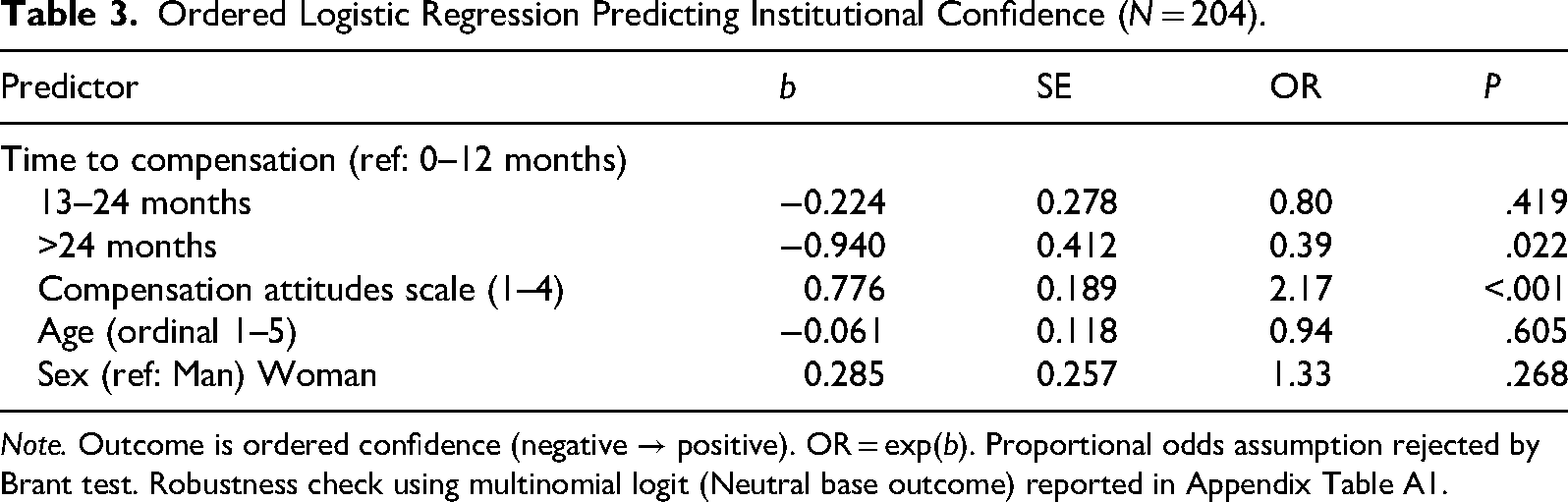
Note. Outcome is ordered confidence (negative → positive). OR = exp(b). Proportional odds assumption rejected by Brant test. Robustness check using multinomial logit (Neutral base outcome) reported in Appendix Table A1.
Model Specification and Assumption Checks
The Brant (1990) test indicates that the proportional odds assumption is violated for the model overall. We retain the ordered logit specification as the primary model because it preserves the ordinal structure of the outcome and provides a parsimonious, directional test aligned with the research question. To assess robustness, we additionally estimate a multinomial logistic regression model that relaxes the parallel-lines constraint; results from this specification are reported in the online appendix. Substantive conclusions are consistent across specifications: very long compensation delays (over 24 months) are associated with lower institutional confidence, while compensation attitudes are strongly and consistently associated with higher confidence.
Robustness to Proportional Odds Violations
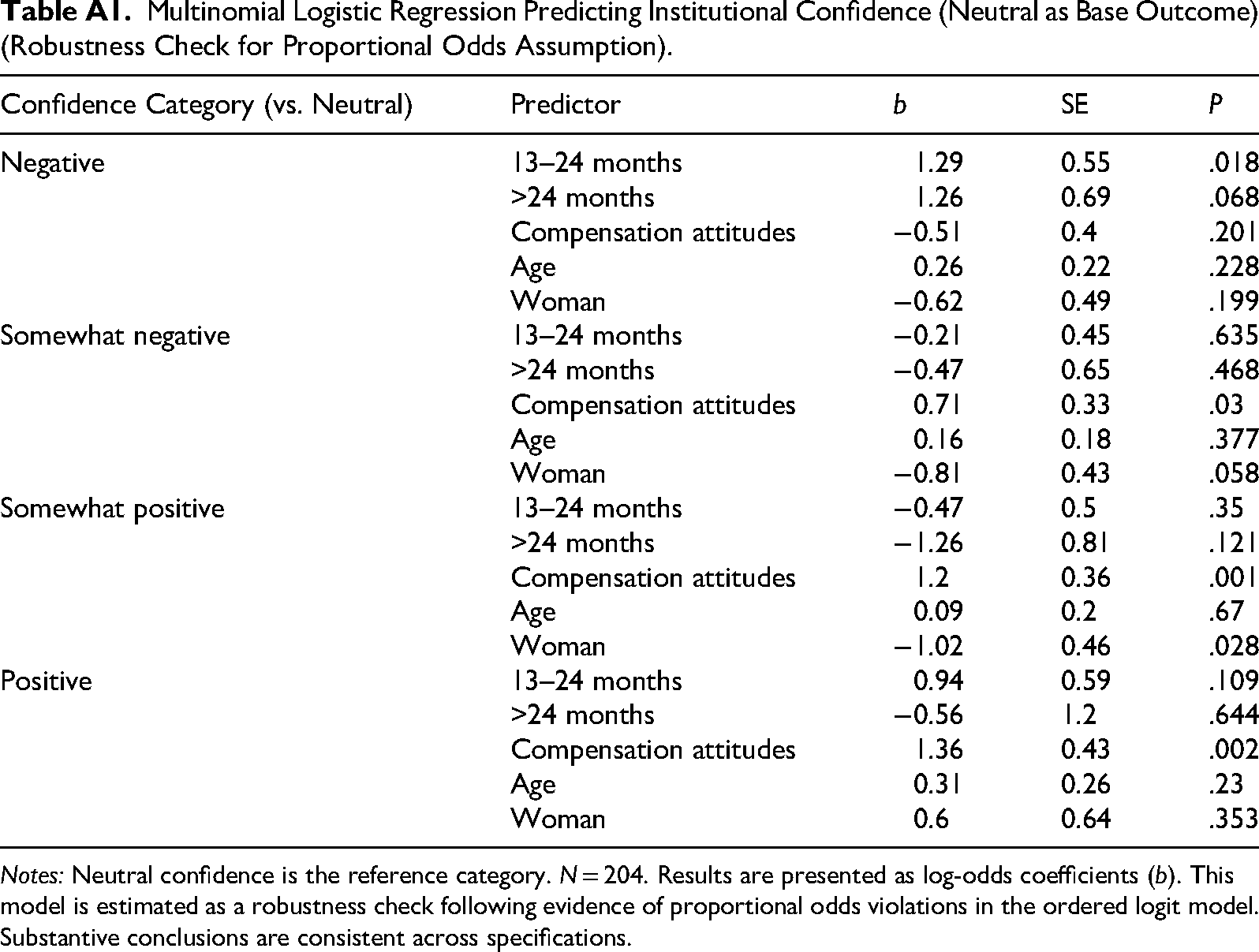
As a robustness check, we estimated a multinomial logistic regression treating the five-category confidence outcome as nominal and using the neutral category as the base outcome. Results were substantively consistent with the ordered logit estimates. More favorable compensation attitudes were associated with a greater likelihood of reporting positive confidence relative to neutral confidence (Somewhat positive: b = 1.20, P = .001; Positive: b = 1.36, P = .002). Extended compensation delays (over 24 months) showed the expected directional pattern, higher likelihood of negative confidence, and lower likelihood of positive confidence relative to neutral, although some contrasts did not reach conventional levels of statistical significance. Overall, the robustness model supports the conclusion that evaluative orientations toward compensation are strongly related to institutional confidence and that very long delays are associated with less favorable confidence outcomes. The substantive conclusions regarding compensation timing and perceived meaningfulness were robust to the inclusion of additional crime-impact controls in exploratory analyses.
Interpretation of Results
The multivariate results partially support the study's original hypothesis regarding compensation timing. Rather than a linear association between longer wait times and lower institutional confidence, the findings indicate a threshold effect. Victims who waited more than 24 months to receive compensation reported significantly lower confidence in the justice system compared to those compensated within 12 months, whereas those who waited 13 to 24 months did not differ significantly from the reference group. This pattern suggests that moderate administrative delays may be tolerated, but very long delays are associated with diminished confidence.
In contrast, victims’ evaluations of compensation as meaningful redress emerged as a strong and consistent predictor of institutional confidence. More favorable compensation attitudes were associated with substantially higher confidence across the ordered outcome categories, net of compensation timing and demographic controls. This finding underscores the importance of the symbolic and expressive dimensions of compensation, beyond the speed of delivery alone.
Age and sex were not statistically significant predictors in the final model, indicating that the observed associations are not driven by basic demographic differences among compensated victims. Taken together, the results suggest that institutional confidence among CVA-engaged victims is shaped less by incremental variation in processing time and more by whether compensation is experienced as timely enough and meaningfully affirming.
Discussion
This study examined whether compensation timing and compensation-related evaluations are associated with institutional confidence in Sweden's justice system among victims who received criminal injury compensation through the CVA. Two findings stand out. First, extended delays matter. Victims who reported waiting more than 24 months to receive compensation expressed significantly lower confidence than those compensated within 12 months, even after accounting for demographics and compensation attitudes. At the same time, the absence of a significant difference for the 13- to 24-month group suggests a threshold pattern rather than a simple linear decline. This aligns with procedural justice frameworks, emphasizing that victims may tolerate reasonable bureaucratic delays, but they interpret long waits as institutional indifference or a failure of responsiveness. This is especially true in a high-trust welfare-state context where timely state support is expected.
Second, victims’ perceived meaning of compensation is strongly associated with institutional confidence. A composite measure capturing whether compensation is experienced as meaningful, symbolically significant, and functionally redressive is a robust positive correlate of confidence. This supports an expressive procedural interpretation of compensation: payment is not merely material, but also communicates recognition and moral validation. When compensation is interpreted as meaningful redress, victims report more positive confidence outcomes, even in a bureaucratic administrative setting.
Notably, timing and meaning are not substitutes. The delay result remains even when accounting for compensation attitudes, suggesting that very long waits may independently shape confidence. Together, these findings indicate that institutional confidence among CVA-engaged victims is shaped not only by payment speed, but also by how compensation decisions are communicated to victims. Therefore, improving transparency, providing clear reasons for decisions, and acknowledging the specific harm suffered may help preserve confidence even when compensation amounts or processing times cannot be improved.
Conclusion
This study contributes to research on victim compensation by showing that institutional confidence among CVA-engaged victims is shaped by both timing and the perceived meaning of compensation. Rather than a simple linear relationship, the findings point to a threshold effect in which only very long delays are associated with diminished confidence. At the same time, victims who experience compensation as meaningful and dignity-affirming report more positive confidence outcomes, underscoring the expressive and symbolic dimensions of state compensation programs.
These results suggest that victim compensation programs are evaluated not only by the amount paid, but by how decisions are communicated and what compensation is understood to represent. Future research should leverage longitudinal or administrative timing data to better isolate causal effects and further examine which features of compensation communication and decision-making strengthen perceived recognition and institutional legitimacy.
Limitations
Several limitations of this study should be acknowledged. First, the translation of the survey from Swedish to English introduced potential gaps in meaning, particularly for legal terminology and crime-specific language. While a native Swedish speaker reviewed the translation, some nuanced Swedish concepts may not have had perfect equivalents in the English language.
Second, the survey did not collect self-reported information on the exact amount of compensation received. Therefore, the attitudes toward compensation used in this analysis serve as a proxy measure rather than a direct assessment of financial outcomes. Future studies might consider asking participants, if ethically appropriate, to disclose the total compensation received, so they may better understand the role of financial adequacy in shaping confidence.
Third, the cross-sectional design limits the ability to infer causal relationships. A longitudinal approach, tracking victims’ attitudes before, during, and after the compensation process, would provide richer insights into whether negative or positive perceptions of the justice system persist or change over time. Such a design would also allow researchers to examine the potential “cooling-off” effect of negative experiences or the reinforcing effects of positive engagement with the CVA.
Finally, the modest sample size (N = 204 in the final multivariate model; N = 211 with a valid outcome measure) limits statistical power and constrains generalizability beyond CVA-engaged victims. While sufficient for ordinal regression, larger samples would yield more precise estimates and permit the inclusion of additional covariates to better capture the complexity of victim experiences. Despite these limitations, this study provides a strong foundation for future research on victim compensation programs in Sweden and comparable justice systems.
Future Directions
Based on these findings, future research should move toward identifying the specific mechanisms linking compensation processes to institutional confidence. Sweden's administrative data infrastructure provides a unique opportunity to construct longitudinal designs that track victims across the compensation process. Linking CVA application data to key timestamps (e.g., submission, decision, and payment), as well as legal process milestones (e.g., police report, indictment, and verdict), would allow researchers to model trajectories of institutional confidence over time. These designs would enable tests of duration dependence and assess whether communication practices, such as updates or reasons-giving, mitigate the negative effects of prolonged delays.
Future studies should also pursue quasi-experimental approaches to better isolate the causal effects of compensation timing. Exploiting exogenous variation in administrative processing, such as policy changes, staffing fluctuations, or queue structures, would allow for designs such as difference-in-differences or event-study analyses. These approaches would help strengthen causal inference without requiring randomized assignment.
In addition, mixed-methods research would provide important insight into the symbolic dimensions of compensation. Qualitative interviews with compensated victims, especially those who experienced integrity-violating offenses, could help clarify how individuals interpret compensation decisions, official communication, and recognition by the state. Such work would help to unpack the underlying mechanisms that underlie the association between perceived meaningfulness and institutional confidence found in this study.
Finally, future research should examine policy-relevant interventions aimed at improving victim experiences within compensation systems. Experimental evaluations of low-cost communication strategies, such as status update notifications, plain-language decision letters, or anticipated-delay framing of compensation decisions, could assess whether improvements in perceived procedural fairness and recognition enhance institutional confidence, even when processing times remain unchanged. Comparative research across Nordic and other compensation systems would further help identify institutional features that promote legitimacy and positive victim outcomes across contexts.
Footnotes

Funding
The author received no financial support for the research, authorship, and/or publication of this article.
Declaration of Conflicting Interests
The author declared no potential conflicts of interest with respect to the research, authorship, and/or publication of this article.
Author Biography
Appendix A.
Multinomial Logistic Regression Predicting Institutional Confidence (Neutral as Base Outcome) (Robustness Check for Proportional Odds Assumption).
| Confidence Category (vs. Neutral) | Predictor | b | SE | P |
|---|---|---|---|---|
| Negative | 13–24 months | 1.29 | 0.55 | .018 |
| >24 months | 1.26 | 0.69 | .068 | |
| Compensation attitudes | −0.51 | 0.4 | .201 | |
| Age | 0.26 | 0.22 | .228 | |
| Woman | −0.62 | 0.49 | .199 | |
| Somewhat negative | 13–24 months | −0.21 | 0.45 | .635 |
| >24 months | −0.47 | 0.65 | .468 | |
| Compensation attitudes | 0.71 | 0.33 | .03 | |
| Age | 0.16 | 0.18 | .377 | |
| Woman | −0.81 | 0.43 | .058 | |
| Somewhat positive | 13–24 months | −0.47 | 0.5 | .35 |
| >24 months | −1.26 | 0.81 | .121 | |
| Compensation attitudes | 1.2 | 0.36 | .001 | |
| Age | 0.09 | 0.2 | .67 | |
| Woman | −1.02 | 0.46 | .028 | |
| Positive | 13–24 months | 0.94 | 0.59 | .109 |
| >24 months | −0.56 | 1.2 | .644 | |
| Compensation attitudes | 1.36 | 0.43 | .002 | |
| Age | 0.31 | 0.26 | .23 | |
| Woman | 0.6 | 0.64 | .353 |
Notes: Neutral confidence is the reference category. N = 204. Results are presented as log-odds coefficients (b). This model is estimated as a robustness check following evidence of proportional odds violations in the ordered logit model. Substantive conclusions are consistent across specifications.
Appendix B.
Survey Instrument (English Translation and Swedish Original)
Appendix Table A1 presents the full wording and response options for all survey items used in the analyses. The survey was administered in Swedish; English translations are provided for transparency. Translations were reviewed by a native Swedish speaker. Items not used in the present analyses (e.g., vignette-based compensation scenarios) are omitted.