







Abstract
Research increasingly shows immigration has neutral or protective effects on community homicide and violence. However, less is known about whether these patterns extend to fatal gun violence. Immigration may uniquely influence such homicides as immigrants often settle in disadvantaged areas with high rates of gun violence, and Hispanic immigrants are frequently linked to gangs in public discourse, which disproportionately contribute to firearm homicides. To address this gap, this study examines nationwide county-level data from the Center for Disease Control mortality reports and the American Community Survey (2000–2015) using negative binomial and fixed-effects models. Findings indicate immigration, including Hispanic immigration, largely protects against firearm homicide with a few exceptions in fixed effects models, which supports the immigrant revitalization thesis and suggests insulating effects of immigration on lethal gun violence.
Introduction
There is now a large body of research showing that immigration has either neutral or protective effects that help reduce community levels of homicide and violence (Feldmeyer and Steffensmeier, 2009; Light and Miller, 2018; Martinez and Lee, 2000; Lee et al., 2001; Ousey and Kubrin, 2018; Sampson, 2008). However, this has not halted public debate surrounding immigration–crime relationships. Public fears and political rhetoric about immigration and violence have persisted or even amplified in the face of this evidence, making it one of the centerpiece topics of elections and political campaigns throughout the early twenty-first century (Davis, 2023; Lee, 2015; Snow, 2022). Narratives linking immigrants and immigration to high profile homicides and gang violence have been particularly prominent in political discourse. For instance, claims that violent Hispanic immigrant gangs were “taking over” apartment complexes and portions of the city in Aurora, Colorado were rampant for weeks during the 2024 presidential election (Heckman, 2024). Several high-profile homicide cases—such as those of Laken Riley, Kate Steinle, and Jocelyn Nungaray—in which U.S. citizens were killed by undocumented immigrants heightened public fear. These incidents have also fueled sweeping stereotypes, including President Trump's widely criticized statement that Hispanic immigrants are “murderers and rapists” (Roosevelt Room, 2018). In sum, concerns about immigration and homicide have not waned despite consistent evidence showing that immigration is more likely to revitalize communities and reduce homicide than it is to generate fatal violence (Lee and Martinez, 2009; Martinez and Lee, 2000; Ousey and Kubrin, 2009, 2018; Sampson, 2008).
What is less clear, however, is whether the relationships between immigration and homicide are similar across specific forms of fatal violence—specifically homicides involving firearms. To date, research on immigration and homicide has largely focused on overall measures of homicide and general relationships between immigration and fatal violence (Akins et al., 2009; Feldmeyer and Steffensmeier, 2009; Lee et al., 2001; Lee and Martinez, 2002; Martinez et al., 2010; Martinez et al., 2016; Ousey and Kubrin, 2014; Schnapp, 2015). In contrast, few studies have examined immigration effects on firearm violence—one of the most pervasive forms of fatal violence in the United States. In particular, immigration may have a unique association with firearm-related homicides for two key reasons. First, immigrants are more likely to settle in disadvantaged communities that already experience higher gun violence (Buggs and Zeoli, 2022; Semenza et al., 2021). Second, Hispanic immigrants in particular are often discussed in the same context as gangs, which disproportionality account for high shares of firearm homicide (Huebner et al., 2016; Pelletier and Pizarro, 2019; Ward, 2013). As we describe in the following sections, further work is needed to obtain a more complete picture of immigration–gun violence relationships.
The current study addresses this gap in the research by examining macrolevel relationships between immigration and community firearm-homicide patterns. This study primarily focuses on firearm-related homicide, examining how county-level patterns of overall immigration and Hispanic immigration are associated with lethal violence involving firearms. To contextualize these findings and reaffirm prior research, we also analyze total homicides and include a separate category capturing all homicides not involving firearms. In doing so, this study extends analyses of immigration effects across fatal violence in several key ways—that is, by focusing on firearm-related homicides, using a different study unit (counties instead of urban neighborhoods) that includes both rural and urban areas, providing national coverage (rather than focusing on select cities), and assessing these relationships for more recent time periods than prior analyses. To conduct this analysis, the current study uses national county-level data on homicide deaths drawn from the Center of Disease Control (CDC) mortality records and data on immigration and other ecological, economic, and demographic characteristics of counties drawn from the American Community Survey (ACS) 5-year estimates and the U.S. Census. This study uses cross-sectional negative binomial regression analysis and fixed-effects time series models to examine immigration's association with firearm homicide (as well as effects on overall homicides and homicides not involving a firearm). Results show that both total immigration and Hispanic immigration most often have either neutral or protective effects on firearm-related homicides, indicating that immigration does not increase and may insulate communities against this form of fatal violence.
Prior Research and Theory on Immigration and Crime
Immigration to the United States has risen sharply in the early decades of the twenty-first century. Twenty three percent of the immigrant population in the United States entered the country between 2000 and 2009, and 31% have entered since 2010 (Batalova, 2024). Between 2013 and 2014 alone, one million immigrants entered the country, which was one of the largest annual growths in immigration seen in recent U.S. history (Batalova, 2024). Of this growing immigrant population, Hispanic immigrants comprise the majority, accounting for 19.8 million, or one-third, of all Hispanics living in the U.S. as of 2019 (Pew Research Center, 2022). Due to this rapid rise in immigration, foreign-born residents now account for 14.1% of the U.S. population (Passel and Krogstad, 2023).
As highlighted above, this sharp increase in immigration coupled with political rhetoric and several high-profile homicides has led to widespread fears that immigration generates social harms and contributes to rising levels of homicide and violence in U.S. communities (Davis, 2023; Lee, 2015; Snow, 2022). Political rhetoric has often associated immigrants with violence and crime, and moral panics have led many to believe this sentiment to be true (Lati, 2024; Proffit and Feldmeyer, 2025). For instance, President Donald Trump has provided a long list of claims suggesting that immigrants coming over the southern border “undermine public safety” and are prone to murder, rape, and serious violence (Lati, 2024; Roosevelt Room, 2018).
However, research has shown that immigration tends to have protective effects that insulate communities from serious violence (see reviews in Kubrin, 2013; Lee and Martinez, 2009; Ousey and Kubrin, 2014, 2018). To explain these findings, research has largely relied on the “immigrant revitalization” thesis, which suggests that at the macrolevel, immigration bolsters community growth and insulates areas from violence, disadvantage, and other social problems (Lee and Martinez, 2009; Martinez and Lee, 2000; Ousey and Kubrin, 2018; Velez, 2009). This thesis argues that immigration helps buffer communities from the consequences of disadvantage (i.e., crime and violence) and although it does not remove these harms, it may dampen them relative to the level of disadvantage a community experiences. For instance, immigrants typically uphold traditional prosocial values, such as strong emphasis on employment, familial bonds, and connections to faith and the community (Feldmeyer et al., 2019; Martinez and Lee, 2000; Ousey and Kubrin, 2009). These strong ties help secure social support among immigrants, in turn fostering social control (Velez, 2009).
Additionally, the revitalization thesis argues that inflows of immigrants bring new economic institutions to communities through involvement in the informal economy (e.g., street vendors—Moore & Pinderhughes, 1993) and acquisition of unwanted jobs in the formal economy (Wang, 2012). As such, immigrant-dense communities see widespread job opportunities, stimulating the economy areas that might otherwise see little economic growth (Velez, 2009). Rather than creating disorganization, the revitalization perspective argues that immigration stabilizes neighborhoods by strengthening social ties, increasing social capital, and reinforcing social and economic institutions in the community (Feldmeyer, 2009; Martinez and Lee, 2000; Lee et al., 2001). Taken together, this perspective suggests that increased immigration revitalizes communities and makes immigrant neighborhoods “some of the safest places around” (Sampson, 2008, p. 30).
Immigration and Homicide
As noted earlier, there is now a sizable body of empirical research that has examined the macrolevel relationships between immigration, homicide, and other forms of serious violence. Across these studies, findings have shown one of three things. Immigration either has no association with homicide (Akins et al., 2009; Lee et al., 2001; Lee and Martinez, 2002; Schnapp, 2015; among others), immigration reduces community levels of homicide (Feldmeyer, 2009; Feldmeyer and Steffensmeier, 2009; Ousey and Kubrin, 2014; Martinez et al., 2010; Martinez et al., 2016; among others), or its effects depend on other structural or ecological contexts (Feldmeyer et al., 2015; Kubrin and Ousey, 2009; Martinez, 2000; Ramey, 2013; Shihadeh and Barranco, 2013; Velez, 2009). 1
This body of work was perhaps best summarized in Ousey and Kubrin's 2018 meta-analysis of macrolevel immigration and crime studies. In their paper, Ousey and Kubrin reviewed 51 studies to assess the overall impact of immigration on community crime rates, many of which focused specifically on homicide. Their findings reveal that on average, immigration has negative, but weak, associations with crime and violence (Ousey and Kubrin, 2018). They emphasize that while 39% of the studies analyzed homicide—making it the most commonly examined outcome—only a few studies differentiated between forms of fatal violence (see Martinez, 2000; Nielsen et al., 2005). In addition, they suggest that immigration might be associated with some forms of fatal violence more than others and specifically recommend that future research explore this possibility.
In particular, additional research that expands on this work is needed to gain a clearer picture of whether immigration effects vary when examining fatal gun violence, which has received limited attention in previous work (but see Proffit et al., 2026). As mentioned prior, immigration may have a unique relationship with firearm-related homicides for two key reasons. First, immigrants are more likely to reside in structurally disadvantaged communities where gun violence is already elevated and illegal firearm access is high (Buggs and Zeoli, 2022; Semenza et al., 2021). Second, Hispanic immigrants are frequently discussed within the context of gang activity—groups that disproportionately contribute to firearm-related homicides (Huebner et al., 2016; Pelletier and Pizarro, 2019; Roberto et al., 2018). Taken together, these factors provide theoretical justification for further exploration of this topic, which we now examine in greater detail.
Immigration and Gun Violence
Structural Disadvantage and Firearms
Although prior studies have shown that immigration into disadvantaged neighborhoods has not equated to more crime, violence, or homicide—past research has not fully explored how immigration relates to fatal gun violence. Immigrants are more likely to settle in disadvantaged areas, and studies have shown a significant association between guns and socioeconomic disadvantage, which in turn heightens rates of firearm homicide (Beardslee et al., 2019; Semenza et al., 2021; Semenza et al., 2022). Research has also revealed strong connections between neighborhood conditions and firearm homicides, especially in areas characterized by high levels of poverty, income inequality, low educational attainment, and low levels of collective efficacy (Buggs and Zeoli, 2022; Carter et al., 2017; Kravitz-Wirtz et al., 2022; Semenza et al., 2021).
Although past research strongly supports the notion that immigration is either unrelated to homicide levels, or may even lower them, the overwhelming majority of this research has only examined overall homicide rates. Notably, the immigrant revitalization perspective reviewed above suggests that the protective effects of immigration should also extend to gun violence. Yet, this relationship has not been explored in depth. In addition, there are some theoretical reasons suggesting why immigration could contribute to community conditions that are tied to greater gun violence. Some research has shown that immigration can be associated with lower levels of collective efficacy (Feldmeyer et al., 2019; Sampson et al., 1997). Immigration may also contribute indirectly to neighborhood levels of poverty, language heterogeneity, income inequality, and low educational attainment (Chen & Zhong, 2013; Shaw and McKay, 1942; Barranco & Shihadeh, 2024 Shihadeh and Barranco, 2024; Martinez and Lee, 2000)—conditions which have been associated with greater community gun violence. This is not to say immigrants themselves are perpetrating gun violence. Rather, in some areas (particularly new destinations—see Barranco & Shihadeh, 2024; Ramey, 2013; Shihadeh and Barranco, 2013) immigrants may contribute to community levels of disadvantage and conditions that make places more susceptible to gun violence. With immigrants often residing in structurally disadvantaged areas—and firearm homicides are closely linked to such disadvantage—it is possible the dominant focus on overall homicide rates has overlooked a distinct relationship between immigration levels and fatal gun violence.
Gangs and Firearms
Political rhetoric has long associated immigration with gang activity, with a specific focus on Hispanic immigrants. For instance, headlines have claimed that “the migrant surge brings killers and criminal gangs” (Lajka, 2019; McCaughey, 2024). Political rhetoric describing Hispanics as “murders” and “rapists,” alongside claims that the United States now faces “an army of illegal alien gang members” composed of “Venezuelan prison gangs,” reflect the inflammatory framing often used in public discourse (McCaughey, 2024; Sentner, 2024). Although these connections are less prominent in academic research, scholarship has shown some potential connections between the two (Katz and Schnebly, 2011; Ward, 2013). In general, gang members are more likely to commit homicides using firearms than any other weapon (Carlock and Lizotte, 2015; Pelletier and Pizarro, 2019). In terms of gang membership dynamics, Katz and Schnebly (2011) found that immigrant dense communities had higher levels of gang membership. Prior research has also indicated that gang membership reduces the network distance (how close someone is) to firearms by 20%, and the closer gang members are to firearms, the greater the risk of victimization (Roberto et al., 2018). Immigrant youth may be vulnerable to gang recruitment as well, as some undocumented immigrant youths are excluded from legitimate opportunity structures (potentially due to complex pathways to citizenship) and face unique marginalization that may foster conditions conducive to gang affiliation (Alexis, 2021). For these reasons, immigration may take on particular importance in shaping community rates of firearm homicide.
Although the arguments described above provide plausible reasons why immigration could have a unique relationship with firearm homicides, the immigrant revitalization thesis suggests otherwise. Through the creation of tight friendship and kindship networks, immigrant communities often have greater levels of informal social control (Feldmeyer et al., 2019). In addition, familism is strong among immigrant groups with great emphasis placed on the fulfillment of family role obligations, sharing recourses, mutual assistance, and pro-social orientations (Landale et al., 2006; Martinez and Lee, 2000; Ousey and Kubrin, 2009; Vega, 1995). Alongside these protective social characteristics, immigration often rejuvenates economies by increasing employment in vital sectors of the economy (Martinez and Lee, 2000; Moore and Pinderhughes, 1993; Velez, 2009). These social and economic characteristics associated with immigrant revitalization are precisely the mechanisms that help stymie structural disadvantage, gang activity, and gun violence (Buggs and Zeoli, 2022; Carter et al., 2017; Kravitz-Wirtz et al., 2022; Martinez, 2000; Martinez and Lee, 2000; Ousey and Kubrin, 2014; Proffit et al., 2026; Semenza et al., 2021). In addition, a large majority (79% as of 2023) of homicides involve a firearm (Gramlich, 2025). As described earlier, prior works have consistently supported the immigrant revitalization thesis, which suggests broad insulating effects from all crime and violence. Thus, there is also strong reason to believe that the protective effects of immigration will extend to firearm-related homicides. Although this theoretical framework has received substantial empirical support (Feldmeyer and Steffensmeier, 2009; Light and Miller, 2018; Martinez and Lee, 2000; Lee et al., 2001; Ousey and Kubrin, 2014, 2018; Sampson, 2008; among others), it is important to continue testing its applicability to specific forms of violence, such as firearm-homicide—especially given the arguments highlighted above and the pervasive political rhetoric suggesting that immigration generates fatal gun violence.
The Importance of Context: Destination Types
Although the immigrant revitalization thesis has seen robust support, some studies have indicated immigration's crime-reducing effects can be “context dependent”—especially pertaining to destination type (Barranco et al., 2017; Feldmeyer et al., 2015; Ramey, 2013; Shihadeh and Barranco, 2013). Studies examining immigrant destinations have largely concluded that in traditional or “established” destinations, communities may reap the benefits of immigration and revitalization more so than new or “emerging” destinations (Ramey, 2013). In long standing destinations (e.g., Miami-Dade County, San Diego) immigrants have existing networks consisting of established friendship networks, labor markets, and organizational infrastructure that can foster economic and social opportunities more effectively—in turn reducing crime (Ramey, 2013). However, new destinations may not yet have the institutional and social support present in traditional destinations, making revitalization processes slower to develop. In turn, newer destinations may not have the full safety net of effects from immigration, or may even experience momentary community disruption in response to early immigration flows in areas that lack the “protective social control umbrella” of established destinations (Shihadeh and Barranco, 2013).
As such, it is also possible that immigration effects on gun violence may vary by destination type. In established destinations, strong social support, resources, and peer networks may offset gun violence more effectively as informal control and collective efficacy are stronger in established immigrant communities. However, in newer destinations, the lack of established institutional and social support may hinder revitalization efforts. Structural disadvantage may be harder to offset and gang activity may be more likely in new destination communities that do not have the protective social control umbrella found in traditional destinations (Shihadeh and Barranco, 2013). Therefore, immigration may have less of an ability to insulate new destinations from disadvantage, gang activity, and ultimately gun violence.
The Current Study, Data, and Methods
In light of the issues highlighted above, the current study seeks to extend research on immigration and homicide by examining immigration effects on macrolevel rates of firearm-related homicide. As noted above, few analyses have examined immigration effects on gun violence. With this in mind, the current study asks whether immigration's protective (or null) effects on homicide hold when focusing specifically on firearm-related homicide. According to the immigrant revitalization thesis, immigration should not increase any form of homicide, and in some cases, may insulate communities from certain forms of lethal violence. However, it remains unclear whether these protective effects extend to fatal gun violence. To address these questions and extend prior work, this study utilizes nationwide county level data from four timepoints (2000, 2005, 2010, and 2015) to assess how immigration is associated with firearm-related homicides, based on CDC coroner reports. The following section outlines the data and methods used to address these research questions.
Data
Data for the current study are drawn from multiple sources covering the 1999–2016 period. Information on homicide deaths are taken from the CDC Multiple Cause of Death (MCOD) restricted-access mortality data (CDC, 2020). These data contain all death records in the United States from 1999 to 2016 and report the underlying cause of death, including multiple forms of homicide. These data are also available by location (i.e., county of residence) for each death, which were used to create 3-year averages of homicide for the 2000–2015 period (our final analytic time frame). There are several advantages to CDC mortality data for studying macrolevel homicide patterns. First, these data are free from biases and caveats often associated with official police data. Specifically, issues related to enforcement or reporting bias in law enforcement data do not pertain (Hindelang et al., 1979). Second, these data provide national county-level coverage from 1999 to 2016. Using national county-level data allows for a more comprehensive analysis by capturing both urban and rural areas, whereas past studies that focused on a handful of cities may not fully represent broader regional or demographic variations. This approach enhances the generalizability of findings and provides a more complete understanding of patterns and trends across different community types and covers more recent time periods. In addition, the CDC data disaggregates homicides by type, which we discuss in more detail below.
Information on the ecological, economic, and demographic characteristics of counties is drawn from the ACS 5-year estimates. 2 The ACS is an ongoing survey conducted by the U.S. Census Bureau that provides data every year on a large range of topics, including economic, social, demographic, and housing characteristics of the U.S. population. The 5-year estimates represent data collected over a 5-year period and are advantageous because they provide estimates for a wide range of topics and provide national coverage across multiple study units (Feldmeyer et al., 2022a; U.S. Census Bureau, 2022).
All data on homicide, ecological, economic, and demographic characteristics are aggregated to the county level and merged based on FIPS county codes. Only counties with a population of least 5,000 residents were included in the analyses, as prior macrolevel research has indicated counties with smaller populations may produce unreliable estimates in aggregate analyses of rare events like homicide (Monnat et al., 2019; Rosenfeld et al., 2021). To be more exhaustive, several robustness checks were performed with different population cutoffs for both the total population (>100,000, <100,000) and immigrant population (>500) which are discussed in the Supplemental Analyses section. The final analytic sample resulted in 11,262 counties for analysis between 2000 and 2015.
Dependent Variables
The dependent variables for this study are county homicide death counts for total, firearm, and “other” homicide recorded in CDC MCOD mortality data. The CDC MCOD mortality data contain information on the following: homicide by any weapon (e.g., blunt force, cutting instrument, firearms, explosives), homicide by any gun (e.g., handgun, shotgun, military rifle, hunting rifle, other firearms), homicide by handgun, homicide by bodily force (e.g., bodily assault, or rape), homicide by poison, and homicide by other means (e.g., suffocation, falling). As such, the above variables were recoded into total homicide, firearm homicide, and other homicide, which are described in more detail below. 3
First, we created a total homicide variable to capture overall homicide by combining the appropriate homicide counts into a single measure, mirroring the approach commonly used in prior research. Second—and the focus for this analysis—firearm homicide includes all gun-related homicides (i.e., homicide by any gun). Finally, other homicide includes all forms of homicide not including a firearm (e.g., bodily assault, blunt force, cutting instrument, rape, poison, other means). All homicide measures use 3-year aggregated counts surrounding each year of analysis (e.g., 2014–2016 for 2015 counts). Research has shown that using 3-year measures of homicide offers better reliability and smooths out annual fluctuations and anomalies, providing a more stable and accurate representation of trends and patterns in homicide data over time (Feldmeyer et al., 2022b).
Independent Variables
The primary independent variable of interest is immigration. In line with prior macrolevel research on immigration and crime (Feldmeyer et al., 2022a; Lee et al., 2001; Ousey and Kubrin, 2009, 2018), immigration is measured as the percentage of the county population that is foreign born. To be more exhaustive, we also include a measure of Hispanic immigration, which is measured as the percentage of the county population that is specifically Hispanic foreign born. This measure is included for several reasons. First, Hispanic immigrants are often vilified in the media for contributing to crime and violence, potentially through gang activity (Lati, 2024; McCaughey, 2024). Including this separate measure will allow for assessment of these claims. Second, Hispanic immigrants are more likely to settle in disadvantaged, high-crime areas due to their lower socioeconomic position (Martinez and Lee, 2000), which may provide insight into specific associations with firearm-related homicides.
We include several other important predictor variables to control for social, economic, and demographic contexts. To control for county socioeconomic conditions, we include a disadvantage index (Sampson & Wilson, 1995; Steffensmeier et al., 2010). This index was created using principal components analysis and combines measures of poverty (percentage of the population in poverty), unemployment (percentage of the population that is 16+ and unemployed), educational attainment (percentage of the population that is 25+ with less than a high school education), and family structure (the percentage of female-headed households). 4
Economic inequality, another measure of socioeconomic status, is measured using a Gini index of income inequality. This measure captures dispersion of income in a county compared to the nation and is used as a gauge of economic inequality. This measure is used to capture socioeconomic context beyond disadvantage, as prior literature has indicated inequality to be a driving force in macrolevel homicide (Galster and Sharkey, 2017; Papachristos et al., 2018). We also control for county manufacturing employment rates (manufacturing jobs per 1,000 residents) as prior work has linked immigration and competition for these jobs with violence (Feldmeyer et al., 2022a; Messner and Sampson, 1991; Shihadeh and Barranco, 2010a).
To account for community diversity, we include a measure of racial/ethnicity heterogeneity calculated using an entropy index of diversity. 5 We include a measure of residential mobility (percentage of the population who moved within the last year) to control for population turnover and community stability (see Pratt and Cullen, 2005; Shaw and McKay, 1942; Steffensmeier et al., 2010). Other controls include the percentage of the male population aged 15–29, total population, and police presence (police officers per 100,000 people). 6
Analytic Strategy
This study utilizes negative binomial regression and Poisson pseudo-maximum likelihood models (PPML) with two-way fixed effects to assess the association between immigration (and Hispanic immigration) and firearm homicide, while also examining measures of total homicide and other homicide. Homicides are rare events, and examination of the data showed positive skewness in homicides across counties. Many counties have few homicides, but several larger urban counties have sizable shares of homicides. Thus, we rely on count-based models to account for the skewed nature of our dependent measures (for similar approaches, see Feldmeyer et al., 2022b; Katz and Schnebly, 2011; Osgood, 2017). In particular, negative binomial regression is well suited for modeling data that exhibit overdispersion, as is the case in our homicide measures. When using these models to examine crime events, it is more appropriate to model a count variable as a rate, thus a population offset is used. Examination of the likelihood ratio test revealed the model with the offset fits the data significantly better than the model without the offset. 7
The formal analysis proceeds as follows. First, we present descriptive statistics showing county patterns of homicide and social-economic context for each of the four time points examined in this study. Second, we present results from cross-sectional negative binomial regression analyses (for 2000, 2005, 2010, and 2015) to examine relationships between immigration and the three homicide types examined here. Third, we replicate all analyses using Hispanic immigration in place of the overall immigration measure to see if effects differ specifically for Hispanic immigration. Fourth, we estimate a Poisson pseudo-maximum likelihood model (PPML) with two-way fixed effects. This specification includes county and year fixed effects to account for time-invariant unobserved heterogeneity as well as temporal shocks that may have occurred during the study period (Correia et al., 2020; Firebaugh et al., 2013). 8 Standard errors are clustered at the county level to account for within-county serial correlation over time. In addition, a population exposure is included to model homicide rates. To assess the extent of temporal variation underlying the longitudinal models, we decomposed variance into within- and between-county components (see Table 1A in Appendix A). Results indicate that most variation in the foreign-born and Hispanic foreign-born population share is cross-sectional rather than longitudinal, with a between-county standard deviation of 5.18 (%foreign-born) and 3.95 (%Hispanic foreign-born) compared to a within-county standard deviation of 0.97 and 0.78, respectively. This suggests that changes within counties over time are relatively modest, which may limit the precision of estimates. Finally, we conduct several supplemental analyses as robustness checks to further examine these relationships. We use alternative population cutoffs for both county population and immigrant presence. We also assess how these relationships vary across different community contexts, including levels of urbanization and destination type.
Descriptive Statistics of Outcome and Explanatory Variables (n = 11,262).
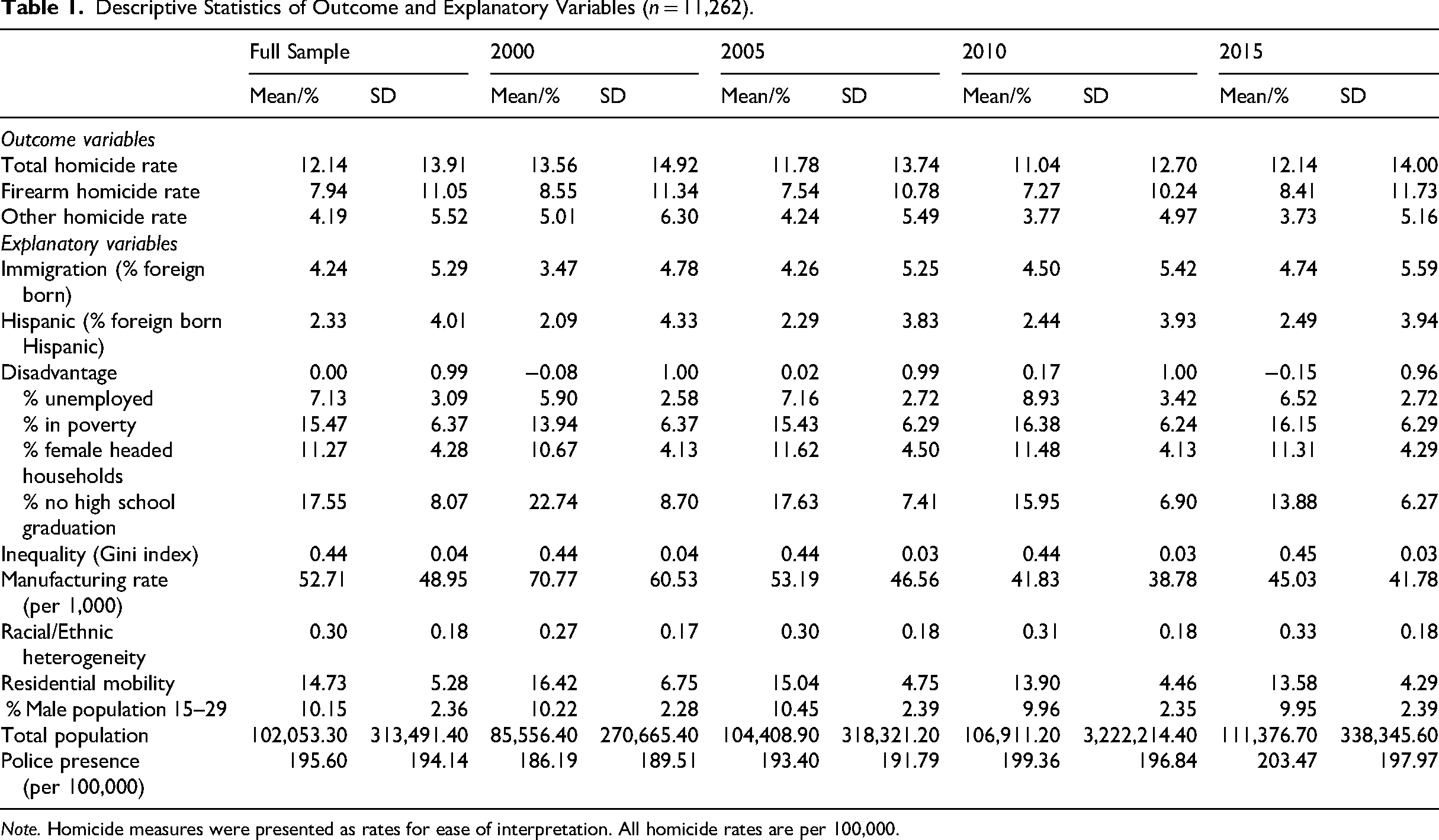
Note. Homicide measures were presented as rates for ease of interpretation. All homicide rates are per 100,000.
Findings
Beginning with the descriptive statistics, Table 1 provides county-level statistics for all outcome and explanatory measures. Across the full sample (2000–2015), the average total county homicide rate was 12.14 per 100,000. However, the standard deviation was 13.91, suggesting large variations in homicide at the county level. Next, firearm homicides averaged a rate of 7.94 per 100,000 between 2000 and 2015. Finally, other homicides had an average county rate of 4.19 per 100,000. Across the study period, all three forms of homicide followed a similar trend declining from 2000 to 2010 and seeing small upticks in 2015 (with the exclusion of other homicides which continued to decline).
Turning to our measure of immigration, Table 1 shows that 4.24% of U.S. county populations were foreign-born for the study period as a whole, but immigrant shares varied widely across place. Some counties had almost no foreign-born residents, while others (e.g., Miami-Dade County, Florida) reached over 50% foreign-born populations by 2015. Hispanic foreign-born populations averaged 2.33% across counties for the study period. Notably, both overall immigration and Hispanic immigration measures saw slight increases from 2000 (3.47% and 2.09%) to 2015 (4.74% and 2.49%), respectively.
Several descriptive patterns among the control variable are also worth noting. Unemployment increased from 2000 to 2010 but experienced a decline in 2015, averaging about 7.13% for the study period as a whole. Poverty rates followed a similar pattern, with increases from 2000 to 2010 and a slight decline in 2015. On average, about 15.5% of county populations were in poverty throughout the study period. The average county percentage of female-headed households was 11.27% overall, with some slight increases from 2000 to 2010. Lastly, the rate of individuals without a high school diploma decreased over time, dropping from 22.74% in 2000 to 13.88% by 2015. On average, inequality was 0.44 on the Gini index, suggesting moderate, but not extreme, levels of economic inequality at the county level across the study period. Finally, manufacturing employment rates declined steadily from 2000 to 2015, dropping from 70.77 per 1,000 to 45.03. Descriptive statistics for other ecological, demographic, community, and population controls were relatively stable during the study period and are shown in Table 1.
Results: Immigration and Firearm Homicide
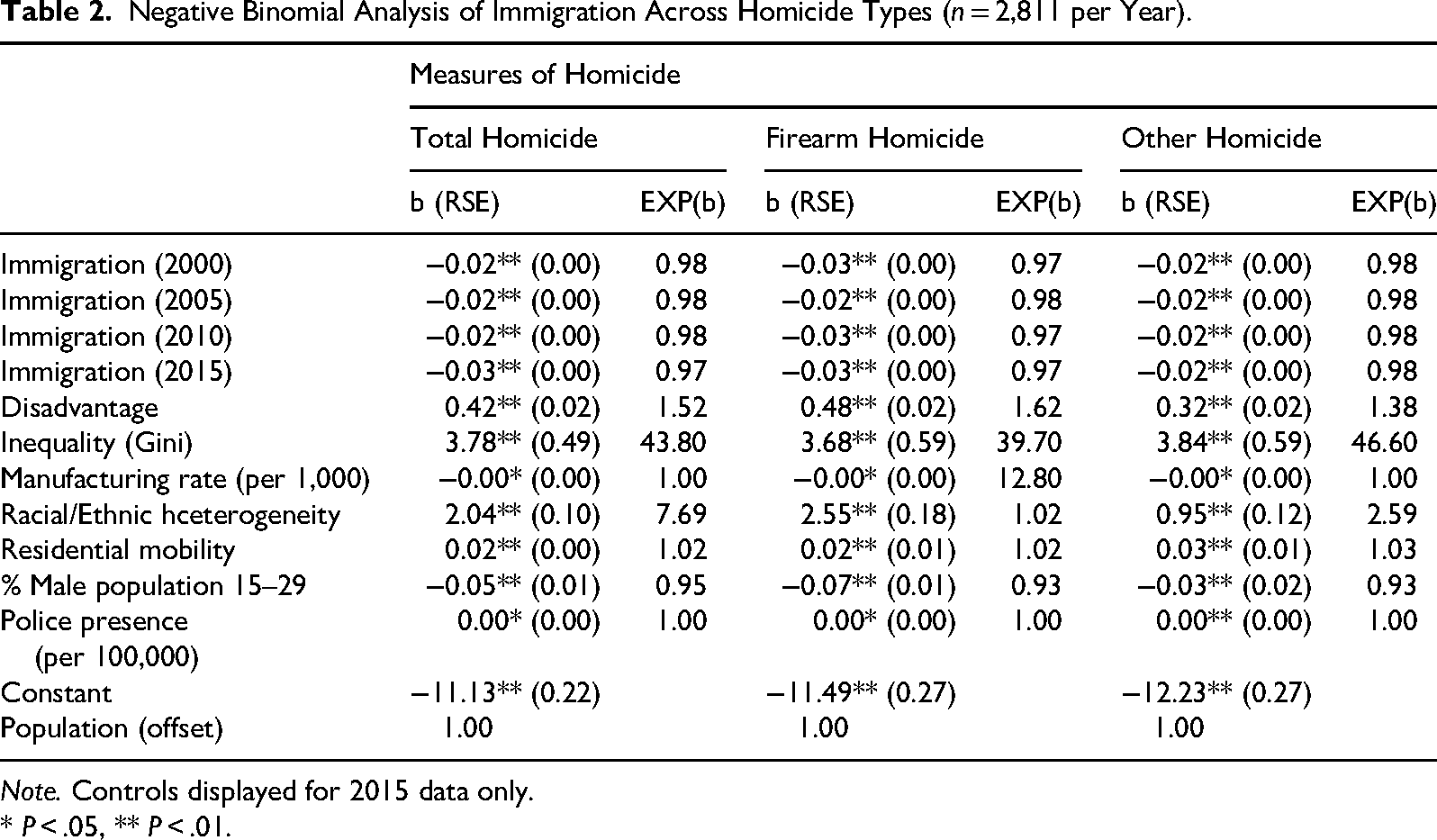
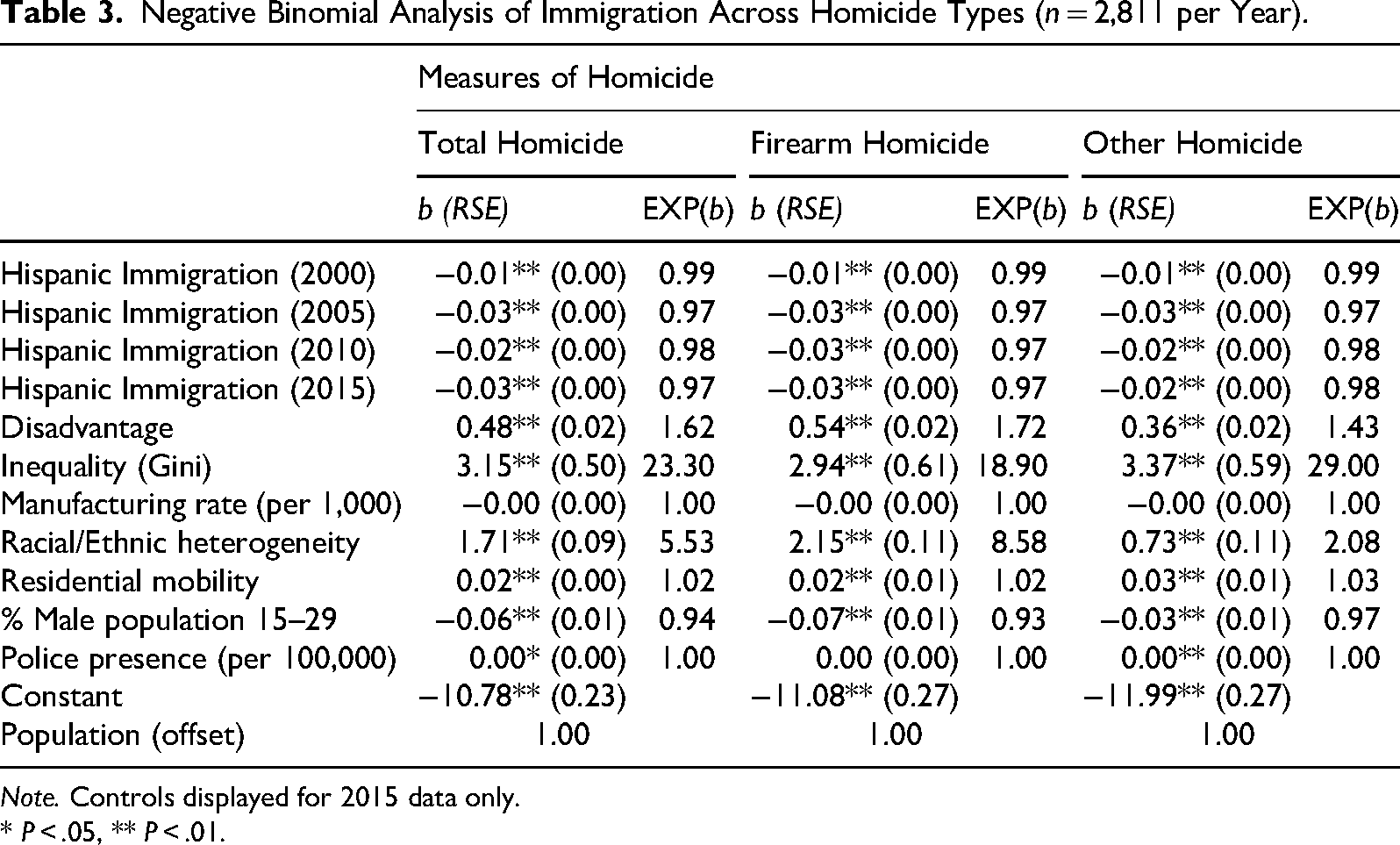
We now turn to the negative binomial regression models examining immigration and firearm homicides across U.S. counties in 2000, 2005, 2010, and 2015. Results are shown for overall immigration in Table 2 and Hispanic immigration in Table 3. For ease of interpretation, we show the immigration effects for each year in the analysis but only show effects of control variables from 2015 models. Effects of control variables did not vary substantively across years and were similar to those shown here (for full tables, see Appendix A).
Negative Binomial Analysis of Immigration Across Homicide Types (n = 2,811 per Year).
Note. Controls displayed for 2015 data only.
* P < .05, ** P < .01.
Negative Binomial Analysis of Immigration Across Homicide Types (n = 2,811 per Year).
Note. Controls displayed for 2015 data only.
* P < .05, ** P < .01.
We turn first to the results for overall immigration shown in Table 2. Beginning with total homicide, findings indicate that after controlling for other predictors, immigration has a significant negative association with total homicide at the county level in 2000 (b = −0.02, P < .01, EXP(b) = 0.98), as well as in 2005, 2010, and 2015 (see Table 2). Specifically, results indicate that the homicide rate decreased by about 2%–3% for every one-unit (1%) increase in immigration. For example, a county where 10% of residents are foreign-born would be expected to have roughly 10%–15% lower homicide rate than an otherwise similar county where only 5% are foreign-born. This suggests that counties with more immigrant concentration experience an insulating effect from homicide, supporting the immigrant revitalization thesis and other past works (Lee et al., 2001; Martinez and Lee, 2000).
Turning to the focus of the analysis, firearm homicides, results largely reflect those seen for the total homicide measure. For instance, findings indicate after controlling for other predictors, immigration has a significant negative association with firearm homicide at the county level in 2000 (b = −0.03, P < .01, EXP(b) = 0.97) with similar significant negative effects also found in 2005, 2010, and 2015 (see Table 2). Specifically, findings indicate that the firearm-related homicide rate decreased by about 2%–3% for every one-unit (1%) increase in immigration, net of other factors. Thus, a county where 10% of residents are foreign born should have approximately a 10%–15% lower firearm-homicide rate than a similarly situated county where only 5% of the population is foreign-born.
Finally, when examining all other forms of homicide not involving a firearm, findings indicate that after controlling for other predictors, immigration has a significant negative association with other homicide at the county level in 2000 (b = −0.02, P < .01, EXP(b) = 0.98), as well as 2005, 2010, and 2015 (see Table 2). Overall, results generally show uniform and invariant effects of immigration across multiple forms of homicide—especially firearm homicide. For every 1% increase in a county's immigrant population, homicide rates decreased somewhere between 2% and 3%, depending on the year and homicide type.
Turning to the control variables, racial/ethnic heterogeneity, inequality, residential instability, and disadvantage had strong positive significant effects across all measures of homicide. This indicates that counties with more diverse populations, higher levels of inequality, greater population turnover, and higher levels of disadvantage were most prone to homicides, and this was consistent between total, firearm, and other homicides. Some fluctuations occurred among these three variables across the time points and measures of homicide, but they generally had strong positive effects. Residential mobility, total population, and police presence had significant positive associations with most forms of homicide across the study period, but effects were small. For the young male measure, association with homicide fluctuated by year, with negative associations for each type (see Thomas and Shihadeh, 2013) in 2015. Finally, counties with higher manufacturing employment rates were associated with fewer homicides.
Hispanic Immigration
As noted earlier, we replicated all analyses with a Hispanic immigration measure to see if effects were consistent when specifically examining Hispanic immigration. Results of this analysis are shown in Table 3.
In general, effects of Hispanic immigration on homicide are quite similar to the effects shown for overall immigration discussed above. Table 3 shows that Hispanic immigration has consistent significant negative effects on total homicide, firearm homicide, and other homicide across all years examined. The results indicate that the total, firearm, and other homicide rate decrease by 1%–3% (depending on the year) for every one percentage point increase in Hispanic immigration. For example, a county where 10% of residents are Hispanic immigrants would be expected to have roughly a 5%–15% lower homicide rate than a similarly situated county where only 5% of the population are Hispanic immigrants.
Taken together, Table 3 shows that Hispanic immigration is not related to higher homicide across any year or homicide type examined here—especially firearm-related homicide. These results imply that not only do immigration's insulating effects extend to fatal gun violence, but these effects are seen for both overall and for Hispanic immigration. Other predictor and control variables had similar effects as seen in the earlier analysis of overall immigration (see Table 3). 9
Results: Poisson Pseudo-Maximum Likelihood Model (PPML) With Two-Way Fixed Effects
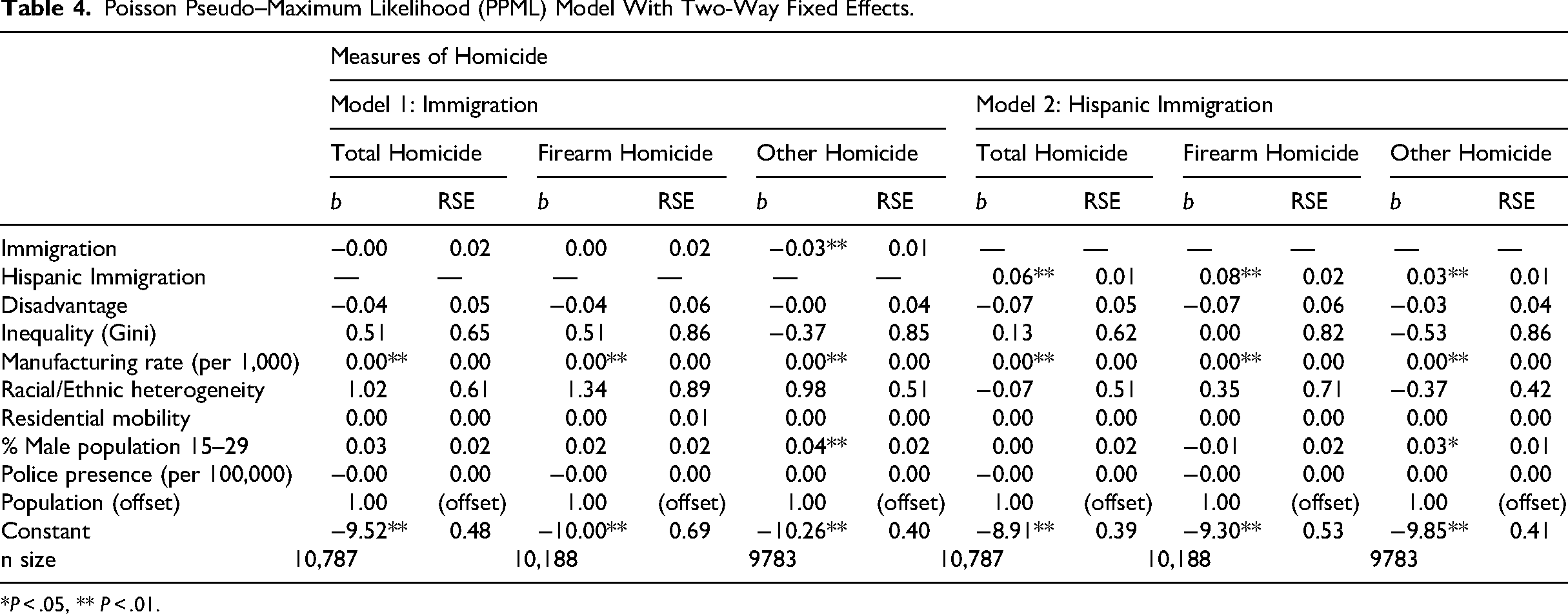
In addition to cross-sectional negative binomial models, we estimate PPML models with two-way fixed effects to assess over-time within-unit changes. As cross-sectional models capture between-unit differences that may be confounded by unobserved heterogeneity, PPML two-way fixed effects models isolate within-county variation over time net of time-invariant factors and temporal shocks that occurred during the study period. Using both approaches allows for evaluation of the robustness of findings by modeling both between-unit differences (cross-sectional) and within-unit changes (fixed-effects). Results of the PPML with two-way fixed effects are provided in Table 4, which show that immigration effects are null for firearm-related homicide, as well as for total homicides. However, immigration is negatively associated with other homicides (b = −0.03, P < .01). This suggests that over time, counties experiencing growth in their immigrant population experienced fewer nonfirearm homicides. For Hispanic immigration, results are positive and significant for all homicide types. Notably, these results run counter to the consistent negative effects seen in the cross-sectional models described above and indicate that firearm (as well as total and other) homicides rose in counties that experienced increases in Hispanic immigration over the 2000–2015 period. 10 We return to this point and discuss these findings in more detail in the discussion section.
Poisson Pseudo–Maximum Likelihood (PPML) Model With Two-Way Fixed Effects.
*P < .05, ** P < .01.
Supplemental Analyses
The findings presented in the main analyses described above rely on a county population cutoff of at least 5,000 residents. This is a common practice in macrolevel analyses to ensure reliability in measures. However, the tradeoff is that this could lessen the impact of larger counties (e.g., Los Angeles County, Cook County, Dallas County) by including a large number of small counties in the analysis. To ensure results are not driven by these differences, several alternative population cutoffs and an interaction term (between urban population and immigration) were examined at each time point in supplemental analyses. For instance, population cutoffs of 50,000 and separate analyses of both over and under 100,000 were examined. Results remained largely the same, with many significant negative associations between immigration (overall or Hispanic immigration) and firearm homicide (as well as total and other homicides). A few more null results were present due to the reduced sample sizes using more restrictive population cutoffs, but the majority of results mirrored the main analyses regardless of the population cutoffs employed (results available upon request). 11
In addition, we also included an immigrant population cutoff in supplemental models to ensure that the size of (or lack thereof) the immigrant population was not biasing results (Harris et al., 2023). When examining counties that had at least 500 foreign-born residents (n = 6,414 for all time points) results mirrored those described in the main analysis, showing all significant and negative associations between immigration (including Hispanic immigration) and firearm homicide (as well as total and other homicides).
We also included several models to assess varying community contexts. First, to examine whether these effects differ in urban versus rural contexts, we included an interaction term between the percentage of the population that resides in urbanized areas and our total (and Hispanic) immigration measure. The interaction term was either null or positive depending on the year examined, while the main effects remain negative and significant. In the models where the interaction term is positive, the effect size is extremely small. Notably, this indicates that immigration (and Hispanic immigration) is associated with lower homicide rates overall, but this protective effect weakens as counties become more urban (results available upon request). Second, we also examined destination type, as prior literature has indicated immigration effects can vary across traditional and new destination types (see Barranco et al., 2017; Ramey, 2013; Shihadeh and Barranco, 2013). Following the practices of prior research, counties were considered “traditional destinations” if their immigrant population was above the mean in 1990 and 2000 and considered “new destinations” if their immigrant population was below the mean in 1990 and grew above the mean by 2000 (Ramey, 2013; Shihadeh and Barranco, 2010b). This resulted in approximately 757 traditional destinations and 2,057 new destinations (depending on the year). Findings suggest immigration (and Hispanic immigration) produce strong insulating effects across most cross-sectional models in traditional destinations (alongside a few null results), with a mix of negative and null findings in the models that examined new destinations—supporting prior literature that suggests immigrant revitalization has more consistent protective effects in traditional destination types. Results from the fixed effects models remained substantively similar to the main analyses, across both destination types (results available upon request).
Discussion
The rapid growth of immigration into the United States has ushered in concerns that immigration is generating increased violence and homicide. Political rhetoric has fueled this sentiment, claiming that immigration is an engine for violence, drugs, and other social harms (Lee, 2015; McCaughey, 2024). However, empirical research has consistently contradicted these claims, showing that if anything, immigration insulates communities from homicide, crime, and related social problems (Feldmeyer et al., 2019; Lee et al., 2001; Ousey and Kubrin, 2009; Sampson, 2008). Yet, few past works have examined immigration effects across different types of homicide. Research to date has focused mostly on overall homicide patterns, with remarkably little work examining fatal gun violence specifically. This gap in research is noteworthy because prior studies have shown that the patterns and predictors of lethal violence often vary across different forms of homicide (Kubrin, 2003; Martinez, 2000; Pelletier and Pizarro, 2019; Wolfgang, 2016). In addition, research on structural disadvantage and gang dynamics offer plausible reasons why immigration may have distinct effects on firearm-related homicide. The current study sought to address this gap in research by examining county-level immigration–firearm homicide relationships.
The results differ meaningfully between cross-sectional and fixed-effects specifications. Cross-sectional models showed that both overall immigration and Hispanic immigration had negative associations with firearm-related homicides at each time point assessed. Specifically, the results indicated that the firearm homicide rate decreased by about 2%–3% for every one percentage point increase in immigration, and it decreased 1%–3% for every one percentage point increase in Hispanic immigration. Supporting much prior literature, these results produced 24 negative associations across 24 cross-sectional analyses indicating that immigration is consistently linked to lower homicide—especially fatal gun violence. However, fixed-effects PPML models reveal a more complex story. Total immigration had either null or negative associations with homicide over the 2000–2015 period. In contrast, increases in Hispanic immigration were linked to higher levels of firearm, total, and other homicides within counties over time. This divergence indicates that the cross-sectional relationship may be a result of the nonrandom distribution of immigrants in structurally different counties (large, stable, economically advantaged, historically lower crime). In contrast, the longitudinal estimates suggest that increases in Hispanic immigration within counties are associated with increases in violence net of time-invariant county characteristics and national trends. These findings may reflect effects of Hispanic immigration growth in new destinations, where immigration flows have been shown to be less protective and can create greater susceptibility to crime (at least in the short term—Barranco et al., 2017; Ramey, 2013). Taken together, the findings highlight the importance of distinguishing between within-unit change and between-unit differences.
These findings hold several key implications for research and theory related to immigration and crime. First, in terms of overall immigration, the results suggest immigration's neutral or protective effects on homicide extend to fatal gun violence. Much prior work has focused on overall homicide measures, but few have examined immigration in the context of gun violence. Findings illustrate that the effects of immigration on fatal violence are broad and not isolated to overall measures of lethal violence. Additionally, research and theory related to structural disadvantage and gang dynamics offer credible reasons to expect unique relationships between immigration and lethal violence involving firearms. Political rhetoric has also often suggested that immigration could be linked to greater firearm homicide through gang-related violence (McCaughey, 2024; Sentner, 2024). However, we find little support for these claims. Instead, our results show that the protective effects of immigration on firearm-related homicide are remarkably uniform, especially in our cross-sectional models. Although more null findings arose in the fixed-effects models, we find no evidence that overall immigration patterns contributed to firearm homicide (or homicide in general) during the 2000–2015 period.
Second, these findings highlight a more complex story for Hispanic immigration and fatal gun violence. It seems that places with larger Hispanic immigrant populations have lower homicide rates, cross-sectionally. This could indicate a protective effect of Hispanic immigration on homicide and effects of immigrant revitalization that insulate communities from firearm violence. Alternatively, it may reflect selection among Hispanic immigrants into more stable areas (e.g., ethnic enclaves) with lower crime. In contrast, longitudinal models show that increases in Hispanic immigration within places over time are associated with increases in firearm homicide. There are several possible explanations for this finding. One possibility is that rapid growth in Hispanic immigrant populations may disrupt existing social networks or coincide with broader shifts in community conditions—such as increases in concentrated disadvantage, linguistic isolation, or residential instability—that are themselves associated with elevated homicide rates. It is also possible that some immigrant communities may experience heightened vulnerability to gang recruitment, social marginalization, or victimization, which could contribute to higher levels of lethal violence. However, these interpretations remain speculative, and the present analyses cannot determine the precise mechanisms underlying this relationship—a point we return to in the future research section below.
Finally, these findings have important policy implications for combating violence across U.S. communities. The body of evidence would suggest that public safety policies aimed at reducing gun violence should prioritize evidence-based practices and programs, rather than focusing on immigration enforcement. As of 2025, more than $170 billion has been allocated to immigration enforcement (which is more than all local and state law enforcement agencies in the United States combined) under the pretense of public safety (O’Herron, 2025). Our findings, along with much prior research on immigration-crime relationships, would suggest immigration enforcement is unlikely to significantly reduce violence (Lee and Martinez, 2009; Ousey and Kubrin, 2018; Velez, 2009), particularly fatal gun violence. These findings suggest that political and policy initiatives aimed at reducing gun violence should focus less on immigration and more on firearm violence reduction programs Engle et al., 2013), focused deterrence strategies (Braga et al., 2019, 2024), and other community-based intervention programs (Hennigan et al., 2015; Sivilli et al., 1996). As our results indicate, broad-based strategies aimed simply at limiting immigration are unlikely to reduce community gun violence, and if anything, could have the opposite effect.
Limitations and Future Research
Despite the contributions of this analysis, there are several limitations that need to be discussed. Although the CDC mortality data provides some of the best available information on homicide with national coverage, they are not without caveats. For instance, these data allow for analysis at the county level but do not allow aggregation at smaller study units (e.g., census tracts, block groups). As noted earlier, counties are well-suited as study units for this analysis and offer several advantages, but immigration's effects on firearm-related homicide may differ for other study units, due to the spatial concentration of gun violence. As such, future research should explore the association between immigration and gun violence at neighborhood units. Additionally, future research should disaggregate firearm homicide data by race/ethnicity of the victim to examine if immigration effects are limited to certain subgroups or apply to multiple racial/ethnic groups. Our data only exist up to 2015 currently, and future research should continue to unpack immigration effects in more recent periods of growth in the last decade.
It is also important to note the limitations with Hispanic immigration measures. Numerous scholars have criticized the binary nature of immigration measures (Caraballo, 2024; Kubrin and Ousey, 2023) and the broad pan-ethnic label of “Hispanic” (Okamoto and Mora, 2014). For example, such measures may inaccurately classify Puerto Ricans—who are U.S. citizens—as immigrants, include Cubans with refugee status, or group together Salvadorans with temporary protection status. These populations have distinct cultural differences and histories, migration patterns, and may face different structural and social contexts when immigrating to U.S. communities. Without explicitly examining country of origin, findings may obscure disparities among immigrant communities. While future research should address these limitations, current data availability for Hispanic immigration measures remains limited. Last, future analyses should explore the positive associations between Hispanic immigration and homicide shown in the longitudinal models here. These findings differ from much of the prior literature on immigration and violence, and further exploration into the precise reasons for these effects is needed.
Conclusion
The relationship between immigration and violence remains a contentious issue, despite a substantial body of evidence suggesting that immigration often reduces community violence or, at the very least, does not contribute to it. If anything, political rhetoric on the topic has amplified in the early decades of the twenty-first century with widespread claims that immigration is a key driver of violence and especially homicide across U.S. communities. The majority of findings from the current study suggest that immigration is not related to increased homicide—especially fatal gun violence. Instead, immigration is most often related to lower levels of firearm (and other) homicides, with 25 of our 30 main models showing significant protective effects from immigration. Longitudinal analyses of Hispanic immigration produced some positive associations with homicide over time, offering a noteworthy exception to this pattern and to findings seen in much prior research. Taken together, the body of evidence presented here indicates that immigration generally functions as a protective factor against homicide, especially firearm homicide, and suggests a need for additional research to explore whether and why changes in Hispanic immigration produced different effects on lethal violence.
Supplemental Material
sj-docx-1-icj-10.1177_10575677261458361 - Supplemental material for Gun Violence in the Age of Mass Migration: An Empirical Assessment of Immigration Effects on U.S. County-Level Firearm Homicides, 2000–2015
Supplemental material, sj-docx-1-icj-10.1177_10575677261458361 for Gun Violence in the Age of Mass Migration: An Empirical Assessment of Immigration Effects on U.S. County-Level Firearm Homicides, 2000–2015 by Calvin Proffit and Ben Feldmeyer in International Criminal Justice Review
Footnotes

Funding
The authors disclosed receipt of the following financial support for the research, authorship, and/or publication of this article: This work was supported by the National Science Foundation (Grant Number 184209).
Declaration of Conflicting Interests
The authors declared no potential conflicts of interest with respect to the research, authorship, and/or publication of this article.
Data Availability
The data supporting this study were obtained through a restricted-access grant and are not publicly available due to confidentiality agreements.
Supplemental Material
Supplemental material for this article is available online.
Notes
Author Biographies
References
Supplementary Material
Please find the following supplemental material available below.
For Open Access articles published under a Creative Commons License, all supplemental material carries the same license as the article it is associated with.
For non-Open Access articles published, all supplemental material carries a non-exclusive license, and permission requests for re-use of supplemental material or any part of supplemental material shall be sent directly to the copyright owner as specified in the copyright notice associated with the article.
