







Abstract
In this study, we examine the impact of a new mobile-based, dockless bike-sharing service on public transportation usage. This new bike-sharing model removes the constraint of having fixed stations and gives users full flexibility on where to pick up and return bikes. This innovative feature of dockless bike sharing potentially disrupts the current norms of how people commute. The dockless shared bikes offer easy connections between destinations and public transportation stations. They can potentially promote public transportation, by improving its flexibility and outreach. To examine this impact, we collaborate with one of the largest dockless bike-sharing companies in China and collect unique daily-station-level panel data of shared-bike rides and subway traffic. Our findings indicate that a 1% increase in shared-bike rides leads to an increase of 0.35% in subway traffic. Further analyses show that this positive effect is stronger when people need to travel a longer distance to reach subway stations. These results suggest one potential underlying mechanism for the positive relationship we observe, that is, dockless shared bikes alleviate the “last-mile problem” for public transportation, making it a more appealing mode of transportation, compared with alternatives. Overall, we find that dockless shared bikes, in contrast to ridesharing or traditional bike sharing, act as a complement, rather than a substitute, for public transportation. Dockless shared bikes present a greener way of commuting, with significant environmental and societal impacts.
Introduction
For thousands of years, people have shared the use of assets, but the Internet has made it much easier to match asset owners with those seeking to use those assets. As a result, the sharing economy has fundamentally changed the way people find lodging, hail a ride, borrow money and share office space. According to a report by the Brookings Institute, the sharing economy market is expected to grow to $335 billion by 2025 (Yaraghi and Ravi, 2017). Transportation is one of the key industries disrupted by the sharing economy, with leading companies such as Uber, Lyft and Didi providing shared car rides via mobile apps. In addition, in the bike-sharing industry, a new dockless business model has emerged. It leverages mobile technology and Internet-of-Things (IoT) to offer bike-sharing with greatly improved flexibility on where to pick up and return the bikes. The most unique feature of this novel bike-sharing business is that users do not need to return the bikes to fixed stations. Instead, they can locate a bike for rent in sight or through a mobile app and park the bike at any safe location after finishing a ride. This novel design of dockless shared bikes can transform how people use shared bikes relative to other transportation modes. Dockless bike-sharing has grown into a phenomenal business, operating around 6.5 million shared bikes and accommodating 25 million rides daily according to the most recent tally, and both numbers are still steadily increasing. Given the large scale of this new bike-sharing business model, it is important to understand how it shifts transportation mode preferences and evaluate its profound social impacts.
Traffic congestion resulted in an estimated $81 billion in economic losses in the US in 2022 (Pishue, 2023). Another report shows that traffic congestion accounted for 3.5 billion gallons of wasted fuel and 36 million tons of excess greenhouse gas emissions in the US in 2019 (Schrank et al., 2021). Greenhouse gas emissions from transportation already constitute one of the top sources of total emissions. 1 As traffic recovers from the pandemic and exceeds pre-COVID levels, these numbers are expected to further increase. Encouraging public transportation usage is an important approach to alleviating traffic congestion and reducing greenhouse gas emissions (Gallivan et al., 2011). However, a major hurdle that prevents people from taking public transportation is the “last-mile problem”. The fixed routes and stations of public transportation modes lack the flexibility to provide seamless connections between the starting and ending points of a trip to public transportation nodes (Wang and Odoni, 2016). The inconvenience of getting to a public transportation station is one of the main reasons that prevent people from using public transportation (Chen et al., 2020). Thus, it is of great importance to evaluate whether the dockless shared bikes can alleviate the “last-mile problem” and promote public transportation usage.
The impact of dockless shared bikes on public transportation can manifest in two different directions. On the one hand, dockless shared bikes can be a direct substitute for public transportation, particularly when people travel short distances to central city locations. On the other hand, the unique design of the dockless share bikes offers a solution to the “last-mile problem”, by providing convenient connections between public transportation stations and users’ destinations. In this way, dockless bike-sharing improves the efficiency and convenience provided by public transportation, thus making public transportation a more appealing option compared with alternatives, such as driving private cars, ride-hailing or taking taxis. As a result, dockless bike-sharing and public transportation can complement each other. Overall, whether dockless bike-sharing and public transportation are complements or substitutes is an empirical question, and the net impact of shared bikes on public transportation remains to be explored.
A large body of the operations management literature on bike sharing focuses on optimal pricing and location for the bikes, and these studies are mostly based on the traditional bike-sharing model with fixed docking stations (Datner et al., 2017; He et al., 2021; Kabra et al., 2020; Shu et al., 2013). An emerging stream of literature focuses on examining the economic impact of the sharing economy, including ride-hailing services. To date, most of the findings suggest that shared car rides become consumers’ substitution for driving private cars (Bellos et al., 2017; He et al., 2017) and using public transportation (Babar and Burtch, 2020; Campbell and Brakewood, 2017; Lee et al., 2022; Li et al., 2022). To our knowledge, no studies have examined how the new generation of dockless shared bikes, whose “pick up anywhere, return anywhere” feature sets them apart from traditional bike-sharing models, influences public transportation usage. In this paper, we seek to answer this important question empirically and uncover the mechanisms that drive this impact. Through the mechanism analyses, we aim to demonstrate that dockless shared bikes indeed complement public transportation, by alleviating the “last-mile problem”.
We collect a unique fine-grained dataset on daily subway traffic, specific to each subway station, and combine it with the corresponding dockless bike ridership starting from or ending in the surrounding area of each subway station. The data sample spans all subway stations in a major city in China for a total of 31 days (every other day during September and October of 2017). To our knowledge, such fine-grained station-day-level data on public transportation has not been used in prior studies on estimating the impact of ride-hailing systems. Our empirical analysis relates subway traffic to shared-bike ridership and finds that dockless bike-sharing ridership has a positive effect on subway traffic, showing a complementary relationship between the two travel methods. In terms of economic significance, all else equal, a 1% increase in the number of shared-bike rides on average leads to an increase of 0.35% in subway traffic. Considering the average daily subway ridership in the city is estimated to be around 10.35 million at that time (China Association of Metros, 2018), this translates to an increase of 36,225 subway trips per day, which is economically significant and has profound implications on our society. Furthermore, we explore the mechanisms that drive the complementary relationship between dockless bike-sharing ridership and subway traffic. Our findings confirm that dockless shared bikes promote the use of public transportation by alleviating the “last-mile problem”, thus reducing the hassle cost and time cost of taking public transportation, making it a more appealing option compared with alternative transportation modes.
There exist potential endogeneity concerns in identifying how shared bike rides lead to changes in subway traffic. For example, heightened travel on certain days could drive up demand for both the subway and shared bikes. To address such concerns, we first employ a two-way fixed effects estimation method, controlling for station and day of the week fixed effects. Thus, any time-invariant station heterogeneity and common day-of-the-week time shocks are controlled. Second, we include station-specific linear time trends, so that weekly temporal shocks unique to each station are accounted for. In addition, we employ an instrumental variable approach, where we use the discount ratio of shared bike rides to instrument for the shared-bike ridership. Specifically, we examine all dockless bike rides near each subway station for each day and compute the discount ratio by dividing the total fare actually paid (after some of the users applied coupons and free ride codes) by the total estimated fare for the trip. Our discussions with managers and review of detailed documentation on all promotion activities by the dockless shared bike company demonstrate that such promotions are solely based on the company’s own marketing strategy, independent of outside factors such as public transportation demand. Therefore, the discount ratio is not directly correlated with subway traffic but can significantly affect bike-sharing ridership, making it a valid instrumental variable. Our results from the instrumental variable estimation are consistent with the findings without the instrumental variable, suggesting that the omitted variable bias is not a concern.
This study contributes to several streams of literature, on bike-sharing, the sharing economy, and on the intersection of information systems and operations management. First, prior studies on bike sharing examine the optimal pricing decisions, distribution of bikes, inventory levels and locations of bike stations (Datner et al., 2017; Kabra et al., 2020; Shu et al., 2013). Our study builds upon these prior studies and examines the new sharing economy phenomenon of dockless shared bikes, focusing on its impact on public transportation and its potential environmental impacts. Second, our study contributes to studies on the economic and societal impact of the sharing economy (e.g., Babar and Burtch, 2020; Li et al., 2022; Lee et al., 2022). Compared with prior studies that focus on how fixed-station bike-rental models influence public transportation, where a substitution effect is found (Campbell and Brakewood, 2017), our study examines how the innovative design of dockless shared bikes puts it in a unique position to promote and complement the use of public transportation. Our findings indicate that the dockless feature of the novel bike-sharing system transforms the relationship between bike-sharing and public transportation. While fixed bike stations are typically located close to public transportation stations, causing shared bikes to compete with public transportation, dockless shared bikes provide end-to-end connections between starting points/destinations and public transportation stations, thus presenting a solution to the “last-mile problem” and complementing public transportation. Furthermore, our results are consistent with and provide additional explanations for the findings by Wang and Zhou (2017), who report that bike-sharing systems in the US have reduced traffic congestion in large US cities. Finally, this study contributes to the literature on sustainability and the social impact of technology (Ketter et al., 2022; Qi et al., 2018). Our findings have significant implications for policymaking for the sharing economy, public transportation management, urban planning, and sustainable development.
Context and Theory
Related Literature
In this section, we will discuss how our study is related to the following three streams of literature: 1) studies on the impact of ride-hailing services, 2) studies on the impact of bike-sharing systems, and 3) studies on sustainability and the social impact of the sharing economy. We will highlight the contributions of our study to each of these literature streams.
There is a growing number of studies that examine the impact of ride-hailing services (e.g., Uber, Lyft) on the usage of other modes of transportation and congestion levels. Some of these studies have documented contrasting findings. For example, Hall et al. (2018) find that Uber complements the use of public transit and that the effect is stronger for smaller transit agencies with less traffic. Pan and Qiu (2022) find a significant drop in bus ridership after the entry of Uber. Li et al. (2022) find that the entry of Uber services reduces traffic congestion in less compact areas but increases traffic congestion in compact urban areas. Lee et al. (2022) examine the impact of ridesharing on public transportation and congestion by analyzing its impact on various traveler segments. They find that while Uber services decrease traffic congestion and encourage the use of public transit in places with a sparser population of riders and walkers, they have the opposite effects for cities with a denser population of riders and walkers compared to drivers. These studies have demonstrated that the flexibility offered by ride-hailing services can fill the gap in public transportation that has fixed routes and fixed schedules (Hall et al., 2018). We expect similar effects to apply to dockless shared bikes. In addition, since dockless shared bikes have lower cost, a larger range of service areas and a higher level of flexibility, we expect they are likely to further fill in the gaps of public transportation. Thus, the impact of dockless shared bikes on public transportation usage likely differs from that of the ride-hailing services and calls for more detailed evaluation.
Prior work on bike-sharing services has mostly focused on the older generation of bike-sharing systems with fixed docks and examined optimal pricing schemes and location management for the bike fleet (Campbell and Brakewood, 2017; Datner et al., 2017; Kabra et al., 2020; Shu et al., 2013; Wang and Zhou, 2017). There is an emerging stream of studies that focus on dockless shared bikes, evaluating their impact on housing price premiums (Chu et al., 2021) and on other types of ride-hailing services (Qin et al., 2018). To our knowledge, however, no prior study has examined the impact of the most recent generation of dockless bike-sharing services on public transportation, or provided insights on the social impact of the recent technological advancements. Our study fills this gap. Among the studies that examine bike-sharing with fixed stations, the work by Campbell and Brakewood (2017) is perhaps the closest to our study. They exploit the phased implementation of a bike-sharing system with fixed docking stations in different areas of New York City and find that the introduction of the bike-sharing system has led to a reduction in bus ridership, suggesting a substitution relationship. In contrast, we find a complementary relationship between bike-sharing services and subway transportation. Such different findings highlight that the unique dockless feature in the context of our study, resulting from recent technological development, can be a game changer that transforms how people use dockless bike-sharing and public transportation. Such shifts in user transportation mode choice can generate significant environmental benefits in return.
Our study also relates to the literature stream that examines sustainability and the social impact of the sharing economy, along the broader scope of research on service operations (Karmarkar, 2015). For example, Qi et al. (2018) study car sharing (involving passenger vehicles) in home delivery services. They find that such systems reduce the length of routes, which is offset by the reduced loading capacity of the smaller cars, so such delivery through shared passenger vehicles does not lead to significant reductions in emissions overall. Bellos et al. (2017) explore car-sharing programs offered by car manufacturers and find that such programs could potentially have a negative environmental impact by turning customers who would otherwise have used public transportation to drive shared cars. Avci et al. (2015) compare a car battery switching system with the conventional battery model in encouraging electric vehicle adoption, and demonstrate the tradeoff between the objectives of reducing carbon emissions and decreasing the reliance on oil for policy interventions. We contribute to this literature stream in two aspects: first, our findings shed light on how the novel dockless bike sharing model, enabled by new technology, promotes public transportation usage. Insights on such a relationship can inform operations decisions to better accommodate the increased demand for public transportation from dockless shared bike users and improve the dynamic management of dockless bike fleets. Second, we quantitatively estimate how dockless shared bikes contribute to reducing carbon emissions, by encouraging people to switch from passenger vehicle usage (e.g., driving, using ride-sharing, or taking a taxi) towards greener modes of transport, such as biking in combination with public transportation. Thus, we demonstrate the significant environmental benefits of the new generation of dockless shared bikes.
Research Context
The context of our study is one of the newest innovations in the sharing economy ecosystem: dockless shared bikes. Unlike traditional rental bikes that require fixed docking stations, these new dockless shared bikes rely on mobile app payment and GPS-enabled locks to operate and there are no fixed stations for the bikes. Users can unlock a bike by scanning its QR code using the bike-sharing company’s mobile app, ride to their destination and simply lock the bike to return it wherever convenient. The mobile app automatically registers the locked bikes as returned and charges for riding fares accordingly. While traditional bike-sharing programs are limited by the fixed dock stations in the possible routes provided to users and cause inconvenience in usage, the new dockless bikes are free from such constraints. The innovative dockless design greatly improves the flexibility for users to rent and return bikes. Charges to bike riders are usually set at affordable rates, under the equivalent of $0.3 per hour in China and around $1 per hour in the US. The dockless bike-sharing companies occasionally offer free rides or discounts to promote usage. As the business grows to scale, the number of bikes in circulation and the user base are sufficiently large to ensure that the bikes can be picked up and returned almost anywhere, such as around residential areas, next to bus stops or around shopping centers.
The dockless feature of these shared bikes is feasible, due to a combination of technological developments in mobile payment, Internet-of-things and big data analytics. Each bike has a lock embedded with a GPS chip, enabling tracking its location in real-time and for users to search for a bike nearby if they don’t see one immediately in sight. The GPS coordinates of starting and ending points for each trip are also recorded to compute trip fare as a function of distance and time. Mobile payment technology allows users to link their payment method with the bikesharing app and easily pay for fares after each ride. Data on all completed trips are also stored in the company’s database for analysis and optimization to efficiently manage the bike fleet.
Dockless shared bikes have quickly developed into a sizeable business with significant numbers of users across several major cities globally. The Chinese dockless bikesharing companies have launched their businesses in several large cities in the US (Coldewey, 2017) and several US bikesharing firms have also entered the market of dockless bike share businesses, including Jump, Limebike, Motivate and Spin (Bhuiyan and Molla, 2017). It is estimated that the introduction of dockless bikes more than doubled the total number of bikes in the US and the total number of trips taken on dockless bikes amounted to 10 million trips in the US in 2019 (NACTO, 2020). In addition, similar programs operating shared e-scooters are introduced in many cities globally (Guo and Zhang, 2021; Wang et al., 2022). The success of dockless shared bikes has made them an integral part of daily commute demands in the cities they have entered and yields a significant impact on the means of travel. Therefore, the public’s interest in dockless shared bikes is not constrained to specific countries, and the findings on the impact of such shared bikes could have generalizable implications across different regions.
Hypothesis Development
Prior studies have shown that time, cost and transit burden are some major factors that influence the choice of transportation mode (Beirão and Cabral, 2007; Ha et al., 2020). The “last-mile problem”, or the challenge of connecting a public transportation node to the starting/ending points of a trip, such as a home or a workplace, posits a significant issue that prevents public transportation usage (Wang and Odoni, 2016). The dockless design feature of the shared bikes is a game changer that significantly reduces travel costs, saves travel time and provides smoother connections. We expect that dockless shared bikes reduce the “last-mile problem” for public transportation, making it a more appealing transportation mode compared with alternatives. Our rationale is as follows.
Dockless shared bikes can provide end-to-end connections between users’ starting/ending points of commute to public transportation stations, thus significantly reducing the “last-mile problem”. The real-time location and distribution of the dockless shared bikes are the direct result of transportation needs and users can typically find bikes right at their starting points, such as outside their apartment buildings, where the previous users parked them at the end of their trips. Past work has shown that the first and last portions of a trip using public transportation usually cover a short distance but consume a significant amount of the overall travel time (Hall et al., 2018). The high hassle cost to get to public transportation stations has been listed as a top reason that prevents people from using public transportation (Chen et al., 2020). Without dockless shared bikes, people would have walked such distances or used vehicles (e.g., cars or taxis) to get to public transportation stations (Jiang et al., 2020). When the distance to reach a public transportation station exceeds a comfortable threshold, people may choose alternative modes, such as driving, ride-hailing, or taking taxis, due to the high hazard cost. With dockless shared bikes, users can easily pick up a bike from their starting location and leave it near the public transportation station when they finish their trip, and vice versa. This flexibility greatly improves the efficiency of getting to and from public transportation stations, making the combination of public transportation with dockless shared bikes an appealing option compared with alternative travel modes. Industry reports also corroborate the role of dockless shared bikes in alleviating the “last-mile problem”. Jiang et al. (2020) find that 80% of respondents use dockless shared bikes to connect with modes of public transportation. In contrast, traditional bike-sharing systems with fixed docking stations are constrained by route popularity, budget limitations, and space constraints, which make it difficult to provide door-to-door service for every individual trip (Cheng et al., 2020). Picking up bikes from and returning them to fixed docking stations imposes a considerable hazard cost (Fishman, 2016), which limits the ability of shared bikes with fixed docking stations to resolve the “last-mile problem” for public transportation.
In sum, the “pick up anywhere, return anywhere” feature makes dockless shared bikes uniquely positioned to complement the use of public transportation, by providing a smooth connection between public transportation stations and intended starting or ending points of trips. Thus, we hypothesize:
Hypothesis: Bike-sharing ridership is positively associated with subway traffic.
At the same time, we note that for certain types of travel needs, especially short-distance trips along convenient commuter routes, it is possible that shared bikes substitute public transportation. This is mostly because biking is now sufficient for reaching destinations instead of taking the subway or bus for a few stops (Campbell and Brakewood, 2017). We expect this substituting effect of dockless bike sharing on public transportation to be mostly limited to trips with starting and ending points both within comfortable walking distance from public transportation stations. Therefore, for the majority of travel needs where public transportation does not fully cover end-to-end transportation, we expect the complementary relationship between shared-bike ridership and public transportation to dominate 2 and we will test our hypothesis empirically.
Data and Empirical Framework
Data
We collect a unique dataset from two main sources: 1) daily subway traffic data with counts of arriving and departing passengers for each subway station from a major city in China; 2) detailed day-level data on shared-bike ridership in the vicinity of each subway station from a leading dockless bike-sharing company in China. We focus on using subway traffic data to evaluate changes in public transportation, mostly because the subway traffic data is more accurately measured, compared with bus ridership data where GPS locations for bus stops and identifying where people get on and off the bus could be more nuanced. Furthermore, we expect the mechanisms that influence the use of dockless shared bikes and the subway to apply to other types of public transportation as well. Thus, we use subway traffic as a representative measure of public transportation. The outcome variable of interest is Subway Traffic(Day Total)i,t, which reflects the total number of passengers entering or exiting subway station i on day t. We take the appropriate natural logarithm transformation for this variable to account for its skewed distribution and use Ln(Subway Traffic)i,t as the main dependent variable in our empirical analysis.
Summary statistics.
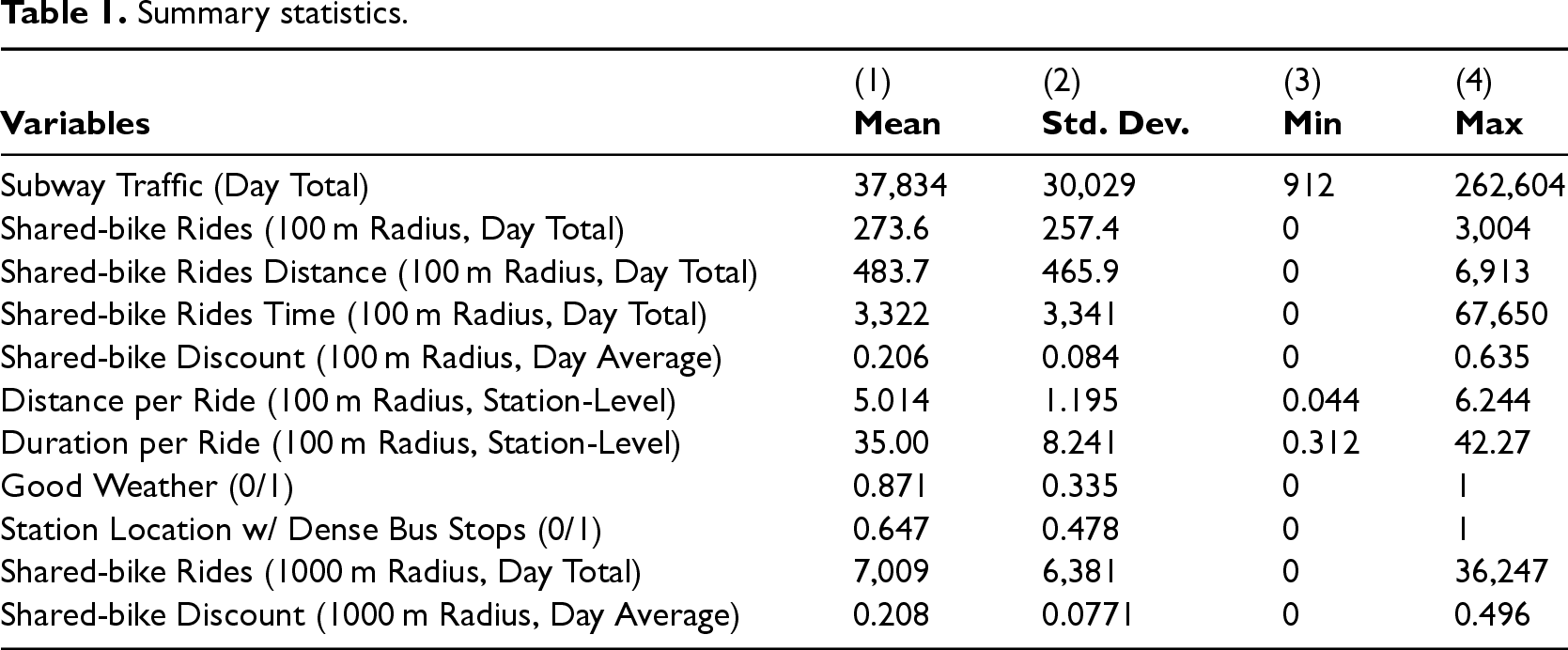
Summary statistics.
We connect the two data sources using the GPS coordinates of bike rides and match the number of rides originating from or ending in a 100-m radius (around 330 feet) of each subway station to the subway traffic data at the same station for the given day. If the subway station is a transit station having multiple exits across subway lines, with some distance in between, we aggregate the bike rides originating from or ending in the 100-m radius corresponding to the exit for each subway line respectively. The 100-m radius is selected, since walking from where the bikes are parked to the subway stations takes around one minute within this radius, a likely indication that the dockless shared bike rides ended here for the purpose of catching the subway. 3 The matched dataset covers 288 subway stations for every other day of the week during September and October 2017, spanning 31 days in total. We dropped observations for five subway stations that were not fully operational during our sample period. Two of these stations were still under construction and three of these stations closed for extended periods due to road construction. Another subway station shut down temporarily for nine days during our sample period due to traffic control but resumed normal operations for the rest of the sample period. Therefore, we only dropped the nine days of observations for this station when it was shut down. As a result, our cleaned sample consists of 8,764 observations from 283 subway stations. To our knowledge, such fine-grained data has not been used in previous studies on ride-hailing businesses.
The main independent variable of interest is Shared-bike Rides (100 m Radius, Day Total)i,t, which reflects the total number of dockless shared bike rides originating from or ending in a 100-m radius of subway station i on day t. We take the appropriate natural logarithm transformation for this variable to account for its skewed distribution and use Ln(BikeRides)i,t as the main independent variable in our empirical analysis. 4 The summary statistics for the main variables are reported in Table 1. The dockless shared bike rides data we obtained for the analysis were desensitized by the firm due to data privacy protection. Thus, the scales of these measures appear different from that of subway traffic. We use the statistics reported in publicly available reports to verify that the actual scale of dockless shared bike rides and subway traffic at each station are comparable. 5
Past work mostly focuses on the entry effect of ride-hailing systems at the city or county level and largely relies on the difference-in-differences (DID) design as the empirical identification strategy. In contrast, we assemble a panel dataset of hourly bike-sharing ridership and subway traffic at the subway station level and employ an instrumental variable approach to estimating the effects at a more fine-grained level (i.e., at the subway station level within a city). The advantage of the instrumental variable approach at such a fine-grained level lies in that it could avoid possible confounding factors at the city or county level. For example, the cities or counties that have bike-sharing systems may be systematically different from those without bike-sharing systems and thus have different time-varying dynamics in terms of subway traffic and shared bike rides. For the empirical analysis, we relate subway traffic to bike-sharing ridership using the following model on a panel data organized by subway stations (i) and day (t):
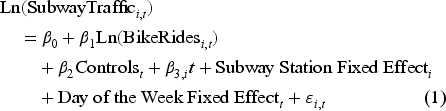
We use the natural log of the total amount of arriving and departing traffic at each subway station, Ln(Subway Traffic i,t ), as the dependent variable and the natural log of the total number of shared-bike rides starting from or ending in a 100-m radius of the subway station, Ln(BikeRides i,t ), as the main independent variable. This scale-free estimation framework allows us to derive accurate estimates of the percentage increases in subway traffic from percentage increases in dockless shared-bike rides. It also ensures that our estimations are not affected by the linear transformations performed for data desensitization. To account for unobservable variables that influence subway traffic, we control for subway station fixed effects, day of the week fixed effects, and station-specific linear time trends for each week. The station-specific linear time trend allows us to control for unobservable factors that drive temporal trends that are unique to each subway station (Papke, 1994; Wooldridge, 2002). To control for observable factors that influence subway traffic, we include measures of weather conditions, including temperature, humidity, wind speed, and precipitation for each day. We also include measures of air quality on each day, Air Quality Index (AQI), levels of O3, NO2 and SO2, a similar set of measures as used in prior studies (see, e.g., Ding et al., 2021). Standard errors are clustered at the subway station level for all the analyses.
We conduct additional analyses to examine the mechanisms that drive the complementary relationship between dockless shared bikes and subway traffic. Our hypothesized mechanism is that dockless shared bike rides reduce the cost for people to connect their starting/ending point of a trip to subway stations and thus provide a solution to the “last-mile problem”. Accordingly, when the “last-mile problem” is more severe (that is, the travel distance of reaching subway stations is long), the advantage of dockless shared bikes in reducing such connection costs is more salient. 6 As a result, we expect the complementary relationship between dockless shared bikes and the subway to be stronger. To test the underlying mechanism, we proxy the severity of the “last-mile problem” using the average travel distance of dockless shared bikes per ride, aggregated to the station level (Distance per Ride (100 m Radius, Station-Level) in Table 1). Using this measure, we divide the subway stations into two groups, Longer Distance per Ride and Shorter Distance per Ride, based on the median value of the measures across the subway stations. 7 Then, we compare the effect of dockless shared bikes on subway traffic, by estimating equation (1) for the two groups of stations, respectively, and comparing the coefficient estimate β1. A significantly greater estimated coefficient β1 for the Longer Distance per Ride group would provide supportive evidence for our hypothesized mechanism. An alternative proxy of the travel distance is the average trip duration of dockless shared bike rides. Specifically, we use the average trip duration of dockless shared bikes per ride to divide subway stations into two groups, Longer Duration per Ride and Shorter Duration per Ride. We contrast the coefficient estimate β1 for the two groups. Similarly, a significantly greater estimated coefficient β1 for the Longer Duration per Ride group supports our hypothesized mechanism.
One major source of endogeneity concern with the current setup is the possible omitted variables that are likely correlated with both subway traffic and bike-sharing ridership. We first note that any time-invariant station heterogeneity and common time trend shocks could be controlled for by including subway station fixed effects, the day of the work fixed effects and station-specific linear time trends. For example, subway stations located in a central commercial district are associated with both a larger subway demand and a larger bike-sharing ridership. Heightened travel on certain weekdays (e.g., Monday or Friday) drive up the demand for both the subway and shared bikes. Our estimation model with subway station fixed effects and the day of the week fixed effects controls for such confounding factors. Furthermore, we control for the time trend of both subway traffic and shared bike ridership using station-specific linear time trends.
While the fixed effects and linear time trends control for several sources of potential endogeneity concerns, it is possible that additional unobservable factors drive increases in both subway traffic and shared bike rides. For example, public events in certain regions could drive up subway demand in those regions, correlated with increases in both subway and shared bike traffic. To address such potential concerns, we employ an instrumental variable approach, constructing a measure of discount ratio to instrument for the bike-sharing ridership. Specifically, for all the shared-bike rides associated with the given observation (on a given day for a given subway station), we calculate the ratio of the total amount of bike fares charged to users, divided by the total bike fares calculated according to the regular pricing scheme. Based on our interview with the company’s marketing managers and our review of detailed documentation for all promotion activities by the dockless bikesharing company during our sample period, we conclude that the discounted dockless shared bike rides mostly come from three sources: 1) a randomly selected set of users may receive the bonus of next rides for free after finishing a bike ride; 2) a random amount of bonus is added when users add credits to their account balances and such bonus can be applied in future trips; and 3) coupons for discounted rides or account credits are provided to certain users (e.g., college students) as part of targeted promotion campaigns. All these three types of promotions are determined by the marketing strategy of the bike-sharing company to encourage the usage of shared bikes. Notably, these promotions do not depend on real-time or anticipated subway traffic. In fact, users typically have an extended period to use the promotion and it would be very difficult, if not impossible, for the bike-sharing company to pinpoint days of coupon usage ex-ante, in anticipation of increased demand in subway traffic.
Therefore, the discount ratio computed using marketing campaign information serves as a valid instrumental variable, satisfying both criteria: 1) relevance: it is strongly correlated with bike-sharing ridership, since the promotions reduce the financial costs of bike rides, and 2) exclusion: it is not directly correlated with subway traffic, except through our proposed channel that these promotions increase the usage of shared bike rides which in turn increases subway traffic. All estimates reported in the results section are produced using the fixed effects estimation, instrumenting for shared-bike ridership with this instrumental variable.
In addition to estimating the main effects, we conduct a series of additional empirical analyses to provide further evidence supporting our main results, that the increase in subway traffic is indeed driven by the increased use of dockless shared bikes. First, we compare days with relatively favorable weather for biking and days with heavy rain or heavy wind that makes biking more challenging, to verify that the complementary effect we observe is stronger for days with favorable weather. Second, we verify whether an alternative explanation likely holds, that dockless shared bikes encourage users to shift from taking buses to taking the subway, in which case the increased use of the subway does not necessarily indicate increased use of public transportation overall. Finally, to enhance our identification, we estimate a dynamic panel system using a generalized method of moments (GMM) approach, following a similar approach used in prior studies (e.g., King et al., 2021; Li and Wu, 2018; Yan et al., 2022), and find the results remain consistent.
Shared-bike rides and subway traffic.
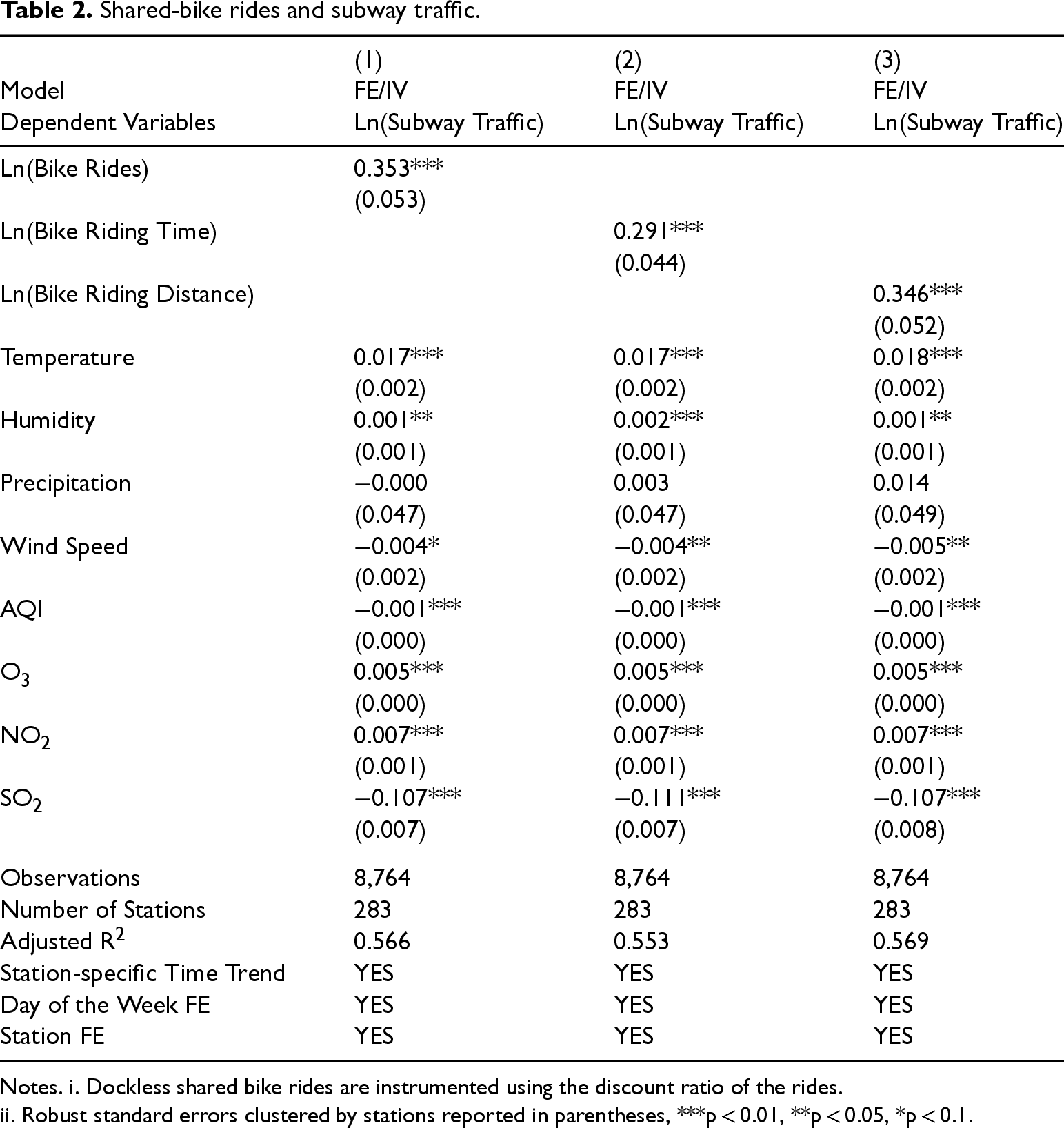
Shared-bike rides and subway traffic.
Notes. i. Dockless shared bike rides are instrumented using the discount ratio of the rides.
ii. Robust standard errors clustered by stations reported in parentheses, ***p < 0.01, **p < 0.05, *p < 0.1.
Dockless Shared Bike Rides and Subway Traffic
Our primary estimation model is 2SLS estimation with fixed effects, using the discount ratio as the instrumental variable. We first use the number of shared-bike rides as the independent variable. The first-stage Cragg-Donald Wald F-statistic is 114.22, greater than the cutoff of 10 (Stock and Yogo, 2005), passing the weak instrument test. The Hansen’s J statistic is not significant (p-value = 0.768) and the null hypothesis cannot be rejected. This shows that the exclusion conditions are satisfied and the instrumental variables are uncorrelated with the residuals. Thus, the instrument variable is valid.
Column 1 of Table 2 reports the estimates from the second stage and shows that a larger number of shared-bike rides leads to significant increases in the volume of subway traffic. This suggests a complementary relationship between bike-sharing ridership and subway traffic and thus supports our Hypothesis. In terms of economic significance, holding everything else equal, a 1% increase in the number of shared-bike rides on average is associated with a 0.35% increase in subway traffic. When we use two alternative measures of dockless shared bike usage (daily total riding time or daily total riding distance), we use the same instrumental variable, the discount ratio of charges for dockless shared bike rides, to instrument for these two alternative independent variables, respectively. Again, both of the first-stage F-statistics are greater than 10, suggesting the instrument variable is valid. The first stage estimation results are reported in Table A3 in the online appendix. Columns 2 and 3 of Table 2 report the second stage estimation results using the dockless bike ride time and distance as alternative measures of dockless shared bike usage, respectively, which are very similar in scale to those in column 1. This verifies that the complementary relationship between dockless shared bike rides and subway traffic that we observe is robust to the different measures of dockless shared bike rides.
Next, we conduct a falsification test to verify that it is indeed the usage of dockless shared bikes that drives the increase in subway traffic, by comparing the effects for days with good weather and unfavorable weather for riding bikes. On days with unfavorable weather that makes biking difficult, the channel of shared bikes promoting subway traffic is expected to be inhibited and weak because people are less likely to consider the travel option of combining shared bikes and the subway, compared to days with good weather for biking. If it is indeed the increase in bike rides that drives the increase in subway traffic, we expect the positive relationship to be much smaller or even disappear for days with unfavorable weather. This, therefore, serves as a falsification test.
We reference biking sports forums 8 and define weather conditions unfavorable for biking as having an average wind speed higher than 18mph, thunderstorms or heavy rain (daily precipitation higher than 0.098 inches). Table 3 reports the results when we estimate the effect of dockless bike sharing and subway traffic on days of good and unfavorable weather, respectively. The results show that the complementary relationship between dockless shared bikes and subway traffic is only statistically significant for days when the weather favors biking (coef = 0.358, p-value < 0.001, according to column 1). For days when the weather is unfavorable, the positive relationship is not statistically significant and the estimated coefficient is quite small (coef = 0.026, p-value = 0.186, according to column 2). These results address omitted variable concerns for identification. Specifically, if our results are mainly driven by unobserved variables that influence both subway traffic and shared bike rides, we would expect to observe a positive correlation between bike rides and subway traffic on days of both good and unfavorable weather. The results from this falsification test do not support this pattern, and thus increase our confidence in the main findings that the complementary relationship detected indeed comes from the combination between the usages of shared bikes and the subway.
Falsification tests using weather condition.
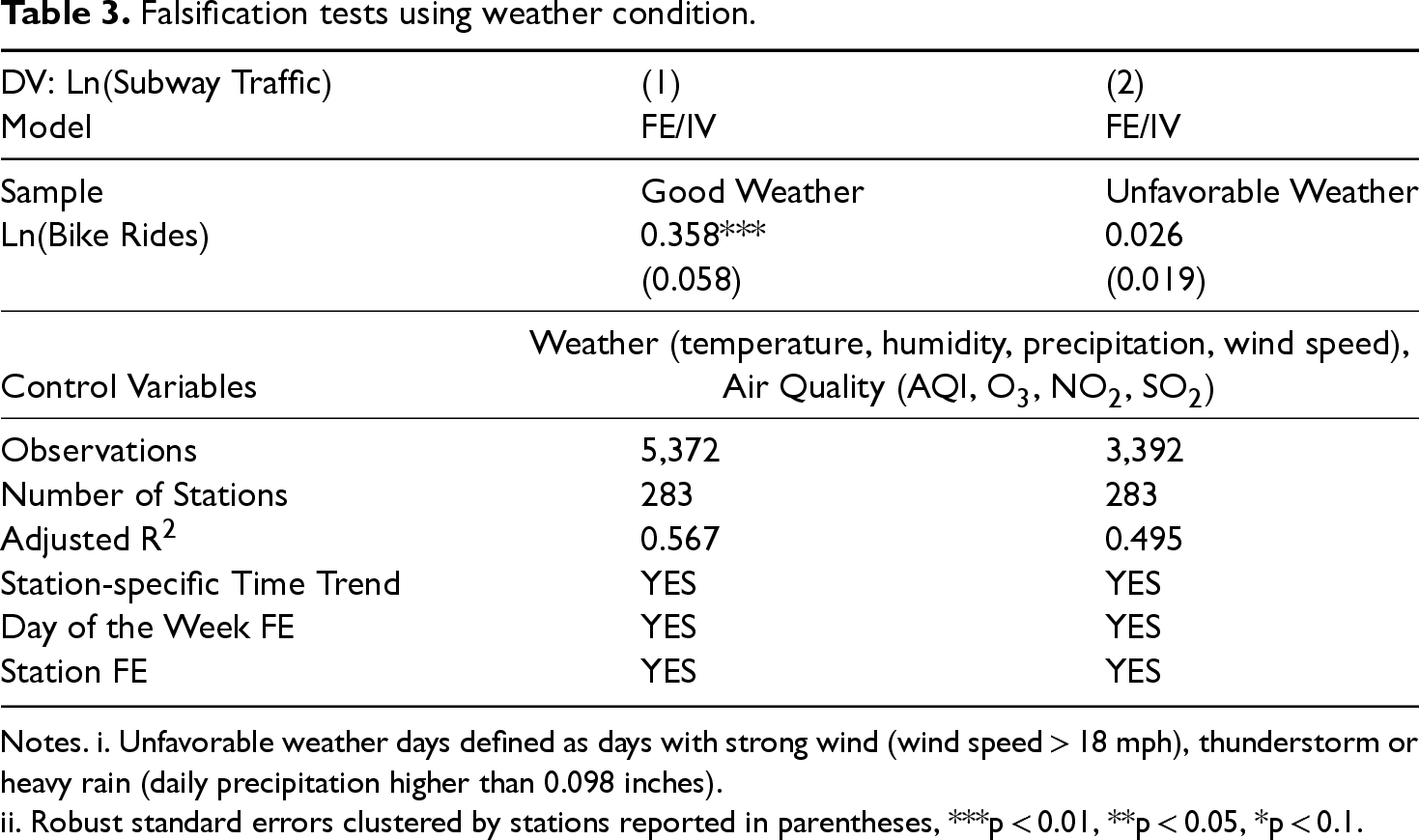
Falsification tests using weather condition.
Notes. i. Unfavorable weather days defined as days with strong wind (wind speed > 18 mph), thunderstorm or heavy rain (daily precipitation higher than 0.098 inches).
ii. Robust standard errors clustered by stations reported in parentheses, ***p < 0.01, **p < 0.05, *p < 0.1.
Recall that our hypothesized mechanism is that dockless shared bike rides reduce the cost for people to connect their starting/ending point of a trip to subway stations and thus provide a solution to the “last-mile problem”. Thus, we focus on the severity of the “last-mile problem” to uncover the mechanisms. Our rationale is as follows. When the “last-mile problem” is more severe (that is, the travel distance for reaching subway stations is long), the advantage of dockless shared bikes in decreasing such connection costs is more salient. As a result, we expect the complementary relationship between dockless shared bikes and the subway to be stronger. To test the mechanism, we proxy the severity of the “last-mile problem” using the average travel distance of dockless shared bikes per ride. Specifically, we use the median value of the average distance traveled for dockless shared bike rides that end at or start from each subway station, to divide our sample into two groups, Longer Distance per Ride and Shorter Distance per Ride. 9 Then, we estimate the effects for the two groups separately and report the results in columns 1 and 2 in Table 4.
\!Mechanism check using the severity of the “last-mile problem”.
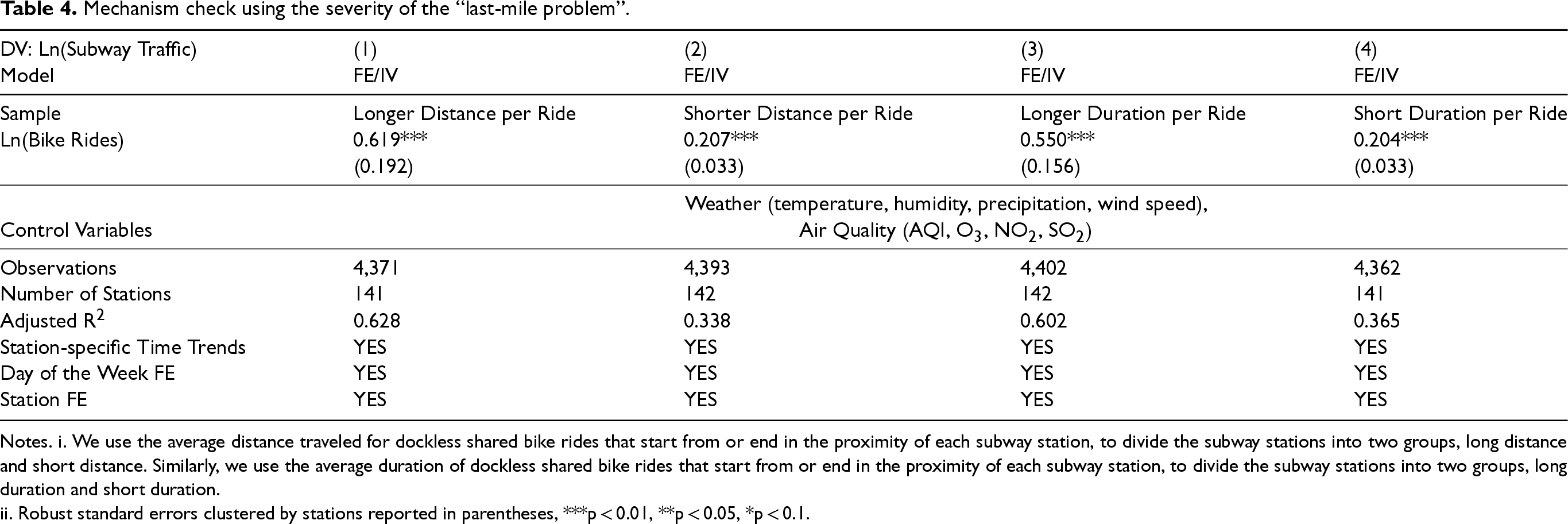
\!Mechanism check using the severity of the “last-mile problem”.
Notes. i. We use the average distance traveled for dockless shared bike rides that start from or end in the proximity of each subway station, to divide the subway stations into two groups, long distance and short distance. Similarly, we use the average duration of dockless shared bike rides that start from or end in the proximity of each subway station, to divide the subway stations into two groups, long duration and short duration.
ii. Robust standard errors clustered by stations reported in parentheses, ***p < 0.01, **p < 0.05, *p < 0.1.
We find that the estimated coefficients of Ln(Bike Rides) in columns 1 and 2 are 0.619 and 0.207, respectively, and the difference is statistically significant (t-value = 140.16, p-value < 0.001). Thus, the results indicate that the complementary relationship between dockless shared bikes and the subway is stronger when the “last-mile problem” is more severe, that is, when people need to travel a longer distance to reach the subway stations. Economically, a 1% increase in dockless shared bike usage leads to a 0.62% increase in subway traffic for subway stations that people typically travel a longer distance to reach (column 1), whereas it only leads to a 0.21% increase in subway traffic for subway stations that people typically travel a shorter distance to reach (column 2).
Alternatively, the severity of the “last-mile problem” can be proxied by the average trip duration for dockless shared bike rides that start from or end in the proximity of each subway station. We use a similar median split method and conduct the subsample analyses. We report the results in columns 3 and 4 in Table 4. The results are quite consistent. That is, we find that the estimated coefficient of Ln(Bike Rides) in column 3 is significantly greater than that in column 4 (0.550 vs. 0.204, t-value = 143.34, p-value < 0.001). Thus, the results again indicate that the complementary relationship between dockless shared bikes and subway traffic is stronger when the “last-mile problem” is more severe, i.e., requiring a longer time for people to reach the subway stations (column 3), compared with stations that take a shorter time for people to reach (column 4). These results support our hypothesized mechanism that the complementary relationship between dockless shared bikes and subway traffic results from the fact that dockless shared bikes could address the “last-mile problem” by reducing the cost in time and effort to reach subway stations and thus making the subway a more attractive transportation mode compared with alternative options.
GMM estimation results for shared bike rides and subway traffic.
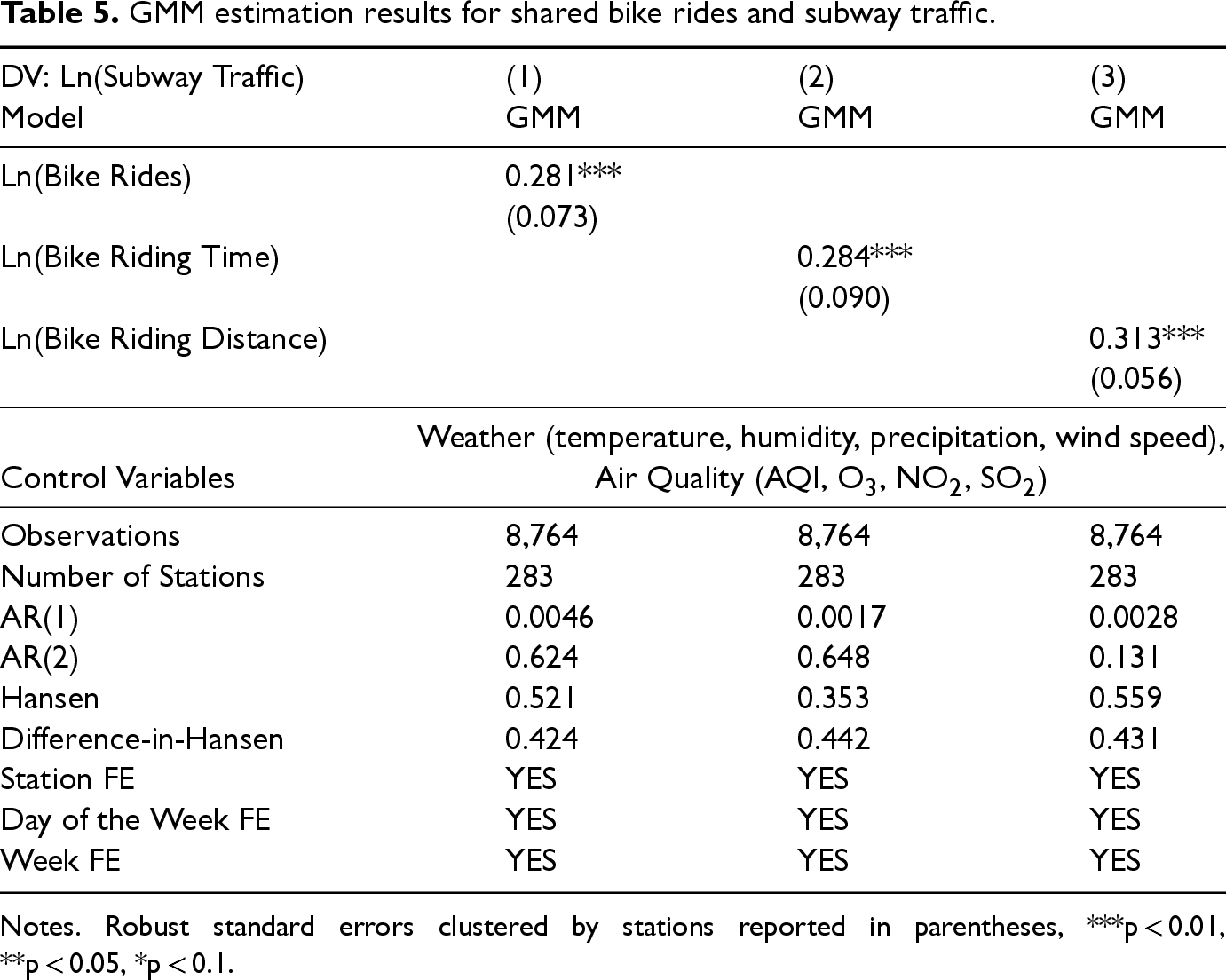
Notes. Robust standard errors clustered by stations reported in parentheses, ***p < 0.01, **p < 0.05, *p < 0.1.
Alternative Estimation Framework
In the main analysis, we used the instrumental variable approach and 2SLS estimation method with panel data. To show the robustness of the results, we also use a dynamic panel system generalized method of moments (GMM) estimation, as an additional identification strategy, to address potential endogeneity concerns, such as omitted variables driving simultaneous changes in both subway traffic and dockless shared-bike rides. GMM estimation has been widely used in the literature to address the endogeneity of independent variables in panel data analysis (Li and Wu, 2018; Jabr and Rahman, 2022; Yan et al., 2022). With the dynamic panel data GMM estimation method, we use the internal panel instruments of difference and lagged values of the endogenous variable, which is the natural log of dockless shared-bike rides in this case, combined with the external instrumental variables from the discount in prices charged for dockless shared-bike rides. We implement the collapse option for multiple-period lagged instrumental variables to avoid the “too many instruments” problem (Roodman, 2009b).
Table 5 reports the estimation results and various statistical test results on the validity of the estimation approach. The validity of the instruments is confirmed, as neither the Hanson J-statistics for over-identification (p = 0.521) nor the difference-in-Hansen test (p = 0.424) rejects the null hypothesis that these instruments are uncorrelated with the disturbance terms (Roodman, 2009a). The auto-correlation tests also confirm that it is valid to use the difference and levels from the second lagged term forward to instrument for the shared-bike ride variables. The estimates are qualitatively similar to the results in Table 2, further reducing the endogeneity concern of our findings.
Potential Alternative Explanations
Our main findings show that increased use of dockless shared bikes leads to increased subway traffic, suggesting that dockless shared bikes complement and promote the use of public transportation. Our proposed mechanism for this complementarity is that dockless shared bikes reduce the hassle cost of taking public transportation, making it a more appealing option compared with other alternatives, such as driving private cars, taking taxis, or using ride-hailing services. An alternative explanation of our findings could be that instead of substituting passenger vehicle usage, the increase in subway traffic comes from users switching from taking buses, thus weakening the practical implications of our findings that dockless shared bikes complement and promote the use of public transportation. Herein, we seek to rule out this alternative explanation by conducting additional analyses, examining how the complementary relationship changes with the density of bus stops near the subway stations.
We query Google Map API for the GPS locations of each subway station and find the number of bus stops located within a 500-m radius of each subway station. 10 We use the average number of bus stops to create a binary split for subway stations with more or fewer bus stops, respectively. We then contrast the impacts of dockless shared bike rides for the two subsamples. If the increase in subway traffic indeed comes from substituting bus traffic, we expect to see the impact of shared-bike rides to be stronger for subway stations with denser bus stops nearby, which have larger pools of bus traffic to potentially substitute for. Table 6 reports the results.
Shared bike rides, subway traffic and relationship with bus traffic.
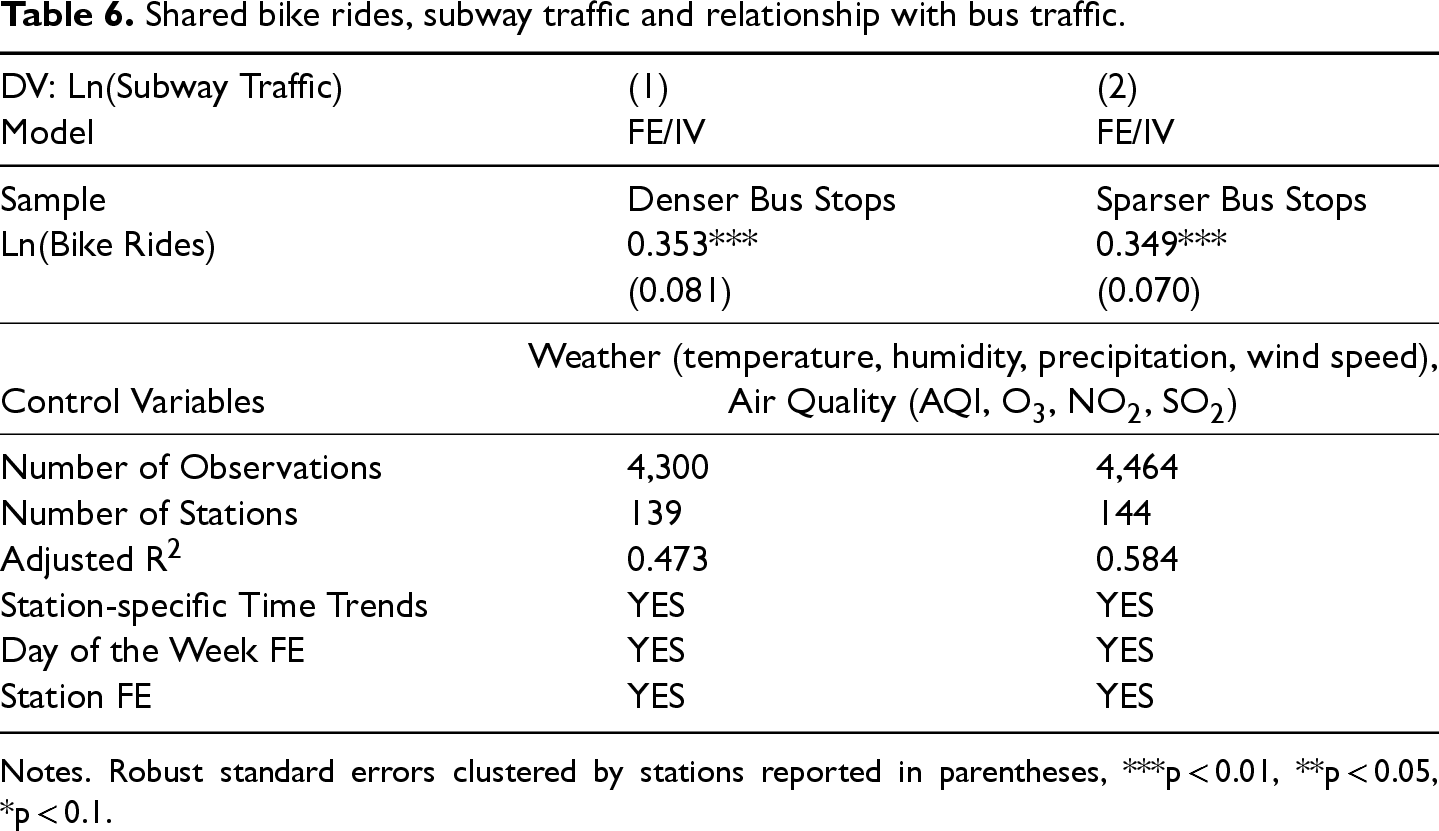
Shared bike rides, subway traffic and relationship with bus traffic.
Notes. Robust standard errors clustered by stations reported in parentheses, ***p < 0.01, **p < 0.05, *p < 0.1.
We observe that the positive effect of shared-bike rides on subway traffic is similar for subway stations with more or fewer bus stops nearby. The estimated coefficients for Ln(Bike Rides) in columns 1 and 2 are not statistically significant (t-value = 0.25, p-value = 0.80). These results suggest that the positive effect of dockless shared bikes on subway traffic does not significantly change with the number of bus stops nearby and therefore the increase in subway traffic is likely to come from other sources, instead of substituting bus ridership. Thus, the results rule out the alternative explanation that the increase in subway traffic comes from users shifting away from taking buses and enhance our confidence in the main findings that dockless shared bikes complement the use of public transportation.
Theoretical Contributions
We find that dockless shared bikes complement and promote the use of public transportation. The dockless feature of the new bikesharing systems leads to a paradigm shift in their relationship with public transportation. By offering flexible end-to-end connections, dockless shared bikes can provide smooth transitions that fill the gaps in the coverage of existing public transportation networks, alleviating the “last-mile problem” in public transportation. Accordingly, we find that dockless shared bikes complement public transportation, in contrast to the prior findings by Campbell and Brakewood (2017) that bike-sharing systems with fixed stations substitute bus transportation. Popular usage of dockless shared bikes can have a significant social impact in reducing carbon emissions and contributing to sustainability in urban travel.
From the research perspective, our study makes unique contributions to several streams of literature and provides insights that can help resolve the contrasting findings in prior studies. First, we contribute to the literature on traditional bike-sharing models with fixed stations and demonstrate that the dockless feature of the new bike-sharing model transforms the relationship between shared bikes and public transportation. For bikesharing with fixed docking stations, the choice of the location of the docking stations needs to balance the travel trajectory of local populations and is likely to have large overlaps with the locations of public transit stations (Chen et al., 2020). This contributes in part to the substitution effect between bike sharing and public transportation, as documented by Campbell and Brakewood (2017). In contrast, dockless shared bikes remove the constraint of having fixed docking stations and allow for convenient connections between final destinations and public transportation stations. The dockless feature, which is enabled by recent technological advancement (e.g., mobile technologies, and IoT), results in a paradigm shift in their relationship with public transportation, explaining the complementary relationship that we find in this study.
Second, we contribute to the literature on the impact of other types of ride-hailing models. Prior work that has found ride-hailing services can complement public transportation in certain cases, such as when they cover areas that are hard to reach, given the fixed routes and timetables of public transportation (Hall et al., 2018; Pan and Qiu, 2022). This is echoed in our findings on how dockless shared bikes provide end-to-end connections that solve the “last-mile problem”, i.e., from the starting point/ending point to public transportation stations. This explains our observed complementary, rather than competing, relationship between dockless shared bikes and public transportation.
Finally, our findings contribute to the stream of studies that examine sustainability and the sharing economy from the service operations perspective. These studies have mostly focused on the environmental impact of car-sharing programs by manufacturers (Bellos et al., 2017), electronic car charging designs (Avci et al., 2015) and car-sharing for delivery services (Qi et al., 2018). We contribute to this literature by examining how the dockless bike-sharing model, enabled by recent technological advancement, promotes public transportation use. We expect the environmental impact of dockless shared bikes to be potentially more profound than car-sharing programs, since these bikes do not have green gas emissions themselves. By promoting the use of public transportation, dockless shared bikes can further reduce green gas emissions by substituting cars trips. A detailed discussion of the estimated reduction in emissions is provided in the next section. Our study also opens the door for future research to examine the dynamic management of the dockless shared bike fleet and pricing incentives to further promote the use of public transportation.
Implications for Urban Planning, Environment, and Managers
Our findings have several important implications for urban planning, environmental impact, and managerial decisions. First, at the aggregate level, users’ behavioral shifts in commute methods potentially have significant environmental and societal impacts, resulting from the environmentally friendly nature of the dockless shared bikes, compared with other ride-based sharing models. As we further investigate the mechanisms behind the increase in public transportation, we find that dockless shared bikes promote public transportation usage by reducing the “last-mile problem” and making public transportation a more appealing option compared with the alternatives. Thus, dockless shared bikes are indeed promoting greener ways of travel. This is particularly relevant for metropolitan cities with dense populations, where increased usage of shared bikes and public transportation could lead to significant reductions in carbon emissions and road congestion. As dockless shared bikes become integrated into urban transportation systems, city planning could potentially consider the allocation of bike lanes in road design to manage bike traffic better along with automobile and foot traffic. For example, Paris has been boosting bicycling with better bike lanes and will invest about 350 million euros over seven years in bicycling infrastructure (DeClercq and Ausloos, 2018). Therefore, our results are of high practical relevance in understanding the environmental and societal impact of dockless shared bikes.
Second, we further estimate the environmental impact based on the estimates from our study. Dockless bike sharing potentially encourages people to switch from passenger vehicle usage, such as driving private cars, taking taxis or using ride-hailing services, towards greener ways of travel that combine dockless bikesharing and public transportation. Such a shift in people’s preferred transportation methods can result in a significant reduction of gasoline consumption and carbon emissions. We use a back-of-the-envelope calculation to estimate the reduction in CO2 emissions from dockless shared bikes and the subway jointly substituting passenger vehicle usage. The coefficient estimates in Table 2 show that, on average, a 1% increase in dockless bike rides leads to a 0.35% increase in subway traffic. Considering the average daily subway ridership in the city is estimated to be around 10.35 million at that time (China Association of Metros, 2018), this 0.35% increase in subway traffic translates to an increase of 36,225 subway trips per day. Prior work estimates that the average duration of subway trips in the city we study is around 39 minutes, spanning around 13 stations, based on metro card swiping records (Huang et al., 2018). The average distance between two subway stations is 1.5 km on average (Huang et al., 2018). Therefore, the average distance traveled per subway trip is around 1.5
Third, our findings can provide bike-sharing companies with insights into demand predictions and shared bike fleet management. Since subway stations are among the most popular places for users to pick up and drop off bikes, the bike sharing companies can use our findings to calculate the optimal bike inventory to hold at each subway station or bus stop based on the relationship between shared bike rides and public transportation. Our finding is also of importance to businesses with customer traffic influenced by such transportation modes. Understanding how users’ preferences change in response to the introduction of dockless shared bikes can help such companies design marketing strategies. For example, businesses located near subway stations can tap into the pool of bike-sharing users, send them promotions, and potentially convert them into new customers.
Finally, while we focus on examining the impact of dockless shared bikes on public transportation in this study, the findings can also be generalized to other forms of sharing transportation business models. For example, shared scooter systems may work in similar ways as shared bikes. In areas where shared scooter platforms are operating, users can potentially use such shared scooters for short trips or as connections to public transportation to reach further destinations. Therefore, it is expected that a similar relationship could be found between shared scooters and public transportation. In addition, a complementary relationship may also exist in other sharing transportation models operating over longer distances, such as shared rides and regional transportation. Users may take Uber, Lyft and other shared rides to regional rail stations and then use regional rail to reach their final destinations, instead of driving private cars the entire way.
Limitations and Future Research
This study also has some limitations that future work can expand on. First, from the subway traffic data, we observe the total traffic coming in and out of the stations, but we cannot observe the entire length or purpose of the trips. Future studies with more granular data could potentially extend from this study and examine more details to understand how the dynamics of shared bikes and public transportation vary for different intended travel lengths. Future studies with more granular data can also pinpoint the travel distance beyond which shared bikes start to complement rather than substitute for public transportation. Second, our measure for public transportation mostly comes from subway traffic, but we do not have granular daily-level observations on other types of public transportation, such as bus ridership, to match with the dockless bikesharing data. We expect that the relationship between dockless shared bikes and subway traffic should generalize to other types of public transportation, since the underlying mechanisms of how dockless shared bikes promote public transportation (such as, through providing end-to-end connections, reducing hassle costs and saving travel time) are likely to hold. Future research can test this empirically, using data from other types of public transportation. Finally, future studies can also combine dockless bikesharing data with economic or environmental data, to directly estimate the impact of bike sharing on economic outcomes (e.g., real-estate prices, local businesses) and environmental outcomes (e.g., carbon emissions).
Other factors besides time cost and hassle cost can also contribute to the complementary relationship between dockless shared bikes and the subway, including environmental considerations and health benefits. Future research can extend from our study and examine how these attitude-related motivations influence the usage of dockless shared bikes and public transportation. The green travel concept and environmental production motivations can lead to behavioral changes where people more frequently switch from driving to using public transportation in combination with bike-sharing (Gardner and Abraham, 2010). Furthermore, past work has shown that riding bikes can bring substantial physical benefits (De Hartog et al., 2010) and standing while taking public transportation can provide a chance to change postures for people who mostly sit still at work (Tirachini et al., 2016). Therefore, the health benefits can be another reason for people to favor dockless shared bikes and public transportation over driving. These reasons can also contribute to the demand for dockless bike-sharing ridership to be positively associated with subway traffic and merit future research to examine their impact in more detail.
Overall, the dockless bike-sharing business combines the traditional advantage of bikes as a green and healthy way to travel, with the technological innovations from the mobile economy and the Internet of things, building a system of shared bikes with the economy of scale. As shared bikes become another option for the daily commute, it promotes increased use of public transportation, mostly through reducing the “last-mile problem” and expanding the flexibility of public transportation to provide end-to-end connections. In this sense, dockless shared bikes hold the promise of reducing carbon emissions, improving public health, and promoting sustainable societies, in addition to the numerous economic benefits.
Supplemental Material
sj-pdf-1-pao-10.1177_10591478231224953 - Supplemental material for Connecting the Last Mile: The Impact of Dockless Bike-sharing on Public Transportation
Supplemental material, sj-pdf-1-pao-10.1177_10591478231224953 for Connecting the Last Mile: The Impact of Dockless Bike-sharing on Public Transportation by Fujie Jin, Yuan Cheng, Xitong Li and Yu Jeffrey Hu in Production and Operations Management
Footnotes
Acknowledgement
The authors would like to thank the Social Technologies in Operations Special Issue Editors, an anonymous senior editor and three anonymous reviewers for their very constructive advice throughout the revision process. The authors thank the audience of the CIST conference and the SCECR conference for their constructive feedback.
Declaration of Conflicting Interests
The author(s) declared no potential conflicts of interest with respect to the research, authorship, and/or publication of this article.
Funding
The author(s) disclosed receipt of the following financial support for the research, authorship, and/or publication of this article: Xitong Li gratefully acknowledges the generous research support from Hi! PARIS Fellowship and HEC Foundation.

Notes
How to cite this article
Jin F, Cheng Y, Li X, Hu YJ (2024) Connecting the Last Mile: The Impact of Dockless Bike-sharing on Public Transportation. Production and Operations Management 34(12): 3904–3919.
References
Supplementary Material
Please find the following supplemental material available below.
For Open Access articles published under a Creative Commons License, all supplemental material carries the same license as the article it is associated with.
For non-Open Access articles published, all supplemental material carries a non-exclusive license, and permission requests for re-use of supplemental material or any part of supplemental material shall be sent directly to the copyright owner as specified in the copyright notice associated with the article.
