







Abstract
Social technologies have enabled the emergence of online platforms that provide offline service consultations and recommendations. In this environment, economic inefficiency arises when customers are not fully aware of their horizontally differentiated preferences. With its expertise or data dominance, a platform can be more informed about customers’ hidden preferences. We focus on an instrumental social technology, that is, targeting, which is a type of data-driven personalized information provision to manipulate customers’ beliefs about service quality. We propose a Hotelling model wherein customers are sensitive to the delays for service while making Bayesian belief updates based on a platform’s recommendations. When customers self-select their favorite service, their choices impose negative externalities through congestion and welfare loss. Our results indicate that service recommendations allow customers to navigate toward the more appropriate service, thus improving matching efficiency, reducing congestion costs, and enhancing aggregate customer welfare. We further identify the role of “information transparency” and study how the platform should strategically release information by making personalized service recommendations to customers. Interestingly, when a customer-centric platform maximizes aggregate customer welfare, we identify the “value of opaqueness” by strategically withholding service recommendations from a subset of customers and notice that this effect is more pronounced for a profit-seeking platform. Our results offer a better understanding of information transparency policies in the joint design of service recommendation systems and pricing mechanisms.
Introduction
A collection of social technologies has enabled the emergence of online platforms (including live-streaming platforms and virtual social networks) that provide offline services. For example, TikTok, an algorithm-driven live-streaming platform, recommends sponsored video content marketing offline services such as restaurants and entertainment (Ma et al., 2022). In addition to these social technologies that build the infrastructure of their online platforms, we focus on an instrumental social technology of targeting: providing data-driven personalized information with a subtle objective to use personal data to manipulate customers’ beliefs about service quality. While most social technologies are applied to the product retail or service marketing environments, the field of operations management has been paying increasing attention to places such as call centers, healthcare, and food service providers as growth sectors for such interfaces. Because of its massive social capital among Gen Z, TikTok is becoming the pivot of targeting tools, and its “health-and-wellness credibility has been bolstered by a host of savvy healthcare providers,” and healthcare service providers are already flocking to TikTok to target younger audiences. 1
Targeting relies on the collection of vast amounts of consumer data to allow the delivery of increasingly personalized content provisions, for example, display advertisements, tailored video advertisements, and sponsored search advertisements. It is becoming highly controversial whether consumers’ personal data can be collected by platforms, even when the objective of such data collection is to provide better-targeted information provision. Regulations and industry norms are emerging to curtail consumers’ data collection and enforce privacy protection. On the regulatory side, new legislation such as the California Consumer Privacy Act and the European General Data Protection Regulation are expected to affect industries and markets that rely heavily on personal data and customer profiling (Harding et al., 2019). Online platforms such as the search engine DuckDuckGo have voluntarily and strategically limited the amount of information they collect about their users (Latzer et al., 2016). However, consumers might be negatively impacted by the increasingly stringent information protection that results. For example, Goldfarb and Tucker (2011) show that due to starker data protection regulation, European Union (EU) consumers were less likely to make a targeted purchase compared to non-EU consumers amid more relaxed regulations.
The data protection debate suggests that personalized targeting may become much less relevant if less consumer data is available to the platform. Consequently, the abundance of services can potentially backfire when customers are uncertain about their preferences among the services provided by online platforms. In exploring different options, customers may choose a service that is not equipped with a desired feature or is inefficient in accomplishing the requested task. Such mismatches between services and customers may also take up resources that could be better utilized, causing a potential delay in service queues. These potential negative outcomes thus give online platforms the incentive to provide customers with service recommendations. Such information provision is usually implemented via a carefully designed recommendation system based on computer algorithms. Services are experience goods that are valued by both quality and the delay in consumption. When customers self-select their preferred services, their choices impose negative externalities through congestion, which is a welfare loss. This is a particularly salient feature since we take a customer-centric perspective and focus on the aggregate customer welfare rather than the platform’s payoff.
We address the data protection and privacy debate from the perspective of information transparency as a communication instrument. That is, we focus on an asymmetric informational setting wherein the platform becomes more informed about customer preferences than the customers themselves. This setup becomes increasingly relevant to today’s service industry as service platforms accumulate customer data or professional expertise. In a variety of service industries, online platforms are able to provide service recommendations by strategically releasing preference information to customers. For example, in the traditional healthcare service operations system, due to a lack of professional medical knowledge, customers (patients) are typically uncertain about the severity of their diseases. Patients first need to consult with a primary care physician (PCP) for a recommendation of the best-specialized provider. Aided by social technologies in patient data collection, HaoDF, one of China’s leading online healthcare platforms, now facilitates offline healthcare services and treatment referrals via online e-consultancy, streamlining the delivery process of specialized medical services to the patient. 2
Given the ubiquity of strategic information transparency policies, we focus in particular on the context of service provision. Information transparency serves as an emerging instrument to empower such digital/platform economies, enabled by the aforementioned social technologies. Vimalananda et al. (2015) provided a comprehensive literature review of service recommendations. With the wide implementation of service recommendations, Zoll et al. (2015) have observed an imminent need for a systematic evaluation of their benefits and limitations. A less explored matter, however, is whether a clear recommendation should be provided in the first place. We use the term “information transparency” in reference to how the platform should strategically release information by making personalized service recommendations to customers. To fully understand the impacts of information transparency on the service system, it is necessary to investigate the heterogeneity of the customers, their strategic behaviors, and the role of information disclosure in customer behaviors. Therefore, in this paper, we address the following research questions: (a) What is the economic value of targeting technology in the operations of online platforms? (b) How can platforms fine-tune the transparency of the recommendation system in order to maximize aggregate customer welfare? (3) What is the optimal information transparency policy for a profit-seeking platform when different selling formats are adopted?
To address the above research questions, we develop a stylized model with (endogenous) information asymmetry. The heterogeneity of customers’ preferences is characterized by a hotelling location model. We model “targeting technology” as a Bayesian learning process where online platforms use historical data and consumer profiling to obtain partial or complete information about a customer’s horizontal preference, and consequently choose to strategically release this preference information to a subset of customers. In general, the targeting technology is idiosyncratic, which depends on the horizontal preference or location of every customer. Based on the released information, each customer’s choice is driven by the service price, the waiting time, and the mismatch cost. The provision of information indirectly alters customers’ service adoption behaviors, and thus the system-level customer diversion and the market size of the services. In obtaining the customer diversion equilibrium, we demonstrate that customer self-selection leads to suboptimal social welfare when customers are provided with the same amount of information. Therefore, “targeting technology,” which is selective in terms of customer population size due to location/preference-dependent information transparency, can help achieve higher economic efficiency by guiding customers toward a better service, that is, one with lower waiting times and better-matched preferences.
Our analysis reveals the power of targeting technology (personalized information transparency) to aid the heterogeneous customer base in navigating through desired service queues. Interestingly, the optimal information structure is polarized, where the platform discloses either full information or no information to any particular customer. It is because, in the hotelling setting, partial information transparency is likely to induce a particular customer to choose the unsuitable service, thus leading to an inferior outcome. In our work, the value of service recommendations is indicated in the increase in aggregate customer welfare under carefully designed information disclosure. In particular, we illustrate that a customer-centric platform can maximize aggregate customer welfare via information design. Our results surprisingly highlight the value of opaqueness when the platform strategically withholds information from a subset of customers to achieve social optimum. Furthermore, the platform may also be incentivized to exploit targeting technology to extract more consumer surplus, and thus maximize the profit. The value of opaqueness becomes more pronounced for a profit-seeking platform. When service prices are exogenous, the platform is able to induce consumers to choose a more profitable alternative by strategically obfuscating consumer preference toward one end of the hotelling line while fully disclosing their preference toward the other end end. If the platform can decide service prices, it could withhold information on both ends of the hotelling line and extract all the consumer surplus. However, when service providers decide prices independently, the platform chooses to disclose full information, as partial information makes the price competition between service providers so fiercer which in turn, forces the platform to reveal full information. Therefore, our results also shed light on the role of information transparency in service recommendations in augmenting pricing instruments on such platform economies.
The paper is structured as follows. In Section 2, we review related literature. In Section 3, we introduce the analytical framework. In Section 4, we analyze our model under customers’ self-selection when all customers receive the same amount of information. In Section 5, we study the optimal information disclosure policy. Extensions are discussed in Section 6. In Section 7, we draw conclusions and briefly discuss future directions. Proofs are presented in the Online Appendix.
Literature Review
With the recent development of the internet, virtual services, e-commerce, and the online market, a growing literature in information systems research focuses on “social technologies,” especially the informational aspect. In a study by Tan et al. (2016) targeting e-books industry, an agency model is proposed to coordinate the incentives whereas supply chain contracts are typically used for traditional material goods. Similar to our duopoly setting, Xu et al. (2010) investigate competition between spatially differentiated firms. Chen et al. (2011) is also related in terms of knowledge transmission game between senders and receivers. They focus on the reputation concern with which the sender is induced to provide high-fidelity information. Along this line, Lin et al. (2008) show that an informed sender can manipulate a receiver’s belief about the sender’s information level.
“Targeting” is one of the social technologies that receives tremendous attention, especially in marketing. The study of consumer targeting technology in marketing starts from Iyer et al. (2005). Shen and Miguel Villas-Boas (2018) extend the idea and propose the concept of behavioral targeting, based on past purchasing history. Zhang and Katona (2012) depict a price competition scenario such that an intermediary should strategically choose inaccurate targeting. More broadly, the modeling of customers’ horizontal heterogeneity in our paper is closest to the service marketing literature under the Hotelling (1990) demand model. Beyond physical products, the marketing of intangible services is featured with congestion cost in the Hotelling model (Kohlberg, 1983). Ahlin and Ahlin (2013) combine both features of horizontal differentiation and service congestion, and it is hence revealed that congestion effects can reduce competition intensity. In a similar vein, Yang et al. (2013) consider a spokes model and considered behavioral bias in a service operations environment. A closely related work by Zhong et al. (2020), examines the referral problem between PCPs and specialists. The model is similar in the sense that a hotelling framework was proposed. In our paper, we focus on the information design problem and provide managerial insights concerning information non-disclosure (“value of opaqueness”).
Methodology-wise, endogenous information structure has been highlighted as a key research topic within the economics and management literature. Recent research illustrates the potential negative implications of information provision in various contexts. Our paper is closest to Liao et al. (2017) in terms of information sharing mechanism in a hotelling market. Liu et al. (2017), for example, find that more/accurate market-generated information can be detrimental to firms and consumers due to firms’ improper pricing strategies and information policies, which is contrary to conventional wisdom. A firm can even manipulate its pricing based on existing online word of mouth to influence online product reviews (thus influencing sales) Feng et al. (2019). For the recommender system in e-commerce platforms, Li et al. (2018) find that recommendation information transparency may not create economic value in a distributional channel setting, in particular, to the consumers. Privacy concern regarding information collection and disclosure has been raising attention.
Finally, the self-interested customers in our paper assimilate queueing theory concepts in the context of a flexible service system. In our paper, online platforms use service recommendations to control the information available to customers so as to affect their service adoption decisions. This is related to a stream of research concerning information economics in the queue game context. Bayesian learning was applied in Lingenbrink and Iyer (2019) to study optimal information sharing in the context of an unobservable queue. They showed that firms can maximize revenue by strategically concealing information, which highlights the “value of opaqueness” in revenue optimization. Guo et al. (2011) showed that social welfare can be maximized by providing partial information on the service time distribution because partial information mitigates the congestion in the queue and thus reduces aggregate delay cost. Similarly, Cui and Veeraraghavan (2016) pointed out that more service information disclosure may also lead to higher congestion costs and welfare loss, due to customers’ individual incentive compatibility under self-selection.
The Basic Model
In this section, we construct a game-theoretic model where the platform can design and provide recommendations to customers.
In our paper, we abstract away from how the updating process is implemented but focus on information provision and the resulting customer behaviors. The step-by-step updating process is motivated by gradualism in strategic communications. For example, in the financial services industry, through a risk tolerance questionnaire, a person can gradually learn about his or her risk appetite and tolerance by answering a sequence of questions. Alternatively, platforms can choose to disclose all signals at once, allowing customers to simultaneously observe and update the information. For instance, online platforms such as Yelp and TripAdvisor use multi-dimensional ratings based on collected data to facilitate customers’ understanding of services. Customers can observe ratings across various dimensions simultaneously to discern their preferences for specific services. The number of dimensions in the rating system or questions in the risk tolerance questionnaire can be considered as a set of signals and are designed by the online platform. Despite potential differences in the learning process, whether it is step-by-step or simultaneous, given the same set of signals, a customer updates the same posterior belief and thus behaves in the same manner.
We further assume that the platform will disclose customer preferences truthfully under the recommendation system. In reality, misinformation and information manipulation on online platforms are heavily regulated by governments. Beyond externally imposed governmental regulations, online platforms are also motivated to self-regulate the information environment because information manipulation and disinformation would lead to consumer trust crises and reputation loss. 3




For simplicity, we start to analyze two extreme cases wherein the recommendation system is either fully transparent or completely opaque. The two extreme cases provide benchmarks to understand more complicated cases.
The Completely Opaque Case
Without a recommendation system, each customer makes her decision according to the prior belief of a uniform distribution. The expectation of
To balance the congestion at two service stations, we assume that customers adopt a mixed service adoption strategy: she chooses
When the recommendation system is not available, there exists a unique strategy (pure or mixed) such that each customer chooses
According to Lemma 1, customer division is induced according to mixed strategies, and loads of two service providers will be balanced when there is no information transparency implemented. It is possible that all the customers will choose only
In the case of full information transparency, we assume that the recommendation algorithm is perfectly accurate and that each customer can perfectly infer her true preference after observing the outcome of signals. This is equivalent to the case where the number of signals
Under full information transparency, there exists a unique threshold strategy
Under full information transparency, customers adopt a threshold strategy because of the monotonicity of utility functions in
In practice, signals solicited by the platform may not be sufficient to fully reveal customers’ true type. We refer to this case as partial information transparency. Note that we have not yet proposed “targeting technologies” since the information structure so far is homogeneous for all customers. In this section, we examine the general case in which the accuracy of a recommendation algorithm is captured by the number of signals
Under partial information transparency where the number of signals is
Under partial information transparency, customers can infer their type from the outcome of observed signals and then update their corresponding beliefs. The larger the outcome
Under full information transparency, aggregate customer welfare is strictly greater than the scenario with no information transparency except when all customers choose either The customer diversion
By directly comparing customer welfare in two extreme cases, we confirm that aggregate customer welfare is strictly higher under full information transparency (in most nontrivial cases). The increase in aggregate customer welfare is contributed by the reduction in mismatch cost and congestion cost. Intuitively, in the absence of information transparency, customers overcrowd the service with the lower price, engendering a high mismatch cost as well as service congestion. Information transparency can serve as a compass by which customers navigate toward the more suitable service and thus reduce the mismatch cost. The negative social externality of customers’ service adoption decisions in the form of high congestion costs is also greatly reduced when customers are guided away from the more popular choice.
Under partial information transparency, as
In our paper, the value of information transparency could be measured by the increase in aggregate customer welfare. It is consistent with empirical studies that have demonstrated the benefits of such consultations, including reduced waiting time and increased service efficiency (Gleason et al., 2017; Naka et al., 2018). Our contribution to the existing literature lies in quantifying the accuracy of information provision through the number of signals, and we demonstrate that under partial information transparency, aggregate customer welfare converges to full information transparency in a nonmonotonic fashion.
In this section, we investigate the optimal information policy considering the different objectives of the platform. In particular, though information transparency reduces mismatch costs and mitigates the negative social externality, aggregate customer welfare is not monotonic in the informativeness of information disclosure. For this reason, in Section 5.1, we study the optimal information provision policy to maximize aggregate customer welfare from the customer-centric perspective. In Section 5.2, we further consider a profit-seeking platform. We also relax the assumption of exogenous prices and examine the optimal information policy under both exogenous prices and endogenous prices. It should be noted that we relax this assumption only when the platform is profit-driven. When it is customer-centric, service prices should be reduced to zero to maximize aggregate customer welfare, so we skip this trivial case.
Customer Welfare Maximization
Centralized Optimization of Customer Welfare
The purpose of this section is to design an information transparency policy to increase aggregate customer welfare. A customer-centric perspective corresponds to the recent shift in business models from profit-driven motives to corporate social responsibilities. As a business innovation, customer-centric management increases competitiveness and brings promising business opportunities for new businesses (Liang and Tanniru, 2006). We focus on the information policy design of recommendation systems, to facilitate “targeted information disclosure”.
To motivate our solution, we start with a characterization of an upper bound of aggregate customer welfare and examine the gap. An upper bound in customer welfare is reached when there exists an omniscient central planner dictating to customers which service they should choose. Suppose that
There exists a unique threshold
Lemma 4 confirms the existence of the optimal threshold strategy
In Corollary 1, we derive comparative statics. In particular, we provide managerial insights concerning the factors that lead to either an overcrowding of
As previously stated, the upper bound of aggregate customer welfare is reached when an omniscient central planner dictates for their customers which service to choose. When customers are free to choose between
To fill the gap between centralized optimization and individual optimization, we propose a personalized information transparency policy that allows the platform to strategically reveal information, whereas customers make their individual choices based on their best knowledge and the released information. In other words, the information revelation policy is personalized and type-dependent. We first propose a general interval revelation policy, under which, the platform is free to provide personalized information to customers.
In the following, we prove that, under the optimal information policy, the negative externalities of individual queue-joining behaviors can be fully resolved and the upper bound of aggregate consumer welfare can be achieved.
When the platform is customer-centric, the optimal information structure is polarized, where the platform discloses either full information or no information to any particular customer.
Unlike the previous literature regarding information sharing or information provision problems, for example, Liao et al. (2017), our paper focuses on the information design problem and considers a more general structure where information disclosure for heterogeneous customers is personalized. Proposition 2 implies that we can rule out partial information transparency for any particular customer when designing the optimal information policy and focus on a polarized information structure where the platform discloses either full information or no information. This is because the interval information structure containing partial information transparency in any interval is weakly dominated by a polarized information structure. Intuitively, in the Hotelling model, the platform is incentivized to induce customers to choose the suitable service through information design, regardless of whether the platform is customer-centric or profit-seeking. This implies that in the Hotelling model, the optimal information policy should induce a threshold equilibrium.
However, partial information transparency in any interval may induce consumers to randomize between services, as the preference information is not accurate enough. For instance, to maximize aggregate customer welfare, customers should adopt a pure strategy according to the threshold
Through Proposition 2, we prove that considering two benchmarks (i.e., full information transparency and the completely opaque case) is enough to formulate an optimal information policy. Regarding target technology, for any particular customer, the optimal intensity of recommendations should be either
The main challenge in designing the information policy is that there are infinitely many interval revelation policies. The significance of the above lemma is to pin down a specific class of information structures. Readers are referred to the Online Appendix for a complete proof and we briefly sketch the proof idea here. Under an arbitrary information structure with
The equilibrium under different information structures when

The equilibrium under different information structures when

The following scenarios under the information structure can take place:
In Case 1, since In Case 2, When Case 3. If When Case 4. If The analysis for Cases 6–10 is symmetric and we omit the tedious algebra here. The values of
Figure 1 illustrates the positioning of different cases in terms of the values of
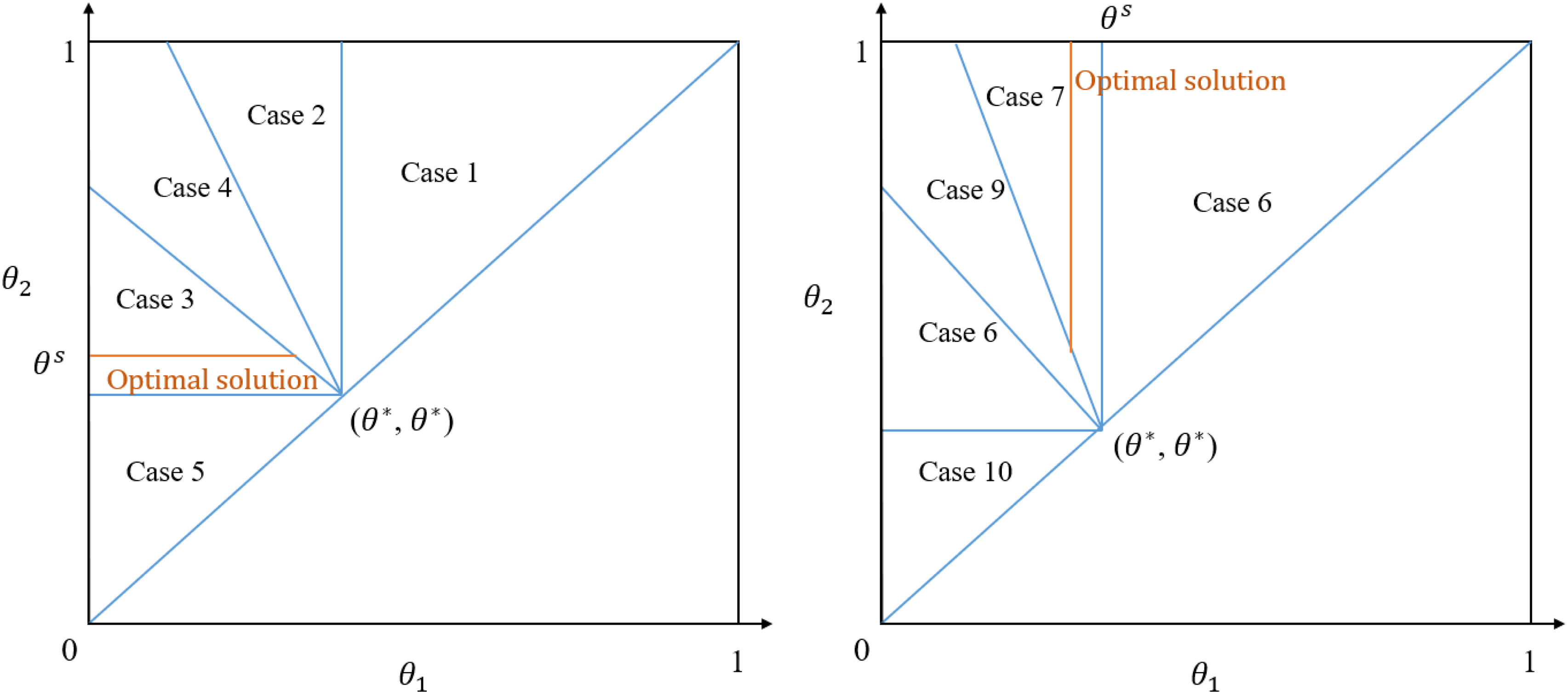
The optimal combination of
The optimal information provision policy is somewhat surprising as it highlights the “value of opaqueness” when a customer-centric platform maximizes aggregate customer welfare by strategically withholding recommendations from a subset of customers. Intuitively, the platform discloses the information for customers located close to either
The “value of opaqueness” echoes the existing research that partial information disclosure could mitigate the congestion and reduce welfare loss, for example, Lingenbrink and Iyer (2019), Guo et al. (2011) and Cui and Veeraraghavan (2016). However, our paper differs from the previous literature by focusing on information disclosure about customer preferences within a Hotelling framework. Another key message from Proposition 3 is that there exists an infinite number of personalized information transparency policies. This observation further highlights the robustness and practicality of strategically disclosing or withholding information to customers to maximize welfare. For instance, once
In the previous sections, our analysis is from a customer-centric perspective, motivated mainly by healthcare operations and corporate social responsibility agenda. In other industries or contexts, profit-seeking incentives may also be of interest to platform economies.
In the following, we assume that a platform’s objective is to maximize its own profit while the model setup remains otherwise identical. Similar to Section 5.1, we still follow the personalized information transparency approach to investigate the optimal information policy. Without loss of generality, we assume that the unit cost of providing service 
The optimal information policy for a profit-seeking platform under exogenous prices.

In the basic model, a customer-centric platform would strategically withhold information from consumers located in the middle segment on the Hotelling line, to prevent them from overcrowding the more popular service. In contrast, for a profit-seeking platform, when the service prices are exogenously given, the information transparency policy is adapted to induce customers to choose the more profitable service. In this case, the platform should withhold information from customers whose types are closer to the more profitable service but disclose full information to more distant customers. For example, when the service
So far, we have derived the optimal information transparency policy when the service prices are exogenously given. In a service retail setting or other contexts, the platform may be able to exploit pricing decisions for profit maximization. According to the classic literature, in the reselling format, the platform purchases products or services from the upstream and resells them to customers, allowing the platform to set prices (Hagiu and Wright, 2015; Feng et al., 2020). Both agency selling and reselling are common in real practice (Tian et al., 2018; Geng et al., 2018), so we extend our model by simultaneously leveraging on pricing and informational instruments for profit maximization. Price discrimination and partial market coverage are eliminated for a clear presentation of the main results. In the following proposition, we characterize the platform’s jointly optimal information policy and pricing decisions.
The optimal information policy for a profit-seeking platform under endogenous prices.
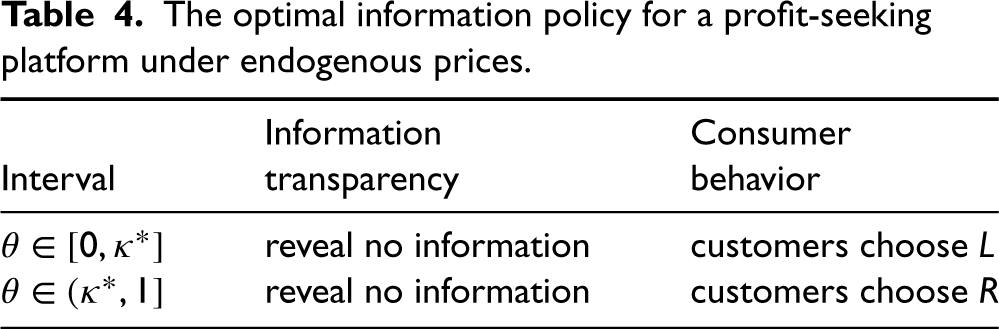
When the service prices are endogenous, the platform adopts a two-interval policy such that customers’ location information is concealed in either interval. Under this two-interval information policy, each consumer only knows which interval she belongs to but not the exact location therein. For profit maximization, the service price must be the lower bound of the surplus of customers that choose the service. Such a two-interval information policy increases customers’ willingness to pay for the service closer to the interval they belong to. Conversely, by strategically obfuscating the location information, they cannot infer their exact location, so the willingness to pay off customers located in the middle is further increased. Therefore, by fully improving the customer’s willingness to pay, especially customers located in the middle, the platform could charge high service prices and extract all the customer surplus (i.e., all customers get zero surplus).
Proposition 5 expands the existing literature on information design by examining the joint design of information disclosure and pricing strategies. It also contributes to the literature on platform operations and information-revealing pricing strategies. Qiu and Whinston (2017) have shown that increased information disclosure through social technologies can alter customers’ willingness to pay, and sellers can utilize information-revealing pricing strategies to enhance profits. In our model, online platforms design information disclosure, and we demonstrate that a carefully designed policy mix of prices and information policies can enable online platforms to extract all consumer surplus.
In the following, we briefly compare the optimal information policy in different scenarios from two dimensions: price setting and the platform’s objectives.
Comparison of the optimal information transparency policy in different scenarios.

Section 5 sheds light on the design of the information transparency policy for a platform with various objectives. For a customer-centric platform, we only consider the case with exogenous prices. Because service prices should be directly reduced to zero under endogenous prices, we skip this trivial case for a customer-centric platform. The “value of opaqueness” is highlighted when a customer-centric platform maximizes aggregate customer welfare. By strategically withholding recommendations from customers in the middle region on the Hotelling line, customers are guided from an overcrowding choice and thus reduce the total congestion cost. However, for a profit-seeking platform, the information policy is exploited to extract more consumer surplus. In particular, when service prices are fixed, the optimal information policy is information disclosure to preference-aligned customers while information nondisclosure to preference-misaligned customers. But when service prices become endogenous, the platform would withhold the information at both ends on the Hotelling line such that the platform could also charge high prices for both services. We remark that such an information policy allows the platform to extract all the consumer surplus under endogenous prices.
Competitive Pricing
In the basic model, we only consider the platform’s decisions, wherein the platform has full control over information design (and price setting). Even under the assumption of endogenous prices, it is the platform that sets prices, which corresponds to the reselling format. On the contrary, following the traditional literature on agency selling, the platform provides an online channel for two firms to sell products, wherein firms decide the price of their products. However, in the basic model, we abstract away from decentralized price decisions by service providers and focus on the platform’s information design problem by assuming that service providers’ pricing decisions are exogenous.
In this extension, we further relax this assumption and consider the strategic interactions between horizontally differentiated service providers’ pricing decisions and the platform’s information design. Under this more complicated setting, we assume that the service providers decide the prices in a competitive market while the platform designs the information policy. The decision sequence takes place as follows. The platform first designs and publicly discloses the information disclosure policy regarding the two horizontal differentiated service providers. After observing the platform’s information policy, the two service providers simultaneously decide on service prices.
In the equilibrium, customer behaviors are not only guided by the information environment and service providers’ prices but also impacted by the externalities of other customers’ queue joining decisions (indicated in the congestion costs). To focus on the strategic interactions between the platform’s information design and service providers’ pricing competition, we intentionally assume
Given
Proposition 6 indicates that the platform should disclose full information no matter whether it is customer-centric or profit-seeking. The equilibrium outcome degenerates to a classic Hotelling model. Interestingly, partial information disclosure may make the price competition between service providers much fiercer. When the platform discloses imperfect information in an interval, as we have discussed in Section 5, customers adopt a threshold strategy depending on the sum of realized signals (i.e.,
To the best of our knowledge, there is limited research on the strategic interactions between a platform’s information design and service providers’ pricing competition. Our findings are also novel in that price competition between horizontally differentiated service providers renders the platform unable to exploit information design to achieve its objectives. Moreover, our model extends the welfare implications of two selling formats, namely reselling and agency selling, by incorporating the platform’s information design.
Under endogenous prices, we have the following observations regarding two selling formats.
When the platform is profit-seeking, the platform’s profit is higher under the reselling format than the agency selling format while customer welfare is lower under the reselling format. When the platform is customer-centric, the platform’s profit is higher under the agency selling format while customer welfare is higher under the reselling format.
Comparing two selling formats, with full control of service prices and information design, the platform is capable of achieving its goal effectively. Recall that Proposition 5 indicates that the platform could extract all surplus by jointly setting service prices and designing the information policy. When the platform is customer-centric, it allocates all surplus to customers by setting zero service prices. However, under the agency selling format, competitive pricing deprives the platform’s ability to influence consumers through information design, which results in full information disclosure no matter what objective the platform holds. The agency selling format benefits consumers when the platform is profit-seeking but service providers when it is customer-centric. Those welfare implications could provide managerial insights in real practice.
In the previous sections, our model is based on the assumptions of the uniform Hotelling line model. In this subsection, we now consider an extension where customers’ type
Comparing Lemmas 1, 2, and 3, which describe the equilibrium of customer service adoption behaviors under different information transparency policies, we note that the case of absent and perfect information transparency are no more than two special cases of imperfect information transparency. In the case of imperfect information transparency, the policy is a soft threshold policy, such that a customer with type
In this section, we use a unifying treatment with general (continuously varying) joining probability, as absent and perfect information transparency are special cases of imperfect information transparency. Though there is no specific form of distribution regarding customer types, waiting times are monotonic in the fraction of customers at two service providers under general distributions. Under the equilibrium condition, the utility functions are also monotonic with the customer type
Lemmas 1, 2, and 3 in Section 4 still hold under general distributions or arbitrary forms of the information updating process: there exists a unique threshold strategy
Proposition 7 confirms the robustness of the results in Sections 4 and 5 under general distributions or arbitrary forms of the information updating process. Under general distributions, customers still adopt a unique threshold strategy under different information transparency in the equilibrium. Suppose the waiting cost is given in the equilibrium, the payoff of choosing
Furthermore, customer behaviors are decided by the posterior belief while the specific form of the updating process will not directly impact customer choices. The form of the posterior belief will not impact customer behaviors and welfare impacts under no information transparency and full information transparency because in those two cases, the posterior belief is irrelevant to the form of the updating process. Thus, Lemmas 1 and 2 in Section 4 hold. Furthermore, in Section 5, according to Proposition 2, the information policy containing partial information transparency is weakly dominated, so the optimal information transparency policy regardless of the platform’s various objectives involves only the complete opaque case and full information transparency. Therefore, our key findings are thus still robust under arbitrary forms of the information updating process or the posterior belief.
Proposition 7 demonstrates that our key findings remain robust under general distributions or arbitrary forms of the information updating process. This implies that the results hold in a broader strategy space beyond the updating process based on Bernoulli random variables, and our results remain valid. Therefore, our paper extends the existing literature on platform operations and information design by investigating the policy mix of pricing strategies and information policies when the platform has multiple objectives.
From a marketing perspective, recommendation systems are typically infrastructure investments made by the platform to facilitate transactions. The search cost is paid by the platform when customers are matched with services. In contrast, customers’ behaviors are affected when they pay the search cost. In a service-marketing platform, a consumer can passively receive service recommendations via display advertisement; the consumer can also search for information using the platform’s search engine. In this section, we generalize the model by considering the cost charged to customers who receive recommendation information. Here we consider the stage where data for customers’ preferences is collected by the platform, which in turn has full information and data dominance. The infrastructure cost of building the recommendation system is then not the theme of this discussion; rather, we consider an information acquisition cost with a rate
It is reasonable to assume that customers are willing to search for information that helps to eliminate uncertainty and make a decision that achieves a better-perceived utility. We further assume that the overall search cost is linear to the fraction of the customer population who acquires the information. Under the optimal interval revelation policy in terms of the information structure, the total information cost is
When the information incurs a cost rate
The results are similar to that when the information is costless, which demonstrates the robustness of our model and the managerial insights drawn from it. Intuitively, costly consumer search incentivizes the platform to withhold information for a wider range of customers, while the structure of the optimal information revelation polity remains the same. Unlike the basic model, in the presence of information cost, the two thresholds
Our work offers a better understanding of targeting technologies in an online service platform, with potential applications in recommendation systems design. We provide a stylized model wherein customers make Bayesian belief updates based on a platform’s recommendations, to decide between joining two horizontally differentiated services. We investigate how the targeted information disclosure to customers concerning their proximity to both choices through service recommendations affects customers’ service adoption behaviors. We are able to quantify the system-level value of service recommendations. Our results indicate that targeting can improve matching efficiency, reduce congestion costs, and so enhance aggregate customer welfare.
A customer-centric perspective is aligned with the recent paradigm shift from profit-driven motives to corporate social responsibilities. Maximizing customers’ aggregate welfare through service recommendations is consistent with major service sectors such as the healthcare industry. Although there exists a gap between centralized optimization and individual optimization in aggregate customer welfare, due to customers’ individual incentive compatibility and negative externalities in service congestion, information opaqueness can help guide customers toward the relatively lower-cost service and thus increase customer welfare. Furthermore, we can maximize the aggregate customer welfare by strategically withholding the preference information from a subset of customers, and this setting reflects a situation of personalized information transparency. Our results highlight the “value of opaqueness” when personalized information disclosure causes customers with a medium type to alter their choices, which corrects customers’ overcrowding service adoption behaviors. Our model and insights are applicable in other social technology contexts where customers’ behaviors are impacted by information disclosure.
Besides, we have also investigated service recommendations when online platforms are profit-driven and when price competition becomes endogenous. When the platform is profit-seeking, the personalized information transparency policy could be also exploited to extract more consumer surplus and maximize the platform’s profit. Interestingly, we find that for a profit-seeking platform, the value of opaqueness becomes more pronounced. With service prices exogenously given, by strategically withholding the information from customers located closer to the more profitable service on the Hotelling line, the platform can induce more customers to choose the service with a higher profit margin. When the platform gets control of service prices, the platform would further reduce the informativeness of the recommendation system by withholding information at two ends of the Hotelling line, in which the platform could extract all the consumer surplus. However, when service providers decide prices independently, the platform chooses the full information disclosure policy, as partial information makes the price competition so fiercer which in turn, forces the platform to disclose full information. Thus, the strategic interactions between decentralized pricing decisions and the platform’s information design could significantly change the platform’s ability to serve its objective through information design. Our findings offer a better understanding of the information transparency policy in the joint design of service recommendation systems and pricing mechanisms.
Furthermore, our findings regarding the information policy design also shed light on the design of the recommendation algorithm for a platform with various objectives. In particular, for a customer-centric platform, the optimal recommendation system should predict the extreme preferences (near both ends of the Hotelling line) but need not differentiate the ambiguous ones (in the middle of the Hotelling line). For a profit-seeking platform with exogenous prices, the optimal recommendation system needs to predict the customers’ preferences which are closer to the less profitable service or product. When the prices become endogenous, a profit-seeking platform should design a recommendation system to differentiate ambiguous preferences.
Supplemental Material
sj-pdf-1-pao-10.1177_10591478231224963 - Supplemental material for Information Transparency With Targeting Technology for Online Service Operations Platform
Supplemental material, sj-pdf-1-pao-10.1177_10591478231224963 for Information Transparency With Targeting Technology for Online Service Operations Platform by Ailing Xu, Yinliang (Ricky) Tan and Qiao-Chu He in Production and Operations Management
Footnotes
Acknowledgments
All authors contributed equally to this work. Both Yinliang (Ricky) Tan and Qiao-Chu He are corresponding authors of this paper. The authors sincerely thank the editors and the anonymous reviewers for their detailed comments and many valuable suggestions. The authors also thank the support from Shenzhen Humanities and Social Sciences Key Research Bases, at Southern University of Science and Technology, College of Business (Shenzhen, China).
Author's Note
Yinliang (Ricky) Tan is also affiliated with China Europe International Business School, Shanghai, China.
Declaration of Conflicting Interests
The authors declared no potential conflicts of interest with respect to the research, authorship, and/or publication of this article.
Funding
The authors disclosed receipt of the following financial support for the research, authorship, and/or publication of this article: This work was partially supported by National Natural Science Foundation of China (NSFC) grant no. 72071101.

Notes
How to cite this article
Xu A, Tan Y (Ricky) and He Q-C (2024) Information Transparency with Targeting Technology for Online Service Operations Platform. Production and Operations Management 33(6): 1410–1425.
References
Supplementary Material
Please find the following supplemental material available below.
For Open Access articles published under a Creative Commons License, all supplemental material carries the same license as the article it is associated with.
For non-Open Access articles published, all supplemental material carries a non-exclusive license, and permission requests for re-use of supplemental material or any part of supplemental material shall be sent directly to the copyright owner as specified in the copyright notice associated with the article.
