







Abstract
Live streaming has significantly transformed the landscape of both offline and online retail operations. This article explores the optimal timing and circumstances under which a firm with a specific product should launch a live streaming channel, and if so, whether it should use third-party streaming, self-run streaming, or a combination of both. We demonstrate that no single channel structure is universally superior to the others: the firm's optimal channel strategy depends on the third-party streamer's popularity and bargaining power, the investment and broadcasting effort cost for the live streaming channel, consumer's channel preference and extra cost for watching live streaming, cross-channel spillover, as well as the price sensitivity of a product. In general, live streaming is most beneficial for firms selling products that aren't highly price sensitive, where traditional pricing tool is less important for attracting consumers. Start-ups should collaborate with either highly popular streamers or those with a small but dedicated following, avoiding those with intermediate popularity. In contrast, established firms should partner with streamers who have a moderate level of popularity. An established firm considering leveraging two or more channels concurrently should additionally take into consideration the cross-channel spillover, channel encroachment cost, and channel competition. Our research reveals that, contrary to expectation, price in live streaming channels may not always be lower than those in traditional channels. Furthermore, highly popular streamers do not always demand higher revenue-sharing ratios and slotting fees. This research sheds light on the key decisions for firms considering live streaming commerce: whether to adopt it, when to integrate it into their strategy, and how to effectively implement it.
Keywords
Introduction
In the last decade, social media has greatly changed the interactions between firms and consumers (Cui et al., 2018; Qiu and Whinston, 2017). Live streaming commerce, a combination of live streaming and e-commerce on social media platforms, has transformed the traditional e-retail industry and established itself as a major sales channel (Arora et al., 2021; Hou et al., 2023; Zhang et al., 2024). It links an online live streaming with an e-commerce store, and typically involves a streamer (also known as a broadcaster or an influencer) introducing and demonstrating a product in real-time on a social media platform. It allows viewers to watch, interact, and shop at the same time through a chat function or reaction button in real-time with the help of new digital tools and technologies (e.g., smart phones and iPads), which can enhance shopping experiences and increase consumers’ trust (Arora et al., 2021; Wongkitrungrueng and Assarut, 2020). An increasing number of firms are now selling to consumers through live streaming. Chinese retail giants such as Taobao.com and JD.com have leveraged live streaming as a new revenue generator. For example, Taobao Live, Alibaba's live streaming platform, generated more than $61.7 billion in gross merchandise volume (GMV) in 2020 (Business Wire, 2021). Walmart has also launched pilot live streaming sales on TikTok (Perez, 2020). Figure 1 shows the market size and market penetration of live streaming commerce in China during 2018 to 2023(e) (Avery Consulting, 2021).
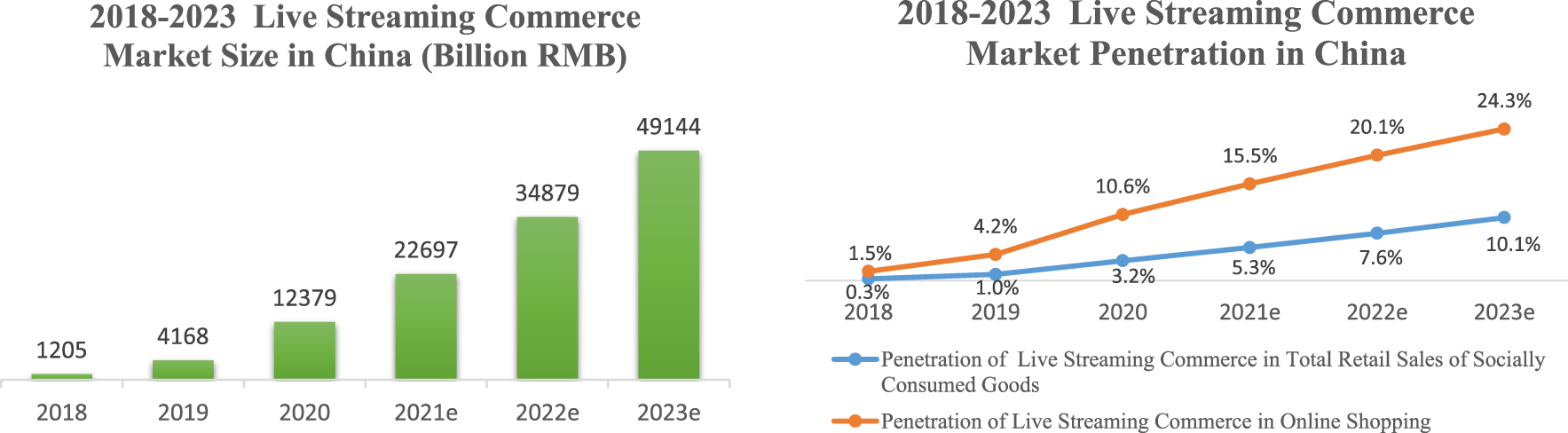
Live streaming commerce market size and market penetration in China.
Despite the market potential of social technology, it is also a double-edged sword. Working in commerce with popular streamers is expensive. It is common in practice for the additional revenue from live streaming sales fails to cover the expenditure, due to the hefty commission (generally in the form of the slotting fee and revenue-sharing ratio) paid to the live streamers, especially the most popular ones. For example, as household streamers in China, Austin Li and Viya have nearly 40 million followers on Taobao Live (Alibaba's live streaming platform), and can sell thousands of products in just a matter of seconds (Hallanan, 2021). However, many firms cannot afford their high fees (Ye, 2020). This, along with the financial pressures from the COVID-19 pandemic, has led some firms to turn to self-run live streaming; that is, the firm trains its sales employees to broadcast on its behalf (Hallanan, 2021). In addition, when an established firm with a traditional e-commerce channel considers introducing a new live streaming channel, channel competition arises. This phenomenon, known as channel encroachment, incurs additional costs (Liu et al., 2021). Here, these costs refer to the investment and effort required for a self-run live streaming channel, or commissions paid for a third-party live streaming channel.
These phenomena give rise to two key research questions. First, when should firms introduce a live streaming channel? Supplemental questions follow. Why do some firms introduce a live streaming channel and some do not? Under what conditions is it profitable for firms to embrace live streaming? Given its entertainment and potential celebrity involvement, live streaming is gaining popularity and has been a favorite new marketing channel (Delacharlerie, 2017). Moreover, anecdotal evidence shows that there is a sizable spillover from the new channel to the existing channel (Abhishek et al., 2016); that is, the product's or brand's exposure on the newly added live streaming channel increases sales through other (traditional) channels. Thus, one might take it for granted that firms should jump on the bandwagon and adopt live streaming. However, this fails to consider the potential expenditure associated with live streaming. Moreover, does live streaming fit all products with different price sensitivities? For what kind of price-sensitive products does live streaming prove profitable for firms?
Second, if firms do decide to introduce a new live streaming channel, what type of live streaming is better for them? In practice, firms can choose between two types: third-party versus self-run live streaming. With third-party channel, firms cooperate with external live streamers (typically, social media influencers) and pay them both a slotting fee and a portion of their sales revenue (the revenue-sharing ratio). With the self-run channel, the firm buys new live streaming equipment and trains its sales employees to promote its brands via online live streaming platforms. Both types have their own advantages and disadvantages. Working with third-party streamers gives firms access to a larger segment of consumers, but at the expense of commission fees; further, while more popular streamers give access to greater numbers of consumers, the fees might be higher. The principal advantages of self-run live streaming are that the broadcasters will have in-depth knowledge of their products and can clearly demonstrate how to use them, and that it is less costly on a daily basis; its disadvantages are the expensive investment in equipment and the smaller number of viewers (and consequently sales, at least in the short term). There are examples of both being used in practice. Figure 2 shows the market share of the two channels (Avery Consulting, 2021). Therefore, the problem faced by firms is what type of live streaming will be better for a particular product.
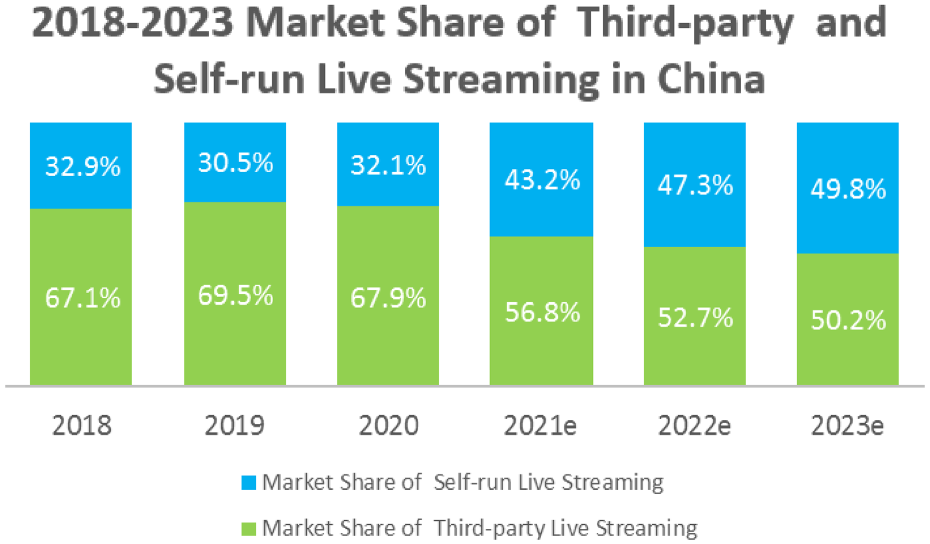
Market share of third-party and self-run live streaming in China.
Live streaming has received increasing attention from scholars in recent years given its growing prevalence. Most studies have focused on examining what factors in live streaming motivate consumers’ engagement and purchase intention from the demand side (Guo et al., 2021; Hilvert-Bruce et al., 2018; Kang et al., 2021; Wongkitrungrueng et al., 2020; Zhang et al., 2024), or investigated the cooperation issues (price, quality, commission rate, and sales format decisions) between firms and third-party streamers (Hao and Yang, 2023; Ji et al., 2023; Kouvelis and Shi, 2020; Liu and Liu, 2021; Wang et al., 2019, 2024), as well as whether it is worthwhile to cooperate with a third-party streamer (Du et al., 2023; Gong et al., 2022; Mallipeddi et al., 2022; Pan et al., 2022; Zhang et al., 2022). However, studies have not explored the choice of the type of live streaming (third-party, self-run, or a combination of both), and thus could not answer the aforementioned research questions.
To address these questions, in this study, we examine whether and when a firm (either a start-up or an established one) with a specific product should introduce a live streaming channel, and if so, with what type (third-party, self-run, or a combination of both). Incorporating market factors (price sensitivity, consumers’ channel preference, the cross-channel spillover) and the distinct features associated with the live streaming channel (the streamer's popularity, slotting fee, revenue-sharing ratio, and bargaining coefficient; investment and effort cost; consumer's extra cost for watching live streaming show), we develop models to analyze the decisions and profits under seven channel structures: traditional e-commerce channel only (channel D); self-run live streaming channel only (channel S); third-party live streaming channel only (channel T); and the combinations of two or three of them (namely, channel DS, channel DT, channel ST, channel DST). Our results suggest that live streaming benefits the firm more for products with low price sensitivity, for which the traditional pricing tool is less important to entice consumers. A start-up firm should cooperate with a streamer with either a high or a low (not an intermediate) level of popularity, while the established firm should select a streamer with moderate popularity. An established firm considering leveraging two or more channels concurrently to achieve a higher profit should additionally take the cross-channel spillover, channel encroachment cost, and channel competition into consideration. Counterintuitively, product price in the live streaming channel is not necessarily lower than that in the traditional channel; and a more popular streamer will not always require a higher revenue-sharing ratio and slotting fee than a less popular one. This research sheds light on the key decisions for firms considering live streaming commerce: whether to adopt it, when to integrate it into their strategy, and how to effectively implement it.
Live Streaming Studies
Studies on live streaming have primarily relied on empirical methods to explore the impact of live streaming on consumers’ engagement, trust, and purchase intention. For example, Hilvert-Bruce et al. (2018) identify six motivations for consumers to view a live streaming channel. Wongkitrungrueng et al. (2020) analyze live streaming sellers’ Facebook data to determine engagement metrics, and define the dynamic, interactive live streaming sales process. They show that the time, effort, and resources sellers invest affect consumer purchase intention. Guo et al. (2021) show that the consumer's trust in the live streamer contributes to engagement in live streaming commerce and product trust. With real-time data, Kang et al. (2021) demonstrate that interactivity is curvilinearly related to customer live streaming engagement. Fei et al. (2021) study how two widely used social cues (i.e., interaction text and herding message) can affect consumers’ attention allocation and purchase intention in live streaming commerce. Ma et al. (2022) demonstrate that trust in the live streaming context is more complex than in conventional online purchasing, which might promote purchase hesitation. Zhang et al. (2024) empirically examine the effect on sales of adopting “lucky draws” on live streaming.
Given the important role live streaming plays on the demand side, how firms should adjust their marketing and operations strategies on the supply side to benefit from live streaming commerce becomes an important question for both academics and practitioners. There are essentially four sets of problems to resolve in this context.
(1) The streamer's effort problem. Wang et al. (2019) introduce a compensation mechanism for unions (streamers’ agents) to affect the streamer's effort. Kouvelis and Shi (2020) also explore salesforce compensation schemes that best motivate sales agents’ (such as streamers). Liu and Liu (2021) discover that the streamer's effort will be weakened when they have fewer viewers, but will be strengthened as the product price and the revenue-sharing ratio increase. Yang et al. (2022) study how the live streaming platform can design bonus mechanisms to motivate streamers to perform better.
(2) Price and/or quality decision problem. Fan et al. (2022) study the impact of the live steaming spillover effect on the firm's pricing decision, as well as the firm's and streamer's profits. To determine whether it is beneficial for the firm to collaborate with influencers, Liu and Wang (2023) investigate the firm's optimal pricing decisions under two business models: the Influencer-oriented short-window model and the market-oriented long-window model. Ji et al. (2022) explore the price and quality strategy in relation to the consumers’ social interaction effect in live streaming e-commerce. He et al. (2024) examine the effects of commission contracts on the streamer's effort, as well as the retailer and the manufacturer's price decisions in a live streaming supply chain. Li et al. (2023) propose the optimal pricing discount of the seller and best discount preannouncement of the streamer in the live streaming.
(3) Sales format choice problem. Wang et al. (2024) discuss the choice between agency selling and reselling agreements in the presence of a live streaming sales channel by incorporating the commission rate and the celebrity's effort. Hao and Yang (2023) explore the choice of two sales formats (resale and agency sale) by taking into consideration three pricing strategies (same high, same low, and differential strategies) and customer returns in live streaming commerce. Ji et al. (2023) also study the optimal selling format (reselling or agency format) for the cooperation between firms and streamers under two pricing strategies (committed price and dynamic price).
(4) Channel choice problem. Gong et al. (2022) study the live streaming multichannel sales strategy based on product quality and standardization. Zhang et al. (2022) examine whether a multinational company should introduce a live streaming channel on an international e-commerce platform. By taking the streamer's ability to sell and the consumer's value and cost associated with live streaming, Pan et al. (2022) explore whether and when adding a live streaming channel is profit-enhancing for firms. Du et al. (2023) explore the effects of the streamer's ability and live streaming market size on the manufacturer's channel strategies. Huang et al. (2024) investigate the impact of consumer live streaming freeriding behavior on the decision to introduce a live streaming channel.
In this study, we extend the live streaming research to consider the distinct features of two types of live streaming: third-party live streaming (the streamer's slotting fee, popularity, and bargaining power) versus self-run live streaming (the investment and effort cost). Incorporating the interaction between the streamer and consumers, the streamer and the firm, as well as both the positive and negative aspects of two types of live streaming for specific products with different price sensitivities, we examine the strategic channel choice for the firm, on whether to employ a third-party live streaming channel or a self-run live streaming channel, or both in the live streaming commerce context. Moreover, we also consider two types of firms: start-ups and established firms.
Channel Choice Studies
The second stream closely related to our study is the work on channel choice. Studies have largely looked at determining whether or not to introduce a new third-party and/or online channel by weighing the pros and cons. The potential demand expansion is a key benefit of selling via a third-party and/or online channel, due to its high exposure and simplicity. Ryan et al. (2012) investigate whether the retailer should choose to sell the product via a third-party online platform which can expand demand. Their findings indicate that the third-party marketplace and retailer can profitably collaborate and compete concurrently. Chennamaneni et al. (2017) reveal that the channel selection of a supplier will be impacted by variables such as operational costs, operational capacity, and the increased potential demand acquired by introducing a third-party and/or online channel. Abhishek et al. (2016) assume that sales from third-party channels can spill over into the traditional channel and investigate whether to employ an agency selling model as opposed to the more common reselling model. Shen et al. (2019) assume a third-party channel has a bigger consumer base than the traditional channel and examine whether a manufacturer's decision to utilize a third-party channel is influenced by a slotting fee and the percentage of revenue paid to the third-party platform.
Nonetheless, some studies have shown that introducing a third-party and/or online channel may not always be advantageous. Chen et al. (2008) investigate whether to operate a dual channel and discover that the choice is heavily influenced by operational costs, retailer inconvenience, and product features. Ryan et al. (2012) also show that the introduction of a new third-party channel structure may generate rivalry and conflict between channels, resulting in channel cannibalization. Hsiao and Chen (2014) consider a manufacturer and a retailer who are both capable of operating an internet channel via a third-party retailer. Counterintuitively, they find that the manufacturer may voluntarily give up its online channel, as selling via an online retailer exacerbates the double marginalization issue. Yan et al. (2018) study whether an online third-party channel should be introduced in addition to the reseller channel, and find that a large spillover effect and the manufacturer's inefficiency in retailing may hurt the e-retailer.
We extend this literature by incorporating the distinct features of both self-run and third-party live streaming in answering the problem of whether to adopt live streaming channel and, if so, what type.
Uniqueness and Contributions of This Study
We contribute to the live streaming and channel choice literature in two ways. First, in line with real practices in live streaming commerce, our study examines the impact of live streaming not only on the interaction between the streamer and consumers, but also on the interaction between the streamer and the firm, under two types of live streaming: third-party live streaming and self-run live streaming. By balancing the potential market expansion (through the streamer's popularity, broadcasting effort, and cross-channel spillover) against channel encroachment cost (i.e., slotting fee, shared revenue, and effort cost of a third-party live streaming channel; or the investment and effort cost of a self-run live streaming channel) and channel competition for products with different price sensitivities, we investigate the trade-offs among different channel choices and the firm's selection of a streamer. Second, we develop models to analyze the decisions and profits under seven channel structures: traditional e-commerce channel only; self-run live streaming channel only; third-party live streaming channel only; and the combinations of two or three of them. By doing this, we provide a complete picture for practitioners on the strategic choice of channel and streamer problem. They need not “guess” or consider only a single factor (e.g., the streamer's popularity), but can weigh the trade-offs under different conditions carefully in the live streaming commerce era. This research sheds light on the key decisions for firms considering live streaming commerce: whether to adopt it, when to integrate it into their strategy, and how to effectively implement it. Moreover, we also consider two types of firm: start-ups and established firms. We begin with the channel choice for a start-up firm in Section 3 and go on to consider an established firm in Section 4.
The Channel Choice for a Start-up Firm
Here we consider a value chain with a start-up firm, a third-party streamer (for convenience, “she”), a live streaming platform, and a continuum of consumers. The start-up firm decides whether to sell products through a traditional e-commerce channel or a live streaming channel, and, if it adopts the live streaming channel, with what type: self-run or third-party. That is, the start-up firm chooses from three possible channel structures: a traditional e-commerce channel (channel D); a self-run live streaming channel (channel S); or a third-party live streaming channel (channel T), as shown in Figure 3.
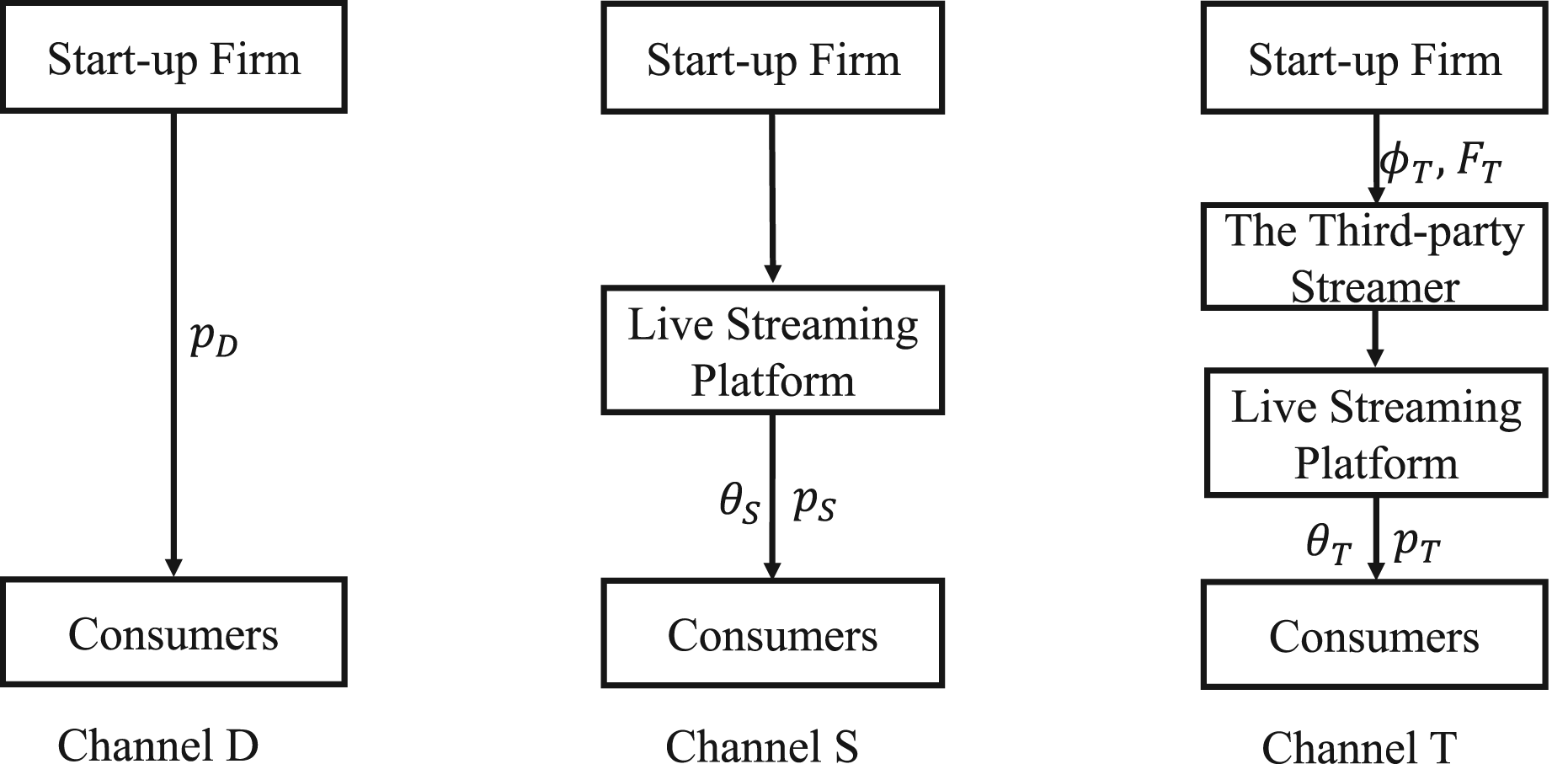
The three possible channel structures for a start-up firm.
Consumers have heterogeneous product valuations, v, that are uniformly distributed in the interval
Furthermore, to achieve success in live streaming commerce, the streamer can put different levels of broadcasting effort into selling products. For instance, she can showcase the product through entertainment forms such as singing and dancing, in order to get consumers to engage in live streaming and make purchases. She can also launch a “lucky draw,” one of the most popular and frequently used tools for traffic acquisition conducted during live streaming selling, to attract and entertain consumers. The “lucky draw” is similar to the traditional lucky draws (also known as sweepstakes) in offline stores or in traditional e-commerce retail (Zhang et al., 2024). During the consumers’ live shopping experience, a lottery is conducted within the lucky draw, for prizes such as goods coupons or actual products (a screenshot of a lucky draw is displayed in E-companion (A)). Thus, the lucky draw can affect consumers’ participation and purchase behaviors (Zhang et al., 2024). However, distinguishing the ex-ante advantage of popularity, the streamer's effort focuses on increasing the consumer shopping experience. This effort, unrelated to the intrinsic value or quality of the product, constitutes an extra value bestowed onto consumers by the streamer, which posts an additive impact on consumer utility. We express the streamer's broadcasting effort as



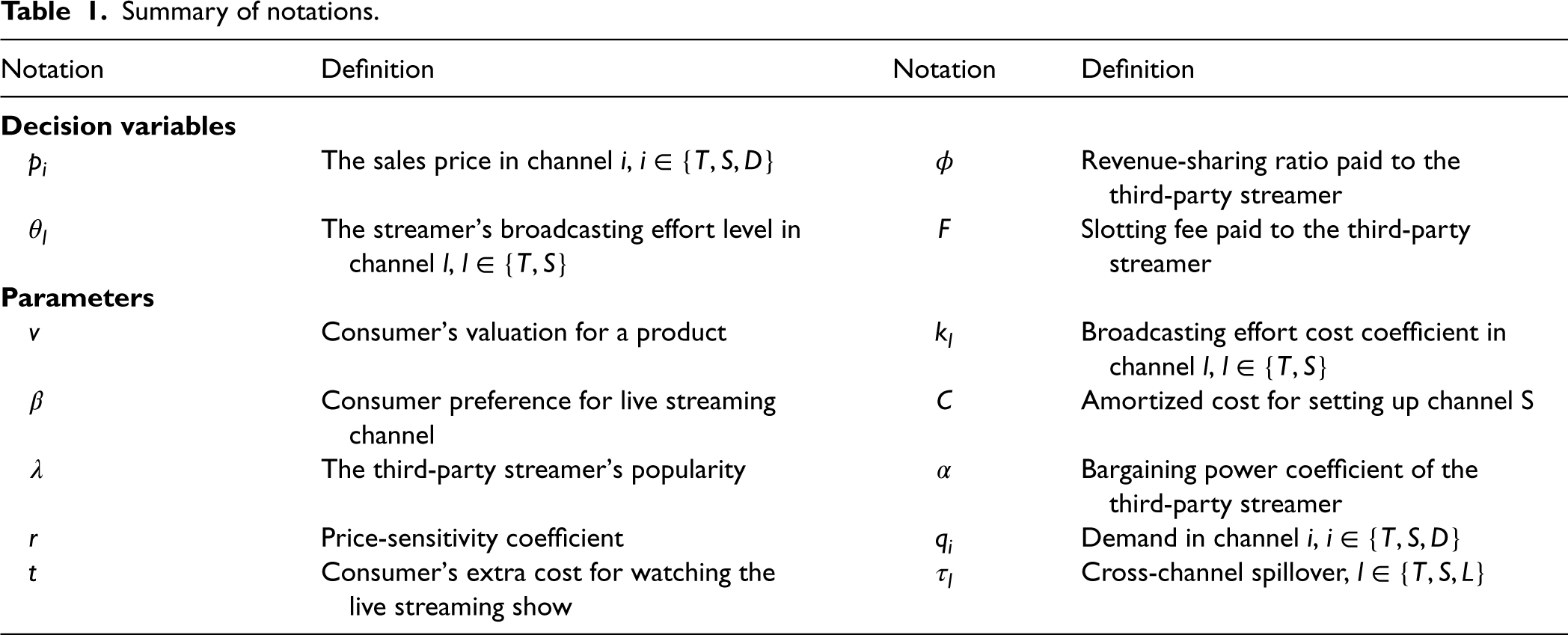
Summary of notations.
In channel D, the firm decides to sell products via the traditional e-commerce channel. From equation (1), we can derive the demand and the firm's profit in channel D as
Self-Run Live Streaming Channel: Channel S
In channel S, the firm trains its own in-house sales associates in live streaming on behalf of the brand. The firm first decides the sales price
The equilibrium decisions and profit in channel S.
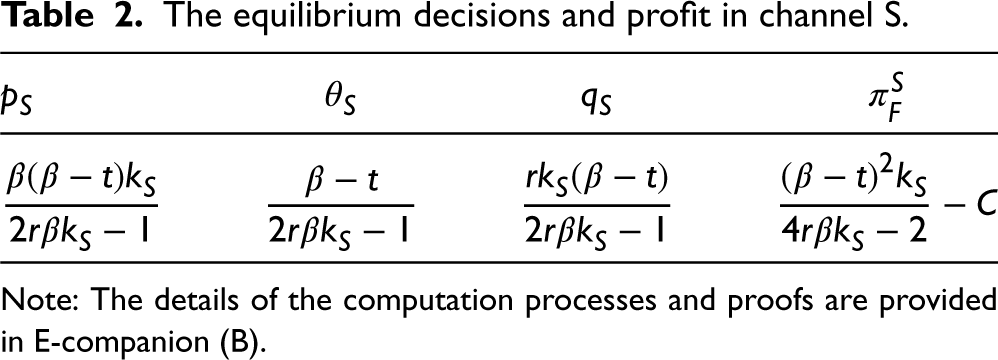
The equilibrium decisions and profit in channel S.
Note: The details of the computation processes and proofs are provided in E-companion (B).
In Table 2, we can see that the price-sensitivity coefficient, r, negatively affects the firm's sales price, broadcasting effort, demand, and profit. When r is small, pricing, the traditional marketing tool, posts a smaller impact on demand. Under this situation, the firm should seek another marketing tool, live streaming for example, and put more effort into that to attract sales and increase revenue. However, a greater broadcasting effort cost coefficient,
In channel T, the firm cooperates with a third-party streamer to sell its products on the live streaming platform. The third-party live streamer charges the firm a slotting fee, F
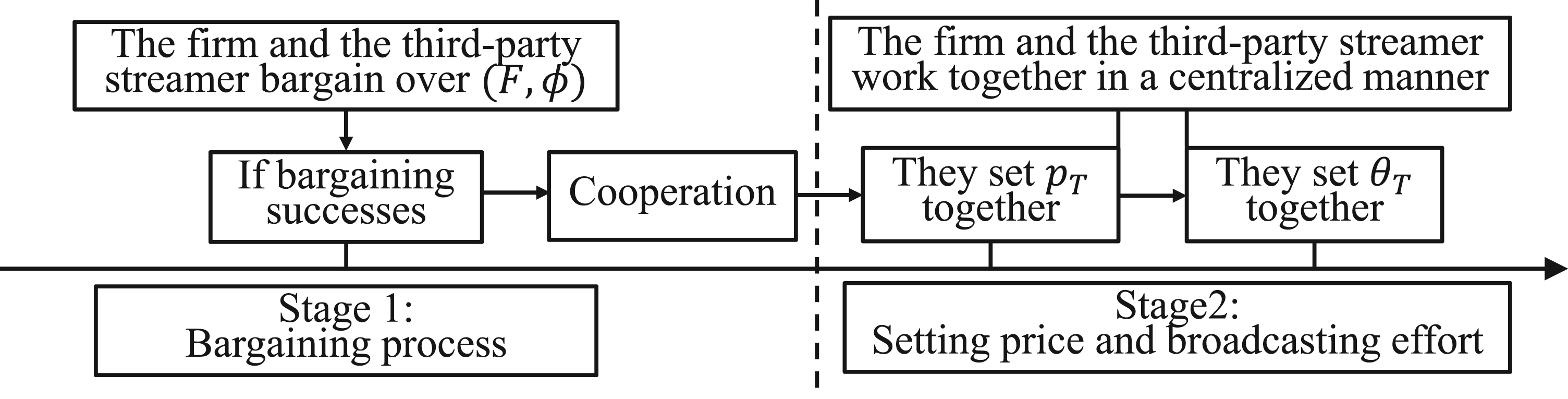
Timeline of the game.
From equation (3), we can derive the demand in channel T as
We solve the following GNB problem:

The reservation profits (the bargaining positions in a GNB setting, that is, outside options) of the firm and the third-party streamer are set to be
For any given
Price is a key factor in attracting consumers, especially for products with lower consumer loyalty and higher price sensitivity. At the early stage of live streaming commerce, sellers commonly promote price discount as a gimmick, they motivate purchases and timely payment by giving a limited-time discount during live streaming (Wongkitrungrueng et al., 2020; Hao and Yang, 2023). Low price motivates customers not only to make purchases in live chat rooms, but also to recommend the seller or products to their friends, resulting in increased sales (Guo et al., 2021). Chen et al. (2019) discover that adopting live streaming increases sales volume by 21.8%. However, given the entertainment value and the additional cost associated with live streaming, should sellers set a lower or higher price in the live streaming channel? Does live streaming really increase sales volume? Will a third-party streamer with higher popularity exert a greater broadcasting effort and contribute to more sales? Proposition 1 sheds light on these interesting questions.
(1) If
Proposition 1 suggests that the price on live streaming channels does not necessarily have to be lower than on the traditional channel. For a specific product with lower price-sensitivity (i.e.,
From the GNB problem in equation (4), since
(1) For any slotting fee
Then, the equilibrium decisions and profits in channel T are shown in Table 3.
The equilibrium decisions and profits in channel T.

From lemma 1, it is intuitive that
(1)
Proposition 2 suggests that it is not always the case that a third-party streamer with a higher popularity will seek a higher revenue-sharing ratio and slotting fee.
Around 30,000 new live streaming merchants are established globally every day, and the associated product orders are growing by 20% a week (Ye, 2020). However, live streaming comes at an additional cost. Therefore, the following question arises: Whether and under what conditions should a start-up firm adopt a live streaming channel, and if so, with what type (third-party or self-run)? In addition, as the distinct advantage of using a third-party streamer comes from her popularity, intuitively, one might ask the questions: Should the firm always choose a third-party streamer with a higher rather than lower level of popularity? These questions are answered below.
(1) The effects of
(1) When
Figure 5 illustrates the results graphically. We observe that C in the self-run live streaming channel, as well as the third-party streamer's popularity,
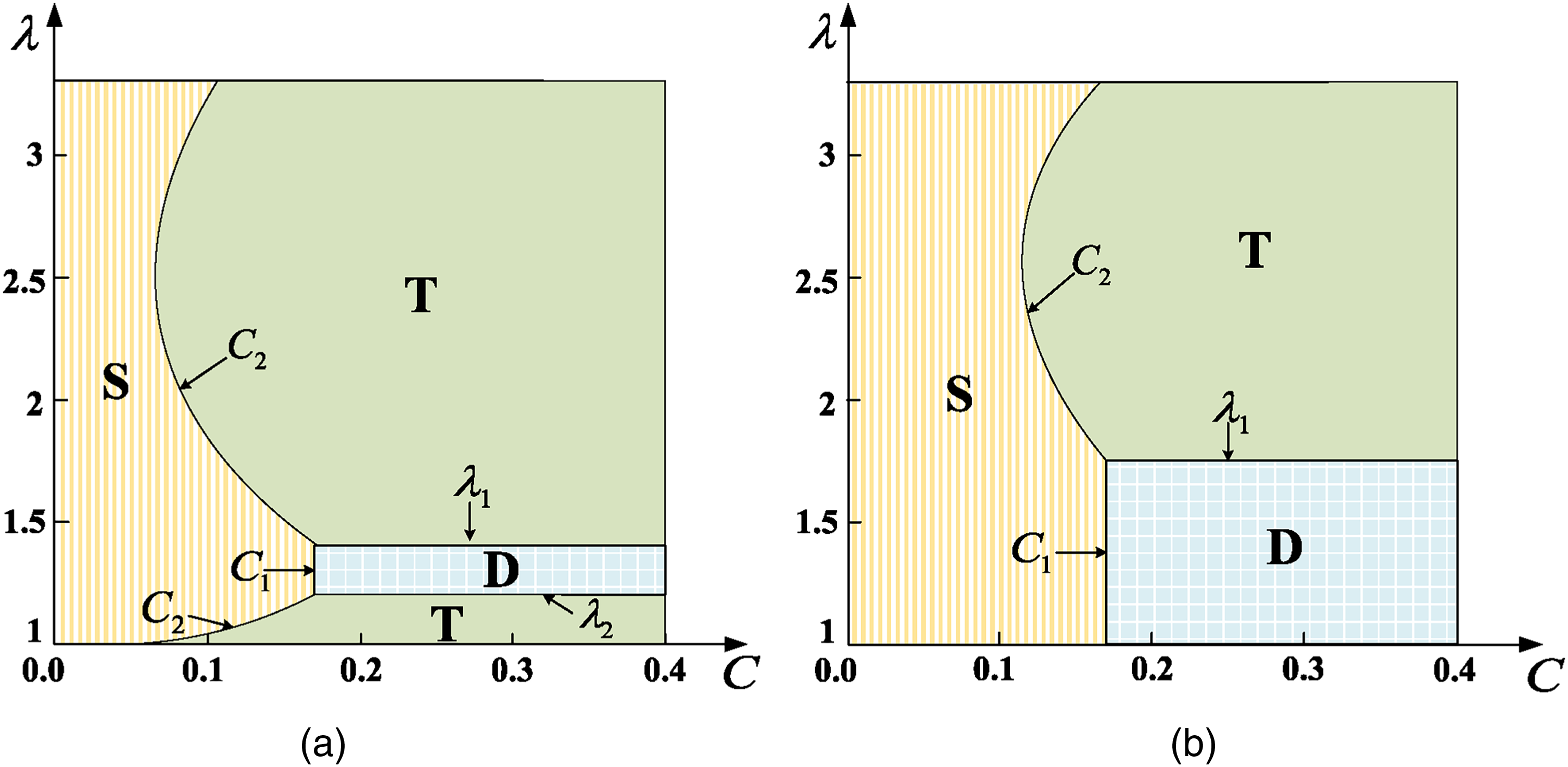
The effects of
When
The choice between channels S and D largely depends on the investment and self-run broadcasting effort cost. Since it is not easy to attract traffic to channel S, the firm must make a great effort to get viewers. In addition to the broadcasting effort, the firm that operates channel S must invest C to acquire the equipment for live streaming. When the extra benefit of introducing channel S cannot justify the additional investment and effort cost (i.e.,
(2) The effects of
Though the third-party streamer's popularity helps the firm to attract more traffic and increase revenue, a more popular streamer is likely to have more bargaining power and require a higher ratio of revenue, which might reduce the firm's profit. In addition, the bargaining coefficient,
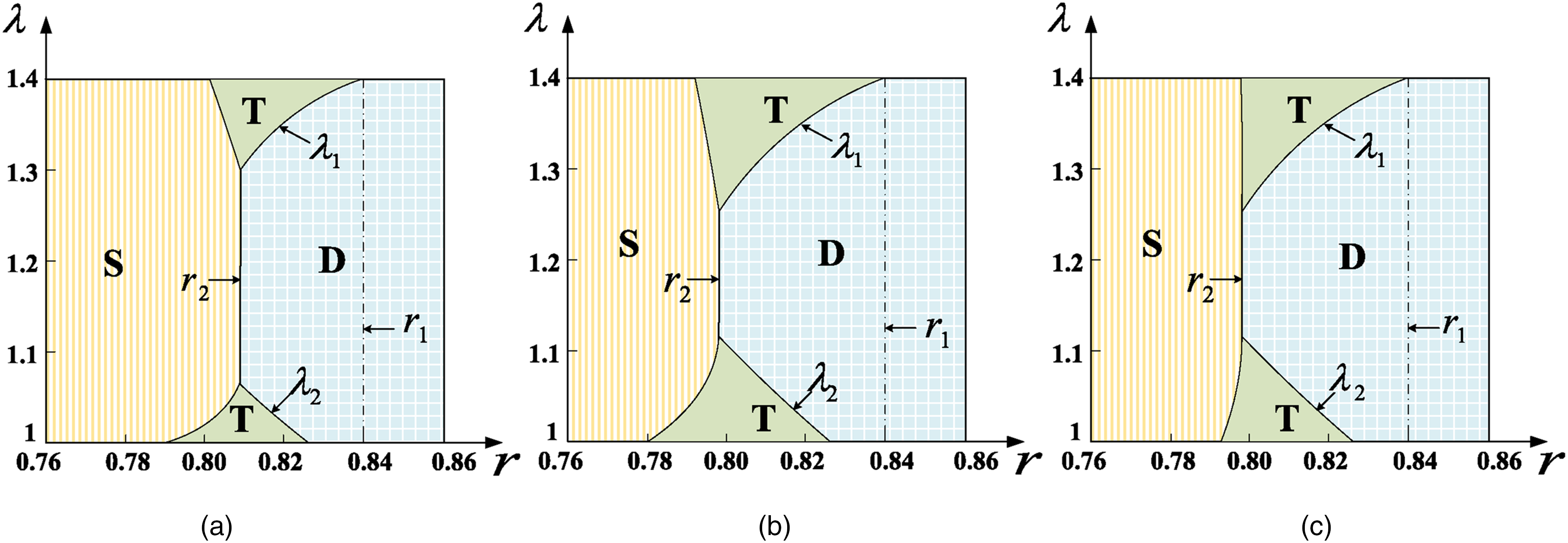
The effects of
Figure 6 suggests that, if r is relatively small (i.e.,
(3) The effects of
In addition to
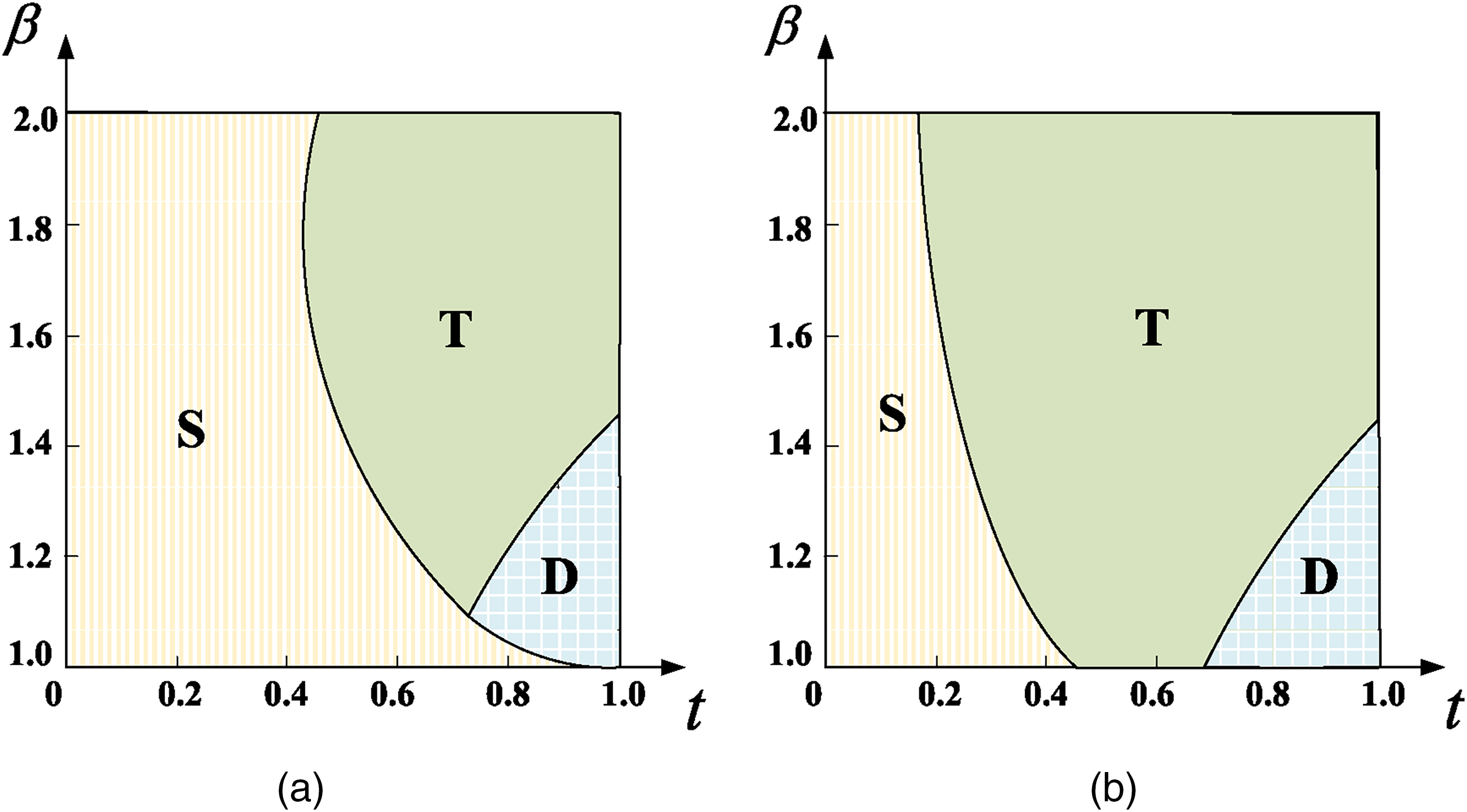
The effects of
Figure 7 suggests that when t is relatively high, if consumers do not value live streaming channel too much (i.e., a smaller
We assume an established firm has been running a traditional e-commerce channel, and now needs to decide whether to introduce a new live streaming channel, and if so, self-run or third-party. That is, an established firm can choose from three possible channel structures: the traditional channel only (channel D); a dual channel comprising the traditional channel and a self-run live streaming channel (channel DS); or a dual channel comprising the traditional channel and a third-party live streaming channel (channel DT), as shown in Figure 8. The established firm will choose the most profitable one.
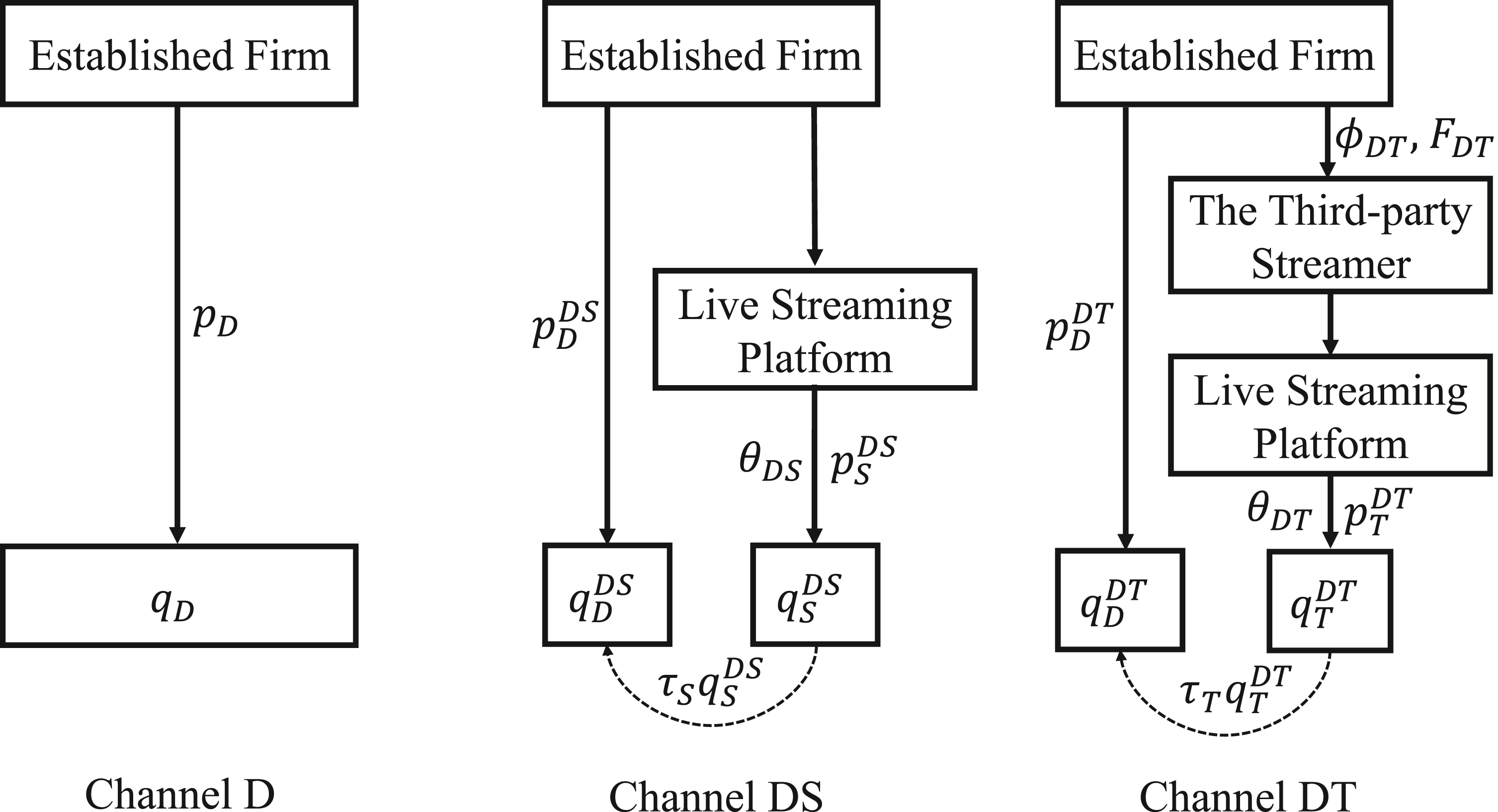
The three possible channel structures for an established firm.
In channel DS, in addition to the traditional e-commerce channel, the firm introduces a self-run live streaming channel. The firm first decides sales prices on the two channels,
Moreover, following Abhishek et al. (2016), we assume that the sales in channel S can post a positive influence on sales in channel D, that is, cross-channel spillover. Thus, the demand in the self-run live streaming channel,
The equilibrium decisions and profit in channel DS are given in Table 4.
The equilibrium decisions and profit in channel DS.
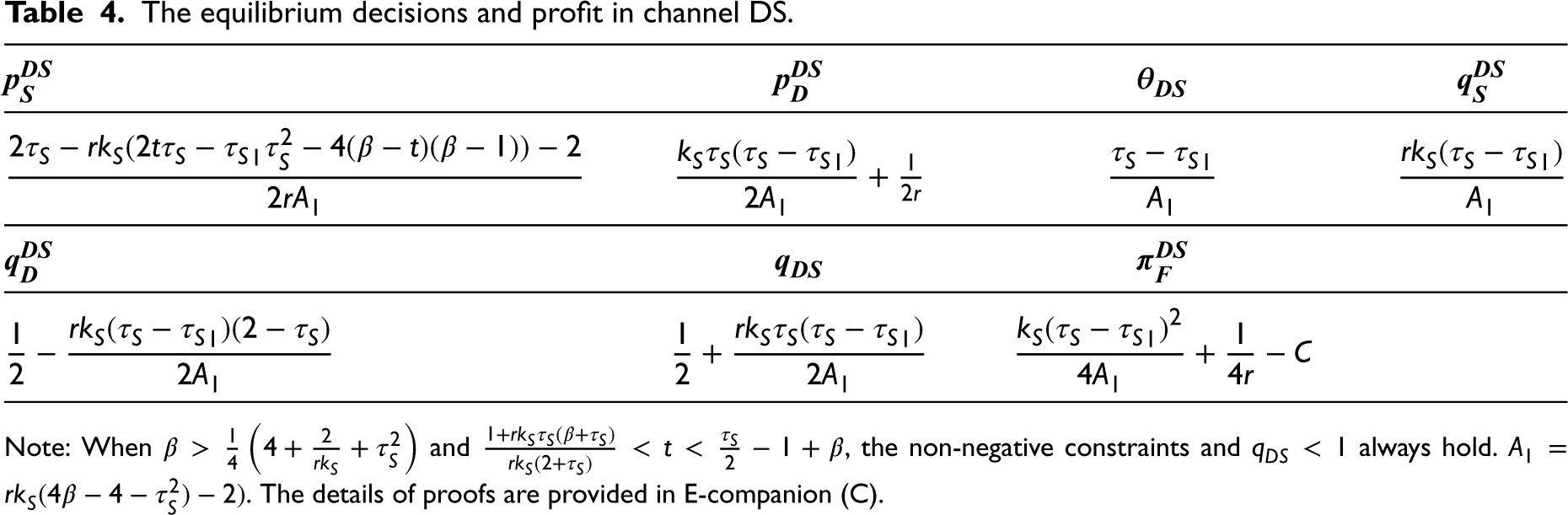
The equilibrium decisions and profit in channel DS.
Note: When
Intuitively, with a positive
(1)
Proposition 4 shows that the sales in the traditional channel (D) will be encroached upon by the live streaming channel (S), leading to
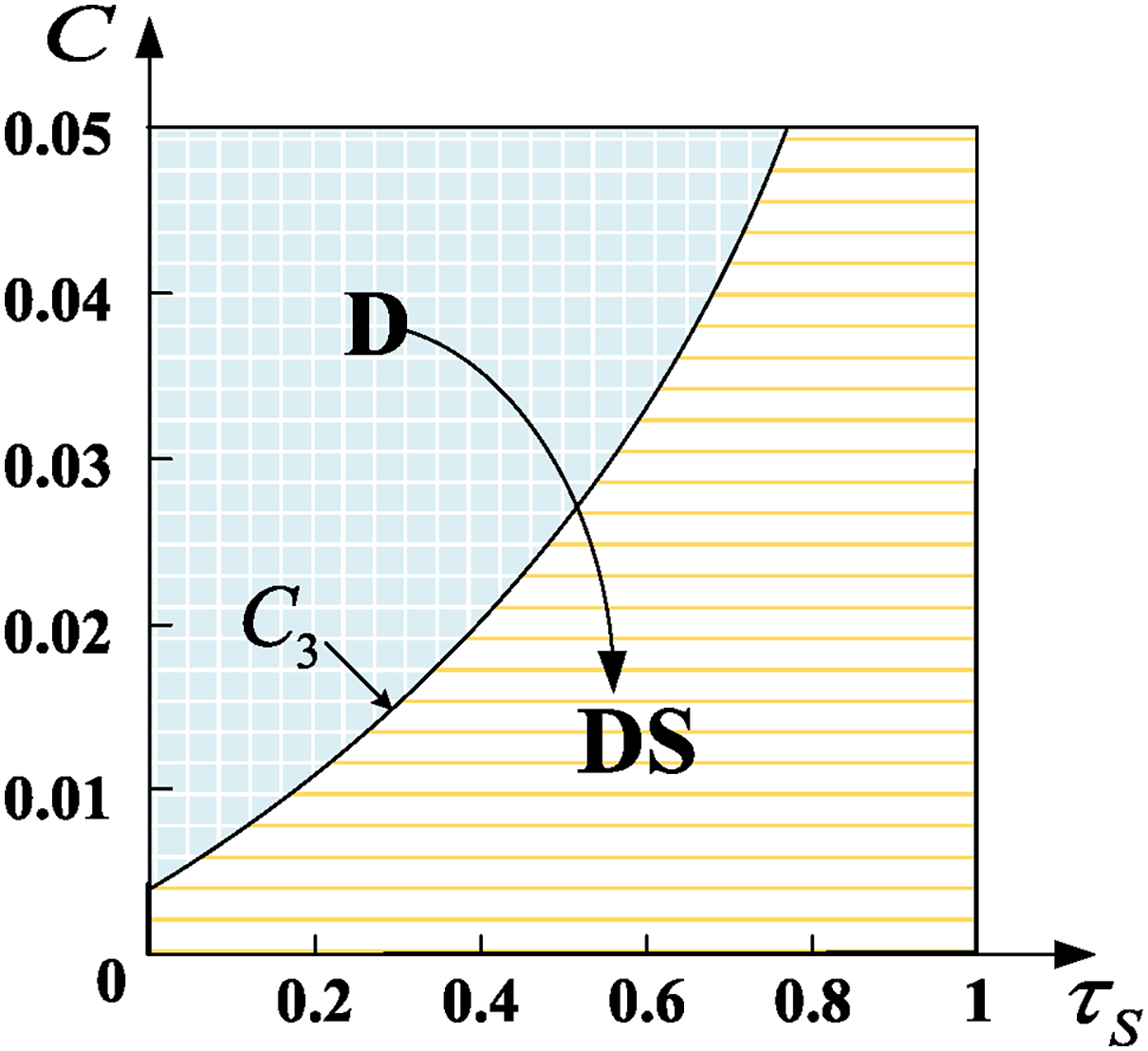
The shift from channels D to DS
In channel DT, the firm operates both a traditional channel and a third-party live streaming channel. Again, there are two stages in the game between the firm and the third-party streamer. In stage 1, the firm and the third-party streamer bargain over
As with channel DS, we find that an equilibrium for channel DT exists only when 
(1) For any slotting fee
Then, we get the equilibrium decisions and profits in channel DT, as shown in Table 5.
The equilibrium decisions and profits in channel DT.
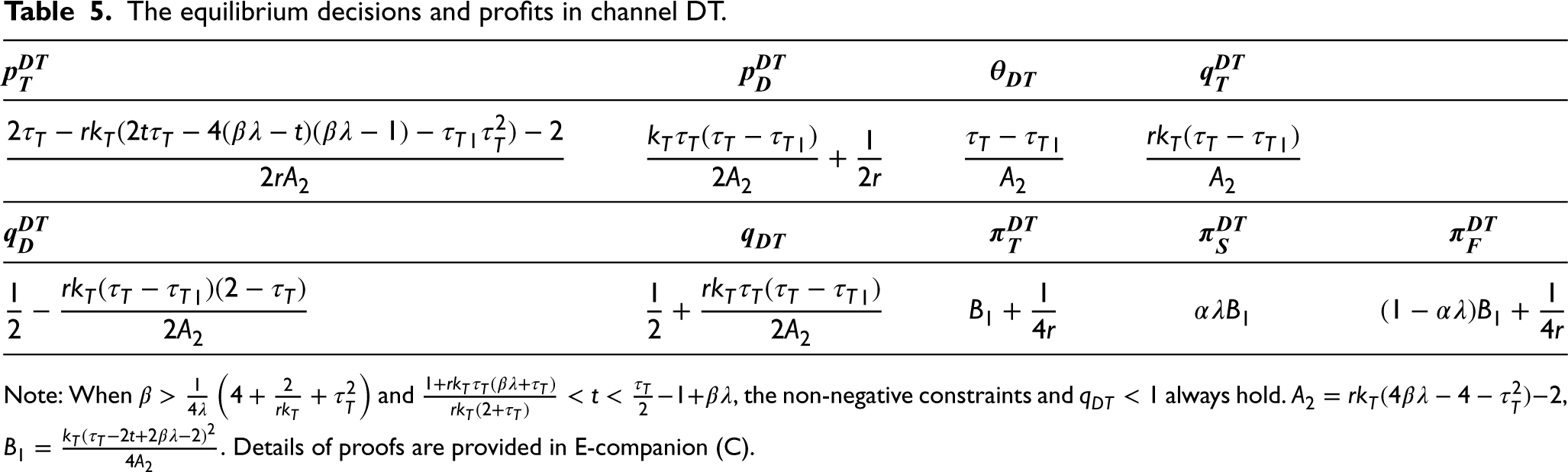
Note: When
(1)
Proposition 5 shows that channel DT has an advantage over channel D in terms of sales (i.e.,
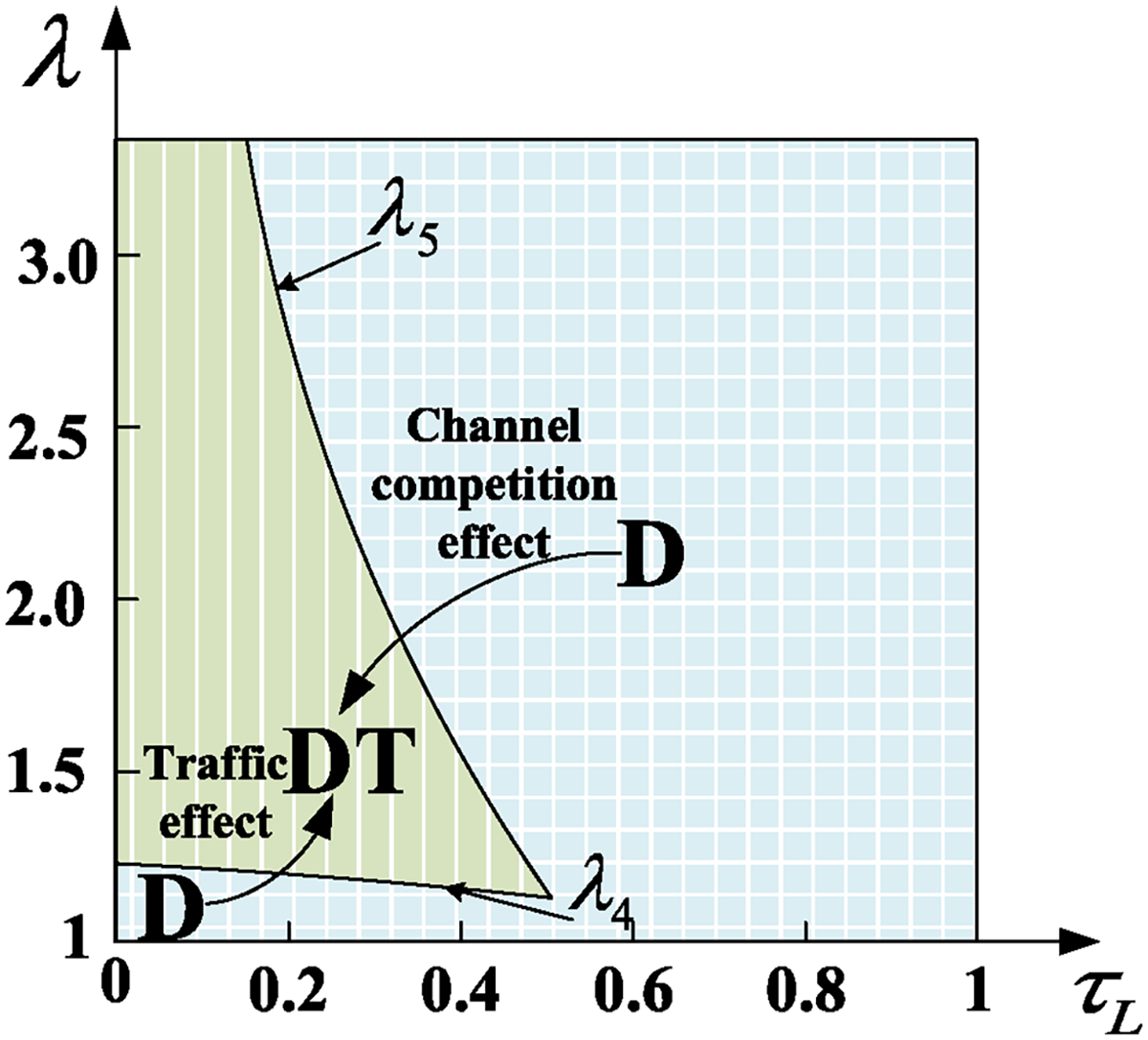
The shift from channels D to DT
Despite the fact that live streaming commerce is thriving, many established firms have remained on the sidelines. Combining a traditional channel with a live streaming channel can be a good approach for firms to boost their market share. Live streaming channel not only assists the firm in expanding the market, but also enlarges the customer base of the current channel due to the cross-channel spillover. However, introducing an additional live streaming channel, either channel S or T, will inevitably increase channel encroachment cost and channel competition. The benefit from the live streaming channel might not always outweigh the cost. Therefore, the questions raised concern whether and under what conditions should an established firm introduce an additional live streaming channel, and if so, with what type (third-party or self-run)? These questions are answered below.
(1) When
Proposition 6 sets out the effects of
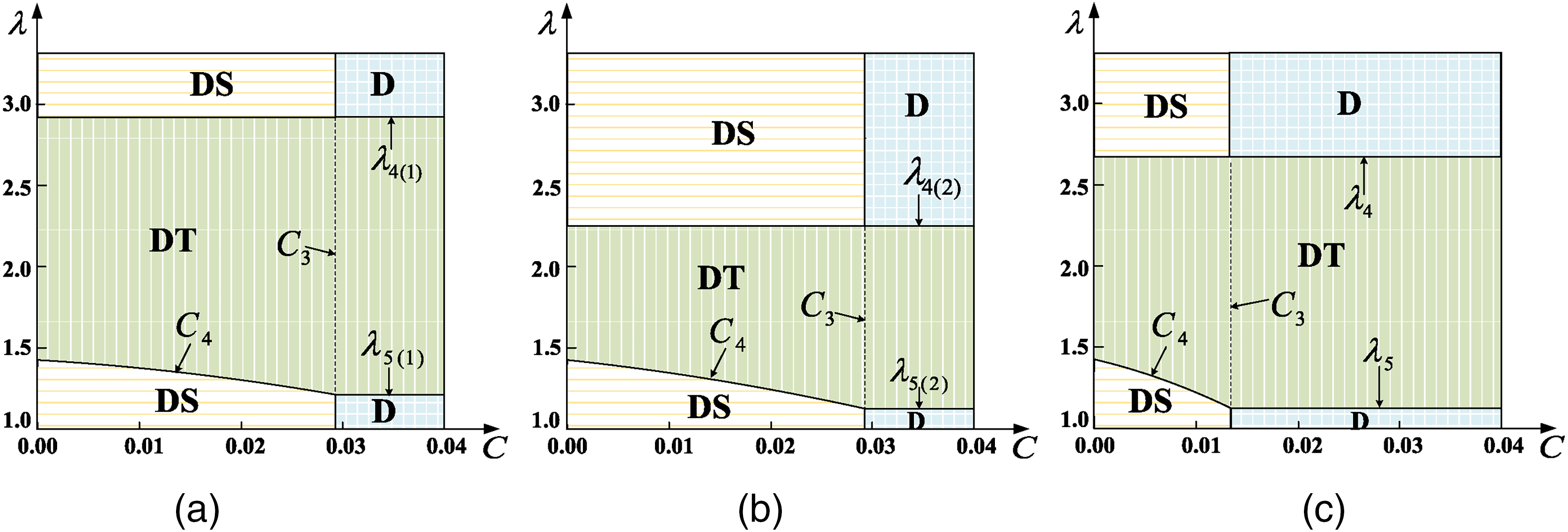
The effects of
In addition, we find that the cross-channel spillover from channel S or T to channel D, and the price sensitivity, r, will post impacts on the threshold values of
In Sections 3 and 4, we assume that a start-up firm or an established firm will consider adding only one type of live streaming channel, either self-run or third-party. However, in practice, many firms leverage (or are considering leveraging) both types of live streaming channels concurrently. For example, Diane Von Furstenberg (DVF), a luxury high-end fashion designer, both runs self-run live streaming and works with third-party streamers. Bissell Homecare, an American vacuum cleaner and floor care products company, does likewise (Hallanan, 2021). Oriental Selection, founded in 2021, is an agricultural products e-commerce firm operating under the name New Oriental Online. At present, it solely provides self-run live streaming on Douyin, but recently it has begun to consider positioning itself as a multichannel, multiplatform, multiproduct live commerce business (TechNode, 2022). In contrast, Northeast Peasant Madame, one of the suppliers of Oriental Selection, cooperates with Oriental Selection to sell corns first, launches its own live streaming channel recently due to the fierce controversy over profit distribution (Koetse, 2022).
Thus, we extend our baseline model to consider a firm that might combine both types of live streaming channels, to explore the double live streaming channel strategy (the use of both live streaming channels concurrently) and the “full channel” strategy (the use of the traditional e-commerce channel and both live streaming channels concurrently). As a result, there will be another two channel structures, namely channels ST and DST, as shown in Figure 12 (note that
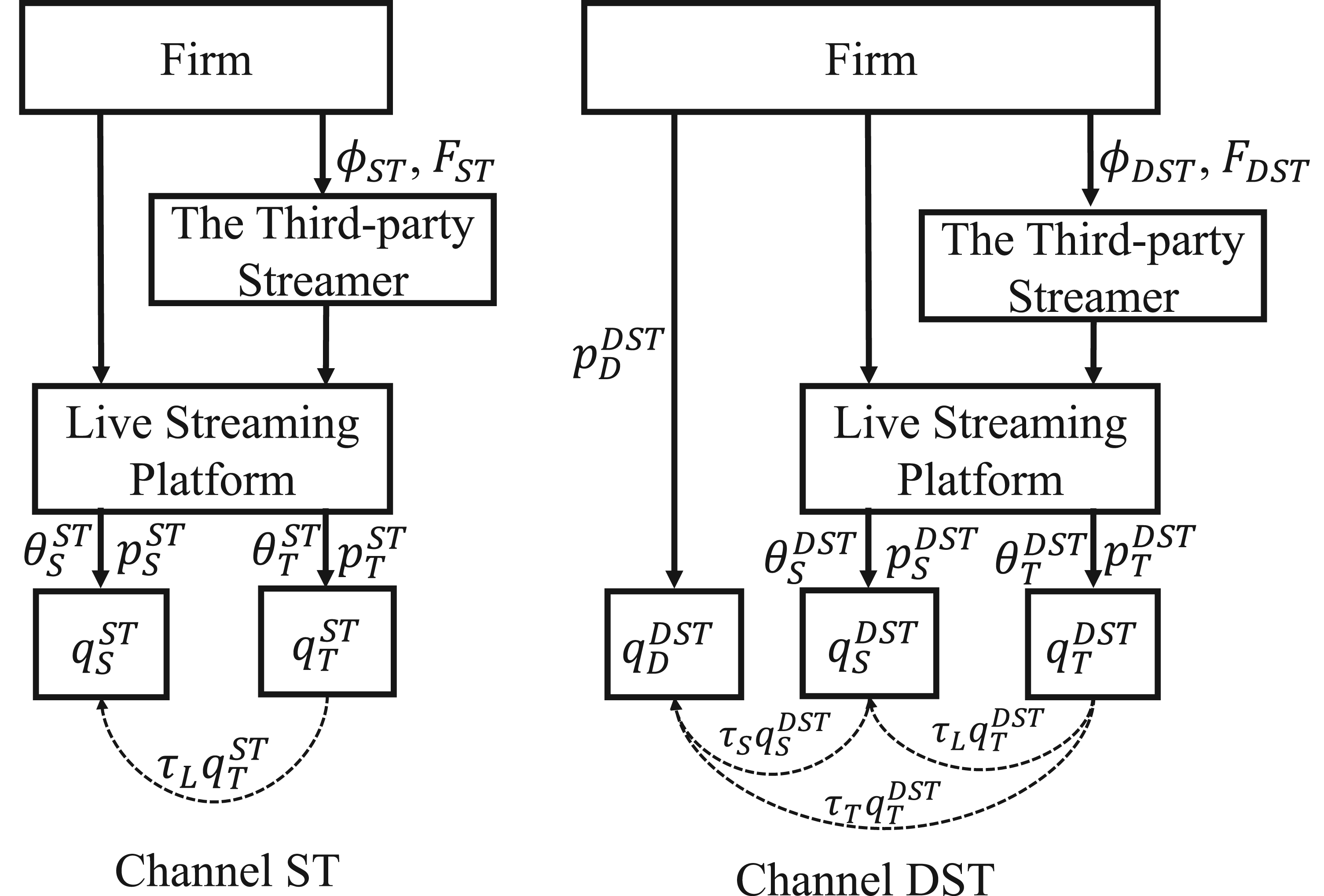
Channels ST and DST.
For a start-up firm that begins with channel S, its revenue can be increased with the addition of channel T. However, if
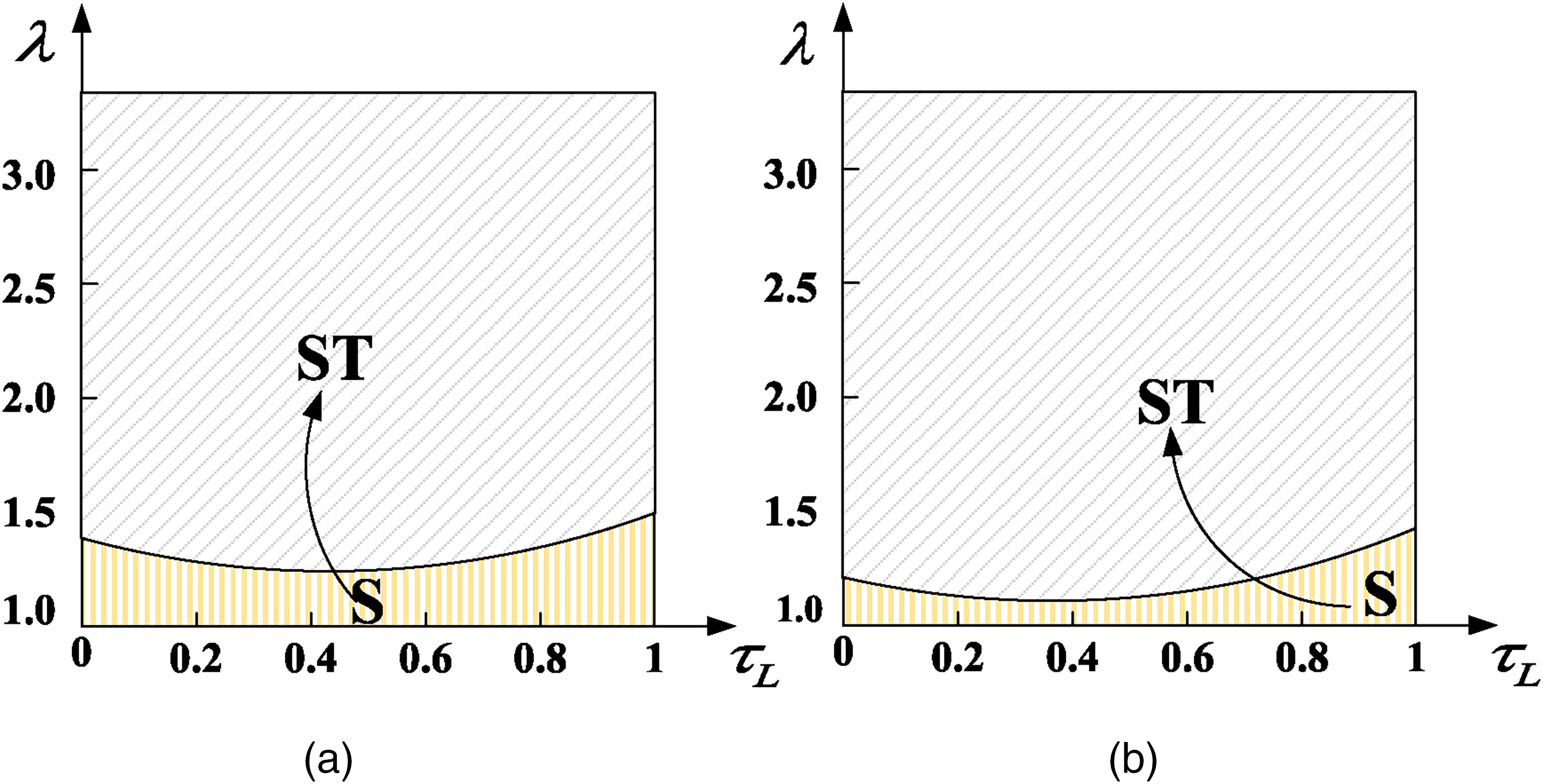
The shift from channel S to ST
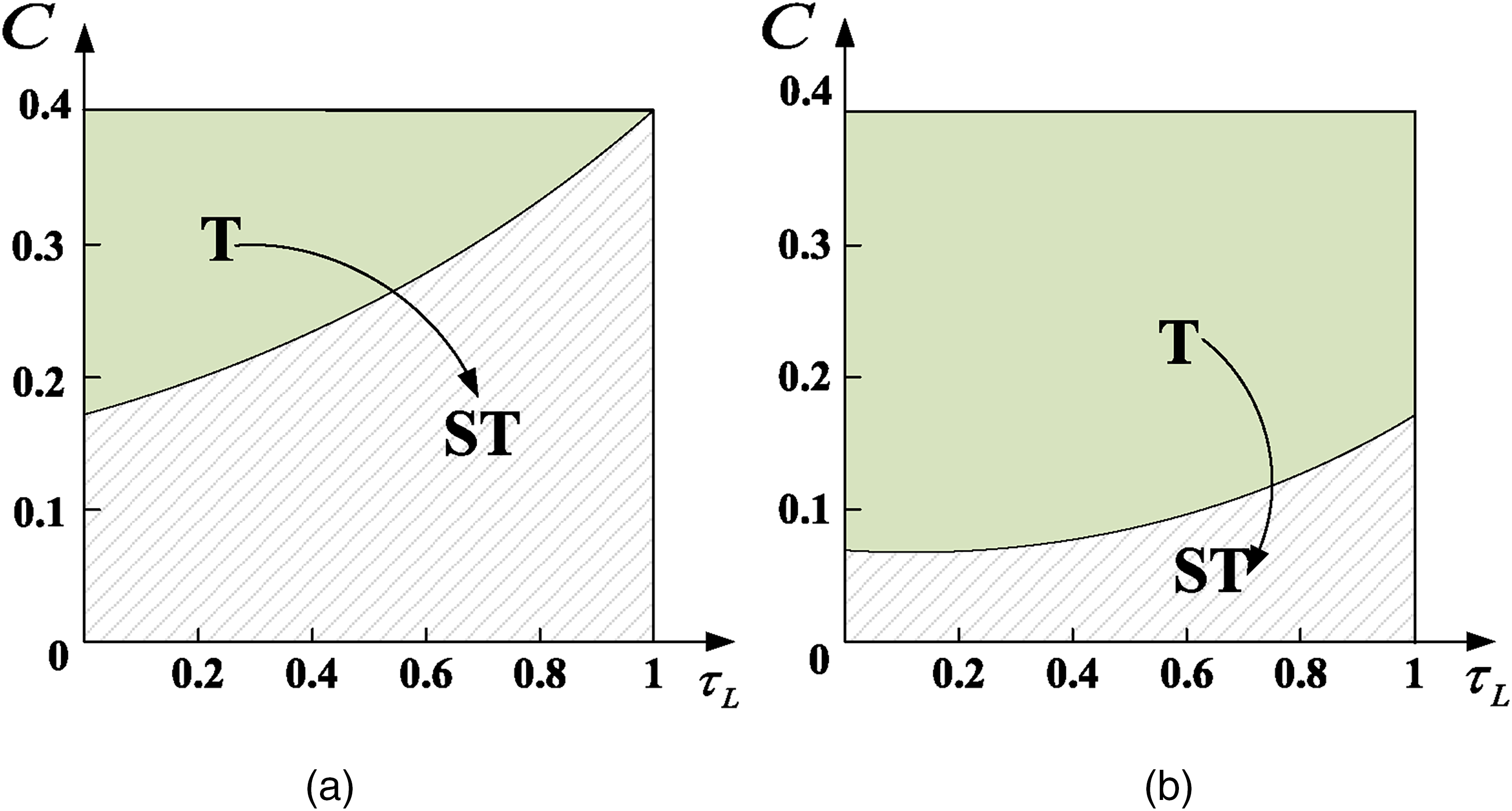
The shift from channels T to ST
In relation to whether and when an established firm that has operated a dual channel strategy should use both types of live streaming concurrently, as in the aforementioned cases of DVF and Bissell Homecare, again, we find that the cross-channel spillover from channels T to S/D and the streamer's popularity posts significant impacts on the effect of adding an additional third-party live streaming channel, while the investment associated with the self-run live streaming channel and the smaller spillover effect from channels S to D can be important deterrents to the launch of an additional self-run live streaming channel, as shown in Figure 15.
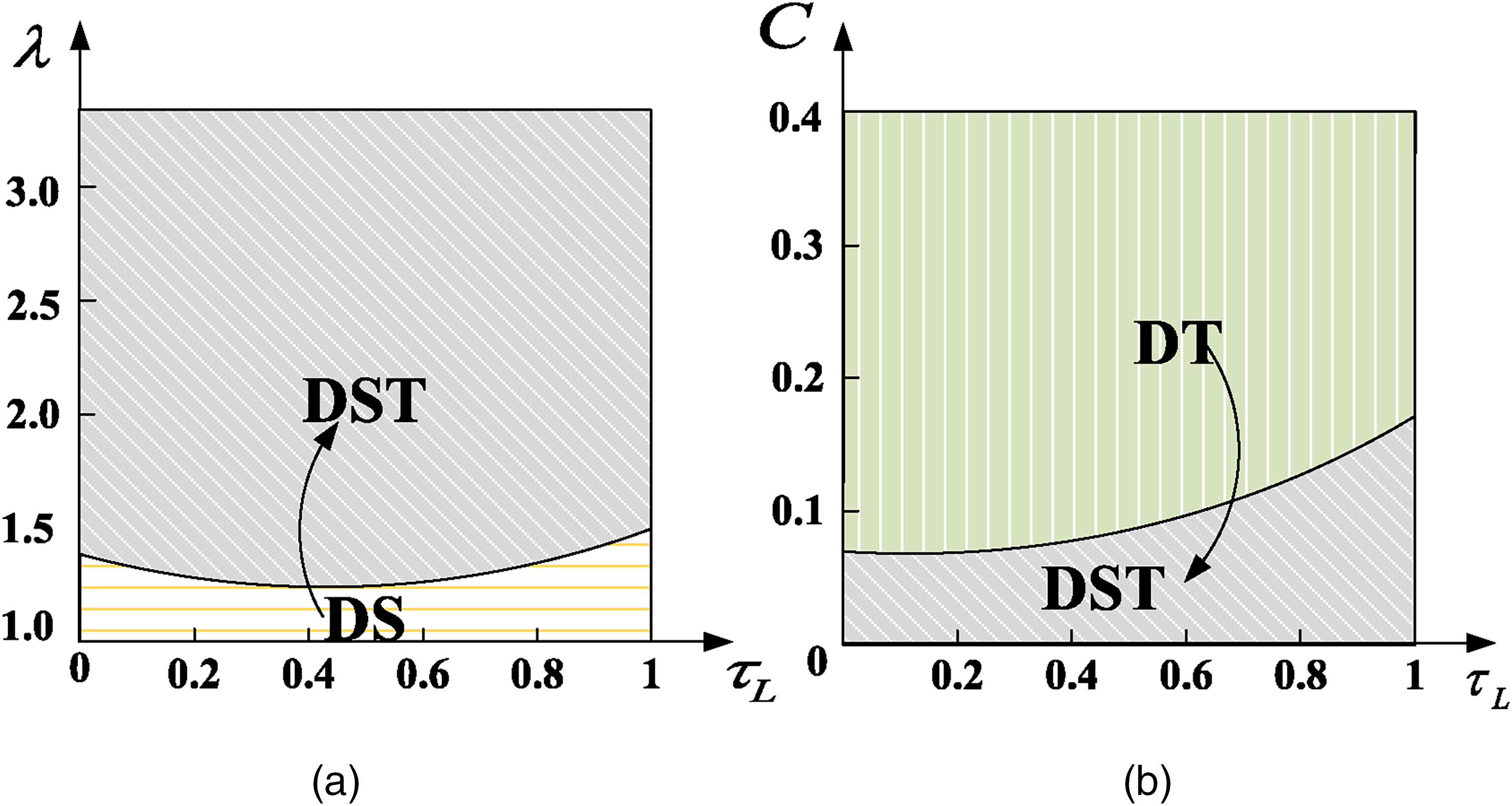
The shift from channel DS or DT to channel DST
This study has interesting implications for practitioners. First, our findings demonstrate that there is no one strategy tailored to all situations: the choice of channel structure in live streaming commerce is closely tied to certain conditions, like the streamer's popularity and bargaining power, the investment and broadcasting effort cost, consumer's channel preference and extra cost for watching live streaming, cross-channel spillover, as well as the price sensitivity of a specific product. Managers should carefully consider the significant influences of these distinct features and market conditions in live streaming commerce, so as to make the right choice of channel strategy. Otherwise, a firm might become worse off when jumping on the bandwagon and blindly embracing live streaming commerce.
Second, our findings suggest that cooperating with top streamers is not always a good choice for firms. Though their popularity helps to enlarge the market, those streamers usually have greater bargaining power, and consequently charge higher slotting fee and/or revenue sharing ratio, which will force the firm to pass most of the increased revenue to them. The choice of streamers for the start-up firm and the established firm for a specific product with a given price sensitivity can differ. The start-up firm prefers to cooperate with streamers with either a high or a low but not an intermediate level of popularity, while the established firm prefers to cooperate with streamers with a moderate level of popularity. Moreover, the firm can only benefit from cooperation with third-party streamers for products with medium price sensitivities. Thus, we provide guidance for managers regarding how to select the best third-party streamer to work for specific products.
Third, the findings indicate that the product price on the live streaming channels does not always be lower than the price on the traditional channel. We suggest that when consumers are less sensitive to the price, the firm can even charge a higher price and increase the sales on live streaming channels than on the traditional e-commerce channel. Moreover, when considering leveraging two or more channels concurrently, managers should carefully balance the benefit (i.e., demand expansion through the streamer's popularity and broadcasting effort, as well as cross-channel spillover) against channel encroachment cost (i.e., the investment and effort cost for a self-run live streaming channel, or the commission for a third-party live streaming channel) and possible channel competition (i.e., channel cannibalization effect) associated with the additional channel.
Conclusion, Limitations, and Future Research Directions
In this article, we seek insights for firms on whether and when to introduce a live streaming channel to sell products to consumers, and if so, with what type (third-party, self-run, or a combination of both). Unlike earlier studies of channel choice, we take into account the market factor (price sensitivity) and distinct features associated with the live streaming channel: the positive effect from the market expansion via the live streamer's popularity and broadcasting effort, and the cross-channel spillover, as well as the negative effect of paying the commission (the slotting fee and revenue-sharing ratio) to third-party streamers with different levels of popularity and bargaining power, consumer's extra cost for watching live streaming, and the investment and effort cost in the self-run live streaming. To determine the optimal channel strategy, we formulate analytical models to analyze seven channel scenarios: channels S, T, D, DS, DT, ST, and DST. We first derive the prices, broadcasting effort levels, revenue-sharing ratios, demands and profits in these seven scenarios and then analyze the firm's choice of channel strategy under different situations. By doing this, we provide a complete picture for practitioners, either from a start-up or from an established firm, on the strategic choice of channel and streamer problem.
The main findings are summarized as follows. First, contrary to the intuitive expectation and anecdotal evidence that prices are usually set to be lower in the live streaming channel, our findings suggest the firm could in certain situations set a higher price in the live streaming channel than in the traditional channel to reap the greatest benefit. Second, most firms take it for granted that streamers with high popularity will be better for the firm. Counterintuitively, our results suggest that this is not always the case, due to the higher channel encroachment cost and intensified channel competition. Moreover, the firm can only benefit from cooperation with third-party streamers for products with medium price sensitivities. Third, there is no one channel choice that is universally superior to the others: the firm's optimal channel strategy depends on the streamer's popularity and bargaining power, the investment and broadcasting effort cost, consumer's extra cost for watching live streaming, the cross-channel spillover, as well as the price sensitivity of a product. In general, live streaming benefits the firm more when the price sensitivity is not too large, that is, when the traditional pricing tool is less important to entice consumers. A start-up firm should cooperate with a streamer with either a high or a low level of popularity, while an established firm should select a streamer of moderate popularity. An established firm that is considering leveraging two or more channels concurrently to achieve a higher profit should additionally take into consideration the cross-channel spillover, channel encroachment cost, and channel competition, so as to maximize the total profit from all channels and reap the greatest benefit from the live streaming commerce.
Our study has some limitations, and these suggest future research directions. First, we consider only a monopoly setting; however, given the explosion in social technologies, consumers are usually able to compare competitors’ products. Therefore, the channel choice in a competitive live streaming environment would be of particular interest. Second, to focus on our research questions, we mainly explore the interactions among the firm, the streamer, and consumers with heterogeneous choice behavior. However, the live streaming supply chain in practice often involves many other players. For example, the live streaming platform is also a crucial component for the success of operating live streaming commerce, and its role remains a research priority. Third, we investigate the impact of salient characteristics associated with the live streaming channel on potential demand and channel choice using an analytical modeling methodology. Given the fruitful empirical research on the demand side of live streaming commerce, using real-world empirical data to support the results of this study would make the research more scientifically sound and practically relevant. Notwithstanding these limitations, the current work helps to provide a complete understanding of the characteristics of live streaming commerce under different market conditions, and thus contributes to the burgeoning research on operations strategies in the context of living streaming commerce.
Supplemental Material
sj-docx-1-pao-10.1177_10591478241270118 - Supplemental material for Channel Choice in Live Streaming Commerce
Supplemental material, sj-docx-1-pao-10.1177_10591478241270118 for Channel Choice in Live Streaming Commerce by Yina Li, Yu Ning, Weiguo Fan, Ajay Kumar and Fei Ye in Production and Operations Management
Footnotes
Acknowledgments
Yina Li and Yu Ning contributed equally to this work. We are grateful to the department editor, senior editor, and referees for very helpful comments and suggestions.
Declaration of Conflicting Interests
The authors declared no potential conflicts of interest with respect to the research, authorship, and/or publication of this article.
Funding
Yina Li was supported by the major project of National Social Science Foundation of China (grant number 22&ZD082) and National Natural Science Foundation of China (grant number 72371104). Fei Ye was supported by National Natural Science Foundation of China (grant number 72071080) and the Innovation Research Group Project of National Natural Science Foundation of China (grant number 72321001).

Notes
How to cite this article
Li Y, Ning Y, Fan W, Kumar A and Ye F (2024) Channel Choice in Live Streaming Commerce. Production and Operations Management 33(11): 2221–2240.
References
Supplementary Material
Please find the following supplemental material available below.
For Open Access articles published under a Creative Commons License, all supplemental material carries the same license as the article it is associated with.
For non-Open Access articles published, all supplemental material carries a non-exclusive license, and permission requests for re-use of supplemental material or any part of supplemental material shall be sent directly to the copyright owner as specified in the copyright notice associated with the article.
