







Abstract
Recent advancements in communication and social technologies have resulted in the growth of peer-to-peer (P2P) marketplaces, such as Xianyu and Poshmark. Individual sellers in these markets, most of whom are unbranded and lack credibility, often face immense challenges in building trust to facilitate P2P transactions. We consider the potential of sellers’ use of social media to establish trust and drive sales. Specifically, we address whether social media use benefits the sales performance of individual sellers, and how social media use affects customer retention and acquisition. We draw on social capital theory to explore the theoretical mechanisms by which social media participation may affect sales, hypothesizing that such participation enables the seller to accumulate social capital and develop trust. We empirically test this by exploiting a quasi-natural experiment wherein a large P2P marketplace for second-hand goods (Xianyu) unexpectedly removed its social media feature (Fishponds). We employ a difference-in-differences design, leveraging a proprietary data set capturing social media participation and sales activities for individual sellers, covering more than 180,000 transactions over a multi-week period around the event. We find that sellers who initially participated in social media channels experienced a significant decline in sales after the shutdown, which is attributable to poorer customer retention and acquisition. We explore heterogeneity in the effects and find that the sellers who benefit most from social media participation are those with the most to gain from trust-building. An additional online controlled experiment provides further evidence of the trust-building mechanism. Our study implies individual sellers can harness social media to generate additional sales from existing and new customers. These insights are important, as they speak to the value of social media channels as drivers of trust in P2P marketplaces.
Keywords
“To encourage users and to build trust, Xianyu came up with the concept of ‘fish ponds’ — thousands of communities based on interest and location. Users talk to one another about hobbies and interests while making purchases.” – FinancialTimes (2016)
Introduction
Recent advancements in IT and social technologies have given rise to online peer-to-peer (P2P) marketplaces, broadly defined as platforms that facilitate P2P transactions (Huang et al., 2023; Luo et al., 2021). There are P2P marketplaces connecting buyers and sellers in various transaction types, for example, resale of used goods (e.g., Facebook Marketplace and Poshmark), short-term freelancing (e.g., TaskRabbit and Upwork), and home rental (e.g., Airbnb) (Diao et al., 2023; Liu et al., 2023).
The rise of these marketplaces introduces new considerations for operations management (OM), challenging assumptions in existing eCommerce research (Benjaafar and Hu, 2020). Specifically, unlike business-to-business (B2B) and business-to-customer (B2C) settings, P2P markets focus on transactions between individual buyers and sellers. These sellers typically lack resources, experience, and the backing of well-known brands (Gu et al., 2024), implying a generally greater need for trust-building. Compounding these issues, P2P marketplaces often lack robust dispute resolution mechanisms such as warranties and hassle-free return policies (Hayes, 2002), implying extreme uncertainty and risk for buyers. Furthermore, while B2B and B2C platforms can leverage participants’ brand reputation, marketing capabilities, and reputation accrued via customer feedback to facilitate trust, participants in P2P markets generally lack these features, implying that P2P marketplace operators have to find alternative ways to support individual sellers, enabling sellers to build trust, credibility, and visibility in the marketplace (Luo et al., 2021).
Existing studies explore how adopting information systems can address operational challenges of online marketplaces (Kumar et al., 2018). Social media technologies, in particular, have immense potential to reshape customer relationship management and improve operational efficiency (Qiu et al., 2022). Studies show the benefits of social media use for business operations: as a driver of customer interaction, a means of enhancing brand visibility, and as a path to shaping consumers’ purchase decisions (e.g., Liang et al., 2023; Manchanda et al., 2015). Despite the extensive literature, there is little evidence of the value of social media use in P2P marketplaces, specifically to foster trust between buyers and sellers.
In B2B and B2C environments, in which the impacts of social media have been largely studied, sellers (companies and brands) regularly use social media to implement strategic, long-term marketing initiatives that foster customer engagement, nurture word of mouth, and increase brand exposure (Park et al., 2018; Wang et al., 2021). Such positive impacts of social media, unfortunately, might not be guaranteed in P2P settings. First, the decentralized and competitive nature of these platforms can dilute the effects of social media efforts exerted by individual sellers, making it difficult for them to stand out. Indeed, unlike established brands in B2B and B2C environments, these sellers do not have dedicated marketing teams or substantial budgets to design and execute sophisticated social media strategies. As a result, they may struggle to create a consistent and compelling online presence that attracts and retains customers (Chen et al., 2024). Second, there is inherent variability and lack of standardization in P2P transactions. In B2B and B2C markets, social media can effectively convey consistent brand messages and reinforce customer trust through reliable product quality and service standards. However, in P2P setting, the quality and reliability of products and services can vary widely among individual sellers, leading to potential customer dissatisfaction and negative reviews. This variability can undermine the trust-building efforts of P2P sellers and make it difficult to establish a strong online reputation (Xie et al., 2021). Hence, although social media can enhance networking and visibility for P2P sellers, the potential downsides might shrink or even cancel out the positive impacts. Practically speaking, given these constraints, it remains unclear whether individual sellers should invest their efforts in social media.
More importantly, the pathways through which trust is formed in P2P settings differ significantly from B2B and B2C environments. Companies in traditional business environments rely heavily on their brand identity and brand reputation achieved via marketing activities, as well as their reputation, for example, through customer reviews, to build trust with customers. In contrast, sellers in P2P marketplaces lack those resources, thus they are required to engage in more personal, direct interactions with potential buyers to establish credibility. Trust in P2P settings is often built over time through user-generated content, social proof, and personal narratives shared via social media platforms (Eckhardt et al., 2019). Although recent literature explores various mechanisms by which social media investments impact B2B and B2C operational efficiency and sales, little attention has been devoted to understanding the trust-building mechanisms of seller social media use in P2P settings. In particular, existing studies often use trust-building as a broad explanation for the observed effects on user connection and engagement, but the literature lacks theoretical discussions on the specific pathways through which trust is established (Guesalaga, 2016; Rishika et al., 2013). Drawing on social capital theory, our research aims to unpack the mechanisms of trust-building arising from social media use by individual sellers in P2P settings.
Furthermore, existing studies pay relatively little attention to the nuances of consumer demand, considering sales only in a broad sense. Here, we consider not only sales volume but also the difference between sales to pre-existing customers (retention) and sales to new customers (acquisition), an important distinction from an operational perspective (Afeche et al., 2017; King et al., 2016). Understanding how social media use influences these distinct outcomes is essential for developing effective customer retention and acquisition strategies in P2P settings.
To summarize, we seek to quantify the value of social media participation for individual sellers in P2P marketplaces and investigate the underlying mechanisms unique to the focal setting. More formally, we address the following research questions: (1) To what extent does social media participation benefit the sales performance of individual sellers? (2) How does social media participation impact individual sellers’ customer retention and acquisition? and (3) What is the mechanism for these identified effects?
However, there are empirical difficulties to overcome if we wish to answer these questions. First, the process of social media adoption and the accrual of benefits is typically gradual, as the formation of social bonds and social capital takes time. Indeed, social group formation requires anywhere from a few months to several years to play out (Phan and Airoldi, 2015). Accordingly, it would be important to focus any such analysis on adopters. However, this leads to a second challenge: many users have privacy concerns when participating on social media, preferring to participate discreetly, under a pseudonym (Bucher et al., 2018). As a result, identifying a sufficiently large set of individuals from the company transaction records and matching them to a social media profile is a difficult prospect (Goh et al., 2013).
We address these challenges empirically, exploiting a quasi-natural experiment at Xianyu, China’s largest P2P marketplace for second-hand products, namely, the unexpected, sudden shutdown of the platform’s social media channel by government regulators. We investigate the impact of this loss of access on the sales activity of participating sellers. More specifically, we compare the sales activities of sellers who participated in at least one social media group before the shutdown with sales activities among sellers who did not participate in any social media group, implementing a difference-in-differences (DID) design. 1 Because the social media channel in question was integrated into the P2P marketplace, we are able to incorporate comprehensive information about each seller’s on-platform social media use and business activities in our analyses.
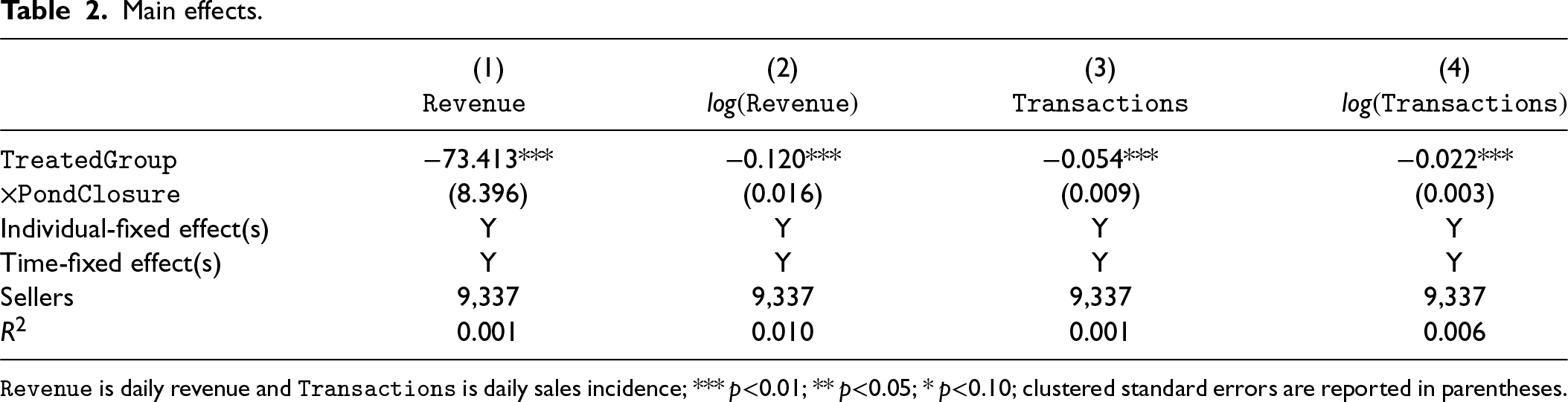
Our analyses yield several important findings. First, we show the elimination of social media participation had a large, negative effect on the affected sellers, such that those in the treatment group suffered an estimated 11.4% decline in revenue relative to the control group, suggesting the shutdown had a substantial effect on sellers’ social capital and trust-building in the marketplace.
Second, we demonstrate that the effect of the loss of on-platform social media participation is not limited to existing customers; new customer acquisitions also drop. This is critical because most individual sellers lack the resources to attract and acquire new customers. Their use of social media likely helped them acquire bonding and bridging capital to connect with existing buyers and approach new ones, respectively. The shutdown eliminated these avenues.
Third, our granular, individual-level data allow us to explore individual characteristics moderating the treatment effect on sales performance. We show that the newer the seller, the more they suffer following the elimination of the social media channel, suggesting that the benefits of social media participation are greater for sellers without established social capital or trust with buyers. Furthermore, we show that, as sellers, men are more impacted than women. This finding is notable, as existing studies find that men struggle more than women to earn customer trust in P2P trade (Buchan et al., 2008; Chan and Wang, 2018).
Finally, we provide direct evidence of the mechanisms through an online controlled experiment wherein we collect data from participants using perceptual measures of trust along several dimensions (integrity, competence, and benevolence) in relation to an individual seller in a P2P market. We randomly expose participants to information indicating that a seller exhibits one among several social media behaviors (posting, commenting, re-sharing, and group event participation). We then conduct a set of mediation analyses to demonstrate that posting and participation in group events, in particular, have positive effects on purchase intent, via increases in participants’ perceptions of a seller’s integrity, competence, and benevolence.
Our research contributes to the literature on the business value of social media in e-commerce in several ways. First, extending extant studies focusing on the effects of social media in B2B and B2C settings, we provide the first piece of empirical evidence showing the positive impact of social media participation in driving business performance of individual sellers in P2P settings. Second, drawing on social capital theory, we are among the first to offer a theoretical explanation of the trust-building mechanism of social media participation in P2P marketplaces. Our results show that social media participation can positively affect sales by facilitating sellers’ accumulation of social capital and trust among buyers. Our work thus advances a novel theoretical mechanism through which social media use can benefit individual sellers.
Third, customer retention and acquisition are essential to thriving P2P marketplaces. The success of any two-sided platform is directly contingent on there being sufficient participation to maintain positive cross-side network effects (Anderson Jr et al., 2014; Katz and Shapiro, 1985). While extant studies typically treat sales outcomes as monolithic (Goh et al., 2013), as summarized in Table A1 of the E-Companion, our findings present novel evidence of the value of social media participation for generating demand from new versus returning customers.
This study also offers several novel insights to the OM literature on the value of social media. First, while existing studies focus on the behavior of a single agent or monopolistic seller, we consider the operations of a broad set of individual sellers (see Table A2 of the E-Companion for a review summary). Second, our analyses, particularly regarding the distinct effects on customer retention and customer acquisition, advance the current state of knowledge and highlight the value of exploring distinct components of sales (Eckhardt et al., 2019; King et al., 2016). Third, our findings at the market level can inform the decision-making of platform operators around feature integration. Specifically, our results show how social media channels can improve platform operations by helping a particular seller segment gain traction and sustain its place in the market. Our research thus joins an emerging stream of empirical OM research on the sharing economy and two-sided markets (Wang et al., 2022); see the summary in Table A3 of the E-Companion.
Literature Review
The Value of Social Media in E-commerce
Integrated social media channels are an essential operational component of many e-commerce platforms. Several studies show that social media channels can have a significant influence on consumer behavior, by enabling peer influence. For example, Park et al. (2018) find evidence of observational learning, such that observing peer purchases can reduce perceptions of purchase risk and increase one’s purchase intentions. Wang et al. (2018) examined peer influence in online book ratings, and find that individuals’ ratings grow more similar to those of peers once the two become socially connected. Huang et al. (2019) and Chen et al. (2011) explored the impact of online word-of-mouth reviews on buyers’ purchase activities, finding that the volume and valence of online comments influence customer purchases. Jing and Xie (2011) demonstrated that group-buying benefits platform sales through information sharing between well-informed and less-informed customers. Zhang et al. (2015) employed an analytical modeling framework to demonstrate that customers acquire more information from the consumption decisions of friends than those of strangers. The effectiveness of this information exchange is contingent upon the size of the particular social network. Finally, Goh et al. (2013) showed that participating in a brand’s social media page significantly lifts customer spending.
Beyond these impacts on consumer behavior, existing studies examine how firms and organizations benefit from investing in social media, in terms of consumer engagement via brand communities, advertising, and, more generally, by amplifying consumption utility by integrating social elements into the consumption process. Specifically, Manchanda et al. (2015) find that firms’ investments in a brand community can increase user perceptions of belonging and engagement. Huang et al. (2020) and Wang et al. (2021) explored firms’ leveraging of social media advertising as a marketing instrument to reach and engage with target customers.
Our study complements the perspectives in the literature by bringing attention to the potential impact of social media participation on individual sellers’ business performance in P2P settings; see Table A1 of the E-Companion for a summary of our key contributions. Individual sellers often lack the formal marketing tools to build their brand identity. They must typically navigate different social media platforms to increase their exposure and connect with potential buyers. Further, unlike B2B and B2C e-commerce settings, P2P marketplaces generally lack mechanisms and institutional safeguards for buyers, such as refund policies, dispute resolution processes, and customer support. Accordingly, for buyers, these markets are characterized by exceptional uncertainty and risk that individual sellers must overcome, for example, by establishing and maintaining a rapport with new and existing consumers via high-touch communication.
There is a clear need for deeper exploration of how individual sellers leverage social media tools in practice, to achieve exposure and build credibility and trust with buyers. We advance a theoretical framework grounded in social capital theory, hypothesizing that sellers’ social media participation positively affects the trust-building via social capital accumulation. This exercise advances the literature by incorporating a seller perspective and informing our understanding of social media as a trust-building tool in P2P marketplaces (Sundararajan, 2019; Qiu et al., 2022).
Our study’s emphasis on seller-specific outcomes is also a distinguishing feature; most existing studies focus on buyer behaviors and outcomes (Huang et al., 2020; Manchanda et al., 2015). We specifically investigate the mechanisms through which social media interactions translate into trust-building actions that influence customer retention and acquisition. This exploration is valuable as many sellers operate within strict resource constraints and have limited capacity for customer relationship management (Gu et al., 2024). For individual sellers, social media offers a cost-effective avenue for such efforts. Our results show that, in addition to benefiting sales, social media participation helps individual sellers acquire and retain customers.
Social Media in Operations Management
Several studies explore how firms can leverage social media to their operational benefit (see Table A2 of the E-Companion for a summary of this literature).
First, several studies demonstrate how social media can be leveraged in pricing and promotion to encourage product adoption. For example, in their theoretical model, Zheng et al. (2023) showed that when network externalities (e.g., demand-side economies of scale) are weak, monopolistic sellers should apply an increasing price strategy. Likewise, Qiu and Whinston (2017) showed that a monopolistic firm can encourage customers’ observational learning using a price-commitment strategy. Other studies show how firms leverage peer influence to increase product adoption through social media campaigns (Bapna and Umyarov, 2015; Gao et al., 2020).
The use of social media to engage employees and thereby improve operational efficiency is another topic covered in the literature. For instance, Chen et al. (2022) find that active participation in knowledge sharing within a firm’s internal community can reduce employee turnover. Others confirm firm social media initiatives can facilitate information flows through internal and external social networks (Lam et al., 2016). Finally, Schmidt et al. (2020) and Yoo et al. (2016) demonstrated that firms can leverage social media to rapidly detect operational glitches or confirm natural disasters.
Our work is distinct in several respects. First, whereas most existing studies focus on the behavior and decision-making of firms or monopolistic sellers, we explore the dynamics of a large body of individual sellers within a marketplace. This breadth allows us to demonstrate how individual sellers, lacking market power, can leverage social media to succeed, offering a fresh perspective on the operational implications of social media use for sellers. Second, we demonstrate that there is heterogeneity among sellers in the benefits of social media use across multiple dimensions, in terms of where demand arises (new vs. existing consumers) and in terms of which sellers benefit (e.g., new vs. established sellers). For example, identifying and quantifying the impacts of social media use on consumer acquisition and retention allows the tailoring of seller strategies to align with their specific circumstances and context. This equips sellers with actionable strategies, fostering adaptability and enhancing overall operational effectiveness. Finally, we highlight the value of social media for operational efficiencies at the platform level, which can inform operators’ decision-making on the integration of social media features. We identify the significance of social media engagement in fostering trust and, examining the dynamics from a platform standpoint, the critical need to leverage social media to enhance supply-side growth. This strategic approach is key to fostering and amplifying network effects. In essence, our findings underscore that platforms shall, as a strategic imperative, harness social media to catalyze trust-building and fortify their competitive position, particularly in settings with few institutional safeguards for buyers.
Hypothesis Development
Understanding the underlying trust-building mechanisms by which social media participation operates is essential, particularly in the context of P2P marketplaces. Unlike other sources of information, for example, profile images, customer reviews, and identity verification, social media facilitates a more dynamic approach to trust-building that emphasizes relationships, connections, and personal bonds. Indeed, social media channels enable individual sellers to engage in continuous, interactive dialogues with potential buyers, providing opportunities to share personal narratives, respond to inquiries, and build an interpersonal relationship. These interactions not only showcase the seller’s authenticity and reliability but also strengthen the social bonds between buyers and sellers over time, creating an environment where trust can flourish. These points highlight the importance of understanding the specific trust-building processes facilitated by social media use, and the degree to which they offer distinct advantages over traditional information channels for establishing long-term, trustworthy relationships with customers.
Social Media, Social Capital, and Trust Building
Social capital, which refers to individuals’ ability to access resources within their social network (Putnam et al., 2000; Wasko and Faraj, 2005), is closely connected with the notion of trust. As Coleman (1994: Chapter 10) observes, “an individual trusts if he or she voluntarily places resources at the disposal of another party without any legal commitment from the latter, but with the expectation that the act of trust will pay off.” Accumulating social capital requires considerable time and effort; the accumulation of social capital requires continuous investment and commitment to forming social connections and attaining social status (Glaeser et al., 2002; Nahapiet and Ghoshal, 1998). Doing so is particularly difficult in online P2P markets, where individuals engage on a relatively occasional basis.
Social media technologies can offer a convenient venue for individuals to build social capital with potential consumers, simplifying and streamlining the process. Social media channels can lower the costs of pursuing this social capital by allowing sellers ready access to broader, more diverse social networks than their own individual networks, reducing relationship-management overheads, and facilitating more frequent communication and information exchange (Ellison et al., 2014).
The use of social media (e.g., posting, commenting, sharing, and passive information consumption) can also help individuals establish a social identity, which can deepen interpersonal bonds between the individual seller and members of their social network (Antheunis et al., 2015). Indeed, researchers point to a positive correlation between social media use and social capital formation (Steinfield et al., 2013).
Prior studies also highlight the association between social capital and trust (Migheli, 2012; Mou and Lin, 2017), which has three main dimensions: integrity, competence, and benevolence (Gefen et al., 2003). In the realm of e-commerce, integrity is reflected in the belief that sellers conduct themselves in a credible and honest manner when transacting. The belief in the seller’s competence is that they have adequate knowledge and ability to fulfill the transaction. Finally, the benevolence dimension refers to the perception that a seller cares about the buyer’s welfare and desires a long-term relationship.
By accumulating social capital, individual sellers can build trust in at least three ways. First, investing significant time and effort in engaging with their network will afford sellers more social cues, and they will divulge more personal information to other network members. Offering this social information to peers builds familiarity, which can, in turn, boost expectations regarding the seller’s integrity (Ter Huurne et al., 2017).
Second, by regularly sharing content, interacting with group members, and participating in relevant discussions, individual sellers can build a strong professional identity, reinforcing the buyers’ belief in their competence. Third, individual sellers who establish a social presence and strong social bonds will then have a reputation to maintain. These sellers may, in turn, be perceived as more interested in longer-term relationships, leading to an expectation that they will act with the buyer’s best interests in mind. Put simply, socially embedded sellers have more to lose if they are caught engaging in opportunistic behavior (Ba and Pavlou, 2002; Gefen et al., 2003).
Based on the above, we expect that individual sellers in a P2P marketplace will conclude more sales as a result of social media participation, because it enables them to accumulate social capital. We thus expect that the sudden shutdown of a social media channel will result in individual sellers losing these benefits, negatively impacting their sales performance.
Hypothesis 1. The shutdown of a social media channel has a negative impact on sales performance.
Bonding Capital and Customer Retention
Research on social capital often distinguishes two general forms: bonding capital and bridging capital (Putnam et al., 2000). These reflect the degree of relational strength and types of resources an individual might access within their networks. Bonding capital refers to individuals’ holding strong, tightly knit, emotionally close connections that will, in turn, yield higher levels of trust (Ellison et al., 2014). This form of capital thus amounts to the formation of long-term, stable social relationships. Individuals with greater bonding capital typically benefit from reciprocal peer support.
Studies show that various forms of interaction on social media positively affect bonding capital (Antheunis et al., 2015). For example, posting personal updates and sharing useful information related to a topic of mutual interest establishes one’s social identity, which, in turn, leads to perceived homophily among peers, strengthening bonds (Stutzman et al., 2012). A direct message between two individuals can similarly deepen interpersonal bonds, as the parties become more familiar with one another. Commenting on others’ posts can reveal mutual interests, creating the opportunity for bond formation.
Bonding capital is of particular relevance in sustaining existing consumer relationships, helping sustain and maintain trust between a seller and established customers. Consistent with this idea, trust is conceptualized as a dynamic entity, requiring ongoing reinforcement and maintenance (Sirdeshmukh et al., 2002; Wang et al., 2022). Previous positive interactions with a seller do not guarantee ongoing trust; the seller’s continuous effort is required to sustain customers’ confidence in their integrity, competence, and benevolence. It thus stands to reason that the social capital accrued via social media engagement can play a crucial role in sellers maintaining relationships with buyers to facilitate repeat purchases.
Sustained trust is likely of particular importance in a P2P marketplace for used goods, where individual sellers tend to list products sporadically, the condition of products offered can vary substantially, and a range of pricing strategies are available. Even when a customer has previously transacted with a given seller, the inherent variability of available products undermines the buyer’s ability to generalize from their previous purchase experiences to future transactions. In short, buyers face an inherent quality risk as, for example, “new” products are likely unfamiliar or may be posted at higher-than-average prices. Sellers’ regular participation in social media channels can thus bolster trust with established customers, encouraging ongoing interaction and repeat purchases.
Given that bonding social capital can translate to sustained trust with existing customers, it is reasonable to expect individual sellers who actively engage in social media to more easily retain customers. Accordingly, we next posit that the elimination of the social media channel will negatively affect individual sellers’ bonding capital, diminishing customer retention.
Hypothesis 2. The social media shutdown has a negative impact on sellers’ customer retention.
Bridging Capital and Customer Acquisition
Bridging capital is linked to the notion of weak ties, which are loose connections between distant individuals with diverse backgrounds. Bridging capital allows individuals to gain access to new connections in external networks and to gather or disseminate novel information (Eklinder-Frick et al., 2011). Social media can facilitate the cultivation of bridging capital by lowering the cost to individuals of establishing and maintaining weak ties among a broad and diverse set of networks (Ellison et al., 2011).
Engaging in various social interactions, allows individuals to accumulate bridging capital and make connections in external networks, where they may ultimately build trust by providing novel, useful information (Brooks et al., 2014). Sellers might also explore and join new social groups to expand their ties and form more diverse connections. Individuals can also initiate connections by “pushing” information to external networks (i.e., promotion and direct messaging) (Burke et al., 2011; Pinho and Soares, 2015). Finally, individuals might make new acquaintances in groups, setting the stage for more efficient future communication, and getting to know individuals by consuming their social media content (Antheunis et al., 2015).
In this way, individual sellers who are active social media users might cultivate bridging capital through social activities, allowing them to expand their connections with new customers, which, in turn, can be translated into improved customer acquisition. We thus expect the elimination of the social media channel to negatively impact sellers’ bridging capital, reducing customer acquisition.
Hypothesis 3. The shutdown of social media has a negative impact on sellers’ customer acquisition.
The Moderating Role of Seller Tenure and Gender
Sellers in P2P marketplaces exhibit significant heterogeneity in terms of their experience and personal characteristics, which in turn influence the challenges they face in trust-building (Einav et al., 2016; Ghose, 2009). This heterogeneity is a crucial aspect to explore, as it directly informs whether, which, and to what degree sellers stand to benefit from social media use for building trust and growing their businesses. In addition, understanding these differences is essential to complement our theoretical discussion of the underlying pathways to trust-building. Those who struggle most to build trust may benefit more from social media use; they have more to gain in terms of social ties and social capital (Huang et al., 2019). Social media provides a channel for these sellers to engage in meaningful interactions with potential customers, facilitating social capital accumulation through direct communication and involvement.
First, newer sellers are likely to face greater challenges to attain trust because there is no track record of their behavior in past interactions and transactions (Luo et al., 2021). This absence of a transaction history makes it difficult for potential buyers to assess their credibility and reliability, placing newer sellers at a disadvantage in trust-building. Social media participation can play a pivotal role in mitigating these challenges by reducing the costs associated with building and maintaining social ties (Ellison et al., 2014). For newer sellers, engaging in relationship management activities through direct messages, comments, and content sharing can help strengthen bonding capital within existing networks. Additionally, participating in social groups and discussions can expand their outreach to new customers, facilitating the accumulation of bridging capital. Therefore, the shutdown of a social media channel is expected to disproportionately impact newer sellers, who rely heavily on these platforms to build trust and establish their presence in the marketplace.
Hypothesis 4a. The negative impact of a social media shutdown on sales, customer retention, and customer acquisition will be amplified for newer sellers.
The online commerce literature also shows that men face more difficulty in attaining trust, than women (Croson and Buchan, 1999; Hall, 2011; Riedl et al., 2010). Intuitively, customers see men as less credible, more opportunistic, and thus less trustworthy as sellers because men are generally understood to be less communicative and as operating strategically (Huang et al., 2019). This perception can hinder trust-building efforts for male sellers, making social media an essential tool for overcoming these biases. By actively participating in social media, male sellers can work to build both bonding and bridging capital, which are crucial for retaining existing customers and acquiring new ones. Social media allows male sellers to demonstrate their integrity, competence, and benevolence, counteracting negative stereotypes and fostering trust. Consequently, the elimination of social media channels is expected to have a more pronounced impact on male sellers, who may struggle to compensate for the loss of this valuable trust-building channel.
Hypothesis 4b. The negative impact of a social media shutdown on sales, customer retention, and customer acquisition will be amplified for male sellers.
Research Context
Company Background
Our business partner, Xianyu, was founded in 2012 as a subsidiary of Taobao.com and focuses on the sale of second-hand goods. The marketplace, which gained its independence from Taobao to become a standalone P2P marketplace in 2016, is now the dominant platform for the exchange of used goods in China. In May 2020, Xianyu boasted more than 200 million users, including 30 million sellers, with a total gross merchandise value of RMB 200 billion. Xianyu thus represents more than half of the total market for online commerce in second-hand goods in China. 2
Like Poshmark and Facebook Marketplace in the United States, Xianyu hosts individuals who buy, sell (or rent) second-hand products within their local community. Users wishing to sell an item on Xianyu need to register an account using their mobile phone number or an existing Taobao account. Once registered, users can post products for sale with a description, category labels, pictures, a price, and a pick-up location. The marketplace fosters trust by requiring all sellers to link their AliPay and Xianyu accounts, such that the sellers’ credit rating is visible to buyers; this credit score is based on Sesame credit (a system implemented by Taobao and AliPay that tracks ratings on more than 700 million Chinese users). Sellers also need to choose their accepted payment methods, including AliPay, bank card, or cash. Each posting remains valid for 90 days, after which, sellers may relist any unsold items.
Xianyu offers several convenient ways for buyers to explore items for sale, with the app landing page presenting buyers with popular product categories (e.g., mobile phones, electronics, books, gaming, home appliances, clothes and shoes, beauty and cosmetics, and house rentals); see Figure 1. Buyers can also search for specific product names or categories directly via a search box at the top of the landing page. On locating a specific product, buyers can send sellers a private message requesting more detailed product information (e.g., the condition of the item), to negotiate the price, or to arrange other transaction details.
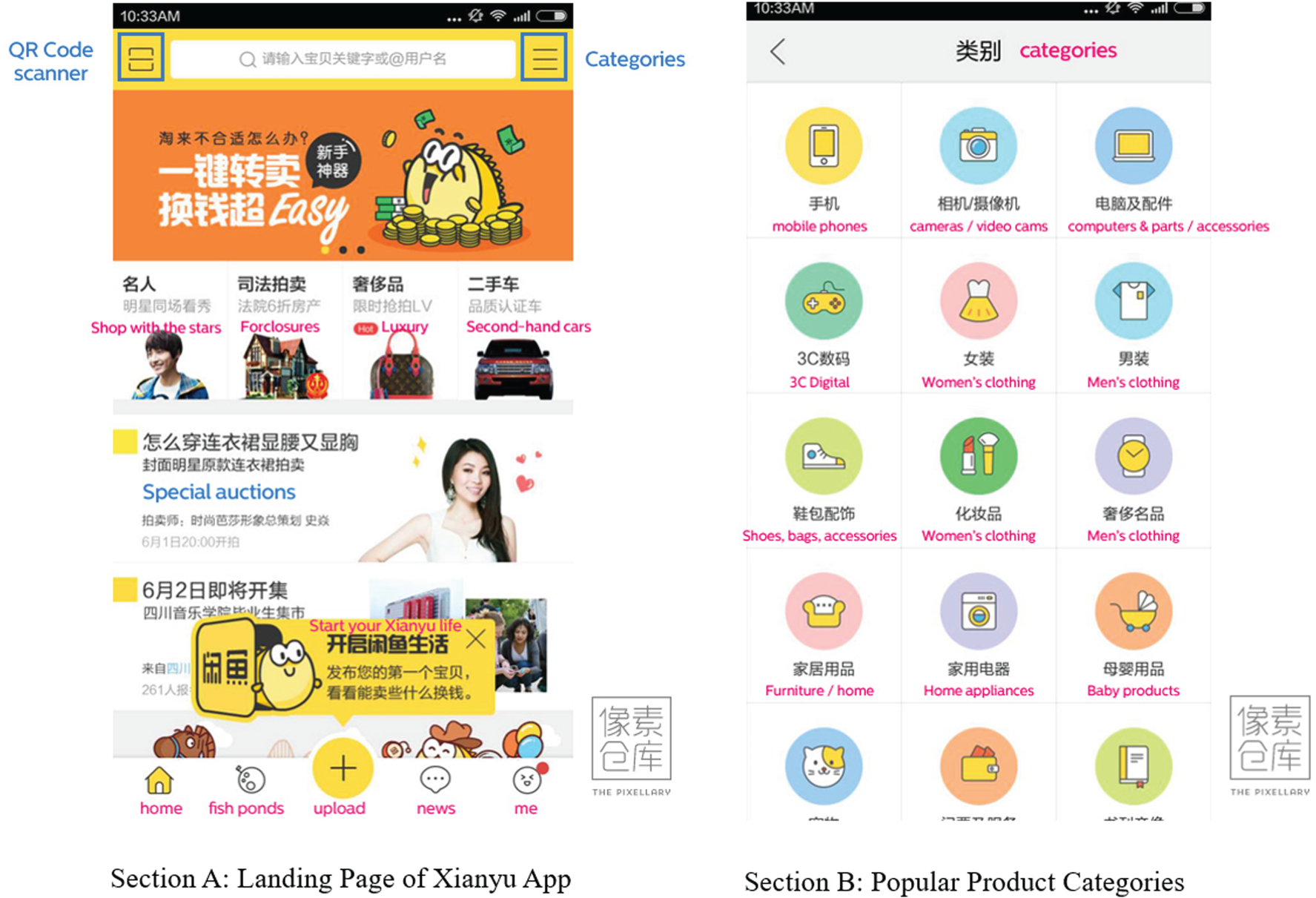
Xianyu app landing page.
A unique feature of Xianyu is that it hosts its own social media channel to build trust and promote user engagement (FinancialTimes, 2016). Xianyu launched this channel, called Fishpond, in early 2016. Fishpond was designed to support social interaction among users with shared interests or who reside near one another (akin to Facebook groups). Both buyers and sellers are free to join any Fishpond, after which they receive updates about new posts. As an important social feature of Xianyu, Fishpond has a prominent tab at the bottom of the Xianyu landing page, as shown in the left-hand panel of Figure 1, enabling Xianyu users ready access to explore Fishpond groups and browse social content.
As depicted in Figure B1 of the E-Companion, users landing on the Fishpond page can explore popular topics, read updates, and post their own content in Fishponds they have joined. In any given Fishpond, content is sorted into three sections: updates, Q&A, and used items). Because Xianyu engages users through social interaction, a January 2019 update made the “updates” section the default landing page for all Fishponds; from here, users could view group announcements, recent online/offline activities organized by group members, and content posted by fellow group members.
Following this update, sellers were unable to directly list their products in Fishpond’s social-update section. However, users did have the option to advertise their product listing to the members of a Fishpond within that Fishpond’s “used items” section. Similar to other social media platforms, Fishpond allows members to post life updates, share local events, and organize online and offline activities. Users can interact with the posts of fellow group members by giving them a thumbs up or “like,” by commenting, or by re-sharing (see Figure B2 of the E-Companion). In addition, members could raise questions and post answers about any issue, for example, on topics related to the local community or to a product. The marketplace restricted each user to joining no more than 100 Fishponds.
Xianyu invested in growing Fishponds as a business priority, to drive engagement among individual users. Fishponds experienced stellar growth before their removal. As reported, users participating in Fishponds were 2.2 times more active than users who did not make use of the channel. By May 2020, Xianyu had more than 1.6 million active Fishponds, reflecting substantial growth from the 12,500 operating in May 2015, with most having been formed on the basis of common interests or geographic proximity (Figure B3 of the E-Companion).
Qualitative Evidence of Social Media’s Value to Sellers
We developed a preliminary understanding of the role of Fishponds in encouraging trust among individual sellers and addressing buyer concerns by initiating a series of in-depth interviews with Xianyu participants. These interviews with buyers and sellers provide valuable insights into the dynamics of trust-building on the platform. We collaborated with a leading Chinese market research company to recruit 50 Xianyu buyers and 50 Xianyu sellers to complete a roughly 20-minute semi-structured interview; see E-Companion C for details of interview logistics and questions.
From these interviews, we identify several key difficulties typically experienced by individuals in the Xianyu sales process. Seller interviewees most frequently highlighted driving traffic/attention to their listings and attracting customers, whereas buyer interviewees most commonly noted concerns over product condition and authenticity. The consensus among sellers who had engaged in Fishponds was that this enhanced their sales and business outcomes; see Table C1 of the E-Companion. Notably, 38 out of the 39 seller interviewees who reported using a Fishpond report its positive influence, particularly in building trust with buyers. Buyers highlight the trustworthiness of Fishpond sellers, in large part based on the social proof derived from posts and peer comments.
This qualitative, interview-based evidence suggests that social media usage does help sellers gain the trust of buyers, driving sales. We turn next to our quantitative research design, recognizing that these qualitative self-reports may be mere perceptions. Our causal research design helps us assess whether social-media-engaged sellers did, in fact, benefit from their social media use, which sellers benefited most, and why.
Quasi-Natural Experiment
Although Fishponds became extremely popular among users, the lack of a formal structure and oversight led to issues of content moderation. Press reports refer to a significant portion of posts in some Fishponds containing pornographic content and referring to restricted, illegal products. Although Xianyu maintains strict policies on allowed product categories (e.g., listing items such as e-cigarettes, or pirated audio or video, is not permitted), opportunistic sellers circumvented the restrictions through informal advertising of banned items (i.e., without a formal product listing) via Fishpond posts that contain external links or contact information to guide interested consumers off-site (or off-line) to complete a transaction.
In response, the Office of Cyberspace Affairs of the Zhejiang Provincial Government launched a regulatory initiative on August 27, 2020, requiring online platforms to conduct an internal review of inappropriate content. The marketplace responded by shutting down its Fishpond social media channels at midnight on the same day. 3
The decision by the senior executive team to terminate Fishponds was unexpected and was not communicated in advance to the platform management team or market participants. Accordingly, the shutdown was not coordinated with other changes to the platform’s design or operation. Further, because users were unaware of a pending shutdown, it serves as a sharp, exogenous shock to users’ platform experience. Users logging on to the marketplace from August 28 onward found that Fishponds had been removed and were inaccessible to all users. Overnight, the social capital accumulated by individual sellers via the social network was eroded.
The context of our study and the shock we study are fairly unique, making it possible to address two empirical challenges in existing evaluations of the economic impacts of social media use. First, the process of social media adoption and the accrual of benefits is typically gradual, as the formation of social bonds and social capital generally takes time. Indeed, existing studies suggest that social group formation requires anywhere from a few months to several years to play out (Manski, 1993). The shock in this study entailed the sudden elimination of a mature social media channel, implying a discontinuous erosion of social connections and social capital.
Second, for many users, participating on social media presents privacy concerns, preferring to participate discreetly under a pseudonym (Bucher et al., 2018). Identifying a sufficiently large set of individuals from company transaction records and matching these to a social media profile presents a challenge for researchers (Goh et al., 2013). Given our direct collaboration with the host platform and the integrated nature of its social media channel, we have access to accurate and comprehensive records linking social media use with sales for each individual seller.
Identification Strategy
We leverage the unexpected removal of Fishponds as a quasi-natural experiment to study the effects of social media participation on Xianyu sales activity. On the date of the Fishpond shutdown, around 31% of registered sellers had never participated in a Fishpond. Although those who participated in Fishpond could be intrinsically different from those who never did so (e.g., self-selection), the shutdown event is plausibly exogenous to sellers’ participation decision because it was unannounced ahead and was made by the senior executive team solely in response to government pressure.
Sellers who participated in at least one Fishpond constitute our treated group, and those who were not socially active serve as the control. We then contrast inter-temporal variation in sales performance among socially active and socially inactive sellers around the date of the Fishpond shutdown (i.e., a DID design), to quantify the benefit (detriment) of using (losing access to) the social media channel for individual sales performance (Pu, 2022). While we recognize possible self-selection into social media use, the exogenous nature of the timing of the policy change and our research design allows us to identify an estimate of the ATT.
Note, a key identifying assumption of the DID design is the absence of unobserved confounds for the treatment, which might vary systematically with both treatment assignment (Fishpond use) and timing. We alleviate these concerns by incorporating the following: (1) individual fixed effects, which account for individual-specific time-invariant factors (e.g., gender, or seller preferences for social media participation), (2) time-fixed effects, to account for common (market-wide), period-specific effects (e.g., holidays and other seasonality), and (3) time-varying, individual-specific controls (e.g., sellers’ popularity, product listing volumes, listing prices, and private message activity). We are thus confident that our estimates reflect the causal effects of social media access (elimination).
That said, we further mitigate concerns about possible unobserved confounds by complementing our DID estimations with the generalized synthetic control with counterfactual estimators (GSC+CE) (Liu et al., 2020). We implement the interactive fixed-effect counterfactual estimator, yielding an estimate of the ATT. Our approach considers the counterfactual outcomes for treated units as missing in the post-treatment period. Adopting a latent factor model, the estimator decomposes time-varying unobservables into group-specific latent factors with effects that vary over time captured by dynamic weights.
The estimator identifies the optimal number of latent factors by minimizing the cross-validated mean squared prediction error as the difference between the imputed, synthetic control panels produced by the factor model for treated units in the pre-treatment period. An estimate of the ATT is then imputed by calculating the difference between the actual outcome for the treated units and the synthesized counterfactual in the post-treatment period (see Xu (2017) for more technical details).
We include seller-specific covariates in the estimation (namely gender, age, and credit level), along with several dynamic variables (i.e., number of fans, products saved, product listing volumes, listing prices, and private messaging activity).
This approach has three major advantages over matching methods (e.g., propensity score or coarsened exact matching). First, whereas matching mostly focuses on balancing time-invariant features, GSC+CE can account for time-varying features. Second, because GSC+CE maintains the temporal structure of the time-series data, we can apply two diagnostic tools (a pre-treatment equivalence test and a placebo test) to assess the validity of our causal identification (see Section 5).
Lastly, the GSC+CE estimation employs cross-validation in the model-fitting stage when identifying the number of latent factors to employ, reducing the risk of over-fitting; by contrast, matching techniques typically do not involve any cross-fitting.
Data
We work with proprietary data (obtained through collaboration with Xianyu’s data science team) on 10,000 randomly selected sellers operating in a single, large metropolitan city, who were active in the marketplace at least 10 days before the Fishpond shutdown. 4 The data set includes all product listings and transactions for this random sample, and each record contains the following: seller identifier, listing item identifier, listing date, listing price, buyers’ private inquiries about the product (made via a private message), number of times the listing was “saved” (favorited) by interested buyers, a transaction date (if the item was sold), and an associated buyer identifier. Available seller profile data includes the account registration date, gender, age, number of daily followers, and the number of Fishponds in which a seller was enrolled. 5
We construct our panel data set as follows. First, we remove clear institutional sellers, namely those offering virtual products (e.g., mobile top-ups, gaming cards, and e-books), the sale of which usually requires a business registration. Second, we aggregate seller’s product records to a daily level, aggregating information on transaction volumes, revenue, product inquiries, and new product listings. The estimation sample contains more than 186,000 observations pertaining to 9,300 sellers over a period of 20 days. 6
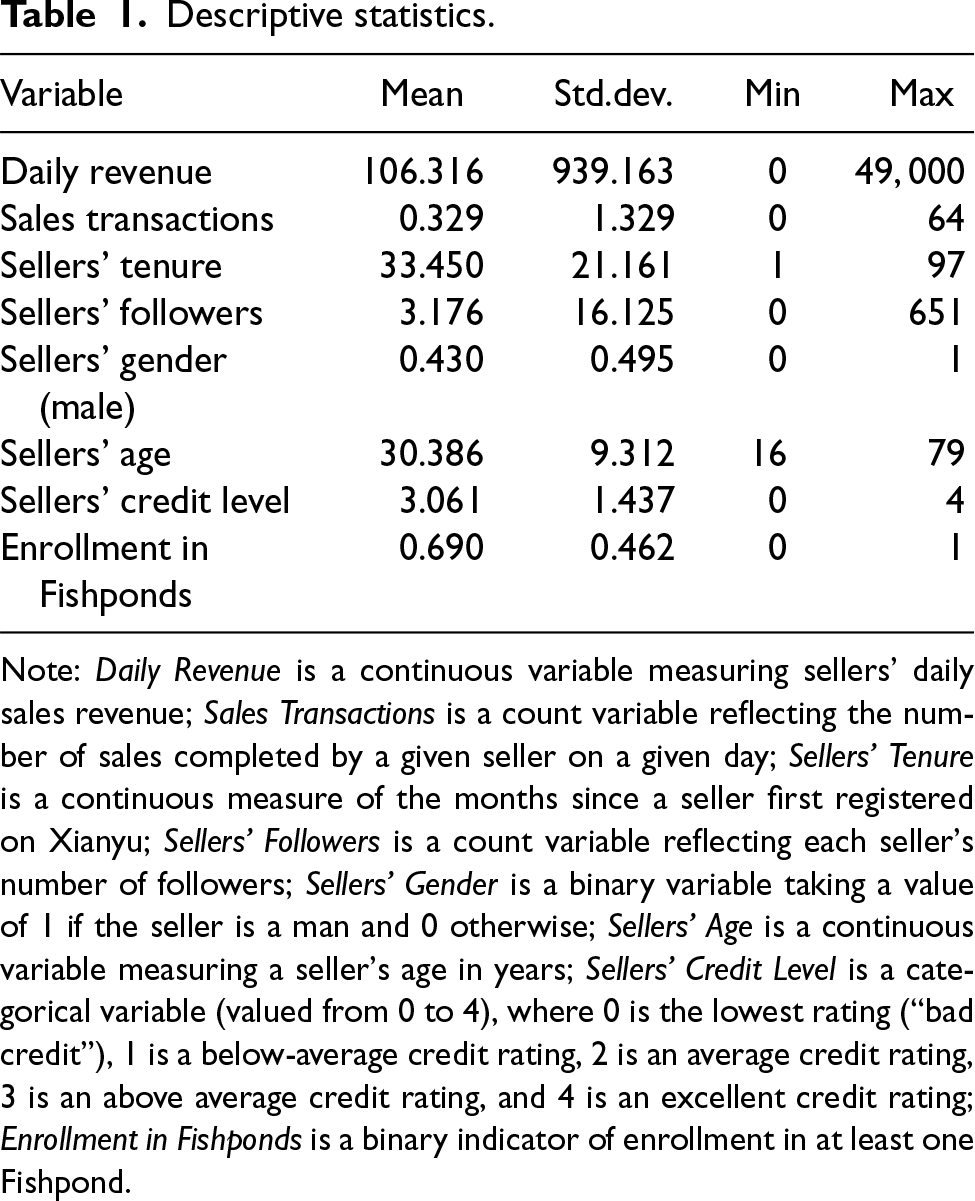
In Table 1, we present our descriptive statistics. An average seller completed 0.33 sales per day, translating to approximately RMB 106. These statistics reflect the small-scale nature of P2P used-product transactions, which occur relatively infrequently for any given individual. The average seller had been active on the platform for 33 months, had three followers, and maintained above-average credit (i.e., their credit card payments are up to date, and the individual has not been involved in any transaction disputes). Finally, 43% of sellers were men, the average seller was 30 years old, 69% had participated in at least one Fishpond, and sellers joined an average of six Fishponds. We report a correlation matrix for these variables in Table D1 of the E-Companion.
Descriptive statistics.
Descriptive statistics.
Note: Daily Revenue is a continuous variable measuring sellers’ daily sales revenue; Sales Transactions is a count variable reflecting the number of sales completed by a given seller on a given day; Sellers’ Tenure is a continuous measure of the months since a seller first registered on Xianyu; Sellers’ Followers is a count variable reflecting each seller’s number of followers; Sellers’ Gender is a binary variable taking a value of 1 if the seller is a man and 0 otherwise; Sellers’ Age is a continuous variable measuring a seller’s age in years; Sellers’ Credit Level is a categorical variable (valued from 0 to 4), where 0 is the lowest rating (“bad credit”), 1 is a below-average credit rating, 2 is an average credit rating, 3 is an above average credit rating, and 4 is an excellent credit rating; Enrollment in Fishponds is a binary indicator of enrollment in at least one Fishpond.
We estimate a canonical DID regression, incorporating two-way fixed effects for sellers and time (Greenwood and Wattal, 2017; Xu et al., 2017).
7
This econometric specification allows us to examine inter-temporal variation in sales outcomes between treated and control sellers around the time of the Fishpond shutdown. The specification accounts for any stable, time-invariant differences between sellers that may contribute to sales performance, as well as unobserved inter-temporal trends at the market level, for example, platform-level promotions, and seasonality. Our regression specification is thus as follows:

Note that the main effects of
Impact of Social Media Participation on Sellers’ Sales Performance
We first estimate the causal impact of the Fishpond shutdown on sellers’ sales performance; we present our estimates of the treatment effect based on equation (1) without time-varying controls in Table 2. The coefficients of
Main effects.
Main effects.
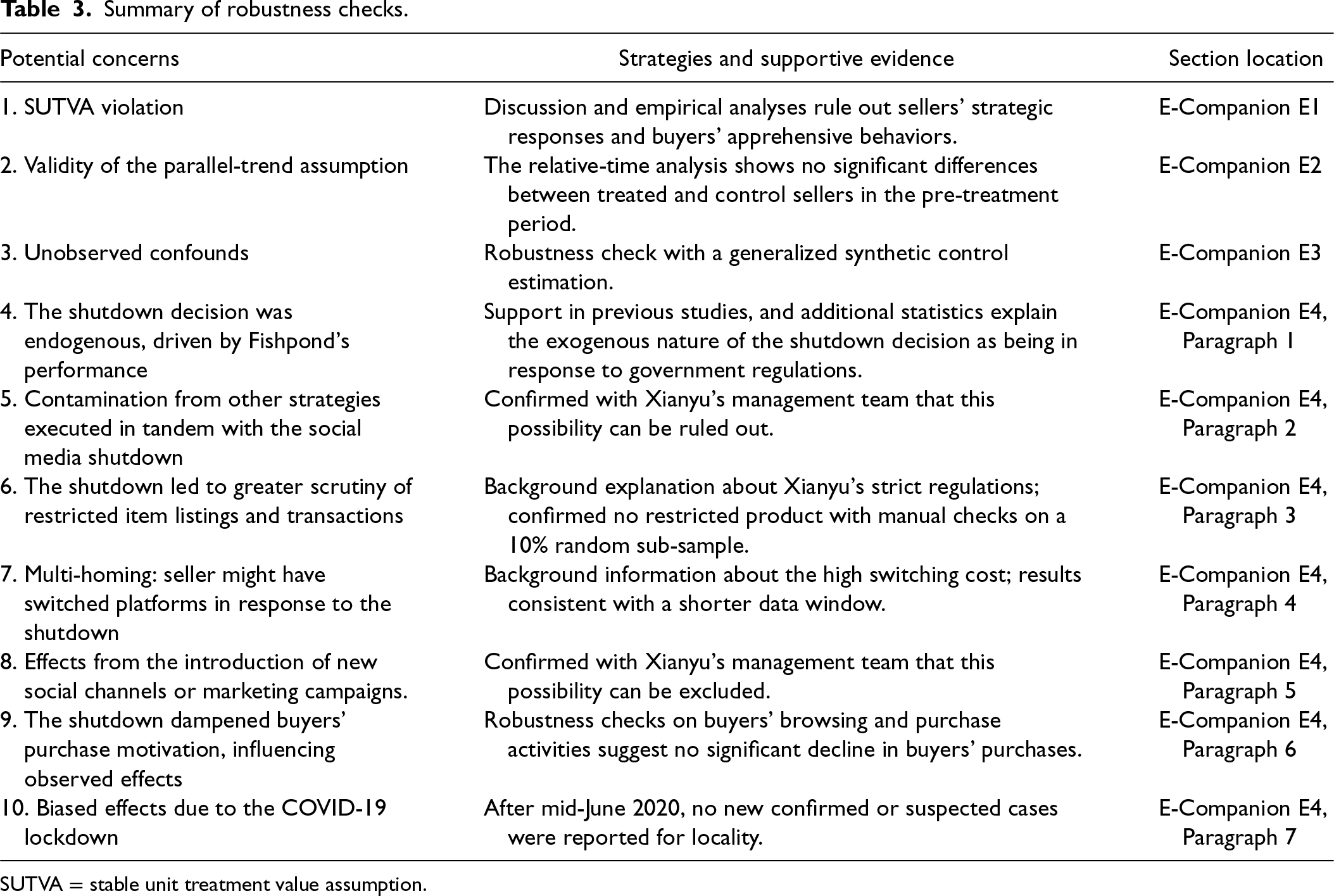
We establish the validity of our main results through multiple robustness checks that collectively validate our causal framework and address endogeneity concerns. We summarize the potential concerns, associated arguments, and empirical evidence to counter each in Table 3; see E-Companion for additional empirical details.
Summary of robustness checks.
Summary of robustness checks.
SUTVA = stable unit treatment value assumption.
We first discuss the empirical evidence supporting the stable unit treatment value assumption (SUTVA) and why potential violations should not be a serious concern in our context. On the surface, several aspects of our setting might raise SUTVA concerns: (i) untreated sellers might have responded to the shutdown event, or (ii) declining performance of treated sellers might lead to increased sales among untreated sellers, as they absorb the excess demand. We conduct additional analysis to address these concerns.
Specifically, we report a model-free comparison of the sales activity of treated and control sellers to demonstrate that the latter did not exhibit a discontinuous, systematic rise in sales following the shutdown event, as we might expect if sales were merely displaced, or if sellers responded strategically to the change, improving their sales volumes.
Beyond this descriptive assessment, we estimate our main models employing a shorter observation window (the idea being that strategic response on the part of untreated sellers would likely take time to plan and execute). We incorporate additional controls for lagged, time-varying factors and undertake moderating analyses. Further, we conduct an online survey experiment to obtain additional causal evidence supporting the mechanisms we claim. We provide a comprehensive overview of these additional analyses, the concerns they address, and the associated findings in E-Companion E1.
Second, we verify the parallel trend assumption of the DID design; that is, we provide evidence that, in the absence of the treatment, sellers in the treated and control groups could plausibly exhibit similar sales trends. Figure E3 in E-Companion E2 shows no evidence that the assumption is violated here.
Third, we further alleviate concerns regarding unobserved confounds by supplementing our DID estimation with a GSC estimation. As discussed by Pan and Qiu (2021), this estimation strategy employs out-of-sample evaluations of the predictive performance of the imputation model in the pre-treatment period to identify optimal weights and latent factors, helping to avoid overfitting. Further, the latent factor structure with time-varying weights helps address concerns of time-varying confounds. In tandem, these two features of GSC estimation ensure more reliable causal estimates; Figure E4 in E-Companion E3 shows that the GSC estimates are similar to those obtained via DID, suggesting that our findings are indeed robust.
Last, we make several additional efforts to rule out possible concerns and alternative explanations for our findings. As summarized in Potential Concerns 4 to 10 of Table 3, we specifically address concerns about possible reverse causality, confounding treatments, scrutiny over restricted item listings, multi-homing, introduction of new social media channels, and the impact of COVID-19. We make clear that these various factors cannot explain our results. Additional details are provided in E-Companion E4.
Having established the robustness of our baseline results, we next turn to the heterogeneity of demand and affected seller characteristics.
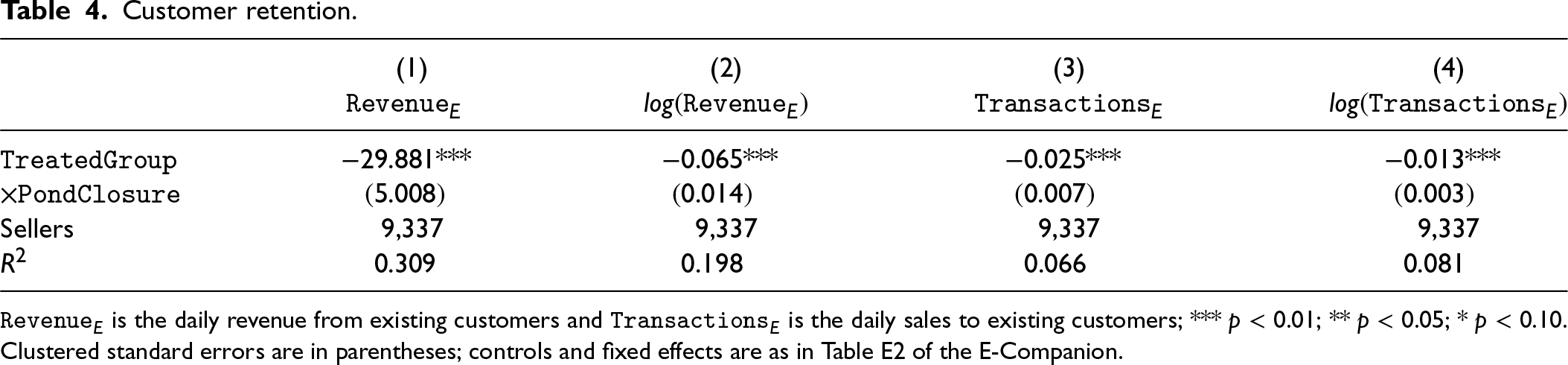
In P2P marketplaces, customer retention and acquisition are critical to individual sellers’ success because most have limited resources for customer relationship management. As hypothesized, participating in social media offers individual sellers an opportunity to maintain existing customer relationships and increase their exposure to new buyers.
To identify the impacts of social media participation on sales to existing versus new customers, we split the dependent variables in equation (1), isolating revenue and transaction volumes tied to repeat versus new buyers.
8
As demonstrated in Table 4, coefficients associated with
Customer retention.
Customer retention.
These results demonstrate that, following the Fishpond shutdown, sellers experienced a decline in repeat-customer revenue and transaction volumes as they lost the bonding capital benefits of the network. This result supports Hypothesis 2. As regards the impact on customer acquisition, and as the results in Table 5 show, the coefficients associated with
Customer acquisition.
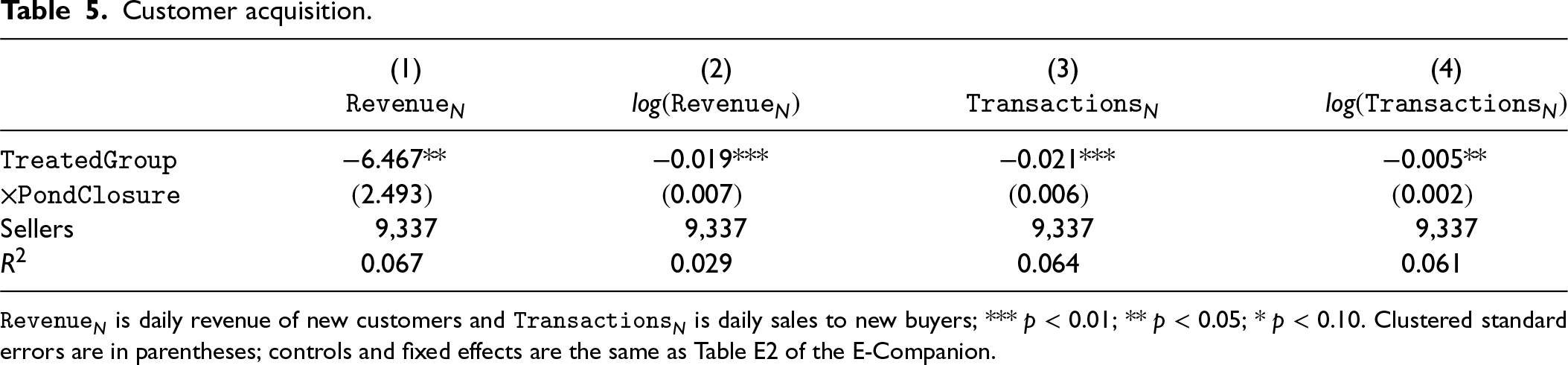
Notably, the magnitude of the effect is much higher for customer retention (6.7%) than acquisition (1.9%), as reported in Tables 4 and 5, suggesting that the economic value of social media is more salient for customer retention by individual sellers in the P2P marketplaces.
The results in Section 5.3 above isolate the impacts of social media participation on sellers’ customer retention and acquisition, which speak to the effects on bonding and bridging capital, respectively. Here, we confirm that the loss of social capital and trust-building capacity is a key mechanism for this effect. We explore seller characteristics that moderate the impact of the Fishpond shutdown, considering seller features that we expect to associate with a greater need for social capital and trust-building. We estimate a moderated DID regression as follows:
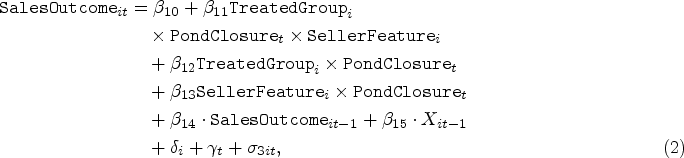
We begin by testing Hypothesis 4a, which states that newer sellers will be more affected because they stand to benefit more from the social capital and trust-building capacity that social media technologies afford. We incorporate our measure of sellers’ tenure (months since registration) into equation (2) as our first moderator. The results of this regression are presented in Tables F1 to F3 in E-Companion F.
First, the negative and statistically significant (
Next, we explore how the effects of the shutdown event on sellers vary for men and women, evaluating Hypothesis 4b. As discussed in Section 3.4, it is harder for men than women to earn the trust of potential buyers, who perceive the former to be less credible, more opportunistic, and thus less trustworthy (Buchan et al., 2008; Croson and Buchan, 1999; Hall, 2011; Riedl et al., 2010). We incorporate a binary indicator of seller gender into equation (2) as a moderator and report our estimation results in Tables F4 to F6 in E-Companion F.
The negative and statistically significant (
Collectively, these results confirm our expectation that using social media channels helps sellers earn the trust of peer buyers through the accumulation of social capital. The elimination of Fishponds systematically caused more harm to the sellers we expected would benefit most from social media use (i.e., sellers of shorter tenure and men).
Online Controlled Experiment
To provide further direct evidence in support of the trust-building mechanism, we follow established practices in empirical OM research (Kyung and Kwon, 2023), designing and implementing an online controlled experiment. This experiment is designed to explicitly assess three dimensions of trust: perceived integrity, competence, and benevolence, based on a 5-point Likert scale. The survey items are adapted from Xu et al. (2016). We examine how participants’ perceptions of a seller’s integrity, competence, and benevolence vary in response to information that they engaged in particular social media activities. We randomly expose participants to information that a seller participating in social media has posted, commented, or re-shared content or participated in a group event.
The online experiment follows a standardized procedure. We introduce participants to the experimental context, which mimics the Xianyu interface. Subjects are encouraged to explore the synthetic marketplace for shopping inspiration. They then receive an explanation of Fishponds’ role as the market’s social media channel. Participants are presented with the profile of an individual seller containing comprehensive details, including their gender, age, city, and occupation. Next, we present the randomly assigned treatment related to activities in which the seller has recently engaged in a Fishpond. Before collecting perception data, we present the participants with an attention check. Finally, we collect their perceptions of the seller’s integrity, competence, and benevolence, using the measurement items outlined in Table G1 of the E-Companion. 9 Participants are then presented with the seller’s listing of a used product (an Apple Watch) and asked to indicate their willingness to purchase it. The survey concludes with the collection of participants’ demographic and background information.
We successfully recruited more than 900 participants. We randomly assign the participants to one of the five experimental conditions. In each of the five treatments (Groups 1 to 5), participants are presented with exactly one of the following stimuli (illustrated in Fgiure G1 of the E-Companion): (1) the seller’s social media commenting activity (e.g., the seller has commented on 30 posts in Fishpond), (2) the seller’s social media re-sharing activity (e.g., the seller has re-shared 30 posts in Fishpond), (3) the seller’s participation in social media events (e.g., the seller has participated in eight group events in Fishpond), (4) a control condition, where no seller social media activity is evident (e.g., the calendar for the current month is presented as a placebo), and (5) the seller’s social media posting activity (e.g., the seller has created 30 posts in Fishpond). We conduct a randomization check and Table G2 of the E-Companion presents the results, confirming that there is no systematic difference between the experimental groups.
We begin by analyzing the impact of different social media activity types on respondents’ stated purchase intention and perception of sellers’ trustworthiness. We employ ordinary least squares (OLS) regression and include dummy indicators for the four treatment groups, omitting the control group as a reference; Table G3 of the E-Companion summarizes the results.
The coefficients of all treatment groups in columns (2) to (4) are positive and statistically significant (although at different levels of magnitude), suggesting that sellers’ social media activity builds trust. However, when we consider the direct impact on purchase intentions in column (1), only the coefficients associated with posting activity and event participation are statistically significant. This indicates that not all social media activity drives customers to purchase. One plausible explanation is that the time and effort involved in posting and group event participation are more substantial than required for behaviors that piggyback on other users’ content, for example, commenting and re-sharing. The more involved activities can enhance perceived trustworthiness and boost customers’ purchase intentions.
We also explore the role of trust in mediating the relationship between social media activity and purchase intention. We capitalize on the randomization inherent in the experimental design to conduct a bootstrapped mediation analysis (Zhao et al., 2010). We focus on the social media activities that have a statistically significant impact on customer purchase intention (referring to Table G3 of the E-Companion): posts and event participation. In our two mediation analyses, social media activity serves as the treatment, with each of the three trust constructs as a single mediator and the reported purchase intention as the dependent variable. We visualize the estimated results in Figures G2 and G3 of the E-Companion (please find estimation results in Tables G4 and G5 of the E-Companion) for posts and event participation, respectively.
When social media posts are the treatment, the estimated indirect effects (the “mediating route”) are positive and statistically significant at the 95% confidence level; the estimated direct effects are insignificant. That is, there is only a significant mediated effect (the so-called “full mediation”) for the impact of social media posting on customer purchase intention via their perception of the seller’s integrity, competence, and benevolence.
Similarly, the results in Figure G2 of the E-Companion show that group participation has a significant impact on customer purchase intention, which is entirely mediated through the buyer’s perceptions of the seller’s integrity, competence, and benevolence. These results provide additional evidence of the trust-building mechanisms of social media participation. Note that ruling out alternative explanations with one single online study is infeasible as these alternative mechanisms involve diverse constructs requiring distinct measures. Capturing all of these items would threaten the reliability of responses we obtain (Westfall and Yarkoni, 2016). Thus, our online study solely focuses on testing the proposed trust-building mechanism, though we have also conducted a battery of separate robustness checks in an effort to rule out alternative mechanisms using our field data in the following section.
Ruling Out Alternative Mechanisms
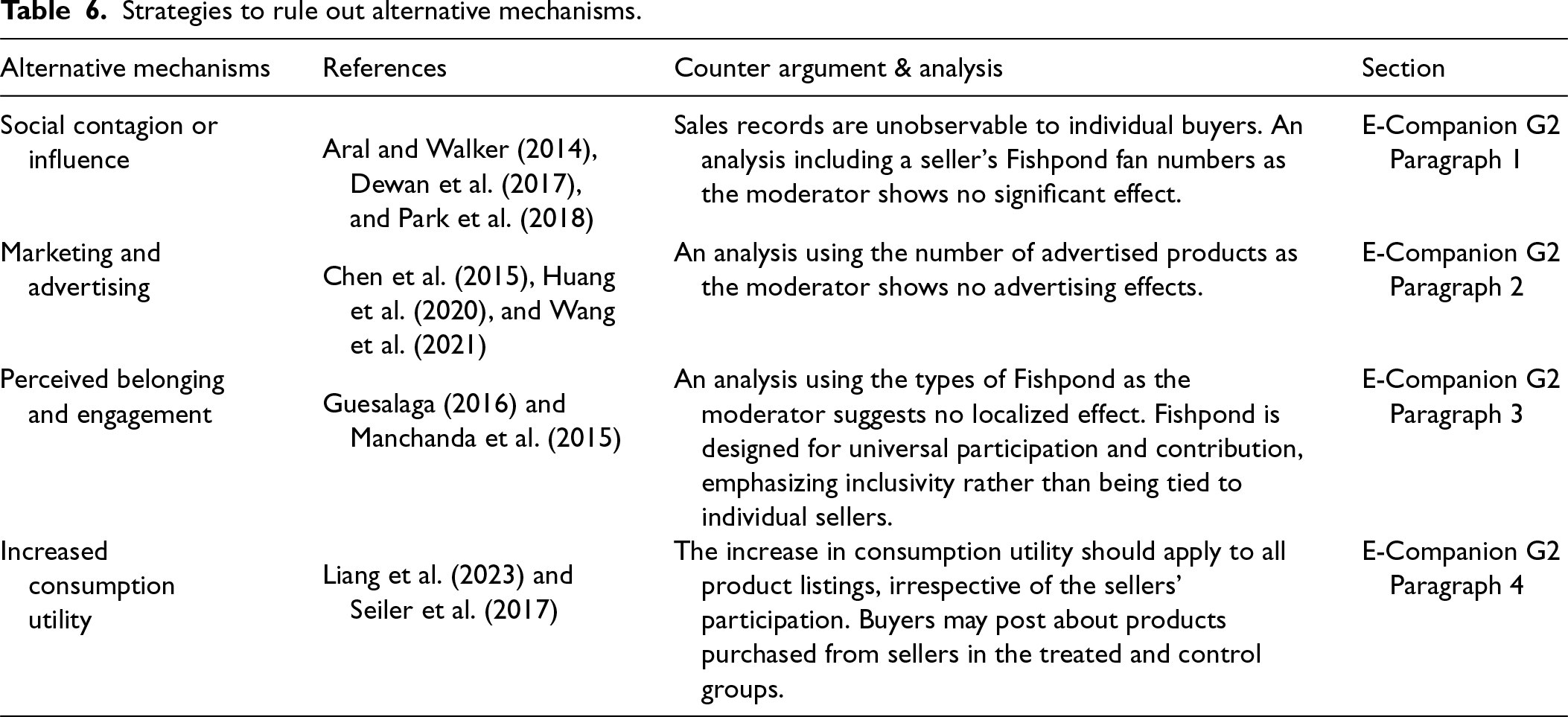
We conduct additional analyses to rule out alternative mechanisms for social media’s impact on performance documented in the literature. In particular, studies show firms and brands leverage social media to influence customer decision-making through social contagion (Aral and Walker, 2014; Dewan et al., 2017), expand customer reach via advertising (Chen et al., 2015; Huang et al., 2020), elevate brand loyalty and customer engagement (Guesalaga, 2016; Manchanda et al., 2015), and amplify consumer utility from a product (Liang et al., 2023; Seiler et al., 2017); Table 6 summarizes the main alternative mechanisms; see E-companion G2, for a detailed discussion, empirical evidence, and clarifications to rule out these possible drivers.
Strategies to rule out alternative mechanisms.
Strategies to rule out alternative mechanisms.
The P2P marketplace has emerged as a transformative business model, allowing individual sellers to connect with peer buyers in an ad hoc, decentralized manner (Eyanerick, 2024). Globally, sales in P2P marketplaces have expanded rapidly over the last 5 years (Saha, 2024). Nevertheless, trust remains an important barrier to trade, and a challenge for buyers, sellers, and platform operators (Kong et al., 2020; Sundararajan, 2019).
This study leverages a quasi-natural experiment, the unexpected shutdown of an integrated social media channel (Fishponds) by a large Chinese P2P marketplace (Xianyu), to advance our understanding of how social media features can cultivate trust among sellers and buyers. We find the social media shutdown had a large, negative impact on the performance of individual sellers, an effect attributable to their losing social capital and trust-building capacity. We break down the effects of the social media shutdown, distinguishing between sellers’ customer retention and acquisition, which separately speak to the roles of bonding and bridging capital.
Further, we report a set of moderation analyses that demonstrate the enhanced value of social media channels among certain groups of sellers, namely those who stood to benefit most from trust-building and social capital: sellers with lesser tenure and men. Lastly, we implement an online controlled experiment to directly test trust building as the mechanism for the impact of social media participation. Our mediation analysis shows that sellers’ social media posting and event participation, in particular, drive customers’ purchase intentions by improving their perceptions of seller integrity, competence, and benevolence.
Our findings have nontrivial implications for P2P marketplace operators. First, improving trust between peer sellers and buyers is key to enhancing the operational efficiency of P2P transactions. Conventional quality signals, such as reputation systems, fall short in addressing this challenge because peer-generated reviews are sparsely reported in P2P settings; these are characterized by casual, infrequent market participation, leading to the cold-start problem. Indeed, existing studies highlight the limitations of reviews and reputation in terms of their transferability across transaction types (Kokkodis and Ipeirotis, 2016). In P2P marketplaces, any two product listings are likely to differ considerably, limiting the value for buyers of a seller’s historical reputation as a predictor of outcomes.
Our research highlights the significance of leveraging social media as a means of building trust. While designing and incorporating social media features can be an expensive and resource-intensive, demanding continuous investments in moderation and maintenance, our results provide clear, causal evidence of their value. We show that incorporating social media features in P2P marketplaces plays a crucial role in encouraging trust and facilitating trade. A robust platform for social interactions contributes to the accumulation of social capital, significantly enhancing seller performance. This evidence is an encouragement to marketplace operators to carefully consider integrating social media features as a strategic investment for long-term success.
Second, individual sellers, who are generally resource-constrained, often engage in distinct activities focused on customer retention and acquisition. Whereas businesses in traditional B2B and B2C contexts typically engage in long-term strategic efforts to acquire and retain customers, individual sellers engage in a casual, ad-hoc manner. We show how online communities facilitate those efforts (Hefner, 2022), offering insights for platform management. Our results underscore the positive impact of social media participation on customer retention and acquisition, aligning with recent claims about the value of online communities (Zanuto, 2024): Trust isn’t built overnight. It’s the result of consistent and meaningful interactions. Online communities provide a space for these interactions to happen organically and regularly.
Third, our focus on heterogeneity in the effects of the policy change, contribute valuable insights into how social media participation can affect different types of sellers. Notably, our findings demonstrate that the sellers who benefit most from social media usage are men and new sellers to overcome challenges in building trust in the e-commerce environment. This is nontrivial for marketplace operators trying to grow the seller community; social media investment can be particularly beneficial for the growth of these types of sellers.
The heterogeneity in effects across sellers serves as a reminder to marketplace operators that the composition of their user base is an important consideration when deciding whether to invest in a social media feature; platform operators should carefully consider which user types would benefit most. Operators may also find it beneficial to offer promotions and encourage greater social media use among specific groups of sellers, leveraging these insights to optimize the value of social media within their platforms.
Finally, our findings offer insights that can help P2P platform operators better articulate the value and benefits of social media channels to external stakeholders, whether investors, policymakers, leadership, or the public. Our findings suggest that social media channels are an essential part of the online commerce ecosystem, particularly for burgeoning P2P marketplaces, which are plagued by acute problems of information asymmetry. Our theoretical explanation of the mechanism by which social media activities facilitate the sellers’ acquisition of social capital suggests that social media features are essential to fostering trust in the marketplace and thereby promoting business growth. To maximize their value in a P2P marketplace, managers may consider pairing the deployment of social media features with the implementation of a governance mechanism to regulate content and user interaction.
Given that P2P marketplace operators are often resource-constrained when they first launch, managers might balance these tensions by directing users to form local community groups on larger, outside social media platforms, as a way to relieve initial scrutiny from regulators. Indeed, emerging P2P marketplaces have collaborated with existing social media platforms to offer more social interactions between buyers and sellers. For instance, Etsy encourages individual artists to join local MeetUp groups for social interactions and Poshmark teamed with Snap to allow social groups to share shopping experiences.
Our study has several important limitations that are worth noting, but that also represent opportunities for future research. First, our natural experiment involves the shutdown of a social media channel. It is important to recognize that there may be asymmetric effects between shutting down versus introducing a social media channel. The dynamics and implications of removing a social media channel may differ significantly from those that would be observed at introduction. That said, investigating the effects of social media introduction leveraging archival field data presents several challenges. Nonetheless, future studies can explore the long-term impact of introducing social media channels into P2P markets, like Fishpond, using longitudinal primary data.
Second, our data pertain only to individual sellers. Future studies could consider how the elimination of a social media channel alters buyer behavior, which might, in turn, yield insights into the trust-building process. Third, our empirical analyses focus on sellers’ transaction frequency and revenues in the short run; it would be interesting to consider longer-term shifts in sales performance and, possibly, sales strategies. For example, the elimination of social media channels likely leads sellers to seek out alternative means of building trust and reputation. Understanding these dynamics could inform patterns of use and help identify substitute and complementary information channels. Lastly, our empirical data lack the granularity to directly test the underlying mechanism. Thus, future research could employ lab studies to fully examine how social media activities affect customer trust and by what magnitude.
Supplemental Material
sj-pdf-1-pao-10.1177_10591478241302768 - Supplemental material for Individual Sellers’ Social Media Participation and Sales Performance in Peer-to-Peer Marketplaces: Evidence From a Quasi-Natural Experiment
Supplemental material, sj-pdf-1-pao-10.1177_10591478241302768 for Individual Sellers’ Social Media Participation and Sales Performance in Peer-to-Peer Marketplaces: Evidence From a Quasi-Natural Experiment by Siliang Tong, Yingjie Zhang, Gordon Burtch and Zhijie Lin in Production and Operations Management
Footnotes
Declaration of Conflicting Interests
The author(s) declared no potential conflicts of interest with respect to the research, authorship, and/or publication of this article.
Funding
The author(s) disclosed receipt of the following financial support for the research, authorship, and/or publication of this article: This research is supported by the Ministry of Education, Singapore, under its Academic Research Fund Tier 1 [RS10/21]; the Start-up Grant (SUG) of Nanyang Business School, Nanyang Technological University; National Natural Science Foundation of China [Grants 72272003, 72325002, 72022007, and 71872080].

Notes
How to cite this article
Tong S, Zhang Y, Burtch G and Lin Z (2024) Individual Sellers’ Social Media Participation and Sales Performance in Peer-to-Peer Marketplaces: Evidence From a Quasi-Natural Experiment. Production and Operations Management 34(6): 1549–1568.
References
Supplementary Material
Please find the following supplemental material available below.
For Open Access articles published under a Creative Commons License, all supplemental material carries the same license as the article it is associated with.
For non-Open Access articles published, all supplemental material carries a non-exclusive license, and permission requests for re-use of supplemental material or any part of supplemental material shall be sent directly to the copyright owner as specified in the copyright notice associated with the article.
