In reusable resources like vehicle sharing, city parking, and hotel services, resource units are used by consecutive customers for a stochastic usage time and are made available for future customers upon return. We model such reusable resources as Erlang loss systems, where customers who find all units occupied are blocked. Customers are rational decision-makers, and their willingness to join the system depends on factors such as price, time limits, service value, and resource availability. When each customer is charged a fixed price, we examine whether it is beneficial to install time limits, which increase availability at the expense of reduced usage time. We formulate and solve a two-dimensional revenue maximization problem to optimize both the usage price and the time limit. We differentiate between on-demand resources, which are immediately reusable upon return, and reserved resources, which can only be reused after the time limit expires. With on-demand resources, setting a time limit is proven to be detrimental, making the entry price the sole tool for maximizing revenue. This conclusion remains valid when the usage time increases with the entry price. In contrast, managing reserved resources involves an interplay between time limits and entry prices. Additionally, we show that loss systems (where customers do not wait) should be managed differently from systems where customers do wait. Specifically, in systems with waiting, we prove that only the time limit should be optimized, while the entry price should capture the full market share. We prove our results by analyzing the behavior of the equilibrium arrival rate and revenue, which necessitates establishing novel properties for the blocking probability. These properties yield new sharp bounds for the blocking probability and enable us to prove the convergence of the optimized model for on-demand resources to the quality-and-efficiency-drivenregime as the number of resource units grows.
Reusable resources refer to products or services that can be used repeatedly by consecutive customers. Examples include shared vehicles, city parking, hotel rooms, and cloud computing services. Sequentially arriving customers have access to a limited number of resource units and can occupy one if available. Those who get to use the resource will occupy a unit for some stochastic usage duration. Once the customer returns the resource unit, it becomes available for the next customer. Customers who find all units occupied upon arrival typically do not wait and leave immediately without using the resource.
This concept of reusable resources also applies to resources that do not have a visible capacity constraint but still need to restrict the number of on-site customers. For instance, gyms, museums, and recreational parks may impose on-site customer caps to prevent overcrowding and maintain the quality of the customer experience. Other resources may install caps to comply with legal restrictions, such as those introduced during the coronavirus disease 2019 (COVID-19) pandemic, which required strict on-site customer limits in retail stores, offices, and theaters to enforce social distancing guidelines.
The scale of a reusable resource, measured in terms of the number of units, can vary significantly, ranging from dozens of shared office bikes to hundreds of hotel rooms, and even thousands of theme park visitors. Regardless of scale, a common factor is that customers have preferred usage times, and while occupying a unit, they create negative externalities for others who also seek access. Specifically, by using a unit of resources, each accepted customer increases the likelihood of rejection for other customers. To mitigate these externalities, we propose two natural mechanisms: An entry price and a usage time limit. The usage time limit restricts how long each customer can use the resource, ensuring faster availability and allowing accessibility to more customers.
Entry prices and time limits represent two valuable tools for resource management due to their direct impact on customer behavior. A higher price makes visiting the resource less attractive and thins the market share of those willing to use the resource. Empirical evidence of the decreasing relation between demand and price can be found in Bell (1960) and Liu and Sustik (2021). Higher entry prices should then increase the success probability of accessing a desired unit of resource. A time limit increases the resource capacity measured in terms of the number of customers that can be hosted per time unit. Controlling for demand an entry price and a time limit thus could have opposite effects. However time limits also negatively affect the customer experience when a customer wants to use the unit for longer. Empirical analyses of customer behavior concerning usage time limits in the context of vehicle-sharing systems confirm that while shorter usage times can improve vehicle turnover and system efficiency, they may also reduce customer satisfaction (Jorge and Correia, 2013; Shaheen et al., 2016). Also, in co-working real estate, cost-sensitive tenants tend to optimize their usage based on both price and time constraints. Higher rents have been found to result in shorter lease durations while controlling for lease duration leads to significantly more tenant concessions (Chegut and Langen, 2019). It is therefore unclear whether time limits increase or decrease the willingness of customers to access a resource and in turn entry prices and time limits might not have interchangeable opposite roles.
To capture the effect of entry prices and time limits on customer behavior, we adopt a rational queueing approach, where customers act as rational decision-makers who decide whether to try to access the reusable resource based on their expected utility. Upon joining, a customer is either accepted and receives a unit or is blocked. A rational customer considers both possibilities and decides to join if the expected utility of joining is positive, assuming the utility of not joining is zero. Each customer’s decision is based on several factors, including the service value, entry price, time limit, expected usage time, and blocking probability. These individual decisions collectively create an equilibrium demand for the resource, which leads to an equilibrium state of resource operations. Therefore, the combination of time limits and entry prices becomes a crucial factor in customer decision-making.
A key challenge is to characterize the equilibrium by quantifying the effect of entry prices and time limits on induced demand. The net effect of both the entry price and time limit on customer utility is not immediately clear. When the resource becomes more expensive, it lowers the net reward of obtaining a unit but increases the likelihood of accessing a unit. Similarly, when customers are forced to reduce their usage time, the constraint degrades their experience but reduces the blocking probability. As a result, it is difficult to predict how customers will respond to the combined effect of both control mechanisms, and whether time limits and prices are ultimately beneficial for resource management.
If the aim is to find entry prices and time limits that maximize revenue from reusable resources, when should time limits be installed? If they prove effective, how do time limits alter the optimal entry prices? Do we need both instruments, or is it sufficient to work with either prices or time limits, separately? Maximizing revenue by setting an optimal entry price and time limit gives rise to two-dimensional revenue maximization problems, for which the role of the time limit is unclear upfront, due to its ambiguous nature. We address the resource management problem in the context of two distinct resource types: On-demand resources and reserved resources. On-demand resources can be reused immediately after their return, without the necessity for maintenance or servicing. This category includes self-service resources, bicycle availability in a bike-sharing system, or occupancy of spaces within fitness centers or museums. The on-demand analysis also applies to systems where the usage time is known in advance, and the system can adjust to make the resource available shortly after a customer’s departure. Conversely, reserved resources are allocated for the entire predefined time limit, irrespective of the actual duration of usage. This practice may be due to the need for cleaning or repairs before a resource can be made available for use again. Examples encompass vehicle rentals, which often require maintenance between rentals, as well as hotel rooms.
Main Contributions
We summarize our main contributions as follows:
(i) Methodology. We introduce a novel model for a loss system, in which rational customers decide whether to join based on the blocking probability, usage price, and actual usage time, defined as the preferred usage time bounded by a controllable time limit. Our model builds on Naor’s expected-utility framework, originally developed for rational, delay-sensitive customers served by a single server (an queue). We extend this framework to multiserver loss systems, replacing waiting costs with blocking costs. We formulate a revenue maximization problem, where both price and time limit are decision variables. To solve this problem, we develop novel structural properties of the Erlang loss formula in terms of the offered load and the number of agents, along with first- and second-order monotonicity properties of the expected usage time as a function of the time limit. These properties provide a more precise characterization of the nonconvex, nonconcave blocking probability and result in a sharper bound for the blocking probability than those found in existing literature. Additionally, using the properties of the blocking probability, we prove that the optimized model with on-demand resources converges to a quality-and-efficiency-driven (QED) regime as the number of resource units approaches infinity.
(ii) Optimal pricing of on-demand resources. For on-demand resources, we show that although revenue does not increase with the time limit, the maximum revenue with respect to the entry price does. This proves that installing a time limit is never optimal, and revenue is maximized by adjusting the entry price only. In addition, we show that this conclusion also holds in settings where the usage time increases with the entry price. The offered load corresponding to the optimal price is determined by the derivative of the rate of blocked customers in the Erlang loss system. We show that the revenue increases with the customers’ expected usage time, even when the optimal demand and entry price decrease with respect to usage time. This highlights the critical role of resource utilization in generating revenue, explained by the higher joining utility for customers with longer usage times. Further analysis of usage time reveals that resource utilization is more crucial for revenue generation than either customer demand or the price paid per unit of usage time. We compare our blocking model with Naor’s queueing model and demonstrate that while the entry price is sufficient to manage the blocking system, the time limit should be the primary tool for managing the queueing system.
(iii) Optimal pricing and time limits for reserved resources. With reserved resources, the optimal solution involves nondegenerate choices for both the price and the time limit and requires solving a genuine two-dimensional optimization problem. We prove and characterize the existence of a unique pair of the entry price and the time limit that maximizes revenue. The role of the time limit in this context is to provide a trade-off between service value and availability of the resource units. In most cases, we find that the optimal time limit is lower than the preferred usage time of customers. This is particularly pronounced when there is high variability in the usage time. This indicates that maintaining sufficient resource availability, even at the expense of short usage times, is crucial for ensuring adequate demand. Therefore, while long preferred usage times are advantageous for revenue generation due to high resource utilization, as seen in the case of on-demand resources, the imposed time limit mitigates this benefit. Lastly, we demonstrate that reserved resources, due to their longer occupation time, result in lower revenue compared to on-demand resources.
Related literature
This study relies on three research areas, pertaining to rational queueing theory for loss queues, management of reusable resources, and analyses of the Erlang loss system.
Rational queueing theory for loss queues. This study adds to the vast body of literature that considers rational queues in which customers make strategic decisions, such as to join or not; see e.g., Cui and Veeraraghavan (2016), Dimitrakopoulos and Burnetas (2016), Gavirneni and Kulkarni (2016), Hassin and Roet-Green (2017), and Legros (2021). Hassin and Haviv (2003) offer an excellent and broad introduction to this research area, in which customers are regarded as decision-makers who search for the best trade-off between the value of a service and the cost of waiting, expressed in terms of a utility function. We adopt this approach with utility functions, but in contrast with the majority of existing studies, we consider a pure loss system with no queueing. Only a few prior studies consider strategic joining in loss systems. For example, Lin and Ross (2003) and Lin and Ross (2004) analyze a loss system with a gatekeeper who decides whether a customer will be admitted, to navigate between the costs of rejected customers and the costs of admitted customers that find all servers busy. The gatekeeper knows when an admitted customer finds all servers busy but not if served customers depart. Lin and Ross (2004) prove that a time-based policy for customer blocking is optimal in the single-server case, whereas Lin and Ross (2003) establish the value of this policy in a multiserver case. Haviv et al. (2010) consider customers’ strategic joining in a nonobservable Erlang loss queue in a transient regime. In the single-server case, up to a certain time, all customers should try to join; and after this time, an equilibrium arrival rate, which corresponds to the stationary regime, is optimal. Ravner and Haviv (2014) consider a particular single-server Erlang loss queue in which service is only provided during a certain time interval, and accordingly analyze when customers decide to join the service for this queue. Finally, Anily and Haviv (2022) investigate the multiserver Erlang loss queue to determine the socially optimal arrival rate and compare it with the equilibrium rate.
Management of reusable resources. Numerous studies have explored revenue management for reusable resources, addressing problems such as admission control, pricing, and assortment optimization through diverse modeling methodologies. For admission control and resource allocation, Levi and Radovanović (2010) and Xie et al. (2024) analyze loss networks using linear programming approaches. Pricing strategies are studied in Doan et al. (2020) and Jia et al. (2024), focusing on heuristic fixed-price policies and adaptive online learning methods, respectively. Dean et al. (2024) develop an online learning algorithm for multiproduct pricing under unknown demand and rental durations in a loss network, introducing a new finite-time regret measure. Hua et al. (2023) propose two near-optimal dispatch policies for Emergency medical services that dynamically handle heterogeneous service times. Assortment optimization and customer selection are tackled in Chen et al. (2017), Gong et al. (2022), and Rusmevichientong et al. (2020), employing dynamic programming and demonstrating the effectiveness of some myopic policies. Other methodological advances for the management of reusable resources include heuristic controls (Lei and Jasin, 2020) and unified frameworks for network revenue management (Baek and Ma, 2022). Besbes et al. (2022) explore both static and dynamic pricing for a fixed number of reusable resources, modeled as an Erlang loss system. They establish that static pricing performs well relative to dynamic pricing. This aligns with our assumptions regarding a fixed entry price. We mention the study by Feldman and Segev (2022) in the context of discretionary services, which already reveals that time limits can increase demand and revenue. Yet, their findings do not directly apply to our context of resource management as they use time limits to manage service time variability and bounds on service value, while we use time limits to increase resource accessibility and per-customer revenue generation.
Erlang loss system. The Erlang loss or system (Erlang, 1917) is the canonical model for situations in which customers are blocked if they cannot access a server directly upon arrival. The current study requires inversion of the Erlang loss formula, which is notoriously difficult when the number of servers is greater than 1, and it seems impossible to describe the inverse in closed-form, as explained by Van Leeuwaarden and Temme (2009). To overcome this difficulty, we regard the inverse as an implicit function and consider the integral representation of the blocking probability as given in Jagerman (1974). In this way, we can leverage the existing properties of the Erlang B formula, such as the increasing and concave properties of the carried load function shown by Harel (1990). We also prove new properties for the derivatives of the Erlang loss formula that are indispensable for the current study. Other rational queueing studies that rest on advanced implicit function theory include Dewan and Mendelson (1990), Afeche and Mendelson (2004), and Taylor (2018); here again a key difference is that we deal with loss instead of queueing systems.
Paper outline
In Section 2, we introduce the Erlang loss utility model with rational customers, formulate the revenue maximization problem, and prove some properties of the blocking probability. In Section 3, we analyze on-demand resources and obtain the optimal entry price. Then, in Section 4, we turn to reserved resources and obtain the optimal pair of entry price and time limit. In Section 5, we discuss the applicability and robustness of our results. We conclude the paper in Section 6. The proofs of the main results are provided in the E-companion.
Model Description
In Section 2.1, we define a utility model for customers’ decision to join a set of resources with potential unavailability. In Section 2.2, we explain how this utility model determines customers’ equilibrium arrival rate. Section 2.3, we formulate the revenue maximization problem and provide properties of the expected usage time and blocking probability that will be used to determine the optimal entry price and time limit. Finally, in Section 2.4, we give a table of notations used throughout the paper.
Utility Model
Naor’s model
Naor (1969) developed a utility model for queueing systems where customers decide whether or not to join the queue using a utility-maximization criterion, with the utility of not joining (balking) being zero and the utility of joining defined as
where is the reward for being served, is the entry fee, and is the cost per waiting time unit. Edelson and Hilderbrand (1975) analyzed this utility model in the context of a nonobservable queue, in which customers are risk-neutral. Since customers are uninformed about the system state, they make their joining decisions based on the expected utility of joining defined as
where is the expected waiting time in the queue. Given that the utility of balking is zero, a customer only joins when the expected utility is positive. Specifically, the market size is represented by a Poisson arrival process with parameter and customers decide to join with a probability . Therefore, the arrival process remains a Poisson process, but with a thinned rate . The probability is selected by customers to maximize their expected utility.
Loss model with a reusable resource
The model analyzed in Naor (1969) and Edelson and Hilderbrand (1975) does not fit well with certain resource environments, as it fails to account for scenarios where customers, such as those in parking lots, vehicle rentals, and hotels, are unwilling to endure waiting times. In such cases, customers, unable to use a resource immediately, tend to seek alternatives promptly. Additionally, reusable resources typically consist of independent units that can be used simultaneously. This necessitates a multiserver model rather than a single-server one. Consequently, the Erlang loss model, referred to as the queue, is more commonly employed to model reusable resources such as parking lots or vehicle rentals (Bein, 1976; Lazov, 2017).
Attempting to join a resource that turns out unavailable creates a waste of time for the customer and the need to look for an alternative. Therefore, the risk of joining a resource in our loss model is not the wait as in the queue but the unavailability of a resource. The probability of not finding an available resource unit may discourage customers from joining in our setting, in a similar way as the expected wait does Naor’s model. We therefore incorporate a penalty for when an arriving customer does not find an available resource unit. Consequently, if a customer decides to join, either a resource unit is available and the benefit of using the resource is , or there is no resource unit available, and a cost of is incurred. Rational customers then join based on their expected utility defined as
where is the blocking probability in a loss system with offered load and resource units given by
While in Naor’s model the benefit of joining, , is guaranteed, in our model for reusable resources, the benefit of joining is uncertain due to the potential unavailability of resources. The utility definition in (1) assumes customers are informed about the blocking probability. This suggests that customers either have prior knowledge of expected system performance through past experiences or that the system provides this blocking probability information.1
The blocking probability (2) only depends on the service time distribution through its mean (Erlang, 1917). We assume that customers are homogeneous in the sense that their preferred usage times are samples from the same distribution. Denote the generic preferred usage time as the random variable , with probability density function (pdf) and cumulative distribution function (cdf) for , with . The expected preferred usage time of an arbitrary customer denoted as , is then given by
We further assume that is independent of . Price-independent usage time reflects scenarios where customers have needs for resource usage that are unaffected by the entry price or time limit, such as hotel stays or preplanned activities. This assumption aligns with the behavior of price-informed customers who decide whether to join based on whether the offered conditions meet their needs, without adjusting their usage time afterward. The presence of more accommodating outside alternatives further reinforces this noncompromising behavior. However, the pricing mechanism may influence customers’ usage time in certain contexts, such as the use of parking spots (Glazer and Niskanen, 1992; Ottosson et al., 2013). This eventuality is discussed at the end of Section 5.
Usage time control
For delay-prone services as in Naor’s model, the entry fee is an effective tool for demand regulation, for instance for maximizing revenue or social welfare (Alperstein, 1988; Chen and Frank, 2001; Leeman, 1964; Naor, 1969). For reusable resources, such as vehicle rentals or museum visits (Mancini and Gansterer, 2021), it might be desirable to employ next to an entry fee also time limits, to avoid excessively long usage times and guarantee sufficiently high resource availability. Let denote the time limit so that the actual usage time is the minimum of and the preferred usage time . Let denote the expected duration of the actual usage time, given by
While imposing a time limit likely increases resource availability, a downside is that some customers would have liked to use the resource for a duration longer than . This restricted usage harms the perceived value of utilizing the resource. Therefore, the net effect of limiting usage time is unclear.
We now incorporate the time limit in the expected utility definition in (1). The value of using a resource pertains to the expected preferred usage time (i.e., without usage time restriction). To account for the negative effect of restricting usage, we define the expected value of using the resource per unit of time as . Assuming valuation grows linearly with usage time, the expected value of the restricted usage time is . An alternative interpretation of the service value is in terms of expected lost usage time , defined as the extra time that customers would have liked to spend with the resource, and given by . Therefore, the service loss due to the bound is , such that the benefit of using the resource with a time limit is , given that .
On-demand and reserved resources
The effect of time limits depends on the type of resource. We distinguish between on-demand and reserved resources.
(On-demand and reserved resources)
On-demand and reserved resources differ in their availability after a customer’s departure. An on-demand resource can be reused instantaneously at customer departure. A reserved resource can be reused only at the end of the time limit.
Definition 1 says that the offered load is given by for on-demand resources and by for reserved resources. The expected utility of joining the facility as given in (1) adjusted to account for time limits is then
with for on-demand resources, or for reserved resources. From Definition 1, it is clear that a finite time limit is necessary for reserved resources, whereas it may not be required for on-demand resources.
Equilibrium Joining Strategy
We now describe the equilibrium joining strategy of customers with an on-demand resource. The joining strategy with reserved resources follows a similar path and will be presented at the beginning of Section 4. There are two pure strategies available for a customer: To join the queue or not to join. A pure or mixed strategy can be described by a probability , with , which is the probability of joining. Observe from equation (5) that for a given , the utility of joining decreases in . Moreover, the blocking probability is increasing in the arrival rate (Harel, 1990). We then distinguish three cases:
Case 1 (zero coverage):, where
In this case, even if no other customer joins, the expected utility of a customer who joins is negative. Therefore, the strategy of joining with probability is an equilibrium strategy.
Case 2 (full coverage):, where
Even if all potential customers join, they all enjoy a positive utility. Therefore, the strategy of joining with probability is an equilibrium strategy.
Case 3 (partial coverage):. In this case, if then a customer who joins suffers a negative utility. Therefore, this cannot be an equilibrium strategy. Likewise, if , a customer who joins gets a positive utility, more than by balking. Hence, this cannot be an equilibrium, either. Therefore, there exists a unique equilibrium strategy with joining probability with where the equilibrium arrival rate solves
The Revenue Maximization Problem
The facility manager tries to find the optimal values for and such that the expected revenue per time unit is maximized, with the expected revenue defined as
We will search for the optimal pair that yields the maximal revenue .
Based on the equilibrium joining behavior of Section 2.2, we can deduce some preliminary results for the search for the optimal entry price for a given time limit. We should exclude , as in this case we have and . We should also exclude , because in this case we have and . The expression of the revenue is increasing in , showing that cannot be optimal to maximize the revenue. We thus conclude that the entry price should be selected within the interval .
Properties of the expected usage time
In Proposition 1, we establish the first- and second-order monotonicity properties of with respect to . These properties will be used throughout the paper to determine the optimal time limit.
(Properties of expected actual usage time)
The expected usage time is increasing and concave with respect to , satisfying
A consequence of Proposition 1 is that for a given entry price , the time limit should be chosen such that , where is the unique solution to . The reason is that we need to ensure that there is an incentive to join with , otherwise the endogenous demand is zero.
Properties of the blocking probability
Throughout the paper, we shall need properties of the to characterize the equilibrium arrival rate, and to find the optimal price and time limit that maximize the expected revenue. We collect and present the relevant properties here, to establish their frequent use in this paper but also to facilitate their use in future papers involving the Erlang B formula.
First, the blocking probability increases with the offered load and decreases with the number of resource units:
Second, the carried load function is increasing and concave (Harel, 1990), which is equivalent to
for and . Our analysis also requires the following properties for the second derivative of :
(Properties of the blocking probability (I))
For and ,
From (14) to (18) we also derive the following two lower bounds on the second derivative over :
(Properties of the blocking probability (II))
For and ,
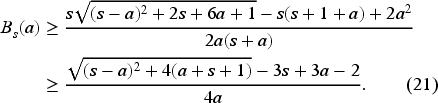
Given the complexity of the expression for , explicit bounds are often employed. For example, Janssen et al. (2008) presented the sharpest Gaussian bounds. Furthermore, Inequalities (14) and (15) provide the most accurate upper and lower bounds known to date, as derived from a quadratic equation in Proposition 1 of Harel (1990). In Proposition 3, we offer a sharper lower bound for , derived from a quadratic equation akin to inequality (16), sharper than the bound presented in Proposition 1 of Harel (1990). Additionally, this proposition demonstrates that inequality (15) from Harel (1990) can be deduced from the new relation of this paper (16).
(Sharp quadratic lower bound for )
The following holds:
Table of notations
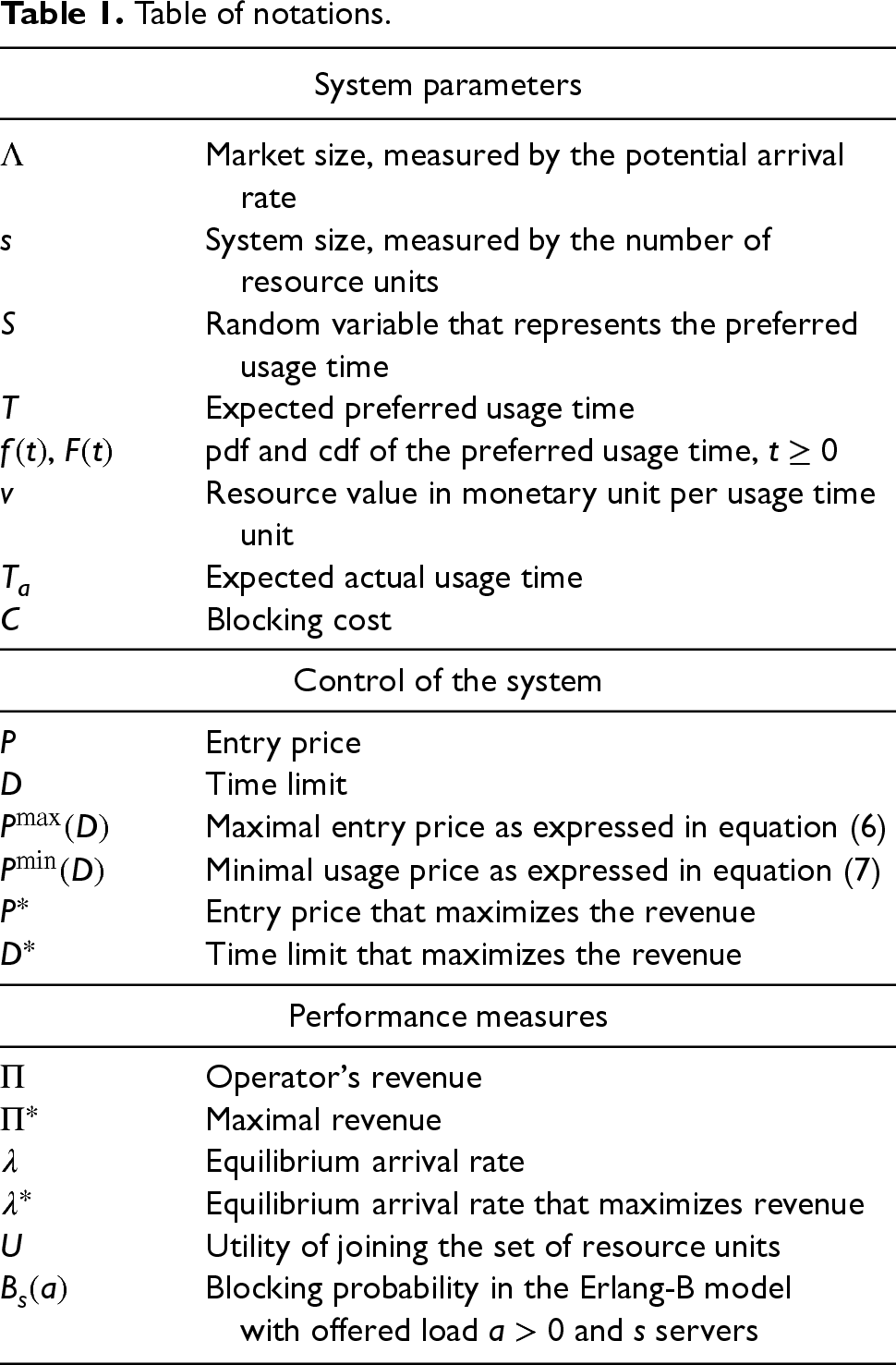
All notation introduced in the paper is presented in Table 1.
Table of notations.
System parameters
Market size, measured by the potential arrival rate
System size, measured by the number of resource units
Random variable that represents the preferred usage time
Expected preferred usage time
,
pdf and cdf of the preferred usage time,
Resource value in monetary unit per usage time unit
Section 3.1 explores how the equilibrium arrival rate responds to the price and time limit. Section 3.2 deals with the optimization problem for maximizing revenue. Section 3.3 quantifies the effects of system parameters on the optimal price and revenue.
Regulating Demand
Theorem 1 shows how the price and time limit affect the equilibrium arrival rate.
(Equilibrium arrival rate properties)
The equilibrium arrival rate and offered load are decreasing and concave in for ,
The offered load is increasing and concave in for ,
The equilibrium arrival rate is either strictly increasing in or first increasing and then decreasing in for .
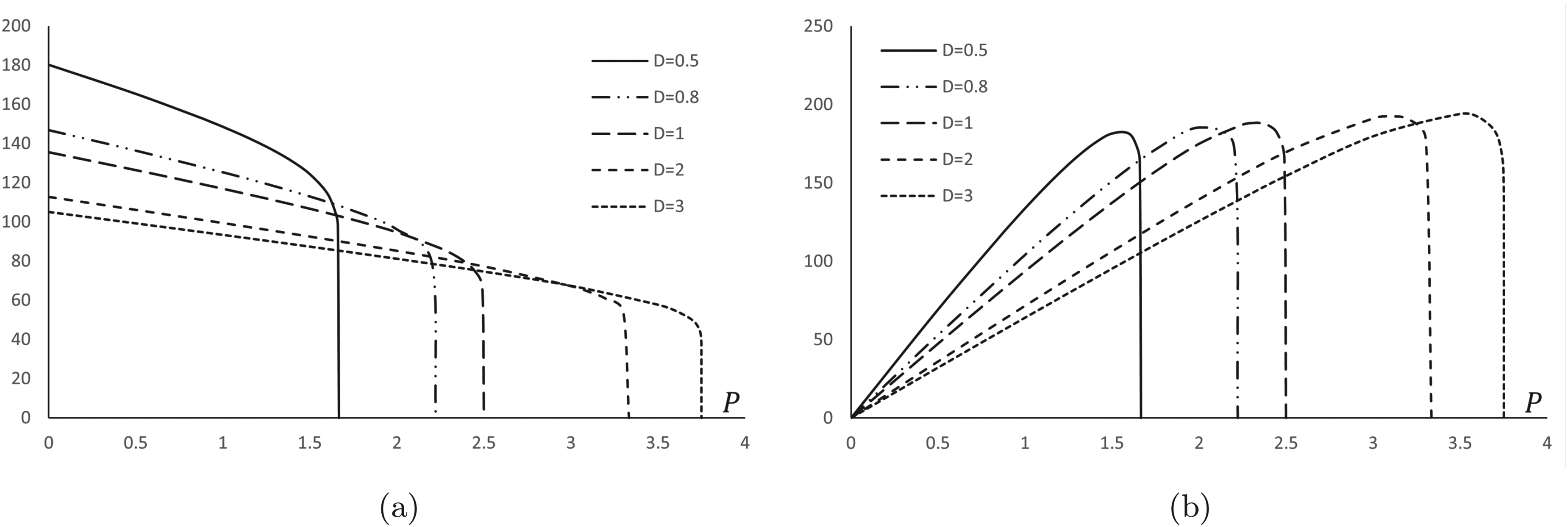
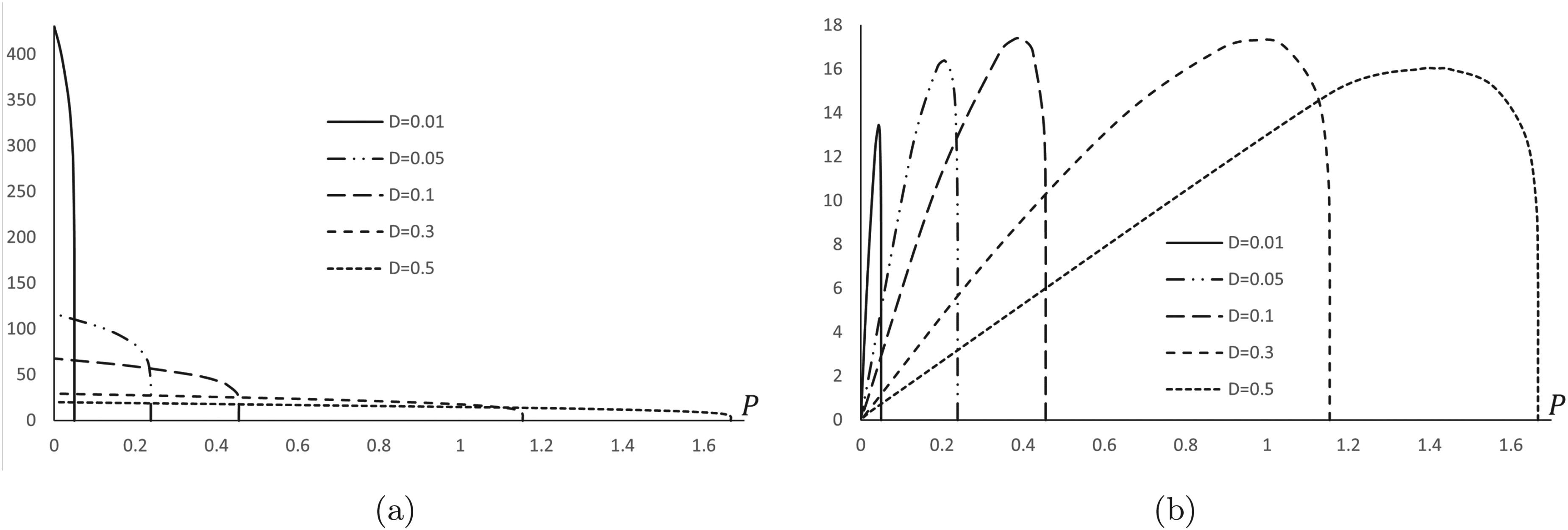
The concavity of as a function of indicates that customers’ price sensitivity increases with , so entry price variations have more of an effect on the demand for costly resource units. The offered load is increasing with , indicating that resource units are being used more intensively with longer usage time. However, this does not necessarily imply that customers join more with longer usage time. When the entry price is high, specifically when , we prove that the equilibrium arrival rate increases with , suggesting that time limits should not be set when the objective is to maximize demand for high-priced resources. However, when , we encounter situations where the equilibrium arrival rate first increases and then decreases with , revealing that a finite time limit can be used to maximize customer demand. Theorem 1 is illustrated in Figure 1(a). We also illustrate the behavior of the revenue as a function of and in Figure 1(b).
Effect of and on the equilibrium arrival rate and revenue (, , , , , for ). (a) Equilibrium arrival rate; (b) Revenue.
Revenue Maximization
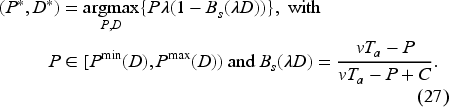
We now consider revenue maximization. Formally, we want to determine the couple for which
Observe from this problem definition that it is equivalent to optimize over , because for each there exists a unique , due to the increasing property of in with (see Proposition 1). First, in Lemma 1, we prove that the revenue does not have critical points for and .
(Absence of critical points)
The revenue does not have critical points for and .
One consequence of Lemma 1 is that either or should lie at the boundary of their respective sets of possible values. We can exclude the boundary values or , for which the revenue is zero. However, there remains to determine whether we should have and optimize or and optimize . Theorem 2 proves that for revenue maximization, we should let tend to infinity in all cases. Moreover, the theorem explains how the optimal entry price should be selected.
It is interesting to observe from Figure 1(b) that the revenue is not increasing in for a given as the different curves cross each other. The result of Theorem 2 shows that only the maximum of the revenue in increases in . Moreover, Theorem 2 shows that the solution to the revenue maximization problem is not influenced by the distribution of the usage time beyond its mean.
Using Theorem 2 for , we can determine explicitly and deduce the optimal price and revenue, as shown in Table 2.
Closed-form results for .
Condition
For larger values of , such closed-form solutions are not available, but the optimal -values can be computed efficiently. Using the explicit expression for and the relation , equation (24) can be transformed into the equation
Equation (25) shows that the offered load increases with the ratio . Thus, for extreme cases of this ratio, we can determine asymptotic expressions for the equilibrium arrival rate, optimal price, and revenue, assuming that the market size is unbounded, as shown in Table 3.
Asymptotic expressions (, ).
Condition
Drivers of the Pricing Decision
We now investigate the drivers of the pricing decision regarding on-demand resources.
Effect of the system parameters
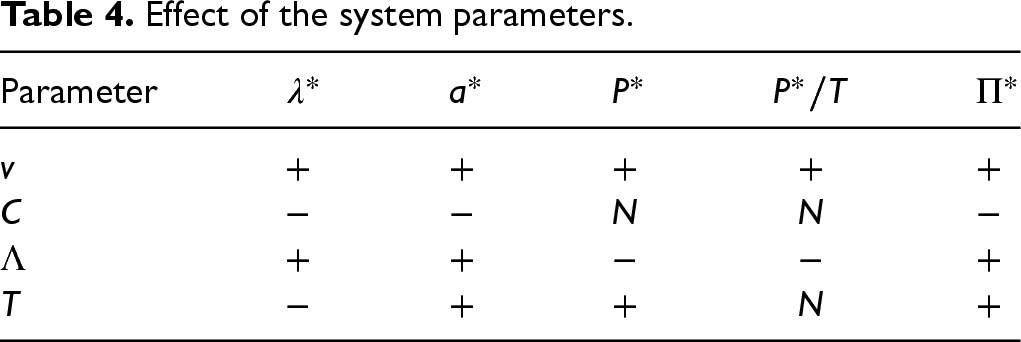
Table 4 refers to how the optimal equilibrium arrival rate , offered load , entry price , price rate , and revenue evolve as functions of the system parameters. We use the symbol () to indicate that a quantity is increasing (decreasing) for a given parameter. The letter is assigned when a nonmonotonic behavior is observed.
The findings presented in Table 4 confirm certain expectations while also revealing unexpected phenomena. An increase in the perceived value per unit of time for utilizing a resource (first line of the table) was anticipated to correspond with an increase in demand, thereby allowing for an increase in the entry price and consequently leading to higher revenue.
Effect of the system parameters.
Parameter
One might have expected a consistent opposite trend regarding the impact of the blocking cost. However, the second line of Table 4 indicates that the entry price may increase with . To elucidate this occurrence, we reformulate the equation as . This rearrangement of the equation illustrates that our system is equivalent to a model with zero blocking cost and a resource value of . In this revised model, the utility of balking is , representing the utility of opting for an external alternative. Consequently, an increase in increases the value of the external alternative, which would prompt a reduction in the entry price. However, it also enhances the value of resource utilization, which could incentivize an increase in the entry price. The interplay between these two phenomena gives rise to the nonmonotonic behavior of the entry price with respect to .
The critical role of the usage time
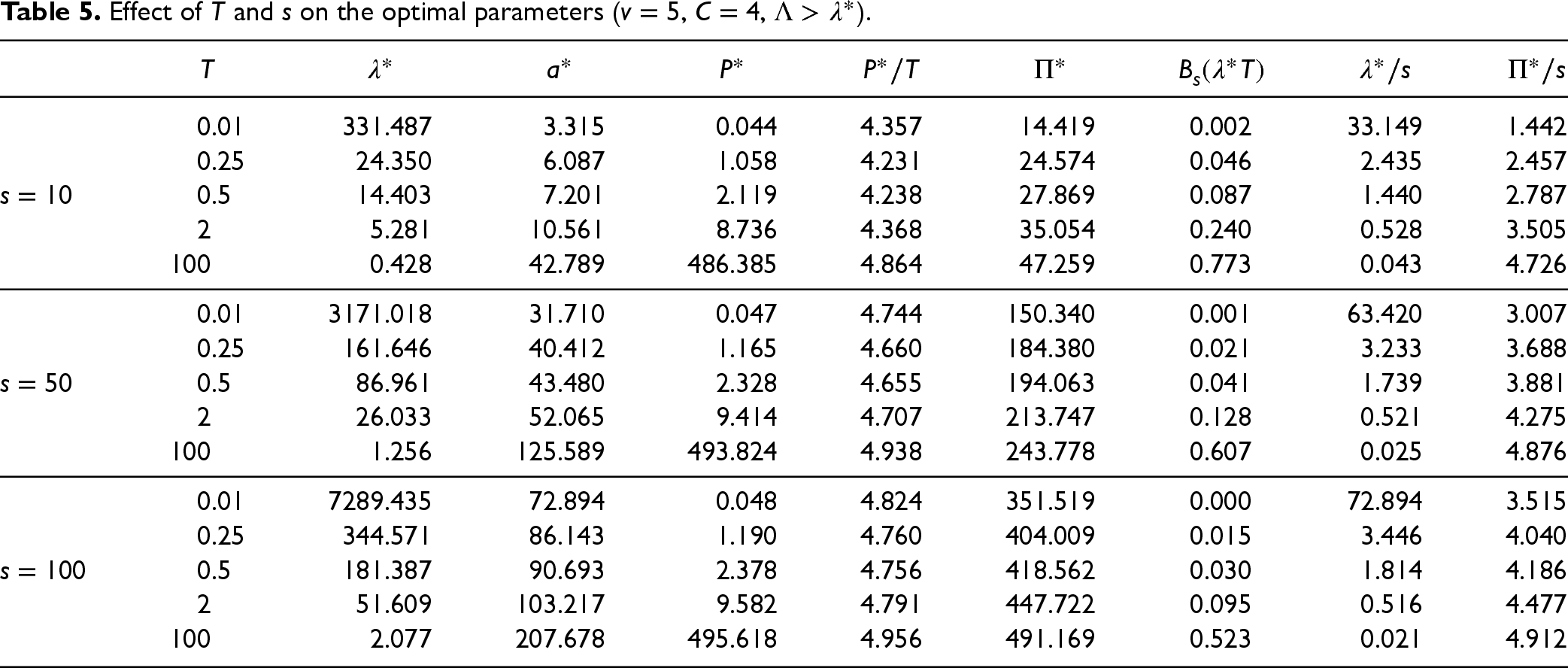
The benefit of long usage time is illustrated in Table 5 for different values of the number of resource units and a large market size , chosen so that joining is not a dominant strategy (i.e., ). We observe that both and increase with . This indicates that it is preferable to have fewer customers who are willing to pay more for using a resource for a longer duration. Furthermore, we note that the price rate initially decreases and then increases with . The decreasing phase of the price rate suggests encouraging customers’ demand. Conversely, the increasing phase is attributed to the potential for higher profits per unit of resource usage time when the duration of usage is prolonged.
Effect of and on the optimal parameters (, , ).
0.01
331.487
3.315
0.044
4.357
14.419
0.002
33.149
1.442
0.25
24.350
6.087
1.058
4.231
24.574
0.046
2.435
2.457
0.5
14.403
7.201
2.119
4.238
27.869
0.087
1.440
2.787
2
5.281
10.561
8.736
4.368
35.054
0.240
0.528
3.505
100
0.428
42.789
486.385
4.864
47.259
0.773
0.043
4.726
0.01
3171.018
31.710
0.047
4.744
150.340
0.001
63.420
3.007
0.25
161.646
40.412
1.165
4.660
184.380
0.021
3.233
3.688
0.5
86.961
43.480
2.328
4.655
194.063
0.041
1.739
3.881
2
26.033
52.065
9.414
4.707
213.747
0.128
0.521
4.275
100
1.256
125.589
493.824
4.938
243.778
0.607
0.025
4.876
0.01
7289.435
72.894
0.048
4.824
351.519
0.000
72.894
3.515
0.25
344.571
86.143
1.190
4.760
404.009
0.015
3.446
4.040
0.5
181.387
90.693
2.378
4.756
418.562
0.030
1.814
4.186
2
51.609
103.217
9.582
4.791
447.722
0.095
0.516
4.477
100
2.077
207.678
495.618
4.956
491.169
0.523
0.021
4.912
Table 5 also highlights some adverse outcomes associated with the absence of time limits. First, we observe a decrease in the equilibrium arrival rate with the expected usage time. This implies that the absence of time limits may negatively impact the market share . Additionally, an increased offered load reduces the accessibility of resource units, as evidenced by the high values of the blocking probability. While this may boost revenue, it could be undesirable from a societal perspective.
Regarding the number of resource units , both the usage price and normalized revenue are increasing, whereas the normalized arrival rate may either increase or decrease. An increased arrival rate is observed in instances of short usage times, where both quantity and price contribute to revenue growth per resource. Conversely, a decreased arrival rate per resource occurs with extended usage times. The asymptotic behavior of the offered load in the number of resource units will be further investigated in Section 5.
Summary
For on-demand resources like bike-sharing systems, we demonstrate that imposing time limits is counterproductive, as it reduces revenue. Longer usage durations allow for higher prices and revenue. This turns out to be more beneficial than increasing customer volume.
Analysis of Reserved Resources
We now focus on reserved resources, in which resource units only become available for reuse after a fixed time . Compared with on-demand resources, the value of using a resource remains , but the offered load becomes , changing the definition of expected utility. Let us first give the counterpart of the equilibrium strategy with reserved resources. The equilibrium market coverage as a function of the entry price falls into one of three ranges:
if and only if (zero coverage, never join);
if and only if (full coverage, always join);
, which solves
if and only if (partial coverage, probability of joining ). Notice that compared with the on-demand resources we have redefined , while the definition of remains unchanged. In Sections 4.1-4.3, we will present results for the demand, revenue, sensitivity analyses and managerial consequences, respectively.
Regulating Demand
We first determine the effect of the entry price and time limit on the equilibrium arrival rate.
(Equilibrium arrival rate properties)
The equilibrium arrival rate and offered load are decreasing and concave in for .
The offered load is increasing and concave in for .
The equilibrium arrival rate is first increasing and then decreasing in for .
In Figure 2, we illustrate Theorem 3 and the behavior of the revenue in and .
Effect of and on the equilibrium arrival rate and revenue (, , , , , for ). (a) Equilibrium arrival rate; (b) Revenue.
Revenue Maximization
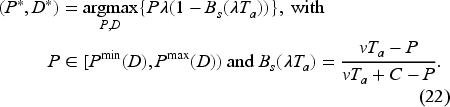
We next determine the values of and that maximize revenue. Formally, we determine the pair such that
Optimizing over and is complex, in that the two variables are interconnected through the equilibrium arrival rate in , which creates an optimization problem for a function with three variables (, , and ) and one constraint of equality. For this problem, can be explicitly expressed in terms of and . Therefore, we apply the substitution method to solve the constrained optimization problem. We then consider the revenue as a function of and without constraint. The zeros of the first derivative of the revenue in and are the critical points. The optimization problem becomes
In Proposition 4, we prove that if (i.e., if the full market share is captured), then there exists a unique value of that maximizes the revenue.
(Optimal value for when )
When , the revenue has a unique maximizer in which is the unique solution of
We now consider the case where . In Theorem 4, we provide the set of equations that leads to the couple that maximizes revenue.
The following system has a unique solution in :
If the arrival rate that solves these equations is lower than , then the solutions to (30)-(31) are and , and the optimal entry price is obtained with .
Otherwise, , is selected to maximize revenue (using Proposition 4), and .
Contrary to the case with on-demand resources, the distribution of the usage time plays a role in the selection of the optimal time limit and entry price. Note thatequation (30) is identical to equation (24) in Section 3, except that is replaced by . Also, combining equations (30) and (31) together with the identify leads to
for which the parameters and are absent, indicating that the relation between the offered load and the time limit is not affected by the service value nor the blocking cost. The system (30) to (31) is difficult to solve, except in some special cases. In Table 6, we give explicit expressions for the system parameters in a case with and a uniform distribution on the interval for the preferred usage time.
Drivers of the Pricing and Time Limit Decision
We now explore the drivers of the pricing and time limit decision.
Closed-form results for and for , with and .
Condition
The case of full coverage (i.e., )
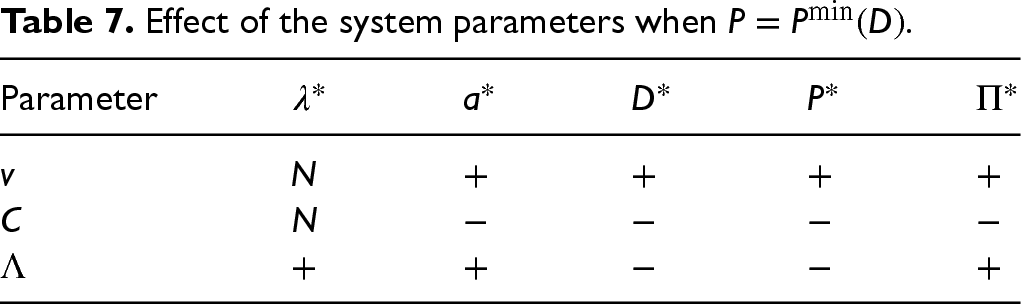
In the case where , we observe some monotone behaviors that are proven in Table 7. An increase in service value or a decrease in blocking cost results in higher resource utilization (i.e., the offered load ), which in turn allows for an increase in entry price. Additionally, it leads to an extension of the time limit. This latter observation may not be immediately intuitive since increasing the time limit has both positive effects, such as increasing the service value , and negative effects, such as reducing resource availability. The final line of the table indicates that both the entry price and time limit should decrease as the market size grows. The reduction in the time limit is necessary to maintain sufficient resource availability to capture the entire market share.
Effect of the system parameters when .
Parameter
The counterpart to the effect of the expected preferred usage time found for on-demand resources involves the complete distribution of the sojourn time for reserved resources. We assume that the preferred usage time is a function of a parameter and assume that is stochastically increasing in (i.e., is increasing in for ). In Proposition 5, we provide the effect of increasing on , , , and .
(Effect of the usage time distribution)
When , , , , and increase in .
Nonmonotonic behaviors when
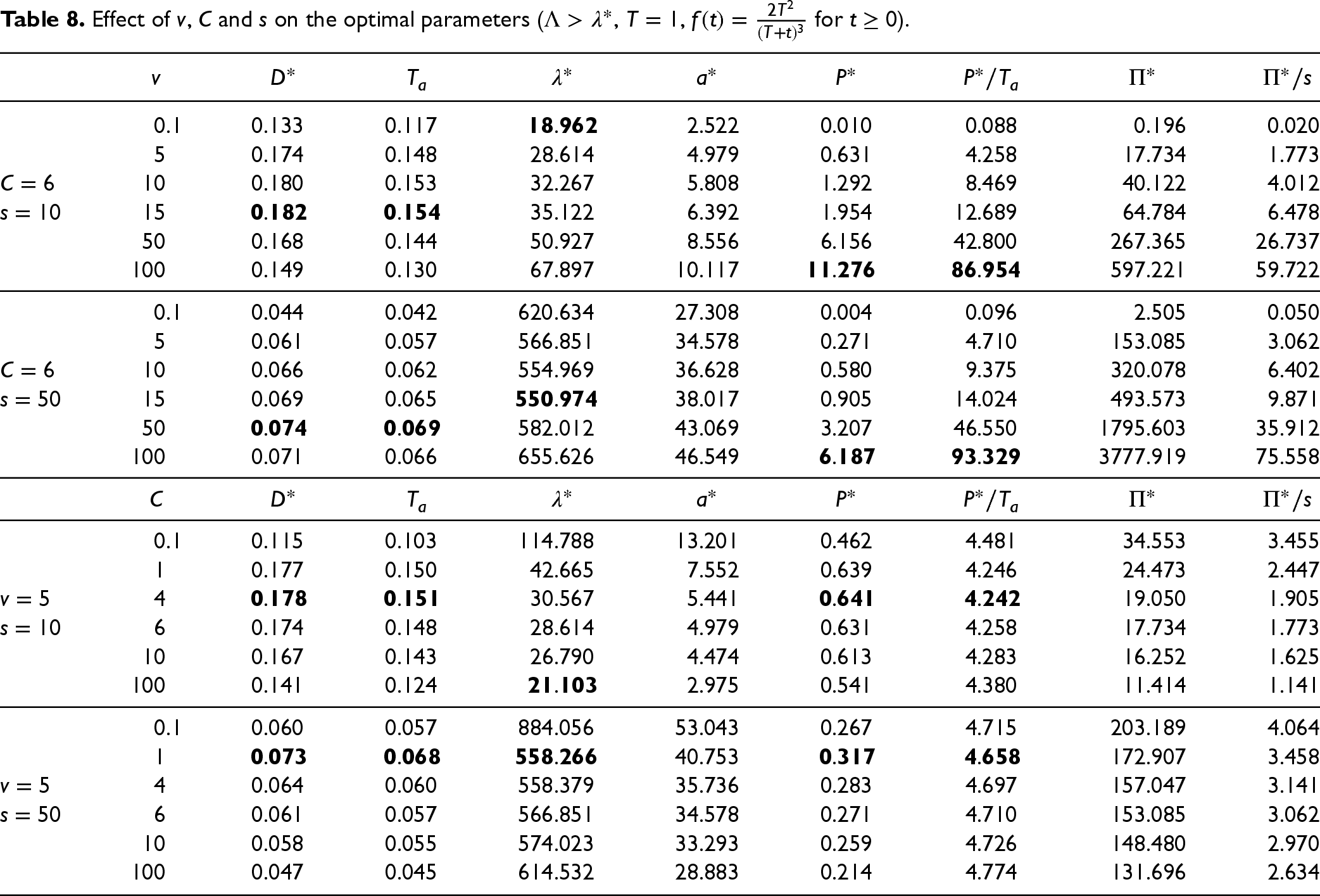
In Table 8, we give the optimal values of the time limit, expected usage time, equilibrium arrival rate, offered load, entry price, price rate, revenue, and revenue generated per resource unit.
Effect of , and on the optimal parameters (, , for ).
0.1
0.133
0.117
18.962
2.522
0.010
0.088
0.196
0.020
5
0.174
0.148
28.614
4.979
0.631
4.258
17.734
1.773
10
0.180
0.153
32.267
5.808
1.292
8.469
40.122
4.012
15
0.182
0.154
35.122
6.392
1.954
12.689
64.784
6.478
50
0.168
0.144
50.927
8.556
6.156
42.800
267.365
26.737
100
0.149
0.130
67.897
10.117
11.276
86.954
597.221
59.722
0.1
0.044
0.042
620.634
27.308
0.004
0.096
2.505
0.050
5
0.061
0.057
566.851
34.578
0.271
4.710
153.085
3.062
10
0.066
0.062
554.969
36.628
0.580
9.375
320.078
6.402
15
0.069
0.065
550.974
38.017
0.905
14.024
493.573
9.871
50
0.074
0.069
582.012
43.069
3.207
46.550
1795.603
35.912
100
0.071
0.066
655.626
46.549
6.187
93.329
3777.919
75.558
0.1
0.115
0.103
114.788
13.201
0.462
4.481
34.553
3.455
1
0.177
0.150
42.665
7.552
0.639
4.246
24.473
2.447
4
0.178
0.151
30.567
5.441
0.641
4.242
19.050
1.905
6
0.174
0.148
28.614
4.979
0.631
4.258
17.734
1.773
10
0.167
0.143
26.790
4.474
0.613
4.283
16.252
1.625
100
0.141
0.124
21.103
2.975
0.541
4.380
11.414
1.141
0.1
0.060
0.057
884.056
53.043
0.267
4.715
203.189
4.064
1
0.073
0.068
558.266
40.753
0.317
4.658
172.907
3.458
4
0.064
0.060
558.379
35.736
0.283
4.697
157.047
3.141
6
0.061
0.057
566.851
34.578
0.271
4.710
153.085
3.062
10
0.058
0.055
574.023
33.293
0.259
4.726
148.480
2.970
100
0.047
0.045
614.532
28.883
0.214
4.774
131.696
2.634
The optimal time limit first increases and then decreases with both and . This phenomenon stems from the dual role of the time limit, which must be sufficiently high to ensure a sufficient resource value () while also being sufficiently low to guarantee enough accessibility (). As increases (or decreases), the utility of joining also increases, possibly amplified by increasing . However, if the resulting demand becomes excessively high, further demand increase can only be achieved by enhancing resource accessibility, thus reducing .
Similar to on-demand resources, the optimal offered load increases with and decreases with . However, surprisingly, the optimal arrival rate does not always follow this trend. In the case where , we present instances where the equilibrium arrival rate first decreases and then increases with both and . The decrease in or the increase in reflects scenarios where it is advisable to increase the entry price even beyond a point where the resulting demand ultimately decreases.
Role of the usage time distribution
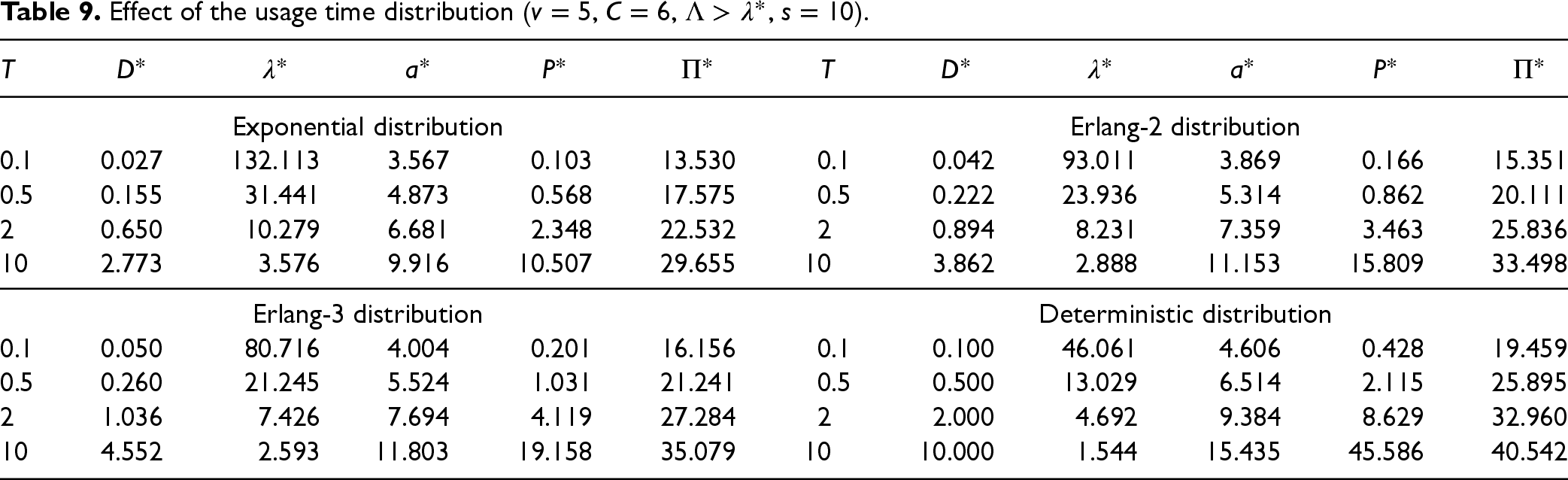
Table 9 examines the impact of different usage time distributions, including the exponential, 2-phase Erlang, 3-phase Erlang, and deterministic distributions, all having the same mean usage time . When users have a long preferred usage time, there is significant potential for generating a higher service value, thereby presenting opportunities to increase entry prices and revenue. This observation aligns with that for on-demand resources, demonstrating the positive impact of high resource utilization.
Effect of the usage time distribution (, , , ).
Exponential distribution
Erlang-2 distribution
0.1
0.027
132.113
3.567
0.103
13.530
0.1
0.042
93.011
3.869
0.166
15.351
0.5
0.155
31.441
4.873
0.568
17.575
0.5
0.222
23.936
5.314
0.862
20.111
2
0.650
10.279
6.681
2.348
22.532
2
0.894
8.231
7.359
3.463
25.836
10
2.773
3.576
9.916
10.507
29.655
10
3.862
2.888
11.153
15.809
33.498
Erlang-3 distribution
Deterministic distribution
0.1
0.050
80.716
4.004
0.201
16.156
0.1
0.100
46.061
4.606
0.428
19.459
0.5
0.260
21.245
5.524
1.031
21.241
0.5
0.500
13.029
6.514
2.115
25.895
2
1.036
7.426
7.694
4.119
27.284
2
2.000
4.692
9.384
8.629
32.960
10
4.552
2.593
11.803
19.158
35.079
10
10.000
1.544
15.435
45.586
40.542
Table 9 also reveals a positive correlation between the time limit and preferred usage time, suggesting that an optimal strategy for maximizing revenue should align with customer preferences. However, the sensitivity of with respect to is relatively low. We observe that in most cases we have . Some counterexamples with can be found when is low (using for instance the results of Table 6). This means that when is sufficiently high the primary role of is to control resource accessibility and reduce the degradation of service levels that typically occur with increasing . Prolonged unavailability of resources can be detrimental, signaling reduced resource availability to the market and leading to decreased demand.
An increase in variability within the usage time distribution necessitates a reduction in the entry price, consequently resulting in a decline in revenue. This observation is underpinned by the interplay between the actual expected usage time () and the variability of the preferred usage time. While increases with , it decreases with the variability of the preferred usage time. This underscores the idea that resource management is more efficient when customers predictably utilize resources. For instance, in scenarios where the usage time is deterministic, the optimal time limit () is equal to the preferred expected usage time ().
Summary
For reserved resources like hotel rooms, this study highlights the importance of jointly optimizing entry prices and time limits. Implementing shorter time limits enhances resource accessibility, helps moderate pricing, and strikes a balance between customer satisfaction and demand, particularly in situations with high variability in usage durations.
Further Discussion and Results
In this section, we discuss the findings of this study and provide additional results.
Price rate instead of entry price
In some cases, such as certain rental systems, the pricing mechanism relies on a price rate instead of an entry price. The optimization of a price rate is analogous to that of an entry price. To see this, consider a price rate per unit of time spent with a resource unit, such that the utility of joining and the revenue are redefined as , and , where for on-demand resources, and for reserved resources. At equilibrium, using , we can express the revenue as , which shows that the substitution approach used to maximize the revenue with an entry price applies in the same way with a price rate. Thus, the results of Theorems 2 and 4 can be applied, where the optimal price rate is given by with the expected usage time with the optimal time limit .
Comparison between reserved and on-demand resources
Reserved and on-demand resources can be used in different contexts. It is however interesting to mention that, as proven in Proposition 6, on-demand resources outperform reserved resources in terms of generating revenue. This result is intuitive as for a given time limit , the value of using a resource is the same for both resources (), while the blocking probability with a reserved resource is higher than the blocking probability with an on-demand resource, due to .
(On-demand outperforms reservations)
The optimal revenue with on-demand resources is greater than the optimal revenue with reserved resources.
Multiclass classification in usage time
An important result is that, for revenue maximization, a service should have fewer customers with longer usage times rather than many customers with shorter usage times, as this allows for the implementation of higher entry prices (see Tables 4 and 9). The rationale behind this result is that customers with longer usage times perceive a higher utility in using the resource. This result extends to the multiclass setting as detailed in the E-companion. Specifically, we show that customer classes with longer usage times have higher utility, which in turn allows for the possibility of implementing higher entry prices.
Comparison with a waiting system
We now consider the same problem of managing a time limit and an entry price for a reusable resource, but instead of considering the Erlang loss model, we investigate this problem in the context of Naor (1969) where customers wait. The expected utility of joining in Naor’s model and expected revenue is formulated as , and , where is the expected wait in the queue (excluding the service time2 ) as given by the Pollaczek-Khintchine formula: , where is the offered load, and is a random variable that represents the occupation time of a resource by a customer. In Proposition 7, we prove that it is optimal to select such that the market share is fully captured and indicate how the time limit should be selected.
(Optimal parameters in Naor’s model)
For on-demand and reserved resources, it is optimal to select , such that . The optimal time limit is the unique solution in of
, with for on-demand resource, and
with for reserved resource.
This reveals an important difference with our blocking model. When customers wait, the revenue is primarily driven by the volume of customers who join, necessitating minimization of the entry price. The time limit is selected to strike a balance between service value and waiting cost, while also ensuring system stability, unlike in a blocking scenario where stability is ensured when customers are blocked. When customers are sensitive to blocking, it is optimal not to capture the full market share. Moreover, with an on-demand resource, a time limit should not be imposed.
QED convergence
We now consider the asymptotic behavior of the offered load with on-demand resources when the number of resource units tends to infinity, in the case where there is no bound on the market size (i.e. ). In Proposition 8, we prove that the offered load increases in and that the ratio tends to a finite limit, which is the solution to an explicit equation.
(Convergence to the QED regime)
The offered load is increasing in and tends to infinity as tends to infinity. Moreover, the ratio tends to a finite limit that is solution of
where and is the cdf of a standard Normal distribution.
A consequence of this result is that the optimal entry price tends to and the optimal revenue tends to infinity as the number of resource units tends to infinity, which signals the benefits of operating on a large scale (with many resource units).
Having a finite limit for the ratio is associated with features of the so-called QED regime (Halfin and Whitt, 1981). Proposition 8 thus shows that the classical QED assumption of a finite ratio for , which is often used for staffing decisions, emerges from our loss model with rational customers.
Price-dependent staying time
We now extend the analysis with on-demand resources to the case where the staying time is price-dependent, showing the robustness of the result in Proposition 9.3 We assume that the price-dependency of does not affect its monotonicity properties in . The following assumptions are made regarding the price-dependency of :
is increasing and concave in , and is decreasing in , with .
The increasing property of accounts for situations where a higher entry price may incentivize customers to prolong their staying time to increase the usage benefit from the resource for the given price paid. Moreover, we assume that the sensitivity of to reduces as increases. Finally, we assume that the benefit from joining, , is decreasing in .4 The condition that prevents the unrealistic scenario where could be an admissible solution.
(Optimal solution)
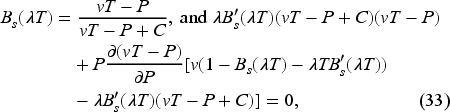
The maximizer of the revenue is given by . The optimal entry price is determined by the solution to the following system of equations in :
where . If the solution to (33) is such that , then the entry price that solves (33) is the optimal entry price. Otherwise, the optimal entry price is the unique solution in to
Conclusion
This study addresses the management of reusable resources with pricing and usage time limits. To this end, we modeled the occupancy of a finite set of resource units as an Erlang loss system, and we assumed that customers are rational in their decisions to access the resources. Customers’ utility depends on the entry price and time limit but also on the service value, preferred usage time, and blocking cost, expressed in terms of the Erlang loss formula. Individual joining decisions by all rational customers together create endogenous demand for the resource. Our objective is to optimize the entry price and time limit for on-demand or reserved resources such that the revenue is maximized.
On-demand resources allow customers to reuse units immediately upon return. In this context, although the revenue is not increasing in the time limit, the maximal revenue in the entry price increases in the time limit, which proves that time limits should be prohibited. This result is also valid if the usage time is increasing in the entry price. The revenue maximization problem then becomes a one-dimensional problem that seeks the optimal entry price only. Using a range of existing and novel properties of the Erlang B formula, we solve this optimization problem to establish a unique characterization of the optimal entry price. From this characterization, we confirmed some intuitive results such as the increase of the entry price and demand in the service value, but we also exhibited some nonmonotonic behavior such as the potential increase of the entry price in the blocking cost. The revenue benefits from customers’ preference for a long usage time. However, this comes at the expense of service level degradation in terms of blocking when usage time increases. Finally, we showed that as the number of resource units tends to infinity, the system is driven into a QED-regime behavior.
Reserved resources become available for reuse only upon reaching the end of the time limit. Such conditions naturally arise when predicting return times is impractical or when proactive maintenance planning is required. In this context, there exists a distinct, nondegenerate pair of entry price and time limit that serves to maximize revenue. The optimal time limit strikes an equilibrium between resource accessibility and usage time. In most cases, it is selected lower than the preferred usage time, particularly when there is high variability in usage time, highlighting the need to maintain resource availability. Reserved resources lead to a lower revenue than on-demand resources due to their lack of flexibility. They are also more complicated to manage as they require two parameters of control and the interaction between these two leads to unexpected nonmonotonic behavior such as the potential decrease of the demand and entry price in the service value.
For practice, an important result of this study is that on-demand resources, such as parking spaces and vehicle-sharing systems, could be effectively managed solely through pricing mechanisms without imposing time limits. This finding contrasts with current practices, where vehicle usage time is often capped. This raises questions about the role of imposing these time limits in practice. As our study shows that they do not enhance revenue, their purpose might simply be to allow the owner to reclaim the asset quickly, preventing long-term rentals from resembling semiownership. In the case of resources that require predefined time slots (reserved resources), such as hotel rooms, our study demonstrates that price and time limits should be used in combination, with usage limits set below the customers’ preferred durations. This indicates that resource accessibility is a key factor in increasing market share. While a time limit shorter than the preferred usage duration may be unpopular with customers, it enables lower pricing and greater accessibility, ultimately resulting in a larger market share and higher revenue.
Topics that remain for future research include the considerations of more advanced pricing schemes that combine fixed fees, price rates, and discounts. Further analysis of the relationship between the pricing mechanism and the expected usage time could be of interest. In particular, it would be challenging to determine the conditions under which the optimality of having no time limit holds when the usage time decreases with the price rate. Another interesting extension of our model would be to consider two classes of customers, one subject to blocking and one subject to waiting, in which case the exact analysis in this paper becomes considerably more complicated because a multiserver queueing model would no longer be insensitive to the usage time distribution. In addition, it could be interesting to explore the pricing optimization problem for an application where there is a different time limit associated with each resource unit. Furthermore, it is interesting to explore the use of time limits from a social optimization standpoint. Existing knowledge indicates that individual optimization results in resource over-utilization. Consequently, it is plausible that more stringent time limits should be considered when pursuing a socially optimal objective.
Supplemental Material
sj-pdf-1-pao-10.1177_10591478251319683 - Supplemental material for Managing Reusable Resources With Usage Time Limits
Supplemental material, sj-pdf-1-pao-10.1177_10591478251319683 for Managing Reusable Resources With Usage Time Limits by Benjamin Legros, Johan SH van Leeuwaarden and Jan C Fransoo in Production and Operations Management
Footnotes
Declaration of Conflicting Interests
The authors declared no potential conflicts of interest with respect to the research, authorship, and/or publication of this article.
Funding
The authors disclosed receipt of the following financial support for the research, authorship, and/or publication of this article: Johan van Leeuwaarden was funded by a Vici grant of the Dutch Research Council (NWO).
ORCID iDs
Benjamin Legros
Jan C Fransoo
Supplemental Material
Supplemental material for this article is available online (doi: ).
Notes
How to cite this article
Legros B, van Leeuwaarden JSH and Fransoo JC (2025) Managing Reusable Resources With Usage Time Limits. Production and Operations Management 34(8): 2413–2429.
References
1.
AfechePMendelsonH (2004) Pricing and priority auctions in queueing systems with a generalized delay cost structure. Management Science50(7): 869–882.
2.
AlpersteinH (1988) Note–optimal pricing policy for the service facility offering a set of priority prices. Management Science34(5): 666–671.
3.
AnilySHavivM (2022) The price of anarchy in loss systems. Naval Research Logistics69(5): 689–701.
4.
BaekJMaW (2022) Bifurcating constraints to improve approximation ratios for network revenue management with reusable resources. Operations Research70(4): 2226–2236.
5.
BeinP (1976) An N-server stochastic service system with customer preferences. Operations Research24(1): 104–117.
6.
BellC (1960) On the elasticity of demand at retail. The American Journal of Economics and Sociology20(1): 63–72.
ChegutALangenM (2019) The financial impacts of coworking: Rental prices and market dynamics in the commercial office market. Available at SSRN 3481142.
9.
ChenHFrankMZ (2001) State dependent pricing with a queue. IIE Transactions33(10): 847–860.
10.
ChenYLeviRShiC (2017) Revenue management of reusable resources with advanced reservations. Production and Operations Management26(5): 836–859.
11.
CuiSVeeraraghavanS (2016) Blind queues: The impact of consumer beliefs on revenues and congestion. Management Science62(12): 3656–3672.
12.
DeanAZhalechianMShiC (2024) Learning bundle pricing of reusable resources. Available at SSRN.
13.
DewanSMendelsonH (1990) User delay costs and internal pricing for a service facility. Management Science36(12): 1502–1517.
14.
DimitrakopoulosYBurnetasA (2016) Customer equilibrium and optimal strategies in an M/M/1 queue with dynamic service control. European Journal of Operational Research252(2): 477–486.
15.
DoanXLeiXShenS (2020) Pricing of reusable resources under ambiguous distributions of demand and service time with emerging applications. European Journal of Operational Research282(1): 235–251.
16.
EdelsonNHilderbrandD (1975) Congestion tolls for Poisson queuing processes. Econometrica: Journal of the Econometric Society43(1): 81–92.
17.
ErlangA (1917) Solutions of some problems in the theory of probabilities of significance in automatic telephone exchanges. Elektrotkeknikeren10: 189–197.
18.
FeldmanPSegevE (2022) The important role of time limits when consumers choose their time in service. Management Science68(9): 6666–6686.
19.
GavirneniSKulkarniV (2016) Self-selecting priority queues with Burr distributed waiting costs. Production and Operations Management25(6): 979–992.
20.
GlazerANiskanenE (1992) Parking fees and congestion. Regional Science and Urban Economics22(1): 123–132.
HalfinSWhittW (1981) Heavy-traffic limits for queues with many exponential servers. Operations Research29(3): 567–588.
23.
HarelA (1990) Convexity properties of the Erlang loss formula. Operations Research38(3): 499–505.
24.
HassinRHavivM (2003) To Queue Or Not to Queue: Equilibrium Behavior in Queueing Systems, Volume 59. New York, NY: Springer Science & Business Media.
25.
HassinRRoet-GreenR (2017) The impact of inspection cost on equilibrium, revenue, and social welfare in a single-server queue. Operations Research65(3): 804–820.
26.
HavivMKellaOKernerY (2010) Equilibrium strategies in queues based on time or index of arrival. Probability in the Engineering and Informational Sciences24(1): 13–25.
27.
HuaCWangTZhangJZhouZ (2023) Asymptotically optimal dispatch policies for emergency medical services. Available at SSRN 4386239.
28.
JagermanD (1974) Some properties of the Erlang loss function. Bell System Technical Journal53(3): 525–551.
29.
JanssenAVan LeeuwaardenJZwartB (2008) Gaussian expansions and bounds for the poisson distribution applied to the Erlang B formula. Advances in Applied Probability40(1): 122–143.
30.
JiaHShiCShenS (2024) Online learning and pricing for service systems with reusable resources. Operations Research72(3): 1203–1241.
31.
JorgeDCorreiaG (2013) Carsharing systems demand estimation and defined operations: A literature review. European Journal of Transport and Infrastructure Research13(3): 201–220.
32.
LazovI (2017) Profit management of car rental companies. European Journal of Operational Research258(1): 307–314.
33.
LeemanW (1964) The reduction of queues through the use of price. Operations Research12(5): 783–785.
34.
LegrosB (2021) Agents’ self-routing for blended operations to balance inbound and outbound services. Production and Operations Management30(10): 3599–3614.
35.
LeiYJasinS (2020) Real-time dynamic pricing for revenue management with reusable resources, advance reservation, and deterministic service time requirements. Operations Research68(3): 676–685.
36.
LeviRRadovanovićA (2010) Provably near-optimal LP-based policies for revenue management in systems with reusable resources. Operations Research58(2): 503–507.
37.
LinKRossS (2003) Admission control with incomplete information of a queueing system. Operations Research51(4): 645–654.
38.
LinKRossS (2004) Optimal admission control for a single-server loss queue. Journal of Applied Probability41(2): 535–546.
39.
LiuCSustikM (2021) Elasticity based demand forecasting and price optimization for online retail. arXiv preprint arXiv:2106.08274.
40.
ManciniSGanstererM (2021) Vehicle scheduling for rental-with-driver services. Transportation Research Part E: Logistics and Transportation Review156: 102530.
41.
NaorP (1969) The regulation of queue size by levying tolls. Econometrica: Journal of the Econometric Society37(1): 15–24.
42.
OttossonDChenCWangTLinH (2013) The sensitivity of on-street parking demand in response to price changes: A case study in Seattle, WA. Transport Policy25: 222–232.
43.
RavnerLHavivM (2014) Equilibrium and socially optimal arrivals to a single server loss system. In 2014 7th International conference on NETwork Games, COntrol and OPtimization (NetGCoop), pp.119–126. IEEE.
44.
RusmevichientongPSumidaMTopalogluH (2020) Dynamic assortment optimization for reusable products with random usage durations. Management Science66(7): 2820–2844.
45.
ShaheenSCohenAZohdyIetal (2016) Shared mobility: Current practices and guiding principles. Technical report, United States. Federal Highway Administration.
46.
TaylorT (2018) On-demand service platforms. Manufacturing & Service Operations Management20(4): 704–720.
47.
Van LeeuwaardenJTemmeN (2009) Asymptotic inversion of the Erlang B formula. Journal on Applied Mathematics70(1): 1–23.
48.
XieXGurvichIKüçükyavuzS (2024) Dynamic allocation of reusable resources: Logarithmic regret in overloaded networks. Operations Research.
Supplementary Material
Please find the following supplemental material available below.
For Open Access articles published under a Creative Commons License, all supplemental material carries the same license as the article it is associated with.
For non-Open Access articles published, all supplemental material carries a non-exclusive license, and permission requests for re-use of supplemental material or any part of supplemental material shall be sent directly to the copyright owner as specified in the copyright notice associated with the article.