







Abstract
In recent years, “super fakes,” that is, high-quality counterfeits, have gained popularity. The ability of super fake manufacturers to produce high-quality products has inspired a novel anti-counterfeiting measure: converting counterfeiters to authorized suppliers. We develop a game-theoretic model to examine the interactions between a brand-name firm with a licit home supplier and a counterfeiter who can be potentially converted to an authorized overseas supplier. Our analysis leads to three main results. First, the brand-name firm can convert the counterfeiter to a licit supplier through either dual sourcing or single sourcing when the cost differential between two suppliers is moderate to high, or the quality perception differential between brand-name products produced by two suppliers is low. However, this conversion does not necessarily prevent counterfeiting unless the penalty from law enforcement is stringent. Our paper recommends that brand-name firms strategically use their wholesale pricing and sourcing decisions to establish socially responsible supply chain operations and prevent counterfeiting. Second, while dual sourcing is known for its risk diversification, our study identifies another benefit previously not reported in the literature: mitigating counterfeit risks. Dual sourcing can be more effective than single sourcing as the quality perception of super fakes approaches that of brand-name products, and its effectiveness becomes more pronounced when the brand-name firm offers wholesale price contracts in a sequential order. Conversely, single sourcing is preferable under conditions of high cost differential and low quality perception differential. Lastly, converting counterfeiters to authorized suppliers can reduce consumer surplus and does not improve social surplus unless authorities enforce high penalties on counterfeiters or the cost differential between two suppliers is substantial.
Introduction
Counterfeits are illegal products that imitate and infringe on the brands of genuine items. Globalization has significantly expanded the range of products being counterfeited, extending from luxury goods (e.g., fashion apparel and watches) to other consumer products (e.g., electronics and stationery). According to the Organisation for Economic Cooperation and Development (OECD), in 2019 alone, imports of fake products into the European Union (EU) increased to 6.8% of all imports, and globally, the value of counterfeit and pirated merchandise reached USD 509 billion, representing about 3.3% of world trade (UNECE, 2023).
Although industries and governments have been actively working to combat counterfeiting, companies continue to suffer significant trademark infringement from counterfeiters. For years, the luxury goods industry has invested heavily in fighting against counterfeiters by encouraging governments to strengthen regulations and law enforcement to seize counterfeit products, and running public awareness campaigns on the risks of purchasing counterfeits (Fontana et al., 2019). In the United States, the government has been advocating for stronger global law enforcement on trademarks and intellectual property (IP) rights. These measures aim to drive counterfeiters out of the market. However, in some developing economies, despite the passage of anti-counterfeiting laws, enforcement remains weak. For instance, the Turkish parliament passed regulations against counterfeits in 2016, which include prison terms and steep fines. Nonetheless, these laws have not effectively curbed counterfeiting, and their overall impact remains uncertain (Smith, 2018). In China, local governments have established laws to crack down on fake products, but in some cases, the incentive to enforce these laws is insufficient. For example, the “fake shoe market” has become an invisible pillar of the local economy in Putian, China (Chen, 2017).
With advancements in manufacturing technology, the quality of counterfeits is steadily improving (Yao, 2014). As quoted by Alibaba’s Jack Ma, “fake products today are of better quality and better price than the real names” (Dou, 2016). In recent years, many counterfeiters have demonstrated the capability to produce high-quality products. Turkish counterfeit Louis Vuitton (LV) bags, for instance, are notorious for being high-end “genuine fakes” because they are made from leather sourced from the same suppliers as genuine bags and crafted by experienced artisans. This makes these high-quality fake bags difficult to distinguish from the originals (Iredale, 2024; Letsch, 2011). Similarly, Chinese imitations, which were once known for their low quality, are now being produced as “super fakes”: products of such high quality that even experts have trouble differentiating them from genuine items (Mau, 2018). The Economist (2022) points out that the quality of counterfeit consumer goods has reached unprecedented levels.
Due to the improved manufacturing capabilities of counterfeiters, we observe a practice that some brand-name firms outsource their production to counterfeiters, converting them to authorized suppliers. In the luxury goods industry, for example, Balenciaga’s Triple S sneakers were initially made in Italy but are now produced in factories in Putian, China. A Balenciaga official explained that the key reason for outsourcing to China was that Chinese factories “have the savoir-faire and capacity to produce a lighter shoe” (Silbert, 2018). In the consumer goods industry, Japanese stationery maker Kokuyo partnered with the Chinese “shanzhai” stationery brand Gambol, which had previously imitated Kokuyo’s famous Campus brand and sold the knockoff at much lower prices in over 5,000 retail stores in China. By collaborating with its counterfeiter, Kokuyo has successfully increased its market share in China (Sugawara, 2015). Similarly, Honda established a joint venture with Hainan Sundiro Motorcycle CO., a company that used to produce Honda knockoffs. The motivation behind this collaboration is that the Chinese company can produce parts at one-fourth the cost of Honda’s production (Zaun and Leggett, 2001).
Converting counterfeiters into authorized overseas suppliers has various implications. For brand-name firms, outsourcing to overseas suppliers who were previously counterfeiters may have two benefits. First, if counterfeiters can produce high-quality products at low costs, it will save production costs for brand-name firms. Second, converting counterfeiters to authorized suppliers may help brand-name firms mitigate the risks of counterfeiting in overseas markets and possibly capture larger market shares. This is because former counterfeiters, now authorized suppliers, may become less likely to produce counterfeit goods. However, not all brand-name firms favor such partnerships due to potential damage to their brand reputation. For instance, some consumers in China expressed dissatisfaction when Balenciaga moved the production of their Triple S sneakers to Putian, a city notoriously known for its counterfeit producers (Pan, 2018). Similarly, despite the FDA’s assurance about the quality of drugs regardless of manufacturing locations, there are still consumers concerned about generic drugs made in India (Villa et al., 2023). For counterfeiters, becoming authorized suppliers for brand-name firms can help them secure profits and avoid lawsuits and penalties from law enforcement if they stop counterfeiting. However, counterfeiters may not always be willing to become authorized suppliers. For example, according to our conversations with leather counterfeit producers in the Grand Bazaar of Istanbul in Turkey, some counterfeiters of high-quality fake bags are not willing to become authorized suppliers for genuine brands due to a significant cut in their profit margin in the contracts offered by brand-name firms. Thus, brand-name firms need prescriptions regarding when and how they can convert counterfeiters to licit suppliers and reduce the risk of counterfeiting.
Motivated by the above observations, in this work, we consider the strategy of converting counterfeiters who are capable of producing high-quality products to authorized overseas suppliers. We build a game-theoretical model and study the following three research questions:
Considering the option of converting a counterfeiter to an authorized overseas supplier, what is the equilibrium sourcing strategy for a brand-name firm? Under what conditions is the counterfeiter willing to be authorized as an overseas supplier? Under what conditions would a counterfeiter cease selling counterfeits upon becoming an authorized overseas supplier? Specifically, which sourcing strategy effectively mitigates the risk of counterfeiting? Does converting the counterfeiter to an authorized overseas supplier benefit consumers or society?
To examine these questions, we develop a model that captures interactions between a brand-name firm with a home supplier in the home market and a counterfeiter who produces “super fakes” in the overseas market. The brand-name firm may outsource production to the home supplier and/or the counterfeiter via wholesale-price contracts, selling the brand-name product in both home and overseas markets. If the counterfeiter sells counterfeits in the overseas market (regardless of whether the counterfeiter accepts or rejects the contract from the brand-name firm), the counterfeiter risks facing the penalty from law enforcement. In our paper, we assume that the counterfeiter sells non-deceptive counterfeits, meaning consumers know they are purchasing counterfeits at the time of sale (e.g., Cho et al., 2015; Gao et al., 2016; Grossman and Shapiro, 1988; Yi et al., 2022; Zhang et al., 2012). As observed from our motivating examples, counterfeiters capable of producing high-quality products are generally non-deceptive. Thus, brand-name firms consider them as potential suppliers rather than deceptive counterfeiters who lack such capability.
The brand-name firm’s possible sourcing strategies can be classified into four types: single sourcing from the home supplier, dual sourcing, single sourcing from the overseas supplier, and no sourcing. We develop the conditions that lead to each of these four sourcing strategies as game equilibrium. We also explore key modeling features that affect the equilibrium sourcing strategies and the effectiveness of preventing counterfeit sales. These factors include the cost differential between the home supplier and the overseas supplier converted from the counterfeiter, the consumers’ quality perception differential between brand-name products produced by two suppliers (to capture the loss of brand value when the brand-name firm sources from the overseas supplier that was previously a counterfeiter), the consumers’ quality perception of a counterfeit product, and the penalty from law enforcement. Our main findings are summarized as follows:
Equilibrium sourcing strategies: When the cost differential between two suppliers or the penalty from law enforcement is intermediate to high, the brand-name firm can convert the counterfeiter through dual sourcing or single sourcing. Otherwise, the brand-name firm may lack the incentive to convert the counterfeiter, owing to minimal cost savings and the necessity for a significantly high wholesale price to incentivize the counterfeiter. Furthermore, as the quality perception differential decreases, which reflects a smaller loss in brand value from converting the counterfeiter, the counterfeiter will be more likely to be converted through dual sourcing or single sourcing. Preventing counterfeit sales: Our results demonstrate that although an intermediate to high cost differential or a low quality perception differential makes the conversion more likely, it does not necessarily prevent the overseas supplier from engaging in counterfeiting. The penalty from law enforcement becomes the primary factor in further preventing the authorized overseas supplier from counterfeiting. Additionally, we identify another benefit of dual sourcing—mitigating counterfeit risks—in addition to its role of risk diversification studied in the literature. It can be more effective than single sourcing as the quality perception of super fakes approaches that of brand-name products, and its effectiveness becomes even more pronounced when the brand-name firm offers wholesale contracts in a sequential manner. Conversely, single sourcing is preferable under conditions of high cost differential and low quality perception differential. As the quality perception of counterfeit products approaches that of brand-name products, as seen with super fakes, the threat of counterfeiting increases. Our study shows that the brand-name firm can strategically set wholesale prices to prevent counterfeiting, which is an effective anti-counterfeiting strategy for super fakes. Impacts on consumer and social surplus: We find that converting the counterfeiter to an overseas supplier may hurt consumer surplus and does not always improve social surplus. This is because consumers tend to prefer products from the home supplier over those from the overseas supplier. More importantly, converting the counterfeiter reduces competition in the overseas market, leading to a surplus loss. When the penalty from law enforcement or the cost differential between two suppliers is high, converting the counterfeiter benefits society. Otherwise, caution should be exercised with this conversion strategy.
The rest of this paper is organized as follows. Section 2 reviews the related literature. In Sections 3 and 4, we present the model, the equilibrium, and main results and insights of the paper. Section 5 discusses the impacts on the profits of firms, consumer surplus, and social surplus. Section 6 explores two extensions of our base model. Section 7 concludes the paper. We present a total of four extensions to the base model in E-Companion A, and all proofs are relegated to E-Companion B 7.
The literature on product counterfeiting is extensive. Grossman and Shapiro (1988) examine the status and quality attributes of brand-name products, analyzing both the positive and normative effects of counterfeiting. Qian (2008), using panel data from Chinese shoe companies, finds that original producers tend to offer higher quality products at higher prices in response to counterfeit entry. Qian (2014) discusses the dual roles of counterfeits as both advertising and substitutes for brand-name products of varying quality levels. Qian et al. (2015) explore strategies for authentic firms to combat counterfeiters by enhancing experiential quality (e.g., functionality) and searchable quality (e.g., appearance). Gao et al. (2016) analyze the entry decisions of copycats, considering both physical resemblance and product quality features. Pun and DeYong (2017) study the competition between authentic manufacturers and copycat firms in the context of impatient consumers with strategic behavior. Jin et al. (2023) discuss the impacts of copycatting and network externality on a retailer’s strategic inventory. Chen et al. (2022) find that the benefits of consumer wealth status signaling to the firm are neutralized by the presence of counterfeits. Yuan et al. (2022) discuss how manufacturers determine information disclosure strategies about product fit, considering the potential risk of supplier copycatting. Gao et al. (2023) consider the direct and indirect online channels of an authentic luxury brand, showing that sharing the same online channel with counterfeiters can improve consumer surplus. Peinkofer and Jin (2023) empirically examine the impact of counterfeit products on consumer perception of product quality. Ding et al. (2024) find that the branded firm may benefit from the counterfeit competition by considering a price signaling game. In our paper, we focus on the emerging “supper fakes” produced by non-deceptive counterfeiters, who have the capability to produce brand-name products of high quality. Apart from the competition between the brand-name firm and the counterfeiter analyzed in the literature, we investigate the “collaboration” between the brand-name firm and the counterfeiter, that is, the brand-name firm converts the counterfeiter to an authorized overseas supplier by adopting different sourcing strategies. In addition, we differentiate the brand-name products produced by the licit home supplier and the overseas supplier converted from the counterfeiter by using consumers’ quality perception differential, which captures the loss of brand value when the brand-name firm sources from the overseas supplier that was previously a counterfeiter. This new element of quality perception differential is not considered in the literature. Furthermore, we allow the authorized overseas supplier to decide, endogenously, whether to sell counterfeits.
There are several strategies to combat counterfeiting discussed in the literature. Grossman and Shapiro (1988) examine the effect of enforcement policy to combat foreign counterfeits with low quality for international trade. Zhang et al. (2012) investigate strategies for brand-name companies to fight non-deceptive counterfeiting by raising consumers’ awareness of intellectual properties and the potential harm of counterfeits or pushing the government for enforcement. Cho et al. (2015) study the effectiveness of different approaches for a brand-name firm competing with deceptive and non-deceptive counterfeiters, including law enforcement efforts and consumer education. Gao et al. (2016) show that higher quality and enhancement of status image through advertising can prevent the copycat from entering the market. Yi et al. (2022) discuss the supply chain members’ anti-counterfeiting efforts such as enforcing the closure of factories supplying counterfeits and educating consumers. Li et al. (2023) examine the customer-to-customer platform’s inspection service to detect counterfeits. Gao and Wu (2023) consider the retailers who sell both authentic products and counterfeits, and the manufacturer’s strategic response to regulation, such as a penalty for counterfeit sales imposed by regulators. There are also papers considering anti-counterfeiting technologies that help consumers distinguish genuine products from fakes. Gao (2018) examine how pharmaceutical firms adopt overt anti-counterfeiting technologies to increase the fixed entry cost to combat deceptive counterfeiters. Pun et al. (2021) and Shen et al. (2022) discuss the value of blockchain technology adoption to combat deceptive counterfeits. Unlike the existing literature, we study the innovative anti-counterfeiting measure that the brand-name firm can use to combat the counterfeiter by converting her to an authorized overseas supplier. Even after the counterfeiter is converted by accepting the contract, she may still decide to sell counterfeits in the overseas market. We further examine the effectiveness of this new measure in preventing counterfeiting and improving welfare.
Related to counterfeiting, gray markets (or parallel importing) are unauthorized channels in which retailers sell brand-name products (e.g., Ahmadi et al., 2015, 2017; Ahmadi and Yang, 2000; Autrey et al., 2015; Hu et al., 2013; Shao et al., 2016). Unlike counterfeits produced or sold by unauthorized imitators, products in gray markets are genuine and sourced from authorized sellers. Recent work by Wang et al. (2020) provides an overview of this topic.
Our paper is also related to the literature on firms’ global sourcing decisions. Feng and Lu (2012) consider production cost and contract negotiations between manufacturers and suppliers. Wu and Zhang (2014) consider supply lead time to capture the tradeoff between cost and responsiveness. Sun et al. (2010) study the firm’s technology outsourcing strategy to a foreign firm with imitation risk. Berry and Kaul (2015) empirically examine how foreign knowledge-seeking impacts the firm’s global sourcing choices between offshore integration and offshore outsourcing. Guo et al. (2016) consider socially conscious consumers and analyze a buyer’s sourcing decision between a responsible supplier and a supplier with violation risk. Orsdemir et al. (2019) study how firms decide between vertical integration and horizontal sourcing under corporate social and environmental responsibility violation risk of suppliers and demand externalities. Hu et al. (2020) study when an innovator may source from a competitor-supplier under technical and non-technical innovation spillover risks. Pun and Hou (2022) consider a manufacturer’s outsourcing decision of production tasks to a supplier with imitation risk. Skowronski and Benton (2017) empirically evaluate how brand-name firms protect IP from poaching when outsourcing to suppliers in countries with weak IP rights. A stream of literature considers sourcing decisions with suppliers who potentially sell products through a direct channel to consumers (e.g., Arya et al., 2007; Ha et al., 2016; Li et al., 2014). Different from the above literature, we focus on sourcing decisions in the setting where a counterfeiter produces and sells super fakes, and may be converted to an authorized overseas supplier. In our paper, the counterfeiter decides on whether to accept the brand-name firm’s contract for being converted to an authorized supplier, and whether to sell the counterfeit in the overseas market even after the conversion. When selling the counterfeit, the counterfeiter faces a law enforcement penalty from the local government in the overseas market.
Our paper is related to the literature about the coopetition relationship between upstream and downstream firms. Qi et al. (2024), and the references therein, present a comprehensive review of the coopetition literature. Ha et al. (2016) investigate a scenario that the upstream manufacturer sells directly to consumers, thereby competing with its retail partners. Mantovani and Ruiz-Aliseda (2016) examine a setting when firms collaborate with producers formed by their components. Pei et al. (2023) consider manufacturers adopting the “coopetitive” strategy by opening a platform for operations involving after-sales service. Different from these studies, our research focuses on the brand-name firm who can offer a wholesale price to convert the counterfeiter to operate in a “coopetitive” manner. This coopetitive strategy helps the brand-name firm to not only enjoy the cost advantage benefit, but also to mitigate the competition in the overseas market. Our study contributes to existing research on anti-counterfeiting by depicting a new coopetition relationship between two firms and by showing a comprehensive analysis of the impact from the strategy adoption.
In summary, our model incorporates the recent trend of high-quality counterfeits to examine interactions between the brand-name firm and two types of potential suppliers, one of which is converted from the counterfeiter. To the best of our knowledge, our paper is the first to study combating counterfeiting through conversion. Based on our model, we derive novel insights into anti-counterfeiting and global sourcing.
Model
In this section, we describe the model setting and the sequence of events before formulating the consumer utility and expected profit for each firm. Table 1 presents the notation used in the model.
Model notation.
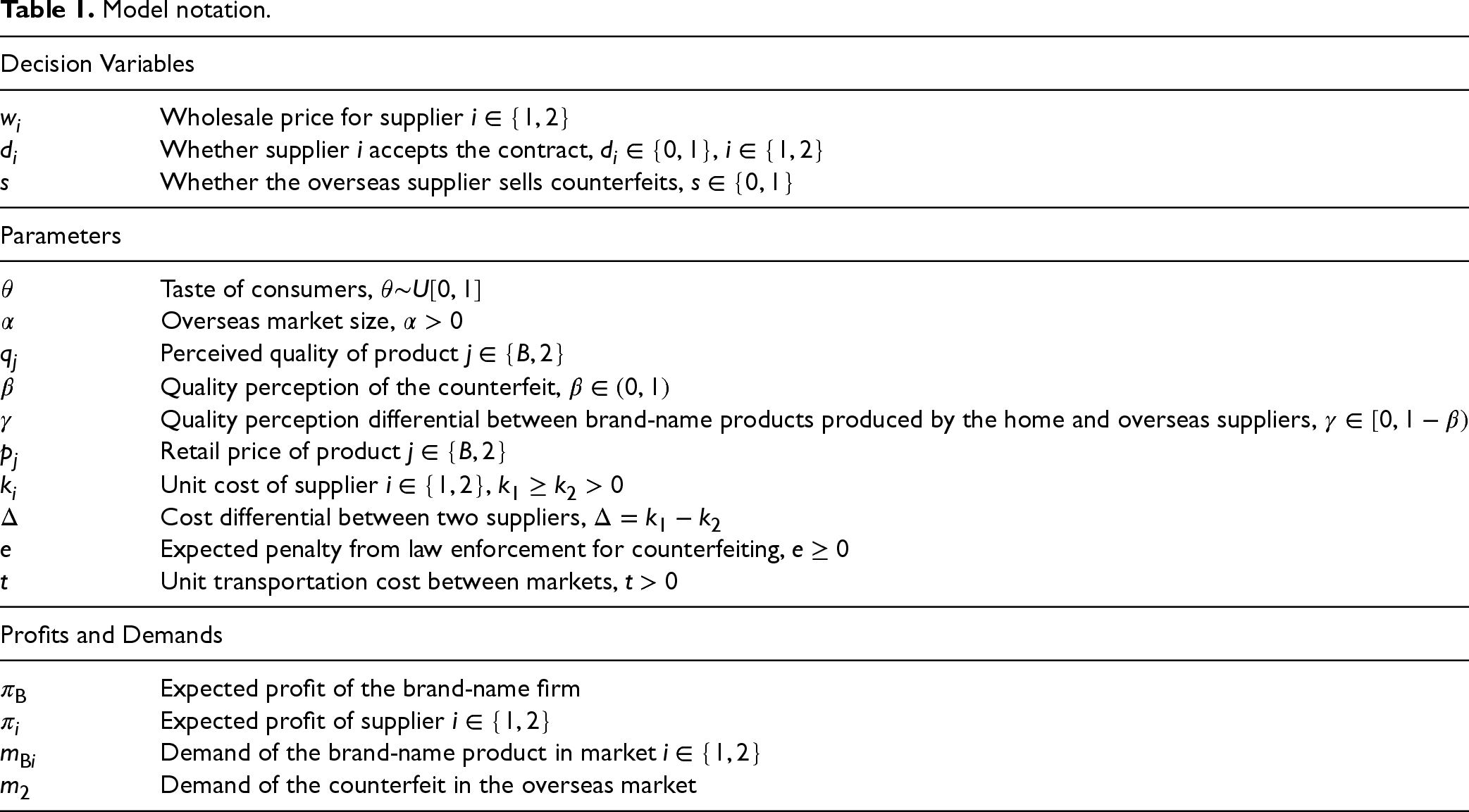
Model notation.
We consider a setting where a brand-name firm (‘‘he’’) potentially outsources production to a home supplier and/or an overseas supplier converted from a counterfeiter, selling the brand-name product to consumers in both home and overseas markets. The size of the home market is normalized to 1, and the overseas market size is
The brand-name firm engages suppliers through wholesale-price contracts. As shown in Figure 1, the model features two stages of decisions: the contract stage (stage 1) and the selling stage (stage 2). At the beginning of the first stage, the brand-name firm offers a wholesale price
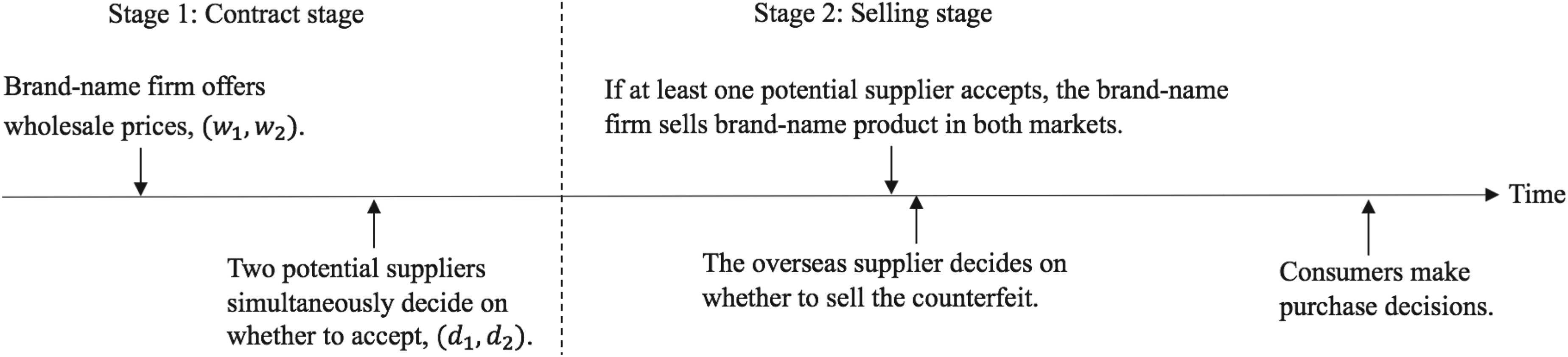
Sequence of decisions and events.
In the second stage, if at least one supplier accepts the contract, the brand-name firm sells the brand-name product at a retail price
In our paper, the overseas supplier may decide to sell counterfeits regardless of her contract acceptance decision. Specifically, in the second stage, the overseas supplier decides on whether to sell counterfeits in the overseas market at the retail price,
We use
Figure 2 depicts the resulting four supply chain structures based on the brand-name firm’s sourcing strategies: single sourcing from the home supplier (H), dual sourcing (D), single sourcing from the overseas supplier (O), and no sourcing (N).
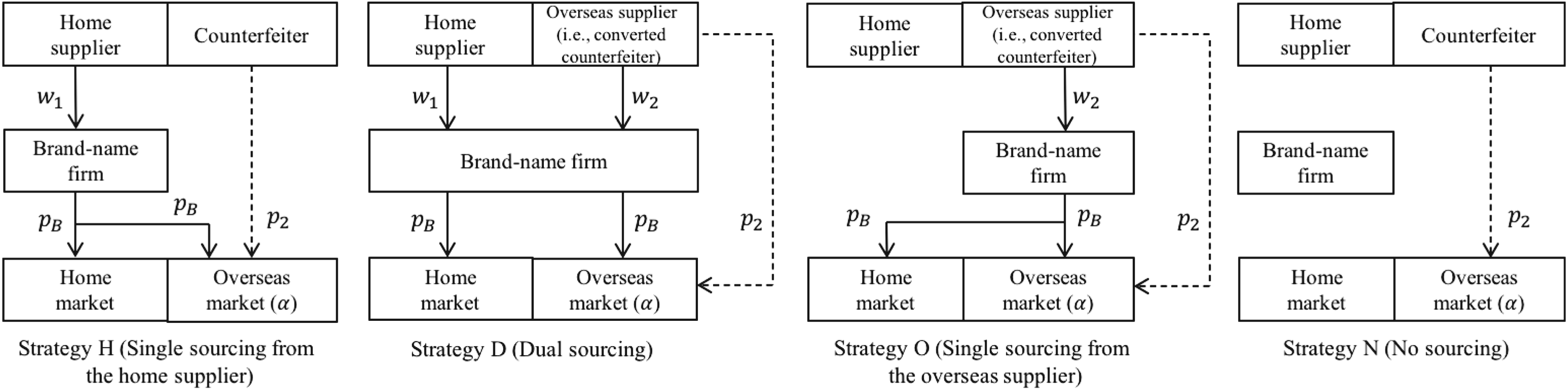
Supply chain structures. Note. Solid lines represent the product flow of the authentic brand-name product and dash lines represent the product flow of the counterfeit.
In our model, each consumer demands at most one unit of the product and does not purchase across markets. Consumers make their purchase decisions to maximize their utility. A consumer’s utility from purchasing product
For simplicity, we normalize the actual quality of the brand-name product to 1. The perceived quality of the brand-name product can be different from its actual quality, especially when produced by an overseas supplier converted from a counterfeiter. To capture the possible loss in brand value due to sourcing from a former counterfeiter, we assume no perception discount for the brand-name product produced by the home supplier, and we use
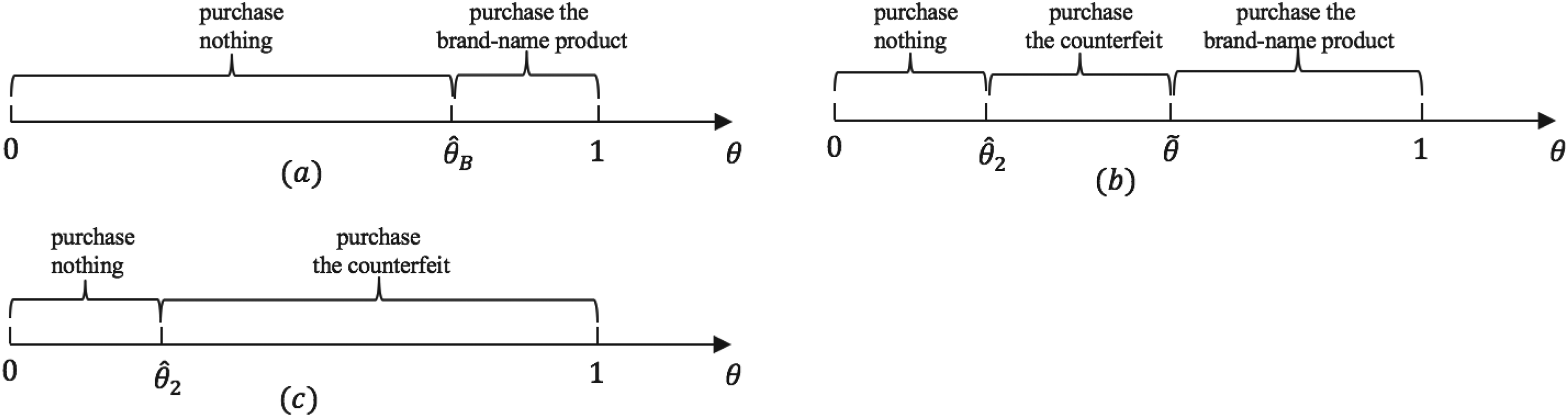
Consumer utility thresholds. Note. (a) The home or overseas market with only the brand-name product; (b) the overseas market with both the brand-name product and the counterfeit; (c) the overseas market with only the counterfeit.
In the overseas market, if the counterfeiter sells the counterfeit, both the brand-name product at price
To summarize, given the home supplier’s contract acceptance decision 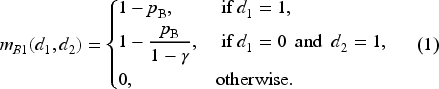
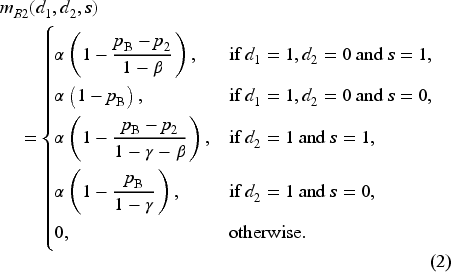
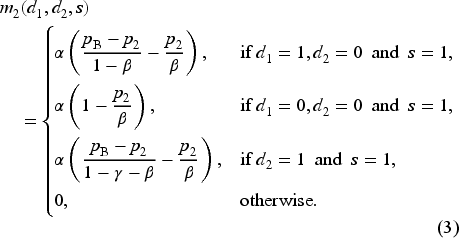
In this subsection, we derive the expected profits of the brand-name firm, the home supplier, and the overseas supplier. We use
Given the wholesale prices and players’ decisions 
The home supplier’s expected profit 
The overseas supplier’s expected profit 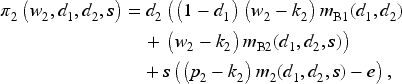
Equilibrium Analysis
In this section, we use backward induction to analyze the sequential game between the brand-name firm and the two potential suppliers, as depicted in Figure 1. In Section 4.1, we analyze the contract acceptance decisions of the home and overseas suppliers, as well as the overseas supplier’s decision on whether to sell counterfeits. In Section 4.2, we derive the profit of the brand-name firm in the second stage under each possible sourcing strategy and discuss the optimal wholesale prices the brand-name firm should offer to maximize his profit. In Section 4.3, we identify the conditions under which a particular sourcing strategy arises in equilibrium in the first stage and analyze the impact of different factors on the equilibrium. In Section 4.4, we investigate the conditions under which counterfeiting can be prevented in the equilibrium and compare the effectiveness of different sourcing strategies on preventing counterfeiting.
Suppliers’ Best Responses
In the second stage, the overseas supplier determines whether to sell counterfeits. She does not engage in counterfeiting if she generates a higher profit without counterfeiting, that is,
For given 
Lemma 1 implies that after accepting the contract and becoming an authorized supplier (
Next, given 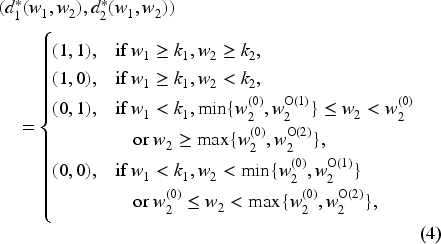
Equation (4) indicates that if the wholesale price
In this subsection, we determine the optimal wholesale prices. The brand-name firm chooses wholesale prices 
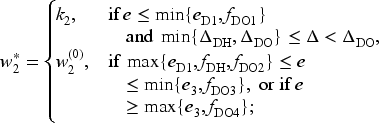
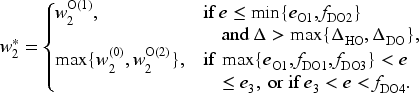
The optimal wholesale price(s) of the brand-name firm, which will be accepted by the home and overseas suppliers, satisfies the following:
under Strategy H, under Strategy D, under Strategy O, (i)
In leader–follower games with wholesale-price contracts, the leader can generally extract all the benefits and set a wholesale price equal to the marginal production cost (Cachon 2003). In our model, under strategies H and D, the brand-name firm sources from the home supplier by providing the wholesale price equal to the supplier’s marginal cost, that is,
Under strategies D and O, the brand-name firm has two options regarding the wholesale price
The decision between offering low and high wholesale prices, which leads to the aforementioned two scenarios, depends on the penalty
When the brand-name firm decides on his sourcing strategy while facing the counterfeiter who can potentially be converted to an overseas supplier, he considers the following tradeoff: reducing the production cost by sourcing from a low-cost and authorized overseas supplier versus losing brand value by sourcing from a former counterfeiter. If the overall benefit from cost reduction exceeds the overall loss in brand value, the brand-name firm prefers converting the counterfeiter, leading to the preference of strategies D and O; otherwise, the brand-name firm is better off sourcing only from the home supplier, that is, Strategy H. Converting the counterfeiter to an authorized supplier does not guarantee that the overseas supplier will not produce and sell counterfeits. Under strategies D and O, the brand-name firm’s wholesale price decision becomes critical. He now has to offer a premium wholesale price to attract the counterfeiter to accept the contract. While offering a sufficiently high wholesale price mitigates competition by preventing the overseas supplier from counterfeiting after conversion, a relatively smaller wholesale price premium that is sufficient to utilize the counterfeiter as an authentic supplier would still allow her to sell counterfeits in the overseas market.
We next present a proposition that compares the optimal profits of the brand-name firm under the four possible sourcing strategies. The derivations rely on the threshold functions developed for the penalty cost (
The equilibrium sourcing strategy of the brand-name firm is as follows:
Strategy H with Strategy D with Strategy O with
Proposition 1 presents three possible equilibrium outcomes: Strategy H, Strategy D, and Strategy O. Strategy N is not an equilibrium strategy because it is dominated by Strategy H, under which the brand-name firm can earn a non-negative profit from the home market. Figure 4 illustrates how the equilibrium sourcing strategy varies with respect to the cost differential between two suppliers (
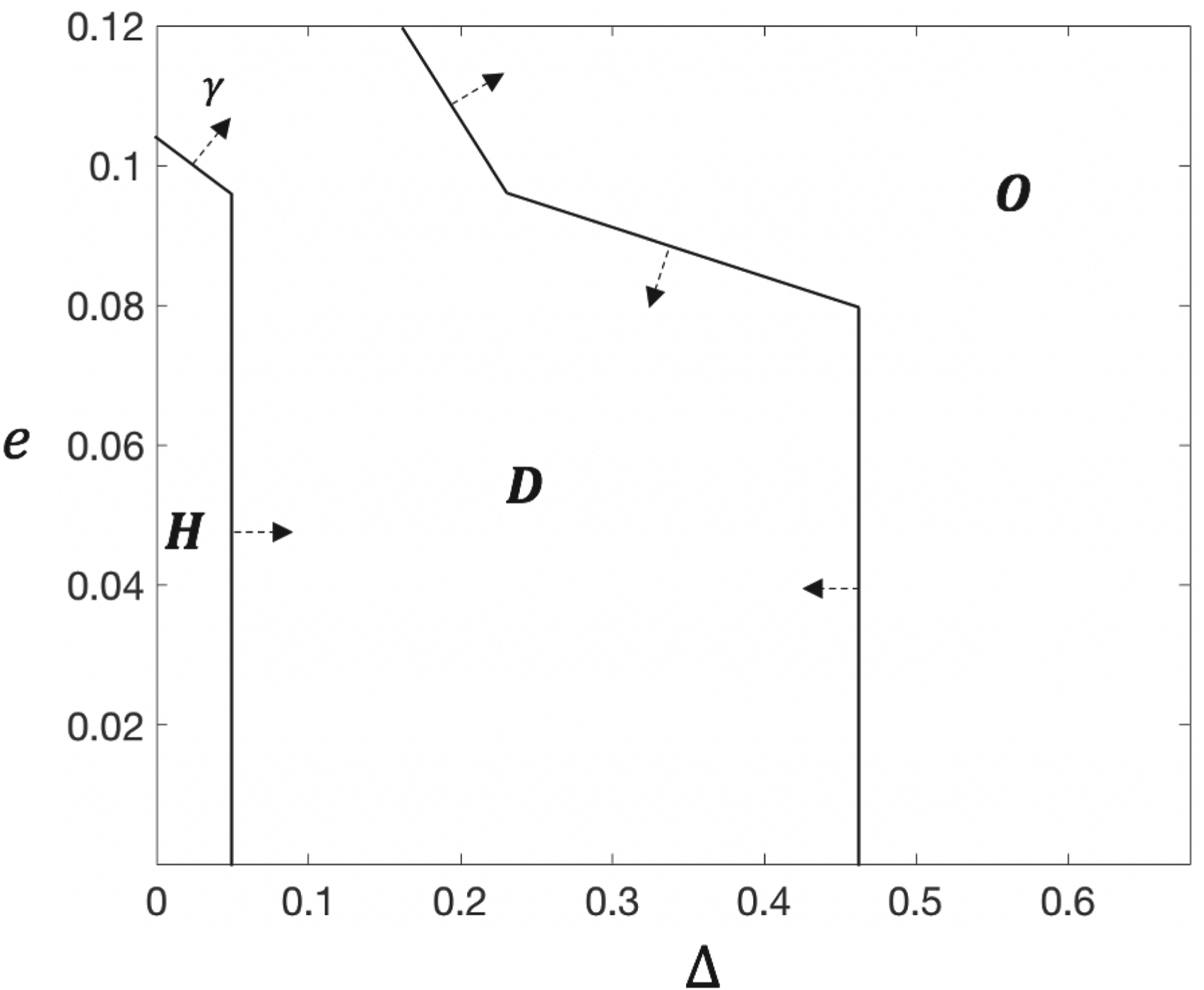
Equilibrium sourcing strategy relative to the cost differential between two suppliers (
When the cost differential (
When the penalty from law enforcement (
Dashed arrows in Figure 4 illustrate the impact of increasing values of the quality perception differential between two suppliers (
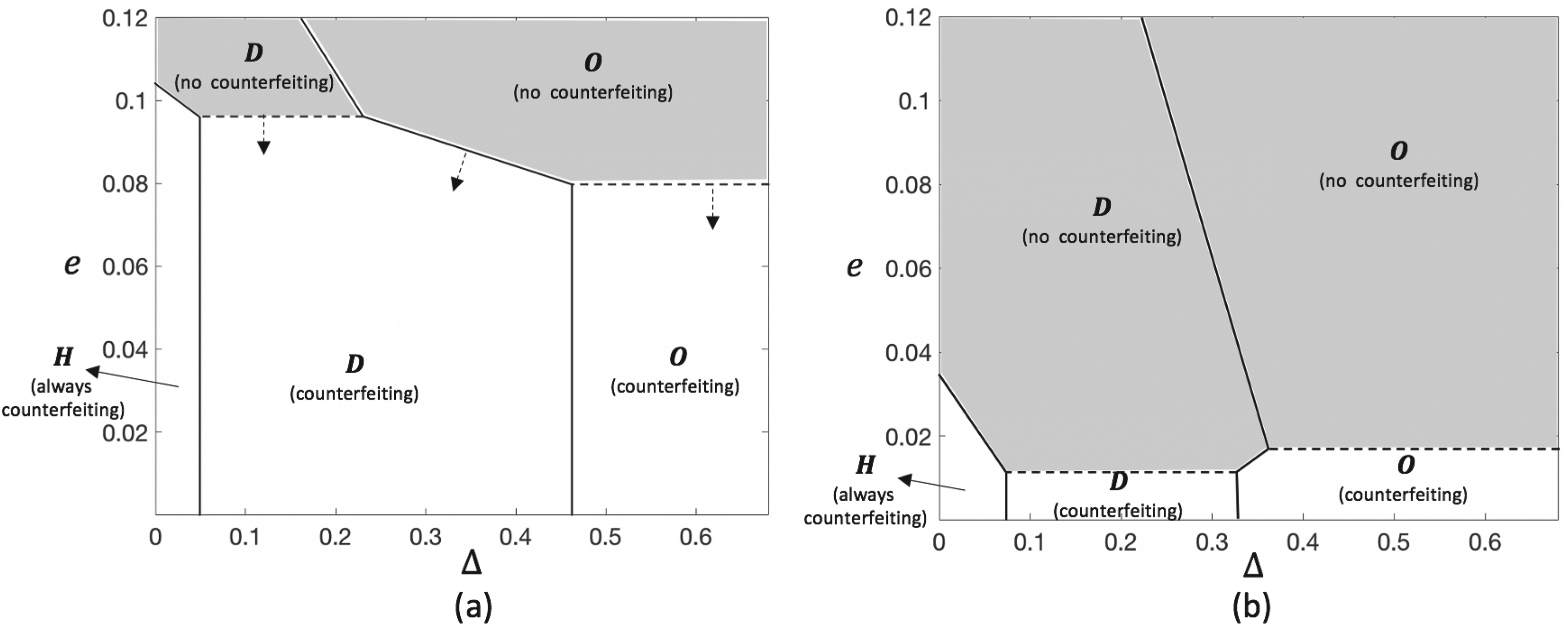
Equilibrium sourcing strategy relative to the cost differential between two suppliers (
When the brand-name firm successfully converts the counterfeiter to an authorized overseas supplier, the overseas supplier may still decide to sell counterfeits in the overseas market. This section investigates the conditions under which counterfeiting is prevented in the equilibrium, that is,
The shaded areas in Figure 5 represent the regions in which the overseas supplier chooses not to sell counterfeits in the equilibrium under strategies D and O. Figure 5 shows that four factors have a non-monotone and interdependent influence on the counterfeiting decision. These four critical factors are (i) the cost differential between two suppliers (
If
Proposition 2 indicates that when the quality perception differential (
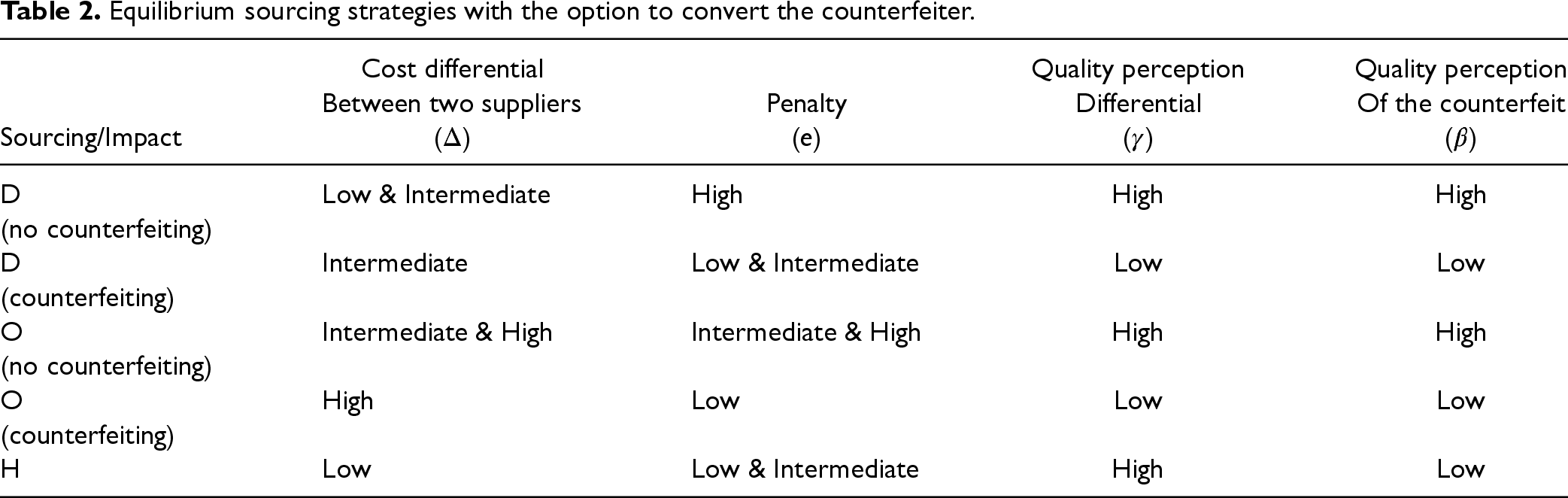
To summarize, the brand-name firm has three possible equilibrium sourcing strategies, as outlined in Table 2. Our analysis yields important implications for global brand-name firms facing the risk of counterfeits, along with recommendations for policymakers. First, while an intermediate to high cost differential (
Equilibrium sourcing strategies with the option to convert the counterfeiter.
In this section, we investigate the impact of converting the counterfeiter to an authorized supplier on firms, consumers, and society. In Section 5.1, we introduce the benchmark case. Sections 5.2 and 5.3 further compare the base model with the benchmark case in terms of profits, consumer surplus, and social surplus.
Benchmark
We first present a benchmark case where the brand-name firm does not have the option to convert the counterfeiter to an authorized overseas supplier and, therefore, sources only from the home supplier. We use “
In the benchmark case, the optimal decision of the counterfeiter about whether to sell the counterfeit is

Comparison of Profits
By comparing equilibrium profits of firms in the base model with that in the benchmark case, we obtain Corollary 1.
For the brand-name firm, For the overseas supplier, For the home supplier,
Corollary 1 shows that converting the counterfeiter brings a win-win outcome for the brand-name firm and the counterfeiter. It is straightforward that when Strategy H is the equilibrium strategy, the profit of each firm in the base model is the same as that in the benchmark case. In the following, we focus on the cases in which strategies D or O is the equilibrium strategy in the base model. Corollary 1(a) shows that, compared with the benchmark case, strategies D and O benefit the brand-name firm. By converting the counterfeiter to an authorized overseas supplier, the brand-name firm not only takes advantage of the low production cost of the overseas supplier but also might expand his market share in the overseas market by mitigating the competition with the counterfeiter. This is consistent with practical examples of Japanese stationery makers Kokuyo (Sugawara, 2015) and Honda (Zaun and Leggett, 2001). Corollary 1(b) shows that, compared with the benchmark case, converting the counterfeiter through Strategy D does not affect the counterfeiter’s profit. This is because, with the home supplier being available, the brand-name firm sets the wholesale price
In the benchmark case without the option to convert the counterfeiter, in equilibrium, the consumer surplus in the home market, 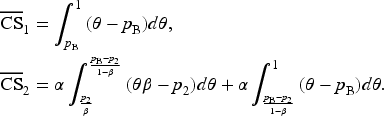
In the base model with the option to convert the counterfeiter, in the equilibrium, under Strategy H, the consumer surplus in each market, 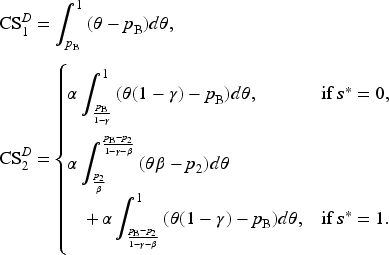
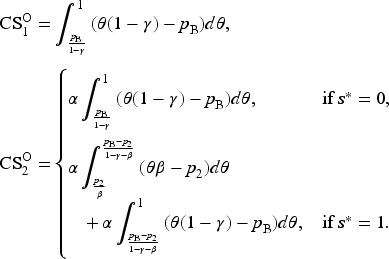
In the home market, In the overseas market, In the two markets,
Proposition 3(a) shows that, compared with the benchmark case, Strategy D has no impact on consumer surplus in the home market, whereas Strategy O reduces consumer surplus in the home market. This reduction is due to the quality perception differential
Next, we analyze the impact of converting the counterfeiter on social surplus. According to Corollary 1 and Proposition 3, compared with the benchmark case, converting the counterfeiter benefits the profits of firms but leads to a reduction in consumer surplus. Therefore, the comparison of social surplus between our base model and the benchmark case depends on whether the gain in profits or the loss in consumer surplus dominates. This is formalized in Proposition 4, which employs thresholds
When counterfeiting is prevented in the equilibrium,
Proposition 4 shows that neither Strategy D nor Strategy O necessarily improves social surplus compared with the benchmark case. Specifically, when the authorized overseas supplier does not sell counterfeits in the equilibrium, both strategies D and O improve social surplus when
We describe the scenario in which converting the counterfeiter leads to higher profits at the brand-name firm and the overseas supplier, and an increase in social surplus as the “triple-win” outcome. This triple-win outcome is shown in Corollary 1 and Proposition 4, and is depicted with the dotted areas in Figure 6.
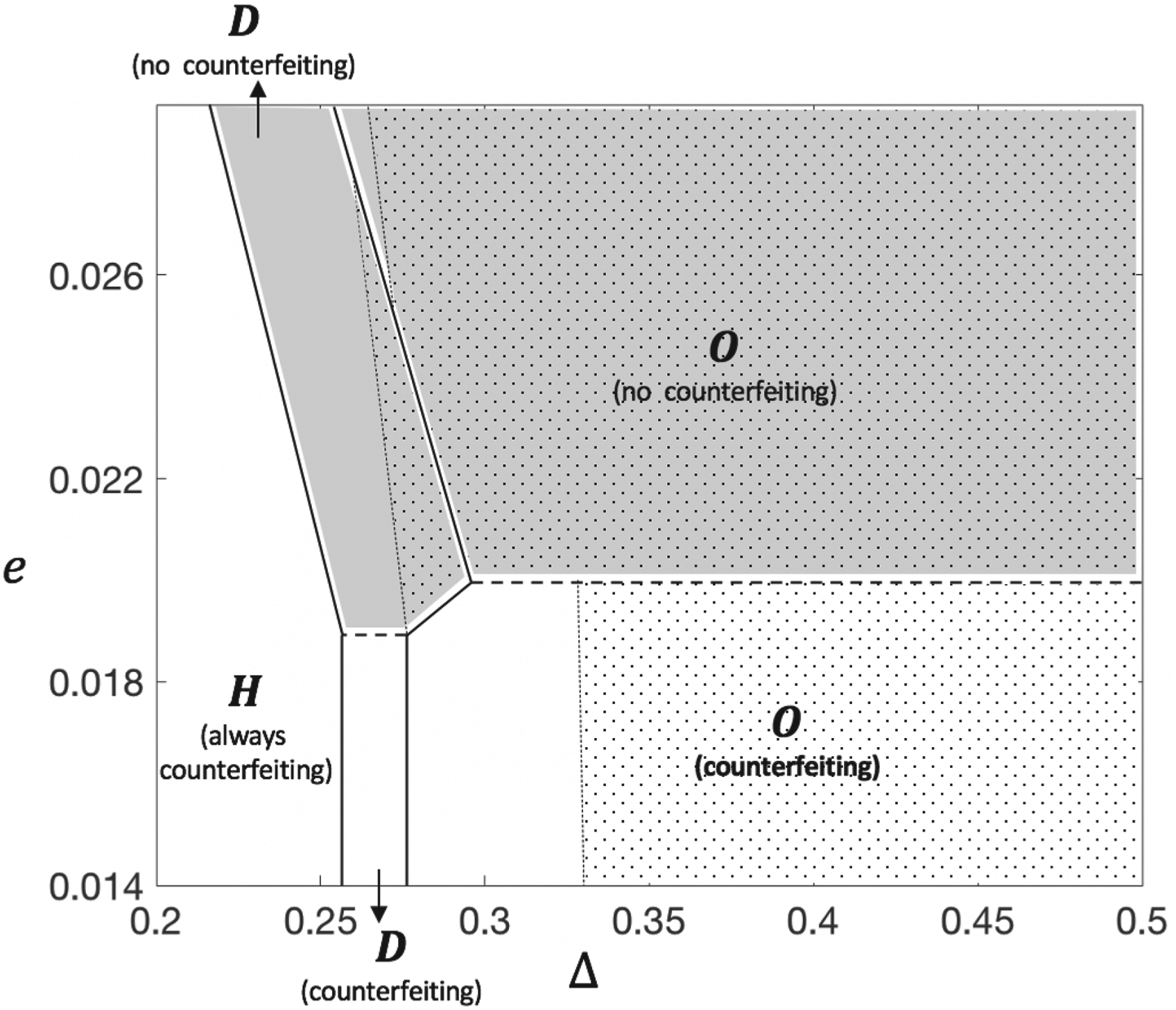
Triple-Win outcome. (Shadow areas indicate that counterfeiting is prevented. Dotted areas indicate the triple-win outcome. In this example,
The above analysis of consumer surplus and social surplus provides insights for governments on whether they should encourage converting counterfeiters to authorized overseas suppliers. When the penalty from law enforcement or the cost differential between two suppliers is high, converting counterfeiters should be encouraged because it benefits brand-name firms, overseas suppliers, and society. In this case, intergovernmental cooperation is helpful in reinforcing law enforcement to implement the conversion strategy towards counterfeiters in emerging markets. However, when the penalty from law enforcement or the cost differential between two suppliers is relatively low, caution should be taken about converting counterfeiters.
In this section, we consider two extensions of our base model: (1) the brand-name firm sequentially offers wholesale contracts to two potential suppliers; (2) counterfeit price is determined endogenously.
Extension 1: Sequential Contract Offering
This extension examines the case when the brand-name firm offers wholesale price contracts sequentially (rather than simultaneously) as depicted in Figure A1 of E-Companion A 7. The overseas supplier first decides whether to accept the contract, followed by the home supplier. This sequential setting allows us to explore scenarios where, if the overseas supplier rejects the contract, the brand-name firm may then turn to the home supplier. We solve this problem by backward induction. Optimal wholesale prices of the brand-name firm under each possible sourcing strategy are formalized in Lemma 3, which employs penalty cost thresholds
The optimal wholesale price(s) of the brand-name firm, which will be accepted by the home and overseas suppliers, satisfies the following: let
under Strategy H, under Strategy D, under Strategy O, (i)
Compared with Lemma 2 in our base model, the possible optimal wholesale prices
By comparing potential profits under each sourcing strategy, we get the equilibrium presented in Proposition 5.
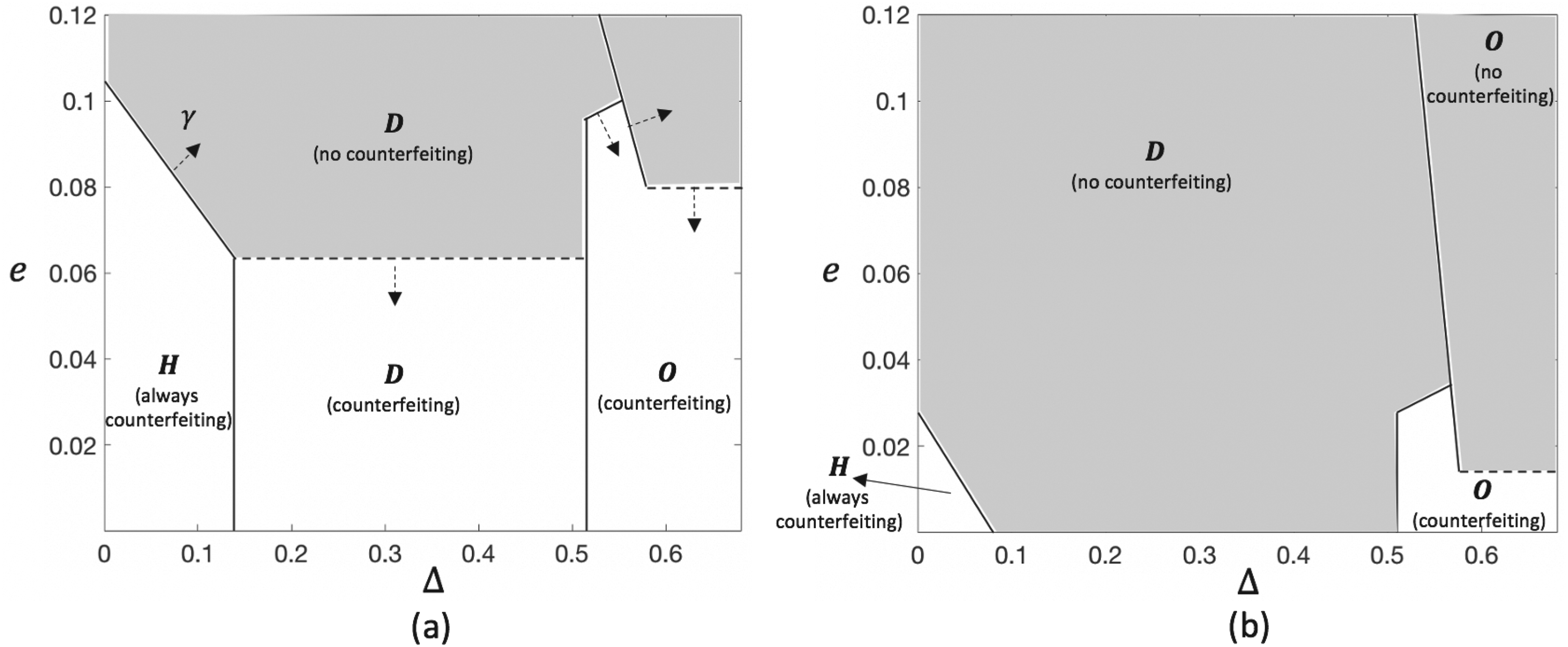
Equilibrium sourcing strategy relative to the cost differential between two suppliers (
The equilibrium sourcing strategy of the brand-name firm is as follows:
Strategy H with Strategy D with Strategy O with
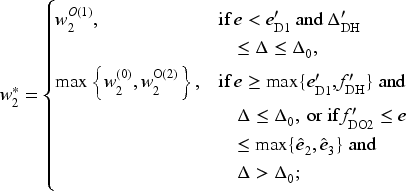
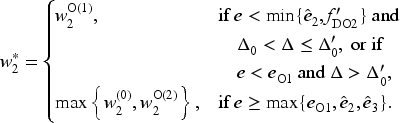
Figure 7(a) displays the regions corresponding to each optimal sourcing strategy. Consistent with earlier findings, the same three optimal sourcing strategies emerge in our equilibrium analysis. The brand-name firm prefers to convert the counterfeiter into an authorized overseas supplier under strategies D and O. Strategy D is preferred at intermediate values of the cost differential
We make three observations regarding the prevention of counterfeiting. First, the horizontal dashed line (
This section examines endogenous price setting for counterfeits. If the overseas supplier determines to sell counterfeit products (i.e.,
For given 
Lemma 4 shows that the overseas supplier can be prevented from selling counterfeits, that is,
Lemma 5 presents optimal wholesale prices provided under each possible sourcing strategy, which employs notations
The optimal wholesale prices of the brand-name firm, which will be accepted by the home and overseas suppliers, satisfy the following:
under Strategy H, under Strategy D, under Strategy O, (i) where
The E-Companion A.2 7 presents a numerical illustration of when each strategy is optimal under the endogenous counterfeit price setting (Figure A2 7). The results are similar to those presented in the setting with exogenous price in Figure 5. Our analysis with endogenous counterfeit pricing yields two insights. First, the ability to set the price of the counterfeit enables the overseas supplier to maximize the profit from selling counterfeits, making counterfeiting more attractive. Second, the brand-name firm has a smaller range of acceptable wholesale prices to offer the overseas supplier in the pursuit of eliminating counterfeiting.
In E-Companion A.3 7, we present an additional extension where both the brand-name firm’s retail price
High-quality counterfeits, known as “super fakes,” are increasingly prevalent in emerging markets. We have developed a game-theoretic model based on a two-tier supply chain that captures the interactions between a brand-name firm with a legitimate home supplier and a counterfeiter capable of producing these super fakes, who could potentially be converted to an authorized overseas supplier. Our study outlines three primary sourcing strategies for the brand-name firm: dual sourcing (Strategy D), single sourcing from the overseas supplier (Strategy O), and single sourcing from the home supplier (strategy H). The effectiveness of each strategy varies based on specific problem parameters, with strategies D and O potentially facilitating the conversion of the counterfeiter into an authorized supplier. Our analysis explores how various factors, such as the penalty from law enforcement, the cost differential between two suppliers, the quality perception differential between the brand-name products produced by two suppliers, and the quality perception of counterfeits affect the brand-name firm’s choice of sourcing strategy and the prevalence of counterfeit sales. This research contributes to the understanding of socially responsible supply chain operations by examining the impacts of converting counterfeiters on firms, consumers, and society at large, offering valuable insights for managing supply chains in emerging markets susceptible to high-quality counterfeiting.
Our paper offers insights and recommendations for global brand-name firms facing counterfeiting risks, as well as guidance for policymakers. First, the brand-name firm is positioned to convert the counterfeiter into an authorized supplier when the cost differential between home and overseas suppliers exceeds an intermediate level. If the cost differential is intermediate, dual sourcing is adopted; if the overseas supplier has a significant cost advantage, single sourcing is preferred. Under both strategies, the brand-name firm offers a high wholesale price to the counterfeiter, which does not need to be excessively high if the penalty for counterfeiting is moderate to high. Additionally, a smaller quality perception differential, indicating a lesser loss in brand value upon converting the counterfeiter, increases the likelihood of conversion. Our findings suggest that brand-name firms should strategically use wholesale contracts to convert counterfeiters.
Second, converting the counterfeiter to an authorized overseas supplier does not automatically prevent counterfeit sales, as the authorized overseas supplier might still engage in such activities. Our study delineates the conditions under which an overseas supplier chooses to sell or refrain from selling counterfeits. While a moderate to high cost differential and/or a low quality perception differential facilitate conversion, they do not ensure cessation of counterfeiting. The enforcement of penalties becomes crucial in preventing counterfeiting. As the quality perception of super fakes approaches that of genuine brand-name products, the brand-name firm gains a stronger incentive to completely prevent counterfeiting by strategically setting wholesale prices. This strategy lessens the reliance on traditional anti-counterfeiting measures, rather it encourages global firms to offer effective contracts to prevent counterfeit sales.
Third, we identify another benefit of dual sourcing that has not been reported earlier: mitigating counterfeit risks, in addition to its widely-reported role of risk diversification. It can be more effective than single sourcing as the quality perception of super fakes approaches that of brand-name products; its effectiveness becomes more pronounced when the brand-name firm offers wholesale price contracts in a sequential order. Conversely, single sourcing is preferable under conditions of high cost differential and low quality perception differential, as it requires lower penalties from local authorities.
Fourth, converting counterfeit producers in overseas markets to authorized suppliers can negatively affect consumer surplus and does not necessarily enhance social surplus. This outcome arises because consumers may prefer the product from the home supplier, and conversion also removes competition in the overseas market, thereby reducing consumer choice and surplus. Society benefits when either penalties from law enforcement or the cost differential between suppliers is high, suggesting a complex interplay between market dynamics and regulatory actions.
Our study introduces two extensions. The first examines the potential of offering wholesale contracts sequentially. While our primary conclusions remain valid, we find that dual sourcing outperforms single sourcing in terms of mitigating counterfeiting risk as it requires a smaller penalty to be effective. In the second extension, we explore the brand-name firm’s ability to set retail prices, demonstrating that this pricing flexibility can be leveraged to prevent counterfeiting.
Future research could extend these findings in several ways. Our analysis adopts a risk-neutral perspective when considering the potential for counterfeiting. Incorporating a risk-averse perspective of the counterfeiting overseas supplier may further improve our findings and identify the necessary and sufficient conditions in a granular way. Additionally, our study assumes that the home supplier earns no profit if she rejects the brand-name firm’s contract. Investigating scenarios where the home supplier has alternatives, such as producing for other companies upon rejecting the contract, could provide further insights.
Supplemental Material
sj-pdf-1-pao-10.1177_10591478251327759 - Supplemental material for Converting Counterfeiters in Emerging Markets to Authorized Suppliers: A New Anti-Counterfeiting Measure
Supplemental material, sj-pdf-1-pao-10.1177_10591478251327759 for Converting Counterfeiters in Emerging Markets to Authorized Suppliers: A New Anti-Counterfeiting Measure by Liling Lu, Xin Fang, Sarah Yini Gao and Burak Kazaz in Production and Operations Management
Footnotes
Acknowledgments

Declaration of Conflicting Interests
The authors declared no potential conflicts of interest with respect to the research, authorship, and/or publication of this article.
Funding
The authors received no financial support for the research, authorship and/or publication of this article.
How to cite this article
Lu L, Fang X, Gao SY and Kazaz B (2025) Converting Counterfeiters in Emerging Markets to Authorized Suppliers: A New Anti-Counterfeiting Measure. Production and Operations Management 34(9): 2910–2930.
References
Supplementary Material
Please find the following supplemental material available below.
For Open Access articles published under a Creative Commons License, all supplemental material carries the same license as the article it is associated with.
For non-Open Access articles published, all supplemental material carries a non-exclusive license, and permission requests for re-use of supplemental material or any part of supplemental material shall be sent directly to the copyright owner as specified in the copyright notice associated with the article.
