







Abstract
In light of the recent frequency of global emergencies that result in overseas delivery delays and cost surges, many multinational brands consider reshaping their sourcing configurations by incorporating local suppliers that may be of lower quality than globally selected counterparts. In this global context, pre-committed emergency renegotiation clauses have gained recognition as a common practice in international commercial contracts, which enable contractual parties to adjust key terms, such as the wholesale price and order quantity, during ex-post emergencies. This work aims to investigate how the presence of overseas emergency renegotiation affects the brand’s strategy preference for dual versus single sourcing and the decision-making of supply chain parties. By comparing with two widely observed benchmark scenarios—contract termination and contract continuation at post-recovery cost—that exclude overseas emergency renegotiation, we show that in the presence of emergency renegotiation, the overseas supplier under both sourcing strategies may lower its wholesale price for the brand in response to a higher delay probability, which would not be the case in the contract termination benchmark. This price-cutting effect encourages the brand to order more from the overseas supplier, even if the delay probability is high. Furthermore, the brand favors dual sourcing if the overseas post-recovery unit cost is either low or high, driven by a distinct incentive under renegotiation: the local supplier may suppress the local rival by setting a high wholesale price, a scenario not possible in the contract continuation benchmark. Our study highlights the value of emergency contract renegotiation in reshaping resilient sourcing strategies for multinational brands facing global emergencies, even with ex-post local reorder or overseas quality deterioration during recovery.
Keywords
Introduction
Traditionally, global brands like Apple and Mattel have prioritized sourcing products worldwide to achieve superior quality and access advanced production technologies (EC Sourcing Group, 2024; Tang, 2008). However, the increasing frequency of global emergencies in recent years has led these companies to reevaluate their global sourcing strategies. One notable example is the COVID-19 pandemic, which significantly disrupted global supply chains across various industries. Such emergencies can have several potential consequences. Firstly, they often result in global delivery delays, as complete disruptions are relatively rare in the post-pandemic era, with most emergencies causing delays instead. Accenture reported that since the pandemic, the majority of suppliers in the manufacturing sector have experienced production and logistics delays (Accenture, 2024). For instance, Toyota, a leading Japanese automaker, had to postpone vehicle production due to pandemic-related disruptions in Vietnam and Malaysia (The Financial Times, 2021). Additionally, another critical consequence is the increased post-recovery costs incurred by affected suppliers, such as elevated production and logistics expenses compared to pre-emergency conditions (International Monetary Fund, 2022; S&P Global, 2021).
To mitigate these potential damages, dual sourcing has become a prevalent strategy. Global brands can incorporate a local supplier, typically situated nearby, into their supply networks, even though this local supplier may be of lower quality as compared to the globally selected high-quality counterpart (KPMG, 2024: 11; Tomlin and Wang, 2011). A notable example is Ford’s recent partnership with GlobalFoundries, a US semiconductor chip supplier, aimed at reducing its reliance on Taiwanese chips to enhance supply chain resilience (The New York Times, 2021). This global dual-sourcing approach, involving both overseas and local suppliers, intuitively helps balance supply resilience with high-quality products. However, it also introduces challenges, such as increased supply maintenance costs (Art of Procurement, 2020; Tang and Kouvelis, 2011), elevated procurement prices due to exposure to supply risks (Forbes, 2022; Niu et al., 2021), and quality inconsistency between suppliers (Li et al., 2020; Niu et al., 2019). These challenges may contribute to the findings of the KPMG survey, which states, “Just 32% of procurement leaders taking part in our global survey say their company is planning, or likely to initiate, onshoring or nearshoring of supply sources” (KPMG, 2024: 11).
Although the effectiveness of dual sourcing as a resilience strategy and the associated trade-offs have been well-documented in both literature and business practice, we note that a growing number of corporations have recognized the importance of renegotiating contracts during emergencies, particularly following the disruptions caused by the pandemic (Katok and Tan, 2025). Andrew Butt, co-founder and CEO of Enable, emphasizes that “contracts shouldn’t be viewed as fixed agreements that companies have to observe no matter what” (Forbes, 2021). The KPMG survey echoes this sentiment, highlighting the necessity for the ability to renegotiate contracts (KPMG, 2024: 18).
In practice, when pre-signed contracts lack explicit renegotiation clauses, emergencies typically result in two possible and widely observed contractual outcomes. The first is contract termination, akin to a complete disruption, a scenario widely adopted in the literature to capture the consequences of such events (Shan et al., 2022; Tang et al., 2014). The second is contract continuation, grounded in the legal principle that a signed supply contract is binding and cannot be altered arbitrarily, as per the legal doctrine of pacta sunt servanda. Consequently, even if emergencies cause delays and increased costs for the supplier, it remains obligated to fulfill the original contract terms. This scenario is analogous to the concept of “forced compliance” discussed by Cachon and Lariviere (2001). In contrast to these two extreme scenarios, the inclusion of contract renegotiation provides contractual parties with a new, more desired option for responding to emergencies.
To facilitate contract renegotiation during emergencies beyond a party’s reasonable control, parties can include a renegotiation clause in their initial contract. This clause essentially allows for the modification of certain terms, adhering to the principle of good faith (Trans-lex, 2024). It ensures a rational allocation of risk and damage, preventing the burden from falling solely on the affected party and aiding in the stabilization of supply chains. The scope of circumstantial changes that can trigger renegotiation—such as delivery delays and cost escalations resulting from emergencies—as well as the specific aspects subject to adjustment, are typically outlined in the initial contract, serving as an ex-ante commitment between the contractual parties. For instance, hardship is one of the conditions that triggers renegotiation, and the hardship clause can be considered a subset of renegotiation clauses. Articles 6.2.2 and 6.2.3 of the UNIDROIT Principles of International Commercial Contracts (PICC), a private law framework for international contracts ratified by 65 member states, state that “There is hardship where the occurrence of events fundamentally alters the equilibrium of the contract either because the cost of a party’s performance has increased
The evolving business cognitions and legal frameworks underscore the growing recognition of renegotiation as a critical mechanism for maintaining contractual relationships and sustaining contractual performance during emergencies. The proactive incorporation of renegotiation clauses reflects a shift towards more adaptable contracting, especially in the context of recurrent emergencies that do not result in complete disruption (hereafter referred to as “delivery delay” for clarity). In this study, we treat emergency renegotiation as a default business phenomenon and investigate the novel insights it introduces into the existing literature on supply diversification. Specifically, we aim to analyze how this anticipatory renegotiation influences the operational decisions and interactions among supply chain parties. This analysis is particularly relevant for global brands that are wavering on global sourcing configurations, a topic that is underrepresented in the current literature of single- and dual-sourcing strategies.
To these purposes, we develop a game-theoretical model comprising a global brand, a local rival, a local supplier, and an overseas supplier. The two suppliers differ in terms of delivery delay risk and production quality: the overseas supplier is chosen for its superior production quality but is susceptible to potential overseas delivery delays and incurs additional post-recovery costs. By contrast, the local supplier is reliable in terms of delivery but faces issues with quality yield. The brand, which traditionally relies on high-quality global sourcing (referred to as Strategy S), has the option to transition to a dual-sourcing configuration (referred to as Strategy D) at the additional cost of maintaining dual suppliers. Meanwhile, the local rival sources exclusively from the local supplier. In the main model, which includes emergency renegotiation, the overseas supplier and the brand renegotiate and execute a new contract, including revised wholesale price and order quantity, in response to delivery delays and additional post-recovery costs as stipulated by the renegotiation clause. This setup can be considered a blended mechanism of “ex ante commitment” and “ex post negotiation” as defined by Li (2013), where a price or contract committed ex-ante is subject to renegotiation ex-post.
We begin by analyzing two widely observed benchmark scenarios in the absence of overseas emergency renegotiation: contract termination and contract continuation at recovery cost. In the first benchmark, we assume that an overseas delivery delay results in contract termination, meaning the brand receives nothing from the overseas supplier, akin to a complete overseas disruption. In the second benchmark, the overseas supplier is obligated to fulfill the original contract despite the delivery delay, which incurs an additional post-recovery unit cost. Subsequently, we compare these benchmarks with our main model to identify which outcomes from the benchmarks remain consistent and which are uniquely induced by the presence of emergency renegotiation. Among others, we highlight the following key insights.
In the contract termination benchmark, the brand’s wholesale prices under both strategies increase with the delay probability. However, when overseas emergency renegotiation is introduced, the overseas supplier may instead reduce the wholesale price charged to the brand as the delay probability increases. This suggests that the presence of emergency renegotiation would allow overseas suppliers to mitigate potential losses from increased delay probabilities by focusing on increasing sales volume, rather than maintaining a high margin. This price-cutting behavior encourages the brand to order more from the overseas supplier than from the local supplier even when the overseas delay probability is high, a result absent in the benchmark.
Furthermore, we show that the emergency renegotiation in the main model introduces a new incentive for the brand to prefer Strategy D. Specifically, compared to Strategy S, the local supplier under Strategy D may suppress its local rival channel by setting a higher wholesale price, particularly when the overseas supplier’s post-recovery unit cost is high. This suppression is not achievable in the contract continuation benchmark, where the wholesale price charged by the local supplier to the local rival is consistently lower under Strategy D than that under Strategy S. Consequently, the brand is inclined to adopt Strategy D if the overseas supplier’s post-recovery cost is either low or high.
The remainder of this article is organized as follows. We review the relevant literature in Section 2. In Section 3, we describe the model by illustrating the notations, assumptions, supply chain structures, and game sequences. Two benchmarks without overseas emergency renegotiation (contract termination and contract continuation) are examined in Section 4. Then we analyze the main model with overseas emergency renegotiation in Section 5. We provide several extensions in Section 6. Concluding remarks are given in Section 7. All the proofs and additional results are relegated to the Appendices.
Literature Review
Our work is closely related to the literature on managing supply chain resilience, particularly the stream on dual sourcing (Dong et al., 2023; Liu et al., 2016; Li et al., 2023; Tomlin, 2006; Tomlin and Wang, 2011), which is widely recognized as an effective approach to enhancing supply chain resilience by allowing firms to adjust order allocations across suppliers with varying levels of supply uncertainty. Prior studies have extensively investigated operational decisions (e.g., price, order quantity, and quality level) under supply risk and explored the conditions under which firms are incentivized to adopt a dual-sourcing strategy. For instance, Burke et al. (2007) find that only when the supply capacity significantly exceeds demand can single-sourcing be the optimal strategy; otherwise, dual sourcing tends to dominate. Xiao et al. (2015) consider a dual-sourcing strategy where the buyer can source from a responsive spot market or sign a forward-buying contract with postponed delivery, and analyze how procurement cost fluctuations influence the buyer’s optimal price and sourcing decisions.
Aligned with the aforementioned stream, we focus on the bright and dark sides of dual sourcing under supply uncertainty. The delivery delay serves as a supply risk for the affected supplier, rendering it at a disadvantage in competing for downstream orders compared to the supplier at low/no risk, which is similar to Hu and Kostamis (2015). However, our work differs by incorporating suppliers’ endogenous pricing decisions, enabling us to capture their competitive interactions more explicitly. Specifically, as the overseas delay probability increases, the unaffected local supplier will be endowed with more pricing power so that a higher wholesale price is charged. In this sense, introducing a local supplier may not entail supplier competition that leads to lower wholesale prices than the single-sourcing structure, but instead result in a higher wholesale price. However, the brand may still prefer dual sourcing even if the wholesale price from the local supplier exceeds that under the single-sourcing structure. This contrasts with the result by Tang et al. (2014) that dual sourcing is favored primarily when supplier competition drives prices down. This is because in our model, the local supplier may suppress the local rival, indirectly benefiting the brand. Furthermore, under endogenous wholesale prices, a higher post-recovery cost of the overseas supplier does not necessarily encourage the brand to adopt dual sourcing, which complements the results of Hu and Kostamis (2015) and Dong et al. (2022) that a new supplier will be included if the existing suppliers are of high cost. We also differ in model setup: while their studies focus on the impact of the ex-ante cost difference on supply diversification strategy, we consider cost increases that occur ex-post.
The optimal order allocation under dual sourcing has also been extensively explored. Our model is similar to the scenario of “one sole sources, the other dual sources” by Tang and Kouvelis (2011), which solely highlights the difference in supply chain structures and shows that under symmetric suppliers and exogenous wholesale prices, the dual-sourcing buyer always allocates a larger (or smaller) order to the exclusive (or common) supplier. In our model where suppliers are asymmetric in supply risk and wholesale prices are endogenous, however, the brand may place a larger order with the common local supplier if the overseas delay probability is moderate. This result highlights the impact of the delay probability on suppliers’ pricing power. Moreover, some studies, such as Dada et al. (2007), Hu and Kostamis (2015), Li et al. (2013), and Shan et al. (2022), reveal the cost-first-reliability-second principle when there exist both reliable and unreliable suppliers. We echo this finding by showing that the risky overseas supplier may still obtain more orders from the brand if the local supplier charges a high wholesale price (under a high overseas delay probability), which further underscores the role of pricing power and how it is shaped by some important parameters.
Second, we contribute to the broad literature on supply random yield. Some studies take suppliers’ yield rate as the measure of supply uncertainty (Dong et al., 2022; Kouvelis et al., 2021; Tang and Kouvelis, 2011), whereas others interpret yield uncertainty as the production/service quality level. For example, Federgruen and Yang (2009) build a quality competition model where suppliers compete by setting their yield rates, yield deviations, or both. Wang et al. (2014) model yield uncertainty as a reflection of production quality and examine why the manufacturer may benefit from supporting supplier quality improvement. Niu et al. (2019) study a brand’s incentive to introduce a non-competitive supplier with low production quality to manage the competitive supplier that develops a self-brand. Consistent with the above papers, we also interpret yield uncertainty as an indicator of production quality and model it using a proportional yield formulation (Yano and Lee, 1995). Differently, we study the overseas delivery delay which follows a binomial distribution (Hu and Kostamis, 2015; Tang et al., 2014), while the local supplier’s quality follows a continuous distribution of yield uncertainty. This joint consideration of both the overseas supplier’s delivery delay and the local supplier’s poor quality contributes to capturing the competitiveness asymmetry between the two suppliers in a global supply chain with possible emergencies.
The third stream of literature relevant to our work is global operations. The first sub-stream is on tax-effective operations, where three common taxes are extensively studied—corporate income taxes (Lai et al., 2021; Shunko et al., 2014), tariffs (Wu et al., 2024), and export-oriented taxes (Hsu and Zhu, 2011; Xu et al., 2018). Another sub-stream is on global supply chain networks involving activities such as sourcing, production, and distribution, among which global sourcing is the most relevant. Wu and Zhang (2014) delve into two single-sourcing strategies (local or overseas sourcing) under local competition and highlight the tradeoff of local sourcing between high production cost and accurate demand information. Shao et al. (2020) study a sourcing game in which competing firms choose between a factory with a transparent cost and one with uncertain but potentially lower cost. Chen et al. (2022) investigate how tariffs, global sourcing costs, and local consumer price premiums affect a global brand’s choice between local and overseas sourcing. Compared with the aforementioned studies, we investigate a global supply chain where the high-quality supplier is located overseas and subject to emergency-induced delivery delay and additional post-recovery cost. Within this setting, we explore how the presence of overseas emergency renegotiation influences supplier interactions and, consequently, the brand’s global sourcing strategy. We find that under emergency renegotiation, the brand may prefer dual sourcing when the overseas supplier’s post-recovery unit cost is either low or high.
Finally, our work is also related to the literature on contract renegotiation. While some of them focus on capacity re-allocation or optimal contract design under renegotiation, such as Kemahlıoğlu-Ziya (2015), Li (2013), Plambeck and Taylor (2007a), and Plambeck and Taylor (2007b), we shift the focus to the brand’s global sourcing strategy and examine what differences will be engendered when considering renegotiation. Our analysis is similar in spirit to Kemahlıoğlu-Ziya (2015), which first studies the case without renegotiation and then the case with renegotiation, with a comparison to derive distinctions. Katok and Tan (2025) design a behavioral experiment to investigate the renegotiation effect in mitigating disruption-related losses. In their setting, the supplier bears an additional cost when responding to a disruption and renegotiating with the buyer, which conceptually aligns with the post-recovery cost in our model. Moreover, in our context, the ability of renegotiation is not grounded in information asymmetry, but rather the growing practice in which more and more firms pre-commit to renegotiation clauses in their ex-ante contracts. These clauses are triggered by stipulated circumstances, such as hardship or some other predefined emergencies. We treat emergency renegotiation as a model context and examine how its presence influences global sourcing strategy preference and supplier decision-making. One key implication is that emergency renegotiation may transform a simultaneous game into a sequential one. The resulting benefit is the overseas supplier’s ex-ante wholesale price potentially decreasing with its delay probability on the ground that the overseas supplier and the brand are in consensus to strive for a high sales volume at the ex-ante stage.
Model Setup
We consider a global supply chain consisting of an overseas supplier facing possible overseas delivery delay, a local supplier, a brand originally sourcing from the overseas supplier, and a local rival sourcing locally. The overseas supplier has advanced manufacturing techniques superior to the local supplier but is exposed to the delivery delay risk and additional post-recovery cost. The brand can choose either to engage both the overseas and local suppliers (dual-sourcing strategy, abbreviated as Strategy D) or to continue sourcing solely from the overseas supplier (single-sourcing strategy, abbreviated as Strategy S). In Section 6.5, we extend the model to allow for the possibility that the local supplier is also subject to emergencies and may face local delivery delays. The supply chain structures are illustrated in Figure 1.
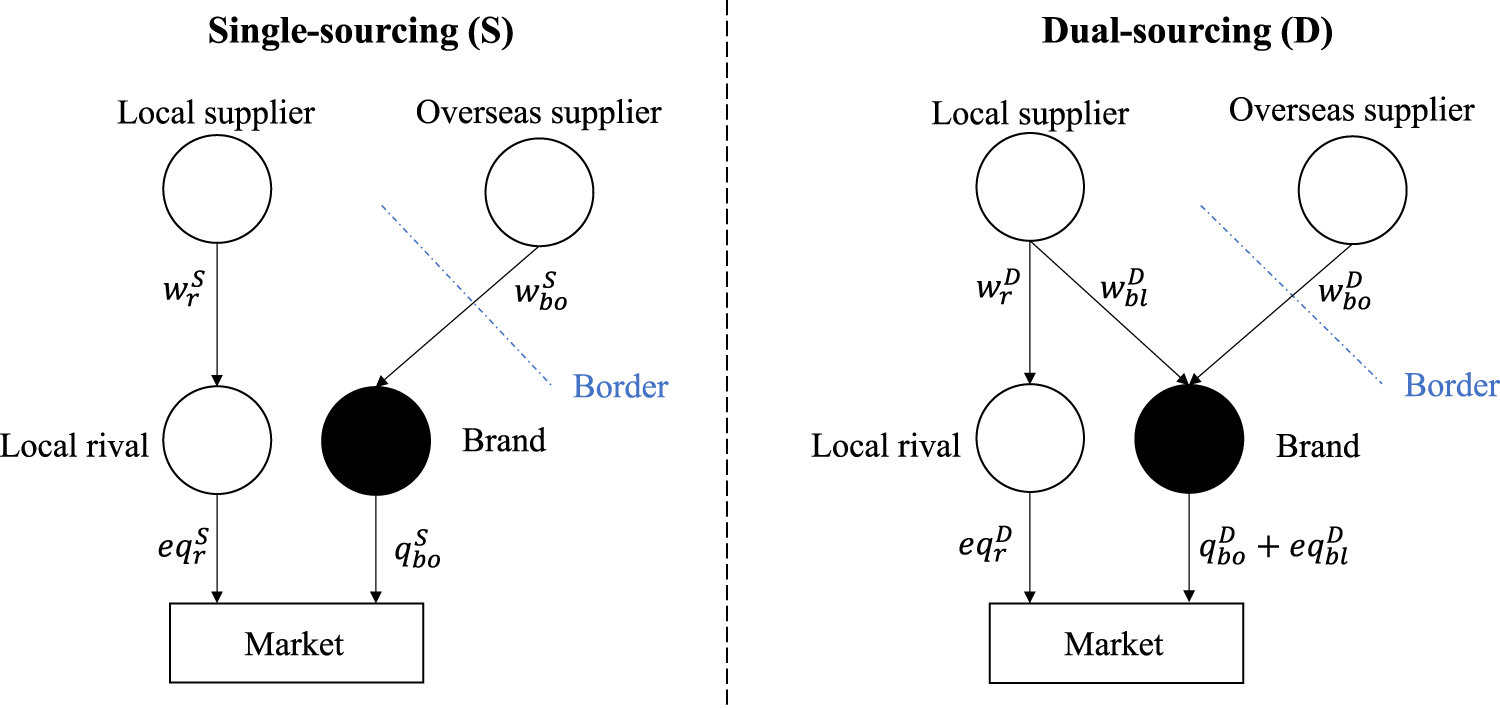
Supply chain structures.
In this article, we focus on the manufacturing industry in which overseas delivery delays caused by emergencies are common (e.g., the automotive and smartphone industries), and production is one-shot with a long lead time. Accordingly, the two downstream buyers (i.e., the brand and the local rival) typically determine their order quantities in advance, anticipating future delivery delay. The market is characterized by an inverse demand function
The local supplier faces a production quality issue due to inferior manufacturing processes. Specifically, if the local supplier receives an order quantity
We use subscripts “
As previously discussed, with overseas emergency renegotiation, a new contract will be re-signed once the overseas supplier suffers from delivery delay and incurs an extra post-recovery cost. To maintain consistency between ex-ante and ex-post decision-making and avoid additional tradeoffs blurring our analysis, we assume that the power of the parties remains unchanged during renegotiation (Li, 2013). That is, it remains the case that the overseas supplier quotes a new wholesale price at which the brand determines a new order quantity. Such a new re-signed contract will differ from the original one because the brand and the overseas supplier act as second movers after observing the rival’s decisions, which can be viewed as an indirect cost of delivery delay while the post-recovery cost is the direct one. We further consider other possible damage/constraint associated with overseas delivery delay in Section 6, where the overseas supplier has a capacity constraint (Section 6.3) or quality deterioration (Section 6.4) upon delay. The subscripts including “
We use the parameter
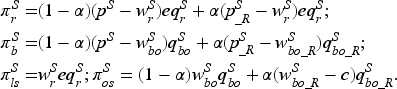
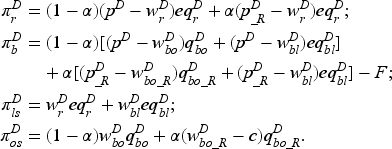
The sequence of events is illustrated in Figure 2. In Stage 1, the brand decides its sourcing strategy, single-sourcing or dual-sourcing. In Stage 2 (ex-ante), the original wholesale price contracts are signed. The local supplier and the overseas supplier determine their wholesale prices
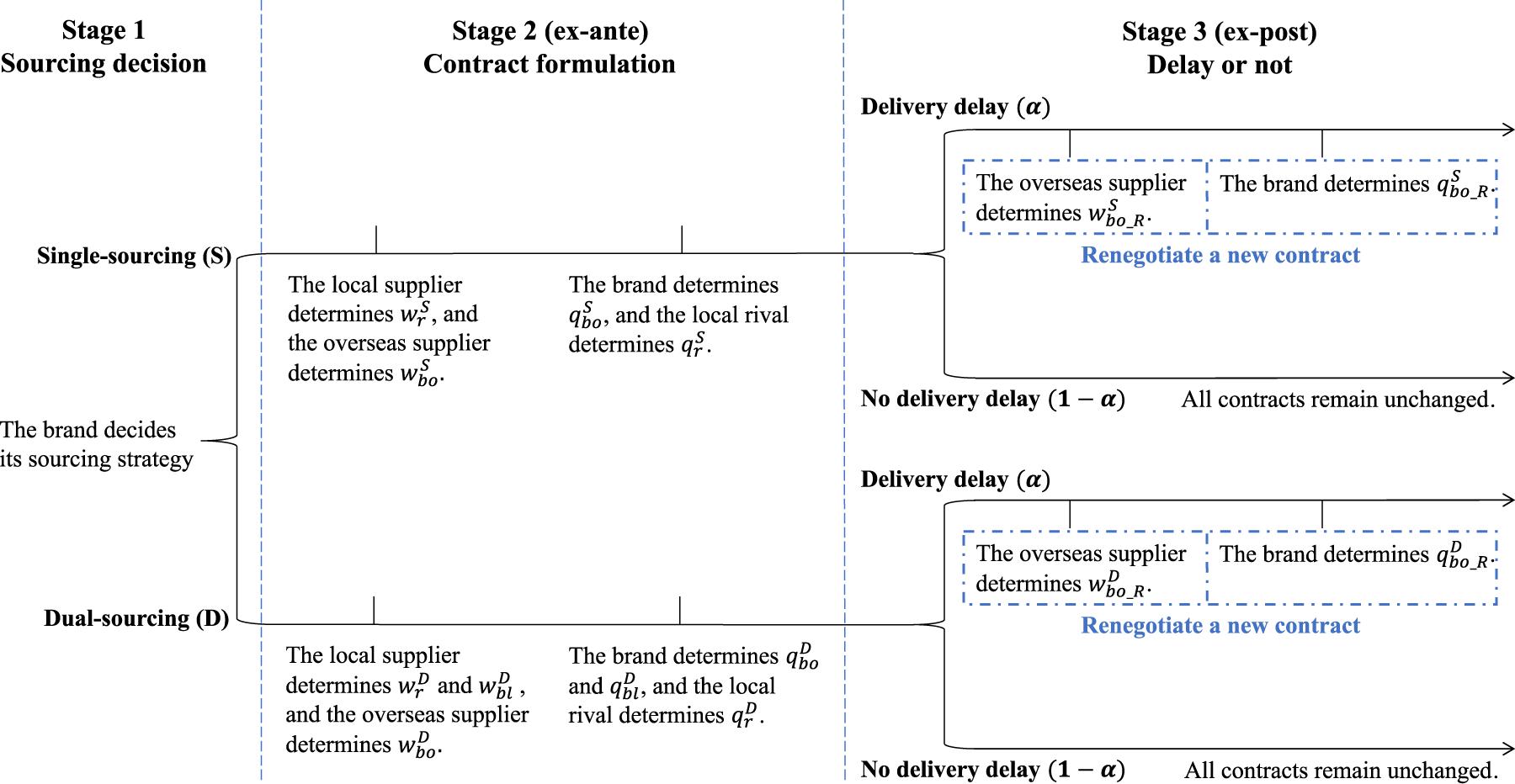
Sequence of events.
In this section, we examine the scenario without overseas emergency renegotiation, focusing on two extreme benchmarks concerning procurement contracts affected by overseas delays: (1) contract termination and (2) contract continuation at an additional post-recovery unit cost. These two benchmarks represent two widely observed and practically relevant contractual outcomes of delay when no explicit renegotiation clause is included. The contract termination benchmark captures situations where delays lead to a complete breakdown of the contractual relationship, a scenario often assumed in the literature to model all-or-nothing disruption. By contrast, in the contract continuation benchmarks, the affected overseas supplier is compelled to fulfill the original contract despite increased costs, in line with real-world practices governed by legal doctrines such as pacta sunt servanda. We focus on the impact of the overseas delay probability in the first benchmark and the impact of the overseas supplier’s post-recovery cost in the second one. This analysis aids in understanding the role of emergency renegotiation, which not only inherits certain attributes from these benchmarks but also introduces new characteristics. It is important to note that all the subsequent discussions are conducted with respect to the final equilibrium outcomes, with all the sub-game derivations relegated to the Appendices.
Benchmark 1: Contract Termination
In the first benchmark, we assume that the overseas delivery delay will entail the contract termination so that the brand receives nothing from the overseas supplier, equivalent to the complete overseas disruption (Hu and Kostamis, 2015; Shan et al., 2022). We add the term “
In the benchmark of contract termination, the following statements about the brand’s wholesale prices hold. Under both strategies, the brand’s wholesale prices increase with The comparison between the brand’s wholesale prices under the two sourcing strategies yields: There exists a threshold
In a competitive environment, delivery delays cause indirect harm by allowing the market of the affected party (i.e., the brand) to be captured by a competitor not exposed to the same risk (i.e., the local rival). Once no delivery delay occurs, this ex-ante captured market places the brand at a competitive disadvantage. To counteract this, the brand is incentivized to secure its market share by placing larger orders ex-ante as the delay probability, denoted by
Under Strategy D, the local supplier’s wholesale price to the brand also increases with
Proposition 1(b) aligns with the established consensus in the literature on supply diversification: in the absence of supply risk, dual sourcing can promote supplier competition, resulting in lower wholesale prices under Strategy D compared to Strategy S, which involves an exclusive supplier. However, when accounting for the impact of overseas delay, the strong pricing power granted to the local supplier by a large
In the benchmark of contract termination, the difference in the brand’s profits under the two sourcing strategies (i.e.,
Based on the preceding analysis, the advantage of dual-sourcing, namely supplier competition, diminishes as
In this benchmark scenario, the overseas supplier is obligated to fulfill the pre-existing contract despite the occurrence of an overseas delivery delay, which induces an additional post-recovery unit cost. We refer to this benchmark as contract continuation hereafter. This situation is analogous to the concept of “forced compliance” by Cachon and Lariviere (2001). The term “
Compared to Strategy S, Strategy D presents two intrinsic structural distinctions: (1) the brand sources from two upstream suppliers, and (2) the (common) local supplier serves two downstream buyers. The former distinction involves supplier interactions that are reflected in the wholesale prices charged to the brand, resulting in an increase in the brand’s quantity due to this dual-sourcing structure. Regarding the latter distinction, we focus on the variation in the local supplier’s wholesale price charged to the local rival under the two strategies, which indicates its incentive to coordinate the two channels. Based on these insights, we obtain the following proposition by comparing the two strategies.
In the benchmark of contract continuation, comparing the two strategies, we have the following statements. For the brand’s wholesale prices, For the brand’s total quantity, define For the local rival’s wholesale price,
This benchmark essentially represents a simultaneous game, 2 wherein the overseas contract continues to be executed despite the occurrence of a delivery delay. As a monopolistic position becomes unattainable under conditions of overseas delay, the local rival is unlikely to significantly increase its order to capture the market. Consequently, only the direct damage from the delivery delay, namely the post-recovery cost, is present, while the indirect damage identified in the first benchmark is absent. As a result, the brand has a diminished incentive, as compared to the first benchmark, to source from the local supplier ex-ante, thereby reducing the local supplier’s leverage to increase prices. Supplier competition under Strategy D will dominate and result in lower wholesale prices than under Strategy S (cf. Proposition 3(a)). As suggested by Feng and Lu (2013), the equilibrium wholesale prices are higher in the common-supplier structure (i.e., one-to-two) than in an exclusive-supplier structure (i.e., channel-to-channel), since a high wholesale price of the common supplier can alleviate the downstream competition. Our findings diverge from theirs and underscore the unique characteristics of this dual-sourcing and dual-sales-channel structure. Specifically, it highlights the interplay between supplier competition, arising from supplier interaction in the two-to-one structure, and the softened downstream competition incentive, stemming from channel coordination in the one-to-two structure. In this benchmark, the influence of supplier competition predominates over that of the softened downstream competition.
Beyond supplier competition, the dual-sourcing structure offers an additional advantage: a larger total quantity compared to Strategy S. This benefit is driven by two main factors. First, wholesale prices under Strategy D are lower than those under Strategy S. Furthermore, the inclusion of a reliable local supplier reduces supply risk, thereby enhancing the brand’s competitiveness. As a result, this increase in quantity naturally reduces the local rival’s market share. Anticipating this, the local supplier will adjust its dual sales channels by lowering the wholesale price to the less competitive local rival. This outcome can also be interpreted from the perspective of downstream competition: since the brand faces lower wholesale prices under Strategy D, the local rival’s wholesale price should also be lower to remain competitive.
Note that
In the benchmark of contract continuation, the following statements about the impact of For the brand’s wholesale prices, For the brand’s total quantity,
Lemma 1 shows the impact of
Both suppliers’ wholesale prices increasing with
In the benchmark of contract continuation, the difference in the brand’s profits under the two sourcing strategies (i.e.,
Based on the preceding analysis, the advantage derived from a larger quantity, which encourages the brand to opt for Strategy D, diminishes as
In this section, we analyze the key differences and insights introduced by emergency renegotiation (the main model outlined in Section 3). We highlight two distinct driving forces absent in the two preceding benchmarks: (1) the overseas supplier’s price-cutting, and (2) the local supplier’s suppression of the local rival. These forces contribute to our understanding of how the presence of emergency renegotiation shapes the brand’s order allocation and sourcing strategy preference. A concise summary of the subsequent analysis roadmap is illustrated in Figure 3.
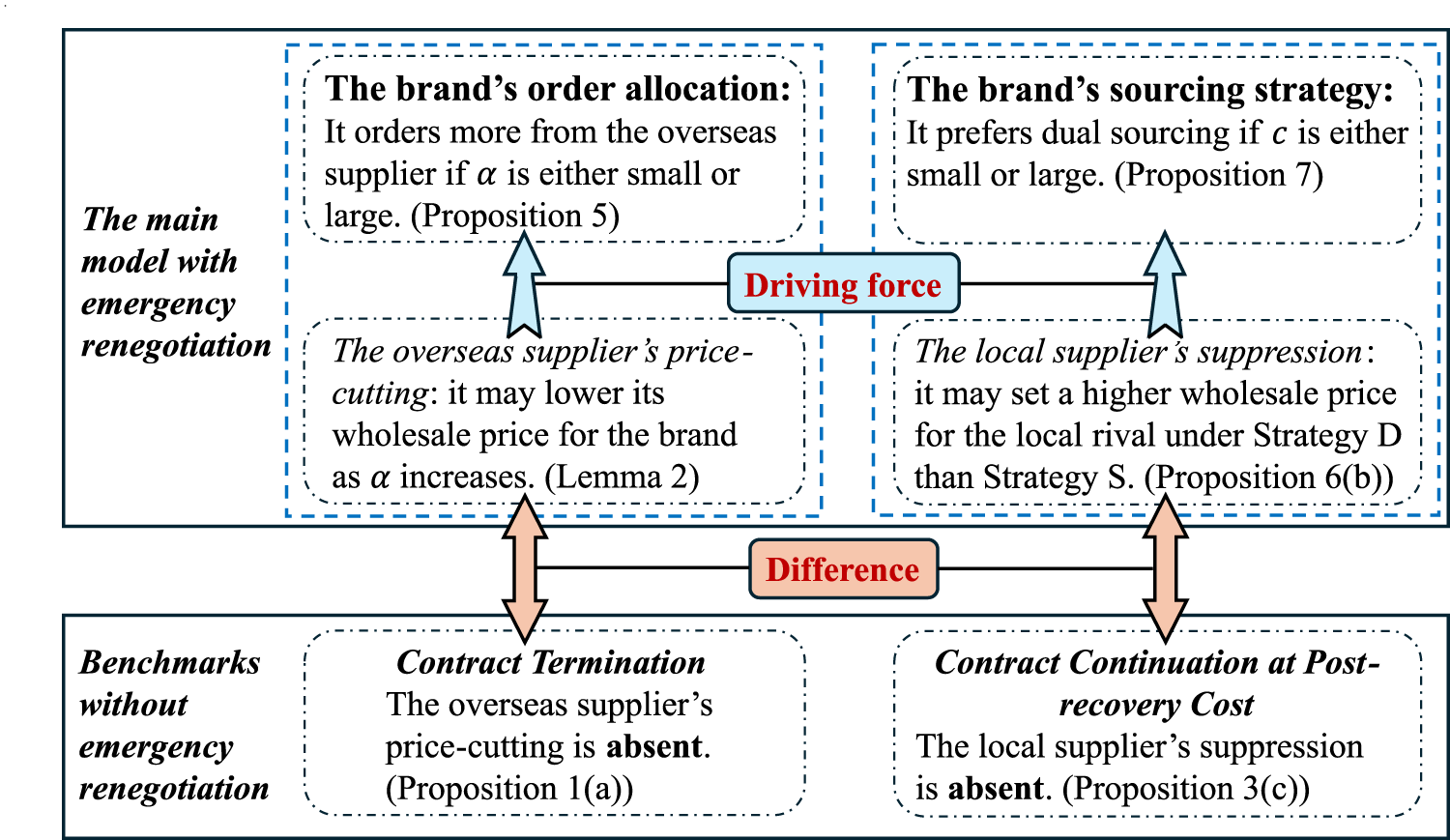
Logic framework with key results.
Note that, if an overseas delay occurs, the contract will be reformulated based on the ex-post residual market that takes into account ex-ante decisions. To counteract the potential disadvantage of being a second-mover and the cost increase imposed by the overseas supplier, the brand is inclined to place larger orders in the ex-ante stage to effectively compete with the local rival, who acts as the first mover. Consequently, it is intuitive that the brand’s expected profitability is contingent upon its ex-ante decisions, as high profitability for both the original and new contracts can be achieved if the brand demonstrates strong competitiveness ex-ante. Therefore, we focus exclusively on the ex-ante operational decisions, in parallel with the benchmarks, to identify the distinctive implications of emergency renegotiation for supply diversification strategies.
Assume Under Strategy S, Under Strategy D,
In sharp contrast to the contract termination benchmark, Lemma 2(a) shows that the wholesale price set by the overseas supplier
Under Strategy D, the overseas supplier’s tendency to lower its wholesale price as
Assume
Proposition 5 excludes the impact of
Although the presence of emergency renegotiation may alter the overseas supplier’s decision-making, the role of
In what follows, we find another key distinction elicited by overseas emergency renegotiation: the local supplier has the incentive to suppress the local rival channel by setting a higher wholesale price under Strategy D than Strategy S, particularly under a large
With overseas emergency renegotiation, comparing wholesale prices under the two sourcing strategies, the following statements hold. For the brand’s ex-ante wholesale prices, There exist thresholds For the local rival’s wholesale price, there exist thresholds
Proposition 6(a) echoes Proposition 1(b), with the rationale recapped as follows. Supply diversification may engender supplier competition as both suppliers compete for the brand’s order, compared with Strategy S with an exclusive overseas supplier. Therefore, the local supplier faces a tradeoff: lowering its wholesale price to compete for the brand’s order versus leveraging the pricing power granted by a large
Regarding the wholesale price of the local rival channel, a key difference from Proposition 3(c) emerges. Although the local rival is less competitive under Strategy D than Strategy S (i.e.,
The threshold of
The above results highlight a key insight: under Strategy D, the local supplier may set a higher wholesale price for the local rival than under Strategy S (referred to as the local supplier’s suppression of the local rival). This suppression behavior introduces a new incentive for the brand to adopt Strategy D, especially when
With overseas emergency renegotiation, there exist two thresholds When if if if When if if if When if if if
Proposition 7 fully characterizes the brand’s optimal sourcing strategy through the lens of three key parameters. A higher supplier maintenance cost
This result can also be explained from the perspective of supplier competition. Under a small
The literature on supply diversification, such as Dong et al. (2022) and Hu and Kostamis (2015), shows that given exogenous supply prices, a new supplier will be introduced when the costs of the existing suppliers are high. In the contract continuation benchmark, an increase in the cost disadvantage of overseas suppliers discourages the brand from including the local supplier in its portfolio (cf. Proposition 4). This finding suggests that the classical results in the literature may not hold when wholesale prices are endogenous and emergency renegotiation is absent. By contrast, our main model offers a new perspective to support the results in the literature: in the context of endogenous wholesale pricing and emergency renegotiation, an overly high expected cost of the overseas supplier (i.e.,
With overseas emergency renegotiation, the following statements about other parties’ profits hold. For the overseas supplier, For the local rival, For the local supplier, there exist thresholds
The brand’s adoption of dual sourcing intuitively harms both the local rival and the overseas supplier, compared to Strategy S. For the local supplier, the intuition is that Strategy D would be beneficial due to the presence of two buyers, namely the brand and the local rival. However, Proposition 8(c) reveals a counterintuitive outcome, indicating that the local supplier may not necessarily benefit from Strategy D. This phenomenon is referred to as the local supplier’s dual-sales-channel dilemma. Dual sourcing can enhance the brand’s competitiveness, thereby negatively impacting the local rival. Consequently, the local supplier can earn more under Strategy D than Strategy S only if it can impose a high wholesale price on the brand. This high margin in the brand channel must compensate for the losses incurred in the local rival channel, a scenario that requires a large
In this section, we conduct additional analysis and model extensions to both confirm the robustness of our main results and derive new managerial insights. Specifically, we discuss (1) ex-post reorder from the local supplier in Section 6.1; (2) consumer surplus and social welfare in Section 6.2; (3) the impact of capacity constraint of overseas post-recovery production in Section 6.3; (4) the impact of quality deterioration of overseas post-recovery production in Section 6.4; and (5) the impact of local delivery delay in Section 6.5, respectively. In addition, we further discuss the impact of consumer loss from delivery delay in Proposition EC.1 in Appendix A.
Ex-Post Reorder From Local Supplier
In practice, a brand with dual supply sources may opt to reorder from the reliable local supplier if there is a delay in overseas delivery. This situation, along with the one analyzed in the main text where the brand commits to renegotiating with the overseas supplier in the event of an overseas delay, is integrated into three distinct scenarios under Strategy D. Specifically, under Strategy D, the brand can pre-commit to the following actions if an overseas delay occurs: (1) exclusively renegotiating a new contract with the overseas supplier (Strategy D as outlined in the main model); (2) exclusively entering into a reorder contract with the local supplier (referred to as Strategy DL); or (3) both renegotiating with the overseas supplier and entering into a reorder contract with the local supplier (referred to as Strategy DB). Under Strategy S, it is assumed that the brand, having an exclusive supply channel, lacks the capability to reorder from the local supplier, thereby maintaining the setup and results of Strategy S as presented in the main model. For tractability, we assume that there is no additional cost associated with the local supplier’s ex-post production, as it never suffers from disruption. The subscript “
Under Strategy DL, the inverse demand functions are
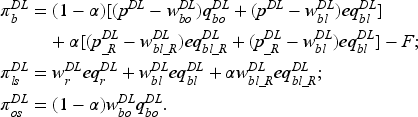
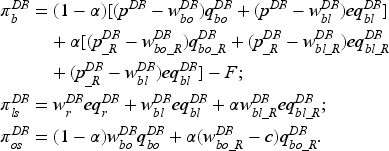
Similarly, the above formulas represent a two-stage game, where ex-post decisions (labeled with “
Considering the case with ex-post reorder from the local supplier, we have the following statements about the brand’s preferred sourcing strategy. There exists thresholds There exists thresholds
Proposition 9(a) shows that when the post-recovery cost of the overseas supplier is high, the brand will prefer Strategy DL under which it can ex-post reorder from the local supplier, rather than sourcing from the high-cost overseas supplier under Strategy S. Instead, a small
In Proposition 9(b), the brand will earn more under Strategy DB only if
While deriving analytical results comparing the brand’s profits under Strategy DB and Strategy D proves challenging, numerical examples suggest that the brand tends to be more profitable under Strategy DB. This observation is intuitive: introducing an additional supplier can intensify competition at the ex-post stage, thereby benefiting the brand. However, it is important to acknowledge that committing to sourcing from both suppliers ex-post may, in practice, incur additional costs compared to sourcing from a single supplier. Such costs could include start-up expenses for production, which are not accounted for in this extension.
Uncertain supply leads to a deficiency in product availability on a societal level, raising the important question of whether the sourcing strategy adopted by a profit-oriented brand can enhance consumer surplus and social welfare. We will dedicate to this issue with the following analysis.
Under Strategy S, the total supply in the market are:
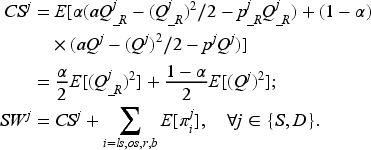
The following statements regarding consumer surplus and social welfare hold. The consumer surplus under Strategy D is higher than that under Strategy S (i.e., The comparison result of social welfare under the two strategies is the same as that of the brand’s profit in Proposition 7, with the exception that the expressions for all thresholds differ. Detailed results are provided in Proposition EC.2 in Appendix C.
Strategy D contributes to improving product availability, resulting in a larger total market supply compared to Strategy S, and consequently, a higher consumer surplus.
In Proposition 10(b), the comparison of social welfare, encompassing both consumer surplus and the sum of profits, under the two strategies exhibits a pattern similar to the brand’s strategic preference (cf. Proposition 7). We analyze how
The aforementioned findings, combined with the result from Proposition 7 that the brand’s profit difference displays a non-monotonic (convex) pattern in
Here, we investigate another direct damage that the overseas supplier may suffer, that is, the capacity constraint of overseas post-recovery production, denoted by
There exists thresholds
The result of Proposition 11 is somewhat counterintuitive: a small
Delivery delays may lead to a quality issue with the overseas supplier’s products when it hastily produces the required order quantity. We tackle this issue by introducing a random variable
We conduct extensive numerical studies to show the impact of the quality problem in overseas post-recovery production (cf. Figure 4). The main findings are summarized in the following observations.
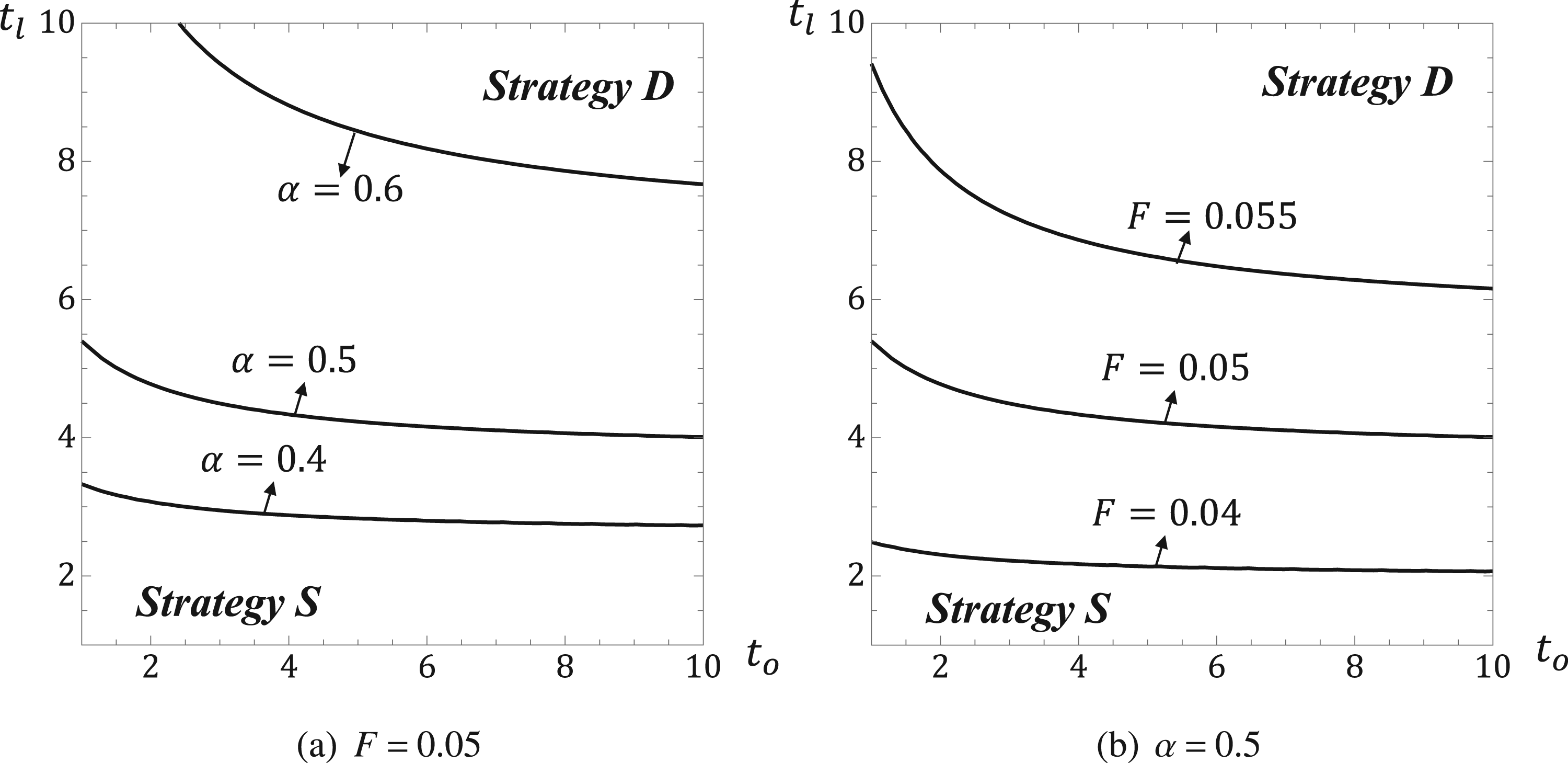
The brand’s strategy preference in terms of
Consider the quality deterioration of overseas post-recovery production. The brand is less incentivized to choose Strategy D as the supply maintenance cost As the quality of overseas post-recovery production improves (i.e.,
Observation 1(a) suggests an intuitive result that has been well explained in the main model. Similar to the role of
In this subsection, we formulate a general model where both the local and overseas suppliers may suffer from the potential delivery delay. The local delay probability is indexed as
The reverse demand functions considering the local delivery delay.
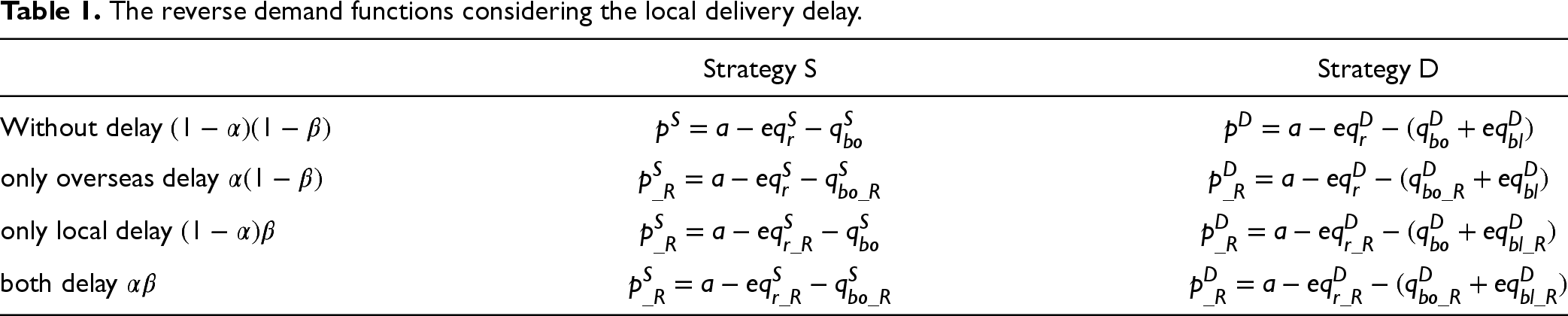
The reverse demand functions considering the local delivery delay.
Consider both overseas and local delivery delays. The brand is less incentivized to choose Strategy D as the supply maintenance cost Strategy D is preferred only when the overseas and local delay probabilities (i.e.,
Figure 5 depicts the impacts of the local and overseas delay probabilities. Intuitively, the supply maintenance cost weakens the brand’s incentive to choose Strategy D. In terms of
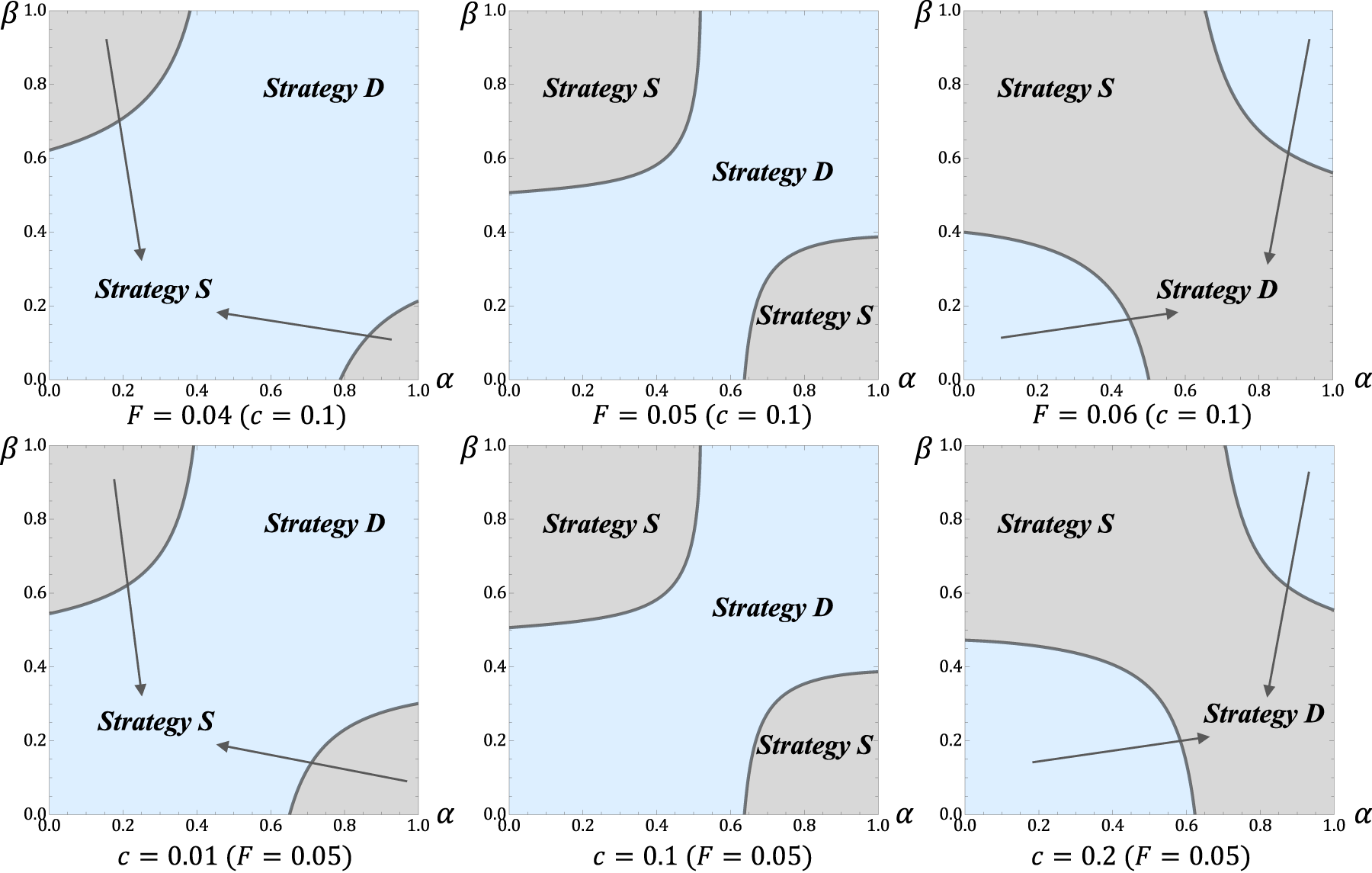
The brand’s strategy preference in terms of
Observation 2(b) suggests that Strategy D is preferred only when
Potential overseas emergencies have led many brands, which initially source from overseas suppliers known for superior quality and advanced production technology, to suffer from delivery delays. In response, some brands are considering dual sourcing by incorporating a local supplier into their supply network. Additionally, the recent trend of incorporating renegotiation or hardship clauses into initial contracts allows contractual parties to adjust agreements in the face of emergencies such as delivery delays and cost escalations, a process referred to as emergency renegotiation. In this study, we consider emergency renegotiation as a business context and examine how its presence influences the brand’s preference for sourcing strategies, specifically between Strategy D (dual sourcing) and Strategy S (single sourcing).
We analyze two benchmarks that exclude overseas emergency renegotiation to uncover some fundamental driving forces, and then compare these with the main model, which incorporates emergency renegotiation, to determine which results from the benchmarks persist and what nuanced differences emerge with overseas renegotiation. First, in the contract termination benchmark, a high probability of overseas delay can enable both the local and overseas supplier to impose high wholesale prices on the brand, thereby discouraging the brand from adopting dual sourcing. This outcome is retained in the main model with emergency renegotiation. Additionally, we identify a distinction between this benchmark and the main model: in the context of overseas emergency renegotiation, the overseas supplier may reduce the wholesale price charged to the brand under both strategies as the delay probability increases. This price-cutting behavior further influences the brand’s order allocation between the two suppliers: the brand prefers to order more from the overseas supplier even if the overseas delay probability is high.
Second, we reveal that in the presence of emergency renegotiation, the brand prefers dual sourcing if the overseas supplier’s post-recovery unit cost is either low or high. This preference arises because, under Strategy D, the local supplier may suppress the local rival channel by setting a higher wholesale price than under Strategy S, especially when the post-recovery cost is high. This effect is unattainable in the contract continuation benchmark where the wholesale price charged by the local supplier to the local rival is always lower under Strategy D than Strategy S. These findings contribute to the existing literature by incorporating emergency renegotiation into the global sourcing framework and exploring new insights that emerge from its inclusion. Moreover, our work offers a rationale for why some brands may opt against sourcing diversification in the face of random emergency risks.
To conclude, we acknowledge several limitations of this work and suggest possible directions for future research. First, the production quality of the local supplier has been treated as an exogenous parameter, while in practice, it may be endogenously determined through the supplier’s quality improvement efforts. Second, how disruptive technologies applied to ex-ante prediction and/or ex-post contingency interact with traditional risk-mitigation methods at both strategic and operational decision-making levels is a question worth further investigating.
Supplemental Material
sj-pdf-1-pao-10.1177_10591478251375298 - Supplemental material for Global Sourcing for Supply Resilience in the Presence of Emergency Contract Renegotiation
Supplemental material, sj-pdf-1-pao-10.1177_10591478251375298 for Global Sourcing for Supply Resilience in the Presence of Emergency Contract Renegotiation by Baozhuang Niu, Lingfeng Wang, Guang Xiao and Nan Zhang in Production and Operations Management
Footnotes
Acknowledgments
The authors are grateful to the editors and reviewers for their helpful comments. Baozhuang Niu was supported by the National Natural Science Foundation of China (72125006 and 72293564/72293560) and the Fundamental Research Funds for the Central Universities (No. CXTD202401). Guang Xiao was supported by the National Natural Science Foundation of China (72422016). Lingfeng Wang is the co-first author and Nan Zhang is the corresponding author.
Declaration of Conflicting Interests
The author(s) declared no potential conflicts of interest with respect to the research, authorship, and/or publication of this article.
Funding
The author(s) disclosed receipt of the following financial support for the research, authorship, and/or publication of this article: Baozhuang Niu was supported by the National Natural Science Foundation of China (72125006 and 72293564/72293560) and the Fundamental Research Funds for the Central Universities (No. CXTD202401). Guang Xiao was supported by the National Natural Science Foundation of China (72422016).

Notes
How to cite this article
Niu B, Wang L, Xiao G and Zhang N (2026) Global Sourcing for Supply Resilience in the Presence of Emergency Contract Renegotiation. Production and Operations Management 35(1): 331–348.
References
Supplementary Material
Please find the following supplemental material available below.
For Open Access articles published under a Creative Commons License, all supplemental material carries the same license as the article it is associated with.
For non-Open Access articles published, all supplemental material carries a non-exclusive license, and permission requests for re-use of supplemental material or any part of supplemental material shall be sent directly to the copyright owner as specified in the copyright notice associated with the article.
