







Abstract
We evaluate economic immunity to the COVID-19 pandemic accorded by a sector’s exposure to artificial intelligence (AI). Using an event study design, we causally estimate the impact of AI industry exposure (AIIE) on shifts in economic activity following the first pandemic-induced lockdown in India. We use payments data from one of India’s largest payment gateways and find that a one-standard-deviation increase in AIIE arrests the post-pandemic decline in industry payments by a third. High AIIE of neighboring sectors further improves a sector’s economic resilience, emphasizing the importance of supply chain partners in technology adoption and change. Further analyses speak to the mechanisms underlying the documented impact of AI on economic activity. Notably, we present evidence suggesting that the observed effects of AI are distinct from those attributable to IT investments or digitization, that AI investments are associated with superior information capabilities prior to the pandemic that arguably enabled agility and responsiveness, and that AI-enabled adaptation occurs in a manner that complements labor rather than displacing it. We discuss the implications of our findings in terms of the assessment of the business value of AI and management of disruptions associated with crises events.
“Machines don’t fall ill, they don’t need to isolate to protect peers, they don’t need to take time off work.” Daniel Susskind 1
Introduction
Artificial intelligence (AI) is widely touted as the “most important general-purpose technology of our era” (Brynjolfsson and Mcafee, 2017). A rich body of research in technology and operations management emphasizes how AI, big data, and machine learning can be used by firms to make better decisions, including better demand forecasting (Cui et al., 2022; Chang et al., 2021; Lau et al., 2018; Zhu et al., 2021), improved pricing, procurement, inventory, and service operations decisions (Ban and Rudin, 2019; Cui et al., 2022; Cohen, 2018; Ellis et al., 2018; Geva and Saar-Tsechansky, 2021; Swaminathan, 2018; Yang et al., 2022); and enhanced customer management and care (Gursoy et al., 2019; Nenova and Shang, 2022; Queenan et al., 2019; Yoganarasimhan, 2020). However, there is little systematic documentation of empirical evidence of the effects of firm or sectoral exposure to AI on fundamentals and economic performance (see Felten et al., 2021 and Raj and Seamans, 2019 for an articulation of this gap in the literature). This study addresses this important research gap by providing an empirical assessment of the economic impact of exposure to AI across a broad cross-section of industries in India during the COVID-19 pandemic. Disruptions associated with the pandemic resulted in an exogenous and widespread increase in the need to reorganize business operations, and our study, therefore, constitutes a test of claims in prior work that the most significant effects of AI in the future would result from its enablement of reorganization of business practices (Brynjolfsson and Mcafee, 2017; O’Shaughnessy et al., 2023).
The COVID-19 pandemic was an unprecedented crisis that posed exceptional risks and challenges to individuals, businesses, institutions, and societies (Ding et al., 2021; Reinhart, 2020). Policy responses to the pandemic, including social distancing and isolation or lockdowns resulted in frequent, abrupt, and substantive cratering of demand and disruptions in business operations. 2 Emergent studies (Chen and Biswas, 2021; Dohale et al., 2022) and industry research reports (McKendrick, 2021) suggest that AI facilitated greater business continuity during this crisis via reorganization to meet the challenges brought upon by the pandemic. Greater exposure to AI renders processes and work more amenable to reorganization with learned systems 3 at similar performance-cost ratios that was necessary for business operations after the pandemic-induced disruption. Thus, AI-enabled reorganization potentially aided both in the pre-emptive and reactive stages of decision-making as a response to the lockdown (Dohmen et al., 2023; Pournader et al., 2020).
Consistent with our thesis, a report published by PwC India (PwC, 2020) notes a marked increase in the integration of AI with business processes within the Indian and the global economy in the wake of the pandemic. Based on extensive interviews and surveys conducted with senior executives and decision-makers, the report concludes that 45% of Indian organizations increased AI use as a result of the pandemic, and attributes the increased adoption to the role AI technologies played in facilitating a range of business functions, including contactless customer interactions, remote work-related productivity enhancements, and dealing with novel decision-making contexts, wherein prior knowledge and expertise were potentially of limited use. The report further notes a qualitative shift post COVID-19 in AI-related challenges from being primarily technical (e.g., unavailability of data) to being more related to business performance (e.g., measuring the business value of AI), indicating greater integration of AI technologies with business operations. In line with the findings of the report, a systematic review of media reports that we describe in Section 4.1 shows that adoption of AI post the pandemic within the Indian context spanned industries, business domains, and various forms of AI.
Existing research emphasizes that AI technologies differ in important ways from traditional IT. Notably, contemporary AI technologies demonstrate the ability to learn and improve in novel ways through data and experience, which in turn allows for complex forms of automation that obviate human intervention in decision-making, and at the same time, makes these technologies more opaque to humans. For example, Berente et al. (2021) describe in detail the corresponding attributes of autonomy, learning, and inscrutability of AI technologies and their implications for effective management. Prior work has also linked these very characteristics of AI to its vast potential to transform human–machine collaboration, and business processes and functions in ways that are qualitatively different from those enabled by conventional IT (Brynjolfsson and Mitchell, 2017; McAfee and Brynjolfsson, 2008). The clear conceptual distinction between AI technologies and traditional IT in terms of their nature, implementation, and opportunities with regard to transformation of business processes and functions makes it important to assess AI’s economic impact specifically.
The COVID-19 outbreak in India and the consequent nationwide lockdown (shutdown) imposed by the Indian government present a unique and ideal empirical setting to causally identify the impact of AI exposure on economic activity. First, the timing, severity, and scope of the lockdown in India were unanticipated, constituting an unexpected shock to firms. Figure EC1.1 in the E-Companion shows the timeline of COVID-19 cases in India, where the shaded area corresponds to the duration of the first lockdown. The latter was imposed very early in the outbreak’s trajectory when India had registered fewer than 500 active COVID-19 cases. It came into force on March 24, 2020, was initially enforced until April 14, 2020, and later extended until May 31, 2020. Thereafter, the government announced a series of unlock phases that lasted through September 2020. Second, the lockdown was enforced just 4 hours after it was announced. The unexpected and exogenous nature of the shock and its speed suggest that firms’ ability to respond in a timely or systematic fashion to the unfolding crisis was very limited. Thus, it was firms’ pre-existing conditions (including AI exposure) that engendered resilience to and recovery from the crisis. Pre-existing AI exposure, together with the exogenously imposed need to reorganize business operations during the pandemic, allows for empirical identification of the business impact of AI. Finally, unlike in the United States and other advanced economies, where lockdown intensity varied across regions within countries, the first phase of lockdown in India was homogeneous in intensity across regions, sectors, and firms, pervasive in its impact, and extremely stringent. 4 Other than a few essential services, all commercial, industrial, travel, religious, and cultural activity were shut down during this period. 5 These aspects of the shock create the opportunity for a study that uses a narrow time window to test the causal relationship between exposure to AI and economic performance and in turn, immunity to crises.
For our primary analyses, we leverage high frequency payments data at the
We implement a difference-in-differences strategy to assess differential changes in payment activity across sectors during the 21-day nationwide lockdown in India. We find that sectors with higher AIIE demonstrate more resilient economic activity. On average, the lockdown led to an average decline of 26% in the total value of payments and 25% in the count of payments received across sectors. However, sectors with high AIIE witness a significantly lower decline in payments received. A one-standard-deviation increase in AIIE stems the decline in payments received by the sector by 9 percentage points during the lockdown. Further, we find that the benefits of AIIE to a sector are moderated by the AIIE of downstream sectors. Specifically, we use the input–output production matrix (two-digit NIC sectors) to build AIIE scores for each sector’s input (upstream) as well as output (downstream) production linkages. We find that a sector with high output AIIE—that is, high AI exposure of downstream sectors—suffers a lower decline in payments received post-lockdown, relative to the baseline case discussed above. That is, when the technology and business logic are not aligned with customers’ capabilities, the resultant adjustment costs for customers ultimately reduce the net benefits to adopters of the technological innovation within the supply chain (Afuah, 2004; McElheran, 2015). 7
The aforementioned analyses, which use high frequency payments data to causally estimate the impact of AI exposure on business continuity over a short time period, reflect the response of the median firm within a sector in the aftermath of the lockdown. We complement these analyses with those based on alternative measures of both business continuity and AI exposure. Specifically, we demonstrate the robustness of our findings to firm-level indicators of business continuity obtained from financial information in the Prowess database. Our findings also remain robust to the use of alternative measures of AI exposure estimated in prior work (Brynjolfsson et al., 2018; Felten et al., 2021), serving as a validity check for the survey methodology used to estimate our AI scores. Finally, we report analyses that document a positive impact of AI exposure on a range of worker outcomes during the pandemic. Many of these worker outcomes arguably also serve as indicators of business continuity (e.g., continued hiring, continued monetary compensation, provision of non-pecuniary benefits, job security) and therefore, the corresponding analyses, which use measures of firm and occupational-level AI exposure, lend additional support to our primary findings.
We additionally report analyses that shed light on the mechanisms underlying the observed economic resilience engendered by AI during the lockdown. First, we use a systematic review of media reports following the lockdown in India to document the diverse domains to which AI technologies were applied and the multitude of ways in which they allowed for reorganization of business processes and functions during the pandemic. We also empirically distinguish the demonstrated effects of AI on economic performance during the lockdown from those of IT or digitization. Second, we present findings from a pre-pandemic survey that suggest that firms’ AI exposure relates to enabling conditions for reorganization of business processes. Notably, we find that higher AI scores relate to superior linkages to suppliers/customers, greater business process integration, and improved information sharing internally within the organization, all of which were potentially valuable in allowing firms to adapt and reorganize processes swiftly in the wake of the pandemic. Finally, in addition to complementing our primary findings, results pertaining to the effects of AI exposure on worker outcomes described above allow us to speak to the central debate within the AI literature regarding whether AI-driven reorganization of businesses is likely to complement or substitute labor (Brynjolfsson and Mitchell, 2017). These analyses suggest that exposure to AI was associated with both more favorable objective (hiring shifts, compensation shifts, and non-pecuniary benefits) and subjective (job security, work satisfaction, and overall evaluation of the employer) outcomes and in turn, indicate that at least over the period we study, exposure to AI enabled business continuity in a manner that complemented rather than substituted labor.
Our findings yield important insights for the literature on the business value of AI. A limited number of studies that have examined the performance implications of AI innovations have produced conflicting results, with some documenting positive effects of AI on business outcomes (Babina et al., 2024; Rock, 2019) and others finding negative or mixed effects (Li et al., 2021; Lui et al., 2022). The varying conclusions of these studies emphasize the need for further research to adjudicate these differences. Recent work in the domain of operations management (Choi et al., 2022; Mithas et al., 2022) further attests to this need. Emergent research (Brynjolfsson and Mcafee, 2017; O’Shaughnessy et al., 2023) suggests that the most substantive effects of AI in the future would manifest in the redesign of business processes and transformation of the nature of work. Therefore, one explanation for these mixed findings is that the need or intent to reorganize business processes was heterogeneous across samples of firms studied in prior work, which, in turn, resulted in variation in observed effects of AI on business value. Moreover, when endogenously determined by firms, reorganization plans are likely to be long term and not designed to bring immediate productivity gains (Bughin et al., 2018), thereby, making it challenging to assess the relationship between AI-enabled reorganization and business value. The pandemic resulted in an exogenously imposed, unanticipated, and widespread need to reorganize business processes to meet challenges created by associated disruptions, thereby allowing for empirical identification of the business impact of AI. Our study leverages granular, high-frequency payments data and an event study design to assess whether AI exposure resulted in greater resilience immediately after the pandemic-induced disruptions and the associated need to reorganize business operations kicked in.
Our findings also have important implications for prior work on operational disruptions and risk management. A growing stream of research in this domain evaluates how firms can mitigate risks from natural and man-made hazards (e.g., Bakshi and Kleindorfer, 2009; Kleindorfer and Saad, 2005; Mehrotra and Schmidt, 2021; Schmidt and Raman, 2021). Such unanticipated events can result in substantive disruption of firms’ production management and supply chain infrastructure, leading to large-scale economic losses (Kleindorfer et al., 2003). Accordingly, the literature on operational risk management has investigated the various firm actions required to mitigate risks and sustain operations during disruptions (e.g., Dong and Tomlin, 2012; Tomlin and Wang, 2011; Tomlin, 2006). Prior research has argued that firms’ prior investments in digital infrastructure, such as control systems (Schmidt and Raman, 2021) and information technology (Kleindorfer and Saad, 2005; Park et al., 2023) determine the extent to which their operations remain resilient during such catastrophic episodes. Relatedly, existing research pertaining to disruptive technologies discusses the potentially substantial impact of integrating AI with firms’ production management and supply chain operations (Choi et al., 2022; Sharifi et al., 2021). However, there is little research that systematically examines the economic impact of AI integration on firms’ operations during crises. An assessment of the role of AI in the specific context of the COVID-19 induced crisis is particularly important because of both the severity of the impact of the pandemic on business operations and the widespread adoption of AI during this time.
The remainder of this paper is organized as follows. We describe our empirical context and data in the next section. Section 3 discusses our primary results. Section 4 details the mechanisms. Section 5 discusses and concludes the study.
Data
We use multiple sources of data, as summarized in Table EC2.1 in the E-Companion. The first dataset relates to the measurement of AI. Acemoglu et al. (2022) articulate three measures of AI that capture the amenability of occupations to AI capabilities. We use two of these measures in our assessment. 8 Our primary measure of AI draws on responses to the Suitability to Machine Learning (SML) survey, a 23-item rubric from Brynjolfsson et al. (2018) that evaluates SML of the primary task of each respondent’s occupation along a 5-point scale. In contrast to traditional IT investments, AI and ML technologies are designed to improve themselves over time. Brynjolfsson et al. (2018) note: “Instead of requiring an inventor or developer to codify or code each step of a process to be automated, a machine-learning algorithm can discover on its own a function that connects a set of inputs X to a set of outputs Y as long as it is given a sufficiently large set of labeled examples mapping some of the inputs to outputs.” This improvement in AI technologies reflects greater measurability of task inputs and outputs, availability of large datasets that can be used to train algorithms, the absence of complex task logic, specialized skills, and task evolution over time, among others. Our measure of AI exposure, which instantiates the SML index developed by Brynjolfsson and Mcafee (2017) to the Indian context, incorporates these work attributes and is distinct from measures of IT investments in the literature (that is limited to measuring IT assets and expenses).
Our survey was administered in English and vernacular languages to 3,099 individuals employed across the 106 3-digit occupations defined in the 2004 National Classification of Occupations (NCO).
9
The sample of respondents was selected to capture sufficient variation within a given occupation as specified in the 2017 Periodic Labor Force Survey (PLFS). The survey was administered between June and December 2019, well before the registration of the first COVID-19 case in India and enforcement of the nationwide lockdown (see Figure EC1.1 in the E-Companion for survey timeline). To create the occupation-level AI scores, we consider the mean SML score of all respondents from the focal occupation. Following prior work (Felten et al., 2021), we use the occupation-level AI exposure scores and the distribution of workers across the 106 occupations within each sector as per the 2017 PLFS to estimate sector-level exposure scores at the 2-digit NIC level. Specifically, we estimate

The next set of data in our analyses, high-frequency measures of economic activity, notably, daily payments data across sectors for the period January 2019 to April 2020, are obtained from the National Payments Corporation of India (NPCI). Specifically, we use data from the UPI, a real-time payment system developed by NPCI to facilitate electronic transactions. Using UPI, we track the volume and value of daily economic transactions at the
Summary: UPI payments data.
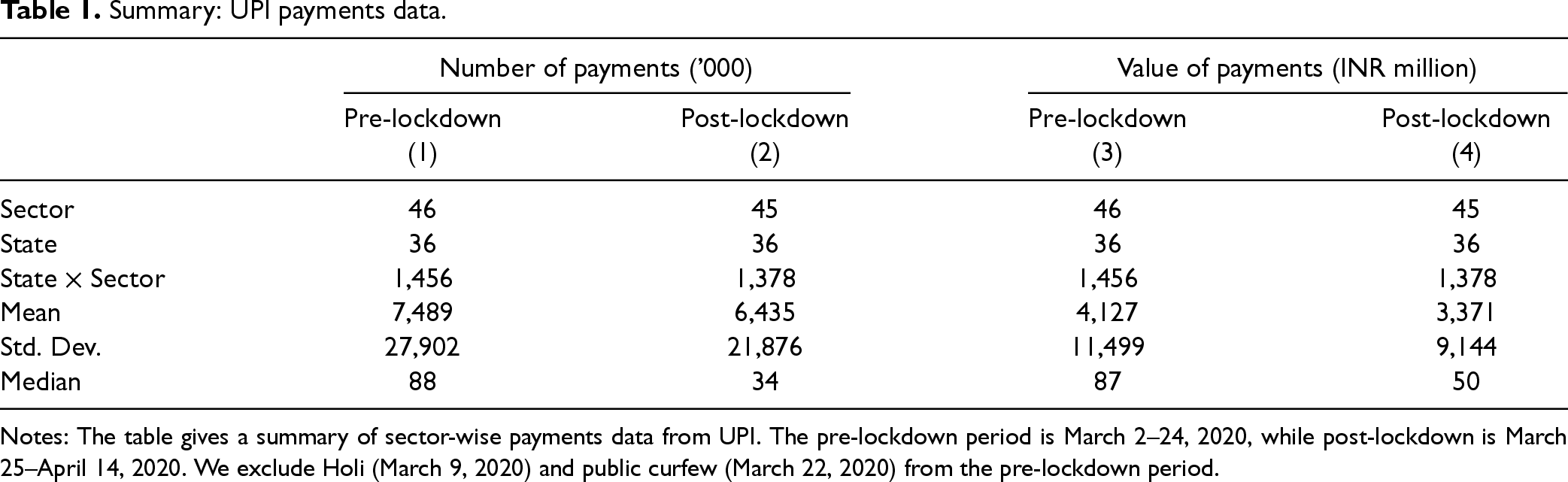
Notes: The table gives a summary of sector-wise payments data from UPI. The pre-lockdown period is March 2–24, 2020, while post-lockdown is March 25–April 14, 2020. We exclude Holi (March 9, 2020) and public curfew (March 22, 2020) from the pre-lockdown period.
We draw on three additional data sources to uncover the mechanisms through which exposure to AI generates resilience. The first dataset (the AI and Future of Work Survey) comprises a survey of 301 executives and pertains to the adoption and applications of AI within their firms. The survey was administered by authors in 2019, before the lockdown. The survey also captured exposure to AI using the same rubric as Brynjolfsson et al. (2018). Therefore, using these data, we are able to assess specific business capabilities that AI investments relate to prior to the pandemic.
The remaining two datasets are used to assess whether firms with high exposure to AI reorganized in a manner that substituted labor or complemented it. The first of these datasets, which pertains to objective worker outcomes, comprises responses to an employee survey, called the Step-Up survey, conducted during the lockdown by Naukri.com, India’s largest online job search portal. The objective of the survey was to provide job seekers with information on companies and sectors after the lockdown (March–November 2020). The data captures variation across firms with regard to post-pandemic hiring and compensation shifts, as well as non-pecuniary benefits, and therefore, allows for an evaluation of whether these worker outcomes differed systematically across firms with varying exposure to AI. These data are available in aggregate form at the firm-level for 2,971 firms—employee responses are aggregated to provide firm-level estimates of the proportion of employees reporting the focal outcome. The second dataset, which pertains to subjective worker outcomes, consists of employee perceptions of their employing firms and was obtained from AmbitionBox, a subsidiary of Naukri.com. Analogous to Glassdoor.com, AmbitionBox allows employees to anonymously provide ratings, reviews and opinion texts of their employing firm across a range of dimensions, such as job security, work satisfaction, and company culture. The data comprises 119,060 reviews from 1,624 companies and allows for an assessment of whether subjective employee outcomes varied systematically across occupations with varying exposure to AI. Further details on our datasets are provided in Section EC2 in the E-Companion.
Empirical Framework
We estimate the following difference-in-differences specification to test the impact of the lockdown on payments received by a sector and whether such impact varies by the latter’s pre-pandemic exposure to AI:

The term
We expect the overall impact of
To obtain an unbiased estimate of
Our choice of a narrow 21-day event window rules out two other concerns. First, over a longer estimation window, both the lockdown and payments could be influenced by a third common factor, leading to a biased estimate of
Finally, we use residuals as our dependent variables as this allows us to filter out any seasonality in the payments data. We use a longer time-series, January 1, 2019–April 14, 2020, to address seasonality concerns through a battery of fixed-effects at the
The results for the impact of the lockdown on payments are reported in Table 2. The first three columns pertain to the count of payments received, while the last three columns relate to the value of payments. Column (1) reports the impact of the lockdown on the count of payments after controlling for
Impact of AI on sectoral payments.
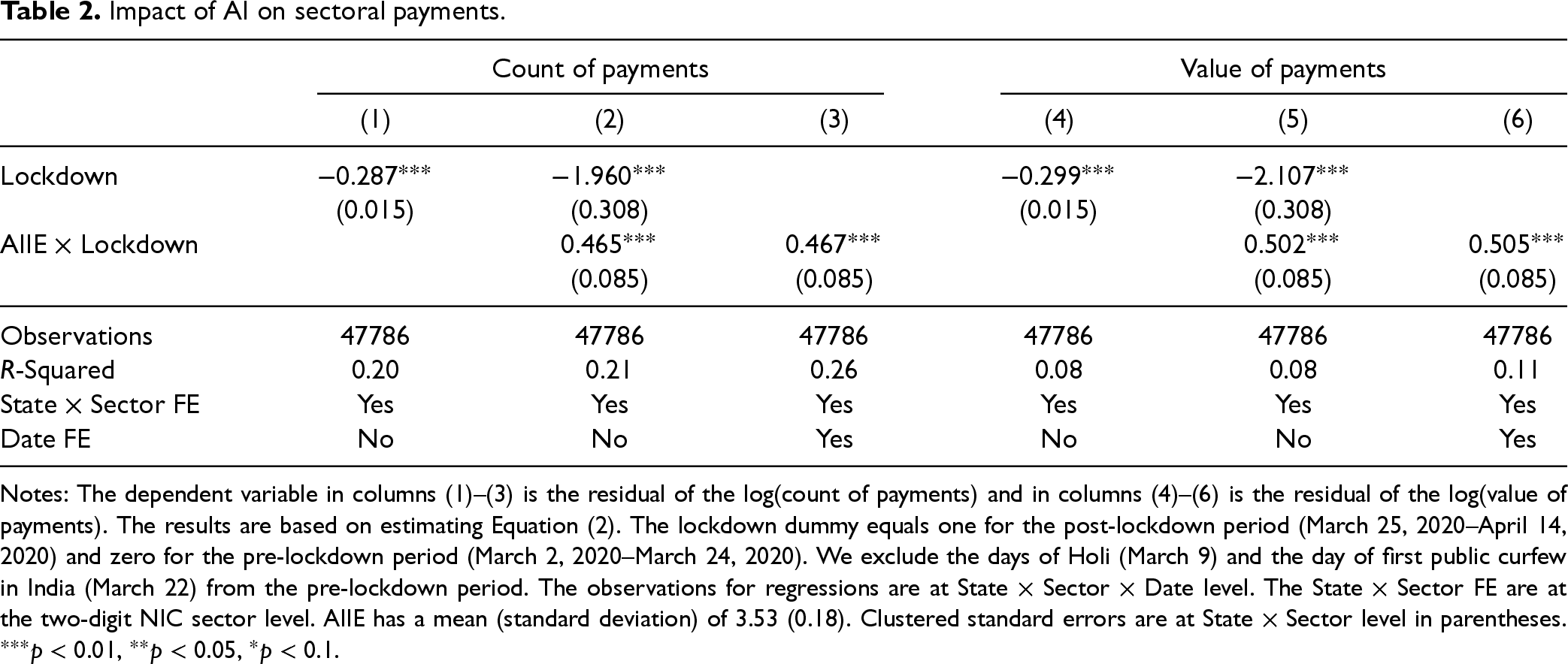
Impact of AI on sectoral payments.
Notes: The dependent variable in columns (1)–(3) is the residual of the log(count of payments) and in columns (4)–(6) is the residual of the log(value of payments). The results are based on estimating Equation (2). The lockdown dummy equals one for the post-lockdown period (March 25, 2020–April 14, 2020) and zero for the pre-lockdown period (March 2, 2020–March 24, 2020). We exclude the days of Holi (March 9) and the day of first public curfew in India (March 22) from the pre-lockdown period. The observations for regressions are at State
Columns (4)–(6) present similar results for the impact of AIIE on total value of payments. Column (4) shows that the impact of the lockdown is negative and significant on the total value of payments. In column (5), the coefficient of
We next rule out the possibility that our results are driven by differential pre-lockdown trends across the sectors. Given that we use residuals in our specification and restrict the estimation period to 21 days before and after the lockdown, this concern is minimal. Nevertheless, we estimate the change in daily payments received by modifying Equation (2). We replace
We plot the event study coefficients with log(value of payments) as the dependent variable in Figure 1. The vertical line divides the pre- and post-lockdown periods. For sectors with high AIIE, we find a sharp increase in the value of payments after the lockdown, which persists during the entire post-lockdown period. In contrast, most coefficients before the lockdown are insignificant, which rules out that sectors have diverging pre-trends before the lockdown. Similarly, E-Companion Figure EC1.2 reports the results for the log(count of payments). We find that the coefficients after the lockdown are positive and significant, indicating that high AIIE increases the count of sectoral payments.
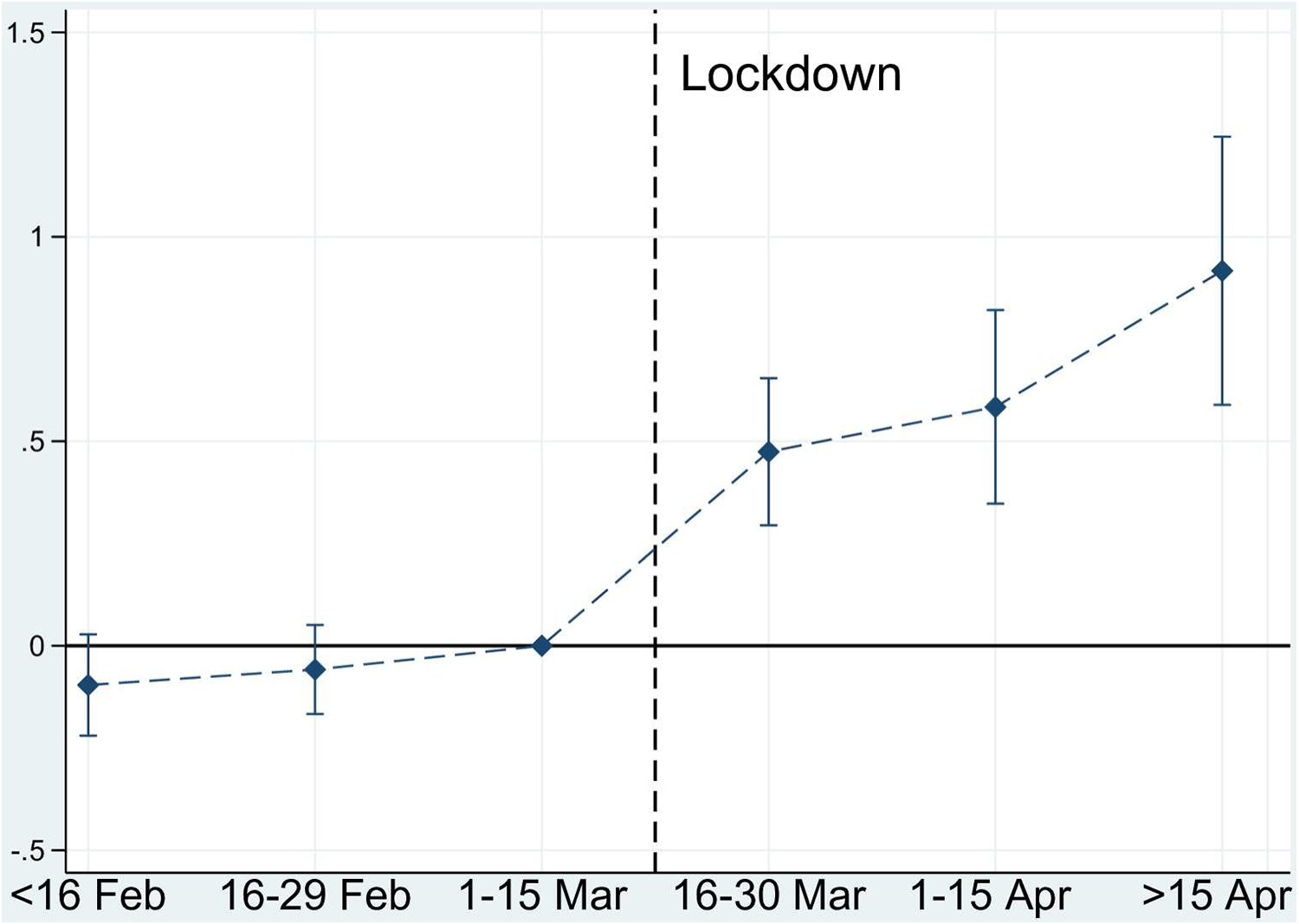
Impact of AI on value of payments over time. Notes: The figure plots the event-study coefficients on the interaction term
Our results are robust to alternate dependent and independent variables, other subsamples, and placebo tests. We detail these tests below.
AI Adoption of Neighboring Sectors Matters
The findings described so far relate to the direct impact of AIIE on the focal sector’s payments. In this section, we assess how linkages between the focal sector and other sectors impact payments received by the former. Owing to linkages between sectors within the economy, it is possible that a sector itself has high AI exposure but is unable to function during the lockdown due to dependency on other sectors.
Like before, we use the payments data to test the impact of average AI score of input (or upstream) and output (or downstream) sectors on economic activity of sector
To estimate the impact of AI exposure of neighboring sectors on economic activity, we augment Equation (2) with input
Impact of AI on payments of neighboring sectors.
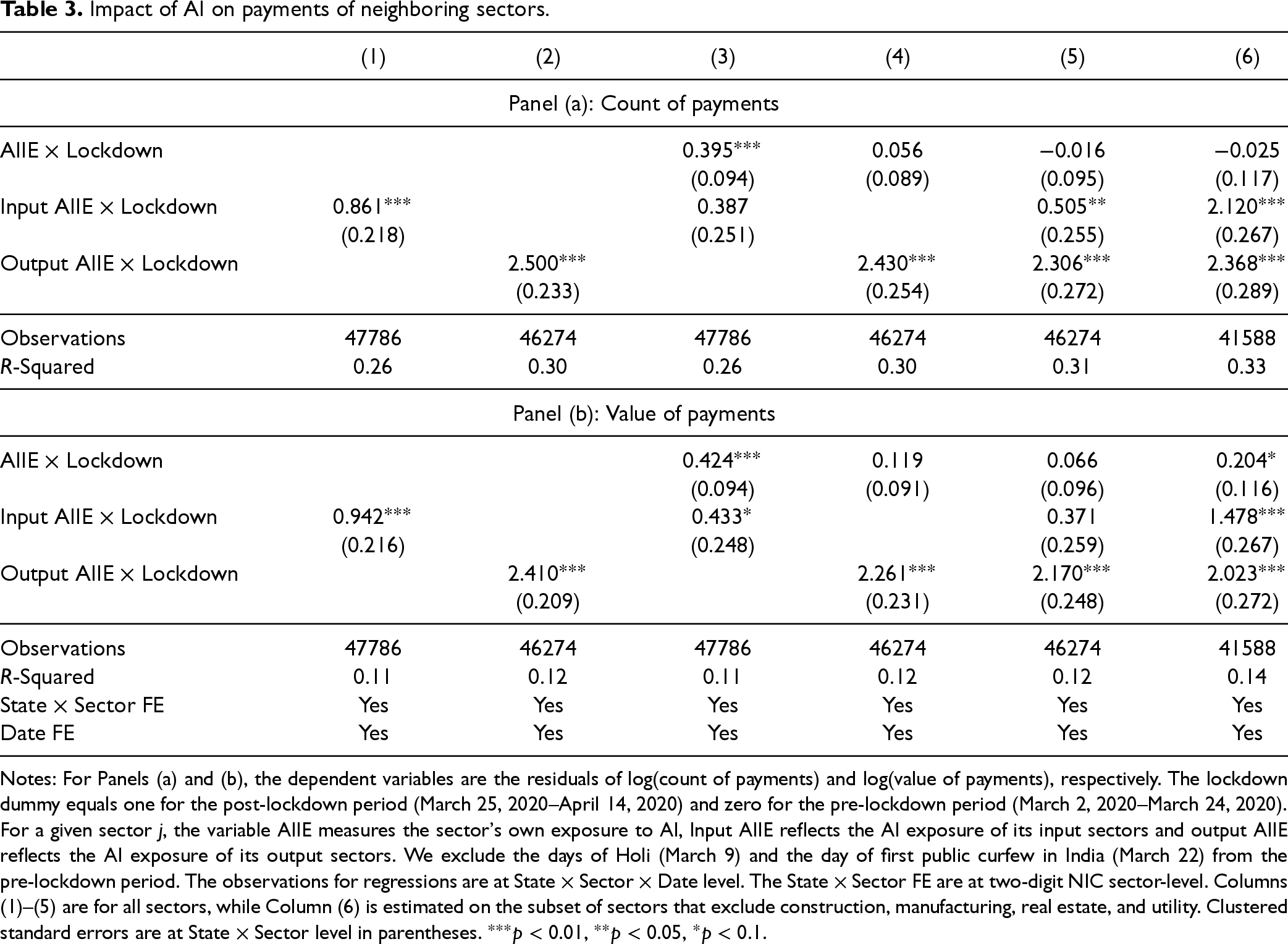
Impact of AI on payments of neighboring sectors.
Notes: For Panels (a) and (b), the dependent variables are the residuals of log(count of payments) and log(value of payments), respectively. The lockdown dummy equals one for the post-lockdown period (March 25, 2020–April 14, 2020) and zero for the pre-lockdown period (March 2, 2020–March 24, 2020). For a given sector j, the variable AIIE measures the sector’s own exposure to AI, Input AIIE reflects the AI exposure of its input sectors and output AIIE reflects the AI exposure of its output sectors. We exclude the days of Holi (March 9) and the day of first public curfew in India (March 22) from the pre-lockdown period. The observations for regressions are at State
Results pertaining to the total value of payments in Panel (b) mimic those in Panel (a) (columns (1)–(4)). Column (5) in Panel (b) shows that Output AIIE has maximal impact on the value of payments received among the three measures. Here, only the coefficient of Output AIIE is positive and significant. One possible reason for the insignificant effect of Input AIIE could relate to difficulties in accessing inputs due to mobility restrictions during the lockdown, which, in turn, reduce the positive effects of AI on the focal sector. This issue should be less relevant for sectors that rely less on physical inputs. To evaluate this possibility, we re-estimate the model after excluding sectors that rely extensively on physical inputs for production (i.e., the construction, manufacturing, real estate, and utility sectors) (Column (6)). We find that the coefficient of Input AIIE after lockdown is positive and significant in this case, highlighting the importance of both input and output AIIE.
Overall, Table 3 demonstrates that AI adoption by a sector has an impact on outcomes of neighboring sectors. The sectors connected to those with greater AI exposure show more economic resilience during the lockdown. These results relate to the work by Cui et al. (2022), who demonstrate how AI systems can create and deliver value in the context of procurement. These positive spillovers across the supply chain can occur in multiple ways as the integration of firms’ own systems with its partners can facilitate customer requirements management, demand forecasting, or minimization of supplier risk (Helo and Hao, 2022; Xu et al., 2023).
In this section, we report analyses that shed light on the mechanisms underlying the observed economic resilience facilitated by AIIE during the pandemic. We perform three distinct sets of analyses, each of which relates to different aspects of the processes that account for the effects of AI on business continuity. Specifically, these analyses demonstrate that (i) AI facilitates business continuity in ways beyond those attributable to IT investments or digitization, (ii) pre-pandemic AI exposure relates to superior information management capabilities that arguably increases reorganizational capability for focal firms during the pandemic, and (iii) AI-enabled reorganization positively impacts a range of worker outcomes during the pandemic.
AI Builds Resilience Beyond IT/Digitization Exposure
The results reported in prior sections demonstrate the impact of AIIE on resilience in sectoral economic activity. Even though we conceptually distinguish AI and IT, it is possible that our primary results are driven by variation in IT investments and digitization levels across sectors, which, in turn, are correlated with AIIE. For instance, IT investments such as software applications or communication infrastructure can provide economic resilience to pandemic-induced lockdowns, especially during periods in which workers stayed at home to work (Park et al., 2023). Similarly, the digitization of products and services renders them modular, and in turn, amenable to generative and distributed innovation (Rahmati et al., 2020) that were valuable to product and service redesign during the pandemic. Given that IT also potentially contributed to resilience during the pandemic, it is important to examine whether the effects of AI we document persist after accounting for those attributable to IT.
Our baseline specification, through the inclusion of
Impact of AI vs. IT/digitization on sectoral payments.
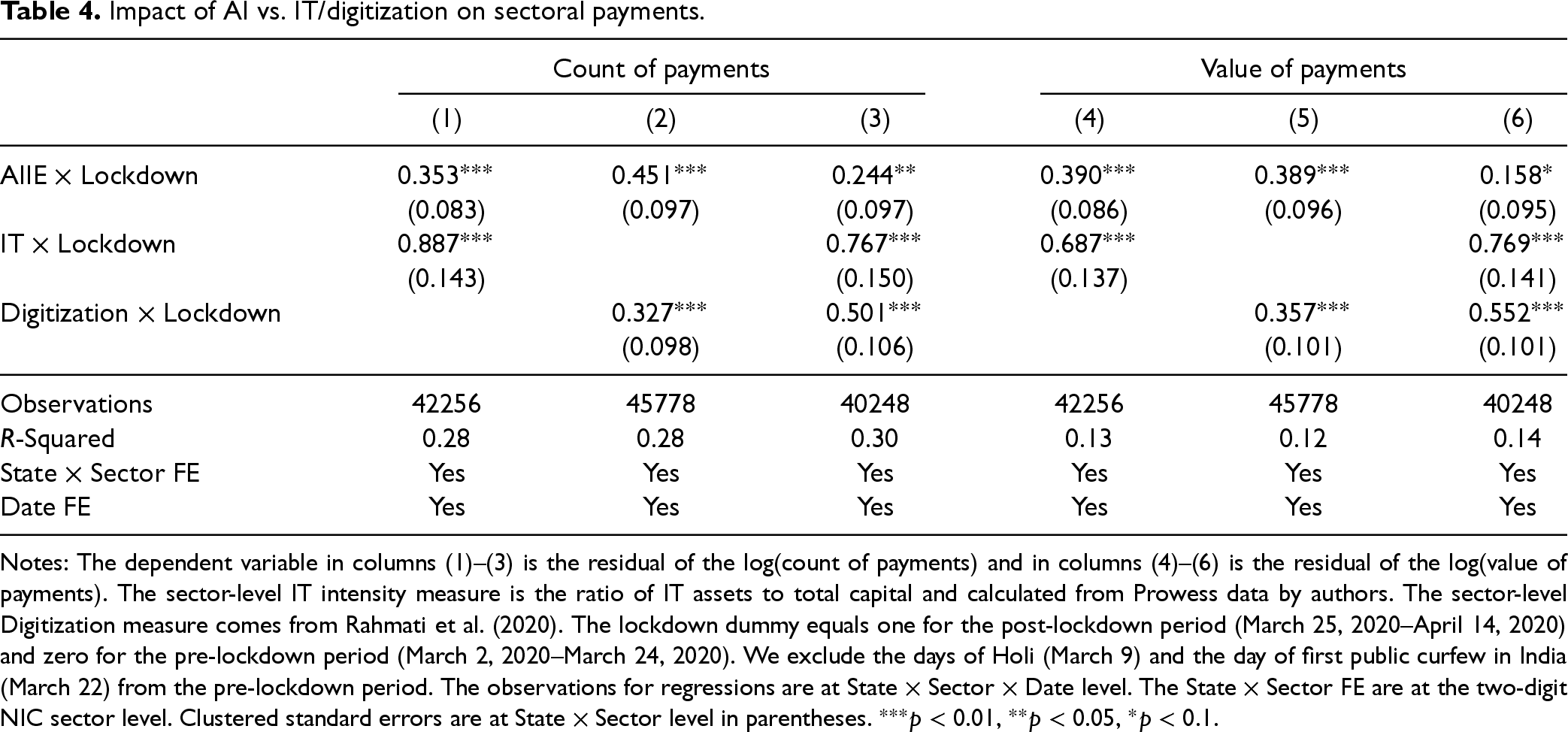
Impact of AI vs. IT/digitization on sectoral payments.
Notes: The dependent variable in columns (1)–(3) is the residual of the log(count of payments) and in columns (4)–(6) is the residual of the log(value of payments). The sector-level IT intensity measure is the ratio of IT assets to total capital and calculated from Prowess data by authors. The sector-level Digitization measure comes from Rahmati et al. (2020). The lockdown dummy equals one for the post-lockdown period (March 25, 2020–April 14, 2020) and zero for the pre-lockdown period (March 2, 2020–March 24, 2020). We exclude the days of Holi (March 9) and the day of first public curfew in India (March 22) from the pre-lockdown period. The observations for regressions are at State
To differentiate the effect of AIIE from general IT intensity, we include
Recent advances in Information Systems research posit that modern IT systems have evolved from being mere back-office technologies to integral components of diverse products and services (Henfridsson and Bygstad, 2013; Yoo et al., 2010). Therefore, we additionally assess the robustness of our results to the inclusion of a recent measure of digitization proposed by Rahmati et al. (2020) 13 that captures the average ability of the sector to: (i) develop digital products and services, (ii) embed digital components into products and services, and (iii) reconfigure and recombine know-how into new classes of products and services. The measure encompasses a broader conceptualization of digitization that extends beyond investments in traditional IT, and captures the extent to which firms in a sector embed digital technologies within their products, services, and processes. This measure, therefore, encompasses the remote work and collaboration role of digitization.
The results pertaining to the estimation of the impact of AIIE after including
Overall, these results suggest that both AI and conventional IT contribute to resilience during the pandemic. Importantly, they are consistent with the proposal that AI-enabled novel forms of business process reorganization that contributes to resilience over and above that facilitated by IT and digitization, and underscore the stability and significance of the effects of AI on business continuity that we document in the previous section.
To further understand the nature of underlying integration of AI with business processes and associated reorganization, we conduct a systematic evaluation of media reports following the lockdown in India. The corresponding analysis also allows us to further differentiate the effects of AI from those that would correspond to traditional IT and digitization. Using Factiva, we downloaded AI-related articles from five major Indian business newspapers (Financial Express, Business Standard, Indian Express, Mint, and The Economic Times) published between March and October 2020. We used the topic filter “Artificial Intelligence/Machine Learning” and use three search keywords “covid”, “pandemic”, and “lockdown.” This results in an initial list of 272 articles. We then screen these articles manually to: (i) identify those that describe a specific application of AI-based technologies, and (ii) relate these applications to a business challenge brought about by the pandemic. We exclude articles that describe applications of AI to mitigate COVID-19-specific healthcare challenges and those that describe duplicate use cases. This process results in a total of 47 use cases from 37 articles. Each use case is additionally coded for whether or not it relates to the three domains of AI application - Demand forecasting and marketing, Production management, and Logistics. 15 In this regard, we rely on recent work by Choi et al. (2022), who describe these as three broad areas in which AI technologies are driving significant reorganization of business processes. See Table EC1.6 in the E-companion for article details, a description of each of these use cases, and the application domains they are categorized in. Two noteworthy observations follow from this analysis.
First, the identified use cases cover applications across a wide range of domains. In terms of the application domains described by Choi et al. (2022), of the 47 use cases, 20 relate to Demand forecasting and marketing, 23 to Production management, and 9 to Logistics. 16 This diversity in application domains suggests that AI builds resilience with regard to a wide range of business functions and helps firms deal with disruptions to both demand and supply side operations during the pandemic. Moreover, as the associated descriptions in Table EC1.6 indicate, the industries these applications are embedded in are similarly diverse and include retail services, financial and insurance services, oil and gas, education, professional services, and public administration, among others. These observations are consistent with the role of AI as a general-purpose technology whose applications transcend business domains and industries (e.g., Bresnahan and Trajtenberg, 1995; Brynjolfsson et al., 2018; Chen and Biswas, 2021; Choi et al., 2022).
Second, the applications documented in Table EC1.6 reflect a multitude of ways in which businesses drew on AI-based technologies to reorganize work processes in each of the three domains described by Choi et al. (2022). For example, applications in the area of demand forecasting and marketing included AI-based virtual agents that automated conversations traditionally handled by insurance agents and enabled contactless claims processing in the insurance industry, the use of ML to forecast in-time stock needed in stores in the retail sector, the use of virtual reality, ML and Deep Tech to provide virtual home tours and site visits to enhance the buying experience and maintain business continuity in the real estate sectors, and advanced computer vision technologies and deep learning models that allowed physical retail companies to provide contactless sizing for their customers. With regard to production management, applications include the use of computer vision technologies to automate car inspections in the insurance sector, the use of advanced audio and video analytics to automate exam proctoring in education or monitor employee productivity for remote systems, and the use of real-time analytics of sensor data in the oil and gas industry toward preventive and remote maintenance. In the area of logistics, AI platforms allow for dynamic route optimization, tracking insights, and automated order management and dispatch across diverse sectors.
The above applications of AI technologies during the pandemic in each of the three domains can be contrasted with those attributable to conventional IT. For example, in the area of marketing, with the widespread implementation of social distancing, companies turned to social media for marketing to and communicating with their customers (Cong et al., 2024). Intelligent sensing played an important role in the area of demand forecasting (Boh et al., 2023; O’Leary, 2020). For example, Boh et al. (2023) document the case of Nike, which faced significant challenges in aligning supply with demand during the pandemic. The company responded with a dynamic supply chain that leveraged demand sensing and real-time inventory visibility using RFID technologies along with data analytics to bring the right products to the right places. 17
In the area of production management, organizations switched to online business models through participation in digital platforms that leveraged demand-side economies of scale to power interactions between different classes of consumers and suppliers (Boh et al., 2023). Diverse types of organizations drew on in-house and cloud services, peer-to-peer information and knowledge sharing systems, and online support service systems to drive the transition to remote work and remote delivery of traditional services (Cong et al., 2024; Rai, 2020). For example, Park et al. (2023) document how centralized IT investments of higher education institutions enabled and supported their transition to emergency remote teaching and maintaining better education services during the crisis. Enterprise systems enabled traditional in-person components of service delivery such as monitoring, assessments, and consultations to be performed virtually with relevant data uploaded from peripheral sites to a centralized integrated database and interpreted remotely (Ting et al., 2020; Vargo et al., 2021).
In the area of logistics, companies used technologies such as adaptive warehouse management systems that dynamically reassigned labor based on real-time demand signals and that in coordination with Internet-of-Things-enabled digital product twins to simulate different operating scenarios under pandemic conditions (Mohapatra et al., 2022).
The above examples emphasize the differential characteristics and roles of traditional IT relative to AI technologies. While the AI applications involved learning, adapting and autonomous decision-making using both structured and unstructured data, the traditional IT applications involved implementation of pre-programmed rules or logic without the learnability or adaptability of systems. They were also used for specific tasks with clear action-outcome linkages and structured data.
In sum, the qualitative analysis allows us to document vivid examples of how exactly AI accorded resilience and sustenance to businesses across various domains and lends further support to the proposition that the role played by AI during this time was distinct from that of IT and digitization.
A rich body of research in management (Cyert et al., 1963; Galbraith, 1973; Mendelson and Pillai, 1998) propounds the view of organizations as information processing systems, and finds that firms’ information management strategies aim to route the right information to the right decision-makers at the right time, and assist them to act on it quickly and effectively. Indeed, prior research in economics and management (Bresnahan et al., 2002; Brynjolfsson and Hitt, 2000; McAfee and Brynjolfsson, 2008) finds that the comparative advantage of information technology, in general, is that it redraws how information is acquired, stored and processed in firms to shape the optimal organization of work. In this regard, it is noteworthy that many of the use cases we document based on our assessment of media reports suggest that AI contributed to resilience via improved efficiency in terms of acquisition and processing of information (e.g., by aiding demand forecasting, monitoring of inventory and production, management of supply chains via enhancements such as real-time route optimization and post-delivery analytics, and provision of customer/stakeholder services such as the execution of digital audits and automated insurance claims handling). It is therefore possible that the buffering impact of AI exposure on business continuity that we document results from superior information management capabilities of firms with greater AI exposure that in turn, enabled them to reorganize business processes in the face of pandemic-induced disruptions.
To assess whether AI exposure relates to firms’ information management capabilities, we use the AI and Future of Work survey, wherein executives responded to the 23-item SML rubric, providing an estimate of AI exposure. In addition, the respondents provided information regarding the organizational changes within the focal firm after the adoption of AI. In terms of application areas that relate to their firms’ information management capabilities, respondents rated the extent to which AI played a role in enabling the following business capabilities within their firms on a five-point scale: linking the organization to customers and suppliers, integrating internal business processes, and providing timely information for executive management to develop strategies. To measure the effect of AI on these variables, we estimate the following specification:

Columns (1)–(3) of Table 5 report results for the estimation of AI-enabled business capabilities. We find that AI exposure relates positively to the strength of linkages with suppliers and customers, greater internal business process integration, and timely sharing of strategic information with top management. That is, exposure to AI is associated with firm characteristics that relate to superior information management. These findings are consistent with the idea that AI exposure facilitated greater resilience during the pandemic because it resulted in superior information management capabilities at the firm level.
AI exposure and firms’ information capabilities.
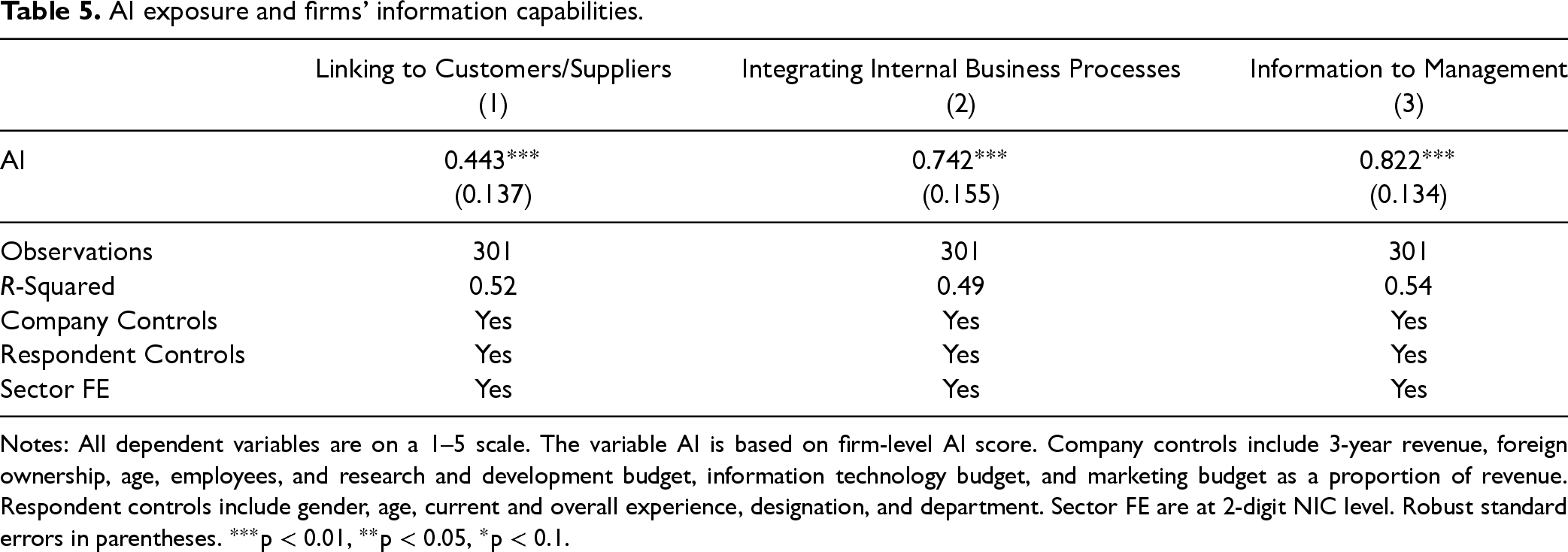
Notes: All dependent variables are on a 1–5 scale. The variable AI is based on firm-level AI score. Company controls include 3-year revenue, foreign ownership, age, employees, and research and development budget, information technology budget, and marketing budget as a proportion of revenue. Respondent controls include gender, age, current and overall experience, designation, and department. Sector FE are at 2-digit NIC level. Robust standard errors in parentheses.
We additionally assess whether AI substituted or complemented labor during the pandemic. Not only does such an assessment facilitate an understanding of the mechanisms through which AI resulted in business continuity during the pandemic, it is also of independent interest and importance because the effects of AI on demand for and value of labor are theoretically ambiguous and inconclusive. Prior research (Frey and Osborne, 2017; Huang and Rust, 2018; Leonhard, 2016; Mfanafuthi et al., 2019) finds that occupational exposure to AI may result in displacement or reduction of human capital within that occupation. Indeed, Frey and Osborne (2017), in an early and detailed assessment of 702 occupations in the US, conclude that 47% of total jobs in the country are at risk of being substituted by AI. In contrast, a rich body of work (Brynjolfsson et al., 2018; Frank et al., 2019; LaGrandeur and Hughes, 2017) concludes that AI may complement human capital to increase productivity and reorganization of work. Brynjolfsson et al. (2018) submit that the latter outcome is more likely since only some tasks in most occupations are suitable for AI and others will continue to require human capital. Given the conflicting evidence, these effects of AI remain open empirical questions.
Our data on worker outcomes are obtained from AmbitionBox, a subsidiary of Naukri.com, India’s largest online job search portal, and include two data sources. The first dataset comprises responses to a survey of workers conducted during and after the lockdown to provide job seekers real-time information on companies and sectors that were actively hiring, salary shifts in their occupation and sector, and components of salaries that were impacted. Over 100,000 workers respond to questions on pecuniary and non-pecuniary benefits and support provided by their employers during the lockdown. Specifically, we estimate shifts in hiring (hiring continuity, offers cancelled), salaries (timeliness, cessation, reduction) and non-pecuniary benefits (employee care programs, work-from-home). These data, however, are available only at the firm-level, i.e., individual responses aggregated to firm-level estimates of fraction of workers reporting the focal outcome. We assess the impact of firm-level AI exposure on these outcomes for a sample of 2,971 firms.
18
Accordingly, we estimate the impact of AI on these objective firm-level outcomes by:

Impact of AI on hiring, wages and non-pecuniary benefits.
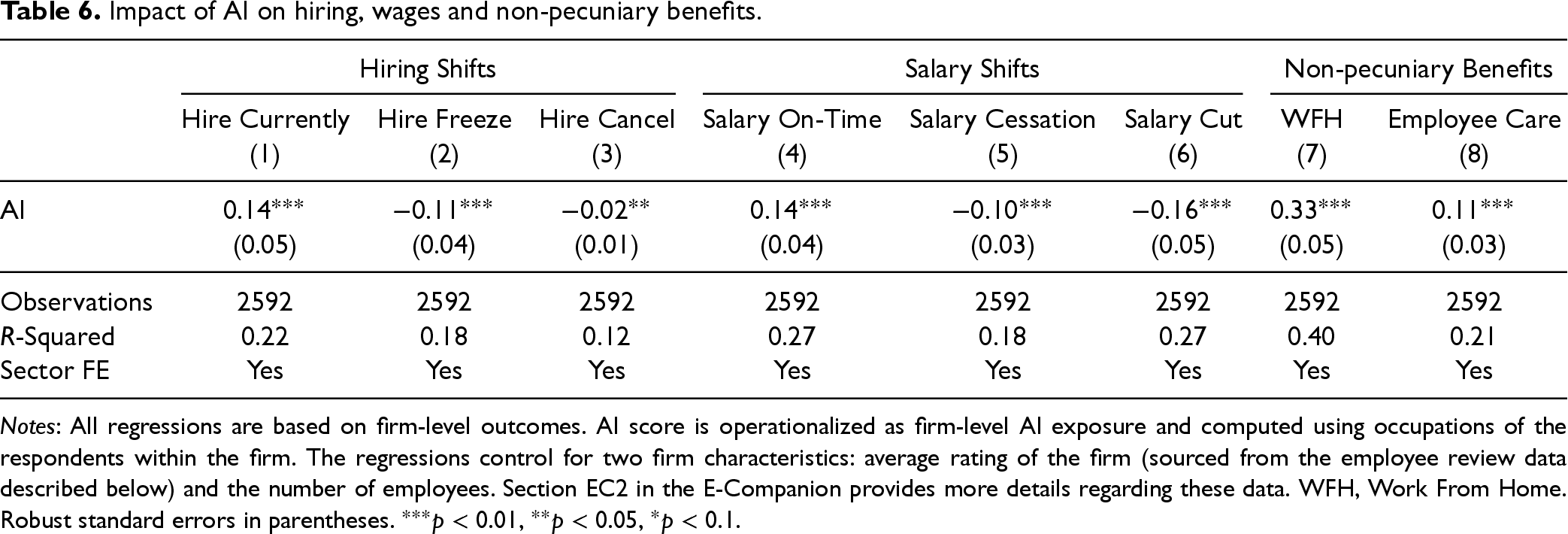
Notes: All regressions are based on firm-level outcomes. AI score is operationalized as firm-level AI exposure and computed using occupations of the respondents within the firm. The regressions control for two firm characteristics: average rating of the firm (sourced from the employee review data described below) and the number of employees. Section EC2 in the E-Companion provides more details regarding these data. WFH, Work From Home. Robust standard errors in parentheses.
We also obtain workers’ perceptions of their firms from the AmbitionBox data. Analogous to Glassdoor.com, AmbitionBox allows employees to anonymously provide ratings, reviews and opinion (text/comment) of their employing firm, the management, and various aspects of work culture.
19
These data comprise 119,060 reviews across 1,624 companies. We analyze four key employee outcomes captured in the reviews - overall satisfaction with the firm, sense of job security, satisfaction with work, and satisfaction with the company culture. Whereas the previous analyses pertaining to objective outcomes are feasible only for the period following the imposition of the nationwide lockdown, these employee reviews pertaining to subjective outcomes are available both pre- and post-lockdown period. We estimate the impact of AI on these subjective worker outcomes using the following specification:

Overall, these results support the conclusion that higher exposure to AI is associated with superior objective and subjective worker outcomes, and that AI complemented, rather than substituted, labor during the lockdown. While prior work indicates that the impact of AI-based technologies on the labor market has so far not been substantial (Acemoglu et al., 2022), it is important to note that we assess these effects over a relatively short period of time. In the long run, as Brynjolfsson and Mitchell (2017) note, the impact of AI on the workforce is likely contingent on a range of factors, including but not limited to complementarities between tasks and occupations, elasticity of labor supply, and price elasticity of demand for different tasks and occupations. Moreover, the impact of AI on subjective worker outcomes in particular may differ substantially even in the short run in other empirical contexts that are not characterized by as much uncertainty and insecurity for workers as the pandemic. In such scenarios, effects of AI on the relationship between workers and technology and the structuring of work (Glikson and Woolley, 2020), may draw greater attention and consideration by workers and thus impact their evaluations more strongly. As AI-based technologies develop in the future and as the world moves definitively to the post-pandemic era, further research is needed to understand AI’s impact on labor.
It is also worth noting that several of the worker outcomes we studied arguably also serve as indicators of business continuity; in particular, objective outcomes such as continued hiring, continued payment of salaries, and provisions for work-from-home arrangements. Given that we observe overall positive effects of AI on these outcomes, these findings constitute further evidence in support of the conclusion that AI exposure was associated with business continuity and resilience during the pandemic.
The COVID-19 pandemic and related lockdowns to curb its spread resulted in significant disruptions to demand, supply chains, work, and business models of firms. In this paper, we ask if these disruptions were asymmetric across firms—specifically, whether the exposure of occupations and firms to AI helped them systematically mitigate the negative effects of the crisis. We find robust evidence that sectors with high exposure to AI were resilient to lockdown-induced disruptions. Further, the observed benefits of AI extend to other connected sectors within the focal sector’s input–output network. These results remain robust to a range of different specifications, including those that utilize alternative measures of AI and business continuity. Additional findings inform an understanding of the processes that account for the documented positive impact of AI exposure on resilience by highlighting the distinct role of AI in driving the effects we observe, documenting an association between AI exposure and information management capabilities that arguably enabled reorganization of business operations, and showing that AI-enabled reorganization during the pandemic occurred in a manner that complemented labor.
Our study is among the growing set of studies within the domain of operational disruptions and risk management that assess the impact of crises events on firms (e.g., Bakshi and Kleindorfer, 2009; Kleindorfer and Saad, 2005; Mehrotra and Schmidt, 2021; Schmidt and Raman, 2021). The negative impact of operational disruptions on firm value is substantial (Hendricks and Singhal, 2005; Hendricks and Singhal, 2003). The COVID-19 pandemic was unique in terms of severity and the widespread nature of the associated disruptions. Yet, many of the specific challenges it produced for businesses, such as supply chain disruptions, cratering of demand, and the failure of existing business models, were similar to those produced by other disruptions, such as localized natural calamities, political instability, wars, terrorist attacks, and economic slowdowns. Given that we find buffering effects of AI exposure on business continuity within the particularly disruptive context of the COVID-19 pandemic, one can expect that the anticipated widespread adoption of AI technologies in the future is likely to result in a world wherein economic activity is, in general, more resilient to unanticipated disruptions.
Our findings also contribute more generally to the literature on the business value of AI. As noted earlier, the limited research that assesses the economic value of AI (e.g., Babina et al., 2024; Li et al., 2021; Lui et al., 2022; Rock, 2019) has yielded inconclusive evidence, and scholars have called for systematic assessments of the impact of AI on business performance. Our novel empirical context, the aftermath of the COVID-19 pandemic, yields important insights for this literature. The pandemic resulted in a range of supply- and demand-side disruptions, whose impact was heterogeneous across firms and industries. Yet, these disruptions uniformly resulted in the sudden and unanticipated need to rethink and redesign business processes to meet challenges associated with the pandemic. The uniformly positive effects of AI exposure on resilience that we observe within this context attest to AI’s potential to reorganize and transform business processes. At the same time, it is worth noting that there is possibly greater heterogeneity across firms and industries in terms of the potential upside of AI adoption in environments characterized by fewer widespread disruptions than the pandemic. It would therefore be useful for further research to facilitate a nuanced understanding of contextual antecedents of successful AI adoption that can inform managerial decisions regarding AI investments and deployment.
Relatedly, our results point to the possibility that the effects of AI investments on business performance and market reactions are contingent on the value that reorganization of business operations brings within the particular context (Brynjolfsson and Mcafee, 2017; O’Shaughnessy et al., 2023). Indeed, prior work that has documented negative effects of AI on business outcomes doesn’t necessarily consider samples of firms or industries wherein the need or benefits of reorganization of business processes are salient. For example, Lui et al. (2022), in what the authors note to be the first study to measure the value of AI adoption for firms, evaluates the effects of 119 announcements pertaining to AI investments by 62 firms and finds that the mean cumulative abnormal returns for these firms immediately after the announcement were negative and statistically significant (
Our findings pertaining to the impact of neighboring sectors’ AI exposure on a focal sector’s resilience suggest that the value of AI investments extends also to other sectors within the sector’s input–output network. These findings reflect that the resilience of neighboring sectors was necessary and important over and above a sector’s exposure to AI in terms of maintaining continuity during the pandemic. They are also consistent with prior work that relates to the value of adoption of technological innovations to the extent to which they align with customer capabilities (Afuah, 2004; McElheran, 2015). These findings suggest that the marginal returns to investments in AI are likely to increase as AI adoption increases. This entails the presence of positive externalities in the context of AI adoption, as has been noted in the context of other general purpose technologies (Bresnahan and Trajtenberg, 1995), and therefore, highlights the critical role that policymakers could play in aligning incentives to adopt AI with the value it brings for industries and economies.
Although our primary focus has been to assess the impact of AI on resilience during the pandemic, reports of a spike in AI adoption during this time indicate that the pandemic is likely to have shaped the evolution of AI as a mainstream technology. This premise is consistent with a substantial body of research that shows that diffusion of new technologies and innovations is a path-dependent process wherein early patterns of adoption and usage influence subsequent adoption and development of technologies (e.g., Aghion et al., 2014; Greve and Seidel, 2015; Karanam et al., 2024). The increased adoption of AI post-pandemic possibly led to phenomena that further accelerated its adoption, such as the development of regional and industrial hubs associated with generation of AI-related knowledge and increased transmission of such knowledge (Dahlke et al., 2024). At the same time, owing to the specific set of challenges associated with the pandemic, it likely also resulted in a qualitative shift in terms of the specific applications and domains within which development of AI occurred that are not necessarily optimized to economic and social needs in the long term. Such a possibility relates to interesting avenues for future research. For example, it would be worth examining whether greater integration of AI with business processes during the pandemic translated to a sustained source of value for certain classes of firms, AI technologies, or domains of reorganization. Such assessments are likely to guide policy that would support effective integration of emerging technologies with business processes during crises events and in their aftermath. Another important direction for future research would be to extend our analysis to the firm level in order to better understand the impact of AI investments on individual firm performance, as our current industry-level analyses limit causal insights into firm-specific heterogeneity that contributes to organizational resilience.
Footnotes
Acknowledgments
The authors gratefully acknowledge the support of the Office of the Chief Economic Advisor to the Government of India, Dr. Krishnamurthy Subramanian, and the National Payments Corporation of India for providing access to payments data. They thank Prof. Subodha Kumar, the Senior Editor, and the three anonymous reviewers for their valuable and constructive feedback, which significantly improved this paper. They also thank Aditya Singhai and Aadhil M Shaik for excellent research assistance. Most importantly, this work is dedicated to the memory of the late Nikhil Madan, whose insights and writing were instrumental in shaping this article. An earlier version of this paper was circulated as “Suitability for Machine Learning and Immunity to the COVID-19 Pandemic.”
Declaration of Conflicting Interests
The authors declared no potential conflicts of interest with respect to the research, authorship, and/or publication of this article.
Funding
The authors received no financial support for the research, authorship, and/or publication of this article.

Notes
How to cite this article
Bhatia A, Madan N, Mani D and Tomar S (2026) AI and Immunity to the COVID-19 Pandemic. Production and Operations Management 35(5): 1611–1629.
References
Supplementary Material
Please find the following supplemental material available below.
For Open Access articles published under a Creative Commons License, all supplemental material carries the same license as the article it is associated with.
For non-Open Access articles published, all supplemental material carries a non-exclusive license, and permission requests for re-use of supplemental material or any part of supplemental material shall be sent directly to the copyright owner as specified in the copyright notice associated with the article.
