







Abstract
We investigate fan cultivation and monetization with network effects for competing influencers. Influencers are asymmetric in content-creation ability, and each influencer cooperates with a brand. They monetize their fame by charging a commission fee for selling the cooperating brand’s products to consumers. Influencers compete for fans by adjusting content quality in the fan-cultivation stage, and brands determine product prices in the monetization stage. We first study influencers maximizing only current sales profits and then incorporate long-term benefits through the word-of-mouth effect. We characterize the equilibrium of the quality-pricing game between influencers and brands and reveal how commission rates, content-creation abilities, network effect levels, and word-of-mouth strength affect influencers’ and brands’ equilibrium behavior and profits. We find that a higher revenue share of a brand does not always benefit the brand. Improving an influencer’s ability always helps the influencer-brand channel, whereas raising the commission rate may hurt the channel’s profit, depending on whether the influencer is advantaged (i.e. having a higher content-creation ability or charging a higher commission rate). From the social welfare perspective, cooperating with low-commission-rate influencers is recommended. Moreover, conducting influencer marketing with influencers who have a greater difference in content-creation ability improves social welfare. Allowing for the word-of-mouth effect, strengthening the effect improves the advantaged influencer’s content quality and may lower the disadvantaged influencer’s. Surprisingly, a stronger word-of-mouth effect may make either influencer worse off. We extend the base model by investigating a brand’s influencer cooperation strategy, cooperation with multiple influencers under a commission-and-slotting-fee (a fixed payment made to an influencer) mode, fans with correlated content preferences, and substitutable products with correlated consumer preferences sold by competing brands. These extensions confirm the robustness of the base-model findings and bring new insights. Specifically, as the network effect strengthens, the brand tends to cooperate with a more advantaged influencer. When a brand can cooperate with multiple influencers with a slotting fee, cooperating with one influencer is non-optimal when the slotting fee is low or the network effect is weak. Direct competition between correlated products may make a higher commission rate of the advantaged influencer contribute to more social welfare.
Keywords
Introduction
Influencer marketing, a collaboration between a popular figure (i.e. an influencer, referred to as he) and a brand (it) to promote its products, has grown astonishingly quickly since the advent of social media. An influencer produces exciting content and publishes it on a platform such as Instagram, YouTube, TikTok, or WeChat to attract followers. He usually monetizes his fame via a brand partnership through advertising or commission models (McKinsey & Company, 2023). In the advertising model, he receives a flat rate per post to feature a product or service. In the commission model, he receives a commission from the sales of the product or service. In the past few years, influencer marketing has grown from an emerging market valued at $1.7 billion in 2017 to a global $24 billion industry by 2024 (Influencer Marketing Hub, 2025).
As the influencer marketing landscape has increased dramatically in recent years, academic interest in influencer marketing has similarly surged. Previous studies have focused primarily on analyzing the mechanics of influencer marketing, such as attributes to bolster an influencer’s appeal and effectiveness, and the balance between authenticity and promotional activities (Pan et al., 2025). However, research on how the dynamics change between content creation to cultivate fans and brand partnerships to monetize fame from the perspective of the influencer’s lifetime value is quite limited (Libai et al., 2025). In practice, an influencer first cultivates fans by creating engaging content and then monetizing his fame. For example, Hyram Yarbro, a prominent influencer in the United States, launched his YouTube channel in 2017 by focusing on skincare advice and product reviews to attract fans. By 2020, he had more than 4 million subscribers, accomplishing the fan-cultivation stage, and was ready to step into the monetization stage. In 2020, he established a paid partnership with the L’Oréal subbrand CeraVe (Ozuem et al., 2022). For Hyram, he needed to balance the costly content creation in the fan-cultivation stage with possible future return in the monetization stage. Brands cooperating with Hyram needed to choose an optimal price to tradeoff between an increased price and decreased demand. In addition, Hyram also faced competition from other influencers. This example and other similar ones suggest the importance of studying the dynamics between fan cultivation and monetization in influencer marketing, focusing on the interaction between content quality and pricing decisions in a competitive environment. So, this article is devoted to exploring, from an influencer’s lifetime value perspective, the dynamics between content creation and brand partnerships.
An influencer creates a network effect by increasing a buyer’s purchase intention as the number of his fans increases, as shown empirically by Weismueller et al. (2020) and Dias et al. (2021). Different from the platform, an influencer could control this network effect through his content-creation strategy. Having more fans means potential buyers have more opportunities to see, like, share, and engage with the influencer’s channel. This network effect on the demand side is essential to understanding the influencer economy. It significantly affects the interaction between influencers, brands, fans, and consumers in the fan-cultivation and monetization stages. In addition, the word-of-mouth effect, reflecting how the current market size affects the future market size, is an essential phenomenon in influencer marketing (Leung et al., 2022). Hence, we consider a two-stage influencer-marketing framework in which an influencer creates exciting content to attract fans/followers and then monetizes his fame by charging a sales commission. Such a two-stage framework is standard in influencer marketing practice (e.g. Joshi et al., 2025; Leung et al., 2022). On the one hand, the quality of content is vital for cultivating followers, as determined by the influencer. On the other hand, brands make retail price decisions when cooperating with influencers. In practice, influencers may have different content-creation abilities, and they may charge different commission rates from different brands (Gandola, 2022). Hence, it is important to investigate the effects of content-creation ability and commission rate as well as consider asymmetrical influencers in influencer marketing. We label an influencer with a higher (resp. lower) ratio of the commission rate to the cost coefficient of improving content quality as an advantaged (resp. disadvantaged) influencer.
We are interested in investigating the optimal content quality strategies of asymmetric influencers and the optimal pricing strategies of brands. Specifically, our research questions are (1) How do competing influencers determine their content quality in the fan-cultivation stage to balance the costly content creation and the possible future returns in the monetization stage? (2) How do cooperating brands determine price in the monetization stage based on the results of the content competition in the fan-cultivation stage? (3) How do the network effect, content-creation ability, and commission rate affect the equilibrium decisions and profits of the influencers and brands? (4) Would the answers to the above questions hold under different scenarios that consider the word-of-mouth effect in the monetization stage, or determine a brand’s influencer cooperation strategy when incurring a fixed payment (slotting fee) for employing an influencer, or incorporate fans’ correlated content preferences, or introduce brand competition through consumers’ correlated product preferences?
We find that from an influencer’s perspective, consistent with intuition, his higher content-creation ability or higher commission rate benefits him. From a brand’s perspective, cooperating with a high-ability influencer benefits it. However, cooperating with a lower-commission-rate influencer, which implies a higher revenue share for a brand, may hurt a brand’s profit, because a lower commission rate can hurt the influencer-brand channel, consequently lowering its profit. From the social welfare perspective, influencers with lower commission rates are preferable. Moreover, the greater the ability gap between the influencers is, the greater the social welfare.
When we consider the word-of-mouth effect, we find that an advantaged influencer’s equilibrium content quality always increases with the level of that effect. In contrast, a disadvantaged influencers’ content quality can decrease as the word-of-mouth effect strengthens. The situation occurs when the future market size of the disadvantaged influencer is enormous, as it makes the current market insignificant for the influencer, and a stronger word-of-mouth effect enhances the advantaged influencer more than it does the disadvantaged one. We also find that the channel with a higher market growth rate would have a lower equilibrium price as the word-of-mouth effect strengthens. In contrast, the price for the channel with a lower growth rate increases with the word-of-mouth effect, as a higher market growth rate means that the future is more important than the present.
Furthermore, we reveal that, different from our intuition, the strengthening of the word-of-mouth effect may hurt an influencer’s profit when the influencer’s future market size is large enough and the word-of-mouth effect is relatively weak, as a sizable future market results in a low equilibrium price for an influencer. When the word-of-mouth effect is weak, the benefit from the additional consumers attracted by the word-of-mouth effect cannot cover the profit loss incurred by the price reduction. Our results are robust in scenarios where a brand cooperates with multiple influencers in the commission-and-slotting-fee mode, fans have correlated content preferences, and competing brands face consumers with correlated product preferences.
Under various extended settings, we see that most of our findings from the base model continue to hold. Moreover, we obtain some new insights. For a brand’s influencer cooperation strategy, we reveal that as the network effect strengthens, the brand should change its cooperation strategy from no cooperation to cooperating with a disadvantaged influencer and finally to cooperating with an advantaged influencer, because a more advantaged influencer amplifies the benefit from the network effect; a strong enough network effect could cover the high commission cost for employing the advantaged influencer. When a brand can choose to cooperate with multiple influencers under the commission-and-slotting-fee mode, we find that when the slotting fee is low or the network effect is weak, cooperating with one influencer is not optimal. The reasons are the following. With a low slotting fee, the benefit from the demand expansion brought about by multiple influencers always outweighs the slotting cost of employing a new influencer. A weak network effect reduces the intensity of the quality competition under the multiple-influencer strategy and hence makes it dominate the single-influencer strategy. Considering the direct competition between brands and correlation between consumer preferences, we find that the total social welfare and the consumer surplus increase with the commission rate.
We contribute to the literature in the following ways. First, we bridge the fan-cultivation stage and the monetization stage to investigate the dynamics of influencer marketing from the perspective of the influencer’s lifetime value framework. We focus on the commission model in influencer marketing and develop a game-theoretic framework to study the engagement (fan cultivation) and purchase (monetization) processes with competing asymmetric influencers. Second, we incorporate the network effect into viewers’ utility and explore how its strength affects cooperation between brands and influencers. Third, we consider the word-of-mouth effect and investigate how it interacts with the network effect, consequently affecting the behaviors and profits of influencers and brands.
We organize the remainder of this article as follows. In Section 2, we review the related literature. In Section 3, we formulate the problem. In Section 4, we characterize the equilibrium of the two-stage quality-pricing game in the base model. In Section 5, we consider the word-of-mouth effect. In Section 6, we explore various realistic extensions and find that our base mode results are robust, as well as gain some new insights. In Section 7, we conclude the article.
Literature Review
There are several streams of literature—including influencer marketing, network effects, internet advertising, and live-stream e-commerce—relevant to our study. Influencer marketing has become an active topic in economics and marketing due to technological advances. It refers to endorsement and product placement by people with knowledge or social influence on a particular topic (Jin and Muqaddam, 2019; Leung et al., 2022). It dates back to Lazarsfeld et al. (1944), who initially studied the influence of the 1940 presidential election and proposed a two-step communication flow model, that is, information going from the media to opinion leaders to the broader public. Katz (1957) clarified who could be considered an opinion leader in the era when mass media were the only real source of information. Cho et al. (2012) described opinion leaders as those with a significant or even the greatest impact on other people’s adoption of products and services.
With the rapid development of information technologies, social media has changed how opinions are formed and communicated (Rutter et al., 2021). Evans (2022) documented that 84% of all adults in the United Kingdom were social media users, whereas that figure was 58% of all adults worldwide. Engagement is a crucial measure of social media performance, and its efficiency is a function of the number of followers and engagement. Unlike traditional marketing channels such as product placements in TV programs and standard banner advertising, which are one-way, brand-driven communications from the brands to the consumers, influencer marketing is two-way, trust-driven communication by the influencer’s personal credibility through engagements such as comments between the influencer and potential consumers. Engaging in influencer marketing can create a network effect due to the communication among the influencer and the fans, which could be controlled by the influencer via his content creation and results in a more effective way for the influencer to affect potential consumers than traditional marketing channels (Libai et al., 2025). Such network effects differentiate the influencer marketing channel from the traditional marketing channels, such as TV programs and standard banner advertising. Thus, most of the influencer marketing literature addresses engagement and its efficiency. Dolan et al. (2016) created a social media engagement behavior model. They demonstrated seven distinct types of engagement via social media platforms: co-creation, positive contribution, consumption, dormancy, detachment, negative contribution, and co-destruction. Social media platforms typically allow for engagement with influencers through “likes” or “comments.” Backaler (2018) defined influencing as the ability of a social media influencer to attract followers. Collective Bias (2016) found that microinfluencers can achieve up to 10 times greater engagement efficiency than their megainfluencer peers. Schouten et al. (2019) also reported that consumers tend to identify more with microinfluencers than with megainfluencers, as microinfluencers more closely resemble themselves or their aspirational selves (Shan et al., 2020). Based on social capital theory and the insights drawn from practitioners and consumer interviewers, Leung et al. (2022) proposed follower networks, personal positioning, communication content, and follower trust as influencer resources that online influencer marketing can use to increase a firm’s marketing communication effectiveness. Libai et al. (2025) synthesize all the literature on influencer marketing in a value chain framework and propose future studies from the perspective of influencers, firms, and platforms that host influencers. All the literature on influencer marketing focuses on either the fan-cultivation stage or the monetization stage. In contrast, we bridge the fan-cultivation and monetization stages to investigate influencer marketing dynamics.
Most of the related literature consists of empirical studies. A few works employ modeling methodology (e.g. Cai et al., 2024; Cong and Li, 2023; Gu et al., 2025; Pei and Mayzlin, 2022). Using a Bayesian persuasion framework, Pei and Mayzlin (2022) studied a firm’s management of influencers’ product reviews by requiring an influencer to declare his relationship with the brand publicly. Cong and Li (2023) used a two-dimensional Hotelling model to investigate how sellers and influencers interact in price competition in a vertically differentiated market. In a monopoly setting, Cai et al. (2024) investigated whether the social media retailing model, which combines social media content creation and product selling, performs better than the traditional e-tailing model of only product selling. They considered a monopoly creator on a social media platform, which can be viewed as an influencer. Gu et al. (2025) studied live streaming with entertainment and product selling. They focused on the strategic interactions between a shoppertainment live streamer and manufacturers that sell through it and worked out how the bandwidth allocation strategy affected the pricing strategy of the manufacturers. The above studies, except Gu et al. (2025), focus either on the content creation or product selling. In contrast, we model influencer marketing by combining the fan cultivation and the purchase stages. We study the dynamics of fan engagement and purchase processes from a long-term rather than short-term perspective, as in Gu et al. (2025). In addition, we also consider the network effect of the influencer.
Another related stream of research focuses on network externalities and describes situations where the value of joining the network increases with the size of the network. Katz and Shapiro (1994) reviewed the literature on system competition and network externalities. They further proposed strategies to help a network attract users and examine the competition between incompatible systems. Social media platforms are networks that connect influencers and fans. It is also called a two-sided market, which has become an active topic in economics and marketing. A two-sided platform, according to Hagiu and Wright (2015), is a platform that (i) enables direct interactions between two or more distinct sides and (ii) is affiliated with each side. Most of this literature focuses on the pricing issue of the platform. Chen et al. (2020) examined the strategic and operational issues arising from five types of online platforms, that is, resource sharing, matching, crowdsourcing, review, and crowdfunding. They discussed some research opportunities for operations management. Tang et al. (2021) studied gender-related operational matters in ride-hailing platforms. Amaldoss et al. (2021) investigated a media platform’s content provision policy in a multisided media market with competing content suppliers. Deshpande and Pendem (2023) studied the impact of logistics performance on consumer purchasing behavior on e-commerce platforms. Guan et al. (2023) investigated the quality issue from the manufacturer’s point of view under peer-to-peer sharing. They characterized how the suppliers’ market structure affects the media platforms’ profits. In contrast, we focus on investigating the content competition between influencers and the cooperation between influencers and brands while considering the same-side network effect and word-of-mouth effect.
Our research is also related to the literature on internet advertising. Kumar et al. (2007) addressed a hybrid pricing model, where the price advertisers pay is a function of ad exposure and click numbers. Unlike the previous literature, which focused on the scheduling of the banner space, Kumar et al. (2020) focused on optimizing the timing to display ads by modeling the user’s continuous engagement process through Brownian motion. Fan et al. (2007) investigated selling or advertising strategies for a media provider. They characterized the threshold for the media provider to distribute content via a traditional channel with no charge or an online channel with an access fee. While their models share some similarities with ours, we model consumers’ different preferences for content quality. Mallipeddi et al. (2022) investigated the problem of the selection and scheduling of influencers in a social network. They modeled both short- and long-horizon problems. They solved the problem with data from Twitter. Yang et al. (2023) employed the Hotelling model to study collaboration on joint content, negotiation on content production, and revenue sharing among content creators. These studies focus on the advertising aspect of influencers’ roles, whereas we consider that influencers attract fans under content competition and sell products via the network effect.
Our research is also related to the growing literature on live-stream e-commerce. Qi et al. (2021) studied the capacity investment strategy of a manufacturer who sells a product on a live-streaming shop platform. Qi et al. (2022) extended this approach to incorporate top and regular influencers, in which the top influencers can charge fixed payments and per-unit commissions. Using a mechanism design framework, Chen et al. (2025) demonstrated how a live-streaming platform can leverage information provision to improve its ad revenue upon traditional position auctions. All these papers employed signaling games with incomplete information and used perfect Bayesian equilibrium as the solution concept. Hou et al. (2022) developed an analytical framework to investigate a firm’s live-streaming adoption strategy. Chen et al. (2024) studied how a seller negotiates with a celebrity over the commission from selling products on a live-streaming channel. Unlike the literature on live streaming, we incorporate the fan-cultivation stage under a competitive environment in addition to the selling stage.
Our study differs from the extant literature in several ways. First, most of the literature consists of empirical studies. We are among the few works that employ modeling methodology. Second, most modeling papers focus on either the fan-cultivation stage or the monetization stage. For the monetization stage, most of the literature considers the advertising model in influencer marketing. Instead, we bridge the fan-cultivation stage and the monetization stage. We focus on the commission model in influencer marketing and study the engagement (fan cultivation) and purchase (monetization) processes with competing asymmetric influencers. Third, the literature investigating engagement and the purchase process focuses on a short-term perspective, such as a living stream. In contrast, we study the dynamics of fan engagement and purchase processes from a long-term perspective. In addition, we also consider the network effect of the influencer.
Formulation
In this section, we provide the formulation and decision timeline of our base model. Then, we derive the fan numbers in the fan-cultivation stage given the influencers’ content qualities and obtain the product demand in the monetization stage given the fan numbers and product prices.
We consider two influencers, 1 and 2, who cooperate respectively with brands 1 and 2, competing for the same group of fans. Each influencer (he) monetizes his fans through two stages. In the fan-cultivation stage, the influencers compete on their content to attract fans. Within the fan-cultivation stage, the influencers first determine content quality, and then fans determine which influencer to follow based on the content quality. In the monetization stage, each influencer conducts a livestream to sell products from his cooperating brand, and the viewers of the livestream gain additional utility from the fan number cultivated in the fan-cultivation stage (i.e. the utility from the network effect). Within the monetization stage, the brands first determine product prices, and then consumers determine whether to purchase a brand’s product based on the price. It also reflects the practice whereby the brand cooperates with regular influencers. To reflect the reality that viewers could be fans who have already followed the influencer or others who do not follow the influencer, we model the fans and the viewers as different groups. That is common in social media platforms such as TikTok (Matsakis, 2020). In practice, when an influencer conducts a livestream to sell products, the inventory is prepared first and is usually abundant. Therefore, we do not consider the inventory competition between the viewers in this paper. Figure 1 illustrates the decision sequence.
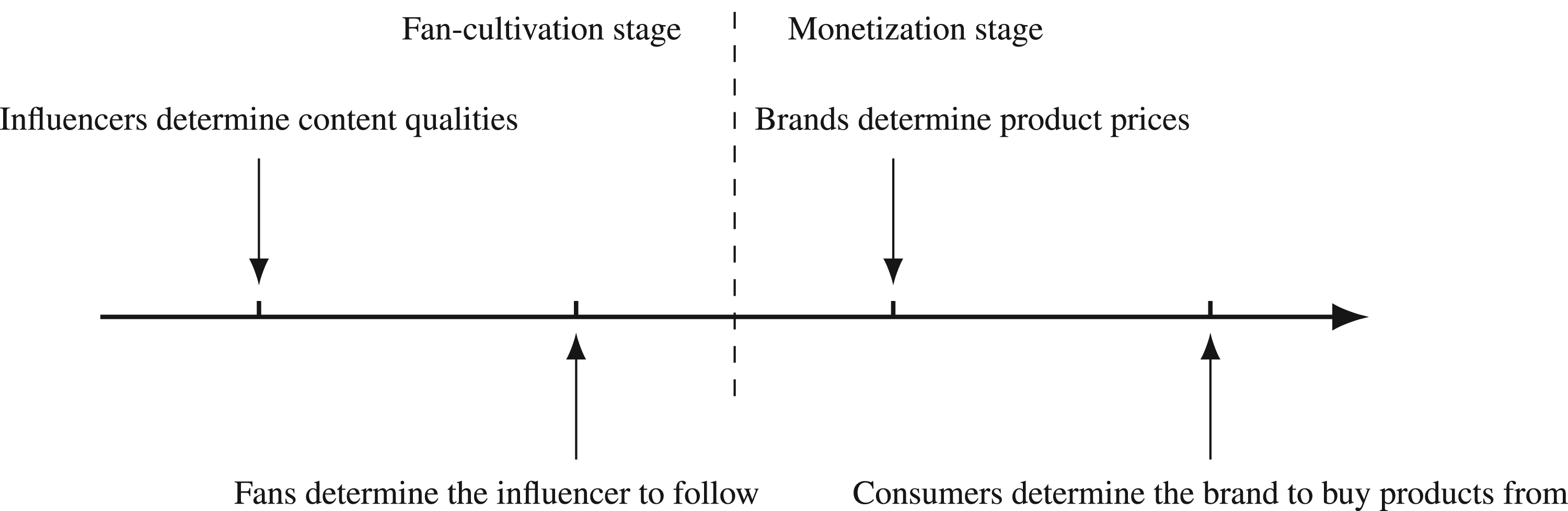
Timeline.
In the fan-cultivation stage, let

Given content qualities
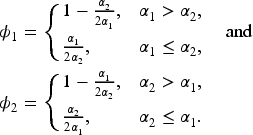
The result implies that an influencer’s fan number always increases with his content quality. When his fans are few, the growth rate is linear; as the number of fans increases, the growth rate becomes slower. We can then characterize how the network externality acts on the consumer utilities in the monetization stage. We define
In the monetization stage, each influencer monetizes his fans by selling the cooperating brand’s product in his livestream. For influencers, the more followers they have, the more valuable they become to brands and other users. A larger fan base means consumers have more opportunities to see, like, share, and engage with the influencer’s channel. Consequently, consumers’ purchase intention increases with the number of followers of an influencer (Dias et al., 2021; Weismueller et al., 2020). Hence, we assume that the network effect of an influencer is tied to his fan base size and is a same-side effect on the demand side. Specifically, the consumer utility from buying products of influencer

Without loss of generality, we normalize the total potential demand of each brand to one. We derive the demand for brand
For
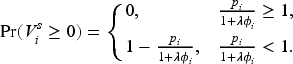
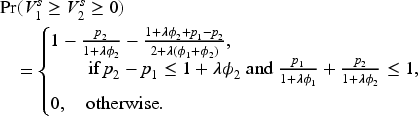
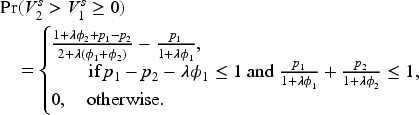
The result shows that in the monetization state, each brand’s demand decreases linearly with its price and increases more and more slowly as the number of fans of its cooperating influencer grows. It helps derive the brands’ optimal behavior in the monetization stage. Brand


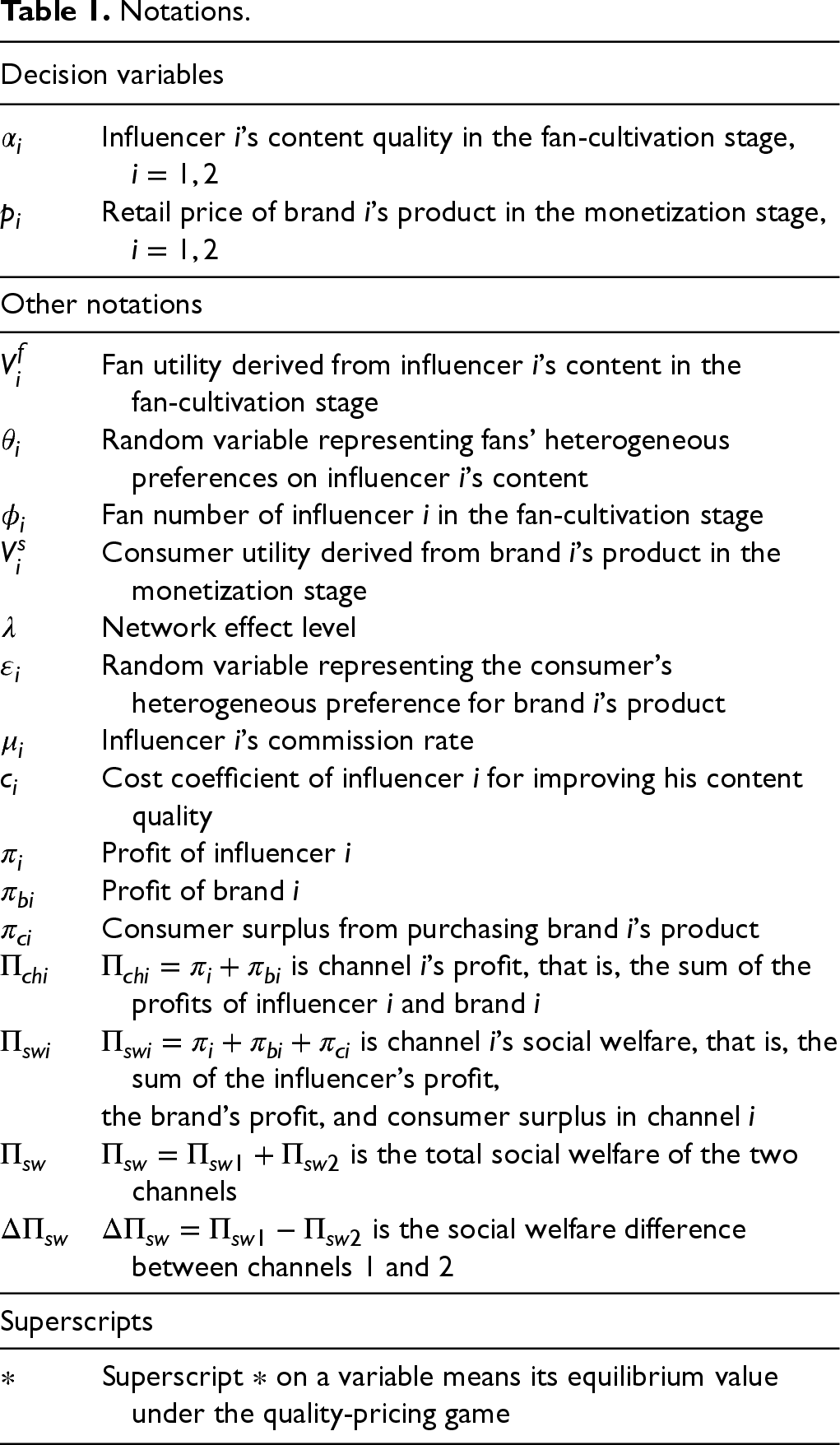
Notations.
In this section, we solve the brands’ pricing game in the monetization stage and then obtain the influencers’ equilibrium content quality in the fan-cultivation stage. Further, we investigate how the commission rates, content costs, and network effects affect the equilibrium behaviors and profits of the influencers and brands. To obtain the equilibrium content qualities of the influencers, we must solve a two-stage game. First, we derive the optimal prices of the brands in the monetization stage for any given fan numbers
(Optimal prices and profits of brands in the monetization stage)
For any given fan number
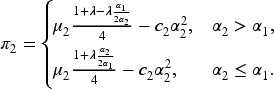
Lemma 3 shows that the optimal profit and price of the brand in the monetization stage both increases with the fan number cultivated in the fan-cultivation stage, which builds up a connection between the decisions across the stages. Next, we substitute the brands’ optimal prices in the monetization stage into the profit function of the influencers. As an example, we take influencer 1 for our calculation. Substituting 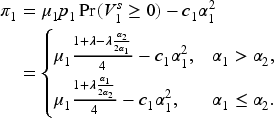
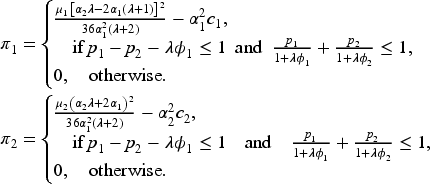
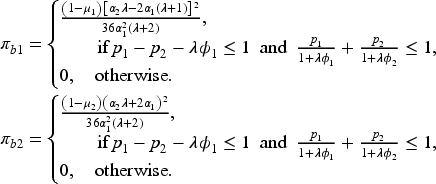
(Equilibrium policies and profits of influencers and brands)
The equilibrium content qualities of the influencers are as follows:


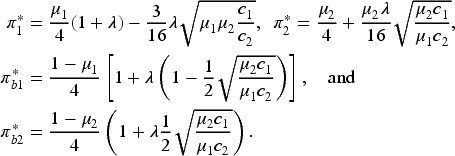
Theorem 1 demonstrates that when considering the pricing optimization of brands, the equilibrium of the content quality game between influencers is unique. In the equilibrium, as the network effect strengthens, each influencer improves his content quality, the prices charged by the brands increase, and both the influencers and the brands earn greater profits. However, the effects of the content costs
(Effects of commission rates, content costs, and network effects on equilibrium decisions)
(a)
From the influencers’ perspective, Proposition 1(a) implies that reducing the disadvantaged influencer’s cost improves both influencers’ content quality. In contrast, reducing the cost of an advantaged influencer improves only his content quality and even reduces the content quality of a disadvantaged influencer. Similarly, Proposition 1(b) indicates that a higher commission rate for the disadvantaged influencer results in higher content quality for both influencers. In contrast, a higher commission rate for the advantaged influencer leads to a quality increase for only the advantaged influencer and a decrease in the disadvantaged influencer’s content quality. In other words, when the disadvantaged influencer becomes better (i.e. with a lower content cost or a higher commission rate), it leads to higher content qualities for both influencers; however, when the advantaged influencer becomes better, it improves only his content quality and lowers the disadvantaged influencer’s content quality. The reason is that enhancing the advantaged influencer enlarges the gap between the influencers, which makes the two influencers more asymmetric. Hence, it becomes more difficult for the disadvantaged influencer to compete with the advantaged one. As a result, in equilibrium, the content quality of the advantaged influencer increases, and the disadvantaged influencer can only lower his content quality. In contrast, enhancing the disadvantaged influencer makes the two influencers more symmetric, leading them to improve their content quality to compete for fans. From a brand’s perspective, the proposition says that its price decreases in its cooperating influencer’s cost and increases in its competitor’s cost. Moreover, each brand’s price increases in its cooperating influencer’s commission rate and decreases in its competitor’s commission rate. The reason is that a lower content cost or a higher commission rate boosts the influencer’s fan number and increases his consumers’ utility through the network effect, which consequently raises the equilibrium price of his cooperating brand. Proposition 1(c) indicates that a stronger network effect improves both influencers’ content qualities and increases their cooperating brands’ prices, because it intensifies the content competition between influencers and improves consumers’ willingness to pay.
(Effects of commission rates and content costs on influencers’ and brands’ profits)
(a)
Proposition 2(a) reveals that for an influencer, a higher commission rate increases his profit and reduces the profit of his competitor. However, for a brand, Proposition 2(b) shows that even a higher commission rate means a lower revenue share for the brand; it may increase the brand’s profit, as illustrated in Figure 2. In other words, if a brand determines the commission rate, giving itself a higher revenue share does not always benefit it. The reason is that a higher commission rate for the influencer encourages him to improve his content quality, which brings in more fans and thus enhances the influencer’s profit and the brand’s sales via the network effect.
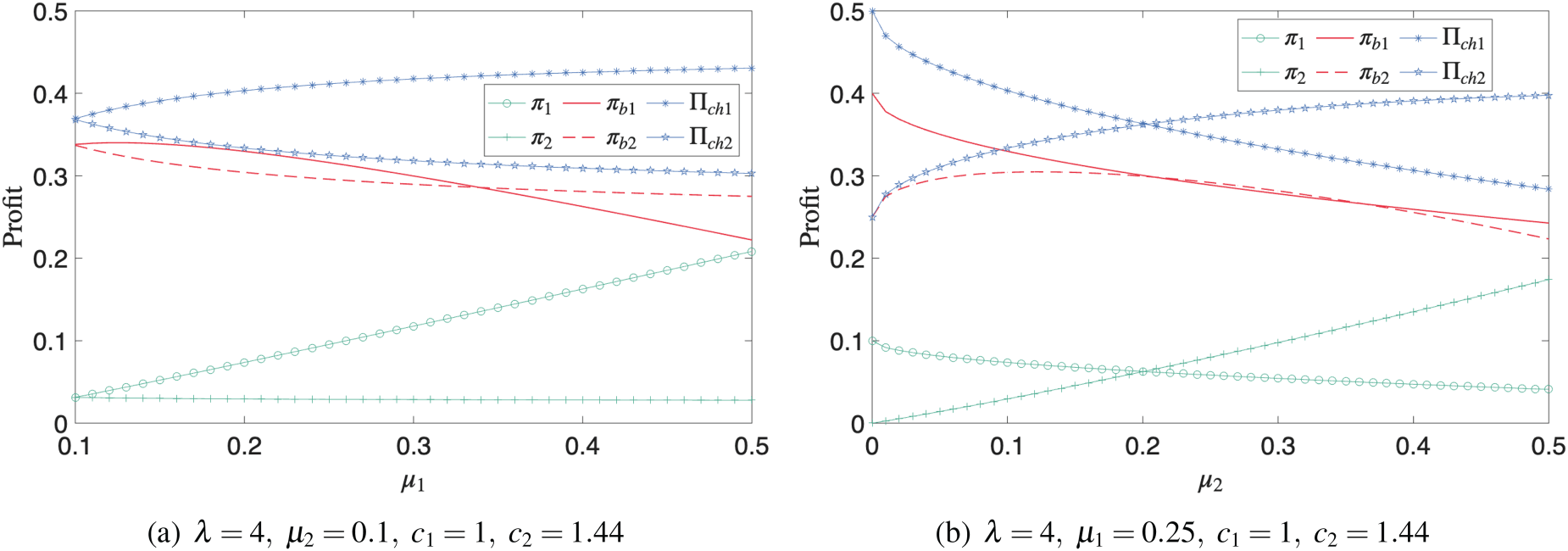
Profits of influencers, brands, and channels over commission rates
Proposition 2(c) is consistent with our intuition that reducing the content cost of an influencer benefits him and his cooperating brand and hurts the competing influencer and the competing influencer’s cooperating brand.
Next, we investigate the effects of commission rates and content costs on channel profits and social welfare. Define
(a)
Proposition 3(a) and (b) show that for the advantaged influencer, a higher commission rate always benefits his channel. In contrast, for the disadvantaged influencer, a higher commission rate may worsen his channel, because the disadvantaged position in the fan-cultivation stage makes the influencer’s profit increment be outweighed by the profit loss of his cooperating brand. In addition, improving the commission rate of either influencer makes him more advantaged in the content competition and therefore always hurts his competitor’s channel. Likewise, Proposition 3(c) reveals that a lower content cost of an influencer improves his channel’s profit and reduces his competitor’s channel’s profit.
Recall that the consumer utility in channel 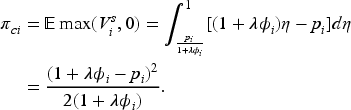
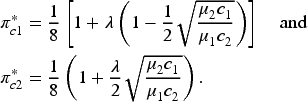
(Effects of network effects, commission rates, and content costs on social welfare)
(a)
Proposition 4(a) reveals that the social welfare of an influencer’s channel improves when the network effect strengthens, when the influencer is better endowed (i.e. obtains a higher commission rate or has a lower content cost), or when his competitor is worse endowed. These findings also suggest that, from the channel’s perspective, providing a greater share of the sales profit to the influencer rather than the brand makes the channel better off, because a higher commission brings the influencer’s optimal content quality closer to the channel optimum. Proposition 4(b) shows that a stronger network effect benefits social welfare. In addition, increasing either influencer’s commission rate reduces social welfare, regardless of the influencer’s ability, because the intensified content competition between the influencers makes the system deviate from its centralized optimum. It implies that, from the perspective of social welfare, in contrast to the channel’s perspective, allowing brands to maintain a greater share of sales profit is better than giving more profit to influencers, regardless of whether the influencer’s ability is high or low. On the other hand, improving the ability (i.e. lowering the content cost coefficient) of the advantaged influencer increases social welfare, whereas cultivating the disadvantaged influencer reduces social welfare. This finding indicates that
We investigate influencers with symmetric costs and symmetric commission rates in Section EC.2 of the E-Companion. Most of the results under the symmetric cases are consistent with our intuition and are particular cases of the asymmetric model. Below, we highlight the results not obtained in the asymmetric model. In the asymmetric model, an influencer’s content quality decreases with his own content cost and increases with his competitor’s content cost. However, in the symmetric-cost model, a higher content cost means that the content costs increase for both influencers. We find that the effect of the cost increment on lowering the influencer’s content quality is greater than that of improving his competitor’s content quality, which leads to reductions in both influencers’ equilibrium content quality. Similarly, for the symmetric-commission-rate model, a higher commission rate means that the commission rates increase for both influencers, which results in an improvement of both influencers’ content qualities and profits and reductions in both brands’ profits, both channels’ profits, and both channels’ social welfare.
In this section, we investigate influencers who consider the word-of-mouth effect in the monetization stage, which confirms the robustness of the base-model results and reveals how the impacts of the word-of-mouth effect on the influencers and brands depend on the current and future market sizes. Specifically, following Campbell (2015), we assume that an individual who has purchased the product in the current market informs 
(Equilibrium policies and profits with the word-of-mouth effect)
The equilibrium content qualities of the influencers are
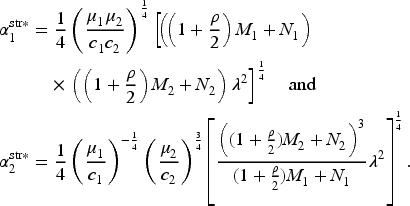
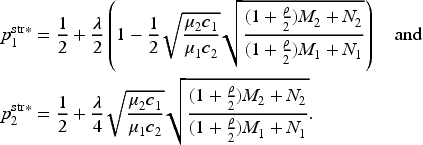
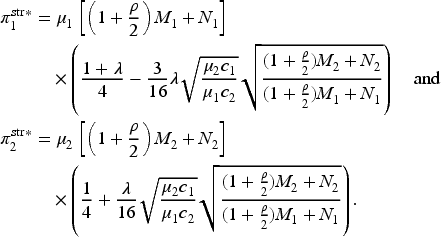
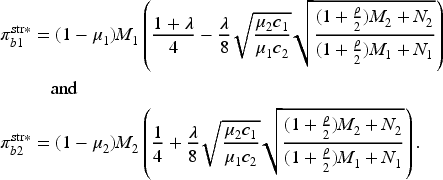
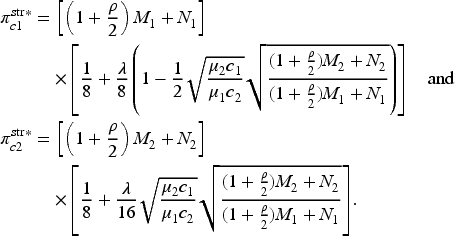
Theorem 2 characterizes the equilibrium policies and profits of the competing influencers and brands with the word-of-mouth effect. From the results, it is easy to verify that the effects of the network effect level, commission rates, and content costs are similar to those of the base model. Meanwhile, compared with the base model, the equilibrium considering word-of-mouth effect is additionally affected by the word-of-mouth effect and market size. Consistent with intuition, this proposition implies that a larger market size in an influencer’s channel would benefit both the influencer and the brand, and the consumer surplus would improve as well. However, the impacts of the word-of-mouth effect on the optimal policies may be non-monotone depending on the market sizes, as shown below.
(Effects of word-of-mouth on influencers’ and brands’ policies)
(a)
Proposition 5(a) reveals that the advantaged influencer’s content quality always increases with the word-of-mouth effect. In contrast, the disadvantaged influencer’s content quality can decrease as the word-of-mouth effect strengthens, due to his disadvantaged position in the content competition. This situation occurs when the disadvantaged influencer’s future market size is immense, making the current market insignificant for the influencer. Hence, retreating from the content competition to reduce the content cost is optimal for the disadvantaged influencer. Note that
Lemma 4 implies that as the level of the word-of-mouth effect increases, the increasing (resp. decreasing) speed of both influencers becomes faster (resp. slower), which helps derive how the level of the word-of-mouth effect affects the influencers’ profits in the following proposition.
(a) For
Although in many situations, the strengthening of the word-of-mouth effect benefits both influencers, Proposition 6 indicates counterintuitively that it may hurt either influencer’s profit under certain conditions. This anomaly occurs when an influencer’s future market size is large enough and the word-of-mouth effect is relatively weak. The reason is that a sizable future market makes the equilibrium price decrease in the level of the word-of-mouth effect, as shown in Proposition 5(b). Also, when the word-of-mouth effect is weak, the benefit from the additional consumers attracted by the strengthened word-of-mouth effect cannot cover the loss incurred by the price reduction. Note that for the advantaged influencer, this anomaly also occurs when his market size is small enough. That is because a stronger word-of-mouth effect impels the advantaged influencer to improve his content quality in equilibrium, as shown in Proposition 5(a), and the content cost increment outweighs the gain from consumer attraction via word-of-mouth, given that his current market size is small.
Discussion
We analyze four extensions of the base model from the aspects of brands, influencers, fans, and products. Specifically, we consider a brand’s influencer cooperation strategy, cooperation with multiple competing influencers under the commission-and-slotting-fee mode, fans with correlated content preferences, and substitutable products with correlated consumer preferences sold by competing brands. In these extensions, we derive theoretical results to check the robustness of the results for the base model and reveal new insights from the extended settings. For the last extension, owing to the nonexistence of a closed-form solution, we conduct numerical experiments to verify whether the results of the base model continue to hold.
A Brand’s Influencer Cooperation Strategy
In this subsection, we extend the base model to investigate a brand’s influencer cooperation strategy. As in the base model, we assume two influencers competing for fans. From a brand’s perspective, we consider the brand’s decision on whether to adopt influencer marketing and, if so, which influencer to cooperate with. Note that when the brand is making the influencer cooperation decision, there can be four possible availability states of the influencers, that is, both influencers are available, only influencer 1 is available, only influencer 2 is available, and neither influencer is available. The brand’s optimal cooperation decision is conditional on the availability of the influencers.
To derive the optimal influencer cooperation strategy, we must compare the brand’s profits under each cooperation strategy. Specifically, suppose the brand chooses not to adopt influencer marketing (i.e. the no-cooperation setting). In that case, it does not need to pay the influencer a commission and cannot gain any additional demand from the influencer’s channels. To distinguish from the setting where the brand adopts influencer marketing (i.e. cooperates with brand 1 or 2), we use subscript
(Brand’s optimal influencer cooperation strategy)
Proposition 7 states that the influencer cooperation strategy depends on the network effect level. For the case where both influencers are available, if the network effect is weak, then running the business without influencers is optimal for the brand; if the network effect is strong, cooperating with the advantaged influencer benefits the brand most; if the network effect is neither too weak nor too strong, the disadvantaged influencer is the brand’s best choice. Similarly, when only one influencer is available, the optimal strategy is to cooperate with the influencer if the level of the network effect is stronger than a threshold. The results imply that a brand should cooperate with a more advantaged influencer as the network effect strengthens, because the advantaged influencer amplifies the benefit from the network effect and a strong enough network effect could cover the high commission cost for the advantaged influencer.
Cooperation With Multiple Competing Influencers Under the Commission-and-Slotting-Fee Mode
In this subsection, we extend the base model to consider a brand that can choose to cooperate with multiple competing influencers to sell a single product. In addition, we extend the commission-only cooperation mode between the influencer and brand in the base model to the commission-and-slotting-fee mode, which is widely adopted in practice, as reported by the China National Radio News (CNR, 2021). Under the commission-and-slotting-fee mode, an influencer receives a fixed payment from the brand, that is, the slotting fee, in addition to commission from selling the products. The brand chooses to sell the product without influencer marketing, with a single influencer, or with two influencers. Similar to Section 6.1, we assume that if the brand chooses to cooperate with one influencer, the other influencer could always find another cooperating brand, which makes the one-influencer equilibrium consistent with the base model results. To focus on the brand’s influencer cooperation decision and simplify the analysis, we consider that the influencers are identical, which implies that they have the same content cost and commission rate, denoted by
(Demand in the monetization stage when cooperating with two influencers)
Given fan numbers
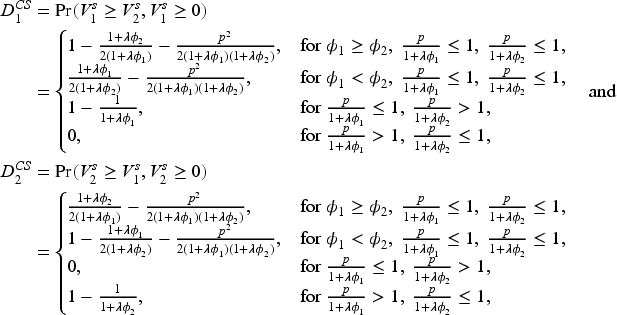
where
Because we focus on identical influencers in this extension, the equilibrium fan numbers of the two influencers satisfy 

(Equilibrium for a brand cooperating with multiple influencers)
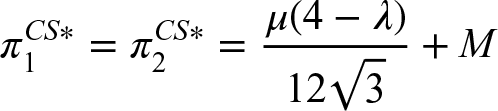
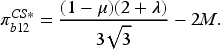
Lemma 6 characterizes the equilibrium decisions and profits of the brand and influencers when the brand chooses to cooperate with both influencers. Likewise, based on Theorem 1 of the base model and the fact that slotting fee
(Brand’s optimal influencer cooperation strategy under commission-and-slotting-fee mode)
Denote
Proposition 8 reveals that when there is no slotting fee, the brand always wants to cooperate with two influencers when adopting influencer marketing, as it would stimulate demand and increase revenue. However, when the slotting fee is strictly positive, the strategy of the brand depends on the value of a benchmark profit
To better understand Proposition 8, Figures 3 to 5 illustrate how the brand’s optimal influencer cooperation strategy changes with respect to the commission rate, slotting fee, and level of network effect. Specifically, Figure 3 demonstrates that for a given level of network effect, consistent with our intuition, when the cost of influencer marketing is low (i.e. both the commission rate
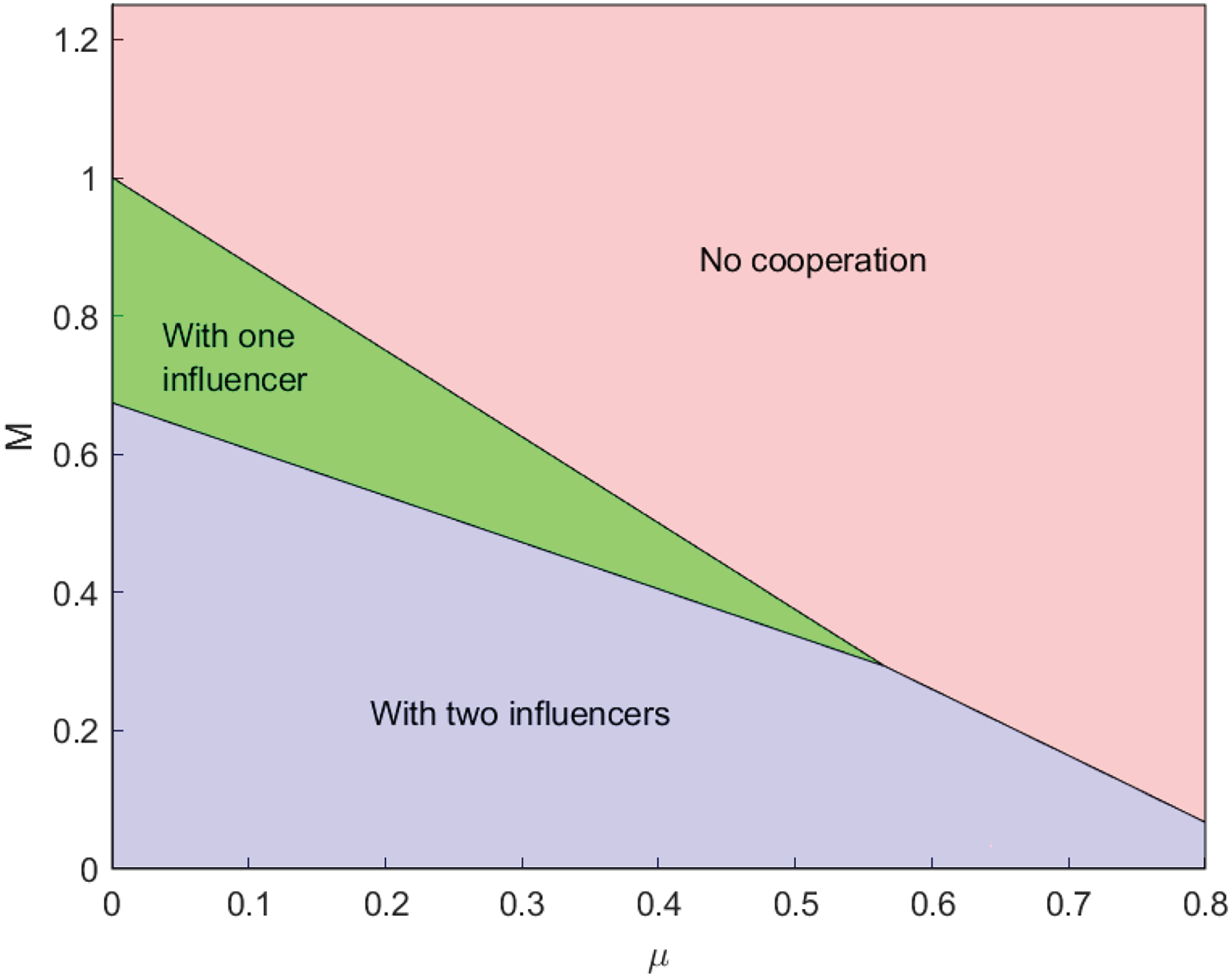
Brand’s influencer cooperation strategy over commission rate
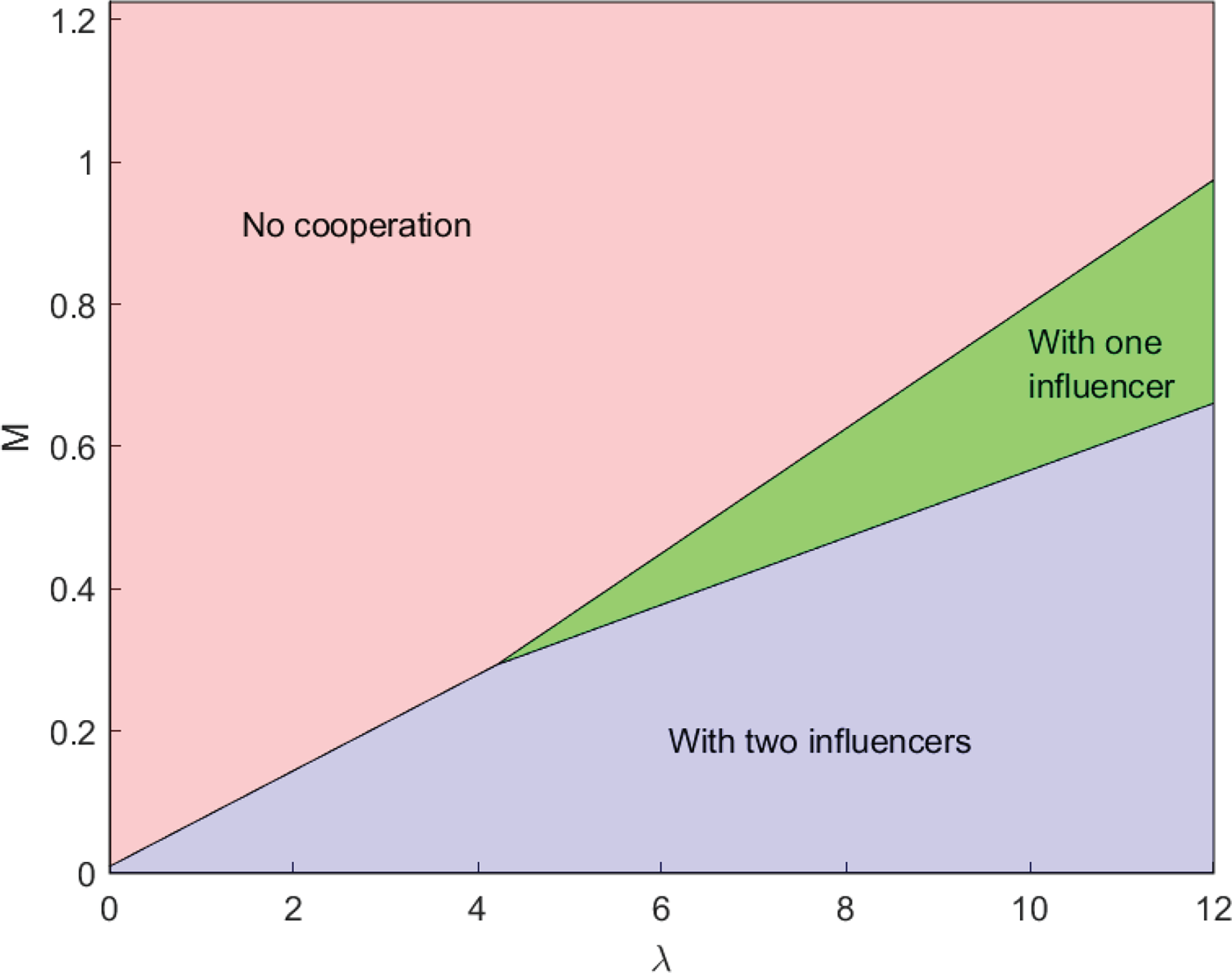
Brand’s influencer cooperation strategy over the level of network effect
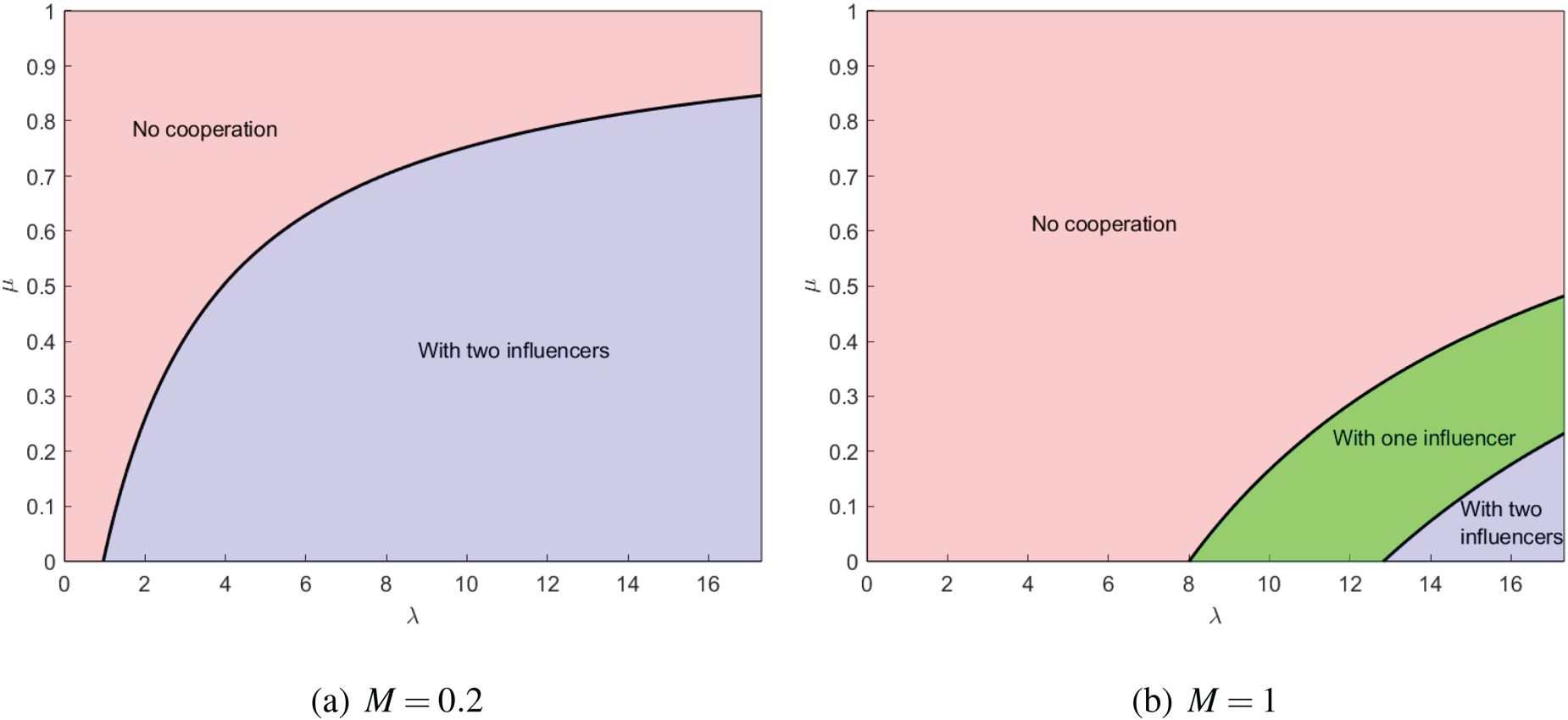
Brand’s influencer cooperation strategy over the level of network effect
In this subsection, we extend the base model by assuming that the fans’ preferences for the two influencers are perfectly negatively correlated, that is, 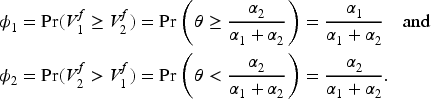
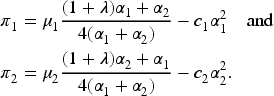
(Equilibrium policies and profits under correlated content preferences)
Under the correlated content preference setting, the equilibrium content qualities of the influencers are
With the equilibrium derived in Theorem 3, we can verify the robustness of the results obtained in the base model (i.e. Propositions 1–4). We find that even the equilibrium content qualities, prices, and profits with correlated content preferences are much more complicated than those in the base model. The effects of the commission rates and content costs on the equilibrium decisions and profits of the influencers and brands, equilibrium channel profits, and equilibrium social welfare are consistent with those in the base model. It ensures the robustness of our derived insights. The verification details are in Section EC.3 in the Appendix.
Numerical Experiments on substitutable Products With Correlated Consumer Preferences Sold by Competing Brands
In this subsection, we consider the direct competition between brands (i.e. the products sold by different brands are substitutable) and the correlation between consumer preferences. Specifically, we assume that the consumers could purchase brand 1’s product, or purchas brand 2’s product, or none, and the consumer preference heterogeneities towards brands’ products satisfy 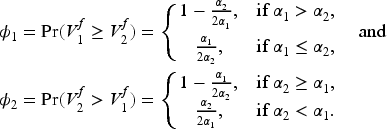



Due to the complexity of the setting that incorporates the content quality competition between influencers, price competition between brands, and consumer preference correlation between the brands’ products, it is not easy to obtain the closed-form equilibrium solution for the two-stage game and conduct theoretical analysis on the equilibrium. Hence, we conduct numerical experiments instead to study how the results of the base model change under extension. The results of the experiments are provided in Section EC.4 in the Appendix. Most of the numerical results are consistent with the propositions of the base model, indicating that our base model has a certain level of robustness. The only exception is that, as shown in Proposition 4 of the base model, social welfare decreases in the commission rates. In contrast, the numerical results show that social welfare can increase with the commission rate when considering brand direct competition and product correlation. It implies that the direct competition between correlated products may make the increment in the advantaged influencer’s commission rate contribute to greater social welfare by improving the consumer surplus.
Conclusions
Summary of the Article
With the increasing popularity of social media platforms, influencers have gained significant power to broadcast information via short video clips, attract fans, and generate revenue from their fame. A growing number of influencers monetize their fame by cooperating with brands on product sales. In this work, we investigate how influencers cultivate fans with content creation and how their fame can be monetized through cooperation with brands. Using a two-stage quality-pricing game framework, we study the competition and cooperation problem between influencers and brands in influencer marketing. We divide the time horizon into two stages, that is, a fan-cultivation stage, where influencers determine their content quality and compete for fans, and a monetization stage, where the brands that cooperate with the influencers decide their product prices. Using backwards induction, we first characterize the optimal pricing strategies of the brands based on the consumer choice behavior, incorporating the network effect of influencer marketing, given the content-quality decisions of the influencers. Then, we characterize the content-quality game between the competing influencers in the fan-cultivation stage based on the influencer selection behavior of the fans. We obtain the equilibrium content qualities for the influencers and equilibrium prices for the brands and investigate how the commission rates, content costs, and network effect level affect the equilibrium behaviors and profits of the influencers and brands as well as social welfare.
Strategies for Stakeholders
Robustness of Our Results
We extend the model setting in the following aspects to verify the robustness of the insights derived from the base model. First, we consider that a brand could cooperate with multiple influencers simultaneously and pay each influencer a slotting fee in addition to the commission fee. We reveal that cooperating with one influencer could never be optimal when the slotting fee is lower than a threshold. It is because a low slotting fee makes the gain from demand expansion by an additional influencer always outweigh the cost increase from introducing a new influencer, leading to the domination of cooperation with multiple influencers over cooperating with one influencer. Second, we incorporate the correlation between the fans’ preferences toward the competing influencers’ contents and obtain the equilibrium solution under the extended setting, which is much more complicated than the base model. Based on the equilibrium, we validate that the effects of the commission rates and content costs on the equilibrium behaviors and profits of the influencers and brands, equilibrium channel profits, and equilibrium social welfare are consistent with those derived from the base model, which confirms the robustness of our insights. Finally, we consider both the direct competition between brands and the correlation between consumers’ product preferences. Since a closed-form equilibrium cannot be obtained under this setting, we conduct numerical experiments to study whether the findings of the base model would continue to hold. The numerical results are consistent with the insights gained from the base model, except that social welfare can be nonmonotonic with respect to the influencers’ commission rates.
Future Research Directions
There are several fruitful directions for future research. First, exploring oligopoly influencers’ equilibria and investigating how the number of influencers affects the equilibrium results would be desirable. Second, it would be interesting to investigate fans’ multihoming behavior in our model’s fan-cultivation stage. Third, we assume that all the information is publicly known. However, when an influencer’s content cost and preference are private information, it would be interesting to explore how this information asymmetry affects the results.
Supplemental Material
sj-pdf-1-pao-10.1177_10591478251407774 - Supplemental material for Fan Cultivation and Monetization With Network Effects: Competing Influencers and Collaborating Brands
Supplemental material, sj-pdf-1-pao-10.1177_10591478251407774 for Fan Cultivation and Monetization With Network Effects: Competing Influencers and Collaborating Brands by Yangyang Xie, Suresh P Sethi, Lijun Ma and Zhiyuan Chen in Production and Operations Management
Footnotes
Acknowledgments
We would like to express our sincere gratitude to the editors and reviewers for their valuable and constructive suggestions, which substantially improved this research.
Declaration of Conflicting Interests
The author(s) declared no potential conflicts of interest with respect to the research, authorship, and/or publication of this article.
Funding
The author(s) received the following financial support for theresearch, authorship and/or publication of this article: This research is partially supported by the National Natural Science Foundation of China (Nos. 72371231, 72471153, 72471180, 72031004, 72531010, and 71991464/71991460), the Guangdong Basic and Applied Basic Research Foundation (Grant No. 2024A1515011819), and the Shenzhen University HighLevel University Construction Phase III-Human and Social Sciences Team Project for Interdisciplinary Innovation (Grant No. 24JCXK05). Suresh P Sethi thanks McDermott Chair for support of this research.

How to cite this article
Xie Y, Sethi SP, Ma L and Chen Z (2026) Fan Cultivation and Monetization With Network Effects: Competing Influencers and Collaborating Brands. Production and Operations Management 35(6): 2476–2495.
References
Supplementary Material
Please find the following supplemental material available below.
For Open Access articles published under a Creative Commons License, all supplemental material carries the same license as the article it is associated with.
For non-Open Access articles published, all supplemental material carries a non-exclusive license, and permission requests for re-use of supplemental material or any part of supplemental material shall be sent directly to the copyright owner as specified in the copyright notice associated with the article.
