







Abstract
Crowdshipping, a rapidly growing approach in Last-Mile Delivery (LMD), relies on independent crowdworkers to fulfill delivery orders. Building a sustainable network of crowdshippers is crucial for the long-term success of such systems, as participation is primarily driven by fair compensation. This is especially important for workers who rely on crowdwork as their main source of income, making equitable pay not just a matter of fairness but of financial well-being. In this study, we address several key questions that gig-economy platforms concerned with fair pay may ask: How can equity be measured? What are the associated cost implications? And how can potential drawbacks be managed? Our main contribution is the development of a practical, equity-oriented framework tailored to crowdshipping within an LMD environment. Inspired by the real-world operations of several crowdshipping platforms, the framework operates in real time and is built around a bi-objective optimization model that balances equity and cost. This allows us to systematically explore trade-offs and identify the equity measures that most effectively capture this balance. We demonstrate that even a modest reduction in cost efficiency (e.g., 2.5%) can lead to substantial improvements in equity; potentially up to 65%. Our results provide actionable insights for practitioners, including guidance on selecting appropriate equity measures. We also find that the best equity outcomes occur when the crowdshipper pool is kept relatively small. Furthermore, we quantify the performance loss of high- and low-performing crowdshippers as the pool size increases, offering valuable insights for workforce planning and management. Along similar lines, we demonstrate that our framework remains effective in managing vehicle shortages in dynamic environments while achieving comparable levels of equity improvement.
Introduction
Last-mile delivery (LMD) consistently represents a significant expense within the logistics framework. According to CapGemini Research Institute (2019), LMD stands out as the primary cost driver in the supply chain, a fact accentuated by the exponential growth of e-commerce, which exposes the unsustainability of current delivery models. Vehicle routing in last-mile logistics is often considered non-value-added due to resource underutilization, high delivery costs, and loss of business time. In response to the growing demand for faster delivery services, several retailers are now adopting platforms allowing them to employ independent gig workers for order fulfillment. Such platforms facilitate the onboarding of gig workers based on demand dynamics, lowering operational costs compared to maintaining permanent employees, as noted by Fatehi and Wagner (2022). The employment of gig workers in the context of LMD is often referred to as crowdshipping.
It is important to distinguish crowdshipping from traditional outsourcing. While some authors (e.g., Kafle et al., 2017) describe crowdshipping as a form of outsourcing, specifically the assignment of deliveries to crowd-based workers, the term generally carries a broader meaning in the logistics literature. Traditional outsourcing typically involves delegating a set of logistics functions to a third-party provider, whose fleet performs the work under a service-level agreement (Malchow, 2023). In contrast, crowdshipping relies on independent couriers who connect directly with a platform or retailer to carry out specific delivery or pickup tasks. In a typical crowdshipping setup, a group of ad hoc drivers handles the delivery of one or more online orders to shopper locations (Alnaggar et al., 2019; Archetti et al., 2016; Arslan et al., 2019; Dahle et al., 2019; Dayarian and Savelsbergh, 2020; Macrina et al., 2017; Soto Setzke et al., 2017). Unlike conventional LMD, crowdshippers are not employees of the delivery company; they offer services occasionally, usually using spare space in their personal vehicles while en route to other destinations. As a result, crowdshippers differ in availability, vehicle capacity, and coverage area, among other factors.
While crowdshipping transforms LMD, its unique features bring operational challenges. One key issue, noted by Allon et al. (2023), is ensuring a steady and reliable supply of crowdshippers, which largely depends on their satisfaction with past participation. Achieving this requires fair and equitable workload allocation and compensation (Bai et al., 2019; Dayarian and Pazour, 2022). While fairness matters across all workforces, it is especially critical in crowdshipping, where gig workers are paid per task. Unlike salaried employees (e.g., Rea et al., 2021), crowdshippers’ earnings depend directly on workload distribution. Perceived unfairness can quickly lead to dissatisfaction and lower participation, making fair pay essential to sustain engagement and platform success. Equitable workload allocation ensures all crowdshippers have equal profit opportunities based on system conditions and individual capabilities. This supports financial stability, especially for those relying on crowd work as their main income, and guarantees outcomes nearly as favorable as efficiency-focused approaches.
Achieving workload equity involves two types of costs: operational and opportunity costs. Operational costs arise from deviations between equity-oriented and efficiency-oriented workload allocations. Opportunity costs reflect the potential loss in earnings for some crowdshippers when workload is redistributed to improve compensation for others, promoting a more equitable income distribution. Imposing operational costs on crowdshippers would reduce their total payoff, undermining the goal of encouraging participation through fairness. Thus, we focus on a setting where the company values equity, absorbs the operational costs, and propose a framework for equity-driven workload allocation. Opportunity cost is inherent in equity-focused strategies, as they redistribute opportunities by benefiting some crowdshippers while reducing pay for others compared to efficiency-based allocations. While those who benefit may be more inclined to participate, high-performing crowdshippers with greater resources may feel discouraged, even if they recognize the fairness principle. Our framework addresses this concern through effective workforce size management.
The proposed framework targets a free-market setting, specifically benefiting for-profit companies. Benefits arise when (1) the operational cost of equity remains low enough to preserve the company’s competitive edge, and (2) equity-driven outcomes favor all crowdshippers as uniformly as possible, including high performers. To achieve this, we develop a mechanism to mathematically represent crowdshippers’ workloads (the equity metric), which must be equalized. This equalization requires equity measures to evaluate the level of equality or inequality achieved. Our framework first proposes a novel equity metric capturing workload allocation across a diverse pool of drivers and adopts several established equity measures from economics. At its core is a bi-objective optimization process that balances equity and cost by approximating the nondominated (Pareto-optimal) frontier. To maintain competitiveness, the company sets an upper bound on the operational cost it is willing to incur while balancing equity and cost. Using this framework, we address three key research questions through computational analysis:
Which equity measure(s) are most reliable within the scope of our study? Since no unique equity function exists, we use multi-objective optimization to show that no established economic equity measure can be dismissed for the workload allocation problem. We then introduce a novel approach to identify the most reliable measure numerically. A measure is reliable if its nondominated frontier solutions approximate well those of other measures. Our results highlight the Coefficient of Variation as particularly promising. How much can equity improve with varying equity budgets within a working horizon? We show that equity can improve by up to about 65% within a working horizon with no more than a 2.5% increase in cost, and up to about 75% with under a 10% cost increase. What losses (i.e., opportunity costs) might high-performing crowdshippers face due to equity considerations? Our findings show that the framework minimizes losses for high performers. Additionally, interests align between high- and low-performing crowdshippers and equity-focused companies. Reducing the number of crowdshippers benefits all by cutting company expenses and lowering opportunity costs for both groups. Along similar lines, we also explore a complementary aspect of the problem in scenarios where courier shortages arise due to the dynamic nature of the system. We show that comparable levels of equity improvement can still be achieved under such conditions; however, this may come at the cost of increased operational expenses for the platform.
Contributions
The main contributions of this paper can be summarized as follows: We propose a practical equity-oriented framework tailored to crowdshipping within an LMD environment. This framework seeks to mitigate the adverse effects of operational and opportunity costs while maximizing the benefits of equitable workload allocation. We base the framework on the real-world activities of a group of crowdshipping platforms. We refer to the identified problem as the Dispatch Zone-Wave Problem (DZWP). We propose a solution method alongside the problem formulation to provide effective strategies for addressing the DZWP. The proposed method is tailored to optimize decision-making processes, enhancing the overall effectiveness of the equity-aware framework in similar LMD contexts. We conduct numerical experiments to evaluate the efficiency and performance of the proposed method, providing empirical evidence of its ability to handle practical-sized scenarios. A significant portion of our experiments is based on Amazon-inspired instances, which are specifically designed to address the three main research questions outlined earlier.
Paper Organization
The remainder of this paper is organized as follows: In Section 2, a brief literature review is provided. In Section 3, the theoretical foundation of the research is presented. Section 4 offers an overview of the DZWP. Section 4 provides an overview of the DZWP, including its assumptions, objective functions, and mathematical formulation. The proposed solution approach for solving the workload allocation problem is described in Section 5. Section 6 presents a solution approach to identify the most reliable equity measure(s) numerically. In Section 7, a detailed computational study is provided to address the research questions discussed above. Finally, a discussion including some concluding remarks is given in Section 8.
Literature Review
In this section, we review existing literature relevant to our study, organized around three key themes: (1) Optimization approaches for the LMD, (2) fairness in resource allocation, and (3) fairness in LMD-specific contexts. We emphasize summaries of strengths, limitations, and implications for each theme, highlighting how these inform our equity-driven framework for crowdshipping.
Optimization Approaches for the LMD
Exact methods aim to yield optimal solutions but require problem-specific adaptations for vehicle routing problem (VRP) variants, as seen in unified frameworks by Baldacci and Mingozzi (2009) and Pessoa et al. (2020). Applications in crowdshipping include iterative exact solving for dynamic pickups (Arslan et al., 2019) and robust optimization with queuing theory (Fatehi and Wagner, 2022). Despite these advancements, solving even moderately sized instances remains computationally intensive.
To overcome these limitations, ML has recently gained traction as either a standalone approach (Kwon et al., 2020) or combined with other methods (Morabit et al., 2021; Sobhanan et al., 2025). For example, Behrendt et al. (2023) apply ML to courier scheduling in crowdsourced deliveries. Despite their promise, ML techniques face challenges such as data dependency, long training times, and limited scalability, making them less adaptable when problem features change. As a result, heuristics have become the most widely used methods for large-scale optimization. Macrina et al. (2020) employ a variable neighborhood search for crowdshipping with intermediate depots but do not address equity considerations. Among heuristics, genetic algorithms (GAs) are particularly popular for their flexibility and speed to guide the population search towards optimality; for example, Vidal (2022) provide an open-source GA that finds near-optimal solutions to the capacitated VRP. GAs have proven effective for many VRP variants, including multi-depot (Vidal et al., 2012) and truck-drone fleets (Mahmoudinazlou and Kwon, 2024). For a comprehensive review of exact methods and heuristics applied to VRPs in freight transportation, readers can refer to Konstantakopoulos et al. (2022).
While traditional VRPs primarily focus on minimizing cost, real-world applications often involve balancing multiple objectives. For instance, Bula et al. (2019) propose a bi-objective model minimizing routing risk and cost. Recent research increasingly employs evolutionary algorithms for multi-objective VRPs (Liu et al., 2023) or adapts single-objective heuristics to incorporate route balancing (Matl et al., 2019a). Other studies optimize costs, emissions, and time using Non-dominated Sorting GA (NSGA-II) (Zhao et al., 2021) or combine heuristics with preference learning for more balanced solutions (Mesa et al., 2024; Nourmohammadi et al., 2025). Collectively, these reveal trade-offs overlooked by single-objective methods, underscoring the need for bi-objective equity-cost balancing in our framework.
Fairness in Resource Allocation
Fairness in resource allocation is a key concern across fields like healthcare, public policy, economics, and ethics. Mandell (1991) explore the cost-equity trade-off in public service delivery, unlike LMD in for-profit companies. Bertsimas et al. (2012) address efficiency-fairness trade-offs using
Fairness in LMD
For a detailed review of workload equity in vehicle routing, see Matl et al. (2018), which evaluates equity measures in bi-objective VRP models, identifying key properties and their impact on routing solutions. Matl et al. (2019b) extend this work through bi-objective optimization for route length balancing, termed the VRP with Route Balancing. Building on this, our study enhances practical relevance for crowdshipping by addressing workload equity among diverse couriers, incorporating multiple equity measures to capture varied preferences and trade-offs in crowdsourced delivery platforms.
Crowdshipping
Gig-economy delivery platforms, reliant on independent couriers, face unique challenges in equitable task allocation. Basık et al. (2018) and Li et al. (2023) explore fair task assignment in crowdshipping, focusing on fairness without route optimization. Other studies address fairness in transportation via single-objective optimization, covering scenarios like health worker allocation (McCoy and Lee, 2014), demand satisfaction with limited fulfillment (Ibarra-Rojas and Silva-Soto, 2021), and workload balancing with route consistency (Yu et al., 2024). Recently, Mahmoodian et al. (2025) proposed a vehicle routing model maximizing Nash Social Welfare of profit ratios for equitable workload distribution among crowdshippers. In contrast, our study employs a bi-objective optimization framework, balancing equity and cost to enhance fairness and operational efficiency in crowdshipping.
Meal Delivery Problem
The meal delivery problem, a key LMD scenario, emphasizes scheduling over routing due to tight delivery time windows (Agnetis et al., 2023; Cosmi et al., 2025). Operational planning prioritizes effective scheduling to ensure timely fulfillment, critical for customer satisfaction in gig-economy platforms. Martinez-Sykora et al. (2024) propose multi-objective optimization models to equitably distribute orders among food-delivery couriers, minimizing workload, travel, and waiting times, with real-world data validating significant fairness improvements over standard practices. While integrated routing and scheduling, known as the Meal Delivery Routing Problem (Reyes et al., 2018; Yildiz and Savelsbergh, 2019), is less studied, recent work by Singh et al. (2024) introduces an online heuristic algorithm incorporating fairness via a min-max objective for the
Research Gap
Despite advancements in LMD optimization, significant gaps remain at the intersection of efficiency and equity. Existing vehicle routing literature predominantly focuses on single-objective cost minimization, overlooking bi-objective frameworks that balance costs against workload equity for heterogeneous couriers. Moreover, broader fairness models are often ill-suited for for-profit platforms, failing to address the practical costs of implementing equity. A critical methodological void also exists, as the literature lacks both a suitable equity metric for diverse courier pools and a systematic process to validate and select the most reliable measure across a Pareto-optimal frontier. This study addresses these shortcomings by introducing a practical, bi-objective framework for the DZWP featuring a novel equity metric and a new approach for identifying the most reliable measure, thereby enhancing the operational viability and fairness of crowdshipping platforms.
Theoretical Foundation
In this section, we present a general theoretical framework applicable to a broad class of problems, including the specific setting of this paper. Consider an entity
Entity
A proper mapping reduces the full-dimensional criterion space to two dimensions such that every Pareto-optimal solution in the bi-objective space remains Pareto-optimal in the full space.
By Definition 1, proper mapping ensures that solving the bi-objective problem yields a subset of Pareto-optimal solutions in the full solution space. Without proper mapping, suboptimal solutions may arise in which improving one agent’s utility does not reduce the utility of others. This discussion highlights that not all equity measures are suitable, and those that fail to ensure proper mapping can be safely excluded. In general, both the structure of the utility function and the choice of equity measure are critical for achieving proper mapping. For instance, minimizing the Range of utilities often fails to achieve proper mapping because it focuses only on narrowing the gap between the highest and lowest utilities, while ignoring intermediate values. As a result, some agents may experience poor outcomes, and the resulting solutions may not be Pareto-optimal in the full space unless the utility function satisfies certain properties. Therefore, the use of Range as an equity measure should generally be avoided unless the utility function is explicitly designed to preserve proper mapping. In the following, we introduce a property of utility functions that, if satisfied, enables all equity measures (including the Range) to achieve proper mapping.
If
We aim to prove the assertion through a contradiction. Consider an arbitrary equity measure, and suppose
Now, we consider two cases. First, suppose there exists

Theorem 1 suggests that as long as the utility function of agents is an increasing function of the summation of item sizes allocated to them, then none of the equity measures can be considered unsuitable in theory. Therefore, the task of selecting the most appropriate equity measure(s) becomes primarily a computational challenge. Later in Section 6, we outline a computational method for this selection process. The underlying concept of our proposed approach lies in solving a bi-objective optimization problem for each equity measure. If the Pareto-optimal solutions of one equity measure closely approximate those of the others, we designate it as the most reliable equity measure. This is because by selecting that equity measure, we obtain solutions that are good across a variety of equity measures.
In this section, we provide a detailed description of the problem under study, the DZWP. Specifically, we study the context of a company (i.e., Entity G) operating from a single depot, aiming to conduct last-mile deliveries (i.e., Indivisible Goods of varying sizes) using crowdshippers (i.e., Agents). Each day is divided into equal-length time intervals (e.g., every hour) that online shoppers can choose among for their delivery to take place. Each interval is available to the online shoppers by a fixed cutoff time, after which it cannot be selected for delivery. The group of orders received for delivery within a time interval is referred to as a “wave”. Moreover, delivery orders within a wave are further broken down based on their delivery locations. Specifically, we assume that the geographical area covered by the depot is divided into predefined delivery zones to categorize orders based on their delivery locations. The compensation offered for deliveries made at different delivery zones can vary based on their characteristics (further discussed in Section 4.2).
To streamline our discussion, we call each delivery zone within a wave a “zone-wave”, presuming the company devises a plan for each zone-wave independently. Once the orders for a given zone-wave are identified, the decision maker faces the task of securing sufficient transportation capacity to deliver the orders of each interval. As crowdshippers sign up to provide service, they choose the zone-wave they wish to serve. Subsequently, the company adopts a first-come, first-served approach for selecting crowdshippers for each zone-wave. Note that this assumption is both practical and fair. It is practical because from a crowdshipper’s perspective, once they see a company’s request for a given zone-wave in their platforms, they expect prompt accommodation rather than being put on hold for an extensive time to know if they are selected. It is fair because it prevents the company from discriminating against crowdshippers. We later, in Section 7.2.2, demonstrate that the company should prioritize selecting the minimum number of crowdshippers required to fulfill orders for each zone-wave, as if done otherwise, it could negatively affect both low- and high-performing crowdshippers. Next, the company endeavors to allocate jobs (and corresponding routes) to the selected crowdshippers by solving a variant of VRP incorporating two conflicting objectives: cost and equity.
Therefore, to address the problem of each zone-wave, as outlined in Figure 1, the company solves two optimization problems: The crowdshipper selection problem and the workload allocation problem. The former is a single-objective optimization problem aimed at determining the minimum number of crowdshippers required to fulfill all orders within a targeted zone-wave. The latter focuses on workload allocation while considering the trade-offs between cost and equity objectives, ultimately selecting a solution that achieves a desirable balance between these two objectives. The crowdshipper selection problem can be viewed as a variation of the classical bin-packing problem, dynamically solved as crowdshippers join the system and enroll for a targeted zone-wave following a first-come, first-served rule. Due to its straightforward nature, we do not explore its details in this paper; interested readers can refer to E-Companion EC.1 for the mathematical formulation and additional information. Therefore, the remainder of this paper focuses primarily on the workload allocation problem, which constitutes the main contribution of our study. We detail our proposed methodology for analyzing trade-offs in workload allocation within a targeted zone-wave and present an approach to select solutions that balance these conflicting objectives.
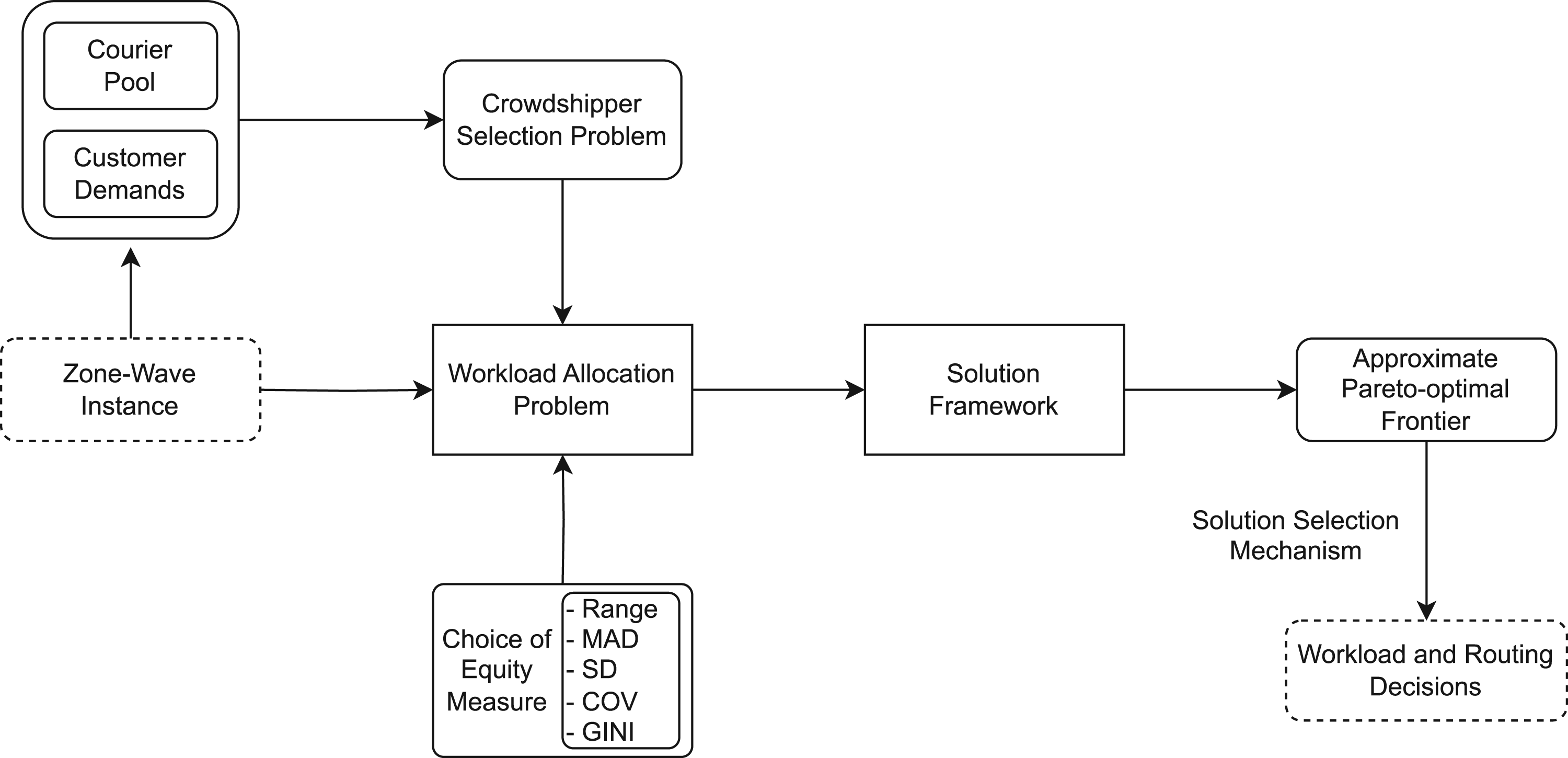
An outline of the dispatch zone-wave problem (DZWP) optimization workflow.
In light of the above, the remainder of this section is organized as follows. We begin by outlining the key assumptions of the workload allocation problem for each zone-wave and its distinguishing features compared to existing capacitated vehicle routing variants. We then define the objective functions (cost and equity) mathematically. As shown in Figure 1, various equity measures are considered, derived from the theoretical foundations discussed in Section 3. Finally, we present a mathematical formulation for each zone-wave.
In order to formulate the workload allocation problem for each zone-wave, several key assumptions have been made. Specifically, the problem is framed as a discrete VRP in a crowdshipping context, focusing on a single decision epoch within a dynamic operational setting. Each zone contains a single depot that serves as the origin point for all deliveries within that zone. Unlike traditional VRP variants with homogeneous vehicles, our problem involves a limited fleet of vehicles with varying loading capacities.
Decision-making is considered for a specific zone-wave, where participating drivers have signed up in advance and are aware of the depot location. This means a crowdshipper can only sign up in advance for a single zone in any given wave. The fleet of vehicles is selected on a first-come, first-served basis from a queue of heterogeneous vehicles, ensuring that the minimum number of vehicles is assigned to fulfill all demands within a given zone-wave. We denote the set of crowdshippers selected for the workload allocation problem in the zone-wave under consideration by
Each selected vehicle performs exactly one delivery trip within a zone-wave, and crowdshippers are free to work with other platforms outside their delivery commitments. Specifically, each crowdshipper begins their route from the depot and serves assigned customers based on prescribed routing. Unlike traditional VRP, crowdshippers are not required to return to the depot after completing their tasks. In other words, the problem is modeled as an open-route VRP, where couriers complete their routes upon delivering to the last customer. If a courier wishes to participate in a subsequent wave, they must sign up again for a zone of interest. In that case, since each zone-wave is treated independently, being selected in one wave does not guarantee selection in another. The company evaluates each zone-wave separately, with a focus on improving equity within that specific context.
Couriers are not compensated for traveling to the depot at the start of any zone-wave. Consequently, the optimization process assumes that all couriers begin each decision epoch at the depot. Additionally, crowdshippers are expected to follow the customer visit sequence recommended by the system, with all mileage costs along this route fully covered by the company. However, any additional mileage resulting from deviations will not be reimbursed. Finally, a major distinction of this study from the traditional VRP setting is that it considers not only cost minimization but also the improvement of equity. The equity objective function can be highly non-linear depending on the underlying equity measure. Let
Notation used for formulating the workload allocation problem.
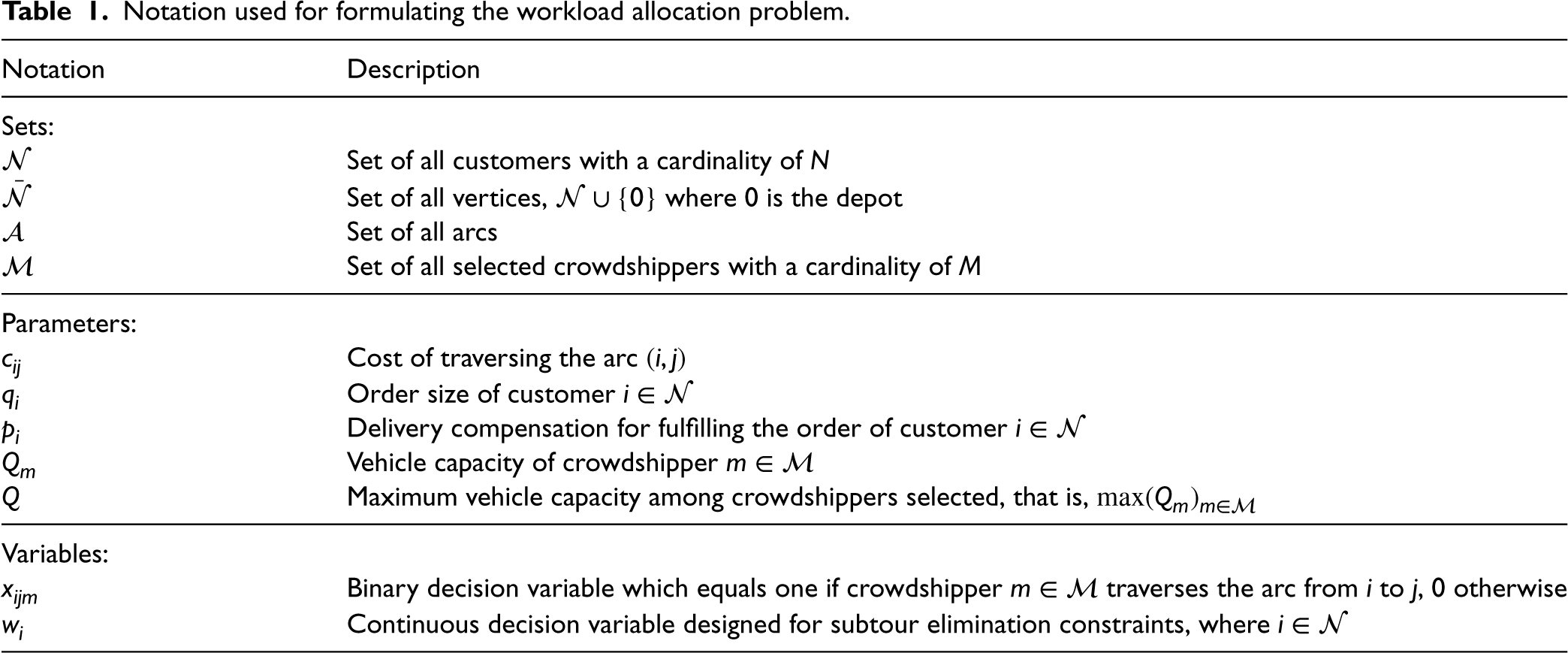
Notation used for formulating the workload allocation problem.
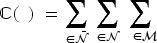
The foundation of our cost objective lies in the company’s compensation policy, which consists of two components: delivery compensation and mileage compensation. Delivery compensation depends on the delivery zone and the number of deliveries. Since the total number of orders is fixed within any zone-wave, the total delivery compensation is also fixed, given by
To meet the first axiom, the company must assign optimal (i.e., shortest) routes and avoid reimbursing more than the actual routing cost, which would encourage manipulation. To satisfy the second, it cannot reimburse less, as this would shift equity costs to the crowdshippers. Hence, full reimbursement is required to meet both conditions. Therefore, within each zone-wave, the collective profit of crowdshippers is fixed, equal to the delivery compensation. This is akin to a fixed-size cake that must be fairly divided based on workload. As delivery compensation is constant, minimizing total routing cost becomes the company’s cost objective:
Equity Objective Function
The equity objective function builds on two key concepts (Matl et al., 2018; Xinying Chen and Hooker, 2023):
Equity Metric: Interpreted as the utility function of agents (i.e., crowdshippers), it represents the quantity we seek to equalize (e.g., profits, tour lengths, among others). Equity Measure: A mathematical function (e.g., range, standard deviation, among others) used to evaluate the level of achieved equity. It acts as the criterion for assessing fairness.
Together, these define the equity objective function to be optimized. However, no universal form exists for this function. In our setting, the challenge lies in selecting both the equity metric and measure. This difficulty arises from heterogeneous crowdshipper characteristics, such as varying vehicle capacities. Although profits may seem like a natural equity metric, since crowdshippers aim to maximize earnings, ignoring their investments (i.e., contributed resources) risks bias and misleading conclusions. Crowdshippers behave as rational investors, expecting higher returns with greater input. Hence, the equity metric should reflect their level of investment. In our model, crowdshippers provide two resources: Time and vehicle capacity. Because zone-waves are analyzed independently and mileage costs are reimbursed, time is effectively standardized across crowdshippers within a zone-wave. Thus, the only remaining differentiating resource is vehicle capacity, which directly affects their profit and must be accounted for in the equity metric. With this consideration, we next introduce our proposed equity metric or utility function for each crowdshipper, termed “adjusted profits.” Specifically, we define

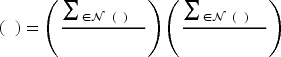
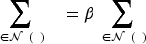
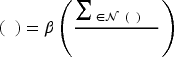
The proposed utility function for crowdshipper
Now that we have established the equity metric, the primary question arises: What form should the equity measure take? The following result can be directly proved from Theorem 1 and Observation 1.
Any equity measure offers proper mapping when the proposed utility function is employed for the crowdshippers.
The aforementioned proposition indicates that any equity measure available in the literature is theoretically suitable for the context of our research. Therefore, we examine several equity measures in this study, treating the selection of the most reliable measures as a key research question. In Section 6, we will present an approach to numerically compare and select the most reliable equity measure(s) for the problem under study. Specifically, within the context of our research, we examine five well-known equity measures, that is, range, mean absolute deviation (MAD), standard deviation, coefficient of variation, and Gini coefficient. While there are other measures, we do not include them in this study as they perform similarly to those we have already considered. For instance, Min-Max, a popular method, shares similarities with the range. We choose to use range since our research emphasizes distributional justice over the condition of the worst-paid-off crowdshipper. Building upon this foundation, we define

With the objective functions defined, we can now present the complete formulation of the workload allocation problem. Based on the notation outlined in Table 1, the workload allocation problem for any zone-wave can be formulated as follows:
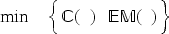








The first objective function aims to minimize the total routing cost incurred by all crowdshippers, and the second objective function retains its abstraction, allowing for the integration of any equity measure to evaluate the disparity in adjusted profits. Constraint (2b) ensures the fulfillment of all customer demands. It is important to note that while constraints (2c) enforce flow conservation at each node, the first objective function solely minimizes traversal costs for active routes. Hence, the cost of returning from the last served location to the depot, although considered in the constraint set, is omitted from the objective function. Crowdshippers depart from the depot according to constraints (2d), and self-visits are prohibited by constraints (2e). Subtour elimination constraints (2f)–(2g), also known as Miller-Tucker-Zemlin constraints (Miller et al., 1960), ensure the connectivity of crowdshipper routes based on heterogeneous load capacities. Variables
In this section, we present our proposed approach for solving this problem. The proposed approach consists of two components: A bi-objective optimization process aimed at generating the nondominated frontier, and a practical, generic method for selecting a solution from this frontier that balances cost and equity in alignment with the company’s needs.
Biobjective Optimization Process
Solving the workload allocation problem (2) is challenging. This is evident as even classical VRPs with a single objective pose considerable difficulty. In our research, we confront a variant of the VRP that is notably more complex due to its bi-objective nature, particularly when one objective is nonlinear (partly due to the nonlinear nature of the adjusted profits). Consequently, employing exact multi-objective optimization methods for solving the workload allocation problem becomes impractical. Therefore, we propose a custom-built heuristic approach tailored to address the problem, irrespective of the equity measure employed. Our proposed method quickly approximates the nondominated frontier for any instance of the workload allocation problem. It combines the core principles of the well-known NSGA-II(Deb et al., 2002) with the concepts of Multi-Directional Local Search (MDLS; Tricoire, 2012), offering an effective solution approach for handling the complexities of the workload allocation problem.
We refer to our proposed solution method as
To effectively solve the workload allocation problem, we either customize some of the main operations or add some new operations to NSGA-II. Customized operations include:
Solution Representation: We employ a sequence-based solution representation for Initialization: The initial population is generated using both targeted and random methods. Targeted methods such as Clarke-Wright savings, sweep, and nearest neighbor heuristics generate good initial solutions and accelerate convergence. Some solutions are constructed by heuristically balancing the equity metric among vehicles, while random permutations of customers and breakpoints are incorporated to maintain sufficient population diversity. GA Operations: Parent selection, a critical step in the GA, is implemented using binary tournament selection based on fitness scores. To generate offspring, we employ effective crossover operations specifically designed for sequence-based chromosome representations. Additionally, mutations are introduced with a predetermined probability and tournament selection.
Newly integrated operations include: Local Search: We attempt to refine the set of best solutions by employing MDLS at each iteration. This process prioritizes cost and equity separately, leveraging Large Neighborhood Search and workload reassignment strategies to achieve targeted improvements. Infeasible Population Management: Due to vehicle capacity constraints, some solutions generated during the search may be infeasible. Instead of discarding these solutions, we either attempt to repair them or preserve them in a separate population. This diversifies the total population and aids in escaping local optima. To ensure proper integration into the selection process, the objective values of infeasible solutions are penalized based on the extent of capacity violations, weighted by an adaptive penalty factor. Diversity Score: Our method enhances population diversity using a diversity score and alternately focuses on cost, equity, and solution rank throughout the search process to ensure a balanced exploration of the solution space.
Additional information about
Cardinality: The Cardinality, sometimes referred to as ‘Card.’ in this study, shows the number of approximate nondominated points found. We would like to highlight that, unlike exact methods, in heuristic solution approaches, the number of approximate nondominated points does not necessarily increase over time, as it is possible for a point to be found in one iteration that dominates a subset of the points in the previous iteration. However, one can hope that the Cardinality measure gets stabilized over time. Hypervolume (HV): This is a widely used performance indicator in multi-objective optimization (Pal and Charkhgard, 2019), and we sometimes refer to it as ‘HV’ in this study. It is a single value reflecting the area of the criterion space that is dominated by the approximate nondominated frontier found and is trapped between the approximated nondominated frontier and a given reference point. Larger values for the HV indicate better approximations. To ensure this premise, it is critical for the reference point to be selected carefully and remain fixed when comparing multiple approximations. In the case of our study, because we are minimizing both objective functions, the correct selection of the reference point means each component of the reference point should be larger than or equal to the same component among all approximate nondominated points across all comparisons.
Balancing Objectives: Equity and Cost
As previously noted, the equity and cost objective functions are two antithetical objectives, making it unlikely for a solution to simultaneously optimize both. Consequently, in tackling such bi-objective optimization problems, the primary aim for the company is to identify the trade-offs between the objectives, determining what is known as the “nondominated frontier.” With the nondominated frontier calculated, the company faces the task of selecting a nondominated point (and its corresponding Pareto-optimal solution) that effectively balances the equity and cost objectives from its perspective. This selection process is closely tied to the specific problem at hand and is heavily influenced by the application’s context and underlying research philosophy. In our research context, the guiding philosophy centers on favoring an equity-driven workload allocation, that is, balancing adjusted profits, within a free-market environment, with a focus on benefiting for-profit companies. Benefits are attained when (1) the cost of equity remains sufficiently low to preserve the company’s competitive edge, and (2) the outcomes driven by equity are uniformly favorable for all crowdshippers to the highest degree feasible. In essence, the cost of equity borne by the company should not yield undesirable consequences, resulting in uniformly unfavorable outcomes for all crowdshippers.
The latter condition is addressed by the proposed compensation policy outlined earlier in Section 4.2, which guarantees that crowdshippers will not bear the burden of equity costs. The former condition is pivotal in balancing the cost and equity objective functions. This means that the company can only afford to sacrifice a small fraction of its least-achievable costs to achieve a higher workload allocation for crowdshippers. Consequently, the company selects a point from the nondominated frontier with a capped percentage increase in costs, denoted by
Identifying the Most Reliable Equity Measure(s)
In this section, we explore the process of identifying the most reliable equity measures for solving the workload allocation problem within a given zone-wave. As per Proposition 1, all equity measures considered in this study offer proper mappings. Therefore, selecting the most reliable measure(s) is primarily an empirical question, best addressed through computational analysis. Thus, we propose a method for this purpose in this section. The approach proposed here conducts a comprehensive analysis over the entire set of approximate Pareto-optimal solutions found using each measure. Later in Section 7.1.3 and E-Companion EC.5, we highlight other alternative techniques that rely on analyzing a subset of Pareto-optimal solutions found using each measure. However, such approaches raise some major questions that are not trivial how they can be addressed. We posit that a measure identified as the most reliable using full-set analysis is likely to perform well under subset-based analysis but not necessarily vice versa. In Section 7.1.3 and E-Companion EC.5, we provide numerical evidence supporting this claim. With this in mind, we next present our proposed selection approach.
Our proposed approach starts with generating approximate nondominated frontiers for each equity measure using 
The mapping process is straightforward. For instance, let
Considering the exploration of five distinct equity measures in 
Note that among these approximations,
After computing all five different approximations for each equity measure, we can now readily identify the most reliable measure(s). An equity measure earns this distinction if it not only produces the best-known approximation for itself but also comes close to achieving the same level of accuracy for other measures through mapping. We gauge this performance using the HV gap. Clearly, determining the best measure through this method requires a comprehensive computational study across various instances to assess the average performance of each equity measure and its corresponding mappings.
Computational Study
In this section, we conduct an extensive computational study using large-sized instances to not only showcase the performance of
We conduct two series of experiments, each based on a distinct set of instances. The first series, reported in Section 7.1, focuses on operations at a single zone-wave level, exclusively addressing the workload allocation problem without focusing on the process of crowdshipper selection, and is designed to answer research questions of a theoretical and computational nature. In contrast, the second series of experiments, reported in Section 7.2, investigates the end-to-end operations of a company over a typical working horizon. These experiments involve multiple zones and waves, jointly addressing both the crowdshipper selection and workload allocation problems on a recurring basis. Therefore, the second part aims to answer research questions grounded in real-world operational settings.
Specifically, the first series of experiments is designed primarily to highlight the performance of the proposed workload allocation approach and to identify the most reliable equity measures. To ensure the generality of the results, we focus on a relatively large set of randomly generated instances, as this phase centers on pure performance analysis through computational experiments. Specifically, 14 different size classes of randomly generated instances are considered, with 10 instances in each size class, yielding a diverse experimental set. In contrast, the second part of the experiments mainly addresses real-world operational questions introduced in the Introduction of this paper, and demonstrates how the courier selection and workload allocation model operates in a dynamic setting where orders arrive over time. For this series of experiments, we utilize the 2021 Amazon Last Mile Routing Research Challenge dataset (Merchán et al., 2024) to simulate a planning horizon consisting of 100 waves of customer orders spanning five geographically distinct zones in the Los Angeles, California region. Each wave constitutes a synthetic instance derived from realistic data, capturing the spatial and demand characteristics typical of LMD operations, in which 20% of drivers are high-capacity and 80% are low-capacity. Further details about the instance generation and adoption process are provided in E-Companion EC.4.
Part I: Evaluation of the Algorithmic Performance
The first series of experiments consists of several components: Analyzing the overall performance of the proposed heuristic, validating its effectiveness, and ultimately identifying the most reliable equity measure(s) based on the proposed approach. Identifying the most reliable measure is particularly important, as it will be fixed and consistently used in the second series of experiments.
Overall Performance Analysis
In this subsection, we focus on assessing the overall performance of the
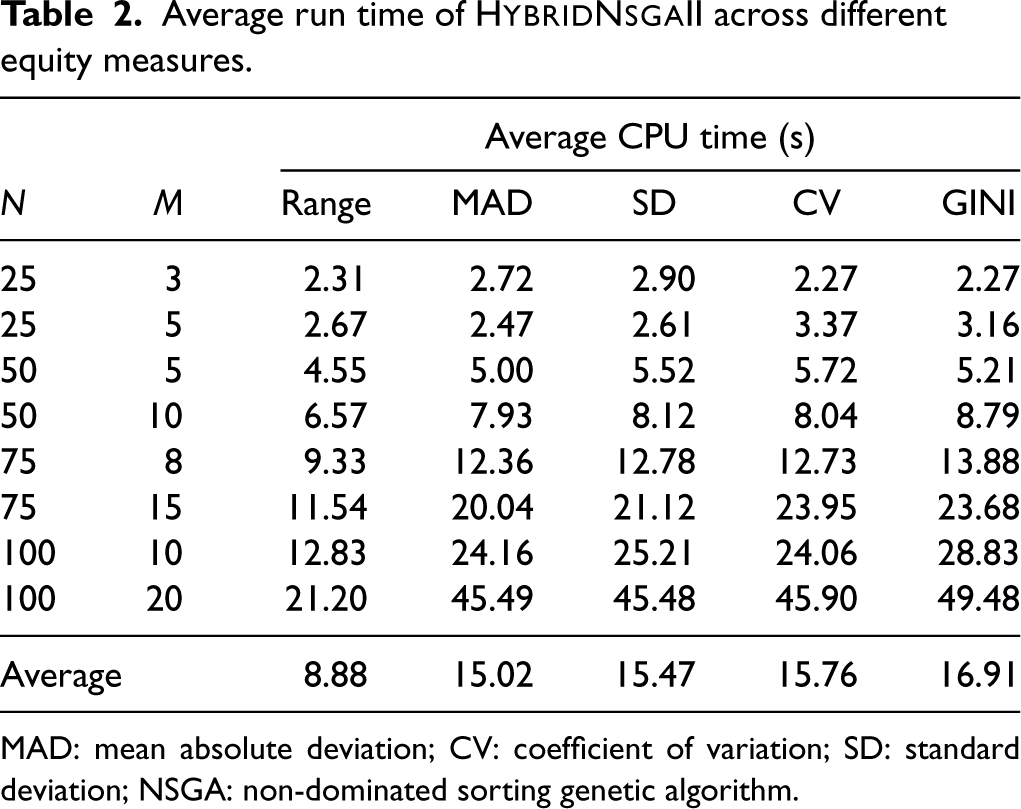
Average run time of
across different equity measures.
Average run time of
MAD: mean absolute deviation; CV: coefficient of variation; SD: standard deviation; NSGA: non-dominated sorting genetic algorithm.
The progression of
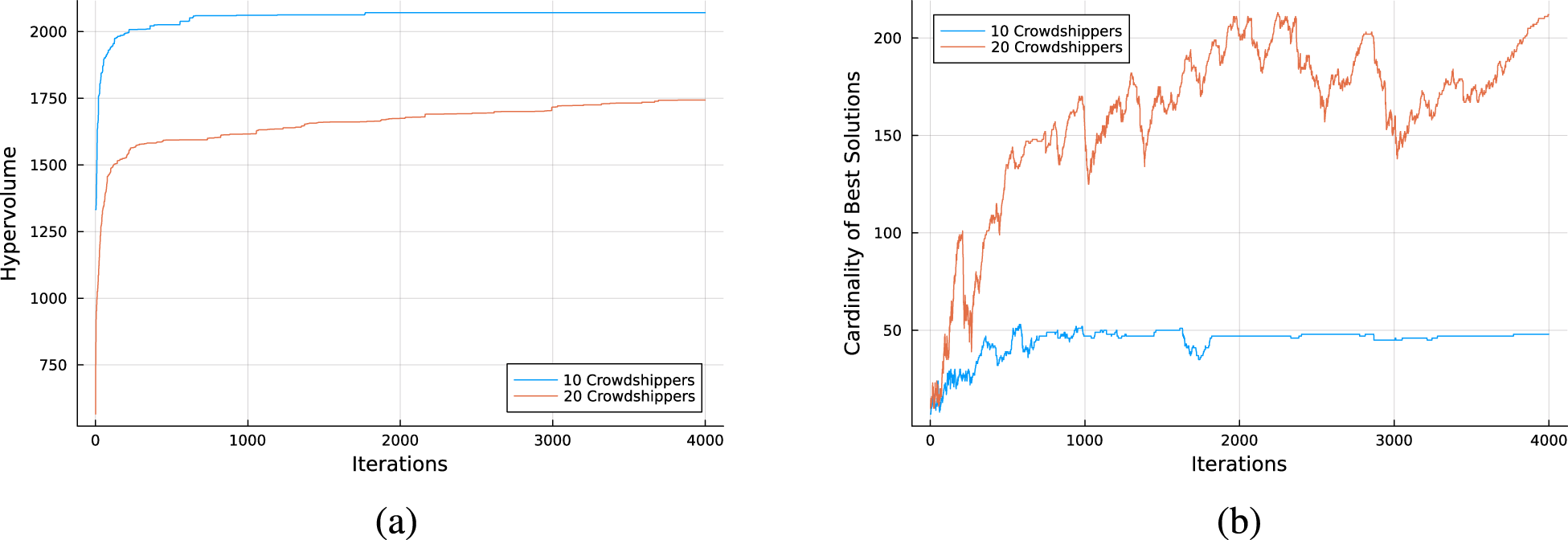
Progression of
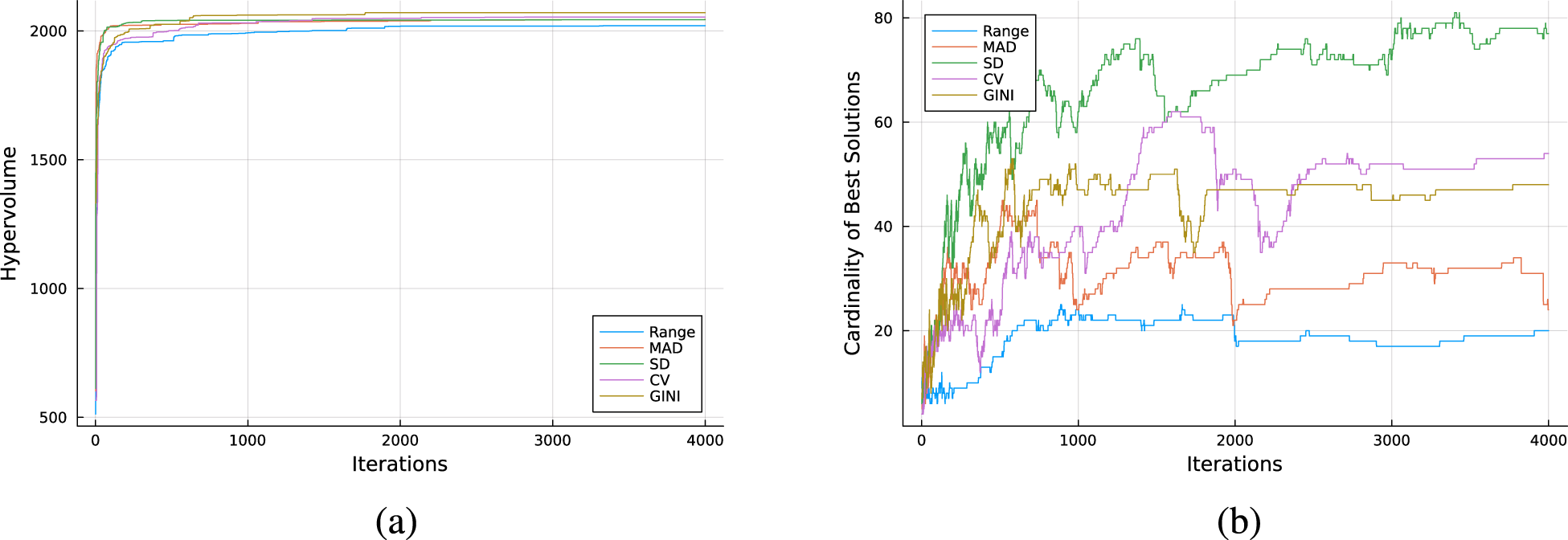
Progression of
Regarding Cardinality, natural fluctuations are observed, indicating continuous improvement of its best-known approximate nondominated frontier over time, facilitated by various enhancement techniques such as dynamic weight adjustments and periodic repopulation of the solution set. It is noteworthy that a decrease in the nondominated frontier can occur when a newly found feasible point dominates a subset of points in the best-known approximate nondominated frontier, resulting in a reduction in Cardinality as dominated points are removed. Furthermore, an interesting but expected observation is that more complex equity measures lead to larger Cardinality values. This implies that in practice, companies may struggle to enhance equity when employing simpler measures like Range. The challenge lies in selecting a point from the approximate nondominated frontier that balances equity without significantly impacting costs. Due to the limited options available, attributed to the small Cardinality under these simpler equity measures, companies may find it difficult to achieve substantial improvements.
In this subsection, our goal is to present numerical evidence demonstrating the high-quality performance of our proposed heuristic, that is,
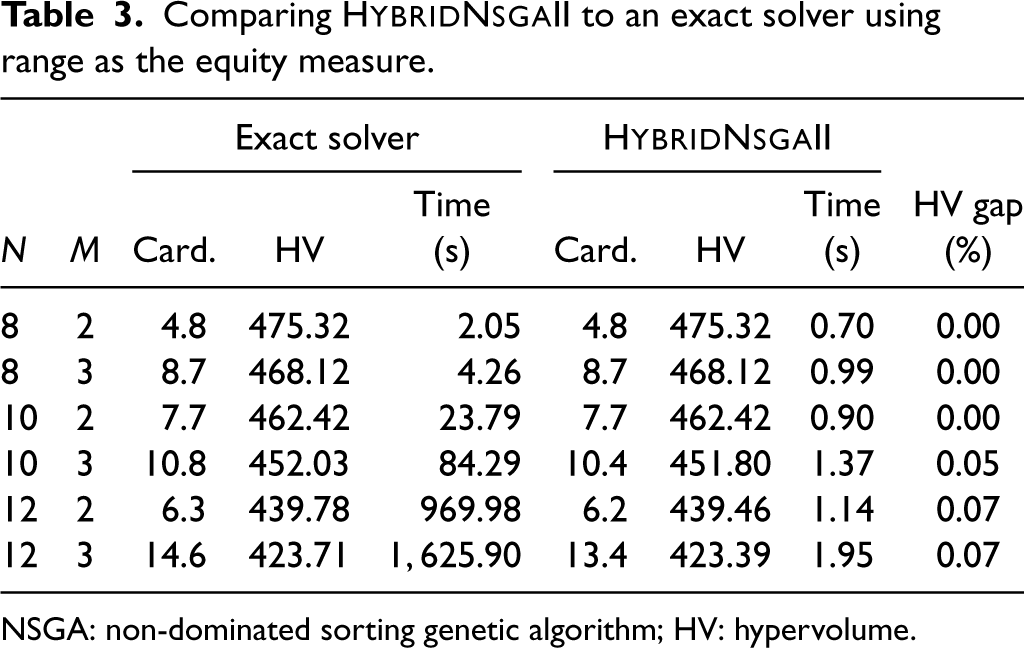
For the bi-objective analysis, we compare the performance of the proposed heuristics with an off-the-shelf exact solver. In light of the complex nature of the VRP variation we are examining, exact bi-objective optimization solvers face significant challenges in solving instances unless the equity measure chosen is Range from our list of options. This preference stems from the inherently linear nature of Range, coupled with the fact that existing off-the-shelf multi-objective optimization tools are primarily designed for integer linear programs. Consequently, our comparison with an exact off-the-shelf solver is focused solely on Range. However, it is worth noting that despite the Range’s linear nature, the range of adjusted profits is non-linear due to the underlying non-linearity of adjusted profits (refer to Equation (1)). To address this, we have decided to employ the range of vehicle utilization values (specifically,
We did not impose any time limit for the Exact Solver. Consequently, six instances took up to 75 minutes to be solved using the exact solver, while the rest were solved within 30 minutes. The results of our comparison across various instance sizes are presented in Table 3, with each row displaying averages from 10 randomly generated instances, totaling 60 instances overall. In the final column of the table, we showcase the gap between the HV reported by our proposed approach and the exact method for the fixed reference point of
Comparing
to an exact solver using range as the equity measure.
Comparing
NSGA: non-dominated sorting genetic algorithm; HV: hypervolume.
Overall, our findings underscore the efficacy of our proposed approach, which significantly outpaces the exact solver in terms of speed. Notably, for networks of size 8, our approach successfully generated all nondominated points. This trend continues for networks of size 10 with 2 crowdshippers. Furthermore, our observation from the table reveals that even for relatively larger-sized instances, the proposed approach consistently finds almost all nondominated points.
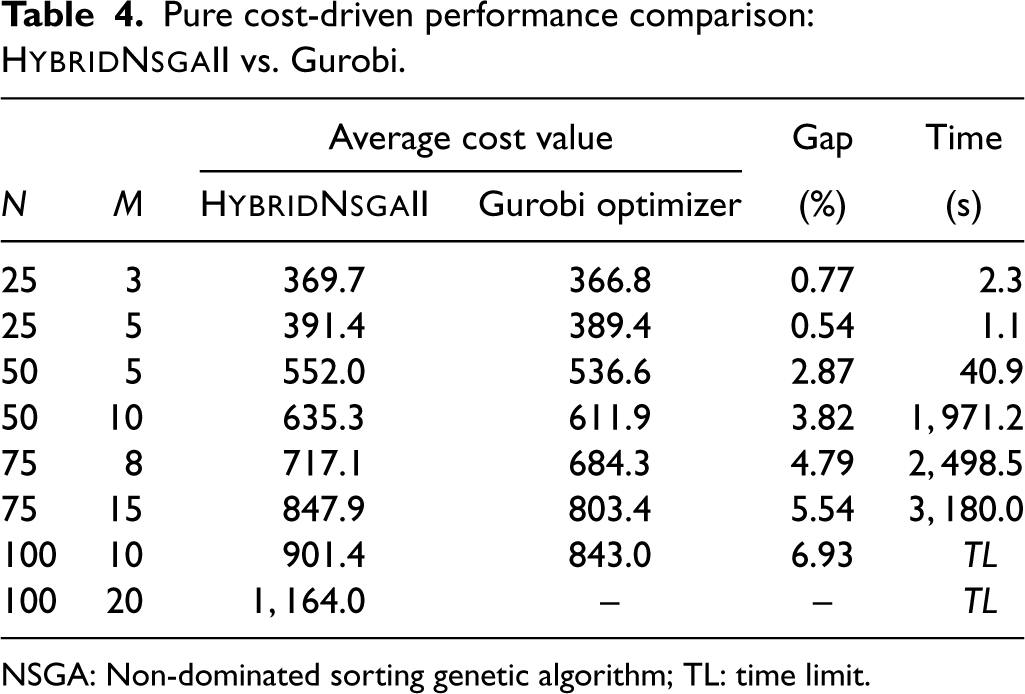
Next, we focus on the single-objective analysis. We conduct two benchmarking experiments: pure cost-driven performance comparison and pure equity-driven performance comparison. For the former, we solve the single-objective cost-minimization model using Gurobi and compare the best solution reported by Gurobi within a time limit of
Pure cost-driven performance comparison:
NSGA: Non-dominated sorting genetic algorithm; TL: time limit.
Note that as shown in the previous subsection, our proposed approach can approximate the entire nondominated frontier within seconds, rather than focusing solely on a single least-cost solution. In contrast, the Gurobi focuses only on pure cost-driven solutions, and it requires a significant amount of time. In fact, as shown in Table 4, Gurobi Optimizer is even unable to provide a feasible solution within a one-hour time limit for large instances. Consequently, in terms of computational time, the superiority of the proposed approach is evident. Regarding solution quality, the performance of the proposed heuristic is also reasonable. Even for large datasets
In light of the above, in terms of pure cost-driven solutions, the performance of the proposed approach is competitive and within an acceptable range. However, a natural follow-up hypothetical question arises: If we had access to a black box that could instantly provide the solution that Gurobi reports after one hour, could such information be used to warm-start
Performance improvement by seeding
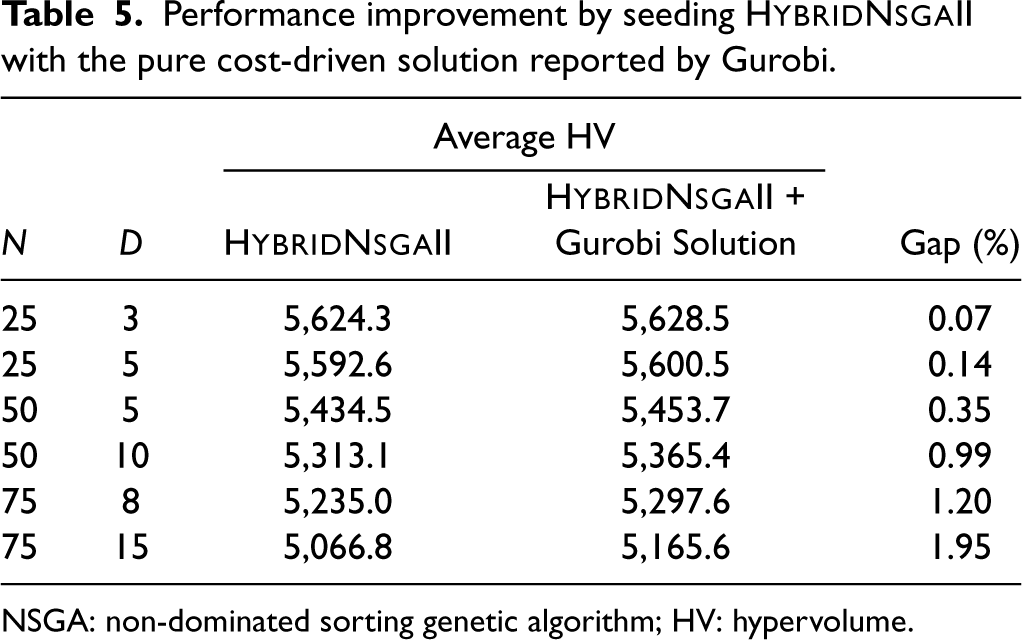
NSGA: non-dominated sorting genetic algorithm; HV: hypervolume.
Next, we conduct a similar experiment, this time by focusing on the pure equity-driven performance evaluation, specifically analyzing the opposite end of the nondominated frontier produced by our approach. For this purpose, we employ SCIP as a nonlinear mixed-integer optimizer, since all the equity measures under consideration are highly nonlinear. As discussed earlier, even the Range measure is nonlinear due to the nature of adjusted profits. In practice, we observed that among the equity measures, only Range and MAD can be handled robustly by SCIP (i.e., without encountering numerical issues), owing to their relatively lower degree of nonlinearity. Therefore, in this section, we report results exclusively for these two measures. Even for Range and MAD, however, the solution time remains significant, even for instances with fewer than 12 nodes. As a result, we restrict our analysis to such small instances. To further assist SCIP, we warm-start the solver using the pure equity-driven solutions obtained by
Pure equity-driven performance comparison:
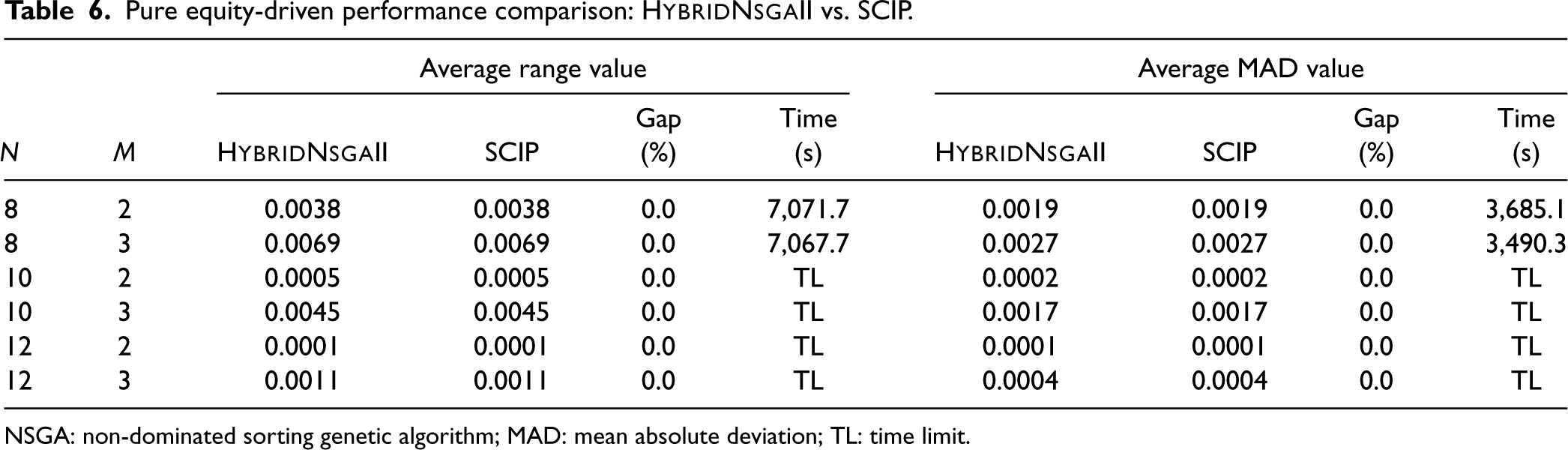
NSGA: non-dominated sorting genetic algorithm; MAD: mean absolute deviation; TL: time limit.
In this subsection, we embark on exploring one of our key research questions: Which equity measure(s) prove most reliable within the scope of our study? To achieve this goal, we utilize the selection method introduced in Section 6. This method identifies a measure as most reliable when it can generate a set of Pareto-optimal solutions using
Given these considerations, we revisit the 80 instances outlined in Table 2 from the preceding subsection. These instances are evenly distributed across four classes, categorized by the number of customers in their networks, denoted as
Mapping results: Hypervolume gaps.
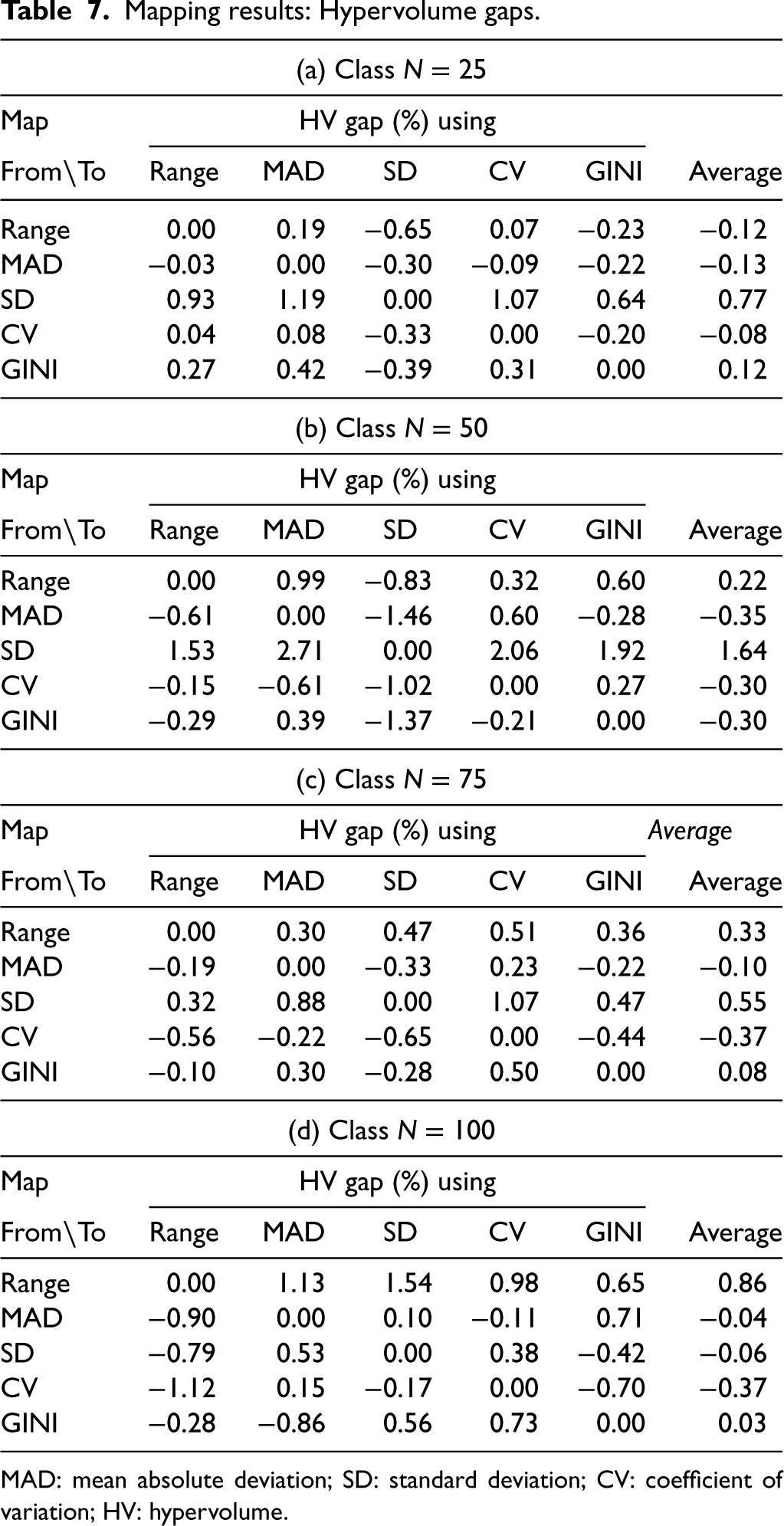
Mapping results: Hypervolume gaps.
MAD: mean absolute deviation; SD: standard deviation; CV: coefficient of variation; HV: hypervolume.
Note that a negative HV gap in Table 7 indicates that the approximation found through mapping is better than the original approximation for that criterion space. This can partly be attributed to the fact that
The second series of experiments focuses on three key practical research questions rooted in real-world operations, which involve multiple zones and span over a sequence of multiple waves, referred to as the decision horizon. Specifically, we use a case study inspired by the publicly available Amazon routes, involving 5 zones and a decision horizon of 100 waves. For each zone-wave, a list of available vehicles along with their sign-up times is provided. From this list, the minimum number of drivers needed to meet the demand is selected by solving the crowdshipper selection problem discussed in E-Companion EC.1. Next, we examine the extent to which equity can be improved under varying equity budgets by the end of the decision horizon (Section 7.2.1). Then, we investigate the potential losses that crowdshippers may incur as a result of incorporating equity considerations (Section 7.2.2). This analysis reveals that selecting the minimum number of drivers required to satisfy demand minimizes such losses, while deviations from this baseline can have negative impacts in terms of opportunity cost for some drivers. Finally, we explore the expected consequences of insufficient driver availability in dynamic environments (Section 7.2.3). While the first two research questions assume sufficient driver availability to meet demand in every zone-wave, the third question relaxes this assumption and studies the impact of that. In such cases, demand satisfaction may require either postponing excess demand to future waves with an associated penalty cost or offering additional incentives to attract more drivers in each zone-wave. We investigate both scenarios in detail.
Quantifying Potential Equity Improvement
In this subsection, we explore a key research question: How much can equity improve with varying equity budgets by the end of a decision horizon? The goal is to demonstrate that equity can be significantly enhanced across various zones even with only a small increase in the operational cost for the company in different zones. To explore the question, we consider different equity budgets for the company, ranging from
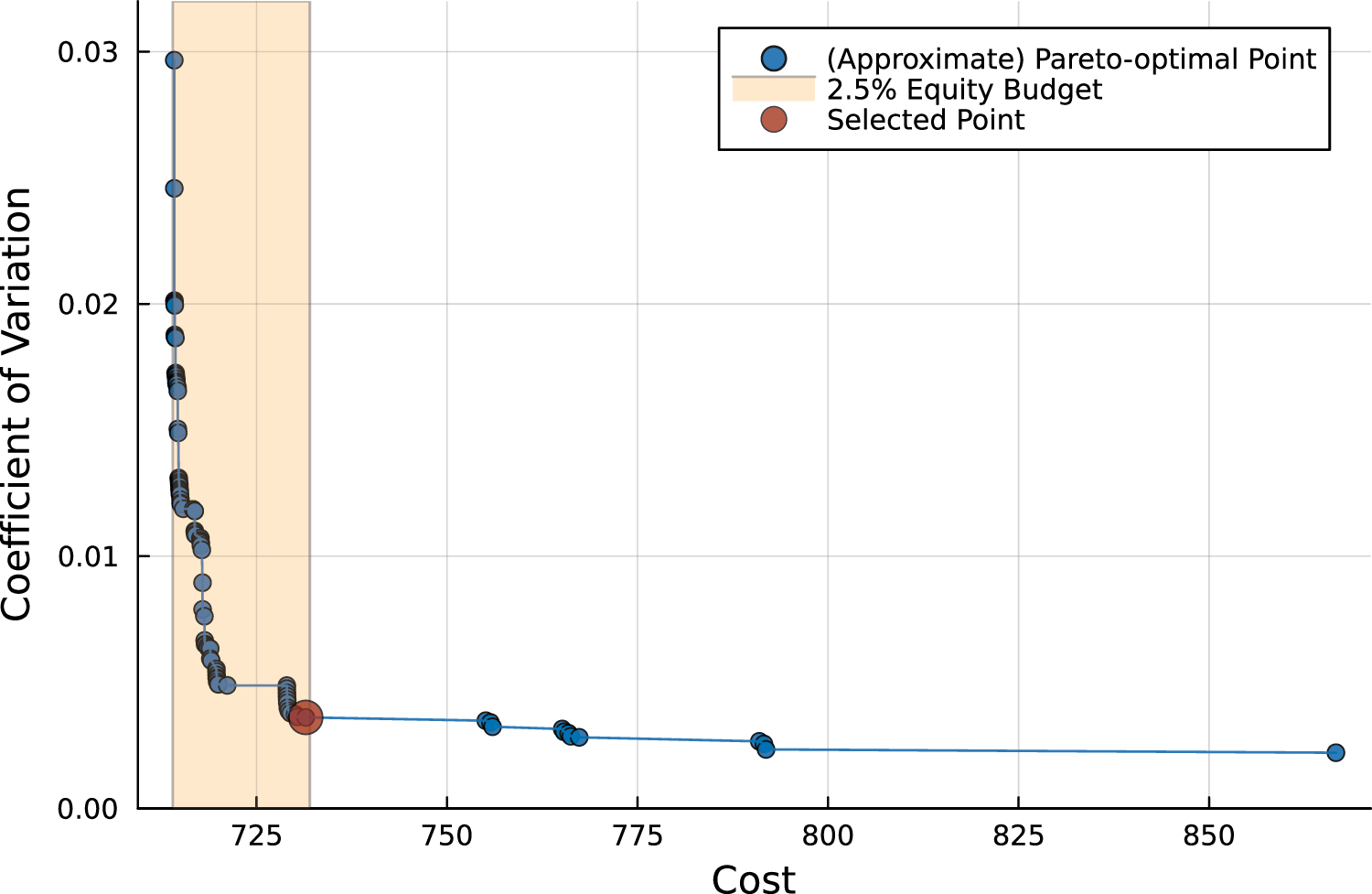
Approximate pareto-optimal frontier obtained for a specific zone-wave.
Table 8 shows the average improvement for each zone in where the numbers in each row represent averages across all 100 waves. In this table,
Summary of results from simulating the entire decision horizon.
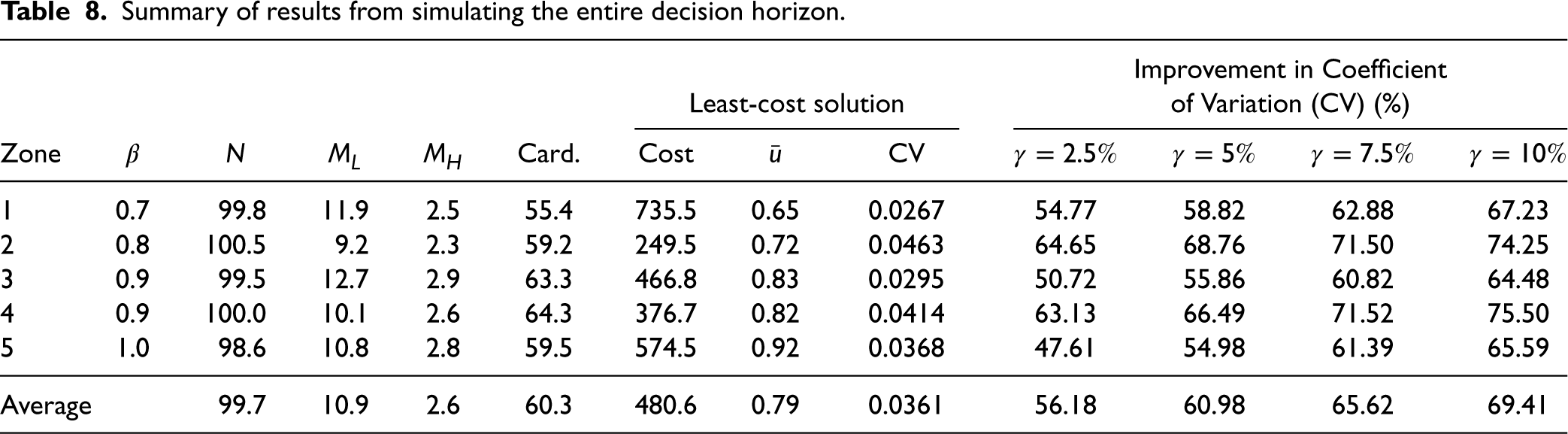
Table 8 demonstrates that even a minor deviation of 2.5% from the least-cost solution can significantly enhance equity in workload allocation. Across the five zones, distinguished by the geographical segmentation and
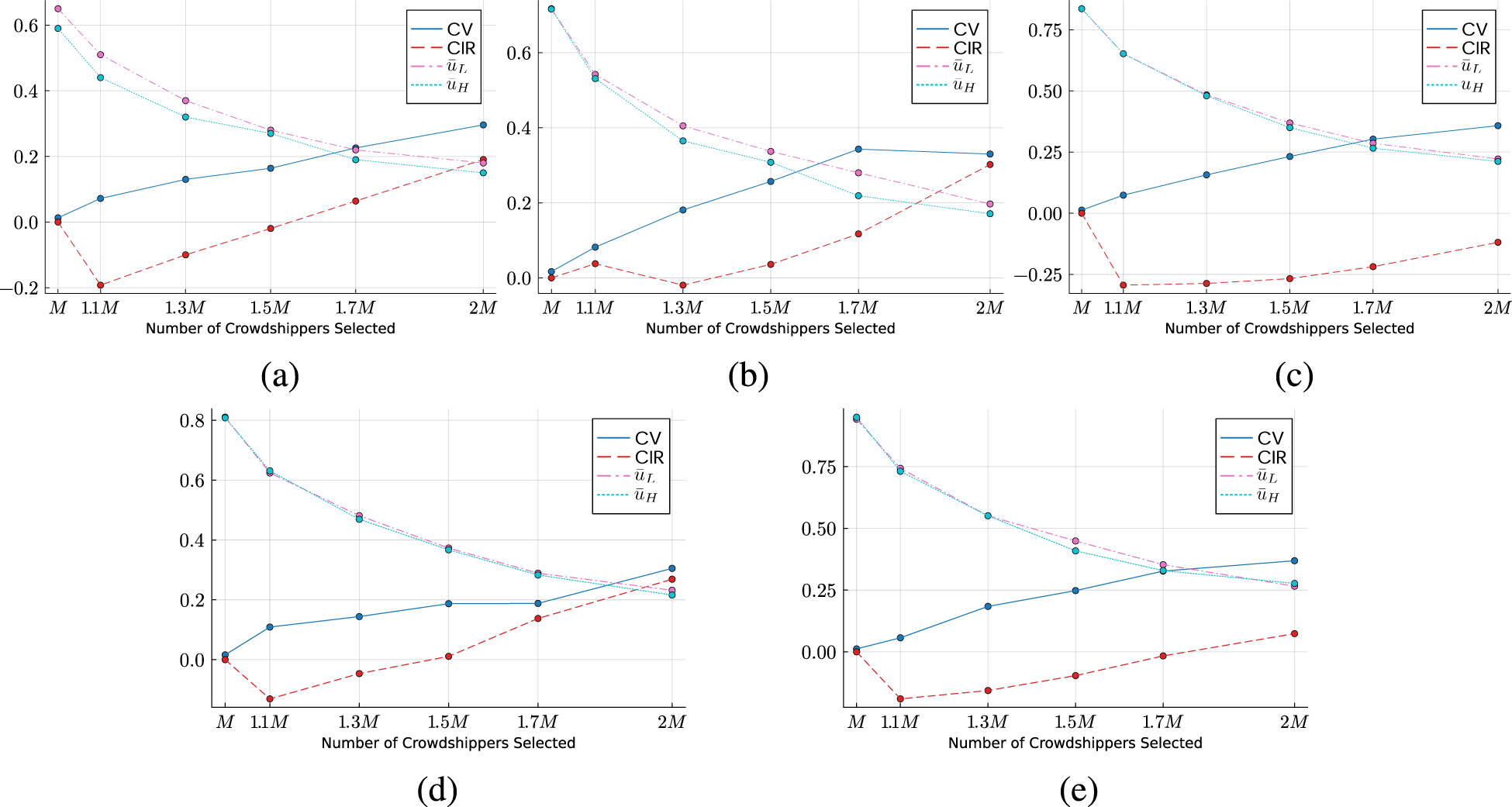
Average trends in equity, cost increase ratio, and adjusted profits when
In this subsection, we explore a key research question: How much potential loss (i.e., opportunity cost) might a crowdshipper experience due to the company’s equity considerations? Here, gains (or losses) refer to the disparity between the adjusted profits under an equity-aware solution and those under the least-cost solution. To provide a more comprehensive view, we offer insights about both sides of the equation in this section: low-performing and high-performing crowdshippers. The response to the research question depends on the number of crowdshippers within the system. Our proposed approach, by construction, targets the minimum number of crowdshippers (denoted as
Table 9 summarizes the results of the zone-wave experiments for varying numbers of crowdshippers, with each row reporting averages computed over 20 waves. Note that this represents 20% of the total number of waves in the decision horizon, which is expected to provide a good approximation for the entire decision horizon, as there is no transfer of information between waves. The main reason for limiting the analysis to 20 waves is the computational burden. Recall that each instance is solved 10 times using Insight I: Expanding the number of crowdshippers can initially reduce the company’s operational costs, as all selected crowdshippers must be utilized on a first-come, first-served basis. However, beyond a certain point, further increases in the number of crowdshippers lead to higher operational costs. For example, in Zone 1, a 50% increase in crowdshippers lowers operational costs, but a 100% increase results in higher costs compared to the baseline. Insight II: Even if the company hires more crowdshippers than necessary, it can still notably improve equity across all zones with a small equity budget. This improvement is evident in the shifts in the CV values for each crowdshipper size. Insight III: While equity gains remain notable even with a limited equity budget across different workforce sizes, the disparities between the average adjusted profits of high-performing and low-performing crowdshippers exhibit minimal variation. In essence, Insight IV: The equity deteriorates with an increase in the number of crowdshippers in general. This is apparent from the rising trend in the CV values across each row. According to the definition of CV, this suggests that as the number of crowdshippers increases, the average adjusted profits decrease significantly, to an extent where even a decrease in standard deviation cannot compensate for it. Insight V: When the minimum number of crowdshippers is employed, changing the equity budget has negligible impact on the average opportunity cost, as reflected in the adjusted profits of both high-performing and low-performing crowdshippers. Insight VI: Finally and interestingly, selecting more crowdshippers than needed leads to higher opportunity costs for both low-performing and high-performing crowdshippers. This is evident in the reductions incurred in the adjusted profits of both high-performing and low-performing crowdshippers as the number of crowdshippers increases.
Comparing the impacts of different numbers of crowdshippers.
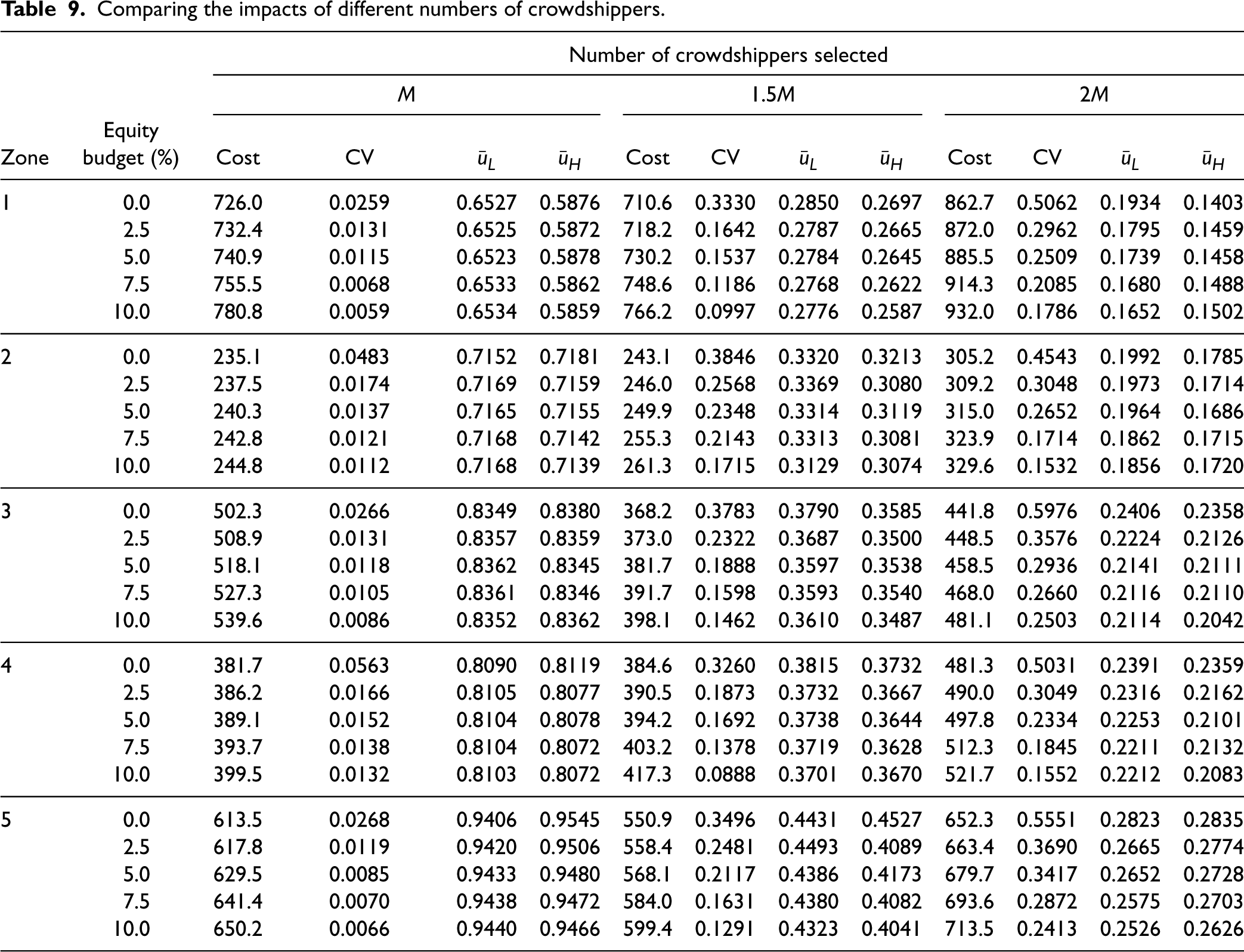
Comparing the impacts of different numbers of crowdshippers.
To demonstrate the broader applicability of our findings beyond the
In this section, we focus on another key research question: How does vehicle shortage affect the company’s cost and the equity among drivers over the entire decision horizon? To fulfill demand under limited vehicle availability, we consider two scenarios: (1) Postponing excess demand to future waves with an associated penalty cost (referred to as the Postponement (PP) scenario), and (2) offering additional incentives to attract more drivers (referred to as the Additional Vehicles (AVs) scenario). To enable a fair comparison across scenarios, we assume that the final wave in the decision horizon does not experience any shortage, that is, all remaining demands are met with sufficient driver availability.
To set up the experiments for both scenarios, we first identify the so-called “at-risk” orders, that is, demand received at a given zone-wave that, due to a shortage of vehicles, must be handled according to one of the two scenarios described earlier. In our experiments, to create different levels of vehicle shortage, for each zone
We first focus on the PP scenario. We assume that postponing each order from one wave to the immediate next wave incurs a fixed, user-defined cost parameter, denoted by
Least cost under the postponement (PP) scenario.
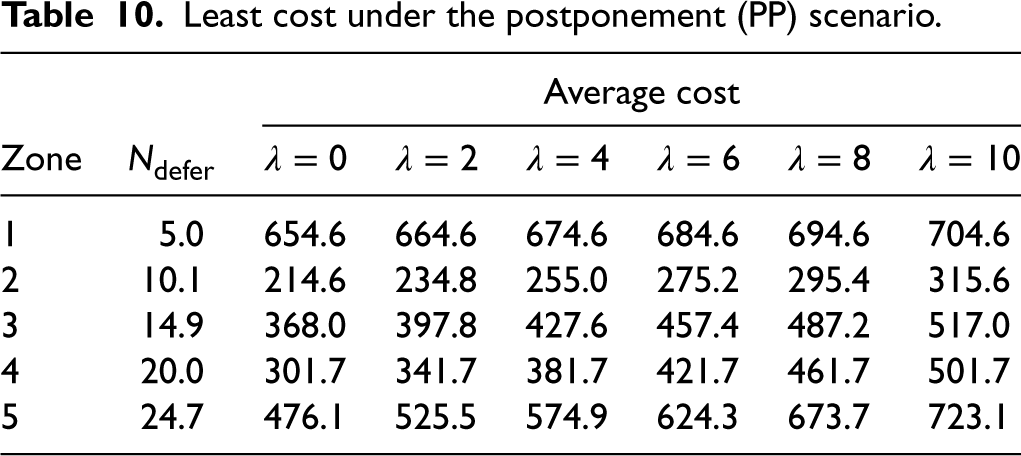
Least cost under the postponement (PP) scenario.
Table 11 further summarizes the results of simulating the entire decision horizon with
Summary of results under the PP scenario with
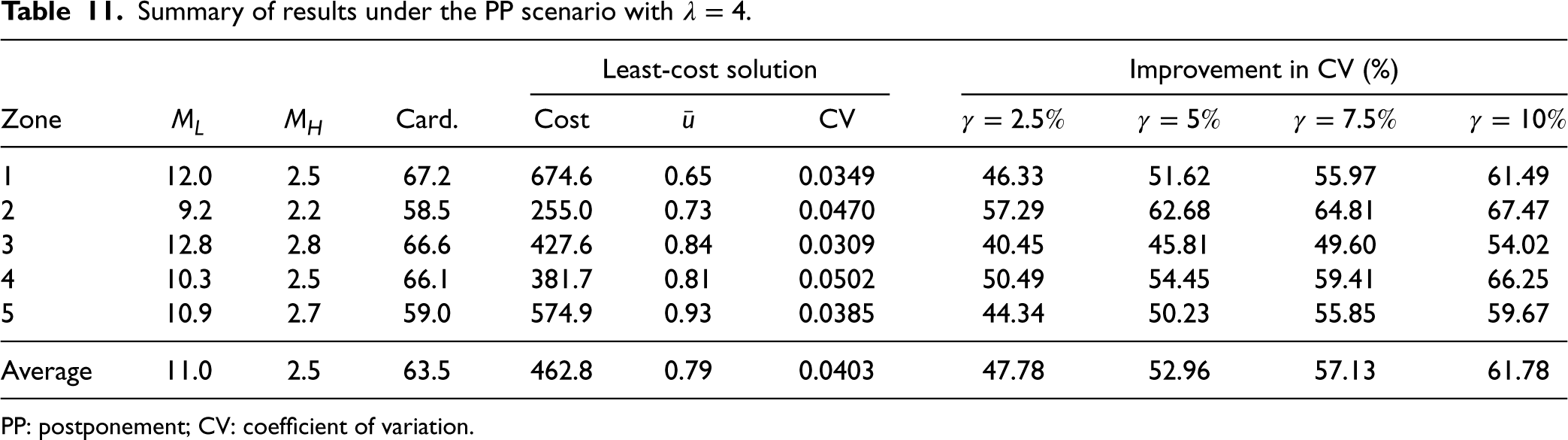
PP: postponement; CV: coefficient of variation.
Next, we focus on the AV scenario, where extra drivers are incentivized to participate through premium payments. For comparability, we assume the sequence of driver arrivals remains the same as in the no-shortage case. However, a smaller subset of the earliest arrivals agree to participate under the original terms, while the remaining drivers will join only if offered higher per-delivery compensation (a premium). To determine which drivers should receive the premium, we proceed as follows. For each zone-wave, we first identify the minimum number of vehicles required to meet demand under a first-come, first-served policy, assuming no orders are at risk. Next, for the same zone-wave, we find the minimum number of vehicles needed to serve only the non-at-risk orders under the same policy. The difference between these two vehicle sets corresponds to those requiring the premium.
For the AV scenario experiment, we consider three premium levels offered to additional crowdshippers: 10%, 20%, and 30% increases in per-delivery compensation. In this setting, the total cost depends not only on routing costs but also on which deliveries are assigned to the additional vehicles, since a bonus is paid for those deliveries. To solve this problem using our proposed method, which is designed to minimize routing costs, we convert the per-delivery bonus into an equivalent travel cost. Specifically, for additional vehicles, the route length is augmented by the bonuses associated with the deliveries assigned to that route. Thus, unlike the PP scenario, changes in payment can also affect workload allocation, as the adjusted profits of drivers depend on the offered premium.
Table 12 presents the least-cost solutions under each of the three bonus levels. The “Total Cost” in this table captures the total operational cost to the company, which includes both the standard routing cost and the bonus compensation paid only for deliveries made by the additional crowdshippers. In the table, all reported values are averages over 100 waves per row. Notably, the least-cost solutions found by the proposed heuristic approach in Table 12 are comparable to those reported in Table 8, which assumes no vehicle shortages and no bonuses. This comparability holds because the set of orders and vehicles is fixed across zone-waves; the only variation is that a subset of crowdshippers receives a per-delivery bonus. As anticipated, the total cost is higher under the AV scenario due to the inclusion of the compensation bonuses, particularly in zones with a high number of at-risk orders (e.g., Zone 5). Furthermore, a clear pattern emerges within this scenario: as the bonus value increases, the total cost consistently rises, a trend readily observable across Table 12.
Least-cost solutions under the AV scenario.
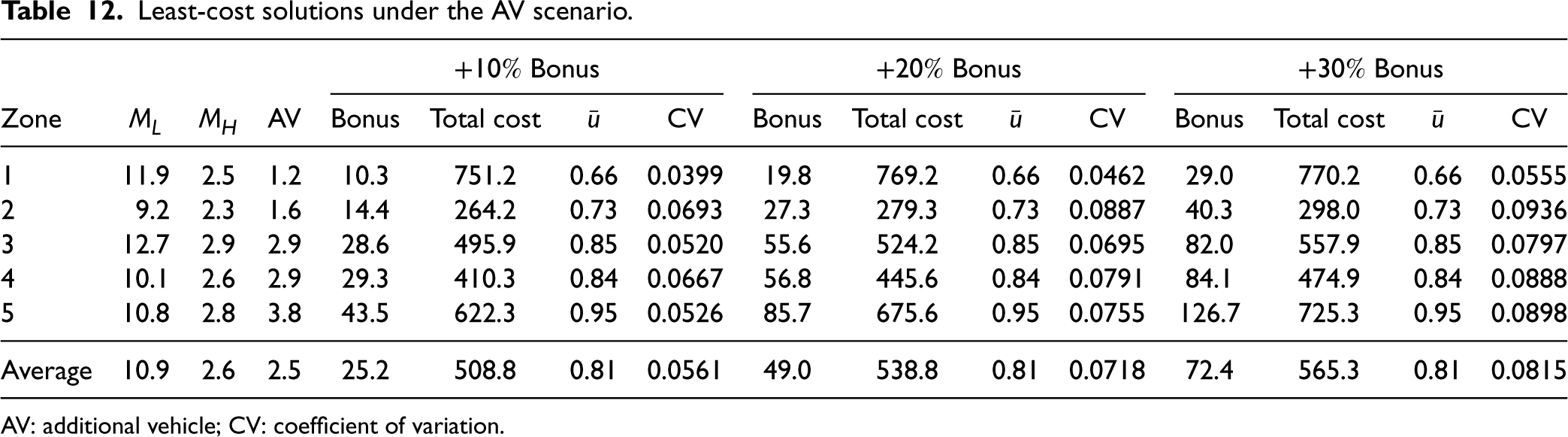
AV: additional vehicle; CV: coefficient of variation.
As for the impact of bonuses on CV, we observe that the bonus increases profit inequality among crowdshippers compared to both the No-Shortage (Table 8) and PP (Table 11) scenarios. This occurs because a higher bonus directly increases the adjusted profits for a few additional drivers hired to satisfy the zone-wave order fulfillment requirement without order deferment. This, in turn, makes achieving an equitable workload allocation more challenging. Notably, despite the different bonus levels offered, the algorithm is able to maintain the same average adjusted profit,
In summary, the AV scenario experiment shows an increasing trend in both total cost and CV, as observed across all zones for each 10% increase in the bonus. Finally, we note that the equity improvements observed in the AV scenario remain substantial (37%–79%) across various equity budgets, consistent with the trends observed in other experiments presented in this paper. For complete details across equity budgets, interested readers are referred to the E-Companion EC.6.
This study focused on three key questions faced by crowdshipping-based LMD platforms aiming to ensure fair pay and long-term sustainability: (1) How can equity be effectively measured? (2) How can cost benefits be evaluated? (3) What are the potential losses of employing additional couriers compared to the minimum required? The first question concerns selecting an appropriate equity measure from the vast literature in statistics and economics. The second underscores the need for LMD platforms (especially for-profit ones) to evaluate equity alongside cost, requiring tailored tools to assess both dimensions. The third addresses the potential drawbacks of promoting equity, particularly the notion of opportunity cost, which reflects how redistributing opportunities to promote fairness may unintentionally reduce profit-making opportunity for high-performing crowdshippers, thus discouraging participation.
To address these questions, we proposed a practical equity-oriented framework inspired by real-world crowdshipping operations. It consists of: (1) a fair crowdshipper selection process based on first-come, first-served principles, and (2) a bi-objective optimization approach for workload allocation and routing that balances cost and equity. This optimization approach is a heuristic, named
For the first question, we established theoretical foundations using Pareto-optimality concepts and proposed a systematic method for identifying most reliable equity measures. The method is simple: If Pareto-optimal solutions under one equity measure perform well across all measures, that measure is deemed reliable. Applied with
Supplemental Material
sj-pdf-1-pao-10.1177_10591478261425875 - Supplemental material for Equity-Driven Workload Allocation for Crowdsourced Last-Mile Delivery
Supplemental material, sj-pdf-1-pao-10.1177_10591478261425875 for Equity-Driven Workload Allocation for Crowdsourced Last-Mile Delivery by Abhay Sobhanan, Hadi Charkhgard and Iman Dayarian in Production and Operations Management
Footnotes
Acknowledgment
The authors thank the senior editor and the two anonymous reviewers for their valuable comments on an earlier version of this manuscript. The first author also gratefully acknowledges that part of this research was conducted during his doctoral program at the University of South Florida.
Declaration of Conflicting Interests
The authors declared no potential conflicts of interest with respect to the research, authorship, and/or publication of this article.
Funding
The authors received no financial support for the research, authorship and/or publication of this article.

How to cite this article
Sobhanan A, Charkhgard H and Dayarian I (2026) Equity-Driven Workload Allocation for Crowdsourced Last-Mile Delivery. Production and Operations Management XX(XX): 1–24.
References
Supplementary Material
Please find the following supplemental material available below.
For Open Access articles published under a Creative Commons License, all supplemental material carries the same license as the article it is associated with.
For non-Open Access articles published, all supplemental material carries a non-exclusive license, and permission requests for re-use of supplemental material or any part of supplemental material shall be sent directly to the copyright owner as specified in the copyright notice associated with the article.
