






Abstract
A major concern that customers face when considering buying an electric vehicle is the uncertainty about its ability to cover their mobility needs. While an electric vehicle’s rated range is publicly known, the range it realistically achieves for a given customer is not, as it depends on idiosyncratic driving factors that customers can fully understand only through hands-on experience. Dealer services like extended test drives can alleviate customers’ concerns and have the potential to increase electric vehicle adoption. However, not all dealers adopt such demonstration practices and their environmental implications are not straightforward. In this paper, we develop a game-theoretic model to investigate when a dealer should offer demonstration services and whether doing so can increase electric vehicle adoption and reduce the environmental impact. We consider a car dealer who procures conventional and/or electric vehicles from a manufacturer and sells them to customers with heterogeneous mobility needs. Customers are a priori uncertain about the electric vehicle’s ability to meet their mobility needs; the dealer can provide demonstration services to mitigate the range uncertainty. We find that the dealer should offer demonstration as the electric vehicle range increases, but may refrain from offering demonstration when the production cost of electric vehicle decreases. In addition, offering demonstration leads to greater electric vehicle adoption only when the electric vehicle technology is less developed. Interestingly, even when offering demonstration leads to greater electric vehicle adoption, it may also lead to greater total usage emissions. We further examine the manufacturer’s Corporate Average Fuel Economy (CAFE) compliance and show that dealer demonstration can compromise the manufacturer’s ability to comply with the CAFE regulation while promoting electric vehicle adoption. Perhaps unexpectedly, to comply with a more stringent CAFE standard, the manufacturer may raise the wholesale price of the electric vehicle and, in the presence of demonstration, the electric vehicle adoption may be lower.
Introduction
The transportation sector is a significant contributor of greenhouse gas emissions; in the United States, it accounts for 28% of the total emissions (U.S. EPA, 2023b). Environmental groups and agencies have long advocated for the mass adoption of electric vehicles as a promising strategy to reduce emissions (U.S. EPA, 2023a). In recent years, electric vehicle adoption has attracted substantial interest from both automakers and customers. Major manufacturers of gasoline-powered vehicles, including Ford, General Motors, Volkswagen, BMW, and Nissan, are introducing fully electric options (Consumer Reports, 2023). Customers have also been expressing increasing purchase interest, with 36% of Americans recently indicating that they would seriously consider a fully electric vehicle (Consumer Reports, 2022a). Despite these promising signs, however, the adoption rate of electric vehicles is still low, and critical emission targets are projected to be missed; only 5.6% of new cars sold in the United States in 2022 were electric (Automotive News, 2023). In 2030, the adoption rate in the United States is projected to reach 25%–30% (IHS Markit, 2021), which falls short of the 50% target (The White House, 2021).
A major roadblock toward the mass adoption of electric vehicles is the customer concern over limited range. Surveys by AAA (2022a) and Consumer Reports (2022a) found more than 50% of customers to be concerned about the ability of electric vehicles to fully meet their mobility needs, making limited range one of the top reasons, besides high prices and charging logistics, preventing them from purchasing. This is despite the fact that the majority of surveyed customers understand that current electric vehicle ranges exceed 100 miles (AAA, 2022a). In fact, the Environmental Protection Agency (EPA) Fuel Economy and Environment Label (readily accessible from the “window sticker”) provides an electric vehicle’s rated range as estimated under standardized testing conditions. However, it is widely acknowledged that the range an electric vehicle realistically achieves for a given customer—its achievable range—is significantly affected by driver habits and driving conditions such as high speed, heavy acceleration, road conditions, ambient temperature, and the use of heating, ventilation, and air conditioning (HVAC); see AAA (2019); Ford (2023); Renault (2023); and U.S. EPA (2021). For example, driving at 70 mph rather than 30 mph reduces range by more than 45% (Wager et al., 2016), while HVAC use at 20
The experiential nature of range performance suggests that providing customers with first-hand experience to better understand the extent to which an electric vehicle can meet their mobility needs is an important way to facilitate adoption. 2 According to the U.S. Electric Vehicle Consideration Study by J.D. Power (2022), only 11% of respondents who had no personal experience with an electric vehicle were “very likely” to consider buying one; this percentage more than tripled to 34% for those who had driven an electric vehicle before (also see AAA, 2022a; Consumer Reports, 2022b). A more recent electric vehicle driver survey finds that prepurchase range concerns drop from 48.1% to 22.8% after first-hand experience driving an electric vehicle (Plug In America, 2025). This brings to the forefront the role that car dealers play as gatekeepers of electric vehicle adoption.
In their capacity as facilitators of the entire car purchase process, from test drives to financing and vehicle delivery, car dealers are widely recognized as an essential force for the mass adoption of electric vehicles. Although a few luxury brands (most notably Tesla) sell electric vehicles directly to customers, the majority of auto manufacturers offer mass-market electric vehicles through their existing dealership networks. 3 Dealerships are increasingly important as “the EV market leaves luxury niche status and enters the mainstream,” and are on track to invest $5.5 billion in electric vehicle infrastructure to provide customers with first-hand experience opportunities (National Automobile Dealers Association, 2021, 2023). Dealers also partner with nonprofit organizations to organize test drive events (Drive Electric Virginia, 2023; Smart Columbus, 2023). In addition, customers exhibit a predominant preference for buying electric vehicles at dealerships and view the first-hand experience as a major source of information (Escalent, 2021; InsideEVs, 2022).
In practice, dealers have been enabling customers to experience electric vehicles first-hand through demonstration services such as extended test drives. In contrast to traditional test drives, which typically last less than 30 min (Youngs, 2019), extended test drives span multiple days and, among other aspects of ownership, enable customers to better understand the range an electric vehicle can realistically achieve for them. For instance, customers can test drive a BMW i3 for several days using BMW’s Extended Test Drive Program (BMW of Freeport, 2023) to “see how the i3 fits [their] lifestyle” (BMW of Chattanooga, 2023). In addition, Volvo (2023) offers test drives of up to 4 days on its electric fleet through the Test Drive+ program. More examples include Charters Citroen Aldershot (2023); Hendy Group (2023); and Sherwoods Motor Group (2023). Dealerships have also been partnering with community-based organizations to hold test drive events for electric vehicles, including Chevrolet Bolt, Ford Mustang Mach-E, and Nissan Leaf (see, e.g., Clean Vehicle Empowerment Collaborative, 2023; Drive Electric Northern Colorado, 2021; Drive Green New Jersey, 2023).
Providing demonstration services is widely recognized as a promising strategy to facilitate the mass adoption of electric vehicles (Environmental and Energy Study Institute, 2021; Exro Technologies, 2023; Society of Manufacturing Engineers, 2020). In particular, empirical evidence suggests that providing test drives can increase the likelihood of electric vehicle purchases (J.D. Power, 2022; Opinion Dynamics, 2023). However, not all dealers offer demonstration services. A survey by Sierra Club (2023) shows that 66% of dealerships nationwide did not have an electric vehicle on their lots, with 45% of them indicating that they would not offer an electric vehicle even in the absence of any production or supply chain/inventory constraints. Reasons for their unwillingness to offer electric vehicles for demonstration include high infrastructure investments, for example, charging stations and staff training (Sierra Club, 2023) and the perception of lower profit margins than comparable gasoline vehicles due to the electric vehicles’ higher procurement costs (de Rubens et al., 2018, 2020).
Perhaps more importantly, the overall effect of demonstration on customers’ purchase decisions is not straightforward. Customers may find from demonstration that the electric vehicle can meet a larger fraction of their mobility needs than originally expected. Thus, some of them will prefer the electric over the conventional vehicle to benefit from its lower operating (e.g., fuel and maintenance) cost. 4 Others, however, may confirm through the demonstration the electric vehicle’s limited ability, although perhaps not as limited as originally expected, to cover their mobility needs and, therefore, may still prefer a conventional vehicle over an electric. Additionally, demonstration does not necessarily guarantee a favorable view of the electric vehicle technology. In fact, customers may find the electric vehicle to be able to meet a smaller fraction of their mobility needs than originally expected. As a result, they may buy a conventional vehicle or entirely refrain from purchasing. Therefore, it is a priori unclear whether and when a dealer should offer demonstration.
The environmental implications of offering demonstration services are also not well understood. Nonprofit organizations that collaborate with dealers to offer demonstration have typically recognized such services as an effective way to facilitate electric vehicle adoption, touting environmental benefits. For example, Drive Electric Northern Colorado (2021) proclaims its extended test drive program as “designed to achieve widespread deployment of electric vehicles,” presuming it to be “good for the environment”; also see Clean Vehicle Empowerment Collaborative (2023) and Evolve Houston (2023). Underlying these assertions is the belief that demonstration always resolves customers’ uncertainty in favor of the electric vehicle and therefore, guarantees the displacement of conventional vehicles by electric ones. Furthermore, these claims use electric vehicle adoption as the proxy of environmental impact and do not account for the total emissions from the usage of both electric and conventional vehicles, which may differ across customers.
Dealer demonstrations may also have significant implications for the manufacturer, who is subject to the Corporate Average Fuel Economy (CAFE) standard. The CAFE regulation requires the combined fuel economy of a manufacturer’s entire fleet to meet a minimum standard. Since the fuel economy rating is much higher for an electric vehicle than a comparable conventional vehicle, the CAFE compliance critically hinges on the ratio between conventional and electric vehicle sales. A dealer demonstration shifts this ratio by shaping customer preferences between different vehicle types and influencing the manufacturer’s wholesale pricing decisions. As the CAFE standard further tightens, it is important to understand how dealer demonstrations affects the manufacturer’s compliance.
The objective of this paper is to examine the economic and environmental implications of dealer demonstration. To this end, we consider a car dealer who procures a conventional gasoline and/or an electric vehicle from the auto manufacturer and sells them to customers with heterogeneous total mobility needs arising from heterogeneity in trip frequency and uncertainty in the length of trips. Compared to the conventional vehicle, the electric vehicle has a lower per-mile operating cost, but its designed range (i.e., the range as specified based on the technical characteristics of the car) is limited. The electric vehicle can meet customers’ total mobility needs by a fraction, which is customer-specific and a priori uncertain; we refer to this fraction as achievable range. Customers hold a prior belief about the electric vehicle’s achievable range, which they update based on the impression they receive from the demonstration service. We characterize the impact of demonstration on dealer profitability, the electric and conventional vehicle sales, the manufacturer’s CAFE compliance, and the resulting environmental impact from all vehicles sold. Our results offer several insights for dealers, auto manufacturers, policymakers, and nonprofit organizations.
We first analyze the dealer’s decision to offer demonstration. We find that the lower production cost of the electric vehicle relative to the conventional vehicle may disincentivize the dealer from offering demonstration. This is because demonstration deters purchases from high-mobility-needs customers after receiving an unfavorable impression. We then characterize the impact of offering demonstration on electric vehicle adoption. We find that offering demonstration leads to greater adoption only when the electric vehicle technology is less developed. Otherwise, the dealer offers demonstration solely as a price discrimination instrument that improves profits while reducing electric vehicle adoption.
Next, we study the environmental implications of offering demonstration. One would expect that if demonstration leads to greater electric vehicle adoption, it would also lead to lower usage emissions because electric vehicles have lower per-mile emissions. However, we show that offering demonstration may lead to higher electric vehicle adoption, but also higher usage emissions. Finally, we examine the impact of dealer demonstration on the manufacturer’s CAFE compliance. We find that offering demonstration can compromise the manufacturer’s ability to comply with the CAFE standard while promoting electric vehicle adoption. Paradoxically, even when it increases the CAFE level, offering demonstration may lead to greater emissions. To comply with a more stringent CAFE standard, the manufacturer may raise the wholesale price of the electric vehicle and, in the presence of demonstration, the electric vehicle adoption may be lower.
Related literature
Our paper contributes to the literature on environmentally sustainable operations (for recent reviews, see, Atasu et al., 2020; Sunar and Swaminathan, 2022) and in particular, the emerging stream of studies on green technology adoption. In this stream, Cohen et al. (2016) consider the impact of demand uncertainty in consumer subsidies to facilitate the adoption of a green technology product. Chemama et al. (2019) compare the effectiveness of subsidy commitment versus flexibility when the supplier can defer production to a later period. Murali et al. (2019) examine the effects of a mandatory environmental quality standard and a voluntary external certification on green product development among competing firms differentiated in their environmental claim credibility. In a supply chain context, Kalkanci and Plambeck (2020) and Kraft et al. (2020) study the role of information disclosure in incentivizing supplier practices to reduce the environmental and social impacts from production; for discussions on how modern supply chains can operationally address emerging environmental and social issues, see Erhun et al. (2021). Our paper is also broadly related to research on sustainable business models, for example, leasing (Agrawal et al., 2012), servicizing (Agrawal and Bellos, 2017; Bellos et al., 2017), and modularity (Agrawal et al., 2021; Agrawal and Ülkü, 2013).
Closer to our context, some papers in this stream investigate how innovative business strategies can facilitate electric vehicle adoption. Lim et al. (2015) consider that customers underestimate an electric vehicle’s range and overestimate its depreciation rate, and study how these limitations can be addressed through battery leasing and enhanced charging. Avci et al. (2015) analyze the operations of battery switching stations wherein customers can swap a depleted battery with a fully charged one on a pay-per-use basis. Shi and Hu (2024) examine the profit and environmental implications of a flexible battery leasing model, which enables customers to up/downgrade battery capacity after vehicle purchase. Other studies consider electric vehicle subsidies (Ma et al., 2019; Shi et al., 2022; Yu et al., 2022), fleet management (Abouee-Mehrizi et al., 2021; He et al., 2021), and vehicle-grid integration (Qi et al., 2022; Wu et al., 2022).
The papers in this stream assume that customers perfectly know the electric vehicle range, whereas in practice, the range that can be realistically achieved is customer-specific and a priori unknown. Our paper complements this literature by incorporating customer uncertainty over the achievable range and by investigating the car dealer’s role in facilitating the resolution of range uncertainty through demonstration services. To the best of our knowledge, we are the first to analyze the role of dealers and their offering of demonstration services in facilitating electric vehicle adoption and reducing emissions.
Our paper is also related to the literature on firm activities that facilitate customer resolution of product value uncertainty prior to purchase. Lewis and Sappington (1994) analyze a monopolist’s optimal pricing and information supply whereby customers learn about their personal fit with the product. They find that supplying information facilitates price discrimination and the optimal strategy is either no or full information. Johnson and Myatt (2006) generalize these results to any firm actions that increase the dispersion of consumer valuations. Ghosh and Galbreth (2013) analyze the strategies of two competing firms around disclosing information about the quality of their products to consumers who may miss such disclosures due to inattention and who may subsequently decide to conduct their own costly search for quality information. Boleslavsky et al. (2017) study the Bertrand competition between an established and an innovative firm whose product value is uncertain and can be learned through demonstration. They find that offering demonstration enables the innovative firm to charge a high price and target customers drawing a favorable impression, thereby softening competition. Feldman et al. (2019) consider the pricing and quality decisions of a firm selling a product with uncertain quality to customers who can learn about it through online reviews. In the context of omnichannel retailing, Gao and Su (2017) and Gao et al. (2022) examine the informational role of physical showrooms in resolving customer value uncertainty to avoid costly returns of products purchased online. These papers focus on a firm offering a single product. In contrast, our focus is on car dealers, who sell both conventional and electric vehicles. Given that an electric vehicle has a lower operating cost, whereas a limited and a priori uncertain achievable range, offering demonstration may lead some customers who would otherwise buy a conventional vehicle to buy an electric, and vice versa. Therefore, in our context, the economic and environmental implications of offering demonstration depend on its effect on the demand and usage of both electric and conventional vehicles.
Model
We consider a sequential game in which a car dealer procures a gasoline and/or an electric vehicle from the manufacturer and sells it to customers with heterogeneous total mobility needs. Compared to the gasoline vehicle, the electric vehicle has a lower per-mile operating cost; however, it may not fulfill a customer’s total mobility needs; the extent of fulfillment (achievable range, hereafter) is a priori uncertain as it depends on idiosyncratic driving factors. For the electric vehicle, after incurring a lump sum cost, the dealer can provide demonstration services, which enable customers to better understand the range they can realistically achieve. To ease exposition, we will refer to the manufacturer as “it,” the dealer as “she,” and a customer as “he.”
Customer and vehicle characteristics
We consider a unit mass of customers with heterogeneous total mobility needs. We consider that each customer drives a total number of
Customers maximize their net utilities by choosing among three options: (i) buy a conventional vehicle at price
In contrast, an electric vehicle may not cover trips longer than a certain distance due to shorter range, less extensive refueling infrastructure, and longer refueling duration than a comparable gasoline vehicle. Let
We draw an important distinction between an electric vehicle’s designed versus achievable range. We define achievable range as the extent to which an electric vehicle can meet a customer’s total mobility needs under idiosyncratic conditions. Electric vehicles typically achieve lower-than-designed ranges under, for example, high-speed driving, heavy acceleration, and extensive HVAC use. Since these factors are specific to each customer at the time of driving, their combined effects on range can be ascertained only through hands-on experience with an electric vehicle. 6
In light of these practical observations, we consider that the electric vehicle’s achievable range, as denoted by
Demonstration services
The uncertainty over the achievable range may prevent customers from purchasing an electric vehicle. The dealer can influence this decision by providing demonstration services (e.g., extended test drives) that enable customers to better understand the range an electric vehicle can achieve under their idiosyncratic driving conditions.
9
To capture the impact of demonstration services on customers’ purchase decisions, we adopt the established framework of demonstration for innovative products with “deal-breaking” attributes (Boleslavsky et al., 2017). Specifically, we assume that a customer, who after purchase experiences a low achievable range, draws from the demonstration an unfavorable impression with probability
Based on the impression from the demonstration, customers update their beliefs over
We use the subscript
Problem formulation
The sequence of events is as follows. First, the dealer decides whether to invest
For a given demonstration and pricing strategy, customers maximize their net utilities by deciding whether to buy a conventional versus electric vehicle or entirely refrain from buying. The dealer maximizes her profit by setting the vehicle prices and, when offering electric vehicles, whether to provide demonstration. Let
The manufacturer’s problem, at a given dealer demonstration strategy, is to determine the wholesale prices to maximize its profits from producing and selling the vehicles to the dealer as follows:
We assume
In this section, we characterize the subgame perfect equilibria (see online E-Companion B for proofs). We first consider customers’ optimal purchase decisions for a given demonstration and pricing strategy.
In the absence of demonstration, customers a priori expect a higher effective quality of an electric vehicle than a conventional vehicle due to the former’s lower operating cost, that is,

Customers’ purchase decisions for given prices in the absence of demonstration. Note. All
In the presence of demonstration, customers draw from it an impression and update their belief regarding the electric vehicle’s achievable range. Customers who receive a favorable impression infer the achievable range more likely to be high and expect an even higher effective quality of the electric vehicle (i.e.,

Customers’ purchase decisions for given prices in the presence of demonstration. (a) Favorable-impression customers and(b) unfavorable-impression customers.Note. All
Based on the optimal purchase decisions presented above, we derive the demand functions for the electric and conventional vehicles, substitute them into the dealer and manufacturer profits, and solve for their optimal (selling and wholesale) prices, with and without demonstration separately. Below, we present how offering demonstration affects customers’ purchase decisions in equilibrium.
When the production cost of the electric vehicle is prohibitively high (i.e.,
In the absence of demonstration, customers purchase an electric vehicle if and only if their total mobility needs are high (i.e.,
Due to the lower operating cost, customers a priori expect a higher effective quality of the electric vehicle than the conventional vehicle (i.e.,
Having characterized the positive effect of a favorable impression on electric vehicle adoption, we now investigate the effect of an unfavorable impression.
In the presence of demonstration, customers who in its absence would purchase an electric vehicle, do not purchase one if they receive an unfavorable impression.
An unfavorable impression reduces the attractiveness of the electric vehicle to customers who now perceive it to have a lower effective quality than the conventional vehicle. That is, although in the absence of demonstration these customers expect a higher effective quality of electric vehicle than conventional vehicle (i.e.,
In what follows, we build on Lemmas 1 and 2 to explore the implications of offering demonstration for the dealer’s profitability, the electric vehicle adoption, and the total emissions. We graphically illustrate our results based on calibrated data (see online E-Companion C for details).
The dealer’s decision of whether to offer demonstration is affected by its impact on the demands of electric and conventional vehicles as derived in Section 4.1, as well as its impact on the manufacturer’s wholesale pricing, as characterized in the next lemma.
In the presence of demonstration, the manufacturer sets a higher wholesale price for the electric vehicle (i.e.,
In the presence of demonstration, customers receiving a favorable impression expect a higher effective quality. This allows the dealer and the manufacturer to charge higher selling and wholesale prices, respectively. Notably, regardless of demonstration, the wholesale and selling prices are not affected by customers receiving an unfavorable impression, as they do not buy an electric vehicle due to expecting a lower effective quality than the conventional vehicle.
The manufacturer maintains the same wholesale price of the conventional vehicle because demonstration does not affect its effective quality (and therefore, selling price). Although the electric vehicle is more attractive to customers receiving a favorable impression, potentially cannibalizing conventional vehicle sales, the dealer does not reduce the conventional vehicle price because he profits more by increasing the electric vehicle price and maintaining the conventional vehicle price.
Based on these results, we next analyze the dealer’s decision of whether to offer demonstration to maximize her profits.
The dealer should offer demonstration if and only if
The dealer should offer demonstration if the associated cost
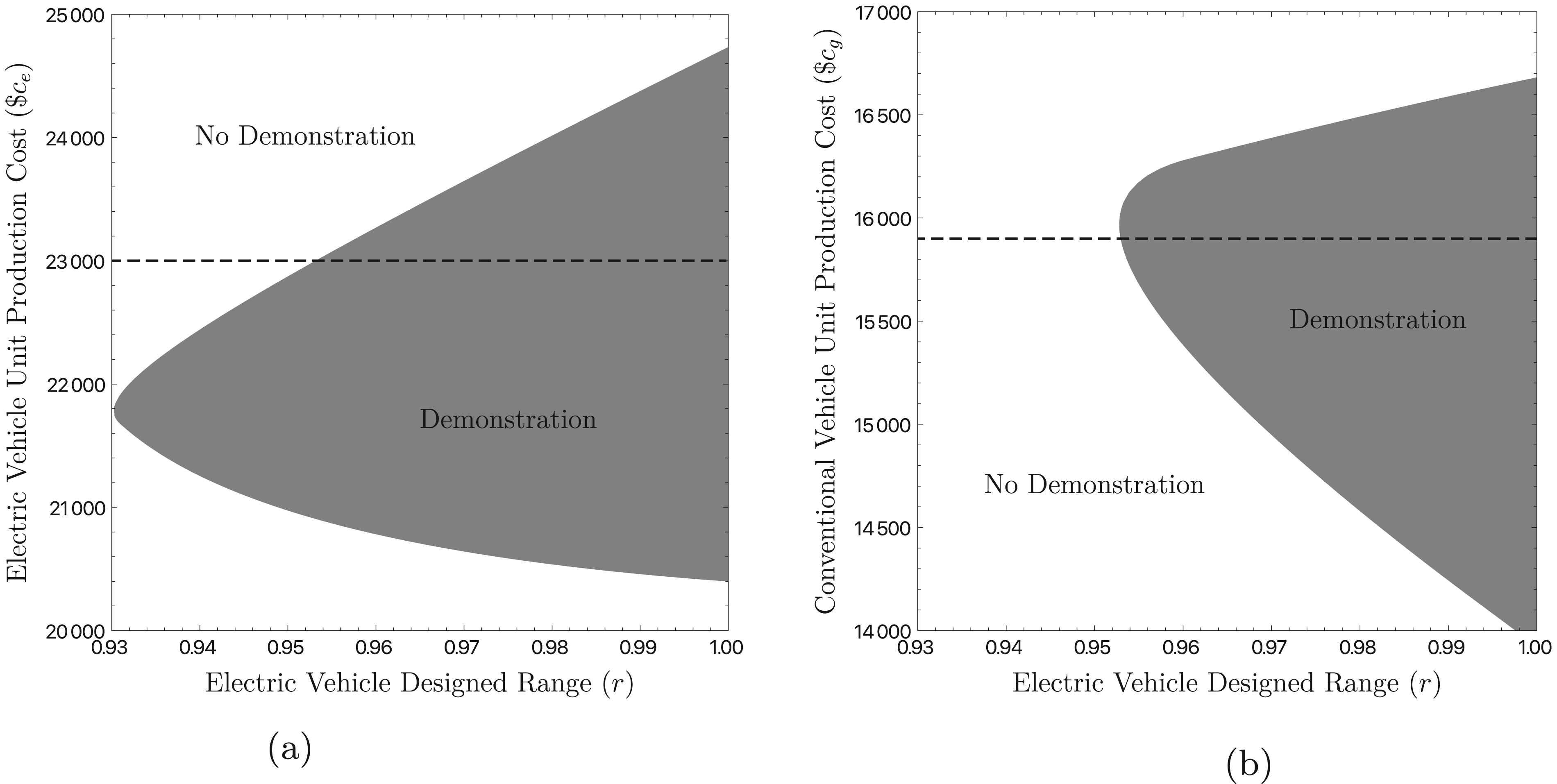
When to offer demonstration services? (a) Impact of
The above result also shows that as the conventional vehicle production cost
Proposition 1 also shows that offering demonstration becomes more attractive to the dealer when the designed range
We now examine the impact of offering demonstration on the sales of electric and conventional vehicles. To focus on the more interesting cases, we henceforth assume
Offering demonstration leads to greater electric vehicle adoption if and only if
The above result shows that offering demonstration leads to greater electric vehicle adoption when the electric vehicle technology is less developed, that is, when
When the electric vehicle technology is more developed (i.e.,
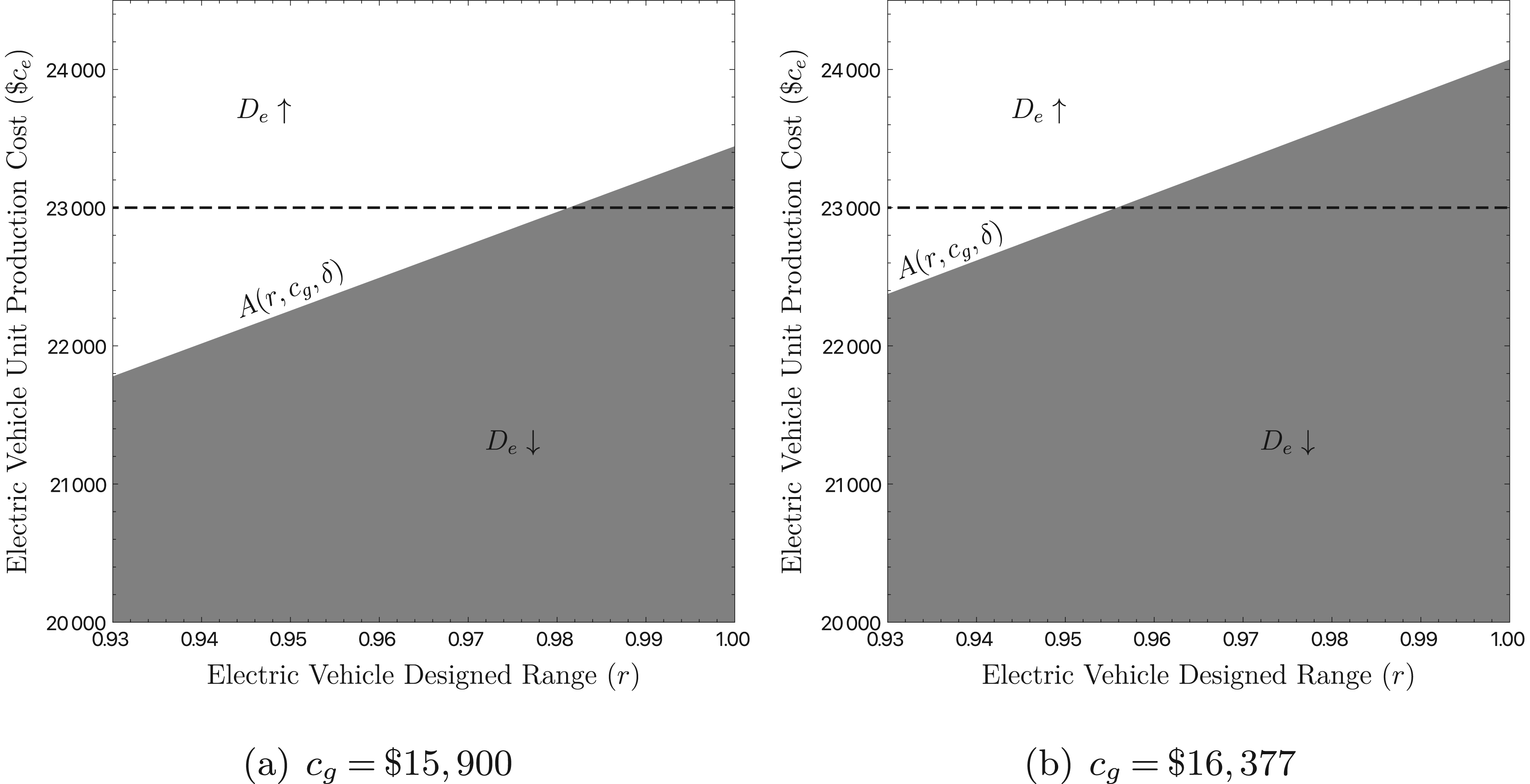
Does offering demonstration services increase or decrease electric vehicle adoption
Proposition 2 also examines the impact of
Our results highlight the evolving economic and environmental implications of demonstration services as the electric vehicle industry matures. Under current conditions, when electric vehicle and demonstration technologies are costly or limited (i.e., high
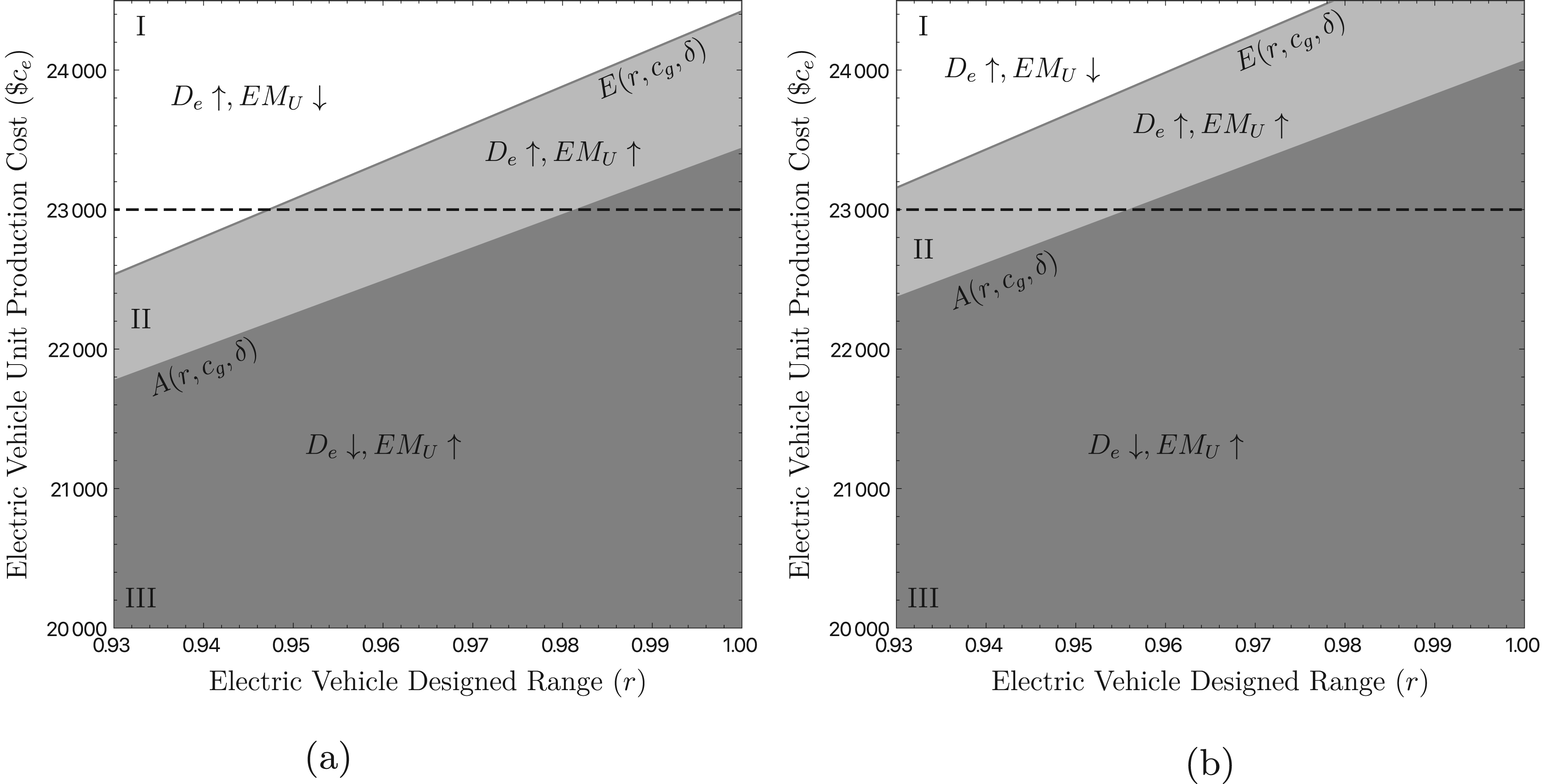
Equilibrium effect of offering demonstration on electric vehicle adoption
Next, we analyze how the dealer’s demonstration strategy affects emissions from the usage of all (electric and conventional) vehicles sold.
12
Usage emissions (henceforth, emissions) include tailpipe emissions as well as emissions associated with fuel generation (i.e., gasoline and electricity for conventional and electric vehicles, respectively). Let
When offering demonstration leads to lower adoption of electric vehicles (i.e., when
As it is expected, emissions increase when the demonstration diverts customers from electric to conventional vehicles due to receiving an unfavorable impression. Hence, it may be tempting to assume that greater electric vehicle adoption implies lower total emissions. In what follows, we show that this is not necessarily true.
When the dealer’s offering of demonstration leads to greater adoption of electric vehicles (i.e., when
As illustrated in Figure 5, when offering demonstration leads to greater electric vehicle adoption, it also leads to lower emissions only under a less developed electric vehicle technology (i.e.,
Perhaps more interestingly, we also find that the demonstration may lead to greater emissions even when it does not expand car ownership. 14 To understand the intuition, recall that in the absence of demonstration, customers with more total mobility needs prefer the electric vehicle due to a lower operating cost, whereas customers with less total mobility needs prefer the conventional vehicle as the operating cost benefit is outweighed by range concerns. Thus, in the presence of demonstration, a customer diverted from the electric to the conventional vehicle, due to receiving an unfavorable impression, imposes a larger amount of emissions from greater usage than the amount reduced by a customer diverted in the opposite direction due to receiving a favorable impression. Additionally, with a more developed electric vehicle technology, electric vehicle sales are higher in the absence of demonstration. As a result, with the demonstration more customers will be diverted from the electric to the conventional vehicle, and therefore, emissions are more likely to increase.
Proposition 3 also examines the impact of the conventional vehicle production cost
Previously, we analyzed the economic and environmental implications of dealer demonstrations with endogenous wholesale prices by the manufacturer. In practice, auto manufacturers are also subject to regulations that require their CAFE level, defined as the production-weighted harmonic mean fuel economy, to meet a predetermined standard. In our model, the manufacturer’s CAFE level
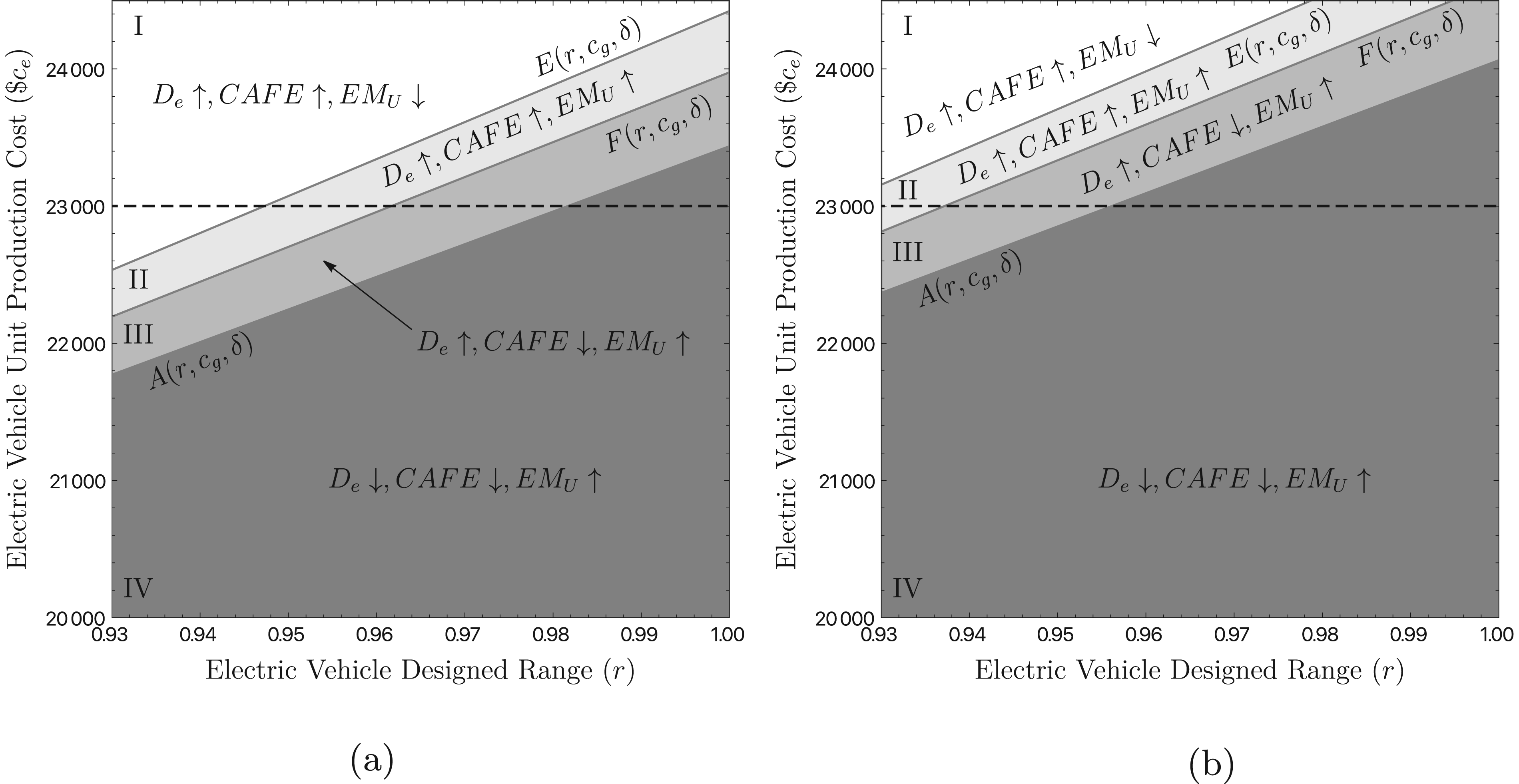
Equilibrium effect of offering demonstration on electric vehicle adoption
For expositional convenience, we will use the ratio
Since the CAFE level is effectively the ratio of electric to conventional vehicle sales, the impact of offering demonstration on the CAFE level depends on its effect on both electric vehicle sales (as derived in Proposition 2) and conventional vehicle sales, which we analyze next.
Offering demonstration leads to greater conventional vehicle sales if and only if
As expected, when offering demonstration leads to lower electric vehicle sales (i.e.,
Building on the analysis above, we now examine the impact of offering demonstration on the manufacturer’s CAFE level. When
When
The above result shows that offering demonstration leads to a lower CAFE level when the electric vehicle technology is more developed and/or the conventional vehicle production cost is high (i.e.,
We now examine the manufacturer’s wholesale pricing decisions to ensure CAFE compliance and the resulting effect on electric vehicle adoption in equilibrium. To this end, we formulate the manufacturer’s problem as
First, for a given demonstration strategy, we examine how the manufacturer should adjust the wholesale prices under a more stringent CAFE standard. Since this requires a larger ratio of electric relative to conventional vehicle sales, one might expect the manufacturer to lower the wholesale price of the electric vehicle and raise the wholesale price of the conventional vehicle. However, our analysis shows that this is not always the case.
For a given demonstration strategy, there exist the optimal conventional vehicle wholesale price is increasing in the optimal electric vehicle wholesale price is decreasing in the equilibrium electric vehicle adoption is increasing in
Under a more stringent CAFE standard, the manufacturer should raise the wholesale price of the conventional vehicle
Next, we compare results with and without demonstration to gain further insights into its moderating role in the effects of a tighter CAFE standard
We also find that a tighter CAFE standard leads to lower electric vehicle adoption only in the presence of demonstration. This occurs when the tighter CAFE standard leads the manufacturer to raise
In the main model, we assumed that customers are heterogeneous in their trip frequency, but homogeneous in the distribution of their trip lengths. In particular, customers may have trips of different lengths that follow the same distribution
We consider two customer segments that have the same total mobility needs but differ in trip frequency and length. A fraction
We now derive customers’ utilities from purchasing an electric vehicle. We assume
There are two important observations from the above: First, low-type customers are less affected by the range limitation due to their shorter trips. Although high-type customers can use the electric vehicle only for trips within range (i.e.,
While we can analytically characterize the customer purchase decisions under this generalization, it is analytically intractable to characterize the equilibrium wholesale prices and other outcomes. See online E-Companion E for all the technical details. Accordingly, we resort to numerical analysis to compare the equilibrium outcomes in the absence and presence of demonstration to offer insights for when the dealer should offer demonstration, and how this influences adoption and usage emissions. We find that all our structural results in Section 4 continue to hold as can be seen by comparing Figure 7 with Figures 3(a) and 5(a).
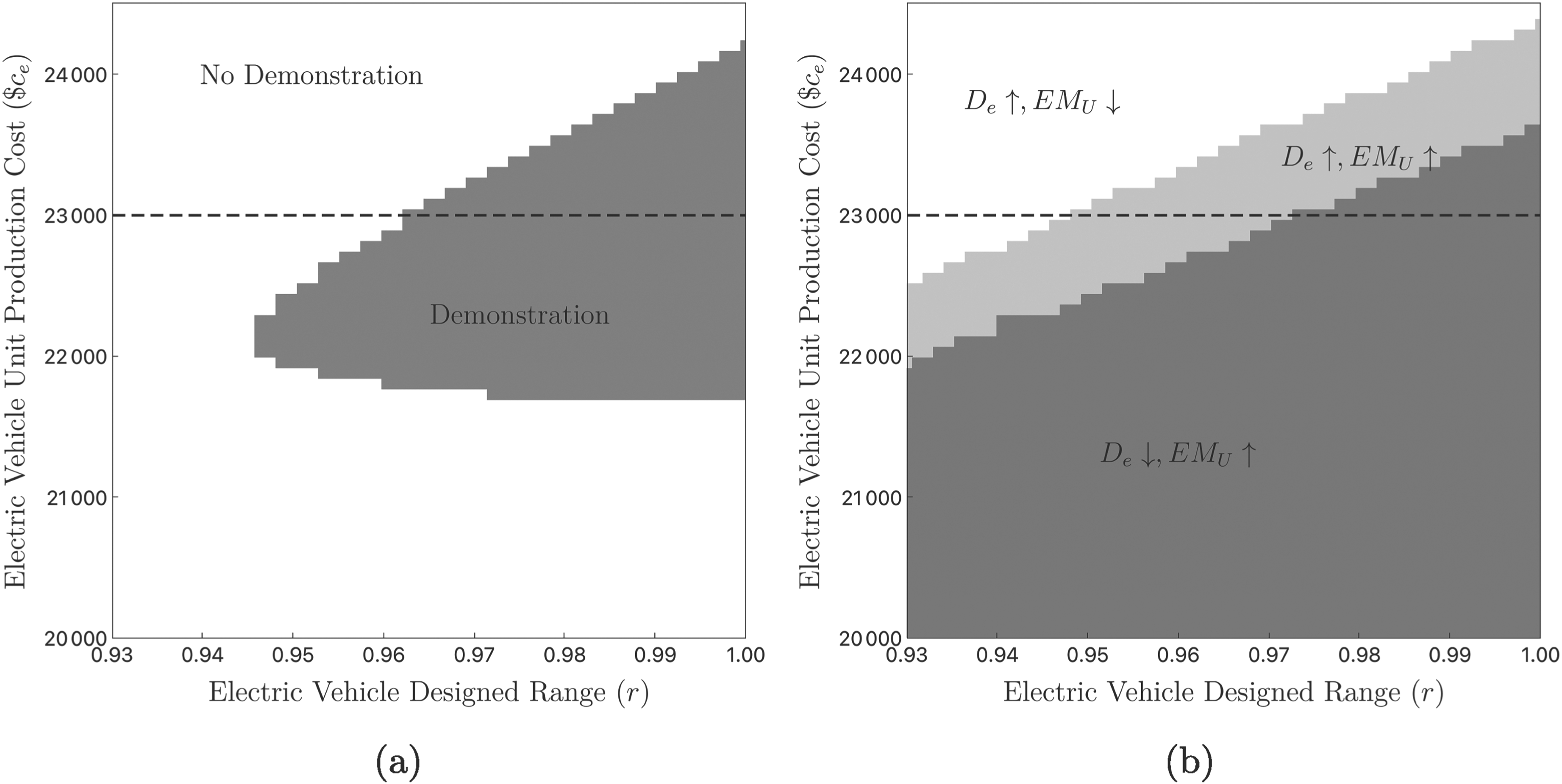
When to offer demonstration services and equilibrium effect on adoption
We next focus on how heterogeneity in trip length distributions affects the adoption of the demonstration, and thus, the equilibrium adoption and usage emissions (see Figure 8, where the effect of greater heterogeneity can be inferred by considering a lower
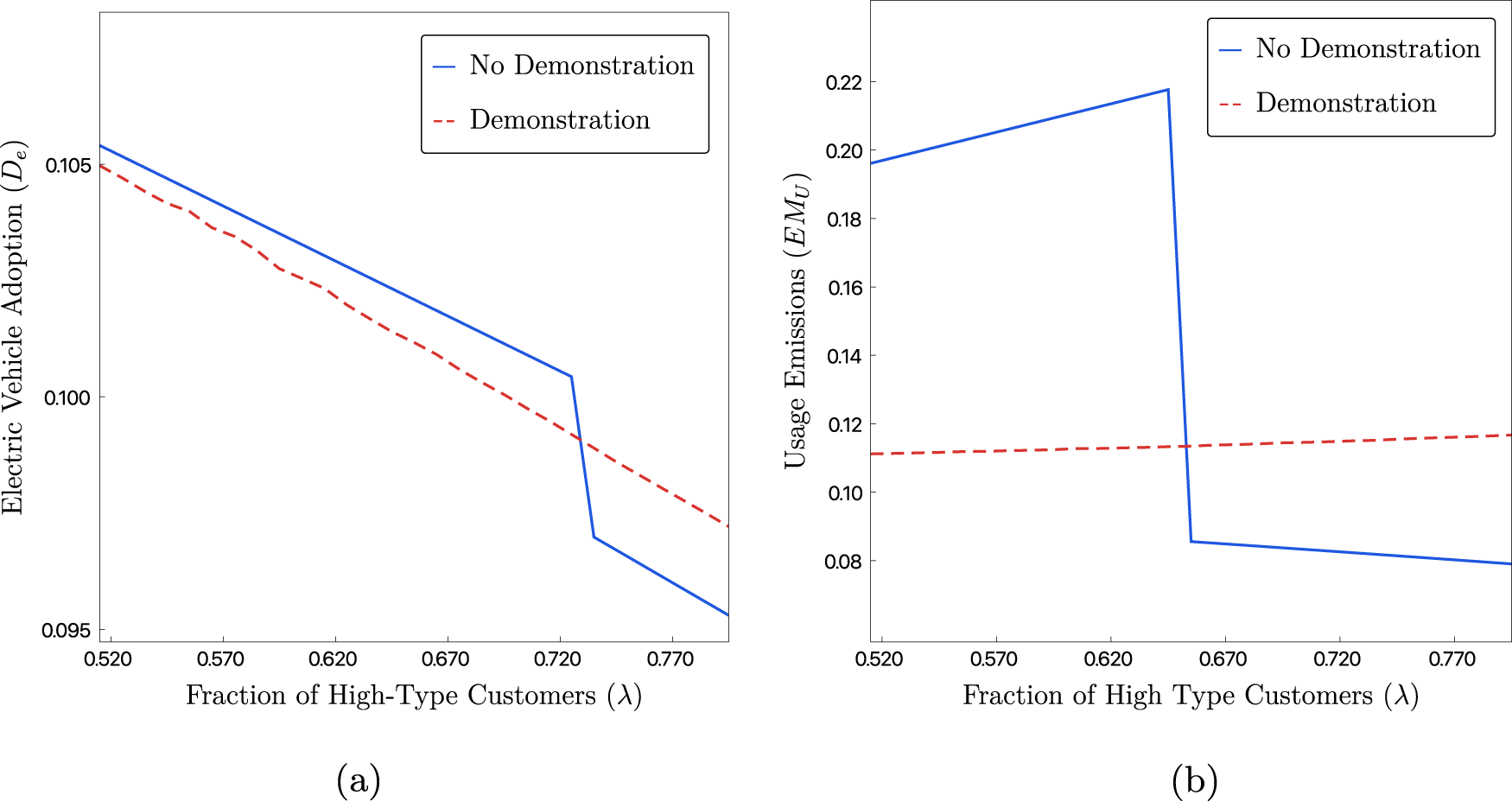
Equilibrium effect of the fraction of high-type customers
In this paper, we formally examined the impact of offering demonstration services on dealer profits, the manufacturer’s regulatory compliance, the adoption of electric vehicles, and overall environmental impact. Our results highlight that the economic, environmental, and policy implications of offering demonstration are nuanced, and depend critically on operational characteristics, including production costs and the electric vehicle’s designed range. These findings offer a set of key managerial and policy insights.
First, offering demonstration services can simultaneously improve dealer profits, promote electric vehicle adoption, and reduce emissions when the electric vehicle technology is relatively less developed; see region I in Figure 6. This highlights the potential of community-based organizations’ ongoing initiatives in facilitating dealer demonstrations (Drive Electric Northern Colorado, 2021; Evolve Houston, 2023; Peninsula Clean Energy, 2021) to generate both economic and environmental benefits. The effectiveness of such initiatives depends on the state of electric vehicle technology. As the production cost
Second, community-based organizations should exercise caution when using electric vehicle adoption as the primary metric for evaluating the environmental benefit of their initiatives that facilitate dealer demonstrations. When offering demonstration leads to greater electric vehicle adoption, it also leads to lower emissions when the electric vehicle technology is less developed, but can result in higher emissions once the technology becomes more advanced; see regions II and III in Figure 6.
Third, manufacturers should carefully consider the impact of dealer demonstrations on their CAFE level when deciding whether to facilitate demonstration by providing staff training and/or promoting extended test drive programs on their websites (Volvo, 2023). Even when dealer demonstration promotes electric vehicle adoption, it may lower the manufacturer’s CAFE level by leading to a proportionally greater increase in conventional vehicle sales (see region III in Figure 6).
Fourth, policies that disincentivize conventional vehicle production (e.g., through taxation or emission regulations) or tighten the CAFE standard have nuanced environmental implications through their interactions with dealer demonstrations. Although conventional vehicle production disincentives on their own may promote electric vehicle adoption, they can induce the dealer to refrain from offering demonstration services, which in turn can decrease adoption and increase emissions when the electric vehicle technology is less developed. Moreover, in the presence of demonstration, a more stringent CAFE standard may not lead to greater electric vehicle adoption.
To derive first-order insights into the role dealers can play in facilitating electric vehicle adoption, our model relied on simplifying assumptions, which naturally open avenues for future research. For instance, building on our analytical framework, one can further explore how dealer demonstrations could help mitigate competitive pressures from other dealers or auto manufacturers. Another promising direction is to introduce information asymmetry, for example, dealers may be better informed than customers on vehicle performance, durability, and safety features, and to examine the signaling role of demonstration services. Future research can examine other aspects that customers may learn from dealer demonstrations, such as the charging experience, driving experience, or overall lifestyle fit. Other promising directions include accounting for additional sources of customer uncertainty (e.g., travel needs or charging access) and information-provision mechanisms (e.g., product reviews and owner communities). Future research may also incorporate additional considerations, such as salesforce effort, planned obsolescence, secondary markets, consumer subsidies, or battery recycling policies that promote social welfare, as well as network effects in technology diffusion, to examine their interactions with dealer demonstrations. The impact of dealer demonstrations on the manufacturer’s ability to meet environmental regulations also highlights opportunities for negotiation and coordination between dealers and automakers.
Supplemental Material
sj-pdf-1-pao-10.1177_10591478261455540 - Supplemental material for The role of dealer demonstration in the adoption of electric vehicles
Supplemental material, sj-pdf-1-pao-10.1177_10591478261455540 for The role of dealer demonstration in the adoption of electric vehicles by Vishal V Agrawal, Ioannis Bellos and Hang Ren in Production and Operations Management
Footnotes
Acknowledgments
The authors are listed in alphabetical order of their last names. We would like to express our sincere gratitude to the Department Editor, the Senior Editor, and the two anonymous reviewers for their valuable and constructive suggestions, which greatly improved the paper. We are also sincerely grateful to Professors Atalay Atasu, Ho-Yin Mak, Şafak Yücel, and Can Zhang for their valuable and constructive feedback.

Funding
The authors received no financial support for the research, authorship, and/or publication of this article.
Declaration of conflicting interests
The authors declared no potential conflicts of interest with respect to the research, authorship, and/or publication of this article.
Notes
How to cite this article
Agrawal VV, Bellos I and Ren H (2026) The role of dealer demonstration in the adoption of electric vehicles. Production and Operations Management x(x): 1–20.
References
Supplementary Material
Please find the following supplemental material available below.
For Open Access articles published under a Creative Commons License, all supplemental material carries the same license as the article it is associated with.
For non-Open Access articles published, all supplemental material carries a non-exclusive license, and permission requests for re-use of supplemental material or any part of supplemental material shall be sent directly to the copyright owner as specified in the copyright notice associated with the article.
