






Abstract
We examine a firm’s personalized pricing (PP) strategies in markets where consumers are uncertain about product quality. In such markets, prices serve not only as a tool for price discrimination but also as a means of conveying quality information to consumers. We reveal that a firm faces a tradeoff between adopting PP to better price discriminate among consumers and not adopting it to signal its high quality. We find that a high-quality firm should adopt PP only when its product quality is known to either a very small or a very large fraction of consumers, and when its high-quality product, on average, offers either very low or very high additional value to consumers relative to a low-quality product. Moreover, the high-quality firm may charge consumers personalized prices less than their willingness to pay to signal its quality in equilibrium, deviating from first-degree price discrimination when consumers are informed about quality. Counterintuitively, when more consumers know product quality or when the high-quality product provides higher average value to consumers, consumer surplus and social welfare may decrease, but a low-quality firm’s profit may increase. Furthermore, the firm’s profit can be lower when its personalized pricing leverages more information about consumer characteristics. Randomized experiments provide evidence that a personalized price is a weaker signal of objective product quality than a uniform price.
Keywords
Introduction
An increasing number of firms adopt personalized pricing (PP), leveraging consumer data to tailor prices for individual consumers. Many firms across various industries, including Discover Financial Services, Progressive Insurance, Home Depot, JCPenney, Staples, Kroger, Safeway, McDonald’s, Carlsberg, Adidas, Reebok, Eddie Bauer, and River Island, have practiced personalized pricing (Banjo, 2014; Kelso, 2022; Progressive, 2024; Skrovan, 2017; Talon.One, 2025; Valentino-DeVries et al., 2012). In practice, PP is often implemented in the form of personalized coupons or discounts communicated to each consumer via private channels, such as personal web or app accounts, emails, and text messages. Figure A1 in the Online Appendix presents examples. Firms either develop their own digital PP systems or adopt third-party ready-to-deploy PP solutions, such as Amazon Personalize, Vouchery, and Talon.One. For instance, Talon.One has supported firms including Adidas, Reebok, Eddie Bauer, and River Island in generating personalized coupons. Recent empirical research has shown that personalized pricing can significantly improve firms’ profitability (e.g., Dubé and Misra, 2023; Liu, 2023).
It is well established that PP enables firms to engage in (first-degree) price discrimination by charging consumers’ willingness to pay (WTP) when consumers have perfect knowledge about product quality (Pigou, 1920). However, in many market situations—particularly for experience products that are newly introduced to the market, and for which limited quality information is publicly available—consumers often face uncertainty about product quality at the time of purchase. Their uncertainty about quality significantly complicates the firm’s PP strategy, as simply setting the price equal to consumers’ WTP becomes invalid for two important reasons. First, because consumers are uncertain about product quality, they do not know their true WTP for the product. Second, consumers with quality uncertainty can infer product quality from the prices they receive—prices typically serve as signals of product quality—so the personalized prices can endogenously affect consumers’ WTP for the product. While this signaling role of prices has been extensively studied in the context of uniform pricing (e.g., Bagwell and Riordan, 1991; Chen et al., 2024; Desai and Srinivasan, 1995; Milgrom and Roberts, 1986; Soberman, 2003), the extant literature has yet to explore how prices can still signal product quality when these prices can be personalized.
Recent academic research and industry reports suggest that personalized pricing can alter how consumers infer product quality from prices, often attenuating the effectiveness of price as a quality signal. For example, Spann et al. (2024) argue that when personalized pricing algorithms generate substantial price variation across consumers, individuals become less likely to treat the prices they receive as reliable quality signals, as the informational role of price is thereby obscured. Similarly, Zagorsky (2025) notes, “In a custom-pricing situation, seeing a high price doesn’t mean something is higher quality. Instead, a high price simply means a business views the customer as willing to part with more money.” We also observe that firms using personalized pricing attempt to reassure consumers about product quality. For example, Kroger emphasizes that “customers never have to compromise high-quality for low prices” while promoting its personalized savings features (Kroger, 2026).
To provide further evidence that personalized pricing can influence consumers’ quality inference, we also conducted four randomized online experiments in different product contexts, where consumers were asked to evaluate a new product’s quality based on the prices (personalized vs. uniform) they received. These experiments consistently show that personalized pricing, compared to uniform pricing, significantly weakens consumers’ inference of product quality from price. Moreover, some participants explicitly articulated that personalized pricing undermined their tendency to interpret a high price as an indicator of high quality. For example, one participant noted, “I am thinking that the higher price would likely mean higher quality but my confidence is decreased by the personalized price.” Another said, “They are probably charging more because of the personalization aspect. I doubt they are any better than the average priced pair.” Note that this mechanism is distinct from previously documented downsides of personalized pricing, such as fairness concerns (Allender et al., 2021; Cohen et al., 2022) or the erosion of luxury brand exclusivity. Importantly, our experiments measured consumers’ perceptions of objective product quality, whereas the existing literature typically studies factors that influence WTP but are independent of objective quality perceptions.
The preceding evidence indicates that when consumers are uncertain about product quality, a firm’s PP strategy must account not only for price discrimination but also for its influence on consumers’ quality inference. This article examines how a firm should optimally design its PP strategy in markets where consumers have imperfect knowledge of product quality. Specifically, we address the following questions:
How should a firm design its PP strategy? Specifically, when should the firm adopt personalized pricing, and if so, how should it set personalized prices for different consumers? How will the firm’s PP strategy affect its profit and consumer welfare? Does having more information about consumers increase the firm’s benefit from PP?
We develop an analytical model where a monopoly firm sells a product whose quality can be either high or low. Consumers differ in their valuations and informedness about product quality. In particular, quality-sensitive consumers appreciate the premium features offered by a high-quality product and thus are willing to pay more for it than a low-quality product, whereas quality-insensitive consumers do not value these premium features and their WTP is independent of product quality. In addition, informed consumers know about the product quality, whereas uninformed consumers do not. The firm decides whether to adopt the PP technology at an adoption cost, which allows it to personalize prices based on consumers’ quality sensitivity and informedness. If the firm adopts the PP technology, consumers will observe only their own personalized prices but not the prices for other consumers. As noted, this assumption reflects that in most digital PP practices, consumers receive personalized price offerings via private communications. By contrast, if the firm does not adopt the PP technology, it charges a uniform price for all consumers. An uninformed consumer updates her belief about the firm’s product quality based on what she observes about the firm’s pricing decisions, including whether it adopts the PP technology and the corresponding personalized or uniform price. Thus, the firm has incentives to influence uninformed quality-sensitive consumers’ quality beliefs via its pricing decisions.
Our first finding is that with consumers’ quality uncertainty, a high-quality firm has incentives to strategically refrain from adopting the PP technology. This result arises because the adoption of PP, as compared to charging a uniform price, may weaken a high-quality firm’s effectiveness in signaling its high quality. As established in Bagwell and Riordan (1991), in the context of uniform pricing, a high-quality firm can signal its high quality with a high uniform price, because at this high price, quality-sensitive consumers will not buy the product if they believe or know that the product has low quality. A firm whose product quality is indeed low would find it unprofitable to mimic the high price because doing so would forgo informed quality-sensitive consumers; it would prefer to capture these consumers as well as quality-insensitive consumers with a low uniform price. Consequently, uninformed quality-sensitive consumers rationally infer high quality from the high uniform price. By contrast, when the high-quality firm adopts the PP technology, charging such a high (personalized) price to uninformed quality-sensitive consumers can no longer convince them of its high quality. This is because a low-quality firm would be strongly inclined to also adopt the PP technology and mimic the high personalized price for these consumers. The mimicry does not prevent the firm from selling to other consumers with low personalized prices, which are unobservable to uninformed quality-sensitive consumers. Therefore, in markets with consumers’ quality uncertainty, the high-quality firm faces a tradeoff regarding the adoption of the PP technology: doing so allows the firm to price discriminate among consumers but may prevent it from effectively signaling its high quality. The finding is consistent with and provides a microfoundation for the empirical observations discussed above.
In light of this tradeoff, how should a firm design its PP strategy in a market with consumers’ quality uncertainty? Specifically, when should it adopt the PP technology, and if so, how should it personalize prices for different consumers? Our second main result reveals that the prevalence of consumer quality uncertainty in the market has a non-monotonic impact on the adoption of the PP technology by a high-quality firm: it should adopt the PP technology either when its quality is known to most consumers or when it is known to few consumers. When most consumers are already informed about product quality, a firm with low product quality has very weak incentives to mimic the high-quality firm. In this case, if the high-quality firm adopts the PP technology, it can secure substantial profit from extracting the surplus of most quality-sensitive consumers who are informed about product quality. Conversely, when most consumers are uninformed about quality, the low-quality firm has very strong mimicry incentives. In this case, even if the high-quality firm does not adopt the PP technology, it still needs to charge a low uniform price to discourage the low-quality firm’s price mimicry. In these two cases, the high-quality firm will adopt the PP technology to benefit from price discrimination. Otherwise, the firm should refrain from adoption to benefit from effectively signaling its high quality. In addition, we find that the high-quality firm should refrain from adopting the PP technology when the size of quality-sensitive consumers is intermediate and when their appreciation for the high-quality features is moderate; otherwise, the firm should adopt the PP technology. In sharp contrast, we find that consumers’ quality uncertainty can facilitate a low-quality firm’s adoption of the PP technology, provided that the high-quality firm also adopts it. In this case, the low-quality firm’s adoption of the PP technology allows it to mimic the high-quality firm’s personalized prices and hence profit more from uninformed quality-sensitive consumers.
We also find that when the high-quality firm adopts the PP technology, it may charge uninformed quality-sensitive consumers a personalized price lower than their WTP for its product, departing from the classic first-degree price discrimination result. This arises either in equilibria where the lowered price would make the low-quality firm unprofitable to mimic the high-quality firm’s price for these consumers, or in equilibria where the low-quality firm successfully mimics this price so that these consumers’ WTP is based on their prior quality belief. Interestingly, in the latter case, the low-quality firm can charge uninformed quality-sensitive consumers a personalized price higher than their WTP for a low-quality product.
Our third main finding is that the firm’s strategic decisions on its PP strategy can lead to unintended market consequences. First, we find that when more consumers become informed about product quality, consumer surplus and social welfare may decrease, whereas the low-quality firm’s profit may increase. A practical implication is that, in markets where consumers infer quality from price, greater transparency about product quality, facilitated by increasingly popular review systems and influencer channels, can harm consumers and society by shifting the firm’s equilibrium PP strategy. As explained, when most consumers are informed about product quality, in equilibrium, the high-quality firm may adopt the PP technology and lower the personalized price for uninformed quality-sensitive consumers to make mimicry unprofitable for the low-quality firm. When the number of informed consumers further increases, the low-quality firm’s mimicking incentives weaken, so the high-quality firm can lower its price to a lesser extent, thereby reducing the total consumer surplus. By contrast, when the number of informed consumers increases from a medium level to a high level, the high-quality firm switches from not adopting the PP technology to adopting it to focus on price discrimination while tolerating the low-quality firm’s mimicry of the personalized price for uninformed quality-sensitive consumers. This potentially increases the low-quality firm’s total profit. In a similar vein, we find that consumer surplus and social welfare may decrease when the high-quality product generates more value to consumers on average relative to the low-quality one, and when implementing personalized pricing becomes less costly.
We further demonstrate that the above findings are qualitatively robust when the firm observes only consumers’ valuation but not their informedness about product quality. Interestingly, the high-quality firm’s equilibrium profit can be higher when it does not observe consumer informedness than when it does. This suggests that more knowledge about consumers can backfire on a high-quality firm when some consumers are uncertain about product quality. Our results are also robust when the firm can accompany its personalized prices with a list price, when some consumers do not observe the firm’s adoption of personalized pricing, when quality-insensitive consumers also have a higher WTP for the high-quality product, when the high-quality firm incurs a higher marginal cost, and when the firm’s cost of adopting personalized pricing is its private information.
In summary, this research offers new insights into a firm’s personalized pricing strategy in markets where prices serve as quality signals and consumers observe only their own personalized price. Our findings show that, in such markets, a high-quality firm must carefully balance the dual roles of personalized pricing as a tool for surplus extraction and a device for quality signaling. We find that the high-quality firm optimally refrains from adopting personalized pricing when the product’s premium features are only moderately valued by consumers, or when an intermediate share of consumers is informed of product quality. Such conditions arise naturally, for instance, when the product has been on the market long enough for quality information to reach some consumers through reviews, word-of-mouth, or advertising, but not yet the majority. They also arise when the product imposes moderate requirements, such as background knowledge or technical expertise, for consumers to access and comprehend quality information. We further find that, in the markets we study, a high-quality firm should be careful about conditioning its prices on consumer informedness (for instance, enabled by collecting additional consumer data or deploying more advanced artificial intelligence algorithms), because doing so can weaken its quality signaling and reduce its profit. Lastly, we find that several seemingly beneficial market developments can have counterproductive effects on consumer and social welfare, because they reshape the firm’s quality signaling incentives and shift its pricing decisions. Policymakers and consumer advocates should therefore account for the firm’s strategic response when promoting greater accessibility of quality information (e.g., through expanded consumer review platforms or stricter disclosure regulations), improvements in product quality (e.g., through advances in materials or quality control), and reductions in the cost of implementing personalized pricing (e.g., driven by pre-trained artificial intelligence models or lower data acquisition costs).
The rest of the article is organized as follows. Section 2 reviews the literature. Section 3 describes the model setup, and Section 4 presents the equilibrium analysis. Section 5 extends the analysis to situations where the firm observes only partial consumer information, where the firm can accompany its personalized prices with a list price, and where the firm can also signal through advertising. Section 6 presents our randomized online experiments. Section 7 concludes the article.
This research is related to the growing literature on personalized pricing. Pigou (1920) suggests that personalized pricing allows a firm to extract more surplus from consumers based on their heterogeneous WTP. Recent empirical research has studied how to quantify the value of personalized pricing over uniform pricing, how to implement personalized pricing in practice, and its welfare impacts (Dubé and Misra, 2023; Elmachtoub et al., 2021; Liu, 2023).
A large body of theoretical literature demonstrates the strategic effects of personalized pricing, including how personalized pricing affects price competition (Bhaskar and To, 2004; Chen et al., 2017, 2001; Choudhary et al., 2005; Ghose and Huang, 2009; Li et al., 2024; Liu and Serfes, 2004; Rhodes and Zhou, 2024; Shaffer and Zhang, 1995, 2002; Thisse and Vives, 1988), influences the interaction between channel members (Jullien et al., 2023; Liu and Zhang, 2006), triggers consumers’ fairness concerns (Allender et al., 2021; Cohen et al., 2022), incentivizes consumers to avoid or manipulate data tracking and protect privacy (Acquisti and Varian, 2005; Anderson et al., 2023; Chen et al., 2020; Li and Li, 2023; Taylor, 2004), shapes consumers’ beliefs about how many other consumers will buy a product with network effects (Hajihashemi et al., 2022), and alters consumers’ incentives to search for product valuations (Wang et al., 2023). Several papers study how a firm’s personalized pricing strategy interacts with the firm’s other strategic decisions, such as consumer addressability (Chen and Iyer, 2002), personalized advertising (Anderson et al., 2015), product personalization (Du and Ning, 2025), and consumer information sharing (Hu et al., 2025).
The aforementioned papers assume that product quality is common knowledge. By contrast, our article studies how a firm should design its PP strategy when consumers have quality uncertainty, which is prevalent in markets for experience products and new products. In such contexts, pricing serves not only the role of extracting consumer surplus but also the role of conveying quality information. We show that a firm may find it profitable to refrain from adopting personalized pricing, forgoing price discrimination in favor of quality signaling. Therefore, our article contributes to the literature by documenting the strategic effect of personalized pricing on shaping consumers’ beliefs about product quality. In addition, it provides a microfoundation for, and is consistent with, the experimental and empirical evidence that personalized pricing weakens consumers’ tendency to infer product quality from observed prices.
To improve the quality of decision making, a firm often seeks to acquire more information about consumers (Bergemann et al., 2018). When consumers know product quality, the earlier research indicates that a monopolistic firm can generally receive more profit from personalized pricing if it has more information about its consumers (Armstrong, 2006). By contrast, with quality uncertainty, we show that a monopolist’s profit can decrease when the firm can personalize prices based on more granular consumer information.
Our study is also related to the literature on the quality signaling role of pricing (Bagwell and Riordan, 1991; Bolandifar et al., 2023; Chen et al., 2024, 2025; Chen and Jiang, 2021; Desai and Srinivasan, 1995; Guo and Wu, 2016; Guo and Jiang, 2016; Janssen and Roy, 2010; Jiang and Yang, 2019; Kuksov and Liao, 2019; Milgrom and Roberts, 1986; Soberman, 2003; Stiving, 2000; Zhao, 2000). Most of these papers illustrate how a firm can use its uniform price, sometimes together with other instruments (e.g., advertising, money-back guarantee), to signal its high quality. By contrast, we consider the firm’s quality signaling problem when prices can be personalized. We show that when a high-quality firm adopts personalized pricing, it can choose to lower its personalized prices from the perfect-information level to signal high quality. This is in sharp contrast to the context of uniform pricing, where the high-quality firm raises its price to signal high quality.
In particular, two papers have studied a firm’s signaling problem when the firm can price discriminate consumers who are uncertain about product quality or valuation. Anderson and Simester (2001) show that implementing price discrimination can be an adverse signal of product quality. This result relies on the fact that consumers observe the discriminatory prices for all other consumers, and that the marginal cost of a high-quality firm is higher than the WTP of low-valuation consumers. Because serving low-valuation consumers is unprofitable for a high-quality firm, consumers will infer low quality if they observe the firm serving these consumers with a low discriminatory price. The mechanism described in Anderson and Simester (2001) applies only to traditional, non-digital price discrimination (e.g., student discounts), where prices of all consumers are publicly observable. In stark contrast, our mechanism uniquely applies to most modern practices of digital personalized pricing, where prices are privately communicated and consumers observe only their own personalized price.
Xu and Dukes (2022) consider a situation where consumers are uncertain about their product valuations but receive signals that are either positively or negatively biased, making consumers potentially overestimate or underestimate their valuations, respectively. The firm personalizes prices and has private information about whether consumers tend to underestimate or overestimate their valuations. They show that a firm can signal to consumers that they tend to underestimate their valuations by accompanying its personalized prices with a list price. In sharp contrast, our article shows that when consumers are uncertain about product quality, a high-quality firm cannot signal its quality by accompanying its personalized prices with a list price.
Model
Market basics
A monopoly firm sells a product, whose quality is either high (
There is a unit mass of heterogeneous consumers. They differ in their informedness about product quality (Bagwell and Riordan, 1991). Informed consumers (denoted as
Consumers also differ in their sensitivity to product quality (Kirmani and Rao, 2000). Quality-sensitive consumers (denoted as
In summary, our main model contains four groups of consumers, differing in their quality sensitivity
Personalized pricing technology
Without the personalized pricing (PP) technology (denoted
In practice, whether a firm employs personalized pricing is often known to its customers. Major economies such as the European Union require firms to explicitly disclose the use of personalized pricing based on consumer profiles.
4
Many firms also voluntarily disclose to their consumers that the coupons and discounts they receive are personalized to maintain trust and transparency, as illustrated by Figure A1 in the Online Appendix. Conversely, if a firm does not adopt personalized pricing, consumers can readily verify that the price they receive matches the publicly listed price or that offered to other consumers. Therefore, in the main model, we assume that consumers can observe whether the firm adopts the PP technology (
Additionally, in most modern, online practices of personalized pricing, firms communicate personalized prices to consumers via private channels, such as text messages, emails, or personal app accounts, to alleviate consumers’ privacy and fairness concerns. Consequently, consumers usually observe only their own personalized price but not the prices for other consumers (Du and Ning, 2025; Hajihashemi et al., 2022; Liu, 2023; UK Competition and Markets Authority, 2018; Xu and Dukes, 2022). This sharply contrasts with traditional offline price-discrimination settings considered by the prior literature, for example, student discounts or installment billing options, where all price levels are publicly observable (Anderson and Simester, 2001). Accordingly, we assume that if the firm adopts the PP technology, consumers observe only their own personalized price but not those received by other consumers.
Formally, let
A consumer’s expected utility of purchasing the product depends on her knowledge about product quality. Since informed consumers know product quality, an informed consumer

By contrast, uninformed consumers form their beliefs about product quality based on their observed information

We have two remarks about our model setup and assumptions. First, in the main model, when the firm uses the PP technology, it does not announce a list price. Section 5.2 relaxes this assumption and shows that our results are qualitatively unchanged. Second, even if the firm uses the PP technology (
We make the following parameter assumptions throughout the analysis:

We solve for pure-strategy perfect Bayesian equilibria (PBE). In a PBE, quality-insensitive consumers will buy the product if and only if its price is no greater than one, and informed quality-sensitive consumers will buy if and only if the price is no higher than
The firm’s equilibrium action
If
In our setting, both pooling and separating PBE can arise: the equilibrium is pooling if
In our setting, there are multiple PBE supported by different off-equilibrium beliefs, many of which are unreasonable. To rule out unreasonable equilibria and pin down a unique equilibrium, we adopt the strongly undefeated equilibrium (SUE) refinement, which has been widely used in the economics and marketing literature (Chen et al., 2025; Gill and Sgroi, 2012; Guo and Jiang, 2016; Mezzetti and Tsoulouhas, 2000; Miklós-Thal and Zhang, 2013; Subramanian and Rao, 2016; Wu et al., 2020). 8 Other common equilibrium refinements, such as the D1 criterion and the intuitive criterion, can fail to select a unique equilibrium outcome in our setting. See Online Appendix A for more details about the analysis.
In our setting, the SUE refinement will select the PBE that, among the universe of PBE supported by any possible off-equilibrium belief, yields the highest profit for the high-quality firm. If multiple equilibria satisfy this criterion, then the refinement will further select among these equilibria the one that yields the highest profit for the low-quality firm. As suggested by Miklós-Thal and Zhang (2013), the SUE, which is the “best equilibrium” from the perspective of the high-quality firm, is intuitively appealing because it is the high-quality firm that wants to reveal its type.
Following the definition of SUE, we solve for the SUE by finding the PBE that yields the highest profit for the high-quality firm among all PBE. If multiple PBE satisfy this criterion, we further choose the PBE that yields the highest profit for the low-quality firm. In our setting, this process will select a unique equilibrium. We will refer to the SUE simply as the equilibrium in the rest of the article. We use the superscript “
Summary of notations.
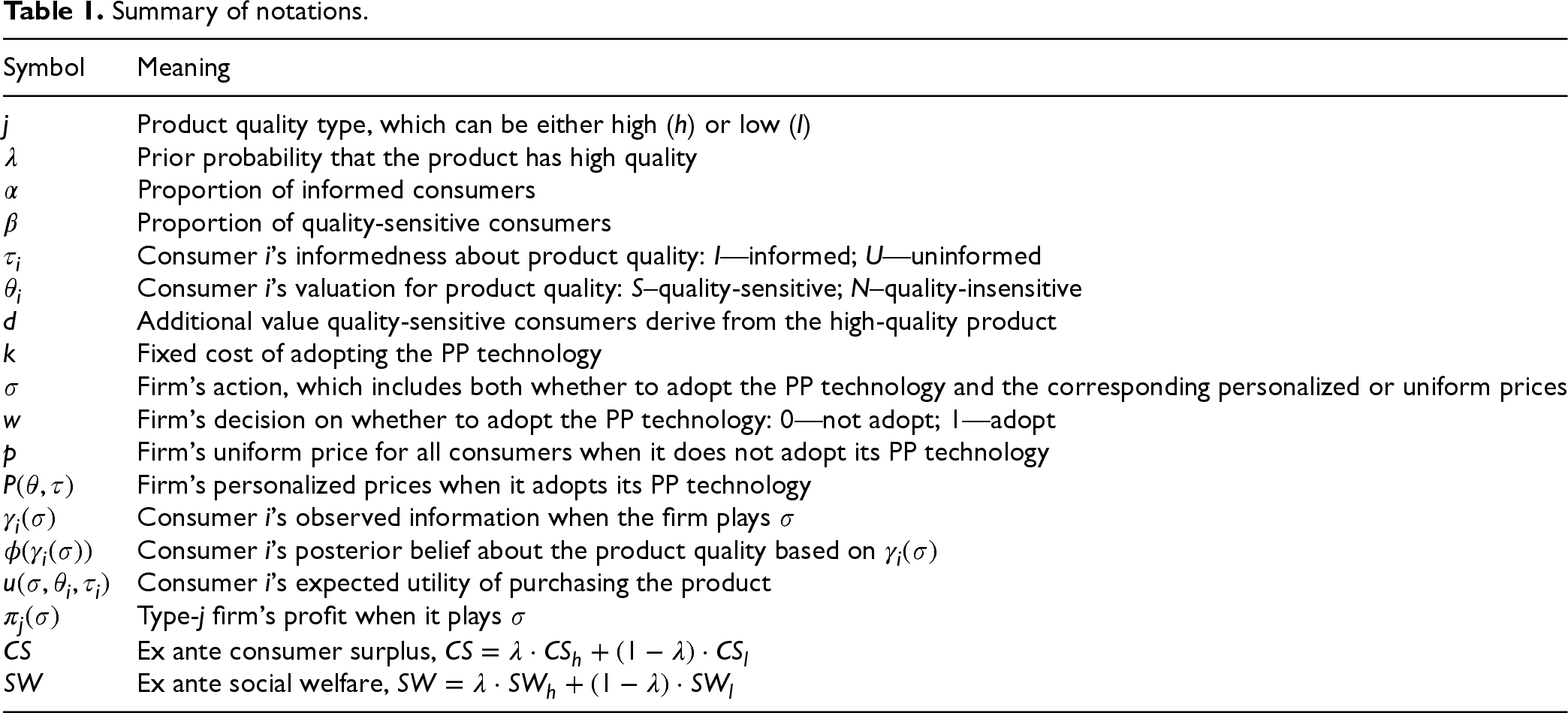
Summary of notations.
We first examine a benchmark without quality uncertainty, in which all consumers know about product quality. Then, we examine the general scenario with quality uncertainty and compare the results with the benchmark to understand how consumers’ quality uncertainty affects the firm’s personalized pricing decisions, including whether it adopts the PP technology and its corresponding uniform or personalized price levels. Finally, we study the comparative statics of the welfare outcomes accounting for the firm’s strategic personalized pricing decisions.
Benchmark: no consumer quality uncertainty
In this benchmark, all consumers are informed about product quality (
(PP technology adoption without quality uncertainty)
When all consumers are informed about product quality (
When all consumers are informed about product quality, the high-quality firm will adopt the PP technology, whereas the low-quality firm will not adopt it. The latter is because only the high-quality firm has incentives to price discriminate consumers based on their quality sensitivity. However, as we will show later in Propositions 1–3, in the presence of quality uncertainty, the firm’s PP strategy significantly deviates from this perfect-information benchmark. The high-quality firm may refrain from adopting the PP technology, whereas the low-quality firm may choose to adopt it in equilibrium. Moreover, the equilibrium personalized price levels may depart from consumers’ WTP.
General case: with consumer quality uncertainty
Next, we analyze the general case where some consumers are uninformed about quality (i.e.,
Depending on whether each firm type will adopt the PP technology and whether different firm types will set the same prices, there are six types of potential equilibrium (see Table A1 in Online Appendix A). However, some of them cannot constitute an equilibrium. For example, we can rule out the scenario in which only the low-quality firm adopts the PP technology (
We prove that only three types of outcomes can constitute an equilibrium. The first type is the no-adoption equilibrium, in which the firm does not adopt the PP technology regardless of its quality type (
Equilibrium PP adoption and prices.

Equilibrium PP adoption and prices.
In sharp contrast to the benchmark, with quality uncertainty, the high-quality firm may strategically abstain from adopting the PP technology (corresponding to the no-adoption equilibrium). The abstention is because the adoption of PP, compared to charging a uniform price, may weaken its effectiveness in signaling its high quality. As established in Bagwell and Riordan (1991), when a high-quality firm does not adopt PP, it can signal high quality with a high uniform price. At this high price, quality-sensitive consumers will not buy the product if they believe or know that the product has low quality. A firm with low product quality would find it unprofitable to mimic the high price because doing so would prevent it from selling to informed quality-sensitive consumers. Instead, it would prefer to capture these consumers as well as quality-insensitive consumers with a low uniform price. Consequently, uninformed quality-sensitive consumers rationally infer high quality from the high uniform price. By contrast, when the high-quality firm adopts PP, charging such a high personalized price to uninformed quality-sensitive consumers can no longer convince them of its high quality. This is because a low-quality firm would be strongly incentivized to also adopt the PP technology and mimic the high personalized price for these consumers. The mimicry does not prevent the firm from selling to other consumers with low personalized prices, which are unobservable to uninformed quality-sensitive consumers. Therefore, in markets with consumers’ quality uncertainty, the high-quality firm faces an important tradeoff regarding the adoption of the PP technology: doing so allows the firm to price discriminate among consumers but may prevent it from effectively signaling its high quality.
In light of this tradeoff, we proceed to elaborate on the firm’s decisions regarding its PP strategy, which is twofold: when to adopt the PP technology and how to set the personalized prices for different consumers. We first consider how the firm’s strategy is shaped by the prevalence of consumer quality uncertainty in the market. A larger number of informed consumers
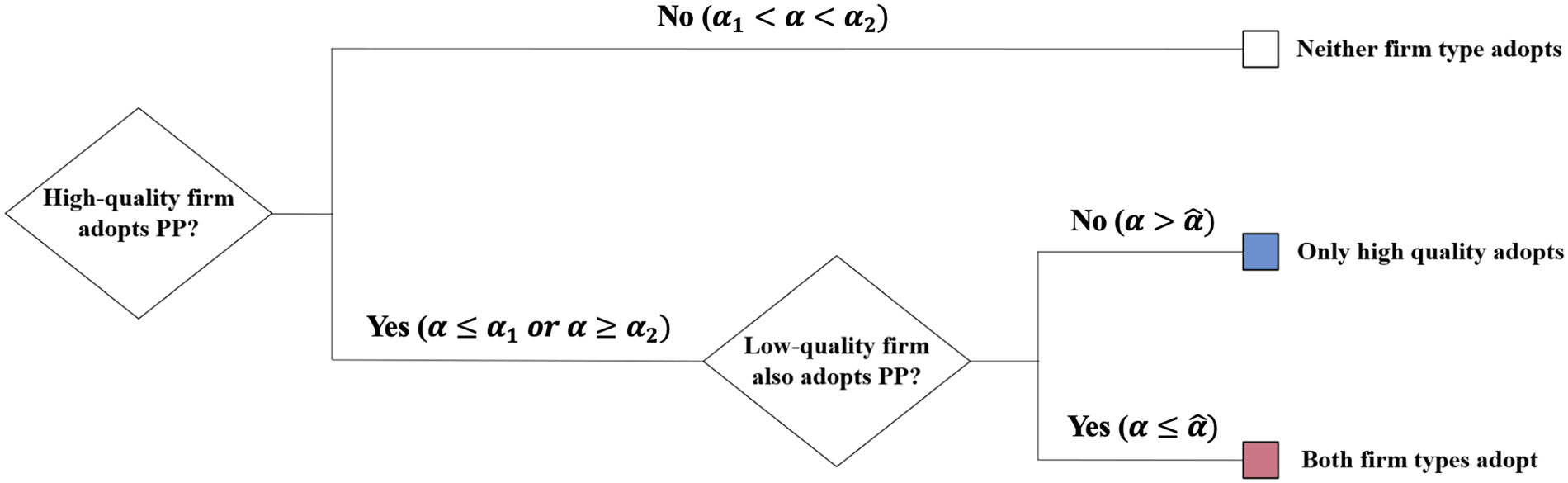
Equilibrium PP technology adoption situations.
In equilibrium, the high-quality firm will adopt the PP technology when the number of informed consumers
Proposition 1 reveals a non-monotonic relationship between the prevalence of consumer quality uncertainty and the high-quality firm’s adoption of the PP technology: the high-quality firm refrains from adoption when the number of informed consumers
In addition, Proposition 1 shows that in the region where the high-quality firm adopts the PP technology in equilibrium (
Figure 2 provides four graphical examples illustrating the equilibrium pattern of PP technology adoption. Consistent with the discussion above, the high-quality firm adopts the PP technology when
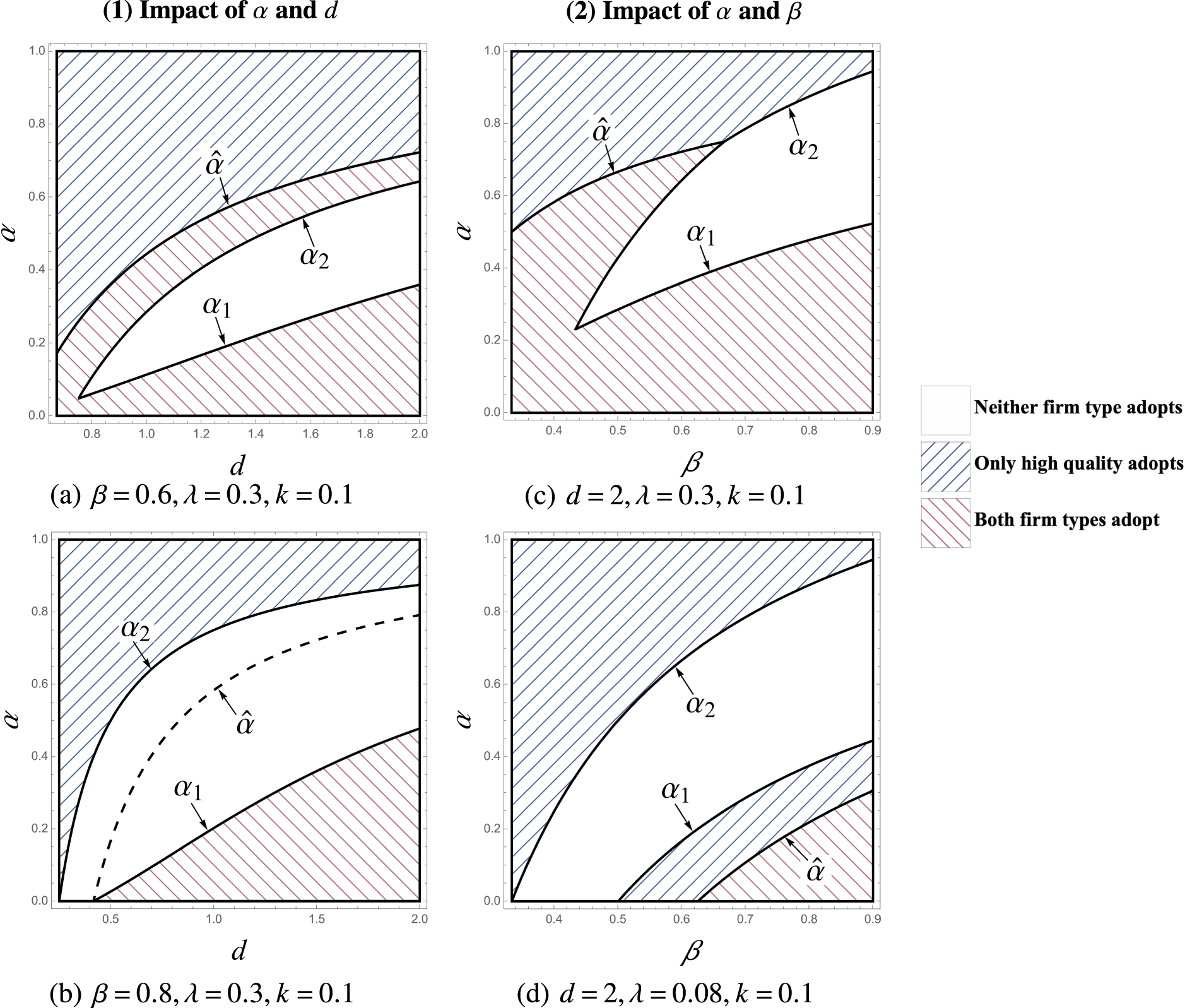
Equilibrium adoption of the PP technology. (a)
Next, we elaborate on how a firm that has adopted the PP technology should personalize prices across consumers. Proposition 2 shows that, under quality uncertainty, the high-quality firm may set personalized prices for uninformed quality-sensitive consumers below their WTP, contrary to the standard first-degree price discrimination result under perfect information. Interestingly, quality uncertainty may also allow the low-quality firm to charge uninformed quality-sensitive consumers personalized prices above their WTP for a low-quality product. For all other consumers, the firm charges the full WTP regardless of quality type.
(Personalized prices when the firm adopts PP in equilibrium)
In the parameter region yielding a partial-adoption equilibrium ( In the parameter region yielding a universal-adoption equilibrium ( The firm, when adopting the PP technology, charges other consumers a personalized price equal to their WTP.
First, in a partial-adoption equilibrium, even though uninformed quality-sensitive consumers correctly infer product quality from
Second, in a universal-adoption equilibrium, uninformed quality-sensitive consumers receive the same personalized price regardless of the firm’s quality type; consequently, they cannot infer product quality in equilibrium. In this case, the equilibrium price for these consumers,
Importantly, Propositions 1 and 2 reveal that in markets with consumers’ quality uncertainty, when the high-quality firm adopts the PP technology, it should not simply follow the doctrine of charging consumers their WTP. Instead, the firm should calibrate the price levels based on the prevalence of quality uncertainty among consumers to optimally balance the dual incentives of extracting surplus and signaling quality.
In equilibrium, the high-quality firm will adopt the PP technology when the size of quality-sensitive consumers
Proposition 3 shows that given the number of informed consumers (
In summary, our analysis highlights that a high-quality firm should refrain from adopting personalized pricing when the number of consumers who know product quality (
Finally, we note that the main qualitative message, that the high-quality firm may refrain from adopting PP in equilibrium when
(No-adoption equilibrium can uniquely survive D1)
The no-adoption equilibrium, in which
Moreover, our result implies that a high-quality firm can proactively improve the profitability of using personalized pricing by strategically investing in consumer education. For example, the firm can help consumers better recognize its product quality through efforts such as providing clear and easily understandable information on the product page, running advertising campaigns that highlight key quality features, partnering with reputable social media influencers who can credibly endorse the product, and integrating consumer reviews from other trusted sources. These actions can accelerate the market’s transition from partial to widespread quality awareness. Doing so can enable the firm to re-establish personalized pricing as a profitable strategy by alleviating the tension between surplus extraction and quality signaling.
In addition, a high-quality firm can also assess the extent of quality improvements offered by premium product features and align its pricing practices with the strength of its quality differentiation. The firm tends to benefit from adopting personalized pricing when the premium features represent either a substantial improvement or only a minor improvement over existing products. Lastly, a firm should also adjust its personalized pricing adoption and price levels to technological improvements that reduce the cost of implementing personalized pricing.
Finally, we emphasize that personalized pricing may also serve other purposes, such as learning about demand heterogeneity and segment composition. Our analysis abstracts from these motives to isolate the signaling role. When such benefits outweigh the adverse signaling effect shown in our article, high-quality firms may nonetheless find it profitable to adopt personalized pricing.
Welfare impacts of the PP technology
In this section, we study how various market factors affect the welfare of different market parties under the firm’s equilibrium PP strategies.
First, in today’s markets, product quality information, such as product review blogs or videos from professional content creators or regular consumers, has become more accessible to consumers than ever. The increased information availability is reflected as an increase in the number of informed consumers
(Welfare impacts of quality uncertainty prevalence)
As the fraction of informed consumers
Figure 3 offers an example illustrating the welfare impacts of
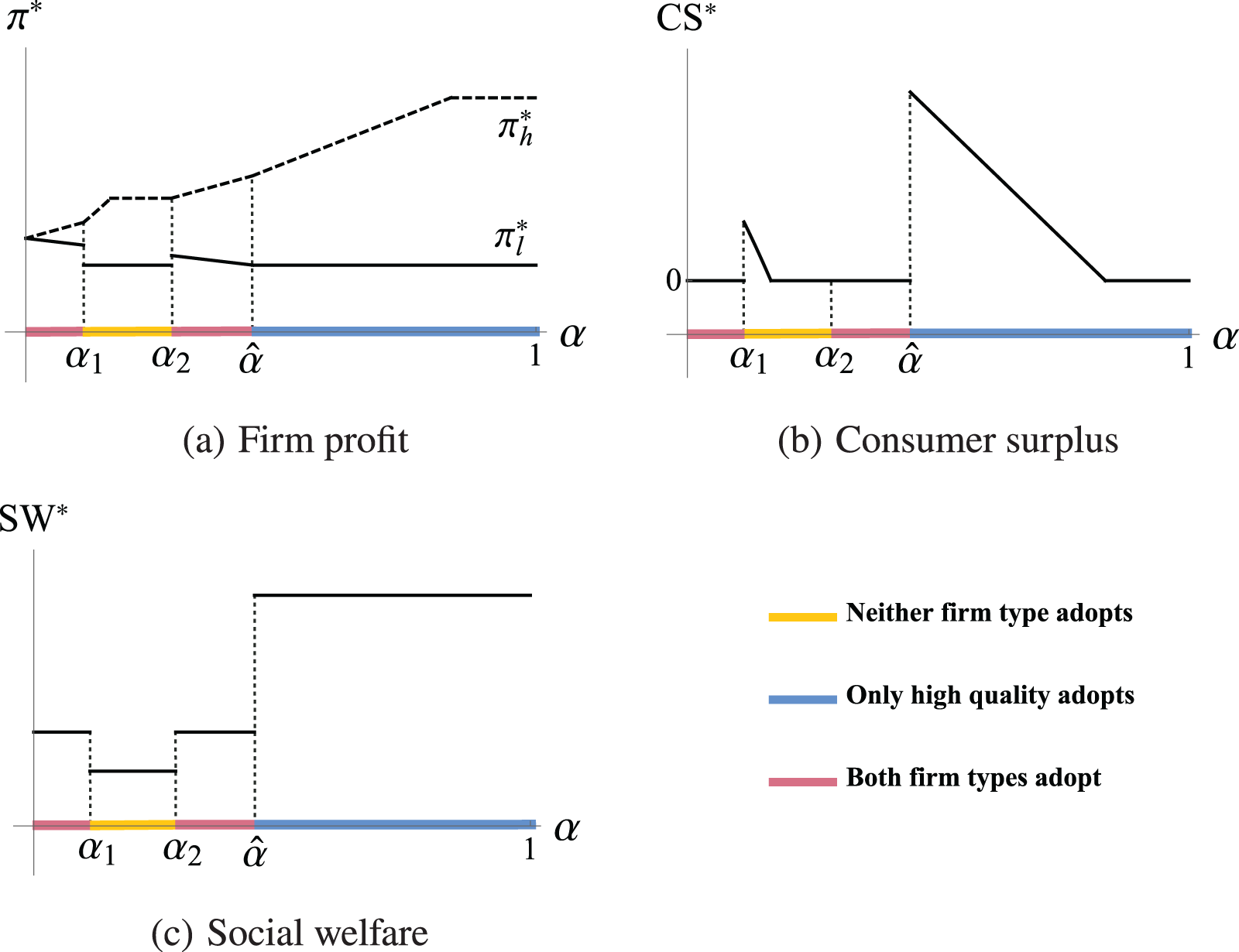
Welfare impacts of quality uncertainty prevalence. (a) Firm profit, (b) consumer surplus and (c) social welfare. Note.
Moreover, social welfare may also decrease with
Next, we examine how the quality premium, captured by higher
As the number of quality-sensitive consumers increases or when these consumers have higher valuation for the high-quality product (i.e.,
Consumers can be worse off when the high-quality firm switches from not adopting the PP technology (no-adoption equilibrium) to adopting it (universal-adoption equilibrium) to price discriminate quality-sensitive consumers. This can happen, for example, when
In summary, our findings suggest that, once we account for the firm’s strategic adoption of personalized pricing, seemingly beneficial changes in market conditions (such as greater accessibility to product quality information, improvements in product quality, and reductions in personalization costs) may harm consumers and society. 14 Policymakers and consumer advocates should therefore be mindful of the firm’s strategic pricing and signaling response when promoting innovations that enhance product quality, improve quality information transparency, or lower personalization costs.
Extensions
PP with imperfect targeting
In our main model, when the firm adopts the PP technology, it observes the full consumer profile, including the WTP
In this extended model, if the firm chooses to adopt the PP technology (
We further compare the market outcomes between the perfect targeting scenario (i.e., the main model) and the imperfect targeting one to understand how the firm’s adoption of PP technology depends on what information it knows about consumers. Armstrong (2006) suggests that the PP technology increases the firm’s profit more when it is based on more granular consumer information. In sharp contrast, Proposition 5 shows that with consumers’ quality uncertainty, the high-quality firm’s equilibrium profit can be higher in the imperfect targeting scenario than in the perfect targeting one.
(Knowing consumer informedness can reduce firm profit)
When the size of informed consumers
This counterintuitive result arises from the fact that in the imperfect targeting scenario, if the firm adopts the PP technology, the personalized price for quality-sensitive consumers is independent of their informedness, in contrast to the case where their personalized prices are contingent on informedness in the perfect targeting scenario. This affects the high-quality firm’s incentives for PP adoption in two opposite ways. On the one hand, with imperfect targeting, the high-quality firm, to avoid the low-quality firm’s mimicry, needs to lower its personalized price for all quality-sensitive consumers, reducing its profit from not only uninformed but also informed quality-sensitive consumers. In comparison, in the perfect targeting scenario, the high-quality firm only needs to lower the personalized price for uninformed quality-sensitive consumers, without reducing its profit from informed quality-sensitive consumers. This effect makes the PP adoption less beneficial to the high-quality firm under imperfect targeting than under perfect targeting. On the other hand, with imperfect targeting, the low-quality firm has weaker incentives to mimic the high-quality firm’s personalized price for quality-sensitive consumers, which satisfies
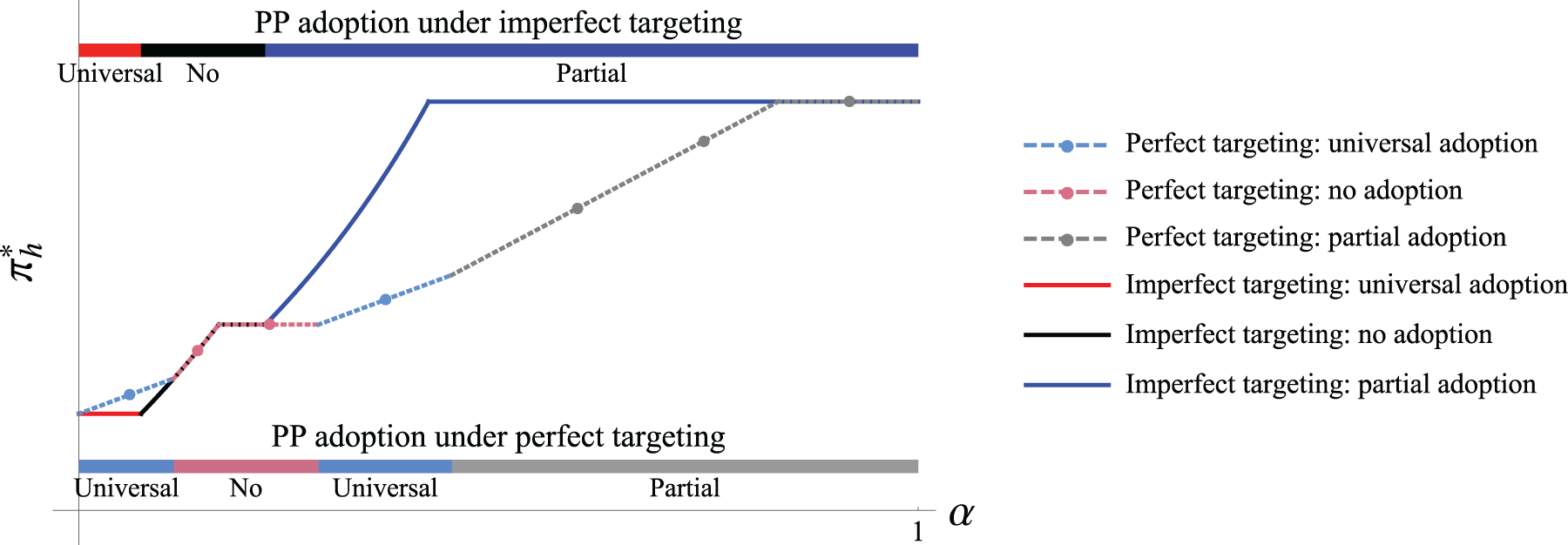
Comparison of the high-quality firm’s equilibrium profit. Note.
Proposition 5 also shows that the firm’s ex ante equilibrium profit can be higher in the imperfect targeting scenario than in the perfect targeting scenario. This implies that a firm may benefit from deliberately adopting a coarser pricing system before learning whether its product is high or low quality (e.g., when designing its pricing infrastructure prior to product launch). Pre-committing to a less granular pricing system may not only reduce implementation costs, but also relieve future signaling pressures.
There exist parameter regions in which the high-quality firm does not adopt a PP technology with perfect targeting in equilibrium, yet adopts a PP technology with imperfect targeting.
The above comparison reveals that the firm’s profitability of adopting personalized pricing may be impaired when the firm possesses more information about consumers. As an extension of this insight, Corollary 2 shows that the high-quality firm’s decision on whether to adopt personalized pricing can also be switched by the specification of the PP technology. Specifically, we find that when the equilibrium is a no-adoption one in the perfect targeting scenario, the equilibrium may be a partial-adoption one in the imperfect targeting scenario. Figure 4 provides an example, with the dashed red line (Perfect targeting: no adoption) versus the solid blue line (Imperfect targeting: partial adoption). Moreover, the high-quality firm’s equilibrium profit can be higher in the latter case. Therefore, instead of completely resisting personalized pricing, the high-quality firm could opt for a constrained PP technology. This result echoes Wang et al. (2023) in that an imperfect personalized pricing algorithm can outperform a perfect one, yet through different channels. In Wang et al. (2023), the effect is driven by consumer search: consumers must incur search costs to make a purchase, and algorithmic errors can give high-valuation consumers a chance to be misclassified as low-valuation consumers and obtain a low price, thereby encouraging more consumers to search and purchase. By contrast, in our setting, the reason is that an imperfect pricing algorithm inhibits the firm from personalizing prices contingent on consumer informedness, thereby reducing the low-quality firm’s incentives to mimic the high-quality firm.
In summary, we show that our results are qualitatively robust when the firm does not observe consumers’ knowledge about product quality. Moreover, using such information to set personalized prices may reduce a high-quality firm’s profit when some consumers are uncertain about product quality. Accordingly, even when richer consumer data or more advanced algorithms make it feasible to identify which consumers are informed about quality, a high-quality firm may prefer not to condition its prices on this information.
Using list prices together with personalized prices
In practice, firms adopting personalized prices sometimes also use a list price, which effectively serves as a self-imposed universal price cap for all consumers (Xu and Dukes, 2022). For example, in many personalized discount programs, products are available for purchase at their list prices, and consumers receive personalized discounts off the list prices. As illustrated in the main analysis, adopting PP may impede a firm’s ability to signal its high quality because consumers cannot observe the personalized prices for other consumers. One may wonder whether a firm can facilitate the signaling of its high quality by accompanying its personalized prices with a list price, which lets consumers know the price cap for other consumers.
This extension explores this possibility. In this extended model, if the firm adopts the PP technology (
(List prices are not used in equilibrium)
The firm will not use a list price in equilibrium. The equilibrium outcomes are identical to when the firm cannot use list prices (Table 2).
Proposition 6 suggests that in our context, the firm will not use a list price together with personalized prices in equilibrium, showing the robustness of our main findings. The reason is as follows. The firm will use a list price only under a universal-adoption equilibrium (
The finding is in sharp contrast to Xu and Dukes (2022), who find that when a firm uses personalized prices, it can signal its private information to consumers by also using a list price. In their setting, the firm’s private information (the firm’s type) is about whether consumers underestimate or overestimate their valuations for the firm’s product. The firm can use a list price in addition to personalized prices to signal to consumers that they underestimate their valuations, because the firm tends to set low personalized prices in the case of underestimation. In other words, in their setting, the type of firm that wants to reveal its type tends to set lower personalized prices. By contrast, in our setting, the firm’s private information is about its product quality, so the type of firm that wants to reveal its type tends to set higher personalized prices. Therefore, if the high-quality firm uses PP, using a list price does not help the firm signal its high quality. We note that one should interpret Proposition 6 as that using list prices cannot help a firm signal its high quality when it adopts PP, instead of that it is never profitable for firms to use list prices in any context. For example, using list prices can be profitable in the context of Xu and Dukes (2022), and firms may use list prices for other reasons, such as signaling the targeting cost in offering personalized prices (Yu and Zhang, 2025).
Using advertising as a quality signaling tool
In practice, firms may use a variety of instruments to convey quality, such as costly advertising, warranties, and other brand or service commitments. However, these instruments are not always salient or readily deployable, and consumers’ quality beliefs are often shaped by prices, which are often directly observable during the shopping experience. In many online shopping contexts, consumers first encounter a product while browsing and evaluating, and may not have seen or recalled any advertising for it at that point (e.g., advertising run on other channels that consumers may not have seen). Warranties can similarly serve a signaling role, but are often set at the brand level or governed by standardized policies, making them difficult to adjust at the product level. While online reviews are important sources of quality information, they can be subject to inflation or manipulation in certain product categories, reducing their informational value. In such settings, where non-price signals may be unavailable, hard to attribute, or too coarse, prices become a natural and immediate channel through which consumers form quality beliefs.
That said, our article is not intended to suggest that quality signaling through PP adoption/non-adoption “replaces” other signaling instruments. Rather, our analysis identifies a distinct channel through which personalized pricing reshapes consumers’ quality beliefs, and this channel can remain relevant even when additional signals are available. In Online Appendix G, we formally consider an extended model in which the firm can also choose to incur a fixed cost
Experimental evidence
We conducted four randomized online experiments to test the premise that personalized pricing weakens consumers’ tendency to infer product quality from price. See Online Appendix I for more details. In each experiment, 200 participants imagined shopping for a product whose quality is uncertain. They were told (i) the average price for typical products in the same category, (ii) the focal product’s price, and (iii) the focal product’s pricing format. Across all experiments, we held the numeric price points constant and randomly assigned participants to one of two pricing formats: uniform price vs. personalized price. Participants rated the focal product’s quality relative to the market average on a 7-point scale (
In three studies, the focal product was priced above the market average (wireless earbuds:
Taken together, these experiments provide convergent evidence for the premise underlying our model: a personalized price is a weaker quality signal than a uniform price, which leads to our key insight that a high-quality firm may strategically refrain from adopting personalized pricing under quality uncertainty.
To complement the statistical results, we present illustrative excerpts from participants’ open-ended responses. Several participants in the personalized pricing group explicitly described how personalization weakened their quality judgments. For example, when the focal product was priced above the market average, some participants were less inclined to infer high quality from the high personalized price:
“I am thinking that the higher price would likely mean higher quality but my confidence is decreased by the personalized price.” “They are probably charging more because of the personalization aspect. I doubt they are any better than the average priced pair.” “Since the pricing is personalized and not everyone may be quoted the same price for the same shoes, it makes me skeptical that the shoes are that much higher in quality.”
Similarly, when the focal product was priced below the market average, some participants were less inclined to infer low quality from the low personalized price:
“I assessed the price of a comparable product, considering the fact that I may have received a discount due to personalized pricing.” “I feel like it should be of comparable quality. Just because it’s a deal doesn’t mean it’s not a good product.”
These responses illustrate the premise underlying our model: personalized pricing can undermine a firm’s ability to signal high quality through price.
The rapid development of marketing analytics and artificial intelligence provides firms with unprecedented capabilities to personalize prices for individual consumers. This article examines a firm’s personalized pricing strategy in markets where consumers are uncertain about product quality. In such markets, pricing serves dual roles: extracting surplus and signaling quality. We find that implementing personalized pricing, despite enabling price discrimination, may not efficiently convey quality information to consumers. Therefore, in markets with consumer quality uncertainty, a high-quality firm deciding whether to adopt personalized pricing should weigh the resulting loss in quality signaling against the gain from price discrimination. We also find that firm profit may be higher when the firm does not observe consumers’ quality informedness than when it does. This suggests that the firm should be careful about conditioning its prices on consumer informedness, for instance, enabled by collecting more consumer information or deploying more advanced artificial intelligence algorithms.
Our findings suggest that a high-quality firm should refrain from adopting personalized pricing when the number of consumers who know product quality is intermediate, when the number of consumers who appreciate the product’s premium features is intermediate, and when their appreciation for those features is moderate. Moreover, when adopting personalized pricing, the high-quality firm should not simply follow the convention of setting prices equal to consumers’ WTP for full surplus extraction; instead, it may need to shade prices downward to facilitate quality signaling. After accounting for the firm’s strategic pricing decisions, improving product quality, increasing consumer access to quality information, or reducing the cost of personalized pricing can hurt consumers and society.
Our article identifies several directions for future research. First, we focus on personalized pricing. Increasingly, other marketing mix elements, such as advertising and product design, are also highly personalized. Such personalization similarly prevents consumers from observing which marketing mix other consumers receive, analogously to the personalized pricing setting. For example, with highly targeted advertising, a consumer does not observe the firm’s advertising intensity directed at other consumers. Future research could examine how personalization affects the quality signaling roles of different marketing instruments. Second, our article provides several testable predictions. Future empirical research could validate these predictions using market data.
Supplemental Material
sj-pdf-1-pao-10.1177_10591478261465977 - Supplemental material for Personalized pricing with consumers’ quality uncertainty
Supplemental material, sj-pdf-1-pao-10.1177_10591478261465977 for Personalized pricing with consumers’ quality uncertainty by Guangzhi Chen and Tianxin Zou in Production and Operations Management
Footnotes
Acknowledgments
The authors gratefully thank the department editor Professor Tony Cui, the senior editor, and two anonymous referees for their valuable comments and suggestions.

Funding
The authors received no financial support for the research, authorship, and/or publication of this article.
Declaration of conflicting interests
The authors declared no potential conflicts of interest with respect to the research, authorship, and/or publication of this article.
Notes
How to cite this article
Chen G and Zou T (2026) Personalized pricing with consumers' quality uncertainty. Production and Operations Management x(x): 1–20.