







Abstract
Although role stress literature has almost exclusively focused on individual role incumbents, it is conceivable that shared conditions of ambiguity, conflict, and quantitative or qualitative overload may give rise to a collective experience of role stress in teams. Testing a multilevel mediation model among 38 Dutch project teams (N = 283), we studied the interplay among individual and team role stress, team learning behaviors, and individual and team performance. Team role stress was discerned as a separate construct next to individual role stress. Team quantitative role overload, in particular, impeded team and individual performance by inhibiting team learning behaviors and, indirectly, also hindered individual performance by increasing individual quantitative overload.
Keywords
Organizations increasingly rely on team-based arrangements as means to gain competitive advantage and improve the experience of work for employees (Thompson, 2004). A popular team arrangement is the project team, which can be defined as a temporary organization that operates relatively autonomously toward the attainment of a goal, on time, within budget, and in accordance with predetermined performance specifications to add value for the owner (i.e., client; Turner, 2006). Project teams often have to deal with multiple stakeholders (e.g., the owner, users, and external parties involved, such as, local or national authorities) who may confront them with ambiguous and/or conflicting requirements, and/or simply overload them with too many quantitative or qualitative task requirements, given available resources. Moreover, because projects generally entail the completion of a product to be developed, the work to be done is typically nonroutine (Gaddis, 1959; Söderlund, 2004; Turner, 2006) and requires a constant adaptation to an often turbulent and uncertain outside environment. The latter may dictate interim membership changes on top of the already commonly part-time, multifunctional, and limited lifespan membership (Turner, 2006). Such conditions are likely sources of the experience of role stress.
Role stress has been defined as the strain resulting from ambiguity, conflict, or overload in multiple task requirements or roles of employees (Kahn, Wolfe, Quinn, Snoek, & Rosenthal, 1964). Although it comprises a natural and often unavoidable phenomenon in organizational settings, it is known to impair the effectiveness of individuals executing a job (Kahn et al., 1964). Prior research consistently revealed negative relationships with job performance and job satisfaction (e.g., Beauchamps & Bray, 2001; Erera-Weatherley, 1996; Jackson & Schuler, 1985; Zika-Viktorsson, Sundström, & Engwall, 2006).
Traditionally, role stress research has almost exclusively focused on role stress as an individual phenomenon, although, nowadays, scholars are increasingly advocating the existence of team-level role stress as well (Akgün, Byrne, Lynn, & Keskina, 2007; Leach, Wall, Rogelberg, & Jackson, 2005; Peiró & Rodriguez, 2008; Weaver, Bowers, & Salas, 2001), suggesting that shared task demands and conditions may give rise to collective stress experiences, that are likely to hamper the goal-directed functioning of the team as a whole (Weaver et al., 2001). However, the considerable and valuable body of work demonstrating detrimental effects of team stressors on team processes and performance outcomes (e.g., Drach-Zahavy & Freund, 2007; Driskell & Salas, 1999; Pearsall, Ellis, & Stein, 2009) has used aggregated measures of individual stress experiences, rather than measures of collective team stress. This observation asks attention to issues of level of analysis (Bliese & Jex, 2002; Klein, Dansereau, & Hall, 1994; Van Mierlo, Rutte, Kompier, & Doorewaard, 2005).
In line with the referent-shift consensus model (Chan, 1998), we deem it important to assess not only how much stress each individual member experiences in a particular team situation (individual role stress) but also how much stress the team as a whole is experiencing, The sharedness of stress experiences, and the realization of this sharedness (Van Ginkel & Van Knippenberg, 2008), may affect collective team beliefs and behaviors in such a way that team performance is more seriously compromised than would otherwise be the case.
Surprisingly, few studies in the stress literature have empirically examined stress–performance relationships at multiple levels. Therefore, the first purpose of this study was to propose and test a model that identifies individual and team role stress as separate concepts originating from separate sources (i.e., individual and team task demands and conditions, respectively) and to establish individual-level, team-level, and cross-level performance effects.
A second aim of the present study, then, was to shed light on the mechanisms involved in the multilevel stress–performance relationships. Team learning behaviors comprise an ongoing process of collective reflection and action (Edmondson, 1999) that has been identified as a key means for teams to cope with ambiguous, conflicting, and overburdening demands (Edmondson, 1999; Pearsall et al., 2009). Particularly in dynamic, nonroutine situations, teams benefit from adopting self-management behavior (Rousseau & Aubé, 2010) and positive learning climates to increase their level of adaptability (Han & Williams, 2008) and to strengthen team performance (see also Kostopoulos & Bozionelos, 2011). The moderator role of learning on the stress–performance relationship has been the most commonly investigated mechanism, and there is ample evidence of its effect (e.g., Pearsall et al., 2009; Rousseau & Aubé, 2010). However, prior research also suggests a mediator role, that is, the experience of stress may typically divert attention and effort away from such collective adaptive responses and learning behaviors (e.g., Fried, Ben-David, Tiegs, Avital, & Yeverechyahu, 1998; Taris, Kompier, De Lange, Schaufeli, & Schreurs, 2003). We choose to further investigate the less investigated mediator role of team learning, suggesting that team role stress may hamper individual and team performance through a reduction in team-learning behaviors, also because reduced team learning will add to individual role stress.
Theoretical Background
Individual and Team Role Stress Defined
Roles refer to sets of expectations about behaviors, given a certain position in a social structure, and are a defining characteristic of teams (Beauchamps & Bray, 2001). Considerable research has focused on role-related perceptions of stress. Following Kahn et al. (1964), we define role stress as a composite construct consisting of role ambiguity and role conflict and, in line with later studies (Bacharach, Bamberger, & Conley, 1990; Ivancevich & Matteson, 1980; Peterson & Smith, 1995), of role overload. Role ambiguity occurs when a person does not have access to sufficient information to perform his or her role adequately (Rizzo, House, & Lirtzman, 1970), whereas role conflict refers to “the simultaneous occurrence of two (or more) sets of pressures such that compliance with one would make more difficult compliance with the other” (Kahn et al., 1964, p. 19).
Quantitative role overload occurs when a person perceives an inconsistency between task demands and time or other resources available for completing tasks (Bacharach et al., 1990; Ivancevich & Matteson, 1980). Qualitative role overload is when a person perceives a lack of knowledge, abilities, or skills to comply with expectations (Ivancevich & Matteson, 1980). As such, role overload can even occur when there is no role ambiguity or conflict.
In the past 50 years, a vast number of empirical investigations into the causes and effects of role stress has been carried out (for an overview, see Murphy, 2002; Tubre & Collins, 2000), and there is no doubt that stress is an important phenomenon for the individual role incumbent. In more recent years, though, scholars have also come to identify stress as a collective reality in team settings (Akgün et al., 2007; Kanki, 1996; Weaver et al., 2001). More specifically, Weaver and colleagues (2001) argued for the acknowledgement of a new class of team stressors associated with perceived requirements and conditions in the team setting (e.g., workload, team size, or time pressure) that affect the team as a whole. The collective awareness of these stressors may cause team members to “experience fear, pressure and uncertainty, and feel confused in a collective manner” (Akgün et al., 2007, p. 629), due to task interdependencies and shared responsibilities (e.g., Leach et al., 2005).
George’s (1990, 1996) work on group affect teaches us that there are several processes that contribute to collective experiences in groups and teams. First, thoughts, feelings, and perceptions may become shared because teammates are exposed to similar demands, conditions, and outcomes in a project. Moreover, attraction, selection, and attrition processes (Schneider, 1987) may promote similarity in personality traits within groups, which may contribute to consistent interpretations of these demands, conditions, and outcomes among team members. Finally, social influence theory (Fisher, 1986) suggests that individuals may be influenced by others regarding how to interpret and feel about these stimuli. Therefore, we argue that project demands, conditions, and outcomes may give rise to shared experiences of team role stress, also because members may be predisposed or socialized to interpret and experience them in similar ways. Consistent with common definitions of individual role stress (Bacharach et al., 1990; Ivancevich & Matteson, 1980; Kahn et al., 1964; Peterson & Smith, 1995), we regard team role stress as a composite construct consisting of team role ambiguity, team role conflict, and team role overload.
Individual and Team Role Stress and Their Relationships With Performance
Research has consistently linked individual role stress (i.e., role ambiguity, conflict, and overload) with higher levels of job-related tension, reduced organizational commitment, greater job dissatisfaction, and impaired performance (e.g., Jackson & Schuler, 1985; Zika-Viktorsson et al., 2006). Negative relationships between role stress and job performance are explained by cognitive and motivational processes (Tubre & Collins, 2000); cognitive, because of the lack of information to solve conflicting demands; motivational, because role stress tends to weaken “effort-to-performance” and “performance-to-reward” expectancies. Moreover, psychological (e.g., decreased efficacy beliefs and job satisfaction) and behavioral implications (e.g., performance deficiencies) of role stress have been reported (Beauchamps & Bray, 2001).
Consistent with findings from prior studies (Drach-Zahavy & Freund, 2007; Pearsall et al., 2009), we expect team role stress to relate negatively to team performance. Similar to the processes involved in individual role stress, the collective experience of role stress may create cognitive and motivational deficiencies that will impair the performance of the team as a whole. Concretely, the collective experience of role ambiguity, role conflict, and/or role overload may impair the team’s problem-solving competencies or subvert members’ motivation to invest in the project (Pearsall et al., 2009). In addition, teams may suffer coordination losses (Steiner, 1972) because ambiguity, conflict, and/or overload in team demands undermine the team’s interactive capacity to perform toward a common and valued goal in a coordinated manner (Morgan & Bowers, 1995; Salas, Dickinson, Converse, & Tannenbaum, 1992).
Much less evidence is available for cross-level effects of role stress. Researchers have studied stress effects either in teams or in individual incumbents; few, if any, have studied cross-level relationships. Given the high levels of task interdependence, which are characteristic of project teams (Somech, Syna Desivilya, & Lidogoster, 2008; Harrison & Humphrey, 2010), it is rather difficult for individual members to be effective in case there is ambiguity or controversy about the team’s goals and roles, let alone the stress that is caused by quantitative or qualitative understaffing. Therefore, we expect team role stress to also show detrimental effects at the individual level of performance. A reversed cross-level effect of individual role stress on team performance is less likely (and, moreover, cannot be tested empirically, less likely). With compensatory and back-up behavior being one of the strengths of teamwork (Salas, Sims, & Burke, 2005), role stress in a single team member may not significantly affect team outcomes unless a person fulfils a very prominent role, and even in this case the team can function as a safety net and is expected to compensate for the malfunctioning of one of its members.
Hence, the proposed-level and cross-level relationships are formulated in the following hypotheses:
Hypothesis 1: Individual role stress is negatively related to individual performance.
Hypothesis 2: Team role stress is negatively related to team performance.
Hypothesis 3: Team role stress is negatively related to individual performance.
Team Learning and Its Relationship With Role Stress and Performance
Because of the specific characteristics of project teams (e.g., task interdependence, nonroutine tasks, multiple stakeholders), it is extremely important for a team to be able to collectively adapt to taxing demands and circumstances and to establish or maintain a high level of team performance. According to Edmondson and Smith (2006), project team members facing nonroutine challenges must adopt an inquiry orientation, in which they mutually explain their positions to translate the diversity of their cross-functional viewpoints and personal networks into project success. These interpersonal exchanges put forward the importance of team-learning behaviors or the ongoing process of collective reflection and action (e.g., Edmondson, 1999; Gibson & Vermeulen, 2003; Kasl, Marsick, & Dechant, 1997; Savelsbergh, Van der Heijden, & Poell, 2009, 2010; Yeo & Marquardt, 2010).
Building on prior research, we believe that team-learning behaviors will be not only a moderator but also an important mediator in the relationship between team role stress and team performance. In this study, we focus on the mediator role which has been least investigated until now. Team-learning behaviors are regarded as key means for teams to cope with ambiguous, conflicting, or overburdening demands (Edmondson, 1999) and have consistently shown strong and positive relationships with team adaptivity and performance (e.g., Edmondson, 1999; Han & Williams, 2008; Savelsbergh et al., 2009). Moreover, a recent study indicated that team-learning behaviors enhance performance because they help teams to build shared mental models regarding their task environment (Van den Bossche, Gijselaers, & Segers, 2010). On the contrary, team performance will be negatively affected in case team members refrain from these behaviors, for instance, by rushing into solving situations without exploring perspectives, analyzing alternative strategies, and/or building consensus regarding team activities.
We anticipate that a collective experience of role stress may prevent team-learning behaviors from taking place and as such may indirectly hamper performance. Recent advancements in theories on the impact of stress and emotions on people’s action repertoires suggest that too high levels of stress and demands may seriously impair performance, as the experience of stress jeopardizes a person’s engagement in learning behaviors (Taris & Kompier, 2005). That is, if a person’s resources are totally absorbed in an attempt to deal with demanding and stressful conditions, few resources for learning will be left and no learning will take place.
In a similar vein, Fredrickson’s (2001) “broaden-and-build theory” underlines that the experience of positive emotion fosters the desire to explore, assimilate new information and, hence, may enhance learning. Negative emotions, such as, the ones associated with team role stress (e.g., disinterest, fear of failure, and anger due to conflicting demands), however, cause a narrowing of people’s mind sets and action repertoires and thereby block a team’s desire to engage in learning behaviors (Fredrickson, 2001).
Although both theories mentioned in the previous paragraphs have been developed in the context of individual performance, we deem their principles applicable in the context of team performance as well. After all, it is conceivable that stressful conditions associated with team-level role ambiguity, role conflict, and, particularly, role overload leave a team with few resources and little desire to fully engage in team-learning behaviors. Indeed, previous research indicated that stressors perceived as a hindrance (i.e., exceeding the team’s competencies) show negative effects on a team’s capacity for learning, remembering, and communicating relevant team knowledge (Pearsall et al., 2009; Zika-Viktorsson et al., 2006). These findings corroborate our assumption that the strains associated with ambiguous, conflicting, or simply too high demands will have a negative effect on team-learning behaviors, which will impede a team’s ability to adequately adapt to these taxing demands, resulting in impaired performance.
Hypothesis 4: Team-learning behaviors (partially) mediate the negative relationship between team role stress and team performance.
Finally, we postulate that the lack of team learning behaviors due to team role stress will impair not only effective team performance but also the effectiveness of individual team members. DeShon, Kozlowski, Schmidt, Milner, and Wiechmann (2004), for example, found that the use of individual- and team-level feedback loops—an identified element of team learning behaviors—contributes to clarifying and regulating individual goals, roles, and performance in relation to the team goals, roles, and performance. Team-learning behaviors may help team members to avoid and/or reduce individual role stress and to maintain high-level individual performance. Otherwise stated, when a team fails to engage in learning behaviors, individual role stress levels may build up, causing deleterious effects to the individual team member’s effectiveness. The reversed effect of individual-level role stress on team-level learning behavior is again not very likely, considering the limited impact that a single person’s stress experience will have on the learning behavior of an entire team. Hence, we hypothesize that team learning behaviors are positively related to individual performance and that this relationship will, at least partially, be mediated by individual role stress.
Hypothesis 5: Individual role stress (partially) mediates the positive relationship between team-learning behaviors and individual performance.
Figure 1 provides a full overview of our hypotheses as presented above.
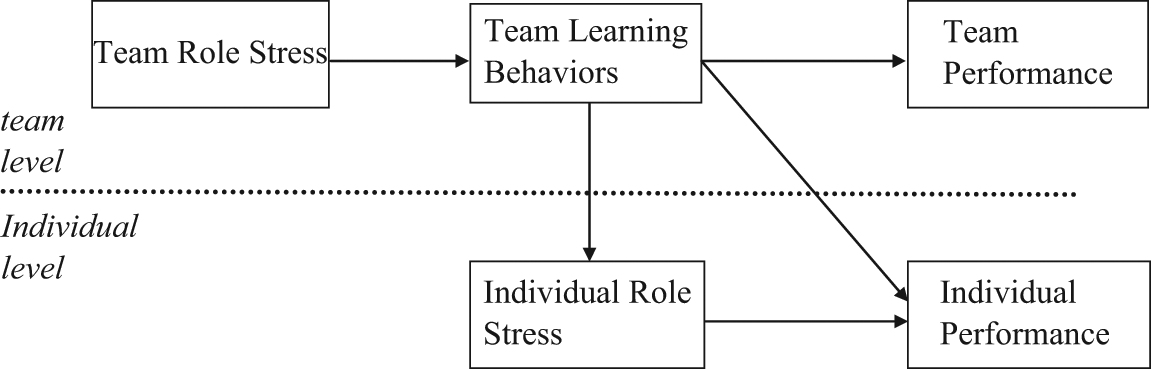
Overview of conceptual research model
Method
Procedure and Sample
Data were collected during the second half of 2008. Our final sample consisted of 40 project teams from ten Dutch companies involved in different areas of the building and construction industry, including building and utilities (n = 10), engineering and construction (n = 12), infrastructure (n = 8), and area decontamination and development (n = 10). The principal researcher asked the team members (n = 335), project managers (n = 40), and external owners (i.e., clients; n = 40) to complete an electronic questionnaire. Team members and project managers were asked to respond to questions regarding individual and team role stress, team-learning behaviors, and individual and team performance for their specific projects. The external project owners, being relative outsiders, were asked to fill out a subset of questions regarding the project team’s performance. Nominally identical versions of measurement scales were used for the three categories of respondents, that is, team members, project managers, and project owners. Measurement scales that were originally in English were translated into Dutch using the “translation-back-translation method” (Hambleton, 1994).
Responses were received from 245 team members (71.3% response rate), 38 project managers (95.0% response rate), and 38 project owners (95.0% response rate). The relatively high response rates may be partly explained by the fact that participation to the survey study was stimulated by project managers and announced as being part of companies’ improvement strategies (Baruch & Holtum, 2008). We decided to exclude teams for which the response rate among their members was below 50%, to warrant reliability of the data. Due to these constraints, two teams were deleted from the sample, leaving a total of 38 teams to be included in further analyses.
The team size (including the project manager) of the remaining 38 project teams ranged from 2 to 22 members (M = 9.74; SD = 5.39). The mean age of the team members was 42.2 years (SD = 10.2) and 45.86 years (SD = 7.6) for their project managers, and 82.9% of the team members and 94.7% of the project managers were male. The total amount of work experience of the team members (M = 18.9 years; SD = 11.0) and their project managers (M = 21.6 years; SD = 7.9) was rather high; 77.0% had more than 9 years of total work experience.
Measures
Individual and team role stress
We used a subset of items from Ivancevich and Matteson’s (1980) scales of employee tension due to (a) role ambiguity; (b) role conflict; (c) quantitative role overload; and (d) qualitative role overload, to measure the multidimensional concepts of individual and team role stress. It is important to note that the application of the role stress phenomenon to the team level implies a switch from one level of theory to another. Consequently, measurement and analysis procedures should be chosen accordingly to avoid a fallacy of the wrong level (Klein et al., 1994; Van Mierlo et al., 2005). Given a few exceptions (e.g., Akgün et al., 2007), research on stress in teams has typically used individual-level measures, aggregated to the group level. Strictly speaking, conclusions based on aggregated individual scores may relate only to individual employees. Studying a group-level phenomenon requires a measure that truly reflects the team as the entity of interest. Therefore, we operationalized team role stress as a referent-shift consensus model (Chan, 1998). The original individual role stress items were carefully reworded for the team role stress scales, asking the project team members to evaluate the role of their project team as a whole, rather than their individual role. For example, “The team is responsible for an almost unmanageable number of assignments at the same time” instead of “I am responsible for an almost unmanageable number of assignments at the same time.” The appendix presents all items of the team role stress measure.
Role ambiguity was assessed using a five-item scale reflecting the four forms of role ambiguity identified by Kahn and associates (1964): “scope of responsibilities,” “role behaviors necessary to fulfill one’s responsibilities,” “criteria according to which one is evaluated,” and “ambiguity about whose expectations team members are required to meet.” An example item was “My job duties and work objectives are unclear to me.” For team role ambiguity, this item was reworded into “The work duties and objectives of the team are unclear to the team members.”
Role conflict was assessed using three items. Two items were derived from the Ivancevich and Matteson (1980) role conflict scale. An example item was “I receive conflicting requests from two or more people.” For the measurement of team role conflict, this item was reworded to “The team receives conflicting requests from two or more people.” One item from House, Schuler, and Levanoni (1983) was added to attain a more complete picture of role conflict causes than those covered by the Ivancevich and Matteson (1980) scale. More specifically, for the individual-level measure, we added, “I receive an assignment without adequate resources and materials to execute it.” For the team-level measure, the following item was added: “The team receives an assignment without adequate resources and materials to execute it.”
Quantitative role overload was assessed using four items from Ivancevich and Matteson’s (1980) scale. An example item was “I simply have more work to do than can be done in an ordinary day.” This item was reworded to “The team simply has more work to do than can be done in an ordinary day” to measure quantitative team role overload.
Qualitative role overload was assessed using a three-item scale from Ivancevich and Matteson (1980). An example item was “The tasks assigned to me are too difficult and/or complex.” This item was reworded to “The tasks assigned to the team are too difficult and/or complex” to measure qualitative team role overload.
For all individual and team role stress scales, a 5-point rating scale was used with scale anchors ranging from 1 (completely disagree) to 5 (completely agree). Internal consistencies using Cronbach’s alpha were acceptable to good for the four individual role stress scales (respectively, αrole ambiguity = .79, αrole conflict = .70, αrole quantitative overload = .78, and αrole qualitative overload = .67), as well as for the four team role stress scales (respectively, αteam role ambiguity = .77, αteam role conflict = .81, αquantitative team role overload = .82, and αqualitative team role overload = .80).
Team-learning behaviors
We used a scale developed by Savelsbergh and colleagues (2009) based on an integration of team-learning literature (e.g., Edmondson, 1999) with reflexivity literature (e.g., Schippers, Den Hartog, Koopman, & Wienk, 2003; Van den Bossche, Gijselaers, Segers, & Kirschner, 2006) and error-management literature (e.g., Van Dyck, 2000; Van Woerkom, 2003), covering eight distinct and concrete learning behaviors including: (a) exploring different perspectives; (b) co-construction of meaning; (c) reflection on outcomes; (d) reflection on processes; (e) communicating errors; (f) analyzing errors; (g) feedback behavior; and (h) experimentation. Each of these behaviors reflects a distinguishable and valuable element of team learning. However, for the sake of parsimoniousness, and in conformity with previous literature (e.g., Edmondson, 1999; Van der Vegt & Bunderson, 2005), we used a composite construct for team-learning behaviors. An example item was “Team members elaborate on each other’s information and ideas.” A 5-point rating scale was used with scale anchors ranging from 1 (completely disagree) to 5 (completely agree). The internal consistency of the 28 items was high (α = .94).
Team performance
To capture the accomplishments of the teams, we distinguished between several dimensions of team performance, as defined by Hackman (1989), and used by many others (e.g., Cohen & Bailey, 1997; Katzenbach & Smith, 1993; Sundstrom, DeMeuse, & Futrell, 1990), including the quality of the work, adherence to budget and schedules, and client relationships. We employed a multirater performance measurement approach (Smither, London, & Reilly, 2005) involving a subjective self-reported measure as well as a more objective client rating obtained from the project owner. The subjective self-report measure consisted of 11 items, 3 of which were based on Müller and Turner’s (2007) project success criteria and the others based on Savelsbergh et al.’s (2009) team-performance assessment criteria. We used a “relative rating procedure” asking respondents to rate their team performance in their specific project relative to that in other projects they had recently worked on (cf. Henderson & Lee, 1992). Example items were “In comparison with other project teams I have recently worked for, the way that good client relationships are taken care of in this team makes me feel . . .” and “In comparison with other project teams I have recently worked for, the number of improvement initiatives of this team makes me feel. . . .” A 5-point rating scale was used with scale anchors ranging from 1 (much less satisfied) to 5 (much more satisfied). The internal consistency of the scale was high (α = .90, both for team members and managers; α = .80 for clients).
Individual performance was measured using six items that captured team members’ self-perceived contribution to the project (see also Bandura, 1986), consistent with the notion that the team’s performance is achieved through individual team members’ efforts (McGrath, 1964; Tesluk, Zaccaro, Marks, & Mathieu, 1997). An example item was “In comparison with other project teams I have recently worked for, my own accomplishments in this team in general make me feel. . . .” Again a “relative rating procedure” was used, and answers were provided on a 5-point rating scale ranging from 1 (much less satisfied) to 5 (much more satisfied). The internal consistency of the six items was high (α = .86).
Data Preparation
To test the validity of the constructs, their measures were tested with regard to dimensionality, discriminant validity (Anderson & Gerbing, 1988), and aggregate reliability, where appropriate (cf. Bliese, 2000; Klein & Kozlowski, 2000). Dimensionality and discriminant validity were tested by means of confirmatory factor analyses (CFAs) using the AMOS 16.0 program (Arbuckle, 2006). Model fit was evaluated with a set of indices including the chi-square test statistic, the goodness of fit index (GFI), the comparative fit index (CFI), the parsimony normed fit index (PNFI), and the root mean square error of approximation (RMSEA), each of which reflect somewhat different facets of model fit (Kline, 1998). Values of CFI and GFI ≥ 0.90 and RMSEA < 0.10 are considered acceptable, whereas values of CFI and GFI ≥ 0.95 and RMSEA < 0.08 may be interpreted as a good fit (Hu & Bentler, 1999). CFI takes the sample size into account and performs well even if the sample size is small (Tabachnick & Fidell, 2007). Parsimony fit indices, such as the PNFI, take the complexity of a model into account and typically have lower values. Parsimony fit indices in the range of .50 are not uncommon (Byrne, 1998).
The outcomes of the CFA at the individual level confirmed the validity of the multidimensionality of the individual role stress construct (χ2 = 172.09; df = 86; χ2/df = 2.001; p = .000; GFI = .92; CFI = .93; PNFI = .71; RMSEA = .060). Testing the discriminant validity of the four stress dimensions at the team level, we followed the partial disaggregation method (Bagozzi & Heatherton, 1994) to reckon with the limited size of our sample (N = 38). Each factor was operationalized by means of two indicators representing parcels of the scale items. The indicators were chosen on the basis of an exploratory factor analysis (EFA) on the items of each scale separately, in which we forced a two-factor solution to select the most distinguishing indicators.
The model fit indices of the CFA (χ2 = 19.38; df = 16; χ2/df = 1.21; p = .25; GFI = .90; CFI = .97; PNFI = .50; RMSEA = .076) supported the validity of the four-factor model of stress at the team level. All items loaded statistically significantly on their intended factor and the four-factor model offered a better fit to the data than any two-factor model or a single-factor model. Both constructs appeared to comprehend the four dimensions corresponding to role ambiguity, role conflict, quantitative role overload, and qualitative role overload.
Subsequently, to assess the discriminant validity between individual and team role stress, a series of four 2-factor models (individual vs. team factor) were estimated, one for each dimension of role stress, as recommended by Bagozzi, Yi, and Phillips (1991). The CFAs of the two-factor models produced a good fit for role ambiguity (χ2 = 68.765; df = 34; χ2/df = 2.02; p = .000; GFI = .96; CFI = .96; PNFI = .69; RMSEA = .060), for role conflict (χ2 = 14.803; df = 7; χ2/df = 2.12; p = .039; GFI = .98; CFI = .986; PNFI = .454; RMSEA = .063), for quantitative role overload (χ2 = 31.024; df = 18; χ2/df = 1.72; p = .029; GFI = .98.; PNFI = .622; CFI = .986; RMSEA = .051), and for qualitative role overload (χ2 = 12.085; df = 86; χ2/df = 1.73; p = .098; GFI = .46; CFI = .991; PNFI = .457; RMSEA = .051). Moreover, comparison of the two-factor models with their equivalent single-factor models showed a superior fit for the two-factor models (i.e., the chi-square difference was significant [p < .05] for all comparisons), herewith confirming the discriminant validity of the individual role stress and the team role stress constructs.
Finally, CFAs were conducted to assess the validity of the other measurement instruments used in our study. The outcomes of these analyses reconfirmed the validity of the multidimensional team-learning behaviors’ instrument from Savelsbergh and colleagues (2009), as a second-order model of team-learning behaviors consisting of eight latent learning behaviors, each measured by three to six observed variables (χ2 = 491.03; df = 259; χ2/df = 1.66; p = .00; GFI = .88; CFI = .95; PNFI = .69; RMSEA = .049), appeared to fit the data well. Moreover, the validity of the performance measures was confirmed as indicated by adequate model fit (χ2 = 93.92; df = 39; χ2/df = 2.15; p = .000; GFI = .95; CFI = .97; PNFI = .67; RMSEA = .064) for both individual performance and for team performance (χ2 = 15.12; df = 6; χ2/df = 2.52; p = .019; GFI = .98; CFI = .99; PNFI = .39; RMSEA = .073) and high-factor loadings (minimum of .72 and .57 for individual and team performance, respectively).
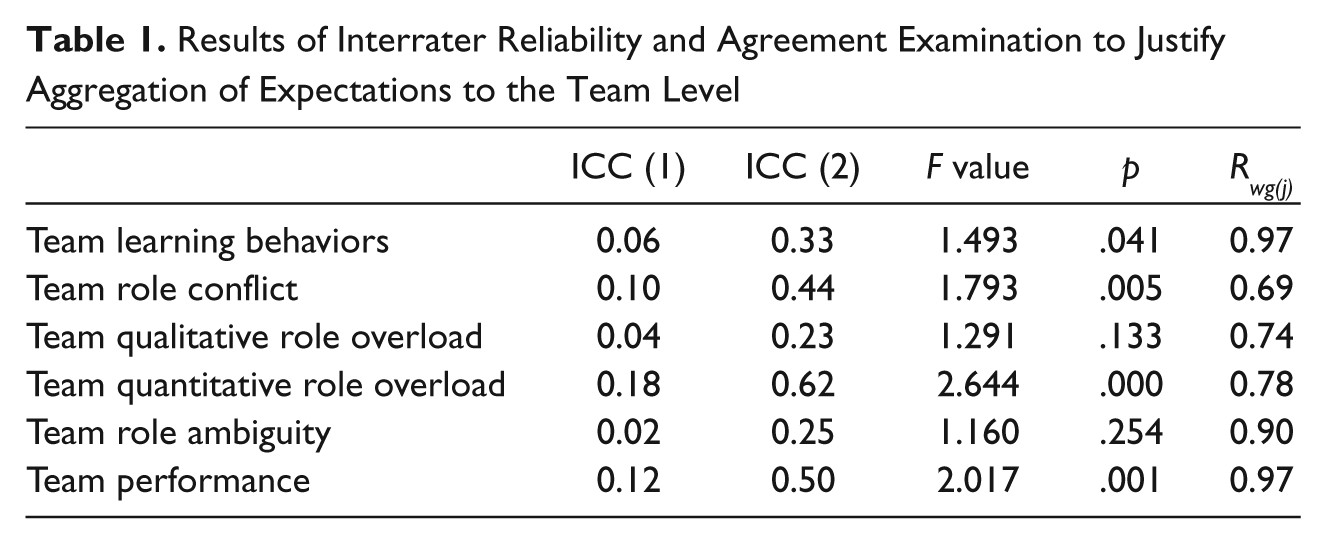
Before aggregating the data of the team-level constructs (i.e., team role stress, team-learning behaviors, and team performance), we assessed the validity of aggregation by calculating the average intragroup agreement index Rwg(j) (James, Demarée, & Wolf, 1984). Rwg(j) reflects the degree to which raters essentially provide the same rating and ranges from 0 to 1 (complete disagreement vs. complete agreement) among group members. Values of .70 or above are considered adequate (George, 1990; George & Bettenhausen, 1990). Moreover, ICC(1) and ICC(2) have been used to assess so-called aggregate reliability (Bliese, 2000). ICC(1) indicates whether a construct has sufficient homogeneity within groups to justify aggregation to the group level. Values range from −1 to +1, with values between .05 and .20 being most typical (Bliese, 2000). ICC(2) refers to the degree to which group means can be reliably differentiated. Values equal to or above .50 are considered acceptable. As can be seen in Table 1, most indicators meet or approach the appropriate criteria, justifying the aggregation of scores to the group level. Note that sampling rather similar teams (e.g., teams from a single company or sector) and relatively small sample sizes per team might result in somewhat less reliable differences between teams, implying somewhat lower ICC(2) values (cf. Bliese, 2000; Chen, 2005; James et al., 1984), which appeared to be the case in our study. Therefore, we also conducted one-way ANOVAs on the aggregated data set to examine whether statistically significant between-group differences existed for our measures. This appeared to be the case for all group-level variables, except for team role ambiguity, F(38, 283) = 1.16, ns, and qualitative team role overload, F(38, 283) = 1.29, ns. We therefore concluded that team role ambiguity and qualitative team role overload did not show enough variability in our sample to validly determine their impact and, therefore, excluded these measures from all further analyses.
Results of Interrater Reliability and Agreement Examination to Justify Aggregation of Expectations to the Team Level
Analyses
The hypothesized individual- and cross-level relationships among team-learning behaviors, individual role stress, and individual performance were examined by means of hierarchical linear modeling (HLM; Hox, 2002; Snijders & Bosker, 1999), using MLWin 2.20 (Rasbash et al., 2002). Our analysis followed Mathieu and Taylor’s (2007) guidelines for testing mesomediational relationships (i.e., meditational relationships that traverse levels of analysis). First, a null model was specified for the individual-level outcome measure (i.e., individual performance) to check whether there was sufficient variability for modeling cross-level influences. We proceeded to test individual-level relationships, while controlling for team membership, by entering all four indicators of individual role stress into the model. Next, before testing the proposed mesomediational relationships, we specified null models for potential individual-level mediators to check for cross-level mediation potential. The actual test of the mesomediational relationship consisted of (a) modeling the presumed predictor (team-learning behaviors) and mediators (individual role stress) on the dependent variable (individual performance), while controlling for team role stress; and (b) testing the influence of the predictor on the potential mediators. (Partial) mediation is established if the relationships between the predictor and the dependent diminishes or disappears completely (in case of full mediation), after including the mediator, provided that the predictor is significantly related to the mediator and that the mediator significantly predicts the dependent (Baron & Kenny, 1986; Kenny, Kashy, & Bolger, 1998; Mathieu & Taylor, 2007).
The team-level relationships were tested by means of structural equation modeling (SEM) analyses (Jöreskog & Sörbom, 1993), using the AMOS 16.0 program (Arbuckle, 2006). This involved a test of the hypothesized (partial) mediation relationship between team role stress, team-learning behaviors, and team performance. 1 The model’s fit was evaluated using the same set of indices that we used for the CFAs. The mediation tests followed similar steps to the ones described above. First, the significance of all applicable univariate relationships was evaluated using zero-order correlations. Subsequently, the evaluation of the mediation effects involved testing models that either constrained or allowed for direct effects between the predictor and the criterion variables. Since the hypotheses predicted the direction of all effects, tests were performed using a one-tailed significance level of .05 (α).
Results
Table 2 provides descriptive statistics and correlations of all variables under study at both the individual and the team levels. Considering the response scale (1-5), employees reported relatively low levels of individual and team role stress and relatively high levels of team-learning behaviors. Moreover, employees were quite positive about their individual and team performance (M = 3.41, SD = 0.58, and M = 3.34, SD = 0.52, respectively). Client ratings of team performance were equally positive (M = 3.38, SD = 0.42) in comparison with self-rated team performance, t(37) = −.69, p = .50.
Means, Standard Deviations, and Correlations
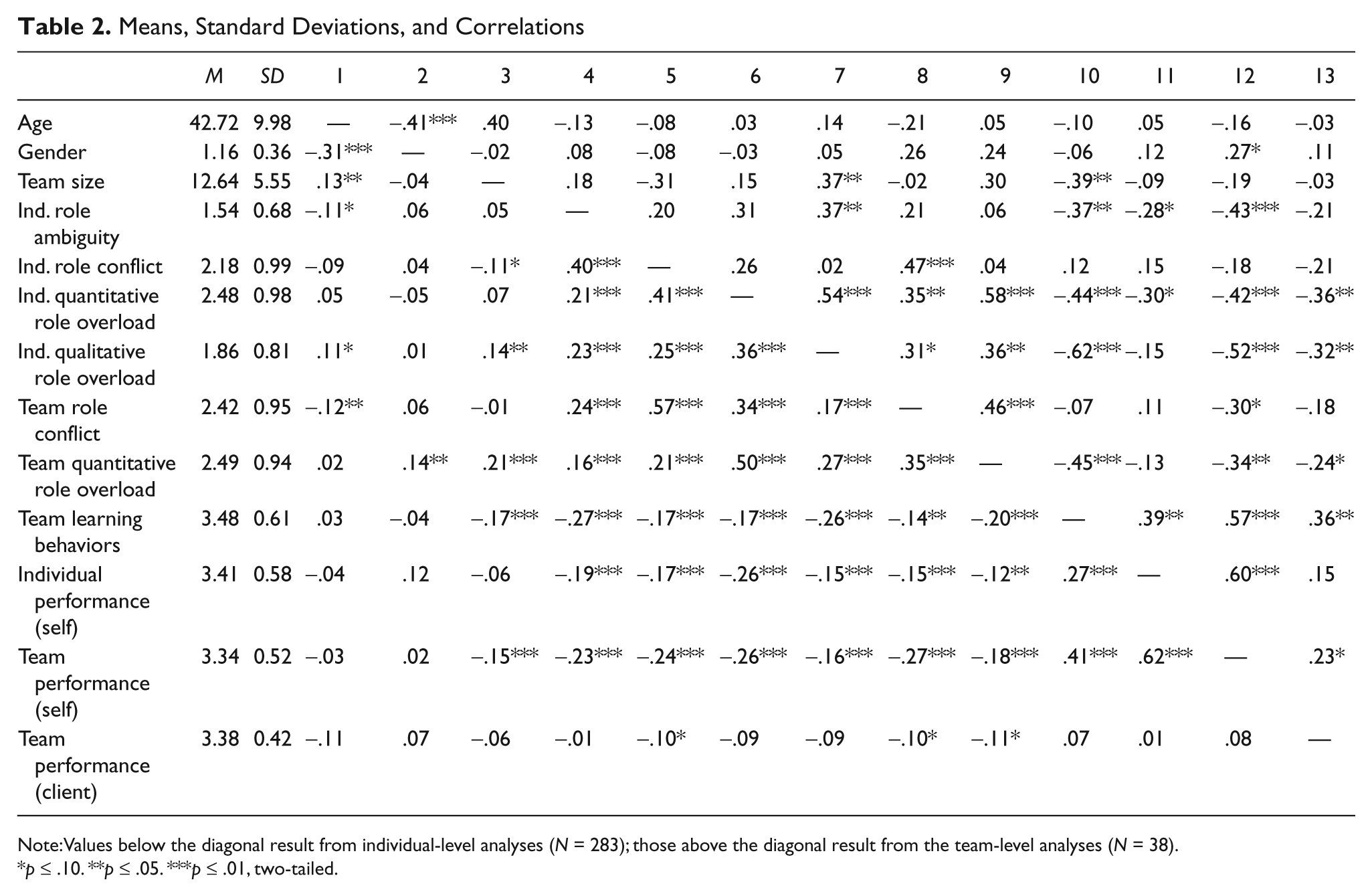
Note: Values below the diagonal result from individual-level analyses (N = 283); those above the diagonal result from the team-level analyses (N = 38).
p ≤ .10. **p ≤ .05. ***p ≤ .01, two-tailed.
Table 2 also shows that the four indicators of individual-level role stress are all negatively associated with individual performance (i.e., individual role ambiguity: r = −.19, p < .01; individual role conflict: r = −.17, p < .01; individual quantitative role overload: r = −.26, p < .01; and individual qualitative role overload: r = −.15, p < .01). These findings provide support for Hypothesis 1. Also, team role stress appeared to show negative relationships with self-rated team performance (team role conflict: r = −.30, p < .10; team quantitative role overload: r = −.34, p < .05) and a marginally significant negative relationship with client-rated team performance (team quantitative role stress: r = −.24, p < .10), which implies support for Hypothesis 2 as well. Finally, team-learning behaviors showed a relatively strong positive relationship with self-rated and client-rated team performance (r = .57, p < .01, and r = .34, p < .05, respectively), as assumed in Hypotheses 4. A more accurate testing of our hypotheses, however, involved HLM and SEM analyses, the outcomes of which will be discussed in the next subsection.
HLM Analyses of the Relationships Between Team Learning Behaviors, Individual Role Stress, and Individual Performance
The first step in the HLM analyses consisted of the calculation of a so-called baseline or “null” model for the dependent variable to determine how much variance resides within teams and how much variance resides between teams. The proportion of total variance that resided between teams was small, yet significant (9.0%, χ2(1) = 7.15; p < .01), meaning that a significant proportion of the variance in individual performance can be explained by team membership and that multilevel testing is justified. As indicated previously, we followed the steps prescribed by Mathieu and Taylor (2007) to elaborately test individual-level and cross-level relationships (see Table 3 for all specific outcomes).
Results of the HLM Analyses
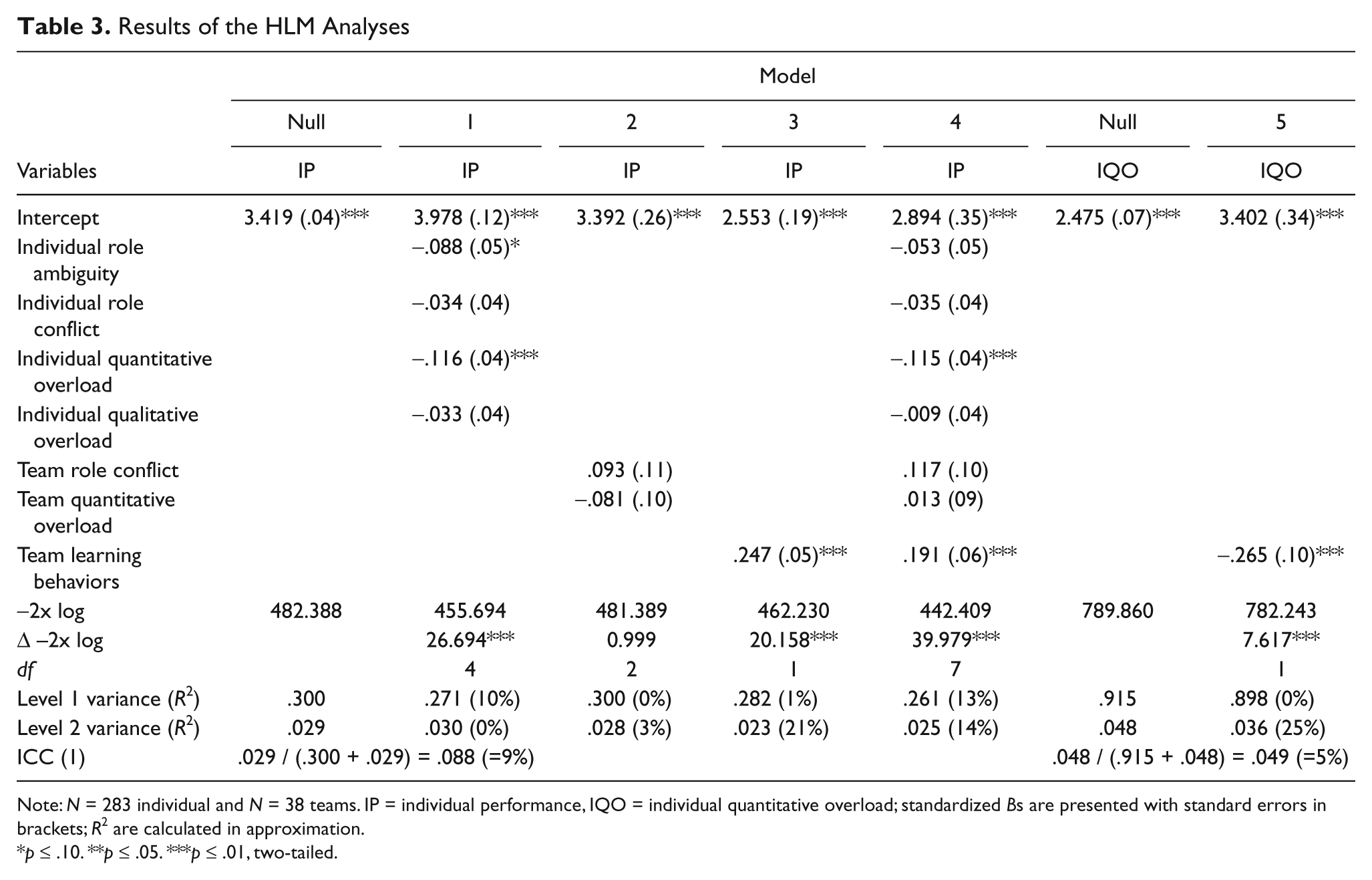
Note: N = 283 individual and N = 38 teams. IP = individual performance, IQO = individual quantitative overload; standardized Bs are presented with standard errors in brackets; R2 are calculated in approximation.
p ≤ .10. **p ≤ .05. ***p ≤ .01, two-tailed.
We tested the individual-level relationships by regressing individual performance on the four individual role stress indicators (Model 1). Although all four indicators of individual-level role stress showed significant zero-order correlations with individual performance, individual quantitative role overload was the only significant predictor of individual performance when the others were controlled for (β = −.12; p < .01). Individual role ambiguity (β = −.09; p < .10) added marginally to its prediction. Together, these variables were found to explain 10% of the individual-level variance. Hence, in partial support of Hypothesis 1, we concluded that individual role stress, in particular quantitative role overload, is negatively related to individual performance.
The cross-level relationship between team role stress and individual performance, as presented in Hypothesis 3, was tested by regressing individual performance on the two team role stress indicators (Models 2). The results indicated that neither construct was significantly related to individual performance (for team role conflict: β = .09, ns; and for team quantitative role overload: β = −.08, ns) and hardly explained any team-level variance, so we concluded that Hypothesis 2 was not supported by our data.
The next step in the HLM analyses was to test mesomediational relationships among team-learning behaviors, individual role stress, and individual performance as proposed in Hypothesis 5, while controlling for team role stress. Model 3 demonstrated a significant overall cross-level relationship between team-learning behaviors and individual performance (β = .25; p < .01; 21% team-level variance explained). Moreover, adding individual and team-level role stress measures in Model 4 resulted in a significant reduction, albeit not a complete mitigation, of the team-learning cross-level effect (β = −.19; p < .01; Sobel = 2.34, p < .05), suggesting partial mediation through quantitative role overload, as corroborated by the significant relationship between team learning and individual quantitative overload (β = −.27; p < .01) in Model 5. 2 Hence, Hypothesis 5 was partially supported as the HLM analyses confirmed that the positive relationship between team learning and individual performance was partially mediated by individual role stress, specifically, individual quantitative role overload.
SEM Analyses of the Relationships Between Team Role Stress, Team Learning Behaviors, and Team Performance
The correlations in Table 2 already indicated that team-learning behaviors were positively related to team performance (r = .57, p < .01, and r = .36, p < .05, for self- and client-ratings, respectively) and that team-level quantitative role overload was negatively related to team-learning behaviors (r = −.45; p < .01) and to self-rated team performance (r = −.34; p < .05). Team role conflict appeared to show no substantial relationship with team-learning behaviors (r = −.07, ns) and an only marginally significant relationship with team performance (r = −.30; p < .10).
The SEM analysis testing Hypotheses 4, stating that team-learning behaviors (partially) mediate the negative relationship between team role stress and team performance, showed a close fit to the data (χ2 = 5.16, df = 5, p = .40, GFI = .95; CFI = 1.00; PNFI = .44; RMSEA = .03; AIC = 25.16). However, based on the modification indices, a superior fit was obtained by including the direct effect of team role conflict on self-rated team performance (χ2 = 1.38, df = 4, p = .85, GFI = .99; CFI = 1.00; PNFI = .39; RMSEA = .01; AIC = 23.38). This model showed that team-level quantitative role overload (β = −.53; p < .01) inhibited team-learning behaviors, which were, in turn, positively related to self-rated performance (β = .57; p < .01) as well as to client-rated performance (β = .36; p < .05). Team role conflict was not significantly related to team-learning behaviors (β = .17; ns) but did show a direct negative relationship with self-rated team performance (β = −.26; p < .05). The model was found to explain 23% of the variance in team-learning behaviors, 39% of the variance in self-rated team performance, and 13% of the variance in client-ratings of team performance. With these outcomes, Hypothesis 4 stating that team role stress negatively affects team performance, partly due to a reduced prevalence of team-learning behaviors, is supported. Figure 2 provides a full overview of all findings from the HLM analyses as well as from the SEM analyses as presented above.
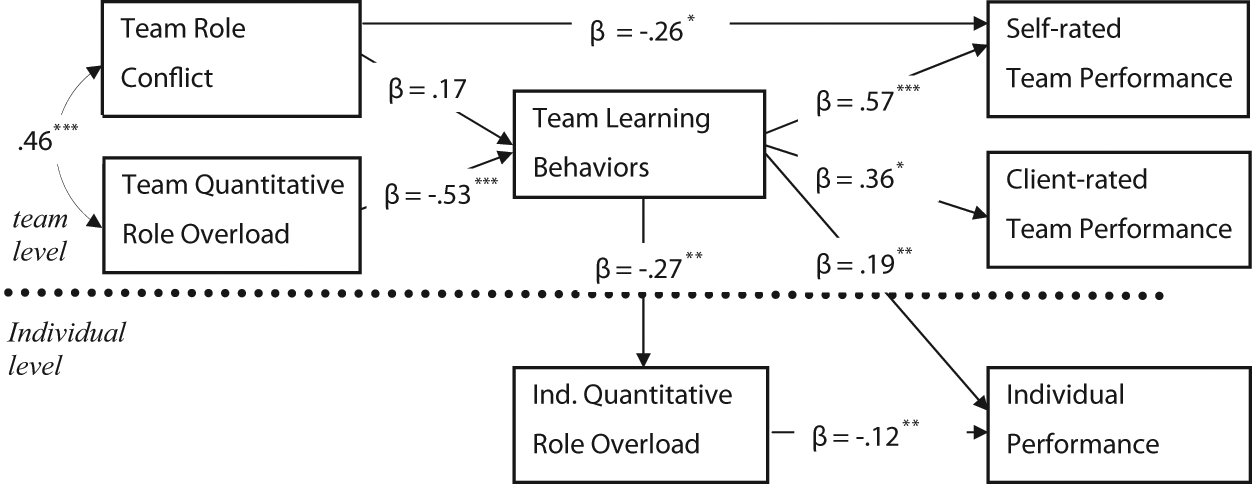
Overview of findings from the HLM and SEM analyses
Conclusions and Discussion
Reflection on the Outcomes
The aim of the present study was to test a multilevel mediation model describing the relationships among role stress, team-learning behaviors, and the performance of project teams and their members. We distinguished between both individual and team role stress.
The outcomes of our study provide ample support for the assumption that individual and team role stress both relate negatively to performance in project teams and are in line with previous research wherein detrimental effects of individual role stress on individual performance was found (e.g., Erera-Weatherley, 1996; Zohar, 1997). Also, they add proof to the assumption of an equally detrimental effect of a collectively experienced team role stress on team performance. Moreover, our findings indicate that team role stress also negatively affects individual performance. To be precise, rather than operating directly, this effect was found to work indirectly in that team role stress inhibited team-learning behaviors, which subsequently increased individual quantitative overload, thereby negatively affecting individual performance.
Besides the empirical verification of team role stress as a shared experience in teams, this study contributes to the discussion concerning the “stress–learning–performance relationship.” More specifically, our findings confirmed that team role stress, in terms of both quantitative role overload and conflict, relates negatively to team performance. In the case of quantitative role overload, the effect was fully explained by a reduced prevalence of team-learning behaviors. Possibly, the collective experience of quantitative role overload takes up too many resources spent on primary team task processes and limits the capacity of the team to engage actively in secondary processes such as team learning, thereby impeding the team’s performance. With these outcomes, our findings corroborate prior research, in that team learning behaviors were strongly and positively related to both individual and team-level performance (e.g., Edmondson, 1999; Savelsbergh et al., 2009).
Through its negative effect on team learning, team role stress also appeared to indirectly hinder individual performance. The cross-level relationships that we tested supported the notion that the positive effect of team-learning behaviors on individual performance was partially mediated by a reduction in individual quantitative role overload. A likely explanation for this outcome could be that sharing experiences, collective reflection, and feedback processes may help optimize the work division among the members of a team. Research by DeShon and colleagues (2004) showed, for example, that individual and team feedback processes may help individual team members to regulate the allocation of their resources more adequately.
All in all, the present study demonstrates that both individual and team role stress are important factors in determining the effectiveness of project teams and their members. Moreover, testing the “stress–learning–performance relationship,” using a multilevel approach, allowed us to offer support for the hypothesized mediating role of team-learning behaviors in the negative relationship between team role stress and performance at the team and individual levels. Herewith, this study enriches the existing role stress literature and, above all, supports the assumptions regarding the association between role stress and team learning in a project context. The outcomes provide empirical support for existing theoretical interest in the ability to learn and the ability to share what has been learned within project teams (Winter Smith, Morris, & Cicmil, 2006).
Limitations of the Study and Recommendations for Further Research
In interpreting the results of our study, one should take into account the single method of data collection, the limited sample size, and the cross-sectional design. All data were collected using questionnaires and largely based on self-measures, opening up the possibility of response set consistencies (Podsakoff & Organ, 1986). Although recent findings indicate that self-report measures may not limit internal validity as much as is often expected (Lance, Dawson, Birkelbach, & Hoffman, 2010), we invested considerable effort in collecting performance ratings from multiple sources, including team members, team leaders, and clients. As it turned out, ratings from the team members and leaders were not related to those of the clients. Such discrepancies in performance perceptions, however, are not uncommon (Gibson, Cooper, & Conger, 2009). They may arise not only from the fact that external stakeholders may differ in their focus and weighting of performance aspects but also from the fact that team members and team leaders may use “inside information” to evaluate performance; information that clients, being relative outsiders, may not have access to. It is exactly because of this enhanced insight that we are inclined to attach more value to the self-reports compared with the client ratings.
We acknowledge that the number of teams involved in our study was rather small, which restricted the number of relationships that could be examined simultaneously and which raises questions about the robustness of the estimations. However, the sample size meets the general accepted minimum criteria of 30 level-two unit observations for modelling multilevel effects (Maas & Hox, 2004). Also, teams appeared to vary considerably in terms of their size (from 2 to more than 20 members) and some of the participating teams’ composition only just passed the criteria for inclusion. Consequently, our findings may be somewhat overweighted by the few teams whose members made up a large proportion of the total sample of individual-level relationships. In addition, smaller sample sizes per team, together with the fact that all teams were sampled from a single sector (i.e., building and construction) resulted in less reliable differences between teams and thus lower ICC(2) values (cf. Bliese, 2000; Chen, 2005). At the request of the participating companies, to minimize interruptions of the teams’ work, we had to sample sparingly. However, despite the somewhat low ICC(2) values, emergent group-level effects have appeared, and these would only have been stronger in case higher ICC(2) values had been obtained (Bliese, 1998, 2000), herewith, in fact, supporting the validity of our outcomes.
Future research using larger samples should aim to examine the robustness of our findings, preferably by simultaneously testing both unilevel and cross-level mediation relationships in a multilevel structural equation model. Samples that show more homogeneity in size should improve the equality of weighting of the teams in the results for the individual-level relationships. Moreover, including samples from a more diverse organizational context could enhance our understanding of the impact of team role ambiguity and qualitative team role overload constructs, which we were forced to exclude from the analyses, due to insufficient variability between the teams in the present sample. Finally, as analysis of the team role stress construct in the present study had to be restricted to team role conflict and team quantitative role overload, broader conceptualizations of team role stress could be included in further research.
Because of the cross-sectional design that was employed, any attempt to make causal explanations must remain tentative. Research using a longitudinal design can provide more specific information about the stability and change of the variables and about cross-lagged (i.e., over time) relationships than our cross-sectional approach can (De Lange, 2005; Taris et al., 2003). A multiwave design will, however, give rise to other issues, such as the problem of selecting appropriate time intervals for effects of role stress and team learning to become apparent (Frese & Zapf, 1988; Kessler & Greenberg, 1981). Notwithstanding the difficulties that are inherent to time lag determination, profound longitudinal research is needed in this field of study, especially given the dynamic nature of the stress–performance relationship over time (see also Ployhart & Vandenberg, 2010; Vandenberghe, Panaccio, Bentein, Mignonac, & Roussel, 2011). Randomized field experiments with appropriately lagged measures of mediators and outcomes could give more confidence that the presumed causal sequence has not been compromised (Mathieu & Taylor, 2007). Also, future longitudinal approaches could examine whether relationships of role stress, team-learning behaviors, and performance vary over time depending on the project phase. This could help project managers to identify those phases that are most critical in countering role-stress effects and stimulating team-learning behaviors.
Practical Implications
Project managers and team members may be confronted with team role stress in any project characterized by high quantitative or conflicting demands. An increased insight into the stress–learning–performance relationships, using a multilevel perspective, may help team members and their managers counter negative role stress effects. More specifically, our findings underscore the negative effects of stressful conditions on engaging in team learning. Stress causes team members to “forget” to sit back and collectively make sense of the problems at hand. Project managers perceiving signals of individual or shared role stress should stimulate members to collectively explore and reflect on the role division in their team, opening up the opportunity to experiment with a different role division and a reallocation of resources, to safeguard the effectiveness of the individual team members as well as of the team as a whole (see also Charbonnier-Voirin, El Akremi, & Vandenberghe, 2010). Only in case project managers explicitly take into account the possible detrimental effects of individual and team role stress, and try their utmost to enhance team members’ coping strategies, today’s demands may be met. After all, project teams are continuously confronted with changing requirements and unpredictable environments, which obviously might evoke stress and necessitate a team’s constant flexibility to adjust.
Footnotes
Appendix
The author(s) declared no potential conflicts of interest with respect to the research, authorship, and/or publication of this article.
The author(s) disclosed receipt of the following financial support for the research, authorship, and/or publication of this article: This work was supported in part by Project Management Institute America.