







Abstract
Workforce diversity has been described as a double-edged sword; it has the potential for positive and negative outcomes. To better understand why and how diversity leads to positive outcomes, we examined the relationship between employee perceptions of diversity climate perceptions and intent to turnover. We explored the role of four psychological outcome variables (organizational commitment, climate for innovation, psychological empowerment, and identity freedom) as possible mediators of this relationship. Racial and gender subgroup differences were also examined. Survey data were collected from 1,731 public employees. Findings suggest that when employees perceive equal access to opportunities and fair treatment, intent to turn over decreases. Furthermore, these relationships are significantly mediated by psychological outcomes. Implications for diversity management and training are discussed.
Ever since dramatic shifts in the demographics of the workforce were predicted more than two decades ago, diversity researchers and authors have been writing about the need for organizations to create a work environment that supports and values diverse employees (e.g., Cox, 1994; Konrad, Prasad, & Pringle, 2006; Shore et al., 2011). They have argued that diversity is a double-edged sword; it has the potential for positive and negative outcomes. Moreover, the difference between these two dramatically different scenarios often depends on the work environment and the extent to which diversity is managed or mismanaged.
The argument goes as follows. When diversity is managed effectively and the work environment supports and values a diverse workforce, employees from all demographic backgrounds feel included within their organization and believe that their ideas, opinions, and suggestions are welcome. The eventual outcome is the espoused potential benefits of a diverse workforce that comprise the business case for diversity (Konrad, 2003; Kulik & Roberson, 2008), namely, that employees will realize their full potential at work and greater creativity and innovation will result from the variety of perspectives, experiences, backgrounds, and work styles that a diverse workforce may bring (Milliken & Martins, 1996; Page, 2007; Williams & O’Reilly, 1998), positively impacting the bottom-line.
This proposition, known as the cognitive resource perspective or, more recently, the resource-based view of diversity, is a theoretical approach used to explain the positive effects of diversity on workplace outcomes. Richard and Miller (2013) define the resource-based knowledge view as a set of conditions in which diversity becomes a competitive advantage. “The coordination and combination of employees’ knowledge, skills, and abilities become the firms’ human resources and capital, and a source of competitive advantage to the extent the resources are valuable, rare, hard to imitate, and strategically difficult to substitute” (Richard & Miller, 2013, p. 241). This perspective suggests that demographic diversity is accompanied by diversity on underlying attributes such as values, beliefs, attitudes, and personality (McGrath, Berdahl, & Arrow, 1995; Webber & Donahue, 2001). As demographic diversity increases, so does the group’s cognitive resources and ability to engage in more complex problem solving and thinking (Hambrick & Mason, 1984; Page, 2007; Roberge & van Dick, 2010).
The flip side of the argument, however, is that when the work environment fails to support diverse employees, negative outcomes may result, such as an increase in harassment and discrimination (Schneider, Hitlan, & Radhakrishnan, 2000), intergroup conflict (Jehn, Bezrukova, & Thatcher, 2008), and turnover (McKay et al., 2007). Research examining the faultline theory of diversity and conflict support this argument. Faultline theory suggests that demographic differences resulting in subgroups or coalitions increase the salience of in-group/out-group differences, resulting in further polarization and competition and conflict (Lau & Murnighan, 2005). When diversity climate perceptions are characterized by a belief that the organization is unfair or when personnel practices favor certain groups over others, demographic differences become more salient and faultlines crack open, exposing the organization to negative work outcomes (Jehn & Bezrukova, 2010).
Overall, research examining the effects of diversity on workplace outcomes has been characterized as limited and inconsistent (Curtis & Dreachslin, 2008; van Knippenberg & Schippers, 2007; Webber & Donahue, 2001). This inconsistency is likely because the relationship is more complex than was originally thought (Harrison & Klein, 2007; Kochan et al., 2003). One explanation for these mixed results is the organizational climate created for a diverse workforce; some organizations effectively manage diversity while others mismanage the potentially valuable resources found within a diverse workforce (Jayne & Dipboye, 2004).
Although the resource-based view of diversity is commonly cited as support for the competitive advantage of diversity, few studies have empirically examined the veracity of its claims. Most research in this area has focused on the link between diverse representation within an organization (e.g., the proportion of various racial and gender demographic groups represented in the organization) and objective business performance measures indicating financial performance (Dwyer, Richard, & Chadwick, 2003; Kochan et al., 2003; Richard, Murthi, & Ismail, 2007). In a recent review of the literature on diversity as a source of competitive advantage, Richard and Miller (2013) summarize the empirical work on the diversity-performance relationship as quite scarce. In fact, the studies reviewed found no support for a main effect of diversity on firm business performance, but rather support for a moderated relationship in which business strategy, organizational culture and design, and human resource management practices all played a significant role in determining the extent to which diversity positively impacted firm performance.
Though many scholars have argued that diverse groups result in creative ideas, innovative solutions, and improved decision making by raising divergent ideas and opinions about how best to improve organizational effectiveness (De Dreu & West, 2001; Phillips, Northcraft, & Neale, 2006), there still exists a need to explore the conditions under which diversity leads to positive workplace outcomes. Gonzalez and DeNisi (2009), for example, call for additional research in this area. They challenge scholars to explore the association between diversity climate and organizational diversity, including how climates are perceived and managed. Thus, there remains a significant gap in the literature that the present study seeks to fill. To do so, we focus on three goals. First, we examine the link between diversity climate perceptions and turnover intentions. Second, we explore four psychological variables as mediators of this relationship to more fully understand how and why diversity climate perceptions influence employee retention. And finally, we assess whether such relationships hold consistently across racial and gender subgroups.
Conceptualizing an Affirming Climate for Diversity
Scholars have long argued that organizational climate is an important construct, because it impacts employee performance and satisfaction (L. R. James, James, & Ashe, 1990), and touches nearly every aspect of organizational life (Kuenzi & Schminke, 2009). Schneider, Gunnarson, and Niles-Jolly (1994) write that climate is “the atmosphere that employees perceive is created in their organizations by practices, procedures, and rewards” (p. 18). They go on to say that “Employees observe what happens to them (and around them) and then draw conclusions about their organization’s priorities” (p. 18). Thus, employees form an overall perception of what is valued and deemed a high priority within their organization based largely on what management does, not what it says (Schneider et al., 1994). For example, organizations that create a climate for innovation experience a more innovative and creative workforce (Schneider et al., 1994) and organizations that create a strong service climate positively impact customers’ perceptions of service quality (Schneider, White, & Paul, 1998).
Although practical guidelines for creating a positive diversity climate can be found abundantly in the popular press (e.g., Chavez & Weisinger, 2008), only a handful of empirical studies exist focusing on diversity climate. Early research demonstrated that a diversity climate exists and employees do indeed develop an overall impression of the extent to which the organization values diversity based on its practices, policies, procedures, and rewards (Kossek & Zonia, 1993; Mor Barak, Cherin, & Berkman, 1998).
The conceptualization of diversity climate has evolved over time. Early research was highly pragmatic and each study conceptualized diversity climate differently, depending on the specific organization involved. Recent work has attempted to take a more theoretically based approach to the study of diversity climate and conceptualize the construct as multidimensional. Although to date there is no single widely used measure of diversity climate, there is overlap and convergence in how diversity climate is conceptualized. Diversity climate has often been defined as consisting of two core diversity practices: fair treatment and integration (McKay, Avery, & Morris, 2008; Mor Barak et al., 1998; Roberson, 2006). For example, McKay et al. (2008) define diversity climate as “employees’ shared perceptions that an employer utilizes fair personnel practices and socially integrates underrepresented employees into the work environment” (p. 350). Gelfand, Nishii, Raver, and Schneider (2005) define diversity climate as “employees’ shared perceptions of the policies, practices, and procedures that implicitly and explicitly communicate the extent to which fostering and maintaining diversity and eliminating discrimination is a priority in the organization” (p. 104). Likewise, we define diversity climate, at least in part, as consisting of perceptions of a set of diversity practices aimed at providing fair and equal opportunities to all employees.
Beyond what may be referred to as fair diversity practices, many scholars have theorized that diversity climate also consists of the interpretation of such practices. That is, an important element of diversity climate includes employee perceptions of the extent to which they feel valued and the degree to which diversity is viewed as a competitive advantage. For example, Cox (1991, 1994) defined three types of organizations: monolithic, plural, and multicultural. Cox distinguished a multicultural organization from one that is monolithic (demographically and culturally homogeneous) and one that is plural (diverse representation at lower levels only), by defining a multicultural organization as one in which members of all sociocultural backgrounds can contribute and achieve their full potential. Unlike a plural organization, in which differences are simply tolerated, in a multicultural organization, organizational members view diversity as a valuable resource and competitive advantage.
Thus, a review of the literature suggests that diversity climate is complex and multifaceted (Herdman & McMillan-Capehart, 2010). An affirming climate for diversity consists of management practices to create a work environment defined as providing equal access and fair treatment to all. The creation of an affirming climate for diversity also depends on employee perceptions that diversity is valued and the extent to which diverse employees are encouraged to contribute fully to the organization (Joshi & Roh, 2013).
To define an affirming climate for diversity for purposes of the present study, we drew heavily on Cox’s (1991, 1994) conceptualization of a multicultural organization. Cox identified and described six dimensions of a multicultural organization. Full structural integration is achieved when all demographic groups are adequately represented within various organizational levels, functions, and work groups. Integration in informal networks occurs when all organizational members have equal access to and are included in social and informal networking activities. Low cultural bias is evident in organizations where steps are taken to identify and eliminate discrimination and prejudice in the workplace. Intergroup cohesion is observed when the organization achieves an optimal level of conflict involving work tasks, while minimizing conflict due to social identity group differences, such as race and gender. Acculturation refers to the method by which cultural differences are resolved in organizations. Cox argues that acculturation should involve a two-way process in which minority and majority group members have some influence on organizational norms and values and minority group members are not expected to assimilate or shed their identity when coming to work. Finally, Cox suggests that a multicultural organization may be characterized by the extent to which organizational identification occurs for all employees.
Turnover: A Key Outcome of an Affirming Climate for Diversity
As mentioned earlier, previous research has focused primarily on the link between diverse representation within an organization and objective business performance. Research examining the relationship between diversity climate and outcomes is limited to a handful of studies. McKay et al. (2008) found that diversity climate plays an important role in predicting sales performance. Findler, Wind, and Mor Barak (2007) examined social work managers in Israel and found a significant direct relationship between climate variables (i.e., fairness, inclusion, stress, and social support) and general health and well-being, job satisfaction, and organizational commitment.
While a variety of consequences of diversity climate have been explored in the literature (van Knippenberg, Homan, & van Ginkel, 2013), employee satisfaction and its opposite, turnover, are often mentioned as a key outcome and reason to invest in fostering a positive diversity climate. This is likely due to the fact that the cost of turnover in organizations is well documented and considered significant enough that organizations are advised to take steps to reduce turnover (Kacmar, Andrews, Van Rooy, Steilberg, & Cerrone, 2006).
Creating an affirming climate to support a diverse workforce is one strategy to improve employee satisfaction and commitment and, thereby, reduce turnover (Hicks-Clarke & Iles, 2000). When employees of color see similar others succeeding in the workplace, they perceive that they, too, will be permitted to succeed in the organization (Thomas, 2005) and, thus, will be less likely to turn over. Several studies report a significant negative relationship between an affirming diversity climate and turnover intentions (Kaplan, Wiley, & Maertz, 2011; McKay et al., 2007; Stewart, Volpone, Avery, & McKay, 2011). Using a multiorganizational sample, Kaplan et al. (2011) found that positive perceptions of diversity climate were related to decreased turnover intentions. McKay et al. (2007) found that people from underrepresented groups had higher rates of turnover than White men, a finding consistent with previous research on turnover. In addition, however, they found that high turnover among underrepresented groups is especially high if such group members perceive that the organization is not committed to supporting diversity. Thus, our first hypothesis attempts to replicate previous findings by predicting that diversity climate will be negatively related to turnover intentions.
Psychological Outcomes of Diversity Climate Perceptions
After reviewing the extant literature examining the relationship between diversity climate and outcomes, it quickly becomes apparent that work remains to be done in this area and additional outcome variables and/or mediators should be examined. The resource-based view of diversity suggests that demographic diversity leads to a competitive business advantage because it is accompanied by diversity in values, beliefs, attitudes, and personality, resulting in additional cognitive resources that enable employees to engage in more complex problem-solving and higher-order thinking (Hambrick & Mason, 1984; Webber & Donahue, 2001). Although this theory remains largely untested, Ely and Thomas (2001) found that firms that adopt an integration and learning perspective have a high value for diversity and view it as a resource for learning, change, and renewal throughout the entire organization. When firms value diversity and embrace the opportunity to learn from a diverse workforce, their employees have the chance to experience constructive intergroup conflict and explore diverse viewpoints, which facilitates opportunities for cross-cultural learning and enhances performance. Likewise, Cox (1994) suggests that the goal of managing diversity is to maximize the ability of all employees to contribute to organizational goals and achieve their full potential.
To create a work climate that is affirming for diverse employees such that the benefits of diverse perspectives are realized, a better understanding of the complex relationship between diversity climate and work outcomes is necessary (Curtis & Dreachslin, 2008). To advance the field and illuminate the proverbial black box one must ask: How, why, and under what conditions do diversity practices have a positive impact on employees’ perceptions that their differences contribute to and enhance their work?
According to Cox’s (1994) Interactional Model of Cultural Diversity (IMCD) model, the relationship between diversity climate and organizational effectiveness outcome variables is mediated by the extent to which employees experience positive affect and achievement within the organization. The IMCD is consistent with previous research that finds organizational commitment mediates the effect of diversity climate perceptions on turnover intentions (McKay et al., 2007). Kaplan et al. (2011) also examined a mediator of turnover intentions. They found that calculative attachment (defined as a rational calculation of the probability of attaining important goals in the future through continued membership) fully mediated the relationship between diversity climate perceptions and turnover intention. Although only a handful of empirical studies have examined mediators of diversity climate and turnover, theoretical work in this area suggests that diversity climate has a positive impact on organizational outcomes like employee retention, because employees experience positive psychological outcomes in a work environment characterized by fair and supportive procedures, practices, and policies.
Therefore, one of the goals of the present study was to empirically examine the role of a variety of mediators to clarify the relationship between diversity climate perceptions and turnover intentions. We predict that when employees perceive their demographic group is tolerated, but not valued as a result of perceived unfair or unequal management practices, they will experience marginalization. Furthermore, when employees feel marginalized, they are less likely to contribute their unique perspectives and will disengage from their work or even disengage from the organization itself and ultimately find employment elsewhere. Conversely, when employees work in an organization characterized as engaging in a set of fair and inclusive management practices, employees will perceive that they are an important part of the organization and that their group identity is valued, which, in turn, affects their perception that diverse perspectives and backgrounds contribute to the work. In the present study, we have identified four psychological outcomes that we predict will mediate the relationship between diversity climate perceptions and turnover intentions.
Recently, the extent to which organizational members identify with or are committed to their organization has been examined as a key mediator or moderator of the relationship between diversity climate and workplace outcomes. For example, McKay et al. (2007) demonstrated that organizational commitment mediates the relationship between positive perceptions of workplace diversity climate and turnover intentions. Gonzalez and DeNisi (2009) found partial support for diversity climate as a moderator of the relationship between organizational identification, organizational commitment, and intentions to quit. Therefore, in the present study, we examine organizational identification as a potential psychological outcome of diversity climate perceptions that mediates the relationship between diversity climate and turnover intentions. We define organizational identification as the extent to which employees identify with, are involved in, and enjoy a sense of belonging and membership in an organization (Allen & Meyer, 1990). This is consistent with Cox (1991, 1994) who argues that within a multicultural organization, organizational identification occurs for all employees.
In a recent review of the literature supporting diversity as a competitive advantage, Richard and Miller (2013) suggest research supports the notion that diverse groups are more likely to come up with creative ideas and innovative solutions by raising divergent ideas and options about how best to improve organizational effectiveness. Yet, the literature also seems to be clear that an affirming climate for diversity is necessary to achieve such positive outcomes (van Knippenberg et al., 2013). Research has found that the introduction of minority viewpoints leads to more divergent thinking, consideration of alternative perspectives, and greater information processing (Nemeth, 1986; Tomasetto, Mucchi-Faina, Alparone, & Pagliaro, 2009). In support of this, Yang and Konrad (2011) found a three-way interaction among employee involvement, variation in involvement, and racioethnic diversity on innovation. They conclude that ensuring high levels of involvement among members of historically marginalized racioethnic groups enhances innovation.
Furthermore, there is evidence to support that a climate for innovation is related to employee well-being (King, de Chermont, West, Dawson, & Hebl, 2007). Based on this research as well as literature citing the business case for diversity, which argues that creativity and innovation resulting from diversity can be a competitive advantage (Konrad, 2003; Kulik & Roberson, 2008), we predict perceived climate for innovation will mediate the relationship between diversity climate perceptions and turnover intentions. When employees perceive an affirming climate for diversity, they are more likely to also perceive a climate in which innovative and creative ideas are valued and encouraged. This perception eventually relates to lower turnover.
The resource-based view of diversity also predicts that a positive outcome of diversity is an organization’s enhanced ability to engage in complex problem solving. Again, the notion that minority viewpoints lead to more divergent thinking and consideration of alternative perspectives (Nemeth, 1986; Tomasetto et al., 2009) suggests that heterogeneous employee groups may be better equipped than homogeneous groups to solve organizational problems and improve organizational performance. Yet, this potential benefit of diversity will only be realized if employees perceive an affirming climate for diversity and this perception is then associated with the belief that they are empowered to make decisions and encouraged to engage in problem solving. There is evidence to suggest that when employees perceive they are empowered, this perceived empowerment is related to positive outcomes, such as increased job satisfaction and work productivity/effectiveness as well as lower job-related strain and propensity to leave the organization (Koberg, Boss, Seniem, & Goodman, 1999; Spreitzer, Kizilos, & Nason, 1997). Therefore, we predict that perceptions of psychological empowerment will mediate the relationship between diversity climate perceptions and intentions to turnover.
Finally, we consider Cox’s (1994) IMCD model to identify an additional possible mediator, as well as a recent review highlighting the importance of identity work in navigating the self in diverse work contexts (Roberts & Creary, 2013). Cox argues that identity is central to how diversity impacts behavior in organizations. He illustrates the important relationship of identity to the career experience of minority group members and suggests that there is a cost to the individual and the organization when members attempt to repress expression of group identity (Cox, 1991). Such individuals may feel pressure to act in ways that may be unnatural for them and a strong desire to fit in with the dominant group may lead to additional stress that likely has a negative impact on work performance. Cox (1991) asserts that “people are at their best when they can be themselves” (p. 59). Roberts and Creary (2013) likewise argue that navigating the self is critical to working in a diverse workplace and involves identity construction and negotiation processes that unfold as people interpret and act on their differences. Roberts and Creary go on to say that as employees act on these differences in constructive ways, they open possibilities for differences to become sources of creativity and resilience (p. 73). In this paper, we define identity freedom as the extent to which employees feel free to express their identity at work. We predict that identity freedom will mediate the relationship between diversity climate perceptions and intentions to turn over. When employees perceive an affirming climate for diversity, they are more likely to experience freedom to express their identity as well as different perspectives and opinions, which, in turn, lead to positive work outcomes, such as lower intention to turnover.
Subgroup Differences
In addition to examining turnover as a key outcome of diversity climate and various mediators of this relationship, a final goal of this study was to examine whether the four psychological outcomes mediated the relationship between diversity climate perceptions and turnover intentions regardless of racial and gender subgroup differences. Although decades of research on racial and gender differences have yielded important findings that suggest that Whites and men experience a dramatically different workplace from people of color and women (Cox, Welch, & Nkomo, 2001; Powell, 1999), there is research to support the assertion that an affirming climate for diversity has positive work outcomes for all organizational members.
For example, Phillips, Duguid, Thomas-Hunt, and Uparna (2013) report that the information-processing benefits of diversity do not come solely from the contributions of social minorities, but also come from dominant group members such as Whites. Other research suggests that diversity climate perceptions are significantly related to turnover intentions for Whites as well as racial minority groups (Kaplan et al., 2011; McKay et al., 2007). For example, McKay et al. (2007) found that diversity climate perceptions mediated by organizational commitment were positively related to turnover intentions for White men and women as well as non-White groups. Dobbin, Sutton, Meyer, and Scott (1993) suggest that all demographic groups benefit from equal opportunity and affirmative action initiatives, because such processes demand that organizations examine and rationalize their staffing procedures, resulting in more objective decision making and increased perceptions of fairness. Thus, creating a work environment characterized by fair treatment, for example, may be beneficial for all employees regardless of racial or gender group differences. Therefore, we hypothesize that the psychological outcome variables will mediate the relationship between diversity and turnover regardless of gender or racial group membership.
Method
Sample
Participants were 1,731 public employees from a large municipality in the United States. The largest group of employees (n = 866; 50%) comprised police officers. Approximately 15% of the sample consisted of firefighters (n = 254) and the remaining 35% were represented by other departments such as city planning, parks and recreation, and internal support services (n = 611). Of the 1,731 survey respondents, approximately 70% (n = 1,192) were men and 30% (n = 515) were women (24 people failed to indicate their gender). Approximately 81% (n = 1,400) of the participants were Caucasian/White and 19% (n = 331) were non-Caucasian. Approximately 10% (n = 179) were Hispanic/Latino, 5% (n = 86) were African American, 2% (n = 32) were Asian, and 2% (n = 34) were Native American. The majority of respondents were between 36 and 45 years of age (36%; n = 624). Most employees were tenured between 6 and 10 years in the organization.
Procedure
The diversity climate survey used in the present study was developed to guide diversity training initiatives within the municipal organization and provide a baseline measure of employee perceptions and attitudes. We worked closely with the Diversity Coordinator to develop and revise the survey. A volunteer task force was created including representatives from all departments and levels to administer the surveys. Prior to administering the surveys, task force members participated in a training session in which they were provided with materials intended to inform them of the goals of the survey, when and how respondents would receive feedback, and steps taken to ensure respondent confidentiality. A task force member or representative then facilitated each survey administration session. Employees completed the surveys in meetings of their work groups during work time. The entire organization (approximately 2,300 employees) was invited to participate in the survey during a 3.5-week period. Facilitators collected the completed surveys at these meetings, placed them in envelopes immediately, and mailed them to an outside vendor for data keying to ensure respondent confidentiality. The overall response rate was 81%.
Measures
Affirming climate for diversity
We developed a measure of diversity climate that included four subscales (Structural Integration, Informal Integration, Low Cultural Bias, and Intergroup Cohesion). In developing our measure, we drew heavily on Cox’s (1991, 1994) conceptualization of a multicultural organization. Low Cultural Bias was measured using 7 of the 15 items from the Workplace Prejudice/Discrimination Inventory (K. James, Lovato, & Cropanzano, 1994). These 7 items were selected because they assessed employee perceptions of the existence of bias, prejudice, and discrimination in the workplace. The 8 items not taken from the original survey were eliminated due to redundancy with other items or because they measured more informal types of discrimination, such as social isolation. Items indicating the existence of bias and discrimination in the workplace were reverse scored so that high scores indicated a lack of bias in the workplace.
Items comprising the other three subscales in the diversity climate measure (Informal Integration, Intergroup Cohesion, and Structural Integration) were developed based on Cox’s definition of these dimensions (see Cox, 1991). Although other diversity climate measures were consulted during development of these subscale items, no existing measures seemed to adequately capture the multicultural dimensions defined by Cox. Thus, new items were developed by the first author and revised with input from the diversity director of the organization in which the survey was administered as well as other diversity scholars. Examples include the following: “I feel excluded from casual conversations with members of other demographic groups” (Informal Integration–Reverse), “Minority input is effectively considered at all levels in the organization” (Structural Integration), and “There are tensions between members of different groups in this organization” (Intergroup Conflict–Reverse). For all items, responses ranged from strongly disagree (1) to strongly agree (7).
Psychological outcome variables
Organizational identification was measured using five items from the affective subscale of the organizational commitment measure developed by Allen and Meyer (1990). Psychological empowerment was measured using the three-item Self-Determination subscale from Spreitzer’s (1995) Psychological Empowerment scale. Four new items for perceived climate for innovation were developed. To develop these items, the authors consulted literature on the business case for diversity as well as research on innovation (cited previously). Based on this literature, the authors generated a list of behaviors that might be expected if employees worked in an environment in which they were expected and rewarded for contributing to innovative and creative ideas. Four items were developed to assess employees’ perceptions that creative solutions and new ideas are supported and encouraged at work (e.g., “In my work unit, we are encouraged to come up with new and creative ideas”). Identity freedom was developed based on Cox’s (1991, 1994) dimension of acculturation as well as work by Shore et al. (2011) on inclusion. Cox and Shore describe a positive diverse work environment as one in which employees can express their true identity at work rather than attempt to suppress differences. We developed a five-item scale to assess the extent to which employees feel they can “fit in” and contribute fully at work without having to assimilate. A sample item is, “I feel that I can fit in at work without having to change who I am.”
Turnover
Turnover intentions were measured using a three-item subscale of the Michigan Organizational Assessment Questionnaire (MOAQ; Seashore, Lawler, Mirvis, & Cammann, 1982). These items assessed the extent to which employees actively thought about leaving the organization (e.g., “It is likely that I will actively look for a new job (outside the organization) in the next year”).
Control variables
Because of their conceptual and empirical links with turnover and organizational identification, organizational tenure and job level were used as control variables when testing hypotheses (Griffeth, Hom, & Gaertner, 2000; Mathieu & Zajac, 1990). Tenure was measured using a 5-point scale (1 = less than 1 year, 2 = 1-5 years, 3 = 6-10 years, 4 = 11-15 years, 5 = more than 15 years). Job level was also measured with a 5-point scale (1 = clerical/paraprofessional, 2 = professional, 3 = supervisor, 4 = manager, 5 = senior manager).
Results
Analysis Plan
Our analysis involved three stages. In the first stage, we sought to establish the number of dimensions necessary to represent employees’ perceptions of diversity climate. Our diversity climate survey consisted of items measuring four distinct climate dimensions (Structural Integration, Informal Integration, Lack of Cultural Bias, and Intergroup Cohesion). However, prior theory has conceptualized diversity climate as comprised of two dimensions, fair treatment and integration. Therefore, using a randomly selected half of our sample, we conducted exploratory factor analysis (EFA) to determine the number of diversity climate dimensions. In the second stage, we used confirmatory factor analysis (CFA) on the second half of the data set to replicate the results of our EFA and establish a measurement model. At this stage, we tested for method bias and assessed whether the measurement model was invariant across three subgroups of employees: White males, White females, and non-Whites. In the final data analysis stage, we created a structural equation model (SEM) to test our hypotheses regarding the relationships between diversity climate perceptions and turnover, and to test whether this relationship was mediated by four psychological variables. In addition, we assessed whether these relationships were generally consistent across various subgroups of employees.
Stage 1: EFA
Prior to analyses, all survey items were assessed for missing values, outliers, and univariate skewness and kurtosis. Missing data were replaced via mean substitution and 25 cases classified as multivariate outliers were deleted. To determine the underlying factor structure of the survey items, we conducted a series of EFAs with principal axis factoring as the extraction method and Promax rotation. To remain in the analysis, an item’s communality estimate after extraction must have been greater than .25, and only items with loadings greater than .45 on the factors were interpreted (Tabachnick & Fidell, 2001). Based on these criteria, 12 items were not included in the subsequent CFA.
Results indicated that the most interpretable factor solution consisted of seven factors (please see Table 1). All factors had initial eigenvalues greater than 1.0 and collectively accounted for 59% of the variance in the measured items. Two of the seven factors emerged as diversity climate dimensions, consisting exclusively of items from the Lack of Cultural Bias, Informal Integration, Intergroup Cohesion, and Structural Integration scales. The first of these factors (α = .87) consisted of nine items; five items from the Lack of Cultural Bias scale, two items from the Intergroup Cohesion scale, and two items from the Informal Integration scale. Generally, these items dealt with issues of treatment in the workplace, and we therefore chose to call this factor, Equal Treatment. The second of these factors (α = .80) consisted of five items; two items from the Informal Integration scale and three items from the Structural Integration scale. Because all of these items reflect employees’ perceptions of equal accessibility to organizational level, resources, and informal networks, we chose to call this five-item factor Equal Access. Together, these two dimensions measure perceptions of diversity practices involving equal access and treatment to foster an affirming climate for diversity.
Results of Exploratory Factor Analysis.
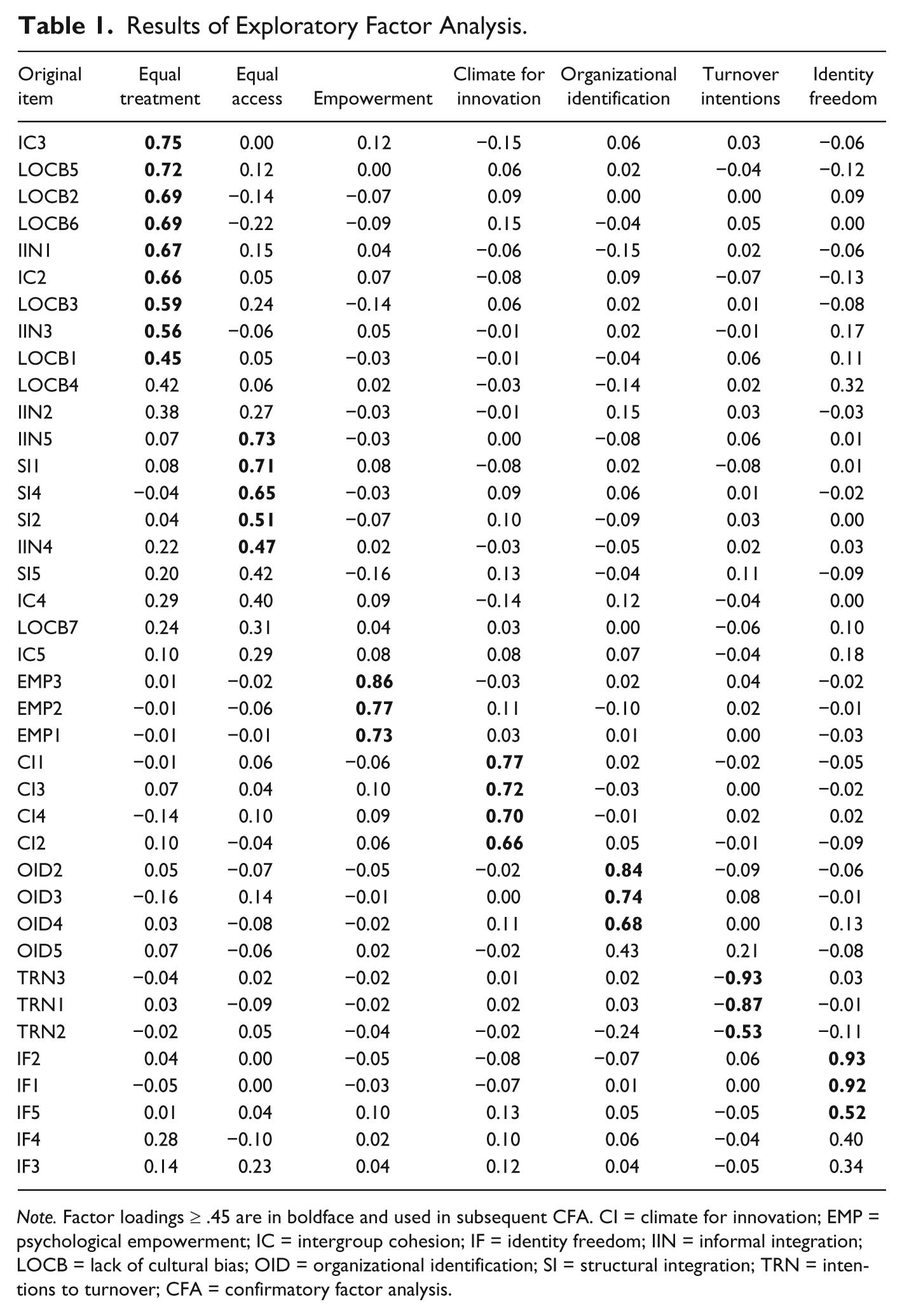
Note. Factor loadings ≥ .45 are in boldface and used in subsequent CFA. CI = climate for innovation; EMP = psychological empowerment; IC = intergroup cohesion; IF = identity freedom; IIN = informal integration; LOCB = lack of cultural bias; OID = organizational identification; SI = structural integration; TRN = intentions to turnover; CFA = confirmatory factor analysis.
All other items generally loaded on their respective scales. However, in cases in which factor loadings were below .45, those items were dropped from subsequent analyses. This resulted in removal of one item from the Organizational Identification scale and two items from the Identity Freedom scale. Even after removal of such items, these scales demonstrated strong internal consistency. Cronbach’s alpha was as follows: Organizational Identification (.80), Identity Freedom (.82), Psychological Empowerment (.83), Climate for Innovation (.83), and Turnover Intentions (.87). Means, standard deviations, correlations, and reliabilities of the final scales are provided in Table 2.
Descriptive Statistics for Diversity Climate Scales and Psychological Outcome Variables.
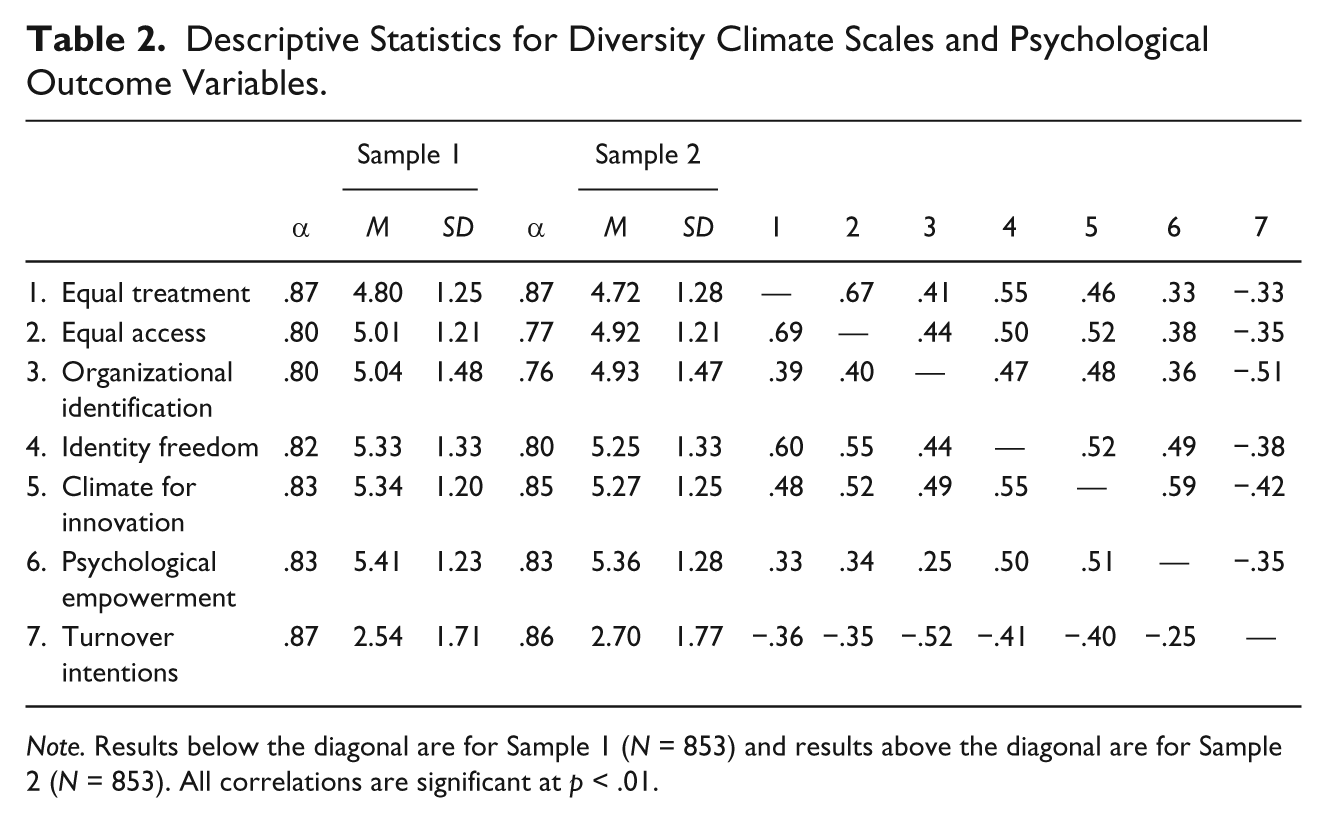
Note. Results below the diagonal are for Sample 1 (N = 853) and results above the diagonal are for Sample 2 (N = 853). All correlations are significant at p < .01.
Stage 2: CFA
After finding evidence to support a two-dimensional conceptualization of diversity climate involving equal access and equal treatment, we moved to the second stage of the analysis in which we replicated the EFA results using CFA. We conducted the CFA with Mplus 4.0 (Muthén & Muthén, 2006), using the second half of our sample. Our analysis also evaluated whether method bias was of concern and the measurement invariance across three different employee subgroups. Model fit was assessed using model chi-square (χ2), the comparative fit index (CFI), the Tucker–Lewis index (TLI), the root mean squared error of approximation (RMSEA) and standardized root mean squared residual (SRMR). Values close to or above .95 for the CFI and TLI, close to .06 or less for the RMSEA, and .09 or less for the SRMR indicate good model fit (Hu & Bentler, 1999).
Our measurement model consisted of seven latent factors representing the constructs of Equal Treatment, Equal Access, Identity Freedom, Organizational Identification, Psychological Empowerment, Climate for Innovation, and Turnover Intentions. All items were specified to load only on their respective factors, which were allowed to correlate with one another. Inspection of the modification indices after the first model fitting suggested that correlating the uniquenesses between Items 1 and 3 of the turnover scale would significantly improve model fit. Because both items contained the words “looking for a new job,” it seemed reasonable that they shared common variance and, therefore, we retained this correlation in all subsequent models.
Results indicated that the measurement model fit the data well, χ2(383) = 861.26, CFI = .96, TLI = .95, RMSEA = .04, SRMR = .04, and all items loaded significantly on their respective factors. In addition, this seven-factor model fit significantly better than several alternative measurement models, including a six-factor model in which the items representing Equal Treatment and Equal Access factors were forced to load on a single diversity climate factor, Δχ2(6) = 291.02, p < .001, and a one-factor model in which all survey items were forced to load on a single global factor, Δχ2(21) = 3,035.44, p < .001. Therefore, these results confirmed the seven-factor structure of the previous EFA.
We next determined the extent to which method bias was present in the data using the measured response style technique (Podsakoff, MacKenzie, & Podsakoff, 2012). Briefly, this technique involves assessing the extent to which four common participant response styles (acquiescence, disacquiescence, extreme responding, and midpoint responding) inflate the correlations among survey items. Following procedures described in Weijters, Schillewaert, and Geuens (2008), we assessed whether factor loadings in our measurement model were reduced when accounting for these response style biases. Results of this analysis revealed that factor loadings did not change in a model that accounted for these response styles, indicating that correlations among survey items were not upwardly inflated by method factors.
Finally, we determined whether the seven-factor measurement model was invariant across three subgroups of employees: White men (n = 478), White women (n = 211), and non-Whites (n = 156). At a minimum, measurement equivalence across groups is established by demonstrating that: (a) the same number of factors holds across groups and (b) groups have equal factor loadings on the factors (Raju, Lafitte, & Byrne, 2002). To test measurement equivalence, we first fit the seven-factor measurement model across all three groups, allowing each group to have unique factor loadings. Results indicated this model fit well, suggesting an invariant seven-factor structure across groups, χ2(1,149) = 1,758.11, CFI = .95, TLI = .94, RMSEA = .04, SRMR = .05. Next, the factor loadings for each group were constrained to be equivalent to one another. Results indicated that this model also fit the data well, χ2(1,195) = 1,816.32, CFI = .95, TLI = .94, RMSEA = .04, SRMR = .05, and did not differ from the fit of the first model that allowed factor loadings to vary freely, Δχ2(46) = 58.21, ns. These results established measurement equivalence, indicating that the subgroups conceptualized all seven factors comparably.
Stage 3: Structural Equation Modeling
To test Hypotheses 1 and 2, we first created a SEM in which Equal Treatment and Equal Access directly predicted all other variables, and the four psychological outcomes (Identify Freedom, Psychological Empowerment, Climate for Innovation, and Organizational Identification) predicted Turnover Intentions. The two control variables, Organizational Tenure and Job Level predicted Organizational Identification and Turnover Intentions. Results revealed that this model fit the data well, χ2(435) = 974.01, CFI = .96, TLI = .95, RMSEA = .04, SRMR = .04, but also revealed several nonsignificant direct effects from diversity climate perceptions to the other variables, and significant positive correlations between the four psychological outcome variables. This suggested that the model could be improved by eliminating nonsignificant paths and specifying direct relationships from one psychological outcome variable to another.
Therefore, a revised model was created in which Equal Treatment and Equal Access predicted all other variables, and direct relationships between the psychological outcome variables were specified. In addition, nonsignificant paths were eliminated using a model-trimming procedure recommended by Kline (2005). In this procedure, nonsignificant paths are eliminated one at a time based on theoretical and empirical grounds. After removing each path, overall model fit is evaluated by a significant change in model chi-square. If this change is significant, the path is retained, and if nonsignificant, the path is removed. The only exception we made to this process was that the paths involving control variables were retained, even though they were nonsignificant. Results of this process revealed that the final “trimmed” model fit the data well, χ2(442) = 984.08, CFI = .95, TLI = .95, RMSEA = .04, SRMR = .04, and just as well as the original structural model, Δχ2(7) = 10.07, ns, indicating that trimming the nonsignificant paths resulted in a more parsimonious model that still fit the data well. The final structural model and parameter estimates appear in Figure 1.
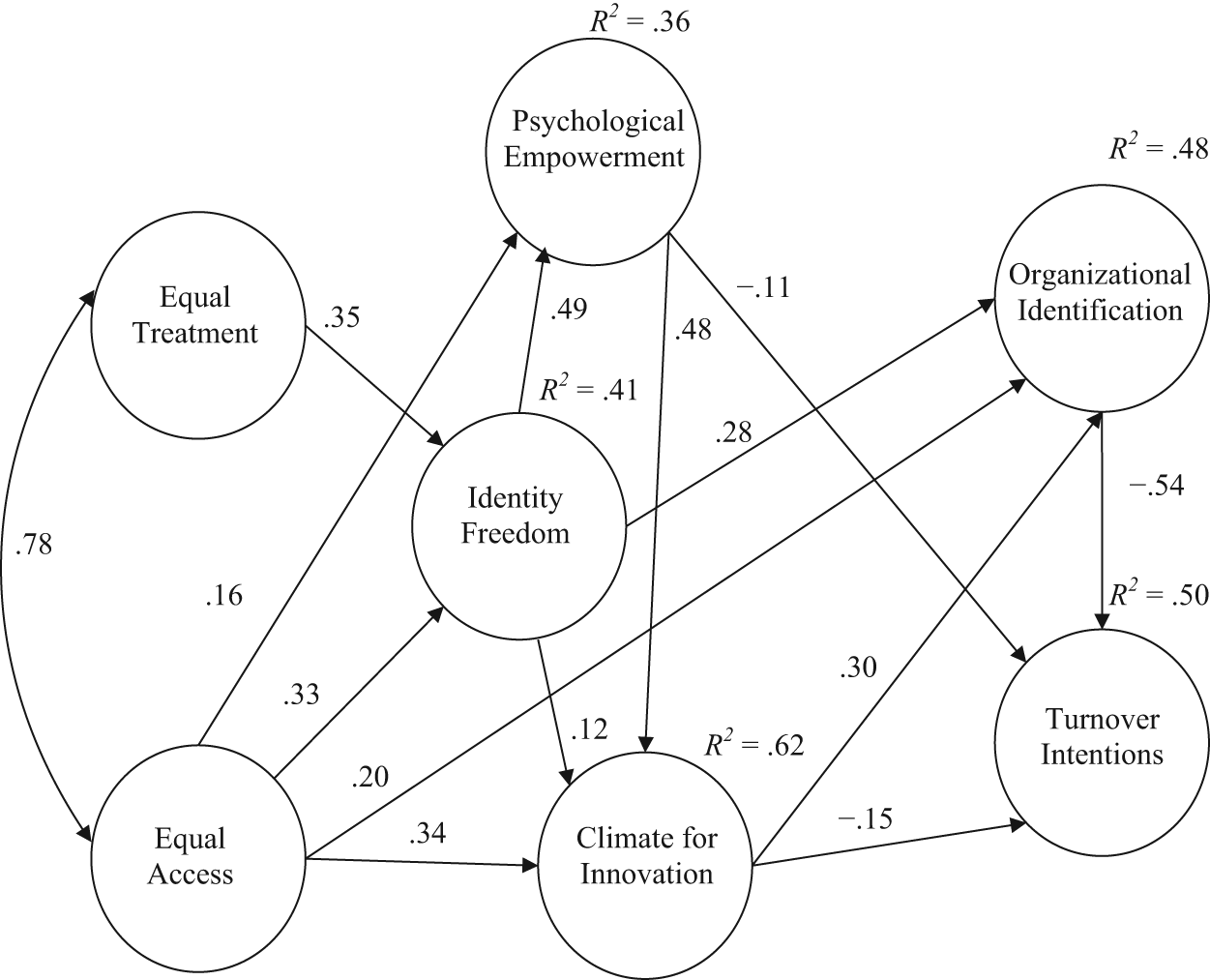
Results of structural model.
To test Hypotheses 1 and 2, the total effects of diversity climate perceptions on Turnover Intentions, as well as the other study variables from the final structural model presented in Figure 1, were calculated. These results appear in Table 3.
Total, Direct, and Indirect Effects of Diversity Climate Perceptions on Study Variables.
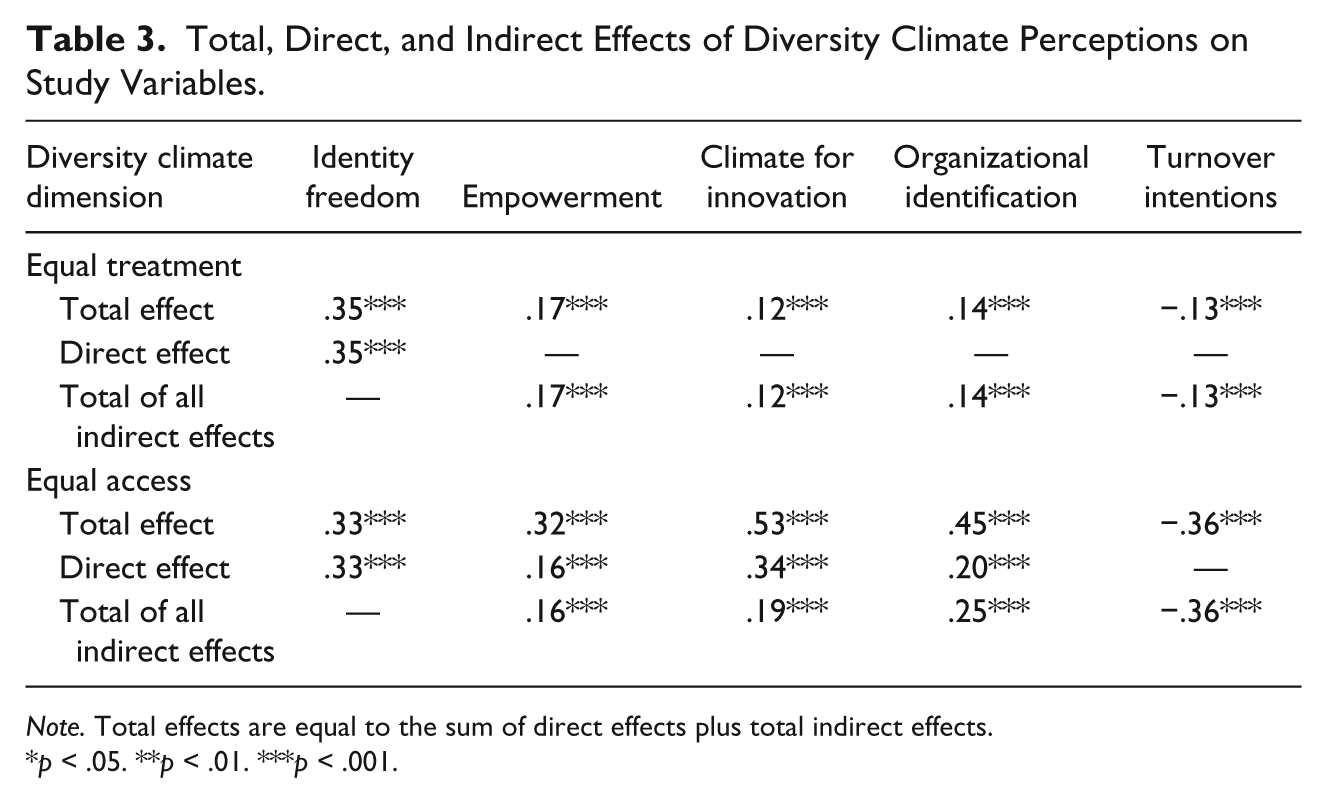
Note. Total effects are equal to the sum of direct effects plus total indirect effects.
p < .05. **p < .01. ***p < .001.
In support of Hypothesis 1, Equal Treatment and Equal Access had a negative total effect on Intentions to Turnover. In support of Hypothesis 2, the overall effect of both diversity climate perception variables on turnover was entirely mediated through the four psychological outcome variables. Specifically, as can been seen in Table 3, there were no direct effects of diversity climate perceptions on Turnover Intentions. The total effects of these variables were equal to their total indirect effects, indicating complete mediation. In addition, the diversity climate perception variables had a significant overall effect on all four psychological outcome variables. Specifically, Equal Treatment had a significant direct effect on Identify Freedom and significant total effects on Psychological Empowerment, Climate for Innovation, and Organizational Identification, as mediated through Identify Freedom. Equal Access had significant direct and indirect effects on four psychological outcome variables.
To test Hypothesis 3 and determine whether the four psychological outcome variables mediated the effect of diversity climate perceptions on turnover intentions across various subgroups, we fit the revised structural model described above (first including all paths) to the data for each employee subgroup. Then, following a similar model-trimming process, nonsignificant paths were eliminated with the goal of creating a more parsimonious model for each subgroup that still fit the data well. Goodness of fit statistics and total, direct, and indirect effects of the diversity climate dimensions on Turnover Intentions and psychological outcome variables for the models that resulted from this process for each group are presented in Table 4.
Total, Direct, and Indirect Effects of Diversity Climate Perceptions on Study Variables across Employee Subgroups.
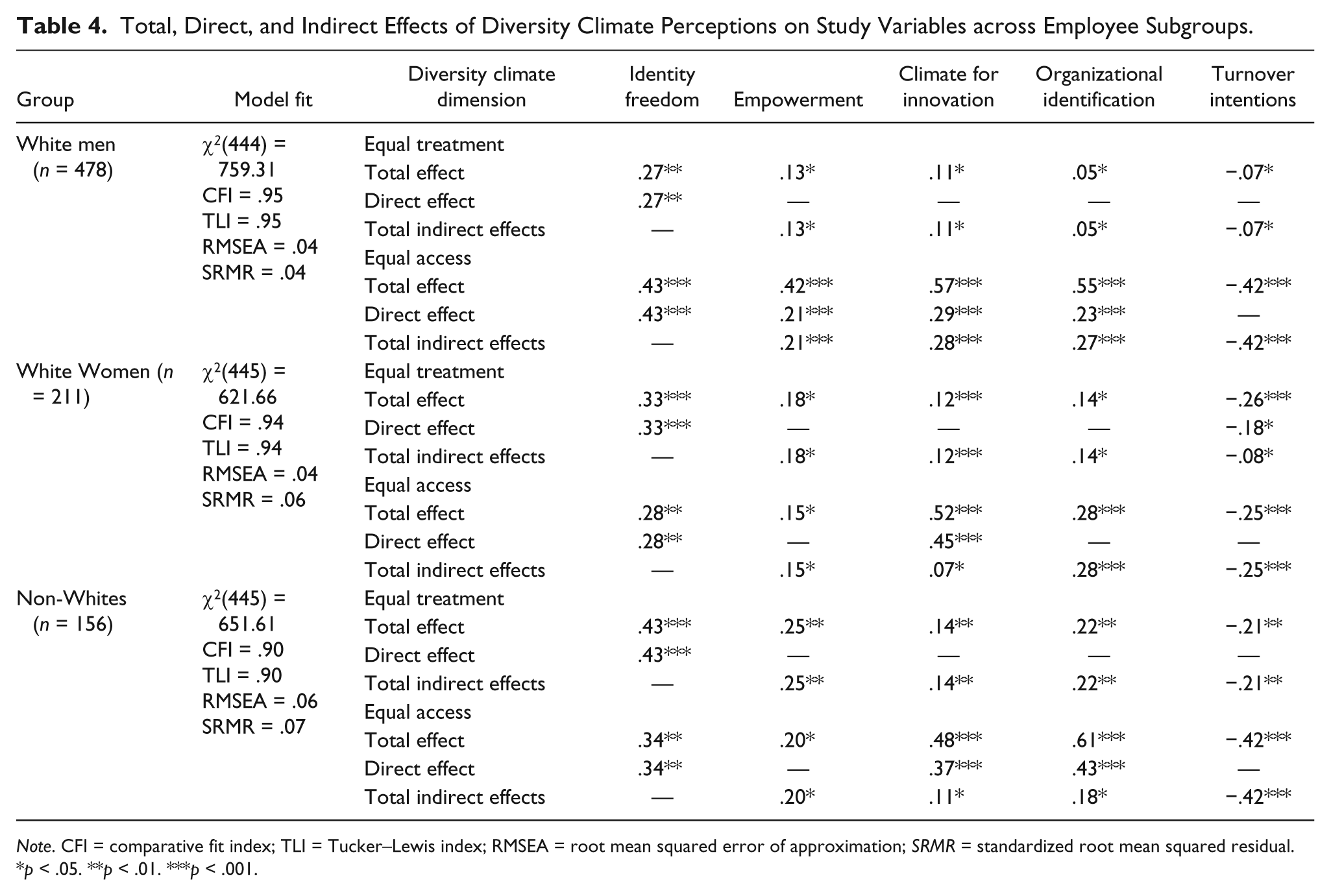
Note. CFI = comparative fit index; TLI = Tucker–Lewis index; RMSEA = root mean squared error of approximation; SRMR = standardized root mean squared residual.
p < .05. **p < .01. ***p < .001.
Results indicated that these models generally fit the data well, with goodness of fit criteria at or close to conventional cutoffs for each subgroup. In support of Hypothesis 3, the effects of Equal Treatment and Equal Access on Turnover Intentions were mediated by the four psychological outcomes across all three employee subgroups, as evidenced by significant total indirect effects (see Table 3). In addition, the pattern of total, direct, and indirect effects of the diversity climate dimensions on the psychological outcomes was consistent across subgroups.
Discussion
The results of this study support the argument articulated in the diversity literature, which is that when organizations manage diversity well and engage in management practices perceived as fair to a diverse workforce, they reap important benefits. Our results suggest that when employees feel they work in an environment in which they have equal access to opportunities and are treated fairly, they are less likely to report intentions to leave the organization. In addition, four psychological outcomes (identify freedom, psychological empowerment, climate for innovation, and organizational identification) fully mediate the relationship between diversity climate perceptions and turnover intentions.
Of these four psychological variables, it appears that identity freedom plays a key role in mediating the relationship between diversity climate perceptions and turnover intentions. Specifically, equal treatment and equal access predicted identity freedom, which, in turn, predicted psychological empowerment, climate for innovation, and organizational identification. Thus, it may be that diversity climate perceptions significantly affect the extent to which employees feel that they can be themselves at work. Moreover, when employees feel free to be themselves and to express their unique perspective, they feel empowered to make decisions affecting their work, feel encouraged to develop innovative solutions, and are more likely to identify with the organization.
In addition, the present research found that these relationships were generally consistent across employee gender and race. The findings suggest that it is important for organizations to take steps to create an affirming climate for diversity for all employees, regardless of demographic differences, and that efforts to do so should encourage employees to tap into and take advantage of their differences in a way that contributes to greater innovation and problem-solving capability (Joshi & Roh, 2013; Konrad, 2003).
The results of the present research also support previous work showing that diversity climate is multidimensional (Herdman & McMillan-Capehart, 2010). Specifically, we found support for two dimensions of diversity climate related to Cox’s (1991, 1994) theoretical work on multicultural organizations. The first dimension, equal access, involves employee perceptions that all employees have access to resources and power, and have the opportunity to take advantage of developmental opportunities within the organization. The second dimension, equal treatment, involves the perception that employees from all demographic groups are treated in the same way, and that discrimination, conflict, and exclusion along demographic lines is minimal. In addition, we found support for four psychological variables that may be considered outcomes of diversity climate perceptions yet are still an important part of creating an affirming climate for diversity. Furthermore, the results of the measurement equivalence/invariance analyses in the present study suggest that all employees (regardless of race or gender) conceptualize diversity climate similarly.
Finally, our findings add to the present diversity literature by providing a better understanding of how diversity climate impacts turnover intentions. Specifically, when employees perceive that organizational practices are fair and believe that they are valued and have equal opportunities to fully participate in and excel within the organization, they will feel a strong sense of identification with the organization, which reduces the likelihood of turnover.
Implications
This research suggests that organizations must realize the importance of going beyond the recruitment and hiring of a diverse workforce. To truly benefit from diversity, organizations must also allocate the resources to create an environment that supports a diverse workforce. These resources will be well-spent, as diversity climate seems to have a significant impact on all employees, including White males, White females, and non-Whites.
This research has also helped clarify the construct of diversity climate, which we hope will advance the field and suggest additional implications for practitioners. Organizations can better focus their resources by taking steps to positively impact employee perceptions of equal access and equal treatment. Employee attitude surveys should contain survey items that focus on diversity climate perceptions as well as the extent to which employees feel that they can be themselves at work and fully contribute their unique perspectives to their work group. Organizations can then track these results and trends over time and also assess any demographic differences in employee perceptions. These data can be used to make organizational changes to improve the climate for diversity.
These findings may also prove to be useful in developing diversity training content and framing diversity in such a way that resistance is minimized (Thomas, 2008). A study conducted by the Society for Human Resource Management (SHRM) found that 76% of organizations provide some type of diversity training (Fegley, 2006). In addition, diversity training is estimated to be a nearly $8 billion industry (Anand & Winters, 2008). Although this information suggests that the overwhelming majority of organizations conduct diversity training, scholars have criticized these programs for many reasons, among them the fact that many programs involve divisive or emotionally damaging exercises, are not developed based on clear training objectives or goals, are unconnected to procedures and programs that will lead to change, and lack follow-up (Chrobot-Mason, Hays-Thomas, & Wishik, 2008). As a result, many diversity training initiatives may actually cause more harm than good and resistance to such programs is often high. The results of this study may help facilitate the development of more constructive and effective diversity training programs. Organizations may find it useful to develop diversity training content that focuses on behaviors that foster an environment in which members have equal access, are treated equally, and experience identity freedom within the organization.
Limitations and Future Research
There are several limitations of this study that are important to consider when conducting future research in this area. Perhaps the biggest limitation is the correlational nature of the data, which necessarily limits conclusions about causal relationships. Even though our final structural model specifies causal relations that are consistent with previous theoretical and empirical work, caution should be exercised in making definitive conclusions about cause and effect relations.
Another limitation involves not having a large enough sample size to examine racial subgroups (e.g., African Americans, Hispanics, Asians, and Native Americans) and, therefore, collapsing these groups into the single category of non-Whites. Because Anderson and Gerbing (1988) recommend a minimum sample size of 150 to obtain meaningful SEM parameter estimates, it was necessary to place all non-White employees into a single category. Thus, future research is needed to examine various racial subgroups to determine if diversity climate is conceptualized differently or leads to different outcomes among various demographic groups. Furthermore, additional outcomes of diversity climate should be examined to expand the scope of the business justification for diversity management. For example, an affirming climate for diversity may impact other employee attitudinal or behavioral outcomes such as organizational citizenship behaviors (OCB) and it may also have an impact on more external outcomes, such as customer retention or corporate image.
Conclusion
Diversity in the workplace has the potential to be an organizational benefit, but also an organizational liability. Research in this area seems to suggest that the key contributing factor in determining such an outcome is the extent to which the organization engages in a set of diversity practices that lead to positive psychological outcomes such that employees feel valued and encouraged to fully contribute to the workplace. Although it may be a difficult decision to invest in resources to measure diversity climate and implement initiatives to improve employee perceptions of climate, our results suggest that organizations that do so will ultimately be making a wise decision.
Footnotes
Declaration of Conflicting Interests
The author(s) declared no potential conflicts of interest with respect to the research, authorship, and/or publication of this article.
Funding
The author(s) received no financial support for the research, authorship, and/or publication of this article.