







Abstract
As organizations face progressively complex challenges, team leader boundary work that is relational and inclusive (i.e., work that relates to others across team boundaries and includes a wide variety of stakeholder perspectives and concerns) is more and more valued. These trends pose advantages and disadvantages for women team leaders. Although the desired leadership competencies align well with the communal qualities often attributed to and expected of women leaders, displaying boundary work behaviors that are relational and inclusive may paradoxically result in a questioning of women’s leadership competence by team members and parties external to the team. Moreover, concerns about gender stereotyping and discrimination may pressure women to adapt their boundary work behaviors to downplay or negate “femininity” as they lead. Reflective of these dilemmas, we propose that female team leaders experience conflicting internal motivations about the boundary work behaviors they display. Drawing from social role, impression management, and social identity perspectives, we examine the motives that drive women leaders to engage in or avoid boundary work that aligns with female gender roles, the contextual influences affecting the likelihood women leaders will act on these motives, and the implications of this boundary work for teams and female team leaders.
Media outlets frequently describe women leaders as more relational and inclusive than male leaders (see Liu, Cutcher, & Grant, 2015) and assert that this tendency has positive impacts on both organizational functioning and leadership attributions (“Women leaders: The hard truth about soft skills [Web log],” 2010; Koplovitz, 2013). However, although organizational scholars have also found that women are often evaluated as relational and inclusive leaders (Anderson, Lievens, Van Dam, & Born, 2006; Eagly & Johannesen-Schmidt, 2001), scholarly data on women leaders’ impact are mixed. Some studies find that women leaders often lead firms to superior performance (Adams, 2014) and better stock market returns (Campbell & Vera, 2010) and that employees give female leaders higher ratings than they give male leaders (Paustian-Underdahl, Walker, & Woehr, 2014), whereas others suggest that women in organizational leadership positions are, on average, seen as less competent and less effective than male leaders (see Eagly & Karau, 2002), and are judged more harshly for making mistakes (Brescoll, Dawson, & Uhlmann, 2010). Scholars conclude there is a female leadership advantage and disadvantage, “that research has established a mixed picture for contemporary female leadership” (Eagly, 2007, p. 9).
In this article, we examine this “mixed picture” of women as leaders of teams in organizational settings, with a focus on an area of team leadership that has garnered growing research attention: team leader boundary work. Team leader boundary work broadly refers to the team leader’s efforts to (a) interact with key parties who reside outside a team’s boundaries and (b) support and defend a team’s boundaries (Faraj & Yan, 2009). Through boundary work, a team leader influences the extent and manner in which her team interfaces with its broader organizational environment (Ancona, 1990). Essential to leader boundary work is the degree to which leaders enable their teams to consider the perspectives of important external parties or to remain relatively isolated from external influences (Druskat & Wheeler, 2003). One way a leader opens the team to outsider influence is by actively soliciting diverse expertise from outside the team to inform her team’s idea generation. Buffering her team from the pressures from upper management is another type of leader boundary work, one that tightens the team’s boundary and enables the team to work autonomously and without interference.
Recent trends in leader boundary work suggest potential advantages for female team leaders, particularly within knowledge-based organizational environments that rely on cross-boundary collaboration and information sharing among work units. Ample evidence supports that as businesses face increasingly complex challenges, such as creating products sustainably, leader boundary work that skillfully includes a wide variety of stakeholder perspectives and concerns advances organizational learning (Edmondson, 1999), innovation (Hargadon, 2002), and team effectiveness (Ancona, 1990). Because these team leadership competencies align with the relational styles attributed to women, this increases the likelihood, frequency, and/or ease with which women leaders will adopt such beneficial boundary work. Furthermore, engaging in inclusive boundary work may be highly motivating to female team leaders as it enables them to meet the strong expectations of women to display “feminine” qualities, namely, communality and consideration of others, while they lead in organizational settings (Eagly & Karau, 2002).
Yet, paradoxically, these same trends may also pose distinct disadvantages for female team leaders who may be disproportionately expected to engage in relational and inclusive boundary work but be evaluated negatively for doing so. According to social role theory (Eagly, 1987; Eagly & Karau, 2002), this potential for prejudice exists because perceivers infer that a female’s display of culturally defined “feminine” behavior confirms stereotypes that women lack the attributes required for effective leadership. For example, demonstrating concern and consideration for others’ perspectives, such as soliciting outsider input into a team’s decision-making, is seen as evidence of women’s innate communal qualities (i.e., warm, congenial, collaborative), which are simultaneously considered to be incongruent with the agentic qualities (i.e., dominant, assertive, independent) of competent leaders (Eagly, 1987; Eagly & Karau, 2002). Thus, while trends toward more inclusive boundary work may align with societal expectations that women are and should be communal, displaying these boundary work behaviors may paradoxically result in a questioning of her leadership fitness by her team and/or the external parties she engages, impeding her ability to effectively lead. Furthermore, when female leaders are concerned about stereotyping, they are likely to experience strong internal motivations to adapt their boundary work behaviors in ways that downplay or negate “femininity” as they lead (Carbado & Gulati, 2000; Klein, Spears, & Reicher, 2007).
In the sections that follow, we unpack team leader boundary work and describe three types of boundary work behaviors commonly used by team leaders to “loosen” team boundaries to include outsider input and to “tighten” team boundaries to restrict external engagement and strengthen the team’s distinction from other teams (Somech & Khalaili, 2014). After considering how leader boundary work aligns with female gender role expectations, we apply social role, impression management, and social identity perspectives to describe the conflicting internal motivations that female team leaders experience about the boundary work behaviors they display as they lead their teams. Reflective of the mixed picture above, we expect that a woman team leader’s approach to boundary work is not likely to be static, but instead is dynamically tailored depending upon her team, organizational context, and the conflicting internal motives she experiences as she leads. A female leader might engage in relational and inclusive boundary work behavior, for example, to meet the expectations that she and others have for her to behave communally, yet her concerns about prejudicial beliefs and discriminatory treatment provide additional incentives to at times, temper or avoid (though at other times to engage) such behaviors. We also illuminate contextual and individual level variables, such as a woman’s personal beliefs, team sex composition, and organizational human resource policies that strengthen or weaken relationships between a woman’s motives about her boundary work and her behavior. We then propose implications of boundary work that aligns with female gender roles for teams and women leaders.
Our article moves beyond extant research on female leadership in three important ways. First, we examine boundary work, a topic not yet considered within the scholarship on gender and leadership. We chose to focus on leader boundary work given its increasing relevance to team, leader, and organizational effectiveness (see Ancona & Bresman, 2007; Druskat & Wheeler, 2003; Morgeson, DeRue, & Karam, 2010), coupled with our belief that boundary work introduces a dilemma for female team leaders. When doing boundary work, it is likely that female leaders’ displays of communality are simultaneously expected, valued, and devalued, presenting an important conundrum for women to understand and navigate as they lead work teams.
Our second contribution is to address identity and power considerations in boundary work, as understood through social identity–based impression management (Roberts, 2005), identity performance theory (Carbado & Gulati, 2000), and facades of conformity (Hewlin, 2003). These frameworks help us consider more fully the internal pressures female team leaders face and the implications for their boundary work behaviors. These frameworks illuminate that, by virtue of their membership in a subordinated social identity group, women must negotiate conflicting internal motives to either affirm or negate their identities. This conflict requires cognitive attention and resources to resolve and arises in response to pressures to conform to organizational values and to circumvent negative stereotypes. This is significant because we believe that the time and investment required of female team leaders to resolve conflicting internal motives results in “hidden” costs that can significantly reduce women team leaders’ effectiveness.
Our final contribution is to suggest that women leaders’ boundary work choices influence group- or team-level outcomes in meaningful ways (please see Figure 1 for an illustration of our full conceptual model). Researchers have explored how women lead individuals and how women lead through creating high-quality one-on-one relationships with followers (e.g., Yammarino, Dubinsky, Comer, & Jolson, 1997), but less is known about how women lead groups as a whole. Our focus on female leader boundary work provides new insights into how women lead teams. We begin with a discussion of team leader boundary work.
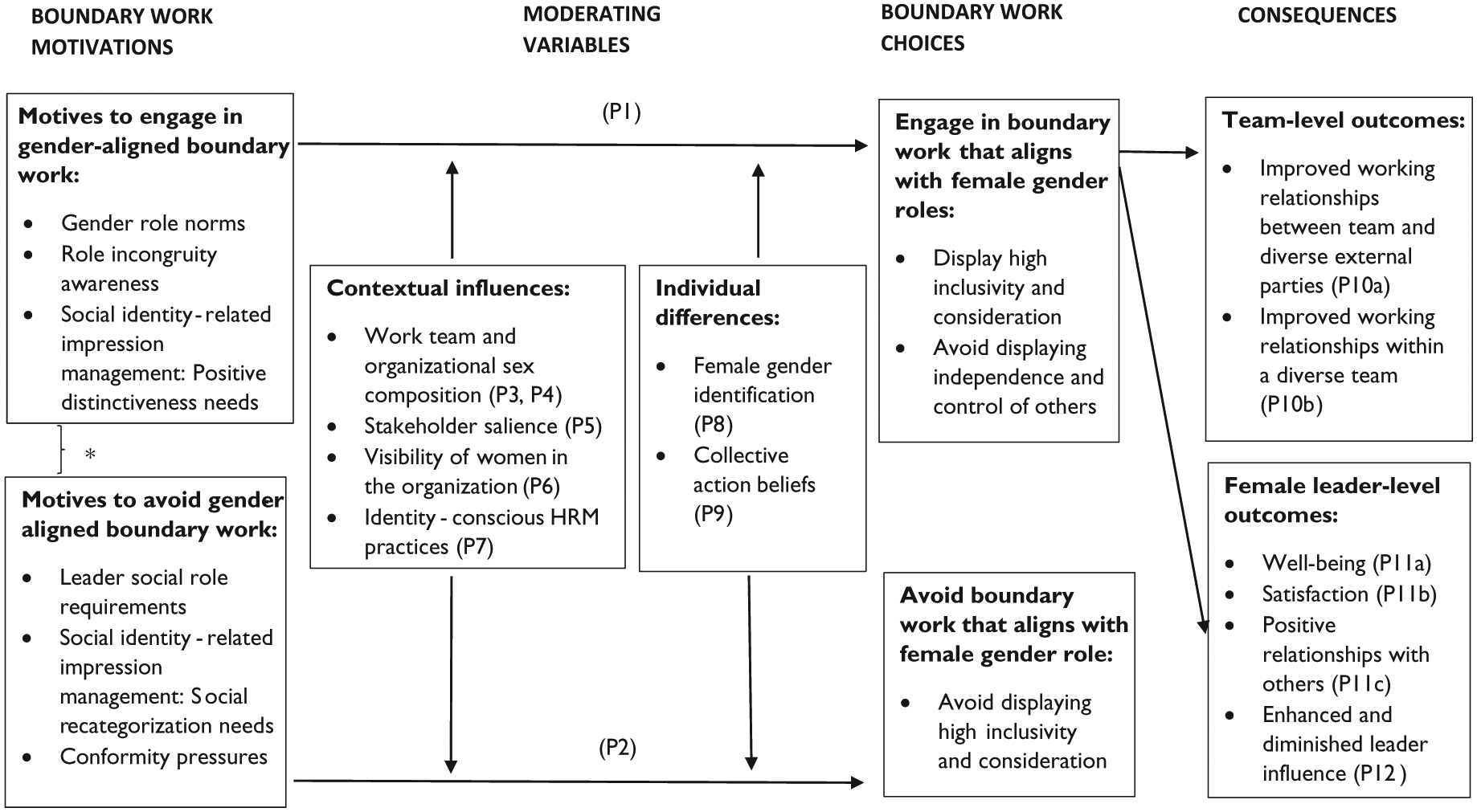
Proposed conceptual model of female team leaders’ boundary work motivations, choices, and consequences.
Theoretical Background
Team Leader Boundary Work
Team leader boundary work broadly refers to the leader’s efforts to interact with key parties who reside outside a team’s boundaries as well as to support and defend a team’s boundaries (Faraj & Yan, 2009). Leader boundary work is necessary because every work team is embedded within a larger organizational system (Ancona, 1990; Sundstrom, De Meuse, & Futrell, 1990), and a team’s success and survival depends on effective engagement with its environment. Particularly important is balancing the need to relate to key external parties who can supply the team with resources, ideas, information, and support with the need to protect team identity and cohesion (Friedlander, 1987; Leifer & Delbecq, 1978). Leader boundary work can thus be conceptualized at the group-level of analysis because it reflects a leader’s efforts to influence collective phenomenon, such as obtaining resources from outsiders or restricting the team’s external engagement, that affect team-level outcomes (Hackman, 2002; Yukl, 2013).
1
Friedlander (1987) emphasizes what he states as the “obvious effects” boundary work can have on relationships between and within teams as follows: Work groups with insufficient definition and with diffuse boundaries tend to be overwhelmed, to lose their unique capabilities, and to be less cohesive. Groups with boundaries that are overly rigid and thick become fortresses unto themselves (p. 305).
Capturing similar sentiments, Somech and Khalaili (2014) distinguished “boundary-loosening” activities from “boundary-tightening” activities; while the former opens the team to its environment, the latter restricts team engagement across its boundary and strengthens the team’s distinction from other teams. When leaders choose boundary-loosening activities, they engage in high levels of external interaction, resulting in teams that are externally oriented, integrated with the directives of their larger organizational system, and influenced by diverse expertise and opinions outside the team (Druskat & Wheeler, 2003). This work enables coordination, adaptation, and collaboration between the leader’s team and other work units, which supports the stability of the larger organizational system (Friedlander, 1987). When leader boundary work tightens, strengthens, and defends team boundaries, this results in teams that are internally oriented, autonomous, and, although these teams are distinctive and clearly identified, they are also more isolated and segmented (Ancona, 1990). Through tightening boundary work, leaders provide their teams with demarcated space and energy to execute teamwork and to produce novel contributions unencumbered by larger organizational pressures or demands (Yan & Louis, 1999).
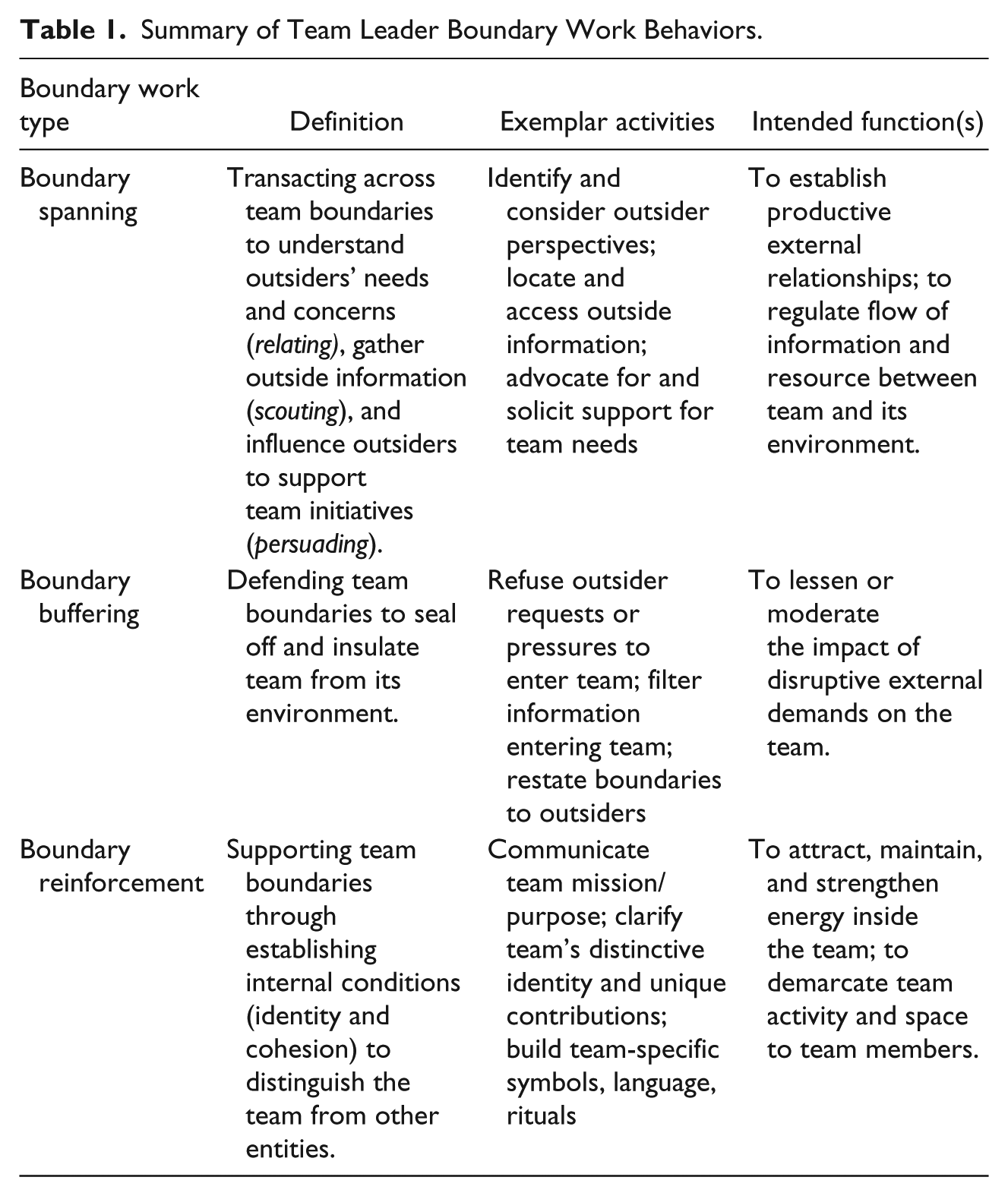
Leaders accomplish boundary loosening predominately through what is known as boundary spanning. Boundary spanning involves transacting across team boundaries to gain important resources, information, and support from key external parties (Ancona, 1990; Faraj & Yan, 2009; Marrone, 2010; Marrone, Tesluk, & Carson, 2007). Boundary spanning includes three subactivities: (a) connecting with key outsiders and relating to their concerns, (b) scouting or probing for external information, and (c) persuading others to support team decisions (Ancona, 1990; Druskat & Wheeler, 2003). Although relating, scouting, and persuading are distinct boundary spanning activities, research demonstrates they are nonetheless highly interrelated and mutually reinforcing. For example, data from Druskat and Wheeler’s (2003) study of leaders of self-managing manufacturing teams showed that when team leaders built relationships through understanding the perspectives, needs, and concerns of key external parties (e.g., upper management, neighboring work units, technical experts, etc.), the leaders gained greater access to external sources of information and were better positioned to both request and secure needed support from these external parties.
Tightening boundaries occurs through two activities: boundary buffering and boundary reinforcement (Faraj & Yan, 2009; Yan & Louis, 1999). Boundary buffering defends and insulates the team from outside pressures and influences, which enables team members to work autonomously toward team objectives and purpose (Leifer & Delbecq, 1978) and to learn from one another free from otherwise disruptive forces in the organization (Faraj & Yan, 2009). An example of boundary buffering is refusing to acquiesce to pressures from other teams to consider alternative viewpoints or to release team information before the team is ready. Boundary reinforcement distinguishes the team from other entities by creating internally cohesive team conditions and clarifying the team’s identity (Yan & Louis, 1999), which are essential for growing the team’s specialized objectives, purpose, and contributions (Friedlander, 1987; Hackman, 2002). An example of reinforcement is establishing team rituals, such as “kickoffs” that clarify and celebrate who is on the team and reinforce internal ties between members. Boundary reinforcement activities conceptually entail “generating a sufficient and sustained centripetal or attracting force that establishes the perimeter of the team’s space” (Faraj & Yan, 2009, p. 607). An important distinction between boundary reinforcement and boundary buffering is the locus of the leader’s attention. When defending the team’s boundary (boundary buffering), leader actions are directed outward on setting limits on external influences, whereas leader actions are directed inward on team cohesion and identity when reinforcing the team’s boundary. In sum, when doing boundary work, team leaders balance their attention between a team’s needs for autonomy and independence and external parties’ needs for inclusion and collaboration. For a summary of these boundary work behaviors commonly used by team leaders, 2 see Table 1.
Summary of Team Leader Boundary Work Behaviors.
Before considering the motives that influence female team leaders’ boundary work choices, and the implications of those choices, it is fruitful to consider briefly the extent to which a leader’s boundary work behavior aligns with both female and male gender roles. Gender roles are the socially shared expectations about how men and women do and should behave. The predominant feature of female gender roles is that women are and should be communal (Fiske & Stevens, 1993). Communality is characterized by displays of concern for the welfare of others and this includes attributes such as warm, nurturing, interpersonally sensitive, gentle, cooperative, and helpful (Eagly & Karau, 2002). Agency, more commonly ascribed to men and central to male gender roles, includes attributes of confidence, assertiveness, independence, and control over one’s environment (Eagly & Karau, 2002). Whereas communality encompasses efforts to promote the growth of others, agency promotes the self through achievement (Schaumberg & Flynn, 2017).
Consequently, when leader boundary work considers others’ perspectives, nurtures, or grows relationships, it aligns with female gender role expectations of communality and reflects cultural definitions of what is feminine. When boundary work promotes the leader’s independence and autonomy vis-à-vis his or her team’s isolation from other parties, and/or controls other parties through restricting the team’s information outflow or persuading others to accept only team initiatives, it aligns with male gender roles and reflects cultural definitions of masculinity. Importantly, our depicting of a leader’s boundary work as more or less feminine or masculine is independent of the leader’s biological sex. Men as well as women may choose to engage in boundary work that aligns with female gender roles as they lead their teams.
Next, we develop our arguments that female team leaders experience conflicting internal motivations to both engage in and avoid boundary work that aligns with female gender roles.
Proposition Development
Motives to Engage in Boundary Work That Aligns With Female Gender Roles
The content of traditional gender roles offers the first reason that female leaders are motivated to engage in boundary work that is relational and inclusive. Female gender roles include both descriptive norms, or expectations that women are communal, and prescriptive norms, or expectations that women ideally should demonstrate care and consideration for others (Eagly & Karau, 2002; Fiske & Stevens, 1993). There is an obvious overlap between women’s gender roles and her use of boundary work that includes, relates to, and supports the concerns of others inside and outside her team’s boundary. Precisely because women are expected to be communal (and internalize such expectations to some extent, see Eagly & Karau, 2002), a female team leader feels internally motivated to loosen her team’s boundaries so that she and her team can understand and collaborate with external parties and tighten her team’s boundaries so that she may grow and develop team cohesion and identity. In their extensive review of gender roles, Eagly and Karau (2002) explain that gender roles have such pervasive effects because sex is the strongest personal characteristic used as basis for categorizing people, stronger than age, race, and occupation, and because gender norms concerning how women do and should behave are automatically activated.
A second reason female team leaders feel motivated to display boundary work behaviors that align with female gender roles is that such choices allow women to overcome a fundamental “role incongruity” uniquely faced by women leaders (Eagly & Karau, 2002). Female leaders experience role incongruity because women are expected to be communal and supportive of others, whereas leaders are expected to be agentic, dominant, and independent of others. Thus, while men experience role congruity (that is, masculinity and leadership expectations largely overlap), female leaders must manage a fundamental role incongruity to succeed. For example, women are often evaluated more negatively than men as leaders (Eagly & Karau, 2002) and this is, in part, because women are liked less when they are seen as autocratic or taking charge (because it does not fit what society expects of women), and they are not seen as competent when perceived as communal and taking care (because it does not fit what society expects of leaders). For a woman to succeed in a leadership position, she must be seen as both a woman and a leader. Boundary work behaviors allow her to navigate this incongruity by enabling her to exercise the necessary hierarchical control required by her leadership role without being perceived as harsh.
A female team leader can use boundary work to display high levels of inclusivity and to avoid displaying high levels of agency. For example, she can use relating and scouting boundary spanning behaviors that gather and include the perspectives of others to demonstrate a visible willingness to learn from outsider perspectives and to show that she leads in concert with the interests, needs, and goals of key external parties. In addition, for her to avoid advocating for only her own interests as she leads, which would result in significantly negative assessments of her (Rudman, 1998), she can use persuading boundary work with relating and scouting behaviors to show that the goals she is championing are shared and were generated in consideration of external parties. This “contextualized persuasion”—or advocacy for her team’s efforts that serve broader interests—is likely to meet gender role expectations for women to care for and support others (in this case, parties beyond herself and her team). Finally, she may minimize other boundary work choices that are distinctively masculine (i.e., demonstrating independence and dominance) because displaying them would more likely exacerbate role congruity conflict. For instance, boundary buffering that isolates her team without visible consideration of outside parties would not display the warmth and kindness that are expected of women, and that women may expect of themselves. Thus, female team leaders may avoid boundary work approaches that are likely to be perceived as agentic because not only do these approaches fail to align with gender role expectations and may result in negative evaluations, but also they serve to amplify (rather than reduce) the tension female leaders feel between being a leader and being a woman.
The impression management and social identity literatures offer additional insights into these motivations. Applying impression management theory, a female leader is motivated to align her boundary work behavior with female gender roles because she understands that by projecting an image consistent with others’ expectations of her to be cooperative, sensitive, and so on, she can shape others’ reactions to her in desirable ways (Leary & Kowalski, 1990). Specifically, meeting these expectations of external parties and team members can generate compliments and social approval that increase her chances of obtaining additional desired outcomes from these parties (e.g., access to information, support, etc.) and boost her self-esteem. Moreover, because boundary work involves public and recurring contact with multiple parties that are important to leader and team success (e.g., upper management, other work units, clients, etc.), it is a likely area where female team leaders are motivated to affect impressions (Leary & Kowalski, 1990).
Applying a social identity perspective suggests that a female team leader may also use boundary work to elevate the positive distinctiveness of her social identity in the minds of others (Roberts, 2005). Social identity is defined as “the individual’s knowledge that he [or she] belongs to a certain social group, together with some emotional and value significance to him [or her] of that membership” (Tajfel, 1978, p. 31). When a female team leader’s social identity as a “female” is salient, 3 she is attentive to social cues indicating how others perceive her identity group affiliation and is likely motivated to influence such perceptions. Her monitoring and desire to control social identity–related impressions are further heightened by her awareness of negative stereotypes that suggest women (as a group) are emotional, indecisive, and unfit for leadership (Carbado & Gulati, 2000; Roberts, 2005). Consequently, she understands that shaping others’ perceptions of her as a woman is essential to influencing their views of her as a competent and desirable leader (Roberts, 2005).
Specifically, a female team leader may engage in boundary work that adheres to female gender roles in an effort to spotlight the positive associations others already have of women or to generate new ones to counter negative stereotypes (Roberts, 2005). Engagement in inclusive boundary work can allow her to highlight that communality and sensitivity (characteristics positively equated with “female”) have enabled her to develop multiple meaningful and sustainable relationships with clients and other work units. Furthermore, she may strategically choose to employ boundary work that adheres to female gender role expectations to generate new associations in the minds of some that being a woman and being a leader can be integrated and are not mutually exclusive. Finally, she may be motivated to display this boundary work to demonstrate that she possesses the ideal characteristics of being female because this validates and affirms her social identity and further allows her to claim its positive aspects, such as the sense of belonging and self-esteem it brings (Leary & Kowalski, 1990; Roberts, 2005).
To recap, female team leaders are motivated to engage in boundary work that aligns with female gender roles because it allows them to meet expectations to be communal, achieve the need to be seen as more collaborative and less hierarchical as they lead, and positively shape others’ impressions of them and their female social identity. We propose the following:
Motives to Avoid Boundary Work That Aligns With Female Gender Roles
Despite all of these incentives to engage in boundary work that aligns with female gender roles, female leaders are also motivated to avoid this boundary work because there is a conflict between leader social roles (i.e., expectations about the characteristics that leaders do and ideally should possess; Eagly & Karau, 2002) and female gender stereotypes. Most people hold expectations that leaders are and ideally should be agentic (Eagly & Karau, 2002; Fletcher, 2004; Schaumberg & Flynn, 2017). Moreover, gender stereotypes suggest that women (and men) are part of “mixed-valence groups,” meaning that displays of high communality and warmth by a female are interpreted as evidence that she lacks the agency and competency required for effective leadership (Fiske, Cuddy, Glick, & Xu, 2002). Consequently, if others see a female team leader’s boundary work as highly feminine, then she risks violating leader social roles and while she may be well liked for acting communally, she is disrespected as a leader for the same (Cuddy, Fiske, & Glick, 2004; Eagly & Karau, 2002). A female team leader is thus motivated to avoid inclusive boundary work because her avoidance can reduce violations of leader social roles and positively shape others’ assessments of her competence.
The second reason why a female team leader is motivated to avoid boundary work that aligns with female gender roles is that her avoidance can shape others’ views of her social identity group affiliation. As discussed prior, a social identity perspective suggests that because women belong to a social identity group that is negatively stereotyped as unfit to lead, women are likely to be motivated to engage social identity–based impression management as they lead. While some women may use “positive distinctiveness” strategies that embrace and affirm their social identity, other women may choose “social recategorization” strategies that distance them from their group affiliation (Roberts, 2005). When a female leader distances herself from her group, she communicates that being a female is not significant or meaningful to her, which makes it less likely that her image as a leader will be threatened by the negative stereotypes of females (Roberts, 2005).
Specifically, a female team leader may wish to avoid boundary work that adheres to female gender roles when interacting with clients and other work units to reduce the salience of her group affiliation during such interactions (to decrease the likelihood these parties will categorize her as a devalued, out-group member and avoid future stereotyping; Roberts, 2005). Reducing information about her social identity provides “room” for her to create a more nuanced and differentiated picture of herself as an individual. By avoiding relational and inclusive boundary work she is in a better position to highlight to others that some other distinctive quality, perhaps her sense of humor or her specialized knowledge of the industry, rather than her group membership have enabled her to develop multiple meaningful and sustainable relationships outside her team. Furthermore, she may strategically choose to avoid boundary work that adheres to female gender roles to appear more similar to members of the in-group (males) so that she is more positively regarded by them (Roberts, 2005).
Finally, further consideration of power and discrimination, as reflected in the lenses of identity performance (Carbado & Gulati, 2000; Klein et al., 2007) and facades of conformity (Hewlin, 2003) theories, offers additional insights into the pressures a women leader may feel to assimilate even when it feels inauthentic. “Identity performances” are the visible and purposeful behaviors employees display as expressions of themselves as members of a social identity group (e.g., females; Carbado & Gulati, 2000; Klein et al., 2007). According to identity performance theory, because women hold less power in society and at work, they are susceptible to choosing identity performances that suppress or negate their sense of self when they perceive that their identity conflicts with their organization’s espoused values. For female leaders, these conflicts occur often around organizational values for leadership, because organizational incentive systems are often inherently reflective of and informed by cultural stereotypes that associate maleness and masculinity with effectiveness and superiority (Acker, 1990; Fletcher, 2004; Treviño, Balkin, & Gomez-Mejia, 2017). Under these conditions, concerns of stereotyping and discrimination around visible leadership behaviors such as boundary work are heightened and women feel pressures to engage in identity performances that downplay “femininity” as they engage in boundary work.
Hewlin (2003) similarly argues that when employees perceive a conflict between their personal values and the values of their organizations, some will feel pressure to create “facades of conformity,” or false representations created by the employee through expressions, gestures, and/or behaviors to appear as if he or she aligns with and embraces organizational values. She explains that employees who are in the minority by virtue of either possessing salient demographic features or values, attitudes, and beliefs that differ from the majority are more likely to create facades because they feel that they must do so to conform and “fit it” and to receive benefits from the majority. Thus, a female team leader’s frequent minority status at work may also heighten the pressures she feels to adapt her boundary work displays to conform to organizational values for leadership even when it feels inauthentic.
To recap, female team leaders are motivated to avoid boundary work that aligns with female gender roles because this allows them to minimize leader social role violations, positively shape others’ impressions of their female social identity, and signal conformity to organizational values regarding leadership. Although women may engage in boundary work that distinctively aligns with male gender roles, we suspect the latter is less likely because appearing masculine results in significant “backlash” and disliking of female leaders (Eagly, Makhijani, & Klonsky, 1992; Eagly & Karau, 2002; Heilman & Okimoto, 2007; Rudman, 1998; see Schaumberg & Flynn, 2017 for a recent exception). We propose the following:
Contextual Considerations: When Women Team Leaders Are Most Likely to Adapt Their Boundary Work to Align With Female Gender Roles
Above, we drew from multiple theoretical frameworks to support why female team leaders experience conflicting motivations to engage in and avoid boundary work that aligns with female gender roles. In this section, we use these theories to identify contextual conditions that affect the salience of women’s motives and the likelihood that female team leaders will act on different motives when making boundary work choices. We begin with a consideration of work team and organizational level factors. It is important to understand contextual influences at these levels because one’s team and the broader organizational environment send signals about what people expect from their leaders, presenting situational opportunities and constraints for leader boundary work behavior (see Johns, 2006). Because leader boundary work operates at the group-level of analysis, and involves frequent interactions with important parties outside the group’s boundary, social characteristics of the leader’s work group and its embedding environment are excepted to be primary sources of variance in leader behavior (Dansereau, Alutto, & Yammarino, 1984). Viewed from this perspective, leadership does not emerge independently from a female leader’s personal qualities, but instead is at least in part conferred upon her by members of her group and organization (see Livi, Kenny, Albright, & Pierro, 2008). We focus on aspects of the context at these levels that can either exacerbate and reduce role incongruities, thereby elevating or lessening the tensions a female leader feels between being a leader and being a woman in that context (Eagly & Karau, 2002), and affecting the likelihood she will act on different boundary work motives.
Work Team and Organizational Level Influences
Sex composition
Sex composition refers to the proportion of women and men on a leader’s team and in her organization. When a leader’s social identity as female is salient and different from many others around her (e.g., when leading an all-male team or enacting boundary work within a mostly male organization), she is more likely to act on motivations that involve negating her identity to assimilate and circumvent negative stereotypes about women. Sex composition affects leader boundary work for three reasons.
First, team sex composition affects how team members interpret their leader’s boundary work behaviors. Specifically, teams comprised of a majority of men are more likely to perceive female team leaders as likable yet unqualified when they display distinctively relational and inclusive boundary work because men often have less experience with female managers and possess more masculine construals of leadership than women do (Eagly & Karau, 2002). Furthermore, her minority status on the team also calls more attention to her sex and increases the tendency for men to perceive her as unqualified to lead (Kanter, 1977). Consequently, a female leader’s concerns about stereotypes are heightened and her expressions of feminine boundary work behaviors are constrained because using positive distinctiveness strategies are unlikely to counter negative gender stereotypes when leading all- or mostly male teams.
Second, team sex composition affects whether the leader can effectively shape the behavior of her team members. Qualitative studies show that when team leaders engaged in relational and inclusive boundary work, they also encouraged and/or directed their team members to do the same (see Ancona, 1990; Ancona & Caldwell, 1992). On all- or mostly male teams, a female leader’s influence may be opposed if her boundary work encourages or requires her team to engage in “feminine” communication styles that are incompatible with team cultures or norms (e.g., competitiveness; Weinberg & Cleveland, 2017). The actual and anticipated resistance to relational boundary work on teams with few women decreases the likelihood that female leaders will engage in such boundary work.
Finally, a team leader’s boundary work choices are shaped by the whether she feels integrated with her team. Relational demography theory (Tsui, Egan, & O’Reilly, 1992) proposes that individuals compare their demographic characteristics, such as sex, with those of coworkers and look for similarities and differences to determine their social position in the workplace. Extensive relational demography research has demonstrated that those who are dissimilar from the majority group (e.g., women leaders in contexts with few other women) feel less integrated with the majority group and a reduced sense of belonging (Elfenbein & O’Reilly, 2007), making it more likely that female team leaders will act to assimilate with those in the majority. There is also evidence at the organizational level that lack of integration can influence women leaders to devalue culturally feminine behaviors (Ely, 1995).
In contrast, when women lead teams comprised of more women than men, they are freer to adapt boundary work that aligns with female gender roles because most team members are likely to have androgynous views of leadership (see Eagly & Karau, 2002). The women she leads are also more likely to support and join her in boundary work approaches that are relational and inclusive because this boundary work adheres to their own gender social roles. Furthermore, her similarity to her team members increases feelings of integration (Elfenbein & O’Reilly, 2007) and reduces her concerns about negative gender stereotypes. Research on stereotype threat, for example, suggests that the presence of other women on the team lessens the pressures and anxieties a female leader experiences regarding negative stereotypes (e.g., Sekaquaptewa & Thompson, 2003). In line with these arguments, we propose the following:
Likewise, the proportion of males and females in the larger organization can also affect the boundary work choices of female team leaders. Organizations that are male-dominated throughout or that have a high concentration of men in leadership ranks, signal high congruence between masculinity and leadership. If a female team leader feels she is not well-integrated with the external parties outside her team’s boundary, she will be more likely to act on her motives to assimilate with those in the majority and avoid behaving in culturally feminine ways (e.g., Ely, 1995) because this context heightens her sensitivity to the penalties she is likely to incur should her boundary work violate leader social roles. In contrast, if the proportion of women is greater than the proportion of men in the organization—provided that women are represented to a greater proportion within leadership ranks and not only at lower levels in the organizational hierarchy—then women leaders’ concerns about negative gender stereotypes are likely to be reduced, freeing them up to engage in more inclusive boundary work. We propose,
Stakeholder salience
When doing boundary work, female team leaders must attend to multiple stakeholders who are inside (e.g., team members) and outside their teams (e.g., upper management, neighboring work units). When a stakeholder is highly salient to a leader, she is motivated to appear as effective as possible to that stakeholder (Leary & Kowalski, 1990). Consequently, when a salient stakeholder signals they hold particularly masculine models of leadership, a female leader is less likely to engage in boundary work that aligns with female gender roles. For example, external work units with task-oriented communication styles (e.g., instrumentally focused on rules, procedures, and work requirements; see Weinberg & Cleveland, 2017), are likely to respect masculine leadership and evaluate communal boundary work as ineffective. A stakeholder might be salient because the leader depends on that stakeholder for obtaining valued outcomes (e.g., subject matter experts who possess scarce technical information) or because the leader expects frequent social contact with that stakeholder (e.g., teams who meet regularly with their leaders) (Leary & Kowalski, 1990). We propose
Visibility of women in the organization
Another important influence affecting the likelihood that female team leaders will act on their motives to use boundary work aligning with female gender roles is the visibility of women to one another in the organization. Klein et al. (2007) explain that when members of a social identity group “are mutually visible and present and communication channels are available within the group, then the possibility of coordination should create a sense of empowerment” (p. 40), which, in turn, leads to behavioral choices by members to emphasize the positive distinctiveness of their social identity group. In these contexts, female team leaders are more empowered to behave in culturally feminine ways because they benefit from the support of other women. Such support likely alleviates some concerns about acceptance from members in dominated social identity groups (e.g., males), thus reducing the salience of motivations to assimilate and avoid or negate female gender roles. Thus,
Organizational identity-conscious human resource management (HRM) practices
Finally, organizational values are developed and signaled through intentional HRM practices. Identity-conscious practices, such as affirmative action policies, are defined as HRM policies and practices that are influenced by social group identity (Konrad & Linnehan, 1995). Researchers have found that identity-conscious practices engender psychological safety, inclusion, and feeling valued and respected (Purdie-Vaughns, Steele, Davies, Ditlmann, & Crosby, 2008). As one might expect, women in companies that embrace gender conscious practices may feel free to act in culturally feminine ways without being penalized or stereotyped (Konrad & Linnehan, 1995).
Yet identity-conscious practices may also have paradoxical effects. Women have stated that gender conscious policies generate an additional burden by placing women “in the spotlight where their failure would reflect negatively not only on themselves as individuals, but on the larger group to which they belong” (Roberson & Kulik, 2007, p. 26). Moreover, identity-conscious workplaces may make negative stereotypes about women more salient because these practices may be interpreted by dominant social identity group members (men) to mean that women are not genuinely qualified for selection or promotion (Heilman, Block, & Lucas, 1992). Heilman’s research is replete with examples of the unintended consequences of identity-conscious practices, and notes that the heightened awareness of gender stereotypes may influence women’s self-evaluations and behaviors (Heilman & Alcott, 2001). Thus, it is possible that when identity-conscious practices are used, women may be concerned about being negatively evaluated if they confirm gender stereotypes, and consequently, women may be more likely to engage in identity-negating ways. Thus, we propose,
Individual Level Influences
Women leaders’ boundary work choices do not solely depend on contextual influences. The social identity–related attitudes and beliefs that women leaders hold are leader-level differences that also shape how likely they are to adapt inclusive and relational boundary work. Like in other instances of organizational behavior, the influence of individual-level differences may be most relevant to boundary work behavior when situational signals from the team and organizational contexts are weak or conflicting (see Johns, 2006). We examine the leader’s level of female gender identification and her beliefs about the need for social change.
Female gender identification
Gender identification is defined as the importance, meaning, and value that one places on gender as part of his or her self-definition (Schmader, 2002). Gender identification is consequential for a female team leader’s boundary work choices because the stronger her gender identification, the more motivated she is to maintain a positive image of women and the more susceptible she is to the devaluing of women in her workplace (Schmader, 2002). These responses are, in part, because “a benefit to the group counts as a benefit to the self, at least for high identifiers” (Klein et al., 2007, p. 31). In addition, individuals desire to be seen by others in ways that mirror their self-concept (Leary & Kowalski, 1990). Consequently, highly gender-identified female leaders are more likely to respond to negative gender stereotypes by acting in ways that display and affirm their identity as women because they want to positively restore “the social meaning of that identity” (Roberts, 2005, p. 698). Because high identifiers see being a woman as a strength they bring to the table, they are motivated to tighten and loosen their team boundaries in feminine ways. We propose
Need for collective action beliefs
In addition, women team leaders are more likely to display boundary work that distinctively affirms femininity when they feel the need to a change stereotypes and influence the treatment of women within the workplace more broadly (Klein et al., 2007). Research on social mobilization demonstrates that the collective behavior of low status groups is often required to achieve group goals (Van Zomeren, Postmes, & Spears, 2008). For example, because Dr. Martin Luther King and other leaders of the American Civil Rights Movement defined African Americans as equal citizens engaged in nonviolent protest to achieve due rights under the law, those engaged in the struggle had to act collectively and nonviolently to gain the ends of the Movement. Similarly, when women team leaders believe women are devalued and feel that social action is needed to correct this, they are more likely to positively frame culturally feminine behaviors as appropriate for leadership and believe that women must behave accordingly if they are ever to be recognized within their organizations. We propose
Implications of Boundary Work That Aligns With Female Gender Roles
Now that we have examined women’s motives to engage in or avoid boundary work that aligns with female gender roles, and the contextual influences affecting the likelihood women leaders will act on these motives, we propose implications of this boundary work for teams and leaders.
Leader boundary work that is relational and inclusive has the potential to help teams improve their relationships with external working units composed of diverse others (Ancona, 1990; Druskat & Wheeler, 2003). For example, when a leader engages in boundary spanning that seeks to understand the needs of other teams and influences her team to do the same, this improves perspective taking, reduces stereotyping, and strengthens social connections with others (Ku, Wang, & Galinsky, 2015). Moreover, this boundary work can improve coordination with other teams through imitation or mimicry (Galinsky, Ku, & Wang, 2005). When working cross-culturally, for example, teams that learn and copy the behaviors of their interaction partners are more likely to avoid cultural gaffes or missteps (though not in all cases, see Cho, Morris, & Dow, 2018). The improved social connection and task coordination across diverse teams stimulates organizational learning (Edmondson, 1999) and innovation (Hargadon, 2002).
In addition, leader boundary work also has important implications for relationships within diverse teams. Specifically, boundary reinforcement that nurtures and responds to internal team members’ needs for team identity and cohesion reduces tension on teams with diverse members. For example, the development of a superordinate identity may ease tension by getting all members to focus on a common goal that is important to members of the team (Thomas, 2005). Boundary tightening can also result in cohesive teams that contribute novel solutions to organization problems (Friedlander, 1987). We propose
For women leaders, their use of relational and inclusive boundary work behaviors can result in more authentic self-presentation because it gives them an opportunity to be communal in a role where they are usually expected to be agentic. Consequently, female team leaders can experience the psychological benefits of acting authentically, be more satisfied with their organizations, and are more likely to be retained in environments where such boundary work is valued (Roberts, 2005). Moreover, because female team leaders are acting in ways that are aligned with female gender roles, they more likely to experience positive interpersonal relationships with others (Leary & Kowalski, 1990). We propose:
However, women team leaders are also likely to experience a “double-bind” whereby exercising relational and inclusive boundary work results in positive experiences of authenticity, yet also causes female leaders to be judged as less agentic and independent (Eagly & Karau, 2002; Fiske et al., 2002). Furthermore, women who engage in relational and inclusive boundary work may be under-rewarded (Heilman & Chen, 2005), which may diminish their leadership potential and influence. Boundary work that adheres to female gender roles may also compromise a women’s advancement in her organization because ascendance to higher levels of management often requires highly agentic displays (Eagly & Karau, 2002; Martell, Parker, Emrich, & Crawford, 1998). Yet if a women’s boundary work approach matches key stakeholders’ expectations and preferences for leadership, she may also grow her leadership influence. For example, if women display distinctively communal boundary work to external parties in flat, decentralized organizations that value “feminine” leadership, or to team members who prefer egalitarian communication styles to accomplish shared goals, her leadership influence and position may advance because her boundary work is well suited to meet stakeholder expectations (see Weinberg & Cleveland, 2017). We, therefore, propose
Finally, female team leaders likely pay additional “hidden” costs as they attempt to navigate conflicting motivations about boundary work. Specifically, for some women concerns of discrimination and negative leader evaluations are so great that they must enact facades or engage in identity performances that amount to identity denials to be successful within their firms. Research on facades and acting inconsistent with one’s sense of self suggest that these behavioral displays can result in significant psychological and emotional distress (e.g., Hewlin, 2003; Roberts, 2005). In addition, our examination suggests that female team leaders must frequently expend energy navigating the minefield of female gender role expectations in addition to providing guidance to her team. This mental labor has the potential to detract significantly from the female leader’s objective performance.
Discussion
Research Implications and Future Research Suggestions
Our research advances extant boundary work literature in two primary ways. First, we extend understanding about why and when female team leaders might engage in boundary work that is relational and inclusive, and how such work affects themselves and their teams. A careful review of the boundary work literature reveals most researchers study male leaders (a recent exception is Benoliel & Somech, 2015). We suspect our research will fuel new examinations of female leader boundary work and its impact. We believe such endeavors are timely and relevant given increasing demands on organizations to understand, consider, and incorporate diverse viewpoints as they generate new solutions to organizational problems. Second, we extend the understanding of how the context or conditions outside of the team may influence the ways in which leaders engage in boundary work. Because boundary work researchers have not previously measured the social psychological aspects of context, such as the demographic composition of the team or organization, they may be missing the “bundle of stimuli” (Johns, 2006, p. 388) that influence when and how boundary work is performed. Furthermore, our competing propositions on the effects of identity-conscious HR practices reveals how difficult it can be to avoid the negative effects of gender bias on women’s leadership behaviors, boundary work included. Future researchers should examine how identity-conscious practices influence women’s leadership behaviors.
This article also offers new insights into how people present themselves at work. Fertile opportunities exist for extending research on impression management including identity-negating performances (Klein et al., 2007) and facades of conformity (Hewlin, 2003). Our research adds a better understanding of the special burden that membership in a subordinated group places on self-presentation. Although members of all identity groups engage in impression management to various degrees, groups that are stereotyped with attributes that are antithetical to valued roles within corporate America have to engage in more and different forms of impression management. Our article highlights that women have the burden of overcoming role incongruity (leader and woman), which can be done through boundary work activities that adhere to female gender roles. However, our research also points out that even as women consider performing these boundary work behaviors, they are cognizant that such displays may be evaluated using negative stereotypes about women. Future research should examine how women leaders navigate the tension between displaying positive female norms while also guarding against negative female stereotypes. Examinations of leader political skill (Ahearn, Ferris, Hochwarter, Douglas, & Ammeter, 2004), for example, may be a fruitful first step.
Another important future consideration is that women are at various stages of identity development. Research on feminist identity development suggests that identification can range from passive acceptance where women deny sexism and discrimination to active commitment where women are dedicated to working for women’s rights (Downing & Roush, 1985). Identification exists on a continuum and women at different stages will respond to stereotypes and gender roles in varying ways. We suspect that some women disidentify with being female and define themselves as the opposite of what is culturally defined femininity. Moreover, women who are members of other subordinated groups (e.g., African American women) and identify strongly with multiple social identity groups (female and African American) likely have different experiences and boundary work strategies than White women (Parker & ogilvie, 1996). We suspect members of multiple marginalized groups have learned how to be successful by employing unique boundary work strategies that may be yet unexplored because these groups are not included in study samples or are included in small numbers. Future research is needed to study how gender identity development and multiple identities affect women’s boundary work. Future research may also examine how a female team leader’s identification with her work team and organization (Ashforth & Mael, 1989) interact with her other social identities (e.g., as a woman and an African American) to predict her boundary work motivations and behaviors.
Finally, future examinations might also explore the conditions under which different stakeholders inside and outside the team converge and diverge in their attributions of the leader during the same boundary work displays (e.g., as altruistic or self-interested; see Ferris, Bhawuk, Fedor, and Judge [1995]), and if anticipating divergent attributions would further affect a women’s boundary work motivations and choices.
Practical Implications
Although many organizations are aware of the glass ceiling, practitioners do not often address the personal costs borne by women who attempt to meet primarily masculine leadership expectations. Organizations can use our research to consider the costs associated with identity performances in terms of time, effort, and identity negation. Furthermore, our research increases awareness that identity struggles are especially high when prejudices about women are strong and when leadership styles valued by the company exclude culturally feminine behaviors. Indeed, we expect that the combination of role incongruity and identity performance requirements create conditions under which women utilize an extraordinary amount of cognitive energy to manage threats associated with negative stereotypes, ensure they behave in gender normative ways, and exercise prototypical leadership behaviors. These cognitive costs are likely to negatively influence women’s performance and well-being. However, research suggests that creating identity-safe conditions where women know that being a woman is not a barrier to success leads to higher performance (Davies, Spencer, & Steele, 2005). For example, assuring female leaders that successful boundary work in the organization is marked by communal qualities may reduce attrition of female leaders. Furthermore, empirical evidence from Elsesser and Lever’s (2011) survey of over 60,000 employees showed an increasing acceptance of female leaders and a preference for what some scholars have termed “feminine leadership” (e.g., sensitive leaders). These findings could suggest that women can increasingly use boundary work that is communal to meet both leader and gender roles and be preferred by followers.
It is also important for organizations to understand and remember that gender bias, norms, and stereotypes are insidious and often unconscious. Thus, attending to the context, rather than attempting to “fix” individual managers or female leaders, is likely to be most effective in creating conditions where women can be successful as leaders. For example, our investigation suggests that the visibility of women to one another affects whether women can engage authentically in boundary work behaviors, so one strategy would be to support workplace affinity groups. Finally, we suggest improving ambiguous metrics for evaluating leaders to diminish the impact of negative gender stereotypes (Williams, Phillips, & Hall, 2016). Clear, quantifiable metrics will allow managers and coworkers to judge all leaders more objectively but it will be especially beneficial to women leaders.
Conclusion
There is a rich opportunity for research on how female team leaders can adapt their boundary work displays to manage role-incongruity, circumvent negative gender stereotypes, and realize the advantages of relational and inclusive leadership. Tests of our propositions may enhance understanding of why and when female team leaders engage in or avoid boundary work that aligns with female gender roles, and may further explain inconsistencies in women leaders evaluations. Our incorporation of power and identity considerations introduces the dramaturgical aspects of leadership and suggests that while role prescriptions are important, women’s boundary work is also affected by concerns about affirming negative stereotypes that weigh on their choices as leaders. Finally, our theory proposes that contextual factors can strongly influence how women resolve conflicting motives about the boundary work they display and suggests these choices have meaningful implications for leaders and work teams. Organizations that attend to such factors can create conditions where female team leaders can flourish.
Footnotes
Declaration of Conflicting Interests
The author(s) declared no potential conflicts of interest with respect to the research, authorship, and/or publication of this article.
Funding
The author(s) received no financial support for the research, authorship, and/or publication of this article.
Associate Editor: Lucy Gilson