







Abstract
Our study focused on the low leader–member exchange (LMX) minority under the LMX differentiation context. Specifically, based on the group engagement model, we proposed that high LMX relational separation (LMXRS) impairs subordinates’ organizational altruism behaviors through undermining their procedural justice perception; furthermore, such an effect is stronger for low-LMX members in low overall LMX differentiation groups. Using data collected from 4 companies in China that included 49 teams and 273 employees, we demonstrated that high LMXRS entails a lower procedural justice perception and fewer follow-up altruism behaviors, especially for low-LMX members. Moreover, the three-way interaction result showed that the detrimental effect of high LMXRS on low-LMX members’ procedural justice perception and follow-up organizational altruism behaviors is stronger when the group-level LMX differentiation is low. We discussed the theoretical and practical implications of these findings.
Keywords
Introduction
People were born equal, yet they are treated differently everywhere. Differentiated treatment from those in authority is ubiquitous, especially in the workplace. Taking the leader–member exchange (LMX) relationship as an example, high-LMX members share mutual trust, open communication, and reciprocal support with supervisors, while low-LMX members’ relationship with supervisors is limited to basic contractual-type obligations (Dienesch & Liden, 1986). Except for determining their relationship with supervisors, researchers also proposed different LMX relationships could shape subordinates’ in-group membership in a “relative” way (Hogg et al., 2005). More specifically, as team members lack an objective standard to evaluate their relationship with the leaders, they could become sensitive to other coworkers’ LMX quality during face-to-face interaction and hence compare themselves with coworkers to generate information about their relative standing on the whole LMX map (Henderson, Wayne, Shore, Bormmer, & Tetrick, 2008; Hu & Liden, 2013). As responses to this proposition, recent LMX differentiation research focused on the individual-within-group level (meso level) and examined how LMX differentiation determines subordinates’ perceptions and behaviors at the meso level (Henderson et al., 2008; Hu & Liden, 2013; Tse, Ashkanasy, & Dasborough, 2012; Vidyarthi, Liden, Anand, Erdogan, & Ghosh, 2010).
However, when exploring the effect of meso-level LMX differentiation on subordinates, almost all studies focused on the effect of subordinates’ relative LMX (RLMX) or LMX social comparison (LMXSC) and the social meaning of whether one’s LMX quality is better or worse than coworkers (for one rare exception, see Harris, Li, & Kirkman, 2014). Indeed, having better LMX than coworkers has been proved effective in maintaining individual psychological contract fulfillment (Henderson et al., 2008), fostering social identification (Tse et al., 2012), and spurring job self-efficacy (Hu & Liden, 2013) beyond traditional LMX quality. But such an overemphasis could be problematic as it prevents us from having an all-round understanding of meso-level LMX differentiation. Based on group diversity typology (Harrison & Klein, 2007), LMX differentiation is considered as a multifaceted concept including three aspects, namely, separation, disparity, and variety (Buengeler, Piccolo, & Locklear, 2021; Martin, Thomas, Legood, & Dello Russo, 2018). As Harris et al. (2014) suggested, at the meso level, the concept of RLMX or LMXSC captures only the disparity aspect which makes both of them ill-equipped to “answer questions regarding one’s overall similarity or dissimilarity” (Harris et al., 2014, p. 315). To address the similarity or dissimilarity issue and capture the separation aspect of meso-level LMX differentiation, Harris et al. (2014) introduced a new concept, LMX relational separation (LMXRS), to measure whether the focal member’s LMX quality is similar to that of his/her colleagues (low LMXRS) or not (high LMXRS). Furthermore, Harris et al. (2014) proved the accentuating effect of low LMXRS on the relationship between LMX and subordinates’ engagement behaviors while giving us limited knowledge of whether, how, and when LMXRS could directly influence subordinates’ workplace behaviors.
We believe examining the consequences of LMXRS is rather rewarding for us to understand the meso-level LMX differentiation. First, we posit LMXRS could construct subordinates’ in-group membership from the social identity perspective (Buengeler et al., 2021; Harris et al., 2014). Specifically, differing LMX quality could trigger a social categorization process where those sharing similar LMX identify with each other and exclude those with dissimilar LMX (Hogg & Terry, 2000). Consequently, high LMXRS indicates one’s identity as an isolated minority in terms of LMX quality which is likely to reduce his or her coworker-oriented cooperative behaviors (Omilion-Hodges & Baker, 2013; Sherony & Green, 2002). Furthermore, based on the group engagement model (Tyler & Blader, 2003), group membership information could serve as sources of subordinates’ procedural justice judgment (Haynie, Cullen, Lester, Winter, & Svyantek, 2014; Omilion-Hodges & Baker, 2013) and hence drive subordinates’ coworker-oriented cooperative behaviors. Given the importance of coworker-oriented organizational citizenship behaviors (OCBs) for task fulfillment (Farmer, Van Dyne, & Kamdar, 2015; Kim, Park, & Park, 2020) and the central role of justice in organizational life (Tyler & Blader, 2003), it is necessary for us to investigate the potential relationships between LMXRS, procedural justice, and coworker-oriented cooperative behaviors, such as organizational altruism behaviors.
Moreover, for the concept of LMXRS itself, we still need to clarify how it interacts with other LMX attributes to influence subordinates. As a nondirectional concept, the effect of LMXRS on subordinates’ group membership could hinge on group members’ own LMX quality (Harris et al., 2014). As shown in social identity research, the negative minority within a group is regarded as the “black sheep in the flock” (Hogg & Terry, 2000; Marques, Robalo, & Rocha, 1992) while members of the positive minority are labeled as high flyers (Hogg & Terry, 2000) who are socially attractive and valuable (Cialdini et al., 1976). Therefore, we contend that low LMX possibly makes high-LMXRS members the black sheep and hence impairs their justice perception as well as follow-up organizational altruism behaviors. However, such a statement may contradict the optimistic tone made by Seo, Nahrgang, Carter, and Hom (2018) who argued that low LMX could force the minority to undertake constructive changes to facilitate the group or attempt to blend into the majority. Considering these contradictory arguments and the importance of these deviants (Bolinger, Klotz, & Leavitt, 2018), further empirical examination of these solo-status members is necessary (Seo et al., 2018). Moreover, earlier research also conceptualized LMX differentiation as the overall variability of LMX at the group level (Liden, Erdogan, Wayne, & Sparrowe, 2006). We regard this group-level LMX differentiation could serve as an important contextual factor in shaping the interactive effect between LMXRS and LMX as group members could utilize the general LMX differentiation atmosphere as a referent to their standing. Understanding the relationship between LMXRS and other LMX concepts, especially how it interacts with them to influence subordinates, is important for the clarification of the concept itself, yet no published papers have examined how this cross-level interaction influences subordinates’ procedural justice perception and organizational altruism behaviors.
In a nutshell, our research aims to shed light on the detrimental effect of the separation aspect of LMX differentiation at the meso level and to investigate whether, how, and when LMXRS could influence subordinates’ organizational altruism behaviors. Specifically, one of our purposes is to explore the direct effect of LMXRS on subordinates’ organizational altruism behaviors and the mediating role of procedural justice perception. Also, we aim to investigate how LMXRS interacts with absolute LMX quality and how this process is influenced by the group-level LMX differentiation. Using the group engagement model (Tyler & Blader, 2003) as our theoretical lens, we contend that high LMXRS leads to fewer organizational altruism behaviors by dampening the subordinates’ procedural justice perception and that such a negative effect of LMXRS is stronger for low-LMX members under low group-level LMX differentiation.
Our work makes several contributions to the existing literature. First, we fill the knowledge gap by highlighting how LMXRS impairs individual procedural justice and organizational altruism behaviors. We view LMXRS as a deep-level indicator of diversity (Harris et al., 2014) and argue that high LMXRS establishes the identity of the minority, which undermines the principle of leaders’ neutrality (Chen, He, & Weng, 2018) and induces less internal support and social recognition (Li & Liao, 2014). Hence, in line with the group engagement model (Tyler & Blader, 2003), high LMXRS jeopardizes the conditions for group members to perceive procedural justice and perform high-level organizational altruism behaviors. In doing so, we also respond to the calls to study LMX at different levels and through different theoretical paths (Gerstner & Day, 1997) and to study leadership through a social identity lens (Hogg, Haslam, Steffens, & Gaffey, 2019).
Second, we show our concern about the plight of the low-status minority in LMX by proposing an interaction between LMXRS and LMX. In explicating the identity and engagement state of these double deviants, we propose that low LMX will not motivate the minority to seek constructive change (Seo et al., 2018) but will deteriorate their procedural justice perception and altruism behaviors. We make a nuanced contribution to LMX differentiation research by exploring how LMX differentiation influences the “black sheep” within the team and respond to the calls to pay more attention to noncore members (Bolinger et al., 2018) and low-LMX members (Bolino & Turnley, 2009; Ma & Qu, 2010).
Third, our research contributes to LMX differentiation research by showing how employees react to LMX heterogeneity across different levels and various aspects. In recent years, scholars have realized the multilevel nature of LMX differentiation (Henderson et al., 2008) and expanded the taxonomy and measurement to capture its aspects fully across different levels (Martin et al., 2018), enabling a discussion of how its various aspects interact with each other to influence employee work outcomes (Henderson et al., 2008; Liden et al., 2006). In doing so, we respond to calls to consider various properties of LMX differentiation within the same study (Martin et al., 2018) and suggest paying more attention to choosing the right property and analysis level based on phenomena and theories in LMX studies (Buengeler et al., 2021).
Theoretical Background and Hypotheses
LMXRS: A new LMX Differentiation Concept at the Meso Level
Differentiation is the basic tenet of LMX theory as it assumes that leaders tend to develop differentiated exchange relationships with their subordinates. Moreover, not only operating at both the group level and the meso level, LMX differentiation also contains various aspects (Martin et al., 2018), including separation, disparity, and variety (Buengeler et al., 2021; Harrison & Klein, 2007). Specifically, the separation aspect of LMX differentiation captures horizontal similarity or dissimilarity among individuals in LMX quality, the disparity aspect represents the vertical difference in the distribution among individuals in LMX quality, and the variety aspect depicts differences in the category or type of LMX quality.
Based on this group diversity typology, both belonging to meso-level LMX differentiation constructs, LMXRS is different from RLMX in the category of the diversity construct, underlying theory, and conveying social information. First, LMXRS is a separation construct that describes horizontal dissimilarity to other members in LMX while RLMX is a disparity construct that captures vertical differences between one’s own LMX and the average level of LMX in the group. Second, the concept of LMXRS is deeply rooted in social attraction and social categorization from coworkers (Hogg & Terry, 2000) while RLMX is built on social comparison among group members (Hu & Liden, 2013). Third, LMXRS could send disparate social information from RLMX. For group members, LMXRS is a proxy for “a psychological process through which a sense for one’s relational separation is determined” (Sparrowe & Emery, 2015, p. 19) and is well equipped to answer questions regarding the effect of one’s similarity and dissimilarity in LMX while RLMX is a proxy for the psychological comparison process through which one’s own LMX position in the group is determined and is suitable for answering questions pertaining to one’s superiority or inferiority to others in LMX (Harris et al., 2014).
The difference between LMXRS and group-level LMX differentiation lies in their operating level and the social information that they can impart. Specifically, group-level LMX differentiation is operationalized as the overall heterogeneous atmosphere of in-group LMX relationships (Liden et al., 2006) while LMXRS captures the focal member’s dissimilarity or similarity to coworkers in LMX at the meso level (Harris et al., 2014). Therefore, group members could have unique LMXRS scores under the same group-level LMX differentiation (Harris et al., 2014). As for conveying social information, different from LMXRS capturing one’s own unique standing, group-level LMX differentiation serves as a proxy for the perception of the overall LMX differentiation atmosphere shared by all the group members, such as “In our group, our leader treats us differently (similarly).”
Group Engagement Model: Linking the Relational Theory of Procedural Justice With Social Identity Theory
The group engagement model (Blader & Tyler, 2009) integrates two theories that are closely related to the multilevel nature of LMX differentiation, namely, the relational theory of justice (Tyler & Lind, 1992) and social identity theory (Turner, 1975), to explain how the formal and informal treatment quality that individuals receive within the group leads to their cooperative behaviors via procedural justice. Procedural justice is defined as the individual perception of fairness in the resource-allocating and decision-making procedures within the organization. Originated from legal settings, early procedural justice research focused exclusively on the formal procedural aspect of decision-making and resource-allocating procedures (Thibaut & Walker, 1975) while neglecting procedures’ implications for individual personal value and self-worth perception (Tyler & Lind, 1992). To fill this gap, the relational theory of procedural justice is proposed to address the relational antecedents of procedural justice perception (Tyler & Lind, 1992). It pinpoints the relationship with leaders as essential sources for group members to construct their group membership, perceive in-group value, and thus generate procedural justice. More specifically, it proposes that three relational concerns with leaders, namely, neutrality, trustworthiness, and status recognition, determine subordinates’ perception of procedural justice (Tyler & Lind, 1992). In other words, subordinates perceive the group procedure as fair only when they are treated equally, their leaders are trustworthy, and their status is socially recognized (Chen et al., 2018).
On the other hand, the group engagement model draws on social identity theory to explain why individuals’ procedural justice perception determines their discretionary cooperative behaviors (Tyler & Blader, 2001, 2003). As proposed in the group engagement model, the perception of procedural justice provides identity security for group members to merge themselves with the group and perform more voluntary behaviors that benefit others in the group. In other words, when individuals believe that they are treated fairly during resource-allocating and decision-making procedures, they are less concerned about the potential pitfalls of forming identification with their coworkers and the group as a whole. With stronger identification with their coworkers and the group, they are more likely to take the initiative to help others and the group. Otherwise, if they have no faith in procedural justice, they feel more vulnerable to the risks entailed by identifying with their coworkers and the group and hence less willing to lend a hand when their coworkers and the group are in need.
The Influence of LMXRS on the Procedural Justice Perception
The group engagement model (Tyler & Blader, 2001, 2003) suggests LMX differentiation may shape subordinates’ procedural justice in two ways: it could impair group members’ preference for fairness in leader–workgroup relationships and provide social information for subordinates to construct their in-group membership (Harris et al., 2014). Therefore, we propose that the first reason why high LMXRS impairs subordinates’ procedural justice perception is that it violates the principle of neutrality in the relational theory of procedural justice. In fact, procedural justice is germane to LMX differentiation phenomena as high-LMX members and low-LMX members receive differentiated treatment from team leaders (Martin et al., 2018). In the resource-allocating context, team leaders allocate more resources, tangible (e.g., delegated tasks) and intangible (e.g., trust and emotional support), to high-LMX members while allocating limited resources to low-LMX members (Liao, Liu, Li, & Song, 2019). In the decision-making context, high-LMX members are also favored by team leaders in performance evaluation and the judgment of deviant behaviors in such a way that their performance is always overestimated (Ma & Qu, 2010) and their deviant behavior is always underestimated (Kluemper, Taylor, Bowler, Bing, & Halbesleben, 2019). Thus, in teams with varying LMX quality, high-LMXRS members are more likely to face differentiated treatment from supervisors during resource-allocating and decision-making procedures.
Organizational justice theory indicates that people have an inherent aversion to unjust behaviors beyond their self-interest (Adams, 1965; Cropanzano, Goldman, & Folger, 2003). For high-LMXRS members, biased treatment from team leaders contradicts their inherent preference for equal and constant treatment from leaders and makes them less likely to perceive justice in resource-allocating and decision-making procedures (Sias & Jablin, 1995). In addition, as Tyler and Lind (1992) suggested, the most salient representation of leaders’ neutrality is the belief that leaders are not prejudiced against certain group members. Since high-LMXRS members are either extremely disliked or extremely favored by team leaders, it is hard for them to believe that their leaders can treat group members in a disinterested manner. To put it succinctly, high LMXRS arouses subordinates’ concerns about the neutrality of the leaders and makes it difficult for them to perceive high procedural justice.
Except for violating the neutrality principle, we propose that the negative relationship between LMXRS and procedural justice perception could be imputed to a loss of social recognition induced by leaders’ differentiated treatment. For one thing, we propose high LMXRS could introduce a negative group membership to the focal member and undermine their perception of in-group value and social status. Specifically, based on balance theory, two members with dissimilar LMX quality have been proved less likely to establish close relationships with each other (Omilion-Hodges & Baker, 2013; Sherony & Green, 2002). Moreover, social identity theory suggests that individuals tend to define themselves in line with certain prototypes through social categorization based on similarities shared by group members (Ashforth & Mael, 1989; Hogg & Terry, 2000; Tajfel, 1974). Therefore, for team members, high LMXRS results in their prototypically marginal status, makes them more susceptible to being socially excluded by team members, and reduces their perception of personal value within the group. Albeit the fact that this loss of social status comes directly from coworkers rather than team leaders, it still could lead group members to form a negative judgment of leaders’ role in enacting procedures fairly. As is suggested by Tyler and Lind (1992), “People evaluate and react to authorities and their decisions in terms of what they gain and lose from the authorities' decisions” (p. 120). Similarly, the multifoci justice theory contends individuals emphasize who should hold responsibility for violating principles of justice when forming justice perception (Lavelle, Rupp, Manegold, & Thornton, 2015). For high-LMXRS members, it is their leaders who treat them differently and break the principle of justice, which entails them isolated status (Harris et al., 2014), reduces social recognition and mutual support they received from their coworkers (Tsui, Egan, & O’Reilly, 1992), and undermines the construction of positive group value perception (Tyler, 1989). Thus, when evaluating their leaders’ role in making decisions or allocating resources, they could impute the loss of social recognition and in-group value to their leaders and become unlikely to believe their leaders are fair.
Based on the above discussion, we propose hypothesis 1.
The Influence of LMXRS on Organizational Altruism Behaviors
The group engagement model focuses on how formal and informal treatment received by employees within groups shapes their cooperative behaviors (Tyler & Blader, 2003). Here, we focused on the effect of LMXRS on employees’ organizational altruism behaviors, discretionary helping behaviors aimed at coworkers (Smith, Organ, & Near, 1983). As an individual-targeted dimension of OCB, employees’ organizational altruism behaviors directly benefit their coworkers rather than the organization (Geiger, Lee, & Geiger, 2018; Ilies, Nahrgang, & Morgeson, 2007). Therefore, the underlying motivation for employees’ organizational altruism behaviors may stem from a horizontal exchange relationship or identification (Farmer et al., 2015).
We hypothesized a negative relationship between LMXRS and organizational altruism behaviors mainly based on the social identity theory, which is the core of the group engagement model. Social identity theory puts individuals’ need for belongingness at the center of their social life and proposes that people define their social selves according to their relationship with the environment (Ashforth & Mael, 1989). When individuals cognitively assimilate themselves with a certain in-group prototype, they establish social identification with that social group and feel themselves to be one of the group members (Hogg & Terry, 2000). The feeling of oneness makes group members merge themselves with the group and internalize the goals and objectives of the group as their own (Mael & Ashforth, 1992).
Empirical studies have demonstrated that dyadic LMX dissimilarity is harmful to coworker relationships and mutual resource-sharing behaviors (Omilion-Hodges & Baker, 2013). Further, beyond the dyadic horizontal relationship, the interpersonal “similarity attraction” could trigger social categorization within the group. Specifically, members who have a similar LMX quality to each other (low-LMXRS members) are more likely to develop a close relationship and strong identification with each other during the social categorization process (McPherson, Smith-Lovin, & Cook, 2001) while high-LMXRS members would be recognized as deviants in the group and deprived of membership in social groups established by those with similar LMX relationships. Consequently, low-LMXRS members who establish social identification with each other are inclined to help their coworkers when they are in need as they view the need or goal of the group as their own. In contrast, for high-LMXRS members who lack a sense of oneness with their coworkers, their coworkers’ struggling situation may not arouse a constructive response to lend a hand.
Moreover, high-LMXRS members’ reluctance to help their coworkers could receive further validation from social exchange theory (Blau, 1964) since the concept of organizational altruism behaviors is rooted in the social exchange process (Geiger et al., 2018). As we described earlier, low-LMXRS members tend to establish close relationships and strong identification with each other and perform more helping behaviors within their clique, which excludes those high-LMXRS members. Based on the reciprocity principle of social exchange theory (Blau, 1964), if high-LMXRS members receive fewer helping behaviors from their coworkers, they will be less likely to take the initiative to help their coworkers in need.
Based on these arguments, we predicted that LMXRS has a negative relationship with organizational altruism behaviors.
The Mediating Role of Subordinates’ Procedural Justice Perception
When subordinates perceive higher procedural justice, they will be more likely to perform more organizational altruism behaviors. The group engagement model argues the procedural justice perception as the key link between the informal treatment quality received by employees and their follow-up cooperative behaviors (Blader & Tyler, 2009; Tyler & Blader, 2003). As we mentioned previously, subordinates’ altruism behaviors aimed at coworkers has been proved to be a result of merging themselves with the group, forming strong identification with it, and finally viewing others’ needs or problems as their own (Farmer et al., 2015). Therefore, any social information undermining the process of depersonalization will prevent subordinates from participating in organizational altruism behaviors.
On the other hand, based on the group engagement model, individuals’ perception of procedural justice is a determining factor shaping their identification with the group by providing identity security (Blader & Tyler, 2009). If individuals perceive high procedural justice, they will have strong faith in being treated with fairness, respect, and individualized consideration and thus feel safe in merging themselves with the group and devoting themselves to performing more organizational altruism behaviors regardless of the potential risks. Otherwise, if they cannot be treated in a fair manner within the group, they will feel more vulnerable to potential prejudice during future decision-making and resource-allocating processes and then form a psychological distance between themselves and others in the group.
To summarize, combining hypothesis 1 and hypothesis 2 and drawing on the group engagement model, we argue that procedural justice perception plays a mediating role in the process of LMXRS influencing organizational altruism behaviors. High LMXRS violates the principle of neutrality and undermines group members’ social recognition by entailing a negative membership, which then deteriorates their judgment of procedural justice. On the other hand, lower procedural justice increases the risk of merging with others and hence leads to fewer organizational altruism behaviors.
The Joint Influence of LMXRS and LMX
We have suggested how LMXRS shapes subordinates’ organizational altruism behaviors through the perception of procedural justice. We were also interested in how the low-LMX minority differs from the high-LMX minority in procedural justice perception and organizational altruism behaviors. More specifically, based on the group engagement model, we argue that the detrimental effect of high LMXRS on subordinates’ procedural justice perception and follow-up organizational altruism behaviors is stronger for low-LMX members than for high-LMX members.
For low-LMX members, their procedural justice perception is more susceptible to impairment from high-LMXRS membership. On the one hand, the identity of low-LMX members intensifies high-LMXRS members’ perception of their negative social status within the group. Specifically, combined with low LMX, those high-LMXRS members are excluded by both leaders’ and coworkers’ cliques and more likely to become a negative minority within the group. Social identity research has shown that members of the negative minority, just like the black sheep in the herd, receive less in-group favoritism and more in-group derogation (Hogg & Terry, 2000; Marques et al., 1992), which destroys their cognition of social status and their perception of personal value in the team (Hogg & Terry, 2000). On the other hand, low LMX undermines high-LMXRS members’ trust in supervisors (Dulebohn, Bommer, Liden, Brouer, & Ferris, 2012), making it more difficult for them to believe that they will be treated equally in the future (Tyler & Lind, 1992). Based on the relational theory of justice in the group engagement model, for low-LMX members, the negative effect of high LMXRS on procedural justice will be stronger due to the exacerbation of their negative social status and loss of trust in team leaders.
On the contrary, for high-LMX members, the procedural justice perception may not be strongly influenced by LMXRS. Drawing on social identity theory, the needs of high-LMX members for self-enhancement and uncertainty reduction are satisfied by identifying themselves as in-groups of the team leader (Dansereau, Graen, & Haga, 1975). In this way, the importance of horizontal identification, that is, the influence of LMXRS, is trivial (Bolinger et al., 2018). Besides, high-LMX members could establish a positive perception of their social status within the group from their high-quality exchange relationship with supervisors, which mitigates their plight of lacking peer recognition and support brought by high LMXRS (Seo et al., 2018). Moreover, research on high fliers has shown that positive deviants, such as high-LMX members, could even be socially attractive since other group members could bask in these high fliers’ reflected glory (Cialdini et al., 1976; Hogg & Terry, 2000). In addition, mutual trust shared between supervisors and high-LMX members enhances these in-groups’ positive expectation of future treatment quality and thus bolsters their perception of procedural justice. Therefore, according to the group engagement model, the negative relationship between LMXRS and procedural justice is weaker for high-LMX members.
To conclude, we propose that LMX quality attenuates the negative relationship between LMXRS and procedural justice perception. Moreover, since subordinates’ procedural justice perception determines their follow-up organizational altruism behaviors, we also predict that LMX could mitigate the indirect effect of LMXRS on organizational altruism behaviors via procedural justice perception.
The Influence of Group-Level LMX Differentiation on the Organizational Altruism Behaviors of the Black Sheep
Prior empirical studies have demonstrated various properties of LMX differentiation that interact with each other to influence different outcomes (Liden et al., 2006; Ma & Qu, 2010). Besides, a few, albeit solid, studies have proved that not all differentiation is the same for LMX (Li & Liao, 2014; Seo et al., 2018), which led to our assumption that high LMXRS could exist in both low LMX differentiation groups and high LMX differentiation groups. Particularly, for those low-LMX minority members, we were interested in whether the overall LMX differentiation at the group level could influence the procedural justice perception and organizational altruism behaviors.
We propose that group-level LMX differentiation could serve as a proxy for the psychological perception of the general LMX differentiation atmosphere and determine the salience of the minority identity. When the group-level LMX differentiation is low, the whole team will be identified by members as the team leader treats most of them similarly (Liden et al., 2006). In contrast to the remaining majority, however, the identity of the low-LMX minority is outstanding. In other words, those black sheep under low group-level LMX differentiation would perceive status information such as “my supervisor treats all our members but me equally and in a friendly manner.” Such a sharp contrast would amplify the negative group value judgment of the low-status minority and hence intensify the deterioration of procedural justice perception and organizational altruism behaviors. When the group-level LMX differentiation is high, the leader develops differential exchange relationships with team members (Liden et al., 2006). Therefore, LMXRS is high for the majority, and the emergence of social isolation is less possible. An extreme situation occurs when the group-level LMX differentiation reaches its culmination and thus LMXRS is equally high for everyone (Harrison & Klein, 2007). Even for these low-status deviants, their deprivation of procedural justice will be eased due to the lack of a marked comparison and therefore their unwillingness to perform organizational altruism behaviors will be alleviated. Thus, we propose the following hypotheses.
Our theoretical model is shown in Figure 1. Theoretical model.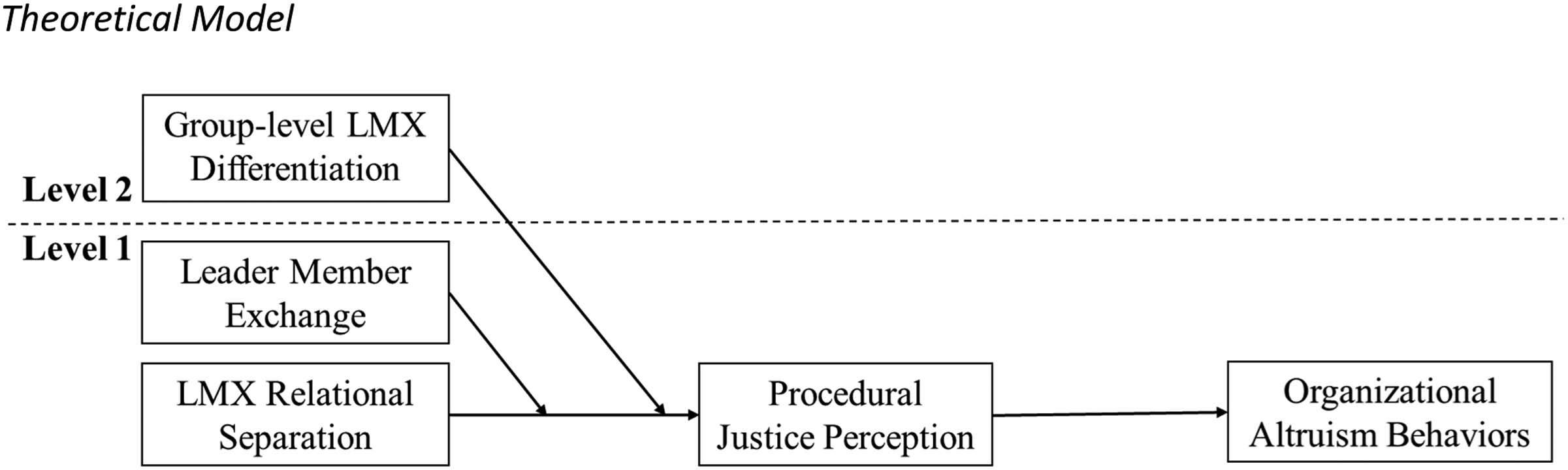
Methods
Sample and Procedure
The participants in our study consisted of 55 teams and 287 employees from 4 companies in China. We first invited the leaders of these teams to complete our survey, in which they evaluated their subordinates’ organizational altruism behaviors. Then, we asked them to code all their subordinates and provide their email addresses. If the team had more than 10 members, the supervisors were asked to identify 10 members randomly. We invited these identified subordinates to complete the employee survey. In advance of the surveys, we explained the purpose of this study to all the subjects and promised that all the results would be anonymous and confidential.
We excluded six of the original 55 teams because they only had 1 subordinate. After excluding incomplete questionnaires, our sample contained 49 teams and 273 employees with effective response rates of 89.09% for supervisors and 95.12% for subordinates. In the subordinate sample, 51% were men; the mean age was 30.57 (SD = 4.60); the mean job tenure was 2.13 (SD = 1.84); and the mean educational years was 16.11 (SD = 1.27).
Measures
We used well-established measures and applied the translation and back-translation procedure to ensure the validity of our measures (Brislin 1980). The variables were measured using five-point Likert scales ranging from 1 = strongly disagree to 5 = strongly agree.
LMX
To measure individually perceived LMX quality, we used a 16-item LMX multidimensional measure (LMX-MDM), which was expanded by Law, Wang, and Hui. (2010) based on the initial 12-item LMX-MDM developed by Liden and Maslyn (1998). A sample item is “The working relationship with my supervisor is effective.” The coefficient alpha was 0.94.
LMXRS
We used the formula provided by Harris et al. (2014) to describe the LMXRS. The formula is as follows

Group-level LMX differentiation
In line with most of the previous research (Kauppila, 2016; Liden et al., 2006), we adopted the within-group variance of individual LMX to represent the differentiation of LMX on the group level.
Procedural justice
Following prior research (Chen et al., 2018), we adopted the 6-item scale developed by Niehoff and Moorman (1993). A sample item is “Job decisions are made by the department manager in an unbiased manner.” The coefficient alpha was 0.90.
Organizational altruism behavior
To measure employees’ organizational altruism behaviors, we used the altruism dimension from Organ’s (1988) five dimensions of OCB and the scale developed by Podsakoff, MacKenzie, Moorman, & Fetter. (1990). Sample items are “Helps orient new people even though it is not required” and “Helps others who have heavy workloads.” The coefficient alpha was 0.91.
Control variables
In line with previous research about LMX differentiation and OCB (Bernerth & Aguinis, 2016), we chose demographic characteristics including age, gender, job tenure, and education as control variables. When examining the cross-level three-way interaction, we also followed the suggestion made by Hofmann and Gavin (1998) and controlled the interaction effect happening at the group level to ensure that our three-way interaction was not spurious, including the LMXRS mean, LMX mean, group-level LMX differentiation, the interaction terms of LMXRS mean and group-level LMX differentiation, as well as LMX mean and group-level LMX differentiation as control variables.
Analytical Strategy
Our hypothesized variables and controls are nested in both the individual level (Level 1) and the group level (Level 2); we, therefore, adopted the hierarchical linear model (Gavin, 2004; Hofmann & Gavin, 1998) to test the theoretical model. Before testing the hypothesis, we used the null model to examine the between-group variation of the dependent variable. The ICC (1) for procedural justice is 0.02, F (48,272) = 1.14, and p > 0.05, which means that the between-group variation of procedural justice is insignificant. Nonetheless, the ICC (1) for organizational altruism behaviors is 0.32, F (48,272) = 3.87, and p < 0.001. Considering the significant between-group variation of our dependent variable and the nested nature of our data, we tested our hypotheses with the HLM model.
To test the mediating role of procedural justice perception, we referred to Li and Liao’s (2014) work and followed Baron and Kenny’s (1986) three-step approach. Furthermore, we adopted the Monte Carlo method (N = 20,000, CI = 95%) to assess the mediation to detect the indirect effect more rigorously.
Before examining our three-way interaction hypotheses, we applied group-mean centering techniques to the level-1 predictors and grand-mean centering techniques to the level-2 predictors to avoid spurious cross-level interaction relationships (Hofmann & Gavin, 1998). Considering the high correlation between LMXRS mean and group-level LMX differentiation (r = 0.95, p < 0.001), such a centering technique is necessary for avoiding confounding effects between the group level and the individual level. Then, we adopted Aiken and West’s (1991) approach to interpret the interaction by conducting simple slope analysis and plotting the interactive effect. Finally, when examining the three-way interaction effect, we conducted the slope difference test to detect the differences in the relationship between LMXRS and subordinates’ procedural justice perception under different combinations of LMX and group-level LMX differentiation (Dawson & Richter, 2006).
When testing the moderated mediation model, we referred to Edwards and Lambert’s (2007) first-stage moderated mediation model, calculated the indirect effects of the two-way interaction model and the three-way interaction model, respectively, and conducted bootstrapping tests (N = 20,000, CI = 95%) to evaluate the indirect effects under different levels of moderation and the difference between them more precisely.
Results
Preliminary Analyses
Results of Confirmatory Factor Analysis for LMX, Procedural Justice, and Organizational Altruism Behaviors.
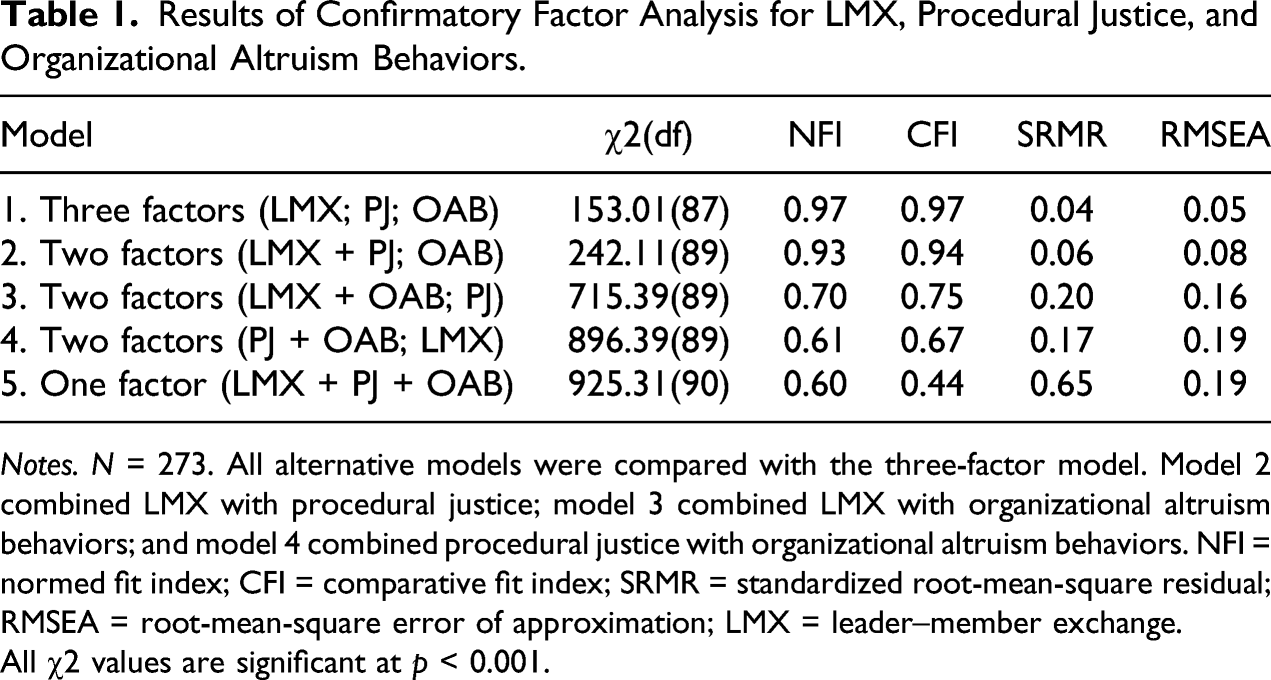
Notes. N = 273. All alternative models were compared with the three-factor model. Model 2 combined LMX with procedural justice; model 3 combined LMX with organizational altruism behaviors; and model 4 combined procedural justice with organizational altruism behaviors. NFI = normed fit index; CFI = comparative fit index; SRMR = standardized root-mean-square residual; RMSEA = root-mean-square error of approximation; LMX = leader–member exchange.
All χ2 values are significant at p < 0.001.
Means, Standard Deviations, and Correlations among the Study Variables.
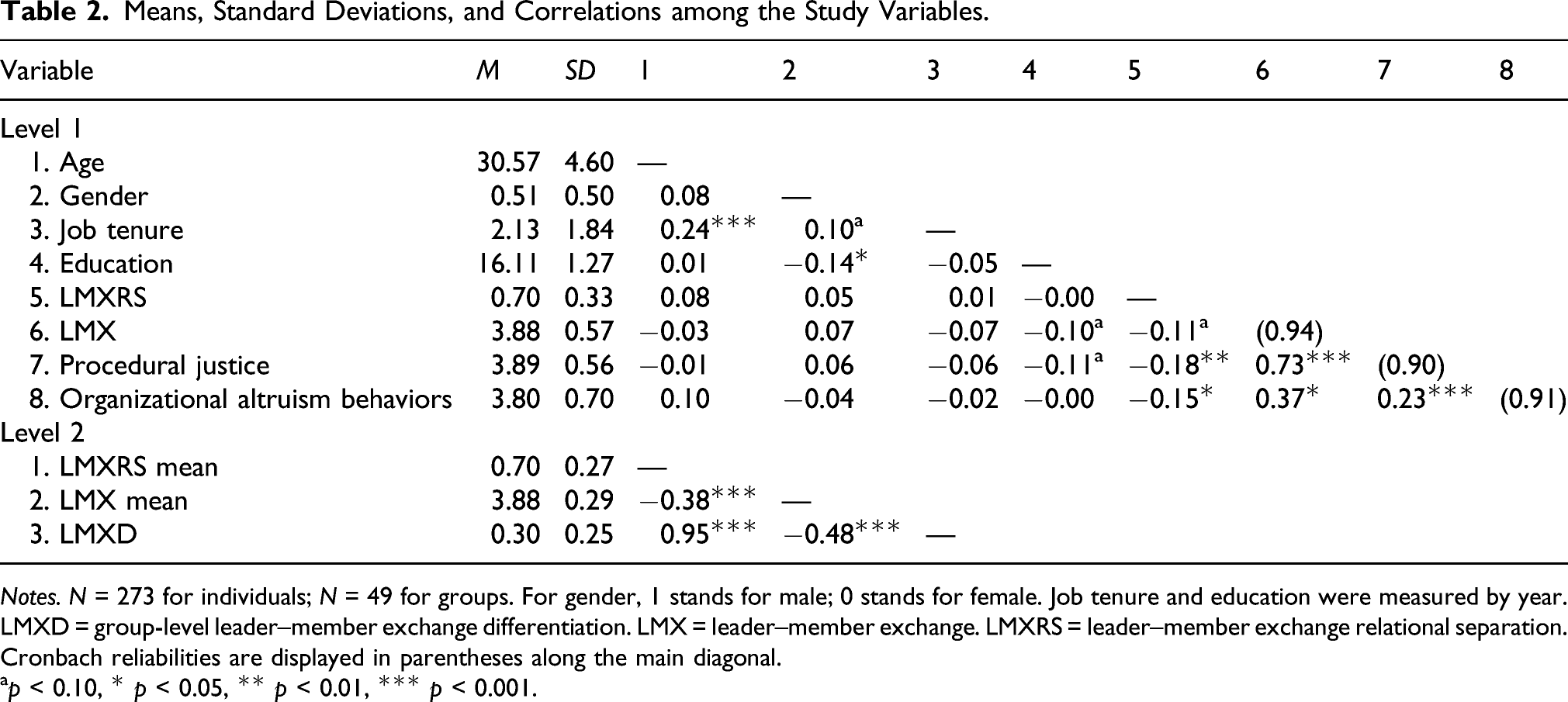
Notes. N = 273 for individuals; N = 49 for groups. For gender, 1 stands for male; 0 stands for female. Job tenure and education were measured by year. LMXD = group-level leader–member exchange differentiation. LMX = leader–member exchange. LMXRS = leader–member exchange relational separation. Cronbach reliabilities are displayed in parentheses along the main diagonal.
ap < 0.10, * p < 0.05, ** p < 0.01, *** p < 0.001.
Tests of the Hypotheses
HLM Regression Results for the Hypotheses.
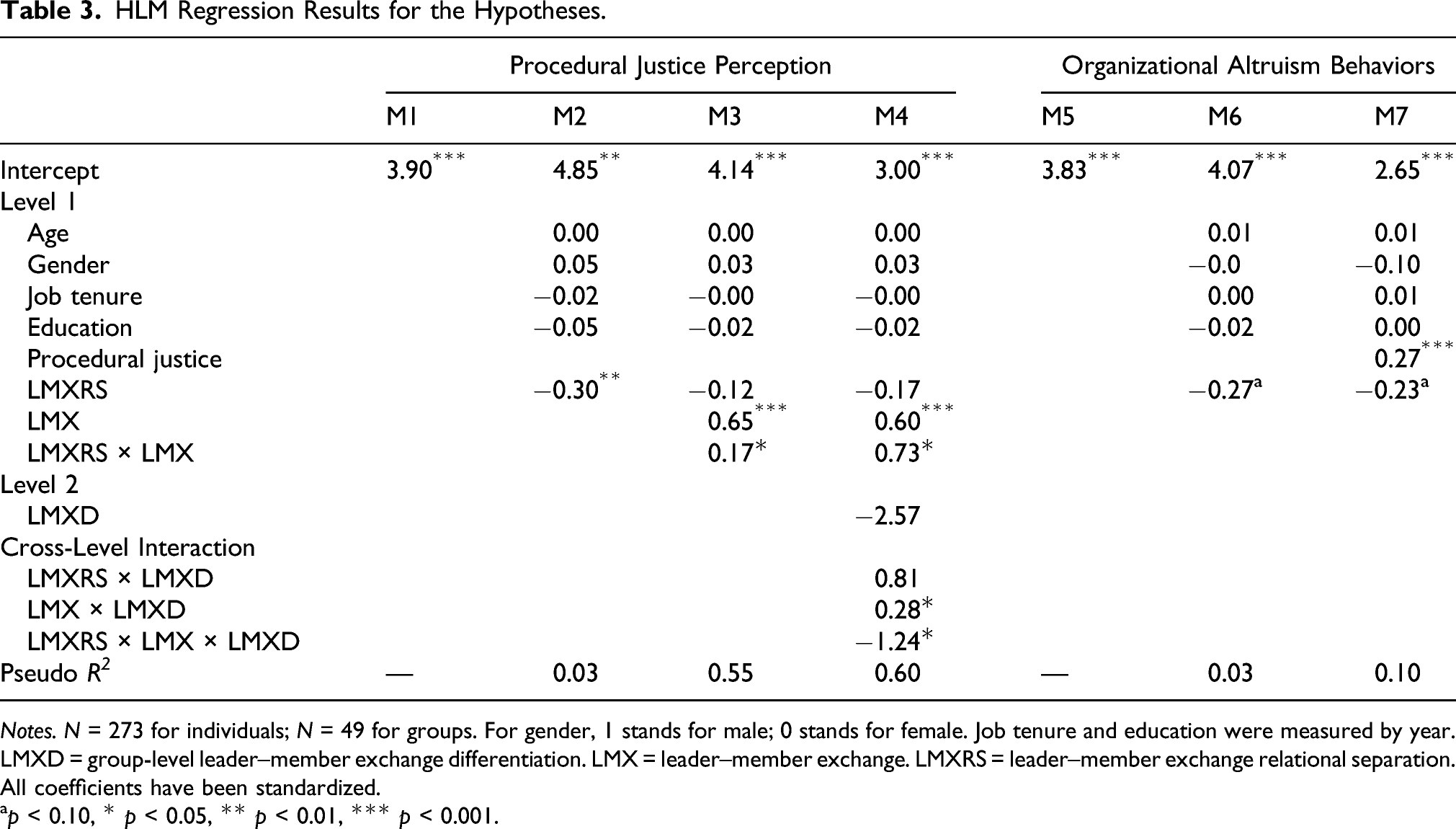
Notes. N = 273 for individuals; N = 49 for groups. For gender, 1 stands for male; 0 stands for female. Job tenure and education were measured by year. LMXD = group-level leader–member exchange differentiation. LMX = leader–member exchange. LMXRS = leader–member exchange relational separation. All coefficients have been standardized.
ap < 0.10, * p < 0.05, ** p < 0.01, *** p < 0.001.
After controlling procedural justice perception, as shown in model 7, the procedural justice perception is significantly related to organizational altruism behaviors (γ = 0.27, p < 0.001) while the effect of LMXRS on organizational altruism behaviors becomes weaker (γ = −0.23, p = 0.08). The 95% CI of the Monte Carlo simulation of indirect effect ranges from −0.12 to −0.04, which excludes 0. Thus, hypothesis 3 is supported.
Hypotheses 4a and 4b predicted that high LMX could attenuate the negative effect of LMXRS. As shown in model 3, the interaction term is significant (γ = 0.17, p < 0.05). Moreover, the simple slope test shows that the relationship between LMXRS and procedural justice perception is significant only when LMX is low (γ = −0.22, p < 0.01) rather than high (γ = −0.04, p = 0.70). We also plotted these interactions by following the steps provided by Aiken and West (1991). The interactive effect is plotted in Figure 2. Moreover, the bootstrapping test shows that the indirect effect is significant only when LMX is low (indirect effect = −0.06, 95% CI [−0.40, −0.03]). Thus, hypotheses 4a and 4b are supported. Two-way interactive effects between LMX relational separation and LMX on procedural justice. Note: LMX: leader–member exchange.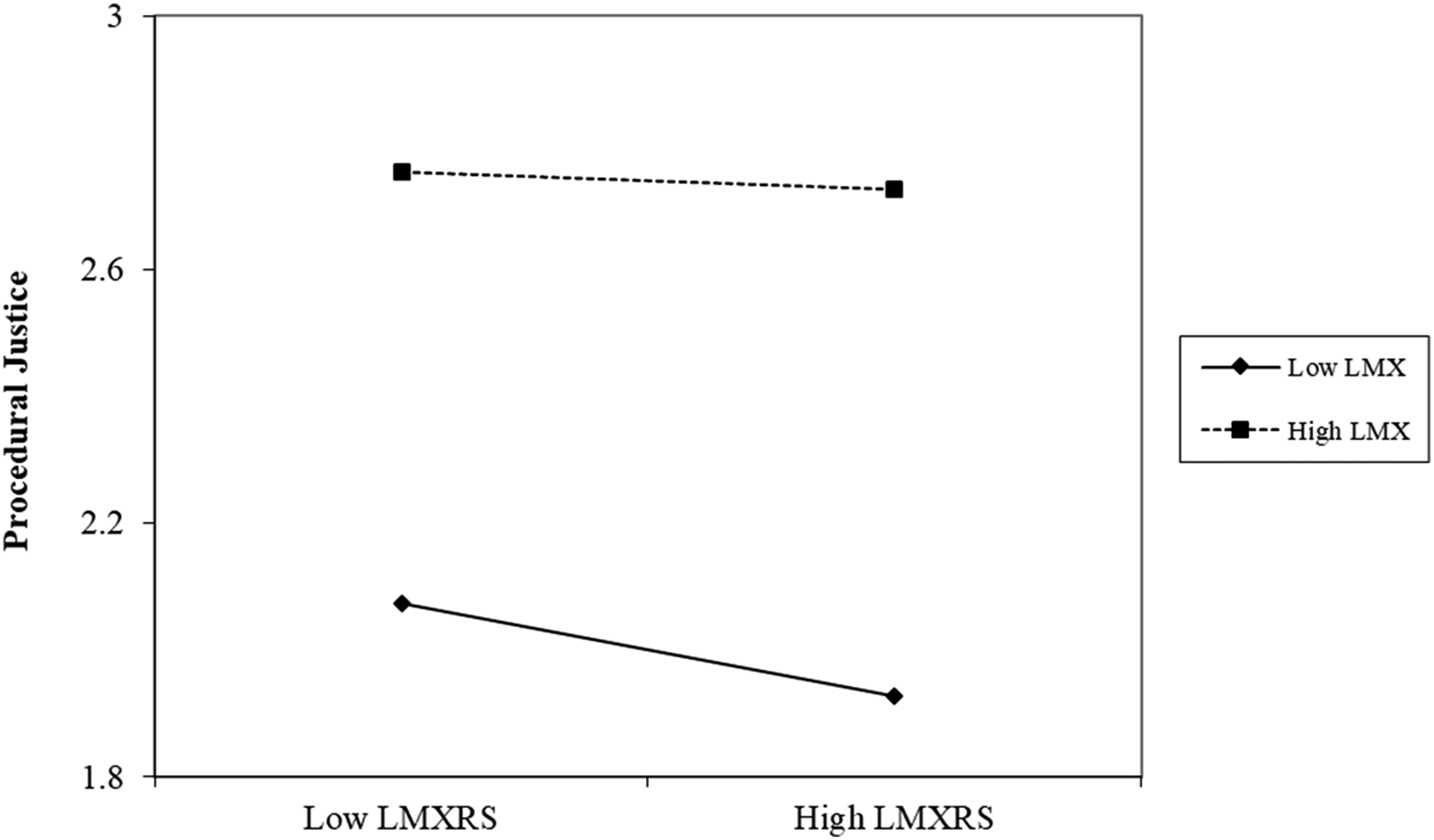
Hypothesis 5a proposed that the three-way interaction among LMXRS, LMX, and group-level LMX differentiation on procedural justice perception and the effects of LMXRS on procedural justice perception are more negative for low-LMX members when the degree of group-level LMX differentiation is low rather than high. As shown in model 4, the three-way interaction term is significant (γ = −1.24, p < 0.05). By the same token, we conducted the simple slope test and plotted the three-way interaction. The three-way interactive effect is shown in Figure 3. The result of the simple slope test indicates that the relationship between LMXRS and procedural justice perception is more significant for low-LMX members when the group-level LMX differentiation is low (γ = −0.89, p < 0.01). Three-way interactive effects among LMX relational separation, LMX, and group-level LMX differentiation on procedural justice. Note: LMX: leader–member exchange.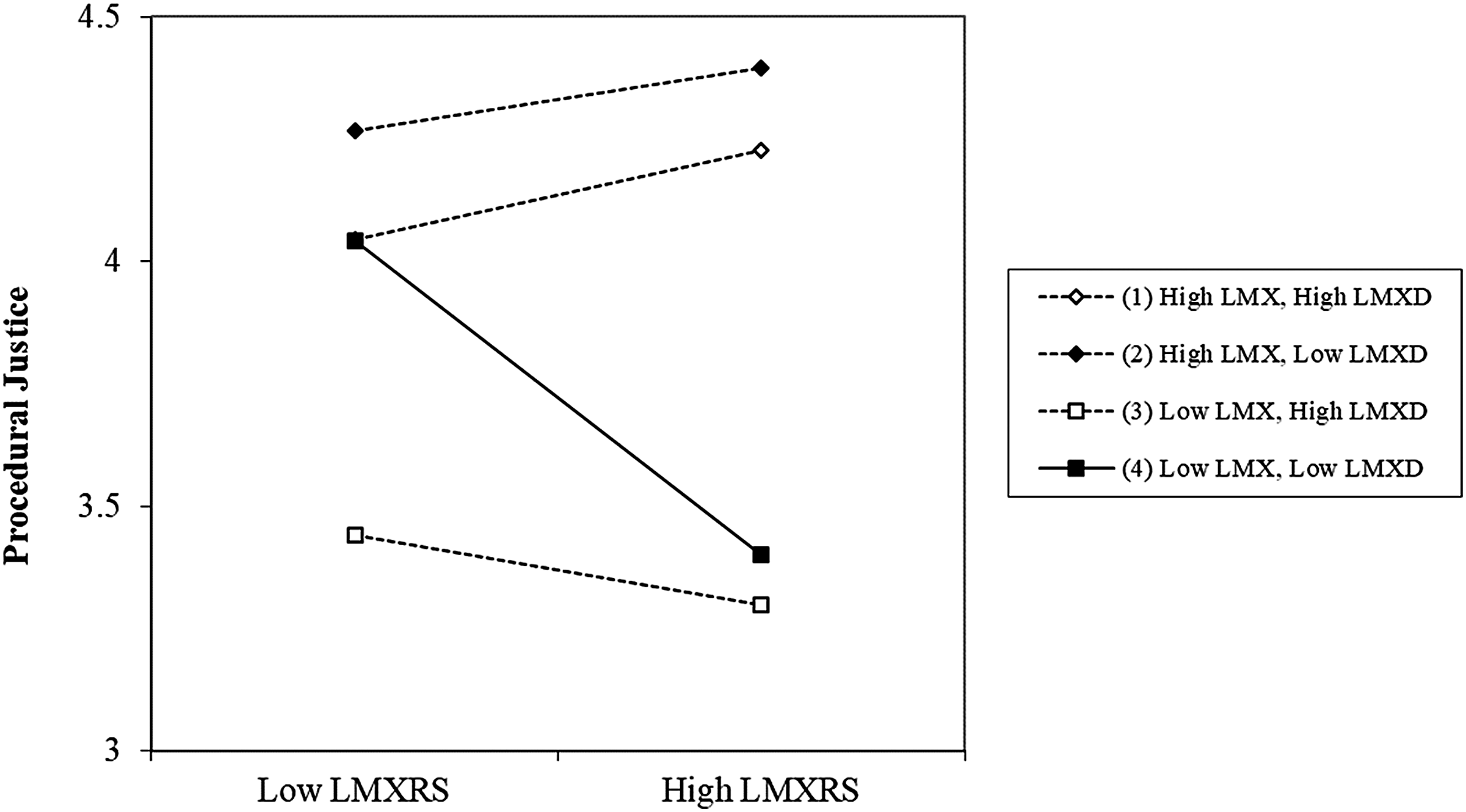
A Significance Test of Differences between Pairs of Slopes for the Effect of LMX Relational Separation on Procedural Justice.
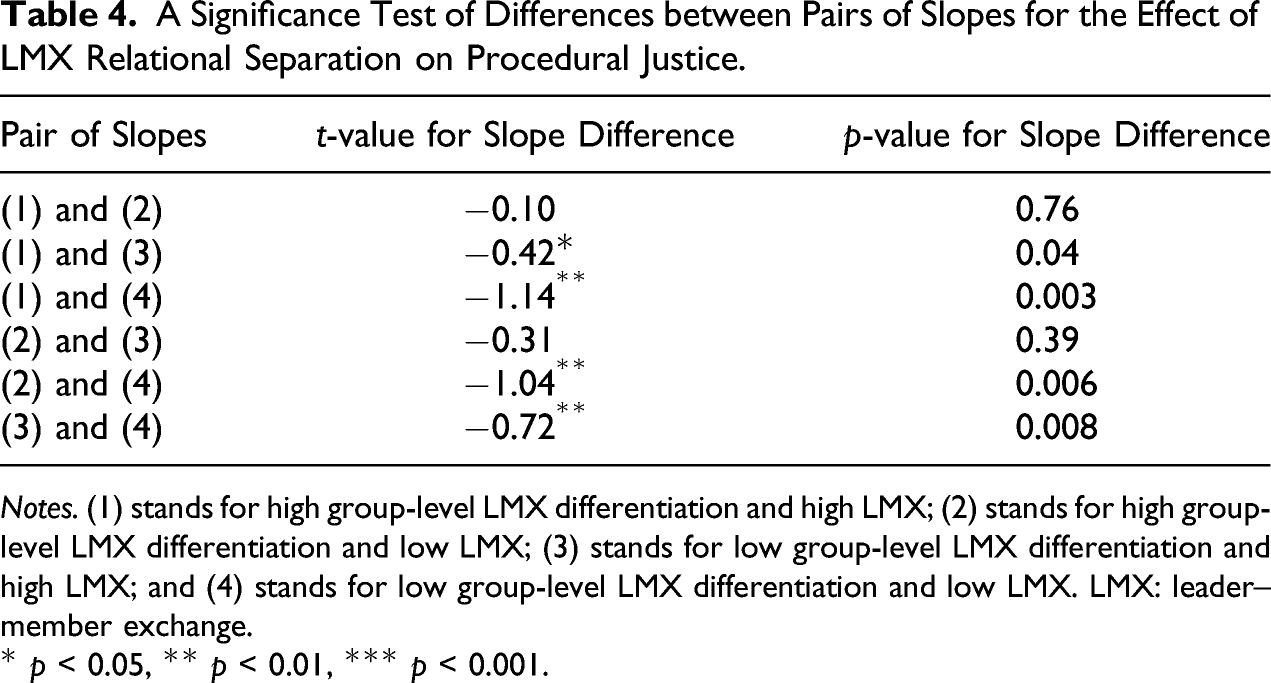
Notes. (1) stands for high group-level LMX differentiation and high LMX; (2) stands for high group-level LMX differentiation and low LMX; (3) stands for low group-level LMX differentiation and high LMX; and (4) stands for low group-level LMX differentiation and low LMX. LMX: leader–member exchange.
* p < 0.05, ** p < 0.01, *** p < 0.001.
Moreover, the bootstrapping test shows that the indirect effect is significant for low-LMX members when the group-level LMX differentiation is low (indirect effect = −0.26, 95% CI [−0.44, −0.12]). Thus, hypothesis 5b is supported.
Discussion
It is well acknowledged that LMX differentiation is common within groups. Our research focused on the separation aspect of individual relative standing in the whole LMX map via the group engagement model (Tyler & Blader, 2003). By adopting a rarely discussed concept in LMX differentiation literature, LMXRS, and using a field study based in China, we found that high LMXRS jeopardizes subordinates’ procedural justice perception and then reduces their organizational altruism behaviors. Moreover, low LMX members rather than high LMX members suffer most from high LMXRS due to the identity of “double deviants” or “the black sheep” (Hogg & Terry, 2000). At the group level, we also found that low LMX differentiation amplifies the plight of the low-LMX minority.
Theoretical Implications
We have made several theoretical contributions to the current study of LMX differentiation. First, our study reveals the role that LMXRS plays in shaping subordinates’ procedural justice perception and follow-up organizational altruism behaviors. In line with meso-level LMX differentiation research, we acknowledged the importance of coworkers’ LMX (Henderson et al., 2008; Hu & Liden, 2013; Tse et al., 2012; Vidyarthi et al., 2010) and made a further development by showing how LMXRS, the separation aspect of meso-level LMX differentiation, matters in determining group members’ procedural justice perception and follow-up organizational altruism behaviors. By doing so, we started to answer “whether and how” LMXRS influences subordinates’ behaviors, confirmed Harris et al.’s (2014) proposition that LMXRS could serve as a promising indicator of deep-level diversity, and responded to the recent calls to expand both the taxonomy and the theoretical lens to study LMX differentiation phenomena (Buengeler et al., 2021; Martin et al., 2018). Moreover, traditional LMX research has contended that employees can be divided into in-groups and out-groups based on their LMX quality (Dienesch & Liden, 1986) while ignoring the horizontal categorization of group members because of their dissimilarity in LMX. Our work highlights the importance of horizontal categorization in LMX differentiation and reveals how it drives subordinates’ organizational altruism behaviors via influencing their procedural justice perception. Thus, our investigation of LMXRS also enriched our understanding of how LMX differentiation influences coworker-oriented discretionary behaviors.
Second, by exploring the interactive effect between LMXRS and LMX, our research showed high LMXRS only impairs low LMX members’ procedural justice perception. Bolino and Turnley’s (2009) theoretical work emphasized the detrimental effect of low LMX quality based on relative deprivation theory, but our research has taken a step further by focusing on both the vertical LMX quality and the horizontal separation aspect of LMX differentiation and discussing the plight of the low-LMX minority. Those noncore members are also essential for the normal functioning of organizations (Bolinger et al., 2018), but we know little about their psychological and behavioral reactions to the minority identity (Seo et al., 2018). Thus, our study contributes to partly filling this knowledge gap from a justice perspective. Moreover, we responded to the optimistic argument that the low-status minority would seek constructive changes by emphasizing the importance of the minority identity (Seo et al., 2018). Without eliminating the possibility of this “happy ending,” we showed how the low-LMX minority is deprived of procedural justice perception and performs fewer altruism behaviors. On the other hand, our work showed that the high-LMX minority is not susceptible to the detrimental effect of high LMXRS. Such a finding corroborates the previous research by showing that positively unique members could also establish strong identification with the group and perform more helping behaviors (Farmer et al., 2015).
Finally, our three-way interaction result expanded the current knowledge about how LMX differentiation works across different levels. Harris et al. (2014), in their illuminating work, considered LMXRS as an individual-level reflection of group-level LMX differentiation and separately examined their moderating roles with absolute LMX quality. However, we contend that such an opinion is too conservative. LMX configuration research has implied that high LMXRS could happen under various forms of LMX differentiation due to different patterns (Li & Liao, 2014; Seo et al., 2018). Our three-way interaction result confirmed this possibility as the negative effect of high LMXRS for low-LMX members is more significant when the group-level LMXD is low. Moreover, we made a contradictory finding: at the meso level, high LMXRS impairs individual procedural justice perception and cooperative behaviors; at the group level, however, low group-level LMX differentiation becomes detrimental by amplifying the plight of the low-LMX minority. Similarly, Li and Liao (2014) discovered a competing effect of LMX differentiation at different levels. The difference is that Li and Liao (2014) attributed their findings to the coexistence of two opposite functions of LMX differentiation, whereas our contradictory finding mainly results from the complication of LMX differentiation itself. That is, the overall low group-level LMX differentiation could serve as a sharp contrast to those low-status deviants and deteriorate the plight of these black sheep.
Practical Implications
Our study also provides some illuminating suggestions for team leaders to improve differential leadership at work. First, leaders should be careful not only about the degree but also about the pattern of differential leadership within the group. Constrained by organizational and personal resources, it is common for team leaders to establish high-quality LMX relationships with certain subordinates (Li & Liao, 2014). However, group-level LMX differentiation is also a reflection of leaders’ values and motives regardless of resource constraints (Lee, Chae, & Shin, 2016; Ma & Qu, 2010). Therefore, to avoid horizontal social categorization due to differing LMX quality, we encourage team leaders to devote more resources to developing high-quality exchange relationships with their subordinates in an equal way. For those team leaders who adopt a differentiated leadership style, we suggest that they should pay attention to different patterns when implementing a differentiation strategy, especially those faultlines separating their followers into different subgroups or the majority versus the minority. Based on LMX configuration research (Li & Liao, 2014; Seo et al., 2018), we encourage those leaders who apply differentiated leadership to adopt a fragmented LMX configuration to avoid the emergence of social isolation within the group.
Second, group leaders should pay more attention to low-LMX members. Our findings show that low-LMX members will easily be vulnerable to harm from increasing LMXRS when the group-level LMX differentiation is low. These outsiders may not play core roles in the team, but noncore roles are both beneficial and indispensable for the team (Bolinger et al., 2018). One task that team leaders can undertake is to make the differentiation process more transparent and justifiable. For example, they could establish different LMX based on individual performance rather than personal liking to increase low-LMX members’ procedural justice perceptions (Chen et al., 2018) and foster group cooperation (Han, Liao, Han, & Li, 2021). At the same time, leaders can show more care in private for low-LMX members who are on the edge of the team to compensate for the loss of high-quality exchange at work (Chen, Yu, & Son, 2014).
Finally, team leaders could enhance subordinates’ perception of personal value within the group to strengthen their procedural justice perception and motivate them to engage more in cooperative behaviors. As suggested by the group engagement model, leaders could encourage the participation of subordinates during decision-making and resource-allocating processes (Thibaut & Walker, 1975). With more opportunity to express their opinions, for example, subordinates will have a stronger perception of controllability over decisions and feel that they matter to the group. Another suggestion for team leaders is to treat their subordinates with respect and politeness regardless of whether they are insiders or outsiders. By doing so, leaders could improve their subordinates’ perceptions of interpersonal justice and social treatment quality within the group (Tyler & Blader, 2003). With higher in-group social value, subordinates will have greater confidence in believing in fair treatment in the future, making them feel safe in merging themselves with the group, and will engage in more discretionary behaviors that are beneficial for their coworkers and the group.
Limitations and Future Directions
Despite the theoretical and practical contributions that we have stated, there are several limitations in our study that open up avenues for future research. First, our cross-sectional design could not affirm the causal relationship. Collecting longitudinal data helps to establish causal relationships but also brings high risks of a low response rate. On the other hand, LMXRS is hard to examine under experimental designs. However, we still advocate for more future work to design more rigorous studies to explore the effect of LMXRS.
Second, we collected data from China, and it is unknown whether these findings could be generalized. In contrast to Western countries’ culture, Chinese culture is characterized by high collectivism (Morris & Peng, 1994) and high power distance (Kirkman, Chen, Farh, Chen, & Lowe, 2009). Chinese employees tend to rely on the evaluation of leaders to build their own self-concept and to be sensitive to small circles and guanxi within the group (Luo, Cheng, & Zhang, 2016). Perhaps future research could retest our findings and explore how LMXRS influences employees’ work outcomes in different cultures.
Third, we treated our mechanism, procedural justice, as a combination of both procedures and social treatment concomitant with procedures. Like other studies sharing this assumption of the procedural justice concept (Chen et al., 2018; Niehoff & Moorman, 1993), we took the six-item procedure justice scale used in Niehoff and Moorman’s (1993) study to capture both the procedural and the interpersonal perspective. However, the four-factor model of justice separates interpersonal justice from procedural justice and treats it as a dependent dimension of justice (Colquitt, 2001). As the agent–system model (Bies & Moag, 1986) suggested, procedural justice shapes subordinates’ reaction to the system (i.e., the organization and the coworkers in the organization) while interpersonal justice determines their reaction to the actor (i.e., the team leader). Therefore, as one of our anonymous reviewers suggested, we believe that interpersonal justice could be an interesting mechanism when exploring the effect of LMXRS on subordinates’ attitudes and behavior toward supervisors.
Finally, we discussed how LMXRS influences organizational altruism behaviors through procedural justice perception, but LMXRS is still a promising concept in LMX differentiation research and deserves more discussion. In the future, we call for more works to examine its role as a predictor and a moderator in LMX differentiation studies. For example, our work drew on the group engagement model to focus on one of the subordinates’ positive engagement behaviors—organizational altruism behavior. However, recent organizational behavior research has shown emerging interest in negative behaviors among coworkers, such as workplace ostracism (Robinson, O’Reilly, & Wang, 2013). Moreover, we showed how high LMXRS impairs subordinates’ organizational altruism behaviors while other theories may suggest that it is also possible for the minority to perform more organizational altruism behaviors to blend into the majority. We contend that this could happen but that it hinges on some important boundary conditions, such as the minority members’ expectation of the possibility to change their horizontal relationships. We believe that these efforts would help provide a better understanding of LMX differentiation itself and its consequences. Another noticeable work that needs to continue by using LMXRS and other measurements is to make a further comparison among different types of individual-within-group differentiation and to specify different mechanisms and different outcomes to provide insightful and solid instruction for the future selection of different measurements of LMX differentiation.
Conclusion
For LMX heterogeneity, not all differentiation is the same (Seo et al., 2018); at least, it is not the same for everyone. We looked at the minority under the microscope by examining the effect of LMXRS. We found that high LMXRS jeopardizes subordinates’ perception of procedural justice and then reduces their organizational altruism behaviors. Such a relationship is significant only for low-LMX members and not for high-LMX members. The three-way interaction showed that the plight of the low-LMX minority could be amplified by low group-level LMX differentiation. More work could be undertaken to explore the influence of LMXRS on other behaviors and attitudes, such as voice, knowledge-sharing behavior, and so on. We also hope to conduct more research to examine and compare different measurements of LMX differentiation and provide a more integrated view of LMX differentiation in groups.
Footnotes
Acknowledgments
The authors would like to thank Dr. Rebecca Reichard and three anonymous reviewers for their helpful comments and excellent guidance during the review process.
Declaration of Conflicting Interests
The author(s) declared no potential conflicts of interest with respect to the research, authorship, and/or publication of this article.
Funding
The author(s) disclosed receipt of the following financial support for the research, authorship, and/or publication of this article: This research was supported by the grants funded by the National Natural Science Foundation of China (Grant No. 71502020, 71972017, and 71974021), the Chongqing Social Science Planning Project (Grant No. 2018PY76), and the Fundamental Research Funds for the Central Universities (Grant No. 2019CDSKXYJG0037).

Associate Editor: Rebecca Reichard