







Abstract
Global patterns of work and global mobility have become increasingly prevalent within the Global Talent Management (GTM) discourse, albeit with a narrow focus on expatriation, elite talent, performance driven practices - overlooking emerging trends of work, the diverse pool of talent, and alternative forms of global work arrangements. Within this changing mobility context, the research questions driving our work are: (1) What kinds of perspectives or considerations does a mobilities lens introduce to GTM, and (2) how might these affect our understanding of global mobility and GTM practices and dynamics? We leverage Massey’s Power Geometry model to critically examine the discourse on global mobility, uncovering power dynamics and spatial aspects often overlooked in the GTM literature. Through our conceptual framework, we focus on three key interrelated areas: power of mobility, hierarchy of mobility, and control over mobility. Our conceptual framework can serve to unpack the complexity of global mobility as a multi-level and multi-actor phenomenon and highlight how it’s affected by power dynamics at every level. It provides a broader, more inclusive understanding of global mobility forms, and brings out the intersectional dynamics and power relations overlooked in mainstream global mobility research.
Introduction
Globalization has created significant opportunities and challenges for multinational corporations (MNCs). Specifically, global forms of work and global mobility have become a common feature in MNCs, as today’s businesses transcend national boundaries. The effects of cultural, linguistic, spatial, and temporal distances, as well as the macro political, economic, and societal institutions make the coordination of work and management of people within MNC’s particularly challenging (Lee, Yoshikawa, & Harzing, 2022; Peltokorpi & Xie, 2025; Saittakari et al., 2023; Svystunova et al., 2024; Vecchi et al., 2021; Welch & Welch, 2018). In response, global talent management (GTM) scholarship has received traction (Caligiuri et al., 2024; Sousa et al., 2024), and is now considered as a key theme in International Human Resource Management (IHRM) research and practice. IHRM research has highlighted the importance of globally mobile professionals as a key element of MNC’s global talent management strategies (McDonnell et al., 2010; Napathorn, 2020), and as an important source of competitive advantage for MNCs, who tap into a global workforce (Bonneton et al., 2022; Bouteraa & Bouaziz, 2023; Chatterjee et al., 2023; Farndale et al., 2023; Lee, Yahiaoui, et al., 2022).
As such, recent academic literature has started to explore the integration of global talent management and global mobility (Caligiuri et al., 2024; Dickmann & Mello, 2023; Isichei & Collings, 2018; Sousa et al., 2024), with a focus on how the latter can maximize organizational performance and effectively deliver on the organization’s global talent management strategy. Indeed, the integration between global talent management and global mobility is increasingly important in managing the supply and demand of globally mobile professionals (Abeuova & Muratbekova-Touron, 2019; Kirk & Howe-Walsh, 2021; Selivanovskikh, 2020; Sousa et al., 2024; Tarique & Schuler, 2018) albeit with an extensive focus on expatriate management (Andersen, 2021; Guttormsen & Lauring, 2022; Schmitz et al., 2023; Wang et al., 2022; Wang & Varma, 2019; Zhong et al., 2021). A closer examination of the GTM literature highlights a focus on examining international working patterns (Baruch et al., 2013; Caligiuri et al., 2024; McNulty & Brewster, 2017; Mello et al., 2023; Sousa et al., 2024), global work (Hinds et al., 2011; Lazarova et al., 2023), global work experiences (Andresen et al., 2022; Dragoni et al., 2014; Kim et al., 2022; Schmid & Baldermann, 2021), global staffing (Collings et al., 2009; Guo et al., 2016; Patel et al., 2019), and global work arrangements (Ahrens et al., 2018; Jooss, McDonnell, & Conroy, 2021; Mayrhofer & Reiche, 2014; Ocampo et al., 2024; Reiche et al., 2019). In addition, research has also explored non-traditional expatriates in the global context (Guttormsen, 2018; Hutchings, 2022; Purgał-Popiela, 2021), global competence (Cascio & Boudreau, 2016), challenges of global talent management (Fernandes et al., 2023; Park et al., 2022), including managing a more pronounced heterogeneity among the global workforce, such as paying attention to diversity (Al Ariss & Crowley-Henry, 2013; Groutsis et al., 2016; McNulty & Brewster, 2020; Romani & Holgersson, 2020), and categories, such as the low-status expatriates at the base of the pyramid (Haak-Saheem & Brewster, 2017; Holtbrügge, 2021, çelik et al., 2019).
This research acknowledges the talent gap cited across many western economies and the growing importance of emerging markets, which indicates that a significant macro-level shift of mobility patterns has commenced on a global scale (Abeuova & Muratbekova-Touron, 2019; Ewers et al., 2022; Isichei & Collings, 2018; PwC, 2020; Reiche et al., 2019; Sousa et al., 2024). Within this changing mobility context, the research questions driving our work are: (1) What kinds of perspectives or considerations does a mobilities lens introduce to GTM, and (2) how might these affect our understanding of global mobility and GTM practices and dynamics?
Addressing these complexities allows us to contribute to the IHRM and GTM fields in significant ways. We first contribute to the IHRM field by calling for more extensive coverage and understanding of global mobility forms. In so doing, we address a criticism by Cooke et al. (2019), where they argued that IHRM research “...has for too long focused rather narrowly on expatriate management” (p. 59), as well as long-standing concerns that GTM studies focus on a too-narrow range of talent (Al Ariss & Sidani, 2016; Caligiuri et al., 2024; Makarem et al., 2019; Oppong, 2023). Second, through leveraging broader critical literatures, such as Massey’s Power Geometry model, to the GTM field (i.e. Makarem et al., 2019; Metcalfe et al., 2021), we join our voice to the emerging conversations in various business and management journals (e.g. Metcalfe et al., 2021; Wittek, 2019 in the International Journal of Human Resource Management, Hajro et al., 2021 in the Journal of World Business), also in a recent SI in the Academy of Management Discoveries (2023) that advocate for a more critical perspective on global mobility. Through leveraging a critical lens, new insights into the tracking and unravelling of global mobility processes are uncovered (Groutsis et al., 2023). Third, we contribute to the GTM field through developing a conceptual framework that shows how a stronger dialogue between global mobility and mobilities lens can greatly enrich GTM research, with a mobilities lens sparking interest in a much broader spectrum of global mobility, and in bringing to the fore intersectional issues and power dynamics that affect mobility movements. By doing so, we hope that we amplify existing voices calling for a more inclusive GTM theorizing (Afiouni et al., 2020; Kwon & Jang, 2021; Makarem et al., 2019; Metcalfe et al., 2020, 2021). We thus move beyond the narrow focus on expatriation, elite talent, performance driven practices, and other important but limited considerations of talent and mobility that are prominent in the GTM literature, and which often overlook emerging trends of work, the diverse pool of talent, and alternative forms of global work arrangements.
The paper is structured as follows: we begin with an outline on the importance of using Massey’s power geometry model in our understanding of global mobility to show the complexity of mobilities within GTM theorizing. By examining the themes of space and power in Massey’s power geometry model, we demonstrate that intersecting issues and power dynamics have differential consequences for the mobility of different individuals. Building on the above, we then propose a conceptual framework of global mobility that incorporates multi-level analyses around the power of mobility, hierarchy of mobility, and control over mobility. Our conceptual framework can serve to unpack the complexity of global mobility as a multi-level and multi-actor phenomenon and highlight how it’s affected by power dynamics at every level. It will thus provide a broader, more inclusive understanding of global mobility forms, and brings out the intersectional dynamics and power relations overlooked in mainstream global mobility research. In the remainder of the paper, and given our critical positioning, we prefer to use the term ‘labor’ instead of ‘talent’ to remain true to the critical management studies heritage, as well as the terminologies used across social science fields (Savage, 2021, pp. 7-27). Another reason we prefer to use the term ‘labor’ is that the definition of ‘talent’ remains ambiguous in the TM discourse (Al Ariss et al., 2014; Nijs et al., 2014; Skuza et al., 2022; van Zelderen et al., 2023) and is often used in an exclusionary manner (i.e., focusing on high potential employees).
Mobilities Studies: Outlining Massey’s Power Geometry
‘Mobilities studies’ is commonly described as a ‘multi-disciplinary’ project, which has its origins in the humanities and social sciences, bringing together scholars from a wide array of disciplines (e.g. geography, urban studies, sociology, anthropology, migration studies, and cultural studies), all connected by a shared interest in varied mobilities in contemporary life (Cresswell, 2006; Hui, 2016; Sheller, 2011; Shirmohammadi et al., 2019; Urry, 2007). Such an interest is anchored in the acknowledgment of the historical importance of mobility, as witnessed in the flow of workers from countryside to city in 19th-century industrialization. Mobilities scholars stress on the idea that a distinct feature of contemporary societies is found in the proliferation of ‘multiple mobilities’ (e.g. business travel, virtual communication) linking people, information, and resources together in entirely new ways (Elliott & Urry, 2010; Kesselring, 2014; Sheller & Urry, 2006; Urry, 2007). Mobilities studies thus challenges traditional scholarship that is static, aspatial, and immobile in nature, encouraging a more ‘movement-oriented’ and dynamic approach (Sheller & Urry, 2006).
It is important to note how mobilities studies build upon insights from the ‘spatial turn’ in the humanities and social sciences, which argues for the need to make the analysis of space more central and explicit (Logan, 2012; Sheller & Urry, 2006) when examining mobilities. Particularly influential for mobilities scholars are the ideas of Doreen Massey (1993, 2005), who brings her understanding of space “as social relations shaped by power” (Massey, 2005, p. 9) to regional development, globalization, political economy, and divisions of labor. Massey explores the concept of ‘power geometry’- that refers to the ways in which different groups and individuals experience mobility and control over space in an unequal and power-laden way (Massey, 2005). According to Massey, power and spatial dynamics play a crucial role in shaping who gets to move, how they move, and who controls movement in the globalized world. Power geometry “does not imply any specific form (any specific geometry), it’s rather a concept through which to analyze the world … an instrument of potential critique” (Massey et al., 2007, p. 321), a critique of globalization and spatial relations, emphasizing that not everyone has the same ability to move across space or influence how space is organized (Massey, 2005). Instead, Massey articulates how groups and individuals’ differential capacities need to be understood in relation to flows of capital, colonialism, migration, social relationships, and culture.
The power dynamic, central to Massey (1993, 2005), is the concern with ‘power in relation’ to the flows, the movement of people, and its centrality in understanding the many ways that mobility is inflected by politics - revealing the ways that social inequalities tend to persist and often deepen along with the acceleration of capital and talent mobility (Bélanger & Silvey, 2020). The power geometries of migration, for example, manifests more broadly in: who has the capacity to move, either at all, or at the speed or to the destinations they might like, the degree of control people have over various stages of their mobility trajectories, the power people have to remain with their family members when they travel (and, for how long), including the risks that different people face of deportation, confinement, and exclusion. Thus, Masseys’ ‘power geometry model’ helps unravel the complexities of ‘labor movement’ and ‘laborers in movement’, highlighting that mobilities are multi-sited, multi-centered, uneven, and dispersed, yet constitute ‘networks of spatial connectivity’ (Conway, 2008; Massey, 2004). The spatiality of organizational life has been previously studied (Beyes & Holt, 2020; Halford, 2008; Munro & Jordan, 2013; Shortt, 2015; Tyler & Cohen, 2010; Worrall, 2021), including niche studies on business travel, commuting, and global careers (Elfering et al., 2020; Hughes & Silver, 2020; Lazarova et al., 2023; Montazer et al., 2023).
Further, for Massey, time and space are not separable, but inextricably connected, as time–space. Specifically, time–space is not simply a multi-dimensional context in which individuals live their lives; it is a dynamic, socially constituted, and shaped by power relations of domination and subordination. Contrary to much-heralded ideas of ‘smooth mobility’ and ‘hypermobility’ in a shrinking world, Massey instead emphasizes the ‘power geometries of time–space’, highlighting how certain social groups have unequal access to, and control, over time – space and mobility. Massey’s power geometries of time-space model, used in the migration literature, highlights the multiplicities of movement and organization. She argued: Now I want to make one simple point here, and that is about what one might call the power geometry of it all; the power geometry of time–space compression. For different social groups, and different individuals, are placed in very distinct ways in relation to these flows and interconnections. This point concerns not merely the issue of who moves and who doesn’t, although that is an important element of it; it is also about power in relation to the flows and the movement. Different social groups have distinct relationships to this anyway differentiated mobility: some people are more in charge of it than others; some initiate flows and movement, imprisoned by it. (Massey, 1994, p. 149)
Drawing on Massey’s power geometry model, we thus seek to centralize the “spatial” and “mobile” dimensions of global mobility, recognizing the inseparable interplay of time and space, often referred to as “time-space”. This approach calls for a more comprehensive exploration of the power dynamics, practices, and meanings associated with global mobility and GTM. In fact, in her conceptualization of the heightened time-space compression under globalization, Massey draws attention to the differentiated relations to mobility among social groups. Therefore, we aim to unpack the power and spatial dynamics that have been mostly overlooked in the discussion of global mobility in the GTM literature to theoretically expand the GTM field. This attention to the workings of power, politics, and inequality across geographic scales and social locations has since then become an important approach in critical mobilities and social change research (Bélanger & Silvey, 2020; Gruber, 2021; Janská et al., 2024; Kesselring, 2014; McDowell, 2008; Scocco, 2022). More relevant to GTM, the theoretical perspective of Massey’s power geometry model can help us bring to the fore of the GTM literature issues, such as forced displacement, refugee overflows, and migratory movements of lower skilled persons (Alberti et al., 2013; Hopkins et al., 2015; Lee & Wechtler, 2023; Li & Kung, 2023; Sklair, 2002), which leads to a more expansive and inclusive understanding of global mobility, highlighting intersectional dynamics and power relations that are often neglected in mainstream research.
Conceptual Framework
From this theoretical positioning, we leverage the tenants of Massey’s power geometry model to develop a Conceptual Framework of Global Mobility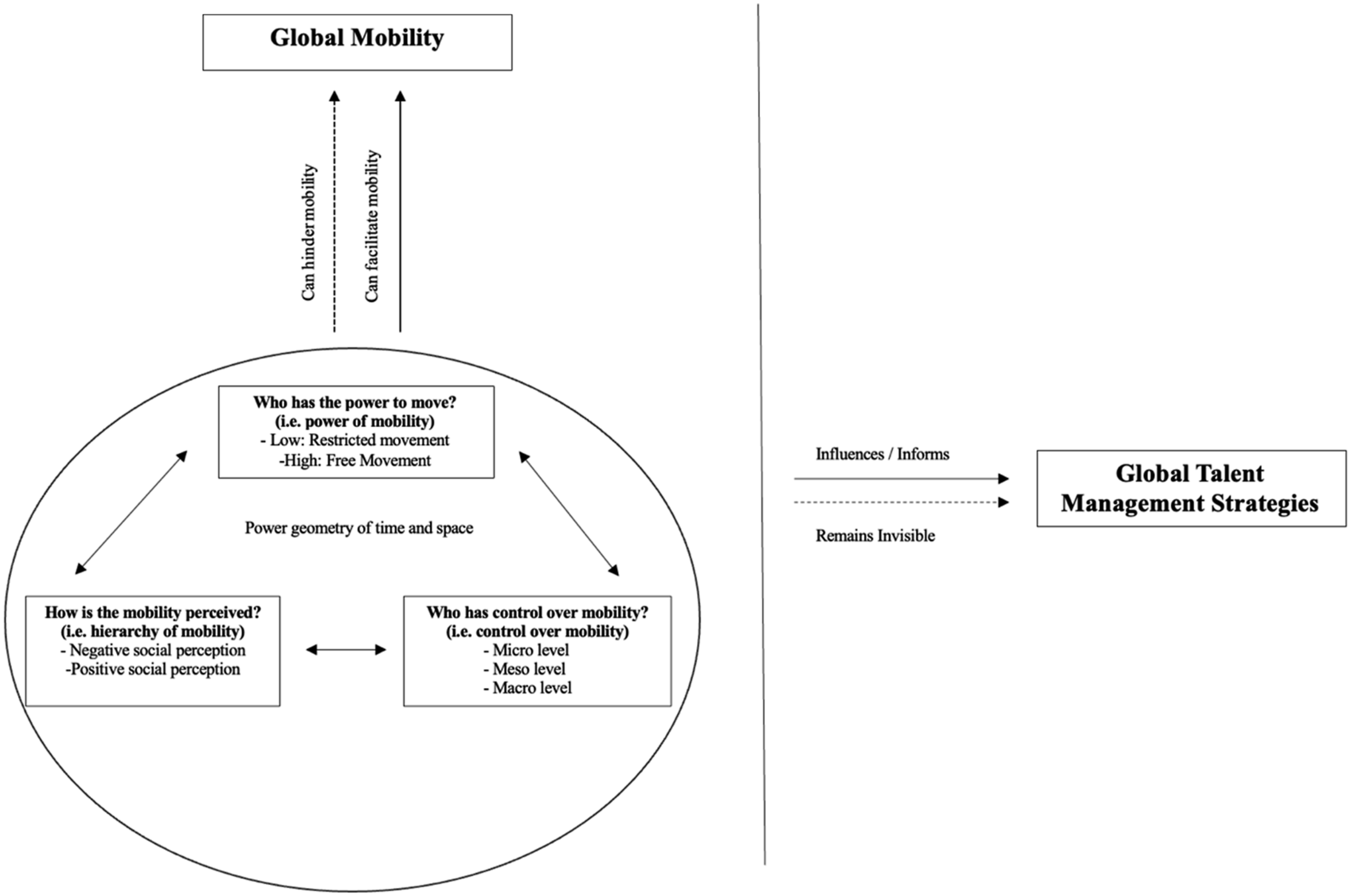
Defining Key Concepts and Their Interrelationships
In this section, we introduce three interrelated concepts from Massey’s (1994) power geometry framework—power of mobility, hierarchy of mobility, and control over mobility—and explain how they intersect together to shape who gets to move, under what conditions, and with what consequences. By unpacking these dynamics, we demonstrate that mobility is not a neutral process, but one that actively reflects and reproduces global power asymmetries.
Power of mobility emphasizes who can move and how. It represents an individual’s ability to move freely across borders, choose their destination, and possess the necessary qualifications and legal rights to move across boundaries (Bélanger & Silvey, 2020; Hammer & Adham, 2023; Skeggs, 2004; Zheng & Smith, 2024). It’s about access to mobility itself — often shaped by socioeconomic status, nationality, gender, race, and other structural factors. For example, a highly skilled expatriate with a global employment package and visa sponsorship has a high power of mobility; a low-wage migrant worker with limited documentation does not.
Hierarchy of mobility refers to the structured ranking of individuals based on their access to mobility (Gustafsson & Engblom, 2024; Tesfahuney, 1998). It refers to the social value and legitimacy assigned to different types of mobility. Some forms of movement (e.g., international corporate assignments) are celebrated and rewarded, while others (e.g., refugee movements or low-wage labor migration) are stigmatized or criminalized. It is important to note that while power of mobility is about the ability to move, hierarchy of mobility is about how different mobilities are socially ranked, regardless of whether people can move freely or not. For example, a corporate relocation is viewed as strategic and desirable; a domestic worker crossing borders may be perceived as a security threat or economic burden.
Control over mobility reflects and reinforces multiple agents’ power over movements. It refers to who governs, regulates, or restricts movement — including states, organizations, and institutions that enable or constrain mobility through policies, borders, contracts, and surveillance. This focuses on the agents and mechanisms that structure mobility, not on the mover themselves. For example, a multinational corporation deciding who is eligible for global assignments exerts control over employee mobility. Governments controlling visas and border crossings also exercise this form of power.
Recognizing the differences, while understanding the interconnectedness between these three concepts, is essential in unpacking the complexity of global mobility within GTM. In sum, the power of mobility, as we will show next, is not evenly distributed, leading to a hierarchy of mobility where certain roles, skill sets, or individual characteristics have greater freedom and opportunity to navigate global work opportunities. This hierarchy is, in turn, a reflection of the multi-actors’ (e.g. individual, organizations, state) control over mobility—how it strategizes the placement and movement of labor to align with individual, business, and national objectives. We tease the intricacies of our framework as it relates to GTM further below.
Conceptual Connections to GTM Research
As shown in Figure 1, our conceptual framework highlights that global mobility can be facilitated or hindered by the interaction of various power relations within a designated time & place, and with constraints on movements (space) - which are rarely accounted for in the GTM literature. The spatial organization of the figure further reinforces these interdependencies. The three key dimensions—power of mobility (ranging from low (e.g., individuals facing restricted movement) to high (e.g., those freely mobile, typically emphasized in GTM literature), hierarchy of mobility (which reflects societal perceptions—ranging from positive (e.g., corporate elites) to negative (e.g., refugees or displaced persons), and control over mobility (conceptualized through relational power and networks operating at macro (e.g., states, UN), meso (e.g., organizations), and micro (e.g., individuals) levels) —are depicted as interlocking forces rather than isolated variables. Arrows in the figure illustrate the dynamic and recursive nature of these relationships, while the encompassing circular frame is meant to evoke Massey’s (1994) notion of power-geometry, emphasizing that mobility is always spatially and temporally situated, and that immobility is not the absence of movement but the outcome of systemic constraints. Our framework extends this by centering the relational and situated nature of mobility—demonstrating that GTM strategies cannot be meaningfully designed or assessed without accounting for the spatial and temporal power dynamics that enable or restrict movement.
The characteristics of the mover—such as their nationality, class, profession, gender, and caregiving status—shape their [power of mobility] and position within the [hierarchy of mobility], determining not just whether they can move, but also how that movement is perceived and valued. These individual-level attributes do not operate in isolation; they intersect with structural factors that exert [control over mobility], such as state immigration policies, employer selection processes, and global labor market hierarchies. This intersection reinforces existing inequalities. Those who already possess privileged characteristics—for example, a highly skilled male professional from the Global North with no care responsibilities—are more likely to be offered mobility opportunities by multinational firms, have their visas fast-tracked by states, and be celebrated as globally mobile “talent” ([high power of mobility] and [high position in the hierarchy of mobility]). In contrast, those with disadvantaged characteristics—such as low-wage migrant workers from the Global South, women with caregiving duties, or individuals from politically unstable countries—face layers of structural control that restrict their movement ([low power of mobility] intersecting with [strong control over mobility]): limited visa pathways, exploitative migration regimes, and employer sponsorship schemes that tie them to precarious conditions. These intersecting dynamics mean that those with [low power of mobility] are often subjected to the most restrictive [control over mobility], while their mobility is devalued or rendered invisible within organizational and policy frameworks ([low position in the hierarchy of mobility]) (Anderson, 2010; Bloch & McKay, 2016). Meanwhile, those with [high power of mobility] and [high hierarchical status] are granted facilitated, supported, and prestigious forms of movement.
However, what is key here—and, where our framework most directly speaks to global talent management strategies—is the recognition that these mobility dynamics are not neutral or incidental. While the GTM literature often focuses on the deployment of ‘global talent,’ it tends to treat mobility as an unproblematic process—failing to interrogate how access to mobility is unevenly distributed and conditioned by intersecting power structures. Our framework makes visible the underlying dynamics—power of mobility, hierarchy of mobility, and control over mobility—that influence who can move, under what conditions, and how that movement is socially and institutionally valued. In doing so, the framework introduces two critical pathways depicted in the figure through directional arrows. On the one hand, if these mobility dynamics are recognized and taken seriously, they can inform and influence GTM strategies, pushing them to become more reflexive, equitable, and inclusive. On the other hand, when these dynamics remain invisible, as they often do in mainstream GTM literature and practice, the strategies that emerge tend to reflect and reproduce dominant power hierarchies. They privilege already-mobile, elite professionals—typically from the Global North—while rendering invisible the constrained, precarious, or devalued mobilities of others, such as migrant workers, individuals with caregiving responsibilities, or individuals from conflict-affected regions. Understanding how power, hierarchy, and control intersect to shape global mobility is essential for designing GTM strategies that are equitable and inclusive. If these dynamics remain unacknowledged, GTM practices risk reproducing—and, even legitimizing—the very hierarchies they often claim to transcend. In this way, our framework challenges GTM to move beyond a managerial focus on efficiency and alignment with corporate goals, toward a more critical understanding of how global mobility is itself shaped by and embedded in power. We unpack this framework as it relates to GTM in more details below:
Power of Mobility and GTM
Contemporary global talent management debates rarely address the power asymmetries that shape talent mobility, as there are assumptions that strategic GTM operations are based on free movement and free choices, and glosses over issues of power relations in work engagement (Guttormsen & Lauring, 2022; Hajro et al., 2022). The current literature further downplays other diverse mobilization forms, characterized by displacement, refugee overflows, and migrationary movements of lower skilled persons (Bris et al., 2023). This, in turn, highlights how scholars of global mobility foreground the extreme socio-spatial constraints encountered by labor migrants, undocumented people, asylum seekers, and refugees, as well as the modalities of agency these people can exert in the face of limited choices, immobility, and waiting (notable exception; Guttormsen & Lauring, 2022). Instead, most of the literature assumes employees have the freedom to move and select the destination they want to work in, possess high level of education, and have the legal right to enter the foreign country (Jooss, McDonnell, & Conroy, 2021, 2022; Renshaw et al., 2021). Failing to acknowledge that many forms of labor across the global economy are constrained by limited mobility—and that intersecting signifiers of gender, race, and class further complicate mobility research—undermines a comprehensive understanding of GTM.
Building on this, global mobility debate tends to exist in a contextual vacuum, seemingly untouched by socio-historical and geo-political processes of colonialism, and their continuing global implications (Jooss et al., 2022). The term ‘coloniality’ is used here since global mobility literature is written from a Global North perspective, an epistemological privilege that assumes to be speaking for most expatriates and migrants, thus marginalizing the many types of labor and laboring (Guttormsen & Lauring, 2022), and the knowledge and experiences of employees from the Global South. This is underpinned by assumptions of a neoliberal political economy that is the dominant model most adhered to across the globe. This position and approach have been associated with the building of greater labor inequalities in developed economies, which tends to also support the notion of ‘managerialist philosophy’, thereby requiring organizations to allocate talent leaders and disconnect from myriad labor mobility categories (Isichei & Collings, 2018; Tung, 2016)
Hierarchy of Mobility and GTM
In essence, global talent management is a way of ranking and rating employees. This acknowledges the presence of hierarchies of mobility and differentiated mobilities, which occur due to where one is positioned, and where there are avenues, or not, of being able to move, or whether someone is rendered immobile. These dynamics are particularly evident in the typologies of foreign labor, where distinctions between the global laborers shape their mobility. We will discuss this in more details next.
Typologies of Global Labor
The literature on global talent management indicates a growing array of various forms of global laborers and international work experiences (Arifa et al., 2021; Briscoe et al., 2009; Haak-Saheem & Brewster, 2017; Kelly & Conroy, 2024). Laborer’s global mobility can be categorized into three types, including migration, assigned mobility, and self-initiated expatriation (Baruch et al., 2024). Nevertheless, clear distinctions between these laborer categories remain under debate, making cross-study comparisons challenging (Alshahrani, 2022; Baruch et al., 2013; Brewster et al., 2021; Doherty, 2013; Kunz, 2020).
To begin with, migration refers to voluntarily movement across national borders in which individuals relocate from one geographical area to another, without a predetermined return date, or a definite intention of returning to their home country or previous place of residence (Agozino, 2000; Despotovic et al., 2022; Kunz, 2020). Migrants’ experiences in their host countries are shaped by numerous factors, including their socioeconomic status, cultural background, and their motivations for migration, which vary considerably. Individuals relocate for various personal and professional reasons, including career development, lifestyle change, or seeking refuge (Atay et al., 2024). For instance, skilled migrants - those with post-secondary education or equivalent training - typically migrate with the specific goal of obtaining legal, long-term residency and employment in their host country (Cerdin et al., 2014; Farashah et al., 2023).
It is important to note that contributions to host economies are predominantly associated with highly skilled migrants. However, low-skilled migrants also play a significant role in their host country’s economies. In countries with high portions of skilled natives, low-skilled migrant workers often play a complementary role in the labor market by addressing workforce shortages and filling essential roles in understaffed sectors. These sectors are frequently those that native workers find less desirable (Shirmohammadi et al., 2019). Clearly, these labor configurations involve a range of global institutions that are actively responding to the shifts in global migration, namely: the changing nature of location and firm- specific advantages considering access to human capital; the implications of migration for firms’ entry modes and market selection approaches; and how migration impacts firms’ organizational culture and approach to strategy (Hajro et al., 2022).
To distinguish between migrants and non-migrants, two main criteria are used: (1) physical relocation across national borders, and (2) a shift in the primary place of residence, which serves as the center of an individual’s life (Alshahrani, 2024; Andresen et al., 2014; Scholten, 2022). Consequently, not all individuals who solely engage in cross-border work meet this definition. For example, globally mobile professionals regularly travel across borders for work, while maintaining their primary residence in their home country, without permanently relocating nor being accompanied by their families. They frequently return home at regular intervals, such as weekly, bi-weekly, or on a rotational schedule, depending on the industry. While their primary work location is abroad, some of their responsibilities may also be carried out in their home country (Mäkelä et al., 2017).
Beyond the general migrant category, there exists a crucial distinction between migrants and expatriates. Expatriates differ from migrants in that they fulfill two additional criteria: (1) engagement in formal employment abroad, and (2) legal authorization to work in the host country (Alabdulkarim et al., 2023; Andresen et al., 2014; Doherty et al., 2011; Kunz, 2023; McNulty & Brewster, 2017; McNulty & Vance, 2017). Those who relocate internationally, but do not engage in employment - such as dependents of expatriates, under-age children, non-working partners, or non-employed foreign students - are classified as migrants, but not as expatriates. Furthermore, individuals working illegally in a foreign country are excluded from the expatriate category, as legal employment is a defining characteristic of expatriation even for independent workers (e.g., self-employed and/or owners of organizations) (Paik et al., 2017; Pinto et al., 2024; Vance et al., 2017). Unlike migrants who undergo profound changes in their identity and value systems, as they integrate into their new host society, expatriates who are temporary “visitors”, retain their cultural values and identities while merely adapting their behaviors to navigate a new, yet temporary environment (Hajro et al., 2019). However, this distinction is not fixed, as some expatriates who initially move abroad for work eventually choose to settle indefinitely, gradually integrating into the host country’s society and transforming into migrants (Cao et al., 2015; Despotovic et al., 2022; Xie et al., 2023; Yang & Guo, 2022).
Further, expatriates can be further classified into “Assigned Expatriates” (AE), or “Assigned Mobility”, and “Self-Initiated Expatriates” (SIE), which are frequently used interchangeably in research on expatriation and international workers due to their significant overlap (Baruch et al., 2024; Bozionelos et al., 2023; Hajro et al., 2019; McNulty & Brewster, 2017). Yet, the distinguishing definitions have been evolving and are reflected as follows. “Assigned expatriates” are professionals who are relocated internationally by their home-country employer for a temporary assignment - i.e. assigned mobility (Bozionelos et al., 2023; Kumpikaitė-Valiūnienė et al., 2022). Their international move is organization-driven, meaning the employer determines the destination, assignment duration, and job role. These expatriates remain employed under their home company’s contractual terms, and are expected to return upon completing their assignment, which usually lasts between three months to five years (Casado & Caspersz, 2021; Mutter & Thorn, 2021). AEs are typically sent abroad to fulfill corporate objectives aligning with specific organizational needs and matching competencies, such as overseeing operations, transferring knowledge, or leading foreign subsidiaries (Jannesari et al., 2024; Moulaï et al., 2022).
In contrast to AEs, whose global mobility is initiated by the organization, “self-initiated expatriates” proactively seek cross-border employment on their own, without employer support (Alshahrani, 2022; Andresen et al., 2020; Haak-Saheem & Brewster, 2017; Kelly & Conroy, 2024; Mäkelä et al., 2022; Mello et al., 2024; Suutari et al., 2018). During the relocation process, SIEs face more challenges than AEs, including financial difficulties and the uncertainty coupled with their move. This is primarily because they are responsible for securing their own employment, visas, and relocation arrangements, often relying on personal savings to fund their relocation initiative (Kelly & Conroy, 2024; Mäkelä et al., 2022; Wechtler et al., 2023). A defining feature of SIEs is that they do not have a predetermined length of stay in their host country, unlike AEs, who are bound by contractual assignments (Jannesari et al., 2024; Kelly & Conroy, 2024). Their employment contracts are local, meaning they are subject to host-country labor laws, and do not receive expatriate benefits, such as housing allowances or tax equalization (Casado & Caspersz, 2021; Kelly & Conroy, 2024; Kirk & Howe-Walsh, 2021).
In sum, not all migrants qualify as expatriates; the key differentiators include employment status, legal work authorization, and the duration of stay. As for AEs and SIEs, these share commonalities in their intent to work abroad, but differ in their pathways to international employment. These distinctions are essential in understanding global labor mobility, and the diverse experiences of individuals navigating international careers.
The Power Within the Typologies of Global Labor
Understanding the typologies of global labor as hierarchical allows us to critically examine how different laborers experience mobility. A good example is corporate elites - present at the top of the hierarchy- who possess mobile career paths in diverse regions and spaces, as they have the capacity to move and interweave between different MNCs and within global organizations of corporate economies (Valk, 2019). This hypermobility is due to being highly skilled with significant professional, political, and managerial capital (Jooss, Conroy, & McDonnell, 2021). Their mobile capacity, as well as globalized and cultural knowledge capacities, creates significant demand for them from MNCs, international organizations, and governments (Hajro et al., 2022). Accordingly, the mobility of corporate elites remains essential to maintaining global competitiveness (Renshaw et al., 2021). Against this backdrop, current writings on GTM privilege leaders, namely Global North Elites, and various labels of expatriate (McNulty & Brewster, 2020), who are largely representatives of the transnational corporate class/elites (Sklair, 2002), which is not an accurate picture of global working and operations.
Global mobility has been socially constructed to reflect the importance of agency and ‘individualized signifiers’ (Kirk, 2019; Mutter & Thorn, 2021), which are symbolic markers of status, identity, and belonging, reinforcing social hierarchies and power differentials. This reflects the top of the hierarchy with individualistic orientations of more highly educated migrants who have multiple opportunities for moving. This is further fleshed out in Bris et al. (2023) study, stating that the motivational factors behind the mobility of highly skilled individuals are not economically based, but rather focused on the potential returns on their skills development, as well as factors related to cultural affinity and belongingness. We would find that majority of the global mobility in the GTM literature helps constitute ‘individualized’ notions of talent, that privileges white heterosexual identities on the expense of other international workers, without considering the discourse around restriction on mobility/immobility that marginalized bodies experience (with exceptions noted by Guttormsen & Lauring, 2022).
Further, the presence of cultural, linguistic, spatial, and temporal distances involved in global work—as well as distinct political, economic, and societal institutions—makes the coordination of work and the management of people within MNCs particularly challenging (Latukha et al., 2021; Peltokorpi & Xie, 2025; Reiche et al., 2019). This is especially relevant, as evolving and geographically dispersed work environments require constant adaptation and alignment with distinct organizational policies and infrastructures (Bosch-Sijtsema et al., 2011). Cultural distance, encompassing differences in values, norms, and working styles, can hinder knowledge exchange and collaboration, often privileging those who possess intercultural competencies, or who originate from dominant cultural backgrounds in global business (Stahl et al., 2017). Linguistic distance similarly affects mobility, as individuals fluent in widely spoken business languages, such as English, often have greater access to international career opportunities, while those with limited linguistic capital face structural barriers to mobility (Neeley, 2017; Peltokorpi & Xie, 2025). Spatial and temporal distances also create asymmetries in global mobility, where professionals located in peripheral or less economically developed regions may experience restricted access to global job markets, due to infrastructural limitations, visa restrictions, or geopolitical constraints, placing them on the lower end of the time/space spectrum (Aygül & Mertek, 2024; Baldassar et al., 2024; Zhang, 2019). Additionally, temporal misalignment - caused by time zone differences - complicates synchronous collaboration, reinforcing power imbalances, where those in dominant economic contexts dictate work rhythms and availability expectations (Kiely et al., 2022).
Control Over Mobility and GTM
Decisions over mobility are exercised across multi-scalar levels, incorporating international organizations, like the UN, MNCs, state governments, and various civil society organizations (Isichei & Collings, 2018). Business organizations and human resources policies have been the primary focus of expatriate management research (Isichei & Collings, 2018), local and global political processes, and governmental institutions, such as immigration and taxation authorities, also guide the admittance of individuals from different countries, creating possibilities and limitations (Guttormsen & Lauring, 2022). Compliance with tax, immigration, and other legal requirements are major challenges involved in managing the global workforce (Isichei & Collings, 2018; Valk, 2019). As an example, frameworks, such as visas and permits, serve as a macro-level control mechanism that directly influences individual mobility at the meso - and micro-levels, constraining or facilitating access to work. Work authorization is most associated with skilled migrants’ access to qualification-matched employment, employment mobility, and even professional development and salary negotiations (Shirmohammadi et al., 2019). Additionally, barriers within more tangible structures, such as restrictions on travel routes to and from certain countries, can significantly shape the flow of expatriate populations (Guttormsen & Lauring, 2022). Beyond legal restrictions, corporate actors also exercise a significant degree of control over mobility, shaping not only who moves, but also where, when, and under what conditions mobility occurs.
The supporting infrastructure for global work can similarly be structured along physical and temporal lines. Physically, Bloch and McKay (2016) note ‘uneven opportunities to migrate, with border controls aimed at excluding some groups while the global elite can move freely; the growth of forced migration as a consequence of North/South relations and the need of capitalism for low-paid and often precarious workers’ (p. 5). Along with organizational structures and managerial preferences, recruitment biases, for example, can as well shape an individual’s ability to move across borders or advance within the organization. For instance, employers’ selection biases against countries of origin decreases skilled migrants’ access to potential qualification-matched employment (Shirmohammadi et al., 2019). Temporally, mobility is regulated through time-sensitive mechanisms, such as contract lengths and business travel schedules, which determine not only how long an individual can stay in each location, but also the frequency and flexibility of their movement. For globally mobile professionals, for example, decisions about when to travel are often dictated by their line manager (Isichei & Collings, 2018), demonstrating how organizational agents impose temporal constraints on mobility. The described dynamics further illustrate the multifaceted nature of responsibilities for flows, movements, and mobilities, shaped by intersecting macro and meso-level actors. As such, the responsibilities for flows, movements, and mobilities, are multi-faceted and emanate, not just from governments and international agencies, they are also managed and controlled via MNCs, who play a crucial role in the selection and employment of labor (Hajro et al., 2022; Jooss, McDonnell, & Conroy, 2021). Hence, the interplay between the agency of migrants and the structural context within, which they maneuver, should remain at the heart of how we understand talent mobility.
Discussion
As highlighted previously, contemporary debates of global mobility and GTM have ignored the importance of time, place, space, and how the power of mobility is organized and managed. Massey’s power geometry lens opens out the myriad ways in which we can better understand who has the power over global mobility and GTM strategies. The power geometries of global mobility manifest as inequalities in power, hierarchy, and control over mobility: who has the capacity to move, either at all, or at the speed or to the destinations they might like, the degree of control people have over various stages of their mobility trajectories, the power people have to remain with their family members when they travel (and, for how long), and the risks that different people face of deportation, confinement, and exclusion. Following from Massey’s foundational theorization of im/mobility, we can better understand how power geometries influence the stratification of global talent management - more importantly, understand the increased movement and linkages across space and time, that are emerging in tandem with new forms of exclusion, dislocation, immobility, segregation, and stratification (Tazzioli, 2018).
Through this lens, the positioning and power held by global laborers’ and workers can help unravel the materialities of space and place, and explain the organization of multiple forms of mobilities that can aid GTM theorization and strategy development. In our discussion, we thus reflect on how global mobility is shaped by power relations within a designated time & place (location), and with constraints on movements (space), and further reflect on how the power of mobility, the hierarchy of mobility, and control over mobility are all interconnected, leading us to push the GTM literature forward, through calling for adopting a critical perspective when examining global mobility in GTM by focusing on: (a) broader and inclusive conceptualization of global mobility in GTM, and (b) contextualized and relational conceptualization of global mobility in GTM. We will discuss each in turn.
A Critical Perspective on Global Mobility
Massey’s notion of power geometry offers a critical lens through which to interpret the dynamics outlined in our conceptual framework. At its core, power geometry emphasizes how power operates unevenly across space, shaping who moves, who doesn’t, and who controls the conditions of mobility. In Massey’s terms, mobility is not just about movement—it is about the power over movement. Our framework - presented in Figure 1- aligns with Massey’s argument by illustrating that GTM is not a neutral or equal process, but one deeply embedded in hierarchies and systemic power structures. Just as Massey argues that some individuals are “in charge of” mobility (e.g., global business elites), while others are “forced to move” (e.g., migrant laborers), we highlight that the dominant discourse in GTM privileges those at the top of the global hierarchy—typically white, professional, elite expatriates—while rendering the precarious and invisible laborers largely absent. For instance, and circling back to Figure 1, GTM frameworks that focus primarily on “high potentials”, or “global talent pools”, tend to valorize those already positioned with high power of mobility and high societal status—often Western-educated, highly skilled professionals who match dominant corporate ideals. This selective visibility not only sidelines individuals with lower power of mobility (such as migrant care workers, low-wage laborers, or those navigating restrictive visa regimes), but also renders the structural constraints shaping their immobility as irrelevant to GTM discourses. In doing so, GTM strategies may unwittingly reinforce global labor segmentation and deepen inequalities across nationality, gender, and class. Conversely, when GTM strategies are informed by an understanding of how mobility is structured by intersecting power dynamics (as illustrated in Figure 1), they can begin to challenge the exclusionary practices that underpin traditional notions of talent. This might involve rethinking who is recognized as “global talent,” questioning the geographic and demographic assumptions embedded in talent pipelines, and accounting for the social and institutional barriers that constrain access to mobility. Our conceptual framework (Figure 1) thus highlights the interplay between power, hierarchies, and control over global mobility, centralizing power as a key factor influencing mobility dynamics. In many instances, power dynamics intersect with hierarchies to govern the control and distribution of global mobility opportunities. The control over global mobility is not only exercised through organizations, but as we show, it is also through individuals and national/regulatory systems that reinforce existing power imbalances and perpetuate inequalities in access to movement - echoing Massey’s observation that spatial mobility is tightly controlled and politically charged. In this way, Figure 1 serves not only as a conceptual map of mobility, but also as a critical tool for interrogating and reshaping GTM. It calls for a shift from managing mobility as a technical HR process to understanding it as a socially and politically embedded phenomenon—one that has real implications for equity, representation, and justice in the global workforce. We discuss more next.
Broader and Inclusive Conceptualization of Global Mobility in GTM
Our framework (Figure 1) underscores the importance of critically examining the distribution of power and its impacts on global mobility and GTM strategies. Our critique thus draws attention to the exclusionary rhetoric of all that is non-white, precarious, and invisible in the global mobility literature - building up on a point that Massey makes when she discusses how time-space compression works differently for different people, depending on their position in the global power geometry. As demonstrated earlier, the majority of GTM literature focuses on elite prompting us to advocate for a more inclusive discourse in GTM, that encompasses laborers positioned in the lower echelons of the hierarchy, thus revealing disparities in mobility opportunities. By centering the experiences of laborers and precarious workers, our framework not only exposes how spatial mobility is patterned by power but also demands a reconceptualization of GTM to reflect the multi-scalar and asymmetrical nature of global movement—just as Massey urged scholars to consider the uneven geographies of globalization.
Massey’s framework also reveals how talent is positioned differently across global geographies. While executives and high-skilled workers from the global North may be celebrated as “global leaders”, talent from the global South is often framed as supplemental or peripheral. This reinforces colonial hierarchies of knowledge and labor, rather than dismantling them. Further, GTM practices risk reproducing a neoliberal logic that values individuals based on their market adaptability, rather than addressing the systems that restrict others. By seeing mobility as socially constituted, GTM scholars and practitioners can better recognize how race, class, gender, and geography intersect to structure whose mobility is enabled, whose is constrained, and whose is altogether invisible. A broader and inclusive perspective, therefore, calls for GTM to move beyond efficiency-driven approaches, and toward strategies that actively disrupt mobility regimes grounded in racialized and gendered global hierarchies. This means not just expanding access to mobility, but also transforming how value, skill, and potential are defined and by whom.
Hence, the meaning of global mobility, in this context, cannot be fixed in advance, but must emerge through an analysis of the experiences of these invisible and precarious laborers in specific spatial locales (Al Ariss & Syed, 2011; Cerdin et al., 2014; Sarpong & Maclean, 2021). We draw attention to the precarity of mobility, and the widening inequalities in all societies as a contemporary economic feature (Kalleberg & Vallas, 2018; Piketty, 2020), often neglected in the global mobility literature, and posit it as a central axis around how we need to think of mobility and GTM strategy. This, in turn, will have implications for how we analyze the movement of talent (Al Ariss et al., 2014), and by extension, the context in which that mobility is unfolding (Castells, 2000; Sklair, 2002). As such, an inquiry around global talent management will need to focus on the lives of the global laborers, in ways not determined by what the current literature asserts as universal (Metcalfe, 2019) and expand to include those that are marginalized.
Contextualized and Relational Conceptualization of Global Mobility in GTM
An important aspect of using Massey’s power of geometry lens is to highlight assumptions related to socio-cultural and geo-political context. The global mobility writings assume a neoliberal market economy and ignore contextualized factors that are shaping international business systems. Through Massey’s framework, we can appreciate how mobility is socially constituted—not a mere act of geographical transition, but a dynamic process tied to power, privilege, and positionality. The lens allows us to tease out new insights into how different actors are differently positioned within these global flows, based on histories of colonialism, geopolitical marginalization, and socio-economic stratification. For instance, highly skilled expatriates from Western countries often benefit from seamless mobility, corporate sponsorship, and visa privileges, while equally skilled professionals from the Global South—particularly women or racialized individuals—face multiple, intersecting barriers to global career opportunities (Crowley-Henry et al., 2018). Their mobility is not only constrained but also devalued within dominant GTM frameworks that fail to recognize non-elite or non-Western talent as “strategic”. Importantly, this shifts the focus away from static notions of space and territory, challenging us to conceptualize place as relational and constituted through global networks, rather than fixed coordinates on a map. In doing so, this framework opens the door for more critical, inclusive, and intersectional grounded theorizing in GTM.
Massey argues against conceptualizing space as pre-social, closed ‘containers’, in which other processes happen, and instead approaches space as relational, dynamic, and socially produced. Like identities, places or spaces at all scales are precarious achievements constituted through relations and interactions between multiple entities from individuals to institutions. For example, global cities like London, Dubai, or Singapore are frequently portrayed in GTM literature as natural hubs of global talent. However, from Massey’s (1994) perspective, their status as “strategic talent destinations” is not fixed or inherent—it is socially produced through the uneven power relations that shape global flows of people, capital, and ideas. These cities become talent spaces not merely because of their infrastructure or geography, but because of the interactions between powerful actors—such as multinational corporations, state immigration regimes, and elite mobile professionals—who actively shape and benefit from these flows. At the same time, less visible actors, like low-wage migrant workers, are also part of the mobility system, yet occupy a different position in the geometry of power: they are essential to the functioning of these spaces, but lack control over their movement, and are rarely recognized as part of GTM systems. In Massey’s terms, this example illustrates how space is relational—constructed through power-laden mobilities that are deeply stratified—and, how individuals are differently positioned within these spaces depending on their social, economic, and geopolitical status.
Space is thus always under construction, continuously being made; never finished, places and spaces are ‘temporary constellations’, constituted by a heterogeneous set of “raw materials”, such as physical features and the built environment, individuals and social groups, political coalitions, businesses, and economic structures (Pierce et al., 2011, p. 59). Given its co-constitutive relationship with social processes, space or ‘space-making’ is inherently political, and Massey’s work links spaces and places to “the power-geometries they both enact and exist within” (2005, p. 168). The notion of power geometries aims to capture that “not only is space utterly imbued with and a product of relations of power, but power itself has a geography” (Massey, 2009, p. 18). This allows us to appreciate the dynamic way that ‘mobility is socially’ constituted in different geo-political and socio-cultural contexts and tease out important new aspects that are impacting global political economy, and all forms of business development that have never been named, but are central to understanding new insights into the conceptualization of a field of study.
In the next section, we discuss the practical implications of our research.
Practical Implications for GTM
First, GTM practices and policies related to the recruitment, management, and development of globally mobile employees would benefit from considering wider categories of global laborers. As McNulty and Brewster (2019, 2020) have argued in key research, the lower-level SIE will form the larger share of international workers as digitalization, remote work, and new organizational forms continue to reshape global labor markets. This leads to notions of mobility ontologies as the scale, place, and pace of industry is expanding, and the mobile worker will increasingly become the norm. This shift questions and challenges traditional GTM perspectives that prioritize high-status labor and performance-driven mobility, calling instead for more inclusive frameworks that recognize diverse mobility trajectories.
Second, a further exploring and deeper understanding of the mobility regimes (e.g., policies, constraints) that influence or shape who can move, under what conditions, and with what level of autonomy. A mobility regime approach would mean moving beyond, assuming mobility with freedom, but also ‘new confinements and modes of exploitation’ (Glick Schiller & Salazar, 2013, p. 8). Many global laborers, especially lower-status migrants, often face obstacles and barriers, such as restricted movement, unstable working conditions, or systemic disadvantages that limit their freedom. When GTM strategies acknowledges these confinements, exploitative structures and power imbalances that are ingrained in global mobility pathways, they can better address the realities of different mobility experiences.
A third implication for GTM practitioners is recognizing their role in shaping mobile inequalities and expanding their focus beyond high-skilled workforce to address broader socio-economic implications. MNCs and HR themselves play a direct role in influencing labor hierarchies by having visa sponsorship programs, managing employment classifications, and developing the needed mobility policies. For example, HR practitioners’ core responsibilities of recruiting high and low-skilled migrant workers for overseas employment must ensure inclusive GTM practices. This highlights the necessity to consider the multi-level actors involved in shaping global mobility strategies, as they directly influence workers’ access to free mobility, opportunities, legal protection, and career advancement. This links to our fourth implication that focuses on the role of HR in MNCs in managing sociocultural stereotypes against immigrants and fostering intercultural inclusiveness within the organization. This can take shape through various diversity management practices and employee training programs, as well as inclusive recruitment practices, culturally responsive onboarding programs, and continuous diversity and bias-awareness training for managers and staff.
Fourth, GTM strategies must also confront and dismantle the socio-cultural stereotypes and biases that often accompany global mobility, particularly for migrants from marginalized backgrounds. Human resource professionals within MNCs have a critical role to play in fostering intercultural inclusivity and psychological safety within diverse workplaces. This requires going beyond symbolic diversity commitments to implement meaningful diversity management practices—such as inclusive recruitment protocols, culturally sensitive onboarding, mentorship programs for migrant workers, and ongoing bias-awareness training for all staff. In doing so, organizations can move toward a more ethical and socially responsible approach to global talent management—one that sees mobile workers not merely as economic units, but as individuals navigating complex intersections of identity, power, and opportunity.
Future Research Avenues
Building on Massey’s (1994) power geometry framework, future research in IHRM and GTM could benefit from critically examining how the intersecting dynamics of power of mobility, hierarchy of mobility, and control over mobility structure the spatial and social organization of global mobility, shaping not only who moves, but under what conditions, and with what value attributed to their movement—thereby, actively producing and reinforcing transnational inequalities.
First, future research could delve deeper into the empirical exploration of underrepresented mobility forms, particularly by examining how individuals with constrained mobility—whether due to socioeconomic, political, or legal limitations—strategically navigate complex global structures in pursuit of international work. This line of inquiry calls for a nuanced understanding of the forms of agency such individuals enact when confronting institutionalized barriers. Furthermore, scholars could interrogate the mechanisms through which corporate and state mobility regimes confer legitimacy upon certain mobilities—such as elite expatriation or high-skilled migration—while simultaneously marginalizing others, such as migrant labor or undocumented movement. Investigating these dynamics will shed light on how such regimes shape professional possibilities, reinforce global inequalities, and produce stratified career outcomes across transnational labor markets. Potential research questions could be: How do individuals with constrained power of mobility navigate structural barriers to access international work opportunities, and what forms of agency do they enact? In what ways do corporate and state mobility regimes legitimize certain forms of movement while devaluing others, and how does this impact workers’ career trajectories?
Second, future research should critically investigate the organizational mechanisms of control and exclusion that shape global talent mobility, particularly through the lens of differential access and constraint. This includes unpacking how GTM practices—ranging from assignment selection to performance evaluation—interact with employees’ nationality, gender, and caregiving responsibilities to either enable or curtail their international mobility prospects. Equally important is examining how formal structures, such as visa regimes, sponsorship systems, and HR mobility frameworks, do not operate in isolation, but co-produce layered inequalities that systematically privilege certain worker profiles while sidelining others. These institutional arrangements often obscure discriminatory logics under the guise of neutrality or meritocracy. Future studies should adopt an intersectional and comparative lens to illuminate how these mechanisms operate across geographies and sectors, and how they sustain global hierarchies of labor valuation and access. Potential research questions could be: How do organizational GTM practices differentially enable or restrict mobility opportunities based on employees’ nationality, gender, and caregiving status? What role does intersectionality play in shaping how mobile workers experience global assignments, and how is their mobility perceived within organizational hierarchies? How do visa regimes, sponsorship systems, and HR mobility frameworks co-produce inequalities in global talent flows?
Third, future research can prioritize comparative studies across geographies and sectors to reveal the uneven terrain of GTM and challenge the dominant, often Western-centric assumptions embedded in existing theories. There is a critical need to reorient GTM frameworks to reflect the asymmetrical experiences of mobility that manifest across diverse labor market segments—from high-skilled expatriates to migrant contract workers—and, in varied geopolitical contexts. By examining how corporate and state regimes differentially legitimize certain forms of movement, while rendering others invisible or undesirable, scholars can expose the structural hierarchies that govern who move, how, and with what consequences. Comparative analyses can illuminate the interplay between macro-level policy structures and micro-level career outcomes, revealing how mobility systems both reflect and reproduce broader global inequalities. Such inquiry holds the potential to generate more inclusive, contextually grounded theories that move beyond one-size-fits-all models of global talent flow. Potential research questions could be: How can GTM theories be reoriented to account for the asymmetrical experiences of mobility across different labor market segments and geographic regions? In what ways do corporate and state mobility regimes legitimize certain forms of movement while devaluing others, and how does this impact workers’ career trajectories?
Conclusion
Through drawing on Massey’s power geometry model, we propose a conceptual framework that focuses on three core concepts: power of mobility, hierarchy of mobility, and control over mobility to extend the contemporary understanding of global mobility by addressing the lack of explicit attention given to issues of mobility, space, and place, as well as the tendency to overlook considerations of power and spatial constraints. Through this approach, we offer valuable insights into the dynamics of contemporary mobilities, highlighting the diverse experiences and consequences of mobility within a rapidly changing global landscape.
The concept of global mobility encompasses multiple inequalities, highlighting the fact that it is shaped by various labor flows, conflicts, and social movements across diverse geographic territories, hence the needs for a broader spectrum of global mobility. Our contribution to the field is significant in connecting interdisciplinary fields, providing a clearer and more nuanced understanding of the diverse forms of laboring, mobilities, and im-mobilities within the global economy. By examining the themes of space and power, we demonstrate that intersecting issues and power dynamics have differential consequences for the mobility of different individuals. Furthermore, our discussion emphasizes the fluidity of mobility within shifting geopolitical and sociocultural contexts and urges scholars to engage in a more extensive coverage and understanding of global mobility forms. This fluidity is orchestrated by multiple agents operating at various levels, including macro-level structures, state governments, regional entities, organizations, and individuals.
Footnotes

Funding
The authors received no financial support for the research, authorship, and/or publication of this article.
Declaration of Conflicting Interests
The authors declared no potential conflicts of interest with respect to the research, authorship, and/or publication of this article.
Data Availability Statement
Data openly available in a public repository that issues datasets with DOIs.