







Abstract
Digital collaboration tools (DCTs), such as Microsoft Teams and DingTalk, are essential in the functioning of virtual teams. However, existing research on how these technologies influence coordination among virtual team members remains underexplored. This study investigates how DCT-enabled disclosure awareness—the extent to which virtual team members are aware of each other’s personal information via DCTs—influences team functioning. Drawing on adaptive structuration theory, we argue that DCT-enabled disclosure awareness positively affects team coordination and, subsequently, team performance. In addition, we propose that power and status hierarchies moderate this relationship, such that the positive impact of DCT-enabled disclosure awareness is stronger when power hierarchy is low or status hierarchy is high. Our hypotheses are supported by multi-source, multi-wave field survey data from 130 virtual teams. These findings provide new insights into virtual team management in the era of organizational digitalization, specifically highlighting how virtual teams can leverage digital technologies to improve performance.
Keywords
Introduction
Virtual teams, defined as groups of dispersed members brought together through technologies to achieve a common goal (Gilson et al., 2015), have become increasingly prevalent in modern organizations. The rise of digital technologies, the accelerating process of globalization, and the widespread adoption of remote and hybrid work arrangements have all contributed to the growing prominence of virtual teams (Luciano et al., 2025). The 2024 Workplace Flexibility Trends Report reveals that two-thirds of full-time U.S. employees now participate in blended work arrangements, combining in-office presence with remote work opportunities, indicating a significant shift toward virtual coordination (TechSmith, 2023). Despite their growing prevalence, virtual teams face distinct coordination challenges that differ markedly from traditional face-to-face teams. The inherent physical separation creates multiple barriers to effective coordination, stemming from geographical distance, departmental separation, and hierarchical differentiation (Leonardi, 2014; 2022). These barriers significantly impede virtual team members’ ability to develop mutual understanding regarding roles, expertise, and working styles, thereby complicating the coordination process. The criticality of interpersonal connections in virtual teams is further evidenced by Berthold and colleges’ (2022) study of over 11,000 respondents across various industries from 2020 to 2022, which found that 52% of participants identified face-to-face interactions with colleagues as their primary motivation for returning to office spaces.
As scholars have noted, virtuality presents both challenges and opportunities (Luciano et al., 2025). To address the above-mentioned challenges, organizations are increasingly relying on digital collaboration tools (DCTs) to foster virtual team coordination (Behrend et al., 2024; Larson & DeChurch, 2020). Compared to face-to-face interaction, DCTs enable virtual team members to learn about each other in a more comprehensive and thorough way. For example, employees can use the “personal information panel” of some platforms to disclose their photos, department information, superior–subordinate relationships, professional skills, and emotional states, or a function like “personal user manual” to describe their hobbies, values, and preferred collaboration styles. It can be seen that organizations have invested significant resources in developing the disclosure features of DCTs, aiming to help virtual team members better understand each other and build relationships, thereby promoting effective coordination.
Despite the widespread adoption of DCTs and their disclosure features, their effectiveness for virtual teams remains theoretically underexplored. Prior research has highlighted the benefits of DCTs at the organizational (e.g., improved innovation performance; Ng & Yee, 2020) and individual levels (e.g., enhanced job performance and creativity; Kuegler et al., 2015; Ali-Hassan et al., 2015). However, research at the team level—a critical context for DCTs—remains limited (Lane et al., 2024). This gap is compounded by existing literature on self-disclosure, which primarily focuses on traditional, offline interactions and the individual level. While self-disclosure is known to foster interpersonal relationships (Collins & Miller, 1994), its implications in the workplace are complex, with documented risks (Gibson et al., 2018) alongside its potential benefits (Arnett, 2023). Therefore, our research attempts to examine whether and when DCT-enabled disclosure awareness, defined as the extent to which virtual team members are aware of the personal information about each other via DCTs, enhances team coordination and hence team performance.
According to adaptive structuration theory (DeSanctis & Poole, 1994), the use of technology in virtual teams is shaped by both the way team members appropriate and interact with the technology and the social structures within the team. Adaptive structuration theory posits that technology does not solely determine team outcomes; rather, the interplay between technological features and social dynamics shapes how technology is used and its subsequent effects on team processes and performance. DCTs provide virtual team members with opportunities to share and access personal information (e.g., hobbies, attitudes, values, relationship networks) with relative ease (Lim, 2018). This affordance of DCTs can reduce coordination challenges often associated with geographical distance, departmental separation, or hierarchical differences by fostering mutual awareness and interpersonal connections. Therefore, we propose that DCT-enabled disclosure awareness positively influences virtual team coordination and performance, as it acts as a social lubricant, promoting richer interpersonal understanding among virtual team members.
Moreover, adaptive structuration theory posits that social structures like hierarchies shape how team members interpret and use technology (DeSanctis & Poole, 1994; Hill et al., 2009). Accordingly, we examine virtual team power and status hierarchies as critical boundary conditions in the relationship between DCT-enabled disclosure awareness and team coordination, as these hierarchies constitute fundamental social structures that profoundly influence team functioning. While power stems from asymmetric control over resources and is often formal and rigid, status is rooted in respect from others and is conferred through ongoing interactions (Bendersky & Pai, 2018; Blader & Chen, 2014; Magee & Galinsky, 2008). We propose that these two forms of hierarchy play divergent moderating roles. On one hand, we expect power hierarchy to act as a barrier, causing team members to hesitate in relying on disclosed information, thus inhibiting the realization of collective coordination. On the other hand, we argue that a differentiated status hierarchy may serve as a catalyst, with team members becoming more attentive to the information disclosed by others through DCTs, thereby enhancing the functional utility of disclosure awareness for smoother coordination.
We conducted a multi-source, multi-wave field survey to test our hypotheses. Overall, the findings of this study make three primary contributions to the literature. First, by shifting from a universalist to a contingency-based perspective on disclosing personal information, we provide new insights into the literature on virtual team effectiveness. Second, we inform adaptive structuration theory by offering a more nuanced deconstruction of “social structures,” demonstrating that power and status hierarchies exert contrasting influences on how virtual teams appropriate disclosure features. Third, by examining the impact of team-level disclosure awareness via DCTs, we enrich the self-disclosure literature in workplace context. These contributions, as well as the study’s implications for digital management practice, are discussed in more depth in the final section of this paper.
Theoretical Background and Hypotheses
Virtual teams inherently face significant coordination challenges stemming from geographical dispersion, asynchronous communication, and reduced social presence (Gilson et al., 2015; Luciano et al., 2025). While scholars have attempted to explore the relationship between technology use and virtual team coordination, existing research presents several limitations. First, findings on the impact of technology on virtual team coordination are inconsistent, with some studies suggesting improvements (Bryant et al., 2009; Lowry et al., 2006) while others indicate ineffectiveness or even detrimental effects (Schweitzer & Duxbury, 2010; van der Kleij et al., 2009). Second, much of this research has primarily focused on traditional tools (e.g., email or instant messaging), without adequately exploring the specific features of modern DCTs (Lin et al., 2010). Third, and critically, prior work often overlooks crucial contextual factors in real organizational environments, particularly how pre-existing social structures—such as power and status hierarchies—act as crucial boundary conditions for the appropriation of DCTs in virtual teams (Hill et al., 2009; Martins et al., 2004). Therefore, it is essential to move beyond viewing technology as a static input and instead consider how virtual team members actively shape technology use to address coordination challenges. Adaptive structuration theory (DeSanctis & Poole, 1994) provides this lens, positing that technology’s impact in teams is not solely determined by the technology itself but by the social structures within the team and how members appropriate and adapt the technology. The successful utilization of DCT-enabled disclosure features in virtual teams hinges precisely on this active appropriation.
DCT-Enabled Disclosure Awareness, Coordination, and Performance in Virtual Teams
DCT-enabled disclosure awareness captures the extent to which virtual team members are aware of each other’s personal information through disclosure on DCTs, including personal social details (e.g., name, age, gender, hometown), personal expertise details (e.g., skills, education, qualification certificates, work experience), personal views and opinions (e.g., stance, value), and moods and feelings (e.g., fatigue, stress) (Lim, 2018). Compared to traditional face-to-face disclosure, the information disclosed on DCT is made (a) public (i.e., accessible to multiple recipients rather than a single one), (b) retrievable (i.e., it can be accessed by any recipient in a given time period), (c) instantaneous (i.e., it can be updated by the discloser in a timely and conveniently manner), and (d) deliberative (i.e., stemming from the discloser’s deliberative or self-presentational behavior rather than spontaneous) (Bazarova & Choi, 2014; Lin & Utz, 2017; Weisbuch et al., 2009).
As Lim (2018) suggests, our focus shifts from the act of self-disclosure to understanding how much personal information team members actually know about each other via DCTs. This distinction is key to understanding how disclosed information impacts team dynamics. For example, a team member may self-disclose extensively, but if others aren’t paying attention, the impact is minimal. Nevertheless, the broader self-disclosure literature remains invaluable, offering foundational insights that inform our arguments about the role of DCT-enabled disclosure awareness. Additionally, our focus differs from ambient awareness, which is a passive, low-intensity sense of general communications (Leonardi, 2015). Unlike ambient awareness, which arises from fragmented digital traces, DCT-enabled disclosure awareness involves intentional, identifiable personal information shared through specific features of DCTs, leading to a more focused impact in virtual teams.
According to adaptive structuration theory, by actively appropriating the disclosure features of DCTs, virtual team members co-construct a shared understanding of each other’s roles and competencies, facilitating coordination (DeSanctis & Poole, 1994; Lewis, 2003). A key challenge in virtual teams is the lack of face-to-face interactions, which are crucial for building interpersonal relationships and forming impressions of teammates (Cummings & Dennis, 2018). In this context, DCT-enabled disclosure awareness becomes a vital social resource, fostering interpersonal familiarity and significantly reducing uncertainties in role expectations. This more profound mutual understanding, built on information disclosed via DCTs, directly facilitates task allocation and enhances coordination efficiency.
DCT-enabled disclosure awareness is positively related to team coordination in virtual teams.
The relationship between team coordination and performance is well-documented, particularly in virtual settings where coordination challenges are more pronounced (Gilson et al., 2015; Luciano et al., 2025). Coordination captures the synergistic combination of individual efforts and collective outcomes (Kozlowski & Bell, 2013; Marks et al., 2001). Teams that coordinate effectively can better manage task interdependencies, align member contributions, and reduce process losses, leading to higher performance outcomes (LePine et al., 2008; Tesluk & Mathieu, 1999). By leveraging DCT-enabled disclosure awareness, virtual teams enhance their ability to anticipate teammates’ actions and adapt to dynamic task requirements. In turn, higher levels of coordination are associated with higher levels of virtual team performance. Taken together, we predict that DCT-enabled disclosure awareness is indirectly related to team performance through team coordination. Therefore, we propose the following hypothesis.
DCT-enabled disclosure awareness has a positive indirect relationship with team performance via team coordination in virtual teams.
Virtual Team Hierarchies as Boundary Conditions
According to adaptive structuration theory, social structures influence how team members interpret and use advance technologies (DeSanctis & Poole, 1994). The disclosure features of DCTs are typically developed to overcome the coordination challenges within organizations, which are affected by hierarchical differentiation within team contexts (Greer et al., 2018). Studies have shown that in virtual teams, highly hierarchical team structures encounter more challenges and difficulties compared to flat team structures (Bell & Kozlowski, 2002; Hoch & Kozlowski, 2014). Therefore, we examine the boundary conditions of the relationship between DCT-enabled disclosure awareness and virtual team coordination by incorporating team hierarchical structures into our model.
The literature on social hierarchy consistently identifies power and status as its two most important bases. Power refers to asymmetric control over valued resources. Status, on the other hand, refers to the esteem and respect that an individual holds in the eyes of others (Magee & Galinsky, 2008). Both power and status are essential components of social hierarchy and share downstream consequences, such as influence (Körner et al., 2025). A growing body of research demonstrates that power and status are distinct constructs, each influencing individuals in different ways (Blader & Chen, 2012; Blader et al., 2016; Choi et al., 2025; Fast et al., 2012; Fragale et al., 2011; Yu et al., 2019). A key distinction is that, unlike power, status relies more on the judgments and evaluations of others and is shaped through a social conferral process. While power is largely a characteristic of the actor (i.e., the powerholder), status is more influenced by the perceptions of co-actors and observers (Blader & Chen, 2014). At the team level, power hierarchies are typically more formal, explicit and stable than status hierarchies (Hays & Bendersky, 2015; Magee & Galinsky, 2008). In our research context, a virtual team with a high power hierarchy is typified by a senior manager supervising junior engineers within clearly defined reporting relationships. By contrast, a virtual team characterized by a high status hierarchy but low power hierarchy may consist of peer-level engineers collaborating across locations, where one member enjoys substantial prestige due to greater seniority or educational background, despite having no formal authority over others. Research suggests that power and status hierarchies are independent of each other and have distinct effects on team dynamics (Hays & Bendersky, 2015; Hays et al., 2022; Slade Shantz et al., 2020). In light of these insights, we explore the moderating roles of power and status hierarchies separately.
The moderating Role of Power Hierarchy
In organizational contexts, positions and roles are usually granted different amounts or sources of power, which are then conferred upon the individuals who occupy them (e.g., leaders and subordinates). Within power hierarchies, low-power members depend on high-power members for rewards and to avoid punishments (Magee & Galinsky, 2008). We argue that the role of DCT-enabled disclosure awareness in facilitating virtual team coordination is conditional on the degree of power differentiation within the team.
In virtual teams with a low power hierarchy, the egalitarian distribution of authority fosters a climate of psychological safety (Edmondson & Bransby, 2023). In this context, DCT-enabled disclosure awareness acts as a social lubricant. By being aware of each other’s personal contexts, professional insights, or current availability, team members can rely on this information without the fear of formal repercussions or interpersonal risks (Rothbard et al., 2022). Under this circumstance, DCT-enabled disclosure awareness provides the necessary informational foundation for mutual alignment, thereby enhancing overall team coordination.
However, in virtual teams with a high power hierarchy, the stark formal differentiation creates a rigid barrier that prevents DCT-enabled disclosure awareness from being effectively utilized for collective coordination. For low-power members, even high levels of awareness of team members’ disclosed information may be insufficient to alleviate concerns about negative consequences and interpersonal risks. As Rothbard et al. (2022) found, when there is a power disparity between the discloser and the recipient, both parties tend to be cautious about the disclosed information. For example, low-power members may fear surveillance from high-power members, while high-power members may suspect that low-power members are engaging in “kiss-up” behavior. Moreover, research shows that high-power individuals tend to engage in less perspective-taking (Blader et al., 2016) and are less responsive to the specific needs or characteristics of others (Blader & Chen, 2014). As a result, even when high-power members are fully aware of the personal information shared by their subordinates, they may lack the motivation to adapt their established routines or coordination strategies. Consequently, disclosure awareness may be less likely to translate into collective coordination in virtual teams with stronger power differentiation. Hence, we hypothesize the following.
Power hierarchy moderates the positive relationship between DCT-enabled disclosure awareness and team coordination in virtual teams, such that the positive relationship is stronger when power hierarchy is low.
Building on the above hypotheses, we further propose a pattern of moderated mediation, in which power hierarchy moderates the indirect relationship between DCT-enabled disclosure awareness and team performance via team coordination in virtual teams. The strength of this indirect relationship is determined by the level of power hierarchy. Specifically, when power hierarchy is low, the positive effect of DCT-enabled disclosure awareness on team coordination is stronger, so team coordination transmits more positive effect of DCT-enabled disclosure awareness on team performance. In contrast, when power hierarchy is high, team coordination transmits less positive effect of DCT-enabled disclosure awareness on team performance. Therefore, we propose the following hypothesis.
Power hierarchy moderates the indirect relationship of DCT-enabled disclosure awareness on team performance via team coordination in virtual teams, such that the indirect relationship is stronger when power hierarchy is low.
The moderating Role of Status Hierarchy
Unlike the formal rigidity of power hierarchy, status hierarchy is informal, mutable, and continuously negotiated through interactions (Bendersky & Pai, 2018; Blader & Chen, 2014; Hays & Bendersky, 2015). In virtual teams with a clear status hierarchy, members are differentiated by esteem and respect (Magee & Galinsky, 2008). We propose that the degree of status hierarchy influences the extent to which DCT-enabled disclosure awareness facilitates team coordination.
When status hierarchy is high, the clear social order provides distinct incentives for members at both ends of the hierarchy to utilize disclosed information for collective coordination. Because status—relative to power—is more dependent on continued deference from others (Hays & Bendersky, 2015), high-status members tend to engage more in perspective-taking (Blader et al., 2016), actively considering team members’ viewpoints when interpreting disclosed information. Low-status members, in turn, are motivated by respect for high-status members and are therefore more attentive to the information disclosed by them through DCTs. This attentiveness increases the likelihood that disclosure awareness contributes to collective coordination within the virtual team.
Conversely, when status hierarchy is low, the weaker incentives associated with status-based differentiation may limit the coordinative benefits of disclosure awareness. Under such conditions, team members may become aware of one another’s disclosures, but this awareness is less likely to be incorporated into coordination-relevant interpretations that structure collaborative activities. As a result, in virtual teams with low status hierarchy, the positive relationship between DCT-enabled disclosure awareness and coordination is less pronounced. Thus, we propose the following hypothesis.
Status hierarchy moderates the positive relationship between DCT-enabled disclosure awareness and team coordination in virtual teams, such that the positive relationship is stronger when status hierarchy is high.
Building on the above hypotheses, we further propose a pattern of moderated mediation, in which status hierarchy moderates the indirect relationship between DCT-enabled disclosure awareness and team performance via team coordination in virtual teams. The strength of this indirect relationship is determined by the level of status hierarchy. Specifically, when team status hierarchy is high, the positive effect of DCT-enabled disclosure awareness on team coordination is stronger, so team coordination transmits more positive effect of DCT-enabled disclosure awareness on team performance. In contrast, when status hierarchy is low, team coordination transmits less positive effect of DCT-enabled disclosure awareness on team performance. Therefore, we propose the following hypothesis (see Figure 1 for our full theoretical model). Theoretical model. Note. H = hypothesis. “+” or “−” means the hypothesized relationship is positive or negative, respectively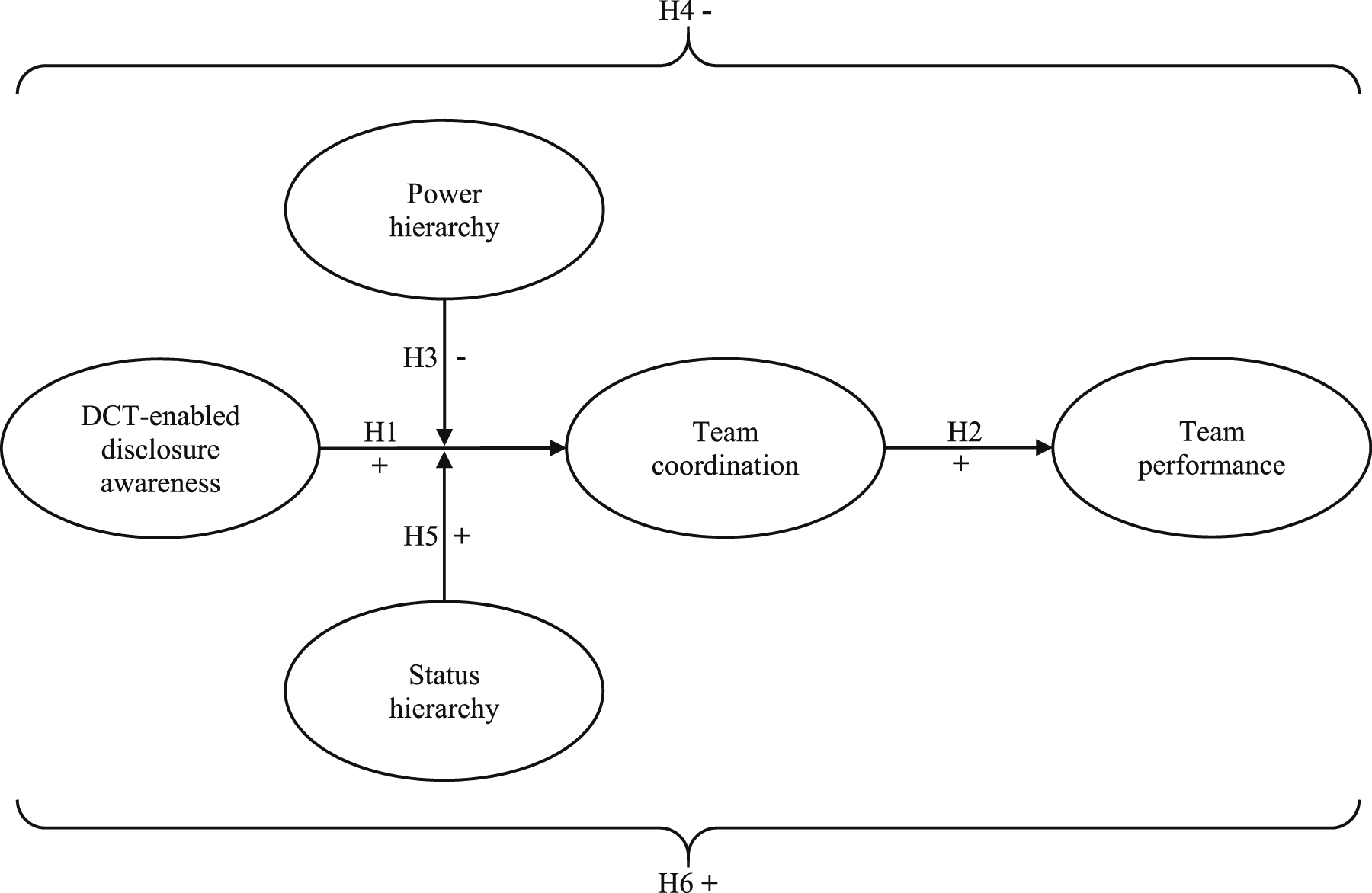
Status hierarchy moderates the indirect relationship of DCT-enabled disclosure awareness on team performance via team coordination in virtual teams, such that the indirect relationship is stronger when status hierarchy is high.
Method
Participants and Procedure
We conducted a multi-wave, multi-source field survey in two different organizations in China, one in the construction industry and the other in the real estate sector. Both companies extensively utilize virtual project teams to coordinate geographically dispersed and interdependent project work. These teams are typically temporary and cross-functional, established to manage the full project lifecycle, ranging from early-stage planning and design approval to construction, operation, and initial delivery. Team members were geographically distributed between remote project or construction sites (e.g., project leaders and engineers) and the company headquarters (e.g., financial controllers and designers), with distances typically ranging from approximately 100 to 180 kilometers, which necessitated substantial reliance on DCTs for coordination, including managing key milestones, guiding construction, and controlling costs and risks.
The study procedures were reviewed and approved by the Institutional Review Board (IRB) of the first author’s affiliated university under the project title, “Digital Disclosure and Team Performance.” The two participating organizations were identified through professional networks, with human resource (HR) managers assisting in participant recruitment and forwarding the electronic survey link. At the beginning of each survey wave, participants were presented with an electronic informed consent document embedded in the survey instructions, which described the study’s purpose, procedures, and participants’ rights, including voluntary participation, data anonymity, and the rights to withdraw from the study. Participant who completed a survey at each wave received a monetary incentive of RMB 30 (approximately $4). The DCTs used in both companies were similar and featured disclosure functionalities, as illustrated in Figure 2. Based on the lists provided by the HR managers, we invited 144 team members from 64 virtual teams in the construction firm and 375 team members from 101 virtual teams in the real estate firm to participate in our research. In total, we contacted 519 team members from 165 virtual teams. An example of the personal information panel in the digital collaboration tool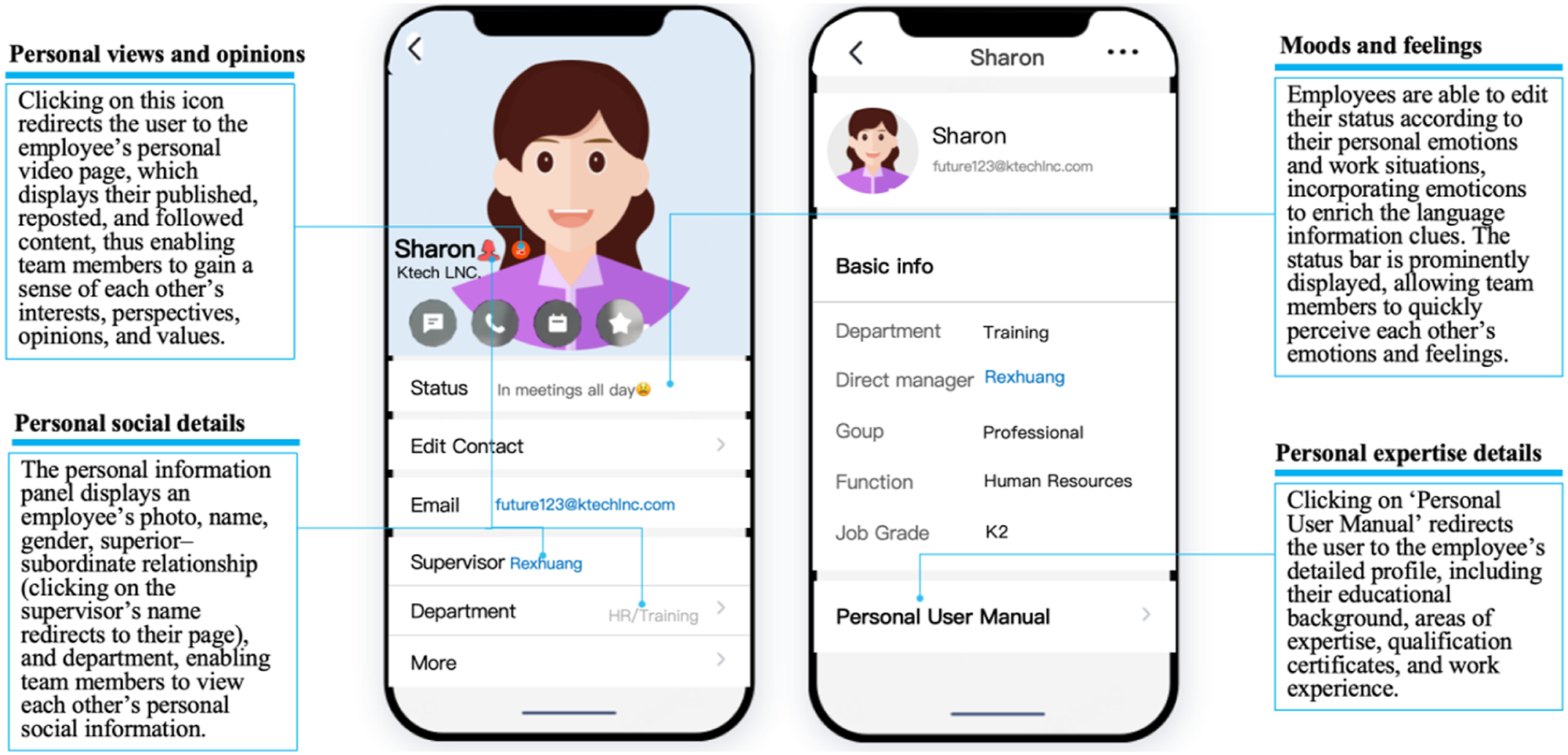
We first obtained the demographic information of the participants through the HR managers, and then sent our first-wave survey (T1) to team members to collect data on DCT-enabled disclosure awareness. In the first wave, we received responses from 464 team members across 152 virtual teams. Two weeks later (T2), we sent the second-wave survey to team members to collect data on team coordination and to supervising leaders responsible for monitoring the focal teams’ project progress and outcomes to obtain data on team performance. These leaders were typically senior managers overseeing multiple project teams through routine reporting systems and milestone reviews, which positioned them to provide informed evaluations of team performance during the focal time period. In the second wave, we received responses from 432 team members and performance ratings for 135 virtual teams provided by 36 supervising leaders, each evaluating an average of 3.8 teams.
After all surveys were returned, we eliminated the samples with incomplete data and those with fewer than two team members (Duan et al., 2023; Greer & van Kleef, 2010). Ultimately, we obtained samples from 427 team members across 130 virtual teams, with response rates of 82.27% and 78.79%, respectively. These virtual teams consisted of two to 15 members, with an average of 3.63 members per team (SD = 2.26). The average team tenure was 6.34 years (SD = 4.27). The mean age of the team members was 35.06 (SD = 6.32), 57.85% were male, and 93.68% had a college degree or above. There was no significant difference between the non-response sample and the final sample in terms of gender, age, and education level.
Measures
All the scales were translated from English into Chinese using a double-blind back-translation procedure (Brislin, 1980). Unless otherwise indicated, all measures used a 7-point Likert scale (1 = strongly disagree to 7 = strongly agree).
DCT-Enabled Disclosure Awareness
To capture DCT-enabled disclosure awareness, we first measured the extent to which each team member is aware of the personal information of their teammates, following Lim (2018). This four-item scale covers four aspects of personal information: personal social details; personal expertise details; personal views and opinions; and moods and feelings. Sample items were “I learn about the personal social details (e.g., name, age, gender, photos, supervisor–subordinate relationships) of my team members through the DCTs used by our team” and “I learn about the personal expertise details (e.g., skills, talents, degree, expertise, certificates earned, prior working experience) of my team members through the DCTs used by our team.” The Cronbach’s alpha coefficient for this measure was 0.84. Because DCT-enabled disclosure awareness reflects a shared informational environment emerging from team members’ common exposure to the same DCTs and interaction structures, we conceptualized it as a team-level construct. Aggregation was supported by substantial within-team agreement (median Rwg = 0.85; LeBreton & Senter, 2008). The ICC(1) and ICC(2) values were 0.14 and 0.34, respectively 1 . Thus, we aggregated the individual scores to the team level to obtain DCT-enabled disclosure awareness.
Team Coordination
We followed Lewis’s (2003) five-item scale to measure team coordination. Sample items were “Our team worked together in a well-coordinated fashion” and “Our team had very few misunderstandings about what to do.” The Cronbach’s alpha coefficient for this measure was 0.90. Because team coordination reflects collective interaction processes through which members align their actions and manage interdependencies (Marks et al., 2001), we treated it as a team-level construct. ICC (1) and ICC (2) were 0.23 and 0.49, respectively. The median of Rwg was 0.97, indicating that there was sufficient interrater agreement (LeBreton & Senter, 2008). Thus, we aggregated the individual scores of team coordination to the team level.
Power Hierarchy
Power hierarchy was measured in two steps. First, following prior research, we measured each team members’ power using their formal hierarchical level (Tarakci et al., 2016; Wellman et al., 2020). Given slight differences in the job ranking systems of the two companies, we asked the HR managers of each company to classify positions into five hierarchical levels (i.e., entry-level, lower-middle, middle, upper-middle, and senior-level) and to provide the corresponding level for each team member. Second, to assess the degree of power hierarchy within each team, we calculated the standard deviation of members’ hierarchical levels (Greer & van Kleef, 2010; Halevy et al., 2012).
Status Hierarchy
Status hierarchy was measured in two steps. First, because status is contextually embedded, identifying its key indicators requires an understanding of the specific organizational and cultural environment in which it is embedded (Bunderson, 2003). After consulting with the HR managers of both companies and drawing on prior research conducted in the Chinese context (Li et al., 2023), we measured each team member’s status as an index comprising three context-relevant proxy indicators: age, educational level, and organizational tenure. Rather than treating these indicators as a definitive representation of interaction-based status, we conceptualize them as observable attributes commonly associated with esteem and respect in this organizational setting. The Chinese cultural context in which this study was conducted emphasizes “respect for age” (Lockett, 1988), thus age is typically associated with respect from others. Education level was measured by the team member’s highest degree attained and coded as a sequential categorical variable; higher educational attainment is generally associated with greater prestige (Blagoeva et al., 2020). Organizational tenure captures members’ valuable informal knowledge of the organization (Rollag, 2004), which may also contribute to their perceived standing within the team. These indicators are commonly regarded as proxies for status (Christie & Barling, 2010; Körner et al., 2025; Kunze & Menges, 2017). Consistent with prior research, these indicators were first standardized across the full sample and then equally weighted and averaged into a single status score (Blagoeva et al., 2020; Christie & Barling, 2010; Li et al., 2023). Because our theoretical interest lies in capturing dispersion in members’ relative standing within teams rather than firm-specific demographic positioning, full-sample standardization provides a common reference frame for estimating status differentiation across teams drawn from both organizations. Analyses using within-firm standardization produced substantively identical results.
To validate our status measurement, we invited an independent sample of 27 team members from 12 teams in similar contexts to provide round-robin ratings status of each other’s status within their teams. We first introduced the definition of status and then asked them to evaluate each team member’s “status within the team” (Anderson et al., 2006; Hays et al., 2022). We then calculated each team member’s status by averaging the ratings provided by their team members. We also computed a status index based on their age, education level, and organizational tenure using the same method. The results showed a high correlation between the two measurements (r = 0.95, p < 0.001), providing additional support for the validity of these proxy indicators as contextually grounded measures of team members’ relative status. In line with our approach to measuring power hierarchy, we calculated status hierarchy as the standard deviation of team members’ status scores within each team (Greer & van Kleef, 2010; Halevy et al., 2012).
Team Performance
We used the three-item scale from De Jong and Elfring (2010) to measure team performance over the past two weeks. Sample items were “The team’s effectiveness was very high” and “The quality of work the team produces was very high”. The Cronbach’s alpha coefficient for this measure was 0.93.
Control Variables
In order to rule out alternative explanations, we controlled for several variables that might affect the hypotheses testing. First, since the extent of offline interaction may influence team members’ reliance on DCT-enabled disclosure, we asked HR managers to assess each team’s frequency of face-to-face communication based on members’ geographic distribution and departmental work practices (1 = never to 5 = always) (Lim, 2018). We controlled for the gender ratio of team members (% female) to account for potential biases in how digital disclosure is evaluated, as societal expectations regarding gender roles may affect the relationship between disclosure awareness and team interpersonal dynamics (Rothbard et al., 2022). We also controlled for team size because it is an important factor in team performance (Mathieu et al., 2019). As suggested by Harrison and Klein (2007), we controlled for the mean power and mean status of team members to ensure the moderating effects that we observed was due to the heterogeneity of power and status within the virtual teams. In addition, because data were collected from two different companies, we controlled for the potential systematic effects of each company by creating a firm dummy variable.
Results
To test our hypothetical model, we performed data analyses in three steps. First, we employed the linear regression command in Stata 15.1 to perform hierarchical regression analysis. Prior to creating the interaction terms, all predictors and moderators were mean-centered to reduce potential multicollinearity and facilitate interpretation of the interaction effects (Enders & Tofighi, 2007). Second, we conducted simple slope analysis and plotted the moderation effects at two levels (i.e., mean ± one standard deviation) of the moderator variables, in accordance with Cohen et al. (2003). Third, to test the indirect effects, we used the PROCESS plug-in in SPSS (Version 26) to calculate the 95% bias-corrected bootstrapped confidence intervals (CIs) with 5,000 replications.
Confirmatory Factor Analysis Results
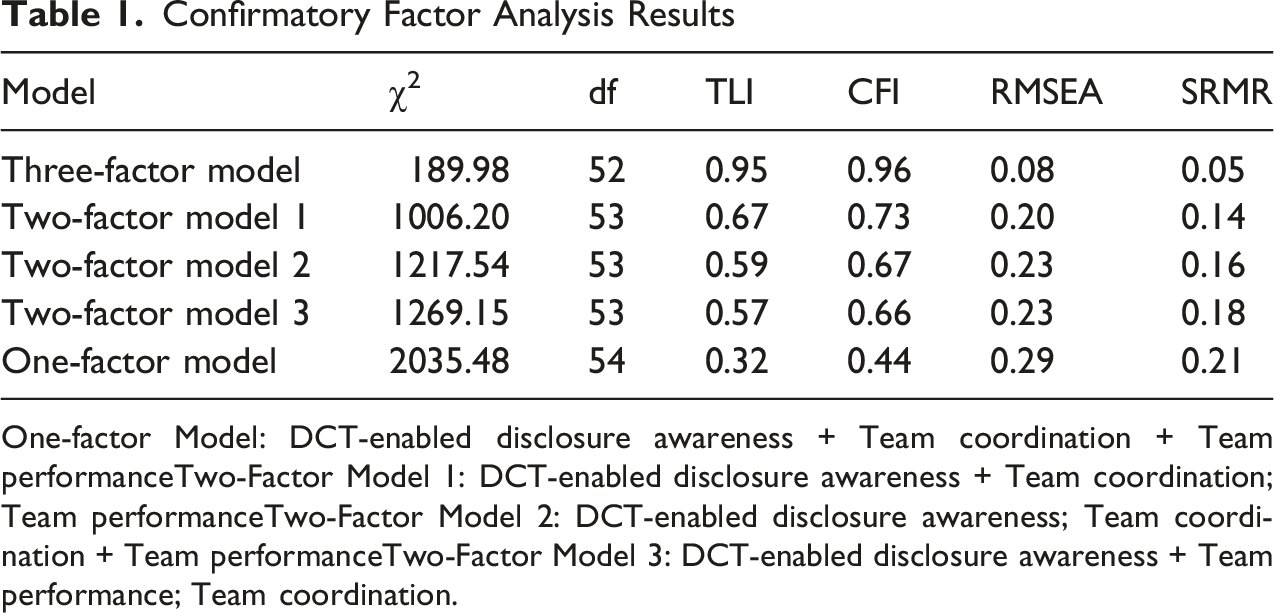
One-factor Model: DCT-enabled disclosure awareness + Team coordination + Team performanceTwo-Factor Model 1: DCT-enabled disclosure awareness + Team coordination; Team performanceTwo-Factor Model 2: DCT-enabled disclosure awareness; Team coordination + Team performanceTwo-Factor Model 3: DCT-enabled disclosure awareness + Team performance; Team coordination.
Means, Standard Deviations, and Correlations of Variables
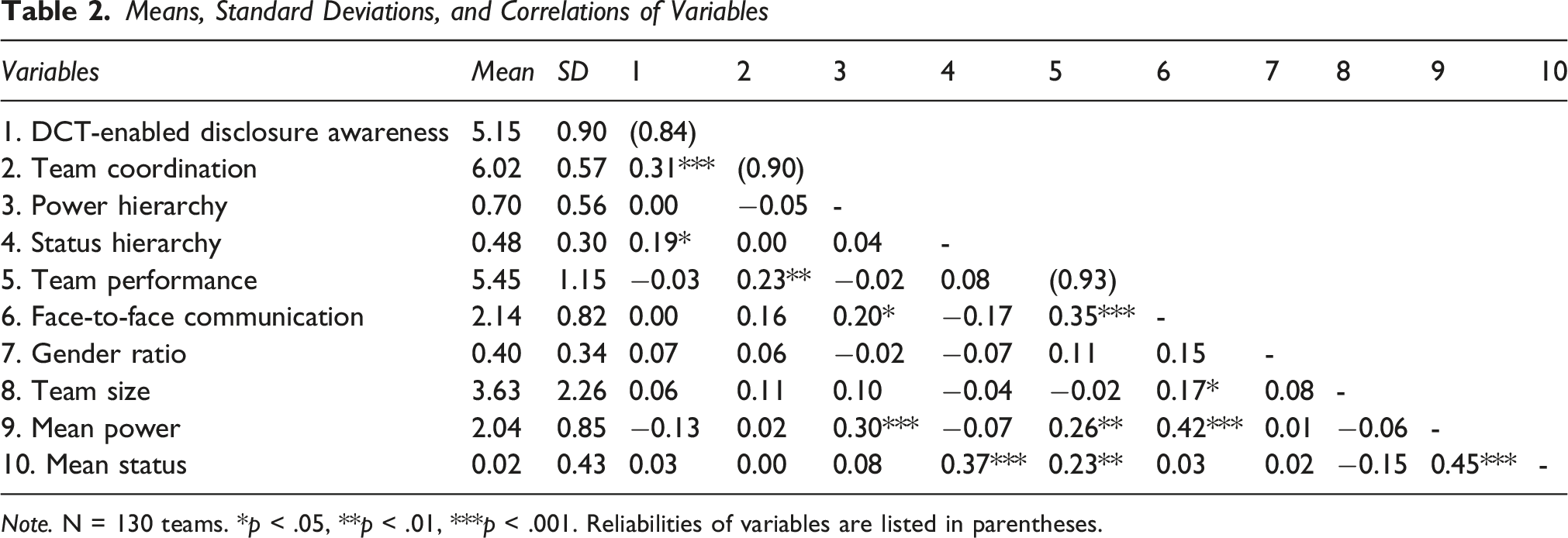
Note. N = 130 teams. *p < .05, **p < .01, ***p < .001. Reliabilities of variables are listed in parentheses.
Regression Results
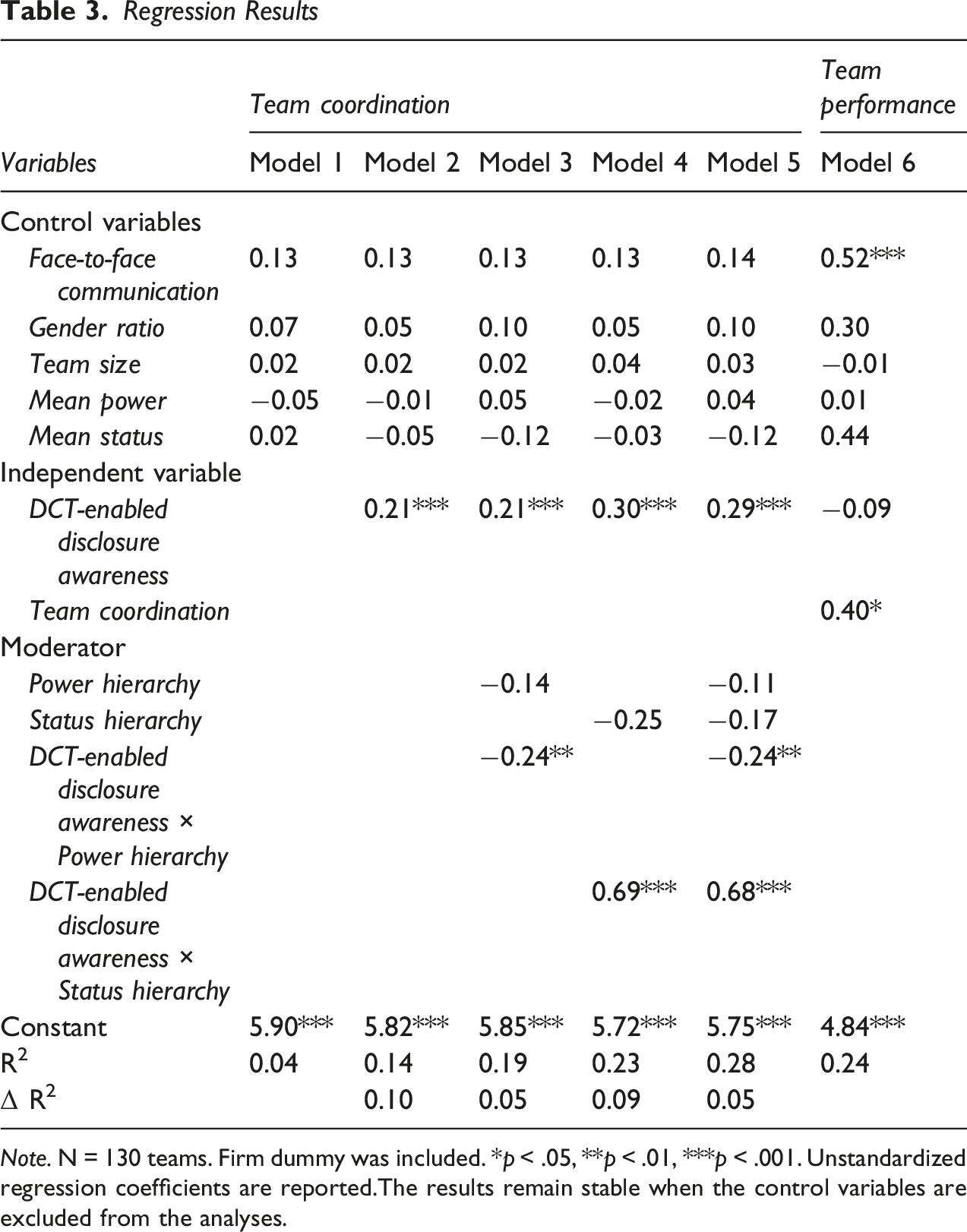
Note. N = 130 teams. Firm dummy was included. *p < .05, **p < .01, ***p < .001. Unstandardized regression coefficients are reported.The results remain stable when the control variables are excluded from the analyses.
Hypothesis 3 proposed that power hierarchy moderates the relationship between DCT-enabled disclosure awareness and team coordination in virtual teams. The results in Model 3 show that the interaction term of DCT-enabled disclosure awareness and power hierarchy was negatively related to team coordination (β = −0.24, p < 0.01). The ΔR2 from Model 3 to Model 2 was 0.05, indicating that the moderating effect of power hierarchy explained 5% of the variance of team coordination. In order to further analyze this significant moderating effect, we conducted simple slope analysis according to Cohen et al. (2003). As illustrated in Figure 3, when power hierarchy was low (one standard deviation below the mean), DCT-enabled disclosure awareness was positively related to team coordination (β = 0.34, p < 0.001); when power hierarchy was high (one standard deviation above the mean), the relationship between the two variables was insignificant (β = 0.07, n. s.). Therefore, Hypothesis 3 was supported. The moderating role of power hierarchy on the relationship between DCT-enabled disclosure awareness and team coordination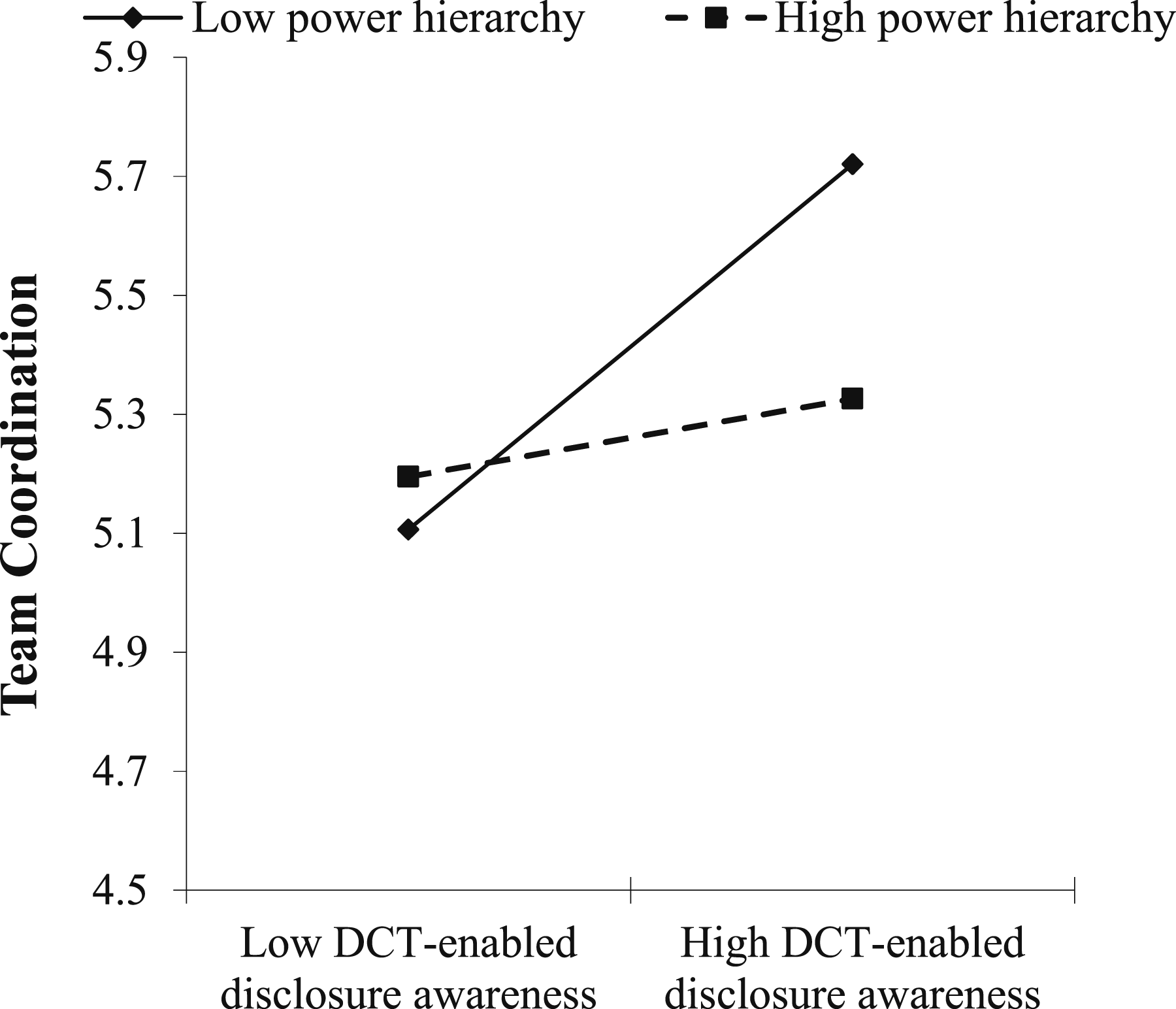
Hypothesis 4 proposed that power hierarchy moderates the indirect relationship of DCT-enabled disclosure awareness on team performance via team coordination in virtual teams, such that the indirect relationship is stronger when power hierarchy is low. When power hierarchy was low, the indirect effect of DCT-enabled disclosure awareness on team performance through team coordination was significant (estimate = 0.15, 95% CI = [0.034, 0.302]); when power hierarchy was high, the indirect effect of DCT-enabled disclosure awareness on team performance through team coordination was not significant (estimate = 0.01, 95% CI = [−0.060, 0.107]). The difference between the indirect effects at high and low values of power hierarchy was also significant (estimate = −0.14, 95% CI = [−0.314, −0.007]). Hence, Hypothesis 4 was supported.
Hypothesis 5 proposed that status hierarchy moderates the relationship between DCT-enabled disclosure awareness and team coordination in virtual teams. The results in Model 4 show that the interaction term of DCT-enabled disclosure awareness and status hierarchy was positively related to team coordination (β = 0.69, p < 0.001). The ΔR2 from Model 4 to Model 2 was 0.09, indicating that the moderating effect of status hierarchy explained 9% of the variance of team coordination. As illustrated in Figure 4, when status hierarchy was high, DCT-enabled disclosure awareness was positively related to team coordination (β = 0.50, p < 0.001); when status hierarchy was low, the relationship between the two variables was insignificant (β = 0.09, n. s.). Therefore, Hypothesis 5 was supported. The moderating role of status hierarchy on the relationship between DCT-enabled disclosure awareness and team coordination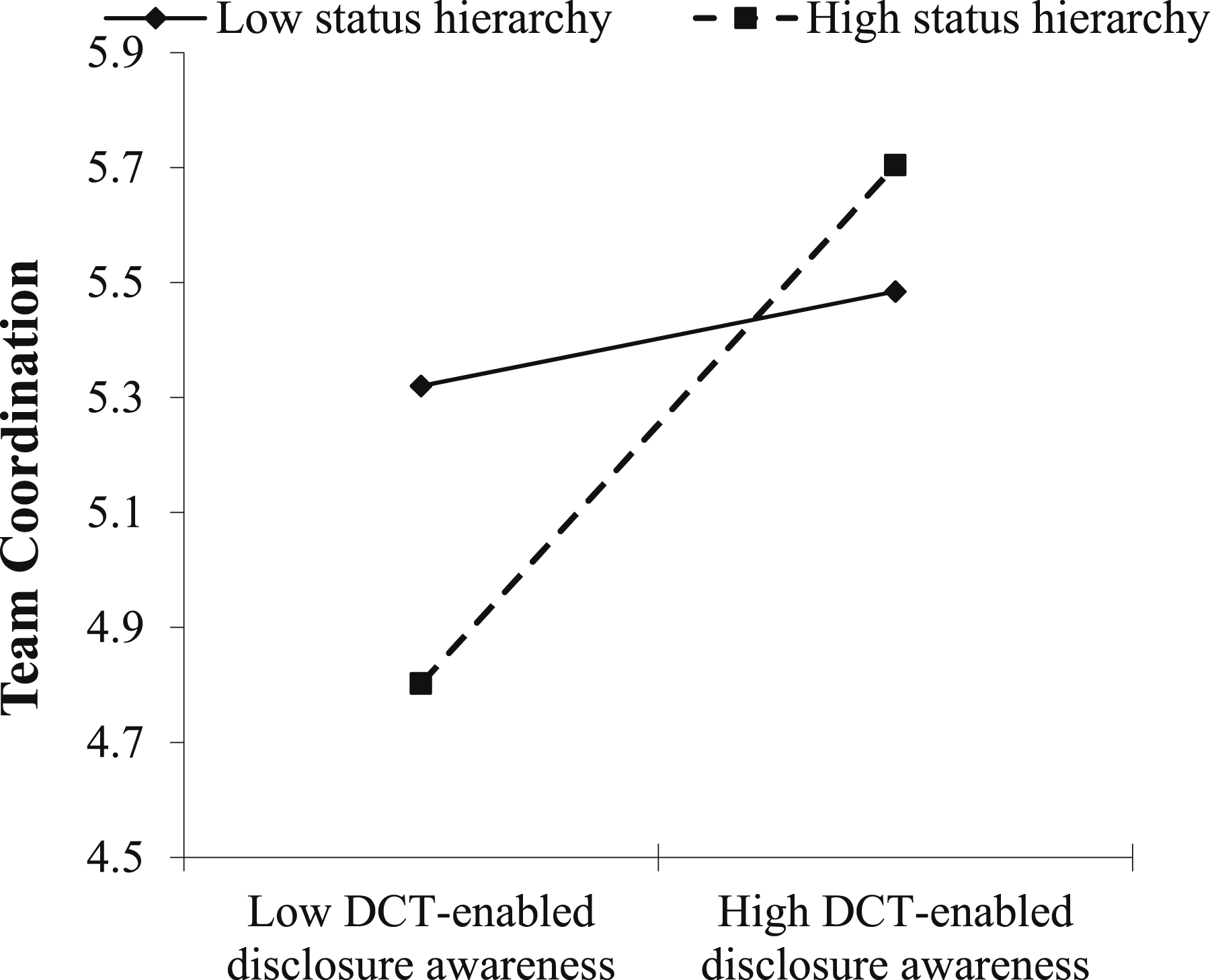
Finally, Hypothesis 6 proposed that status hierarchy moderates the indirect relationship of DCT-enabled disclosure awareness on team performance via team coordination in virtual teams, such that the indirect relationship is stronger when status hierarchy is high. When status hierarchy was high, the indirect effect of DCT-enabled disclosure awareness on team performance through team coordination was significant (estimate = 0.20, 95% CI = [0.036, 0.388]); when status hierarchy was low, the indirect effect of DCT-enabled disclosure awareness on team performance through team coordination was not significant (estimate = 0.04, 95% CI = [−0.005, 0.117]). The difference between the indirect effects at high and low values of status hierarchy was also significant (estimate = 0.154, 95% CI = [0.010, 0.335]). Hence, Hypothesis 6 was supported.
Supplementary Analyses
To further refine our understanding of the findings, we conducted supplementary analyses to explore whether the coordination-enhancing potential of disclosure awareness varies based on the specific type of the shared information. While our primary analysis focused on the overall level of disclosure awareness, prior research suggests that the depth and nature of information shared play a critical role in shaping interpersonal relationships (Collins & Miller, 1994). Accordingly, using the same set of control variables as in the main analysis, we compared the effects of different types of disclosed information on team coordination. The results indicated that the effects increased in magnitude across the following categories: personal social details (β = 0.12, p < 0.05, ΔR2 = 0.03); personal expertise details (β = 0.09, p < 0.05, ΔR2 = 0.04); personal views and opinions (β = 0.14, p < 0.01, ΔR2 = 0.08); and moods and feelings (β = 0.16, p < 0.001, ΔR2 = 0.10). Here, ΔR2 indicates the change in variance of team coordination explained by each type of disclosed information after adding the variable to the model, compared to the model with only the control variables. Overall, these findings suggest that more affective and identity-relevant forms of disclosure exert stronger coordination-enhancing effects.
In addition, because some supervising leaders evaluated multiple virtual teams in our sample (Mean = 3.8 teams per supervising leader), we conducted robustness analyses adjusting standard errors for clustering at the rater level. The results remained substantively unchanged. Specifically, DCT-enabled disclosure awareness remained positively related to team coordination (β = 0.21, p < 0.01), and team coordination remained positively related to team performance (β = 0.40, p < 0.05). The interaction term of DCT-enabled disclosure awareness and power hierarchy remained negatively related to team coordination (β = −0.24, p < 0.05), whereas the interaction term of DCT-enabled disclosure awareness and status hierarchy remained positively related to team coordination (β = 0.69, p < 0.01). The pattern of indirect effects and simple slope analyses remained consistent with those reported in the main analyses, providing additional support for the robustness of our findings.
Discussion
This study aimed to explore the influence of DCT-enabled disclosure awareness on team performance. Using multi-source multi-wave survey data, we found that DCT-enabled disclosure awareness positively affected team performance via team coordination, and this mediated effect was stronger when team power hierarchy was low or status hierarchy was high. In this way, our results contribute both to the growing body of research on DCTs and to the developing practices around their use.
Theoretical Contributions
Our findings have three main theoretical contributions. First, we advance the literature on virtual team effectiveness by shifting from a universalist to a contingency-based perspective on disclosing personal information. Prior research often assumes that “getting to know each other” through email or exposing electronic profiles helps members interpret each other’s actions more favorably and reduce conflicts (e.g., Chiu & Staples, 2013; Gilson et al., 2013; Moore et al., 1999; Windeler et al., 2015). However, our study clarifies that the relationship between digital disclosure and virtual team performance is not frictionless. Rather than merely reinforcing the “more is better” narrative of personal information exchange, we build upon adaptive structuration theory by illustrating that DCT-enabled disclosure awareness creates opportunities for coordination, but the realization of this benefit depends on the virtual team’s social structure. Specifically, we refine the understanding of technology-mediated coordination in virtual teams by demonstrating that digital disclosure does not inherently resolve coordination challenges; instead, its efficacy is either amplified or suppressed by the hierarchical structures within the team.
Relatedly, our study further contributes to the literature on virtual teams by bringing an explicit social hierarchy lens to the study of technology-enabled coordination. Prior research has shown that power and status differences do not disappear in distributed or virtual teams; instead, they continue to shape interaction patterns, participation dynamics, and collaboration processes. For example, sharing decision authority and encouraging participation can enhance collaboration in highly virtual contexts (Bell et al., 2023; Hill & Bartol, 2016; Kirkman et al., 2004). Similarly, when high-status or highly influential group members dominate group discussions, other members are less likely to participate and report lower levels of satisfaction (Karl et al., 2022). However, this line of research has rarely examined power hierarchy and status hierarchy simultaneously, and little is known about whether they exert distinct or even contrasting influences on the same technology-enabled coordination process. By distinguishing between power hierarchy and status hierarchy and demonstrating their differential moderating roles in shaping when digitally disclosed information becomes consequential for coordination, our study advances a more fine-grained understanding of how hierarchical structures condition technology-enabled coordination in virtual teams.
Second, by identifying team power and status hierarchies as critical, yet contrasting, boundary conditions of DCT-enabled disclosure awareness’s effect on team coordination, this study informs adaptive structuration theory. Adaptive structuration theory posits that team outcomes are not direct consequences of technology itself, but rather emerge from the “structuration” process—the manner in which teams utilize and interact with technology based on existing social structures (DeSanctis & Poole, 1994). However, adaptive structuration theory defines social structures rather broadly, encompassing both formal structures (e.g., reporting hierarchies, decision processes) and informal structures (e.g., leadership, atmosphere). As a result, prior virtual team research using this theory has often treated social structure as a diffuse context or focused on a single structural dimension, such as face-to-face interaction (Hill et al., 2009), physical configuration (Charlier et al., 2016), or multiple team membership demands (Rishani et al., 2025).
We extend this stream of research by integrating insights from the social hierarchy literature to develop a more differentiated understanding of social structures within adaptive structuration theory. Specifically, we demonstrate that power and status hierarchies constitute two distinct social structures that shape the appropriation of digital disclosure in fundamentally different ways. Our findings show that the coordination-related implications of DCT-enabled disclosure awareness are more likely to emerge under relatively egalitarian formal structures (i.e., low power hierarchy), whereas differentiated informal structures (i.e., high status hierarchy) strengthen the extent to which disclosed information becomes salient and consequential for team coordination. By revealing that DCT-enabled disclosure awareness interact with these two hierarchical structures in opposite directions, our study offers a more nuanced and integrative extension of adaptive structuration theory.
Third, our findings advance the literature on disclosure in the workplace context. Early research in social psychology has extensively documented the positive effects of self-disclosure, particularly on interpersonal relationships (Collins & Miller, 1994; Cozby, 1973). However, in the workplace, researchers have identified concerns about self-disclosure and the potential risks it may entail (Phillips et al., 2009). For instance, Gibson et al. (2018) found that self-disclosing weakness can undermine task-oriented relationships. On the other hand, many scholars argue that the benefits of self-disclosure in the workplace can outweigh the risks (Arnett, 2023; Dumas et al., 2024; Hardin, 2024). Since these discussions primarily focus on the individual level and traditional, offline self-disclosure, the current research makes a significant contribution to the literature on workplace self-disclosure by showing how DCT-enabled disclosure awareness enhances coordination and performance of virtual teams.
Practical Implications
This study also offers implications for digital management practice. First, with the continuous development of digital technology, organizations are faced with an increasing variety of DCTs with different functions. To maximize the effectiveness of these tools, managers must choose the most appropriate ones for their contexts and make full use of the disclosure features. Our study reminds managers to attach greater importance to the use of DCTs within their virtual teams and to cultivate team members’ information disclosure habits.
Second, our research also encourages the developers of collaborative tools to improve the usability, visibility, and depth of the disclosure features so that the target users can use these functions more easily and understand each other’s personal information more deeply. For example, “personal user manual,” a disclosure feature of collaboration platform Feishu that contains discretionary information such as employees’ hobbies, values, or how they like to collaborate with others, has been proven to be an effective means of facilitating virtual team communication and collaboration.
Third, our findings highlight the importance of power and status hierarchies in shaping the effectiveness of DCT-enabled disclosure awareness in virtual teams. In teams with low power hierarchies, DCT-enabled disclosure awareness can be leveraged as a social lubricant, encouraging team members to use disclosed information to enhance coordination. However, in teams with high power hierarchies, rigid power dynamics may inhibit the use of disclosed information, as low-power members fear negative consequences, and high-power members may be less attentive to information disclosed by others. Additionally, high status hierarchies provide incentives for both high- and low-status members to engage with disclosed information, enhancing coordination. These insights suggest that organizations should tailor DCT strategies to the specific power and status dynamics within teams to maximize the benefits of digital disclosure for team performance.
Limitations and Future Directions
Despite the above theoretical and practical implications, our research has certain limitations that offer opportunities for future research. First, we adopted a field survey rather than laboratory experiments due to the need to capture organizational contexts. Although we adopted a multi-wave, multi-source design to partially alleviate the concern of common method bias (Podsakoff et al., 2003), our research design was still correlational in nature and did not allow us to draw causal conclusions. Thus, we recommend that future research use field experiments to alleviate the potential for reversed causality.
Second, although our theoretical framework suggests that DCT-enabled disclosure awareness facilitates team coordination by shaping how team members interpret and respond to information disclosed by others (e.g., through perspective taking and related interaction processes), we did not directly measure these intermediate behavioral dynamics. Instead, our conclusions regarding the underlying mechanism are inferred indirectly from the contrasting moderating roles of power hierarchy and status hierarchy, which indicate that the effectiveness of disclosure awareness depends on socially embedded interaction structures rather than merely increased information availability. Future research could build on this work by employing multi-wave longitudinal designs or video-coding approaches to more directly capture how team members interpret, exchange, and act upon disclosed information over time, thereby unpacking the micro-level coordination processes through which DCT-enabled digital disclosure awareness shapes coordination in virtual teams.
Third, following the additive composition model (Chan, 1998), our survey-based measures of team-level constructs directly aggregate team member’s assessments, which may oversimplify the dynamic complexity of the interpersonal interactions. For example, Park et al. (2020) suggest that scholars adopt a dynamic network approach to measure team variables such as coordination or conflict, as each team member may perceive or experience varying degrees of conflict with other members. Given that many DCTs have features that allow for selective or asymmetric disclosure (e.g., “invisible to certain members” or “visible only to specific members”), future research using such dynamic network approaches to measure DCT-enabled disclosure awareness could reveal more nuanced findings. Additionally, team performance in our study was based on subjective leader ratings; future research could strengthen performance measurement by incorporating objective performance indicators where available. Besides, consistent with previous virtual team studies (Cheng et al., 2021; Hill & Bartol, 2016), our study utilized a two-week interval to observe the relationship between DCT-enabled disclosure awareness and subsequent virtual team coordination and performance levels. Future research could adopt longer time spans to track the dynamic, long-term evolution of these effects over time (Braun et al., 2020).
Fourth, the two organizations in our study, from the construction and real estate sectors, demonstrate that our findings have a certain degree of cross-industry generalizability. However, we acknowledge that these findings may not generalize to other contexts. For example, the samples in our research were all from mainland China, a culture characterized by collectivism (Hofstede et al., 1990). Digital disclosure might be more acceptable in this cultural context, possibly amplifying our observation of the positive effect of DCT-enabled disclosure awareness. Moreover, our study focuses on stand-alone teams, rather than multi-team systems, which involve both intra-team and inter-team hierarchical structures that would make the moderating effects in our hypotheses more intricate (Lanaj et al., 2013). We recommend that future research explore the effects of DCT-enabled disclosure awareness across a broader range of contexts, such as different task types, team developmental stages, multi-team systems and cultural settings.
Conclusion
This study contributes to our understanding of how DCTs influence the interaction and performance of virtual teams. Grounded in adaptive structuration theory, we demonstrate that DCT-enabled disclosure awareness has a positive indirect relationship with team performance through team coordination. Importantly, we find that the strength of this mediated effect is contingent on the hierarchical structures of the virtual team. Specifically, the positive effect DCT-enabled disclosure awareness on team coordination is stronger when the power hierarchy is low or the status hierarchy is high. In doing so, our study contributes to multiple streams of literature, including those on virtual teams, self-disclosure, and adaptive structuration theory. We offer a more nuanced understanding of how the interaction between different types of hierarchical structures—power and status—affects the benefits of DCT-enabled disclosure awareness, providing valuable insights into the complexities of virtual team dynamics. Furthermore, our findings have important practical implications for digital management in organizations, particularly in how team leaders and managers can leverage DCTs to foster coordination and enhance virtual team performance. Future research should extend our findings by exploring the role of digital disclosure within more complex organizational contexts—such as multi-team systems and diverse cultural settings.
Footnotes

Funding
The authors disclosed receipt of the following financial support for the research, authorship, and/or publication of this article: This research was supported by the grants funded by National Natural Science Foundation of China (grant numbers 72202228, 72372155 and 72272134) and Renmin University of China (grant number 2024300151).
Declaration of conflicting interests
The authors declared no potential conflicts of interest with respect to the research, authorship, and/or publication of this article.
Data Availability Statement
The data that support the findings of this study are available on request from the corresponding authors.