






Abstract
While scholarly and practical interests in family businesses’ formal governance have grown substantially, the behavioral logics underlying governance formalization remain poorly understood. We therefore advance two critical behavioral logics, including legitimacy and efficiency logics, and examine how and under what conditions they drive family businesses’ formal governance. Drawing on mixed cross-sectional data from the Chinese Private Enterprise Survey (2000–2014), our results reveal that family businesses’ formal governance reflects an organizational response to both behavioral logics, with their relative influence exhibiting divergent patterns across heterogeneous firm contexts. Specifically, small and medium-sized family businesses and those lacking political connections lean toward legitimacy logic, whereas large family businesses and those with political connections lean toward efficiency logic. These findings suggest that to effectively advance formal governance, family businesses should strategically draw upon both legitimacy and efficiency logics according to their distinctive characteristics, particularly firm size and political identity.
Keywords
Introduction
Family businesses are firms in which a single family owns the majority of stock and maintains total control (Gallo & Sveen, 1991; Handler, 1989; Muñoz-Bullón & Sánchez-Bueno, 2014). Historically, family business practitioners have governed informally, preserving greater flexibility and family values (Chrisman et al., 2018). However, the growing presence of external shareholders has prompted family businesses to pursue more effective governance models, including family councils and shareholders’ meetings, to control and coordinate family cohesion (Aronoff & Ward, 1996; Siebels and zu Knyphausen‐Aufseß, 2012). Formal governance, achieved through standardized and institutionalized structures and mechanisms, regulates decision-making and supervision in family businesses (Cobben et al., 2023). By emphasizing explicit structures, codified regulations, and the appointment of independent directors, formal governance enhances transparency and professionalism while mitigating key deficiencies of informal governance (Carney, 2005; Ko & Liu, 2017; Mustakallio et al., 2002; Solinas et al., 2022). Although roughly two-thirds of global businesses are family-owned, the rise of outside shareholders is compelling many family businesses to implement or strengthen formal governance (PWC, 2021). Yet, a comprehensive understanding of what drives family businesses to adopt formal governance mechanisms and how this varies across organizational contexts remains elusive.
Understanding these drivers requires examining the underlying behavioral logics that shape governance choices. Two distinct but interrelated logics are particularly salient: legitimacy logic and efficiency logic (DiMaggio & Powell, 1983; Meyer & Rowan, 1977). Legitimacy logic refers to behavioral patterns through which organizations gain social recognition and resources by conforming to institutional expectations (Suchman, 1995). Under this logic, family businesses adopt formal governance as a strategic response to institutional pressures and stakeholder expectations, thereby obtaining legitimacy—the perception that their actions are appropriate, proper, and desirable within a socially constructed system of norms and values (Aguilera & Cuervo-Cazurra, 2004; Zattoni & Cuomo, 2008). Efficiency logic, by contrast, encompasses governance and strategic patterns aimed at reducing agency costs, improving decision-making, and enhancing long-term corporate value (Zhou et al., 2017). Under this logic, family businesses implement formal governance to constrain opportunistic behavior and improve organizational performance (Nordqvist et al., 2014). Prior studies have examined these logics in isolation (Cobben et al., 2023; Mustakallio et al., 2002; Solinas et al., 2022); however, less attention has been devoted to how they jointly influence formal governance adoption and under what conditions. This gap is significant because family businesses often need to reconcile both legitimacy and efficiency concerns rather than follow one logic exclusively (Chung & Kim, 2018). A deeper understanding of how these behavioral logics drive formal governance—and the boundary conditions that moderate their influence—offers crucial insights into the mechanisms shaping family business governance choices. Accordingly, this study addresses two questions: (1) How do legitimacy logic and efficiency logic influence the degree of formal governance in family businesses? (2) Under what boundary conditions do both behavioral logics affect formal governance?
To answer these questions, this study develops a theoretical model of how and when legitimacy and efficiency logic shape the degree of formal governance in family businesses. Neo-institutionalism theory provides the framework for understanding legitimacy logic, positing that the adoption of formal governance structures is driven by both efficiency and legitimacy considerations (DiMaggio & Powell, 1983). Agency theory furnishes the foundation for analyzing efficiency logic, suggesting that family businesses face distinctive agency problems and that formal governance structures can reduce agency costs and enhance governance efficiency (Schulze et al., 2001; Villalonga & Amit, 2006). Together, these theories constitute key behavioral logics that drive the degree of formal governance in family businesses. Neo-institutionalism theory further emphasizes that institutional pressures and resource constraints affect the trade-offs between legitimacy and efficiency (Meyer & Rowan, 1977). From this perspective, enterprises’ behavioral logic orientation varies with their degree of dependence on external resources and legitimacy, necessitating careful examination of relevant boundary conditions. Firm size reflects a firm’s resource endowments and legitimacy. Smaller businesses are more likely to face resource shortages and legitimacy deficits, prompting them to pursue formal governance for external recognition (DiMaggio & Powell, 1983). Conversely, firms with abundant resources and strong legitimacy are more inclined to follow efficiency logic (Schulze et al., 2001; Suchman, 1995). In transition economies, political connections can substitute for imperfect formal institutions, providing resources and policy support that enable firms to prioritize efficiency over legitimacy in governance decisions (Peng & Luo, 2000; Xin & Pearce, 1996). Accordingly, firm size and political connections serve as critical boundary conditions in this study, as they shape a firm’s capacity and willingness to address institutional pressures and access resources, thereby moderating the relative strength of legitimacy and efficiency logics (Ge et al., 2019; Peng & Jiang, 2010; Sauerwald & Peng, 2013).
Positioned in the Chinese context and adopting a behavioral logic perspective, this study investigates the mechanisms and boundary conditions of formal governance in family businesses. As the world’s largest emerging economy, China offers a distinctive institutional environment and development trajectory that provides rich empirical material (Ge et al., 2019; Haveman et al., 2017; Tsui et al., 2004). Using mixed cross-sectional survey data from Chinese private enterprises spanning 2000–2014, the results—based on ordinary least squares (OLS) regression and a series of robustness checks—reveal that legitimacy logic exerts a significant positive effect on the degree of formal governance in family businesses, whereas efficiency logic does not. The data further demonstrate that firm size and political connections moderate the relative influence of these behavioral logics, producing divergent patterns across contexts: smaller or politically unconnected family businesses are primarily driven by legitimacy logic, whereas larger or politically connected family businesses are more strongly driven by efficiency logic.
We make three contributions to the family business governance literature. First, it integrates legitimacy and efficiency logic as dual drivers of formal governance, extending prior research that has examined these logics separately (Claessens et al., 2002; Parada et al., 2010; Schulze et al., 2003) and offering a more comprehensive framework for understanding the heterogeneous motivations underlying governance decisions (Miller et al., 2013). Second, it reveals how firm size and political connections shape the relative influence of these logics—smaller or politically unconnected firms prioritize legitimacy concerns, whereas larger or politically connected firms emphasize efficiency considerations (Nordqvist et al., 2014; Peng, 2004)—thereby highlighting the importance of organizational heterogeneity in governance research (Chua et al., 2012). Third, it extends governance theory to emerging economies, particularly China’s unique institutional context, demonstrating how family firms navigate institutional complexity and underscoring the need for context-sensitive theorizing (Marquis & Qiao, 2020; Peng, 2003).
Theoretical Background
This research examines the intrinsic logic mechanisms driving formal governance in Chinese family businesses. The theoretical review is organized around three core areas. First, we delineate the distinctive characteristics and evolutionary trajectory of formal governance in Chinese family enterprises. Second, drawing on neo-institutionalism theory, we explore how legitimacy logic shapes the transition toward formal governance. Third, from the perspective of agency theory, we examine the role of efficiency logic in promoting formal governance. This framework lays the foundation for our subsequent analysis of how legitimacy and efficiency logic jointly influence formal governance in family businesses.
Formal Governance of Family Businesses in China
The formal governance of Chinese family businesses exhibits distinctive local characteristics rooted in a unique institutional environment and cultural traditions (Li et al., 2015; Ma, 2021). Since the economic reforms and opening-up, China has progressively established a modern corporate system, encouraging enterprises—including family businesses—to move toward formal governance. Government exerts considerable influence over corporate governance, frequently intervening in private family businesses (Ge et al., 2019). China’s capital market remains relatively underdeveloped, and external governance mechanisms such as market-based acquisitions and institutional investor monitoring have not yet become fully effective (Jiang & Kim, 2015; Kang et al., 2008). Compared with Western developed economies, China’s corporate governance framework displays notable peculiarities (Clarke, 2003; Kang et al., 2008). Specifically, it is organized around laws and regulations such as the Company Law and Securities Law, which emphasize a tripartite governance structure comprising shareholders, the board of directors, and the supervisory board. This system aims to balance the interests of shareholders, management, and employees, reflecting a stakeholder orientation characteristic of the Chinese model (Kang et al., 2008).
Despite similarities with Western nations in basic governance structures—such as the establishment of boards of directors and the inclusion of independent directors (Bilimoria & Piderit, 1994)—Chinese family businesses tend to place greater emphasis on internal control, with familial relationships playing a more pronounced role (Dou & Li, 2013; Li et al., 2015). Moreover, Chinese family businesses are more likely to leverage political connections to access resources and legitimacy, a practice less prevalent in the West (Ge et al., 2019; Jia, 2014). An additional notable difference lies in more concentrated ownership structures in Chinese family businesses, contrasting with the more dispersed ownership observed in Western family enterprises (Fang et al., 2022; La Porta et al., 1999).
The formal governance models of Chinese family businesses reflect both global convergence trends and China’s distinctive institutional and cultural features. As the world’s second-largest economy and largest emerging market, China’s economic transition provides compelling empirical material for examining formal governance transformations (Peng et al., 2018; Tsui et al., 2004). Studying these models deepens understanding of how enterprises in emerging economies navigate institutional change and globalization pressures (Banalieva et al., 2015; Hoskisson et al., 2000; Peng, 2003), while offering insights for refining corporate governance theory and practice in comparable contexts.
Legitimacy Logic Based on Neo-Institutionalism Theory
Neo-institutionalism theory explains how organizations adapt to their environments to survive and compete amid challenges (Scott, 2013). The theory holds that organizations are products of shared understandings of accepted principles of collective activity (Meyer & Rowan, 1977). DiMaggio and Powell (1983) identify three fundamental forces shaping organizations: (1) coercive pressure from government entities and dominant organizations, (2) normative influence from professionals and societal expectations, and (3) mimetic pressure arising from decision-makers’ reliance on the actions of other organizations. These forces constitute the core functional mechanisms of legitimacy logic. This framework is particularly relevant for understanding family businesses’ governance choices, as these firms frequently face dual institutional pressures—balancing the preservation of family traditions with conformity to professional management norms (Chung & Kim, 2018). As family businesses grow and engage with diverse stakeholders, legitimacy-seeking behavior becomes increasingly vital (Zattoni & Cuomo, 2008).
Existing research indicates that family businesses adopt formal governance structures not merely for efficiency but also to gain legitimacy (DiMaggio & Powell, 1983). For example, Parada et al. (2020) find that family businesses establish governance structures in a sequential pattern: business governance mechanisms such as boards of directors and executive committees are set up first, followed by family governance mechanisms such as family councils and constitutions. This sequence reflects family businesses’ responses to institutional pressures to gain legitimacy and signal professionalism. Chung and Kim (2018) demonstrate that the adoption of independent directors in Taiwanese family businesses is shaped by global institutions and local filtering mechanisms, suggesting that legitimacy logic plays a role in prompting formal governance. The pursuit of legitimacy through formal governance is especially pronounced in emerging economies, where family businesses often confront institutional voids and must establish credibility with external stakeholders (Peng & Jiang, 2010). This legitimacy-seeking intensifies when family businesses enter international markets or seek external financing (Aguilera & Cuervo-Cazurra, 2004).
Taken together, the emphasis on institutional characteristics and legitimacy logic is closely aligned with neo-institutionalism theory. This underscores the institutional embeddedness of organizations, a characteristic that family businesses exhibit prominently (Banalieva et al., 2015; Berrone et al., 2022; Peng et al., 2018). Compared with non-family enterprises, family businesses may be more vulnerable to institutional pressures (Berrone et al., 2010; Miller et al., 2013). Accordingly, neo-institutionalism theory offers robust explanatory power for analyzing the formal governance of family businesses and its evolution from a legitimacy logic perspective. This lens is particularly valuable for understanding how family businesses reconcile their distinctive characteristics with institutional demands (Nordqvist et al., 2014) and how they strategically respond to governance expectations across varying institutional contexts (Solinas et al., 2022).
Efficiency Logic Based on Agency Theory
Agency theory addresses conflicts of interest between principals and agents (Jensen & Meckling, 1976). Its core premise is that individuals are self-interested and tend to make decisions that maximize personal benefits (Fama & Jensen, 1983a). Such self-interest may manifest as opportunistic behavior when agents prioritize their own interests over those of principals, giving rise to moral hazard problems (Eisenhardt, 1989). In family businesses, agency problems are particularly intricate, owing to varying degrees of separation between ownership and management and potential conflicts between family and non-family members (Schulze et al., 2001). Opportunism in family firms can take distinctive forms, including nepotism, entrenchment of family managers, and expropriation of firm resources for family benefit (Gómez-Mejía et al., 2001). These opportunistic behaviors translate directly into reduced firm performance through inefficient resource allocation, suboptimal decision-making, and diminished organizational capabilities (Dalton et al., 2007). According to agency theory, adopting formal governance structures can reduce agency costs and enhance governance efficiency by constraining opportunistic behavior (Fama & Jensen, 1983b). For family businesses, formal governance mechanisms help mitigate specific agency problems, such as lax supervision arising from altruism among family members (Schulze et al., 2003) and information asymmetries between family and non-family members (Chua et al., 2009).
Existing research demonstrates that formal governance structures can enhance efficiency in family businesses by directly addressing opportunism. First, formal governance mechanisms such as boards of directors and executive committees clarify decision-making authority and improve decision-making efficiency by limiting opportunistic interventions from family members lacking formal authority (Mustakallio et al., 2002). Second, independent directors bring external expertise and monitoring capabilities that constrain self-serving behavior, thereby enhancing the quality of strategic decisions (Anderson & Reeb, 2004; Pepper & Gore, 2015). Third, formal compensation and incentive mechanisms align the interests of family and non-family managers, strengthening agency efficiency by reducing incentives for opportunism (Gómez-Mejía et al., 2003). These governance interventions directly disrupt the link between opportunism and performance decline by constraining both the ability and motivation for opportunistic behavior—reducing inefficient resource allocation, improving decision quality, and ultimately enhancing firm performance (Dalton et al., 2007). Furthermore, formal governance structures promote risk management and innovation in family businesses by guarding against opportunistic risk aversion or excessive risk-taking by family managers (Kraiczy et al., 2015; Patel & Chrisman, 2014). Beyond legitimacy considerations, therefore, efficiency factors also drive formal governance in family firms. Efficiency logic holds that organizations should systematically address sources of opportunism and their consequences to improve governance efficiency and organizational performance in market competition.
In sum, legitimacy and efficiency logic constitute two critical mechanisms driving formal governance in family businesses. Yet their relative importance varies across contexts and warrants deeper investigation. This study analyzes how these two behavioral logics operate under different boundary conditions to illuminate the internal mechanisms underlying formal governance in family businesses.
Hypothesis Development
Legitimacy Logic and Formal Governance in Family Businesses
The adoption of formal governance structures by family businesses can be understood through neo-institutionalism theory, which emphasizes legitimacy as a key driver of organizational behavior (DiMaggio & Powell, 1983; Scott, 2013). Family businesses may formalize their governance structures not necessarily to improve efficiency and performance but to gain legitimacy by conforming to institutionalized norms and expectations (Meyer & Rowan, 1977). The underlying reason is that formal governance systems and norms are recognized by various stakeholders (Aguilera & Cuervo-Cazurra, 2004; Zattoni & Cuomo, 2008), signaling modernization and even internationalization, and demonstrating reduced reliance on traditional personalized governance (Chung & Kim, 2018). Through adopting a modern enterprise system, the organization standardizes its structure and behaviors, even if the system does not necessarily enhance performance (Banalieva et al., 2015; DiMaggio & Powell, 1983). In doing so, the enterprise signals rationality, modernity, and reliability to strengthen its social image and legitimacy (Aguilera & Cuervo-Cazurra, 2004). Neo-institutionalism theory identifies three primary isomorphism mechanisms through which organizations seek legitimacy: coercive, normative, and mimetic logic (DiMaggio & Powell, 1983).
Coercive Logic
Coercive isomorphism arises from pressures exerted by external organizations as well as cultural and societal expectations (Scott, 2013). Such pressures may be perceived by organizations as either coercion or an invitation to conform (DiMaggio & Powell, 1983). In family businesses, coercive logic often stems from regulatory requirements and government policies (North, 1990). Changes in organizational structure can constitute a direct response to national laws and regulations. For example, the Chinese government requires listed companies to adopt shareholder-oriented corporate governance practices, resulting in a marked increase in the proportion of independent directors (Clarke, 2003; Jiang & Kim, 2015). Peng (2004) finds that many listed family businesses appoint independent directors primarily for legitimacy purposes in response to government appeals. This illustrates how family businesses may adopt formal governance structures to comply with regulatory demands, even when such structures do not necessarily enhance operational efficiency (Meyer & Rowan, 1977).
Coercive logic in the context of family business governance operates through two primary channels. First, direct laws and regulations apply chiefly to family businesses registered as limited liability companies or joint-stock companies, reducing the risks associated with registered capital and providing a legitimate organizational form (Aguilera & Cuervo-Cazurra, 2004; Jiang & Kim, 2015; Scott, 2013). Second, indirect government appeals and policy communications involve government and state-owned holdings within family businesses, where policies are conveyed to core management through shareholding structures (Carney et al., 2020; Tihanyi et al., 2019). As the government extends its influence to other social organizations, the structures of target organizations progressively reflect the institutionalized and legalized rules endorsed by the state (DiMaggio & Powell, 1983). This alignment with institutional pressures enhances organizational legitimacy, even absent direct improvements in operational efficiency (DiMaggio & Powell, 1983). Accordingly, we propose.
As a sub-dimension of legitimacy logic, coercive logic is positively related to formal governance in family businesses.
Normative Logic
Normative isomorphism stems from professionalization, with professionals and professional networks serving as key agents of diffusion (Greenwood et al., 2002; Scott, 2013). Normative logic arises from the adoption of shared norms and standards within organizational fields (DiMaggio & Powell, 1983). Professionals shape organizational structure change by defining optimal structures and compelling organizations to adopt particular practices through influential normative factors (Berrone et al., 2010; Boiral, 2007). These factors spread through professional networks, fostering the diffusion of industry-recognized organizational structures and practices (Miller et al., 2013; Nordqvist et al., 2014).
In family businesses, normative isomorphism manifests in two primary ways. First, professional certification reflects an institutional culture of certification and builds trust (DiMaggio & Powell, 1983) by signaling recognition from external professional bodies. As a legitimacy management tool, professional certification functions as an effective communication mechanism that alleviates information asymmetry and enhances normative legitimacy (Boiral, 2007). Professional certification often necessitates the adoption of more formal governance models, such as quality, human resources, financial, environmental, and safety management systems (Scott, 2013). Second, professional networks embedded in the enterprise—including industry associations—define and disseminate normative rules regarding organizational structure and behavior (Miller et al., 2013; Nordqvist et al., 2014). As a social intermediary, industry associations promote self-discipline through industry rules, standardize the competitive environment, and provide clear codes of conduct for members (Berrone et al., 2010; Parada et al., 2010). Through interactions with other business owners in the same industry, family business owners frequently learn about prevailing formal organizational structures, which in turn shape their governance ideas and practices (Greenwood et al., 2002). This process of normative isomorphism facilitates the diffusion of formal governance practices among family businesses, even when such practices do not directly enhance operational efficiency (DiMaggio & Powell, 1983). Accordingly, professional certification and industry association membership constitute normative convergence forces that promote the formalization of family business governance. Building on this analysis, we propose.
As a sub-dimension of legitimacy logic, normative logic is positively related to formal governance in family businesses.
Mimetic Logic
Mimetic isomorphism is a response to uncertainty (DiMaggio & Powell, 1983). When organizations face ambiguous goals or uncertain conditions, they tend to model themselves after peers perceived as legitimate or successful (DiMaggio & Powell, 1983). In competitive environments, organizations may imitate the structures and behaviors of more successful entities to reduce uncertainty and costs, giving rise to mimetic logic (Nordqvist et al., 2014; Scott, 2013). For family businesses, mimetic isomorphism serves as a legitimacy-seeking strategy by adopting governance structures similar to those of successful peers (Haunschild & Miner, 1997). Imitating established formal governance systems and norms may mitigate the uncertainty and risk associated with personalized governance (Berrone et al., 2010; Miller et al., 2013). For family businesses that have not previously implemented large-scale formal governance practices, imitating the structures and behaviors of other enterprises may be particularly effective (Banalieva et al., 2015; Parada et al., 2020), enabling them to acquire valuable knowledge and experience for decision-making (Ellison & Fudenberg, 1993). Moreover, greater uncertainty increases the likelihood that decision-makers will look to reference objects for guidance (Abrahamson & Rosenkopf, 1997). In practice, enterprises closely monitor the trends of peers and competitors; consequently, organizational structure (Mahajan et al., 1988), governance structure (Bouwman, 2011), and other strategic behaviors are substantially shaped by the actions of other enterprises, leading to mimetic convergence. This mimetic isomorphism can result in the adoption of formal governance structures among family businesses even when the direct efficiency benefits are uncertain or unproven (DiMaggio & Powell, 1983). Accordingly, the governance practices of peer family businesses may induce a focal family business to implement similar formal governance arrangements. Hence, we propose.
As a sub-dimension of legitimacy logic, mimetic logic is positively related to formal governance in family businesses.
Efficiency Logic and Formal Governance in Family Businesses
According to agency theory, especially in transitional Chinese family businesses, formal governance mechanisms are often lacking due to insufficient internal and external supervision and control systems (Randøy & Goel, 2003) and a scarcity of external directors and managers (Cowling, 2003). With limited pressure from external stakeholders to supervise and disclose information (Carney, 2005; Schulze et al., 2001), a family firm’s governance and decision-making processes tend to be informal, intuitive, unpredictable, and lacking in rigorous analysis (Naldi et al., 2007). These traits manifest as opportunism, which generates agency problems that ultimately undermine firm performance (Eisenhardt, 1989). In family businesses, opportunism takes distinctive forms, including nepotistic hiring, entrenchment of underperforming family managers, and expropriation of firm resources for family benefit at the expense of overall firm performance (Gómez-Mejía et al., 2001; Schulze et al., 2001). The link between agency problems and performance decline is mediated by these opportunistic behaviors, which produce suboptimal resource allocation, compromised decision quality, and diminished organizational effectiveness (Dalton et al., 2007).
Agency theory holds that these characteristics can generate increased agency costs and weakened governance efficiency, ultimately eroding corporate value. This occurs through mechanisms unique to family businesses, including nepotism, excessive altruism, self-control problems, free-riding behavior, and conflicts of interest (Jeong et al., 2022; Oswald et al., 2009; Schulze et al., 2001, 2002). Larger family businesses often employ pyramidal and other control-amplification mechanisms, confronting two distinct agency problems: those between family entrepreneurs and professional managers, and those between family entrepreneurs and minority shareholders (Almeida & Wolfenzon, 2006; Villalonga & Amit, 2006). Formal governance interventions target these opportunistic behaviors by establishing monitoring mechanisms, decision protocols, and incentive alignments that constrain self-interested actions (Pepper & Gore, 2015). For instance, independent directors can check opportunistic resource allocation by family executives; formal board procedures can limit arbitrary decision-making that favors family members at the expense of firm performance; and professional management systems can counteract nepotistic tendencies in hiring and promotion (Anderson & Reeb, 2004).
Drawing on agency theory, when managers recognize that the current structure is misaligned with the external environment and is adversely affecting performance, they are motivated to implement structural adjustments to improve organizational outcomes (Fama & Jensen, 1983a, 1983b; Jensen & Meckling, 1976). A rational formal governance system can effectively coordinate and control excessive personalization and individualistic governance within family businesses. The pursuit of efficiency and performance, as emphasized by agency theory, drives enterprises to adopt more efficient organizational structures and governance mechanisms—including shareholder-oriented corporate governance, formal control systems, and codified rules and regulations prevalent in Western business practices (Fama & Jensen, 1983a; 1983b). These governance interventions directly disrupt the link between opportunism and performance decline: by constraining opportunistic behavior, they reduce inefficient resource allocation, improve decision quality, and enhance firm performance (Dalton et al., 2007). By establishing clear accountability structures, formal governance mechanisms also reduce the information asymmetries that enable opportunistic behaviors and create transparency that makes such behaviors more detectable and therefore less likely (Pepper & Gore, 2015).
Agency theory further suggests that formal governance mechanisms can reduce agency costs, maximize shareholder value, expand investment opportunities, facilitate access to external capital, and enhance firm value (Dekker et al., 2015; Manne, 1965). Adopting formal governance systems to counterbalance overreliance on informal relationship governance has become essential for the sustainable operation and growth of family businesses (Carney, 2005; Chrisman et al., 2018; Mustakallio et al., 2002). Driven by the pursuit of efficiency and performance, family businesses seek to achieve these objectives through formal governance structures. Accordingly, we propose.
Efficiency logic is positively related to formal governance in family businesses.
Firm Size as a Key Boundary Condition
Firm size represents a critical organizational characteristic that shapes the resource endowments and institutional pressures facing family businesses (Ahlstrom & Bruton, 2001; Miller et al., 2017; Peng & Jiang, 2010). Drawing on neo-institutionalism theory, we examine how firm size moderates the relationship between legitimacy logic and formal governance. Small and medium-sized family enterprises are often disadvantaged in market access, resource acquisition, and social recognition, lacking the organizational structures and reputational capital that confer legitimacy and authority in the eyes of external stakeholders (Fama & Jensen, 1983a; Jensen & Meckling, 1976). These firms are particularly vulnerable to institutional pressures and legitimacy challenges due to limited market power and resource constraints (DiMaggio & Powell, 1983). Moreover, smaller family firms frequently struggle to establish credibility with external stakeholders, rendering them more susceptible to institutional pressures for conformity and more in need of signaling alignment with prevailing norms (Meyer & Rowan, 1977). In such contexts, adopting formal governance structures serves as a crucial symbolic mechanism, enabling these firms to demonstrate compliance with institutional expectations and enhance social acceptance and legitimacy (Aronoff & Ward, 1996; Siebels and zu Knyphausen‐Aufseß, 2012). Accordingly, the influence of legitimacy logic on formal governance is expected to be particularly pronounced in small and medium-sized family businesses, where the pursuit of legitimacy is a central organizational concern. Thus, we propose.
In small and medium-sized family businesses, the positive relationship between legitimacy logic and formal governance is stronger than in larger firms.
By contrast, the relationship between efficiency logic and formal governance is likely to vary with firm size. Large family enterprises typically possess greater resource endowments, more complex organizational structures, and broader market reach, which inherently confer higher social status and legitimacy (Ahlstrom & Bruton, 2001; Ndofor et al., 2011). As organizations expand, they encounter escalating complexity and internal management challenges, demanding more sophisticated governance mechanisms for effective coordination and control. The separation of ownership and management becomes more pronounced, and family managers may lack the capacity to handle diverse and specialized tasks efficiently (Schulze et al., 2001). These conditions generate substantial agency costs and operational inefficiencies, which can only be mitigated through formal governance structures that provide clear professional management and robust internal controls (Fama & Jensen, 1983b). The scale and complexity of large family firms necessitate a shift from informal, relationship-based management to formalized systems that prioritize efficiency, accountability, and performance (Carney, 2005; Mustakallio et al., 2002). Accordingly, the adoption of formal governance in large firms is driven primarily by efficiency considerations—optimizing resource allocation, reducing agency costs, and sustaining competitive advantage. Thus, we hypothesize.
In large family businesses, the positive relationship between efficiency logic and formal governance is stronger than in small and medium-sized firms.
Political Connection as a Key Boundary Condition
Political connections constitute a pivotal boundary condition shaping the institutional landscape and strategic behavior of family businesses, especially in transition economies characterized by institutional voids and regulatory uncertainty (Peng & Luo, 2000; Xin & Pearce, 1996). Without strong political ties, family firms are more exposed to institutional risks and heightened scrutiny by regulators and market actors (Li & Zhang, 2007; Wang & Qian, 2011). These firms often lack privileged access to resources, policy support, and regulatory protection, rendering their organizational legitimacy more fragile and more contingent on visible conformity to prevailing institutional norms (Haveman et al., 2017). Under such circumstances, adopting formal governance structures becomes a critical strategy for signaling compliance, reducing institutional uncertainty, and gaining acceptance from key stakeholders (DiMaggio & Powell, 1983; Meyer & Rowan, 1977). The pursuit of legitimacy through formal governance is therefore especially salient for politically unconnected family businesses, as it compensates for the absence of political endorsement and enhances credibility with external audiences. Prior research further indicates that in the Chinese context—where institutional pressures are pronounced and regulatory environments are evolving—the lack of political connections amplifies the need for legitimacy-seeking behaviors (Haveman et al., 2017; Li & Zhang, 2007). Accordingly, we hypothesize.
In family businesses without political connections, the positive relationship between legitimacy logic and formal governance is stronger than in those with political connections.
By contrast, family businesses with strong political connections operate in a markedly different context. Political ties provide direct access to valuable resources, policy advantages, and regulatory protection, serving as powerful sources of organizational legitimacy (Ge et al., 2019; Zhang et al., 2016). Such connections can substitute for the legitimacy normally conferred by formal governance mechanisms, reducing external pressure to adopt these structures for legitimacy purposes (Haveman et al., 2017; Peng, 2003). The strategic focus of politically connected family firms shifts toward leveraging their position to enhance internal efficiency and address agency problems arising from organizational growth and complexity (Carney, 2005; Fama & Jensen, 1983b). The resources and policy support afforded by political connections facilitate efficiency-driven governance reforms, enabling firms to professionalize management, strengthen internal controls, and optimize resource allocation (Mustakallio et al., 2002; Peng & Luo, 2000). Consequently, efficiency logic becomes a more salient driver of formal governance adoption in politically connected family businesses, as these firms seek to sustain competitive advantage and operational effectiveness in a complex, dynamic market environment. Accordingly, we propose.
In family businesses with political connections, the positive relationship between efficiency logic and formal governance is stronger than in those without political connections.
Research Methodology
This study employs a quantitative research approach to examine the formal governance of family businesses in China, chosen for several reasons. First, quantitative analysis enables systematic hypothesis testing and examination of relationships between variables across a large sample of firms (Claessens et al., 2002; Villalonga & Amit, 2006). Second, it allows control for confounding factors and isolation of the effects of key variables. Third, quantitative methods are well-suited for examining trends over time, which is important given our mixed cross-sectional dataset (Banalieva et al., 2015; Marquis & Qiao, 2020). Fourth, our approach extends prior quantitative studies on family business governance while enabling more robust statistical analysis compared with qualitative case studies that dominate much of the existing literature (Mustakallio et al., 2002; Parada et al., 2010).
Our study focuses on China, which offers several advantages. As the world’s largest emerging economy, undergoing rapid institutional transitions, China provides a rich setting for examining governance dynamics (Hoskisson et al., 2000; Peng, 2003). The Chinese Private Enterprise Survey (CPES) offers a unique, large-scale longitudinal dataset on family firms rarely available in other countries (Ge et al., 2019; Jia, 2014; Marquis & Qiao, 2020), enabling us to track governance changes over an extended period as firms respond to evolving institutional pressures. Although single-country studies have limitations in generalizability, they allow control for country-level factors that could confound cross-national comparisons, and China’s market transition context offers insights potentially applicable to other emerging economies.
Data Sources
The data come from the CPES, conducted jointly by the United Front Work Department of the CPC Central Committee, the All-China Federation of Industry and Commerce, and the Chinese Academy of Social Sciences. This database represents one of the longest-running and largest national sample surveys of private enterprises in China, conducted biennially since 1993. The CPES offers several key advantages for our research: its longitudinal nature enables examination of governance trends over time; its large sample size enhances statistical power and representativeness; its consistent design across years enables reliable comparisons; it focuses specifically on private and family businesses, aligning with our research objectives; and its comprehensive questionnaire covers various aspects of firm governance and characteristics, allowing us to construct key variables and control for relevant factors.
To date, the survey has been conducted 13 times (1993, 1995, 1997, 2000, 2002, 2004, 2006, 2008, 2010, 2012, 2014, 2016, and 2018). The survey covers private enterprises of varying sizes and industries across 31 Chinese provinces, autonomous regions, and municipalities, ensuring broad representation. A multiphase stratified random sampling strategy is employed: counties and county-level cities are first selected based on economic development levels, followed by proportional sampling of firms across urban and rural areas and industries, with entrepreneurs or firm owners then interviewed directly. This rigorous design ensures broad representativeness and coverage, making the CPES widely recognized and utilized in academic research (Ge et al., 2019; Haveman et al., 2017; Jia, 2014; Jia & Mayer, 2017; Marquis & Qiao, 2020). Although survey contents have evolved over time, most items have remained consistent, enabling the construction of a mixed cross-sectional dataset—a key advantage of which is an increased sample size, yielding better estimators and more effective test statistics.
This paper uses data from eight surveys conducted from 2000 to 2014 for the following reasons: before 2000, the survey was still in an exploratory stage with inconsistent questions and answers, and many missing variables; additionally, many private enterprises during this period were restructuring from state-owned enterprises, and their internal formal governance transitions may not have begun. Currently, the CPES database is open for applications only from 1993 to 2014, precluding access to the 2016 and 2018 waves. The corresponding total samples per survey year were 3,073, 3,256, 3,593, 3,837, 4,098, 4,614, 5,073, and 6,144, respectively. To ensure accuracy and consistency, we exclude samples that did not conform to objective facts, had excessive missing values, or contained abnormal values, yielding a final sample of 23,571 observations: 1,951 in 2000, 2,634 in 2002, 2,640 in 2004, 2,633 in 2006, 2,712 in 2008, 3,226 in 2010, 3,666 in 2012, and 4,109 in 2014. The number of observations with family ownership concentration within the range of [50, 100] was 23,046, accounting for 97.77%. Within this segment, 525 samples were characterized by 100% family ownership (2.23% of the total sample). Furthermore, among these wholly family-owned enterprises, 393 firms employed professional managers, constituting 74.86% of this subgroup. Consequently, the number of samples corresponding to “companies entirely owned and managed by families” was exceptionally small. The vast majority of family businesses exhibited, to varying degrees, a set of principal–agent problems, confirming that our sample is suitable for testing our research questions.
Regarding sample selection and processing, most survey respondents in this paper were owners of small and medium-sized family businesses, whose ownership and governance structures are less standardized than those of listed companies. Accordingly, following He et al. (2014), enterprises with a family shareholding ratio of 50% or above are selected as the family business sample. Indicators of the regional institutional environment come from China’s Marketization Index (2011) compiled by Fan et al. (2011) and China’s Provincial Marketization Index Report (2016) compiled by Wang et al. (2017). Since the period covered by Fan et al. (2011) is 1997–2009 and that of Wang et al. (2017) is 2008–2014, we use data from Fan et al. (2011) for surveys before 2010 and data from Wang et al. (2017) for those thereafter.
Variable Measurement
Appendix A (please kindly see all Appendices in the Online Supplementary File for Review) presents the measurement (i.e., original questionnaire items) and coding methods for all variables.
Dependent Variable
The dependent variable is formal governance. Prior studies have used varying definitions and measurements of family formal governance, including formal control systems, modern enterprise systems, professionalization, and bureaucracy. Existing research measures family formal governance primarily through four factors: the formulation of family formal systems (Hwang, 1990; Songini, 2006; Stewart & Hitt, 2012), formal family organization (Jaffe & Lane, 2004), formal decision-making and management procedures (Chua et al., 2009; Gulbrandsen, 2005), and the introduction of modern corporate governance systems (Bennedsen et al., 2007; Chung & Kim, 2018; Dekker et al., 2013, 2015; Du et al., 2022; Fang et al., 2021; Kim & Chung, 2018; Zhang & Ma, 2009). Although the measurement approaches to formal governance are diverse, most studies employ only one of these four factors, which may not fully capture the essence of the construct. Addressing this limitation, some scholars have comprehensively measured the formal governance of family businesses using four dimensions: control systems (human resources, finance, etc.), non-family involvement, decentralization of authorization and decision-making, and senior management enthusiasm (Dekker et al., 2013, 2015).
Motivated by this approach and considering data availability, this study measures the degree of formal family governance across three dimensions: the establishment of a board of directors, the depersonalization of decision-making, and the introduction of professional managers. These three variables are defined as binary indicators. “Board of directors” indicates whether the family business has a board (1 if applicable; otherwise, 0). “Depersonalization of decision-making” investigates who makes key decisions in the family business: if decisions are made by shareholders, the board of directors, managers, or senior management, it is coded as 1; otherwise, 0. “Professional manager” indicates whether the family business appoints professional managers (1 if applicable; otherwise, 0).
To construct the dependent variable measuring the degree of formal governance, we first conducted a principal component analysis (PCA) on these three binary indicators. PCA is a widely used dimensionality-reduction technique that extracts common factors while avoiding multicollinearity issues and is particularly advantageous for synthesizing a shared dimension from correlated variables, enabling a more comprehensive assessment of formal governance. Recognizing the potential limitations of PCA for binary variables, we also employed multiple correspondence analysis (MCA), which is better suited for categorical data and can address potential loading imbalances. For our main analysis, we use the first principal component from PCA as our formal governance measure, as it captures the maximum shared variance among the three indicators while allowing straightforward interpretation. MCA results are presented in the robustness check section.
Independent Variables: Efficiency Logic and Legitimacy Logic
This paper includes two independent variables: performance gap as the proxy for efficiency logic and institutional pressures as the proxy for legitimacy logic. For efficiency logic, the performance gap is measured by the difference between the focal firm’s performance and the average performance of all family businesses in the same industry (excluding the focal firm). Specifically, return on assets (ROA) is used as the performance measure (Patel & Chrisman, 2014). To mitigate reverse causality concerns, one-year lagged performance measures are used in all analyses.
Legitimacy logic comprises three sub-dimensions derived from institutional pressures: coercive, normative, and mimetic logic. These proxies capture the multidimensional nature of institutional pressures driving legitimacy-seeking behaviors in family businesses. Although legitimacy-seeking actions are not directly observable, the selected indicators reflect external expectations and constraints that motivate firms to conform to prevailing institutional norms (DiMaggio & Powell, 1983).
Coercive logic includes the corporate system and the government/state-owned (collective) shareholding ratio. The corporate system indicates whether the family business adopts a modern corporate system (1 if applicable; otherwise, 0)—specifically, whether it is registered as a limited liability company or a joint-stock company (Chung & Kim, 2018; Peng, 2004). Although the Chinese government does not mandate family businesses to adopt modern corporate systems, it has consistently encouraged and rewarded their adoption through policy documents and leadership speeches to promote standardized corporate governance practices. The collective holding ratio measures the proportion of shares held by governments at all levels, state-owned enterprises, and collective enterprises in family businesses (Tihanyi et al., 2019; Zhou et al., 2017). Both indicators reflect the extent to which family firms are subject to formal regulatory requirements and external ownership constraints, which constitute central sources of coercive institutional legitimacy pressure in the Chinese context (DiMaggio & Powell, 1983; Meyer & Rowan, 1977).
Normative logic includes professional certification and industry association membership (DiMaggio & Powell, 1983; Scott, 2013). First, professional certification encompasses a variety of system certifications, including quality, environmental, and safety management certifications, identification as a scientific and technological small or medium-sized enterprise, credit evaluation certification, and industry-specific qualification certifications. Questionnaires in 2000 and 2002 addressed enterprise credit evaluation and certification; those in 2004, 2006, and 2008 addressed quality management system certification; and those in 2010, 2012, and 2014 did not include professional certification. In each case, a dummy variable is set to 1 if applicable and 0 otherwise. Second, industry association membership indicates participation in industry associations overseen by government at all levels (1 if applicable; otherwise, 0) (Greenwood et al., 2002; Parada et al., 2010). It should be noted that the 2012 questionnaire did not address industry association membership, resulting in missing data for that year. These indicators capture the influence of professional norms and collective standards on organizational behavior, as professional certification and association membership are widely recognized as key channels for the diffusion of normative legitimacy expectations and best practices (DiMaggio & Powell, 1983; Scott, 2013).
Finally, mimetic logic arises primarily from the formal governance practices of other enterprises in the same region or industry (Haunschild & Miner, 1997; Mahajan et al., 1988). When family businesses observe that their governance practices lag behind regional or industry peers, they experience mimetic pressure to align with prevailing standards, particularly when such practices have gained legitimacy through widespread adoption (Meyer & Rowan, 1977). To reflect the focal firm’s behavioral response and maintain consistency with the binary measurement of coercive and normative logics, we operationalize mimetic logic as a binary indicator: family firms with formal governance levels above the regional and industry average (excluding the focal firm) are assigned a value of 0 (no mimetic pressure to imitate), while those below the average are assigned a value of 1 (presence of mimetic pressure). This measurement captures the focal firm’s relative position within its institutional field, emphasizing individual behavioral adaptation rather than aggregate field-level patterns (DiMaggio & Powell, 1983), and follows established precedents in institutional research (Bouwman, 2011; Mahajan et al., 1988), enabling the isolation of mimetic logic effects from other institutional forces. By integrating focal firm behavior with peer comparisons, this approach maintains the conceptual coherence of mimetic logic with coercive and normative logics.
Moderating Variables
This study identifies two grouping variables as boundary conditions: firm size and political connection. For firm size, given that different industries have varying classification standards, sample enterprises are categorized into large enterprises and small and medium-sized enterprises according to the Provisions on the Classification Standards for Small and Medium-Sized Enterprises (National Bureau of Statistics, 2011). For political connection, two types are examined: entrepreneur political identity at the individual level—primarily referring to membership in the National People’s Congress (NPC) or the Chinese People’s Political Consultative Conference (CPPCC)—and organizational-level political connection, primarily referring to the presence of a grassroots party organization within the enterprise (He & Ma, 2018). Specifically, we analyze whether family business owners are members of the NPC or CPPCC and whether there is a party organization within the family business.
Control Variables
To mitigate potential confounding effects and enhance the robustness of our empirical analyses, we include a comprehensive set of control variables at the entrepreneur, firm, regional, and temporal levels, following established practices in family business and corporate governance research (Bertrand & Schoar, 2006; Miller et al., 2017; Villalonga & Amit, 2006). At the entrepreneur level, we control for gender, age, education, party membership, political status, and prior work experience in the public sector. These variables capture key demographic and social capital attributes that may influence governance choices and firm outcomes (Hambrick & Mason, 1984; Li & Zhang, 2007). For instance, political status and system experience may affect access to resources and regulatory environments, while education and age reflect human capital and risk preferences. At the firm level, we control for firm age, size, restructuring history, ownership equity, leverage, entertainment expenses, foreign direct investment, and industry type. Firm age and size are standard proxies for organizational maturity and resource endowment (Beck et al., 2005). Restructuring accounts for major organizational changes that may affect governance structures and performance, measured as a binary variable indicating whether the firm has undergone significant ownership or structural adjustments in the past three years (Kam et al., 2008). Ownership equity and leverage reflect capital structure, which may shape agency costs and governance needs (Fama & Jensen, 1983a; Jensen & Meckling, 1976). Entertainment expenses proxy for informal relationship-building expenditures, which are particularly relevant in the Chinese context (Cai et al., 2011). We focus specifically on entertainment expenses because they relate closely to the informal governance mechanisms central to our research, unlike administrative or operational expenses that reflect routine business costs (Singh & Davidson, 2003), enabling better isolation of the effects of informal relationships from formal governance adoption. Industry type is classified according to the official Chinese industry classification system, as industry heterogeneity may systematically affect governance demands and firm behavior (Claessens et al., 2002; Jiang & Kim, 2015). We construct industry type as a key dummy variable using a 15-category classification encompassing primary industries (agriculture, forestry, animal husbandry, fishery, and mining), secondary industries (manufacturing, construction, electricity, gas, and water supply), and tertiary industries (transportation, information services, wholesale and retail, accommodation and catering, finance, real estate, leasing and business services, resident services and repair, scientific research and education, culture, health, and others). At the regional level, we control for whether the firm is located in a coastal province and the degree of marketization, as these are known to influence institutional environments and governance choices (Du et al., 2017). Annual dummy variables are included to capture temporal heterogeneity and account for unobserved time-specific shocks and macroeconomic fluctuations across our sample period, using 2000 as the reference year (Miller et al., 2017; Villalonga & Amit, 2006).
Formal Governance Trends in Chinese Family Businesses
This section reports the annual trends of formal governance in family businesses. For brevity, we use the sum of three sub-indicators—board of directors, depersonalization of key decisions, and professional managers—as the measurement standard for family formal governance, yielding a formal governance score ranging from 0 to 3. Figure 1 reports the nationwide trend of formal governance in family businesses from 2000 to 2014. The trend of formal governance transformation in Chinese family businesses is prominent, especially from 2000 to 2006. From 2008 onward, the level of formal governance in family businesses generally maintained a steady upward trajectory. Accordingly, with the deepening of China’s market-oriented reforms and institutional changes, the level of formal governance in family businesses has been increasing. However, what are the specific driving forces? This is the core question explored in this paper. Annual trend of family businesses’ formal governance (FG)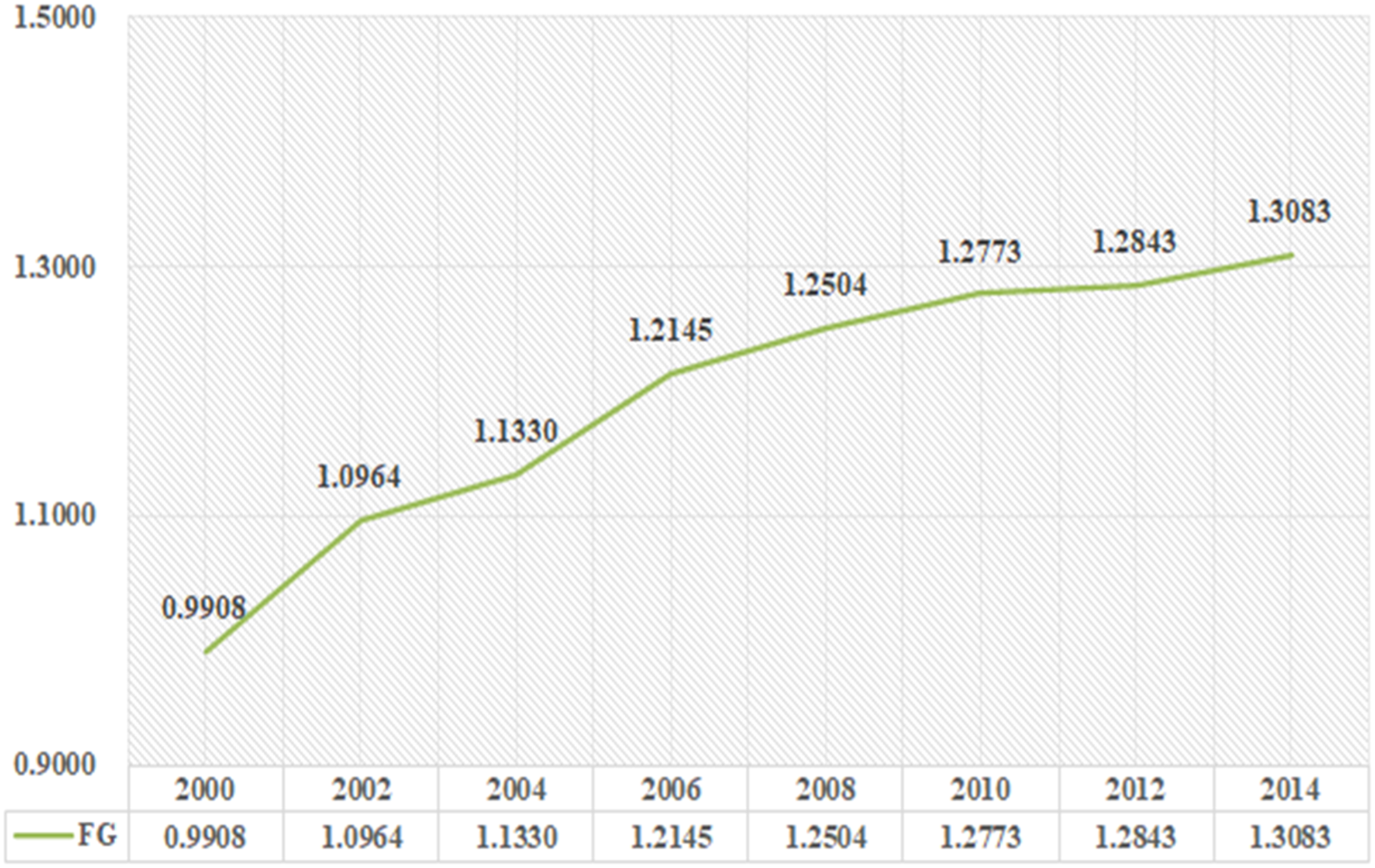
Empirical Results
We use STATA 12.0 for all empirical tests. The formal governance variable (the common factor extracted from the three dummy variables) is treated as a continuous variable, and ordinary least squares (OLS) regression is employed. We pool multi-year observations into a cross-sectional dataset and use OLS regression with year fixed effects to control for temporal heterogeneity, along with firm-level and regional controls to address individual and spatial heterogeneity. In the robustness checks, we use formal governance (the sum of three dummy variables) as the dependent variable. Given that this is an ordered variable, we test it using ordered logistic regression. To mitigate the influence of outliers, continuous variables are winsorized at the 1% level. All regression equations are tested for multicollinearity using variance inflation factors (VIFs); all VIF values are below the conventional threshold of 10 (mean VIF = 2.47), as recommended by O'Brien (2007), indicating no serious multicollinearity concerns.
Descriptive Statistics
Correlation Coefficient of Variables (N = 23571)
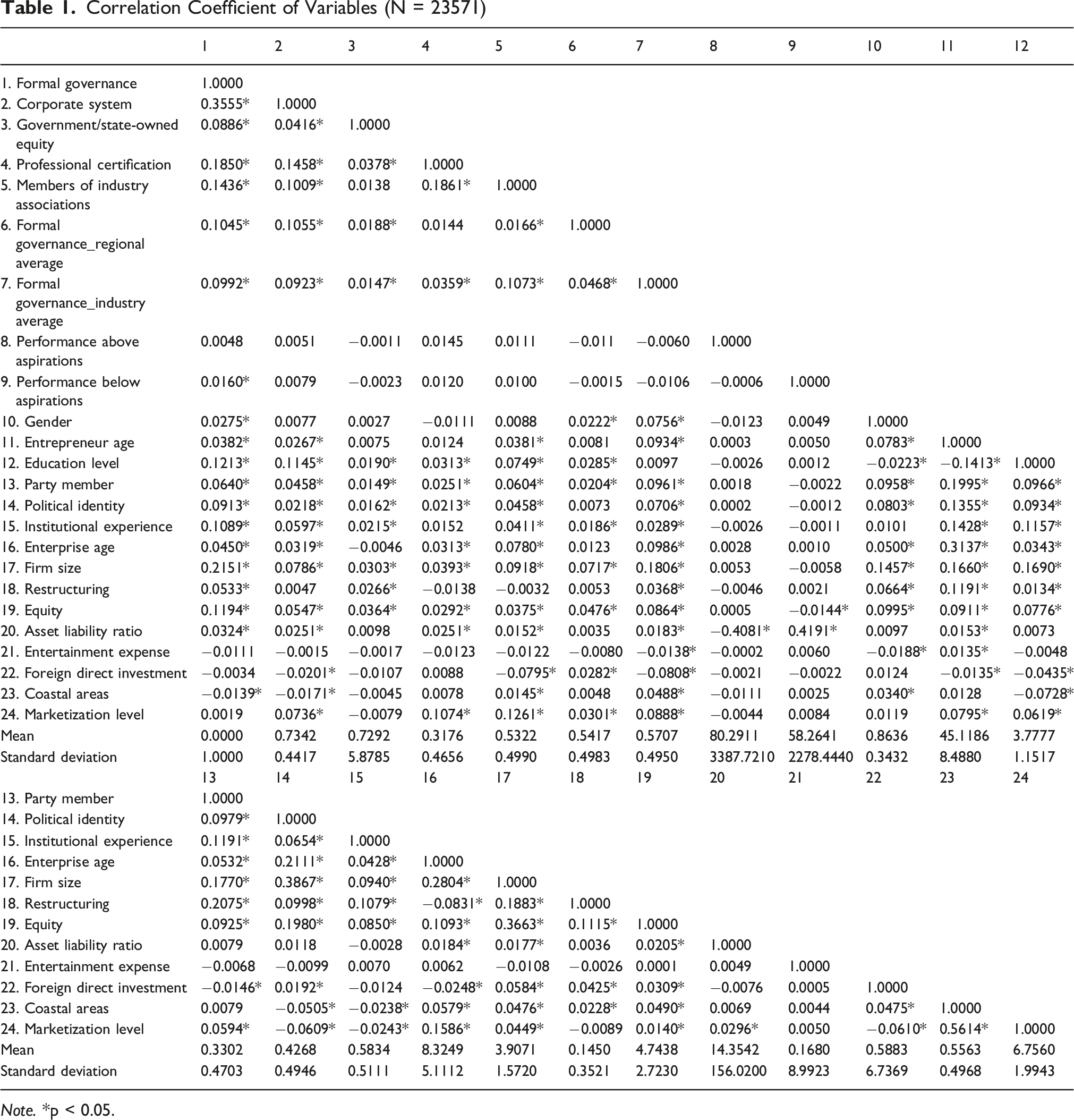
Note. *p < 0.05.
Effects of Legitimacy and Efficiency Logic
The Main Effects of Legitimacy and Efficiency Logics on Family Businesses’ Formal Governance
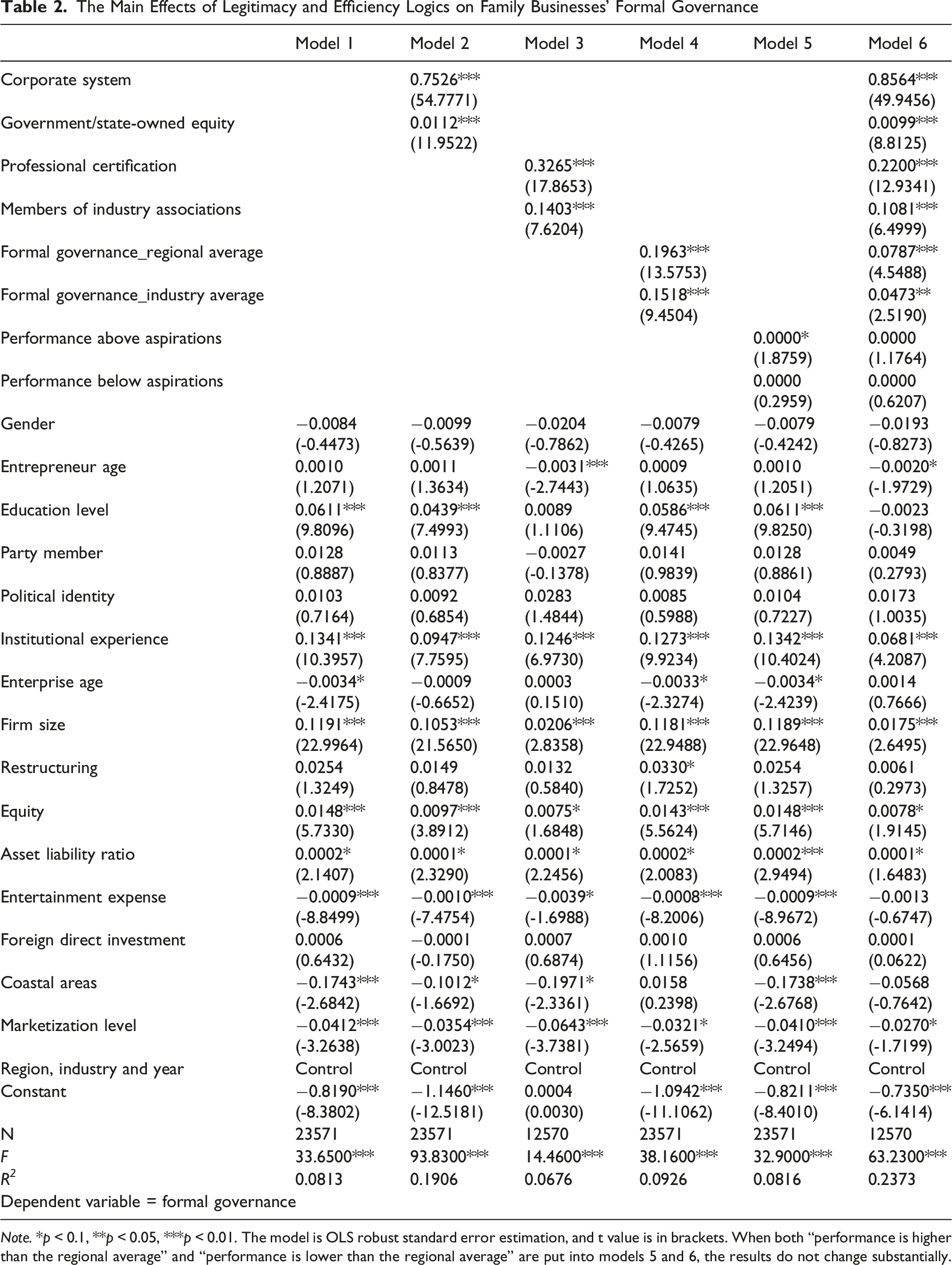
Note. *p < 0.1, **p < 0.05, ***p < 0.01. The model is OLS robust standard error estimation, and t value is in brackets. When both “performance is higher than the regional average” and “performance is lower than the regional average” are put into models 5 and 6, the results do not change substantially.
The results of Model 2 show that corporate system (β = 0.75, p < 0.01) and government/state ownership (β = 0.01, p < 0.01) are significantly and positively associated with formal governance, indicating that equity ratios of registered companies and government/state-owned enterprises impose stricter formal governance requirements, generating coercive institutional legitimacy pressure. Thus, H1 is supported.
In Model 3, professional certification (β = 0.33, p < 0.01) and industry association membership (β = 0.14, p < 0.01) are significantly and positively associated with formal governance, indicating that family businesses with professional certification tend to exhibit higher levels of formal governance. When family business owners join an industry association, they are exposed to the practices of other members; under the institutional pressure of professional networks, the degree of formal governance tends to increase. Thus, H2 is supported.
Model 4 shows that regional average formal governance (β = 0.20, p < 0.01) and industry average formal governance (β = 0.15, p < 0.01) are significantly and positively correlated with formal governance, indicating that within a given region or industry, the level of formal governance is positively related to mimetic pressure on the focal family enterprise, spurring its willingness to promote formal governance. Thus, H3 is supported.
Model 5 shows that performance lower than the industry average (β = 0.00, p > 0.1) is not significantly associated with formal governance. Although poorly performing family businesses face pressure to improve efficiency and may seek to close performance gaps through strategic adjustments (Chrisman & Patel, 2012; Patel & Chrisman, 2014), these gaps do not prompt them to catch up through more formal governance structures. Thus, H4 is not supported. Furthermore, there are no significant differences between the results of Models 5 and 6. These results suggest that efficiency logic is not the primary force driving formal governance in Chinese family businesses; rather, the key driver is institutional legitimacy pressure, shaped by coercive, normative, and mimetic logic.
From the control variables in Model 1, the education level and institutional experience of family business owners are positively associated with the formal governance of the family businesses they lead. Education level is an important dimension of normative institutional pressure (DiMaggio & Powell, 1983). Institutional experience serves as a key reference point for business owners when founding their family businesses and profoundly shapes organizational structure, tending to remain largely unchanged over time despite external changes. The modern enterprise system was initially promoted in China’s state-owned enterprises, so family business owners with system experience are inevitably influenced by the diffusion of this institutional model and subsequently promote formal governance in their own firms. Furthermore, at the firm level, firm size, owner’s equity, and the asset–liability ratio are positively associated with formal governance in family businesses.
Grouping Regression Analysis of Firm Size and Political Connection
The Grouping Regression Analysis of Formal Governance of Family Business
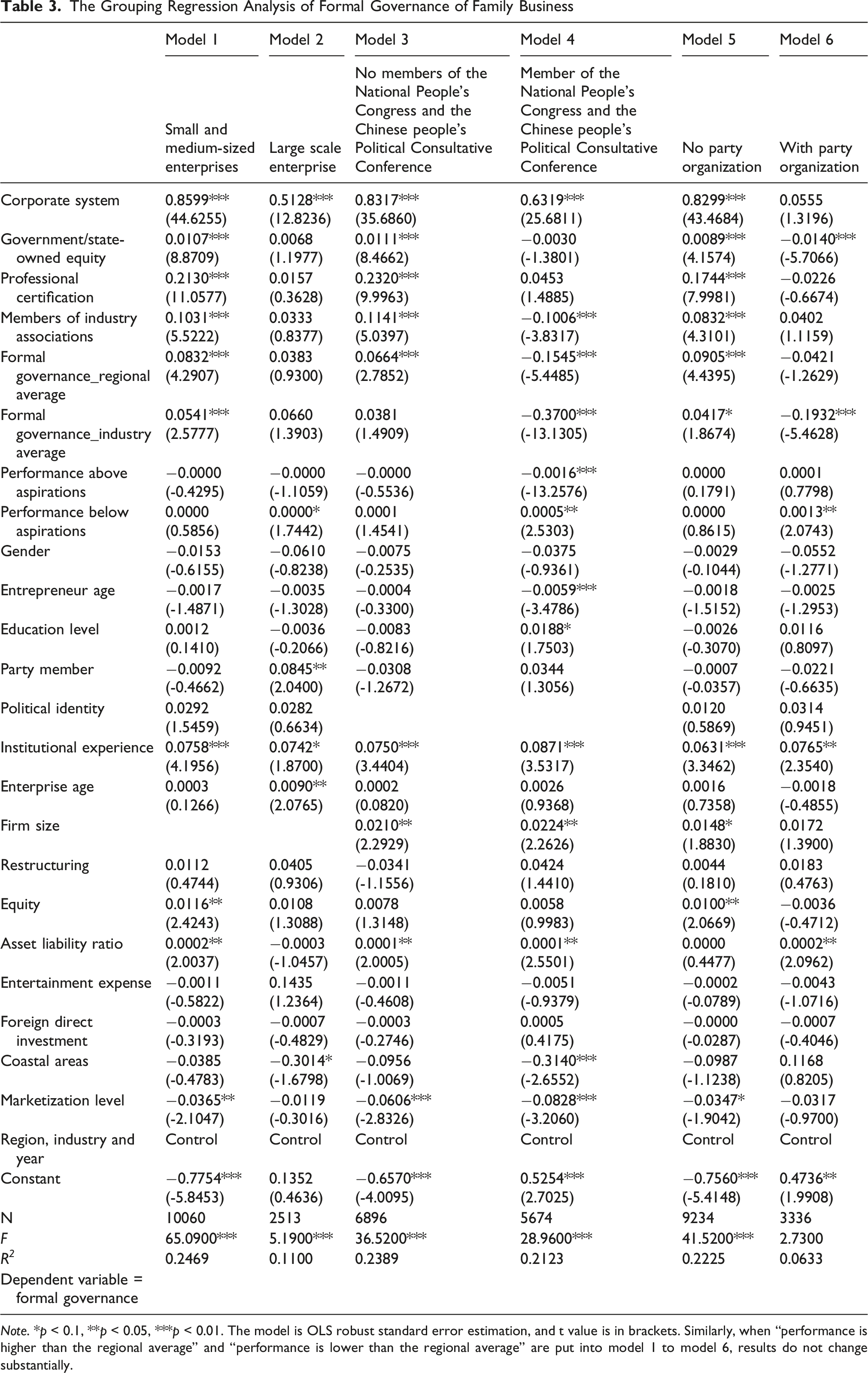
Note. *p < 0.1, **p < 0.05, ***p < 0.01. The model is OLS robust standard error estimation, and t value is in brackets. Similarly, when “performance is higher than the regional average” and “performance is lower than the regional average” are put into model 1 to model 6, results do not change substantially.
The results show that in small and medium-sized enterprises, corporate system, government/state-owned holding, professional certification, industry association membership, and regional and industry average formal governance are significantly and positively correlated with formal governance, whereas performance lower than the industry average is not significantly correlated. This suggests that the governance formalization process in small and medium-sized family businesses primarily follows legitimacy logic. In large enterprises, government/state-owned holding, professional certification, industry association membership, and regional average formal governance are not significantly correlated with formal governance, whereas performance lower than the industry average is significantly and positively correlated. Hence, the governance formalization process in large family businesses aims to improve efficiency rather than obtain legitimacy. The Chow test further reveals significant differences between the coefficients of legitimacy logic variables in the two subsamples, as well as significant differences in the coefficients of variables related to performance lower than the industry average. Thus, H5 and H6 are supported.
Models 3 and 4 present the grouping regression results for enterprises without and with NPC or CPPCC affiliation, respectively. The results indicate that among firms without NPC or CPPCC affiliation, corporate system, government/state-owned holding, professional certification, industry association membership, and regional average formal governance are all significantly and positively correlated with formal governance, whereas performance lower than the industry average is not significantly correlated. This shows that the governance formalization process for family business owners without political identity primarily follows legitimacy logic. In firms with NPC or CPPCC affiliation, government/state-owned holding and professional certification are not significantly correlated with formal governance; Industry association membership, and regional and industry average formal governance are significantly and negatively correlated with formal governance, whereas performance lower than the industry average is significantly and positively correlated. Thus, the formalization process for family business owners with political identity primarily follows efficiency logic rather than legitimacy logic. The Chow test further shows significant differences between the coefficients of legitimacy logic variables in the two subsamples, as well as significant differences in the coefficients of variables related to performance lower than the industry average. Models 5 and 6 present the subgroup regression results for enterprises without and with party organization, respectively, and the results are not substantially different from those in Models 3 and 4. Thus, H7 and H8 are supported.
In sum, for small and medium-sized family businesses and those without political connections (including entrepreneurs’ political identity and the presence of party organizations within enterprises), the governance formalization process tends to follow legitimacy logic. For larger and politically connected family businesses, formal governance tends to be driven by efficiency considerations rather than legitimacy.
Robustness Checks
Replacement of Variables
The first robustness check replaces the formal governance measure. We regress the sum value (formal governance 1) of the three dummy variables—board of directors, depersonalization of decision-making, and professional managers—as the dependent variable to examine the three types of legitimacy and efficiency logic (Dekker et al., 2013; Mustakallio et al., 2002). The regression results are reported in Appendix B, Models 1–5, and are not significantly different from those in Table 2. This study also considers the ratio (formal governance 2) between the sum of formal governance variables and informal governance variables (the number of family members on the top management team) as an alternative measure of the degree of formal governance in family businesses (Chua et al., 2009; Schulze et al., 2001). Appendix B, Models 6–10, reports the regression results, which are not fundamentally different from those in Table 2. We also use MCA to measure formal governance (formal governance 3). The regression results are reported in Appendix C, Models 1–5, and are not significantly different from those in Table 2.
The second robustness check replaces the efficiency logic variable. To further examine efficiency logic in the formal governance of family businesses, we use two alternative business efficiency indicators. The first is the asset turnover ratio (operating revenue/total assets), which measures profitability relative to existing asset scale, reflecting asset management efficiency. It is widely used in finance and accounting (Altman, 1968), economics (Braguinsky et al., 2015), and management (Cochran and Wood, 1984; Jia, 2016), and serves as an indicator of enterprise market capacity. The second is management expenses.
Drawing on agency theory and the literature on managerial opportunism, we employ management expenses as an additional proxy for efficiency logic, reflecting the extent to which firms minimize agency costs and maximize operational efficiency. This approach is theoretically grounded and empirically validated for several reasons. First, management expenses—encompassing selling, general, and administrative (SG&A) costs—constitute a significant portion of firms’ operational expenditures and often include discretionary spending susceptible to managerial opportunism (Singh & Davidson, 2003). Such expenses can reflect agency problems when managers prioritize personal benefits over shareholder value, serving as an inverse indicator of efficiency logic. Second, prior research has established a robust link between management expenses and opportunistic behaviors. For instance, Anderson et al. (2003) demonstrate that the asymmetric behavior of SG&A costs—termed “stickiness”—partly arises from agency costs, as managers may retain excess resources during downturns for personal gain rather than efficiency. Similarly, Singh and Davidson (2003) use the ratio of SG&A expenses to total revenue as a direct measure of agency costs, highlighting how discretionary spending reflects managerial opportunism. Cai et al. (2011) provide compelling evidence by linking entertainment and travel costs within management expenses to corruption in Chinese firms, suggesting that such expenditures often mask illicit transactions and opportunistic conduct. Third, building on Coates (2012), who identifies managerial excess (e.g., private jet usage) as proxies for opportunism that undermine firm value, our approach recognizes that while our dataset of mostly non-listed firms lacks direct measures such as corporate political activities or executive perks, management expenses provide a comparable proxy for discretionary spending that may reflect managerial self-interest over efficiency. Accordingly, high management expenses may indicate weaker efficiency logic due to opportunistic resource allocation, whereas lower expenses suggest stronger alignment with shareholder interests. This operationalization bridges theoretical insights from agency theory and integrates empirical rigor from prior studies (Anderson et al., 2003; Cai et al., 2011; Singh & Davidson, 2003). The regression results reported in Appendix D do not differ significantly from those in Table 2.
The third robustness check replaces mimetic logic. To further validate our findings, we substitute the binary measurement of mimetic logic with continuous variables representing the absolute deviation from regional and industry peer averages. This alternative operationalization tests whether our results hold when using magnitude-based rather than binary measures of peer deviation. The results remain consistent with our main findings in Table 2, as reported in Appendix E.
Endogenous Problems
The regression results may suffer from endogeneity due to omitted variables and two-way causality. First, we address potential omitted variables and employ instrumental variables. Although firm-, regional-, year-, and market development-level variables are controlled, family-level and economic development-level variables remain unaccounted for, despite their influence on governance structure and transformation (Miller et al., 2013; Peng & Jiang, 2010). Accordingly, family-level variables (family ownership (Claessens et al., 2002; Villalonga & Amit, 2006) and family management (Chua et al., 2009; Schulze et al., 2001) and economic development-level variables (regional per capita GDP, unemployment rate, and the proportion of the three industries (Du et al., 2017; Haveman et al., 2017) are controlled. In Appendix F, after controlling for potential omitted variables, the effects of our key explanatory variables remain consistent with the baseline results in Table 2, confirming the robustness of our findings. This indicates that these omitted variables do not bias the estimates by inducing correlation between explanatory variables and the error term.
Second, to address two-way causality, we adopt propensity score matching (PSM) and two-stage least squares (2SLS) methods. While the endogenous issues related to coercive logic (corporate system and government/state-owned holding) and normative logic (professional certification and industry association membership) are addressed, the endogenous issue related to mimetic logic is not explored. The reason is as follows: mimetic logic is measured by the industry or regional average of peer firms’ practices, where reverse causality is less likely, as an individual firm’s governance choices have negligible influence on the aggregate behavior of others (Haunschild & Miner, 1997; Mahajan et al., 1988). Our measurement approach explicitly excludes the target enterprise from calculations, eliminating mechanical correlations between independent and dependent variables while reducing confounding effects (Bouwman, 2011). Regional and industry averages of peer firms’ governance practices capture collective strategic asset dynamics—technological capabilities, market positioning, and resource endowments—within institutional fields, which mitigates endogeneity concerns by reflecting field-level legitimacy logic rather than firm-specific strategic choices (DiMaggio & Powell, 1983) and isolates mimetic logic from other institutional forces (Scott, 2013).
We apply the PSM method to construct a control group similar to the treatment group based on propensity scores (Heckman et al., 1998), reducing sample selection bias and weakening the influence of control variables and other factors. We use a logit model to select matching variables, which include all control variables. Explanatory variables are dummies, defined as 1 for coercive, normative, and mimetic logic and 0 otherwise, while controlling for regional, industrial, and year effects. The corresponding propensity score is estimated with the logit model, and the treatment and control groups are paired using nearest-neighbor matching. The average treatment effect on the treated (ATT) is used to estimate the impact of coercive, normative, and mimetic logics on formal governance. Appendix G reports the PSM results, showing that the ATT effects of corporate system, government/state holding, professional certification, industry association membership, regional average formal governance, and industry average formal governance are significant at the 1% level. Nearest-neighbor matching at ratios of 1:1, 1:2, 1:3, and 1:4 yields no significant changes in the results. This confirms that both coercive, normative, and mimetic logics significantly improve formal governance in family businesses and demonstrates the robustness of our results.
We apply two-stage least squares (2SLS) (Stock et al., 2002) and select the regional and industry mean values (excluding the target enterprise) of corporate system, government/state-owned equity, professional certification, and industry association membership as instrumental variables. These variables capture peer influence within the same region and industry while remaining exogenous for the focal firm’s governance. Appendix H reports the regression results, showing that—in addition to government/state-owned holding (β = 0.04, p > 0.10)—corporate system (β = 1.02, p < 0.01), professional certification (β = 0.82, p < 0.01), and industry association membership (β = 1.63, p < 0.01) are significantly positively associated with formal governance, supporting the robustness of our findings. 1
FGLS Analysis
To address potential heteroskedasticity, we employ feasible generalized least squares (FGLS) for model estimation (Greene, 1990). The regression results are reported in Appendix I and Appendix J, showing no significant differences from the results in Tables 2 and 3.
Further Analysis
We conduct a further analysis to examine the potential outcomes of formal governance structures for family firms, focusing on two productive activities: R&D activities and outward foreign direct investment (FDI). Both are key strategies driving technological advancement (Chrisman & Patel, 2012) and international expansion (Arregle et al., 2021). R&D is measured by R&D expenditures/sales (Chrisman & Patel, 2012), and FDI is measured by FDI expenditures/assets (Liu et al., 2011). Appendix K reports the regression results, showing that formal governance in Model 1 (β = 0.0505, p < 0.01) and Model 2 (β = 0.0445, p < 0.01) is significantly and positively correlated with R&D and FDI, indicating that formal governance could drive technological advancement and internationalization expansion for family businesses.
Discussion and Conclusions
Main Findings
The introduction of formal governance in Chinese family businesses has become a central driver of their modern transformation, with legitimacy logic playing a dominant role. Legitimacy logic encompasses coercive, normative, and mimetic dimensions. Coercive logic arises when family businesses register as limited liability or joint-stock companies, which is positively associated with government ownership and state-owned or collective enterprises, and promotes formal governance. Normative logic indicates that family enterprises with professional certification or membership in industry associations exhibit higher levels of formal governance, due to the pressures of certification requirements and the influence of professional networks. Mimetic logic suggests a positive association between a focal family business and the average level of formal governance in its industry or region—meaning the firm is more inclined to pursue formal governance transformation. Crucially, these transformations are not primarily driven by efficiency logic. Even in family businesses with performance significantly below the industry average, the momentum for transformation remains rooted in legitimacy logic rather than efficiency gains. In sum, our findings support neo-institutionalism theory, suggesting that the diffusion of modern corporate governance in China is driven more by external institutional pressures than by internal efficiency incentives.
Notably, while legitimacy rather than efficiency logic propels the overall formal governance process in Chinese family businesses, different organizational contexts present distinct sources of logic (Luo & Chung, 2013; Miller et al., 2013; Peng & Jiang, 2010). The relative significance of the two main effects varies across heterogeneous contexts. We find that the adoption of formal governance in small and medium-sized family businesses—or in those without political connections—is driven mainly by legitimacy considerations rather than performance improvement. Without the buffer of size or political connections, many family businesses face acute resource shortages and legitimacy deficits. Adopting formal governance can confer a degree of legitimacy, or at least signal positive attributes to the public, thereby aligning with institutional pressures and stakeholder expectations. By contrast, large family businesses or those with political connections tend to be influential economic actors with stronger resource endowments and legitimacy. For these firms, the adoption of formal governance mechanisms is more likely driven by the goal of improving internal efficiency rather than enhancing external legitimacy. Influential family businesses also face larger social “audiences”—government agencies, media, consumers, suppliers, and community members (Gamble et al., 2021)—under which external legitimacy pressures serve as an important supervisory force (Miller et al., 2013). From a dynamic perspective, our research suggests that as family firms grow in scale or transition from lacking political connections to establishing them, the underlying behavioral logic of their governance processes may require dynamic adjustment, shifting from a legitimacy-based logic toward an efficiency-oriented one.
Theoretical Implications
This study makes three theoretical contributions to the family business governance literature. First, it advances the integration of legitimacy and efficiency logics as dual drivers of formal governance transformation in family firms. Prior research has typically examined these motivations separately—either as a response to external legitimacy pressures (Chung & Luo, 2008; Claessens et al., 2002; Parada et al., 2010) or as an instrument for enhancing internal efficiency (Mustakallio et al., 2002; Schulze et al., 2003; Songini, 2006). By combining both logics within a unified analytical framework, this study demonstrates their joint influence on the adoption and evolution of formal governance structures. This dual-logic approach explains the heterogeneous motivations underlying governance transformation and clarifies why some family firms prioritize institutional conformity while others emphasize operational effectiveness. It reconciles seemingly conflicting findings in the literature and provides a holistic lens for analyzing governance decisions that accounts for both external and internal imperatives (Miller et al., 2013; Parada et al., 2020), capturing the complexity and diversity of family business governance and illuminating the interplay between institutional context and organizational strategy (Chrisman et al., 2012; Daspit et al., 2018).
Second, this study elucidates how the effects of legitimacy and efficiency logic on formal governance are contingent on firm size and political connections. By examining these moderating roles, the research reveals that the relative salience of legitimacy versus efficiency logic shifts across different organizational and institutional contexts. Specifically, smaller or politically unconnected family firms are more likely to be driven by legitimacy concerns, whereas larger or politically connected firms tend to emphasize efficiency (Luo & Chung, 2013; Nordqvist et al., 2014; Peng, 2004). This contingency perspective underscores the importance of organizational heterogeneity in governance research and demonstrates that governance strategies are not universally applicable but must be tailored to firm-specific characteristics and institutional embeddedness (Chua et al., 2012; Jaskiewicz & Dyer, 2017), thereby enriching the theoretical toolkit for understanding diverse governance patterns across varying sizes and political environments (Li & Zhang, 2007; Zhang et al., 2016).
Third, this research extends the study of family business governance to emerging economies, particularly the East Asian context (Dinh & Calabrò, 2019; Fang et al., 2022). China’s distinctive institutional environment provides an ideal setting for examining competing behavioral logics. Our findings illuminate how family firms navigate institutional complexity by strategically balancing legitimacy and efficiency considerations, enriching the understanding of family business governance beyond developed Western economies and underscoring the need for institution-sensitive theorizing (Marquis & Qiao, 2020; Nee & Opper, 2012; Peng, 2003).
Practical Implications
This study offers significant insights for family business owners, regulators, and policymakers, though caution is warranted when applying these findings across different institutional contexts. Although our results are derived primarily from the Chinese context, they suggest that legitimacy and efficiency logic influencing formal governance in family businesses may have broader implications for practice in other settings. More importantly, by integrating both logics rather than treating them in isolation, our work clarifies the theoretical and practical considerations surrounding governance choices and, crucially, guides family businesses of varying sizes and political connections in selecting appropriate governance transformation strategies.
For family business owners, our research offers tailored governance recommendations based on institutional context and firm characteristics. Owners should identify the specific institutional pressures most relevant to their environment—whether regulatory requirements, professional standards, or successful peer practices—to inform governance priorities. They should also assess how formal governance can enhance operational efficiency through structured decision-making processes and professional management practices that enable effective engagement of external talent. The governance approach should be calibrated to firm-specific factors: small and medium-sized family businesses benefit from prioritizing legitimacy-signaling mechanisms to overcome resource constraints, whereas large firms can more effectively implement efficiency-enhancing formal structures. Similarly, firms without political connections should emphasize institutionally endorsed practices to establish credibility with external stakeholders, whereas those with political connections may exercise greater strategic flexibility. Rather than adopting standardized governance packages, family businesses should strategically differentiate their governance components, foregrounding legitimacy or efficiency dimensions based on their specific institutional contexts and organizational characteristics. This tailored approach enables family firms to address critical institutional demands while preserving their distinctive advantages.
For regulators and policymakers, our research highlights the need for a differentiated approach to promoting corporate governance reforms. Rather than imposing uniform governance standards across all family businesses, regulators should develop policies that account for firm-specific factors, enabling a more effective reconciliation of legitimacy requirements and efficiency needs across different enterprise contexts.
In conclusion, our study advocates for a context-sensitive approach to family business governance that considers both legitimacy and efficiency considerations. This approach calls for integrating formal governance practices with the unique behavioral logic of family businesses—their legitimacy and efficiency concerns—according to specific conditions such as firm size and political identity. By doing so, a tailored governance approach can support the sustainable development of family businesses—including technological advancement and internationalization expansion—while contributing to broader economic growth and stability across diverse institutional contexts.
Limitations and Future Research
This study offers valuable insights into the formal governance of family businesses, but it is not without limitations. Acknowledging these constraints provides avenues for future research. Since our work focuses primarily on formal governance in China, caution is warranted when directly applying our findings to other countries due to differences in institutional environments and cultural traditions (Marquis & Qiao, 2020; Nee & Opper, 2012; Peng, 2003). Future research should examine how varying institutional contexts—particularly those with different levels of institutional development, cultural orientations toward family, and regulatory frameworks—might alter the relationship between behavioral logic and governance choices. In particular, scholars should investigate whether the moderating effects of firm size and political connections operate similarly across institutional environments with varying degrees of market maturity, rule of law, and collectivistic versus individualistic orientations. Such comparative studies would significantly deepen understanding of the boundary conditions of our theoretical framework and contribute to a more nuanced, context-sensitive theory of family business governance.
Notably, legitimacy logic helps family businesses build reputation and secure resources, which can support long-term efficiency, while efficiency logic contributes to strengthening legitimacy over time. Family businesses should consistently address both sets of needs rather than pursuing one aspect unilaterally (Cobben et al., 2023). While our study does not extensively explore the potential interrelationships between these two logics, these perspectives are thought-provoking, and future research could incorporate them into the analytical framework by examining how cross-logic dynamics influence formal governance outcomes within family businesses.
Furthermore, in our study, coercive and normative logics were measured through specific actions of the focal firm—whether the firm adopts a modern corporate system for coercive logic, and whether the firm has obtained professional certification or holds industry association membership for normative logic. Although we sought direct indicators for measuring the mimetic behavior of focal firms, we were unable to locate suitable measures within the available dataset. Accordingly, we adopted a second-best approach, operationalizing mimetic pressure as a binary classification: whether the formal governance level of the focal firm is higher (assigned as 0) or lower (assigned as 1) than the average formal governance level of firms in the same industry and region, supplemented by an absolute gap methodology analogous to that used for efficiency logic as an alternative measure for robustness analysis. Future research may pursue more direct indicators for assessing mimetic behavior to further extend the implications of our study.
Finally, while our study provides firm-level insights into formal governance mechanisms, a key limitation lies in our relatively limited exploration of industry-level heterogeneity. Although we controlled for industry types, a more granular analysis of industry-specific characteristics and their influence on governance choices would enhance understanding. Industries vary substantially in technological intensity, market concentration, regulatory oversight, and institutional pressures, which may systematically affect how family firms respond to legitimacy and efficiency demands (Banalieva et al., 2015; Berrone et al., 2010). Future research could advance our theoretical framework by explicitly modeling these industry-level contingencies.
Footnotes
Funding
The authors disclosed receipt of the following financial support for the research, authorship, and/or publication of this article: This work was supported by National Natural Science Foundation of China (Grants 72102088), Major Research Projects in Philosophy and Social Sciences of Jiangsu Higher Education Institutions under (2025SJZD129), Humanities and Social Sciences Research Fund of the Ministry of Education (Grants 24YJC630243), Natural Science Foundation of Guangdong Basic and Applied Basic Research Foundation (Project No. 2025A1515011229), and Guangdong Philosophy and Social Science Planning Project (Project No. GD25YSG04).
Declaration of conflicting interests
The authors declared no potential conflicts of interest with respect to the research, authorship, and/or publication of this article.
Data Availability Statement
All Appendices have been put into the Online Supplementary File for Review and the datasets generated during and/or analyzed during the current study are available in the [Open Science Framework] repository. Please kindly see these files by linking: [ ]. Moreover, the data that support the findings of this study are available from [Chinese Private Enterprises Survey (CPES)] but restrictions apply to the availability of these data, which were used under license for the current study, and so are not publicly available. Data are however available from the authors upon reasonable request and with permission of [Chinese Private Enterprises Survey (CPES)].