






Abstract
Organizations increasingly promote neurodiversity in hiring, yet it remains unclear how candidates whose materials signal neurodiversity-related affiliation are evaluated in leadership selection. Drawing on implicit leadership and role congruity theories, dominant schemas would predict reduced perceived leadership effectiveness for candidates who deviate from interpersonal prototypes. In contrast, person-job and person-role fit perspectives suggest more contingent evaluations aligned with role demands. In an experimental study of 99 adults with hiring experience, participants evaluated matched candidates whose biographies either included or did not include neurodiversity-related signals across leadership roles emphasizing interpersonal skills, problem-solving, or innovation. Contrary to schema-based predictions of generalized disadvantage, candidates signaling neurodiversity-related affiliation were evaluated similarly to, and in some cases modestly more favorably than, those without such signals on perceived leadership effectiveness. However, evaluators showed a consistent preference for interpersonal leadership roles regardless of candidate identity. This pattern of evaluative parity alongside enduring relational preferences suggests increasing flexibility in leadership schemas even as interpersonal norms remain influential.
Organizations are increasingly investing in neurodiversity hiring initiatives (Austin & Pisano, 2017; Branicki et al., 2024), raising an important practical question: how are individuals perceived as neurodivergent evaluated for leadership roles? Dominant leadership models emphasize interpersonal fluency, emotional expressiveness, and spontaneous social engagement (Eagly & Karau, 2002; Epitropaki & Martin, 2005; Lord et al., 1984), attributes often implicitly associated with neurotypicality (den Houting, 2019). From a schema-based perspective, candidates who deviate from these relational prototypes may be viewed as less congruent with prevailing images of effective leadership and, consequently, disadvantaged in leadership selection. At the same time, growing organizational attention to neurodiversity suggests that evaluative standards may be shifting, making it timely to examine whether and when prototype-based expectations shape judgments of leadership fit.
Concurrently, the nature of leadership work is evolving. In data-intensive, innovation-driven, and cognitively complex environments, effective leadership increasingly depends on analytical reasoning, systems thinking, sustained focus, and structured problem-solving – capabilities highlighted in neurodiversity scholarship (Austin & Pisano, 2017; LeFevre-Levy et al., 2023; Roberson et al., 2021). If leadership effectiveness continues to be judged primarily on relational presence rather than on cognitive rigor and strategic execution, prevailing assumptions about who embodies leadership potential may be misaligned with contemporary organizational demands.
We examine this question by focusing explicitly on perceived leadership effectiveness as our primary outcome. We center leadership effectiveness because it captures the form of fit most consequential in leadership selection contexts – specifically, the extent to which a candidate is judged to align with evaluators’ implicit standards for successfully occupying and enacting a leadership role. Unlike narrower assessments of task performance, perceived effectiveness reflects a holistic judgment that integrates prototype matching, anticipated influence, and perceived suitability for role enactment, all core elements of schema-based leader evaluation (Epitropaki & Martin, 2005; Lord et al., 1984).
Leadership research offers competing expectations for how individuals perceived as neurodivergent are evaluated. Dominant leadership schemas suggest that candidates who diverge from prevailing interpersonal norms may be viewed as less effective leaders, even when qualifications are equivalent. This perspective implies a general disadvantage in leadership selection, particularly in roles centered on interpersonal coordination and influence. In contrast, person-job fit perspectives suggest a more contingent pattern, in which evaluators attend to alignment between perceived strengths and role demands (Kristof-Brown et al., 2005). From this view, individuals perceived as neurodivergent may be seen as equally, or even more, effective in roles emphasizing analytical reasoning, structured problem-solving, or innovation. Thus, whereas schema-based perspectives imply generalized disadvantage, fit-based perspectives predict role-contingent evaluations.
In an experimental study of hiring professionals evaluating candidates for leadership roles, we tested these competing expectations. Contrary to expectations of a generalized penalty, candidates whose otherwise comparable bios signaled a neurodiversity affiliation were evaluated similarly to, and in some cases more favorably than, those whose bios did not. Evaluators also preferred roles emphasizing interpersonal skills, regardless of candidate identity. Building on these findings, we offer actionable recommendations for organizations seeking to broaden leadership evaluation criteria and outline directions for future research on neurodiversity, leadership schemas, and evolving conceptions of fit.
Method
Participants were 99 adults with current or prior hiring experience (M = 40.77, SD = 11.81) who completed an online evaluation task. We employed a 2 (candidate identity: neurodiversity affiliation, no neurodiversity affiliation) × 3 (job orientation: interpersonal skills, problem-solving, innovative thinking) within-subjects design, in which each participant evaluated both candidates across all three leadership roles. To manipulate role demands, we created three mock job postings modeled after listings on widely used online recruitment platforms. Each posting described a Senior Team Leader position and highlighted responsibilities aligned with one focal domain – relational coordination, systems-oriented problem-solving, or creative innovation – thereby activating distinct leadership prototypes.
We also developed two matched applicant biographies for undergraduate management majors (see Appendix B). The candidates’ qualifications and work experiences were substantively equivalent, with neurodiversity signaled through prior involvement with organizations or teams related to neurodiversity rather than through explicit identity disclosure, whereas the comparison candidate’s experiences were unrelated to neurodiversity. To minimize participant confusion given the similarity of the profiles, the order of job postings and candidate bios was held constant rather than randomized or counterbalanced. By holding candidates’ qualifications constant and varying their identity and the type of role evaluated, this 2 (candidate identity) × 3 (job orientation) within-subjects design allowed us to test whether leadership evaluations reflect general biases based on leadership stereotypes or depend on how well candidates are perceived to fit the specific role. Additional measures, including demands–abilities fit and in-role performance, are reported in the supplemental materials.
Results
Notably, we found no evidence that candidates whose materials included neurodiversity-related signals were evaluated as less effective leaders. Across all role types, effectiveness ratings were statistically comparable to, and in some cases modestly higher than, those for candidates without such signals, indicating no generalized penalty associated with deviation from relational leadership prototypes. A robust main effect of job orientation also emerged (see Figure 1). Leadership roles emphasizing interpersonal skills were evaluated more favorably than those emphasizing problem-solving or innovative thinking, regardless of candidate identity. Importantly, there was no candidate identity by job orientation interaction, indicating that candidates signaling neurodiversity affiliation were neither disproportionately penalized in relational roles nor uniquely advantaged in analytically oriented roles. Effect of job requirements and candidate identity on perceived leader effectiveness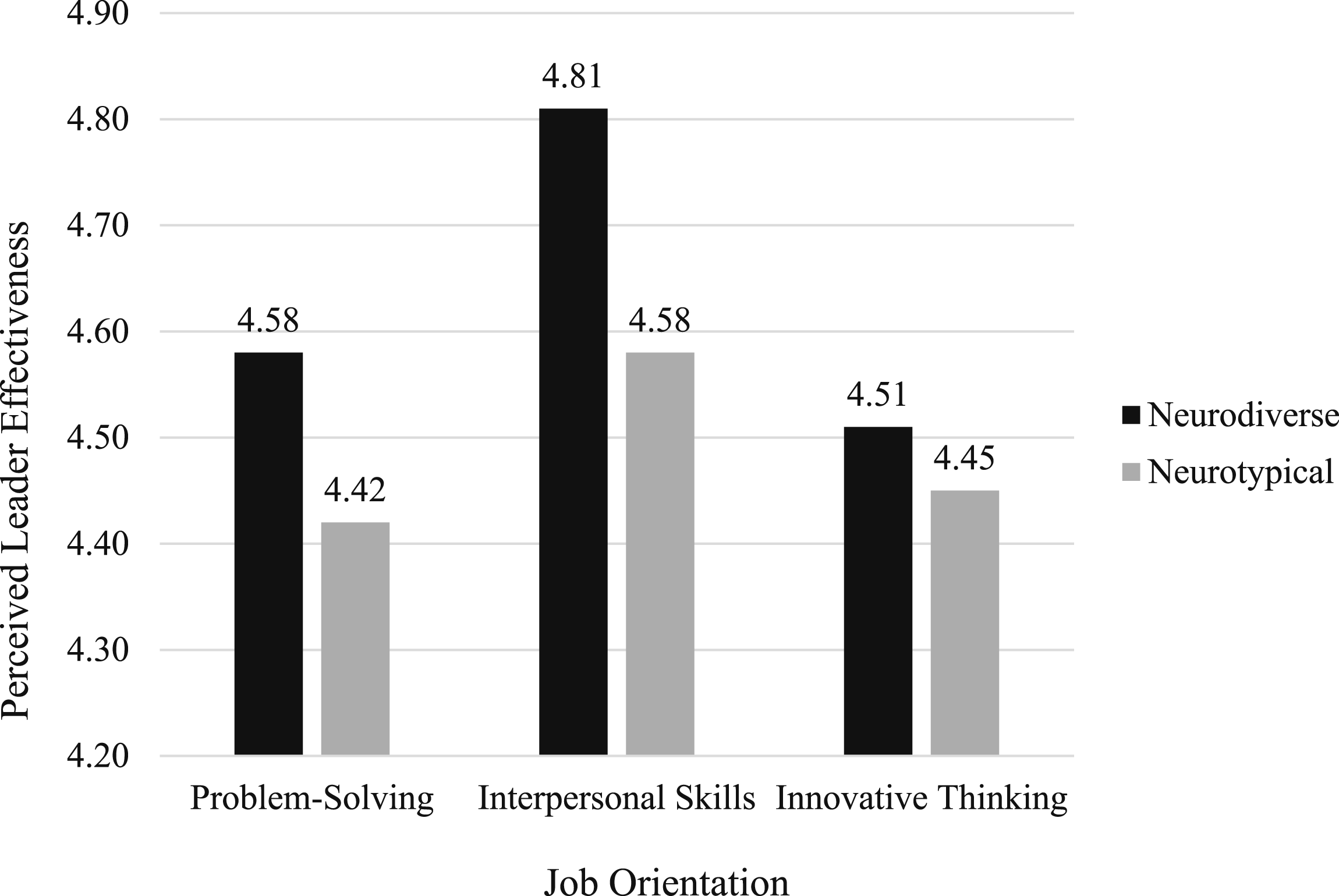
Supplemental analyses of demands-abilities fit and in-role performance showed similar patterns (see online appendix). Overall, the findings suggest that candidates were evaluated similarly regardless of whether they signaled a neurodiversity affiliation, alongside a consistent preference for roles emphasizing interpersonal skills. Rather than showing a broad disadvantage or role-specific advantage, the results indicate that leadership expectations continue to favor interpersonal roles without placing candidates signaling neurodiversity affiliation at a disadvantage across contexts.
Discussion
Our findings refine existing leadership theories and clarify how candidates whose materials include neurodiversity-related signals are evaluated. These candidates were rated similarly to and, on average, modestly more favorably than those without such signals on perceived leadership effectiveness, reflecting a “parity-plus” pattern. This suggests that expectations about who fits leadership roles may be more flexible than often assumed when candidates have comparable qualifications.
The results also qualify fit-based expectations. Although fit perspectives suggest that evaluations should depend on how well candidates match different role demands, we found no evidence that candidate identity influenced evaluations differently across the three role types. In other words, evaluators did not systematically match candidates to roles based on perceived strengths. While this kind of matching is theoretically possible, it was not observed in this study.
Instead, evaluators consistently favored roles emphasizing interpersonal skills, regardless of candidate identity, highlighting the continued importance of relational leadership expectations. Overall, the findings suggest that while preferences for certain types of leadership roles remain stable, evaluations of candidates themselves may be less constrained by traditional assumptions than prior theory would predict.
These theoretical insights carry concrete implications for organizational practice. First, organizations should redesign leadership criteria and job postings to explicitly value analytical reasoning, systems thinking, and innovative problem-solving alongside interpersonal coordination. Making these competencies visible in formal job descriptions signals that leadership effectiveness is multidimensional rather than synonymous with charisma or interpersonal style. Second, interview and assessment practices should be adjusted to reduce inadvertent penalties for stylistic differences. Standardized behavioral questions, work sample tasks, and other skills-based assessments can shift attention from presentation style to demonstrated capability, particularly for roles with strong analytical demands. Third, hiring managers and selection committees should receive training, including calibration exercises that surface implicit leadership prototypes and align evaluation standards across panels. Finally, organizations should create psychologically safe pathways for disclosure and support by embedding inclusive onboarding processes, mentorship structures, and advancement systems that reduce pressure to mask differences. Although our findings are based on evaluations of professionally accomplished candidates whose materials included subtle, affiliation-based cues related to neurodiversity, they suggest that leadership pipelines that recognize diverse ways of working and thinking as potential strategic assets, rather than liabilities, may be better positioned to align talent with increasingly complex organizational demands.
Several features of our design warrant caution in interpreting these implications. Participants were recruited via an online platform and evaluated candidates in a controlled vignette setting. Although they had hiring experience, their judgments may not fully capture the accountability pressures, organizational politics, and multi-stage dynamics that characterize executive selection decisions. Experimental methods allow us to isolate the effects of identity and role orientation, but they simplify the institutional context in which leadership judgments are embedded. Accordingly, our recommendations should be viewed as evidence-informed opportunities rather than definitive prescriptions for promotion outcomes in high-stakes organizational environments.
In addition, the neurodiversity signal embedded in the candidate biographies was intentionally subtle and reflected only one form of identity disclosure. Neurodivergence encompasses a heterogeneous set of neurological profiles, including but not limited to autism, ADHD, dyslexia, and other cognitive differences, each associated with distinct strengths and challenges. Our design adopts a strengths-based framing consistent with the neurodiversity movement’s emphasis on cognitive difference rather than deficit; however, it does not capture variation in support needs, stigma intensity, or intersectional identities. Moreover, because the vignettes depicted professionally accomplished individuals signaling affiliation with neurodiversity-related contexts, some participants may have interpreted the cue in different ways (e.g., as indicating potential allyship rather than personal neurodivergent identity). Future research should therefore vary the clarity, intensity, and context of neurodivergence disclosure to better understand how identity salience interacts with leadership schemas.
Overall, our findings reveal a parity-plus pattern, characterized by similar evaluations alongside enduring prototype preferences, such that candidates signaling a neurodiversity affiliation are not systematically penalized even as interpersonal leadership norms continue to shape evaluations. This pattern suggests that leadership schemas may be evolving, even as relational norms remain deeply embedded. These findings carry implications for both organizations and scholars. For organizations, the takeaway is clear: expanding definitions of leadership effectiveness to include both relational and analytical strengths can enhance inclusion while strengthening alignment between talent and role demands. For scholars, the results highlight the importance of examining both identity-based expectations and role-level schemas to better understand how conceptions of leadership are shifting, and where biases may persist.
Supplemental Material
Supplemental Material - Neurodiversity and Leader Selection: Parity in Evaluations Amid Enduring Interpersonal Prototypes
Supplemental Material for Neurodiversity and Leader Selection: Parity in Evaluations Amid Enduring Interpersonal Prototypes by Quinetta Roberson, Joie Magalona, Narda Quigley in Group & Organization Management
Footnotes

Funding
The authors received no financial support for the research, authorship, and/or publication of this article.
Declaration of Conflicting Interests
The authors declared no potential conflicts of interest with respect to the research, authorship, and/or publication of this article.
Supplemental Material
Supplemental material for this article is available online
Author Biographies
References
Supplementary Material
Please find the following supplemental material available below.
For Open Access articles published under a Creative Commons License, all supplemental material carries the same license as the article it is associated with.
For non-Open Access articles published, all supplemental material carries a non-exclusive license, and permission requests for re-use of supplemental material or any part of supplemental material shall be sent directly to the copyright owner as specified in the copyright notice associated with the article.
