







Abstract
Imagine evolving swarms of robots interacting and by doing so reshaping and cultivating our habitat. This habitat could be here on Earth, on a distant planet or moon, or within a self-contained spacecraft. What would these robots look like and made of what type of material? What kind of information, hardware or software? What are the architectural necessities? There are many open questions when trying to envision the future of architecture; but, in this particular workshop, the goal was not only to imagine the future but also to create it. With this particular goal in mind, the Living Architecture workshop at European Conference on Artificial Life (ECAL) 2017 brought together practitioners from the sciences and architecture to share ideas and technologies to examine possible paths forward. Living Architecture is a specific substantiation of the broader notion of Living Technology where living systems or artificial systems with life-like properties are developed towards technological applications. In Living Architecture, objects designed in the built environment would contain living systems as part of their functionality (such as bioreactors for energy) or artificial distributed systems with feedback loops (such as neural networks or artificial intelligence). In this way, Living Architecture represents a congruence in functionality and form between living systems, technology and architecture.
Imagine evolving swarms of robots interacting and by doing so reshaping and cultivating our habitat. This habitat could be here on Earth, on a distant planet or moon, or within a self-contained spacecraft. What would these robots look like and made of what type of material? What kind of information, hardware or software? What are the architectural necessities? There are many open questions when trying to envision the future of architecture; but, in this particular workshop, the goal was not only to imagine the future but also to create it. With this particular goal in mind, the Living Architecture (LIAR) workshop at European Conference on Artificial Life (ECAL) 2017 brought together practitioners from the sciences and architecture to share ideas and technologies to examine possible paths forward. LIAR is a specific substantiation of the broader notion of Living Technology where living systems or artificial systems with life-like properties are developed towards technological applications. In LIAR, objects designed in the built environment would contain living systems as part of their functionality (such as bioreactors for energy) or artificial distributed systems with feedback loops (such as neural networks or artificial intelligence). In this way, LIAR represents a congruence in functionality and form between living systems, technology and architecture.
There were several convergent themes discussed including swarms and feedback mechanisms. Although coming from vastly different fields, the speakers as well as participants from the conference were able to discuss such shared ideas, which exemplify the existence of a convergence across disciplines. Surely not all technical details were grasped, but the central theme of artificial life united the discussion.
Hanczyc described how his chemical droplets can be animated to follow chemical signals in the environment and how such mechanisms can produce group dynamics. The animated chemical droplets can navigate two-dimensional (2D) mazes as well (Cejkova, Novak, Stepanek, & Hanczyc, 2014). There was then speculation how such chemical units could be used perhaps as dynamic and responsive material in an architectural context. The international collaborative project called Hylozoic Ground headed by architect Philip Beesley was presented as an example (Beesley & Armstrong, 2011).
Louise Magbunduku and Kyle Harrington showed how swarm intelligence can be used to build structures and, ultimately, liveable habitats; this may be further advanced in the architectural morphogenesis and growing building via reaction-diffusion, Figure 1 (Harrington, 2016). Pavlina Vardoulaki showed how units that communicate and collaborate as swarms could in effect efficiently build simple to complicated structures.
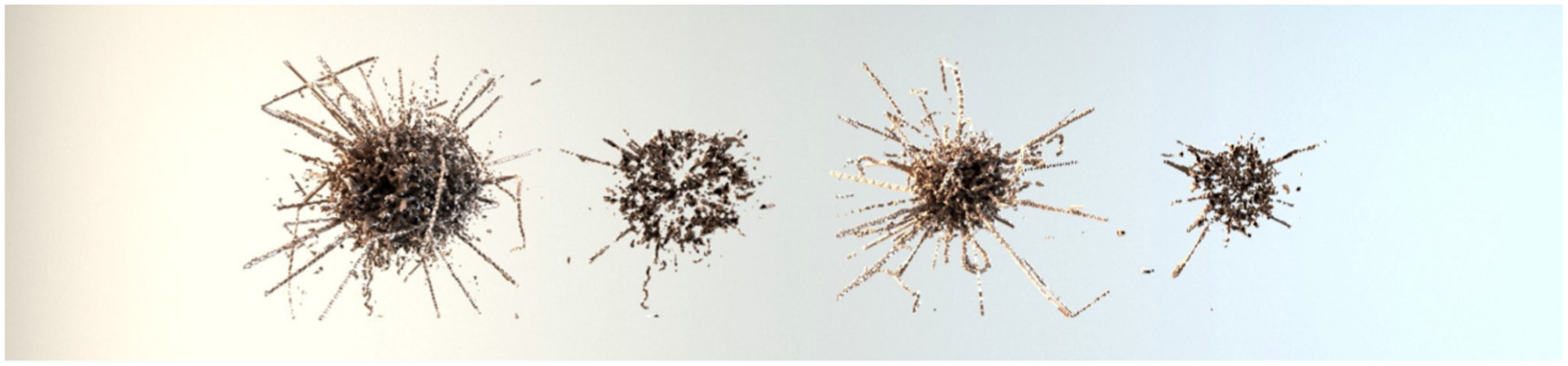
3D render of model and cross section at 10,000th time step of swam evolution.
In addition, the project report from florarobotica (Hamann et al., 2017) showed how modular robots with simple sensors and feedback mechanisms can be used to shape the way that plants grow in response to different light triggers, and how plants and robots form symbiotic structures integrated in urban environment, Figure 2. The results complement nicely research and designs of plant-based computing devices (Adamatzky et al., 2018).
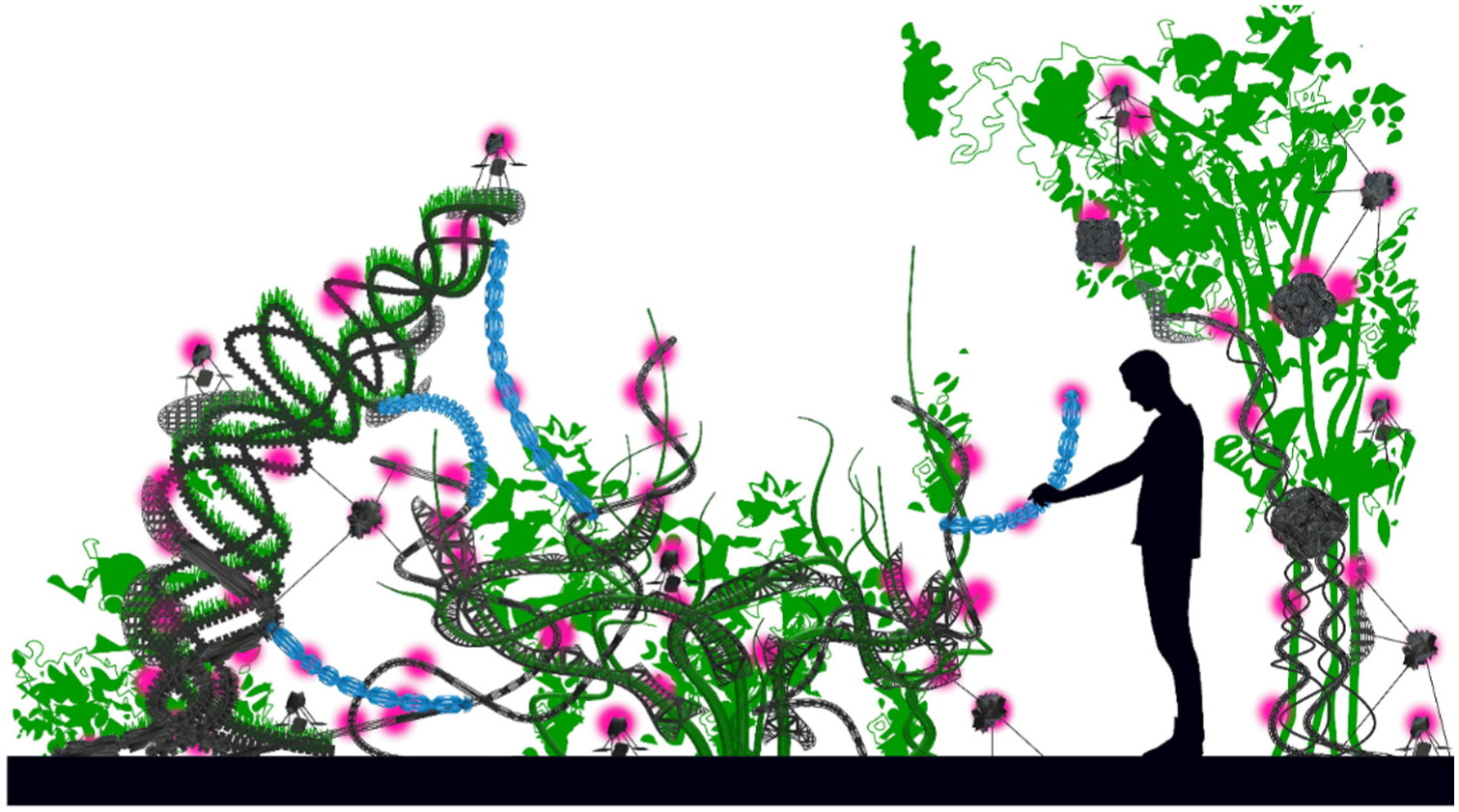
Symbiotic structures between plants and robots.
The comprehensive lecture by a leader in the field of Artificial Life, Takashi Ikegami, described many ways that ideas are exchanged between artists and scientists to challenge and develop ways in which not only the built environment can be reshaped but how artificial intelligent systems may play a role. Again, here, feedback from the technology to the inhabitant plays a key role in the system architecture. Projects such as Mind Time Machine and Alter show how technology with sensors and neural networks placed in real world environments or inhabited by human participants may eventually produce emergent consciousness.
Another aspect was the extension of the field of applications for living architecture into space. Imhof presented a paper which demonstrated how Living Inhabitation Systems could not only be used on but also off the planet. From a materials and systems approach, LIAR concepts were investigated through case studies of experimental architectural projects with applications for terrestrial and extra-terrestrial built environments, Figure 3.
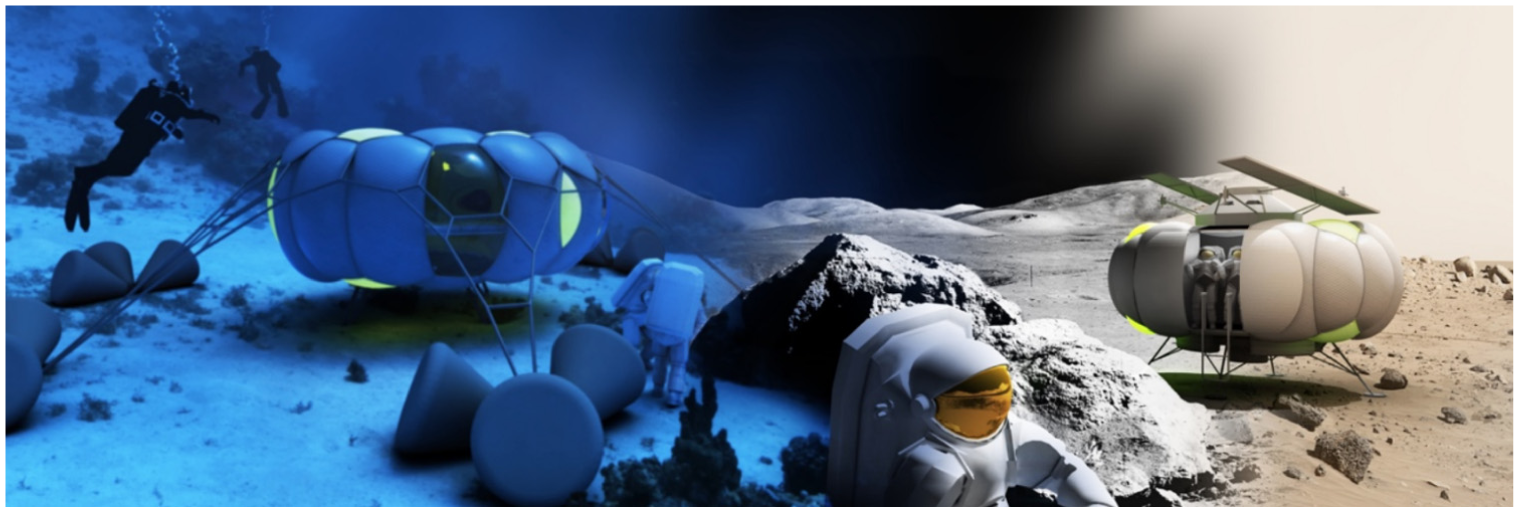
Overall architectural concept for Medusa.
The discussion did not exclusively focus on the potential benefits of living architecture. Some outstanding challenges include the total cost-added when using living organisms or life-like processes in applied technology (Adamatzky, 2016). Discussion included potential costs of disease on and maintenance of the system. Other more fundamental issues of control were also discussed. Indeed, what are the benefits of a living architecture over traditional architecture? The answer may lie in the current prototypes being developed in the context of current European Union (EU)-funded projects: florarobotica and LIAR as well as the Alter project in Japan. The outcome of these forward-thinking projects will produce actual prototypes for benefit-cost evaluation and will shape the next steps in technological development for the build environment that perhaps will be more ecologically integrated as opposed to ecologically antagonistic.
Footnotes
Handling Editor: Tom Froese, National Autonomous University of Mexico (UNAM), Mexico
Funding
The author(s) received no financial support for the research, authorship and/or publication of this article.