







Abstract
Cognitive dynamics are multimodal, and they need to integrate real-time feedback to be adaptive and appropriate. However, cognition research still relies on mostly unimodal paradigms using simple motor tasks in laboratory-based static situations. This paper addresses this limitation by presenting the Mobile Brain/Body Imaging approach based on the Embodied, Embedded, Extended, and Enactive perspective, which complements traditional laboratory work while also facilitating ecologically valid applications. First, we briefly review Mobile Brain/Body Imaging technologies used to obtain functional and structural images of the Brain/Body System during natural cognition. Specifically: mobile cognitive electrophysiology, mobile functional neurovascular dynamics, and mobile behavioral measurements. Second, we review the development of Mobile Brain/Body Imaging/4E in Chile. Finally, we discuss challenges and opportunities. We conclude that although this new epistemic/methodological approach is promising, there is a need for greater portability, robust equipment, and data-analysis tools that can integrate signals from the brain/body-in-the-world system. Future experimental designs need to re-consider their underlying logic and increase their ecological validity by-perhaps-modifying the physical spaces in which experiments are conducted.
Introduction
Human cognition is characterized by its complexity and multidimensionality. Adaptive and appropriate behavior in the here and now requires a system which integrates sensorimotor information from multiple modalities, the individual’s personal experience, and possible future events. This is achieved through real-time feedback processes that guide, plan, predict, and compare sensorimotor states (Wiese & Metzinger, 2017). These processes have been conceptualized as natural cognition (Gramann et al., 2014; Hutchins, 1995).
The multimodal nature of cognitive dynamics has been known since the beginning of the study of the mind (Parada & Rossi, 2020), from ancient Indian physicalism (Bhattacharya, 2002) to the debate between Plato and Anaxagoras (Plato, 1911). However, the traditional approach to studying cognition still relies on the acquisition of datasets using simple motor tasks in relatively static situations, usually in a laboratory setting where participants are isolated from each other (Figure 1 bottom). The main advantage of this approach is the control it gives over confounding variables. Its main disadvantage is the absence of the multiple dimensions of the real world, which are not considered in these experimental contexts. In the present article, we put forward an alternative and complementary approach to the study of cognition in the 21st century. This approach falls within the emerging technico-methodological Mobile Brain/Body Imaging (MoBI) framework, pioneered most notably by the University of California, San Diego, and the Technical University of Berlin (TU Berlin). The MoBI framework is characterized by combining portable/mobile neurobehavioral measuring devices with behavioral monitoring in order to acquire high-dimensional data. Furthermore, data-driven analytical approaches are furthermore used in order to dissociate brain and non-brain activity (Gramann et al., 2014; Makeig et al., 2009). The first decade of MoBI has been marked by technological advances in both hardware and software, allowing simultaneous acquisition of neural (e.g., electroencephalography, EEG), behavioral (e.g., eye tracker), and/or bodily signals (e.g., electrocardiography, EKG) in real-time, while participants act normally in their environments (Figure 1 top).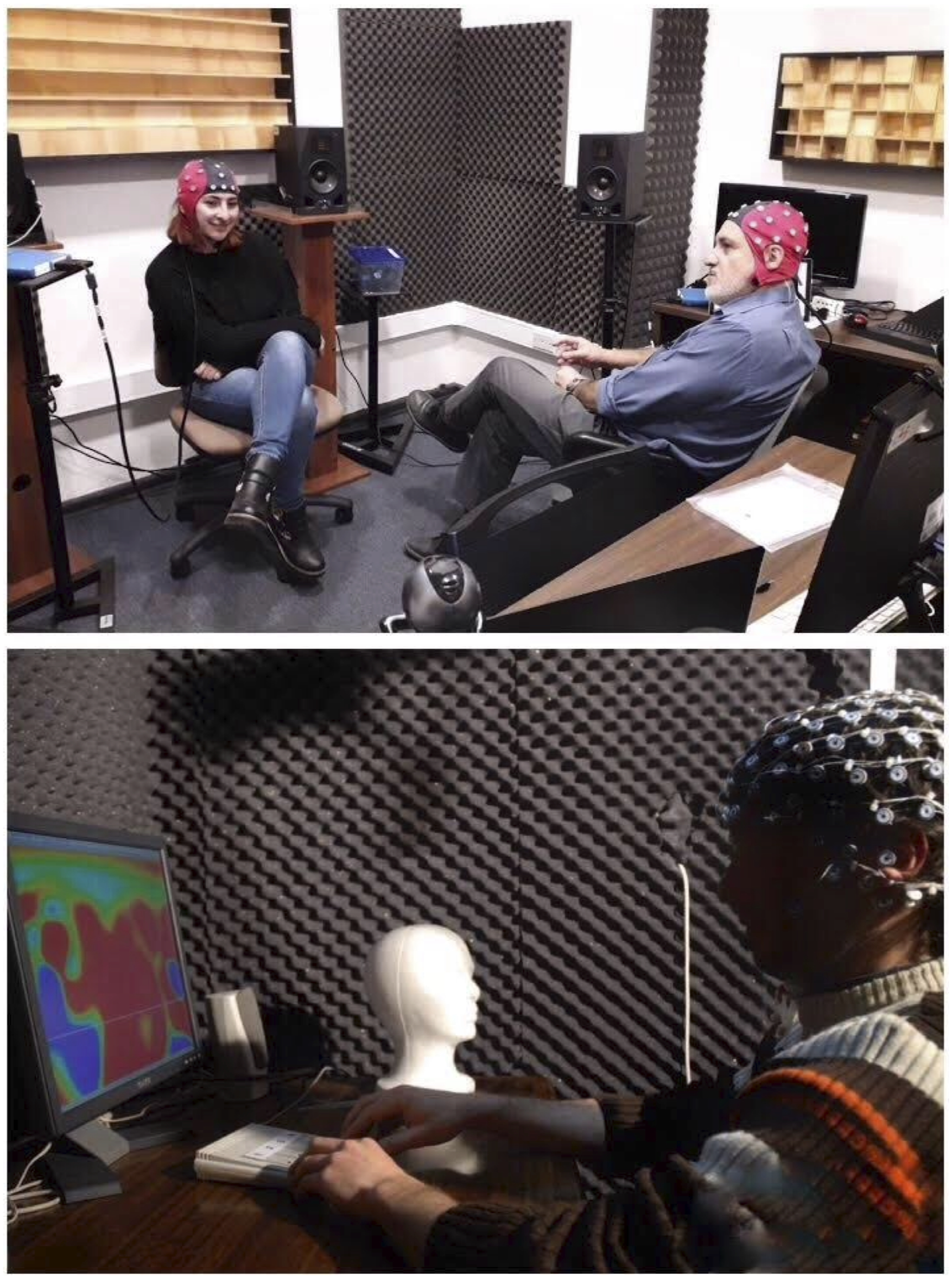
From our perspective, MoBI’s approach to the study of cognition complements traditional laboratory work, while also facilitating practical, ecologically valid interventions and applications in fields such as psychology/psychotherapy (Rodríguez et al., 2018), art therapy (King & Parada, 2021), neuroprosthetics (Petrini et al., 2019), neuroaesthetics (Calvo-Merino et al., 2008; Chatterjee & Vartanian, 2014), sports science (di Fronso et al., 2019), and architecture and design (Djebbara et al., 2019; Fich et al., 2019).
The first section of this article will address the theoretical assumptions underlying the MoBI approach, which—we argue—are best understood from the ethico-onto-epistemology known as the Embodied, Extended, Embedded, and Enactive perspective to cognition (or simply, 4E cognition). Later, we briefly review the technological advances that have enabled MoBI implementation. Finally, a discussion of MoBI’s strengths and limitations for the study of cognition within the 4E perspective is presented.
Cognition is an embodied, extended and embedded-for-action phenomenon but… can we measure it?
Although a key argument in the classical mind-body problem (Bunge, 2014; Feyerabend, 1970) is the consideration of cognition as a biological phenomenon (i.e., a product of cognitive agents’ lived body), cognitive sciences have traditionally conceived cognition from a representational/computational perspective. Thus, understanding the mind as an information-processing machine, which syntactically manipulates mental structures and/or abstract symbols (Gardner, 1987; Rossi et al., 2019). This model also conceptualizes cognition as an internal and predetermined process that occurs in a central processing unit; it only happens—ontologically—in the brain (Adams & Aizawa, 2001). This perspective certainly centers human cognition at the throne of mental abilities (i.e., anthropogenic; Lyon, 2006), even comparing other species to human-like performance.
By contrast, the 1990’s witnessed a revival of theories from the first half of the 20th century (Berthoz, 2008; Gibson, 2014; Merleau-Ponty, 1976), including that of the Enactive Mind, which emphasizes the ever-changing relationship between mind, body, and environment (Varela et al., 2016), the Extended Mind
1
, as the extension of cognitive processes beyond the agent’s biological structure (Colombo et al., 2019; Pritchard, 2010) accentuating the functional coupling between cognitive agents and their ecological niches (Clark & Chalmers, 1998; Flor & Hutchins, 1991), or the Dynamical System Mind, understanding cognition as the product of ever-increasing ontogenic complexity (Thelen & Smith, 1996). In this way, cognition can be conceived as an evolutionary phenomenon rooted in biology (i.e., biogenic; Lyon, 2006), but extended into the physical and socio-cultural world, integrated with an ecological niche and actively coupled with the outside world. This alternative perspective has recently been formalized within the so-called 4E Cognition
2
perspective (Newen et al., 2018). Briefly, the 4E perspective to cognition is an ethico-onto-epistemology that understands the mind as the emergent result of complex multiscale interactions in time and space, which can be understood by relatively independent disciplinary scientific work on biophysical, psychological, and social processes, along with resulting future transdisciplinary efforts. It facilitates and fosters a transversal and holistic way of thinking; connecting students, researchers, and practitioners with “human exceptionalism while being accountable for the role we play in the differential constitution and differential positioning of the human among other creatures” (Barad, 2007, p. 136). Discussing the multiple dimensions and implications of the 4E perspective is beyond the scope of the present article, as it is the main topic for the present special edition (see Gonzalez-Grandón & Froese, 2018; Menary, 2010; and Newen et al., 2018). Nevertheless, we would like to focus on one of the central tenets in the 4E perspective: cognition is the product of cerebral dynamics tightly coupled with physical, physiological, and sociocultural extracranial processes. Following Rossi et al., (2019)—considering an internalist point of view—extracranial processes have little to no role in the generation of cognitive acts, while from an interactionist perspective, they actually enable or constitute it (Figure 2(a)). See De Jaegher et al. (2010) and Rojas-Líbano & Parada for further discussion (2019). Are extracranial components and processes constitutive of the cognitive act? 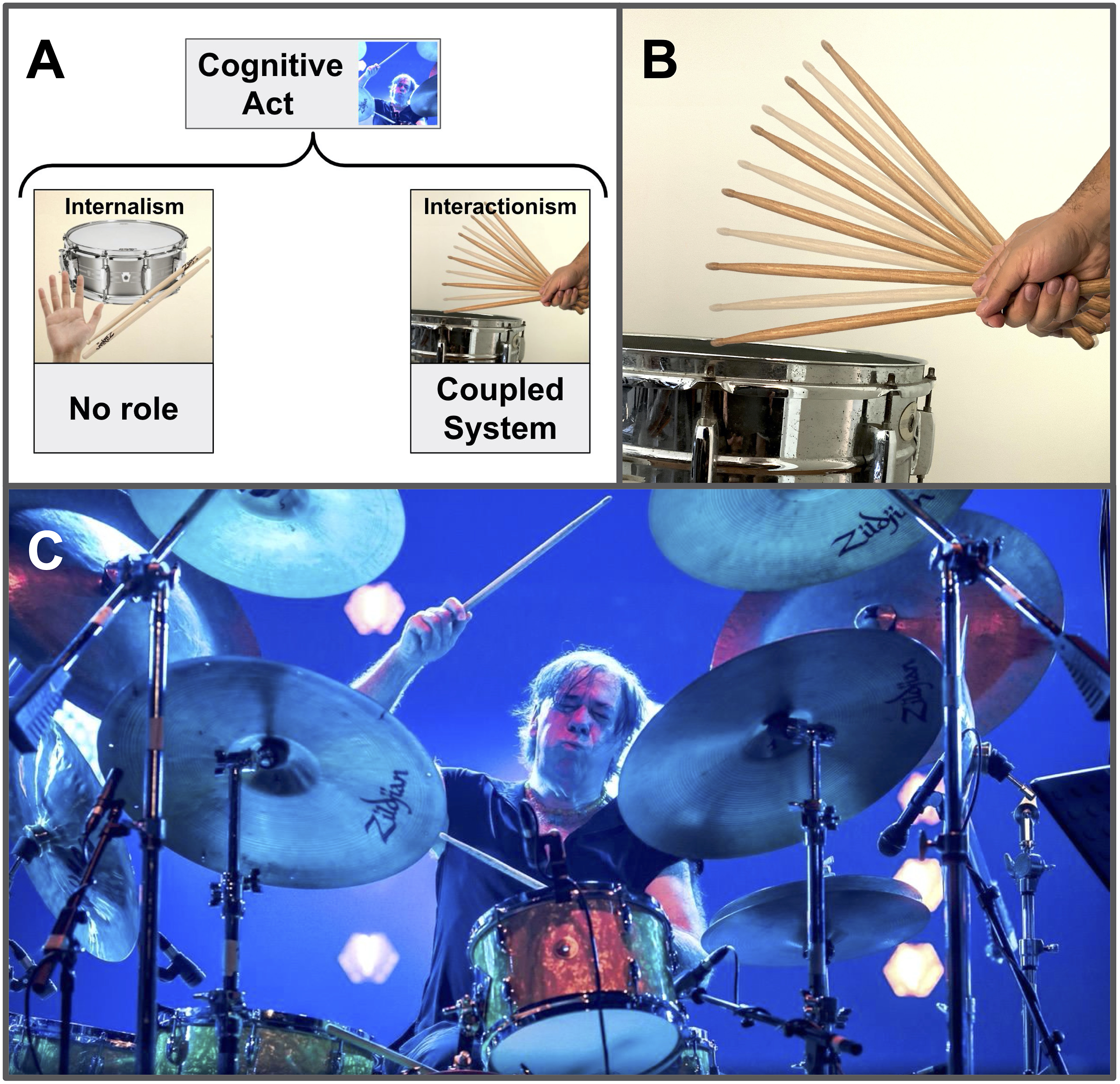
According to Rossi et al., (2019), in the context of such extracranial processes, two dynamics are conventionally described: body dynamics (i.e., brain/body system) and ecological dynamics (i.e., brain/body-in-the-world system). One of the main problems arising from this kind of proposal is the one regarding the constitutiveness of cognition, this is, what processes actually constitute the mind? For example, when a drummer hits a drum, she relies on neural processes and her motor apparatus in order to enact such behavior (Figure 2(b)). One could argue, though, that the hand-drumstick-drum coupling is only enabling the drumming process, and it is not constitutive of drumming behavior. Nevertheless, the cognitive act of drumming (and any musical/artistic endeavor) is the product of the dynamic intersection between biophysical and sociocultural factors unfolding throughout the agent’s ontogenic trajectory (Figure 2(c)). This is, the cognitive act of drumming is only understandable in the light of the history of interactions between the drummer and her instruments (i.e., considering the drummer-drumstick-drum system). The functional coupling of such a complex system embedded within specific contexts (e.g., the drummer drumming in a band at a public concert) allows making sense in novel and unique manners.
When complex constructs are considered for study (Figure 2), our experimental tools are indeed limited. Furthermore, the constitutive, enabling, or contextual nature of extra-cranial processes in cognition is an ongoing debate in cognitive science, we can only hope carefully designed experimental manipulations will help advance these discussions (Adams & Aizawa, 2001; De Jaegher et al., 2010; Kirchhoff, 2015; Parada, 2018; Rojas-Líbano & Parada, 2019). Thus, the experimental side of cognitive/neural science also faces an epistemic/methodological dilemma. The fact that cognition tends to be studied in small and unnatural contexts is a problem that has stressed experimental scientists throughout the 20th century (Bronfenbrenner, 1977; Brunswik, 1943; Neisser, 1976). Several have argued that laboratory reductionism is only able to measure dynamics that are too dissimilar to the agent’s behavior in the real world to have any social or ecological relevance (Bronfenbrenner, 1977; Gibson, 2014). Thus, classical paradigms usually have no consideration for person- and situation-dependent factors that might be a limitation in studies, which could be overcome in real-life paradigms (Shamay-Tsoory & Mendelsohn, 2019). Person-dependent limitations refer to the delimitation of the ability to act, reducing the sense of agency while situation-dependent limitations are those that affect and reduce the real-life experience in the world (Shamay-Tsoory & Mendelsohn, 2019). It is furthermore relevant to consider Brunswick’s ecological validity notion (for a current perspective see Holleman et al., 2021) as many experimental paradigms that at a first sight seem “unecological” or “artificial” might actually be functionally valid, triggering cognitive processes in the micro level (Petitmengin & Lachaux, 2013) whereas 4E-based experiments might be more interested in macrocognitive phenomena (Fiore et al., 2010). Such epistemological concerns are supported by empirical evidence from advanced neuroscientific investigations of more complex questions (Krakauer et al., 2017). For example, the effects of posture and movement on cognition are so profound that even resting state brain dynamics, as measured by hemodynamic measures, might be affected simply by posture (Thibault et al., 2014). More recently, Djebbara and collaborators (2019) showed that neuroelectrical dynamics are modulated by potential body movements in space, while Piñeyro Salvidegoitia et al. (2019) showed that spatiotemporal context benefits memory processes. Growing evidence suggests that cognitive dynamics vary according to the action being carried out by the agent. Furthermore evidence demands—in parallel to the philosophical debate—the active integration of physiological dynamics to the socio-behavioral context of cognition for the empirical study of the mind (Palacios-Garcia & Parada, 2019; Parada & Rossi, 2018; Rojas-Líbano & Parada, 2019). Once again, the Scalable Experimental Design heuristic (Matusz et al., 2019; Parada, 2018) will be a useful strategy for carefully and systematically studying these micro-to-macro cognitive processes.
From a theoretical standpoint, the 4E perspective requires research programs incorporating ecologically valid and complex, real world situations (Parada & Rossi, 2018; Rojas-Líbano & Parada, 2019). Recent studies highlight the considerable influence of both behavioral context and the participant’s agency on a range of cognitive processes (e.g., Chrastil & Warren, 2012). Research using animal models reveals an interdependence between cognitive dynamics and active environmental exploration. For example, in a study of the properties of visual interneurons in fruit flies (Drosophila melanogaster), Maimon and collaborators (2010) found that the activity of these cells doubled during flight compared with resting state, due to an increase in synaptic inputs to the visual vertical system. Reviewing comparative literature is beyond our scope (for reviews see Gramann et al., 2011, 2014; Ladouce et al., 2017). Nevertheless, comparative results reinforce the idea that brain dynamics are influenced by sensory, motor, cognitive, and neural activity as well as the behavioral/contextual/social states (Boehme & Olausson, 2022; Dagnino-Subiabre, 2022; Di Paolo & De Jaegher, 2012; von Mohr et al., 2017). However, it is still unclear whether the brain/body/world relationship is constitutive of cognition or simply corresponds to enabling or contextual interactions (De Jaegher et al., 2010; Rojas-Líbano & Parada, 2019). The potential non-causal status of the relationship between multiple parts of a system (Craver, 2007) and the dynamic interplay and reciprocal causality that exists between them have yet to be elucidated (Leuridan, 2012). Until now, technological constraints have hindered scientists in resolving this debate. In the following section we introduce the technico-methodological MoBI framework, which might open novel possibilities to answering these questions.
Obtaining functional and structural images of the Brain/Body-in-the-world System during natural cognition
Understanding the complexity of cognition unveils the limitation of traditional experimental approaches (Gramann et al., 2014; Ladouce et al., 2017; Shamay-Tsoory & Mendelsohn, 2019). The importance of gathering (neuro)physiological data in ecological contexts has been recognized since the beginning of the 20th century both at the theoretical and empirical levels; theoretical advances proposed by the 4E perspective merely confirm this need. The fact that cognitive science has largely been confined to the laboratory is, for the most part, due to technical and methodological limitations that go beyond theory. Laboratory experiments try to eliminate any potential confounding factors associated with natural behavior, being movement one of the main sources of noise, as unwanted movements generate large artifacts when measuring brain signals (Gwin et al., 2010; Havsteen et al., 2017; Plöchl et al., 2012) and can confound behavioral measures, even in carefully designed experiments (Jungnickel & Gramann, 2016). Keeping movement at a minimum is a very good practice indeed, since one of the main advantages of traditional experimental protocols is the fact that the researcher can exert control over isolated variables and later precisely analyze such factors. Thus, eliminating potential confounding elements and maintaining artifactual signals to a minimum. Hence, keeping brain signals as large as possible while any “background” noise remains small. This notion is known as signal-to-noise-ratio (SNR) and is one of the main reasons laboratory experiments need many trials per condition in order to adequately compute brain measures of interest (Hu et al., 2010; Murphy et al., 2007; Sato et al., 2004). Nevertheless, such controlled results might be a far witness of what agents actually do in the “real world,” decreasing their generalizability.
Fortunately, recent technological advances encompassed under the MoBI framework, are just starting to match the theoretical demands of the 4E perspective for the study of cognition. In this section, we provide the reader with a brief review of the main methodological advances that facilitate an implementation of a research program based on the 4E perspective; a program involving neurobehavioral data acquisition in the real world. Providing a deep and detailed account of every methodological approach greatly exceeds the scope of the present work and this special edition. Nevertheless, we hope to provide a perspective-opening introduction to the reader while pointing towards key literature for further reading with an emphasis on the Chilean context.
Mobile cognitive electrophysiology
The main revolution in MoBI has been powered by non-invasive electrophysiological measurement techniques. Their high temporal resolution makes them suitable for studying cognitive phenomena (Makeig et al., 2004). We will discuss two of the most relevant: electroencephalography (EEG, because of its prevalence in neuroscience laboratories in Chile) and magnetoencephalography (MEG). Even though MEG is not yet available in Chile, it will be discussed as it presents a great opportunity to research certain questions framed in the MoBI/4E research program.
Electroencephalogram
Electroencephalogram (EEG) allows the measurement and visualization of electrical fields resulting from electrochemical activity generated by spatially extended and geometrically aligned populations of neurons (Hari & Puce, 2017; Nunez & Srinivasan, 2006). These field dynamics are captured by electrodes positioned on the scalp (Figure 1) and its technology dates to the early 20th century (Berger, 1929). Electroencephalogram is a non-invasive technique given its usability on most species without any risk of damage or risk to the physical integrity of the participants. EEG nowadays constitutes one of the most powerful techniques to measure electrophysiological cognitive brain dynamics. Given it is non-invasive, EEG overcomes ethical limitations concerning the use of neuroimaging/electrophysiology in human/non-human participants. However, EEG provides only a general map of the functioning brain, with limited spatial resolution, making it difficult to discern precise structural locations from the electric signals (Nunez & Srinivasan, 2006). Nevertheless, recent advancements using high-density EEG, show that source estimation might be highly possible and accurate, even for subcortical structures (Seeber et al., 2019) and depending on the research goal, spatial smearing can be an advantage (Debener et al., 2015). Notwithstanding, despite any potential disadvantages regarding spatial resolution, given its great temporal resolution. EEG is one of the most commonly used neuroimaging techniques in Chile and worldwide. Its flexibility allows building on Berger’s first resting-state recordings (1929) by measuring ongoing activity as well as triggering event-related dynamics in different settings 3 . Thus, scientists can acquire continuous ongoing neurodynamics data from neurotypical participants and/or special populations with research (Khanna et al., 2015; Smit et al., 2008) and/or diagnostic purposes (Caricato et al., 2018; Rubiños & Godoy, 2020). Likewise, scientists can analyze event-related brain activity (Luck, 2012; Makeig et al., 2004) in the time (e.g., Event-Related Potentials, ERP), frequency (e.g., Power Spectra), time-frequency domains (e.g., Event-Related Spectral Power) and associated connectivity (Cohen, 2017; Varela et al., 2001).
Electroencephalogram has a special advantage in the context of implementing MoBI/4E programs due to developments in the last decade. EEG systems now use more compact, lightweight, and wireless devices which are closer to the standard of experimental designs with ecological validity (Gramann et al., 2014; Ladouce et al., 2017; Makeig et al., 2009; Parada, 2018; Shamay-Tsoory & Mendelsohn, 2019). Based on these technological advances, research methodology has co-evolved to capture behavioral responses, ranging from simple actions like pressing a button while remembering words (e.g., Piñeyro Salvidegoitia et al., 2019) to more complex perceptual and motor tasks made possible by the portability of the latest EEG systems (e.g., Jungnickel & Gramann, 2016; Ladouce et al., 2019). These techniques complement the use of other technologies, such as motion capture and/or virtual reality to simulate environments (Djebbara et al., 2019; Fich et al., 2019; Gramann et al., 2021). Furthermore allowing the modeling of cognitive processes in real-time along with natural behaviors occurring in the real world (Makeig et al., 2009).
Moreover, the development of new electrode technologies will enable EEG data to be collected from portable, comfortable-to-wear (Mathewson et al., 2017; Oliveira et al., 2016) and perhaps unobtrusive devices (Bleichner et al., 2016; Debener et al., 2015; Hölle et al., 2020; Mikkelsen et al., 2015; Mirkovic et al., 2016). These future developments will allow researchers to acquire neurophysiological signals during daily activities, such as exploring the built environment (Gramann et al., 2017; Palacios-Garcia et al., 2020; Parada, 2018; Wunderlich & Gramann, 2020) and/or during clinical encounters, such as psychotherapy (Lecchi et al., 2019; (Lecchi et al., 2019; Parada, Martín, et al., 2018; Rodríguez, Martínez, Díaz, Flores, Alvarez-Ruf, Crempien, Valdés, Campos, Artigas, Armijo, Krause, et al., 2018; Ryu et al., 2020).
Thus, EEG becomes a highly relevant method for the 4E research program as it allows measurement during natural conditions and even during social interaction. The measurement of two or more participants simultaneously is known as hyperscanning (Babiloni et al., 2006). Electroencephalogram has been one of the most used methods in hyperscanning due to its high temporal resolution and mobility in contrast with other neuroimaging techniques (Ahn et al., 2018; Czeszumski et al., 2020; Dumas et al., 2011; Liu et al., 2018). Hyperscanning analyses usually assess the level of coupling/synchronization between two or more participants’ brains (Babiloni et al., 2006; Dumas et al., 2011; Liu et al., 2018). Nevertheless, other techniques are also used (see Czeszumski et al., 2020 for a recent review). The simultaneous recording of brain activity allows the study of social interactions due to the possibility to explore interpersonal underlying brain mechanisms during social interaction scenarios (Balconi & Fronda, 2020; Czeszumski et al., 2020; Liu et al., 2018). Hyperscanning research affords studying social cognition in more naturalistic settings (Hari & Kujala, 2009; Konvalinka & Roepstorff, 2012). Thus, more natural and social experimental paradigms may allow causality and/or correlation analyses in brain activity of two or more subjects interacting (Moreau & Dumas, 2021; Novembre & Iannetti, 2021). Several topics related to social cognition have been studied using EEG-hyperscanning: joint and shared attention, interactive decision-making; affective communication, and others (for recent reviews see Czeszumski et al., 2020; and Liu et al., 2018). Furthermore, hyperscanning also allows the implementation of Scalable Experimental Designs (Experimentos Escalables en su Diseño, EED) as an attempt to study cognition in natural/real-world settings (Matusz et al., 2019; Parada, 2018).
Magnetoencephalogram
One of the most interesting advances in recent years has been the development of portable devices to measure electromagnetic fields in the brain. Magnetoencephalogram (MEG), like EEG, is also a direct and non-invasive brain measure technique with excellent temporal resolution. Furthermore, MEG signals are less compromised by conductivity smearing at the scalp, rendering them appropriate for source reconstruction imaging techniques with a millimeter spatial resolution (Dale et al., 2000). Until now, MEG has required high-cost equipment which is bulky and impossible to move. This is because the underlying superconducting technology (known as SQUID, Superconducting Quantum Interference Device) is supercooled by liquid helium (Ahonen et al., 1991). A newer technology, known as Optically Pumped Magnetometer (OPM) is less expensive than SQUID, requires no supercooling, and can be worn by a human participant (Boto et al., 2018). Results obtained using OPM-based MEG indicate that data quality is comparable to that of traditional MEG, even in the presence of neck and head movements (Boto et al., 2018). Unfortunately, there are still important limitations to OPM. The most important is that it will only work in spaces that are properly shielded from other electromagnetic sources, including the Earth’s magnetic field. This fact makes it impossible to use in the actual “real world,” leaving mobile MEG inside the shielded laboratory at best. Nevertheless, this technological advance is still relevant for MoBI/4E, given MEG’s excellent temporal and spatial resolution (Dale et al., 2000; Hill et al., 2020; Stam, 2010). Mobile MEG is thus a promising and viable option for the direct study of cognitive neurodynamics—both in its structural and functional aspects—using more ecologically valid study designs in healthy adults and other populations (Hill et al., 2019, 2020; Seymour et al., 2021). Pioneers such as Cerca Magnetics Ltd. and others will lead the way in combining mobile MEG with virtual/augmented reality settings (Roberts et al., 2019) and more ecological laboratory tasks in order to further advance the MoBI/4E program (Seymour et al., 2021).
Body physiology
Considering that “the self is rooted in the body” is a basic premise of both MoBI and the 4E perspective, measuring body physiology is highly relevant. Several of these measures can be included within MoBI. Here, we consider what we think as some of the most relevant for the 4E research program.
First, electrodermal activity (EDA), as a complex correlate of sympathetic nervous system activity (Braithwaite et al., 2013), refers to autonomic changes or variation of the electrical properties of the skin modulated by sweat gland activity (Benedek & Kaernbach, 2010; Braithwaite et al., 2013). It has commonly been used to assess the level of cognitive arousal (Posada-Quintero & Chon, 2020). Its measurement and physiological relevance dates to the second half of the 19th century (Hermann & Luchsinger, 1878; Vigouroux, 1879) and was consolidated as a robust research technique in the first half of the 20th century (Landis, 1932; Prideaux, 1920).
Electrodermal activity can be measured non-invasively by applying a low electric potential in two points of the skin e.g., hands, feet, wrist (Benedek & Kaernbach, 2010; Fowles et al., 1981), and it can be achieved by an endosomatic recording (i.e., data collection without an external source of electricity) or exosomatic recording (i.e., constant application of a voltage via electrodes; for a recent systematic review see Posada-Quintero & Chon, 2020). Traditional so-called “polygraph systems” can record EDA. Nevertheless they are highly susceptible to muscle movement, cable sway, and some might be uncomfortable to wear. The wearable/mobile versions of EDA (Poh et al., 2010) allow measurements on a variety of natural situations as sensors can be located in real-world objects such as clothing (Howell et al., 2016; Kappeler-Setz et al., 2013) and wristbands (O’Haire et al., 2015). Thus, EDA’s portable and wearable nature makes it an attractive candidate for 4E-based and social interaction research with all sorts of populations (Hernandez et al., 2014).
Equally relevant for 4E-based research are visceral signals (Azzalini et al., 2019; Critchley & Harrison, 2013; Thompson & Varela, 2001) such as the electrocardiogram (ECG, Waller, 1887) and electrogastrogram (EGG, Alvarez, 1922). The heart’s electrical activity recorded over time is known since the late 19th century (Luciani, 1873; Waller, 1887; Wenckebach, 1899) while gastroenteric dynamics were first described early in the 20th century (Alvarez, 1922; Tumpeer, 1926).
EKG is a non-invasive and commonly used technique to record and visualize electrical activity from the heart by presenting the series of waves related to the electrical impulses of each heartbeat (Al Rasyid et al., 2016). EKG allows describing heart rate and heart rate variability, tools for the evaluation of autonomic nervous system and it has been associated with different cognitive functions (Forte et al., 2019). EKG presents similar limitations to EDA. Holters and Event Monitors are the most commonly used methods to monitor and measure heart activity, but they have disadvantages or limitations such as size, cable disposition, time of recording, possible skin irritation (due to hydrogel-based electrodes), among others (Lázaro et al., 2020). Researchers have been working to develop more portable devices allowing comfortable longitudinal recordings (Ehnesh et al., 2020; Iskandar et al., 2019; Lázaro et al., 2020). Examples of these efforts include a chest belt with wireless embroidered dry electrodes (i.e., textile electrodes) with a water reservoir guaranteeing sensor humidity for longer periods of time (Weder et al., 2015) or the development of a wearable armband that allows monitoring and recording ECG for long periods of time by using hydrophobic dry electrodes to ensure an accurate wireless measurements (Lázaro et al., 2020). These developments are relevant for 4E research programs as cardiac-related dependencies have been found in several domains including visual (e.g., visual search, Galvez-Pol et al., 2020; microsaccades, Ohl et al., 2016) and somatosensory perception (Al et al., 2020), among others (for a recent review see Azzalini et al., 2019). Furthermore, another signal that is gaining psychophysiological interest are respiratory dynamics, since it is bidirectionally coupled to cardiac rhythms (Dick et al., 2014; Kralemann et al., 2013) and dependencies on perception and behavior have been suggested (Kay et al., 2009; Perl et al., 2019) yet remain to be studied.
Similar to EKG, EGG non-invasively measures gastric myoelectrical activity using cutaneous electrodes placed on the abdomen. It is a fundamental biorhythm and its measurement allows understanding the control, timing, and propagation of gastric peristaltic contractions; crucial digestive dynamics (Koch & Stern, 2003). Electrogastrogram has been recently re-discovered for psychophysiological research (Davis et al., 1957; Wolpert et al., 2020). In EGG recordings, other physiological rhythms such as respiration and EKG can be observed nested in the signal (Koch & Stern, 2003) and should be timed into experimental paradigms instead of modeling out or using artifact reduction techniques for their removal. Since EGG has not yet become a mainstream signal for cognition research, not many developments of mobile/portable technology have been made. Nevertheless, as evidence accumulates, visceral dynamics will become ever more relevant for the 4E research agenda, as are characterized by their pacemaker nature (Babo-Rebelo & Tallon-Baudry, 2018). Furthermore, evidence indicates that body physiology is nested and intertwined with brain dynamics (Azzalini et al., 2019; Babo-Rebelo & Tallon-Baudry, 2018; Pezzulo et al., 2019; Wolpert et al., 2020).
Mobile functional neurovascular dynamics
Based on the premise of neurovascular coupling (Carmignoto & Gómez-Gonzalo, 2010), the measurement of specific changes in blood concentration/levels of different substances has become a reliable proxy for changes in the metabolic activity of the nervous system. At a global level, fMRI is commonly used to obtain structural and functional images of the brain. In Chile, only a few research institutions have access to the technology, mostly linked to hospital settings. All neurovascular acquisition methods require participants to lie on their backs in a scanning device, which violates most of MoBI and 4E requirements. In contrast to electrophysiology, mobile hemodynamic technologies have achieved only a modest level of development. In this section, we review the most promising efforts towards the MoBI/4E goal of obtaining structural and functional images of the brain in ecologically valid conditions.
Functional magnetic resonance imaging
Since its conception in the mid-1990s, fMRI rapidly became the most popular neuroimaging method since it seemingly posibilited the determination of the operations carried out by the various brain areas (Posner et al., 1988). Similar to other imaging methods, its function is based on the neurovascular coupling premise; the fact that brain metabolism changes with cognitive function (Bandettini et al., 1992). This idea was first explored by the Italian physiologist Angelo Mosso in the late 19th century (Sandrone et al., 2012). Accordingly, there are hemodynamic changes related to cellular activation after stimulation, which generates changes in the blood oxygen level, known as Blood Oxygen Level-Dependent signal (de la Iglesia-Vayá et al., 2011; Logothetis, 2002).
The past 5 years have seen considerable interest in developing a mobile and low-cost system of magnetic resonance imaging for medical reasons. Prototype devices based on the aforementioned SQUID technology have achieved a degree of portability, but at a high cost (Espy et al., 2015). A more affordable approach has been based on the use of specifically designed electromagnets (Sarracanie et al., 2015). However, these devices, known as ultra-low field MR, still require participants to lie down while data is obtained (Thibault et al., 2014), which for most situations is contrary to the 4E research program. For such reasons, fMRI technology is still far from fulfilling the requirements of the MoBI/4E framework and we are not aware of any 4E-inspired functional hemodynamics work (nevertheless, for a review on some attempts to use fMRI in naturalistics settings see Tikka & Kaipainen, 2014).
Positron emission imaging
Positron Emission Imaging (PET) is a research method based on the radioactivity detection emitted by a radioactive tracer injected into the peripheral vascular system (e.g., intravenous injection of Fluorine-18 which emits a positron and collides with a tissue’s electron generating a process of conversion into photons that will be absorbed by crystals and produced a light turn into an electrical signal, A. Berger, 2003) 4 . This method was widely used in the 1980s to obtain functional images at high spatial resolution (Cabeza & Nyberg, 1997). However, given the fact that participants had to be subjected to a small dose of radiation (A. Berger, 2003), this method is considered invasive and was widely replaced by fMRI in the 1990s. Nevertheless, its ability to detect ligands makes PET a powerful tool in both a clinical context and scientific context (A. Berger, 2003; Phelps, 2000). Therefore, the invention of a mobile PET system, requiring only a low dose of radiation (known as low-dose PET) has considerable value. A close implementation of such a device is the Rat Conscious Animal PET (RaTCAP), which allows PET in rats during movement (Schulz & Vaska, 2011). As it is composed of a miniature high-performance PET scanner and complex mechanical methods to attach the scanner to the rat while allowing movement, RaTCAP is not suitable for human cognition research. Nevertheless, RaTCAP adaptations have been attempted for human research. Examples include the PET-Hat prototype (Yamamoto et al., 2011) and the portable PET (Yamaya et al., 2015). However, due to the size of the sensors used, these systems cannot yet be considered “mobile.” A more promising prototype known as ambulatory microdose PET (Melroy et al., 2017) uses microdoses to reduce the quantity of radiation to 75 - 90%. This system is effectively mobile as it is lightweight and allows restricted movement. But just like PET-Hat and mobile PET, it is still in development and still far from becoming appropriate methods for advancing MoBI/4E research programs. In Chile, traditional PET research is virtually non-existent.
Functional near-infrared spectroscopy
Another technique with major promise for the MoBI/4E framework is called functional near-infrared spectroscopy (fNIRS). This non-invasive imaging method uses the projection and reflection of near-infrared light to quantify changes in the concentration of blood hemoglobin (Strait & Scheutz, 2014; Villringer et al., 1993). Functional near-infrared spectroscopy sensors are small and lightweight so they can be used in mobile equipment to measure cortical activity during movement (Miyai et al., 2001; Quaresima & Ferrari, 2019; Suzuki et al., 2008). Furthermore, fNIRS can be used in combination with other neuroimaging systems, such as fMRI and EEG (Pouliot et al., 2012). In Chile, several institutions have access to fNIRS technology with few research outcomes.
The main disadvantage of fNIRS, as with other techniques based on neurovascular coupling, is that temporal resolution is in the order of seconds and therefore not as optimal for the study of temporal aspects of cognitive processes (Cohen, 2011; Irani et al., 2007; Makeig et al., 2009). Nevertheless, given its non-invasiveness, tolerance to bodily movements, high portability, and cross-population usage (i.e., can be used from newborns to the elderly), the future combination of mobile EEG/fNIRS holds great promise for advancing MoBI/4E research programs (Pinti et al., 2020). Thus, coupling fNIRS with EEG will be highly beneficial for any 4E-based research program as it provides researchers both temporal and spatial resolutions with portable/mobile setups (Pinti et al., 2015; 2020; Piper et al., 2014; Quaresima & Ferrari, 2019; Shin et al., 2018). Even though most experimental data comes from hyperscanning EEG (for reviews see Czeszumski et al., 2020; and Konvalinka & Roepstorff, 2012), some studies have used fNIRS (for reviews see Konvalinka & Roepstorff, 2012; and Pinti et al., 2020), and fewer have combined both (Balconi & Vanutelli, 2016; Biessmann et al., 2011; Rosenbaum et al., 2020). A fairly recent example is Balconi and Vanutelli (2016). They manipulated social context using a sustained attention task (basically, a very simple interpersonal competitive game) while measuring EEG/fNIRS. Among other things, their results suggest that even though combining methods may sound like a solution for the 4E research programme, there still is a wide methodological/analytical gap for interpreting and understanding high-dimensionality neural data. We will return to this point in the Discussion section.
Mobile behavioral measurement
Mobile behavioral measurement has achieved a breakthrough in the past 20 years thanks to the development of high-resolution digital sensors, which are also inexpensive and portable. In Chile, several institutions have access to movement laboratories equipped with motion capture (MOCAP) systems. In MOCAP systems, motion is captured using several cameras which track the position of reflective markers (e.g., active light emitting diode (LED)) placed near the wearer’s joints to compute the appropriate kinematics (Gwin et al., 2010). Although still expensive, the MoBI/4E framework could also benefit from MOCAP technologies. However, because of the positioning of the sensors and the multiplicity of cameras required, MOCAP tends to be viable only in specific laboratory settings (Gramann et al., 2021; Gwin et al., 2010). Recently, the usage of user-grade technology has allowed acquisition of movement data using more affordable solutions (Galbusera et al., 2019; Tschacher et al., 2014). Movement laboratories equipped with motion capture technology is regularly used in physical rehabilitation research to analyze the effectiveness of appropriate therapy plans (Alarcón-Aldana et al., 2020), sometimes even combined with virtual reality (Holden, 2005). Movement laboratories equipped with motion capture can be combined with any neuroimaging technology that allows movement. Recently, EEG has been the most used technology within the MOCAP context (Gramann et al., 2021; Makeig et al., 2009). As opposed to the classical behavioral paradigms (e.g., Go/NoGo) where participants sit in front of a computer and button presses are recorded as behavior, MOCAP-aided functional neuroimaging studies can capture multi-joint motions of the body in 3-D space while simultaneously measuring brain activity underlying those movements. For example, the integration of MOCAP and EEG has been used in gait analysis experiments to derive pathological neuromarkers of multiple sclerosis which could be used to improve the assessment of the disorder (De Sanctis et al., 2020). Another novel area of research using this integration within a MoBI/4E framework is the neuroscience of performing arts. Recently, Barnstaple et al., (2020) were able to analyze real-time changes in brain dynamics while participants learned and performed a choreographed dance, opening the door to further highly ecologically valid studies investigating complex activities in real-world-environments.
In the next section, we discuss further technological advancements in the measurement of behavioral dynamics, which can also be used in research contexts where movement is involved.
Audiovisual digital recordings
High-resolution and low-cost digital sensors, including mass-consumption devices such as the Nintendo Wii remote (Attygalle et al., 2008), Microsoft Kinect (Galbusera et al., 2019), and digital video cameras (Sigal et al., 2009; Sundaresan & Chellappa, 2005) can be easily incorporated into laboratories for measuring multiple angles of movement. In addition, the capture of video footage allows an analysis of the interaction and dynamics between participants in relevant contexts (Tschacher et al., 2014). Novel software solutions mean that motion analysis can also be performed using consumer camera systems, making analyses of movement more accessible and easy to implement in highly ecological contexts. For example, the motion energy analysis (MEA) algorithm quantifies the differences between consecutive frames and then sums the number and amount of pixel change in a predetermined region of interest (or the whole frame) obtaining as a result a time-series of this quantification (Ramseyer, 2020). There are several parameters to consider before result interpretation such as video resolution, the size of the region of interest and the recording noise-to-signal ratio (Ramseyer, 2020; Ramseyer & Tschacher, 2011).
Motion energy analysis allows the automatic identification of nonverbal synchrony (movement coordination) rather than using the manual rating technique by an observer (Ramseyer & Tschacher, 2011). Given its simplicity MEA provides an inexpensive solution for data acquisition in ecological settings and can be used in combination with any neuroimaging technique, in any type of data acquisition setup, and species (Stringer et al., 2019). Due to these advantages, MEA is already used in psychotherapeutic contexts (Ramseyer, 2020; Ramseyer & Tschacher, 2011; Tschacher et al., 2014). In psychotherapy, a therapist frequently meets with a patient/client, developing a professional relationship based on standard therapeutic interactions (Krause et al., 2007; Martínez, 2011). Such natural social interactions can be longitudinally recorded, in-situ, effectively extending the laboratory (Parada, 2018). In Chile, this methodological approach has been used in conjunction with EEG to study the psychotherapeutic process and associated brain dynamics (Parada et al., 2018; Rodríguez et al., 2018).
Furthermore, through the use of high-resolution audiovisual systems, body movements and non-verbal communication data can be obtained and analyzed alongside vocalization and verbal interaction between participants. Voice perception is a generally forgotten dimension in cognitive science, but it has an important role in understanding cognition in its natural state (Campanella & Belin, 2007). In Chile, there has been only one study on the use of voice in the context of psychotherapy (Tomicic et al., 2015). Therefore, behavioral and verbal dynamics are a future niche for development in the MoBI/4E framework (Goregliad Fjaellingsdal et al., 2020).
EyeTracker
Eye-tracking techniques offer a simple and non-invasive means of investigating cognitive and socio-emotional phenomena. Due to their ease of use, and relatively simple set-up, eye-tracking technology applications have been widely developed and used in recent decades (Alemdag & Cagiltay, 2018; Duchowski, 2007a; Kredel et al., 2017; Parada et al., 2015; Pieters & Wedel, 2017). Eye Tracking is based on the measurement of corneal reflection due to an infrared LED that illuminates the eye surface (Cooke, 2005). This reflection is measured in relation to the pupil center (Duchowski, 2007b). Thus generating reflections that are captured by a camera and then used to establish the reflection of the light in the cornea and the pupil (Farnsworth, 2019). Then, it is possible to calculate a vector of the cornea-pupil reflection angle and to relate this information with some dimension of the world in order to estimate what the person was looking at. There are several types of Eye Tracking devices ranging from traditional setups to mobile and wireless technologies (Cooke, 2005; Richardson & Spivey, 2004). Research using eye-tracking seeks to provide ecologically valid experimental designs (e.g., Aryadoust & Ang, 2019; John et al., 2018; Kredel et al., 2017) as well as high-precision measurements with good spatial and temporal sensitivity. The development of robust mobile technology, capable of capturing eye movements as participants actively interact in natural and virtual environments, has allowed researchers to address several questions pertinent to the 4E perspective (Dowiasch et al., 2015; 2020; Fong et al., 2016; Macdonald & Tatler, 2018; Palacios-Garcia et al., 2020; Stuart et al., 2018; Wohltjen & Wheatley, 2021). Recently, Wohltjen & Wheatley (2021) explored hyperscanning eye-tracker during naturalistic conversations, opening the door for social interaction and other meaningful 4E-based research paradigms. Future functional neuroimaging studies combined with eye-tracking technology will further improve the MoBI/4E research program. Given that eye-tracking technology is widely available and affordable, there are already several institutions in Chile using such systems in lines of research ranging from marketing to cognitive/neuroscience.
Mobile brain/body imaging/4E in Chile
Chilean human neuroscience of social phenomena research began in the second half of the 2000’s, with the opening of human electrophysiology laboratories at the Universidad Diego Portales in 2006, Universidad De La Frontera in 2007, and, later, others. The original configuration of these laboratories was influenced by the traditional cognitive science paradigm (Figure 1). Recently, there has been a gradual shift in approach as Universidad Diego Portales and the Pontificia Universidad Católica de Valparaíso in 2016, Universidad de Chile in 2017, and Universidad de Concepción in 2018 acquired mobile and portable equipment for novel research contexts. However, this has yet to result in the establishment of high-impact research programs at domestic and international levels. One reason for such delay is the complexity of carrying out a research program based on the 4E perspective, implemented through MoBI technologies. Having updated the reader on the main theoretical and technological advances that have made MoBI/4E research possible, in what follows, we discuss the main challenges and opportunities of its implementation and their impact on the development of 4E research. These challenges are not only pertinent for Chilean research but are also relevant at a global level.
Main challenges and opportunities in the implementation of research programs based on MoBI/4E
The current theoretical/technological status for the study of human cognition, enables researchers to explore questions that might have been considered science fiction in the recent past. Today, behavioral and physiological activity data acquired from one or more agents in motion can be collected simultaneously (Czeszumski et al., 2020; Ladouce et al., 2017; Shamay-Tsoory & Mendelsohn, 2019). However, these technologies are far from easy to use as they are not plug & play. Below, we discuss the most relevant factors that, in our opinion, represent both challenges and opportunities when obtaining functional images of the brain/body-in-the-world system.
Specific technical requirements for the acquisition of mobile signals
About consumer-grade versus research-grade systems
As reviewed in the previous sections, various types of mobile brain/body measurement technology are currently available. Electroencephalogram with its low-cost and high portability has acquired a status of “consumer technology” and has begun to be used in recreational applications (Martišius & Damaševičius, 2016). Such low-cost systems have also been adapted for research purposes (Badcock et al., 2013). The majority of consumer-grade systems work well in situations of high SNR, such as ERP paradigms (Badcock et al., 2013; Debener et al., 2012). However, in low-SNR/high-uncertainty situations, such as real-world conditions, many do not perform as well as expected. During 2018, our research group monitored eye movements (using Tobii Glasses 2 EyeTracker), EEG signals (using the EnoBio 8, Ruffini et al., 2007), spatial positioning (using global positioning system, GPS), and ambient noise while participants walked a predefined 600-m route in different neighborhoods of Santiago de Chile (Palacios-Garcia et al., 2020; Parada et al., 2019). However, under these real-world low-SNR conditions, the captured EEG signals were not sufficient to answer our initial research questions
5
. When another system was used (ANTneuro EEGO), the EEG signals seemed more robust (Figure 3). Thus, following the procedures applied by Radüntz (2018), we evaluated signal quality in order to quantify our sense of “signal usability” in these dry-sensor EEG systems during a semi-structured real-world situation. This experience confirms that (i) in low-SNR situations, it is better to use as many sensors as possible (as suggested by Gwin et al., 2010) and avoid consumer-grade equipment by using systems exclusively designed for research (conclusion reached by Mathewson et al., 2017)
6
, and (ii) dry EEG electrodes might need further development in order to achieve signal quality required for mobile
7
research purposes (conclusion reached by both Oliveira et al., 2016; and Radüntz, 2018). Signal-to-noise ratio (SNR) on different EEG systems. Upper panel displays median SNR values over all sensors in 2 different EEG dry-electrode systems. Lower panel shows median SNR values at each sensor in topographical representation.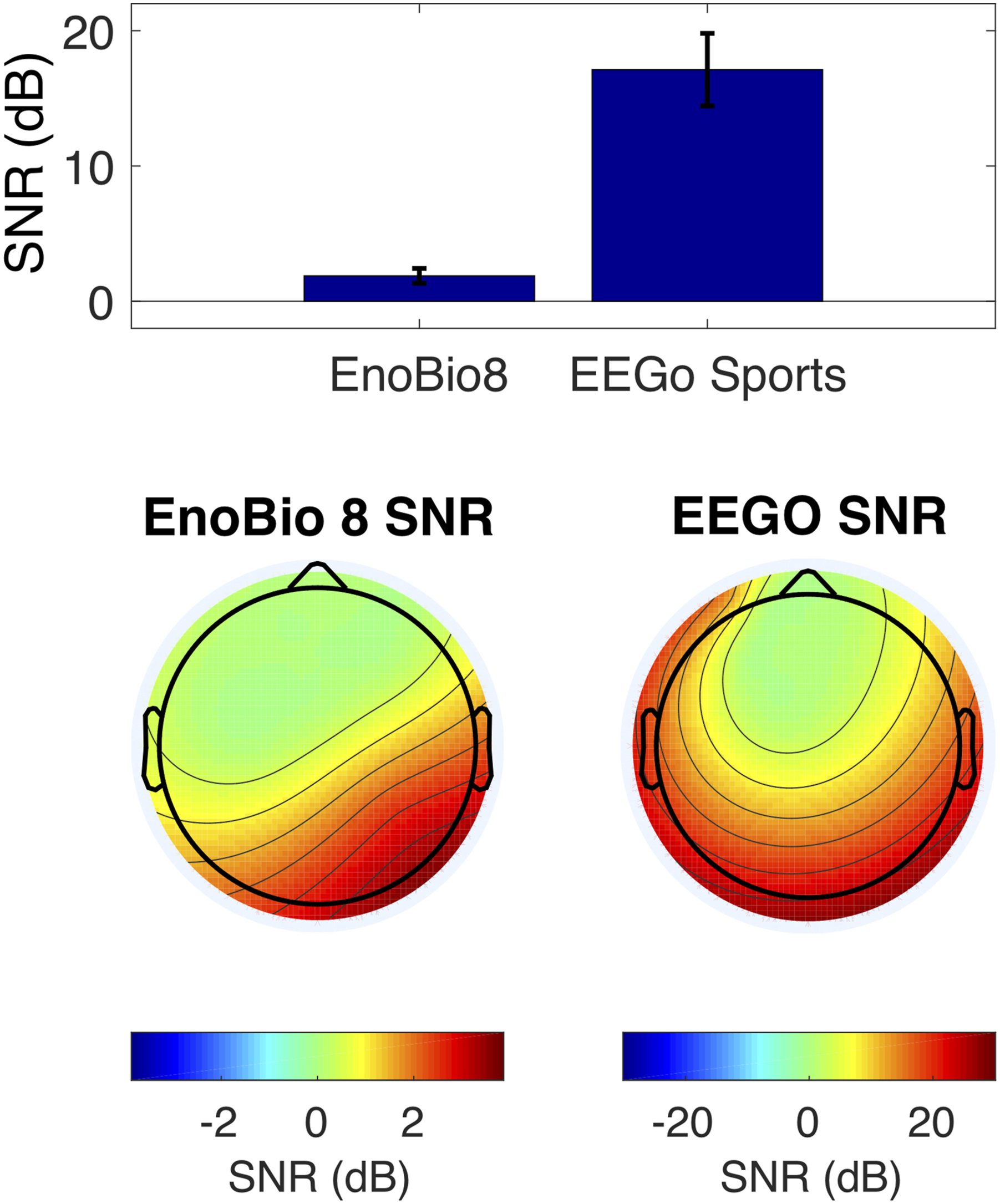
About system synchronization
Online equipment synchronization is an often overlooked crucial factor. In traditional settings, this is a minor problem since (i) multiple simultaneous measurement systems are not generally used and (ii) when multiple systems are used, equipment tends to be static and connected by cables, so when properly configured enable online or offline synchronization. However, MoBI requires minimal cabling to ensure mobility. Currently, the best way to synchronize data sources is through the Lab Streaming Layer (LSL, Kothe, 2019). Lab Streaming Layer was our method of choice when implementing the Human Interaction Laboratory at Universidad Diego Portales in order to study social interaction with a multiple-participant MoBI system. Although other options for signal synchronization might be available, in our experience, these are unsatisfactory as they might lead to measurement errors. If multiple data sources are to be sampled simultaneously, the synchronization software implementation must be rigorous. The systems used must be properly synchronized by software and hardware that is specifically designed for such a task (Barraza et al., 2019).
Specific requirements for experimental designs and the physical space that they require
As mentioned previously, cognitive/neural science laboratories in Chile were set up following the logic of traditional cognitive science (Figure 1 bottom). Implementing MoBI/4E research programs requires not only new research hypotheses but also new physical spaces. In 2018, our research group suggested the idea of “scalable experimental design” (EED) as a heuristic methodological tool (Parada, 2018). Similar ideas have been proposed by other research groups (King & Parada, 2021; Matusz et al., 2019; Shamay-Tsoory & Mendelsohn, 2019). The central concept behind the EED heuristic is the active integration of traditional (i.e., structured) experiments with MoBI experiments, where participants can freely move within a defined context (i.e., structured/semi-structured, e.g., Jungnickel & Gramann, 2016) and real-world situation (i.e., semi-structured/unstructured, e.g., Cruz-Garza et al., 2017). Experimentos Escalables en su Diseño applies the idea of scalable complexity to the study of cognition (Gramann et al., 2021; Ladouce et al., 2019). This scalability depends on formulating hypotheses in such a way that allows testing physiological markers both in traditional laboratory conditions and in MoBI experiments and real-world experimental situations (Gramann et al., 2021; Ladouce et al., 2019; Piñeyro Salvidegoitia et al., 2019; Soto et al., 2018). Thus, the EED heuristics has four main objectives: (i) to investigate the extent to which cognitive phenomena induced in the laboratory can be considered an artifact product of the experimental design (Bronfenbrenner, 1977), contributing directly to the empirical development of the 4E perspective, (ii) to replicate known effects in conditions of greater ecological validity (as in Debener et al., 2012; De Vos et al., 2014; Gramann et al., 2021; Soto et al., 2018), (iii) to systematize the extension of the laboratory setting into the real world (Parada, 2018; Parada & Rossi, 2018), and (iv) increasing the interpretability of results obtained under real-world low-SNR conditions through inherent replicability.
A further innovation that supports the MoBI/4E approach is the possibility of acquiring longitudinal signals from participants in everyday situations, enabling researchers to study brain dynamics in their natural state (Bleichner & Debener, 2018; Hölle et al., 2020; Parada, Martín, et al., 2018; Parada & Rossi, 2020; Rodríguez et al., 2018). The development of novel hypotheses relevant to this type of dataset will be characterized by low SNR, virtually unlimited hours of recording, multiple data sources (e.g., EEG, eye-tracker, and electrocardiography) and high heterogeneity among participants. Data integration relating to phenomenological aspects, such as lifestyle (e.g., analyses of activities of daily living) and/or experiences (e.g., discourse analysis) will be used to interpret, parse, and/or segment the acquired signals (Parada & Rossi, 2018, 2020).
The experimental implementation of an MoBI/4E research program is impeded not only by theoretical aspects of experimental designs but also by the physical layout of the space provided for traditional experimental setups. Thus, the implementation of new spaces for laboratories and/or the ability to flexibly reconfigure current research spaces will be necessary (see Gramann, 2018 for a feature on the Berlin Mobile Brain/Body Imaging Lab, BeMOBIL - https://www.scientia.global/wp-content/uploads/Klaus_Gramman/Klaus_Gramann.pdf). This represents a significant economic and strategic challenge for researchers and research institutions in Chile and elsewhere.
Specific hardware and software requirements for mobile signal analysis
Acquiring MoBI data in semi-structured and unstructured research contexts represents a challenge both at the hardware and software level, while the visualization and analysis of such data can be even more complicated. In such cases, the computer science expression “garbage in, garbage out” is truer than ever, especially if we consider that SNR is reduced in contexts of major movement (Gwin et al., 2010) and depends directly on the quality of the systems used (Radüntz, 2018). Thus, researchers working with the 4E perspective will need to use high-quality hardware (Nordin et al., 2018; Radüntz, 2018), implement state-of-the-art computational algorithms (Blum et al., 2019; Gramann et al., 2021; Gwin et al., 2010; Klug & Gramann, 2020), and consider the EED heuristic when designing research projects (Matusz et al., 2019; Parada, 2018; Shamay-Tsoory & Mendelsohn, 2019). Some of the greatest advances regarding software have been achieved by open-source initiatives such as MOBILAB to visualize and analyze MoBI data (Ojeda et al., 2014) or the HyPyp pipeline for analyzing hyperscanning data (Ayrolles et al., 2021). Given the heterogeneity of designs and data sources, it is important to emphasize that the MoBI community lacks standards or agreements on how to analyze and/or visualize data. However, it is important to consider that more than 90 years after the invention of the EEG, there is still no unified approach to the analysis and interpretation of signals obtained under traditional conditions (Cohen & Gulbinaite, 2014). The fledgling MoBI/4E approach should scaffold its growth in nascent unifying efforts to create globally accepted data-sharing and managing standards (Pernet et al., 2019, 2020).
Concluding remarks
In recent years, cognitive science has made significant progress in understanding how the mind works, especially through the identification of various cognitive and neural subsystems and their structural, functional, and connectivity dynamics (Shine et al., 2019; Swanson et al., 2020; Zamani Esfahlani et al., 2020). By establishing relationships between different brain dynamics involved in cognition, classical laboratory experiments have been of great value. But despite the validity (i.e., controlling relevant variables) and reliability of the data they produce, these experimental designs tend to lack ecological validity. Likewise, without investigating the dynamics of the brain/body system in interaction with the world it is not possible to study cognition in its natural state. The use of recently developed technologies under the paradigm proposed by MoBI can be seen as a possible solution to this problem, allowing the realization of controlled experimental research outside the laboratory. However, this new epistemic/methodological approach comes with its own challenges, from the need for greater portability and robustness of equipment to a requirement for data-analysis tools that can integrate myriad signals from the brain/body-in-the-world system. Younger researchers will have to embrace transdisciplinary approaches, managing both theory and methodology at a sufficient level of expertise so they can collaborate with each field’s disciplinary experts. Additionally, future experimental designs need to allow and consider parametrically increased ecological validity, through the modification of physical spaces in which experiments are conducted and the logic underlying experimental designs (Parada, 2018). Furthermore, correct hardware and software implementation avoids gathering data that will have limited or no usability, will waste participants’ time, and allocated research funding. Hence, appropriate experimental design and data acquisition are certainly a matter of research ethics.
Novel hardware and software developments also present an opportunity to improve diagnosis and treatment strategies for neuropsychiatric conditions, allowing patients to acquire and manage information about their own health status in lower cost, non-invasive manners (Goverdovsky et al., 2017; Piwek et al., 2016) and potentially establishing a direct and continuous link with their health professionals. It should be noted that questions relating to both the clinical validity and ethical implications of asking patients to incorporate wearable and/or hearable technologies in their daily lives still persist, some have identified the need for the determination of “neuro-rights” (Sommaggio et al., 2004; Viosca, 2018).
Thus, challenges are accompanied by opportunities such as (i) the possibility of identifying and diagnosing neuropsychiatric diseases in a non-invasive way at a reduced cost 8 and (ii) acquiring multiple signals from participants in everyday situations, thereby expanding our range of research hypotheses and theoretical conceptualizations about the phenomena we want to understand 9 . In sum, we are at a key moment to advance as a research community by solving these challenges and moving towards a cognitive science with greater ecological validity; one that does not confine the study of cognitive processes to understanding intracerebral phenomena, but instead integrates laboratory and the outside world, taking full account of the organism’s body and environment in which cognition arises.
Footnotes
Authors contributions
FJP conceptualized and wrote the first draft. AGC and FJP made the figures. AGC and SCC edited and wrote the manuscript. AGC, SCC, AR, NFF, and FJP wrote and edited the final version of the manuscript.
Declaration of conflicting interests
The author(s) declared no potential conflicts of interest with respect to the research, authorship, and/or publication of this article.
Funding
The author(s) disclosed receipt of the following financial support for the research, authorship, and/or publication of this article: The present work was funded by Agencia Nacional de Investigación y Desarrollo (ANID) del Ministerio de Educación del Estado de Chile, through Fondo Nacional de Desarrollo Científico y Tecnológico (FONDECYT) Iniciación en Investigación program, project Nº11180620 awarded to FJP. AR, SCC, AGC, and FJP receive funding from Fondo Nacional de Desarrollo Científico y Tecnológico (FONDECYT) regular, project Nº1190610 awarded to AR and FJP. AGC receives additional funding from Programa de Magíster en Neurociencia Social, Facultad de Psicología, Universidad Diego Portales and from FONDECYT Iniciación en Investigación program, project Nº11180620 awarded to FJP.
