







Abstract
There is no doubt that tools have played a central role in the evolutionary history of hominins, from early species like Australopithecus to the genus Homo. Inspired by the French philosopher Bernard Stiegler, this paper explores the Homo species from a Heideggerian perspective, focusing on two central ideas: (i) tools as ready-to-hand versus tools as present-at-hand, and (ii) technologies (tools) versus Technology (technological mode of being). According to Heidegger, focusing solely on tools fails to capture the deeper essence of
Keywords
Introduction 1
The Main Argument
Tools play a pivotal role in the evolutionary history of hominins, from early species like Australopithecus to the genus Homo (Antón, 2014). Inspired by Bernard Stiegler (1998), this paper will examine the topic from a Heideggerian perspective, challenging the idea that tools are merely means to achieve goals. 2 The central thesis this paper will attempt to support and validate is that tools are essential for understanding the evolution of hominins not only because they reflect cognitive development or facilitate tasks like cutting thick skins, but more importantly, because they signify the emergence of a distinct technological mode of being. This technological mode of being entails a fundamentally different way of being-in-the-world—perceiving the world through, and thus as, Techno-logy.
Heidegger (1977) makes a crucial distinction between technologies and Technology (Enframing)—that is, between tools on the one hand and a technological mode of being on the other. According to Heidegger, focusing solely on tools fails to grasp the deeper essence of
This article examines the evolutionary trajectory of the genus Homo through the lens of a fundamental transition: from a stage in which tools are not yet integrated into a coherent system or technological way of life, to a stage in which they signify the emergence of a technological mode of being. Rather than functioning merely as components of a toolkit, tools come to shape a broader framework through which humans engage with the world. The discussion traces this shift from tools as simple extensions of manual activity to the wider implications of a technological worldview. As will be demonstrated, physiological changes accompanying the transition from chimpanzees to early humans–such as modifications in the hands, teeth, jaws, and brain volume–indicate an increasing dependence on tools. This growing reliance ultimately leads to a condition in which the world itself is perceived through a system of tools. To be in the world through a particular set of tools, then, is to exist within a technological mode of being.
This paper argues that a technological mode of being began to develop before the emergence of the Homo species and became more pronounced over time. Specifically, it proposes that human development should be understood not merely in terms of growing dependence on tools, but rather in terms of how the world has been framed within a comprehensive technological mode of being. Essentially, this perspective is reflected in the way we understand and treat our environment, no longer as nature (dwelling with) but rather as a resource. To present this idea simply: as one progresses along the evolutionary tree from chimpanzees to humans, 4 nature is perceived less as a living environment and more as something that stands ready for use.
To Whom Is This Paper Intended?
This article, more than simply attempting to present a new argument, serves as a call to action. Ten years ago, one of the authors (Y.A.) co-authored a paper titled How Does It Feel to Lack a Sense of Boundaries? A Case Study of a Long-Term Mindfulness Meditator (Ataria et al., 2015) with two other neuroscientists. The paper aimed not only to bridge phenomenology and neuroscience through the neurophenomenological approach (Varela, 1996) but also, and perhaps more crucially, to demonstrate that both neuroscientists and phenomenologists have something to gain from shared discourse. It argued that this dialogue is not merely an act of charity but rather a genuine necessity for making meaningful progress in the study of consciousness, addressing what is commonly referred to as “the hard problem of consciousness” (Chalmers, 1995). The paper sparked significant discussion and, in certain respects, shifted the nature of the discourse. While it did not lead to a paradigmatic shift in the Kuhnian sense, it fostered an understanding among various researchers that dialogue between phenomenologists and neuroscientists is both productive and valuable (Lutz et al., 2025; Northoff & Ventura, 2025).
The current article builds on that effort by taking it a step further. Heidegger is arguably one of the most important and influential philosopher of the 20th century. Despite the challenge of engaging with a philosopher who is today known for his Nazi affiliations and antisemitism, 5 his philosophy continues to offer fertile ground for reconsidering everything we once thought to be correct or took for granted.
This article demonstrates the possibility of bridging Heidegger’s philosophy, which fundamentally frames the abyss between humans and animals (Heidegger, 1995), with empirical research on human evolution (Paleoanthropology). In terms of content, the article does not introduce anything new for Heidegger scholars, as it presents his thought in a straightforward—if not overly simplistic—manner. However, the willingness to engage with Heidegger beyond the traditional confines of the natural sciences is, in itself, a powerful and perhaps provocative statement (for further debate, see Glazebrook, 2012). It opens up numerous new possibilities for bridging phenomenology with the natural sciences in general, 6 and specifically with Paleoanthropology.
This article is not intended for devoted Heideggerians, as it would be challenging to shift the views of those deeply entrenched in Heidegger’s own philosophy. Nor is it written for paleoanthropologists who believe that unearthing yet another stone tool will suffice to push the human timeline further back. Rather, it is intended for those who recognize that such efforts often resemble an intellectual ouroboros. Over the past few decades, anyone following research in paleoanthropology will have noticed the progressive erosion of the once-clear boundaries between chimpanzees and modern humans (Wildman et al., 2003). The pursuit of a singular trait that definitively sets humans apart has become something of a running joke—a game of evolutionary bingo that consistently reveals human exceptionalism to be far more fragile than presumed. As the data accumulate, one hears an implicit refrain: “You thought you were special? Look what a chimpanzee can do with a brain under 500 cubic centimeters.”
We contend that Heidegger’s interpretation offers a valuable conceptual framework for rethinking the relationship between humans and chimpanzees. As part of a broader critical discourse (see Derrida, 1987), Heidegger’s thought (1995) enables a more nuanced position—one that simultaneously affirms both continuity and rupture between the two species (Cykowski, 2021). Such a perspective is particularly relevant for contemporary researchers engaged in the ongoing debate over whether humans constitute a fundamentally distinct species or should be understood as part of a continuous evolutionary lineage. In this respect, Heidegger's account of human Dasein offers not a rigid taxonomy, but a philosophical lens through which human origins can be understood without being bound to specific figures such as Homo habilis.
Epistemic Bias and the Challenges of Human Origins Research—the Case of Heidegger
In their influential 2010 paper, “The Weirdest People in the World?”, Henrich et al. (2010) highlighted a significant methodological issue in psychological and behavioral research. Most studies rely on participants from Western, Educated, Industrialized, Rich, and Democratic (WEIRD) societies, yet conclusions are often generalized to the entire human species. Researchers typically assume minimal variation across human populations or that WEIRD groups are representative of all humans.
This issue seems particularly relevant to the field of paleoanthropology. Killin and Pain (2023) rightly argue that the same bias exists when drawing conclusions from modern WEIRD populations about ancient humans, their hominin ancestors, or related species(Figure 1). Cultural variations in visual perception (Müller-Lyer illusion). Line length perception varies across cultures, with WEIRD societies perceiving a 20% difference, while San foragers show no illusion. This highlights cultural influences on even basic visual processing. The strongest effects in WEIRD populations suggest they are outliers, making it unjustifiable to generalize their perceptions to other groups.
Being part of a certain culture inherently means holding a specific belief system. Studies like those of McCauley and Henrich (2006), Henrich (2008) show that these gaps are not merely theoretical but manifest in how we perceive objects in our environment. Gibson (2014) and Merleau-Ponty (1964) understood this well, as did Heidegger (1996). We always perceive objects within a framework, attributing meaning to them—we don’t just hear a sound, we hear the phone ringing. These belief systems profoundly influence how we perceive ourselves, both today and in the past, and how we connect the past to the present.
To return once again to paleoanthropology, we see that Nietzsche encapsulated this insight in Human, All Too Human (1996), where in the section “Inherited Faults of Philosophers,” he criticizes philosophers for failing to study and understand man adequately. All philosophers have the common fault that they start from man in his present state and hope to attain their end by an analysis of him. Unconsciously they look upon “man” as an aeterna veritas, as a thing unchangeable in all commotion, as a sure measure of things. Everything the philosopher has declared about man is, however, at bottom no more than a testimony as to the man of a very limited period of time. Lack of historical sense is the family failing of all philosophers; many, without being aware of it, even take the most recent manifestation of man, such as has arisen under the impress of certain religions, even certain political events, as the fixed form from which one has to start out. They will not learn that man has become, that the faculty of cognition has become; while some of them would have it that the whole world is spun out of this faculty of cognition. Now, everything essential in the development of mankind took place in primeval times, long before the four thousand years we more or less know about; during these years mankind may well not have altered very much. But the philosopher here sees “instincts” in man as he now is and assumes that these belong to the unalterable facts of mankind and to that extent could provide a key to the understanding of the world in general: the whole of teleology is constructed by speaking of the man of the last four millennia as of an eternal man towards whom all things in the world have had a natural relationship from the time he began. But everything has become: there are no eternal facts, just as there are no absolute truths. Consequently, what is needed from now on is historical philosophizing, and with it the virtue of modesty. (pp. 12–13).
Although Nietzsche wrote in the 19th century, scholars continue to treat humans as a finished product, searching for a starting point that led to the present. This tendency to relate the present as the inevitable outcome of history is widespread and deeply rooted in the field of paleoanthropology (Ataria, 2024a; Graeber & Wengrow, 2021). Continuing this line of thought, Villmoare and Kimbel (2024) argue that paleoanthropology faces significant epistemic challenges. As Wood and Smith (2022) noted, the human fossil record creates specific epistemological problems, preventing accurate inferences in areas like causality. In other words, the way we interpret the sparse findings is biased, leaving too much room for researcher interpretation—an interpretation that, as previously noted, always comes from a specific cultural background.
In agreement with this approach, Clark (2006) has argued that human origins research, with its tendency to extend beyond empirical limitations, is one of the most challenging fields in terms of how prior beliefs influence what is defined as a “finding,” how that “finding” is described, and what is inferred about the “creature” associated with it (whether it be a specific bone, tooth, or tool). The historical research of this field over the past century reveals sharp, recurring biases. Clark (1999) further argues that the problem becomes more severe because differing intellectual traditions and unexamined epistemic biases cause researchers to talk past one another. This lack of shared understanding exacerbates the issue, as each group operates under assumptions that are not openly acknowledged or critically examined, making it more difficult to achieve scientific agreement.
If we frame the problem simply, it seems that the “modern” agent defines “modernity” based largely on the world they were born into and cannot think beyond the idea that the “primitive world” could have evolved into the very “modern world” to which the researcher belongs by chance. Against this backdrop, it is not surprising that, over the past 20 years, a fundamental Eurocentric bias in defining “behavioral modernity” has been exposed. 7
With this in mind, one could embrace the following approach: The best lesson our readers can learn is to give up the childish notion that everything that is interesting about nature can be understood. History, and evolution is a form of history, simply does not leave sufficient traces... It might be interesting to know how cognition (whatever that is) arose and spread and changed, but we cannot know. Tough luck. (Lewontin, 1998, p. 130)
One could, however, become more aware of the epistemic positions we have fallen into—and in fact, if there is one thing Heidegger contributed more than anything else, it is precisely this awakening Philosophers who held certain belief systems. In this context, Heidegger asked Western thinkers to make a fundamental shift—and this is exactly the shift that Clark (2006) demands from researchers of human origins: “If human origins research is going to realize its potential as a science-like endeavor, it must make epistemology central to its research protocols, not something of interest to only a few scholars on the edges of the field” (p. 4).
When applying Heidegger’s philosophy to the evolutionary story, it’s important to remember that he was, first and foremost, a white European man living in a society that saw itself as superior. Thus, according to Derrida (1987), Heidegger is unable to think of humanity outside the European framework—all human history is supposed to lead us toward twentieth-century German thought. One could view this as a limitation, compelling us to dismiss it as a thinker creating a theoretical framework for understanding the wound of Homo sapiens.
We are familiar with this position and respect it. However, in light of what we have written so far, it is difficult to think of a theoretical approach that is not biased in some way. The problem is that, in most cases, neither the philosophers (as Nietzsche showed us) nor the researchers themselves are aware of the magnitude of the bias—and in this context, the experiment presented earlier is, in our view, indeed crucial.
In light of these cautions, it should be clear that anyone reading this article must bear in mind that the authors are deeply immersed in Western culture and its philosophical traditions, and that we are engaging primarily with material written by researchers working within Western institutions. To be specific, we share the same world as Heidegger (though we are Jewish and he was an anti-Semitic philosopher)—a world saturated with technology. The thought that things could have developed in only this way is fundamentally wrong. Therefore, the course of this research—which argues that today’s reality’s seeds can be found over two million years ago—may be a fatal error. This is, in a sense, a Freud (2012) kind of thinking—we link present symptoms too strongly to past events (for further debate see Ataria, 2017). Our answer here will come from the philosophy of science. As Popper (2005) taught us, proper science advances from failure to failure, and if there is failure, let it be glorious. If a philosopher’s theory deserves deep examination, even as a failure, it is Heidegger’s philosophy. This article is one step further within that glorious failure.
Structure
In the first part of this chapter, we elucidate Heidegger’s central ideas regarding technology. The discussion begins with an examination of the primacy of tools in their usability (ready-to-hand), focusing on the intrinsic relation between a tool’s inoperability–its transition to the present-at-hand–and the emergence of anxiety. This analysis draws primarily on Heidegger’s foundational text Being and Time. The chapter then turns to Heidegger’s later thought as developed in The Question Concerning Technology, concentrating on the distinction–and possible abyss–between tools understood as technologies and
In the second part of the article, we will attempt to examine the evolutionary trajectory of the hominins, from chimpanzees through Australopithecus to the emergence of Homo (Homo habilis and Homo erectus), from a Heideggerian perspective—not merely focusing on the tools themselves but attempting to identify a deeper, more encompassing commitment to technology, leading to the development of a technological mode of being.
In the third part of the article, we address the question of what is distinctive about the approach proposed here—particularly in relation to the contrast between a technological mode of being and the idea of obligatory stone tool use. We also explore how this revised framework may offer new conceptual leverage for reexamining the evolutionary narrative of the Homo lineage.
We will conclude with the argument that while Heidegger was mistaken in pinpointing the “timing” of the shift (from tools to a technological mode of being), he was correct in a deeper sense: the dramatic change in the story of human emergence is deeply connected to the adoption of an encompassing technological mode of being.
Technology Vs Technologies
Ready-to-Hand Vs. Present-at-Hand
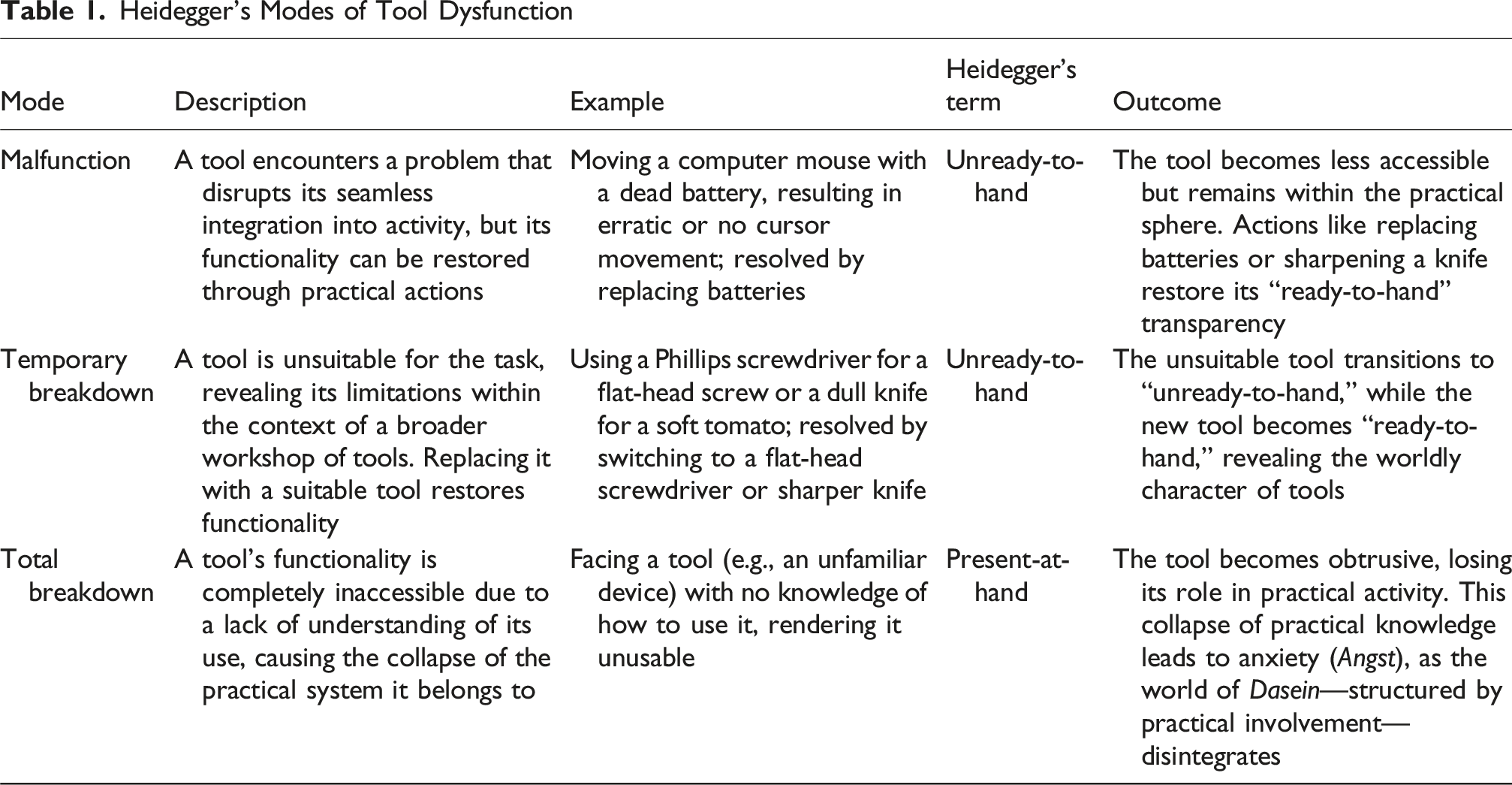
The use of tools is one of the central themes in Heidegger’s seminal treatise Being and Time (Sein und Zeit, 1927). Heidegger challenges us to reconceptualize tools—not as isolated objects, but as things that are proximally ready-to-hand. A tool, in its proper mode of being, is not encountered as a detached object of contemplation but is absorbed into activity, embodied in use. When a tool is damaged or malfunctions, it withdraws from this state of readiness and shifts into a present-at-hand (vorhanden) mode, becoming an object of theoretical reflection. The crucial insight, from Heidegger’s perspective, is that the tool is primordially encountered as ready-to-hand; only when it ceases to function does it appear as a conceptual or physical object.
Thus, no matter how thoroughly we analyze a tool’s features—its weight, shape, or material composition—we ultimately fail to grasp its essence if we ignore its embeddedness within a context of practical engagement (Heidegger, 1996). The tool’s significance lies not in its physical properties per se, but in its functionality and the role it plays within a web of meaningful relations. 8
It is only when the tool ceases to function as a tool—when it withdraws from its usefulness—that it begins to be defined in independent, physical terms, as an object: “In our circumspect use of tools, we can say that the hammer is too heavy or too light” (Heidegger, 1996, p. 330). In other words, the more a tool moves away from its practical role, the more it becomes an object available for representation and scientific study. However, this shift takes us further and further away from the true essence of the tool, which is neither a representation nor an abstract idea, but way of use embedded within human activity. Understanding the tool as ready-to-hand is thus fundamentally different from conceiving it as merely present-at-hand.
Heidegger’s Modes of Tool Dysfunction
Technology (Enframing)
While Heidegger’s early thought concerns technologies, his later thought addresses the essence of technology, which we will henceforth refer to as “
The challenge of nature, or the “challenging claim” (p. 19) is the essence of modern technology (das Ge-stell, Enframing). It is a process that turns everything into a resource—at its end point, even humans become “things”:
The Relationship Between Technology and Science
Heidegger (1977) asserts that this perspective on nature not only predates the emergence of science but also serves as a foundational condition for the scientific revolution. At its core, the scientific revolution represents a profound transformation in humanity’s way of perceiving and relating to nature (Shapin, 1998). Let us clarify this notion.
Technology is generally treated as an application of scientific development, thus Heidegger asserts: Chronologically speaking, modern physical science begins in the seventeenth century. In contrast, machine-power technology develops only in the second half of the eighteenth century. But modern technology, which for chronological reckoning is the later, is, from the point of view of the essence holding sway within it, the historically earlier. (p. 22)
Indeed, historical analyses often portray technology as the application of scientific development (Bijker, Hughes, & Pinch, 1987). By contrast, Ihde and Hanks (2010) argue that technology precedes science—not only in essence, as Heidegger maintains, but also in concrete historical terms. Along similar lines, Whiten and Van Schaik (2007) contend that the Industrial Revolution could not have occurred without the prior Technological Revolution of the Middle Ages. It follows from this that science is not only completely embodied in technology—a scientific laboratory is essentially a technological workshop, in which we perceive the world through a variety of instruments and computers (so that one could argue that the world we “see” is, in fact, of our own making)—but also that, in many respects, technology literally preceded science.
As will be demonstrated later, the transformative shifts driven by technology—particularly the ways it has reshaped how we perceive and understand the world, as well as ourselves—did not originate in recent centuries or even millennia. Instead, this process can be traced back to a time preceding the emergence of the genus Homo. The critical point is that we are dealing with a prolonged and continuous process that characterizes the appearance of the Homo lineage, without committing to any specific species—such as Homo habilis or others currently known—as the definitive “ancestor” of the Homo genus.
To properly establish this argument, we must first consider the notion of technology as a mode of being thrown into the world—that is, as a way of revealing the world. Technology is not merely a tool integrated into the lived body; rather, it functions as a transformative force that fundamentally alters the way we perceive, understand, and engage with our surroundings (Ataria, 2022).
Technology Is a Way of Revealing
From Heidegger’s point of view, “Technology is … no mere means. Technology is a way of revealing” (p. 12). Heidegger returns to the Greek word poiesis (ποίησις), from the verb poiein (ποιεῖν), meaning to make or create. The process of creation (craft) is thus related not only to production for a particular purpose, but also to poetics (art)—a process that gives rise to progress and to “bringing forth” that which is normally concealed. Let us begin with a simple example. A spade allows us to reveal that which was hidden beneath the soil. Of course we can also dig with our hands, but the spade allows us to reach places that we are unable to reach with our hands alone. A pen allows us to reveal truths about our lives that we did not know until the moment that we began to write. A paintbrush allows us to reveal hidden facets of the world around us and of our own mental state. In order to paint, we also require technical knowledge—craft. An accomplished painter must also be an artisan—a necessary but by no means sufficient condition. Not everyone who knows how to hold a brush knows how to paint, which requires something more. When craft is combined with art, the result can be a revelation of truths that, under different conditions, would remain concealed. In this sense, the act of creating art is also an act of revealing truth. According to Heidegger, technology, under certain conditions, allows truth to emerge. In support of this idea, he turns to the word techne (τέχνη): “There was a time when it was not technology alone that bore the name technē. Once that revealing that brings forth truth into the splendor of radiant appearing also was called technē” (Heidegger, 1977, p. 34). Heidegger thus points to the two meanings of the word. One meaning pertains to the means of producing, to the practical ability to produce (know-how), as we find in the writings of Aristole, who recognized the fact that techne also belongs to poiesis and thus entails poetic action—a critical point, as we will see. The second meaning of techne, which is the more important one according to Heidegger, pertains to knowing (episteme) in the widest possible sense—a way of being at home in the world and understanding it. Essentially, by being thrown into world and understanding it we are also opening it up, and in so doing, truth can be revealed (Dreyfus, 2005; van Mazijk, 2019).
This article does not address the question of revealing truth through the use of technologies. The guiding premise of the present discussion is that technology operates as a world-disclosing framework. Understood in this way, techno-logy is fundamentally epistemic: technē denotes a specific mode of revealing through which the world becomes intelligible. (Ihde, 1990). As we noted earlier, Heidegger argues that this technological perspective predates the scientific revolution, which he situates within the second millennium AD. 9 It is important to emphasize that Heidegger does not claim to know the precise origins of the process that ultimately led to viewing nature as a reservoir of energy rather he admits that the “origin is still unknown” (p. 22 [emphasis added]).
In this article, we propose to interpret this mode of being—namely, perceiving and engaging with the world through technology (viewing nature as standing reserve)—as a foundational factor in the evolutionary transformation of the hominin lineage. Within this framework, we conceptualize the technological mode of being (techno-logy) not as a sudden rupture or discrete event, but as a protracted, continuous shift—an epistemic transformation that gradually unfolded over hundreds of thousands of years.
From Chimpanzees to the Genus Homo: Tools and Technology-Phenomenological Perspective
Chimpanzees
Chimpanzee Tool Use and Functions
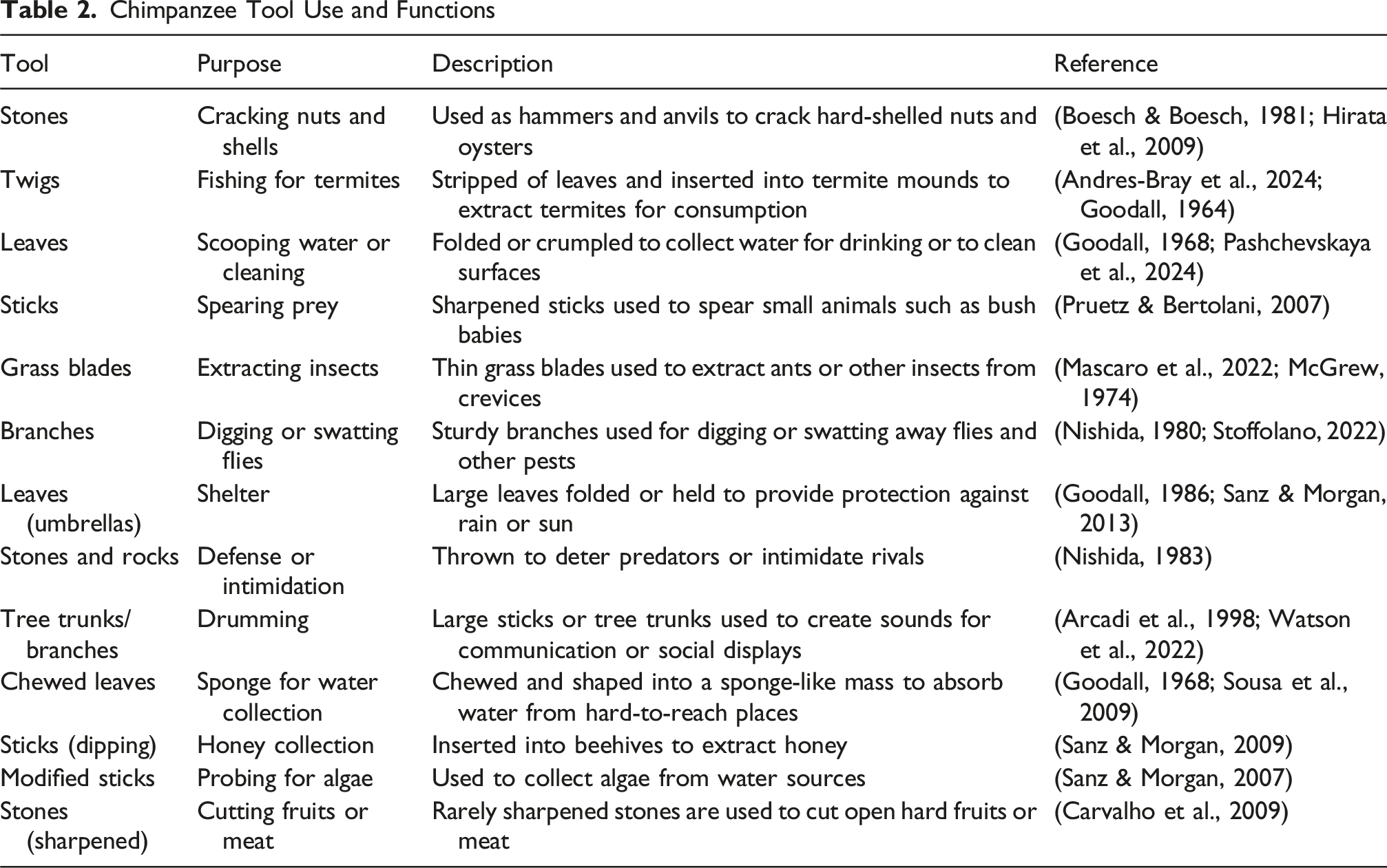
It is evident, therefore, that chimpanzees regularly use tools and, in some sense, even manufacture certain tools (although not stone tools). It is within this context that the following questions arise: what is the nature of their tool use? Specifically, can a tool exist for them in a state of present-at-hand, as Heidegger describes? Following this line of thought, another question arises: do these tools alter the way chimpanzees perceive and engage with their environment?
The way a chimpanzee holds and uses tools is deeply influenced by its morphology, which is itself a product of evolutionary adaptation to its environment. The structure of the chimpanzee’s hand, with fingers that are relatively long compared to the thumb, is well-suited for climbing and swinging on branches but less optimized for a precise grip on tools (Napier, 1960; Marzke, 1997). Similarly, the chimpanzee’s wrist is more restricted in movement compared to that of Homo sapiens, as it evolved to prevent overstretching during quadrupedal walking. As a result, when chimpanzees hold tools, the movement tends to originate from the shoulder and elbow rather than the wrist, with the palm functioning as an extension of the arm. This configuration leads to less precise and subtler movements compared to humans (Marzke & Wullstein, 1996).
Chimpanzees primarily utilize materials readily available in their natural environment—such as stones and sticks. Given the abundance of these materials around them, one might be tempted to view their tools as part of a complete toolkit. However, a deeper analysis—though potentially influenced by a human-centric perspective—reveals that this is not a toolkit in the fuller, more systematic sense.
The stones and sticks used by chimpanzees are not systematically organized, and for the most part, they do not accompany them from place to place (although, as we will discuss shortly, there are exceptions where chimpanzees do carry tools for specific purposes). In any case, it seems that these tools do not fundamentally change how chimpanzees perceive or interact with the world—while the chimpanzees’ I-Can field of action may involve tools (Figure 2), it does not structurally require them. Body schema, tools, and the I-Can field of action. Source: (Maravita & Iriki, 2004). with author permission. Merleau-Ponty (2012) argues that our ability to perceive the world in terms of “I-Can” originates from the body schema, an unconscious system of sensory-motor capacities that seamlessly integrates tools like a cane or knife, transforming them into extensions of the body (Halák, 2021). When a tool, such as a blind person’s cane, is incorporated into the body schema, it ceases to be a mere object and becomes an instrument of perception, functioning as an appendage of the body. This integration updates the “I-Can” map, allowing previously inaccessible elements in the environment to become actionable (Ataria, 2021; 2022). For example, a cane extends the tactile world beyond the skin of the hand, enabling the blind person to engage with objects that were once out of reach. As Merleau-Ponty notes, “The actions in which I habitually engage incorporate their instruments [tools] and make them participate in the original structure of my own body” (2012, p. 93). This incorporation reflects a deep commitment to tools, where they become interchangeable with bodily organs. Tasks typically performed with the body, like grasping sushi, can be executed with tools like chopsticks without conscious distinction, demonstrating the fluidity of tool use. This interchangeability extends to sensory integration, where tools act as sense organs. A blind person “sees” the environment through the touch of a cane, illustrating how “our sense organs appear to us as interchangeable instruments” (Merleau-Ponty, 2012, p. 336). This seamless integration is so natural in daily life—eating rice with hands, chopsticks, or a spoon—that it becomes transparent, underscoring our profound reliance on tools. Merleau-Ponty further defines this commitment through the concept of the “I-Can” gaze: “Everything I see is in principle within my reach, at least within reach of my sight, and is marked upon the map of the ‘I-Can’” (Merleau-Ponty, 1964, p. 162). Tools restructure this intentional engagement, blurring the boundaries between vision and touch. What is seen becomes what can be reached, and what can be reached shapes perception. Commitment to tools is not about frequency of use but a fundamental transformation in the “I-Can” structure, where tools and body merge, reshaping how we act and perceive in the world.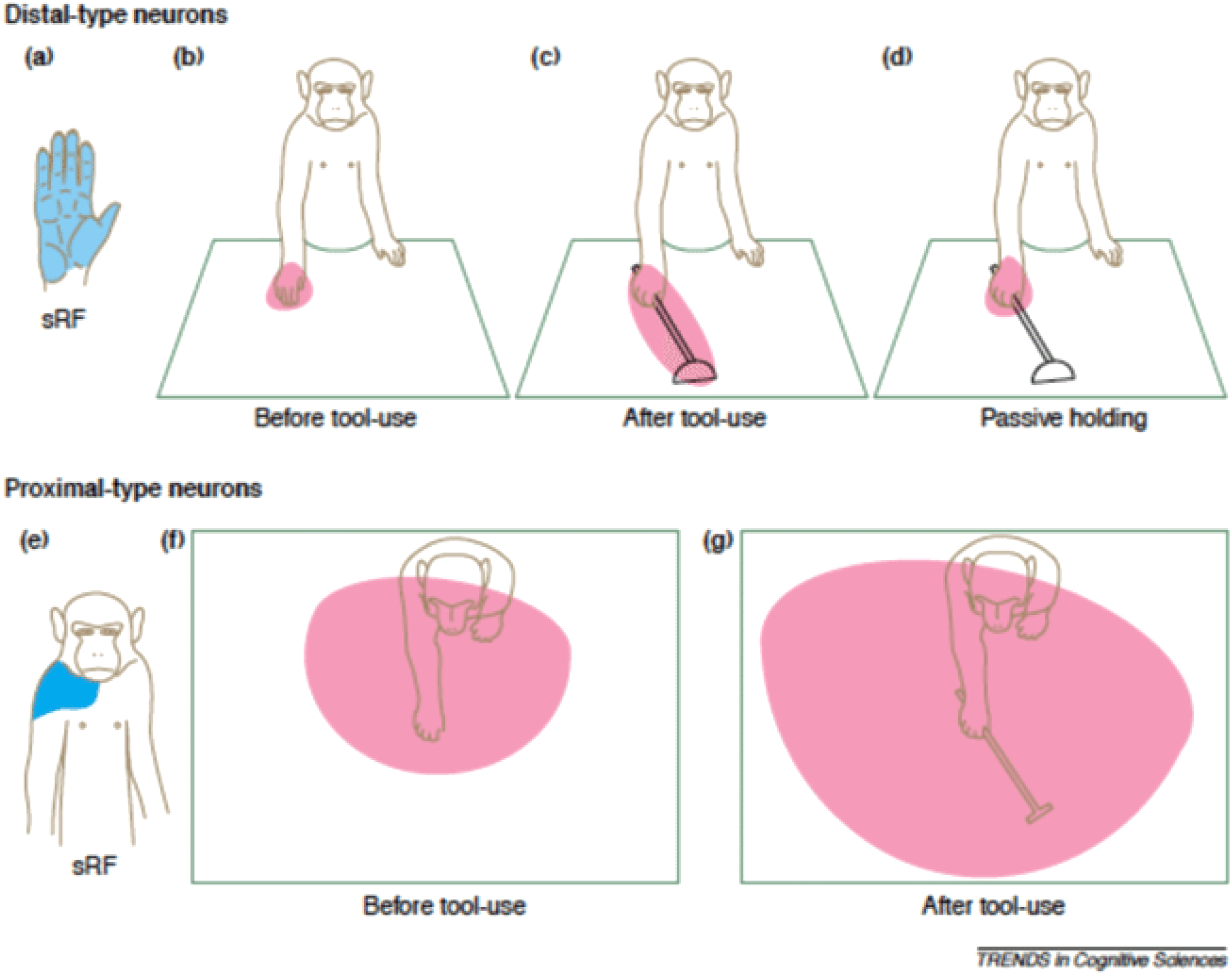
As can be seen in Figure 2. it is certain that there is a possibility that tools may become part of the “I-Can” map of chimpanzees, at least to some extent. However, to the best of our knowledge, no research has demonstrated that wild chimpanzees perform actions that could otherwise be done “naturally” without tools, while using tools. In examining modern humans, there are countless examples of actions that could be performed without tools, yet we unconsciously choose to perform them with tools. This is a situation where “our sense organs appear to us as interchangeable instruments”—a phenomenon for which there is no evidence among chimpanzees, at least not at present.
Chimpanzee Tool Use, Material Selection, and Transport Behaviors
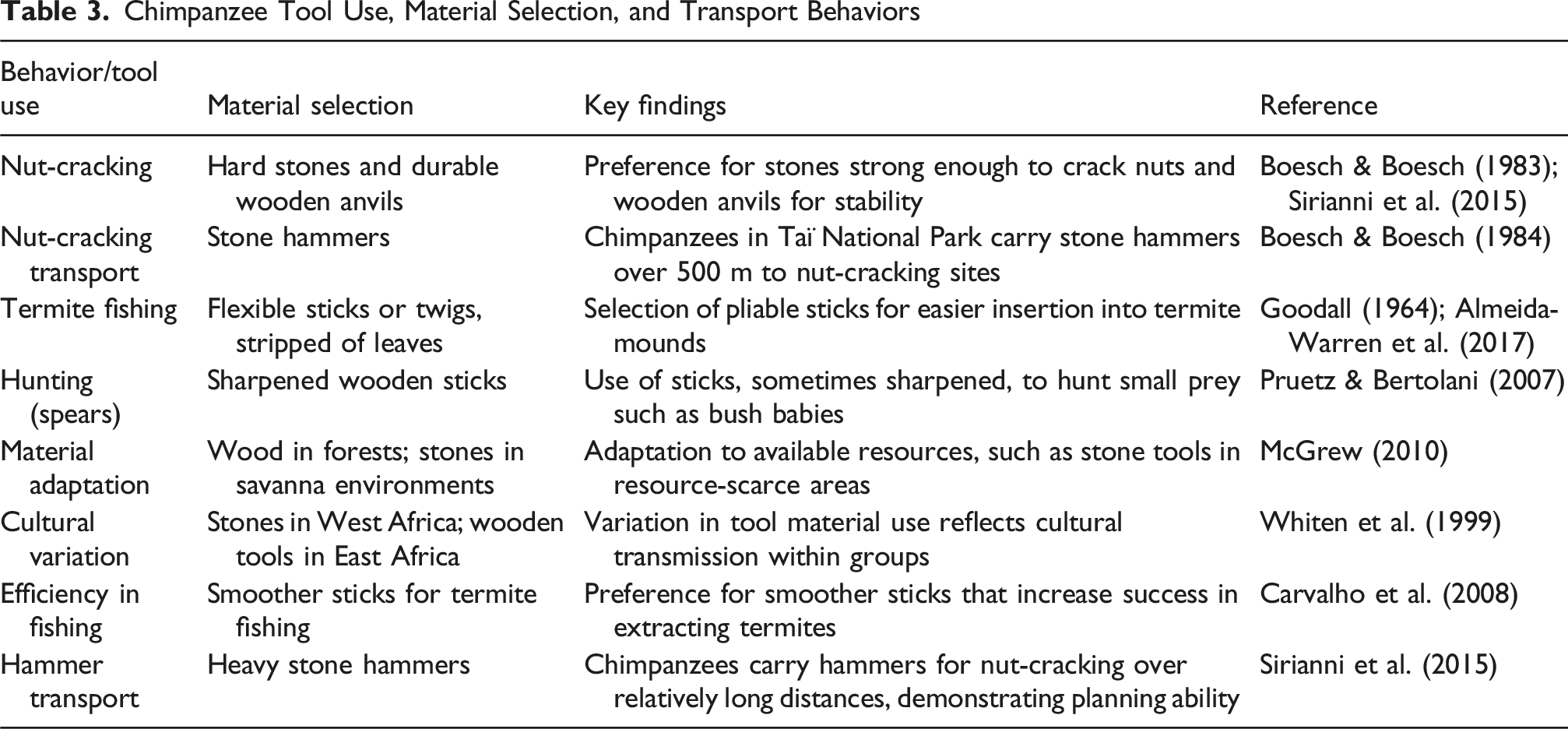
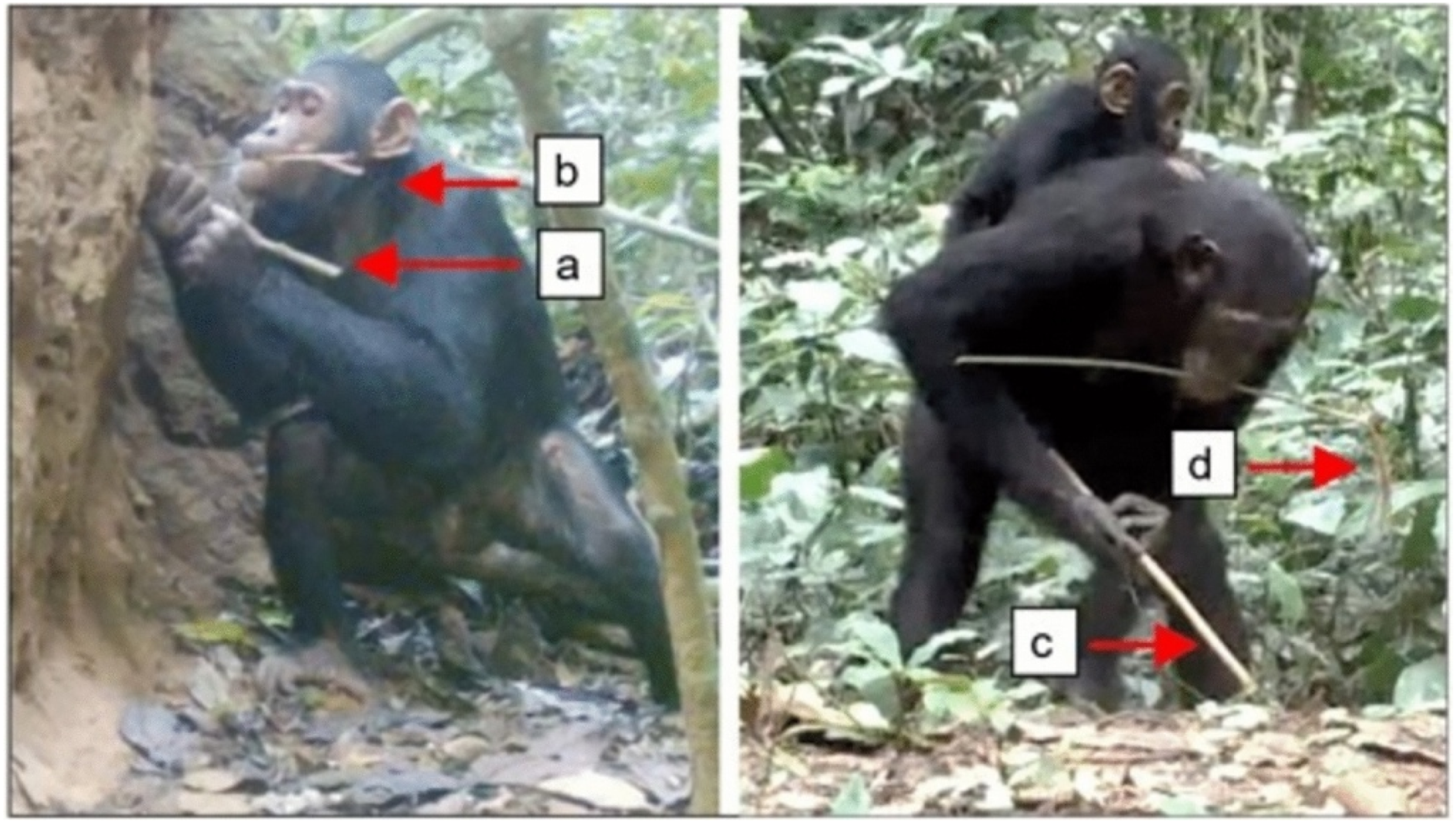
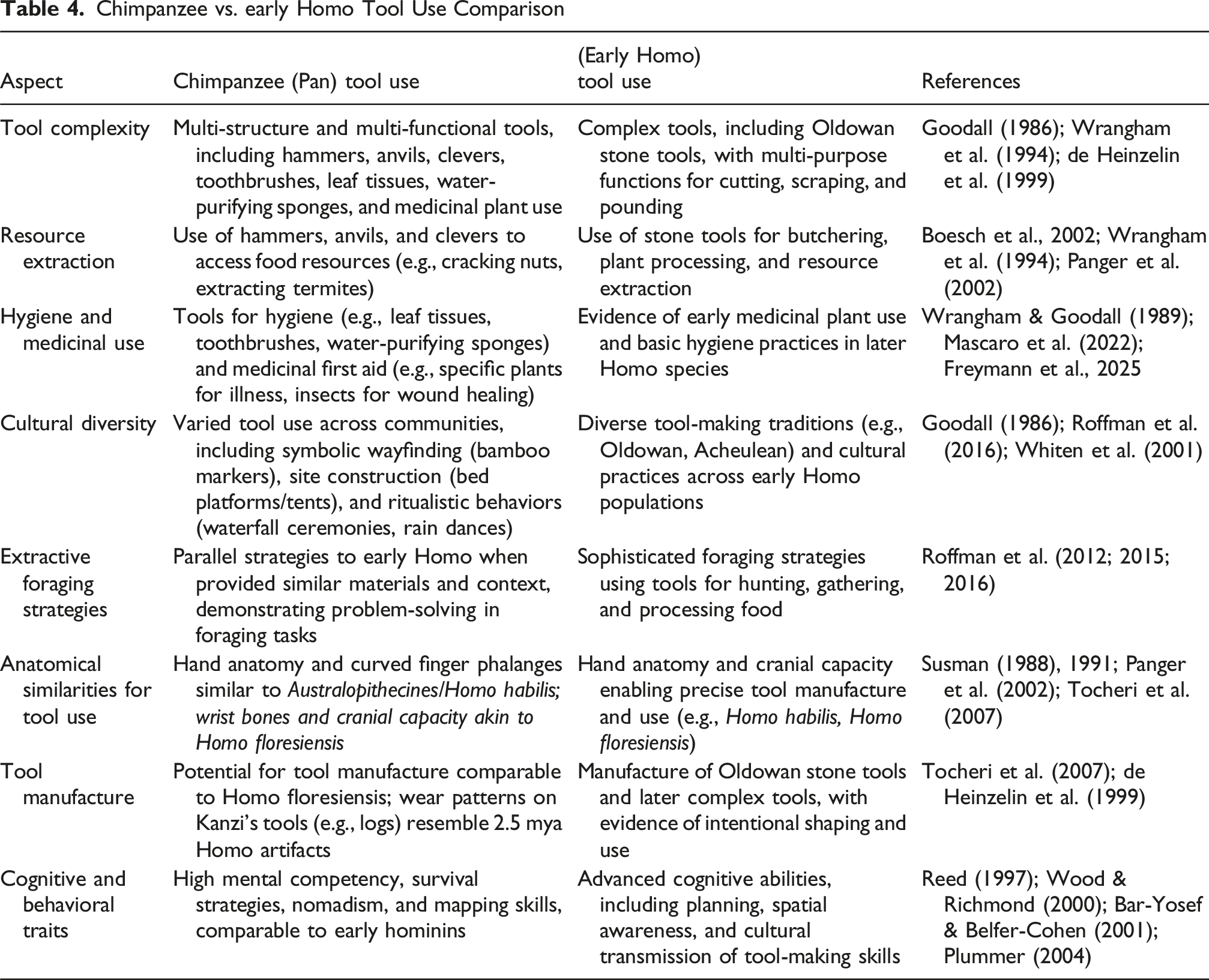
Tool sets to gather termites at epigeal (left) and subterranean (right) nests (source: Musgrave et al., 2024). Left: A subadult male clears a termite exit hole with a perforating twig (a) before using a fishing probe (b) to extract the termites. Right: an adult female digs into the earth with a woody puncturing stick (c), and the brush-tip fibers at the end of the fishing probe (d) are visible as she holds it in her mouth. Several traits once thought unique to early Homo—including cultural variability, tool use, extractive foraging, and complex cognition—are now well-documented in Pan species (Bar-Yosef & Belfer-Cohen, 2001; Panger et al., 2002; Plummer, 2004; Reed, 1997; Whiten et al., 2009; Wood & Richmond, 2000). Chimpanzees exhibit cranial and hand morphology overlapping with Australopithecus, Paranthropus, and Homo floresiensis, supporting their capacity for tool production (Susman, 1988, 1991; Tocheri et al., 2007). Wear patterns from Kanzi’s tool use replicate those found on early archaeological materials dating to 2.5 mya (de Heinzelin et al., 1999), and field studies have revealed culturally transmitted tool behaviors—including hammer-and-anvil use, branch spears, and wooden digging tools—across various populations (Boesch et al., 2009; Goodall, 1986; Hernandez-Aguilar, 2007; Pruetz et al., 2007; Whiten et al., 2001; Wrangham et al., 1994). Yet, with fewer than 60 sites studied among thousands of remaining chimpanzee communities, most cultural variation in Pan likely remains undocumented. Recent reports further bridge the gap with early Homo, describing chimpanzees’ use of composite toolsets (stone, wood, antler) for subsurface foraging and bone processing (d’Errico & Backwell, 2003; Plummer, 2004; Roche et al., 2009). While marrow extraction using sticks has been observed (Goodall, 1986; Watts, 2008), the Pan-Banisha case—where a chimpanzee used an angular hammerstone to split a large ungulate bone longitudinally—demonstrates a lithic-assisted strategy akin to that of early hominins (Brain, 1969; Bunn & Kroll, 1986; Pickering & Heaton, 2009; Ullrich, 1999). This convergence suggests that Pan is capable of a functional analog to the Homo scavenger strategy, involving deliberate carcass exploitation with stone tools (Panger et al., 2002; Plummer, 2004; Susman, 1991). And yet it seems that chimpanzees do not intentionally transport stone tools over long distances for specific purposes. Instead, their tool transport is typically short-range, spanning tens to hundreds of meters, driven by immediate needs, such as cracking nuts near a raw material source or a nut tree. However, over time, their repeated localized actions create a cumulative long-term pattern known as the “distance-decay effect.” As chimpanzees repeatedly use tools and leave them at the site of activity, tools gradually disperse across the landscape, resulting in a pattern of tool concentrations far from the original raw material sources. This unintentional behavior mirrors patterns observed in early hominin archaeological sites, where cumulative, short-term actions contribute to broader spatial distributions of tools. Thus, while chimpanzees do not plan long-distance tool transport, their repeated behaviors produce a landscape-scale effect that appears strategic over time (Luncz, Proffitt, Kulik, Haslam, & Wittig, 2016). Essentially, this is the most important finding relevant to the current research. In this context, it is important to recall the study by Wynn and McGrew (1989), which has received substantial confirmation and reinforcement over the past decades. Wynn and McGrew (1989) begin by noting that “While we cannot watch Oldowan tools being made, we can identify some of the steps in procedure.” More specifically, they emphasize that “Two are of special interest because they appear on the surface to be sophisticated: selectivity of raw material and the use of tools to make tools.” To illustrate this selectivity in concrete terms, they observe that “In the Oldowan assemblages from Olduvai Gorge there is a marked tendency of the smaller tools to be made of quartz and quartzite and for the larger tools to be made of lava.” Importantly, this pattern cannot be explained by immediate availability alone, since “The quartz and quartzite had to be carried for a distance of at least two kilometers.” From this, the authors draw a broader inference: “Thus, it seems that for reasons unknown the tool-users selected certain kinds of raw material for certain kinds of tools.” This selectivity, in turn, has cognitive implications, because “This in turn implies a certain amount of foresight and suggests that tool-use was not entirely spur-of-the-moment.” Beyond material choice, there is also a procedural dimension, insofar as “The knappers also needed to use stone hammers to make the flaked stone tools; in other words they used tools to make other tools.” The broader significance of this observation is underscored when the authors conclude that “This striking point has achieved some notoriety in discussions of the evolution of intelligence and has become a kind of threshold marker dividing ape from human technology” (Wynn & McGrew, 1989, p. 389). Crucially, however, it must be emphasized that from an ape's perspective neither of these features would be remarkable. Chimpanzees in the Tai Forest in Ivory Coast regularly use harder hammers of granite and quartzite on Panda nuts than on Coula nuts, which can be opened by softer hammers of laterite. Moreover, they regularly carry such hammers to nut-cracking stations, sometimes for distances of over 500 m.
If chimpanzees not only design tools but also carry them, even if inconsistently and only over short distances, it suggests that tools possess varying degrees of readiness for use. A tool that is particularly well-suited to a specific hand and action has the potential to reshape the chimpanzee’s map of possibilities, that is, the chimpanzee’s I-Can structure (see Figure 2), influencing how the world invites interaction. Although there is no overarching system through which chimpanzees perceive the world via tools, the act of holding a specific tool can fleetingly alter their relationship with their environment. One might imagine—though this interpretation could be considered anthropocentric—that, for “a brief moment,” the chimpanzee perceives the world in a new way, as a field of action where tools open up new and unique opportunities for engagement and interaction.
At this point, we can return to Heidegger and his concept of the shift of tools along the axis of readiness-to-hand. Tools can be more or less ready-to-hand, meaning they invite us to act with them in the world to varying degrees, shaping the availableness of the world. The selection of the right stick—taking into account its thickness, length, flexibility, stiffness, and roughness—determines its level of readiness for use, with some sticks becoming more suitable for specific tasks, thereby enhancing their utility.
Consider a scenario where the stick breaks, requiring repair or replacement; this represents a shift toward the un-ready-to-hand, where the tool momentarily loses its seamless integration into action but still remains contextually significant. This raises a crucial question: can a tool transition further, into the present-at-hand mode? In this state, the tool is no longer functional or understood in its context of use; instead, it becomes an object of detached observation—something we no longer know how to use, evoking a sense of helplessness.
When we closely observe primates—and keeping in mind that we may never fully grasp the situation from their perspective, remaining forever distanced from their point of view—it seems that certain stones exist for them either as elements of their natural environment or as tools for cracking nuts, but never as objects entirely detached from their context—objects whose purpose and use are utterly incomprehensible. Put differently, the inability to use a particular stick would not cause them anxiety—while reading different kinds of updated studies (Proffitt et al., 2016), this observation remains consistent (for a review, see Harmand & Arroyo, 2023). The stone remains seamlessly integrated into their living environment, not as part of a structured toolkit. Thus, when the stone ceases to serve as a tool, it effortlessly returns to being a part of the environment. This stands in contrast to a hammer, for instance, which is part of a system of tools and, when not in use, is placed back in its designated location, such as a workshop or toolbox. In this sense, the stone (1) is not truly part of a tool kit and (2) never transitions into an object in the present-at-hand sense.
Chimpanzee vs. early Homo Tool Use Comparison
Australopithecus
The transition to Homo sapiens involves Australopithecus, often referred to as “ape-man,” a genus that lived in Africa during the Pliocene and Early Pleistocene and evolved from ape species exhibiting chimpanzee-like traits (Klein, 2009). Australopithecus, a group of bipedal apes, had brain sizes similar to chimpanzees, with early species averaging 360 cc and later species exceeding 500 cc (Holloway, 1975; Kimbel & Delezene, 2009). Unlike chimpanzees, Australopithecus lived in savannas, not rainforests. Bipedalism likely offered savanna-specific advantages, possibly linked to climatic changes expanding these ecosystems (Levin, 2015; Potts, 2013).
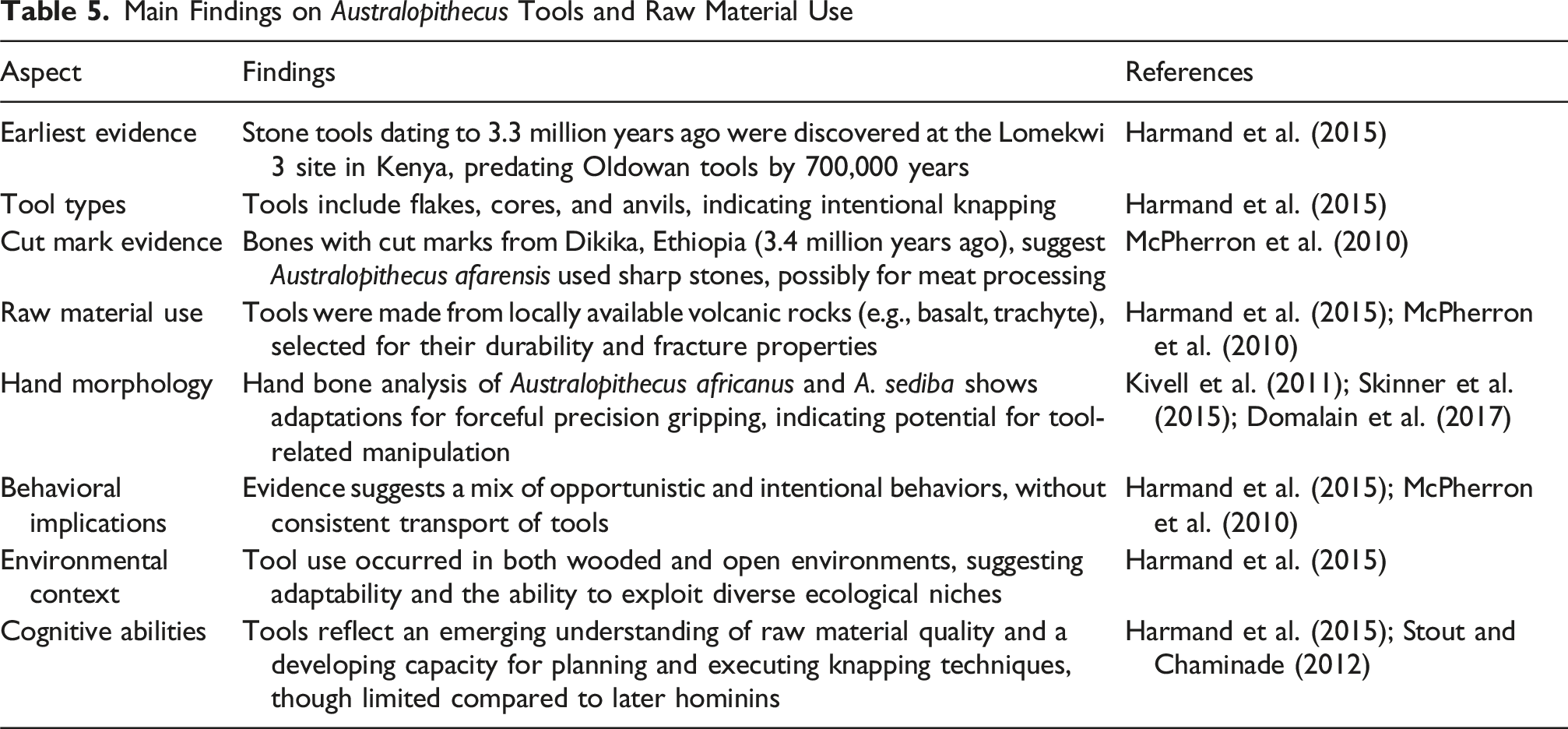
Main Findings on Australopithecus Tools and Raw Material Use
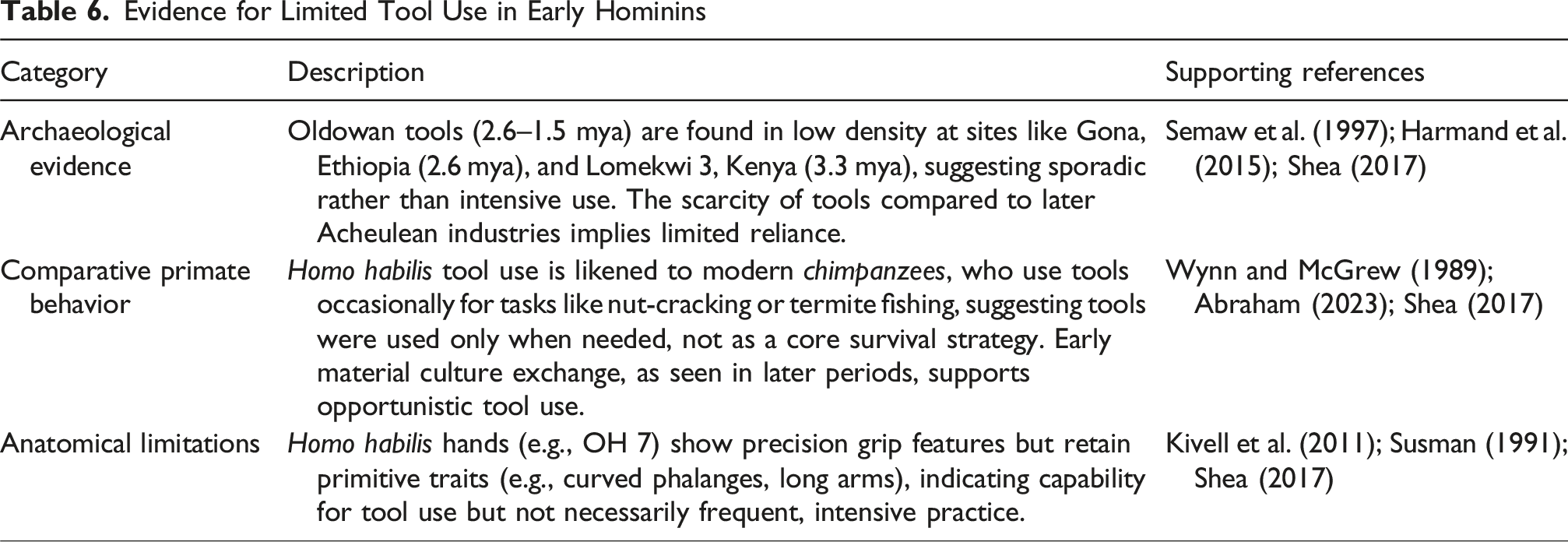
Evidence for Limited Tool Use in Early Hominins
Harmand and her colleagues (2015) uncovered evidence at the Lomekwi 3 site of stone tool use dating back 3.3 million years, predating Oldowan technology by 700,000 years. This discovery indicates that earlier hominins, potentially not belonging to the genus Homo, engaged in technological activities. The researchers noted that “the technological features of flakes and flake fragments are clear, unequivocal, and seen repeatedly, demonstrating that they were intentionally knapped from the cores” (p. 312). This observation supports the notion that Australopithecus engaged in deliberate stone tool crafting. Furthermore, research by Kunze et al. (2024) indicates that their hand use closely aligns with actions required for human-like tool manipulation, suggesting a capacity for skilled interaction with objects.
At sites like Gona and Bouri, tools dating back 2.6 million years were found alongside cut-marked bones, indicating early hominins used sharp tools for processing carcasses (Asfaw et al., 1999; de Heinzelin et al., 1999; Semaw et al., 1997). These tools are attributed to Australopithecus garhi, though other species like Australopithecus aethiopicus or early Homo cannot be excluded (Suwa et al., 1996). It has been suggested that these tools demonstrate that these hominin knappers already had considerable abilities in terms of planning depth, manual dexterity and raw material selectivity (Roche et al., 1999).
The question that arises here is whether, from the perspective of Australopithecus (e.g., africanus, sediba, or other), tools ever transitioned into a present-at-hand state—in which a tool becomes an object detached from its immediate use, perhaps even incomprehensible in its purpose. Naturally, we lack sufficient evidence to confirm or refute such a claim. However, considering the available evidence—or, more accurately, the absence of certain types of evidence—it seems unlikely that Australopithecus carried specific tools from place to place. To be clearer, an obsession with tool use, particularly systematic use, would likely have left more substantial archaeological traces over the span of 2–3 million years. It seems more plausible, then, that Australopithecus was capable of breaking a stone or creating a tool for immediate, single-use purposes. This ability likely exceeded that of chimpanzees in both frequency and skill but remained limited in its impact. Despite these advancements, it appears that such tool use did not fundamentally transform the hominin diet or allow Australopithecus to expand into vastly different or previously uninhabitable environments (de Heinzelin et al., 1999; Semaw et al., 1997). Instead, tool use likely remained constrained by the environmental context and the availability of raw materials in the immediate surroundings. For instance, at Dikika, the absence of stone tools near the cut-marked bones may reflect the lack of suitable raw materials in the sedimentary environment. This highlights the opportunistic and immediate context of tool use rather than systematic or planned behavior. That is to say that their tools likely remained utilitarian, tied to immediate tasks and contexts, without significantly altering their ecological niche (Ambrose, 2001; de Heinzelin et al., 1999; Harmand et al., 2015).
The case of Australopithecus is particularly complex—and, to be frank, leaves too much room for interpretation and prior beliefs. For instance, Skinner and colleagues (2015) conclude their study with the following observation: These results show that A. africanus was capable of habitual and forceful human-like opposition of the thumb and fingers during precision and power (squeeze) grips that are used during tool-related behaviors, providing morphological evidence of committed tool use in a hominin hitherto considered not to be capable of these behaviors and evolving ∼500,000 years earlier than the first evidence of stone tool production. (p. 399)
Extending this line of argument, Kivell et al. (2011) write: Recent evidence suggests that pre-Homo hominins were more dextrous than has been traditionally assumed, that tool-related behaviours have played a chronologically deeper and more prominent role in our evolutionary history than previously considered, and that the hands of these early hominins were capable of combining the functional requirements of both arboreal locomotion and enhanced manipulation. (p. 8)
Unlike chimpanzees, Australopithecus is not a coexisting species, which renders direct observation impossible. Moreover, the vast temporal distance presents significant challenges in recovering associated material culture. This has led to a recurring critique: that the available evidence is too limited to support definitive conclusions regarding the behavioral capacities of Australopithecus.
Keeping this in mind—and fully acknowledging the limitations that have been outlined and of which we are fully aware—the artifacts currently available allow us to assert with some confidence that the hand of Australopithecus was not yet specialized for tool use (Marzke, 1997). More precisely, when its hand is examined within the broader anatomical and neurological context of the species—including overall body morphology and brain structure—it appears that Australopithecus occupied an intermediate evolutionary stage (Almécija et al., 2015): not fully committed to tool use, but also not entirely lacking tool-related behaviors. 10
If chimpanzees used tools, it is reasonable to infer that Australopithecus did as well, likely even crafting simple tools. However, the physiological evidence, combined with the scarcity of findings (which, in itself, is a form of evidence), suggests that Australopithecus was not a species that habitually carried stones or demonstrated an obsession with raw materials. If it did not prioritize the quality of raw materials or the act of transporting tools, 11 it likely did not perceive the world through the lens of tools, and a technological mode of being probably did not develop. This hints at a way of engaging with the world distinct from both chimpanzees and later hominins. Yet, given the current evidence—and the lack thereof—it is difficult to argue convincingly that Australopithecus was deeply committed to tools in the fullest sense of the term, where tools shaped its fundamental way of perceiving and interacting with the world. 12
Homo habilis
Homo habilis is traditionally considered the earliest member of the genus Homo and, by extension, the ancestor of Homo sapiens (Johanson et al., 1987; Leakey et al., 2012).
13
The majority of Homo habilis remains have been found in East and Southern Africa (see Figure 4), particularly along the East African Rift Valley, and the species is typically dated to between 2.31 and 1.65 million years ago (Wood & Richmond, 2000). Its brain size (500–900 cm3) was larger than that of Australopithecus, but still far from the brain size of Homo sapiens. Analysis of its limbs indicates that it could both climb and walk on two legs (Jablonski & Chaplin, 1993). Eastern African Oldowan sites (source: Favreau, 2023 with author permission).
The name Homo habilis, meaning “skilled man,” or “handy man” originates from the assumption of renowned paleoanthropologist Richard Leakey that this species was the first to make and use stone tools. Leakey, along with Tobias and Napier, described their findings in 1964: The recent discovery of a rough circle of loosely piled stones on the living floor at site D.K. I, in the lower part of Bed I, is noteworthy... It seems that the early hominids of this period were capable of making rough shelters or windbreaks, and it is likely that Homo habilis may have been responsible... It seemed reasonable, therefore, to assume that this skull represented the makers of the Oldowan culture. (p. 9)
Distinct right-handedness is a key characteristic of Homo sapiens (McManus, 2002), and it is also associated with tool-making abilities (Ambrose, 2001). 14 This suggests a lateralization of brain function, similar to modern humans. Additionally, the wrist, thumb, and fingers of Homo habilis, particularly from the specimen OH 7, show characteristics suitable for refined, human-like precision grasping, which is consistent with tool-making behavior (Susman & Stern, 1982). 15
An analysis of the Homo habilis toolkit reveals the following insights: 1. Homo habilis developed the ability to identify suitable stones for making tools. Initially, the properties of raw materials constrained the production process, limiting the variety and quality of tools (Espigares et al., 2019). 2. Later Oldowan assemblages demonstrate greater flexibility, with knappers able to rectify knapping accidents and create new striking platforms, showing improved decision-making and greater independence from raw material constraints (Espigares et al., 2019). 3. Hand stones were lightweight and could be carried (Schick & Toth, 1993). 4. Hand stones enabled Homo habilis to modify perishable materials like wood and bone, expanding the toolkit and facilitating access to high-quality food resources, such as meat and marrow from large mammals (Stanford & Bunn, 2001). 5. Evidence of cut marks and percussion marks on bones from large animals, including elephants, shows that Oldowan hominins were the first primates to consume meat, marrow, and possibly other edible tissues from animals larger than or equal to their own body weight.
16
This dietary shift coincided with the use of stone tools for processing large prey (Domínguez-Rodrigo et al., 2005; Espigares et al., 2019).
Against this background, we would like to return to the central purpose of the present text: exploring the connection between tool use, the technological mode of being, and the emergence of genus Homo through the lens of Heidegger’s philosophy of technology—specifically, the concept of ready-to-hand and Enframing. As discussed, Heidegger argues that a fundamental shift occurred with the advent of modern physics, marking a transformation in our relationship with nature. Rather than dwelling with nature in a state of engagement and care, we now represent it (this is the crucial stage for Heidegger—the turning of the world into a mere representation) and perceive it primarily as a resource to be exploited within the framework of total efficiency. In this view, the world is reduced to a mere standing reserve, where nature no longer exists in its own right but is framed as something to be controlled and manipulated.
Against the backdrop of Heidegger’s thinking about tools and
The treatment and transformation of raw materials are critical, in part because these processes demand significant energy investment while offering benefits that are not immediately realized (Finestone et al., 2025). Potts (2012) argues that this process is no less important than the creation of the stone tools themselves: It is not the manipulation and flaking of stone that is unexpected in hominins so much as the dedication to transporting sufficiently large amounts of rock, detectable today as concentrations, over considerable distances from places where that rock naturally occurred. (pp. 309–10 [emphasis added])
The distance hominins were willing to travel to obtain high-quality raw materials provides a clear indication of the significance attributed to these resources. The greater the distances traveled, the more evident it becomes that raw materials held increased importance, reflecting a transformed way of perceiving and interacting with the environment (Toth, 1985).
Transporting raw materials demonstrates that a toolmaker hominin could recognize specific stones as valuable for future use, likely in activities such as hunting, gathering, preparation, and preservation of food. To exclude a few cases, this behavior stands in contrast to the immediate tool use observed in apes, where a tool—such as a nearby stone—is used on the spot to address a present need, like cracking a nut or shell. This shift marks a dual transformation in the perception of time and space: (1) time extends beyond the immediate moment, giving rise to a more complex system of expectations—perhaps reflecting a minimal capacity for “time travel,” a trait often seen as uniquely human (Suddendorf & Corballis, 1997, 2007; Tulving, 2005); and (2) space is redefined as high-quality raw materials are recognized and designated workstations are established, turning the environment, at least to some extent, into a resource to be utilized by the Homo habilis. When early toolmaking hominins began to view nature as a resource for creating tools, their engagement with the world began to transform—shifting from a focus on immediate needs to a broader temporal perspective that required planning and foresight. As a result, the Homo Habilis’ field of action was reshaped—its availability was no longer the same; it was no longer solely about food accessible through the direct use of hands or tools fashioned ad hoc, but also about the deliberate use of tools to access specific resources.
By examining the Oldowan culture (see Figure 4), we can trace the beginnings of this new perspective, namely the reconceptualization of nature as a resource:
Between ∼2.6 and 2.3 Ma, the use of flaked stone tools in acquiring food entailed relatively short-distance transport of resources, typically tens to hundreds of meters. Longer-distance transport is well documented later. By 2.0–1.95 Ma, at the site of Kanjera South, hominin toolmakers were moving certain types of stone over total distances of at least 12–13 km from their closest rock sources (Potts, 2012, p. 310).
Carrying raw materials provides compelling evidence for this emerging view of nature as a resource. This behavior reflects not only the technical utility of transporting materials but also a deeper, more complex relationship with the environment, where specific elements of nature were identified, valued, and transported in anticipation of future needs.
The early toolmaking hominin would travel to a particular site, knowing (it is practical knowledge) that the tool could provide access to certain types of food, or alternatively, collect scavenged remains and bring them to a designated site, creating what could be considered an early form of a butchery—a concept supported by the concentration of tools found in such locations. This behavior facilitated the expansion of living spaces, as areas previously perceived as hostile were now rendered inviting and accessible.
This shift marks the early stages of what would later become a profound transformation in how hominin toolmakers observed and interacted with nature, resulting in a distinct separation and a reconceptualization of nature as a resource. At the very heart of this change lies a fundamental shift in how this early hominin toolmaker perceives and engages with the environment. Specifically, it is the ability to view the surroundings from a distance—a form of detachment, not in a negative sense, but as a departure from total immersion in the natural world.
When an early hominin, however defined or classified, begins to perceive the environment as a resource for creating tools, it marks the onset of profound changes: no longer merely immersed in nature but, to some extent, challenging it. This challenge inherently involves a sense of distancing from nature, potentially accompanied by feelings of uncanniness (for further debate, see Ataria, 2024b; 2024c). This shift is embodied in the transformation of the stone itself. The stone is no longer merely part of the environment or something used ad hoc; it becomes an instrument imbued with purpose, serving specific goals—it becomes in-order-to. Of course, the semantics here must be approached cautiously. This transformation is neither abrupt nor binary but instead a gradual process unfolding over millions of years.
Homo habilis appears to represent an intermediate stage in tool dependence. This species creates, transports, and uses tools but is not entirely reliant on them for survival—remaining capable of perceiving the world independently of a system of tools. In Husserlian terms, Homo habilis’s intentional structure had not yet evolved to the point where the world was exclusively framed through the lens of technology. Put differently, the I-Can structure of Homo habilis was not fully defined or shaped by tools. If we accept that early stone-tool-making hominins were not fundamentally dependent on stone tools during this period, it follows that a malfunctioning tool would not induce a generalized sense of anxiety. From a Heideggerian perspective, tools for Homo habilis likely operated in a state of ready-to-hand, occasionally shifting to unreadiness-to-hand when they failed (see Table 1). However, based on studies like Shea’s (2017), which, through a broad review of various evidence, frames their tool use in terms of occasional tool use (not even habitual), as well as numerous other studies that point to similar trends, it seems plausible to argue that early hominins probably did not reach the state of present-at-hand, where tools are critically examined as separate and distinct objects. Additionally, we believe that these early hominins would not have developed a sense of helplessness and anxiety in the absence of tools to perform a specific task, as they likely did not yet conceptualize problem-solving exclusively in technical terms.
To conclude, we do not observe Homo habilis and see the emergence of the engineer (Homo faber); the world is not yet perceived by Homo habilis purely as a resource to be exploited. Yet something new does begin to emerge—and this is not merely a matter of marks on bones indicating incidental stone use. What the Oldowan tool system teaches us is that a change is taking place in the way those who used these tools perceived the world. These tools transform the impossible into the possible, bringing what is hidden into visibility. As tools become increasingly integrated into the I-can structure, the very work of vision is redefined. Commitment to technology thus becomes another way of seeing the world—another way of dwelling with it. Accordingly, Homo habilis begins to be thrown into the world differently—through tools. In this situation, tools generate new kinds of possibilities; put differently, the world begins to invite action in a new way—through tools. Essentially, this new invitation begins to shift evolutionary selective pressures (Leroi-Gourhan, 1993).
Homo erectus
Homo erectus, broadly defined (sensu lato), includes populations like Homo ergaster, which lived in eastern and southern Africa between 1.9 and 1.4 million years ago (e.g., KNM-ER 3733; Leakey & Walker, 1985). Homo erectus marked a significant evolutionary leap, being the first hominin to closely resemble modern humans with larger brains, refined dentition, and a more agile physique (Antón, 2003). Emerging around 1.9 million years ago and persisting until roughly 150,000 years ago, its development aligns with key technological and migratory milestones. Homo erectus walked upright with body proportions resembling those of Homo sapiens and was the first hominin to fully transition from forest life to a life adapted to the savannah. This shift was evident in its physical structure. The brain size of Homo erectus ranged from approximately 900 cc in earlier specimens to nearly 1100 cc in later ones, marking a significant increase compared to earlier hominins, though still smaller than the average for Homo sapiens.
The transition from Homo habilis to Homo erectus—though not without its limitations as a concept—marks a significant evolution, not only in morphology but also in the quality and complexity of tools. These technological advancements are key to the intuitive association: Homo habilis = Oldowan culture, Homo erectus = Acheulean culture. Note, however, that these generalizations are far from straightforward (Semaw et al., 2020). Just as there is no clear and definitive link between Homo habilis and the Oldowan culture—evidenced by a time gap of at least 300,000 years—there is also no unambiguous identification between Homo erectus and the Acheulean culture. In fact, in its earlier stages, Homo erectus seems to have produced tools similar to those of Homo habilis (Schick & Toth, 1993).
This transition (Oldowan to Acheulean—see Figure 5) remains poorly understood, and current evidence does not definitively establish whether Homo erectus preceded the emergence of the Acheulean hand axe. The earliest known Acheulean tools date to approximately 1.76 million years ago in East Africa, at a site in West Turkana (Lepre et al., 2011). This tool culture
17
persisted and evolved until around 125,000 years ago, reflecting gradual refinement and improvement over time (Langdon, 2023). Acheulian vs Oldowan (bottom row). Oldowan assemblages, represented by Mode 1 cores on the bottom row, consist of hammerstones, cores, flakes, debris, and manuports (Leakey, 1971), reflecting a simpler, early technology based on core-flake methods. Acheulean assemblages, shown above, include Large Cutting Tools (LCTs) such as handaxes and cleavers, characterized by advanced flaking techniques and deliberate bifacial shaping (Kuman et al., 2014). This progression highlights the technological advancement from the basic Oldowan to the more sophisticated Acheulean toolkits.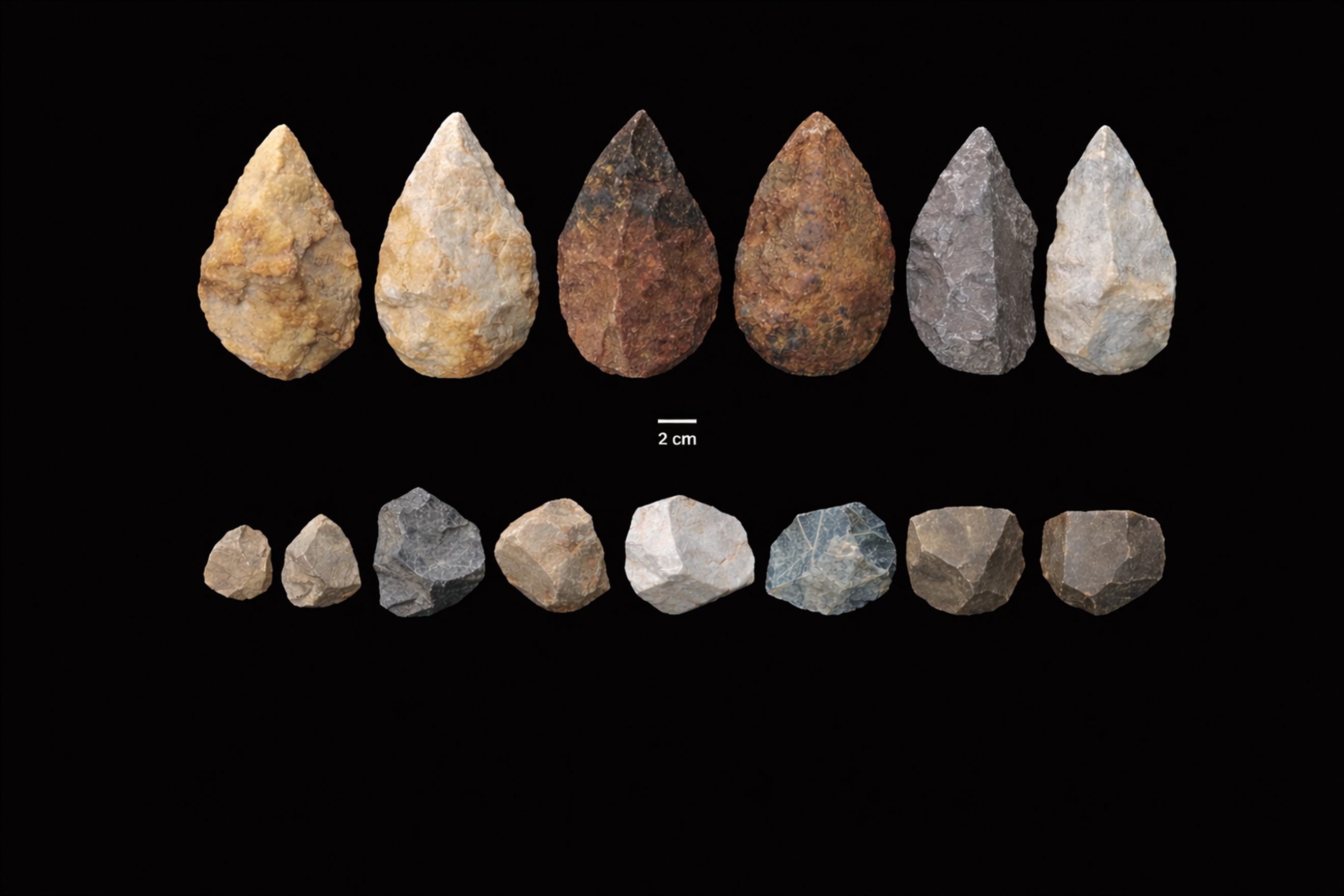
When examining the evolution of toolmaking, a clear trend emerges in the use of raw materials. In the early Oldowan culture, even predating Homo habilis (acknowledging that species evolve gradually rather than appearing abruptly), raw material use was restricted to only a few kilometers of its source, with relatively minimal selectivity in material choice (Barsky, 2009; Delagnes & Roche, 2005). By the Acheulean culture, a shift takes place: raw materials are more selectively chosen based on specific needs and intended use, though the majority of tools are still crafted from materials readily available on site (Favreau, 2023).
This increased selectivity is accompanied by significant technical advancements, including (1) reduced reliance on the inherent properties of raw materials for functional tool production, (2) an expanded range of movement to acquire and transport raw materials and tools, and (3) a growing temporal separation between the collection of raw materials and the creation of tools (de la Torre, 2016). Together, these features reflect a more complex anticipatory system (Stout et al., 2015), marking a fundamental shift in the perception of time. Thus, this shift likely encompasses both memory and future planning, suggesting that the use of tools required a more advanced ability for “mental time travel” (Hiscock, Peter, et al., 2009; Suddendorf & Busby, 2003; Suddendorf & Corballis, 1997). Notably, these changes became significantly more pronounced around one million years ago—approximately 700,000 years after the Acheulean hand axe first appeared.
As tools become essential for survival, the quality of the materials from which they are made gains greater importance. The demand for higher-quality raw materials reflects a shift in how Homo erectus perceives and interacts with the environment. As a result, the world is remapped—areas rich in superior raw materials become focal points in their movement patterns. New terrains, once inaccessible or overlooked, emerge as vital components of a reimagined spatial and practical reality.
An important point regarding the Acheulean hand axe is its rapid and widespread adoption, extending far beyond East Africa almost immediately after its emergence (Lepre et al., 2011). Whether early Homo erectus began their slow migrations out of Africa equipped with smaller, simpler hand axes and a modest toolkit—later refined through technological advancements—or whether they already carried Acheulean hand axes with larger, more advanced designs, what remains evident is the essential connection between their expanding geographic range and their evolving toolkit (Carbonell et al., 2016).
The tools Homo erectus brought with them were instrumental in adapting to and inhabiting regions with harsher climates or limited food availability. Their toolkit redefined the map of possibilities, transforming previously inaccessible resources into attainable ones. This shift fundamentally altered perceptions of proximity and distance, redefining what was considered near or far.
In Heidegger’s framework, the concept of “distance” (Entfernung) does not merely refer to physical spatiality but encompasses the experience of nearness and farness. This involves how entities become available (ready-to-hand) or unavailable (unready-to-hand) within the horizon of the Dasein’s engagement with the world: “De-distancing does not necessarily imply an explicit estimation of the farness of things at hand in relation to Da-sein. Above all, remote-ness is never understood as measurable distance” (Heidegger, 1996, p. 98). From this perspective, it becomes clear that distance is not a function of objective measurement but rather a function of availability: the extent to which something is accessible and ready-to-hand within the context of one’s engagement with the world: “To be close in the sense of de-severing is to be available for use; something is close when it is situated so as to be taken up into Dasein’s ongoing activities, regardless of its physical distance in relation to Dasein” (Cerbone, 2013, p. 136).
Tools fundamentally alter the map of availability (I-can) and, consequently, reshape the sense of farness. This transformation is just one among many. Tools not only bring the distant closer but also enable dietary changes that, over time, result in physiological adaptations, ultimately making tool use indispensable—the use of fire being the most notable example (Wrangham, 2009).
As tools become central to survival, their quality, particularly the raw materials from which they are made, becomes increasingly significant. The demand for higher-quality raw materials drives a shift in how Homo erectus perceives and interacts with the environment, elevating the importance of various minerals in their cognitive maps and practical world. Essentially, the use of raw materials marks a profound shift in how Homo erectus perceived the environment—no longer fully immersed within it, but at least to some extent detached. The land became not merely a backdrop for survival, but a resource—a quarry for mining high-quality stones to create better tools.
Importantly, the adoption of advanced technologies did not diminish Homo erectus’s capacity for simpler, practical problem-solving. They retained the ability to create ad hoc tools for immediate challenges, demonstrating a form of practical knowledge—an embodied understanding rather than theoretical reasoning. This practical confidence in addressing challenges through tool use fundamentally altered how Homo erectus perceived and engaged with the environment, reshaping their thrownness into the world.
This dual strategy of employing both ad hoc and advanced tools provided significant evolutionary benefits. Ad hoc tools allowed for rapid responses to immediate needs, such as accessing bone marrow before predators intervened or quickly cutting through the thick hides of prey. Advanced tools, on the other hand, enabled access to more complex and nutritious resources, ensuring survival in diverse and demanding landscapes. This combination of advanced and ad hoc tool use highlights Homo erectus’ adaptability and strategic approach to survival—a skillset that appears to have been particularly critical under rapidly changing climatic conditions.
Homo erectus, whose body was clearly better adapted for movement across the savannah, favored areas with more favorable living conditions, such as abundant water, reliable food sources, and climates that were better suited to their African-adapted physiology. That said, it is not far-fetched to speculate that small Homo erectus communities likely struggled to sustain themselves in many of the regions they migrated to (Carotenuto et al., 2016). In line with this hypothesis, evidence suggests that some groups were entirely wiped out by sudden climate shifts (Raia et al., 2020).
18
It within this context that the development of tools likely played a crucial role in allowing Homo erectus to adapt relatively quickly—a key distinction—to changing environments (Mercader et al., 2025). This highlights a potential link between technological advancements and survival in the face of dynamic climatic challenges (see Figure 6).
19
Hominid evolution in the context of climate changes (source: Ashley, 2009 with permission by Peter de Menocal) Within the Busidima Formation, the carbon isotopic evidence collected so far shows a gradual shift toward increasing grass cover through time, but with no apparent abrupt increases in grass abundance on the Awash floodplain as global climate was cooling and drying between 3.0 and 2.5 Ma. Climate was semi-arid and seasonally wet, based on the presence of Vertisols and abundant calcified trees. The first appearance of stone tools at Gona at this time is stratigraphically sudden and environmentally specific. The oldest stone tools are intimately tied to the first occurrence after 3.0 Ma of coarse channel gravels of the paleo-Awash, above a hiatus in the stratigraphy of perhaps 200,000 yr. This pattern suggests that the current estimate of 2.5–2.6 Ma is a minimum age for the earliest stone toolmaking in the region, and that the real beginnings of stone toolmaking lie in the 2.6–2.9 Ma period. Early stone toolmaking and use was narrowly confined to the mixed forest and edaphic grassland growing on the paleo-Awash floodplain, unlike later Acheulian toolmakers, who ranged into the secondary drainage systems and perhaps the associated open savannahs with their implements (for further debate, see Quade et al., 2004). Alongside these long-term climatic transitions, environmental volatility increased, with more frequent periods of extreme heat, cold, and fluctuating rainfall. Notably, cycles of deep lakes and arid conditions, lasting approximately 200,000 years, occurred during these fluctuations, which likely spurred significant habitat changes (Schaebitz et al., 2021). The spread of Homo erectus and their use of stone tools coincide with this period of increased climatic instability (Trauth et al., 2007). For example, the period from 1.89 to 1.69 million years ago, marked by intense moist-dry variability, aligns with the earliest evidence of Homo erectus outside of Africa, at Dmanisi, Georgia, around 1.85 Mya (Potts, 2012), and the expansion of Oldowan technology and Homo into eastern Asia (Antón & Swisher, 2004).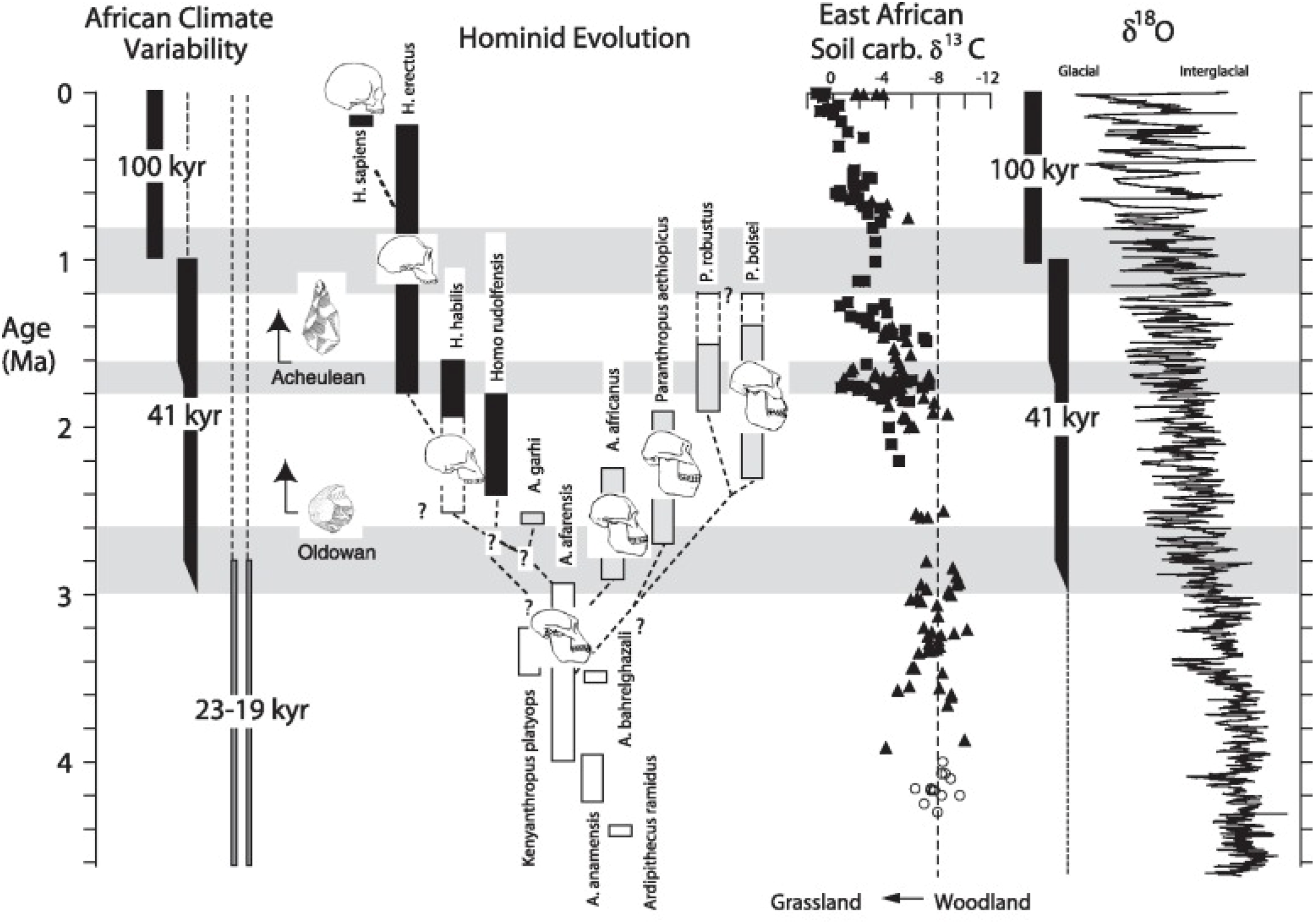
While establishing a definitive causal relationship between these climatic events and Homo erectus’ technological developments is challenging, there appears to be a correlation between periods of extreme climate variability and technological advancements: “while Homo erectus maintained consistent knapping strategies across sites, they developed specialized tools to optimize subsistence activities in dryland niches” (Mercader et al., 2025). Indeed, the increasing unpredictability of the environment, characterized by cycles of aridity and fluctuating moisture, likely triggered technological innovations as a critical means of adaptation (Potts, 2012). With this in mind, it can be proposed that the development of advanced tools by Homo erectus was likely a response to the changing environmental conditions, providing a way to adapt to new challenges and unpredictable landscapes.
We propose, however, that the evolution of tool use in Homo erectus should be understood not only as a response to changing environmental conditions but also as a reflection of a broader shift in their perception and interaction with the world. This shift goes beyond changes in the tools themselves; it likely reflects an evolving worldview that shaped how Homo erectus engaged with, understood, and adapted to their environment. In other words, the evolution of tool use was not driven solely by the tools themselves but by a developing approach to the world that enabled new actions and adaptations.
This idea addresses one of the central puzzles in Lower Paleolithic archaeology: the apparent gap between the significant biological and cultural transformations of early hominins and the technological continuity of the Acheulean handaxe, which remained in use for nearly a million years (1.8/1.6–0.4/0.25 Mya, regionally variable) (Bar-Yosef & Belfer-Cohen, 2001; Scarre, 2009; Wynn & Gowlett, 2018).
Rather than focusing on the various reasons for this “stagnation” (and, as noted, not all accept this position), we propose an alternative view. The change, as we argue in this paper, does not need to occur solely at the level of the tool itself. The change lies in how Homo erectus understood and perceived the world. As their perception increasingly adopted technological terms, so too did their need for tools. The more they viewed the world as a series of technical problems, the greater their dependence on tools became. This helps explain the abundance of tools found among Homo erectus. Indeed, the sheer number of stones found suggests that they may have developed an obsession with the hand axe.
If the focus is on technological being—that is, the change in how the world is perceived—it is reasonable to propose that this shift was the more significant development over those million years. This shift could have also manifested in morphological changes. One could argue, based on further research, that when this technological worldview matured sufficiently, it led to a more substantial breakthrough, both in tool creation and in morphological changes. To put this another way, the shift in worldview turned the hand axe into something akin to a Swiss Army knife—revealing new possibilities with each use. Eventually, the potential of this tool is exhausted (as, when combined with an oven, it fulfills many needs), and the need for new tools arises. This need emerges from a bipedal organism whose morphology has already undergone significant changes and, in many ways, sees the world differently.
This perspective, so we believe, helps explain why there might not necessarily have been a dramatic change in the tools themselves. Instead, the shift in perception could have allowed for a fundamentally different use of the very same tools. The altered way Homo erectus engaged with the world would not require an entirely new set of tools, but rather a reimagining of how existing tools could be used to address novel challenges. In other words, the tools might have remained the same, but their function, purpose, and the cognitive framework guiding their use underwent a transformation.
Homo erectus began to view the world through the lens of their toolkit, using tools to develop new strategies for acquiring food and expanding into new territories. As they encountered less hospitable environments, the need for more complex tools became increasingly urgent. Stones, once raw material ready for immediate use, were now carefully selected and adapted for specific tasks. Hand axes, in particular, became more refined in both form and function, adapting more closely to the human hand and becoming almost an extension of it—an integral part of the cognitive system. More than just a tool, the hand axe symbolized a new way of interacting with the world—a world now perceived through the prism of tools.
Does this mean Homo erectus could not survive without the hand axe? In the short term, probably not. They likely had other means of survival. Over time, however, as evidenced by various morphological changes, their reliance on tools grew. This shift in tool dependence also transformed their intentional structure. Certain tools facilitated the control of fire and the creation of ovens, leading to changes in diet and even tooth structure—a development that unfolded over hundreds of thousands of years, particularly with the Acheulean culture. This growing dependence on tools fundamentally altered how Homo erectus understood and engaged with the world. Tools became almost addictive, opening up possibilities that had previously been beyond reach, making the impossible achievable. Indeed, it appears that for Homo erectus, tools became indispensable for survival. As a result, tools may have transitioned from being simply ready-to-hand to becoming present-at-hand. The tool was no longer just something used for immediate needs, but had become an integral part of the I-Can and the intentional structure. Indeed when the world is perceived through technology, and problems are approached through technological solutions, the failure of a specific tool can evoke anxiety. In such moments, the tool shifts from an extension of action to an object—present-at-hand.
We believe that at this stage (and we do not aim to pinpoint a specific species or time period), when these early hominins begin to feel anxiety (again, this does not need to be an all-or-nothing situation), namely, fear without an object, a feeling of fear from everything and nothing at once, the true shift in the Homo species occurs. To find strong evidence supporting this claim, it is necessary to revisit the field of action of these early hominins.
Discussion
Technological Mode of Being versus Obligatory Stone Tool Use
In his article Occasional, Obligatory, and Habitual Stone Tool Use in Hominin Evolution, Shea (2013) suggests that lithic evidence before 1.7 million years ago indicates occasional stone tool use, similar to nonhuman primates, but with flaked-stone tools. According to Shea (2013) “individuals may gain fitness benefits from using tools occasionally, but not much more than conspecifics who refrain from doing so” (p. 206). Around 1.7 million years ago, hominin tool use became habitual, with tools used consistently in stereotyped ways, leading to evolutionary consequences and increased mobility.
Habitual, Occasional, and Obligatory Tool Use (based on Shea, (2013)).
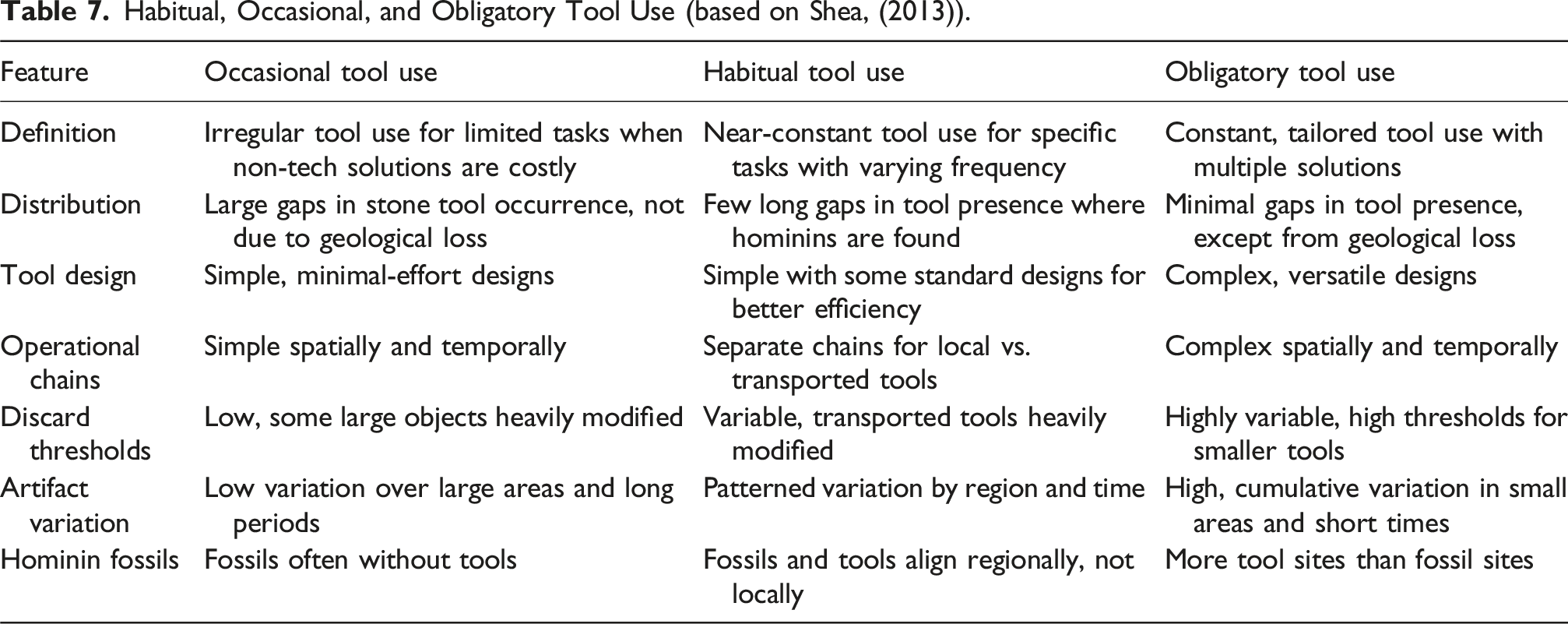
Shea (2013) claims that human obligatory tool use is a result of strong selective pressure, with serious fitness consequences. Individuals who fail to use tools for certain tasks either die immediately or suffer adverse effects. Shea contends that this shift to obligatory tool use is evident in the archaeological record, which should show evidence of long-distance transfers of high-quality rocks (e.g., high silica content) and elevated artifact discard thresholds (i.e., tools discarded after prolonged use).
Although Shea provides one of the most detailed explanations for transitions in tool use, his theory nonetheless presents significant difficulties. While Shea distances himself from linking stone tool use to language origins (“Linking obligatory stone tool use to language origins is admittedly a bit of a stretch”), it seems that he resorts to this link in order to explain the change. Several studies, including Atkinson et al. (2018), challenge the idea that the FOXP2 gene underwent a selective sweep, and increasing evidence suggests that language (or proto-language) evolved much earlier than Shea’s theory proposes (Fitch, 2010; Tobias, 1983).
What is important here is that the need for explanatory factors indicates that, in the final analysis, the change is a result of an improved cognitive system—the focus remains on the subject. In the end, an explanation that centers on the subject falls deep into Cartesian metaphysics—“I think, therefore I am.” Thus, if there is one thing to take from this study to the empirical research in the field of paleoanthropology, it is the abandonment of the autonomous, rational subject (a product of the Enlightenment project) and the shift towards thinking about humans in terms of being-in-the-world.
In principle, Shea, a thorough researcher, focuses on the form of the tool itself. He attempts to explain why a period of stagnation occurred and why innovation emerged later. However, it is clear that the core of his theory is grounded in changes that occur at the level of the tools themselves. In our view, the problem lies here: if we indeed focus on the tools themselves, a more accurate perspective could suggest that these changes reflect cognitive shifts (although we do not fully endorse it, this perspective is difficult to dismiss once we accept Shea’s approach). These cognitive shifts, in turn, enabled more complex planning systems and stronger computational abilities. This, once again, places the human being as a rational animal at the center. It redirects the focus back to the brain and cognition, where tools simply reflect these abilities, much like language does. Therefore, the concept of tool commitment becomes a side effect. This distinction highlights the strength of the approach presented in this paper, which moves beyond a narrow focus on tools alone. Essentially, then, from the perspective we propose, the focus is neither cognition nor the tools themselves (which, in the final analysis, reflect cognitive changes), but rather the technological mode of being. It is precisely against this background that we can appreciate the significance of Martin Heidegger’s (1977) warning against confusing tools with Technology.
Reframing the Evolutionary Story
In Technics and Time, Stiegler (1998) argues that “The evolution of the ‘prosthesis,’ which is not alive yet defines the human as a living being, constitutes the reality of human evolution... it is the tool, tekhnê, that invents the human, not the other way around” (pp. 50–141). Stiegler builds on the work of French archaeologist and ethnologist Leroi-Gourhan, a pioneer in prehistoric technology. In the context of the Zinjanthropus—an australopithecine that lived between 2.3 and 1.2 million years ago in East Africa—Leroi-Gourhan (1993) asserts: “Humans still have a long journey ahead, but it will be less about biological development and more about freeing themselves from their zoological context, with society gradually replacing the phyletic stream” (p. 116). More recently Szathmáry (2015) stated “biology gives room to technological and communal cultural evolution. Due to social care (including medicine) and agriculture, the biology of humans has become gradually de-Darwinized. It is culture where the main action is going on.”
This article aligns with Leroi-Gourhan’s ideas, presenting a radical—yet still speculative—claim that the primary evolutionary engine in the story of Homo is technology (for further debate see: Ataria, 2025b). In other words, the central movement of Homo is toward an increasing commitment to tools, and it is this commitment that shapes morphology, biology, and cognitive systems. However, the argument presented here is even more radical. The key evolutionary process is not specific tool improvements, but Technology itself—as a mode of being. It follows that the species-based division adopted in this article—chimpanzees, australopithecines, Homo habilis, and Homo erectus—is, strictly speaking, methodologically inadequate. What ultimately needs to be understood is not morphology as such, but the technological mode of being, approached through—but not reduced to—morphology and tools.
Heidegger (1977) warns against confusing tools with
Though it may seem abstract, this idea is quite concrete. Language, or proto-language, predates Homo sapiens; humans are born into specific cultures, which are reflected in the structures of their languages. (For instance, the word “black” is associated with “dark,” “lie,” and “evil” in particular ways especially in Western culture Caliskan 2017; Gan 2016; Sherman 2009). This semantic network shapes our perceptions and actions in the world. Similarly, each species is born into a system of signs, which influences how it interacts with the world. The technological mode of being is akin to language—a comprehensive system through which we engage with, perceive, and act in the world. This system cannot be reduced to a single tool or cognitive system; it is greater than the sum of its parts. Ultimately, the technological mode of being is a state where nature is perceived as a resource to be exploited, and not only nature.
Concluding Remarks
Chimpanzees use sticks and other tools, often in quite impressive ways, but they can function perfectly fine without them. They use stones, yet they are not fixated on adapting them to their hands; likewise, they do not carry them from place to place in anticipation of future use, and it is clear that they would not embark on a journey of several kilometers to find the perfect raw material for a particular stone to fit a specific task. With this in mind, we can suggest that while chimpanzees use tools, sometimes quite skillfully, these tools remain merely a means to an end. They are never part of a complete tool kit, and chimpanzees do not appear to develop a deep dependency on them. Once used, the tools quickly revert to being part of the natural environment—neither tool nor object.
The chimpanzee engages in diverse activities with tools, but it does not open up to the world through them. The chimpanzee’s I-Can structure is not rooted in tools, meaning it is not dependent on tools and can function without them. The chimpanzee is not thrown into the world through a specific set of tools, nor does it conceptualize its reality in terms of problem-solving with tools. Hence, if a tool breaks, the chimpanzee does not develop anxiety, nor does it perceive the tool as present-at-hand.
In the transition—from chimpanzee to Australopithecus, to Homo habilis, and finally to Homo erectus—we observe not only innovations and gradual improvements in tools, but, perhaps more crucially, an increasing dependence on them. In simple terms, the emergence of Homo species is marked by a growing reliance on tools. However, as we argue in this article, while these changes are significant, they do not fully explain the rise of the Homo species. What is truly pivotal is the transformation in how the world is perceived, understood, and engaged with. In other words, what matters is not just the use of tools, but the way in which one is thrown into the world through them.
One can thus think of the transition from chimpanzee to Homo erectus as follows: from tools that can be created ad-hoc, almost improvised, to tools for which significant energy is invested to locate their raw materials; from tools used in a temporary and local situation and then left there, to tools that are carried along; from a tool that can be used once without special adaptations, to a tool that becomes increasingly adapted to the hand; from a single tool to a set of tools.
This transition can also be described as follows: from tools (technologies) to a technological mode of being (techno-logy). These changes do not merely indicate technological improvements linked to higher cognitive abilities and a larger brain, which is likely wired differently, but also a different way of being-thrown into the world through these tools: understanding the world and acting within it through tools, but more importantly—treating the environment as a resource.
*
This article follows a long tradition that both agrees with and challenges Heidegger (Habermas, 1971). We believe there is a distinction to be made between tools (technologies) and
We contend that the current study presents a puzzle that scholars engaging with Heidegger as a philosopher must confront: what, precisely, distinguishes tools (technologies) from Technology as such? Is there genuinely a gap between them, and if so, does it amount to an abyss, or is it a gap that remains, at least in principle, bridgeable? In light of the present research, we suggest that this relation is best understood as one of tension. On the one hand, there is a substantive discontinuity between tools and Technology; on the other, particular technologies appear to incorporate elements of the technological mode of being itself. In this sense, tools do not merely belong to the Technology of a given historical period (in terms of centuries or millennia); they also reflect it. Accordingly, aspects of a technological mode of being can be discerned through an analysis of the tools themselves.
This has dramatic implications for pure philosophical research, as it forces us to think of “early Heidegger” and “late Heidegger” as a unified whole, and of course, also for empirical research. Another result is a rethinking of the question of what technology actually is. Often, when reading Heidegger’s “later” works, it seems that everything conforms to the technological mode of being—almost like a new form of divinity. It is precisely the focus on studies such as those examining chimpanzee tool use that raises the question: Are these merely tools, or are they necessarily part of a specific technological mode of being? These are, of course, big questions, but we learn that not only does the empirical world benefit from Heidegger’s approach, but foundational issues in his philosophy are also brought to a certain level of clarification.
It is at least somewhat surprising that recent attempts to rethink the relationship between the “early Heidegger” and the “later Heidegger” generate new questions about the role of tools in the emergence of the genus Homo. As our reflection on the relation between early Heidegger's analysis of tools and later Heidegger's account of Technology has shown, the following question arises: Is there an accumulation of tools that leads from a single tool to a toolset, and from a toolset to a technological mode of being? Can specific threshold points be identified and defined? Alternatively, one might ask whether the technological mode of being is not tied to tools at all, but is instead essentially related to something else. This direction seems plausible, especially since Heidegger (1977) repeatedly highlights the representation of the world as the truly significant change: “The fundamental event of the modern age is the conquest of the world as picture. The word ‘picture’ [Bild] now means the structured image [Gebild] that is the creature of man, producing which represents and sets before” (p. 134). If the ability to represent the world in a specific way preceded the scientific revolution, and in fact served as a condition for the scientific revolution—the transformation of nature into representation and model—then it becomes unclear in what sense the technological mode of being is tied to tools. This raises the possibility that attempts to trace the development of tools in relation to the evolution of Homo may, in fact, be fundamentally misguided—a conclusion that carries, without doubt, far-reaching and potentially dramatic implications for the study of paleoanthropology.
*
This paper thus argues that anxiety arising from the failure of certain tools underpins humanity’s evolutionary development. 20 Indeed, until now, we have not addressed this point clearly enough, so let us be very explicit once more. The argument implied in this text is that anxiety resulting from the malfunctioning of a tool is evidence of the intensity of being-thrown into the world through a technological mode of being. Notice that we explicitly connect the inability to use a specific tool with the technological mode of being. the world through a technological mode of being. This means that the way we use particular tools—and the character of those tools themselves—attests to a technological mode of being (As noted, this position stands in contrast to approaches that sharply separate Heidegger's analysis of tools from his account of Technology). With this in mind, let us present the central claim of this paper: the emergence of genus homo and the transition into a total technological mode of being is manifested in the possibility of a specific tool being in a state of present-at-hand. The more we are thrown into the world through technologies, the more technological being becomes all-encompassing and total, and the greater the anxiety tied to technological failures. It’s important to emphasize again that this is not a binary situation—anxiety doesn’t always manifest in the way it is understood in Western thought, which often frames it in psychiatric terms. When viewed through this lens, it’s clear that even modern hunter-gatherer tribes, who still exist today, do not experience anxiety when their tools are not in use or when they are missing tools. The issue here relates more to how we conceptualize anxiety, rather than the phenomenon itself. Practical knowledge and the ability to improvise create a situation where, almost anywhere, one can create ad-hoc tools, making it difficult to pinpoint such anxiety. It’s similar to a situation where a skilled tradesperson visits your home—they have a toolbox, and in addition, they have a vehicle parked outside, essentially a mobile workshop. If that isn’t enough, it seems they can take a coin from their pocket and use it as a screwdriver. In this case, it’s hard to identify anxiety—but that doesn’t mean it isn’t there. In fact, the number of tools reflects the anxiety underlying their actions: the fear that there may be a moment when they won’t have a tool to use.
Anyhow, it is almost self-evident that this process did not begin with the exact natural sciences, nor does it end with the camera or the atomic bomb. This is a process that has accompanied the evolution of primates and the Homo species from the very beginning: the use of tools, being-thrown into the world through those tools, and within an overarching technological mode of being in which everything stands ready for use—the world turns into raw material.
To our understanding, research on the emergence of the Homo species should focus on this question: When did the absence of tools begin to provoke anxiety? In other words, when did primates start seeing the world through the technologies they used and could no longer think of reality outside of terms of technical problems and technological solutions? This is, in many ways, not a new suggestion. Oakley (1959) aptly wrote, “If man is defined as a tool-making animal, then the problem of the antiquity of man resolves itself into the question of the geological age of the earliest known artifacts…” (p. 5). We believe that we need to try to identify “moments” when the inability to use tools began to provoke anxiety. In this research, we have focused on the use of raw materials—how far one is willing to go to obtain them. But of course, this is only the beginning—we have worked with the findings we currently have. We believe the approach that has been suggested in this paper could push new research directions—what kind of findings should we be looking for?
*
Before closing this paper, we would like to raise three reservations or even warnings: 1. There is no doubt that Heidegger would oppose thinking of his philosophy in evolutionary terms. However, even if he does not explicitly acknowledge it, he does so (at least to some extent) in his 1929 book The Fundamental Concepts of Metaphysics (1995) and in his book Parmenides (1992), where he discusses the connection between hand, language, and thought. In any case, our approach does not occur in a vacuum—interpreters such as Derrida (1989) and Stiegler (1998) have already moved in this direction. 2. It is difficult, perhaps impossible, to think of chimpanzee behavior outside human terms. As much as we try to be aware of this challenge, it remains a weakness in almost any text that describes chimpanzee behavior and intentions—this text is problematic for the same reasons. This issue becomes even more pronounced when describing extinct species like Homo habilis, for which we have no direct means of observation in real time. 3. It is undoubtedly difficult to think about the rise of humanity not from our present state as it exists today—and without a doubt, our present is technological. With this in mind, it is quite clear that the conclusions of this paper remain provisional, insofar as they depend on whether the key concepts—readiness-to-hand, anxiety in the face of tool breakdown, and the disposition to treat nature as a resource—can withstand cross-cultural scrutiny.
Footnotes

Authors’ Contributions
Yochai Ataria authored all sections of the article except the “Chimpanzees” section, which was written under the lead authorship of Itai Roffman.
Funding
The authors received no financial support for the research, authorship, and/or publication of this article.
Declaration of Conflicting Interests
The authors declared no potential conflicts of interest with respect to the research, authorship, and/or publication of this article.