







Abstract
The purpose of this single-group pre- and posttest intervention pilot study was to teach middle school migrant farmworker children the benefits of healthy eating and activity using a multimedia and ethnic-tailored health curriculum, embedded in a 7-week summer Migrant Education Program. Conceptual frameworks were from transcultural nursing, education, and child development. Student-made video productions enhanced classroom learning and content retention. Outcomes were health infomercials, body mass index (BMI), BMI percentile, muscle strength and flexibility, and We Can! and Coordinated Approach To Child Health (CATCH) surveys. Sixty-four students were enrolled (girls n = 31, boys n = 33), 96% Latino, and 65% were overweight or obese. Students had significant improvement in 12 knowledge and attitudes measures with significant gender differences in 11 measures. Although not statistically significant, trends toward healthier weight were seen. Five student infomercials were produced. The school environment effectively delivered health promotion to migrant children and will serve as a prototype for middle school health interventions.
Introduction
The school environment has been identified as a key setting for health promotion (Naylor & McKay, 2009; Salmon, Booth, Phongsavan, Murphy, & Timperio, 2007). Schools can serve as an important resource in obesity prevention and present as a force for social change in the effort to have healthy children (Schwartz & Brownell, 2007). Schools can create an environment and opportunities where students can learn about and practice healthy lifestyle choices. Many states have proposed legislation for school-based evaluation of unhealthy weight (Institute of Medicine, 2009) and numerous school and community healthy weight and healthy nutrition interventions have been or are being scientifically tested for feasibility and effects on outcomes. Yet unpublished data show that 47% of the students grades 1 to 8 attending a Midwest Migrant Education Program (N = 386) were overweight or obese (Kilanowski, 2010).
The research questions were would students who participated in the videography intervention study demonstrate (1) increases in personal knowledge and attitudes toward healthy choices and (2) improvements toward healthy body mass index (BMI) percentiles (BMI-p) and muscle strength and flexibility? The purpose of the Migrant Middle School Media Nutrition Project was to test the effectiveness of a middle school multimedia curriculum intervention as a tool to change behavior focused on healthy eating and physical activity.
Background
The Child and Nutrition and WIC Reauthorization Act of 2004 mandated that any school district that received federal assistance with meal programs must establish nutritional guidelines for all foods served, establish goals for nutrition education, and physical activity (Belansky, Chriqui, & Schwartz, 2009). However, the schools were required to only establish general goals, evaluation procedures were weak, there was no consistency across districts, and no funding was authorized to assist in the implementation. Despite this mandate, a review of the current literature on school-based intervention programs for unhealthy weight showed that no persistence of positive results in reducing obesity in school-aged children has been found (Shaya, Flores, Gbarayor, & Wang, 2008). Positive statistically significant results in outcome measures from health promotion interventions have been reported with content in physical activity only, nutrition education only, and with both nutrition education and physical activity. However, long-term successes of programs have been threatened by reductions in school system budgets seen in reduction in nonacademic activities, activity program resources, and suspension of nonacademic classes. Interventions for childhood obesity have shown promise; however, there are insufficient numbers of randomized control trials (Small, Anderson, & Melnyk, 2007). Furthermore, these programs have been designed for the majority population, and inclusion of children of diverse ethnicity and race have been limited (Pate et al., 2006).
In the United States, the most rapidly growing ethnic minority is the Latino population with 28 million American residents of Mexican heritage (U.S. Census Bureau, 2008). Within this minority populace are approximately 3 to 5 million migrant farmworkers with the majority originating from Mexico (U.S. Department of Labor, 2010). It has been documented that migrant farmworkers display worse health status than the majority population (Kandula, Kersey, & Lurie, 2004; Rubalcave, Teruel, Thomas, & Goldman, 2008). It has been estimated that there are at least 2 million migrant children accompanying their parents during migrant employment (National Center for Farmworker Health, 2009). The majority of these children are U.S. citizens and represent a vulnerable and marginalized group experiencing health disparities. Past research has shown that a paradigm exists with migrant families. These workers harvest produce to bring fresh fruits and vegetables to the tables of American families, and yet the children of migrant workers rarely meet the U.S. Department of Agriculture recommended minimum food group servings of fruit or vegetables; neither do they meet recommendations for grains, dairy, and meat (Kilanowski, 2012; Kilanowski & Moore, 2010). National surveys show that rates of unhealthy weight in Latino youth are higher than the majority population, but the Latino subpopulation of migrant farmworker children measure even higher (Kilanowski, 2010, 2012; Ogden, Carroll, Kit, & Flegal, 2012).
Some interventions have included in their samples children from ethnic and racial groups, but there are insufficient interventions specially designed with cultural sensitivity for vulnerable populations to address documented health disparities (Flynn et al., 2006). The gap in the knowledge is the effectiveness of using multimedia in an existing migrant student summer program for healthy weight interventions, and this has not been published. However, there is information on the relationship of the media on overweight and obesity among Latino youth. Research has shown that Latino youth view more media daily when compared to White youth (13 total hr/day vs. 8 hr 36 min/day) and that increased television (TV) viewing has been associated with the increased consumption of calories through snacking (Robert Wood Johnson Foundation, 2011). It further found that each additional hour of TV leads to an extra 167 calories per day. Therefore, a study where Latino youth learn about the influence of media on personal decision making and use student-created media to influence their peers is appropriate.
Cognitive research has shown that learning is most effective when there is active engagement, group participation, frequent interaction and feedback, and connections to real-world contexts (Pippert & Moore, 1999). Research on the use of multimedia in the classroom showed greater peer interaction and that the interactions were qualitatively different from those that characterized other classroom activities (Reinking & Watkins, 2000). Also found was that the use of multimedia obscured differences in academic achievement that were more visible in other academic activities, and many students acquire different, more active, persona when involved with project activities. Student-produced media affected teaching and learning by offering the opportunity for differentiated learning. Research results have shown that students who participate in computer-connected learning network showed increased motivation, deeper understanding of concepts, greater creativity, and an increased willingness to tackle difficult task (Roschelle, Pea, Hoadley, Gordin, & Means, 2000). In addition, the projects give students a real sense of purpose and pride. The use of multimedia in the classroom changes the classroom from one that removes the teachers as the center of instruction to one that is student centered. The resulting creative projects enhance self-esteem.
The We Can! intervention with its Coordinated Approach To Child Health (CATCH) modules demonstrated the ability to disseminate a multicomponent, multiyear school health program and has shown generalized success with increasing physical activity and in some measures of the nutritional component (Kelder, Hoelscher, Barroso, & Walker, 2005). The CATCH curriculum (N = 357, ages 8 to 14 years, grades 2 to 8) has shown to have significant findings improving food knowledge, food attitude in self-efficacy, intentions to reduce fat, intentions to drink skim milk, healthy eating behaviors in eating fruits and vegetables and reading labels, physical activity attitudes, and decreasing screen time behaviors in weekday viewing (National Heart Lung and Blood Institute [NHLBI], 2007). However, only 6% (21) of the sample was Hispanic. The Media-Smart Youth curriculum, a component of the WeCan! Intervention, was evaluated in youth (N = 74, 1% Latino) and was designed for middle school students to improve media literacy while promoting healthy eating and activity (NHLBI, 2007). Improvements in knowledge and skills in nutrition and physical activity, media awareness, and analysis of media’s messaging were seen in those who participated in the curriculum compared to the control group. In addition, student participants increased their intentions to do more weight-bearing activities in the next month and showed positive trends in reducing consumption of unhealthy snacks. Few past studies have examined the effectiveness of these health promotion interventions in underserved populations. Previously, Latino children occupied small percentages in samples until recently with the Coleman et al. CATCH (2005) study that showed success in slowing the risk of unhealthy weight in both boys and girls. No published literature has examined a sample size of migrant children.
Theoretical Framework
Three disciplines contributed to this study’s research framework: transcultural nursing, child development, and education. Achterberg and Miller (2004) concluded that no one nutrition education theory can serve all people under all conditions and they suggested that a polytheoretical model might provide a stronger framework for education and research. Transcultural nursing honored the students’ ethnicity, family values, foods, and the migrant lifestyle (Leininger, 2002). The developmental milestones of understanding rules, cooperation in working together toward a goal, and participation in media activities where body image differences do not dictate success guided the middle school group dynamics (Erikson, 1963; Piaget, 1963; Sullivan, 1953). Education theory guided methodology. When the learner builds connections between ideas, and blends personal experiences with formal knowledge, integrated learning occurs (Bransford, Brown, & Cocking, 1999; Krajcik, Czernaik, & Berger, 1999). The curriculum combined hands-on learning exercises with structured lesson plans and yielded a transformational approach. The approach to teaching and learning was dynamic and helped the student make sense of the materials presented, rather than memorizing nutrition and physical activity facts.
Method
This pilot study design is single-group pre–post nonexperimental and exploratory, testing the effectiveness of a middle school intervention multimedia module as a tool to change behavior in nutrition and physical activity. This research endeavor was an academic and community collaboration and approved by university Institutional Review Board through expedited review. The Migrant Education Program (MEP), funded through formula grants from the Education of Migratory Children, Title I, Part C, provides remedial education programs for the migrant farmworker children (U.S. Department of Education, 2008). Promoting student success and meeting the unique needs of migrant children is the goal of the MEP and is free to qualifying families. Noteworthy, there is no standardized MEP curriculum and local domain and classroom teachers control curriculum content with reference to state educational grade-level standards. Embedded in the 7-week summer MEP was this study’s health curriculum intervention. Protection of human subjects was approved through expedited review by Case Western Reserve University Institutional Review Board.
Participants
The research study was conducted in the largest summer MEP in a Midwestern state housed in a high school technical center that has a well-equipped computer laboratory and Mac (Apple, Inc., Cupertino, CA) computers. The hours of summer school operation were 8 hr a day, 5 days per week, and 7 weeks in length from June to August. The certified teachers and teachers’ aides who staff the MEP are often Latino. A sample size (N = 40) for a two-tailed t-test with a large effect size was required (Cohen, 1988).
Measurements
All outcome variables were assessed at the beginning of the MEP (T1 baseline preintervention) and at the conclusion of the summer program (T2 exit postintervention).
Anthropometric and muscle strength and flexibility assessments
Anthropometric measures were collected in stocking feet and street clothes behind a privacy screen with a digital scale (Tanita, Arlington Heights, IL) and portable stadiometer (Seca, Columbia, MD). The Centers for Disease Control and Prevention Internet site (2011) was then used to calculate pediatric BMI and BMI-p. The Young Men’s Christian Association (YMCA) has established the measure for muscle strength as the number of student push-ups (“YMCA Fitness Testing & Assessment Manual,” 2000). In addition, the sit-and-reach test, the most widely used research measure of muscle flexibility, was administered. Anthropometric and muscle strength and flexibility assessments were measured twice and recorded.
Knowledge and attitude and behavior assessments
Students’ nutrition and physical activity knowledge and attitudes and behaviors toward healthy choices were evaluated by the age-appropriate WeCan! assessments from the CATCH Kids Club and Media-Smart Youth that have noted reliability (NHLBI, 2012). The CATCH assessments relate to knowledge about healthy eating and physical activity, food attitudes to reduce fat in the diet and intention to drink skim milk, attitudes on healthy eating and physical activity, and media screen time. The booklets are colorful and have drawings of healthy and unhealthy food that students select. Questions ask how they feel about making healthy changes and if they think they can increase health behavior options. Responses to questions range from I didn’t eat any (scored a 0) to I ate it 3 or more times (scored a 3). A yes response was scored a 1, and a no response as 0. Each subscale of the CATCH assessment is given a summed score with a different maximum score depending on the number of items. A total CATCH scored is also calculated.
Media-Smart Youth evaluations have similar questions on healthy choices but also include questions on media literacy. Examples are what was the message of an advertisement, what audience was the intended target, and what visual effects were used to gain the viewers’ attention. Correct responses to knowledge questions are scored with one and a no response scores a zero. Each subscale is then given a summed score. In this study, the Cronbach’s αs of the CATCH and Media-Smart assessments varied with sample sizes (n = 49–56) and number of subscale items. The range for subscales that were later found to have significant differences T1 and T2 was a low of .580 to a high of .853 with a mean Cronbach’s α of .721.
Procedure
The research study healthy eating education was incorporated into the MEP curriculum for middle school students. All migrant parents sign a general enrollment form giving permission for their child’s participation in all activities of the MEP. Additionally, all middle school parents and students enrolled into the study signed consent and assent forms. Middle school students were divided into three groups and rotated through 45- to 60-min block periods of programming. Each day, the middle school students had one period each of reading, mathematics, career development, science (curriculum on healthy eating, nutrition, and exercise), physical education, and the study’s media curriculum. Daily, summer weather permitting, outdoor recess was held after lunch. Media study classroom photographic and videographic materials were provided by the researchers.
The science teacher utilized a nutrition and physical activity curriculum that was previously pilot tested for the two past summers. Curriculum content was derived from organizations such as the National Association of Pediatric Nurse Practitioners and the American Academy of Pediatrics who have established clinical practice guidelines in the prevention and treatment of childhood overweight. Objectives and curriculum content were culturally tailored to complement the Latino migrant child and their itinerant lifestyle. These adaptations included foods choices that were familiar to the Latino migrant children and physical activity choices that were within the resources of the migrant residential environment and migrant family resources. Objectives addressed nine tenets that included the food pyramid and My Plate, eat more fruits and vegetables, eat a healthy breakfast, eat more family meals, decrease television and electronic game time to 2 hr per day, be physically active every day for at least 1 hr, limit sugar-sweetened drinks, consider food serving portion sizes, and read food labels.
The study on middle school videography as a tool to change behavior is reported here. A media specialist led daily classes in photography and videography skills. Classroom content included use of the software programs Photoshop CS6 (Adobe Systems Inc., San Jose, CA) and Final Cut Express (Macromedia, Inc & Apple, Inc., Cupertino, CA), camera angles, composition, and aperture. The goal was to engage students in an active engagement of learning and a hands-on experience to teach others (and themselves) healthy choices. Students were challenged to become engaged in videography to produce infomercials on healthy eating and exercise and reinforcement of the classroom science content. Background curriculum content to educate students on the media awareness and its power on consumer consumption, and media production launched the video classes. Resources for this were chapters from Media-Smart Youth from the We Can! study (NHLBI, 2012). Goals of Media Smart Youth were to increase media literacy skills and help middle school students (1) become attentive and critically appraise how media can affect their physical activity and nutrition choices; (2) build a skill set to make good decisions about incorporating into their daily lives physical activity and nutritious eating; and (3) encourage the establishment of lifelong healthy habits.
The three equal groups of middle school students were each responsible for the creation of health infomercials from storyboard, script writing, creation of props and backgrounds, filming, and video editing. All digital and video cameras, camera accessories, supplies, and funds for props were supplied by the study. Since this was a collaborative effort, the salary of the media specialist was under grant funding support and the MEP provided classroom space.
Intervention fidelity was monitored by the suggestions of Bellg et al. (2004) and Borrelli et al. (2005). Student dosing was monitored by daily attendance. Evaluation of the media teacher by the students was completed midpoint and at the conclusion of the study. The media teacher kept a log of classroom content compared to study protocol objectives. The principal investigator randomly monitored classes, and feedback was provided to the teacher to monitor drift from the curriculum. Pre- and posttest knowledge measures documented understanding of the curriculum materials.
Data Analyses
Quantitative variables were described by mean and standard deviation (SD) or median with interquartile range (IQR) where appropriate, and categorical variables were described by frequency and proportions. Paired t-test, Wilcoxon signed-rank test, or McNemar test was used to compare the changes in survey outcomes after intervention. Effect size was provided for the estimated magnitude of the difference. Subgroup analyses were conducted for boys or girls, respectively, to study the gender effect on survey outcomes changes after the intervention. Correlation coefficients were provided to study the relationships between the outcome changes and baseline BMI or BMI-p changes. The two-sided significance level was set as .05. Data were analyzed employing SAS statistical software, version 9.3 (SAS Institute, Cary, NC).
Results
In summer 2011, 64 middle school students were enrolled into the study (girls n = 31, boys n = 33). The student ranged in age from 11 to 17 years with a mean of 13.2 years (SD = 1.4). Students self-reported to be of Hispanic/Latino ethnicity (96%), other (3%), and White (1%). However, all students were identified by parent report to be Latino, and all students were children of qualifying migrant worker families. In the National Agricultural Workers Survey, migrants are defined as persons who travel at least 75 miles during a 12-month period to obtain a farm job (U.S. Department of Labor, 2004). More than one third (38%) of the students were in the sixth grade, 30% were in seventh grade, and the remainder were in eighth grade. A few traditional high school students were placed in middle school due to academic needs. The majority of families identified their permanent residence as being either Florida or Texas. The length of the summer program was 34 days and had a rolling admission policy. Students were enrolled for an average of 28.32 days (SD = 6.801, range 14–34 days) and actually attended classes for an average of 24.35 days (SD = 8.921, range 5–34 days). Therefore, the average attendance in the intervention was 86% for the 64 students enrolled at MEP. Forty-one percent of the students attended 30 days or more and eight students attended only 10 or fewer classes. The low attendance was most likely due to age-eligible students who choose to work in the fields harvesting blueberries or grapes. At baseline T1, 20% of middle school students had a BMI-p classified as overweight and 45% were obese. No child was underweight.
Anthropometric and Muscle Assessments
The children’s BMI-p was reduced from the mean of 25.89 (SD = 5.55) at baseline to 25.80 (SD = 5.64) after intervention with 95% confidence interval (CI) of [−.46, .63], t(48) = .32, p = .75. At T2, there was a nonsignificant decrease in mean BMI with p value of .09 (SD = 1.89), but it did not achieve statistical significance (p = .75) from signed rank test. However, there was a significant association between BMI-p category at T1 to T2 (Fisher’s Exact Test p = < .0001, n = 50).
Survey outcomes improvement after intervention
Twelve survey outcomes were significantly changed after intervention covering the categories of knowledge, attitudes, intentions to do the next month and healthy behaviors (Table 1). Nutrition knowledge and physical activity knowledge were significantly improved with the larger than medium effect sizes (Cohen, 1988). Healthy eating behaviors like reducing fat, eating fruits and vegetables, and reading labels were successfully raised awareness. Physical activity attitudes were strengthened. Left sit-and-reach and pushup behavior were increased, while TV viewing time on weekday was significantly decreased. In addition, we explored the correlations between survey outcome changes and BMI-p changes. Increased fiber eating behavior was significantly correlated with greater BMI-p reductions (n = 39, rho = .35, p = .030. More improved nutrition knowledge (n = 35, rho = .32, p = .060), and TV time reduction (n = 39, rho = −.27, p = .098) were marginally related to greater BMI-p reduction. Surprisingly, stronger intention to eat more whole grain foods during the next month was marginally related to less BMI-p reduction (n = 35, rho = −.29, p = .089).
Significant Assessment Outcomes After Intervention (T2–T1) Using Paired t-Test or Wilcoxon Signed-Rank Test.
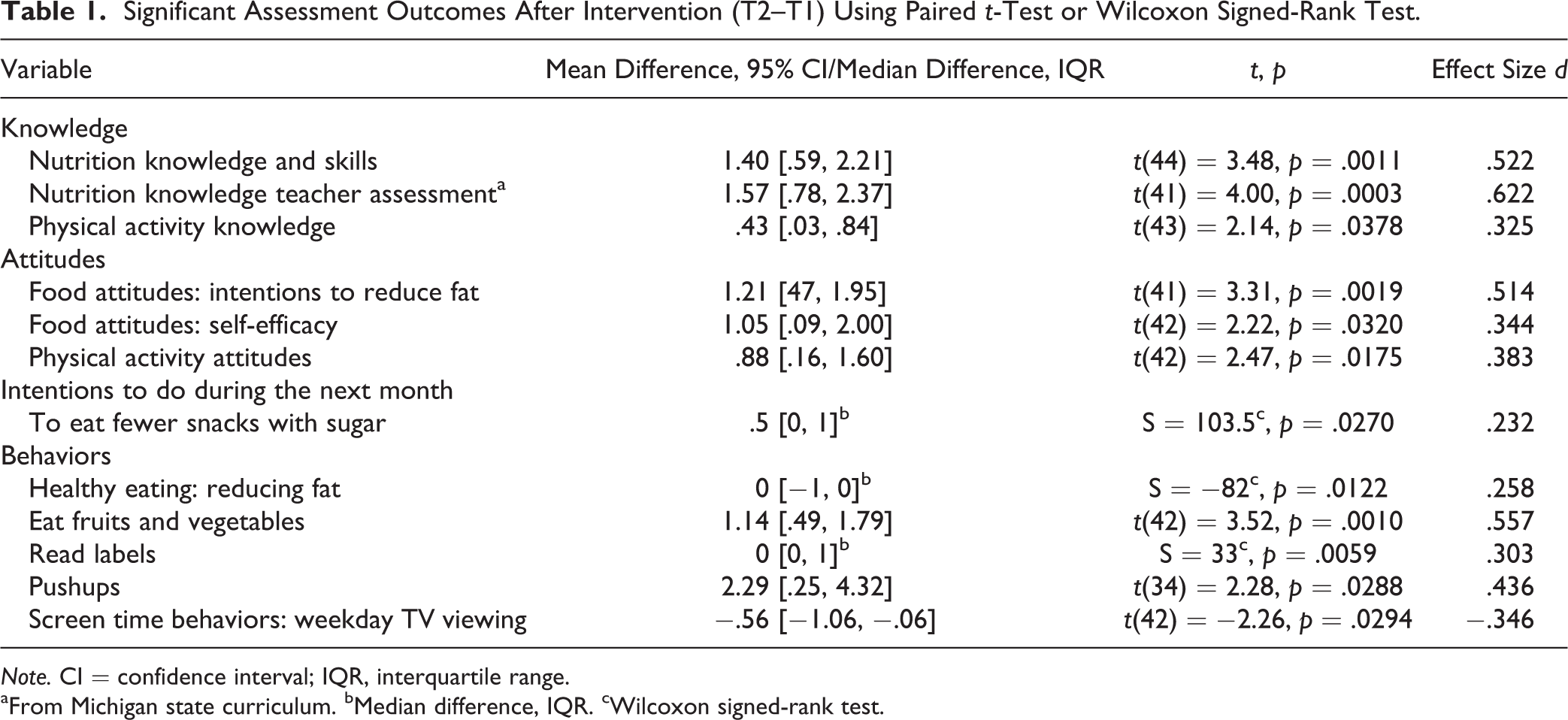
Note. CI = confidence interval; IQR, interquartile range.
aFrom Michigan state curriculum. bMedian difference, IQR. cWilcoxon signed-rank test.
We further investigated whether the changes in survey outcomes after intervention participation had differences by gender. Subgroup analysis results showed that there were significant gender differences in the 11 scales of CATCH, Media-Smart Youth and physical measures of assessments (Table 2). Post intervention, boys obtained higher level of nutrition knowledge and stronger intentions of being physically active, eating more fruit, and fewer sweet snacks. Postintervention boys decreased TV viewing time compared to baseline. In contrast, post intervention, girls achieved higher level of food knowledge and healthier food attitudes in reducing fat and in self-efficiency. Girls had increases in left sit-and-reach efforts.
The CATCH and We Can! Assessment Outcomes With Different Significant Results Between Boys and Girls.
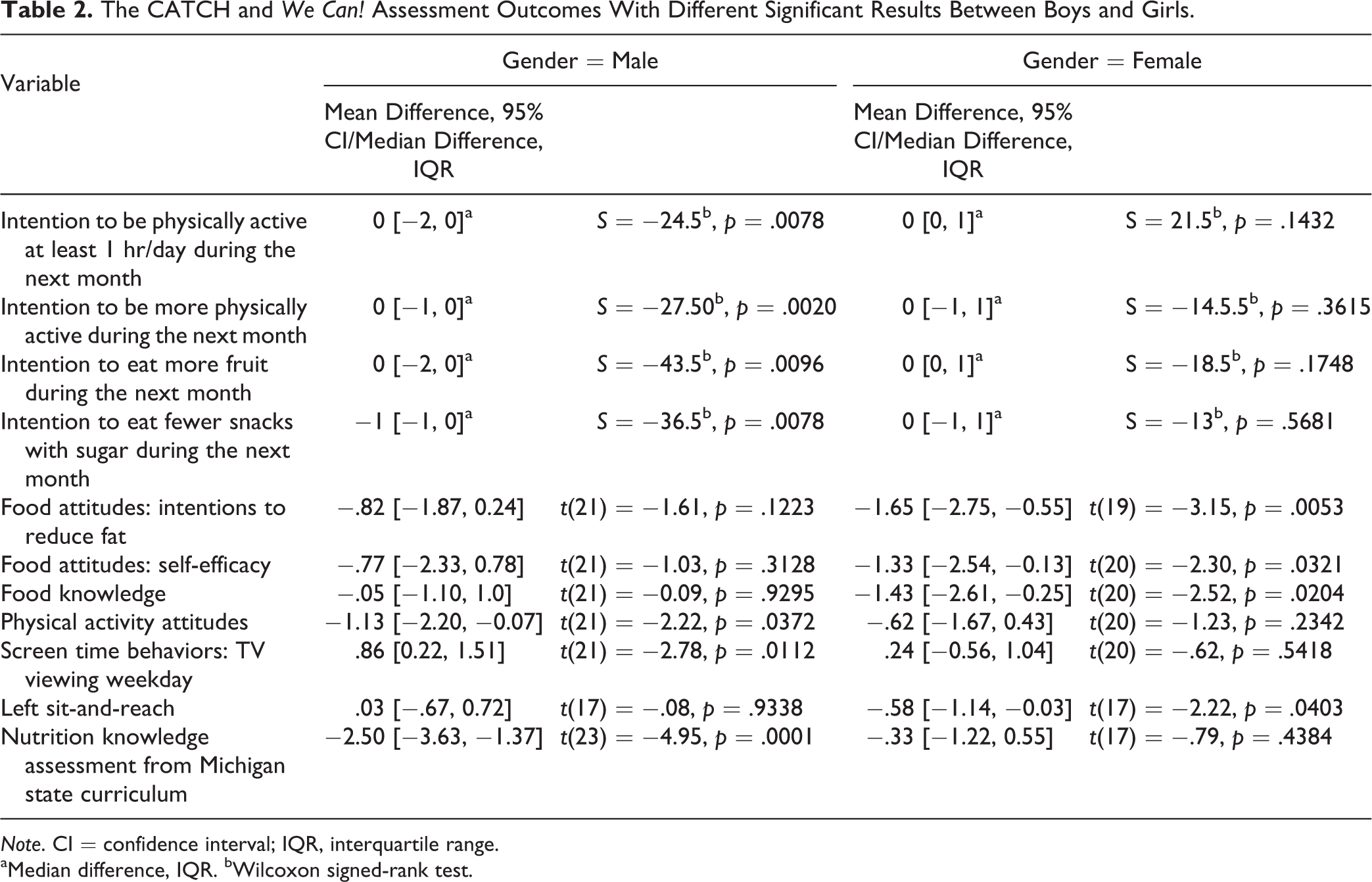
Note. CI = confidence interval; IQR, interquartile range.
aMedian difference, IQR. bWilcoxon signed-rank test.
The relationship between outcome changes and baseline BMI-p were also explored. Children with higher baseline BMI-p were associated with greater physical activity knowledge (n = 40, rho = −.34, p = .037), attitudes improvement (n = 37, rho = −.27, p = .094), and eating more fiber (n = 40, rho = −.30, p = .059) at T2. Interestingly, children with lower baseline BMI-p related to stronger intention to eat more vegetables during the next month (n = 37, rho = .28, p = .098). Pilot studies require report of effect size. The total Media-Smart Youth score was significantly improved with the mean of 5.72 (SD = 11.24, 95% CI = [2.26, 9.18]). The improvement was very significant, t(42) = 3.34, p = .0018, with a medium effect size of Cohen’s d of.51.
The main outcome of the study that defined success was the creation of infomercials. Five videos of 2 to 3 minutes were completed by the students with the guidance of media teachers. Themes captured by the students were “Smart Consumers” (choosing healthy eating); “Exercising and Why it’s Important”; “My Plate”; and “Diabetes.” In the first video, “Smart Consumers,” students discussed antioxidants and other nutrition concepts such as eating proper servings of vegetables and fruits every day. Students also expounded upon the migrant lifestyle that presented challenges for them to be smart consumers because of low wages and a transient lifestyle. Students shared with viewers what crops they picked and what were their earnings. The “Smart Consumers” video allowed the students to share their concerns as young adults with viewers. “Exercise for 60 minutes every day” showcased learned editing skills where students had double and quarter-framed shots on the screen and told the story of one student who was inactive and compared his lifestyle to students who were being active and exercising for a healthier life. Humor played a part in this video. “My Plate” began with students stating what they (both male and female students) would change if they became the President of the United States. The common statements centered on providing a healthy diet for our nation through My Plate. Students explained the benefits of My Plate and the video ends with the declaration, “I
Comparing Results to a National Study
We had the opportunity to compare our study to the final data report of the national Media-Smart Youth and CATCH study. The effect size in the original study was between (.31 to .46) with the assumption of the correlation between pairs ranged from .5 to .75. This effect size was roughly estimated as the least squares mean difference between Time 2 and Time 1 divided by standard error multiplied by the square root of the paired sample size in the treatment multiplied by the correlation between pairs. The accurate effect size could not to be calculated due to inadequate available published information; however, our study’s effect size was similar at .51. We also examined data for differences in the means of the total Media-Smart Youth score (Table 3) and looked at means and SDs at pre- and posttest for intention items. The intention scores were similar in both studies except the subscale of “intention to eat less snack foods with added sugar during the next month” (p = .0270, see Table 1) but not in the national Media-Smart Youth and CATCH study.
Pre/Post Means for Media-Smart Youth Curriculum Scores in the National and Migrant Middle School Media Nutrition Project Studies.

Note. SE = standard error.
Comparing the students’ first BMI-p categories with the second BMI-p category shows a positive change toward a healthy weight category. Students also showed a healthy trend toward decreasing their actual BMI-p. Students who changed their behaviors and ate more fiber in their diets and students who learned more about nutrition demonstrated greater healthy changes in BMI-p. Students who had a higher BMI appeared to be more receptive to the lessons learned in the intervention. At the close of the MEP and completion of the video projects, improvements were seen in 12 students’ assessments. Girls and boys showed improvements in different assessments at postintervention. A review of top practices in reducing obesity in children cited the school as the best setting for implementation of a multidimensional strategy, and that including a physical fitness and activity component saw positive outcomes in 64–68% of the programs (Flynn et al., 2006). They continued that even program outcomes with short-term improvements should be supported. However, incorporating a multimedia videography component to health weight interventions with a Latino migrant student population has not been previously reported.
Discussion
In the conduct of the study, challenges and lessons learned were experienced. Students simultaneously needed the attention and instruction of the one media teacher. The subsequent videography study employed two media teachers per recommendation. Budget limitations were confirmed when one digital camera was lost and a second was dropped and broken. Purchase of protection plans were implemented into the next year’s study budget. Large battery usage was noted and voiceovers in the videos were soft in volume. The subsequent study included purchase of an ample supply of batteries and a lapel microphone.
Challenges and lessons learned will provide direction for improvement in the conduct of the next study incorporating videography. Future research is planned to evaluate the modality of this health promotion delivery in a larger sample size and with a diverse ethnic and racial population of students. In addition, research design of future projects needs to include the assessment if knowledge and behaviors are maintained over time. This project will serve as a prototype for middle school health interventions and can provide guidance for health promotion interventions for Latinos and other immigrant student populations.
Limitations of the study are that no knowledge of long-term effects is known. With limited financial resources for a federally supported program, the lack of sustainability is a concern. However, the MEP is committed to providing nutrition and health information to its student population. The sample size was drawn from a middle school population in one location, and results cannot be generalized to the larger migrant student population who attend a summer MEP. The student assessments are self-report and reflect performance on 1 day only. There was no random selection in this pilot study.
Implications for School Health
This summer school environment was effective for delivery of health promotion lessons to a vulnerable student population, despite its short duration. Although not scientifically measured, students were engaged in the activity of health promotion videography, and students, faculty, and staff enjoyed the showcase of the videos. Post intervention, the MEP distributed over 100 copies of the digital video disks to involved students, teachers, and local, regional, and national Latino leaders in education, legislation, and health to provide information for programming and policy direction. These distributions have the potential to alert policy makers to the needs of migrant farmworker children in the MEP. Although causation cannot be attributed for improvement in student knowledge and positive changes toward healthy attitudes and behaviors outcomes, the use of a multimedia project to create an integrated learning experience demonstrated active learning of nutrition and physical activity classroom objectives. This example of using student-created multimedia projects for health promotion education can be easily duplicated utilizing the many already existing school video and camera resources.
Footnotes
Acknowledgments
The principal investigator would like to acknowledge Maureen Anway and Crystal Elissetche (intervention teachers), the administration, staff, students, and families of the Van Buren Intermediate School District summer MEP.
Declaration of Conflicting Interests
The author(s) declared no potential conflicts of interest with respect to the research, authorship, and/or publication of this article.
Funding
The author(s) disclosed receipt of the following financial support for the research, authorship, and/or publication of this article:The Sigma Theta Tau International, The Honor Society of Nursing Small Grants provided funding support for this research project.