







Abstract
Supportive school policies and well-prepared school nurses can best address the needs of students with chronic health conditions. We analyzed nationally representative data from the 2012 School Health Policies and Practices Study to examine whether districts with policies requiring that schools provide health services to students with chronic health conditions were more likely to provide funding for professional development (PD) or offer PD to school nurses on those health services than districts without such policies. Compared to districts without certain requirements for health services related to chronic health conditions, districts with those requirements were more likely to provide PD on related topics (for all comparisons, p ≤ .001). For some topics, however, regardless of district requirements, PD was fairly low and suggests the need for increases in the rates at which districts provide PD to support school nurses who deliver services to students with chronic health conditions.
The prevalence of chronic health conditions among youth has increased substantially (Perrin, Bloom, & Gortmaker, 2007; Proskurowski, Newell, & Vandriel, 2010; Van Cleave, Gortmaker, & Perrin, 2010). School policies combined with well-prepared school nurses can address the needs of students with diabetes, asthma, food allergies, and other chronic health conditions and provide the support and infrastructure needed to reduce absenteeism, increase academic success, and promote optimal health outcomes and student safety (Butler, Fekaris, Pontius, & Zacharski, 2012; Morgitan et al., 2012; Proskurowski et al., 2010; Rodriguez, Rivera, Perlroth, Becker, & Wang, 2013). Nurse case management of chronic health conditions includes supervision of and assistance to students as well as coordination of care and communication among school personnel, families, and health care providers (Butler et al., 2012; Proskurowski et al., 2010).
School nurses work in isolation, most often as the only health care provider in a building caring for, on average, more than 1,000 students with a wide range of health care needs (Maughan & Mangena, 2014; Rosenblum & Sprague-McRae, 2014). The isolation of working in the school setting can delay or prevent exposure to innovations and updates in care practices (Adams & McCarthy, 2005; Vought-O’Sullivan, Meehan, Havice, & Pruitt, 2006). The Institutes of Medicine’s appointed committee to the Robert Wood Johnson Foundation initiative on the Future of Nursing asserts that “nursing education should serve as a platform for continued lifelong learning” (Committee, 2010, p. 4). School nurses acknowledge they have continuing education needs related to evidence-based practice and clinical practice guidelines (Maughan & Mangena, 2014).
This study examined whether districts with policies requiring schools to provide health services to students with chronic health conditions were significantly more likely to provide funding for professional development (PD) or offer PD to school nurses on those health services than districts without such policies.
Method
We analyzed data from the 2012 School Health Policies and Practices Study (SHPPS), a national study designed to assess school health policies and practices. A complete description of the study methods has been previously published (Centers for Disease Control and Prevention, 2013). Briefly, data collection occurred during October 2011–August 2012 among a nationally representative sample of public school districts using both web-based and paper-and-pencil questionnaires (N = 660 and response rate = 63%, for the school health services component). SHPPS (2012) was reviewed by the Institutional Review Boards at both CDC and ICF Macro, Inc., an ICF International Company (contractor engaged for SHPPS 2012) and determined to be exempt. χ2 analyses were performed using weighted data and statistical software designed to account for the complex sampling design (SUDAAN statistical software, Research Triangle Institute).
Results
The percentage of districts that provided funding for or offered PD for school nurses on topics related to chronic health conditions was significantly higher among districts requiring schools to provide those services (for all comparisons, p ≤ .001; Table 1). This was true even if the required service was not directly related to the PD topic. For example, among districts with a policy requiring schools to provide identification or school-based management of chronic health conditions such as asthma or diabetes, 67.4% had provided funding for or offered PD on that topic, but only 31.8% of districts without such a policy provided PD on that topic. Compared to districts without that policy, districts with the policy also were significantly more likely to offer PD on related topics including tracking students with chronic conditions (44.3% vs. 21.6%); case management for students with chronic conditions, such as asthma or diabetes (53.8% vs. 29.9%); nutrition and dietary behavior counseling (31.1% vs. 13.0%); physical activity and fitness counseling (28.8% vs. 12.6%); teaching self-management of chronic health conditions, such as asthma or diabetes (51.3% vs. 23.6%); and referrals for chronic health conditions, such as asthma or diabetes (47.2% vs. 19.9%). This pattern was consistent for each type of policy.
Percentage of Districts that Provided Funding for or Offered Professional Developmenta to School Nurses on Chronic Health Condition–Related Topics, by Required Chronic Health Condition–Related Policies for Schools—School Health Policies and Practices Study, 2012.
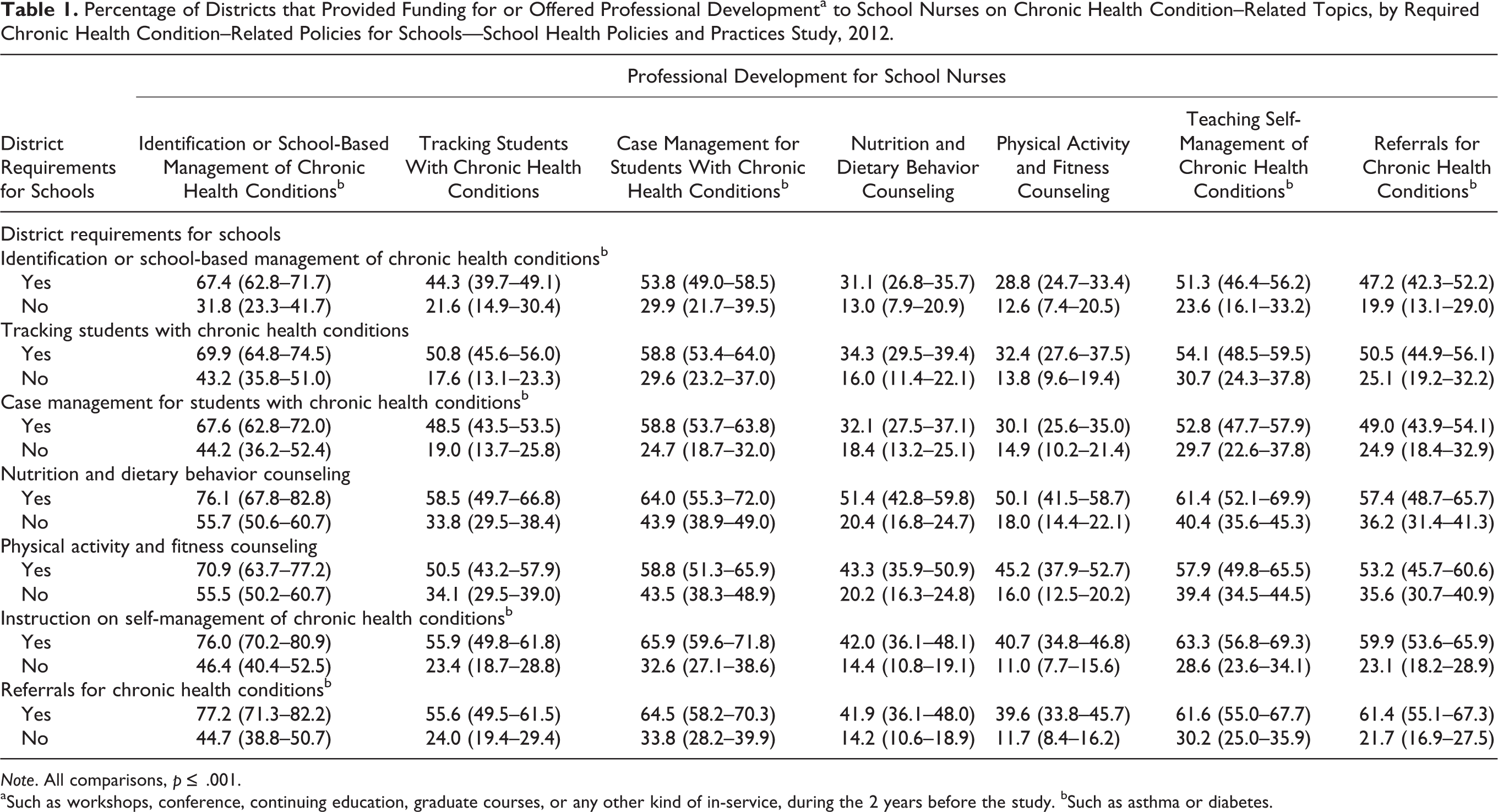
Note. All comparisons, p ≤ .001. aSuch as workshops, conference, continuing education, graduate courses, or any other kind of in-service, during the 2 years before the study. bSuch as asthma or diabetes.
Discussion
The changing prevalence and complexities of chronic health conditions among youth (Perrin et al., 2007; Proskurowski et al., 2010) and the isolation of school nurses in non–health care settings (Adams & McCarthy, 2005; Vought-O’Sullivan et al., 2006) necessitates consistent and regular PD to support the implementation and evaluation of evidence-based clinical practice guidelines (Adams & McCarthy, 2005; Committee, 2010; Vought-O’Sullivan et al., 2006). School nurses armed with skills and knowledge based on best practices are equipped to meet the needs of students with chronic health conditions. Continuing education and PD enables nurses who work in isolation in a non–health care setting to provide the appropriate standard of care (Committee, 2010; Rosenblum & Sprague-McRae, 2014; Vought-O’Sullivan et al., 2006).
This study found that districts with policies requiring health services for students with chronic health conditions were more likely to provide funding for or offer PD on a variety of related topics. Although the data from this study are cross sectional, the results suggest that establishing policies related to health services for students with chronic health conditions may be the first step in ensuring that the appropriate PD is also provided. The allocation of resources to PD may be more likely when driven by polices that require health services.
Limitations of this study are the lack of data on the quality of district policies and practices and the potential for over- or underreporting of required policies or PD offerings. Also, SHPPS data limit the ability to identify mediating factors that might explain study findings.
School health professionals, local health care providers, and parents may find that working with school district wellness and safety committees is an effective way to promote a variety of school district policies that support students with chronic conditions. Supportive school policies requiring care for students with chronic conditions communicate that the school administration and the school community value the health of children attending school and may drive PD for school nurses to best implement those policies. Well-prepared school nurses with current skills and knowledge strengthen administrators’ goals of student success by enhancing the attendance and participation of students with chronic health conditions, ensuring compliance with legal mandates, and increasing the confidence of parents that their children receive the care they need during the school day (Neighbors & Barta, 2004; Rodriguez et al., 2013; Vought-O’Sullivan et al., 2006).
Footnotes
Authors’ Note
The findings and conclusions in this article are those of the authors and do not necessarily represent the official position of the Centers for Disease Control and Prevention.
Declaration of Conflicting Interests
The author(s) declared no potential conflicts of interest with respect to the research, authorship, and/or publication of this article.
Funding
The author(s) received no financial support for the research, authorship, and/or publication of this article.