







Abstract
The present study aimed to describe and explore the influence of social support on the school engagement of young survivors of pediatric leukemia. Fifty-three young Quebecers, previously diagnosed and treated for leukemia, completed a questionnaire measuring their school engagement and participated in an interview focusing on the support offered by four groups of relations with regard to school: parents, siblings, friends, and other nonprofessional relations. The interview responses revealed that parents were perceived to be the primary source of informational and emotional support, with support also provided to a lesser extent by friends, siblings, and members of the extended family. Inferential analyses indicated that young survivors report a higher school engagement score when they perceive themselves as receiving support from a greater number of groups of relations, especially from friends or siblings.
Keywords
Introduction
Over the past 40 years, medical progress has greatly contributed to changing the conceptions surrounding pediatric cancer, once a fatal condition that is now curable in the majority of cases. Of all types of pediatric cancers, acute lymphoblastic leukemia (ALL) remains the most frequently diagnosed, representing close to one third of new cases each year (Canadian Cancer Society’s Advisory Committee on Cancer Statistics, 2015; Ward, Desantis, Robbins, Kohler, & Jemal, 2014). Moreover, ALL finds itself among the types of pediatric cancers to have seen one of the most important increases in survival rates after 5 years, rising from 71% to 91% between 1985 and 2004 in Canada (Ellison, Prithwish, Mery, & Grundy, 2009; Villeneuve et al., 1998). Namely, its survival rate, after 10 years, has been estimated at 84% (Hunger et al., 2012). Given its prevalence in the population, as well as the attention it has received by researchers in the past few years, the present study draws on results of scientific literature related to the situation of young survivors of ALL.
As is the case for all types of pediatric cancer, surviving pediatric leukemia does not necessarily mean being exempt from the unfortunate effects of the illness and its treatments (Landier & Bhatia, 2008; Rowland, 2005). Currently, research efforts regarding pediatric cancer mainly focus on a physical cure, whereas psychosocial adaptation remains a field requiring further study (Gurney et al., 2009).
The Pursuit of Schooling: A Turning Point for Psychosocial Adaptation
Encouraging young leukemia survivors to pursue their education appears to be an essential factor in the psychosocial adaptation process. For many young survivors, returning to school after or between treatments has positive connotations as it evokes not only the end of treatment but also hope for the future (Madan-Swain, Fredrick, & Wallander, 1999). When investing themselves in academic pursuits, they appear to distance themselves from the role of patient and to take on a more active role, one that is expected for a person of their age (Chekryn, Deegan, & Reid, 1986; Ross, 1984). They gain a sense of control over their lives, rediscover self-esteem, take on more normal daily routines, and reestablish relationships with peers (Bessell, 2001; Eiser, 2004; Sullivan, Fulmer, & Zigmond, 2001; Worchell-Prevatt et al., 1998). However, young survivors can also perceive school as being a source of challenges and difficulty (Daly, Kral, & Brown, 2008; Gorin & McAuliffe, 2009). Studies comparing young survivors to their peers reveal that survivors are absent more often from school (Vance & Eiser, 2002), are more academically challenged (Buizer, de Sonneville, van den Heuvel-Eibrink, & Veerman, 2005; Harshman et al., 2012), and are more likely to require specialized educational services (Barrera, Shaw, Speechley, Maunsell, & Pogany, 2005; Lorenzi et al., 2009; Mitby et al., 2003). In addition to being more likely to repeat a grade (Barrera et al., 2005; Gerhardt et al., 2007), they are less likely to obtain a high school diploma or to pursue a higher education (Boman & Bodegård, 2004; Mitby et al., 2003; Mody et al., 2008).
Social Support: A Contributing Factor to Psychosocial Adaptation
A number of scientific studies have examined the importance of social support in the psychosocial adaptation of children and adolescents treated for cancer (see reviews of Decker, 2007; Suzuki & Kato, 2003; and Woodgate, 1999). By definition, this concept refers to the reciprocal exchange that occurs on a daily basis between a person with psychosocial needs and a “non professional” relation (i.e., a member of the nuclear or extended family, a friend, or a member of the person’s extended social group) with whom he or she shares a trusting relationship (Finfgeld-Connett, 2005, 2007). Within this dynamic process, the needs determine the types of support offered: appreciative (recognition and appreciation), emotional (comfort and encouragement), informational (advice and recommendations), or instrumental (goods, services, care, and assistance; Bullock, 2004). This results in benefits on both psychological and social levels: perceived competence, enhanced mental well-being, sense of normalization, and reduced isolation, among others (Finfgeld-Connett, 2005).
In the field of pediatric oncology, the majority of scientific studies have focused on the social support of young survivors within the first 5 years of remission. Results from these studies indicate, among other things, that parents, more specifically, mothers, play the most prominent and appreciated role during this period (Brown, Madan-Swain, & Lambert, 2003; Kyngaes et al., 2001; Mitchell, Clarke, & Sloper, 2006; Ritchie, 2001; Trask et al., 2003). Support from friends also plays a very determining role (Kyngaes et al., 2001; Mitchell et al., 2006; Trask et al., 2003); while this is less so for younger survivors, support from friends comes to play a greater role as young survivors advance in age (Derevensky, Tsanos, & Handman, 1998; Ritchie, 2001). The few studies that examined the perceived types of social support indicate that young survivors appreciate receiving emotional and informational support (Dunsmore & Quine, 1995; Ritchie, 2001), thereby revealing the need to reduce psychological distress as well as the need to know more about the illness and its treatments.
With regard to benefits, young survivors who have a greater number of sources of social support appear to present fewer signs of anxiety, depression, or low self-esteem (Last & van Veldhuizen, 1996). Likewise, a positive perception of support from peers or parents appears to predict benefits with regard to anxiety, depression, self-image, social acceptance, and adjustment in its broadest sense (Decker, 2007). Certain studies have also shown that there are positive associations between social support and the quality of life of young survivors, notably the psychosocial quality of life, as was noted in the study by Spangler (2009), both in the short term and in the long term following diagnosis and treatments (Cantrell, 2007; Zebrack & Chesler, 2002). Moreover, a recent retrospective study revealed that informational support from parents and emotional support from friends during the hospitalization period would explain almost a third of the variance observed with regard to an assessment of the quality of life in the school environment by adolescents who were diagnosed with cancer; the participants completed this assessment within an average period of 6 years of their diagnosis (Castellano-Tejedor, Pérez-Campdepadros, Capdevila, & Blasco-Blasco, 2014).
Currently, the majority of studies examining the role of social support in the adaptation to pediatric leukemia have focused on the acute phase of the illness. However, the survival trajectory of pediatric cancer also consists of two other phases—extended and permanent—during which many difficulties may appear or persist (Shepherd & Woodgate, 2010). Even if there is every reason to believe that social support also plays a key role during these phases, there is currently very little data available to support this. Knowledge surrounding the role of this concept is all the more limited by the fact that few studies have described the types of social support from which young leukemia survivors benefit. Furthermore, the studies examining sources of support have rarely investigated the role played by siblings or members of a larger social group, including members of the extended family, all of whom are involved with young survivors in a social support capacity (Domaison et al., 2009; McCubbin, Balling, Possin, Frierdich, & Bryne, 2002; Mitchell et al., 2006; Moules, McCaffrey, Laing, Tapp, & Strother, 2012; Woodgate, 2006).
As social support is a dynamic process, it is important to define and study it in a contextualized manner, namely, by way of a qualitative approach that allows for the description of the meaning derived by individuals concerning their own experiences and for the formulation of hypotheses with regard to the needs that characterize a particular stage in these individuals’ lives (Williams, Barclay, & Schmied, 2004). With this perspective in mind, the purpose of this study was to further understand how social support can facilitate the psychosocial adaptation of young survivors of pediatric leukemia by focusing on the area of their lives in which they most invest themselves once cured: school.
The Concept of School Engagement: A Window on the Experience of Young Leukemia Survivors
Stepping away from a perspective traditionally focused on deficits in order to better understand human adaptation that highlights individual and environmental strengths and virtues (Seligman & Csikszentmihalyi, 2000), this study aimed to examine the psychosocial adaptation of young leukemia survivors from the standpoint of their school engagement. Over the course of the last two decades, this concept has elicited growing interest from researchers and now resonates strongly with interventions aimed at encouraging academic success and preventing young people with difficulties from dropping out (Finn & Rock, 1997). Among the many variants of this concept, the definition proposed by the National Research Council, together with the Institute of Medicine (2004) appears to best describe the experience of students as a whole: a set of behaviors and psychological dispositions toward school that are influenced by the perceptions of the student with regard to capacities (I can), objectives and personal values (I want), and social relationships (I belong). As stipulated by its precursors, the concept of school engagement is both multidimensional and malleable (Appleton, Christenson, & Furlong, 2008; Fredricks, Blumenfeld, & Paris, 2004; Jimerson, Campos, & Greif, 2003). Therefore, to understand the engagement of a student at school, it is necessary to assess its behavioral, affective, cognitive, and psychological manifestations and to take into consideration the potential influence of internal and external factors on the student’s immediate environment.
The purpose of this exploratory study was to better understand the nature and the influence of social support with regard to the school engagement of young survivors of leukemia, one form of pediatric cancer. With this purpose in mind, the following specific objectives were addressed: (1) to describe the types of support that young leukemia survivors perceive receiving from parents, siblings, friends, and other nonprofessional relations with regard to school and (2) to examine the presence of associations between perceived social support and the school engagement of young leukemia survivors.
Method
Following ethical approval from the institutional review board of the Université du Québec à Montréal, a convenience sample was recruited in collaboration with Leucan, a nonprofit organization that offers an array of services to families living with pediatric cancer in the province of Quebec (Canada). The following criteria were used to determine the admissibility of participants: (i) completion of treatment for leukemia at least 1 year prior to the study, (ii) regular school attendance (at the elementary or high school level) for at least 1 month prior to the study, (iii) fluency in French, and (iv) no presence of an incapacity or deficit likely to impede communication.
Using Leucan’s databases, a member of the organization’s personnel posted an invitation to families with a child who met the given criteria. This posting included both an explanatory leaflet that sought to inform the child and his or her parent of the goals of the study and its process and a participation form to be filled out by the parent and sent by mail to the research laboratory in a stamped envelope that had been supplied. This recruitment strategy led to the formation of a convenience sample of 53 leukemia survivors. Because the sent invitations were not tracked, the number and characteristics of families who declined to participate remain unknown.
The first author of this study met with all of the participants individually in their respective homes in a private room of their choice. During each session, the participants first completed a written questionnaire measuring school engagement and then participated in a semistructured interview with open-ended questions about their perceptions of social support. Informed consent forms were signed by participants and their parents. The sociodemographic and medical data regarding the participants were collected by way of a questionnaire completed by the participants’ parents.
Perceptions of Social Support
A semistructured interview grid was created using the method developed by the second author during the course of various studies on the conception of health and well-being of children and families (e.g., Jutras & Lepage, 2006). During each interview, which lasted approximately 20 min and was audio-recorded, the perceptions of the young cancer survivors were explored with a focus on the presence and types of support provided by four distinct groups of relations with regard to school: (1) parents, (2) siblings, (3) friends, and (4) other nonprofessional relations. For each group of relations, the following two questions were asked: Does (group of relations) do anything to ensure that things go well for you at school? (presence of support), (If yes) What do they do? (types of support).
Measure of School Engagement
In order to measure school engagement, 14 close-ended questions or items addressed the four dimensions most retained in research on the concept (Appleton et al., 2008; Fredricks et al., 2004; Jimerson et al., 2003).The behavioral dimension was comprised of three questions or items covering academic achievement and effort: (1) In comparison to other students in your class, how is school going? (2) When studying or doing homework, when I do something, I am successful … , and (3) Have you done things to improve in (area of study or school life identified by the participant)? The emotional dimension was comprised of five questions or items covering interest in school and school climate: (1) Do you enjoy school? (2) Which figure represents your feelings the most in school lately? (3) At school, we listen to students’ opinions; (4) For school activities, students have responsibilities; and (5) At my school, students respect each other. The psychological dimension was comprised of four questions or items covering sense of belonging and support for learning: (1) I feel good at my school. (2) It is easy to approach my teachers if I want to speak with them. (3) At school, there is at least one adult that would listen if I wanted to talk to them about my problems. and (4) For schoolwork, do you find that teachers ask from you in general.… The cognitive dimension was comprised of two questions or items covering perception of competence and valuing school: (1) I know that I am capable of succeeding in school. (2) Succeeding in school is something very important in my life.
While some questions and items in this measure are novel, those related to interest in school, school climate, sense of belonging, and perception of competence are inspired from the Health and social survey of Quebec children and youth, which specifically targeted 9-, 13- and 16-year-old youth (Aubin et al., 1999). Originally, this survey measured school climate through 5 items drawn from an index developed from a previous investigation conducted in 3,205 young Quebecers (Cloutier, Champoux, Jacques, & Chamberland, 1994). In regard to the measure of interest in school and perception of competence, the Health and social survey (Aubin et al., 1999) was inspired from a largely used screening test of school dropout risk in the Canadian provinces of Quebec and Ontario (Ministère de l’Éducation du Québec, 1983), and for which the discriminant value of test items has been previously supported (Beauchemin, 1986). Some of the items drawn from two of the eight scales of the instrument’s original version were retained for their predictive value of school dropout in adolescents (Beauchemin & Lemire, 1991).
Each question or item used a Likert-type scale comprised of two to four possible responses with verbal or visual anchors, such as 1 = totally false, 2 = somewhat false, 3 = somewhat true, and 4 = totally true. Each answer was associated with a numerical value that indicated some degree of school engagement (e.g., 1 = low and 4 = high). Given that the number of possible responses differed from one question (or item) to another, standardized scores for each of the 14 items were compiled for each participant in order to determine their individual summary score for school engagement. Summary scores varied from −18.74 to 12.15 (SD = 6.65), and the measure of school engagement showed an internal consistency of α = .76 that is considered acceptable according to Nunnally and Bernstein (1994). A reliability analysis revealed that the removal of any item did not increase the value of the Cronbach α and that the value of each item is moderately or substantially correlated to total score, r ≥ .30. Due to a lack of statistical power, no confirmatory analyses were possible.
Four individual interviews were conducted with healthy youth in order to pilot questions and items which comprised the measure of social engagement. Once the pilot interviews confirmed the relevance and adequacy of the questions for healthy youth, the measure of school engagement, as well as the complete interview protocol (including questions concerning perceptions of social support), was piloted with two young survivors of leukemia.
Data Analysis
In order to describe the perceptions that young leukemia survivors have of the types of social support they receive with regard to school (Objective 1), the answers given during the interview were transcribed verbatim and imported into a File Maker Pro® (Microsoft, Redmond, WA) database, which was then subjected to a classical content analysis (L’Écuyer, 1990). The participants’ answers were then segmented and coded independently by two research assistants. Each answer was broken down into units of meaning, defined as the smallest succession of consecutive words having any relevance to the question asked. Each unit of meaning was given a code according to its correspondence with definitions from one section of a preestablished grid. This section of the grid contained 33 codes and associated definitions. It was based on the work of the second author (e.g., Jutras & Lepage, 2006) and had been updated to reflect relevant scientific knowledge, the objectives of this study, and half of the answers provided by participants for each question of the interview. In order to avoid giving more weight to answers containing many synonyms and to thus prevent the occurrence of any possible biases from more verbal individuals, only one unit of meaning was coded for each answer that referred more than once to a given code from the grid. For the purposes of this study, the codes used were placed in four categories (appreciative, emotional, informational, or instrumental) to reflect the related type of social support (Bullock, 2004). For example, the codes “stimulation,” “help with problem resolution,” and “task structuring” were placed in the “informational support” category. The reliability of the coding procedure was determined by percentage agreement. Coders’ choices proved to be congruent for 71% of the units of meaning analyzed. In other cases, coders achieved agreement following a thorough discussion in the presence of the research coordinator. For this study, a threshold criterion of 10% (n = 5) was established in order to retain only the codes that appeared to be the most important for all participants. Thereby, the codes corresponding to the perceptions expressed by less than 10% of the sample were not reported in the present study.
Two types of inferential analyses were conducted to explore the presence of associations between social support and the school engagement of young leukemia survivors (Objective 2). First, correlation analyses were conducted to verify if there was a significant association between the number of groups of relations 1 whose support was perceived (presence and types) and the school engagement scores of the participants. Second, analyses of variance were used to evaluate whether the presence/absence of support perceived from each of the four groups of relations predicted the school engagement scores of the participants.
Results
Participant Characteristics
The 53 participants in this study were comprised of 23 girls and 30 boys. On average, participants were 12 years old (M = 11.5; SD = 3.3) and had been diagnosed 6 years prior to the study (M = 5.7; SD = 2.7). At the time of diagnosis, 41.5% of the participants were attending school. At the time of the study, participants were attending either elementary (62.3%) or high school (37.7%). All had undergone chemotherapy, and almost two thirds of the participants (62.3%) had received radiation therapy. A small percentage of the participants (13.2%) had also received transplants in addition to chemotherapy and radiation treatments. Most participants lived in a two-parent family (77.4%) with an average of 2.4 children (SD = 0.8), and the median household income in Canadian Dollar was between CAD $60,000 and CAD $75,000, which is similar to that of families in Quebec with children between 0 and 17 years of age during the period of the study (Ministère de la Famille, des Aînés et de la Condition féminine, 2005). Among participants with siblings (n = 45 or 85% of the sample), more than half (n = 27 or 60%) lived with a brother or sister of the same age or older. Participants were spread across six regions of Quebec. Correlations and analyses of variance did not reveal any significant association between the participants’ characteristics and their school engagement scores (see Table 1).
Descriptive Statistics and Results From Correlations and Analyses of Variance Between Characteristics of Young Leukemia Survivors and Their School Engagement Scores.
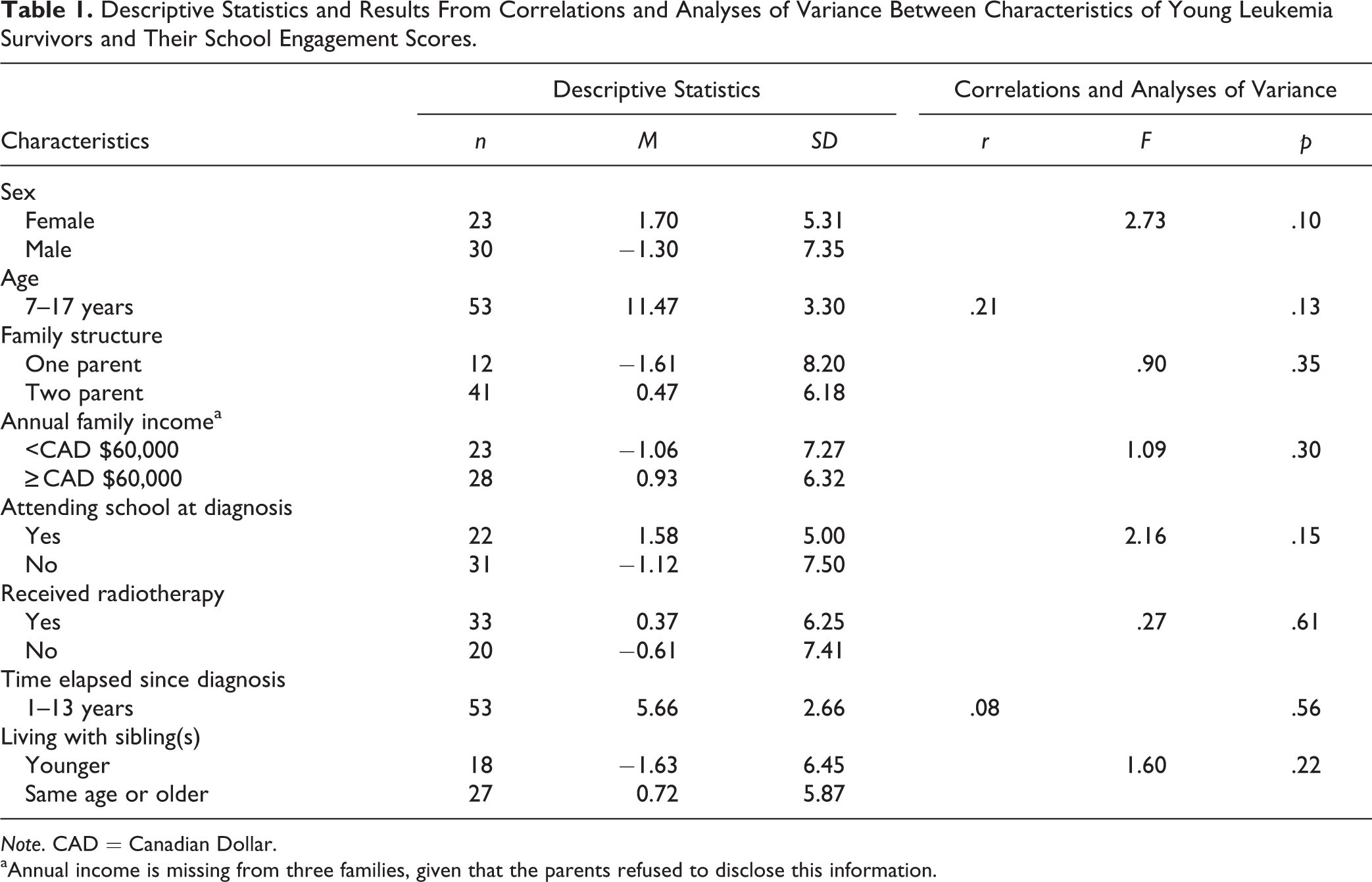
Note. CAD = Canadian Dollar.
aAnnual income is missing from three families, given that the parents refused to disclose this information.
Perceptions of Social Support
The results for the first objective of this study are summarized in Table 2. The types of perceived social support and the proportions in which participants mentioned them are presented for each group of relations. Examples of the participants’ answers are also included in this table.
Perceptions of Young Leukemia Survivors Regarding the Types of Social Support Offered by Four Groups of Relations With Regard to School.
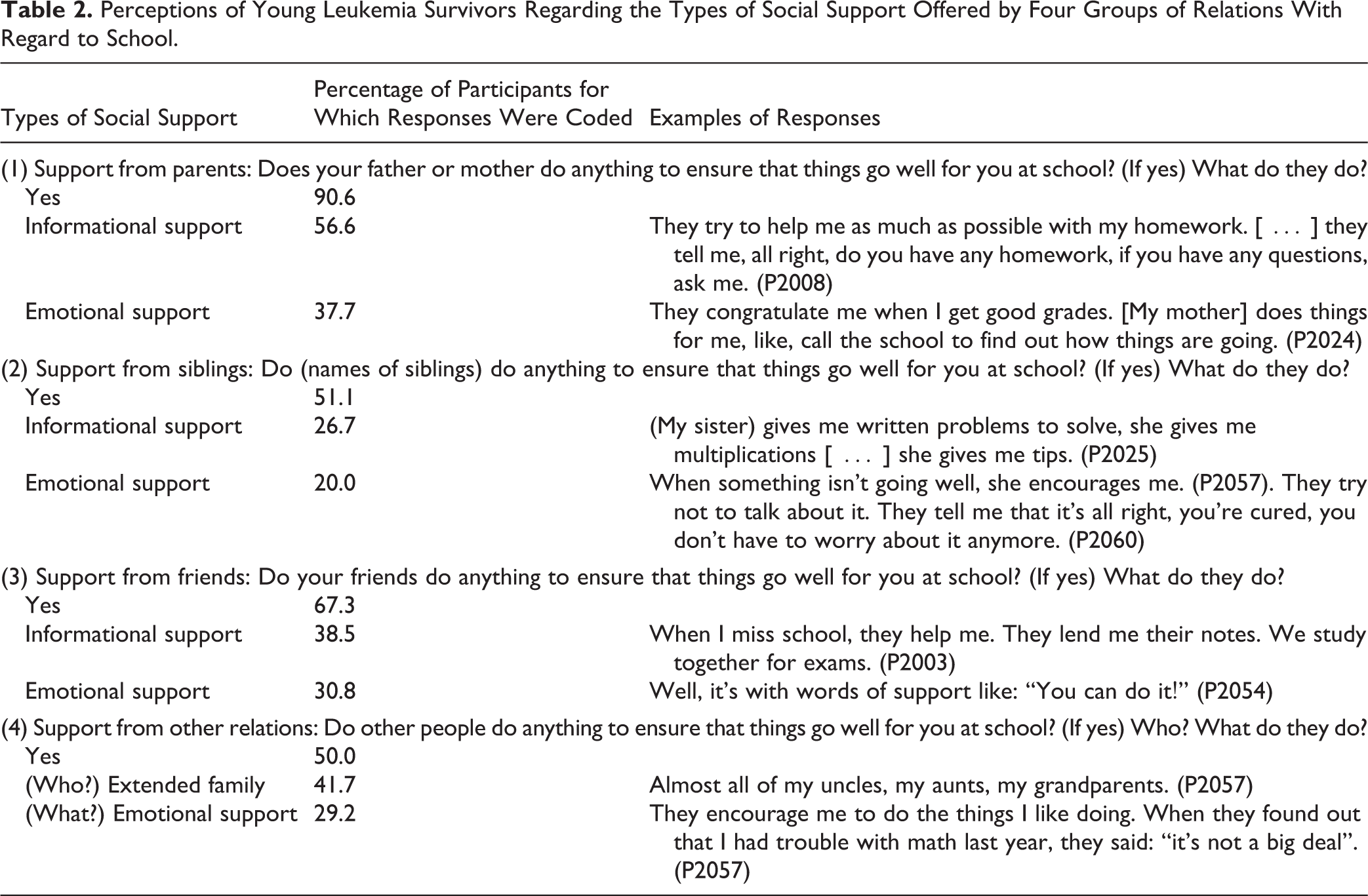
Almost all participants reported receiving support from their parents with regard to school. More than half of them mentioned receiving informational support from parents, mainly in the form of advice and support for problem solving. Over a third of them mentioned emotional support from parents, namely, in the form of encouragement and empathy. Among the participants with siblings, half of them mentioned receiving support from siblings with regard to school. They mentioned informational support, above all in the form of advice and support for problem solving as well as emotional support. Following secondary correlational analyses, the presence of informational support was revealed to be positively associated, with a medium effect size, to having siblings of the same age or older, r(44) = .39, p < .01, whereas there was no association between the presence of emotional support and the siblings’ age, r(45) = −.16, p = .28.
For a little over two thirds of participants, friends offered support with regard to school from an informational perspective and then from an emotional one. Secondary correlational analysis revealed that older participants mentioned support from friends more frequently, with a small to medium effect size, r(52) = .29, p = .04. When asked which members of other groups of nonprofessional relations offer support with regard to school, participants mentioned above all members of their extended family: grandparents, cousins, uncles, and aunts. Almost a third of participants recognized the emotional support of this group, mainly in the form of encouragement to succeed at school.
Social Support and School Engagement
The second objective results of the study, which aimed to explore links between social support and school engagement of young leukemia survivors, are presented in Tables 3 and 4. A correlation analysis revealed significant results. Participants were more likely to acknowledge their school engagement when they perceived receiving support from a larger number of groups of relations (maximum: 4), r(53) = .38, p < .01 (medium effect size). Two other correlation analyses, verifying the presence of links between school engagement scores and the number of groups of relations whose informational and emotional support is perceived, failed to reveal significant results. Finally, two of the four analyses of variance revealed significant results. These indicate higher school engagement scores for participants who perceive receiving support from siblings, F(1, 44) = 6.22, p = .02 (d = .77), and friends, F(1, 44) = 6.03, p = .02, (d = .70), both with a medium effect size.
Descriptive Statistics and Correlations Between Different Variables of Perceived Social Support and the School Engagement Scores of Young Leukemia Survivors.
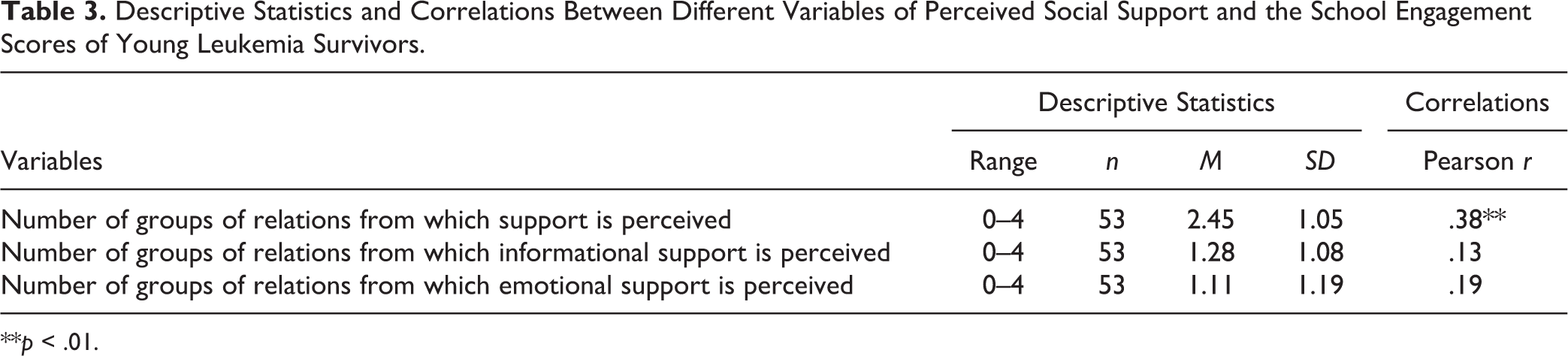
**p < .01.
Analyses of Variance Between Perceptions of Presence/Absence of Social Support From the Four Groups of Relations and the School Engagement Scores of Young Leukemia Survivors.
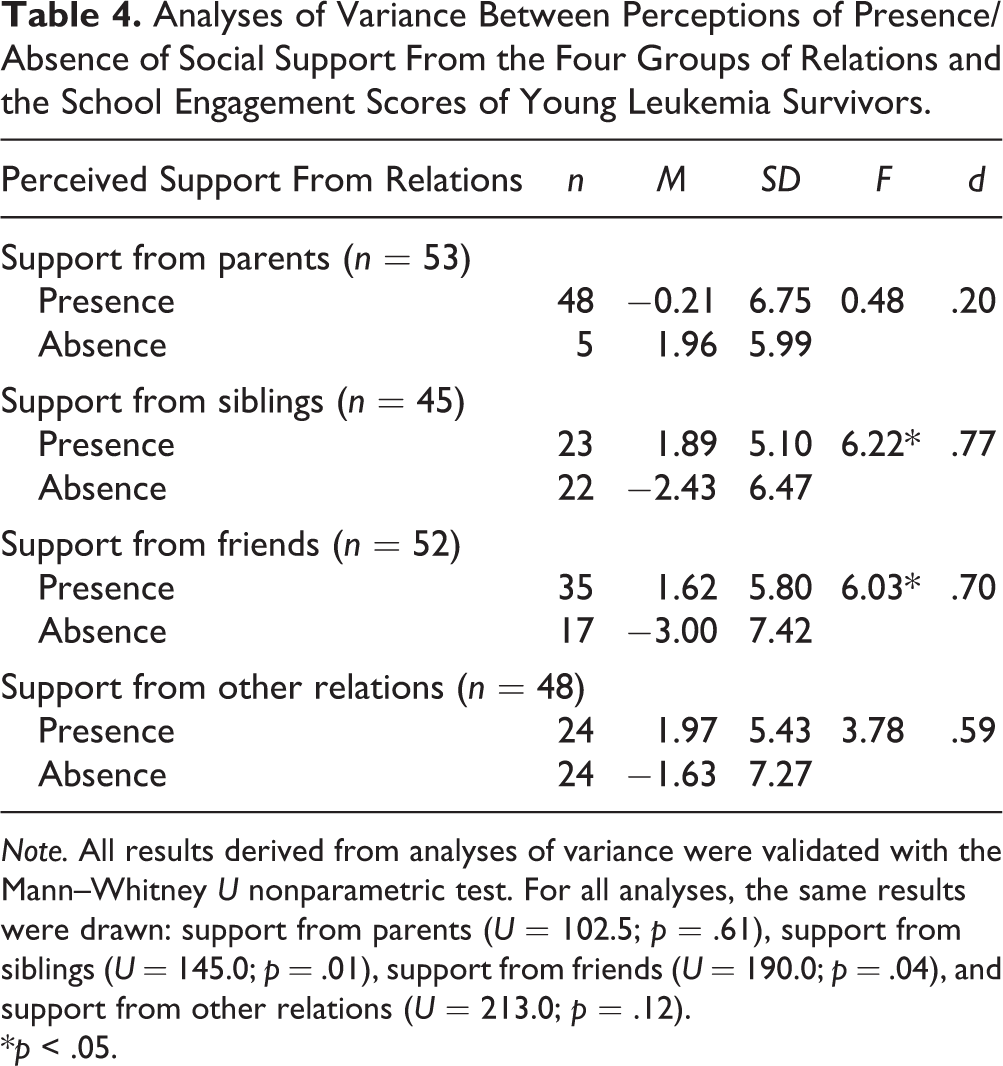
Note. All results derived from analyses of variance were validated with the Mann–Whitney U nonparametric test. For all analyses, the same results were drawn: support from parents (U = 102.5; p = .61), support from siblings (U = 145.0; p = .01), support from friends (U = 190.0; p = .04), and support from other relations (U = 213.0; p = .12).
*p < .05.
Discussion
From the outset, the results of this study are consistent with those of previous studies that point to the majority of social support being perceived as coming from parents, followed by that coming from friends, during the psychosocial adaptation process of young survivors of pediatric cancer (Brown et al., 2003; Kyngaes et al., 2001; Mitchell et al., 2006; Ritchie, 2001; Trask et al., 2003). These same results also confirm that siblings (Domaison et al., 2009; Woodgate, 2006) and members of the extended family (McCubbin et al., 2002) play a significant role in this process. Furthermore, this study adds that close relations provide support that caters more specifically to the needs of the young cancer survivors at school even when the latter are going through the extended and permanent phases of their survival trajectory.
In general, results reveal that close relations tend to cater to the needs of young cancer survivors by offering informational or emotional support with regard to school. Informational support is offered mainly in the form of explanations, advice, and help for problem solving, whereas emotional support is expressed mainly by way of encouragement for academic success. In this respect, the participants’ answers are consistent with the results of previous studies, which show that parents tend to insist more on the academic dimension of their child’s school experience and less on the social dimension (Chekryn et al., 1986; Sexson & Madan-Swain, 1993, 1995), despite recognizing their child’s various other needs (i.e., relational needs, needs for fun and play). The present study also adds that this tendency is observed equally among friends and siblings of young cancer survivors. Based on the fact that close relations are the most important agents of socialization, results indicate that, once the illness is over, the assumption of an active role as student is supported by a young cancer survivor’s groups of relations.
The positive correlation between the number of groups of relations whose support is perceived and the school engagement of participants reflects the findings of previous studies that reveal a higher level of social capital for healthy young people who deem themselves to be more engaged at school (i.e., Garcia-Reid, 2007; Garcia-Reid, Reid, & Peterson, 2005). These results help to promote the perception of school engagement through a bioecological perspective (Bronfenbrenner, 1979, 2001) as already advocated by many authors (Maynard, Beaver, Vaughn, DeLisi, & Roberts, 2014; Woolley & Bowen, 2007; You & Sharkey, 2009), a perspective that places particular emphasis on the environment with regard to an individual’s development and adaptation. According to this perspective, school engagement would then result from a process of mutual influence between the needs of the student and the available resources. When applied to the results of the present study, the bioecological perspective can help to explain the higher school engagement of young cancer survivors who perceive receiving support from a greater number of groups of relations. These young survivors may report higher school engagement because they have at their disposal resources—including family, peer group, and extended social group—that can adequately respond to their needs within various areas of their lives.
If the obtained correlation reveals the beneficial effect of feeling supported in various areas of life, the results of the analyses of variance indicate, however, that it is the perceptions of support from friends and siblings that characterize young cancer survivors with regard to their school engagement. Initially, these results were quite unexpected because they reveal no association with the perceived support from parents. This can be explained by the small number of participants who mentioned the absence of support from parents (n = 5) which limits the statistical power of the analysis and, therefore, its capacity to reveal any significant association.
As for perceived support from friends, the results of this study are similar to those of previous studies that highlight the influence of peers on the school engagement of healthy young people (i.e., Furrer & Skinner, 2003; Perdue, Manzeske, & Estell, 2009; Shin, Daly, & Vera, 2007; Wang & Eccles, 2012). A first explanation of these results takes root in abundant literature that explains the positive impact of friends (or peers) on success and adjustment at school by way of the multiple roles that they play, including academic guidance, acceptance, companionship, motivation, and encouragement (Berndt & Keefe, 1995; Epstein, 1983; Hymel, Comfort, Schonert-Reichl, & McDougall, 1996; Ryan, 2001; Nelson & DeBacker, 2008). A second explanation lies in the fact that older participants mentioned support from friends more frequently. This may reflect the quest for autonomy and the intensification of relationships that are at the heart of the normal developmental process of adolescence (Csikszentmihalyi & Larson, 1984). Young cancer survivors are not excluded from this process (Derevensky et al., 1998), and this study indicates that they benefit from friends’ support with regard to school. Also, during the extended and permanent phases of the cancer survival trajectory, young cancer survivors are very likely to meet challenges that increase their need for acceptance by peers: smaller number of close friends (Barrera et al., 2005); being misunderstood, rejected, and mocked (Lähteenmaki, Huostila, Hinkka, & Salmi, 2002); and feeling that they now have less in common with people their own age (Hokkanen, Eriksson, Ahonen, & Salantera, 2004).
Finally, this study reveals a finding without precedent, namely, that the presence of support provided by siblings is positively associated with the school engagement of young cancer survivors. This finding can plausibly be explained by the fact that 60% of the participants with siblings live with a brother or sister of the same age or older. However, a two-way analysis of variance could not confirm this interpretation. Nonetheless, additional correlation analyses did shed some light on the types of perceived support from siblings according to their age. In this regard, the presence of informational support was revealed to be positively associated with having siblings of the same age or older, as this is also common in healthy children (Bryant, 1989; Dockett & Perry, 2013; Tucker, McHale, & Crouter, 2001). However, there was no association between the presence of emotional support and the siblings’ age.
In light of these findings, additional studies are necessary to further our understanding of the nature and influence of support provided by siblings with regard to school engagement. Future studies aimed at healthy young people would imply further recognizing the active role played by siblings with respect to school engagement. To date, a few studies have examined the influence of siblings on the school engagement of healthy young people but only to determine if these siblings play an indirect and even passive role. For example, studies on the Check & Connect program attempted to predict school engagement by focusing on the attendance and dropout rates of siblings (i.e., Anderson, Christenson, Sinclair, & Lehr, 2004; Lehr, Sinclair, & Christenson, 2004). In the field of pediatric oncology, the experience of siblings of young cancer survivors is a topic of research that is gaining interest. However, the focus is limited to describing changes that have occurred throughout this experience, mainly within the family (Björk, Nordström, Wiebe, & Hallström, 2011; Domaison et al., 2009; Long & Marsland, 2011; Woodgate, 2006), and to determine the resulting needs for siblings (Alderfer et al., 2010; Buchbinder et al., 2011; Patterson, Millar, & Visser, 2011). By establishing that siblings can offer support that is appreciated and beneficial, the findings of the present study support broadening the current scope of research in this field by examining more closely the role of sibling support during the different phases of the cancer survival trajectory, particularly with regard to school.
Limitations and Strengths
The study’s main limits concern its exploratory nature, with the small sample size limiting the statistical power of the inferential analyses, although significant results were still found. Accordingly, the influence of social support was mostly examined in light of its presence/absence rather than with regard to its precise nature or its quality. The use of a measure of school engagement that had not yet been examined psychometrically and the lack of multiple informants may also have had the effect of limiting the precision of the results and their interpretation. Since participation was voluntary, it is possible that the process may have resulted in the self-selection of young cancer survivors. Also, characteristics of nonparticipants remained unknown as a result of the recruitment process that was used. Therefore, participants’ representativeness cannot be assured and limits the possibility of generalizing the results. In this regard, it should be noted that the use of a convenience sample and the limitations that it implies are frequently reported in studies using qualitative methods of data collection, such as those that were cited previously (Björk et al., 2011; Chekryn et al., 1986; Domaison et al., 2009; Kyngaes et al., 2001; McCubbin et al., 2002; Ritchie, 2001; Woodgate, 2006).
The present study is one of the few studies to examine the phenomenon of school engagement among young people with health problems. Falling within a recent research trend that emphasizes psychosocial adaptation, it also has the merit of examining a population that, up to now, has not been the subject of many studies, namely, young cancer survivors for whom the acute phase of illness appears to be over. An understanding of social support provided during the extended and permanent phases of the survival trajectory is enriched by a qualitative approach that allows for the contextualization of this process through the examination of the contribution of four groups of relations. Among the strengths of the procedures used, participants were met in their homes, a procedure that avoided a potential confound of the hospital context. Also, the number of items (n = 14) making up the school engagement measure is greater than that of the majority of studies reviewed on the subject, thereby offering the advantage of examining the concept in its broadest sense.
Implications for School Nursing Practice
As a result of their training, school nurses are aware of the physical, psychological, and emotional issues related to pediatric cancer. They are, therefore, in a good position to help foster the psychosocial adaptation of young cancer survivors by focusing on school, the area in which young survivors invest themselves most once they are cancer free. To this end, the results of this study encourage school nurses to support young cancer survivors’ school engagement by adopting a bioecological perspective (Bronfenbrenner, 1979, 2001). This means that particular attention should be paid to dynamic exchanges between the needs of young cancer survivors and the resources within their social environment in order to understand how survivors develop at school and adapt themselves to the challenges that may surface. According to the results of this study, this involves recognizing, encouraging, and accompanying their various groups of close relations in their supportive roles.
Adopting a bioecological perspective is also consistent with the recommendations from key programs and orientations with regard to school interventions aimed at young cancer survivors (e.g., Herrmann, Thurber, Miles, & Gilbert, 2011; Katz & Madan-Swain, 2006; Power, DuPaul, Shapiro, & Kazak, 2003; Shaw & McCabe, 2008), which focus on establishing effective partnerships between parents and school and health practitioners. Within these partnerships, the following tasks specifically concern school nurses: (1) raising awareness among other school professionals, which includes providing them with information and training, with regard to pediatric cancer and the issues that may surface and persist in the longer term and (2) monitoring and regularly evaluating the needs of young survivors during the different phases of their survival trajectory.
Not only do the results of this study agree with existing recommendations, they also highlight the importance of broadening the sources of support to be considered as intervention partners. Aside from parents, who are already considered by the clinical literature in pediatric oncology to be the main source of support for young cancer survivors, school nurses must also value the roles played by friends, siblings, and members of the extended family in responding to the young cancer survivor’s school needs. Such a recommendation entails developing and implementing modalities of support that would help these various groups fulfill their roles adequately after the cancer treatment in the short term as well in the long term.
Footnotes
Acknowledgments
The authors wish to thank the children and adolescents who participated in the study as well as their parents and the staff at Leucan for their precious collaboration. The authors greatly appreciate the assistance of the following: Annabelle Mercure (recruitment); Marie-Ève Laurendeau (transcription); Delphine Labbé, Annaëlle Pitt, Alexandra Martineau-Gagné, Coralie Lanoue, and Sandra Mayer-Brien (content analysis); Jean Bégin (statistical support); and Mathieu Trudeau (translation).
Declaration of Conflicting Interests
The author(s) declared no potential conflicts of interest with respect to the research, authorship, and/or publication of this article.
Funding
The author(s) disclosed receipt of the following financial support for the research, authorship, and/or publication of this article: This study was funded by Leucan and by the Fonds québécois de la recherche sur la société et la culture (FQRSC), with the participation of the ministère de l'Éducation, du Loisir et du Sport (MELS).