






Abstract
Purpose in life (PIL) promotes positive development and is associated with decreased substance use. However, to our knowledge, researchers have not investigated how different categories of PIL are associated with substance use behavior among youth. Therefore, we sought to explore categories of PIL and how they are related to substance use in a sample of adolescents. Ninth through 12th-grade students from a high school in a Midwest suburban community completed a paper-and-pencil survey (n = 408, M age = 15.36, SD = 1.21; 50% female; 72% White). Measures included lifetime substance use and categories of PIL. Exploratory factor analyses suggest that there are three categories of PIL. Alcohol and other drug (ATOD) use was inversely related with broad other-promoting PIL, while a broad self-promoting PIL was positively associated with ATOD use. These findings suggest that exploring PIL with students may reduce substance use behavior.
Adolescence is period of growth and exploration; this exploration may include participating in risky behaviors such as substance use (e.g., alcohol and drug use). Substance use during adolescence is a serious public health concern, with approximately 66% and 44% of 12th-grade students reporting lifetime use of alcohol or marijuana and hashish, respectively (Johnston, O’Malley, Miech, Bachman, & Schulenberg, 2015). Frequent use, as compared to no use or infrequent, experimental use, may be particularly problematic and associated with negative outcomes such as school disengagement or drop out (Shillington & Clapp, 2002; Siebenbruner, Englund, Egeland, & Hudson, 2006; Zullig, Valois, Huebner, Oeltmann, & Drane, 2001). School nurses are critical agents to intervene with adolescents to promote healthy development and avoid negative risk behavior, including substance use. School nurses fulfill numerous roles and have a close, unique relationship with students, thus providing the opportunity to enact health promotion initiatives on both an individual and group level (Schaffer, Anderson, & Rising, 2015; Wold & Dagg, 1978).
One important characteristic that promotes optimal development is purpose in life (PIL). PIL has been recognized as a critical component of holistic nursing practice (Baldacchino & Draper, 2001; Govier, 2000) and aids in improved adaptation in the face of disease and illness (Lyon & Younger, 2001). Yet, PIL may also be an important intraindividual resource among nonclinical populations and adolescents in particular (Bronk & Finch, 2010; Bronk, Hill, Lapsley, Talib, & Finch, 2009). Previous research suggests that PIL is associated with lower alcohol and other substance use in adolescents (Minehan, Newcomb, & Galaif, 2000). In addition to the general merit of PIL, previous research suggests that the type of PIL an individual espouses may be important (Bronk, 2014). Thus, the present study sought to explore the categories of PIL that adolescents identify and how these categories relate to substance use behavior. This exploration is then extended and applied to school nursing practice.
According to Ryff (1989), PIL constitutes having “goals, intentions, and a sense of direction, all of which contribute to a feeling that life is meaningful” (p. 1071). For adolescents, PIL can provide an organizing scaffold for experiences in daily life and connects current activities with visions of the future (Koshy & Mariano, 2011). Damon, Menon, and Bronk (2003) emphasize that the “desire to make a difference in the world” (p. 121) is a particularly important characteristic linking PIL to positive outcomes (Bronk & Finch, 2010). Yet, in considering PIL as simply a “central, self-organizing life aim” (Kashdan & McKnight, 2009, p. 304), individuals may also espouse a PIL that does not extend beyond the self (Bronk & Finch, 2010; Quinn, 2014). Categories of PIL may also be more nuanced than these two general categories of PIL (i.e., beyond the self and self-oriented; Damon, Menon, & Bronk, 2003), and these distinctions may be important for health-related outcomes.
There is a dearth of research exploring more nuanced categories of PIL. Some researchers have suggested or explored categories based on the content of that PIL (i.e., careers or relationships; Bronk, 2014; Hill, Burrow, O’Dell, & Thornton, 2010). Research on categories of meaning, which is a closely related but distinct concept from PIL (Bronk, 2014; Kashdan & McKnight, 2009), supports these distinctions (De Vogler & Ebersole, 1983; Emmons, 2003). Yet, as indicated above, the conception proposed by Damon and colleagues (2003) suggests that the underlying breadth is important. In other words, does the PIL extend beyond the self to the world beyond or is it centralized to personal concerns? Less has been done to explore this distinction in conjunction with the focus or content of the PIL. One exception is research by Mariano and Savage (2009), who explored the categories of PIL in a sample of middle school, high school, and college students. Factor analyses revealed four categories of PIL: social/practical (focused on money, career, success, and earning respect); moral/spiritual (focused on doing the right thing, helping others, fulfilling obligations, and serving a higher power); creative (focused on creating, discovering, and beautifying the world); and hedonism (focused on pleasure seeking; Mariano & Savage, 2009). They proposed that social/practical and hedonism categories represented self-oriented PIL, while moral/spiritual and creative categories represented beyond-the-self PIL. They found that these categories of PIL were differentially associated with positive characteristics (e.g., empathy; Mariano & Savage, 2009).
In tandem, to our knowledge, researchers have not attempted to connect the categories of PIL to risk behavior, particularly substance use. Yet, Bronk (2014) suggests that beyond-the-self PIL in particular may be associated with lower risk behavior. It is unclear, however, if this relationship exists and whether it is distinct from other potential categories of PIL. Thus, the present study had two primary aims (1) to explore the categories of PIL in a sample of adolescents and (2) to explore whether these categories are differentially related to substance use frequency.
Method
Participants
This secondary analysis was conducted on data from a parent study aimed at developing school curricula to decrease substance use. Data were collected from students in 9th to 12th grade at a single high school in a suburban Midwest community. Approximately 86% of the student population participated in the study (n = 408, M age = 15.36, SD = 1.21; 50% female; 72% White). Only 5% of enrolled students were economically disadvantaged (Michigan Department of Education, 2015). The study was reviewed by the University of Michigan Institutional Review Board and received exemption (Exemption No. HUM00090000).
Procedure
A paper–pencil survey was administered during homeroom by trained school staff in fall 2014. Students were instructed on how to develop a personal identification code for the survey. All students were given the opportunity to participate. Parents received electronically mailed letters with information regarding the study and were instructed to contact the PI or school principal to exclude their child from participating. Student assent was obtained. No compensation was provided to the students for participating.
Measures
Lifetime alcohol and other drug (ATOD) use
Participants responded to 3 items assessing number of lifetime occasions they: Smoked cigarettes?; Had at least one drink of alcohol (more than just a few sips)?; and Used marijuana? Response options ranged from 0 (0) to 6 (40+ times). Responses were averaged, with higher scores indicating more lifetime ATOD use.
Type of PIL
The 17-item Identified Purpose Scale of the Revised Youth Purpose Survey was used to measure different categories of purpose (Bundick et al., 2006). Participants were instructed: “In the following sections, ‘purpose’ refers to the MOST IMPORTANT overall goal or goals for your life. How much do you agree or disagree with the following statements. The purpose of my life is to… ” followed by numerous statements indicating different categories of PIL (i.e., fulfill my duties, serve God/a Higher Power, have a good career). Response options ranged from 1 (agree a lot) to 4 (disagree a lot). Responses were reverse scored, such that higher scores indicate a stronger sense of purpose in that domain. This measure has been used in a limited number of studies (e.g., Bronk et al., 2009; Burrow & Hill, 2011) and has not been thoroughly validated. The items, however, were developed to capture the categories of purpose, specifically self-oriented and beyond-the-self-oriented purpose. Additionally, one previous study found nuanced categories of purpose using this measure (Mariano & Savage, 2009). Therefore, we felt it was an ideal measure to explore distinct categories of PIL.
Data Analysis
Analyses were conducted using IBM SPSS Statistics version 22. Less than 5% of the data were missing for each PIL variable; thus, expectation–maximization estimation was used to impute missing values for the exploratory factor analyses (EFAs). Missing data for substance use exceeded 5% (ranged from n = 63 to n = 66) for each variable and were not imputed; therefore, the sample size for the analyses related to substance was n = 345. Bivariate correlations among the Identified Purpose Scale items were evaluated to determine whether the data were suitable for factor analyses (Floyd & Widaman, 1995). The factor structure of the Identified Purpose Scale was assessed using EFA. Principal axis factoring with orthogonal rotation (e.g., varimax) was performed (Floyd & Widaman, 1995). Oblique rotation was also performed; because the interpretation with the oblique rotation was similar to that for the orthogonal rotation, the orthogonal rotation was reported because it is more commonly used (Floyd & Widaman, 1995; Reise, Waller, & Comrey, 2000). The number of factors was determined according to the evaluation of the scree plot (Osborne & Costello, 2005). Factor loadings were assessed in the corresponding rotated factor matrices. Cross-loading items were assessed to determine whether they loaded markedly more strongly on another factor and whether that factor was interpretable. Items that cross-loaded above .3 similarly on 2 items were considered for deletion. Item deletion was considered in an iterative matter. Once the factor structure was determined, reliability was assessed for each new subscale and a mean score was obtained. Bivariate correlations among the new subscales were assessed. Bivariate correlations were then used to examine the relationship between PIL categories and ATOD use. EFA is a statistical technique used to determine the underlying dimensions that exist within a set of items and, thus, the latent constructs within a “domain of functioning” (Floyd & Widaman, 1995, p. 286). EFA is useful for exploring and improving the psychometric properties of a measure (Reise et al., 2000).
Results
Exploratory Factor Analysis
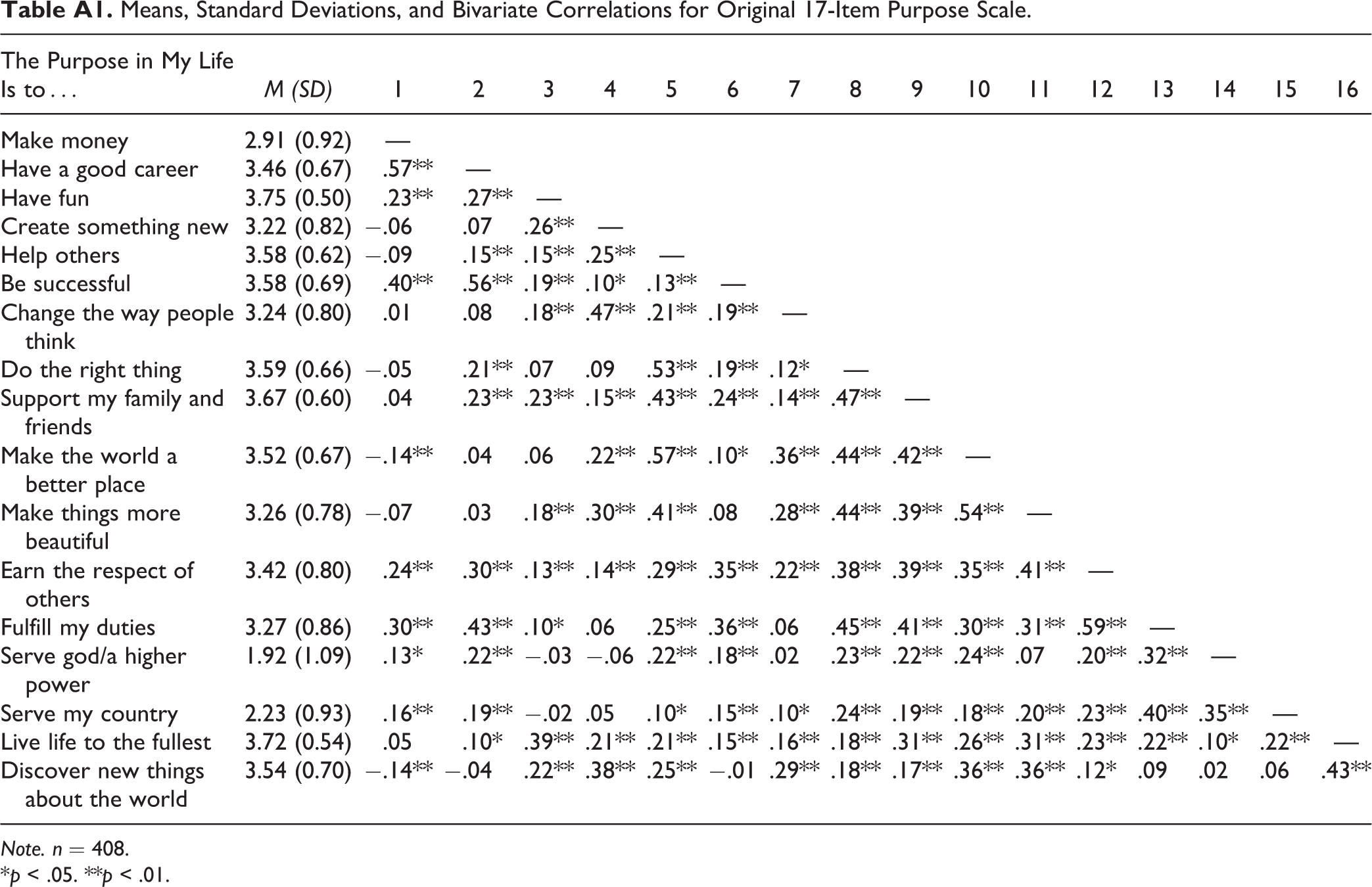
The EFA conducted to explore the underlying factor structure of the original 17-item Identified Purpose Scale yielded five factors with an eigenvalue over 1 and a cumulative percentage of common variance explained of 49.49%. The scree plot, however, suggested a three-factor solution. The EFA was rerun restraining the solution to three factors. The overall fit of the model was assessed with the Kaiser–Meyer–Olkin (KMO) measure of sampling adequacy and Bartlett’s test of sphericity. The KMO was .815 and Bartlett’s test of sphericity was significant, χ2 = 2,250.83, p < .001, suggesting that the data were suitable for factor analysis. The three factors accounted for 41.61% of the common variance. As seen in Table 1, the factor structure revealed 4 items cross-loading over .3 on more than one factor. We first considered removing “make things more beautiful,” as this item cross-loaded over .4 on two factors and the difference between the loadings was small. After removing this item, 5 items exhibited cross-loading over .3 on more than one factor. We then considered deletion of “fulfill my duties,” as this was the only item that cross-loaded over .4 on a second factor. After deleting this item, 3 items still cross-loaded over .3; however, no cross-loadings exceeded .4, the items appeared to load more heavily on one factor, and that factor was interpretable. Thus, we did not remove more items to avoid overfitting the data to the specific sample. The final EFA on the retained 15 items revealed a KMO of .777 and a significant Bartlett’s test of sphericity, χ2 = 1,703.11, p < .001. The full correlation matrix including means and standard deviations for all items are included in Appendix A.
Factor Structure of the Original 17-Item Purpose Scale.

Note. n = 408. Extraction method: Principal axis factoring with varimax rotation. Factor loadings above .30 are boldfaced.
The final three-factor solution is shown in Table 2. Based on the items included in each factor, we chose to define each factor according to two potential dimensions: breadth and focus. Breadth (i.e., broad vs. narrow) corresponds to Damon et al.’s (2003) conceptualizing of beyond-the-self PIL, such that individuals may desire to impact the world beyond themselves (i.e., broad) or simply affect their lives without reaching beyond (i.e., narrow). Focus (other-promoting vs. self-promoting) extends beyond breadth, such that individuals’ PIL may target the benefit of others (i.e., other-promoting) or may be aimed more toward self-enhancement and enrichment (i.e., self-promoting). Factor 1 was defined as broad other-promoting and included 7 items that captured a PIL aimed at helping others and improving the world around them. Factor 2 was defined as narrow self-promoting. This factor included 3 items that captured a PIL aimed at personal achievement without consideration of the world around them. Factor 3 was defined as broad self-promoting and included 5 items. This factor appeared to capture a sense of wanting to enjoy life but make an impression on the world beyond themselves. As seen in Table 3, internal consistency was adequate for both broad other-promoting PIL and narrow self-promoting PIL. The internal consistency for broad self-promoting PIL was low. Communalities produced by the EFA suggest that the variance of many items was not well explained by the factors. Yet, the items appeared to contribute to their corresponding factors in a reasonable and interpretable way. Correlations among the constructed scales suggest that all of the subscales were positively correlated.
Factor Structure of the Revised 15-Item Purpose Scale.
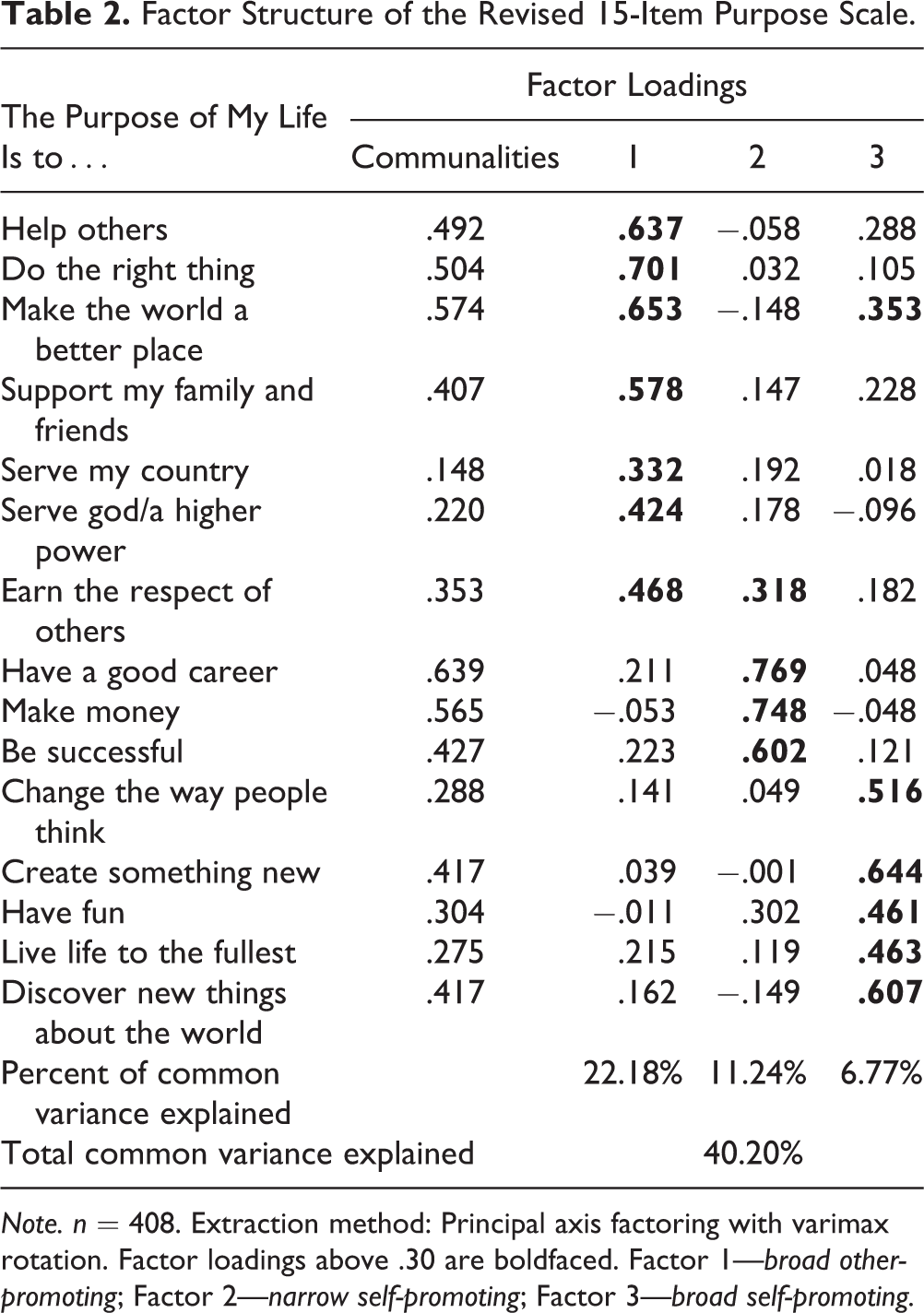
Note. n = 408. Extraction method: Principal axis factoring with varimax rotation. Factor loadings above .30 are boldfaced. Factor 1—broad other-promoting; Factor 2—narrow self-promoting; Factor 3—broad self-promoting.
Internal Consistency and Correlations of Purpose Subscales.
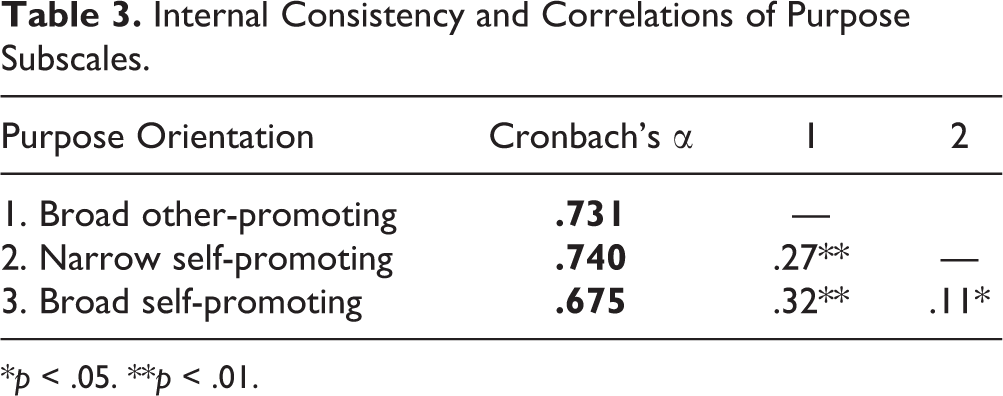
*p < .05. **p < .01.
Differences in PIL Based on Substance Use
Of the individuals who completed the substance use items (n = 345), 47% reported no ATOD use. Frequency of ATOD use ranged from 0 to 6 (M = .92, SD = 1.38). Bivariate correlations suggest that ATOD use was negatively associated with broad other-promoting PIL (r = −.130, p = .016). On the contrary, broad self-promoting PIL was positively associated with ATOD use (r = .126, p = .019). Narrow self-promoting PIL was not associated with ATOD use (r = −.097, p =.072).
Discussion
PIL is a multifaceted construct in which distinct categories have been theorized or tested along two dimensions: content and breadth. Researchers have highlighted the importance of the content of PIL or the closely associated construct of meaning (Bronk, 2014; De Vogler & Ebersole, 1983; Emmons, 2003; Hill et al., 2010). Yet, while researchers often define PIL as a central goal or aim in life (Kashdan & McKnight, 2009; Ryff, 1989), Damon et al. (2003) inserted breadth as an important consideration. Accordingly, PIL is beneficial when it extends beyond the self. Little is known, however, about what categories of PIL may be espoused by adolescents and how these categories may relate to substance use behavior. Thus, the present study sought to fill this gap by exploring the categories of PIL and how they are related to self-reported ATOD use frequency.
Our findings suggest that both focus and breadth are potentially important dimensions. The results suggest three categories of PIL: broad other-promoting, narrow self-promoting, and broad self-promoting. While broad other-promoting and narrow self-promoting categories appear to capture Damon et al.’s (2003) conceptions of beyond-the-self- and self-oriented PIL, broad self-promoting appears to be a unique blend of the two. Indeed, this factor extends beyond the self to make an impression on the world, but it does not appear aimed at improving the world for others as opposed to broad other-promoting PIL. Thus, adolescents may want to leave their handprint on the world, yet this motivation may be driven by a desire to help others or a desire to enhance one’s own well-being and satisfaction. Alternatively, adolescents may desire to enhance one’s own well-being without consideration of how it may influence the world beyond them. It is also noteworthy that all categories were significantly, positively associated. Thus, espousing a desire to help others does not preclude a desire to obtain personal success or to impact the world for selfish motives.
Although exploratory and based on cross-sectional data, the present findings suggest that a broad other-promoting PIL may be protective against substance use behavior, while a broad self-promoting PIL may elevate risk. Broad other-promoting PIL was negatively associated with lifetime ATOD use. Although normative (Petraitis, Flay, & Miller, 1995; Siebenbruner et al., 2006), ATOD use may be seen as less appealing for individuals focused on making a difference in the world through helping others. Similarly, previous research suggests that religiosity is associated with decreased substance use (Kub & Solari-Twadell, 2013; Salas-Wright, Vaughn, Hodge, & Perron, 2012). Alternatively, a broad self-promoting PIL was positively associated with ATOD use. Although adolescents espousing this PIL may want to make a difference in the world, this may be driven by a hedonistic orientation (Mariano & Savage, 2009).
Limitations of this study should be considered. Our sample was drawn from a single high school, which is situated in a city with a large university and health system. Thus, the findings are likely not generalizable to other student populations. Due to the cross-sectional nature of our study, we cannot make assertions regarding causality. Indeed, it is unclear if substance use preceded the adoption of PIL categories. Longitudinal studies are needed to examine the association between PIL categories and substance use behavior over time as well as to examine the stability of PIL categories across time and/or developmental phase. We also acknowledge that this study was exploratory; future research should attempt to refine the subscales identified in the present study and validate the scale in different populations. As such, standard scale development procedures, including evaluating validity and reliability and confirming the factor structure in numerous samples, should be pursued (Hinkin, 1995; Reise et al., 2000). Future research may also benefit from exploring additional dimensions of PIL, including whether adolescents have committed to a purpose or are still searching (Bronk & Finch, 2010), whether the relationship between PIL and ATOD use is modified by age, or how these categories may cluster together (Bronk & Finch, 2010). Additionally, future studies that include PIL along with other known predictors of adolescent substance use (e.g., peer use; Arthur, Hawkins, Pollard, Catalano, & Baglioni, 2002) could provide additional insight into the influence of PIL on adolescent substance use. Despite these limitations, this is the first study to our knowledge to examine the categories of PIL in relation to substance use. The findings suggest that the categories of PIL may provide insight into ATOD use among adolescents.
Implications for School Nurses
Given the many negative outcomes associated with ATOD use during adolescence, it is critical that school nurses identify students at risk for substance use and, in collaboration with other school personnel, identify substance use prevention strategies for their student populations. Our findings suggest that identifying categories of PILs espoused by adolescents may be helpful in determining their risk for substance use. In addition, our findings suggest that assisting students with exploring a PIL that may offer protection against substance use behavior, such as a broad other-promoting PIL, may be an important tool for school nurses as they work to help students avoid risk behavior and holistically support positive youth development and thriving. The National Association of School Nurses has suggested that care coordination, including motivational interviewing/counseling, is an important component of school nursing practice (Maughan, Bobo, Butler, & Schantz, 2016). Thus, school nurses could meet with and counsel students on how different categories of PIL relate to future goals.
Footnotes
Appendix A
Means, Standard Deviations, and Bivariate Correlations for Original 17-Item Purpose Scale.
| The Purpose in My Life Is to… | M (SD) | 1 | 2 | 3 | 4 | 5 | 6 | 7 | 8 | 9 | 10 | 11 | 12 | 13 | 14 | 15 | 16 |
|---|---|---|---|---|---|---|---|---|---|---|---|---|---|---|---|---|---|
| Make money | 2.91 (0.92) | — | |||||||||||||||
| Have a good career | 3.46 (0.67) | .57** | — | ||||||||||||||
| Have fun | 3.75 (0.50) | .23** | .27** | — | |||||||||||||
| Create something new | 3.22 (0.82) | −.06 | .07 | .26** | — | ||||||||||||
| Help others | 3.58 (0.62) | −.09 | .15** | .15** | .25** | — | |||||||||||
| Be successful | 3.58 (0.69) | .40** | .56** | .19** | .10* | .13** | — | ||||||||||
| Change the way people think | 3.24 (0.80) | .01 | .08 | .18** | .47** | .21** | .19** | — | |||||||||
| Do the right thing | 3.59 (0.66) | −.05 | .21** | .07 | .09 | .53** | .19** | .12* | — | ||||||||
| Support my family and friends | 3.67 (0.60) | .04 | .23** | .23** | .15** | .43** | .24** | .14** | .47** | — | |||||||
| Make the world a better place | 3.52 (0.67) | −.14** | .04 | .06 | .22** | .57** | .10* | .36** | .44** | .42** | — | ||||||
| Make things more beautiful | 3.26 (0.78) | −.07 | .03 | .18** | .30** | .41** | .08 | .28** | .44** | .39** | .54** | — | |||||
| Earn the respect of others | 3.42 (0.80) | .24** | .30** | .13** | .14** | .29** | .35** | .22** | .38** | .39** | .35** | .41** | — | ||||
| Fulfill my duties | 3.27 (0.86) | .30** | .43** | .10* | .06 | .25** | .36** | .06 | .45** | .41** | .30** | .31** | .59** | — | |||
| Serve god/a higher power | 1.92 (1.09) | .13* | .22** | −.03 | −.06 | .22** | .18** | .02 | .23** | .22** | .24** | .07 | .20** | .32** | — | ||
| Serve my country | 2.23 (0.93) | .16** | .19** | −.02 | .05 | .10* | .15** | .10* | .24** | .19** | .18** | .20** | .23** | .40** | .35** | — | |
| Live life to the fullest | 3.72 (0.54) | .05 | .10* | .39** | .21** | .21** | .15** | .16** | .18** | .31** | .26** | .31** | .23** | .22** | .10* | .22** | — |
| Discover new things about the world | 3.54 (0.70) | −.14** | −.04 | .22** | .38** | .25** | −.01 | .29** | .18** | .17** | .36** | .36** | .12* | .09 | .02 | .06 | .43** |
Note. n = 408.
*p < .05. **p < .01.
Declaration of Conflicting Interests
The author(s) declared no potential conflicts of interest with respect to the research, authorship, and/or publication of this article.
Funding
The author(s) disclosed receipt of the following financial support for the research, authorship, and/or publication of this article: S. Stoddard is supported by a Mentored Scientist Career Development Award (1K01 DA 034765) from the National Institute on Drug Abuse. K. Abramoski is supported by a predoctoral fellowship from the Rita & Alex Hillman Foundation through the Hillman Scholars Program in nursing innovation.