







Abstract
In this article, the perceptions of preadolescent children (ages 9–11) regarding factors that influence and protect against power imbalance associated with covert aggression and bullying are explored. In aggression research, the term covert has been typically used to describe relational, indirect, and social acts of aggression that are hidden. These behaviors contrast with overt physical and verbal aggression. Children have previously conveyed their belief that covert aggression is harmful because adults do not see it even though children, themselves, are aware. We used focus groups to explore children’s understanding of covert aggression and to identify children’s experience and perception of adult support in relation to bullying. Thematic analysis supported the definition of covert aggression as that which is intentionally hidden from adults. Friendship, social exclusion, and secret from teacher were identified as factors that influence power imbalance, while support from friends and adult support protected against power imbalance.
Background
Optimal development occurs when children learn to trust within secure and nurturing relationships, including those with peers and adults at school (Oberle, Schonert-Reichl, Guhn, Zumbo, & Hertzman, 2014). While school is a context in which protective relationships can be fostered, it is also the central place in which many children are harmed through bullying behavior (Cortes & Kochenderfer-Ladd, 2014). Bullying is a form of aggressive behavior that is repeated in a relationship in which the perpetrator is perceived as having more power than the victim, that results in hurt or harm to the victim (Rodkin, Espelage, & Hanish, 2015). The harm associated with bullying is effected by the power the perpetrator holds over the victim. One potential form of power associated with bullying in the school environment is through aggression that is deliberately hidden from adults by the students who perpetrate the harm (Cross et al., 2009). For this reason, for the purpose of this research, we define covert aggression as that which is intentionally hidden from adults or respected others (Nelson, Kendall, Burns, & Schonert-Reichl, 2015). The aim of this research was to explore the perceptions of preadolescent children regarding factors that influence and protect against power imbalance in relation to covert aggression and bullying.
Covert Aggression and Bullying
Aggression is often categorized as overt or covert. Overt aggression is uniformly defined as direct harm caused through physical acts and verbal threats (Bradshaw, Waasdorp, & Johnson, 2015; Grotpeter & Crick, 1996). Covert aggression, in contrast, has been defined in a number of context-specific ways. Covert aggression is often referred to as nonphysical aggression that causes harm through damage to relationships and social status, equated with indirect, social, and relational forms of aggression (Bradshaw et al., 2015; Cross et al., 2009) and with cyberbullying (Spears, Slee, Owens, & Johnson, 2009). The term covert is also used to refer to aggression that is disguised so that it is not obvious to the target (Morrow, Hubbard, & Swift, 2014), or others, including peers (Closson & Watanabe, 2016) and teachers (Barnes et al., 2012). In the context of bullying, however, the great majority of children who are bullied by any means know who the main aggressor is (Craig, Pepler, & Blais, 2007). Bullying is almost always a group process, involving peers as bystanders, and this is consistent across traditional and cyber forms of bullying (Rodkin et al., 2015; Spears et al., 2009).
Cross et al. (2009, p. 21) comment that restricting the definition of covert bullying to behavior that is “disguised,” or not obvious to the target and peers, negates research showing the role that bystanders play in reinforcing bullying. Children have reported in qualitative research, for example, that covert bullying is harmful because other children can see it but adults cannot (Cross et al., 2009; Houghton, Nathan, & Taylor, 2012). Children themselves have defined covert bullying as that which is “hidden” from adults and other respected people (Cross et al., 2009, p. 21). This finding is consistent with other observations that adults rely on children to report covert bullying (Hymel & Swearer, 2015; Pepler, Craig, & O’Connell, 2010). Cross et al. (2009, p. 334) reported a 16% prevalence rate of covert bullying in response to children’s report of being bullied in ways not easily “seen by others.”
Covert Aggression and Social Isolation
Covert aggression is often perpetrated through social manipulation by children who use aggression as a strategy to achieve status (Cross et al., 2009). Social manipulation and social exclusion are relationally aggressive forms of behavior, aimed at damaging relationships and diminishing acceptance by others (Berger & Caravita, 2016). Morrow, Hubbard, and Swift (2014) contrasted social manipulation (indirect behavior) from social rebuff (direct exclusion); however, the correlation between the two forms of victimization was very high (0.94), suggesting that they are the same construct. Furthermore, empirical analyses have not supported categories of indirect versus direct social aggression (Fitzpatrick & Bussey, 2011; Verona, Sadeh, Case, Reed, & Bhattacharjee, 2008). Children skilled at social manipulation draw power from others, enlisting the support of the group to perpetuate social exclusion and covert aggression while hiding their harmful behavior behind an image of social acceptance (Huitsing, Snijders, Van Duijn, & Veenstra, 2014). For this reason, the victim is isolated from trusted peers and adults (Cross et al., 2009; Rodkin et al., 2015).
Due to neurobiological mechanisms that occur in response to social deprivation and toxic stress, social isolation has negative impact on children’s health and developmental outcomes (Danese & McEwen, 2012). Social isolation places a burden of stress on victims of bullying when they are unable to access support from peers and adults who are trustworthy (Eisenberger, Taylor, Gable, Hilmert, & Lieberman, 2007; Pepler et al., 2010). Furthermore, prolonged social isolation is associated with decreased self-acceptance and internalizing problems, predisposing children to depression and anxiety (Troop-Gordon & Ladd, 2005), and suicidal ideation (Bonanno & Hymel, 2010). Social isolation associated with cyberbullying has resulted in children’s experiencing strong feelings of fear, helplessness, and disruption to education (Spears et al., 2009). The risk to mortality that exists with social isolation is similar to that of smoking, and higher than the risk that exists with obesity and lack of exercise (Holt-Lunstad, Smith, & Layton, 2010). However, neuroimaging has shown that social support moderates the neural response to threat, decreasing the harmful effects of the stress response (Eisenberger et al., 2007).
Learning Resilience Within an Environment of Social Support
Although stress is often considered to be negative, learning how to overcome stressful situations in a positive way leads to adaptation and resilience (Danese & McEwen, 2012). For example, social striving among peers is a normal developmental process by which children learn social understanding, and children mature as they learn to resolve conflict and practice compromise with friends (LaFontana & Cillessen, 2010). Resilience is shown in adversity and is learnt in an environment that moderates the harmful effect of stress, for example, within secure relationships (Seibert & Kerns, 2009). Social support provided by teachers and adults within the school, including school nurses, provides a level of interaction that acts as a resource for children who are experiencing adversity. This gives a secure base for children, thereby supporting neurobiological development and resilience and promoting positive development (Brendgen et al., 2011; Oberle et al., 2014). However, persisting social exclusion occurs in peer groups, restricting children’s access to the relationships and resources that support development (Buhs, Ladd, & Herald, 2006). It is anticipated that covert aggression increases the power of the perpetrator over the victim by limiting children’s access to secure relationships.
Within the framework of relational developmental systems theories, children’s development is most closely supported by microsystems, these include social relationships with peers and teachers in the school environment (Bronfenbrenner & Morris, 2006). This research was conducted within this framework and was guided by the question: Do children experience an “increase of hurt when adults are unaware of, or insensitive to,” children’s reports of victimization? (Nelson et al., 2015, p. 2). Article 12 of the United Nations Convention of the Rights of the Child highlights the right of all children to talk about their own experience and to be heard (www.unicef.org/crc/). It is fundamental that children participate in research that measures and reports on their own well-being (Ben-Arieh, 2005), children were invited to participate in this research through focus group discussions. This article reports on covert aggression, exploring the perceptions of preadolescent children regarding factors that influence and protect against power imbalance in bullying.
Method
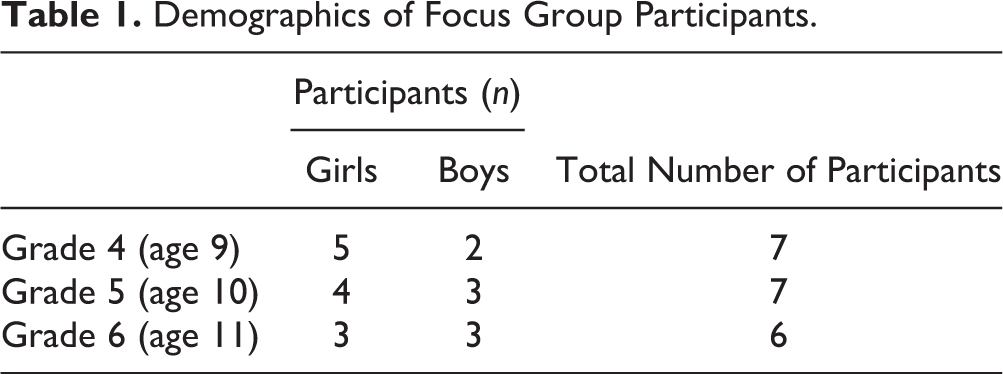
Focus groups were used to explore children’s understanding of aggression that is intentionally hidden from adults and to identify children’s experience and perception of adult support in relation to bullying. Participants were invited from a purposive sample of children enrolled at an independent school in a metropolitan region of Perth, Western Australia. Families enrolled in the school represent a population of socio-educational advantage (Nelson et al., 2015). Thirty children were invited to participate in the focus groups, the principal worked with teachers to purposively select children who would engage in group discussion (Gibson, 2007). Active written consent was sought from parents and children gave written assent, received for 22 participants (73.3%). Three focus groups were conducted by school grade (see Table 1). Two students were not at school on the day of data collection, ethnicity data were collected from school records and were available for 18 of the participants, identified as Australian (n = 17) and British (n = 1), one of these families spoke a language other than English at home. Ethics approval was obtained from the relevant university Human Research Ethics Committee and the participating school.
Demographics of Focus Group Participants.
Focus Group Procedure
Focus groups were conducted in the school in an environment that was familiar to children and were facilitated by the first two authors. Children were given time to get to know the researchers with an informal discussion about children’s favorite subject at school (Morse, 2015). The literature informed the topic of a vignette that was developed to start the discussion, the vignette told of a child named Olivia who was socially excluded by others at school after a popular peer told a lie about Olivia. The name Olivia was chosen for the victim, consistent with the findings that girls are likely to attribute self-blame in response to victimization (Troop-Gordon & Ladd, 2005). Furthermore, qualitative research in Western Australia has found that covert aggression is particularly salient to preadolescent girls in their attempt to maintain social centrality (Houghton et al., 2012). Popularity is a “well-suited” measure of the social dominance that is associated with bullying at preadolescence (Witvliet et al., 2010, p. 288). The perpetrator was named Jordan, a name used for boys and girls in Australia. The vignette was used to then generate third-person discussions about covert aggression and bullying. The questions were informed by the literature (see Table 2). Research suggests that children are unlikely to differentiate bullying from aggressive behavior, children were therefore asked about bullying rather than aggression (Vaillancourt et al., 2008). Two audio recorders were used to record focus group discussions. Data were managed using the software package NVivo Version 10 for Mac.
Focus Group Questions.
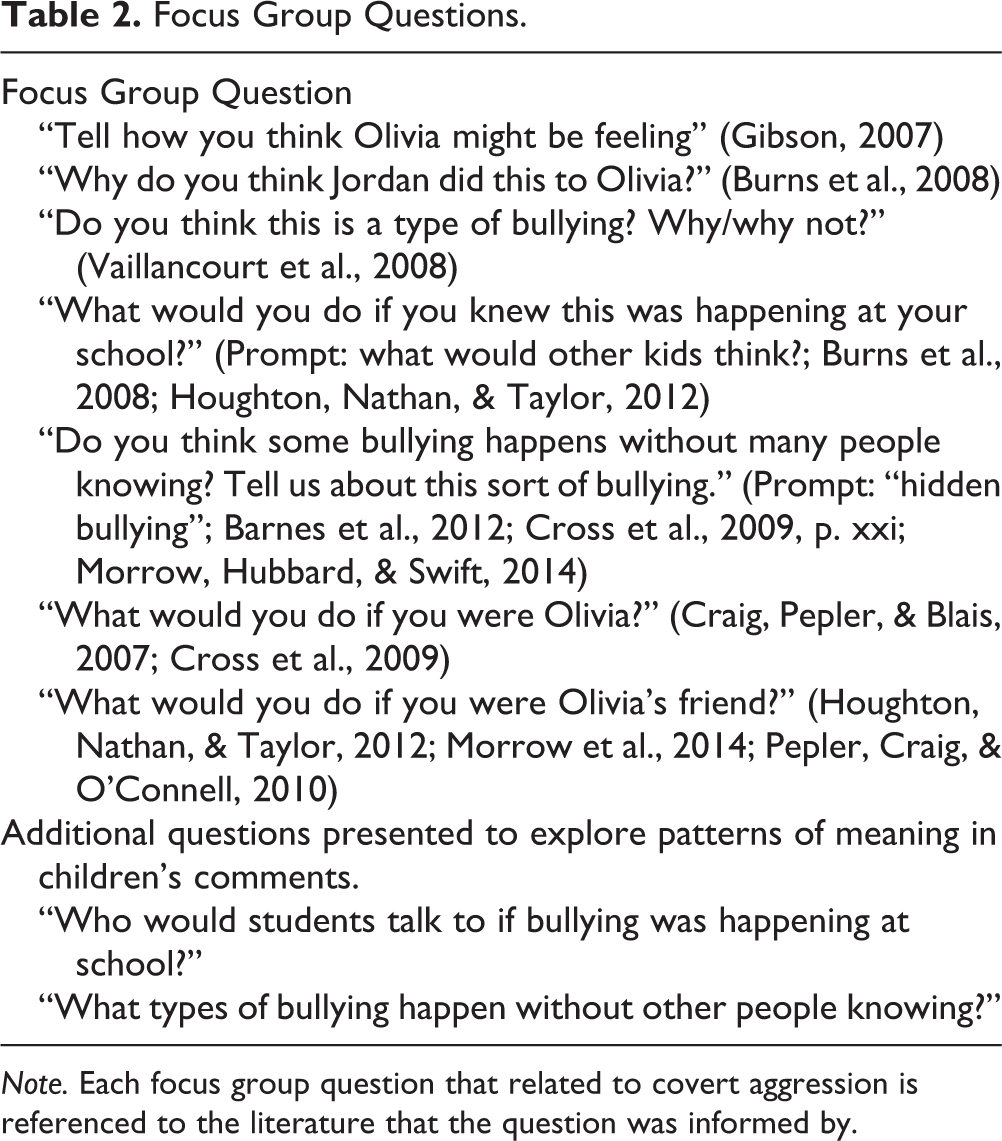
Note. Each focus group question that related to covert aggression is referenced to the literature that the question was informed by.
The validity of the research is supported by the transparency of the underlying assumptions about the data analysis in relation to the theoretical framework (Braun & Clarke, 2006). Methods used to support the credibility of the research include triangulation of questions, initial data were collected in three focus groups, thus converging data sources to enable cross-checking (Morse, 2015). This began in the structure of questions within the focus group moderator guide and was furthered by the review of transcribed data and subsequent thematic interpretation by the two researchers who facilitated the focus groups (Spears et al., 2009).
Data Analysis
Data were transcribed verbatim and coded manually; the authors read and reread manuscripts and made notes of initial ideas, descriptive codes were generated; words and phrases were explored to find shared meanings and perceptions across focus group participants using a thematic analysis approach (Braun & Clarke, 2006). Thematic coding began with a list of ideas that were anticipated based on the critical review of the literature. This method is consistent with researchers who advocate knowing and using the literature to increase the possible lenses through which the data are analyzed, thereby building on existing knowledge (Braun & Clarke, 2006). It was, however, necessary to be aware that categories derived from prior theory might represent the concepts of prior research rather than the views of the participants (Maxwell & Chmiel, 2013). For this reason, analysis also included a search of prevalent attitudes and opinions, and in addition, a search for alternate views expressed by participants who might be key to the research topic (Braun & Clarke, 2006). Themes were discussed and refined until agreement was reached.
Results
Analysis of the data revealed two major themes: (1) what influences power imbalance related to covert bullying? and (2) what protects against power imbalance in relation to covert bullying? Subthemes of friendship, social exclusion, and secret from teacher were identified as factors that influence power imbalance through covert behavior, and subthemes of support from friends and adult support were identified as protecting against power imbalance in covert bullying. These are illustrated in a thematic map (see Figure 1) and in the results of thematic analysis that follow. Pseudonyms, gender, and grade at school have been used to differentiate between participants.
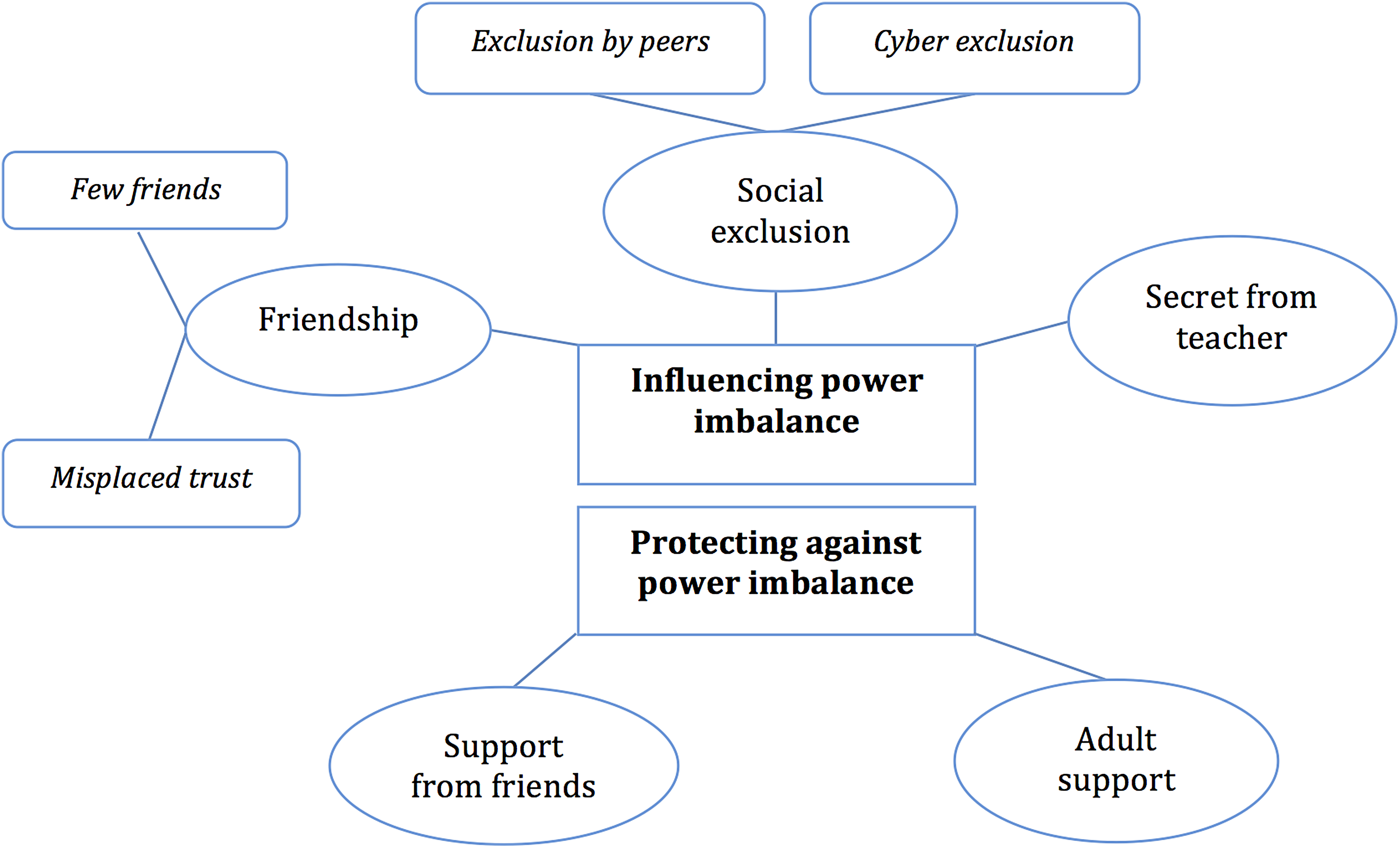
Thematic map of covert factors of power imbalance. The two major themes of the thematic analysis were (1) what influences power imbalance related to covert bullying and (2) what protects against power imbalance in relation to covert bullying. Subthemes of friendship, social exclusion, and secret from teacher were identified as influences on power imbalance. Within the subtheme of friendship, children spoke of few friends and misplaced trust. Within the subtheme of social exclusion, children spoke of exclusion by peers and cyber exclusion. Subthemes of support from friends and adult support were identified as protecting against power imbalance.
Major Theme 1: What Influences Power Imbalance Related to Covert Bullying?
Subtheme 1: Friendship
Friendship was identified as both an influence and a protective characteristic of power imbalance. Friends were seen as being stable and people not to hurt, “cause like, they’re for you forever” (Ruby, Grade 6 girl). However, children recognized there was sometimes dissonance between the ideal and the reality as described by Vashti (Grade 5 girl), “It’s really hard to tell someone like that your best friend is actually bullying you on purpose.” Within the subtheme of friendship, children spoke of few friends and misplaced trust.
Few friends
Being alone was identified as a subtheme associated with power imbalance among Grades 4 and 5 children. Children considered that without friends a child is left to fend for himself or herself, resulting in increased power imbalance, which was simply stated by Lucy (Grade 4 girl), “Because they don’t have many people to stand up for them.” In the Grade 4 focus group, Stefan (boy) asked, “What would be the best way to solve bullying if it’s by more than a couple of people?” Daisy (girl) responded that it is important to have a friend; however, Antony (boy) replied, “What if they’re away?” and Stefan asked “But what if when they’re lonely they get bullied?” demonstrating the value of having a group of friends. Daisy’s reply confirmed this, “Yeh, mostly when they’re lonely they get bullied but if you have a friend you’re alright.” Likewise, Walter (Grade 5 boy) gave an example that a group targeted a child who was alone and the group blocked the door to ensure that the teacher did not see.
Misplaced trust
Misplaced trust was identified as a subtheme of friendship among children in each grade. Stefan (Grade 4 boy) observed that children are likely to trust a friend and not differentiate a joke from misuse of power, stating, “When you’re someone’s friend, you put a lot of trust into them,…so more like, you could push them around a lot more because they know it could be just a joke or something.” Vashti (Grade 5 girl) indicated 4 times of bullying in the form of repeatedly harming a friend and then saying “it was just an accident.” Grace (Grade 5 girl) spoke of a friend who twisted Grace’s story to side with the bully “and they get more rude to you and, I don’t, because it’s been twisted a few times, a lot of times.”
Many girls and boys in each grade spoke of gossip and rumors as an example of misplaced trust, for example, telling a friend’s “most valuable secret” (Ella, Grade 6 girl). Among girls, this was often in the context of using friends to increase popularity or to get into a desired group by intentional and predetermined social climbing, without true regard for the friend. For example, Ruby (Grade 6 girl) referred to being “used” by a friend to get into the popular group.
Subtheme 2: Social exclusion
Social exclusion was identified as an influence of power imbalance in each focus group, seen to occur in peer relationships or through the Internet in the form of cyberbullying though social media and online games, attacking identity, and taking away friends. Social exclusion was described by Gayle (Grade 4 girl), “Bullying, bullying is a way to bring someone’s self-esteem down and make them feel bad about themselves. Take away all their friends and feel like there’s nobody with them.” In response to the vignette, Maria (Grade 5 girl) suggested that the victim of the bullying was left feeling “lonely and insecure.” Hope (Grade 6 girl) said that bullying “makes them feel like they don’t belong anywhere.” Gayle (Grade 4 girl) explained how children are isolated from friends as a powerful bully manipulates children, expressing feelings of hopelessness regarding resolving the situation; “It felt like she was keeping all my friends away because she was telling them false things about me and I just felt like there was no one who could resolve it.” Anthony (Grade 4 boy) gave a similar example, “They all agree with the person that’s being the big bully and so then the person that’s by themself can’t really do anything till he gets, or they get, someone on their side.” Within the subtheme of social exclusion, children spoke of exclusion by peers and cyber exclusion.
Exclusion by peers
Girls from the Grade 4 focus group spoke of hidden bullying referring to indirect behavior, as “physical and secret, like not telling them” (Eliza, Grade 4 girl). The behavior was labeled as “gossip” by children in Grades 4 and 5, and as “talking behind peoples backs” and telling “lies,” by those in Grades 5 and 6. Ella (Grade 6 girl) described how the victim is disempowered, “You can also do like, saying behind people’s backs, and they, the person might not even know it, and everyone would be laughing at them.”
In contrast, other students talked of the hurt caused by direct untrue accusations and lies (said to the face rather than behind the back), and Vashti (Grade 5 girl) spoke of the power of a look: “Some bullying is people who…look at you in that way.” Ruby (Grade 6 girl) gave an example of direct lies, “They say ‘oh, you hit me’…like you didn’t really hit them.” Importantly, in the context of bullying, Ruby added that it “just keeps on carrying on and they just like be mean to you for weeks and weeks and weeks.” The repetition suggests the powerlessness of the victim in her inability to address the situation. Kailey spoke of a similar experience: They say something like ‘well you’re doing this and that.’ ‘Well I’m not’ and like…you, you can’t explain things again and they say the same thing and they’re like and you can’t just get them to know how you’re feeling. (Kailey, Grade 4 girl)
One subtheme that was identified in relation to social exclusion was that a portion of the power imbalance was associated with keeping the bullying hidden from the teacher “so they won’t get in trouble” (Grade 4 girl). When the teacher is told about bullying and the perpetrator/s get into trouble, blame can be laid on the one who told the teacher resulting in exclusion by peers as indicated by Arthur (Grade 6 boy) and Ella (Grade 6 girl), respectively, “They try and have a go at you because they’ve been in trouble so they’re gonna get you in trouble.” “If you tell the teacher sometimes, the whole group will get like in way more trouble than it should have been.”
Cyber exclusion
Although children in Grade 4 were unlikely to have Internet access at home, children in Grades 5 and 6 referred to the power imbalance associated with exclusion via Internet. Grace and Hope spoke of indirect online bullying: Grace (Grade 5 girl) told that children use online forums to tell lies; Hope (Grade 6 girl) said, “Some people don’t, may not realize that they’re being bullied…because they might not have messaging.” Roland (Grade 6 boy) spoke of direct online aggression through messaging, “they just keep being mean.”
Subtheme 3: Secret from the teacher
Adults were seen as a source of support; however, all children in each focus group perceived that bullying often happens without the teacher knowing, a Grade 4 girl attributed this especially to “best friends.” Maria spoke of the importance of maintaining a friendship despite bullying: I sometimes find if your friend (is bullying) that you don’t want (to tell) a teacher because they might then, may not talk to you…, but they might give you nasty looks and not be your friend any more and cannot be your friend. (Maria, Grade 5 girl)
A consistent theme across focus groups was that lies and hurtful rumors exclude children from adult help and limit children’s trust in the teacher and the trust of the teacher in the child. Arthur (Grade 6 boy) gave this example, “Whenever he did something wrong he would blame it on me, and he would always tell rumors.” Stefan gave a similar example: The person that (bullied us), um, told his dad and his dad told our teacher and now our teacher thinks that that person who’s been doing it to us isn’t the person that causes it and that we’re being the person that—and that’s why I don’t usually tell the teacher because I just sort it out myself. (Stefan, Grade 4 boy)
Grace and Hope spoke of a lack of support when talking with teachers about bullying. Grace (Grade 5 girl) said that when she tells the teacher “it doesn’t normally get solved;” Grace had previously said that bullying behavior is kept secret from the teacher thus taking away the potential for adult support, saying “even when you tell they don’t stop bullying but they secretly do it.” Hope (Grade 6 girl) said of teachers, “They ignore me like it was my fault.”
Another form of exclusion involving adults is children’s reported feeling of social exclusion after accepting advice to ignore the bully. Stefan (Grade 4 boy) spoke of feeling excluded after following advice given by his mum to stay away from the bully, “Um my mum just says to go away from them but then I’ve got hardly anyone else to play with.” Vashti (Grade 5 girl) spoke of her experience after telling her dad about bullying, “Sometimes my dad just says to ignore them, and stuff cause he doesn’t really do anything about it. Cause he doesn’t want to get involved.” Hope (Grade 6 girl) had a similar situation in advice given by a staff member at school after feeling excluded from playing a lunchtime sport by her peers, “She told me not to worry about it but they kept on doing it every single time.”
Major Theme 2: What Protects Against Power Imbalance Related to Covert Bullying?
Subtheme 1: Support from friends
Although exclusion by peers influences power imbalance, peer support was identified as a protective characteristic of power imbalance. Friends were seen as those who would stick by you as described by Ella (Grade 6 girl) as prompted by the vignette, “Um, when I was younger, I got like pushed out of that group but then my best friend she like stayed with me so I would like, help Olivia and make a new group then, with her.” Daisy (Grade 4 girl) responded to a discussion about indirect exclusion, talking of the protection given by a friend who told her what was happening and supported her in telling the teacher: “Um my friend was talking about me behind my back but then my other friend told me and I found out I could tell the teacher cause um at least I had a friend who could tell me.”
Subtheme 2: Adult support
Although power imbalance increased when adults were unaware of bullying or did not assist children who reported bullying, adult support was identified as a protective characteristic of power imbalance. For example, Ruby (Grade 6 girl) said that a staff member helped her to understand that “you don’t have to be friends with everybody.” Gayle (Grade 4 girl) said that her mum had “some really good advice,” and Kailey spoke of protection and support provided by her mum: I find it’s easier to go home and tell mum, see what I can say and stuff and what should I do about it and, because if I say the wrong thing it could get even worse and it’s good, I know it’s good to stand up for yourself but I find it hard to do it right at that moment. (Kailey, Grade 4 girl)
Arthur (Grade 6 boy) preferred to talk with an uncle or a family member more removed from his immediate environment, “because that way I don’t see them all the time so they won’t want to talk about it. They will just give me a few tips and then we’ll move on.”
Adults protected against power imbalance by supporting children who had been bullied but also in helping children develop skills to deal with aggressive behavior. For example, Eliza spoke with her mother to help her understand how to approach children when she had been mean to them, and Stefan talked positively about a previous teacher’s intervention. I’ll know that I’ve been mean on that day and I’ll tell my mum and she’ll say “well go to that person tomorrow morning and say I’m sorry for what you did.”…I would do it the next morning so that I can get my words ready and be ready to do it. (Eliza, Grade 4 girl) Our teacher was very good and um, just like whenever something happened they would, um, they would sit down with the teacher and have a talk about it, both of them with the bullying. In fact, yeh, it happened to me once. (Stefan, Grade 4 boy)
The findings from the focus groups suggest that with perceptive support from an adult, children can learn to work through bullying with maturity and sensitivity.
Discussion
The first major theme of focus group analysis identified influences on power imbalance in relation to covert aggression. Subthemes of friendship, social exclusion, and secret from teacher were identified as influences on power imbalance. The second major theme identified factors that protect against power imbalance in relation to covert aggression; subthemes of support from friends and adult support were identified as protecting against power imbalance. Each theme is discussed beginning with friendship.
Within the subtheme of friendship, children spoke of having few friends and of misplaced trust within friendships. Within the framework of relational developmental systems theories, friends act as a resource for children, indicating acceptance and building trust, optimism, and self-worth, and helping victimized children (Bronfenbrenner & Morris, 2006; Closson & Watanabe, 2016). Recent research found that lower levels of victimization were predicted for children who had a greater number of friends (Serdiouk, Berry, & Gest, 2016). This is consistent with our research, with many references made by children to having a friend to “stand up for them.” However, friendship was not always seen as a protective factor. For example, children in this study spoke of misplaced trust in terms of being “used” by friends. The friend holds a position of power through the trust associated with friendship and may abuse that power for personal gain. This is consistent with previous research which found friendships of relationally aggressive children are characterized by high levels of intimacy (hearing secrets told by the friend), relational aggression, and jealousy relative to other children (ages 9–12; Grotpeter & Crick, 1996). Such peer victimization is likely to increase children’s perception of the social environment as hostile, resulting in distrust of peers and contributing to internalizing and externalizing problems, low self-worth, loneliness, depression, and anxiety (Rodkin et al., 2015).
Conversely, children mature as they learn to resolve conflict with friends (Serdiouk et al., 2016). Grace spoke of best friends fighting over not liking the same thing, it is likely that this reflects aggression among children who are practicing “cooperation, compromise, and competition” (LaFontana & Cillessen, 2010, p. 131). This is not bullying. Bullying is proactive aggression, a strategic and goal-oriented behavior that occurs repeatedly within a relationship of abuse, but current research methods do not adequately distinguish bullying from aggression (Rodkin et al., 2015). There has been a recent call for research to assess power imbalance within the bully/victim relationship and children’s social networks (Rodkin et al., 2015). Power imbalance is increased when children intentionally dominate the victim by widening the social network through which the victim is isolated. This is the focus of the following discussion with regard to social exclusion and involving adults.
Social exclusion was the second subtheme identified relative to factors that influence power imbalance within covert bullying; within this subtheme, children spoke of exclusion by peers and of exclusion through online forums. Exclusion and belonging are at two ends of a spectrum as seen in children’s description of bullying as making children feel “bad about themselves,” “left out,” “like they don’t belong,” and “lonely.” Laursen and Hartl (2013) equate loneliness with the experience of social isolation, in the context of a lack of friends or because of exclusion by the peer group. Bullying occurs within peer groups as skillful aggressors use intimacy with peers as a resource to dominate and unite the peer group by excluding other children (Rodkin et al., 2015). The perpetrator of bullying draws power from the peer group, as children conform to peer pressure in an attempt to belong to the group (Witvliet et al., 2010). A qualitative study which found peer group to be a strong influence on the initiation and persistence of bullying suggested popularity to be a key concept within the theme of belonging and enhancing group status (Burns, Maycock, Cross, & Brown, 2008). Children’s experience of loneliness is heightened for those who interpret social isolation as a sign of unpopularity or through self-blame (Laursen & Hartl, 2013).
Secret from teacher was identified as a third subtheme of factors that influence power imbalance in covert bullying. In our focus groups, children in each grade said that others lie to the teacher to get away with bullying. For example, Stefan’s experience was that the teacher had believed the bully rather than him and that he and his friend were unjustly assigned blame. Children with leadership skills and a good understanding of social situations might manipulate others to achieve their own goal of social dominance but be seen by teachers as socially mature (Cross et al., 2009; Rodkin et al., 2015). More than the pure avoidance of discipline, this implies an intentional telling of lies to the adult to hold power over the victim, limiting hope of a resolve. Children’s discussion in focus groups suggested that the lack of emotional support from teachers increased the sense of isolation and hurt felt by children. Conversely, teacher support was negatively associated with striving for dominance, power, and popularity in the Grades 5 and 6 classroom environment (Kiefer, Matthews, Montesino, Arango, & Preece, 2013).
Emotionally responsive adults are a resource for children, helping children to develop new understanding of relationships, for example, by working with children who are bullied to reduce self-blame (Laursen & Hartl, 2013). However, teachers who failed to recognize popular children as perpetrators of bullying were also likely to attribute blame to the victims of bullying (Rosen, Scott, & DeOrnellas, 2017). Furthermore, teachers considered social exclusion to be the least serious form of bullying and had less empathy for victims of social exclusion (Bauman & Del Rio, 2006). In contrast, research has found social forms of bullying to be associated with poor academic and health outcomes (Danese et al., 2009; Morrow et al., 2014). Teacher’s uncertainty about how to respond to children who report bullying is a barrier to children’s adaptation. For example, some student teachers suggested that they would respond by dismissing the intent of the perpetrator or advising the victim “not to worry about it” (Bauman & Del Rio, 2006, p. 277). Research has shown the hopelessness felt by children who are victims of covert bullying highlighting the need for adults to build children’s capacity to respond to bullying in a positive way and to support the development of healthy relationships (Buhs et al., 2006; Closson & Watanabe, 2016; Craig et al., 2007).
Children spoke of feelings of exclusion when they accepted advice from adults to ignore the bully. Advice to avoid or ignore a bully has been found to place children at risk of further relational victimization; for girls, avoidance was related to social withdrawal (Troop-Gordon & Gerardy, 2012). Within the relational developmental systems theories framework, development occurs in the context of children’s widening experience in their environment and is supported by the secure base of an adult who they can return to (Sabol & Pianta, 2012). The findings of this study therefore support the definition of covert as intentionally hidden from adults.
Factors That Protect Against Power Imbalance in Covert Bullying
Support from friends and adult support were identified as protective factors for children in relation to covert bullying. Friends and peers, as bystanders, may assist the bully, remain silent, or intervene to support the victim. Friends who intervene provide emotional support and help each other to practice social skills and to access resources, including (but not limited to) adult help (Norwalk, Hamm, Farmer, & Barnes, 2016). Teachers are often not aware of bullying but friends are; recent studies have shown a protective factor when a friend intervenes and the teacher is receptive to the children (Norwalk et al., 2016; Serdiouk et al., 2016).
The teacher–student relationship forms the foundation for learning and for resilience as teachers listen respectfully to children and the children in turn feel heard and valued (Brooks & Goldstein, 2008). Seibert and Kerns (2009) found that children used peers and teachers as a secure base of emotional support, stabilizing the stress response and helping children adapt to the school environment. Neuroimaging has shown that high levels of ongoing social support were associated with reduced neurobiological reactivity to stress, lessening the neurobiological burden during social exclusion, even when there was no person present to give social support at the immediate time of stress (Eisenberger et al., 2007). Through these pathways, a strong teacher–child relationship was protective for children who had a genetic vulnerability to be aggressive and to be victimized by peers (Brendgen et al., 2011). In our research, Ruby had moved to the school as a result of social exclusion at her old school. Ruby spoke of the teacher at the old school as part of the problem, but at the new school the resource of support from staff had helped her to overcome bullying and to even actively defend others who had been bullied.
Cortes and Kochenderfer-Ladd (2014) found less bullying when teachers took an active role in intervening to promote healthy relationships. Children were, however, less likely to tell the teacher about bullying when they believed that the teacher would simply punish the aggressor. This is consistent with our study, in which many children considered that telling the teacher would result in social exclusion as a result of disciplinary measures. The context of the classroom is molded by the teacher and school policy and is relevant to how children interpret and respond to bullying (Bradshaw et al., 2015). This highlights the need to support teachers in promoting a positive classroom and school environment.
Limitations
Focus groups based on vignettes and hypothetical situations study the intended behavior of children and not actual behavior; however, the use of the vignette provided opportunity to discuss bullying situations in the third person initially which then triggered discussion of experienced situations and issues. When participants view a vignette as realistic, their behavioral intentions are correlated with their actual behavior (Willits, 2014). The vignette was based on extensive review of the literature and children interspersed their responses to the vignette with stories from their own experience. The use of focus groups can therefore be considered a limitation and a strength; the use of one-on-one interviews rather than focus groups would have permitted further depth of discussion with individual children; however, the focus group allowed issues to emerge in the context of children’s discussion giving breadth to the research (Carey, 2016).
Lerner and Callina (2013) recommend a focus on the context of individual populations to increase research validity; our research focus was specific to the context of an urban middle-class population in Perth, Western Australia. A sampling limitation of this study, however, is the lack of participants of ethnic diversity and low socioeconomic status (SES). Children from families of low SES status or ethnic minority might perceive covert bullying differently.
Implications for School Nursing Practice
Although this research focused on the primary relationship between student and teacher, it equally informs school nursing practice. Nurses have reported a lack of confidence in identifying subtle types of bullying (Pigozi & Jones Bartoli, 2016). Covert bullying is covert aggression that is repeated in a relationship of power imbalance. This form of bullying is not easily identified because it is intentionally and deliberately hidden from people who might give aid to the victim (Cross et al., 2009). It is likely that children who experience covert bullying will present to the school nurse as a result of the toxic stress and the resulting neurobiological load that accompanies social isolation. This may manifest, for example, as somatization (McEwen, 2017), anxiety, or school avoidance (Shannon, Bergren, & Matthews, 2010). Nurses therefore must take care not to dismiss repeated presentations to the school health as malingering without assessment of the underlying cause (Shannon et al., 2010).
Within the framework of relational developmental systems theories, development is supported when children have access to a person who provides a secure base of emotional support (Bronfenbrenner & Morris, 2006). Children in our focus groups did not seek punishment for the perpetrator of bullying. Instead, children spoke of the value of having an adult with whom to discuss how they might work through the bullying toward a positive outcome. Indeed, resilience is achieved in adversity, as children are heard by adults and given space to problem solve (Roffey, 2015). It is imperative that the school nurse works with teachers and parents toward assisting children who are experiencing social isolation in the school environment (Nelson, Kendall, & Shields, 2014). Moreover, assessment must take into account the risk of depression, anxiety, and suicidal ideation that accompanies social isolation, along with appropriate referral. Beyond assessment and referral, the role of nurse extends to health promotion (Nelson, Kendall, Burns, & Schonert-Reichl, 2017). The aim is to build children’s capacity to actively defend children who are bullied, to reduce self-blame for children who are bullied, and to support children as they learn how to overcome stressful situations in a positive way that leads to adaptation.
Conclusion
This focus group study explored children’s experience of covert aggression defined as aggression that is intentionally hidden from adults. Covert forms of aggression influence children’s experience of hurt or harm when adults are not aware of, or insensitive to, children’s reports of victimization. This hidden form of aggression increases the power of the perpetrator over the victim, contributing to the power imbalance of bullying. However, support from an adult was identified as a protective factor for children in relation to covert bullying, diminishing the power imbalance that is present in bullying.
Footnotes
Declaration of Conflicting Interests
The author(s) declared no potential conflicts of interest with respect to the research, authorship, and/or publication of this article.
Funding
The author(s) disclosed receipt of the following financial support for the research, authorship, and/or publication of this article: Helen Nelson is supported through an Australian Government Research Training Program Scholarship.