






Abstract
This study purpose was to investigate sex differences in multilevel factors associated with smoking experimentation and age of initiation among Korean adolescents. Based on the ecological model, this cross-sectional study used data from the 2016 Korea Youth Risk Behavior Web-Based Survey (N = 65,528). Among 33,803 males (51.6%) and 31,725 females (48.4%), a greater proportion of males (21.9%) than females (7.1%) engaged in smoking experimentation. Males started smoking earlier than females (males: 12.7 years, females: 12.9 years, respectively, p < .05). In both sex groups, common factors associated with smoking were age, depression, suicidal ideation, academic achievement, household economic status, and having friends smoking and a specific person to talk with about their personal concern (all p values <.05). There were significant sex differences in psychological, family, and school factors of smoking initiation and experimentation. It is necessary to develop smoking interventions considering both individual and environmental factors with sex-specific strategies.
Adolescent smoking is a global health concern. In 2014, 18.2% of males and 8.3% of females among adolescents aged 13–15 years are reported to be smokers worldwide (World Health Organization [WHO], 2015). In addition, approximately 82,000–99,000 young people are reported to start smoking everyday worldwide (Hipple, Lando, Klein, & Winickoff, 2011), and most smokers (88%) initiate the habit during adolescence (Centers for Disease Control and Prevention [CDC], 2019). Similarly, adolescent smoking is an important health problem in Korea, where the smoking prevalence is 21.9% among males and 7.1% among females, and the average age of smoking initiation is 12.7 years (Korean Ministry of Education [KMoE], Korean Ministry of Health and Welfare [KMoH], & Korean Centers for Disease Control and Prevention [KCDC], 2016b). Globally, the adolescent’ smoking prevalence is 14.6% among males and 7.5% among females, and age of smoking initiation was between 13 and 15 years (Arrazola et al., 2017). Compared with global statistics, Korean adolescents show higher smoking rate and earlier age of smoking initiation.
Adolescent smoking prevention is important because smoking is associated with adolescents’ developmental achievements and overall health (U.S. Department of Health Human Services [USDHHS], 2014). Adolescent smoking increases the prevalence of noncommunicable diseases and reproductive problems in adulthood (Kuhn, 2015; USDHHS, 2014). It is associated with maladaptive behaviors, such as violence, as well as various interpersonal problems (Rhim, 2013). In addition, adults who start smoking in adolescence are more likely to become daily and heavy smokers (Hwang & Park, 2015). Earlier smoking initiation increases consumption of tobacco products as well as the likelihood of nicotine addiction in later life (Kendler, Myers, Damaj, & Chen, 2013).
It is important to assess the time when adolescents experiment with smoking while planning timely smoking prevention and cessation interventions. Smoking experimentation refers to the status whether adolescents have ever smoked or tried cigarettes, even one or two puffs. Thus, it is useful to differentiate never smokers from any smoking experience groups (Gwon & Jeong, 2016; CDC, 2010). In contrast, age of smoking initiation most commonly refers to the age of the first smoking experience (CDC, 2010). Although there is no consensus to define age of smoking initiation, previous studies have commonly used the first trial when smoking even a few puffs or an entire cigarette (Azagba, Baskerville, & Minaker, 2015). Since smoking preventive interventions should be provided before adolescents become established smokers with regular smoking, it is important to identify factors associated with age of initiation and experimentation (Azagba et al., 2015).
Many previous studies suggest that adolescent smoking is associated not only with individual factors but also with environmental factors including family, school, and society (Gwon & Jeong, 2016; Kuhn, 2015; Peltzer, 2011; Wen, Van Duker, & Olson, 2009). Individual factors include various sociodemographic factors such as household economic status (Kuhn, 2015; Poutiainen, Levalahti, Hakulinen-Viitanen, & Laatikainen, 2015; Ra & Cho, 2017). Some psychological factors have been reported such as impulsivity (Kuhn, 2015; O’Loughlin, Dugas, O’Loughlin, Karp, & Sylvestre, 2014), depression (Chaiton, Cohen, O’Loughlin, & Rehm, 2010; Jamal, Does, Penninx, & Cuijpers, 2011; Park, 2009), and suicidal ideation (Park & Kim, 2015). Moreover, school-related factors have been identified such as poor academic performance (O’Loughlin et al., 2014) and interpersonal relationships with parents and peers (Ali & Dwyer, 2009; Kuhn, 2015; Peltzer, 2011; Ra & Cho, 2017; Wen et al., 2009). Although the associated factors vary, stressful life events during adolescence might lead to smoking behaviors, which may cause unhealthy coping strategies (Scales, Monahan, Rhodes, Roskos-Ewoldsen, & Johnson-Turbes, 2009). Thus, it is important to develop comprehensive smoking prevention programs considering these multilevel factors. Although most adolescent smoking prevention programs are commonly implemented in school, it is suggested that individual and family factors should also be considered to meet individual healthcare needs for each student (Thomas, McLellan, & Perera, 2013).
Sex is a key factor in adolescent smoking experimentation and age of initiation (Kuhn, 2015; Peltzer, 2011). Motivations for smoking, knowledge of smoking, and attitudes toward smoking differ by sex (Kim, Kim, Kang, & Kim, 2010; Kuhn, 2015). Males have a higher smoking rate and an earlier average age of smoking initiation than females (Peltzer, 2011). Moreover, health outcomes of smoking exhibit sex differences such as a higher prevalence of lung cancer in males and the risk of miscarriage or preterm delivery due to exposure to toxic substances in females (USDHHS, 2014). However, there are few studies examining sex differences in smoking behaviors and the relevant factors based on nationwide survey data (Gwon & Jeong, 2016; Park, 2009; Park & Kim, 2015). In particular, to our knowledge, there are no studies identifying sex-specific factors associated with age of smoking initiation and experimentation at multiple levels using generalizable data.
Thus, this study was proposed as a theory-guided secondary data analysis based on the ecological model using data from the 12th Korea Youth Risk Behavior Web-Based Survey (KYRBS). The ecological model explains health behaviors by considering not only individual characteristics (including psychological factors) but also environmental factors (family and school; Bronfenbrenner, 1979; Wen et al., 2009). This model assumes that individual behaviors change under the associates of multilevel factors such as health policy, social norms, and interpersonal interaction, which in turn associate individual motivations in decision-making for health behaviors (Glanz, Rimer, & Viswanath, 2008).
Aim of the Study
The aim of this study was to investigate multilevel factors associated with smoking behaviors in Korean adolescents. The specific objectives were (1) to compare the prevalence of smoking behaviors (smoking experimentation and age of smoking initiation) between male and female Korean adolescents and (2) to identify sex-specific factors associated with smoking experimentation and age of smoking initiation at the individual (age, depression, suicidal ideation, and academic achievement), family (household economic status and whether or not they are living with their family), and school levels (having a close friend who smokes, receiving school-based smoking education, and having a specific person to talk with about their personal concern). The following two hypotheses were proposed: (1) there was different prevalence of smoking behaviors between males and females and (2) there were different magnitudes of associations of each smoking behavior with multilevel factors between males and females.
Method
Primary Data: The 12th KYRBS
The primary data were taken from the 12th KYRBS, an annual nationwide survey of middle and high school students’ health behaviors sponsored by the Korean government (KMoE, KMoH, & KCDC, 2016a). The KYRBS questionnaire was developed by the KCDC and consisted of 117 items covering 15 domains of health behaviors such as smoking, drinking, physical exercise, and injury (KMoE, KMoH, & KCDC, 2016a). The data were collected between April and May 2015 and released in 2016 for public use. After participants had been provided with information on the survey’s objectives and procedure, each participant was assigned a computer in a separate room, where the KYRBS was presented through an online survey system that did not allow nonresponses to items. The survey took about 45–50 min to complete.
Ethical Considerations
The KYRBS is a descriptive survey sponsored by the Korean government, which has been approved by the institutional review board (IRB) of KCDC until 2014. However, since 2015, it has been conducted without IRB’s review based on the Enforcement Regulations of the Bioethics and Safety Act. After participants voluntarily agreed to participate in the survey, they were asked to sign an electronic consent form. The IRB waived parental or guardian permission (KMoE, KMoH, & KCDC, 2016a). The data were anonymized and de-identified to carefully protect participants’ confidentiality. To perform this secondary data analysis study, IRB exemption approval was obtained from the Yonsei university (IRB approval number: 2017-2445-001).
Participant Sample
In the KYRBS, stratified cluster sampling was employed as follows: (1) At the primary sampling level, schools (middle, general high, and specialized high schools) were selected by stratified systematic sampling in which the population was divided into 132 strata using 44 local districts and school levels and (2) at the secondary sampling level, one class was randomly selected from each grade of the sampled school. Thus, 67,983 students from 400 middle and 400 high schools were selected for recruitment and then the final sample consisted of a total of 65,528 students from 798 schools (survey completion rate 96.4%). Following listwise deletion of entries with missing data, the sample entered into this secondary analysis consisted of data from 33,803 males (51.6% of the total sample) and 31,725 females (48.4%, see Figure 1). This number of participants satisfied the minimum sample size required, as calculated using G*power 3.1.9 (Faul, Erdfelder, Buchner, & Lang, 2009). In particular, the appropriate sample size was calculated for logistic regression with a significance threshold of .05, power of .80, and an odds ratio (OR) of 1.14 (Gwon & Jeong, 2016), which is a significantly smaller OR than that of the smoking prevalence between males (0.21) and females (0.07). This procedure suggested a minimum sample size of 2,177 males and 5,510 females.

Flowchart illustrating the study sample.
Measurement
Dependent variables
For this study, smoking experimentation and age of initiation were measured by self-report. Smoking experimentation was identified using the following question: “Have you ever smoked a cigarette, even one or two puffs?” The available responses were “yes” or “no,” coded as 1 and 0, respectively; participants responding “no” were treated as the reference group. Age of smoking initiation was identified using the following question: “When did you first smoke even a single cigarette?” The available responses were from “before entering elementary school” to “as a high school senior,” depending on the participant’s age. The data exhibited good reliability and validity, with a κappa value for smoking experimentation rate of .84 (Gwon & Jeong, 2016; KCDC, 2009; Park & Kim, 2015).
Independent variables and controls
The study variables were selected based on the ecological model.
Individual factors
Individual factors included sex, age, depression, suicidal ideation, and academic achievement. Sex (self-reported as either male or female) was the main independent variable. Age was a continuous variable ranging from 12 to 18 years. Three categorized questions used in this study were as follows: “Have you ever felt depressed enough to stop your daily routine for 2 weeks in the last 12 months?” (available responses were “yes” or “no”), “Have you ever seriously considered committing suicide in the last 12 months?” (available responses were “yes” or “no”), and “How would you rate your academic achievement in the last 12 months?” (available responses were “excellent,” “average,” or “poor”).
Family factors
Family factors included household economic status and whether or not respondents were living with their family. The questions used in this study were as follows: “How would you rate your household economic status?” The available responses were “affluent,” “average,” or “poor.” Living status modified the response to the question “What is your present residence type?” In the case of “living with their family,” it was coded as “yes,” and in the case of living with relatives, living in dormitories, orphanages, and so on, it was coded as “no.”
School factors
School factors included having close friends who smoke, receiving school-based smoking education, and having a specific person to talk with about their personal concern. The questions used in this study were as follows: “Do you have any close friends who smoke?” (available responses were “yes” or “no”), “Who do you usually talk to when you have worries or difficulties in daily life?” (available responses were “friends,” “teacher,” “others,” or “no one”), and “Have you ever been educated in smoking prevention and smoking cessation at school in the last 12 months?” (available responses “yes” or “no”). For binary response items, “yes” and “no” were coded as 1 and 0, respectively; participants responding “no” were treated as the reference group. The available reference groups of variables are specified in Table 2.
Data Analysis
The data were analyzed using IBM SPSS Version 23.0 (SPSS Corp., College Station, TX). Following the guidelines provided alongside the KYRBS, complex sample data analysis was performed using corrections for strata, cluster, weight, and finite population (KMoE, KMoH, & KCDC, 2016a). Fewer than 5% of the data points were found to be missing, and listwise deletion of these entries was performed when analyzing the data. There were no concerns about multicollinearity after checking assumptions of multivariate logistic regression.
First, differences in smoking behaviors by individual and environmental characteristics were analyzed using χ2 tests on weighted percentages. The Kaplan–Meier estimator was used to estimate the mean age of smoking initiation by sex. Second, factors associated with smoking experimentation were identified using logistic regression analyses. Cox proportional hazards regression was used to analyze factors associated with age of smoking initiation. The significance threshold was set at 5%. The results are presented below in the form of Wald test values (z), ORs, hazard ratios (HR), p values, and 95% confidence intervals (CI).
Results
Sex Differences in Smoking Experimentation and Age of Smoking Initiation
The overall proportion of adolescents with smoking experience was 14.8%. The rate of smoking experimentation was statistically significantly different between 21.9% of males and 7.1% of females (p < .001). Table 1 shows the differences in each multilevel factor associated with smoking experimentation by sex; all variables differed significantly in terms of individual, family, and school characteristics (all p values <.001). The average age of smoking initiation also differed by sex (log rank = 2,857.6, p < .001). Among adolescents who smoked, the estimated mean age of smoking initiation was 12.7 years among males (95% CI [16.5, 16.6]) and 12.9 years among females (95% CI [17.5, 17.6]). In addition, a cumulative hazard plot showed that the majority of adolescents smoked their first cigarette between ages 10 and 17 years (Figure 2). The risk of smoking initiation among males was found to be elevated after age 5, gradually increasing until age 12 and then undergoing rapid growth until age 17. Among females, the risk increased gradually up to age 12 and then underwent rapid growth until age 17.
Differences in Multilevel Factors Associated With Smoking Experimentation by Sex.

aWeighted percentages were calculated by an analysis of the complex sample crosstabs. bWithin the last 12 months.
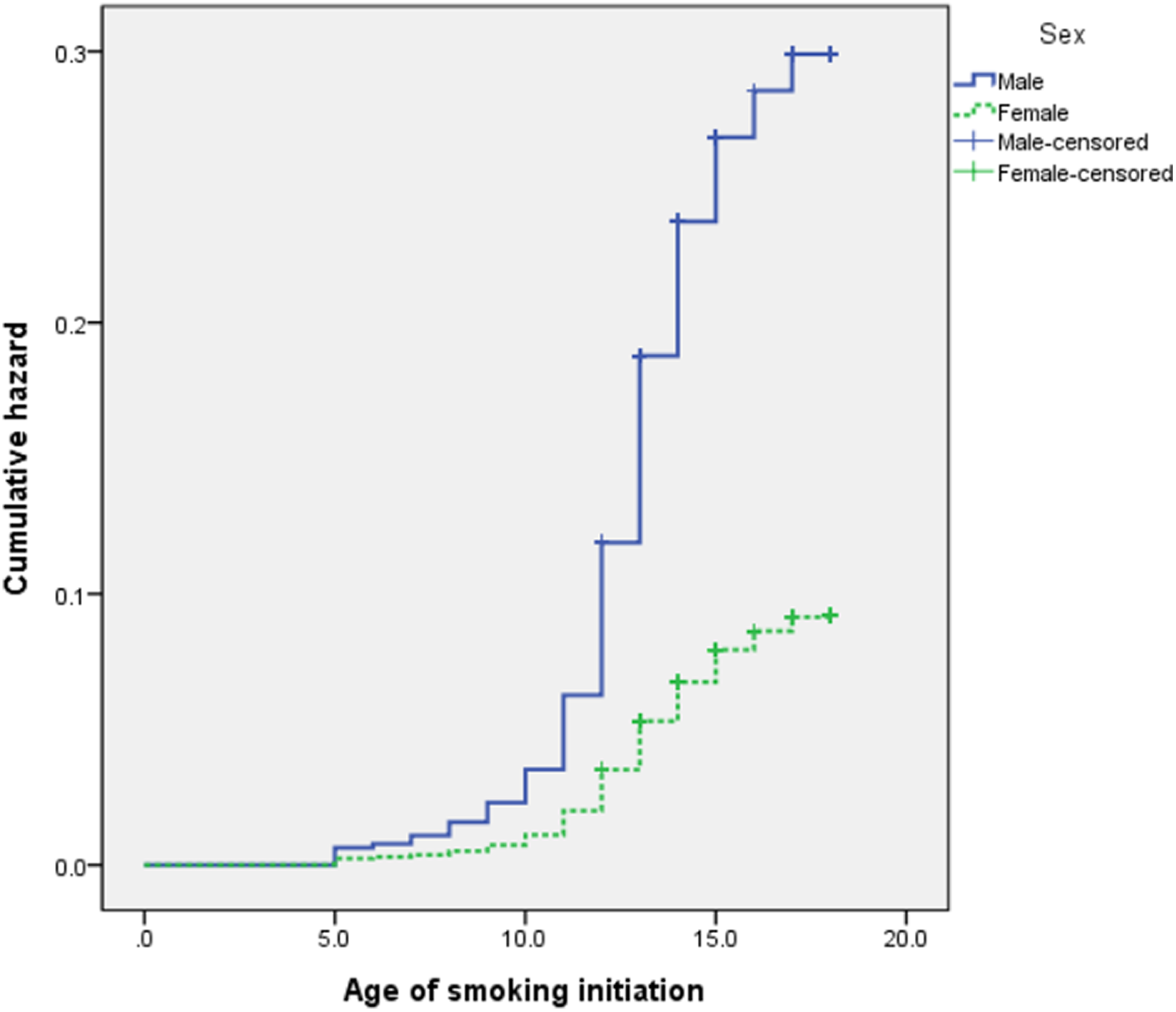
Cumulative hazard plot of age of smoking initiation by sex.
Factors Associated With Smoking Experimentation
Table 2 shows the factors associated with smoking experimentation. The values of Cox and Snell R 2 and Nagelkerke R 2, which indicate the goodness of fit of the model (Walker & Smith, 2016), were as follows: .172 and .304 for all adolescents, .163 and .250 for males, and .104 and .262 for females, respectively. This means that 17.2%, 16.3%, and 10.4% of variances in smoking experimentation for all adolescents, males, and females, respectively, are explained by all factors (individual, family, and school factors) used in this analysis. Most independent variables except living with family and tobacco education were found to be significant factors of smoking experimentation (all p values <.001). In both sex groups, advanced age was associated with a higher likelihood of smoking experimentation; the rate of smoking experimentation was higher among those who reported depression, suicidal ideation, or poor academic achievement than the others. In addition, adolescents living in households of average or affluent economic status were less likely to experiment smoking than those living in poor households. Adolescents who reported (1) having friends who smoked or (2) having a specific person to talk with about their personal concern were more likely to report smoking experimentation than those who did not, irrespective of their sex. Interestingly, experience of smoking education at school had no significant relationship with smoking experimentation overall or in either group.
Multilevel Factors Influencing Smoking Experimentation Among Adolescents.

Note. Logistic regression with complex sample was conducted. ref. = reference group.
aWithin the last 12 months.
There were some significant differences in associated factors by sex. Males were more likely to experiment with smoking than females (OR = 3.04, 95% CI [2.80, 3.29]). Females living with their families were less likely to report smoking experimentation than those who did not (OR = 0.61, 95% CI [0.49, 0.76]); however, this was not found as a significant factor among males. When their friends smoked, males were 4.99 times more likely to smoke, and this figure increased to 8.69 times for females.
Factors Associated With Age of Smoking Initiation
Table 3 shows the factors associated with age of smoking initiation. All independent variables except living with family and tobacco education were significantly related to age of smoking initiation (all p values <.001). The factors associated with earlier age of smoking initiation in both sex groups were the same as those associated with smoking experimentation, including the lack of a significant relationship between age of smoking initiation and experience of smoking education at school. In particular, males began smoking earlier than females (HR = 2.55, 95% CI [2.38, 2.74]). The differences between the sex groups in terms of associated factors were also the same as those in terms of smoking experimentation. Living with family was a significant factor among females but not among males. Females living with their families initiated smoking later than those who did not (HR = 0.88, 95% CI [0.79, 0.97] for all; HR = 0.62, 95% CI [0.51, 0.75] for females). When friends smoked, males were 4.10 times more likely and females were 7.56 times more likely to begin smoking earlier.
Factors Associated With Age of Smoking Initiation Among Adolescents.

Note. Cox proportional hazard regression with complex sample was conducted. ref. = reference group.
aWithin the last 12 months.
Discussion
This is a comprehensive study that identifies significant sex differences at multiple levels, including individual–family–school factors, in the context of smoking experimentation and age of smoking initiation based on national survey data. The findings of this study expand the present knowledge on different smoking patterns between males and females and can contribute to the implementation of sex-specific preventive interventions reflecting multilevel factors in smoking experimentation and age of initiation.
Although the associates of diverse factors on adolescent smoking behaviors have been explored (Goldade et al., 2012; Wen et al., 2009), there is limited knowledge on how multilevel factors differ by sex, particularly for age of smoking initiation. The findings of this study may be particularly significant considering the fact that only a few sex-specific adolescent smoking prevention programs have been attempted (de Kleijn et al., 2015), with mixed outcomes, perhaps because of limited information in considering multilevel factors for each sex. Considering sex differences does not guarantee the successful outcomes of adolescent smoking prevention programs. However, developing individualized adolescent smoking prevention programs by considering multilevel factors targeted at specific subgroups can be important for effective and sustainable outcomes (Duncan, Pearson, & Maddison, 2018).
Consistent with previous reports (KMoE, KMoH, & KCDC, 2016b; WHO, 2009), smoking rate was significantly higher and smoking was initiated earlier among males than among females. The occurrence of higher smoking rates among males is similar to the general global trend (Arrazola et al., 2017). The probability of initiating smoking increased rapidly after age 10 years, and the increase was much steeper among males than among females. This sex difference may be understood throughout Korean culture, which is generally more tolerant of smoking in males than in females (Kim et al., 2010). It is estimated that males smoke more than females worldwide; however, the prevalence ratio significantly varies across countries: In high-income countries, including European countries, females smoke at almost the same rate as males, while females in many low- and middle-income countries smoke at a much less rate than males (Arrazola et al., 2017). With the Korean society becoming more westernized with sex equality, the smoking rate among females would be expected to increase and the female-to-male prevalence ratio would become similar.
In addition, at age 12.7 years for males and age 12.9 years for females, the estimated mean age of smoking initiation was similar. This finding suggests a target age for smoking prevention programs; they would be most effective if implemented before the majority of adolescents start smoking (Hwang & Park, 2014; Park, 2009). Kolovelonis, Goudas, and Theodorakis (2016) reported that smoking prevention programs in elementary school settings had more positive effects to change elementary students’ attitudes toward smoking, intention to smoke, subjective norms, and attitudes toward the application of the program in comparison to secondary students’ attitude. Therefore, such programs should be provided to both sex groups by at least late in elementary school (Hwang & Park, 2014; Park, 2009).
In terms of individual factors, mental health is an important factor in smoking behavior, particularly considering that there is a high rate of depression and suicidal ideation. In this study, 25.5% adolescents reported that they have depression and 19.3% have had suicidal ideation (KMoE, KMoH, & KCDC, 2016b); among adolescents with depression, 20.4% reported that they have tried smoking. In addition, adolescents with depression were about 1.45 times more likely to have smoking experience and tended to start smoking earlier (HR = 1.34). These findings are consistent with those of previous studies identifying a longitudinal association between smoking and depression (Chaiton et al., 2010; Weiss, Mouttapa, Cen, Johnson, & Unger, 2011). Depression is closely related to smoking; however, controversy remains with regard to the direction of causation (Chaiton et al., 2010; Cohn, 2018). Furthermore, adolescents who reported experiencing suicidal ideation were about 1.32 times more likely to have smoking experience and tended to start smoking earlier (HR = 1.24). Park and Kim (2015) reported not only a strong relationship between smoking and suicidal behaviors but also a dose–response relationship, that is, heavier smoking (i.e., daily smoking) was associated with greater risk of suicidal behavior. Thus, assessing adolescents’ psychological characteristics would be necessary in screening for both sex groups at a high risk of smoking (Weiss et al., 2011) and in developing programs including specific strategies to improve self-management skills dealing with psychological distress (Weinberger, Mazure, Morlett, & McKee, 2013; Weiss et al., 2011).
However, psychological issues seem more significant in females than male. Females who reported suicidal ideation were 1.55 times more likely to smoke and began smoking earlier, while this increase was by 1.14 times for males. This indicates that psychological variables were more important among females than among males (Kim et al., 2010; Weinberger et al., 2013). A meta-analytic review also found sex differences in that females with psychological problems had a lower smoking cessation rate. However, vulnerable females were likely to report greater treatment effect than males when receiving smoking education integrated with psychological interventions (Weinberger et al., 2013). Therefore, psychological and emotional management should be provided to female smokers who suffer from mental health problems or to those who are vulnerable to smoking (Kuhn, 2015).
In terms of family factors, adolescents from poorer households were at a higher risk of smoking experimentation, with earlier age of smoking initiation. Most previous studies suggest that lower socioeconomic status is a known risk factor for adolescent smoking behaviors (Hayatbakhsh, Mamun, Williams, O’Callaghan, & Najman, 2013; Kuhn, 2015; Moore & Littlecott, 2015; Poutiainen et al., 2015; Ra & Cho, 2017). Living in a poorer household may place adolescents at a risk of poorer health through factors such as inappropriate living conditions, limited access to health-care services, and lack of finances for providing healthy foods and physical activity opportunities (Moore & Littlecott, 2015). Several studies have reported that adolescents from such households may also be more likely to have models who smoke, such as their parents (Moore & Littlecott, 2015; Poutiainen et al., 2015). The findings of this study emphasize the importance of considering family characteristics and providing preventive health-care services to the entire family when developing and providing smoking programs (Poutiainen et al., 2015). In addition, this study suggests that community-based interventions targeting adolescents from poorer households need to be developed and implemented during early adolescence (Hayatbakhsh et al., 2013; Park, 2009).
In particular, females living with their families were 0.61 times less likely to smoke than those who did not; however, this was not the case among males. Parental lifestyle, parental supervision, and involvement are protective factors that retard progression and age of smoking initiation (Kuhn, 2015; Wen et al., 2009). Females generally tend to have stronger attachment relationships with their parents than males, and the results of this study suggest that females’ smoking behaviors are more controlled by their family. The parent–daughter relationship, prohibiting smoking at home, and clearly communicating household smoking restrictions could associate adolescents’ perceptions of smoking behaviors and attitudes (Albers, Biener, Siegel, Cheng, & Rigotti, 2008; Kuhn, 2015; Wen et al., 2009). For females, an intervention program involving household smoking bans would be effective in promoting antismoking attitudes in collaboration with family members. In addition, this finding suggests that females living without their families are more vulnerable to early age of smoking initiation and experimentation, and they need more resources and urgent attention for smoking prevention for support systems.
Adolescents having friends who smoked were 6.06 times more likely to engage in smoking experimentation and age of smoking initiation (HR = 5.08), and friends showed the greatest association with smoking behaviors in both groups. In addition, the results of this study reveal significant sex differences in the effect of friends on smoking experimentation and age of smoking initiation. The OR of males was 4.99 and that of females was 8.69, and the HR of males was 4.10 and that of females was 7.56. Females’ smoking was much more associated with friends than males’. These results are consistent with those of previous studies demonstrating that adolescents are highly affected by peer groups and social acceptance (Ali & Dwyer, 2009; Mak, Ho, & Day, 2012; Ra & Cho, 2017; Scales et al., 2009; Wen et al., 2009). In particular, it is reported that females’ smoking is highly associated with peers including a romantic partner (Kuhn, 2015). The findings of this study suggest that there is a need for school nurses to implement intervention programs addressing peer association for both male and female groups. Providing a peer-led program has been reported to be cost-effective in reducing smoking (Hollingworth et al., 2012), and the content of education should include skills to refuse when a friend suggests or urges smoking (Duncan et al., 2018). For females, it may be helpful to encourage positive interactions in close relationships with significant individuals (Duncan et al., 2018).
Adolescents having friends were 1.68 times more likely to smoke and began smoking earlier (HR = 1.52) than those having teachers or others to talk about their personal worries or difficulties. Adolescents experience stressful life events such as family problems, academic achievements, or difficulties with peer relationships, and they seek a close person to whom they can talk about those issues and receive advice (Ham & Allen, 2012; Nair et al., 2012). The result of this study implies that Korean adolescents use passive coping skills to reduce emotional distress rather an active coping of problem-focused strategies (Choi, Ota, & Watanuki, 2015; Scales et al., 2009). This finding may be another evidence of the greatest peer association with smoking behaviors and suggests that adolescents who prefer to talk about their worries and problems to friends rather than adults may be the ones who are more vulnerable to experiencing problematic behaviors. Thus, it is important for school nurses to approach adolescents who do not seek help from family members and teachers and provide appropriate counseling and health educations while ensuring confidentiality and privacy (Ham & Allen, 2012).
Despite efforts to increase educational programs, this study showed that tobacco-related education at school does not seem to relate to any variation in smoking behaviors. Many smoking prevention and cessation programs are provided in the classroom as informative form, such as didactic presentations; however, more effective programs combining interactive education emphasizing positive peer interactions with highly engaging activities, such as role modeling, group discussions, and peer coaching, need to be developed (Park, Kulbok, Keim-Malpass, Drake, & Kennedy, 2017; Thomas et al., 2013). Furthermore, it is necessary to augment school-based interventions with interactive strategies using engaging technology or social media such as social networking system (Duncan et al., 2018; Park & Drake, 2015; Thomas et al., 2013). In addition, it would be an effective method to create sex-specific smoking cessation programs (Li, Chan, Wan, Wang, & Lam, 2015).
Implications for School Nurses
This study provides important implications for school nurses, as they can play a significant role in planning school-based tobacco control programs.
First, multilevel factors associating smoking and sex differences in the results of this study help school nurses identify high-risk students of smoking and set priorities for smoking prevention. School nurses should pay more attention to adolescents who have depression, suicidal ideation, low levels of household economics status, and are not living with their families. Therefore, school nurses should assess and identify those groups at risks by applying questionnaire items periodically to understand the psychological status, family, and friends of adolescents. Furthermore, it is recommended to use valid and structured measurements to screen for adolescents with depression and suicidal ideation. In addition, school nurses may be able to operate a case management program for severely smoking high-risk adolescents in conjunction with primary health-care facilities or hospitals in the community.
Second, school nurses should be aware of the fact that students who tend to talk about their problems to their friends than adults and those who have a close friend who smokes are vulnerable to start smoking. Although adolescents are mainly affected by parents and peers, the findings of this study revealed that friends’ smoking behaviors had a greater effect than parents’ smoking behaviors. This finding of this study is different from those of studies conducted in different countries such as the United States (Wen et al., 2009) and Hong Kong (Mak et al., 2012), which found similar effects of association with parents and friends on smoking behavior. Our study findings suggest the necessity to conduct a study to compare the effects of association with parents and friends on smoking behavior for developing interpersonal strategies of adolescent smoking prevention. Those programs must not only provide tailored counseling considering the psychological aspects of an individual but also encourage group interventions involving their families and friends.
Third, to implement adolescents’ smoking cessation programs effectively, multilevel tobacco control interventions considering sex-specific approaches are essential. School nurses must develop tailored interventions for adolescent smoking cessation by considering individual-, family-, and school-level characteristics appropriate to each sex (Kim et al., 2016; Struik, O’Loughlin, Dugas, Bottorff, & O’Loughlin, 2014). In particular, females are more likely to be affected by three levels of individual, family, and school factors, while males are more likely to be affected by personal and friend characteristics. When applying these interventions, careful attention should be paid to applying personalized, privacy-protected interventions to both sex groups to use formal approach through teacher and family. With these strategies, school nurses may be able to start providing educational programs before adolescents become established smokers.
Limitations
In spite of the significance of this study, it has certain limitations. Although the responses were anonymous, smoking behaviors may have been underreported because smoking is usually considered a maladaptive behavior during adolescence. Moreover, as the survey was conducted only on students attending school, the findings in this study are not generalizable to dropouts. In addition, the cross-sectional design makes it difficult to draw causal inferences. Thus, it is recommended that longitudinal studies should be conducted in future to identify causal relationships among variables on this culturally sensitive topic using diverse data collection strategies.
Conclusion
Using the ecological model, this study identified multilevel factors associated with smoking experimentation and age of smoking initiation in Korean adolescents. The findings show that those who have depression, low household economic status, low academic achievement, and smoking friends are likely to experiment with smoking and start smoking at earlier ages. Sex differences were found, in that the smoking rate was higher and smoking was initiated earlier among males compared to females. Females were more affected by psychological vulnerability, family members living together, and peers than were males. When providing smoking prevention or cessation programs for adolescents, it would be beneficial to develop multilevel, sex-tailored interventions and provide at the most timely point considering the age of smoking initiation and experimentation to achieve more efficacy and effectiveness of the program implementation.
Footnotes
Acknowledgment
We really appreciate all efforts of Sun-Aea Kim and Sun Gyoung Na to assist this research project.
Author Contribution
All co-authors contributed to the design and draft of the article, were involved in interpretation and analysis, and gave final approval, thereby agreeing to be accountable for all aspects of work ensuring integrity and accuracy. Eunhee Park and Heejung Kim were involved in critically revising the article.
Declaration of Conflicting Interests
The author(s) declared no potential conflicts of interest with respect to the research, authorship, and/or publication of this article.
Funding
The author(s) received no financial support for the research, authorship, and/or publication of this article.
