







Abstract
This study examined school nurses’ experiences and beliefs about firearm violence and related policies. A cross-sectional survey was conducted at the National Association of School Nurses Annual Conference in July 2023, gathering data on attitudes and knowledge regarding firearm violence prevention. Of the 363 respondents (65% response rate), 98% were female, and 44.9% had under 10 years of experience. Nearly half reported firearm ownership, and 39% had encountered incidents involving a student bringing a firearm to school. Most nurses (86%) reported having a firearm emergency plan at their schools, yet only 8% had training on counseling for firearm safety. Despite 41% receiving firearm safety training, many nurses expressed a need for more resources and training in firearm violence prevention. These findings highlight the need for specialized, culturally informed, and medically accurate training to better equip school nurses in addressing firearm safety and violence prevention in schools.
Introduction
Firearm injury is the most common cause of mortality among children and adolescents living in the United States (Goldstick et al., 2022). Over the last decade, the incidence of fatal firearm injuries in teenage populations has risen by almost fifty percent and has led to more than 100,000 visits to emergency departments (WISQARS (Web-Based Injury Statistics Query and Reporting System). Injury Center. CDC, n.d.) Survivors of nonfatal firearm injuries experience sequelae including physical disabilities, mental health conditions, and substance use disorders (Garbarino et al., 2002; Seewald et al., 2022; Walton et al., 2017). The acute treatment of pediatric firearm violence has been estimated to cost approximately $110 million every year (Seewald et al., 2022; Taylor et al., 2021). The alarming rise in pediatric firearm violence and the associated morbidity and economic impact has led many healthcare organizations to call for a focus on solutions and initiatives aimed at curbing firearm violence in vulnerable communities (Community Violence Intervention. Center for Gun Violence Solutions, 2024).
School nurses are pillars of the healthcare workforce in communities and trusted messengers for public health campaigns. The National Association of School Nurses (NASN) has a history of empowering its members to fight against school-based violence (Position Statement, 2014). School nurses can play a distinctive role in advancing firearm violence prevention within the school community, especially through their ability to identify students at risk and educate students and their families on firearm safety (Hallowell & Cogan, 2023). School nurses’ impact on the school community through frequent interactions with students and addressing urgent mental health needs makes them key stakeholders in firearm injury prevention.
We examined the experiences, attitudes, and beliefs about firearm violence and firearm-related policies by surveying an anonymous sample of school nurses. By doing so, we could gain a more comprehensive understanding of the necessity for school-based firearm violence intervention programs and inform the development of best practices for future training initiatives.
Methods
This study was approved by the Mass General Brigham Institutional Review Board. This study was reported in accordance with the Strengthening the Reporting of Observational Studies in Epidemiology Statement (von Elm et al., 2008). The study was conducted using an anonymized, self-reported online survey of firearm safety-related attitudes and beliefs among school nurses in the United States. The 35-item survey questionnaire was designed by R.C. and C.L.G. with design and validity input from survey experts at the Harvard School of Public Health (Supplementary Material). The survey questionnaire addressed the following categories: exposure to firearms and school-based firearm safety; best practices and suggestions for school-based firearm injury prevention; attitudes and beliefs related to 12 potential policies and interventions for promoting school safety.
A Quick Response (QR) code linking to the survey questionnaire was displayed twice during a general session presentation delivered at the NASN annual conference in Orlando, Florida, in July 2023. Based on the post-session evaluation responses, approximately 560 school nurses were present at the keynote presentation and had access to the QR code.
Measure—Open-Response Questions
Open-response questions gathered suggestions for school safeguarding efforts, experiences with firearm violence threats, years of nursing experience, and current region of practice. For example, nurses were asked, “What suggestions or ideas do you have for strategies to keep children and staff safe from firearm violence in schools?” and “Can you think of any programs or activities with the goal of keeping children and staff safe from firearms that would be beneficial in schools?”. Two experienced coders (S.Z. and I.C.N.) independently reviewed the data from the open-response questions to generate themes, resolving any discrepancies through discussion with C.L.G.
Measures—Multiple Choice Questions
We assessed attitudes and beliefs about policies and future directions using a 5-point Likert scale (1 = strongly disagree, 5 = strongly agree). We evaluated whether these attitudes varied based on firearm ownership. Yes/No/Don’t Know questions determined school nurses’ training experiences and their experiences related to firearm incidents and safety.
Statistical Analysis
Descriptive statistics were performed using STATA version 17.0 (StataCorp, College Station, TX) to summarize the survey responses. The denominators used in calculating percentages were the number of participants who responded to each respective prompt, not the total number of participants.
Results
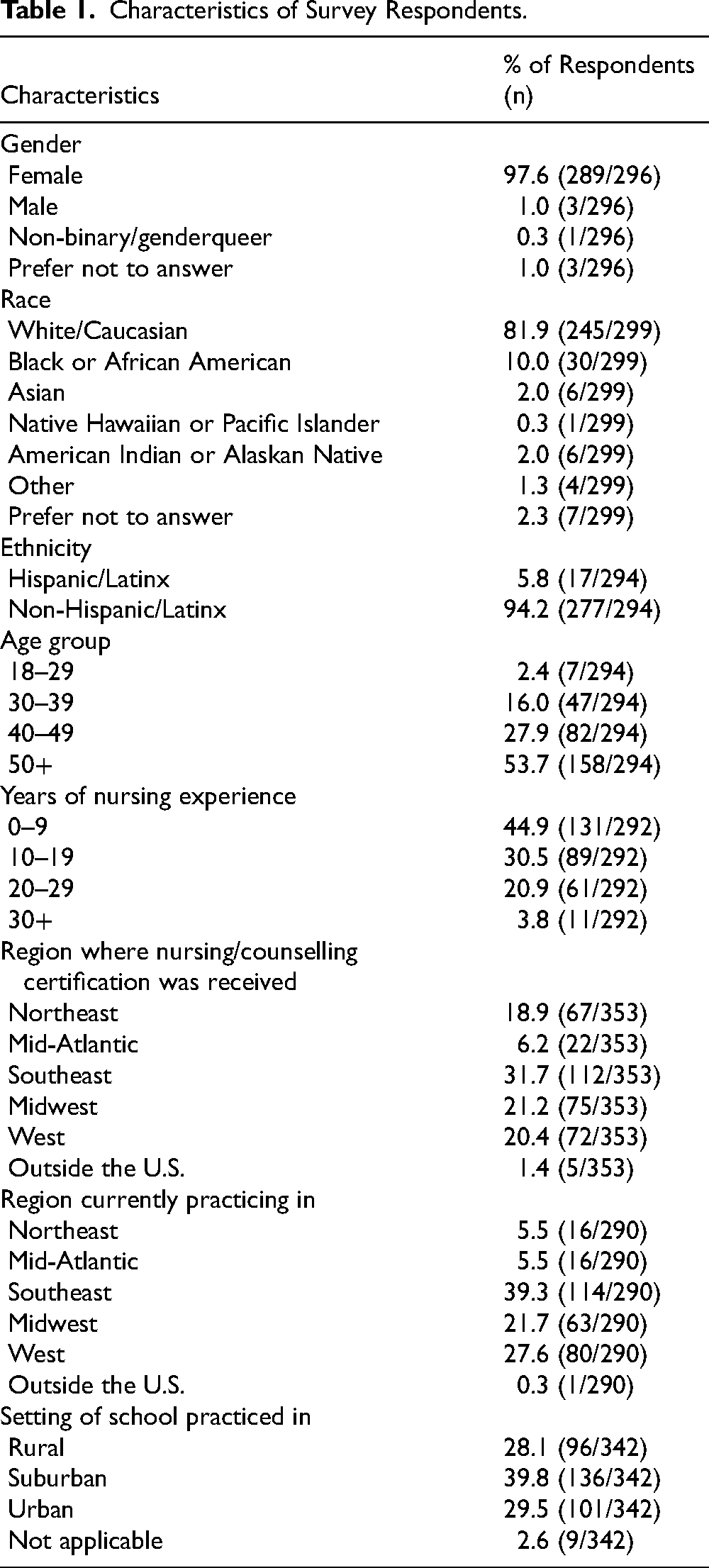
The survey had a response rate of 65%, with 363 out of 560 school nurses participating. The respondents were predominantly female (98%) and non-Hispanic (94%) (Table 1). The majority were White (82%), followed by Black (10%), Asian (2%), and American Indian or Alaskan Native (2%). Over half (54%) of the respondents were aged 50 years or older. Most school nurses (45%) had less than 10 years of nursing experience (Table 1). The Southeast was the most common region for nursing certification (32%) and current practice (39%). The most common school setting was suburban (40%), followed by urban (30%) and rural (28%).
Characteristics of Survey Respondents.
Exposure to Firearms at Home and School
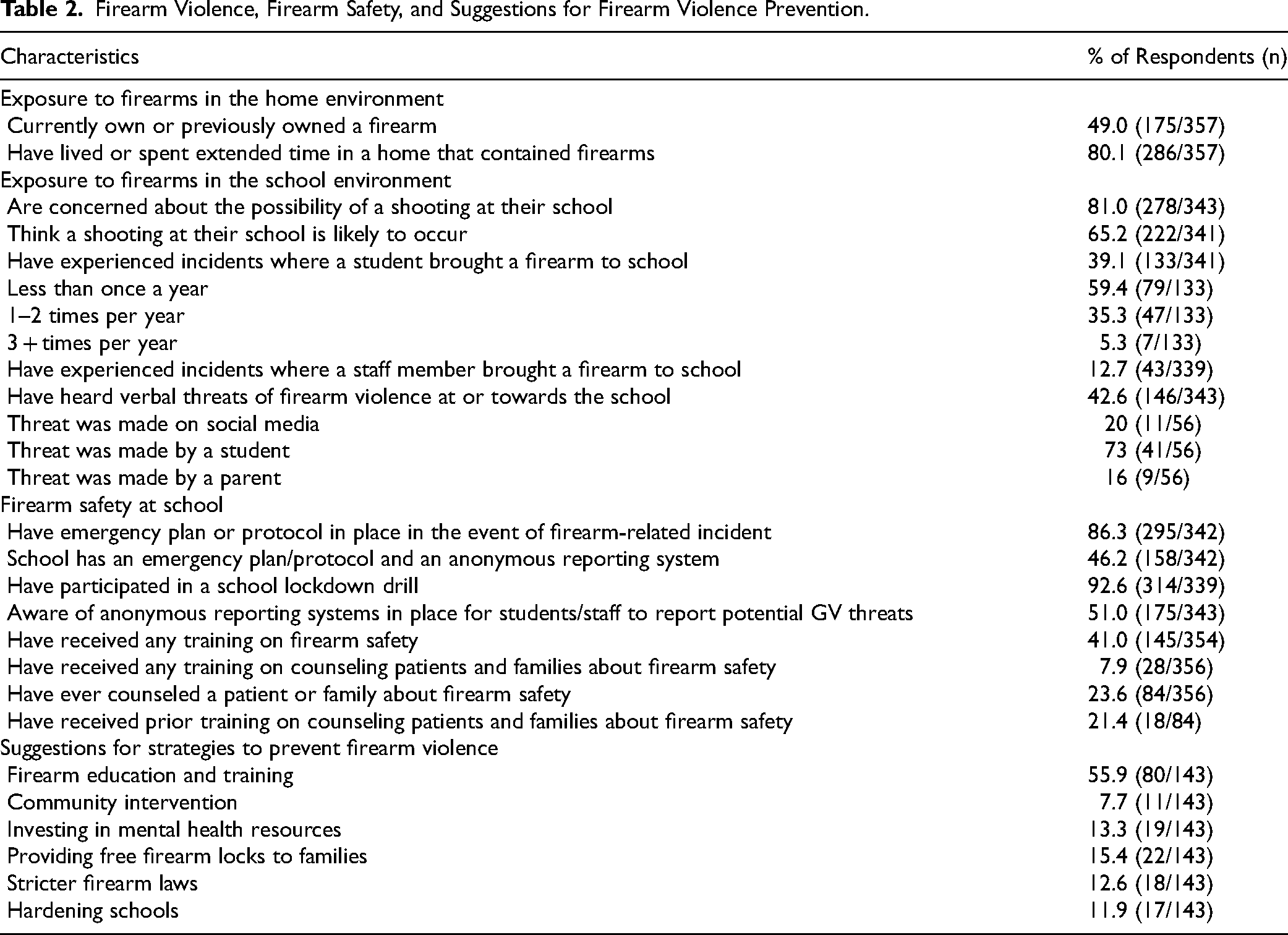
The majority of respondents (80%) reported having lived in a home with firearms, and nearly half (49%) owned a firearm (Table 2). Most nurses (81%) were concerned about the possibility of a shooting at their school, with 65% considering it likely. Over a third (39%) had experienced incidents where a student brought a firearm to school, and among these, 5% encountered such incidents more than twice a year. Additionally, 13% reported incidents involving staff members bringing firearms to school. Nearly half (43%) had heard verbal threats of firearm violence directed at the school. Of the 56 nurses who expanded on the nature of these threats, 16% indicated the threat was made by a parent.
Firearm Violence, Firearm Safety, and Suggestions for Firearm Violence Prevention.
Firearm Safety at School
Almost all respondents (93%) reported participating in lockdown drills at school (Table 2). Most (86%) indicated that their schools had an emergency plan for firearm-related incidents, and 51% were aware of anonymous reporting systems for potential threats. Less than half (41%) had received any training on firearm safety. While 24% had counseled a student or family on firearm safety, only 8% had been trained to provide such counseling.
Safeguarding Strategies
Less than half of respondents (42%) proposed strategies for safeguarding children and staff from firearm violence through open-response questions (Table 2). The most common suggestion was firearm education and training (56%). Other strategies included providing free firearm locks to families (15%), investing in mental health resources (13%), advocating for stricter firearm laws (13%), school hardening measures (e.g., arming teachers, installing metal detectors, and having armed security guards) (12%), and community intervention (8%).
Attitudes and Beliefs About Firearm Violence Prevention
Concerning policies aimed at hardening schools, the majority of respondents (56%) strongly disagreed with allowing teachers to carry firearms on campus for safety (Figure 1). Opinion was divided on the introduction of metal detectors and armed security guards, with 38% and 55%, respectively, strongly agreeing or agreeing with these measures.
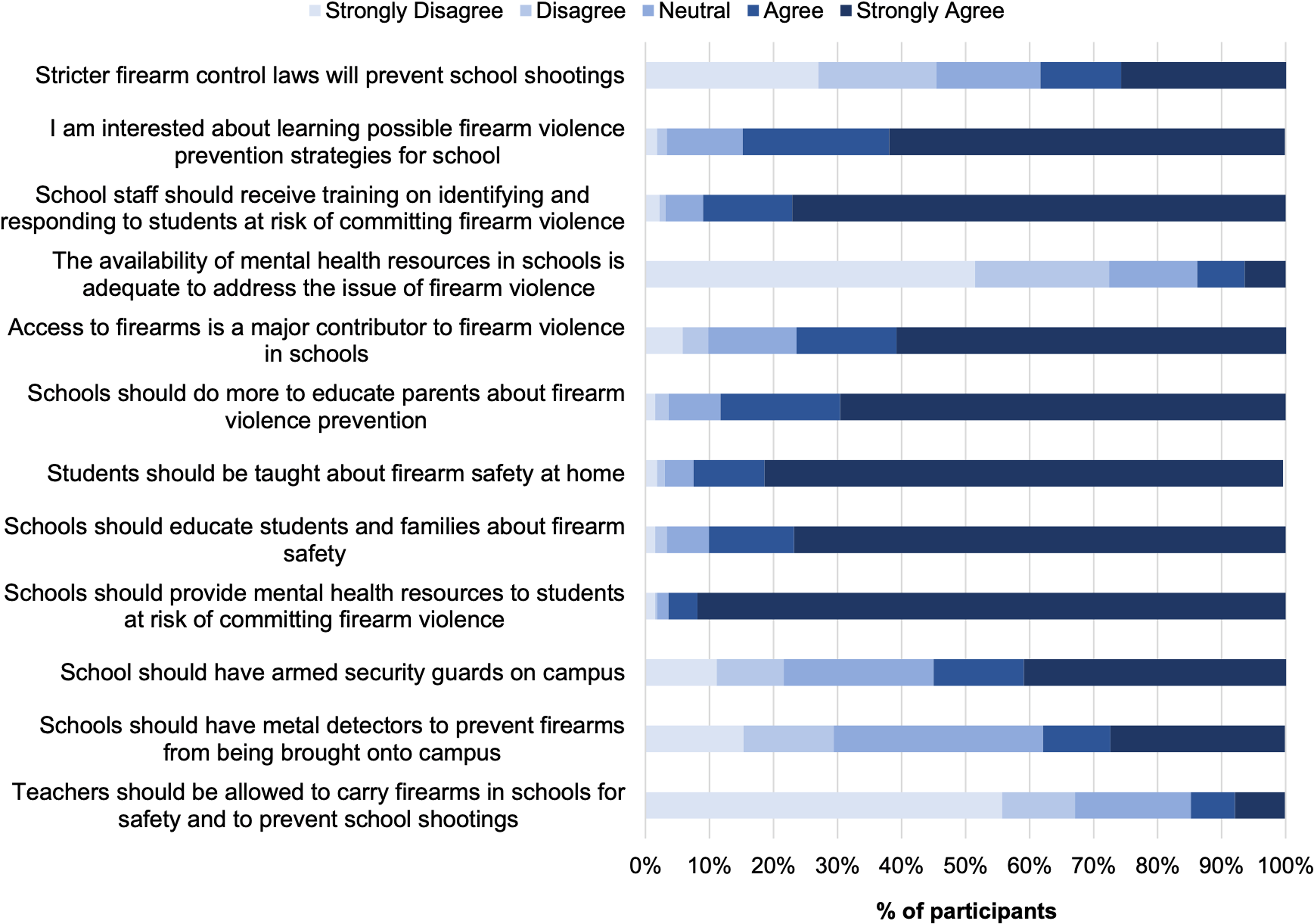
Attitudes and beliefs towards policies and interventions.
Most respondents strongly supported providing mental health resources to at-risk students (92%) and educating both students (77%) and parents (70%) on firearm safety and firearm violence prevention. Additionally, 81% strongly agreed that students should receive firearm safety education at home.
While 77% agreed that access to firearms contributes significantly to firearm violence in schools, only 38% agreed or strongly agreed that stricter firearm laws would prevent school shootings. A majority (77%) strongly agreed that school staff should be trained to identify and respond to students at risk of committing firearm violence, and 85% expressed interest in learning about school-based firearm violence prevention strategies. However, only a minority (14%) strongly agreed or agreed that the availability of mental health resources in schools adequately addresses the issue of firearm violence.
Attitudes and Beliefs by Firearm Ownership
Attitudes and beliefs differed notably between firearm owners and non-firearm owners across various topics, as indicated by the difference in mean Likert scores (where scores closer to 1 indicate stronger disagreement and scores closer to 5 indicate stronger agreement). For example, firearm owners were less likely to agree that teachers should have access to firearms at school (mean score: 1.59 vs. 2.34), less likely to agree that firearm access is a major contributor to violence (1.62 vs. 4.48), and less supportive of stricter firearm control laws as a way to prevent school shootings (3.29 vs. 3.55) (Figure 2). However, there was consensus that more mental health resources are necessary components of school-based firearm violence prevention efforts (4.91 vs. 4.81). Additionally, both groups agreed on the importance of schools providing education on firearm safety and prevention to students (4.69 vs. 4.58), parents (4.59 vs. 4.49), and school staff (4.68 vs. 4.60), and expressed interest in learning about firearm violence prevention strategies for schools (4.47 vs. 4.39).
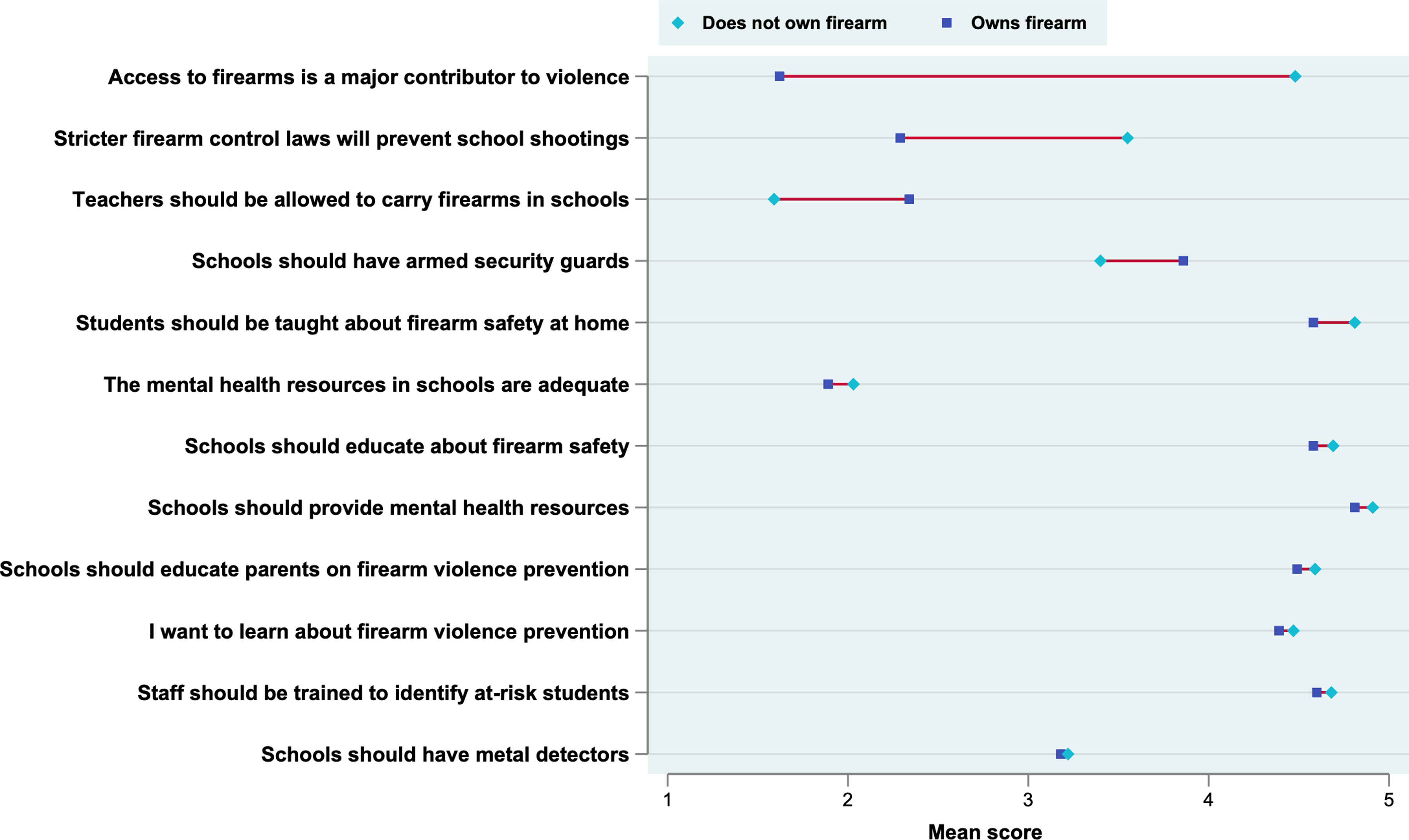
Attitudes and beliefs towards policies and interventions stratified by firearm ownership.
Discussion
This survey-based study aimed to assess school nurses’ attitudes, knowledge, and beliefs concerning firearm violence prevention. Our findings revealed that a majority of school nurses in our cohort have encountered and expressed concerns about firearm violence in their schools. Surprisingly, many of these nurses have not received training to provide guidance on firearm safety to students or families. However, a notable proportion of school nurses, irrespective of firearm ownership, expressed interest in acquiring knowledge on school-based firearm violence prevention strategies.
Firearm violence is a complex public health crisis, and the immediate and long-term consequences of firearm violence are devastating to survivors, families, and the community. Firearm-related death affects children and adolescents at alarmingly high rates in the United States (Flannery et al., 2021; Katsiyannis et al., 2023). This study identifies school nurses as essential healthcare partners within the school communities. School nurses are uniquely positioned to effectively champion firearm violence prevention efforts and expressed a desire for more training in this area (Cogan et al., 2019; Combe & Cogan, 2023). National societies have established that firearm violence prevention is within the scope of practice for school nurses. Because school nurses are positioned at the forefront of community health, school nurses are an ideal population for firearm violence prevention training (Cogan et al., 2019; Combe & Cogan, 2023b). School nurses can build rapport and develop significant trusting relationships with students (Cogan et al., 2019). This presents opportunities to educate students and families on firearm safety.
Our analyses highlighted some notable findings. An overwhelming proportion of nurses were concerned about the possibility of a school shooting, with over 65% stating that a school shooting was a likely occurrence. This perception of risk is further supported by our data, which show that over a third of nurses had experienced incidents where a firearm was brought into school. These disconcerting findings greatly emphasize the need for increased firearm violence efforts within the school community. This is especially important because most nurses surveyed recognized the insufficiency of hard measures like heightened security presence and lockdown drills and acknowledged the need for further firearm violence prevention training. Our findings were consistent with other studies, including by Price and Khubchandani (2019), who evaluated the effectiveness of different methods for school-based firearm violence prevention and found that hardening schools did not empirically reduce firearm violence in schools. Despite differing perspectives between school nurses who own firearms and those who do not, there was still a shared interest in receiving more training. Only a small subset of respondents (23%) provided open-ended suggestions for safeguarding strategies, with a little over half of those emphasizing education as the critical solution. While this does not represent a consensus, the level of expressed interest supports the potential value of investing in school nurse training in this area. Previous studies have shown that a large proportion of firearm owners surveyed support firearm violence prevention strategies like requiring safety courses and training before purchasing firearms (Barry et al., 2018; Siegel & Boine, 2020). Most recently, the 2023 National Survey of Gun Policy conducted by the Johns Hopkins Bloomberg School of Public Health reported that 69% of Americans were in support of funding community-based firearm violence prevention programs, regardless of their political affiliation or firearm ownership status (Johns Hopkins Bloomberg School of Public Health, n.d.).
With the appropriate training, tools, and support, school nurses can appropriately screen and counsel at-risk students and families. Such a change has the potential to greatly impact firearm violence prevention by deploying trained healthcare professionals in vulnerable communities with school-age children most affected by firearm violence (Cogan et al., 2019; Combe & Cogan, 2023; Position Statement, 2014). Yet, there is a dearth of resources available to train school nurses. We found that the school nurses surveyed were largely undertrained, with only 41% having undergone firearm safety education. About a quarter had counseled students and families on firearm safety, yet only 7% had been appropriately trained to do so. While our survey did not directly assess nurses’ confidence or perceived preparedness, the low rate of formal firearm safety training points to a potential readiness gap. This gap in firearm safety training and the paucity of available resources have been echoed by several authors (Drake et al., 2023; Rebmann et al., 2018). Reassuringly, most of the nurses surveyed expressed a desire to be effectively trained in firearm violence prevention.
This study should be interpreted in the context of the limitations. As with all survey research, our study has limitations. Selection bias may have influenced responses, as those with stronger opinions or personal experiences related to firearm violence may have been more likely to participate. Additionally, the convenience sample was drawn exclusively from attendees at a keynote presentation on firearm violence at the NASN conference, where attendance was skewed by those who reside in the Southeast region of the U.S., further limiting generalizability. We were also unable to determine how representative our sample is in terms of demographics, geographic distribution, or firearm ownership compared to the broader population of school nurses. Future research should address these gaps by incorporating more diverse samples and directly assessing nurses’ self-reported preparedness and confidence.
Finally, while this study focused on firearm violence, our findings support broader preventive approaches. School nurses emphasized the importance of better mental health resources as part of a comprehensive strategy. We agree that all students—not just those with diagnosed mental health conditions—benefit from learning emotional regulation, conflict resolution, and coping skills. These skills can be integrated into training frameworks for school nurses, fostering emotionally resilient school environments and reducing the risk of violence upstream.
Despite limitations, this study provides important groundwork for national efforts to equip school nurses with the knowledge and tools to address firearm violence. It highlights both the gaps in training and the enthusiasm among nurses to become part of the solution. As trusted figures in school communities, school nurses have the potential to play a vital role in fostering safer, more supportive learning environments.
Conclusion
Our study reveals that school nurses are concerned about firearm violence and feel unprepared to lead informed discussions on firearm safety. These findings highlight the urgent need for specifically targeted, medically accurate training for this group of health professionals.
Supplemental Material
sj-docx-1-jsn-10.1177_10598405251339655 - Supplemental material for Understanding School Nurses’ Perspectives on Firearm Violence Prevention: Attitudes, Beliefs, and Training Needs
Supplemental material, sj-docx-1-jsn-10.1177_10598405251339655 for Understanding School Nurses’ Perspectives on Firearm Violence Prevention: Attitudes, Beliefs, and Training Needs by Stephany Zhivotovsky, Ikemsinachi C. Nzenwa, Robin Cogan, Sunny G. Hallowell, Rebecca Robbins, Amy J. Kaplan, Chana A. Sacks, Peter T. Masiakos and Cornelia L. Griggs in The Journal of School Nursing
Footnotes
Author Contribution(s)
Declaration of Conflicting Interests
The authors declared no potential conflicts of interest with respect to the research, authorship, and/or publication of this article.
Funding
The authors received no financial support for the research, authorship, and/or publication of this article.

Supplemental Material
Supplemental material for this article is available online.
Author Biographies
References
Supplementary Material
Please find the following supplemental material available below.
For Open Access articles published under a Creative Commons License, all supplemental material carries the same license as the article it is associated with.
For non-Open Access articles published, all supplemental material carries a non-exclusive license, and permission requests for re-use of supplemental material or any part of supplemental material shall be sent directly to the copyright owner as specified in the copyright notice associated with the article.
