






Abstract
Work-related stress has been examined in traditional healthcare settings, yet the well-being of school nurses remains underexplored. This collective qualitative case study examined workplace factors and school nurses’ psychological well-being. Data collection was guided by the Neuman Systems Model using sociodemographic questionnaires, semi-structured interviews, and journaling to explore intra-, inter-, and extra-personal workplace factors. This manuscript reports findings from questionnaire, interview, and journal data. Results showed that well-being was achieved through organizational and relational conditions rather than individual coping alone. Team membership, professional recognition, role clarity, and schedule flexibility promoted psychological security through inclusion in decision-making, respect for clinical expertise, and clear reporting structures. Exclusion, role ambiguity, and limited authority undermined well-being. Relationships with students provided meaning that sustained school nurses’ commitment to the profession despite rising medical acuity and workload. These findings highlight the need for structural workplace interventions to support school nurse well-being and ensure safe student care.
Keywords
Introduction
Psychological well-being is a foundational component of effective nursing practice and workforce sustainability. It has been defined as a state in which individuals are able to realize their potential, work productively, and cope with the normal stresses of life (Dhanabhakyam & Sareth, 2023). It is closely tied to nurses’ decision-making, motivation, and emotional functioning. Across healthcare settings, workplace stress has been linked to absenteeism, reduced work quality, poorer patient safety, and diminished organizational performance (Akbar et al., 2017; Della Bella et al., 2022; Jannati et al., 2011). Compromised well-being is associated with burnout, intent to leave, and increased risk of clinical errors, underscoring the need to understand how work environments shape psychological health (Aiken et al., 2023; Melnyk et al., 2018; Raso et al., 2022).
Much of what is known about nurse well-being comes from hospital-based and specialty care contexts. Studies across acute care, psychiatric, correctional, and palliative settings consistently show that leadership workload, role clarity, and organizational culture are central determinants of psychological well-being (Bégat et al., 2005; Boumans & Landeweerd, 1993; Keller et al., 2023; Rose & Glass, 2008). More recent research has reinforced that unfavorable work environments contribute to burnout, turnover, and poorer patient safety, while interventions focused solely on individual-level resilience are less effective than structural improvements to the work environment (Aiken et al., 2023; Brewer et al., 2023). Global recommendations now emphasize organizational and system-level approaches to clinician well-being (Jakobsson et al., 2026; National Academy of Medicine [NAM], 2021).
School nurses remain an understudied group within this literature. Their practice environments differ markedly from traditional healthcare settings; many work alone, cover multiple schools, and operate within educational rather than healthcare administrative structures (Crome & Thurtle, 2010; Jameson & Bowen, 2020). These conditions may heighten professional isolation, role strain, and psychological stress. International studies also highlight the gaps in organizational support, training, interprofessional collaboration, and access to clear, evidence-based guidelines (Jakobsson et al., 2026; Junco et al., 2024; Moyes & Hayward, 2025).
Workforce data in the United States show that over 40% of school nurses cover two or more schools, and many schools lack full-time nursing coverage, raising concerns about sustainability and capacity (Willgerodt et al., 2018, 2024). These structural conditions suggest that school nurses may experience workplace stressors that differ in form and impact from those documented in hospital-based research.
Quantitative studies have identified stress and burnout among school nurses and highlighted the role of workload, responsibility, and perceived support (Jameson & Bowen, 2020; Jameson et al., 2018; Melnyk et al., 2018; National Association of School Nurses [NASN], 2015). Qualitative research has explored systemic constraints, role challenges, interprofessional relationships, job satisfaction, and experiences during the COVID-19 pandemic, revealing themes of isolation, stress management, and professional visibility (Lee et al., 2021; Smith & Firmin, 2009). Yet, little theory-guided qualitative research has examined how everyday workplace structures, interpersonal relationships, and expectations interact to promote or impede school nurses’ psychological well-being outside of crisis contexts.
Understanding school nurse well-being is critical not only for the nursing workforce but also for student health and educational outcomes. The presence of a school nurse is associated with improved student health, attendance, and access to care, particularly for children with chronic health conditions (Best et al., 2018; Weismuller et al., 2007; Yoder, 2020). Because the quality and safety of nursing care are influenced by nurses’ psychological and physical health, compromised well-being has implications for the broader school community (Khatatbeh et al., 2023; NAM, 2021). Recognizing these connections, international nurse organizations have identified school nurse well-being as a priority area for research aimed at informing practice, policy, and workforce sustainability (International School Nurse Network, n.d.; NASN, 2023; School Nurse International, n.d.).
A framework that accounts for the interactions between individuals and their work environment is essential for understanding these influences. The Neuman Systems Model (NSM) framework depicts a dynamic, open system interacting with intra-personal, inter-personal, and extra-personal stressors (de Almeida et al., 2018; Neuman & Fawcett, 2011). The NSM links environmental stressors to psychological responses and system stability, which makes it well-suited for examining how workplace conditions shape psychological well-being (Ahmadi & Sadeghi, 2017). The NSM has been used to explore organizational and relational factors in nursing and health-related contexts (Delgado et al., 2021; Pereira et al., 2022). Utilizing theory-guided inquiry into workplace demands and resources is similar to the work of Shin et al. (2025) in their study of the work environment and burnout in school nurses.
Guided by the NSM, this qualitative study explores how school nurses describe psychological well-being within their workplace context and identifies intra-, inter-, and extra-personal workplace factors that support or hinder it. The study addressed three questions: (1) How do school nurses describe psychological well-being? (2) How do school nurses describe intra-, inter-, and extra-personal factors in the school nurse workplace? (3) How do these factors promote or impede psychological well-being? By centering school nurses’ perspectives within a theoretically grounded framework, this study aims to inform organizational and policy strategies that strengthen school health services.
Methods
Design
This study used a qualitative collective case study design to examine how workplace conditions shape school nurses’ psychological well-being across diverse institutional contexts. Case study methodology is well suited to investigating complex phenomena within real-world settings and bounded systems (Creswell & Poth, 2018). For this study, each participant is a case and represents a bounded system and unit of analysis. Because school nurses work in highly heterogeneous environments—varying by school type, student acuity, staffing structures, and geographic region—a collective case approach enabled systematic comparison across cases while preserving contextual depth. Examining multiple bounded cases supports both within-case and cross-case analysis, strengthening analytic rigor and theoretical insight (Schoepf & Klimow, 2022; Stake, 1995). This design therefore allowed identification of convergent and divergent workplace patterns influencing well-being.
Ethical Considerations
All study procedures were approved by the George Washington University Institutional Review Board (IRB #NCR245586) and conducted in accordance with ethical standards (Capili & Anastasi, 2024). Verbal informed consent was obtained from each participant over Zoom before data collection. Confidentiality was ensured by de-identifying participants and their personal information before data were analyzed and synthesized. To protect the anonymity of participants, names and identifying information were replaced with aliases and participant identification numbers, and composite profiles were created (Creswell & Poth, 2018).
Population and Setting
The target population was school nurses who met the following eligibility criteria: as a licensed registered nurse, work full-time as an elementary, middle, or high school nurse in a public school, have at least 1 year of experience as a school nurse, speak English, have access to the Zoom meeting platform, and be able to provide informed consent. Using personal and professional networks, the primary researcher contacted school nurses by email and/or phone using an IRB-approved recruitment script. The study setting was virtual—all data collection was acquired using a web-based questionnaire (REDCap), a web-based meeting platform (Zoom), and a web-based journaling format (REDCap). Participants represented a nationally diverse sample of school nurses working in U.S. public elementary, middle, and high schools across the Northeast, South, Midwest, and West, reflecting substantial regional variation in school nurse staffing and coverage documented in the National School Nurse Workforce Study 2.0 (Willgerodt et al., 2024).
Sampling Procedure and Sample Size
Purposeful sampling was employed to ensure inclusion of participants across different school settings and geographic contexts, consistent with qualitative best practices for capturing variation in experiences (Creswell & Poth, 2018). Study participants identified additional eligible school nurses as a snowball sampling method to support ongoing recruitment and data collection. Prior qualitative case studies using interviews and journaling have demonstrated that analytic depth is typically achieved with 14–19 cases (Foong et al., 2022; Mastroianni & Storberg-Walker, 2014). Consistent with this guidance, recruitment for this study continued until data saturation was reached—defined as the point at which no new analytic insights emerged (Aguboshim, 2021; Glaser & Strauss, 1967)—resulting in a final sample of 26 cases.
Measures and Data Collection
The NSM guided data collection across a multistage exploration of school nurses’ perceptions of workplace factors and their psychological well-being using semi-structured interviews (to explore intra-personal factors), journaling (to explore inter-personal factors), and analysis of workplace documents (to explore extra-personal factors) (Neuman, 1989). All study measures were pre-tested with a small focus group of school nurses (Howard, 2019). Focus group pretest data were used only for instrument refinement and were not included in the analysis. Results of workplace document analysis are not reported in this paper.
Sociodemographic and Workplace Questionnaire
The first step in data collection included a participant survey. Consented participants received an emailed link to the REDCap-generated questionnaire. Guided by the National School Nurse Workforce Studies (Willgerodt et al., 2018, 2024), the 18-item sociodemographic questionnaire was designed to collect information from the school nurses about their personal characteristics, including age, race, ethnicity, gender, academic preparation, years of nursing experience, and salary. Additionally, the questionnaire included items about the school nurses’ workplace characteristics, including the number of schools under their care, the number of students served, whom they report to, and geographic location. The data generated from the questionnaire provided background information for each study participant. Each study participant was considered a case defined by their specific personal and workplace characteristics.
Semi-Structured Interview
Next, participants were asked to schedule a Zoom interview with the primary researcher. At an agreed-upon time during off-duty hours, the interview was directed by a semi-structured interview guide designed around concepts from the NSM, which provided structure and consistency throughout all interviews. Both audio and video were recorded using the Zoom Otter AI feature (Chen, 2022). First, participants were provided with a definition of nurse well-being, defined as a state in which individuals are able to realize their full potential, work productively and creatively, and cope with the normal stresses of life (Dhanabhakyam & Sareth, 2023). Next, the researcher asked six questions designed to elicit responses in the same general areas, while probing questions encouraged participants to dig deeper into their experiences (Turner, 2016). General question prompts included: (1) what are your regular responsibilities as a school nurse?, (2) describe the most enjoyable aspect of your work, (3) describe the least enjoyable aspects of your work, (4) how would you describe your psychological well-being as a school nurse?, (5) what values are important to your employer, the school, and the administration?, and (6) describe workplace supports or resources available to you that support your well-being. Interviews lasted approximately 45–60 min.
Participant Journaling
After completion of the interview, study participants received five daily journal prompts through REDCap. Journaling has been used in qualitative research aimed at exploring nursing students’ self-care and health promotion practices (Padykula, 2017), the experiences of night shift nurses’ relationships with coworkers and work satisfaction (Powell et al., 2013), and how work interactions enhance or detract from employee perceptions of well-being (Mastroianni & Storberg-Walker, 2014). The journal prompt included a thought-provoking statement followed by questions. For example, Consider your relationship with your work colleagues at your school. How do those professionals promote or impede your psychological well-being? The prompts elicited school nurses’ thoughts on their interactions with others in the workplace and how those factors promoted or impeded their psychological well-being. The prompts remained accessible to participants for 7 days after opening. This allowed them to revisit unanswered or incomplete responses. Participants were expected to spend 10–15 min per prompt for five prompts, for a total of 50–75 min.
Data Analysis
Data analysis included exploration of participant data to identify links to the NSM constructs of intra-personal, inter-personal, and extra-personal factors. Data analysis was completed in three separate phases. First, data from the sociodemographic questionnaire were analyzed for descriptive statistics and frequency distribution. Second, data from the interviews and journaling were analyzed together using the constant comparative method. Third, data from the job descriptions were analyzed using content analysis. Fourth, two coders—the primary researcher and a trained qualitative analyst—independently coded the data using thematic analysis to identify patterns and relationships among and between codes, with discrepancies resolved through discussion.
Thematic analysis was conducted following Braun and Clarke's (2006) approach, involving iterative coding, pattern identification, and theme development across cases. A theory-informed coding framework grounded in the NSM guided analysis of interview and journal data. A codebook, developed from prior literature and iterative review, was applied independently by the primary researcher and a trained qualitative analyst. Intercoder reliability was assessed in NVivo using Cohen's kappa, with discrepancies resolved through consensus meetings to ensure analytic rigor (Lombard et al., 2002). Coding was iterative and reflexive, allowing for the refinement and addition of codes as analyses progressed. Using constant comparative and thematic analysis, coded data were organized into patterns and synthesized into themes that addressed the study's research questions.
Sociodemographic and Workplace Data
Sociodemographic and workplace questionnaire data were managed in REDCap and analyzed in SPSS (Version 29.0.20) using descriptive statistics (frequencies and percentages) to characterize participant and workplace profiles (Polit, 2010). These data provided contextual grounding for qualitative analysis. Questionnaire data were securely stored in Box and imported into NVivo as attributes and linked to each case to support integrated, case-based, and cross-case qualitative analysis.
Interview and Journal Entries
Interview transcripts were generated from Zoom recordings and reviewed by the primary researcher for accuracy. Interview transcripts and journal entries were securely stored in Box and imported into NVivo (Version 14) for coding and thematic analysis of workplace factors influencing school nurse well-being (Creswell & Poth, 2018).
Results
Sociodemographic Questionnaire Results
Participants represented 13 states, including Colorado, Connecticut, Illinois, Kentucky, Maryland, Michigan, Minnesota, New Jersey, North Carolina, South Carolina, Texas, Wyoming, and the District of Columbia. Among the respondents, all 26 identified as female and non-Hispanic or Latino, and most identified as White. The sample also reflected a relatively younger cohort, with the majority aged 44 years or younger. Further demographic and workplace characteristics are summarized in Table 1.
Participant Demographics and Workplace Characteristics.
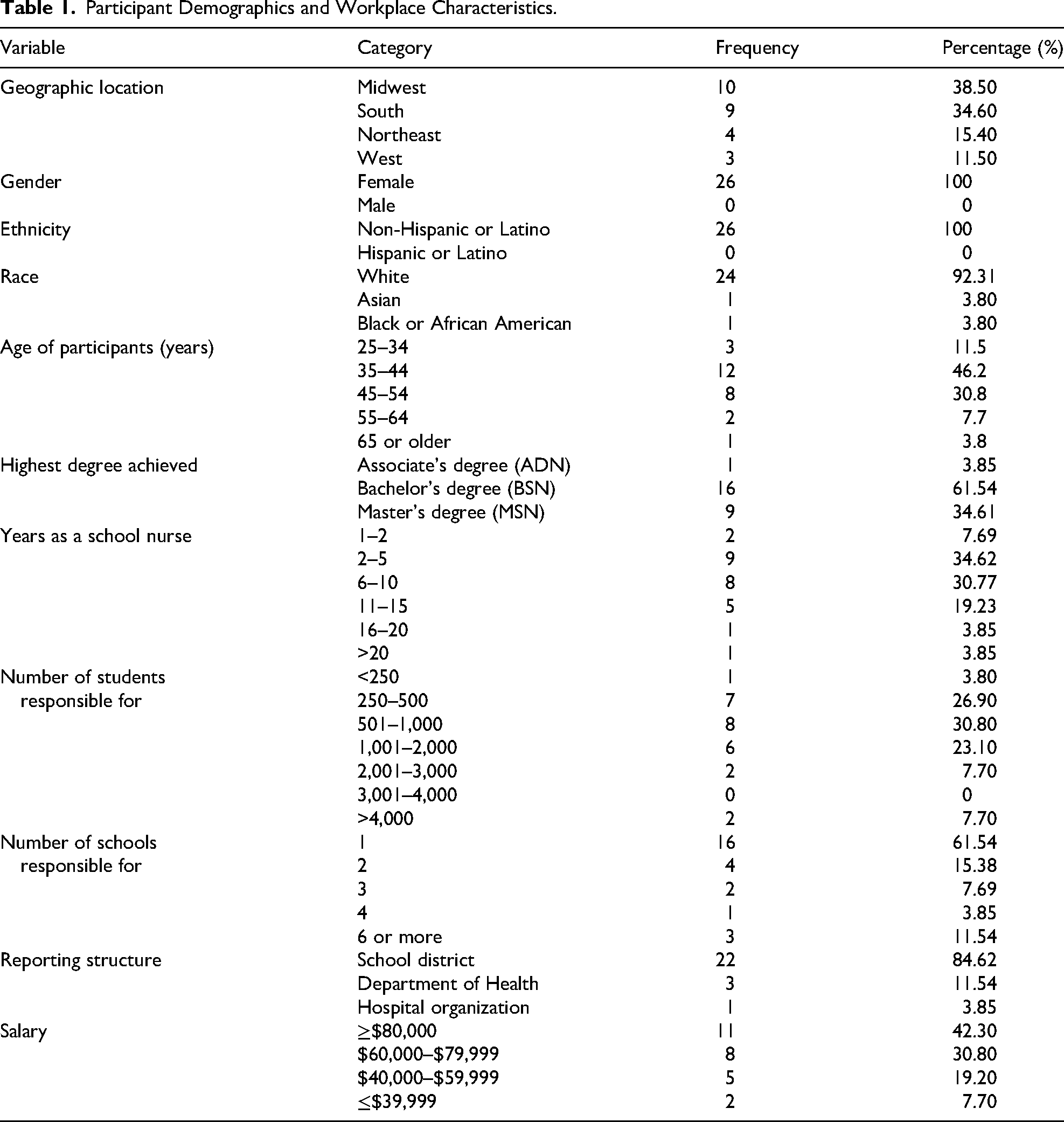
Most participants were bachelor's-prepared, and school nursing experience ranged from 1 year to over 20 years, with the majority reporting between 2 and 10 years of experience (65.38%, n = 17). Participants served student populations of varying sizes, most commonly between 250 and 1,000 students (57.69%, n = 15), and the majority were responsible for one school (61.54%, n = 16). Most participants reported the school district as their supervisory structure, and many identified other school nurses as key sources of professional support (88.46%, n = 23). In addition, most participants reported to the school district (84.62%, n = 22). Salaries varied across participants, with the largest proportion reporting annual earnings of $80,000 or more (Table 1).
Interviews and Journal Entry Results
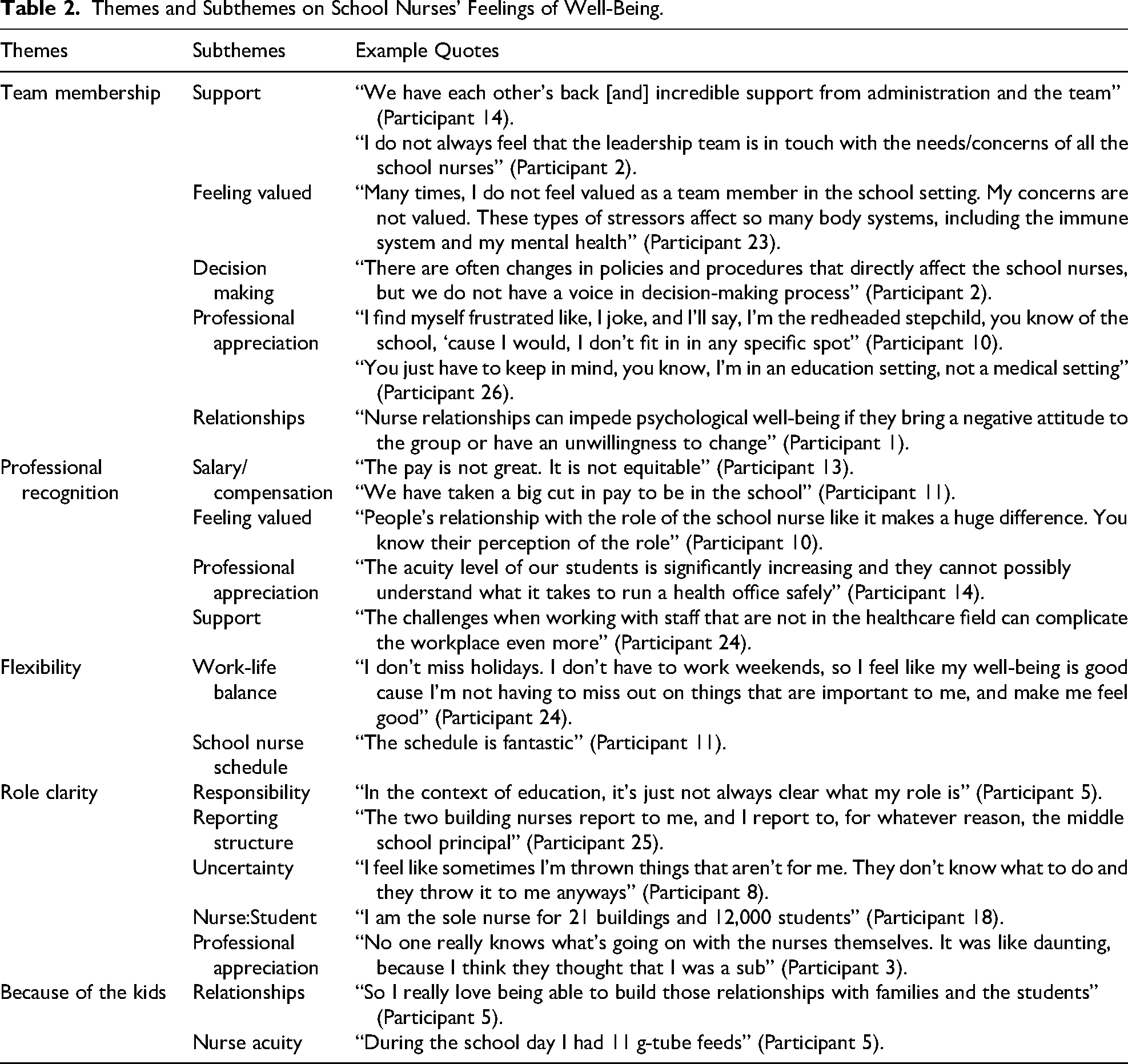
The findings generated from coders’ analysis of interview transcripts and journal entries highlighted five emergent themes: team membership, professional recognition, flexibility, role clarity, and because of the kids. Table 2 provides exemplar quotes illustrating both positive and negative impacts on school nurses’ psychological well-being. Some themes emerged based on frequency (team membership, professional recognition, and role clarity), while others emerged based on the emotion connected to the participants’ perspectives (flexibility and because of the kids). According to Nowell et al. (2017), themes can also emerge based on content that captures something important in relation to the overall research question.
Themes and Subthemes on School Nurses’ Feelings of Well-Being.
Theme 1: Team Membership
The theme team membership refers to the school nurses’ perception of being included or excluded by their school coworkers and/or administrators. This theme was prominent for most participants and emerged through statements about feeling valued, relationships, support, salary/compensation, professional appreciation, and decision-making. Participants described these concepts as factors that promoted and impeded their psychological well-being. Participant 26 articulated that the experience of being a part of these teams makes me feel valued as a nurse. The teams seek information from me from a medical view. In turn, this impacts my well-being as a school nurse in a positive manner. I feel like I am an important member of our school community.
Participant 15 stated, “I am told what is happening and how,” whereas Participant 2 explained that “there are often changes in policies and procedures that directly affect the school nurses, but we do not have a voice in the decision-making process.” Participant 24 added, “I wish there was more support from the administration,” and added, “Some staff members question the choices I have made when caring for students.” This is an important finding given that non-healthcare professionals are questioning the scope and practice of a nurse.
Theme 2: Professional Recognition
The theme professional recognition reflected participants’ perceptions of whether their nursing expertise and role were acknowledged and valued within the school environment. Participants described recognition through several interconnected factors, including professional appreciation, administrative support, compensation, and perceptions of the school nurse role. When nurses felt their expertise was respected and supported by leadership or colleagues, they described improved psychological well-being. For example, Participant 6 noted that “people like Admin[istration] can make you or break you. They’re just very supportive. The support means a lot,” highlighting how leadership support reinforced a sense of professional value.
In contrast, many participants described experiences that signaled a lack of recognition for their clinical role. Participant 14 stated that “95% of the people walk by without saying hello or acknowledging me at my desk,” illustrating feelings of professional invisibility within the school environment. Similarly, Participant 3 explained that dismissive attitudes toward the role undermined well-being: “it just ruins a school nurse's day when you have those parents that are talking to you like, ‘Oh, you’re just a school nurse.”
Compensation also emerged as an indicator of whether participants felt adequately recognized for their profession. Participant 13 remarked, “the pay is not great. It is not equitable,” while another participant noted the financial sacrifice associated with the role. Collectively, these accounts demonstrate how institutional acknowledgment—or lack thereof—shaped school nurses’ perceptions of professional recognition and psychological well-being.
Theme 3: Flexibility
The theme flexibility refers to study participants’ mention of the unique nature of the school nurse role, including the school nurse schedule and the work-life balance that are different from work in the hospital setting. The concept of flexibility surfaced as school nurses perceived the job as less rigid compared to the hospital shift work. The school nurse schedule and work-life balance emerged as important factors in promoting well-being. Participant 11 shared, “I started school nursing pretty much because of the schedule. I was tired of working weekends and holidays,” she commented that “the schedule is fantastic.” Participant 22 noted in their journal, “The summers off are great,” and “When I found out the schedule and that my kiddos could come with me, I was like, this is yes, this is it.” Work–life balance also emerged as an important factor contributing to participants’ job satisfaction and well-being. Other participants similarly described how the school nurse schedule supported personal and family commitments and allowed time for recovery. For example, Participant 14 explained, “They get you by the schedule. I’m off when my kids are off in the summer. I really like to have my summers. I can recharge. I can regroup, and for me that's important.” Participants also described having flexibility to attend personal appointments or take time off when needed.
Theme 4: Role Clarity
The theme role clarity refers to the school nurses’ understanding of their responsibilities as a school nurse as well as others’ understanding of their role within the school community. Role clarity was linked to nurses’ descriptions of vague job expectations, reporting structures, nurse–student ratios, professional appreciation, and workplace uncertainty to increased stress and diminished psychological well-being. Study participants voiced concern over the lack of clarity in who they reported to as well as issues of reporting to supervisors without healthcare experience or knowledge. For example, Participant 15 said, “reporting to nonmedical professionals is often a large stressor in my day, because they are not able to help advocate.” Participant 8 described, “No one understands my position within the building. They don’t know what to do with me,” and “a lot of times, I feel like there are unanswered questions on what to do, and I just have to make the best-educated guess based on my medical and professional opinion.”
Theme 5: Because of the Kids
The theme because of the kids refers to the true reason why school nurses love their job. Despite study participants reporting numerous factors impeding their well-being, all but one participant explicitly stated that their interactions with students were the most rewarding aspect of their role. Participant 21 said, “I feel like I’m like that mom away from home. I’m the auntie. I’m a friend.” and participant 26 said, “That brings me the most joy to see a smile like on a face of a child you’ve helped.”
Furthermore, school nurses spoke of the increased level of care required by more and more students. Participant 26 said, “I have about 380 kids with some kind of health condition. We’ve got kids coming to school who probably never would have attended school years ago.” Participant 17 mentioned that the “chronic health issues in kids is getting substantially increased.” Despite these challenges associated with the increased student health acuity, participants expressed a positive connection with students. Participant 5 shared, “I love getting to spend time with the kids.”
Discussion
This collective qualitative case study provides a grounded, context-specific account of how school nurses’ psychological well-being is driven by their everyday workplace environments. Rather than describing well-being as an internal psychological state, participants associated well-being with institutional conditions—how they were treated by administrators and colleagues, whether their clinical expertise was respected, how clearly their roles were defined, whether they had a voice in decisions affecting students, and whether their work structure allowed recovery and balance. These findings indicate that school nurses’ well-being is shaped by organizational, not only individual factors. This pattern is consistent with the broader nursing literature showing that workplace culture, structural supports, and institutional climate are primary determinants of nurses’ stress and overall well-being (Astiz-Martinez et al., 2024; Bond et al., 2025; Kiptulon et al., 2024).
The demographic characteristics of the sample provide additional context for interpreting these findings. The sample—predominantly White, female, bachelor's-prepared, and serving one school with 1,000 or fewer students—closely mirrors national workforce patterns (Davis et al., 2021; Willgerodt et al., 2024). However, this study captured a notably younger cohort, with most participants aged 44 years or younger, compared with a mean age of 51.9 years in Davis et al.'s (2021) national survey. This younger workforce composition may partially explain why issues of team inclusion, recognition, and professional identity were so salient in the data, as they are navigating educational systems that do not always recognize nursing as a central institutional function of education.
Psychological Well-Being as a Workplace-Embedded Construct
Participants did not describe psychological well-being using formal mental health terminology. Instead, they described it through their lived experience of work—feeling valued or dismissed, supported or isolated, confident or uncertain in their role. This pattern suggests that school nurses experience well-being less as an internal emotional state and more as a reflection of how their organizations treat them (West et al., 2018). When nurses described being listened to, included in decision-making, and supported in managing complex student needs, they associated these conditions with positive workplace experiences. Conversely, when they felt excluded, undervalued, or left to manage clinical responsibilities without adequate support, they described frustration, uncertainty, and diminished well-being.
Jakobsson and Moberg (2025) found that Swedish school nurses felt capable of and motivated to engage in student health-promoting activities in a “positive work environment” (p. 11). This positive work environment was described as one in which there was structure, clear expectations, and interprofessional collaboration. In contrast, these same school nurses reported workload constraints and poor dynamics with their colleagues limited their motivation for and capacity to provide student health promotion.
This workplace-anchored understanding of nurse well-being aligns with the findings of Bond et al. (2025), who argue that well-being is not merely an individual responsibility but a systemic outcome shaped by organizational conditions. Nurses cannot sustain their well-being in environments that undermine professional values or expose them to persistent stress. This study extends that evidence by showing that the school nurse setting introduces distinct workplace challenges that further erode well-being. The findings highlight a structural dimension to school nurse well-being, emphasizing the critical role of organizational environments in enabling or constricting safe and effective practice.
Team Membership as a Structural Determinant of Well-Being
Team membership was one of the most powerful influences on well-being that emerged from this study. Participants described feeling psychologically well when they were included in meetings, consulted for clinical decisions, and treated as legitimate members of the school community. Inclusion signaled respect and professional legitimacy, whereas exclusion communicated that their expertise and presence were dispensable. Importantly, these dynamics were not trivial or interpersonal in a narrow sense; they determined whether nurses had access to information, authority, and institutional protection when managing medically complex students.
These findings refine prior research on collegial relationships in school nursing. While Maughan and Adams (2011) highlighted the importance of interactions that support school nurses’ integration and perceived value within the school team, the present study suggests that inclusion in institutional processes and decision-making further shapes nurses’ well-being beyond interpersonal relations alone. Nurses who lacked a voice in policy changes, care plans, or scheduling decisions experienced significantly greater distress, even when interpersonal relationships were cordial. Similarly, Aljabery et al. (2024) found that system-level constraints contributed to nurses’ emotional and psychological suffering even when interpersonal dynamics were not overtly conflictual.
Professional Recognition as Institutional Valuation
Professional recognition was not simply about being thanked; it reflected whether nurses’ clinical expertise was acknowledged and integrated into school operations. Participants who felt recognized reported greater confidence, psychological safety, and satisfaction. Those who felt invisible or treated as an afterthought described diminished morale and emotional fatigue. Recognition was deeply intertwined with salary, reporting structures, and administrators’ understanding of nursing practice.
These findings align with White et al.'s (2024) call for improved communication and respect for school nurses, but they also show that recognition operates structurally. Nurses interpreted low pay, unclear authority, and limited consultation as evidence that their role was undervalued. This suggests that professional recognition in school nursing is not merely cultural; it is embedded in organizational hierarchies and resource allocation decisions.
Flexibility as a Buffer, Not a Cure
Flexibility—especially predictable schedules and realizing a work-life balance—was one of the strongest promotive factors for well-being. Nurses repeatedly cited weekends, holidays, and summers off as essential to recovery and sustainability. These findings echo Sohail et al.'s (2023) emphasis on work-life balance as protective. However, this study also shows that flexibility alone cannot compensate for inadequate staffing, unclear roles, or lack of recognition. Flexibility buffered stress but did not eliminate it.
Role Clarity and Institutional Vulnerability
Role ambiguity emerged as one of the most destabilizing stressors. Participants frequently described reporting to administrators without healthcare training, managing conflicting expectations, and being left to make high-risk clinical decisions without clear guidance. This placed nurses in ethically and professionally precarious positions, increasing anxiety and emotional strain. Smith and Firmin's (2009) identification of role ambiguity as a source of occupational stress is strongly supported here, but the present study adds a critical institutional dimension: ambiguity was often produced by educational systems that do not structurally integrate nursing expertise into leadership and policy.
Junco et al. (2024) highlighted the absence of standardized protocols and good clinical practice guidelines as obstacles to their effectiveness. In examining the state of school nursing in Spain, they found that in the absence of acknowledgment, appreciation, and regulations at the national level school, nurses are limited in their ability to contribute to the health of Spanish students.
“Because of the kids”: Student relationships as a source of professional meaning
Despite organizational challenges, nearly all participants described their relationships with students as the primary reason they remained in school nursing. Students provided emotional affirmation, purpose, and a sense of contribution. However, this meaning coexisted with rising medical acuity and increasing workload. Nurses described caring for students with complex conditions that would previously have precluded school attendance, yet they continued to find the work rewarding. This may demonstrate that meaningful relationships can sustain engagement even when structural conditions are difficult, supporting Gavin and Pleu'’s (2024) findings on student engagement and job satisfaction.
Integrating the NSM
The findings strongly support the NSM (Neuman, 1989), particularly its emphasis on inter-personal and extra-personal stressors. While intra-personal coping was present, the dominant influences on well-being were relational and institutional. Team membership, recognition, role clarity, and flexibility represent extra-personal structures that either protected or eroded psychological stability. Relationships with students, colleagues, and administrators functioned as interpersonal forces that could buffer or intensify stress. This suggests that interventions must target organizational systems, not only individual resilience.
Implications
Consistent with the School Nurse Practice Framework (NASN, 2024a), this study shows that communication, inclusion, staffing, recognition, and leadership are concrete determinants of school nurse well-being. Policies that clarify roles, integrate nurses into decision-making, ensure fair compensation, and preserve schedule flexibility are essential for protecting the mental health of this workforce and the safety of the students.
Feeling valued, included in school culture, and supported by administrators emerged as central to nurses’ psychological well-being. Increasing public understanding of the clinical scope of school nursing may strengthen respect, inform policy, and secure resources. Visibility at school events and structured opportunities where nurses can share their expertise—such as staff in-service sessions—could enhance recognition. As Dickson et al. (2025) note, students thrive when school nurses are supported by their schools and communities. Creating a well-resourced, respected work environment ultimately strengthens both nurse well-being and quality of student care.
Future research should develop and validate a school nurse-specific well-being instrument, grounded in the workplace factors identified here. Large-scale correlational studies could examine relationships among caseload, role clarity, institutional support, and psychological well-being. Existing educator-specific tools, such as the Teacher Occupational Stress Factor Questionnaire (Foxworth et al., 1984) and the Teachers’ Occupational Stress Questionnaire (Hendres et al., 2014), offer conceptual models for such an instrument.
Study Limitations
This study is limited by timing and sample homogeneity. Data collection occurred largely during the summer months, a period when school nurses may have less availability due to time away from work. This timing may have reduced opportunities to capture perspectives from nurses who are more active or engaged during the academic year.
In addition, the sample was predominantly White and female. While this demographic profile reflects the current composition of the school nurse workforce, it limits the representation breadth of findings. The experiences and well-being of nurses from underrepresented racial, ethnic, and gender groups may differ in meaningful ways, particularly in relation to work climate, structural inequities, and culturally informed stressors.
Despite these limitations, this study had several strengths, including a large sample, multiple data sources, and rigorous analytical procedures. With 26 participants—well above Yin's (2014) recommendation of four to five cases—the study had sufficient depth for within- and cross-case analysis. Triangulation across interviews, surveys, and artifacts strengthened validity (Carter et al., 2014). Use of qualitative software, peer review, an audit trail, and dual coding further enhanced rigor.
Conclusion
School nurses’ psychological well-being is shaped primarily by workplace structures and relationships rather than individual traits. Across 26 cases, well-being was influenced by team membership, professional recognition, role clarity, and flexibility. School nurses’ feelings of inclusion in decision-making and recognition of their clinical expertise promoted their psychological security. School nurses’ feelings of exclusion and role ambiguity undermined it. Additionally, inter-personal and extra-personal workplace conditions drive perceptions of well-being. Structural interventions are key to strengthening workforce stability and ultimately student health outcomes.
Footnotes

Author Contribution(s)
Funding
The authors disclosed receipt of the following financial support for the research, authorship, and/or publication of this article: This work was supported by the Sigma Theta Tau Phi Epsilon Chapter (Phi Epsilon Small Grant).
Declaration of Conflicting Interests
The authors declared no potential conflicts of interest with respect to the research, authorship, and/or publication of this article.