







Abstract

Introduction
Pharmacists are often faced with the problem of modifying an oral dosage form intended for adult use into an acceptable compounded preparation, not only for young children, but also for adults who have difficulty in swallowing or those requiring nasogastric tube administrations. 1 Many of these products lack scientific evidence and are generally assigned with arbitrary short shelf-lives, leading to patient inconvenience and increased costs.
Clobazam, 7-chloro-1-methyl-5-phenyl-1,5-dihydro-3H-1,5-benzodiazepine-2,4-dione, is an anticonvulsant. 2 It is used frequently in a range of pediatric epilepsies. Reported shelf-lives range from 7 to 28 days, but the supporting stability data are very limited.
Aim
We aimed to generate scientific data to support an extended shelf-life of extemporaneously compounded clobazam oral suspension.
Method
Clobazam 1 mg/mL oral suspension was prepared in 3 separate batches within a hospital pharmacy manufacturing facility, under good manufacturing practice. Ingredients used were commercially available clobazam tablets, Frisium 10 mg (as active compound), and equal parts of Ora-Plus (as suspending vehicle), and Ora-Sweet SF (as flavoring syrup). A validated high-performance liquid chromatography (HPLC) assay method 3 was used for determination of clobazam from an extemporaneously compounded oral suspension. Stability studies were conducted at 25 °C (samples stored in a temperature-controlled humidity chamber, condition 1), 4 °C (samples stored in a temperature-controlled refrigerator, condition 2), 4 °C in use (simulating a condition of daily use by patient, condition 3), and 7 days at 4 °C and 3 days at 25 °C (condition 4), the latter to simulate daily dispensing of the product and the possibility of the sample being left out of the refrigerator over the weekend. Duplicate samples were taken from each of triplicate bottles at each selected time point for the 4 different storage conditions throughout the 24-week stability study. Physical properties such as color, odor, dispersibility, and pH were evaluated at each time point. For microbiological testing, a bottle (1 batch) at 4 °C in use was used, which simulated most closely a condition of daily use by patients. Microbiological tests were planned to test on day 0 and on the last testing day.
Results and Discussion
The HPLC assay linearity (r2 > 0.9997) was established in concentrations ranging from 10 to 70 µg/mL, by obtaining intraday and interday data using clobazam reference standard. The standard samples were also used as control samples in the middle and at the end of a HPLC test to ensure that the system was performing well. The drug was well separated from other impurities. The injection precision of the method was established by 5 replicate injections of the formulation (1 mg/mL), resulting in 0.9564 mg/mL of mean drug concentration, with 0.031 mg/mL standard deviation. Therefore, the developed HPLC method was efficiently validated for specificity, accuracy, precision, and linearity.
The in-house proposed assay limit for clobazam oral suspension was not less than 90% of the initial drug concentration. 4 The mean percentage of drug recoveries of replicates of all 3 batches stored at 4 °C and 25 °C, under 4 different study conditions and tested according to the set time points, are shown in Figure 1. The stability data confirmed that the clobazam suspension was stable at 24 weeks, maintaining more than 90% of the initial drug concentration at 4 °C and 25 °C for all study conditions.
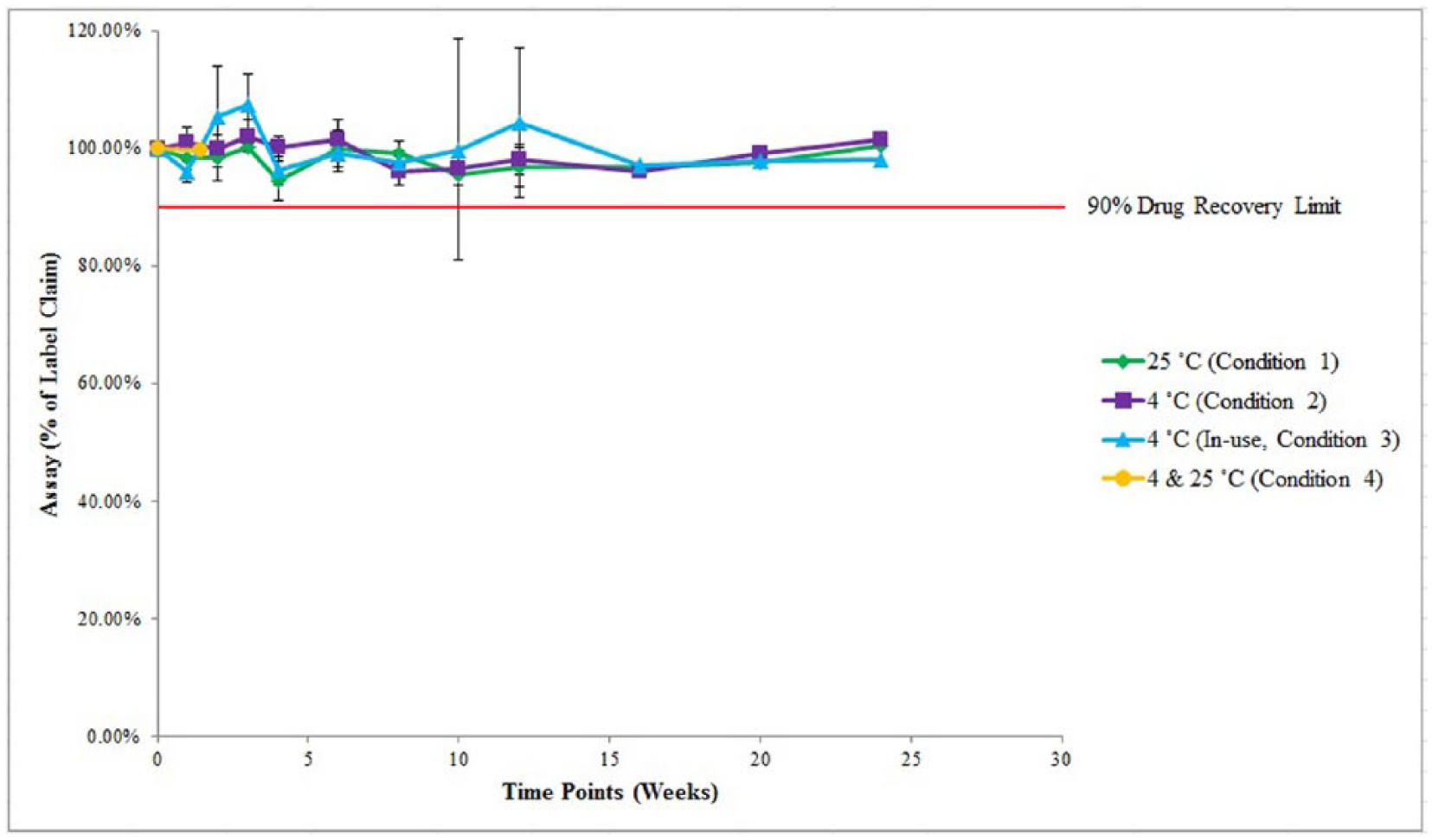
Summary stability data of clobazam oral suspension (1 mg/mL).
No color, odor, or pH changes were observed, maintaining light pink color, light sweet odor, and pH around 4. The suspensions were easily dispersed when shaken. The results of the microbial testing, performed at time 0 and week 24, complied with the requirements of Therapeutic Goods Order No. 77—Microbial Standards for Medicines. 5
Conclusion
Stability studies for clobazam oral suspension (1 mg/mL) were conducted. Based on the results, the shelf-life of the selected formulation of clobazam (1 mg/mL) suspension can be extended to 24 weeks at the storage conditions of 4 °C and 25 °C. The extended shelf-life may allow batch manufacture in facilities complying with good manufacturing practice.
Footnotes
Declaration of Conflicting Interests
The authors declared no potential conflicts of interest with respect to the research, authorship, and/or publication of this article.
Funding
The authors disclosed receipt of the following financial support for the research, authorship, and/or publication of this article: This project was funded by a research project grant from the Women’s and Children’s Hospital Foundation.