






Abstract
Introduction
Anticoagulation is routinely used in atrial fibrillation (AF) patients and for treatment and prophylaxis of venous thromboembolism (VTE) because of an elevated risk for clotting.1,2 Until recently, warfarin was one of the few agents available for these indications. However, a new class of medications known as direct oral anticoagulants (DOACs) has recently emerged. Studies have demonstrated that these agents are at least as effective as warfarin with the added benefit of decreased major bleeding rates, thus making them viable options in most patients.3-5
Apixaban was the third DOAC to become available in the United States. The Apixaban versus Warfarin in Patients with Atrial Fibrillation (ARISTOTLE) clinical study showed that apixaban was superior to warfarin in stroke prevention in patients with AF. 3 It also showed significantly less bleeding compared with warfarin. Additionally, the Oral Apixaban for the Treatment of Acute Venous Thromboembolism (AMPLIFY) clinical study yielded similar results on bleeding and mortality. 6 Because of these benefits, apixaban has become a popular anticoagulant for these indications.
A shortcoming with each of the DOAC trials was the exclusion of patients with a glomerular filtration rate (GFR) of <30 mL/min/1.73 m2, creatinine clearance (CrCl) <25 mL/min/1.73 m2, and serum creatinine (SCr) >2.5 mg/dL or patients on hemodialysis.3-5 One potential reason for exclusion is that patients with advanced chronic kidney disease (CKD) have an increased baseline risk for bleeding because of uremia-induced platelet dysfunction. This creates a problem with anticoagulating these patients because there is both an increased risk of thromboembolic events and major bleeding. 7 Another potential reason for exclusion from the trials is that each of the DOACs has some degree of renal elimination.8-10 This pharmacokinetic property raises a question of whether they may be used safely or if accumulation caused by decreased clearance will cause significantly higher bleeding rates. Although excluding these patients removes potential confounding variables, their exclusion represents a major limitation, such that these agents cannot be used confidently in this population.
Among the DOACs, apixaban undergoes the lowest degree of renal elimination; approximately 27% of the drug is eliminated unchanged in the urine. 11 This prompted a study to evaluate apixaban pharmacokinetics in the setting of end-stage renal disease (ESRD). Patients with ESRD underwent a 4-hour session of hemodialysis and were then given a single 5-mg dose of apixaban. These patients had a 36% higher drug exposure compared with those with normal renal function. The investigators concluded that these results did not warrant a dose adjustment in this population. 12 The United States Food and Drug Administration (FDA) later revised the apixaban prescribing information to include specific dosing recommendations in patients with AF; they do not recommend a dose adjustment for VTE. The 5-mg twice-daily dosing is recommended to be lowered to 2.5 mg twice daily if 2 of the following criteria are met: age ⩾80 years, SCr ⩾1.5 mg/dL, or body weight ⩽60 kg. 10 A more recent 7-patient pharmacokinetics study evaluated the dose appropriateness of apixaban in dialysis patients at steady state by administering 2.5 mg twice daily every day for a week and observed the area under the concentration-time curve. A 5-mg twice-daily dose was administered for a subsequent week after a wash-out period. The authors found that the 5-mg twice-daily dosing led to supratherapeutic levels and the 2.5-mg twice-daily dosing had concentrations similar to the standard dosing in those without renal dysfunction. 13
Because of the lack of supporting literature, existing guidelines do not support DOAC use in the advanced CKD population. The American College of Cardiology/American Heart Association Task Force on Practice Guidelines and the Heart Rhythm Society (AHA/ACC/HRS) AF guidelines recommend only warfarin to be used in ESRD or hemodialysis patients (class IIa/level B recommendation). 1 Similar recommendations can be seen from the CHEST VTE therapy guidelines, where DOAC use is contraindicated in patients with advanced CKD (no recommendation provided). 2 Despite this recommendation for warfarin as a first-line agent, published observational studies suggest that warfarin may cause significantly higher bleeding in the ESRD population than in those with normal renal function. A retrospective cohort study by Shah et al 14 showed that warfarin use in AF patients on dialysis led to double the bleeding rates when compared with the rates in warfarin users not on dialysis. This study is among several showing similar trends for warfarin-related bleeding in these patients.15-18 Comparative analyses could find that warfarin may not be any safer than the other anticoagulants available.
Until recently, comparative data for anticoagulation in patients with advanced CKD did not exist. The first study published in this population was retrospective and compared the bleeding rates of 146 patients taking apixaban with that for warfarin. Patients with a CrCl of <25 mL/min or SCr >2.5 mg/dL were included after receiving a single dose of study drug during a hospitalization. This study showed a trend toward higher major bleeding rates with warfarin although it was not statistically significant. 19 However, the lenient inclusion criteria opened the potential for wide variability on duration of medication use, and length was not discussed. A second retrospective study looking at 160 hemodialysis patients showed similar trends in bleeding rates without achieving significance. It also showed similar rates of clinically relevant nonmajor bleeding and minor bleeding events between the groups, although not reaching statistical significance. 20 Despite these findings, both studies were small and unable to achieve power, leaving an unanswered question of whether DOACs are acceptable alternatives to warfarin in this patient population. Data from a post hoc analysis from ARISTOTLE found that apixaban retained superiority to warfarin even with worsened renal function. 21 Although guidelines recommend against the use of DOACs, apixaban has FDA-approved dosing recommendations, which has led to its use in clinical practice. One medication use evaluation noted that 10.4% of 102 504 patients with advanced CKD (CrCl < 30 mL/min) and 10.5% of 140 918 patients on dialysis were taking apixaban. 7 As DOAC use increases, more evidence is needed to support the use of these agents in this population. The aim of this study is to evaluate the major bleeding and thromboembolic event rates of patients with severe renal impairment taking apixaban and warfarin.
Methods
Study Design, Setting, and Patient Population
This was a retrospective, multisite, single-center cohort. The patients were treated within a health system that comprises 11 medical centers totaling more than 1400 beds. The system has a pharmacist-run warfarin management clinic. Each individual institution and clinic within the system shares a single electronic medical record, making patient information universally accessible.
Patients aged 18 years or older who were treated within the health system from January 1, 2013, to November 1, 2016, were screened for inclusion if they had recorded evidence of CKD stage 4 or 5 by International Classification of Diseases, Ninth Revision (ICD-9), and International Classification of Diseases, Tenth Edition (ICD-10), codes and laboratory evidence of a GFR of ⩽29 mL/min/1.73 m2 as calculated by the Chronic Kidney Disease Epidemiology Collaboration equation. 22 CKD staging was based on the Kidney Disease: Improving Global Outcomes guidelines, with stage 4 defined as a GFR of 15 to 29 mL/min/1.73 m2, CKD stage 5 defined as a GFR of <15 mL/min/1.73 m2, or CKD stage 5 receiving hemodialysis. 23 Patients were also included if they were receiving treatment with apixaban or warfarin for nonvalvular AF or VTE for at least 3 months. Patients treated for less than 3 months were only included if discontinuation occurred because of major bleeding events. Patients were excluded if they were on apixaban or warfarin for reasons other than nonvalvular AF or VTE, if the INR goal for warfarin was outside the range of 2 to 3, or if they were pregnant.
Patients were categorized into 1 of 2 groups: those receiving warfarin and those receiving apixaban. Electronic medical record data were collected at the time of study enrollment. Baseline demographic information for each patient was left unchanged after initial data procurement. Data surrounding events of bleeding, stroke, and thromboembolism occurrences were collected for up to 12 months after enrollment. This study was approved by the Ochsner Medical Center’s Institutional Review Board. No informed consent was required.
Study Outcomes
The primary end point of this study was major bleeding rate at 3 months after enrollment. Time of enrollment was defined by first documented occurrence of a GFR ⩽29 mL/min/1.73 m2 while on the study drug. Major bleeding was defined according to the definition provided by the International Society on Thrombosis and Haemostasis and consisted of 1 of 3 components: fatal bleeding, bleeding in a critical area or organ (intracranial, intraspinal, intraocular, retroperitoneal, intra-articular, pericardial, or intramuscular with compartment syndrome), or bleeding causing a fall in hemoglobin level of ⩾2 g/dL or leading to transfusion of ⩾2 units of packed red blood cells. To eliminate ambiguity, a 48-hour time frame for the hemoglobin drop was included.
Secondary outcomes were major bleeding rates at 6 and 12 months; ischemic stroke rates at 3, 6, and 12 months; and recurrent thromboembolism rates at 3, 6, and 12 months. The time periods are not cumulative, and patients were removed if they had the outcome in the previous time period. Stroke was defined as a focal neurological deficit, from a nontraumatic cause, and was categorized as ischemic or of uncertain type, with a confirmatory diagnosis using chart review and ICD 9 and 10 codes. Thromboembolism was defined as fatal or nonfatal pulmonary embolism, or deep-vein thrombosis with a confirmatory diagnosis using chart review and ICD 9 and 10 codes.
Prior to starting our study, it was calculated that we needed 283 patients per group to achieve 80% power to detect an absolute difference of 6% between the groups. The 6% difference was decided on by estimating a 4% bleeding risk in the apixaban arm by doubling the rate of bleeding from ARISTOTLE assuming that CKD 4 and 5 patients would have higher bleeding rates. 3 The rate of bleeding in hemodialysis patients on warfarin is estimated to be up to 10 times higher than in nondialysis patients. 24 Because our whole study population was not dialysis dependent, we chose to only triple the warfarin bleeding rate from ARISTOTLE to 10%, creating the 6% difference between arms. The analysis was based on annual bleeding rates.
Statistical Analysis
SAS version 9.4 for Windows (Cary, NC) was used to conduct all analyses. Continuous data are presented as means (SD) or medians (interquartile range) and were analyzed using the unpaired t-test or Wilcoxon test where appropriate. Categorical variables were analyzed using a χ2 or Fisher exact test. Bivariate analyses were initially run to determine association of intervention groups with demographics for clinical outcomes. Multivariable logistic regression analysis was performed to estimate odds of bleeding. The variables evaluated in the regression analysis included drug type and variables established by literature review to affect bleeding such as HAS-BLED score, aspirin use, proton pump inhibitor or histamine-2 receptor antagonist use, and duration of medication administered. Variables that were significantly associated with the outcome in the bivariate analysis at each period of time were adjusted for in the regression model. Association of variables with bleeding is presented as odds ratio ([OR] 95% CI). A P <0.05 was considered significant.
Results
A total of 1135 patients were screened for inclusion. Of the 521 apixaban patients screened, 302 were included for final analysis. Of the 614 warfarin patients screened, 302 were included for final analysis. The reasons for exclusion were being on the study drug for less than 3 months (unless they had a bleed during this time period), being on the drug for a nonstudy indication, not having CKD stage 4 or 5, and having missing information pertinent to data collection.
Baseline demographic and clinical characteristics of the study patients are presented in Table 1. Patients were older in the apixaban group (P = 0.006), and more were of female sex (P = 0.01). The majority of patients in the study were on anticoagulation for AF, particularly patients in the apixaban group (P = 0.039). The duration the patients were on the medication was significantly greater in the warfarin arm (9.7 months) versus the apixaban arm (8.8 months; P = 0.003). The median SCr was significantly higher in the warfarin group (2.3 vs 2.5 mg/dL, P = 0.002). However, there were similar numbers of patients in each stage of CKD. The majority of patients in the study had CKD stage 4, and about one-third in each group were on hemodialysis. There were no significant differences in CHA2DS2-VASc score (4.8 vs 4.8) or with any of its individual components. The average HAS-BLED score was 3.4 for apixaban patients and 3.3 for warfarin patients in the study. Approximately half the patients in each arm were on aspirin as well as a proton pump inhibitor or histamine-2 receptor antagonist. A total of 173 (57%) patients were on apixaban 2.5 mg twice daily, and 129 (43%) patients were on 5 mg twice daily. Of these, 32% were dosed incorrectly, with 82% being underdosed. Among the AF patients, 30% were dosed incorrectly, whereas among VTE patients, the rate was 41%.
Baseline Demographic and Clinical Characteristics.
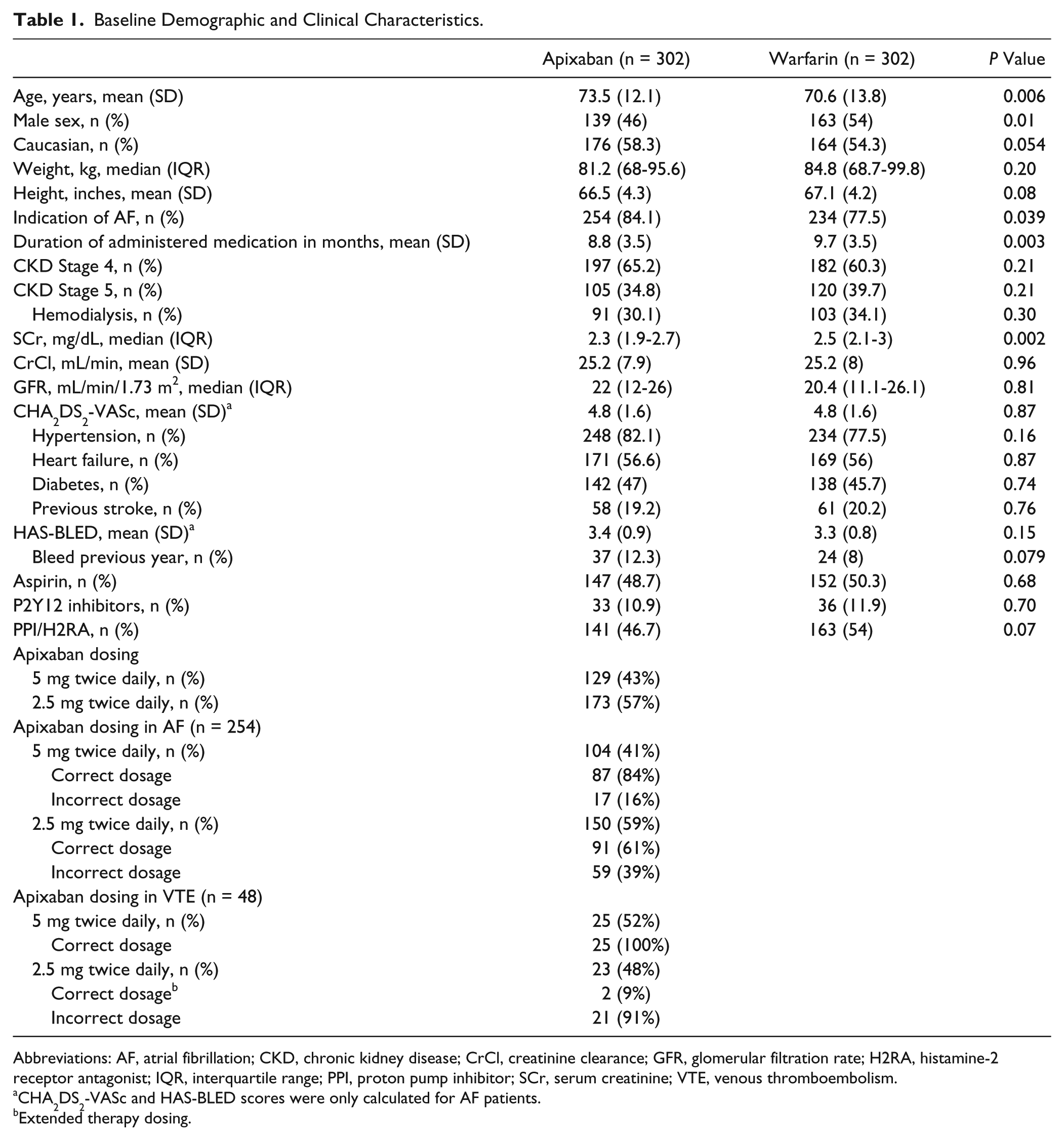
Abbreviations: AF, atrial fibrillation; CKD, chronic kidney disease; CrCl, creatinine clearance; GFR, glomerular filtration rate; H2RA, histamine-2 receptor antagonist; IQR, interquartile range; PPI, proton pump inhibitor; SCr, serum creatinine; VTE, venous thromboembolism.
CHA2DS2-VASc and HAS-BLED scores were only calculated for AF patients.
Extended therapy dosing.
Results of major bleeding per time period are represented in Table 2. A total of 25 (8.3%) patients receiving apixaban experienced major bleeding at 3 months compared with 30 (9.9%) patients receiving warfarin (P = 0.48). During the 3- to 6-month time frame, there were 4 (1.4%) patients on apixaban with a major bleed and 11 (4%) patients on warfarin (P = 0.07). Between 6 and 12 months, a total of 4 (1.5%) patients receiving apixaban experienced major bleeding compared with 22 (8.4%) patients receiving warfarin (P < 0.001). When analyzing dosing in relation to bleeding, of the 33 apixaban patients who bled, 58% were on 2.5 mg twice daily and 42% were on 5 mg twice daily. Of these, 9% were on a supratherapeutic dose, 64% were on the indicated dose, and 27% were on a subtherapeutic dose.
Major Bleeding, Stroke, and Thromboembolism Rates at Different Time Periods.

When analyzing major bleeding rates by category and time period, there was no statistical difference between each drug and bleeding type, as shown in Table 2. The most common location of bleed was the gastrointestinal tract.
Table 3 illustrates the breakdown of the patients who experienced a bleed in each stage of renal failure. There were no differences in bleeding rates with apixaban or warfarin regardless of CKD stage.
Bleeding Rates by Stage of CKD.

Abbreviation: CKD, chronic kidney disease.
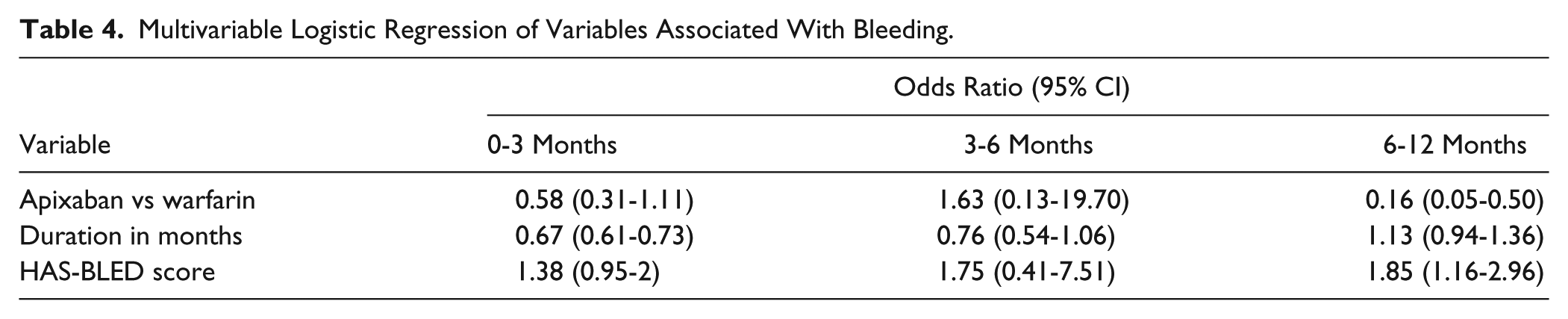
Table 4 illustrates the logistic regression models at the 3 time periods. At 0 to 3 months, drug type (OR = 0.58; 95% CI = 0.31-1.11) and HAS-BLED score (OR = 1.38; 95% CI = 0.95-2) were not significantly associated with bleeding. Duration seemed to have a protective effect (OR = 0.67; 95% CI = 0.61-0.73), which was statistically significant but not clinically expected. Thus, we looked into a regression model for the 3- to 6-month and 6- to 12-month time periods to investigate if similar results would be produced. At 3 to 6 months, drug type, HAS-BLED score, duration, and stomach acid blockers were not significantly associated with bleeding. At 6 to 12 months, apixaban (OR = 0.16; 95% CI = 0.05-0.5) was less associated with bleeding than warfarin. The HAS-BLED score during this time period was also significantly associated with bleeding (OR = 1.85; 95% CI = 1.16-2.96).
Multivariable Logistic Regression of Variables Associated With Bleeding.
Stroke and thromboembolism rates were similar for apixaban and warfarin groups in each of the observed time periods, as illustrated in Table 2.
Discussion
The 2014 ACC/AHA/HRS AF guidelines and the 2016 CHEST VTE guidelines recommend warfarin as the preferred anticoagulant for the ESRD population.7,8 Head-to-head comparisons in this population between oral anticoagulants have been lacking, thus not allowing for confident recommendations for use of DOACs over traditional therapy. This is currently the largest study to evaluate the use of a DOAC in comparison to warfarin in ESRD. We found that apixaban had similar or lower major bleeding rates compared with warfarin depending on the duration for which the study drug was administered. During the first 6 months, the groups had similar bleeding rates. On the other hand, warfarin showed significantly higher bleed rates compared with apixaban when observed for up to 12 months. Stroke and thromboembolism rates did not differ between the 2 groups.
These results are consistent with the findings in previously published literature. The AMPLIFY and ARISTOTLE studies, along with the follow-up to ARISTOTLE by Hijazi et al, 21 showed that apixaban had less major bleeding rates observed across all degrees of renal function.3,6,21 Overall rates in this trial were higher than what was observed in the larger DOAC studies. This may have been a result of selection bias for a population predisposed to hospital admissions, despite data collection from both an inpatient and outpatient setting. In addition, the increased bleeding risks associated with kidney dysfunction pathologies may explain the higher rates that were seen. Because there were no oral anticoagulation class comparisons in this population prior to this year, the rates of major bleeding between agents was unknown. Stanton et al 19 showed very similar bleeding rates to our study, with apixaban having 9.6% major bleeding and warfarin patients having 17.8%. The other recent article by Sarratt et al 20 showed analogous trends between the groups.
The dosing of apixaban patients in this trial was variable. An exact dose-bleeding relationship would be difficult to produce because one-third of the population was dosed incorrectly. Additionally, most of the incorrectly dosed patients were underdosed. Because our trial did not focus on dosing, it is not likely to add much clarity to the issue. Future studies evaluating the optimal dosing still need to be done.
The average international normalized ratio (INR) for warfarin patients who bled in this study was 3.59 ± 2.4. Although this is higher than the goal of 2 to 3, it is not uncommon for patients to have labile INR levels throughout therapy. The purpose of including these patients in our study is to reflect the potential of labile levels in clinical practice. The average INR during bleeding episodes of patients managed by our clinic was 3.64 ± 2.4, showing that even close monitoring does not prevent patients from falling outside the goal range.
Several limitations were noted in this study. Patients may not have had a GFR consistently less than 29 mL/min/1.73 m2. The baseline characteristics were collected at the time of enrollment, and improvement in renal function did not get taken into account. Although data were pulled according to ICD-9 and ICD-10 code listings for CKD stages 4 and 5 and confirmed via chart check for an appropriate GFR, improvement in renal function cannot be ruled out. Additionally, patients may not have been on the study drug for the full duration of each observed time period. Whereas the minimum required time was 3 months to get an accurate assessment of the VTE patients, the patient could have discontinued the drug at any time point prior to the 12-month maximal observation point. The average duration of months observed in each arm was stated previously, with the warfarin group having a longer duration. However, the logistic regression analysis showed that duration on drug had no significant impact on bleeding at the 6- to 12-month time interval. Another limitation is that time in therapeutic range (TTR) for INR levels was based on the yearly average of the warfarin clinic rather than being individualized to each patient. The study’s retrospective nature and patient follow-up frequency did not make it possible to accurately assess TTR for all patients. The average TTR for the year of 2016 was 78.7%. A total of 65% of the total warfarin patients were being followed by the clinic. Finally, the rarity of stroke and thromboembolism may have failed to capture an association between the outcomes and anticoagulant use.
Conclusion and Relevance
Patients taking apixaban had bleeding rates similar to that of warfarin in the first 3 and 6 months after enrollment, though those who continued therapy had higher major bleeding rates with warfarin between 6 and 12 months. Ischemic stroke and thromboembolism rates were similar between the groups. This is the largest direct comparison study of warfarin with a DOAC in the advanced CKD population. Based on the results of this study, apixaban seems to be an acceptable alternative to warfarin in patients with severe renal dysfunction. Future prospective studies are needed to validate our findings.
Footnotes
Acknowledgements
We acknowledge the assistance of Alaa Mohammed, MPH.
Authors’ Note
Results were presented as a poster at the 2017 Alcalde Southwest Leadership Conference in Galveston, Texas, and the 2017 American College of Clinical Pharmacy Annual Meeting in Phoenix, AZ.
Declaration of Conflicting Interests
The authors declared no potential conflicts of interest with respect to the research, authorship, and/or publication of this article.
Funding
The authors received no financial support for the research, authorship, and/or publication of this article.