







Abstract

Most Postgraduate Year 1 and 2 (PGY1/PGY2) pharmacy residents conduct research projects.1,2 However, lack of support and mentorship is a commonly reported barrier to completion of these projects.3,4 We created a research committee to provide residents with research-related support. This evaluation summarizes the advice provided to residents by a pharmacy research committee and evaluates the acceptance and usefulness of this advice.
The project evaluated the 2019-2020 pharmacy residency class at our institution. Our research committee is described in Figure 1. After residents met with their project preceptor(s) but before data collection, the research committee met with each resident and provided feedback. During this meeting, all provided advice was recorded. An email with this advice was then sent to the resident. The email explained that the committee aimed to provide guidance but not to be prescriptive, and the resident should feel no obligation to accept the advice. Residents were encouraged to discuss advice with their project preceptor(s), who also attended the committee meetings. Following the completion of their projects, an optional survey containing the advice was sent to residents. For each piece of advice, residents were asked if they accepted it, did not accept it, or if it was no longer relevant. One individual gathered responses, and only summary level data were presented. Three additional questions asking residents to rate the usefulness of the advice (using a scale ranging from strongly disagree to strongly agree) were also included. Residents were excluded if they did not complete the optional survey. This project was considered program evaluation by our institutional review board (IRB), and thus, IRB oversight was waived.
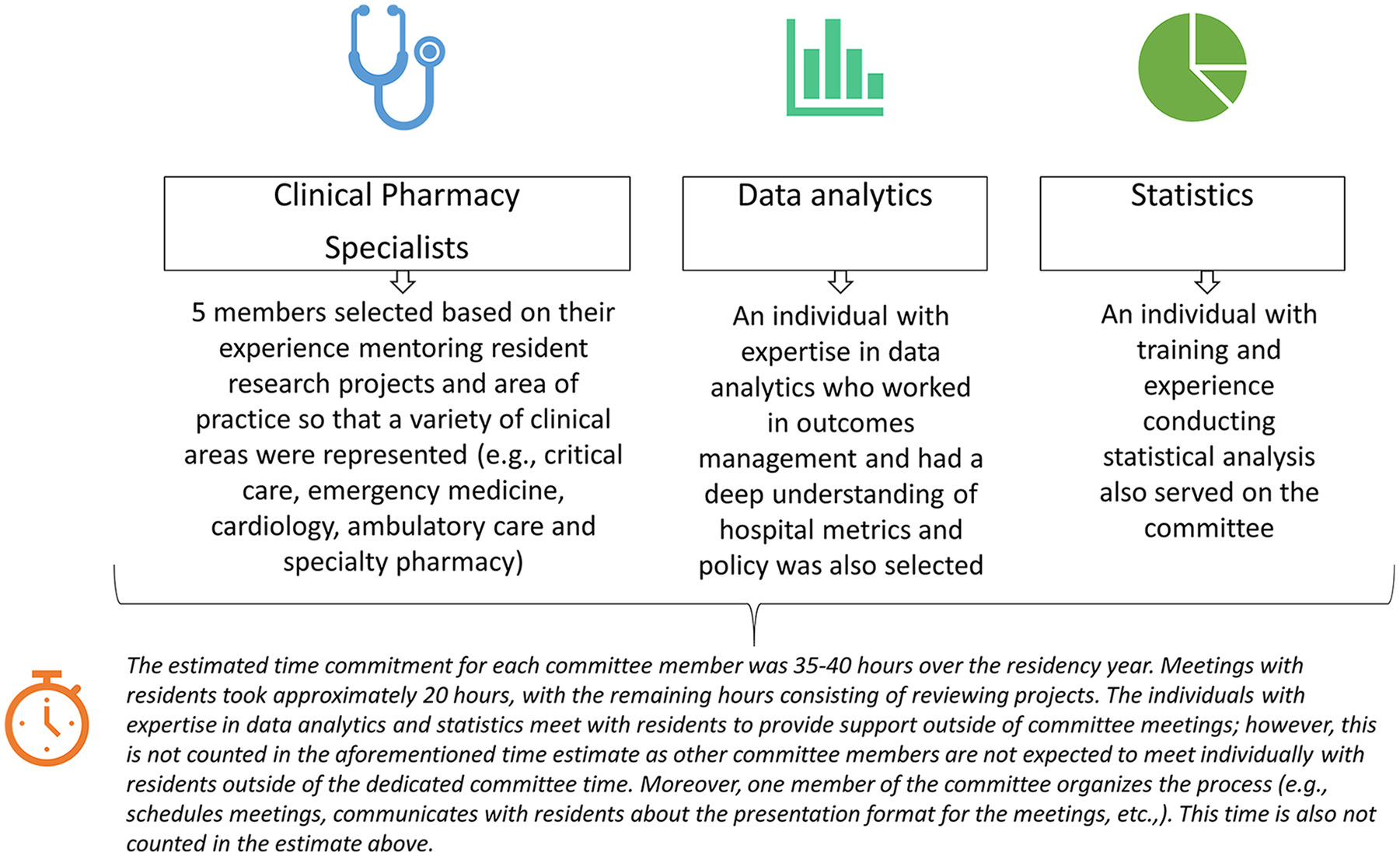
Overview of the pharmacy residency research committee.
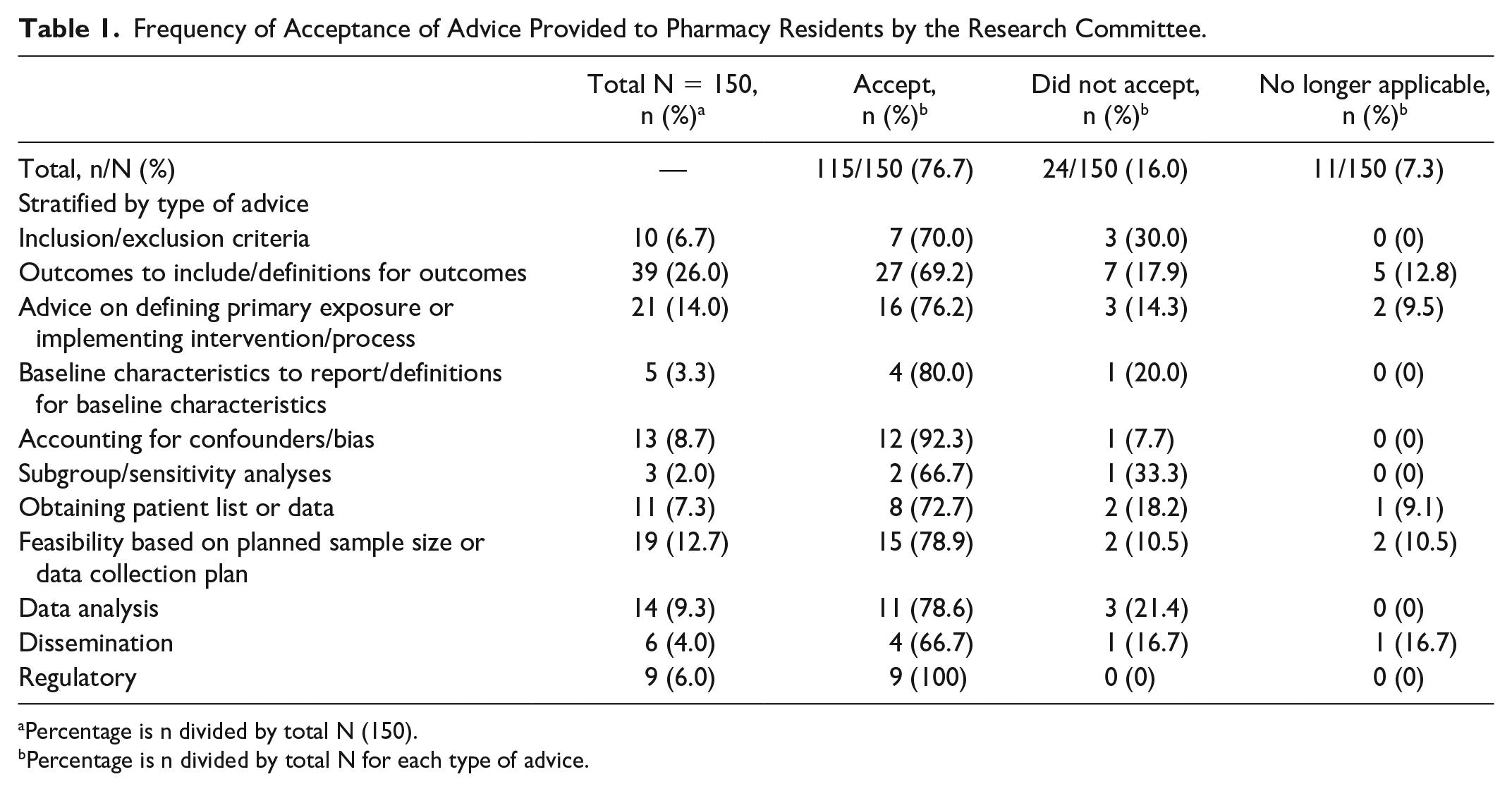
Of the 29 individuals sent the survey, 26 (89.7%) completed it and were included in the analysis. In all, 14 residents were PGY1s and 12 were PGY2s. The research committee provided 150 pieces of advice, and most (77%) were accepted. The proportion of advice that was accepted stratified by type is shown in Table 1. Examples of the provided advice can be found in Appendix 1. Approximately 96% of residents agreed that the research committee provided constructive and actionable feedback; 89% agreed that the committee helped them anticipate barriers; and 85% agreed that the advice from the committee improved the quality of the project.
Frequency of Acceptance of Advice Provided to Pharmacy Residents by the Research Committee.
Percentage is n divided by total N (150).
Percentage is n divided by total N for each type of advice.
Our research committee provided 150 pieces of advice to 26 residents. Most advice was accepted, and residents reported that the research committee provided constructive feedback. Research mentorship and guidance is a previously identified predictor of residency project publication.5,6 Through this research feedback design, we were able to optimize the collective experience and aptitudes of our mentors, allowing for every resident to receive advice from an array of individuals. A limitation of this analysis was that we were not able to assess if the committee affected publication rate, because some resident research manuscripts were still under consideration at journals when we conducted our analysis. Moreover, year-to-year comparisons are challenging because we implement multiple changes to our research process each year and the 2019-2020 residency class faced barriers because of the coronavirus pandemic. Similarly, we assessed 1 year of data, and the applicability of our findings to other residency classes or programs is not known. However, similar committees have been described.7,8 Finally, our evaluation is susceptible to the Hawthorne effect because residents knew we were conducting the analysis. This would be expected to result in more favorable findings. Nonetheless, our high response rate (ie, ~90%) is a strength.
In conclusion, advice provided by our research committee was frequently accepted. Most residents felt that the committee was able to give actionable advice. Research committees appear to be an effective mechanism for providing research-related support to pharmacy residents.
Supplemental Material
sj-pdf-1-aop-10.1177_10600280211017332 – Supplemental material for Advice Provided by a Pharmacy Residency Research Committee
Supplemental material, sj-pdf-1-aop-10.1177_10600280211017332 for Advice Provided by a Pharmacy Residency Research Committee by Erin R. Weeda, Genevieve L. Hayes, Eleni A. Gaspar, Rory J. Thomas, Jean M. Nappi and Kyle A. Weant in Annals of Pharmacotherapy
Footnotes
Acknowledgements
The authors would like to thank the Medical University of South Carolina (MUSC) Pharmacy Services and the MUSC College of Pharmacy for their support as well as Mary Stewart Leatherwood for assisting with data collection.
Authors’ Note
Preliminary work from this project was presented as a poster at the 2019 ASHP Midyear Meeting in Las Vegas, NV.
Declaration of Conflicting Interests
The authors declared no potential conflicts of interest with respect to the research, authorship, and/or publication of this article.
Funding
The authors received no financial support for the research, authorship, and/or publication of this article.

Supplemental Material
Supplemental material for this article is available online.
References
Supplementary Material
Please find the following supplemental material available below.
For Open Access articles published under a Creative Commons License, all supplemental material carries the same license as the article it is associated with.
For non-Open Access articles published, all supplemental material carries a non-exclusive license, and permission requests for re-use of supplemental material or any part of supplemental material shall be sent directly to the copyright owner as specified in the copyright notice associated with the article.
