






Abstract
Objective:
To describe the safety, efficacy, and potential role in therapy of voclosporin, an oral calcineurin inhibitor approved by the Food and Drug Administration (FDA) in January 2021 as an adjunct treatment for lupus nephritis.
Data Sources:
A literature search was conducted using PubMed with the following terms: voclosporin, Lupkynis, and lupus nephritis (January 1, 2010, to December 1, 2021). FDA product labeling was also reviewed for pertinent data sources.
Study Selection and Data Extraction:
All articles were considered for inclusion. English-language articles selected included preclinical and clinical studies examining the pharmacokinetics, efficacy, and/or safety of voclosporin.
Data Synthesis:
Voclosporin has been studied as an adjunct immunosuppressive agent in patients with lupus nephritis. Drug design allows for a more predictable pharmacokinetic profile than other calcineurin inhibitors. Data suggest that adding this newly approved calcineurin inhibitor to a regimen of mycophenolate mofetil and corticosteroids produces promising therapeutic results. As such, voclosporin has been approved for use in patients with active lupus nephritis who are maintained on immunosuppressive therapy with mycophenolate mofetil and a corticosteroid.
Relevance to Patient Care and Clinical Practice:
Voclosporin may be a favorable calcineurin inhibitor in patients with lupus nephritis, due to a predictable pharmacokinetic profile. This allows for decreased therapeutic drug monitoring and suggests a favorable adverse effect profile. However, cost remains a consideration with this new agent.
Conclusions:
Current available data suggest that voclosporin is a promising adjunct treatment option for patients with active lupus nephritis who are maintained on mycophenolate mofetil and a corticosteroid.
Keywords
Introduction
Systemic lupus erythematosus (SLE) is a chronic multisystem autoimmune condition that causes widespread inflammation. 1 One of the most common manifestations of SLE is lupus nephritis (LN), a condition characterized by hematuria, proteinuria, and impaired kidney function, affecting nearly 40% of patients with SLE.1,2 LN is a major risk factor for morbidity and mortality, with 10% of patients progressing to end-stage kidney disease within 10-20 years of diagnosis. 2 Treatment goals are focused on reducing proteinuria to <0.5-0.7 g/24 hours in the first 12 months following diagnosis; improvement of baseline proteinuria should be noted by 3 months, with at least a 50% reduction in proteinuria by 6 months. 3 As kidney function declines, individuals with LN may require hemodialysis or renal transplantation. 4
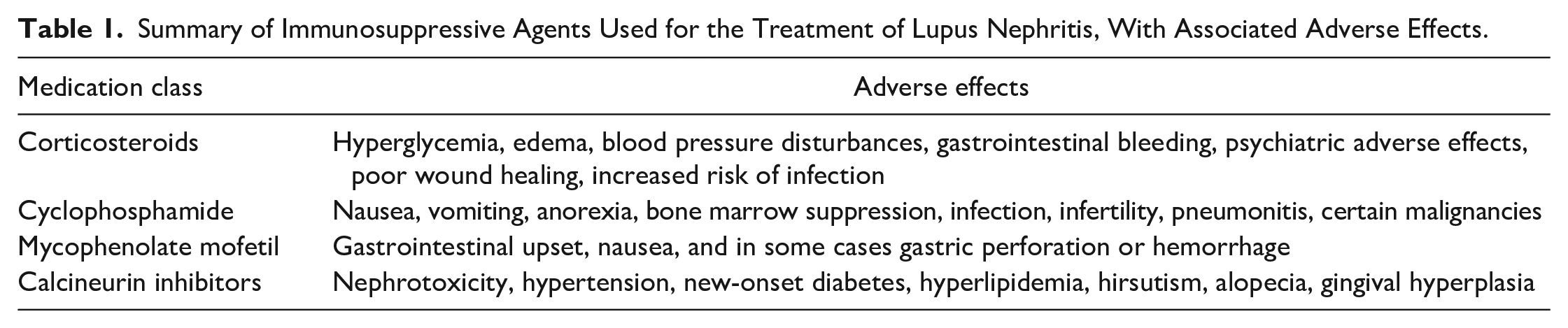
To preserve kidney function and prolong time to hemodialysis or transplant, patients with LN are treated with immunosuppressive therapies, including corticosteroids, mycophenolate mofetil (MMF), or cyclophosphamide (CY).3,5,6 Treatment includes an induction phase, during which immunosuppressive agents are used at high doses, followed by a maintenance phase where lower doses of immunosuppressive agents are used. 7 Current guidelines recommend induction therapy with oral MMF or intravenous CY, combined with corticosteroids.3,6 These immunosuppressive agents are used off-label for LN and have considerable adverse effects, outlined in Table 1.8-10 In addition, these agents do not always promote an adequate therapeutic response, with up to 50% of patients failing to meet the defined proteinuria goal within the first year of treatment. 3
Summary of Immunosuppressive Agents Used for the Treatment of Lupus Nephritis, With Associated Adverse Effects.
Routine monitoring is key during all phases of LN treatment. During the induction phase, monitoring such as urinalysis and 24-hour urine protein collection may help predict response to induction therapy. 3 During the maintenance phase, routine monitoring can predict disease flares, defined as disease activity requiring alternative or more intensive treatment. 3 Disease flares occur in 20% to 25% of patients with SLE within the first 1 to 2 years of treatment.3,11 Most renal flares occur within the first 5 years of treatment and can be diagnosed based on changes in proteinuria, serum creatinine, and urine sediment, thus necessitating ongoing monitoring.3,12 The SELENA-SLEDAI score, used to assess disease flares in SLE, is increasingly reported in therapeutic trials to assess response to therapy. 13
Calcineurin inhibitors (CNIs), another class of immunosuppressive agents, may provide therapeutic benefit when added to conventional LN induction regimens. 14 Available CNIs include cyclosporine (CS) and tacrolimus. In addition to nephrotoxicity, CNIs are associated with a variety of adverse effects, including hypertension, new-onset diabetes, and hyperlipidemia (Table 1). 15 Recent studies have explored the role of CNIs in LN induction therapy; when compared with an induction regimen of CY plus corticosteroids, a regimen of tacrolimus, MMF, and corticosteroids provided similar induction efficacy. 16 There are currently no long-term data on the role of CNIs in the prevention of renal insufficiency or failure in the LN patient population. 3 As such, guidelines suggest that triple immunosuppressive regimens, using a CNI, MMF, and corticosteroid, should be reserved only for patients with nephrotic-range proteinuria.3,5,6 Clinically, LN patients may be initiated on a CNI when they cannot tolerate recommended doses of MMF or are unable or unwilling to initiate intravenous CY therapy.
Voclosporin (VCS), an oral CNI, was approved by the Food and Drug Administration (FDA) in January 2021 for use in combination with background immunosuppressive therapy in adults with active LN. 17 VCS is the first oral agent that carries an FDA approval for this indication. 17 The drug design allows for improved potency against calcineurin inhibition and better metabolic stability than CS. 17 VCS has a consistent pharmacokinetic and pharmacodynamic profile, which eliminates the need for therapeutic drug monitoring and may indicate improved safety when compared with other CNIs. 18 The purpose of this review is to describe the safety, efficacy, and role in therapy of VCS (Lupkynis).
Data Selection
A literature search was conducted with PubMed using the following terms: voclosporin, Lupkynis, and lupus nephritis (January 1, 2010, to December 1, 2021). This search resulted in 33 articles, of which 12 relevant English-language articles of studies assessing pharmacokinetics, efficacy, or safety were selected. Information was also obtained from FDA product labeling. References from selected sources were reviewed for additional data sources.
Pharmacology
VCS is structurally similar to CS, except for the modification of a functional group on the amino acid 1 residue. 19 This modification changes the binding of VCS to calcineurin, leading to a molecule with improved potency when compared with CS; however, the exact mechanism of action is not fully established. 19 Activation of lymphocytes involves an increase in calcium concentrations that bind to the calcineurin regulatory site and activates the transcription factor Nuclear Factor of Activated T-Cell Cytoplasmic (NFATc), which allows for the production of cytokines. These cytokines in turn will assist in the proliferation and activation of lymphocytes. The immunosuppressant activity of VCS comes from the inhibition of the calcineurin-dependent activation of NFATc, which results in the inhibition of lymphocyte proliferation, T-cell cytokine production, and expression of T-cell activation surface antigens.19,20
Pharmacokinetics
VCS has a Tmax of 1.5 hours when administered on an empty stomach. Taking with meals may decrease Cmax by up to 29% and area under the curve by up to 53%. Its volume of distribution is approximately 2000 L. Metabolism is through CYP3A4; thus, moderate inhibitors may have an effect on VCS concentrations. 19 The terminal half-life is approximately 30 hours and VCS is excreted 92.7% fecally and 2.1% renally. The addition of 1 carbon molecule at the amino acid 1 residue of cyclosporine enhances binding of the VCS-cyclophilin complex to calcineurin and leads to faster elimination of the major metabolites of VCS. 19 When compared with CS and tacrolimus, VCS has more consistent absorption (Tmax) and elimination. Because of this, VCS does not require therapeutic drug monitoring, unlike other commonly used CNIs. 19 See Table 2 for a comparison of available CNIs.19-25
Comparison of Voclosporin With Other Available Calcineurin Inhibitors.

Average wholesale price was found using Wolters Kluwer database.
Abbreviation: MMF, mycophenolate mofetil.
Dosing and Administration
VCS comes in 7.9 mg capsules. The recommended starting dose is 23.7 mg (3 capsules) twice a day. Doses should be administered 12 hours apart, with a minimum of 8 hours between doses. Capsules should be taken whole, without splitting or crushing. To allow for proper absorption, the medication should be taken on an empty stomach. 19
Renal and Hepatic Dosing
The patient’s estimated glomerular filtration rate (eGFR) should be assessed every 2 weeks for the first month and then every 4 weeks thereafter. 19 If eGFR is <60 mL/min/1.73 m2 and reduced by 20% to 30% from baseline, reduce the dose to 15.8 mg twice a day and reassess within 2 weeks; if eGFR is still below baseline by 20% or more, then reduce the dose to 7.9 mg twice a day. If the eGFR has been reduced by ≥30%, discontinue VCS and reassess in 2 weeks. Consider reinitiating at 7.9 mg twice a day if eGFR is ≥80% of baseline. If at any time the dose is decreased for renal function, consideration should be made to increase the dose by 7.9 mg twice a day if eGFR is ≥80% of baseline (Figure 1). In patients with mild to moderate hepatic impairment (Child-Pugh A and B), the recommended initial dose is 15.8 mg, but it is not recommended in severe hepatic impairment (Child-Pugh C). 19

Recommended renal dose adjustments for voclosporin.
Role of the Pharmacist
Pharmacists play a key role in monitoring patients during VCS initiation and throughout the duration of therapy. Prior to initiation, baseline eGFR must be above 45 mL/min/1.73 m2 and blood pressure must be below 165/105 mm Hg. 19 Because VCS is approved as an adjunct therapy for LN, patients must be maintained on MMF and a corticosteroid, prior to VCS initiation. 19 Pharmacists should ensure that VCS initiation parameters are met and that immunosuppressive medication regimens are complete. In addition, pharmacists should recommend therapeutic dose adjustments when necessary, based on ongoing kidney function monitoring. 19
Data Synopsis
The data from 2 recent trials led to the FDA approval of VCS for use in LN.18,26 Both of these trials used VCS as an adjunct therapy, added to a background of MMF and corticosteroids. The phase II trial (Aurinia Urinary Protein Reduction Active – Lupus with VCS [AURA-LV]) compared 2 different doses of VCS with placebo and found similar rates of adverse events among all the 3 groups. AURA-LV found a shorter time to complete renal response (CRR) in the VCS groups compared with placebo. 26 The phase III trial (Aurinia Renal Response in Active Lupus with VCS [AURORA-1]) compared VCS with placebo and found no statistical difference in adverse events between the 2 groups. Like the phase II trial, the AURORA-1 trial found a statistically significant improvement in the rate of CRR. 18
AURA-LV Trial
A multicenter, randomized, double-blind, placebo-controlled trial assessed 2 different doses of VCS (23.7 mg twice daily or 39.5 mg twice daily) compared with placebo in patients with active LN (AURA-LV). 26 This study consisted of 265 patients from 79 institutions in 20 countries. Patients were randomized to receive low dose (N = 89), high dose (N = 88), or placebo (N = 88). 26 Overall, the patients included in this trial were primarily women (87.5%) and Caucasian (44.3%). Included patients had a biopsy to stage their LN; 39 (14.7%) patients had pure class V LN, 178 (67.2%) patients had class III/IV LN, and 48 (18.1%) had class III+V or IV+V LN. The mean time since the initial LN diagnosis for all patients was 4.5 years. 26
Common trial procedures included treatment with MMF and low-dose corticosteroids, defined as 2.5 mg/day of prednisone. Patients on higher doses of corticosteroids (20-25 mg/day) were rapidly tapered to 5 mg daily by week 9 and maintained at 2.5 mg starting at week 16. 26
The primary end point was the rate of CRR, defined as a decrease in UPCR (urine protein to creatinine ratio) to 0.5 mg/mg in 2 consecutive, first morning void urine specimens; an eGFR >60 mL/min/1.73 m2; or no decrease of ≥20% of baseline eGFR on 2 consecutive occasions. Secondary end points included safety and tolerability, as analyzed by the incidence and type of adverse events. Efficacy outcomes were reported at 24 and 48 weeks. Safety end points were recorded throughout and categorized as occurring within 24 weeks or after 24 weeks and within 48 weeks. 26
The AURA-LV trial showed that the CRR rate was significantly higher at 24 weeks with low-dose VCS when compared with placebo (32.6% vs 19.3%; odds ratio [OR] = 2.03; 95% confidence interval [CI]: 1.01-4.05; P = 0.046). 26 Although not significant, the CRR was higher in the high-dose VCS group at 24 weeks as well (27.3%; OR = 1.59; 95% CI: 0.78-3.27; P = 0.204). 26 At 48 weeks, CRR rates were significantly higher in both the low-dose VCS group (49.4%; OR = 3.21; 95% CI: 1.68-6.13; P < 0.001) and the high-dose VCS group (39.8%; OR = 2.10; 95% CI: 1.09-4.02; P = 0.026) when compared with placebo (23.9%). 26 The time to CRR was faster in both VCS groups compared with placebo. In addition, there was noted improvement in SELENA-SLEDAI scores in the VCS group compared with placebo. At 48 weeks, more than half of the placebo group (53.4%) had SELENA-SLEDAI scores > 6 compared with lose-dose VCS (29.2%) and high-dose VCS (40.9%). However, this was not noted to be a statistically significant improvement. 26
Adverse events occurred most often in the first 24 weeks of this trial with 242 patients experiencing any adverse event, including 75 (85.2%) patients in the placebo group, 82 (92.1%) patients in the low-dose VCS group (23.7 mg twice daily), and 85 (96.6%) patients in the high-dose VCS group (39.5 mg twice daily). The numerical incidence of adverse events increased with increasing VCS dose, but overall rates were similar among both VCS groups and the placebo group. The most commonly occurring adverse event among all groups was infection with pneumonia (low-dose VCS 11%, high-dose VCS 12%, placebo 7%). Thirteen patient outcomes resulted in death (N = 13). Ten deaths were reported in the low-dose VCS group compared with 2 deaths in the high-dose VCS group and 1 death in the placebo group. The researchers noted this imbalance of deaths reported with low-dose VCS. Upon further analysis of potential reasons, it is noted that the sites that contributed to this imbalance in deaths had enrolled 2 to 4 times the number of patients in the low-dose VCS group than placebo. These imbalances both in randomization and in deaths were noted in 1 site in Sri Lanka (N = 2) and 2 sites in Bangladesh (N = 7). 26
AURORA-1 Trial
A multicenter, double-blind, randomized trial entitled Aurinia Renal Response in Active Lupus with VCS assessed rates of CRR in patients with active LN treated with either VCS or placebo (AURORA-1). 18 The goal of this study was to verify the safety and efficacy of VCS as an add-on to MMF and steroids to treat LN. 18 This study was done in 142 institutions in 27 countries. A total of 357 patients were randomized in a 1:1 ratio to receive VCS 23.7 mg twice daily or placebo twice daily. All patients received 2 days of intravenous methylprednisolone followed by a rapid taper of oral prednisone per protocol and MMF 1 g twice daily. The study was designed to show 80% power, intention-to-treat principle was applied, and compliance was found to be 99% in both the VCS and placebo group. 18
Inclusion criteria were as follows: a diagnosis of active LN (as defined by a kidney biopsy result within 2 years prior to screening) indicating Class III, Class IV-S, Class IV-G (alone or in combination with Class V), or Class V LN, with a doubling or greater increase in UPCR within the last 6 months to a minimum of ≥1.5 mg/mg for Class III/IV or to a minimum of ≥2 mg/mg for Class V at screening; biopsy results over 6 months prior to screening must be reviewed with a medical monitor to confirm eligibility; a kidney biopsy result within 6 months prior to screening indicating Class III, Class IV-S, or Class IV-G (alone or in combination with Class V) LN with a UPCR of ≥1.5 mg/mg at screening; or a kidney biopsy result within 6 months prior to screening indicating Class V LN and a UPCR of ≥2 mg/mg at screening. Patients were excluded from this trial if they required dialysis, had an eGFR of ≤45 mL/min/1.73 m2 at screening confirmed before randomization, were taking prohibited medications, or had a renal transplant. The majority of patients in both the VCS group and the placebo group were women (90% and 85%, respectively) and classified as class IV LN with normal eGFR. A variety of ethnicities were included in this trial. 18
The primary end point was CRR at 52 weeks as defined by a composite of the following: UPCR of 0.5 mg/mg or less, eGFR of ≥60 mL/min, no confirmed eGFR decrease of more than 20% from baseline, no administration of rescue medications, and no more than 10 mg prednisone equivalent/day for 3 consecutive or more days or 7 days total during weeks 44-52. Secondary outcomes were divided into hierarchical and others. The hierarchical outcomes were time to UPCR of 0.5 mg/mg or less, partial renal response, time to 50% reduction in UPCR from baseline, and CRR at week 24. Other secondary end points included proportion of patients experiencing a confirmed decrease from baseline in eGFR; duration of UPCR of 0.5 mg/mg or less; change in UPCR, serum creatinine, urine protein, and eGFR from baseline; change from baseline immunology; and change from baseline in SELENA-SLEDAI. 18
The results of the AURORA-1 trial provide more evidence on the use of VCS for LN induction therapy. A CRR was seen in 41% of patients in the VCS group compared with 23% of patients in the placebo group at 52 weeks (OR = 2.65; 95% CI: 1.64-4.27; P < 0.0001). This difference was found to be statistically significant. 18 Complete renal response at 24 weeks was significantly higher in the VCS group as well (OR = 2.23; 95% CI: 1.34-3.72; P = 0.002), along with partial renal response at 24 weeks (OR = 2.43; 95% CI: 1.56-3.79; P < 0.001) and partial renal response at 52 weeks (OR = 2.26; 95% CI: 1.45-3.51; P < 0.001). 18 Time to UPCR ≤0.5 mg/mg and time to 50% reduction in UPCR were both significantly lower in the VCS group when compared with placebo. 18 Of note, there were no significant differences in other secondary outcomes such as SELENA-SLEDAI score between groups or changes in baseline immunology markers. 18
In this study, the adverse event profile of VCS was not statistically different compared with that of the placebo group (91% and 89% respectively). The most common adverse events were infections (pneumonia), gastrointestinal disorders (diarrhea), and nervous system disorders (tremor, insomnia). The most common adverse events experienced with VCS use are summarized in Table 3. 18 The adverse effects are listed as they appeared in the AURORA-1 trial; no further details pertaining to the subcategories of each adverse event were reported. Patients receiving placebo in the AURORA-1 trial also received MMF and corticosteroids. 18 VCS-treated patients exhibited favorable total cholesterol and lipoprotein cholesterol (low-density lipoprotein) values, respectively (P = 0.005 and P = 0.013), with no increase in the incidence of hyperglycemia. Overall, there was an improvement in mean blood pressure over the study period with no statistically significant difference between the treatment groups. 18
Summary of the Most Prevalent Adverse Effects of Voclosporin Seen in the AURORA Trial.

Interactions and Contraindications
Patients taking VCS should avoid consuming grapefruit juice, due to grapefruit’s inhibition of CYP3A4, as plasma levels of VCS may increase. While VCS is primarily metabolized by CYP3A4, no dose adjustments are recommended for mild inhibitors. When administered with moderate inhibitors (eg, verapamil, fluconazole, diltiazem), reduce the dose to 15.8 mg in the morning and 7.9 mg in the evening. 19
Relevance to Patient Care and Clinical Practice
Current treatments for LN aim to prevent disease progression by suppressing the host’s immune response. However, available treatment options produce the desired therapeutic response in only 50% of patients within the first year and have adverse effect profiles that can be difficult to tolerate. As such, there is a need to identify additional, effective LN treatment options with tolerable adverse effect profiles. VCS has demonstrated efficacy as an addition to LN induction therapy, when compared with placebo, in both the AURA-LV and AURORA-1 trials, respectively. In addition, VCS has an adverse effect profile comparable to tacrolimus and therefore does not increase the incidence of CNI-related adverse events.
Although there is not enough long-term data for guidelines to recommend the use of CNIs as induction therapy in all patients, triple immunosuppressive therapy is currently recommended for patients with nephrotic-range proteinuria. In these patients, VCS may be a favorable treatment option because it does not require therapeutic monitoring and limits the need for frequent clinic visits. The cost of VCS remains a consideration, as it is considerably more expensive than other available CNIs (Table 2). Based on the cost per capsule, VCS therapy is approximately $475 per day and $14,000 monthly.
Future Directions
While initial studies examining the use of VCS in LN are promising, there are still many unanswered questions regarding its use. There is currently a lack of data regarding long-term safety and efficacy outcomes. Continuation of the AURORA trials will address this information gap by providing long-term data; the AURORA-2 trial concluded in October 2021 (NCT03597464). In addition, there are no direct comparisons of VCS with other CNIs in patients with LN. Without this information, it is difficult to distinguish the advantages of VCS when compared with other CNIs, apart from a decreased need for monitoring. Finally, due to the drastic cost differences between VCS and other available CNIs, a pharmacoeconomic study would help elucidate whether the benefits of therapy outweigh the initial cost.
There is also noteworthy data regarding the use of VCS as immunosuppressive therapy after renal transplant. The PROMISE trial, which compared VCS with tacrolimus, demonstrated noninferiority of biopsy-proven acute rejection (BPAR) rates with both dosing strategies of VCS. No differences in acute rejection were noted among the VCS groups and tacrolimus group at day 28, month 3, and month 6. Therefore, VCS was shown to be noninferior to tacrolimus at preventing BPAR. 27 Given these data, it is possible that VCS may play a role in other types of solid organ transplant maintenance therapy.
Conclusion
VCS, a novel oral CNI recently approved by the FDA, is an effective adjunct treatment option for patients with active LN. Individuals maintained on MMF, corticosteroids, and VCS exhibited improvements in CRR without an increase in adverse events, when compared with those maintained on MMF and corticosteroids alone.18,26 Due to its pharmacokinetic profile, VCS may be a preferred CNI. It does not require routine therapeutic monitoring and may exhibit a favorable adverse effect profile when compared with tacrolimus and cyclosporine. Cost remains a consideration, as VCS is much more expensive than other CNIs. Long-term safety and efficacy data would help further the discussion on VCS’s role in LN therapy.
Footnotes
Declaration of Conflicting Interests
The authors declared no potential conflicts of interest with respect to the research, authorship, and/or publication of this article.
Funding
The authors received no financial support for the research, authorship, and/or publication of this article.
