







Abstract
Background:
Neuromuscular blocking agents (NMBAs) are commonly used to manage acute respiratory distress syndrome (ARDS). However, the efficacy of continuous NMBA administration other than cisatracurium remains understudied.
Objective:
To examine the association between continuous rocuronium administration and clinical outcomes in patients with moderate-to-severe ARDS.
Methods:
A retrospective cohort study was performed using data from a Japanese national inpatient database (April 2018-March 2022). Adult patients with pneumonia requiring mechanical ventilation in the intensive care unit (ICU), with respiratory Sequential Organ Failure Assessment score of ≥3 were included. The patients were divided into those receiving continuous rocuronium (exposure group) and those not receiving any continuous NMBAs (comparison group). The association between continuous rocuronium administration and outcomes was analyzed using multivariable regression analyses fitted with generalized estimating equations.
Results:
Among 1992 eligible patients, 124 received rocuronium. In-hospital mortality were 30.8% and 25.8% in the comparison and exposure groups, respectively. No significant differences observed in in-hospital mortality (odds ratio [OR] 0.70; 95% confidence interval [CI]: 0.42 to 1.19), ICU mortality (9.0% vs 8.9%, OR 0.87; 95% CI: 0.41 to 1.87), median length of hospital stay (26 vs 28 days, %change 10.5; 95% CI: −8.9 to 34.1), ICU stay (8 vs 10 days, %change 9.0; 95% CI: −4.3 to 24.2), or mechanical ventilation (7 vs 10 days, %change 10.3; 95% CI: −5.3 to 28.5).
Conclusion and Relevance:
Continuous rocuronium administration for moderate-to-severe ARDS, specifically in patients with pneumonia, was not associated with either improved or worsened clinical outcomes. These findings suggest that rocuronium may be a feasible option as a supportive therapy for ventilator management in patients with moderate-to-severe ARDS, providing a basis for further research in clinical settings.
Keywords
Introduction
Acute respiratory distress syndrome (ARDS) is the most severe form of lung injury. Neuromuscular blocking is a potential therapeutic option for severe ARDS,1,2 as neuromuscular blocking agents (NMBAs) are hypothesized to be effective against ARDS by improving oxygenation through their anti-inflammatory effects, reducing oxygen consumption, and preventing ventilator-associated lung injury.3-5
To date, two large multicenter randomized controlled trials (RCTs) have assessed the effects of cisatracurium in patients with severe ARDS. The ACURASYS trial showed that early continuous administration of cisatracurium for 48 hours improved survival compared to usual care. 6 However, the control group was treated under deep sedation, which is no longer standard practice for ventilated patients. To overcome this issue, the more recent ROSE trial compared early continuous administration of cisatracurium under deep sedation to usual care under light sedation. 7 No significant differences in mortality were observed between groups. Despite this, potential benefits in clinical practice remain, as 17% of the control group received cisatracurium and patients who used NMBAs before randomization were excluded. Due to these backgrounds, recent guidelines provide inconsistent recommendations regarding the routine use of NMBAs in early ARDS.1,2,8
Another issue with NMBA use in ARDS is that most larger studies to date have primarily examined cisatracurium, raising concerns about whether their findings can be generalized to other NMBAs. Rocuronium, an aminosteroid non-depolarizing NMBA, is another commonly used NMBA in the intensive care unit (ICU).9,10 It has a different pharmacokinetic and pharmacodynamic profile compared with cisatracurium, a benzylisoquinolinium non-delocalizing NMBA, which is metabolized in plasma through Hoffman elimination. Notably, rocuronium tends to have a prolonged effect in patients with renal or hepatic dysfunction.11,12 Consequently, it is often considered less favorable compared with cisatracurium in severely ill patients with organ dysfunction. Moreover, rocuronium has been associated with ICU-acquired weakness (ICU-AW) in patients receiving concurrent steroid treatments.5,13 Another study reported an increased risk of post-intubation cardiac arrest with high-dose rocuronium. 14 Given these backgrounds, cisatracurium has been the primary NMBA investigated for ARDS. However, cisatracurium may not be a viable option in certain clinical situations, such as patient allergy and unavailability of the drug in medical institutions, particularly in Japan, where its use has not been approved. More recently, a global drug shortage during the COVID-19 pandemic has been reported.8,15,16 Although rocuronium is the primary alternative in these situations, only a few studies have examined its efficacy in patients with ARDS.16,17 Rocuronium may improve outcomes due to the potentially beneficial effects of NMBAs, but it also carries the risk of worsening outcomes due to adverse effects. This study aimed to examine whether continuous rocuronium administration affects the clinical outcomes of patients with moderate-to-severe ARDS using a nationwide inpatient database in Japan. We particularly focused on pneumonia, which is the most common cause of ARDS, as the target disease.
Materials and Methods
Study Design and Data Source
This retrospective cohort study utilized data from the Diagnosis Procedure Combination (DPC) database, a nationwide discharge and administrative claims database in Japan. 18 The DPC database includes data from over 1100 acute care hospitals, accounting for approximately 50% of acute care admissions in Japan. This database contains detailed patient information for each admission, including age, height, weight, and diagnoses records according to the International Classification of Diseases, Tenth Revision (ICD-10) codes. Diagnoses were recorded separately as main diagnoses, comorbidities present on admission, and complications after admission. Date-stamped claims-based codes for procedures and medications during hospitalization were also included. Sequential Organ Failure Assessment (SOFA) scores on the first and second days of ICU admission based on a 4-point assessment of dysfunction in the 6 organ systems were also recorded in the database. This study analyzed data collected between April 2018 and March 2022.
Case Definition
The study population comprised patients with moderate-to-severe ARDS, with a particular focus on pneumonia. This study included patients who were (1) aged ≥ 18 years on admission, (2) diagnosed with pneumonia on admission, (3) on mechanical ventilation within 2 days of ICU admission, (4) admitted to the ICU for over 2 days, (5) had a moderate-to-severe condition, (6) admitted to the ICUs within 7 days of hospital admission, and (7) were not re-admitted. 19 Moderate-to-severe condition was defined as a respiratory component SOFA score of 3 or 4. We used the worst SOFA score on the first or second day of ICU admission. Early-stage ARDS was defined as pneumonia diagnosis at hospital admission and ICU admission within 7 days of hospital admission. In this study, the diagnostic code for ARDS was deliberately excluded; instead, codes for pneumonia were utilized. This approach was adopted because the ICD-10 code for ARDS is considered to have low sensitivity in identifying the condition. Acute respiratory distress syndrome represents a clinical syndrome rather than a distinct disease, making it less likely to be coded as a diagnostic entry in the database. The ICD-10 code list for pneumonia used in the inclusion criteria is provided in Table S1 of supplemental appendix.
We excluded patients who (1) used vecuronium or suxamethonium, (2) underwent surgery under general anesthesia, (3) underwent extracorporeal membrane oxygenation (ECMO) within 2 days of mechanical ventilation initiation, (4) underwent tracheostomy within 2 days of mechanical ventilation initiation, (5) were discharged from the hospital within 2 days of mechanical ventilation initiation, (6) had a diagnosis of pneumothorax on admission, (7) had missing data on SOFA score or other key variables, or (8) received a cumulative rocuronium dose between 150 and 200 mg during the first 3 days of mechanical ventilation. As ECMO, tracheostomy, and pneumothorax were among the clinical outcomes of interest, patients with these conditions at baseline were excluded.
Definition of Exposure and Comparison
The exposure group, defined as early continuous administration, included patients who received a cumulative dose of ≥200 mg within the first 3 days of mechanical ventilation, based on previous studies using cisatracurium for 48 hours.6,7 The comparison group, defined as no continuous administration, comprised patients who received a cumulative dose of ≤150 mg within the first 3 days of mechanical ventilation, with no administration on the second day.
A 3-day cumulative dose of ≥200 mg was considered equivalent to continuous administration for ≥48 hours, regardless of the daily dose distribution. This assumption was based on the limitations of the insurance claims database, which only provides daily administration data, and the prescribing practices in Japan, where medications are often prescribed in advance for subsequent use over the following days. The cutoff dose of 200 mg was established based on clinical practice, as non-continuous use (eg, intubation or bronchoscopy) is unlikely to exceed a cumulative of 200 mg over 3 days. Patients who received 3-day cumulative dose of 150 to 200 mg were excluded owing to the difficulty in distinguishing between continuous and non-continuous administration within this range.
Outcomes and Covariates
The primary outcome was in-hospital mortality. The secondary outcomes included ICU mortality, length of hospital stay, length of ICU stay, length of mechanical ventilation, initiation of ECMO, discharge destination, occurrence of pneumothorax, and tracheostomy. The maximum length of ICU stay was 14 days, which is the upper limit for which insurance claims are allowed.
Covariates included age, sex, body mass index (BMI), ambulance use, fiscal year at admission, Charlson comorbidity index, each component of the SOFA score, and the Age-Dehydration-Respiratory failure-Orientation disturbance-blood Pressure (A-DROP) score, which is a pneumonia severity classification system and a modified version of the CURB-65 score.20-22 Additional variables recorded on or before the second day of mechanical ventilation initiation included vasopressor use, renal replacement therapy, corticosteroid use, enteral nutrition, blood transfusion, and sedative use. Covariates were selected from the variables in the database according to their clinical significance, with reference to previous studies.6,7,23
Statistical Analyses
Categorical variables were presented as numbers and percentages, while continuous variables were presented as means and standard deviations (SD) or medians with interquartile ranges (IQRs). Multivariate regression analyses were performed using generalized estimating equations to examine the association between exposure and outcomes, accounting for clustering within hospitals. The analyses of hospital mortality were performed after adjusting for all background covariates, with an events per predictor variable ratio of 20.2. For the analysis of ICU mortality, due to the small number of outcomes, adjustments were made for year, age, sex, BMI, Charlson comorbidity index, hospital type, date of MV initiation, components of the SOFA score, sedative usage status, steroid dose, and COVID-19, with an events per predictor variable ratio of 10.
Sensitivity analyses were conducted using 3-day cumulative rocuronium doses of 300 and 500 mg in the exposure group to assess the robustness of the primary analysis. These analyses were performed because the 200 mg cutoff in the primary analysis was relatively conservative, as it was based on a scenario that excluded non-continuous rocuronium administration.
Statistical significance was set at P < 0.05. Statistical analyses were performed using Stata/SE software (version 17.0; StataCorp, College Station, TX, USA). This study was approved by the Institutional Review Board of the University of Tokyo [approval number: 3501-[5] (May 19, 2021)].
Results
Of the 14 147 patients admitted to the ICU within 7 days with pneumonia, 1992 patients were eligible for this study. Of these, 124 (6.2%) received continuous rocuronium administration (Figure 1). A total of 62 patients (50%) in the rocuronium group and 686 patients (36.7%) in the comparison group were correspond to severe ARDS. The rocuronium group was younger, had a higher BMI, fewer comorbidities, more coexisting COVID-19, and was more likely to be admitted to teaching hospitals or high-volume centers than the comparison group. In terms of the organ-specific components of the SOFA score, the comparison group had higher scores for coagulation and renal components, whereas the rocuronium group had higher scores for cardiovascular and neurological components. By the second day of mechanical ventilation, the rocuronium group was more likely to receive sedatives, vasopressors, and corticosteroids, and less likely to receive transfusions. In the exposure group, the median daily dose of rocuronium administered during the first 3 days of mechanical ventilation was 250 mg [IQR, 167-367], and the median duration of rocuronium use was 3 days [IQR, 2-7.5]. In the control group, 667 patients (35.7%) received rocuronium. Table 1, Table S2, and Table S3 show additional patient characteristics.
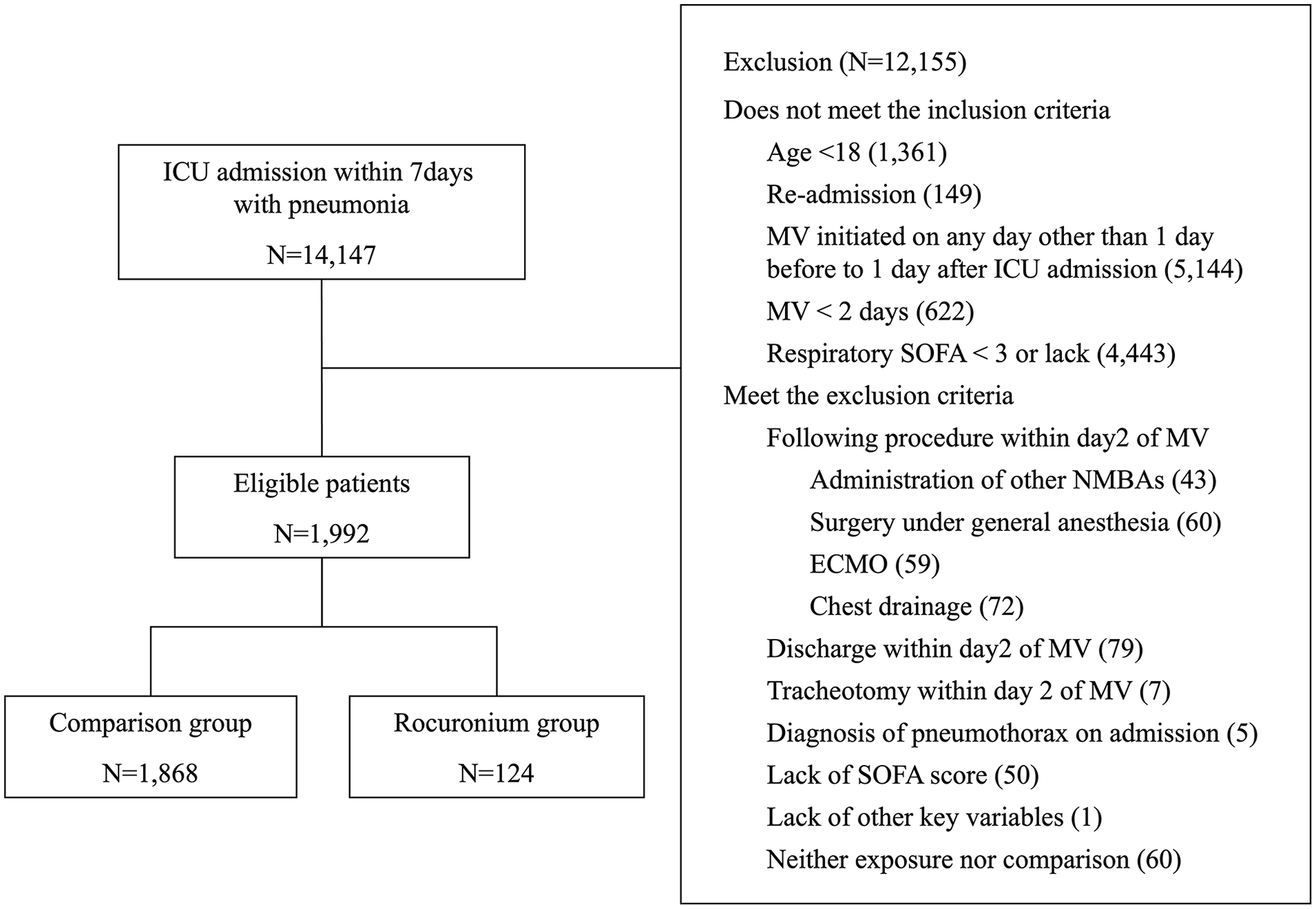
Flowchart of patients with moderate-to-severe acute respiratory distress syndrome (ARDS) from pneumonia requiring ICU admission.
Patient Characteristics.

Abbreviations: A-DROP, age-dehydration-respiratory failure-orientation disturbance-blood pressure; BMI, body mass index; COVID-19, coronavirus disease-19; IQR, interquartile range; MV, mechanical ventilation; SOFA, sequential organ failure assessment.
Rocuronium dose during the first 3 days of mechanical ventilation was measured as the mean daily dose over the 3 days.
Table 2 presents the patients’ clinical outcomes. In-hospital mortality was 25.8% and 30.8% in the rocuronium and control groups, respectively. Multivariable logistic regression analysis revealed an adjusted odds ratio (OR) of 0.70 (95% confidence interval [CI]: 0.42 to 1.19), indicating no significant association between continuous rocuronium administration and in-hospital mortality. In addition, no significant associations were observed between continuous rocuronium administration and ICU mortality (9.0% vs 8.9%, adjusted OR: 0.87; 95% CI: 0.41 to 1.87), length of hospital stay (median 26 vs 28 days, adjusted %change: 10.5, 95% CI: −8.9 to 34.1), length of ICU stay (median 8 vs 10 days, adjusted %change: 9.0, 95% CI: −4.3 to 24.2), and length of mechanical ventilation (7 vs 10 days, adjusted %change: 10.3, 95% CI: −5.3 to 28.5). Table 2 lists other clinical outcomes, including ECMO initiation, discharge destination, and incidence of pneumothorax. However, these outcomes were too few to conduct multivariable regression analyses.
Primary and Secondary Outcomes of the Study Cohort.

Abbreviations: ECMO, extracorporeal membrane oxygenation; IQR, interquartile range; LOS, length of stay; MV, mechanical ventilation.
Sensitivity analyses yielded results consistent with those of the primary analysis. Specifically, multiple sensitivity analyses were conducted by varying the cutoff for the cumulative rocuronium dose during the first 3 days of mechanical ventilation in the exposure group for continuous rocuronium administration. In Sensitivity Analysis 1, the cutoff was set at 300 mg, yielding an OR of 0.65 (95% CI: 0.38 to 1.11). In Sensitivity Analysis 2, the cutoff was set at 500 mg, with an OR of 0.71 (95% CI: 0.41 to 1.25).
Discussion
This study found no significant associations between continuous rocuronium administration and ICU mortality, in-hospital mortality, length of ICU stay, length of hospital stay, or duration of mechanical ventilation.
To the best of our knowledge, this is the first reported nationwide study to investigate the effects of rocuronium on clinical outcomes in ARDS. Previous studies investigating the effects of NMBAs have primarily focused on cisatracurium. 24 Cisatracurium has garnered research interest due to its clearance via Hofmann elimination, a mechanism independent of hepatic and renal metabolism and may be advantageous in critically ill patients with organ dysfunction. 11 However, cisatracurium cannot be used if it is unavailable or the patient is allergic. More specifically, cisatracurium is not available in Japan, and a shortage occurred during the COVID-19 pandemic.8,15,16 Rocuronium is an alternative in these situations and is expected to share several beneficial effects with cisatracurium and other NMBAs, such as reducing ventilator-patient dyssynchrony, preventing ventilator-induced lung injury and decreasing oxygen consumption.
In this study, continuous rocuronium administration was not associated with an increased or decreased risk of hospital or ICU mortality. These findings align with those of a recent RCT examining cisatracurium. 7 Despite the multiple supposed benefits of rocuronium in ARDS, there are several possible reasons why no significant association was observed. First, the potential disadvantages of the muscle relaxant effect may counterbalance the benefits. NMBAs suppress the cough reflex, which may adversely affect recovery from pneumonia, a common cause of ARDS. In addition, prolonged immobilization may have led to an increased risk of complications. Although not statistically significant, the lengths of mechanical ventilation, ICU stay, and hospital stay were longer in the rocuronium group. Furthermore, a secondary analysis of the EDEN trial, which examined early versus delayed enteral nutrition in patients with ARDS, identified the use of NMBAs as an independent risk factor for ventilator-associated pneumonia.25,26 Second, while rocuronium may have temporarily improved oxygenation, it did not significantly impact the clinical outcomes. Unlike cisatracurium, which has been shown in a small study to reduce the pro-inflammatory response in patients with ARDS, the same effect was not observed with rocuronium. 4
Several factors may explain the lack of difference in mortality observed in this study. First, the population was less severe than that in the previous RCTs. Unlike the previous RCTs, our study included patients with a SOFA score of 3 or 4, corresponding to a P/F ratio of less than 200. Therefore, patients with a P/F ratio of 150 to 200 were included. Furthermore, less than half of the total patients had a respiratory SOFA score of 4, which is indicative of severe ARDS. Consistent with these characteristics, the hospital mortality in this study was lower than those in previous studies. Considering these factors, the patients in our study may have been less likely to benefit from NMBAs. Another possible explanation is that this study was unable to adjust for certain potentially clinically significant covariates. Recent evidence suggests that light sedation during mechanical ventilation is beneficial.27,28 Moreover, the discrepancies in the results of previous RCTs have been partly attributed to variations in sedation targets. In this study, sedative use was less frequent in the control group, suggesting that these patients may have received lighter sedation, whereas those in the exposure group may have been more deeply sedated. The differences in sedation levels may have favored the control group and contributed to the lack of detected differences in outcomes.
Continuous rocuronium administration was not associated with the length of hospital stay, length of ICU stay, or length of mechanical ventilation. These results were similar to those of recent RCTs investigating the effect of cisatracurium in ARDS, which also showed no association between cisatracurium and ICU-AW.6,7 Rocuronium, an aminosteroid NMBAs, has been suggested to increase the risk of ICU-AW, especially in ICU patients receiving corticosteroids. 13 Therefore, it was expected that the duration of mechanical ventilation, hospital stay, and ICU stay would be longer in the rocuronium group than in the control group. A possible explanation for these unexpected results is that the dose and duration of rocuronium administration may not have been sufficient to cause ICU-AW in real-world practice. In addition, the impact of NMBAs on the duration of mechanical ventilation and length of stay may not be as large as that during the immobilization period due to sedation. In this study, the median duration of mechanical ventilation was approximately 10 days, longer than that of NMBA administration. To achieve the ventilator strategy goal in cases of severe respiratory failure, complete bed rest with sedation is often necessary, even without NMBAs. Therefore, interventions to prevent ICU-AW such as early rehabilitation could not be initiated in either group. Therefore, in this study, there was no significant association between rocuronium administration and length of hospital stay, length of ICU stay, or duration of mechanical ventilation, as reported in previous studies.
This present study had several limitations. First, unmeasured confounders may have affected the results. The DPC database does not contain clinical information, such as blood test results, ventilator settings, depth of sedation, fluid balance, or whether prone positioning was performed. Deep sedation reportedly worsens ARDS outcomes. As mentioned above, one of the reasons the two RCTs with cisatracurium did not show consistent results may be the differences in the depth of sedation between the control groups. 28 In addition, prone positioning and conservative fluid balance have also been shown to have a positive effect on the outcomes of ARDS. 29 Therefore, the lack of such interventions may have introduced confounding factors. Considering that NMBAs may be used during this practice and that the proportion of severe ARDS was higher in the exposure group compared with the comparison group, prone positioning was more common in the exposure group. In other words, the results may have been biased in favor of the exposure group; if this confounding had been adjusted, the OR for hospital mortality in the exposure group might have been closer to 1. However, other important clinical factors may still have influenced the results, highlighting the need for prospective studies in clinical settings. Second, although ARDS was defined using database-derived variables, a validation study of this definition has not yet been conducted. Of note, imaging findings showing the presence of bilateral infiltrates, commonly used to diagnose ARDS, could not be used due to limitations in the data. Consequently, non-ARDS patients may have been included, introducing potential selection bias. Although the exact number of non-ARDS patients remains unclear, postoperative mechanical ventilation was expected to be a common scenario in which NMBAs would be used in ICUs. Therefore, the risk of bias was likely mitigated by restricting the study population to patients with moderate to severe pneumonia, as determined by the SOFA score, and by excluding postoperative patients. Third, there may have been misclassifications of exposure and comparison. As it is common practice to use NMBAs during intubation procedures, we thought that restricting the comparison group to those not using any NMBAs would be inappropriate. Although the use of NMBAs was permitted in the comparison group, we believe that misclassification was reduced by conditioning the comparison group with the following two points: (1) no NMBAs were administered on the second day after the initiation of mechanical ventilation, and (2) the total amount of muscle relaxants administered up to the third day after the initiation of mechanical ventilation did not reach the minimum amount required for continuous administration. Fourth, the small number of patients in the exposure group may have limited the statistical power. Furthermore, due to the low incidence of outcomes, some secondary analyses and subgroup analyses were not feasible. In particular, the number of patients with pneumothorax was too small to perform multivariate regression analysis, making it unclear to what extent rocuronium may have prevented adverse events. Fifth, due to the limited number of patients, a subgroup analysis for COVID-19 could not be performed in this study. A previous propensity score-matching study in patients with COVID-19 observed no improvement in 90-day mortality with early short course of NMBAs. 30 Therefore, COVID-19 was unlikely to have influenced our results; however, further studies are required to confirm this finding. Finally, because this study was conducted using data only from Japan, the generalizability of the results to other countries remains uncertain.
Conclusion and Relevance
In this study, using a nationwide database in Japan, no significant association was observed between continuous rocuronium administration and improved or worsened clinical outcomes in patients with moderate-to-severe ARDS, focusing on pneumonia. Although the continuous administration of rocuronium did not improve clinical outcomes, the most concerning adverse effect—prolonged resource utilization, which may indicate ICU-AW—was also not observed, suggesting that its use may be acceptable as a supportive therapy for ventilator management in patients with moderate-to-severe ARDS. This study is novel in that it examined the effects of rocuronium, an NMBA other than cisatracurium, on ARDS clinical outcomes using real-world data. However, limitations such as the small number of exposed patients and the lack of comprehensive clinical data suggest the need for further research in clinical settings.
Supplemental Material
sj-docx-1-aop-10.1177_10600280251329195 – Supplemental material for Association Between Rocuronium Administration and Clinical Outcomes in Patients With Moderate-To-Severe Acute Respiratory Distress Syndrome: A Retrospective Cohort Study
Supplemental material, sj-docx-1-aop-10.1177_10600280251329195 for Association Between Rocuronium Administration and Clinical Outcomes in Patients With Moderate-To-Severe Acute Respiratory Distress Syndrome: A Retrospective Cohort Study by Mayuko Tonai, Yusuke Sasabuchi, Hideaki Watanabe, Hiroki Matsui and Hideo Yasunaga in Annals of Pharmacotherapy
Footnotes
Declaration of Conflicting Interests
The authors declared no potential conflicts of interest with respect to the research, authorship, and/or publication of this article.
Funding
The authors disclosed receipt of the following financial support for the research, authorship, and/or publication of this article: This work was supported by grants from the Ministry of Health, Labor and Welfare, Japan (23AA2003 and 24AA2006).
Ethical Approval and Informed Consent
This study was approved by the Institutional Review Board of the University of Tokyo [approval number: 3501-[5] (May 19, 2021)].

Supplemental Material
Supplemental material for this article is available online.
References
Supplementary Material
Please find the following supplemental material available below.
For Open Access articles published under a Creative Commons License, all supplemental material carries the same license as the article it is associated with.
For non-Open Access articles published, all supplemental material carries a non-exclusive license, and permission requests for re-use of supplemental material or any part of supplemental material shall be sent directly to the copyright owner as specified in the copyright notice associated with the article.
