







Abstract
Consumers precluded from obtaining semaglutide or tirzepatide by clinicians or insurers are turning to natural “GLP-1” transdermal patches. The Dietary Supplement Health and Education Act specifies dietary supplement products must be swallowed, so all these products are illegal. We identified 24 transdermal patch dietary supplement products and 1 transdermal gel product with an average of 7 ± 4 natural ingredients (berberine, glutamine/glutamate, cinnamon, and pomegranate most listed). No certificates of analysis were posted, many products lacked the Food and Drug Administration disclaimer, and many products used deceptive advertising. Several products had 1- to 2-star reviews and consumer comments suggesting lack of efficacy or adverse events.
An Unmet Consumer Desire for Weight Loss Products
Extensive weight loss from glucagon-like peptide-1 (GLP-1) and GLP-1/gastric inhibitory polypeptide (GIP) receptor agonists have driven intense consumer interest.1-3 However, the high price of innovator products, lack of prescription coverage, and desire to use the products for solely cosmetic purposes has consumers looking for alternatives. 4 We have previously reported on multiple “peptide” companies selling semaglutide and tirzepatide in lyophilized vials directly to consumers using the loophole that they are “for research purposes only.” 4
Transdermal “natural GLP-1s” are heavily advertised on TikTok raising consumer and media interest. 5 Unfortunately, according to the Dietary Supplement Health and Education Act of 1994, none of these products are legal to sell to consumers because they are not swallowed. 6 This is because nonswallowed products circumvent first-pass metabolism and enhance patient risk.5,6
How Many Products Are Out There and What Are Their Characteristics?
We searched the Google search engine between May and September 2025 combining the term “natural GLP-1s” along with the term’s “skin,” “topical,” or “transdermal.” Google has ~90% of the internet search traffic in the world. 7 Products had to explicitly specify that they were “GLP-1” products in their name, packaging, or in the description of the product on the website.
We investigated the websites for defined product characteristics and provided our raw findings in Supplemental Tables S1-S3.
We identified 24 transdermal patch products and one topical gel product that in name, packaging, or website description stated they were “GLP-1” products (Supplemental Table S1). None of the topically applied products were US Pharmacopeia (USP) or NSF International certified or provided a certificate of analysis on their website. Six of 25 topically applied products (24%) had the full Food and Drug Administration (FDA) disclaimer on their product packaging or the website description with another product (4%) specifying only that the product was not FDA approved.
None of the 25 topically applied products listed semaglutide, tirzepatide, or another FDA approved GLP-1 or GLP-1/GIP agonist as an active pharmaceutical ingredient. Four of the 25 topically applied products (16%) did not specify any active ingredient with the remaining 21 products listing an average of 7 ± 4 natural ingredients (Table 1). The most commonly listed ingredients were berberine; pomegranate extract; glutamine or glutamate; cinnamon; chromium; Garcinia cambogia; green tea extract; vitamins B1, B2, B3, and B6; and ginger.
Listed Ingredients in “Natural GLP-1” Transdermal Products.
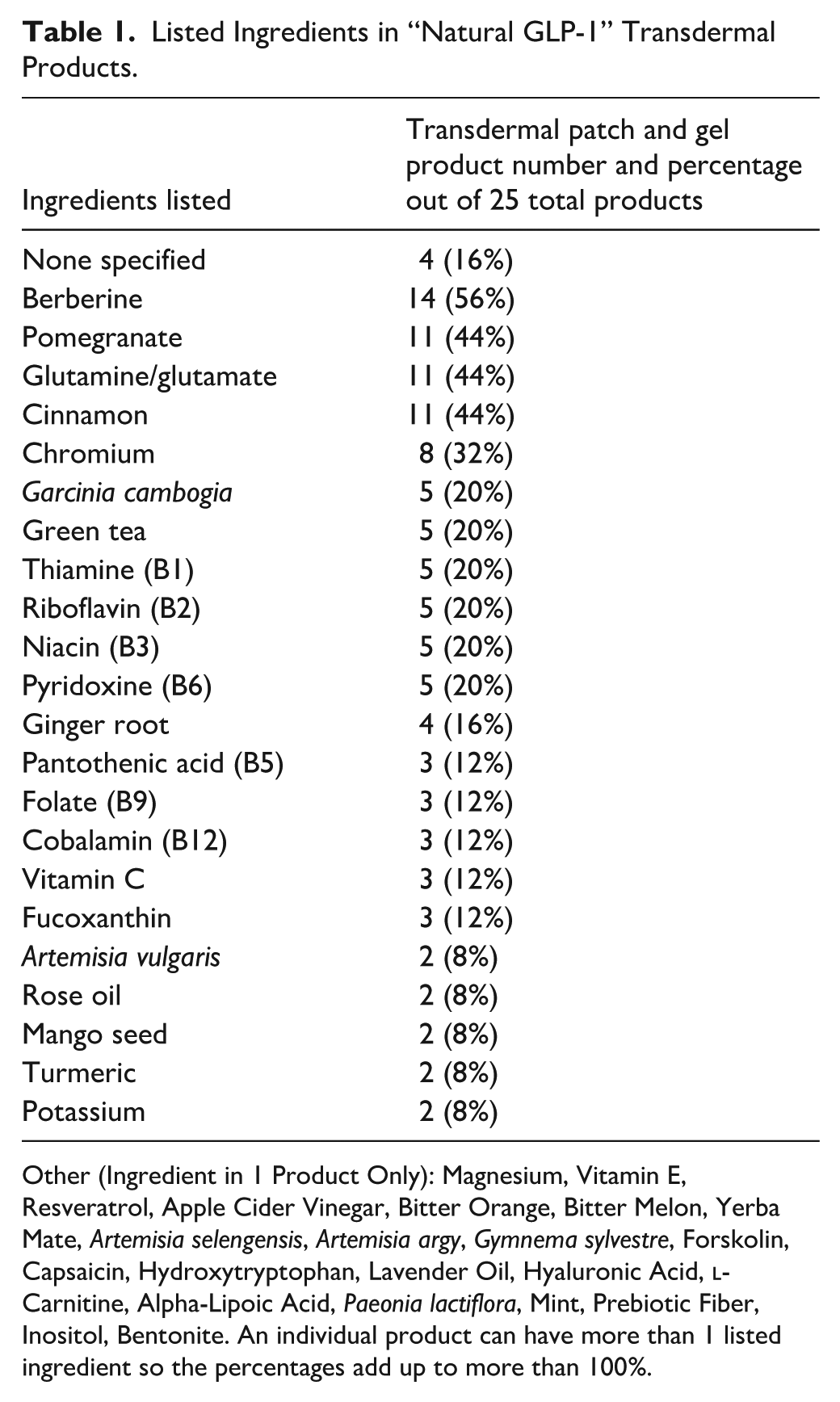
Other (Ingredient in 1 Product Only): Magnesium, Vitamin E, Resveratrol, Apple Cider Vinegar, Bitter Orange, Bitter Melon, Yerba Mate, Artemisia selengensis, Artemisia argy, Gymnema sylvestre, Forskolin, Capsaicin, Hydroxytryptophan, Lavender Oil, Hyaluronic Acid,
Eighteen of 25 topically applied products (72%) provided no health precautions to consumers. Six products (24%) warned against use in pregnancy or lactation, 4 products (16%) warned against use younger than 18 years of age, 4 products (16%) warned consumers to see a health professional if they had other medications or chronic conditions, 2 products (7.7%) specified not to use products on broken or irritated skin, 1 product (4%) specified to keep out of the reach of children, and 1 product (4%) specified not to exceed the recommended dose.
Nineteen of the 25 topically applied products (76%) had advertising practices that were concerning (Supplemental Table S2). Six of the products (24%) used models that looked like they could be teenagers, whereas 5 products (20%) used overly thin models in their advertising. Nine products (36%) used a tape measure wrapped around a thin body, 7 products (28%) used photos of overweight/ to obese models’ abdomens and/or hips for “before” product use and much thinner models’ abdomens and/or hips for “after” product use, and 4 products (16%) used women in baggy pants to suggest dramatic weight loss had occurred, which was not the case.
Nine of the 25 topically applied products (36%) had adverse events reported in the customer review section of the website (Supplemental Table S3). There were 123 reported adverse events across all 9 products with 47 customers reporting no beneficial effects, 32 reporting skin-related issues (10 rash, 8 damage, 7 irritation, 6 chemical burn, 1 blister), 17 neurological issues (8 headache, 2 tingly limbs, 2 anxious/nervous, 1 shaky, 1 weak, 1 insomnia, 1 sleepy, 1 excessive thirst), 16 patch related issues (10 won’t stick, 6 smells bad), 8 gastrointestinal issues (6 nausea, 2 diarrhea), and 3 nondescript issues (1 feeling strange, 1 feeling sick, 1 feeling weird).
Of the 25 topically applied products, 15 of them (60%) had customer star ratings. Seven of the 15 products (47%) had at least 1 customer rating of 1 or 2 stars (denoting very poor quality). Six of the 15 (40%) products had >25% of customers providing 1- or 2-star ratings and another (7%) had 10% to 25% of customers providing 1- or 2-star ratings. Only 82 of the 2639 total customer reviews were 1 or 2 stars (3%), but 1 product had 2251 of the reviews with zero one or star reviews. When that product was excluded in sensitivity analysis, there were 82 of 388 1- or 2-star reviews (21%).
Can These Patches Produce Weight Loss and Are They Safe?
Many of the ingredients in the products have been used in oral dietary supplements touted to provide weight loss in the past, but weight loss with 1 or 2 dietary supplement ingredients such as berberine, cinnamon, or pomegranate extract is ≤2 kg.8-10 Berberine, glutamine, and hydroxyurea delivery into the skin via microneedle transdermal delivery has been investigated but the human drug concentrations in the plasma that could be achieved is not known and only one product identified in our assessment stated they were using “microneedle” technology.11,12 Cinnamon-induced hydrogels have been explored to enhance topical administration of drugs but the delivery of cinnamon constituents itself into the body has not been explored. 13 Pomegranate has been assessed for topical administration but only for cosmetic benefits to the local skin where it is administered. 14 There are no studies evaluating the physical compatibility of the myriad ingredients being placed together in the same patch or gel for long periods of time. We identified several skin reactions from the transdermal products, from rashes to blisters to skin damage when trying to remove the patches from the skin. It is unclear whether there is latex or an adhesive, dietary ingredient, or adulterant that is inducing skin reactions is not known.
Many products contained berberine, prebiotics/fiber, or protein/amino acids which have been shown to slightly elevate GLP-1 secretion in animal studies.15,16 However, it is unclear how placing nutrients into the bloodstream through the skin and not having it track through the gastrointestinal tract would cause GLP-1 secretion.15,16 Putting “GLP-1” in the names and descriptions of these products is misleading because it denotes to consumers robust weight loss and strong tolerability and safety profile which these products do not have data to support. Consumer feedback identified lack of weight loss as a common complaint along with several identified adverse events.
The lack of USP or NSF certification and no certificates of analysis is concerning since prior assessments of dietary supplements found that weight loss products were a key market segment prone to elemental impurity (heavy metal) contamination and adulteration with synthetic chemicals such as sibutramine (removed from the US market for causing cardiovascular events) and phenolphthalein (which could cause cancer).17,18 In addition, there is no way to know if the listed ingredients are actually in the products in the dosages specified and many dietary supplements, when independently tested, are prone to lacking or underdosing listed ingredients. 17
Why Is Not the FDA Stopping These Illegal Products?
The FDA faces many issues in trying to protect consumers from dietary supplements.17,19 First, they are not informed before a dietary supplement is sold in the country. 19 The FDA must independently identify potentially concerning products and then prove the products are unsafe before acting, a time-consuming and resource-consuming process. If manufacturers are outside the United States, it is difficult to take enforcement actions against them, especially if they can just close and reopen under a different name. Finally, the FDA has limited enforcement bandwidth, so even when problems are identified, they have a hard time ensuring that products are removed or that issues are resolved. 19
Even with all these impediments for the FDA, as all these products are being sold using transdermal delivery systems, every manufacturer, distributor, and retailer (predominantly Amazon and eBay) we identified can be warned by the FDA. 6
What Does This Mean for Pharmacists?
Pharmacists are accessible healthcare providers and patients trust their guidance. If patients are interested or are already using these products, identifying the potential risks can support educated consumer choices. Alerting patients that there is no clinical evidence that these products can promote weight loss or are safe, can go a long way to reducing their utilization. Furthermore, if patients have experienced adverse effects, reporting them to the FDA MedWatch program is much better than having the consumers leave a comment on a seller’s website. If the FDA does not get an indication that these products are causing health issues, they are less likely to act.
Supplemental Material
sj-docx-1-aop-10.1177_10600280251407145 – Supplemental material for Transdermal “Natural GLP-1” Dietary Supplements Violate Law and Place Patients at Risk
Supplemental material, sj-docx-1-aop-10.1177_10600280251407145 for Transdermal “Natural GLP-1” Dietary Supplements Violate Law and Place Patients at Risk by C. Michael White, Zeeya Tai and Klaus Nuzi in Annals of Pharmacotherapy
Footnotes

Funding
The authors received no financial support for the research, authorship, and/or publication of this article.
Declaration of Conflicting Interests
The authors declared no potential conflicts of interest with respect to the research, authorship, and/or publication of this article.
Data Availability Statement
Supplemental Tables S1-S3 contain all of the data that was extracted for this project, and it is freely available to clinicians and regulators interested in these products.
Supplemental Material
Supplemental material for this article is available online.
References
Supplementary Material
Please find the following supplemental material available below.
For Open Access articles published under a Creative Commons License, all supplemental material carries the same license as the article it is associated with.
For non-Open Access articles published, all supplemental material carries a non-exclusive license, and permission requests for re-use of supplemental material or any part of supplemental material shall be sent directly to the copyright owner as specified in the copyright notice associated with the article.
