







Abstract
Utilizing a Hong Kong Chinese sample, this study examined how fathers’ negative work-to-family spillover was associated with their behaviors in monitoring their children’s daily doings. In total, 125 fathers with a focal child at fifth or sixth grade were invited to complete a survey. Results revealed that work spillover was negatively associated with child self-disclosure, father solicitation, and father listening and observing children, and the associations for child self-disclosure and father solicitation were mediated by father–child relations. A marginally significant positive association between work spillover and getting information from spouse was also found. The results suggest that work stress poses difficulty to fathers in directly monitoring their children and pushes them to rely on mothers as the source of knowledge.
Traditionally, the focus of parenting research has been on mothers. This is particularly so in the Chinese context (Shwalb, Nakazawa, Yamamoto, & Hyun, 2004) due to the cultural conception that fathers are the primary breadwinner of the family and mothers are the primary caretaker of children (Yang & Yeh, 1997). However, in recent decades, there has been a change in father’s role among the younger generation in China and Hong Kong (Abbott, Zheng, & Meredith, 1992; Ho & Kang, 1984; Li & Jankowiak, 2016). Instead of being solely the breadwinner, fathers now take up more responsibility in childcare and are more involved in nurturing their children. This is likely due to an increasing realization that fathering has an important and independent effect on child development and family functioning (E. Y. H. Lau, 2016; Quach, Epstein, Riley, Falconier, & Fang, 2015; Ren & Zhang, 2018; Wang, Liang, Zhou, & Zou, 2019). Given the changing role of fathers and the positive effect fathering brings, it is necessary to study factors that influence paternal involvement and behaviors in the Chinese context.
Predictors of paternal behaviors have been extensively studied in the West, but relatively less explored in China and Hong Kong. The available literature has examined factors such as fathers’ work-and-family conflict (Y. K. Lau, 2010), their fathering self-efficacy and marital satisfaction (Kwok, Ling, Leung, & Li, 2013), fathering stress (Kwok & Li, 2015), parental beliefs (Leung & Shek, 2013), and perceptions on their children (E. Y. H. Lau, 2016). In this study, we focused on the impact of work spillover on paternal behaviors. Work and family represent two important spheres of fathers’ life. In China and Hong Kong, while fathers have increased their involvement in childcare, most of them are still the primary breadwinner of the family. Many of them have to work for long hours and so experience a substantial amount of work stress (The Hong Kong Federation of Trade Unions, 2014). Investigating how stress in the work sphere may spill over into fathering at home is thus crucial. In fact, literature in the West has consistently shown that the amount of work stress fathers experience can have a negative impact on their parenting (Goodman et al., 2011; Repetti, 1994; Shreffler, Meadows, & Davis, 2011). Although we expected that work stress would pose similar negative effects on Chinese fathers as work stress is a common experience for fathers worldwide, it is also possible that the effect may somehow be different in Chinese society given that approaches to fathering vary greatly across cultures (Seward & Rush, 2015). Given these, we further studied how work stress and spillover might affect paternal behaviors of Chinese fathers. This serves to see whether fathering experiences are comparable between the East and the West, and what differences, if any, may exist.
In particular, we were interested in how work stress shaped fathers’ behaviors to track their children’s whereabouts and doings, a parental activity called parental monitoring. Parental monitoring is an important parenting behavior and has been shown to predict an array of child outcomes and deter problematic behaviors (Amato & Fowler, 2002; Deng, Fang, Li, & Wan, 2006). When children reach teenage and start to spend more time outside home, the task to track what they do becomes especially crucial for parents. Successful monitoring requires team effort between fathers and mothers, and monitoring by fathers has been shown to reduce children’s problematic behavior longitudinally (Crouter, Bumpus, Davis, & McHale, 2005). Work stress may reduce fathers’ capability to monitor their children, thereby affecting child development negatively. In this study, we set out to investigate how work spillover was associated with paternal monitoring behaviors in a sample of Hong Kong Chinese fathers.
Work Spillover and Paternal Monitoring Behaviors
Parental monitoring has been conceptualized as ways for parents to attend to and track children’s whereabouts and doings (Dishion & McMahon, 1998). These activities underlie parents’ knowledge about their children’s daily lives so that they can intervene when things go wrong. Numerous studies, both in the West and in China, have consistently demonstrated that a low level of parental knowledge, including that of fathers, was associated with negative child outcomes (e.g., Amato & Fowler, 2002; Crouter et al., 2005; Deng et al., 2006; Li, Fang, Stanton, Su, & Wu, 2003). Paternal knowledge has been shown to be more affected by work stress than maternal knowledge (Bumpus, Crouter, & McHale, 2006; Crouter, Helms-Erikson, Updegraff, & McHale, 1999; Crouter & Manke, 1997). Fathers who experience heavy work demand and spillover from work would subsequently know less about their children’s doings. As a result, they would be less able to intervene promptly and suitably when things go wrong with their children.
However, most of the available research on parental monitoring has focused on “parental knowledge” instead of “parental monitoring behaviors”—the ways parents attend to and become knowledgeable about their children’s doings. On top of this, there has not been any study explicitly linking work spillover to how parents become knowledgeable about children’s doings. Therefore, we are still not sure about the specific changes in fathers’ monitoring behaviors as a result of work stress that ultimately make them less knowledgeable. Do children disclose less when fathers are stressed out by work? Or do fathers solicit their children less after heavy work? Or do fathers get information from mothers less? Echoing the suggestion by Stattin and Kerr (2000) and Racz and McMahon (2011), there is a need to examine parental monitoring behaviors more specifically to elucidate the processes through which parents acquire knowledge. Examining how work spillover is related to fathers’ monitoring behaviors would also allow us to understand the specific difficulty work poses to fathers in monitoring children. Thus, in this study, we were interested in the linkages between fathers’ work spillover and their behaviors to track their children’s doings.
To decide which specific monitoring behaviors to include, we reviewed literature in the West and came up with several ways fathers commonly rely on to gain knowledge about their children. These include “child self-disclose”—children spontaneously disclosing to fathers; “father solicitation”—fathers asking children; “father listening and observing”—a subtle form of surveillance in which fathers observe children without explicit interaction; “from spouse”—fathers getting information from mothers; “from siblings”—fathers getting information from children’s siblings; and “from others outside family”—fathers getting information from teachers, neighbors, and so on (Crouter et al., 2005; Stattin & Kerr, 2000; Waizenhofer, Buchanan, & Jackson-Newsom, 2004). These various behaviors recognize the diverse sources and activities through which fathers can acquire knowledge—from children themselves, from spouse, and from knowledgeable others. These behaviors can also be passive (e.g., disclosed by children) or active (e.g., directly asking children) (Eaton, Krueger, Johnson, McGue, & Iacono, 2009).
In this study, we chose to focus on the first four monitoring behaviors and dropped the last two which may be less common among Hong Kong Chinese fathers. For “from others outside family,” it is quite unusual for fathers in Hong Kong to have regular exchanges about children’s doings with teachers, neighbors, or others outside family. Teachers only communicate with parents on special occasions (such as parents’ day), and the relationship among neighbors is rather distant in Hong Kong (S. K. Lau & Liu, 1993). In fact, childrearing is considered an “internal affair” and parents seldom discuss that with others outside family. For “from siblings,” this may not be applicable to a substantial number of fathers in Hong Kong due to the growing number of single-child families. Recent statistics in Hong Kong have shown that the average number of children per family is around one (single-child), and families are predominantly single-child (Nip, 2013). Crouter et al. (2005) included “from siblings” in their study and sampled only families with at least two children. In this study, we sought to study typical two-parent Hong Kong families, so it might not be feasible to limit our sample to families with at least two children. As such, we decided to include only the first four monitoring behaviors which are applicable to most Hong Kong fathers in general.
The four monitoring behaviors chosen have been linked to the level of knowledge fathers acquire. In general, literature in the West indicates that all four behaviors positively predicted the subsequent level of paternal knowledge (Crouter et al., 2005; Waizenhofer et al., 2004). A local study also demonstrated that fathers’ active behavioral control and child willingness to communicate with fathers, which are conceptually similar to “solicitation,” “listening and observing,” and “child self-disclosure,” were predictive of higher level of paternal knowledge (Shek, 2008). As such, these monitoring activities can be considered as the sources of paternal knowledge. The more effort fathers put in these monitoring behaviors, the more they would know about their children’s doing, thereby enabling them to act accordingly when things go wrong.
Next, we make specific hypotheses on the associations between fathers’ work spillover and the four monitoring behaviors above. For “child self-disclosure,” “father solicitation,” and “father listening and observing,” they have been shown to predict higher levels of paternal knowledge. Together with the findings that work spillover is linked to lower levels of paternal knowledge, it makes sense to speculate that fathers know less about their children’s doings because children disclose less to them, and they solicit and observe children less when they experience heavy work spillover. This speculation is also in line with the literature on fathers’ withdrawal from children on days with heavy work (Repetti, 1994). Thus, we expected work spillover to be negatively associated with fathers’ engagement in these three monitoring behaviors. Similarly, we also expected the same negative association between fathers’ work spillover and the tendency for fathers to get information from mothers. This is based on the previous findings that work stress and spillover could interfere with marital relationship, thereby reducing communications between parents (Schulz, Cowan, Cowan, & Brennan, 2004; Story & Repetti, 2006). In sum, we expected a general pattern of reduced engagement in monitoring by fathers with a high level of work spillover.
Mediation Effects by Family Relations
In addition to the hypotheses above, we also expected that work spillover would affect paternal monitoring through affecting broader family functioning. Thus, we hypothesized that some of the aforementioned associations would be mediated by family relation variables, namely, father–child and marital relations. Among the four monitoring behaviors, “child self-disclosure” and “father solicitation” require explicit interactions between fathers and children, and “from spouse” requires that between fathers and mothers. These interactions logically depend on the quality of father–child and marital relations, that a warmer family environment should promote these interactions. In fact, father–child relations have been shown to be positively related to child self-disclosure (Kerr, Stattin, & Trost, 1999; Smetana, Metzger, Gettman, & Campione-Barr, 2006). As such, it makes sense to speculate that when fathers’ work stress spills over into family, the quality of family relations is likely to drop, thereby making it more difficult for fathers to engage in these interactions and the relevant monitoring behaviors.
Literature suggests that father–child relations could be negatively affected by paternal work stress and spillover. Fathers are likely to become withdrawn, angrier, more rejecting, and punishing to their kids after heavy work (Repetti, 1994; Stewart & Barling, 1996), which ultimately reduces the quality of father–child relations. Similarly, Crouter, Bumpus, Head and McHale (2001) found that father–child relations would be hampered by long working hours. Therefore, work spillover is likely to result in less positive father–child relations, and in turn discourages father–child interactions and thus child self-disclosure and father solicitation. In addition, we expected that less positive father–child relations would also mediate the link between work spillover and “from spouse.” This is in line with the idea that family relations are interrelated, and that parent–child tension, especially between fathers and children, can cause subsequent marital tension (Almeida, Wethington, & Chandler, 1999). As such, when father–child relations are compromised by fathers’ work spillover, the effect could spill over into the marital dyads, making interspousal communications about children more difficult.
Similar mediation mechanisms should also hold for marital relations. Work stress and spillover have long been documented to create marital tension and difficulties (Barling & Macewen, 1992; Story & Repetti, 2006), and this poorer quality of marital relations could in term lead to suboptimal parenting, possibly including less information exchange about children’s doings. Bumpus, Crouter, and McHale (1999) found that work stress, coupled with poor marital relations, was related to reduced paternal knowledge, and this could be due to less interaction and information exchange with mothers. Thus, marital relations could be another mediator between fathers’ work spillover and “from spouse.” Apart from this, we believe that marital relations would also mediate the associations between fathers’ work spillover and “child self-disclosure” and those between work spillover and “father solicitation.” This is based on the same idea on the interrelatedness among family relations (Almeida et al., 1999). We discussed that father–child relations could spill over into marital dyads, and it is also possible that marital difficulties caused by fathers’ work stress could spill over into father–child dyads (Gerard, Krishnakumar, & Buehler, 2006), thereby reducing positive father–child interactions which “child self-disclosure” and “father solicitation” depend on.
We did not hypothesize any mediation effect for “father listening and observing.” This monitoring activity does not involve any direct interaction between fathers and children or the parents, so it may not be dependent on family relations. Although we expected fathers would listen and observe less when they experienced heavy work spillover, this should be a direct effect of reduced time and energy caused by work, instead of being mediated by poorer family relations.
The Present Study
In sum, we aimed at elucidating the linkages between Chinese fathers’ work spillover and their behaviors to become knowledgeable about children’s whereabouts and doings. First, we hypothesized negative associations between fathers’ work spillover and their engagement in “child self-disclosure,” “father solicitation,” “father listening and observing,” and “from spouse.” Second, we further hypothesized that the associations for “child self-disclosure,” “father solicitation,” and “from spouse” would be mediated by father–child and marital relations.
Method
Participants
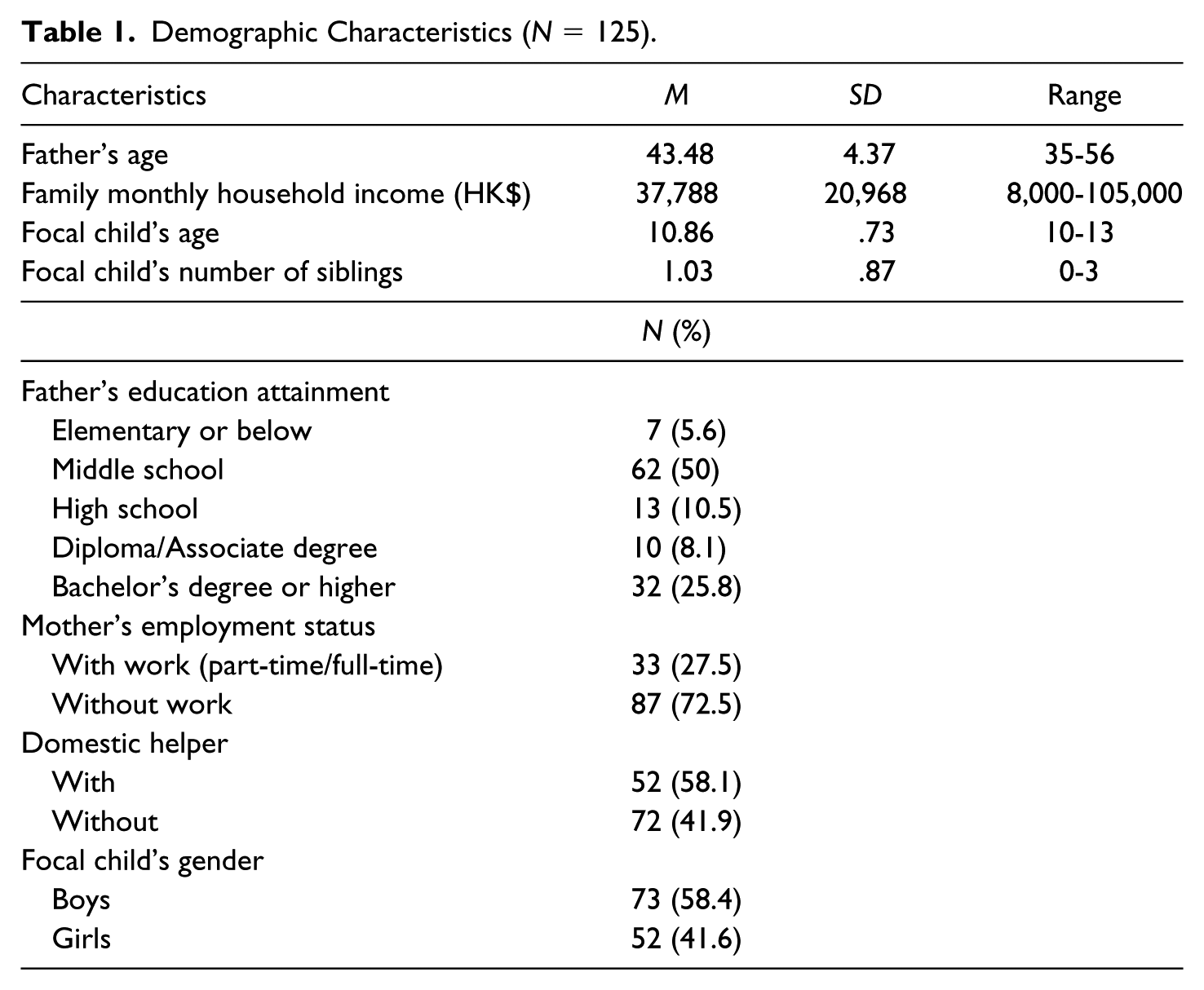
Participants were 125 fathers recruited from a local elementary school in Hong Kong. The study was approved by an institutional review board, and all participants had given their consent to participate. In this study, we sought to recruit “typical” families in Hong Kong, so all participating fathers were from intact families and had a full-time job at the time of data collection. Their fifth and sixth grade children at this elementary school were the focal children in this study (58.4% boys). All families were of local Hong Kong Chinese origin. The mean age of the fathers was 43.48 (SD = 4.37). Half of the fathers had received up to middle school education, and another substantial proportion (25.8%) of fathers had university education. The mean family monthly household income was HK$37,788 (US$4,873). All demographic characteristics of these families are summarized in Table 1. Considering that the sample’s mean family income was above the city’s average, fathers in this study might represent those from mainly middle-class families.
Demographic Characteristics (N = 125).
Procedure
Recruitment of participants was done through a local elementary school in Hong Kong. Due to resource and network constrains, we were only able to connect to one elementary school for participant recruitment. The school is situated in the eastern district in Hong Kong, but students attending this school can be from other districts. We first obtained the consent from the school to recruit participants. Consent forms and questionnaires were then distributed to all students at fifth and sixth grades. They took the consent form and questionnaires home, and fathers from eligible families who agreed to participate completed the consent form and questionnaires. In total, 360 questionnaires were distributed, and 125 completed questionnaires were returned (return rate was 34.7%). Fathers completed the questionnaires with a focal child at fifth or sixth grade (their children in this elementary school) in mind. Upon completion, fathers put the consent form and questionnaires in the envelope provided and sealed it. The students then returned the sealed envelopes to their class teachers, which would subsequently be collected by our research staff.
Measures
All measures were translated into Chinese (Cantonese) using the back translation procedure. Only the Chinese version was used in the study.
Demographics
Fathers provided demographic information, including their age; highest education attainment; occupation and family monthly household income; the focal child’s age, gender, and number of siblings; and the employment status of their spouse.
Fathers’ negative work-to-family spillover
Fathers completed the Work Spillover Scale (Small & Riley, 1990), which measured how much fathers felt their work interfered with their family lives. Three subscales, each consisting of five items, were adopted: marital relationship (e.g., “My job keeps me from spending time with my spouse”), parent–child relationship (e.g., “My job makes it hard for me to have a good relationship with my child(ren)”), and home management (e.g., “ My job makes it difficult for me to get household chores done”). Fathers rated the extent to which they agreed with each statement on a 5-point scale, from “strongly disagree” (1) to “strongly agree” (5). Items which were positively worded were reverse-scored. All item scores were summed and then averaged, and a higher average indicates a higher level of work-to-family spillover. The internal reliability (α) is .90.
Father–child relations
Fathers also completed an eight-item scale adopted from Stattin and Kerr (2000), which measured how positive fathers felt toward their relations with the focal children. Each item (e.g., “Do you usually support and encourage him or her?”) was rated on a 5-point scale, from “almost never” (1) to “very often” (5). Items which were negatively worded were reverse-scored. All item scores were summed and then averaged, and a higher average indicates a more positive father–child relation. The internal reliability (α) is .72.
Marital relations
The three-item Kansas Marital Satisfaction Scale (Schumm et al., 1986) was used to measure how satisfied the fathers were with their marriage. Each item (e.g., “How satisfied are you with your marriage?”) was rated on a 7-point scale, from “extremely dissatisfied” (1) to “extremely satisfied” (7). All item scores were summed and then averaged, and a higher average indicates a more satisfying marriage. The internal reliability (α) is .95.
Fathers’ monitoring behaviors
To gage the different ways fathers used to monitor their children, we adopted the scales by Stattin and Kerr (2000) and Crouter et al. (2005) to measure the four monitoring behaviors. With the focal child in mind, fathers completed four scales measuring their engagement in the four monitoring behaviors. All items were rated on a 5-point scale, from “almost never” (1) to “very often” (5). The first two scales were adopted from Stattin and Kerr: a five-item scale measuring “child self-disclosure” (e.g., “Does he or she spontaneously tell you about his or her friends?”) and a five-item scale measuring “father solicitation” (e.g., “How often do you ask him or her about what happened during his or her free time?”). The other two were adopted from Crouter et al. Fathers were asked three questions about their children’s general daily doings (e.g., “How do you usually learn about how he or she has been spending his or her free time?”). For each question, fathers indicated how often they used the two approaches: listening and observing (i.e., “I can usually tell by observing him or her”) and from spouse (i.e., “My spouse usually keeps me informed about this”).
The reliabilities (α) of the four monitoring behavior measures are .58 (child self-disclosure), .82 (father solicitation), .74 (father listening and observing), and .86 (from spouse). We noted the low reliability of the child self-disclosure scale, which was caused partly by one item (“Does he or she like to tell you about what he or she did and where he or she went during the evening?”). This item had low correlations with the other four items (ranged from .028 to .282). In addition, we think this item might not be applicable to measure self-disclosure by fifth and sixth grade children in Hong Kong (the scale was originally used with older children at eighth grade). In Hong Kong, for children at this age, their free time is usually in the morning and afternoon. In the evening, they are usually at home instead of hanging out. There might not be a need for children to disclose where they were in the evening, and so fathers might have difficulty in answering this item. Therefore, we removed this item from the child self-disclosure scale, and the reliability increased to .61, which is within the range of acceptable reliability (Hair, Anderson, Tatham, & Black, 1998).
The item scores for the respective monitoring behavior measure were summed and then averaged, and a higher average indicates a greater tendency for father to engage in a particular monitoring behavior.
Results
Preliminary Analyses
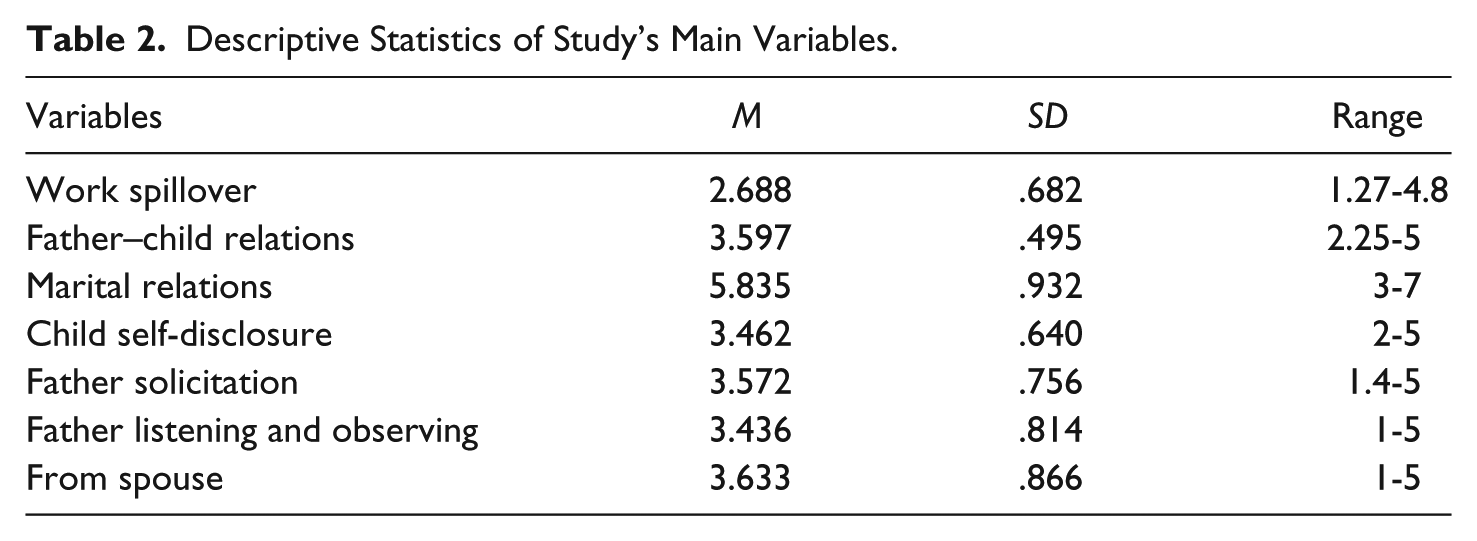
Descriptive statistics of the main variables (spillover, father–child relations, marital relations, and the four monitoring behaviors) can be found in Table 2. Correlational analyses were conducted to examine the relationships between demographic variables and the main variables, to identify possible covariates that had to be controlled in subsequent analyses. The results are presented in Table 3. Fathers’ age and education level, mothers’ employment status, presence of domestic helper, and number of siblings were significantly related to at least one of the main variables. As such, these demographics variables were entered as covariates in all subsequent mediation analyses.
Descriptive Statistics of Study’s Main Variables.
Correlations Between Demographics and Study’s Main Variables.
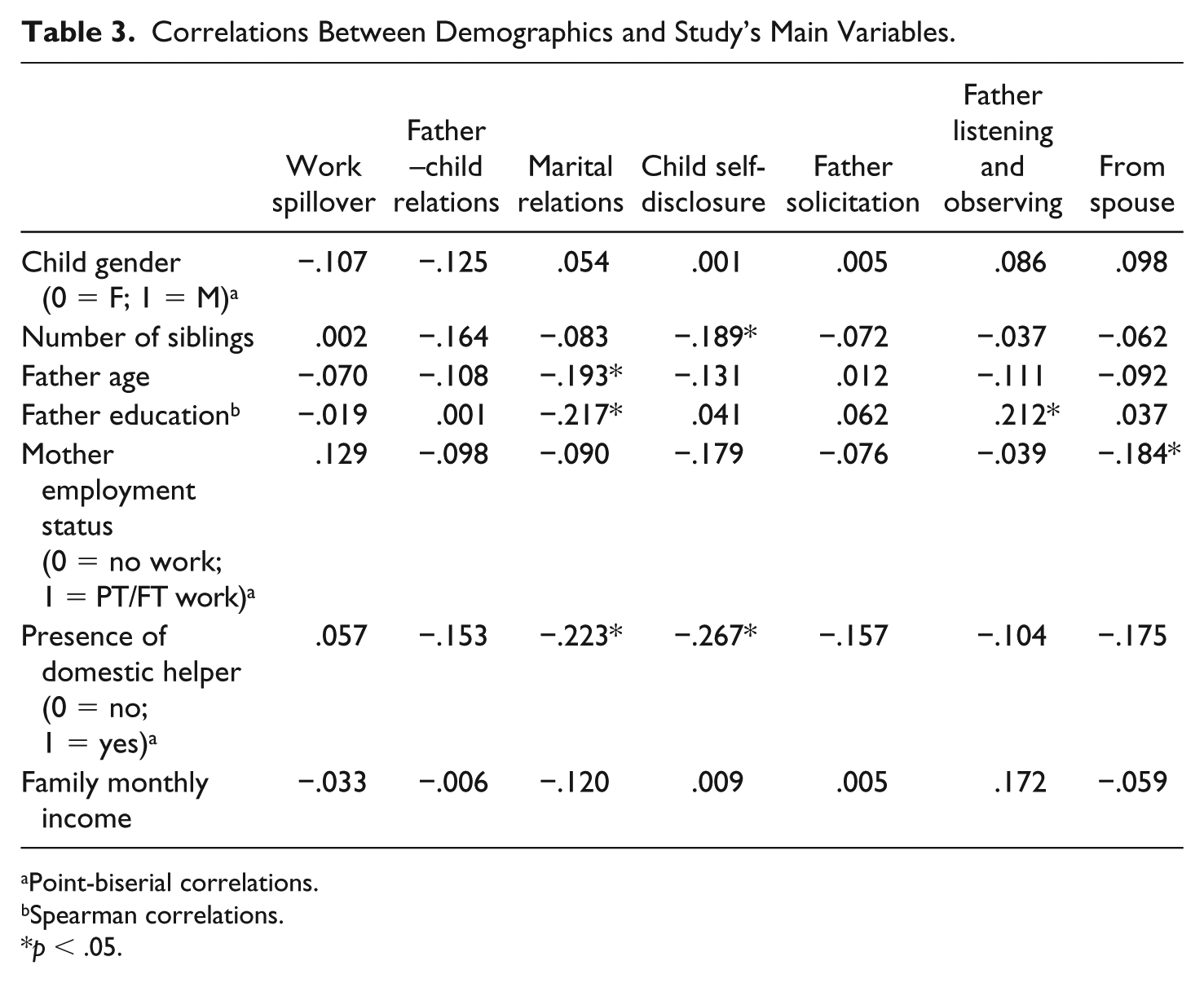
Point-biserial correlations.
Spearman correlations.
p < .05.
Mediation Analyses
Intercorrelations among the main variables are presented in Table 4. Then, to examine the mediation effect of father–child and marital relations on the associations between fathers’ work spillover and their monitoring behaviors, mediation analyses with bootstrapped confidence interval (CI; 5,000 bootstraps) of the mediation effect were conducted (Preacher & Hayes, 2008). Bootstrapping is suggested to be better than the traditional Sobel test. It is a nonparametric method which generates a CI of the estimated mediation effect. When zero is not included in the 95% CI, the mediation effect would be significant at p < .05 (two-tailed) level. In all analyses, the bias-corrected and accelerated (BCa) CI was used to test the significance of the mediation effects. In addition, father–child relations and martial relations were examined simultaneously as mediators in the same mediation model such that their unique mediation effects could be accounted for.
Bivariate Correlations Among Study’s Main Variables.
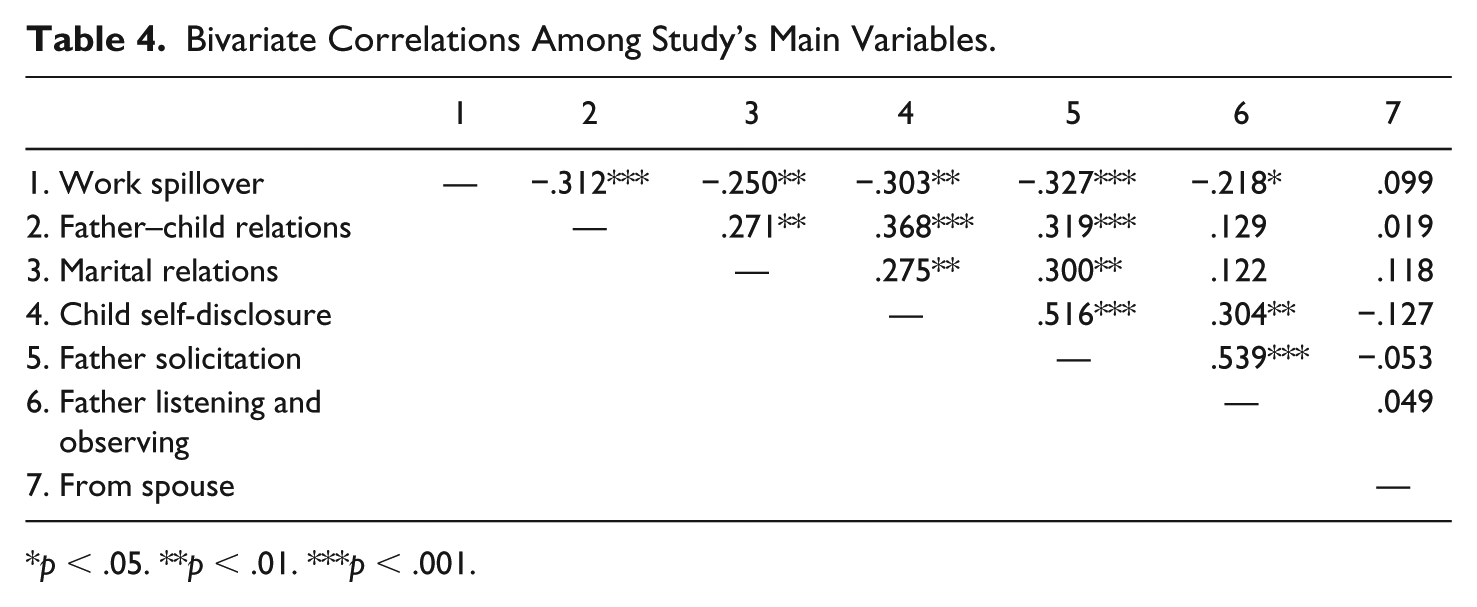
p < .05. **p < .01. ***p < .001.
We first conducted the analysis on child self-disclosure. The total effect from work spillover to child self-disclosure was significant, B=−.228, t(104)=−2.687, p=.008. The effect of work spillover on the mediators, father–child relations, B=−.219, t(104)=−3.449, p<.001, and marital relations, B=−.262, t(104)=−2.039, p=.044, was also significant. However, the unique effect from the mediators to child self-disclosure was significant only for father–child relations, B=.268, t(102)=2.067, p=.041, but not marital relations, B=.107, t(102)=1.663, p=.100. The bootstrapping analysis confirmed that the unique mediation effect was significant only for father–child relations (95% BCa CI=[−.135, −.005]), but not marital relations (95% BCa CI=[−.110, .004]). As such, only father–child relations was a significant mediator.
The same analysis was done on father solicitation. The total effect from work spillover to solicitation was significant, B=−.328, t(104)=−3.209, p=.002, as well as from work spillover to the two mediators (same results as above). Similar to child self-disclosure, out of the two mediators, only father–child relations showed significant unique effect on father solicitation, B=.401, t(102)=2.608, p=.011, and that of marital relations was not significant, B=.128, t(102)=1.685, p=.095. The bootstrapping analysis showed that father–child relations had a significant unique mediation effect (95% BCa CI=[−.210, −.020]), but that of martial relations was not significant (95% BCa CI=[−.121, .006]). Same as child self-disclosure, only father–child relations was a significant mediator.
For father listening and observing, we found a significant total effect of work spillover, B=−.251, t(104)=−2.330, p=.022. However, no significant unique effect of the mediators was observed on father listening and observing (all ps < .25). The bootstrapping analyses also indicated that none of the mediation effects by father–child relations (95% BCa CI=[−.081, .084]) and marital relations (95% BCa CI=[−.121,.007]) was significant. As such, neither father–child relations nor marital relations was a significant mediator.
Finally, for “from spouse,” contrary to our hypothesis, we found a marginally significant total effect of work spillover which is positive, B=.207, t(104)=1.868, p=.065, meaning that with increased work stress fathers might get information from mothers more. However, we again found no significant unique effect of the mediators on “from spouse” (all ps < .25), and the bootstrapping analyses also indicated that the mediation effects of father–child relations (95% BCa CI=[−.045, .134]) and marital relations (95% BCa CI=[−.130, .011]) were not significant.
Discussion
The present study investigated the associations between Chinese fathers’ work spillover and their behaviors to become knowledgeable about children’s whereabouts and doings and whether family relations would mediate these associations. The results partly supported our hypotheses. We found that fathers’ work spillover was negatively associated with “child self-disclosure” and “father solicitation,” and these were mediated by father–child relations. We also found that fathers’ work spillover was negatively related to “father listening and observing.” Contrary to our hypotheses, we found a marginally significant positive association between fathers’ work spillover and “from spouse,” suggesting that fathers actually got information from mothers more often when they experienced heavy work spillover. We also found no significant mediation effect by marital relations.
Negative Associations Between Fathers’ Work Spillover and Their Monitoring Behaviors
We first discuss the mediation effect of father–child relations on the link between fathers’ work spillover and “child self-disclosure” and that between work spillover and “father solicitation.” On one hand, fathers’ work spillover, probably in the form of mood spillover, may result in more conflicts with children (Repetti, 1994). On the other hand, fathers usually have limited time to spend with their children after a long day of work (Yeung, Sandberg, Davis-Kean, & Hofferth, 2001) and have a tendency to withdraw from children and be alone at home after heavy work (Campos, Graesch, Repetti, Bradbury, & Ochs, 2009). All these could result in less paternal warmth and poorer relations with children and subsequently reduce the willingness of children to spontaneously disclose about what they have done and discourage fathers to ask children directly. This may be embedded in a general tendency of reduced interactions between fathers and children as a result of poor father–child relations. Previous literature suggests that parental monitoring depends on children’s openness to be “monitored” (Kerns, 2001). It is possible that poor father–child relations caused by fathers’ work spillover would make children less open to monitoring, and they would be reluctant to self-disclose to fathers or respond to fathers’ solicitation.
We also found that marital relations was not a significant mediator in these associations. We reason that as child self-disclosure and father solicitation are related to father–child interactions, father–child relations may be a more important mediator than marital relations. Therefore, marital relations showed no significant unique mediation effect when father–child relations had already been considered. Another plausible explanation is that, contrary to what we expected, parent–child and marital relations may actually be viewed as two separate spheres within a family. That is, parents can differentiate (possibly deliberately) the two such that the effect of one sphere (e.g., marital conflicts) on another (parenting) can be minimized. This is in line with an increasingly popular view on the differentiation between marital discord and quality of parent–child relations, especially in the case of joint parental custody/responsibility after divorce (Braver & Lamb, 2018; Steinbach, 2018). In this situation, children actually benefit from spending time with each of their parents who nonetheless have/had serious marital conflicts, showing that poor marital relations may not necessarily be carried over and detrimental to parent–child interactions. Note that we do recognize the crucial differences between the situation in divorce and those in an intact family. For example, in divorced families, the biological father and mother of a child do not live together anymore, while in intact families they are still living together, making the impact of marital discords on parent–child relations perhaps more salient. However, the available research does suggest another possibility when looking at the interconnectedness between marital and parent–child relations, that they could somehow be independent. Due to this differentiation, therefore, marital relations (marital sphere) did not significantly mediate the impact of work spillover on fathers’ monitoring (parenting sphere).
For “father listening and observing,” as expected, it was negatively related to fathers’ work spillover, and this was not significantly mediated by any family relation variables. The effect of work spillover on this monitoring behavior is likely to be a direct result of reduced time and energy at home after work. With heavy work, fathers tend to withdraw from childcare at home and so they have less opportunity to sit there and subtly observe and listen to what children do or say (Campos et al., 2009). This does not go through any hampered family relations, possibly because subtly listening and observing does not involve any explicit interaction with other family members. Therefore, the less engagement in this monitoring activity may have to do more with the fact that fathers do not have the time and energy needed to observe children after heavy work. Overall, these results suggest that work stress poses difficulty to fathers in directly gaining information from children through interacting with and observing them.
Positive Association Between Fathers’ Work Spillover and “From Spouse”
Interestingly, we found a marginally significant positive association between fathers’ work spillover and “from spouse.” This indicates that fathers may rely more on mothers to monitor children or as the source of knowledge when they experience heavy work stress. Although this finding runs contrary to our hypothesis, it is in line with other studies showing that fathers who work for long hours would obtain knowledge from mothers more (e.g., Crouter et al., 2005). Incorporating this with the aforementioned findings, we reason that this may grow out of the difficulty for fathers to obtain information directly from children as a result of work stress. As such, they resort to an indirect way and get information from mothers, who are supposed to take care of children and thus be knowledgeable. In addition, this tendency may also be related to the conception that mother is still considered as the primary caretaker of children in China (Yang & Yeh, 1997). When work makes it difficult for fathers to monitor children, they would shift this responsibility to mothers and stay informed with minimal efforts by getting information from mothers.
Although fathers can track children’s doing through getting information from mothers, we believe that relying exclusively on “from spouse” is not the most optimal way of monitoring. First, how much fathers know through “from spouse” all depends on how much mothers know, and there is no new knowledge obtained apart from that mothers have already acquired (Racz & McMahon, 2011). As such, the knowledge gained could be more limited than that obtained directly from children. Work spillover is thus likely to push fathers to rely on mothers as the sole source of information and consequently make them less knowledgeable compared with fathers who are less stressed by work and more able to employ a variety of ways to gain knowledge from children directly. Second, the interactions involved in “child self-disclosure” and “father solicitation” are important as they could be perceived by children as paternal care and warmth (Rohner & Pettengill, 1985). In fact, in the Asian context, parental control, possibly including parental monitoring, is perceived as parental involvement and warmth (Chao, 1994). As such, other than getting less information, relying exclusively on “from spouse” would limit these positive paternal behaviors and hence affect child development.
Conclusions and Limitations
Taken together, we discovered multiple changes in Chinese fathers’ behaviors in tracking children’s whereabouts and doings as a result of work spillover, some of which were through changes in father–child relations. When fathers experience heavy work spillover, children disclose less to fathers and fathers solicit children less as a result of poorer father–child relations. Fathers also observe children less, but have a tendency to rely more on mothers for information. In general, our findings suggest that work spillover makes fathers less able to obtain knowledge directly from children and drives them to rely on mothers as the source of knowledge. Given that fathers monitor children less through directly interacting with and observing them, they are likely to obtain less information subsequently. These changes in monitoring behaviors may be the reason why fathers know less about their children when they encounter heavy work stress (Bumpus et al., 2006). Overall, our results are in line with those found in the West, suggesting that the negative linkage between fathers’ work stress and their efforts in monitoring their children is likely to be universal. As such, it is important to help fathers manage job stress so that they can better monitor their children and also fulfill other paternal roles. Work–life/work–family balance practices and programs at workplace can be useful (Murphy & Zagorski, 2013), but these have yet to be promoted more widely in Hong Kong. We also believe that the role of government policy on work conditions is important. Many Western countries have already implemented the maximum working hour policy. However, this has not been made statutory in Hong Kong. Setting a maximum working hour would help reduce fathers’ work stress and spillover, potentially improving the quality of fathering and benefiting child development.
Despite the findings, the present study has several limitations and caveats. The foremost one is that we did not examine the cross-over effect between fathers and mothers. It is possible that the work spillover experienced by fathers can affect marital relations and in turn mothers’ monitoring behaviors. On the contrary, support from mothers may buffer the negative effect of work spillover and make fathers more able to monitor children. Future studies should examine this cross-over effect to see how the effect of fathers’ work stress may be transmitted within the family. Second, the present study was a cross-sectional study. Therefore, there was no temporal sequence among the variables and the mediation effect should be interpreted with caution. It is possible that the mediation path is going from fathers’ work spillover to their monitoring behaviors (e.g., child self-disclosure) first and then to family relations (e.g., father–child relations). Indeed, we expect a bidirectional relationship, that is, fathers’ work spillover may reduce the quality of father–child relations and then children’s willingness to self-disclose as proposed in this study, and this reduced self-disclosure could in turn lower the quality of father–child relations further. To examine this, a longitudinal panel design can be employed in future. Third, we collected data from fathers only. Future studies could consider collecting data from multiple informants. For example, children could also be asked about how often they disclose to fathers and fathers solicit them. Fourth, fathers were asked to fill out the questionnaires by recalling experience in the past, which might be subject to memory loss and bias. A better way could be the diary method. Fathers would only need to report their experience, such as their work spillover and monitoring methods, on some particular days so that the report is less affected by memory loss and bias and thus more reliable. Finally, our sample may represent fathers from more well-off families, considering that the average household income of our sample is higher than the city’s average. Earlier we discussed the insignificant mediation by marital relations in light of the concept of the differentiation between martial and parent–child spheres, but the available evidence suggests that this might only apply to fathers with higher socioeconomic status (SES; Steinbach, 2018). Whether the same findings can be obtained from fathers with lower SES is still unclear. As such, it is necessary for future research to replicate this study in fathers with lower SES, who may have different responses to work spillover.
Footnotes
Declaration of Conflicting Interests
The author(s) declared no potential conflicts of interest with respect to the research, authorship, and/or publication of this article.
Funding
The author(s) received no financial support for the research, authorship, and/or publication of this article.