







Abstract
Research has uncovered resilience as a dynamic and alterable process. However, few studies have examined resilience across the life span, particularly with men who are at high risk of a myriad of poor health outcomes. Study aims were to explore protective factors and resilience across the life span among a sample of socioeconomically disadvantaged men (N = 32), considering the context of their lived experiences, using focus groups. Thematic analysis resulted in four themes: (a) mainstream protective factors (i.e., prosocial activities, generative opportunities, supportive adults, community investment), (b) context-specific protective factors (i.e., growing up early, criminal justice involvement, gang involvement), (c) demonstration of mainstream resilience, and (d) demonstration of context-specific resilience. This study adds to the limited body of resilience research with marginalized men. Findings point to targeted changes at the structural and environmental levels, in addition to individual-level interventions, to affect meaningful change in the lives of socioeconomically disadvantaged men.
Men of color are disproportionately affected by violence and other adverse social-environmental issues, such as multigenerational trauma, poverty, and incarceration (Rich & Grey, 2005; Thompson & Schwartz, 2014) in the United States. For instance, in 2016, Black and Hispanic men were approximately 6.03 and 2.73 times, respectively, more likely to be incarcerated than White men (Bureau of Justice Statistics, Office of Justice Programs, U.S. Department of Justice, 2018). The 2017 unemployment rate was also higher for Black (7.0%) and Hispanic (3.8%) men older than age 20, compared with the rates for White (3.2%) men (Bureau of Labor Statistics, U.S. Department of Labor, 2018). Furthermore, homicide rates in the United States among non-Hispanic Black and Hispanic men were 9.82 and 2.18 times higher, respectively, than the rates for non-Hispanic White men in 2014 (Kochanek, Murphy, Xu, Tejada-Vera, 2016), and intimate partner violence (IPV) was more severe in non-Hispanic Black and Hispanic couples, compared with non-Hispanic White couples, in a national sample (Caetano, Ramisetty-Mikler, & Field, 2005). Such disparities in exposure to social adversity and health risks result in racial inequalities in men’s health by predisposing socioeconomically disadvantaged men to negative health outcomes. In national samples, African American men, compared with White men, have been found to experience elevated mortality risk as well as greater physical and mental health problems, including hypertension, diabetes, and chronic depression (Thorpe et al., 2015; Ward & Mengesha, 2013; Williams, Mohammed, Leavell, & Collins, 2010).
Although it is well established that men of color, especially those with low incomes, are at increased risk for the development of physical, mental, and behavioral health problems, some men show resilience despite exposure to such adversity (Hammack, Richards, Luo, Edlynn, & Roy, 2004; Teti et al., 2012). Resilience is defined as the capacity of a system (e.g., person) to adapt positively in the face of challenging or threatening circumstances (Masten, 2015). Resilience is seen under two critical conditions: (a) exposure to a significant level of trauma or adversity, and (b) the achievement of adaptive functioning (Luthar, Cicchetti, & Becker, 2000; Masten, 2015; Rutter, 1990; Werner & Smith, 1982). It is important to note that resilience is not a personal trait or innate personal capacity; rather, it is an alterable and dynamic process or phenomenon that is influenced by external environment and various protective factors across multiple ecological levels (Luthar, 2013; Masten, 2015; Masten & Garmezy, 1985; Sameroff, 1993). Thus, it implies that protective factors at multiple levels (e.g., individual, family and peer, community/neighborhood, and society/cultural) can facilitate resilience in low-income men of color (Hammack et al., 2004; Teti et al., 2012; Ungar, 2008). Resilience researchers seek to understand why and how some people experience severe trauma and/or chronic adversity and yet exhibit successful adaptation, representing a paradigm shift from considering vulnerability and pathology/deficit to considering strength and opportunities (Hanewald, 2011).
Unsurprisingly, the majority of research on violence, adversity, and trauma has focused on the far-reaching deleterious mental, physical, and behavioral health consequences of such adverse events. However, some studies have examined resilience among adults with a history of adverse life events, identifying evidence of resilience (Collishaw et al., 2007; Connor, Davidson, & Lee, 2003; Suzuki, Geffner, & Bucky, 2008; Teti et al., 2012). Prior studies that examined resilience among adults identified better health, spirituality, religious forgiveness, lower posttraumatic stress disorder symptoms, good peer relationships in adolescence, the quality of adult friendships, and the stability of adult love relationships as protective factors associated with greater resilience (Connor et al., 2003; Cook, 2000; Suzuki et al., 2008). One qualitative study explored resilience among 20 young inner-city men (aged 18-28 years), focusing on African American and Latino American men who previously engaged in destructive behavior (e.g., violence, crimes) but made positive life behavioral changes (Hughes, 1998). Four significant themes emerged as critical factors that facilitated resilient adaptation (i.e., positive transitions) in these men: respect and concern for children, fear of physical harm or incarceration, contemplation time, and support and modeling (Hughes, 1998). Another qualitative study of resilience in men of color—low-income, urban, Black men in particular—identified five different forms of resilience, including perseverance, a commitment to learning from hardship, reflecting and refocusing to address difficulties, creating a supportive environment, and drawing support from religion/spirituality (Teti et al., 2012).
There is a dearth of research on resilience among men, especially socioeconomically disadvantaged men (e.g., Hughes, 1998; Teti et al., 2012) and men who have perpetrated IPV, leaving a considerable knowledge gap existing regarding factors that facilitate resilience and overall well-being with these groups. A substantial portion of the resilience literature to date has focused on resilience and the development of resilient adaptation among children and youth (Cook, 2000; Goldstein & Brooks, 2005; Hammack et al., 2004; Zolkoski & Bullock, 2012), with only a handful of studies focusing on men, low-income men, or men of color in particular (e.g., Hughes, 1998; Teti et al., 2012), and no studies of men who perpetrated IPV. Resilience researchers argue that resilience is a process that can be developed and displayed across the life span (Werner, 1989), yet the majority of research to date has focused on childhood development. Thus, research examining the nature of resilience during adulthood, moving beyond childhood and adolescence, is warranted. Furthermore, much less attention has been paid to resilience among racially and ethnically diverse population, and the few existing studies have often failed to account for cultural differences and contextual experiences (Beale Spencer et al., 2015; Utsey, Bolden, Lanier, & Williams, 2007), despite evidence that culture, diversity, and social context are significant determinants of risk and resilience (Arrington & Wilson, 2000). Furthermore, this significant knowledge gap limits translational and implementation science of resilience interventions among socioeconomically disadvantaged populations who have perpetrated violence. Therefore, studying resilience among socioeconomically disadvantaged men in batterer intervention programs (BIPs) has significant implications for the field of resilience research and practice.
The purpose of the current study was to qualitatively examine the resilience of socioeconomically disadvantaged men with histories of IPV perpetration and to identify protective factors across multiple ecological levels that influence resilience. Employing qualitative methods provides opportunities to study resilience without predetermined parameters and in an exploratory fashion, ultimately enhancing our understanding of resilience and protective factors by defining these experiences within the cultural context of the participants (Ungar, 2003). Therefore, the study addressed two research questions:
Method
Design
Utilizing analytic expansion (Thorne, 1998), in which the researchers explore new topics using previously collected data, the current study analyzed focus group data collected by the second author. The original study employed grounded theory (Charmaz, 2006) to identify factors and unpack potential mechanisms by which the context influences men’s use of IPV with men in BIPs. During the original collection and analysis of the data, the second author recognized examples of positive adaptation among a relatively high-risk group of men. Focusing on these examples of positive adaptation despite exposure to adversity, the current study reanalyzed the data using thematic analysis (Braun & Clarke, 2006) to understand resilience in the development of men who occupy socially and economically disadvantaged positions in society. Thematic analysis is a method to describe data by identifying, analyzing, and reporting themes or patterns that richly describe the data and highlight themes that reflect the content of the entire data set (Braun & Clarke, 2006).
Procedures and Sample
Using purposive sampling, adult men were recruited from two predominant BIPs in Milwaukee, Wisconsin, at the start of weekly BIP meetings. Five focus groups were completed with 32 men from October 2015 to January 2016, consisting of four to eight men and lasting approximately 1.5 hr. On average, participants were 35 years old, African American, had achieved a high school degree/ General Educational Development (GED), were employed full- or part-time, had never been married, and had a history of incarceration (see Table 1). According to program data, nearly 80% of program participants qualified as low income. Participants received either a US$30 gift card or one credit toward program completion for their time and effort.
Sample Characteristics (N = 32).
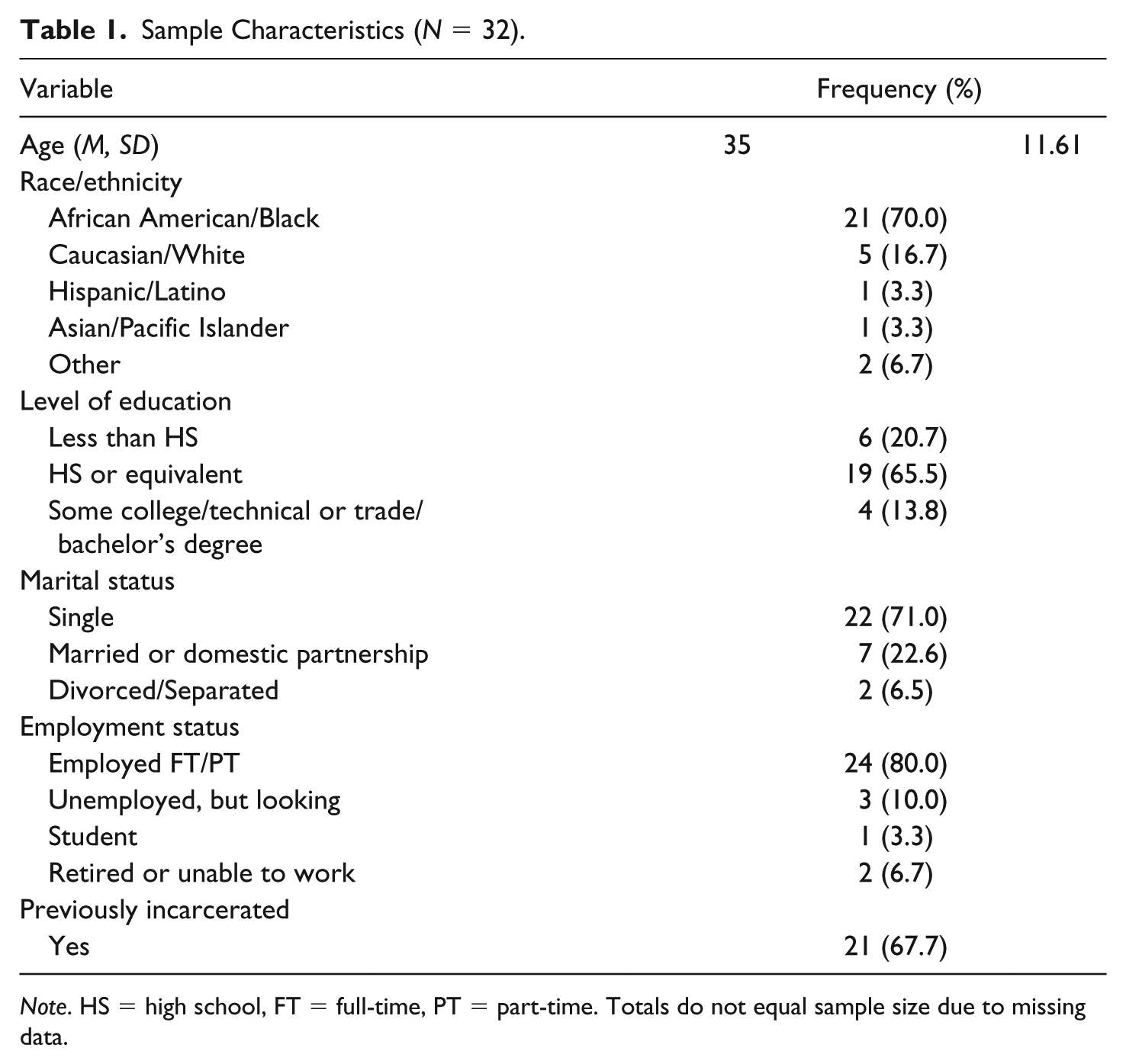
Note. HS = high school, FT = full-time, PT = part-time. Totals do not equal sample size due to missing data.
Data Analysis
Data analysis proceeded in six steps, as outlined by Braun and Clarke (2006). First, two authors read each transcript to gain familiarity with the data. Second, two authors separately coded each transcript using open coding (i.e., brief descriptions that are provisional, comparative, and concrete) to identify as many potential patterns as possible. Then, each transcript was coded using a deductive approach guided by the research questions (e.g., a parent code called “protective factors” was created). Also, in this step, another author reviewed each researcher’s codes to enhance confirmability, ensuring that codes, categories, and themes were linked to the data (Lincoln & Guba, 1985). A code book was also developed and maintained as categories and themes emerged to enhance auditability (Lincoln & Guba, 1985). Third, the research team met to discuss and sort the codes into broader themes, using a thematic map to visualize the analysis (e.g., the “prosocial activities” code was sorted into the parent code “protective factors,” effectively becoming a child code). Fourth, the initial themes were reviewed and further refined (e.g., data supporting different types of protective factors were reviewed and, if necessary, recoded to limit any overlap between themes). This iterative process continued until the revised thematic map fit the data. Fifth, the final themes were defined (i.e., title and content description) and refined using subthemes, providing structure for larger, more complex themes (e.g., subthemes were organized ecologically within a theme). Finally, after the themes were finalized, data extracts were examined to describe how each theme contributed to the overall analytic narrative and potential implications (Braun and Clarke, 2006; for example, the researchers moved beyond the description of the themes and analyzed the potential implications). Pseudonyms were used to protect participants’ confidentiality.
Results
To understand protective factors and resilience in socioeconomically disadvantaged men who have perpetrated IPV, we must first understand their exposure to adversity. Indeed, we found that the men in our study experienced adversities and risks at multiple ecological levels across their life span, including individual-, family-, community-, and societal-level challenges. At the individual level, we found that nearly half of our participants made early life decisions, such as dropping out of school and living independently before the age of 18, which likely contributed to risky behavior later in life (e.g., two thirds of the sample committed crimes that resulted in jail or prison sentences). At the family level, men were exposed to adversity across the life span. In childhood, men were exposed to domestic violence, parental substance use, parental incarceration, parental absence, poor parenting, lack of supervision, and negative or absent role models. As adults, men were in relationships characterized by IPV perpetration. Across the entire sample, these adversities were common and often co-occurred. Community-level stressors included poverty, community violence, lack of community resources, lack of community structure, high rates of single-parent families, lack of collaboration between people, and exposure to drugs, gangs, prostitution, and other crimes. Finally, men reported experiencing societal or macro-level stressors, including discrimination and high unemployment.
Although men in this sample have experienced significant exposure to adversity and related outcomes, our analysis showed that men experienced a number of mainstream protective factors (i.e., socially accepted by the dominant culture; Masten, 2015; Rutter, 1990; Schoon, Parsons, & Sacker, 2004; Werner & Smith, 1982, 1992) and context-specific protective factors (i.e., nontraditional factors that conferred protective effects). Some resilience scholars distinguish between promotive and protective factors depending on the presence of risk (for a review, see Wright, Masten, & Narayan, 2013), though for the purposes of this article, a distinction was not made and factors were considered to be protective if they appeared to be related to positive adjustment. In addition, men’s resilience (i.e., successful adaptation despite exposure to adversity) manifested in two forms, namely, mainstream resilience and context-specific resilience. Mainstream resilience is defined as the achievement of socially acceptable age-salient developmental tasks (e.g., graduating high school) despite adverse environments or experiences. Context-specific resilience is defined as the achievement of nontraditional developmental tasks (e.g., helping to raise younger siblings while still a child) despite adverse environments or experiences.
Mainstream Protective Factors
Prosocial activities
Some of the men in this sample were involved in prosocial activities that appeared to have ameliorating effects. For instance, one participant, Nathan, said, “I played basketball for the high school, and then the guys underneath me, those were the gang-related guys in the neighborhood. So they looked up to me all the time, and so I had no problem.” Another participant, Franco, was in a band and said, “I’ve been a musician since I was nine.” Men’s involvement in prosocial activities seemed to confer protection because it facilitated positive development for some men via status or respect in a desirable activity (e.g., sports) and limited time with or exposure to potentially dangerous actors in their communities.
Opportunities for generativity
Although individual responsibilities varied across the sample, some men highlighted the importance of taking care of their children. Below, Steve discusses how having a child helped him turn his life around: I started to calm down when I had my son though, because before that I really didn’t care if I get fired or get laid off or just party nonstop. I got to get a job and make sure I have this job to make sure my son gets what my mom struggled to get me at home. I have to show my son what it is to be a man, to care, and love, and everything else. (Steve)
Similarly, some men conveyed aspirations of being positive influences in the lives of others. Below, Coney described how he hopes to reach youth of a younger generation with his stories: Being a standup figure in society is being a man, not only just looking out for you and yours but just looking out [for others]. Some people are scared to uplift their voice and speak to these youngsters out here . . . But if my story can help uplift a couple of lives . . . if a lot of these youngsters take the time to sit back and listen, maybe they can get something out of it. (Coney)
This finding suggests that generative opportunities, such as being a role model for youth or fatherhood, can offer protection in the lives of men exposed to adversity. Opportunities to “be a man for others” prompted participants to leave or want to leave a life of crime behind for a more stable life. Furthermore, this finding suggests that some protective factors may be more salient at certain developmental periods in men’s lives (e.g., early adulthood or when men become fathers), thus underscoring the importance of examining resilience across the life span.
Supportive adults in childhood
Consistent with the extant literature (e.g., Vanderbilt-Adriance, & Shaw, 2008), men described experiences with supportive primary caregivers that buffered their exposure to adversity in childhood. For instance, a number of participants described their parents’ use of authoritative parenting skills, which has been found to be protective against a variety of negative outcomes, such as antisocial behavior (Eamon, 2002): When I got in trouble [when] I was younger, my mom said, “hey, I don’t like what you did,” she’ll punish me in a different way. She didn’t hit. All you doing is teaching that person, and she’d tell me why she not going to hit me. (Marcus)
In addition, a connection with a caring adult (nonprimary caregiver) served as a protective factor for men in this study. Throughout each focus group, men described how their relationships with uncles, grandparents, adult siblings, and other positive male figures in the neighborhood positively affected their lives amid adversity: I had family, neighborhood, like me and my brother grew up without a father, but my homeboy, Kevin, stayed across the street, he had a father. So Mr. Lee was like a . . . a big father for me and my brother, because he would take us fishing. He would take us hunting. He would take us to the Bucks game, to the Brewers game, to the Packers game when they still at County Stadium, things like that. (Jax)
The value of being exposed to positive male role models for at-risk youth and young adults cannot be overstated: . . . whoever was that person in your life that was telling you right, whether it was your mother, your uncle, your grandmamma, or whoever was putting you on that path to get you to be successful and be a man, you need to go talk to that person and be around that person, because that person right there is going to give you the tools to save your life. (Tyler)
However, not all of the men had supportive and protective caregivers and/or adults in their lives. Jay reminisced, My family didn’t want anything to do with me. I mean, there was a point where I hadn’t eaten in four days, and I knocked on my grandmother’s door, and she slammed the door in my face. So it was kind of a different experience for me. It was surviving. It was making money any way I could, just making sure I didn’t die, because that was a very real option for me. (Jay)
In addition, some of the men recalled having to protect their mothers from violent adult men in their lives, rather than being protected: I had to stab my mother’s boyfriend at 12 years old . . . He was violent, he was on crack, and he was trying to rob my mama and beat her up, and I had to help my mama out by being the oldest. (Twyon)
Finally, it appeared that the presence of a supportive adult was not enough to counter the risk factors some men were exposed to; rather, it is likely the presence, quality, and number of relational supports that confer protective effects (Ludy-Dobson, & Perry, 2010). Damen explains how this occurred in his life: My mother was a hard worker. She was a very hard worker. Raising three boys, there was times when she would work three different jobs. And she raised us very well, but it was at our own discretion to go and do the things that we saw glorified throughout the neighborhood or may have heard it on the radio or saw it on TV. (Damen)
Community investment
As a whole, community-level factors conferred protection through stability and a sense of community to the neighborhood. For instance, “old heads,” or older, established community members, helped to set and enforce implicit rules about behavior in the neighborhood. Men also described that families, particularly women, helped monitor all of the children in the neighborhood. Some men noted that institutions, particularly churches, “uplifted” their communities. Notably, a number of participants described that home ownership was a salient protective factor because it increased men’s sense of investment and community: See, homeowners, you got stability, and you got to understand you going to want to keep what you got. When you got people that’s renting, they’re basically nomads. They’re from neighborhood to neighborhood, house to house, and most of them peoples, I ain’t going to say it like that, but it’s like when you own your home, it means more to you. So you want to live in a better environment. You want your kids in a better environment. (Trev)
This finding suggests that research aiming to uncover elements that promote a sense of community, and subsequent practices and policies aiming to develop stronger neighborhood investment (e.g., loan programs for low-income or first-time home buyers), may confer protective effects to the community and its residents.
In summary, these themes bring attention to the numerous, and often modifiable, protective factors operating at various ecological levels across men’s lives. Although many of the findings align with the existing literature on protective factors (e.g., Masten, 2015), this study extends the literature on salient protective factors among a sample of at-risk men and highlights the importance of exploring protective factors at multiple ecological levels, broadening the number and realm of protective factors examined and utilized by researchers and practitioners.
Context-Specific Protective Factors
Our analysis suggests that factors may vary along a risk-protective continuum, depending on the interactions between the person and environment. Ungar (2013) asserts that “resilience can manifest as prosocial behaviors or pathological adaptation depending on the quality of the environment” (p. 255). Although mainstream society would likely consider “growing up early,” criminal justice involvement, and gang involvement to be risk factors, we found that in some contexts these factors offered protective effects and/or were related to positive adjustment.
Growing up early
Klint was exposed to great adversity through the death of both parents in childhood; however, having to “grow up early” relayed protective effects in that Klint was better prepared to respond to future life challenges: My dad passed away, and then it was my mom. And it’s just me and my sister. My mom sheltered me and my sister most of our life, and when she passed, we grew up. The world opened up to us. We had no codling, no nothing. I got my next door neighbor’s sister knocked up, I had to learn how to become a dad and support her until that baby was born. But I did still work after that. But from what I know now, I wouldn’t live with my mama. (Klint)
In some contexts, growing up early and successfully navigating adversities enhanced men’s likelihood of success with future adversities, that is, competence begets competence, (Burt, Obradovic, Long, & Masten, 2008).
Similarly, Twyon had to support his family and “become a man” in adolescence. Although this experience of parentification and added responsibility in childhood may be considered risky, Twyon described it as an opportunity for growth. Specifically, he learned how to “hustle,” which some men described as “doing whatever they must to reach a goal”: When you don’t have nothing, your mother can’t provide what you need or what you want, so you need some new shoes for school or you need anything, you got to reach out to other people to try to get it. Some people rob, some people hustle. But my thing was hustling. And that’s when I became a man, like 15 years old where I got to help out with the house and my little sister at the house to make ends meet. (Twyon)
Twyon’s life circumstances prompted him to occupy an adult role as an adolescent and subsequently support his family, from which he learned the values of hard work and achievement. This example reflects the experience of a number of men in this study and draws attention to the importance of recognizing adaptive behavior in response to environmental contexts that confer protective benefits (i.e., strong work ethic, achievement) alongside potentially risky exposures.
Criminal or juvenile justice involvement
Criminal or juvenile justice system involvement is often a risk factor for deleterious outcomes (i.e., Gatti, Tremblay, & Vitaro, 2009); however, some men described positive adjustment resulting from their experience. Describing it as a “turning point,” some men used their prison time to earn a GED and develop trade skills that later deterred them from crime. As a young man, Lennon described developing self-respect and respect for others while in juvenile detention: “When I got locked up at 13, being young, it taught me. Have respect for yourself and respect for everybody around you.”
Gang involvement
Although gang presence in communities was associated with drugs and violence, men conveyed that gangs offered a sense of protection and belonging in their communities (Sharkey, Shekhtmeyster, Chavez-Lopez, Norris, & Sass, 2011). Vance recalled, “You in this neighborhood, either you’re riding with that neighborhood or you against it.” Similarly, a recent study of Mexican adolescents found that belonging to a social group was associated with higher levels of emotional intelligence and resilience; however, youth who were associated with gangs reported lower levels of resilience and emotional intelligence compared with adolescents in other social groups (e.g., sports, arts; Ruvalcaba, Gallegos, Borges, & Gonzalez, 2017). Considering our study’s finding in the context of the broader literature, practitioners working with at-risk adolescents and men should consider providing safe social groups to foster a sense of belonging in the community.
Overall, our findings suggest that some life experiences that are typically thought of as risky may extend some positive outcomes for these men. By examining the context of risk and protective factors using a strengths-based assessment, we have broadened the range of protective factors that are representative of socioeconomically disadvantaged men’s environments and sociocultural contexts.
Displays of Mainstream Resilience
Despite exposure to significant adversity, most participants demonstrated success in age-salient developmental tasks, thus displaying resilience. We found displays of resilience in three domains. First, men displayed educational resilience (e.g., graduating from high school or college), with nearly 80% of the sample having obtained a high school degree/GED or some college. Dexter described how, despite dropping out of high school, he continued to pursue education: “I took up auto mechanics after I dropped out of high school. And I do have my GED. I have a year of college at MATC (technical college).” Similarly, A. J. said, I was told when I was young that reading is fundamental, stay in school. I did. I got HSED. I didn’t get it from my high school, but I got one. I got out. I went to college. I went to La Crosse University, graphic design. Stay in school. (A. J.)
Second, although men perceived a number of barriers to employment, such as having criminal records, 80% of men displayed occupational resilience in the form of being employed. Eli discussed how employment facilitated taking care of himself and others: Taking care of myself and basically just taking care of responsibilities and kids, because I had my first kid at 18. So when I was on my own and paying bills and going to work and taking care of my responsibilities, I think that’s what made me a man. (Eli)
Eli’s quote also suggests that being employed and taking care of himself and others is strongly tied to his sense of masculinity as these accomplishments are what “made him a man.” Given that many men described this close tie between employment and their development as men, more research is needed to explore the relations. Specifically, boys’ and men’s perception of their masculinity may serve as risk or protective factor for resilience.
Third, men displayed relational resilience. This included having meaningful relationships with others, including spouses, ex-romantic partners, adult siblings, and their own children and grandchildren. Sloan said, I used to seek pleasure as a goal. That was my main objective as a young man to seek pleasure as a goal. I mean women, smoking weed, just about personal fulfillment, gratification. As I’ve grown older, now I take pleasure in knowing that I’m doing the right thing. I have two daughters and one grandchild. Now I see my pleasure and my happiness comes from seeing them happy, it’s totally evolved. I want to see them enjoy life, and, basically, I just take pleasure in knowing that I’m doing the right thing for them and myself. (Sloan)
In addition to displaying occupational and relational resilience, the quotes from Sloan and Eli suggest that some men experienced evolutions from being “self-centered” to being “other-centered” in their development. Thus, more research is needed to examine whether such an evolution is a protective factor for positive adult development, particularly among adults.
In summary, the observed displays of educational, occupational, and relational resilience highlight an often untold story of resilience among socioeconomically disadvantaged men. Our findings align with previous research that suggests resilience is ordinary rather than extraordinary (Masten, 2015) and also documents the fluidity of men’s resilience as stressors changed or emerged across the life span.
Displays of Context-Specific Resilience
In this theme, we discuss men’s diverse experiences and highlight the importance of understanding resilience in context (Ungar, 2004). There is value in defining resilience from two vantage points, namely, mainstream resilience, which consists of successfully completing tasks that society deems important, and context-specific resilience, which consists of positive adaptation within tasks and scenarios that may not be considered positive at first look as it provides a richer understanding of how at-risk men function adaptively (Ungar, 2004).
Taking the environment into context illuminated how men in this sample displayed context-specific behavioral resilience by “doing what they had to do.” First, men often served as caregivers to their families and siblings at young ages, an expectation born out of their environments (e.g., single-parent household): It meant a lot for me because my dad wasn’t in my life, so I was raised by my mom and my grandma. Ever since I was like twelve, thirteen, I never knew what the word mature meant, but my family always said, “he’s mature for his age.” So I just continued to do what I was doing and staying to myself, and providing for my brothers and sisters. (Piers)
Second, a number of the men who were incarcerated displayed context-specific behavioral resilience by engaging in the offered programming. Dwayne described how taking part in these opportunities strengthened his capacity for resilience in the future: It gave me structure I didn’t have. It taught me how to do things the right way instead of taking the easy route, which is what I was doing, robbing houses, selling drugs. When I was in prison, I got a job, taught me responsibility. I utilized a lot of the programs they have in prison, which some people do, some people don’t. It’s all what you make of it. For me, it was an experience. It taught me how to be a better man and taught me what not to do for the future. (Dwayne)
In summary, broadening our understanding of resilience to account for adaptive functioning in the sociocultural context may help to more accurately describe the experiences of at-risk men and may lend itself to more relevant prevention and intervention programs.
Discussion
Given the limited qualitative research on resilience among socioeconomically disadvantaged, particularly Black, men, we aimed to explore protective factors across multiple ecological levels that influence resilience in this population. Using thematic analysis, we identified four main themes. First, men described widely recognized or mainstream protective factors at the individual, family, and community level that helped to promote positive adjustment in the face of adversity. Second, men also reported nontraditional factors that conferred protective benefits, or context-specific protective factors. Third, men demonstrated mainstream resilience, or adaptive functioning, in three socially accepted domains, including educational, occupational, and relational resilience. Finally, we found that when taking the sociocultural environment into context, some men demonstrated context-specific resilience by “doing what they had to do” to survive.
The mainstream protective factors found at multiple ecological levels both confirm and extend the field of resilience. At the individual level, exposure to and participation in prosocial activities in adolescence served as a buffer from adversity, which aligns with prior research with high-risk adolescents (e.g., Kim, Gilman, Hill, & Hawkins, 2016). Generative opportunities were also identified as a potential protective factor. Previous research found that becoming a father served as a turning point for low-income, Black and Latino men involved in destructive, criminal behavior (Hughes, 1998), and the same appeared to be true for some of the men in our sample. Potentially, fostering opportunities for high-risk adolescents and adults to reflect on their lives and reconstruct narratives that support a generative identity can facilitate transitions to healthier, more resilient lifestyles (Ungar, 2001) and enhanced well-being.
At the family level, men described how caregivers, extended kin, and positive male role models in their neighborhood were protective against the adversity in their lives. Previous literature supports this notion, indicating that relationships are critical for well-being (Masten, 2015); however, not all men in the study conferred benefits from supportive caregivers, suggesting that it is not only the presence but also the quality and number of supportive adults that are essential for this protective factor to take effect (Ludy-Dobson, & Perry, 2010).
At the community level, men who described their neighborhoods as ripe with “participation,” meaning people stuck together, felt connected, and looked out for one another, appeared to benefit from a greater sense of safety and tighter social fabric (Wilson, 2012) among the community. Men described “old heads,” or older Black men (Anderson, 1999), as important actors in establishing this sense of “participation” in their neighborhoods. Previous research has identified “old heads” as an uncultivated source of social capital for Black male youth, families, and communities (Richardson, 2012). Practitioners and intervention researchers should consider how best to cultivate these assets in low-income, predominantly Black neighborhoods. Moreover, researchers should explore whether there are other untapped sources of social capital among different cultural and racial/ethnic minority communities.
When considering the sociocultural context of the participants’ lives, using race, culture, and class lenses, the scope of protective factors broadens. In this study, men reported experiencing turning points, or significant events that led to changes in their lives (Teruya & Hser, 2010), in childhood, adolescence, and adulthood. Although mainstream society might consider experiences of growing up early, involvement in the juvenile and criminal justice system, and gang involvement to be risky, we found these turning points to confer protection in these men’s lives, joining the small body of literature that challenges the notion that risk and resilience are not universal and, instead, are contextually and culturally specific (Teti et al., 2012). These factors appeared to be protective by way of helping men establish preparedness for future adversity, learn responsibility and respect for others, and fulfill the innate desire to belong to a peer group in adolescence. Illuminating the complexities of these experiences deepens the field’s understanding of developmental risk and protective factors experienced by socioeconomically disadvantaged men in two ways. First, applying a broader scope to developmental risk and protective factors using a contextual or cultural lens applies a strengths-based approach, which can enhance practitioners’ engagement and effectiveness with clients. For example, these findings identify skills, characteristics, and dispositions that can serve as building blocks in programming for socioeconomically disadvantaged men. Second, our findings may point to potential mechanisms (including processes in childhood and adulthood) that foster resilience among disadvantaged groups and call attention to the role of contextual factors.
When assessing men’s success in age-salient developmental tasks during adulthood, resilience was displayed in three domains (education, work, relationships); however, by examining the context in which the men lived, we also found that men displayed behavioral resilience. Men’s experiences of “doing what they had to do” were actually highly adaptive in some circumstances. Thus, not only do our findings further confirm that resilience is dynamic, multifaceted (Luthar et al., 2000), and “ordinary” (Masten, 2015), but they also contribute to the notion that resilience is prevalent among socioeconomically disadvantaged men. Moreover, demonstrated resilience by this high-risk group indicates that targeted changes at the structural and environmental level are necessary, in addition to individual-level interventions, to affect meaningful change in the lives of socioeconomically disadvantaged men.
Strengths and Limitations
All study participants were involved in a BIP and were socioeconomically disadvantaged men. Because resilience research has been understudied in this population, this is a strength of the study; however, these results may not be transferable to other populations. In addition, by nature, the secondary analysis prevented the authors from posing follow-up questions to the participants and, therefore, limits the depth of information and interpretation of the findings. Finally, the men described experiences from childhood to adulthood retrospectively. Our analysis approach may suggest a chronological order or timeline of events, but it is important to note that the men in our study did not provide details of their life experiences in a linear fashion. The authors relied on context clues and the wording of interview questions and prompts to estimate the timing of men’s experiences with adversity in relation to their demonstrations of resilience. Thus, the temporal nature of events cannot be certain.
Nevertheless, several steps were followed to strengthen the credibility of our findings. First, the first and third authors coded the data and the second author reviewed these codes, limiting interpretation biases. Second, a code book was developed to enhance interrater reliability. Third, the broader resilience literature and the more specific literature on resilience among socioeconomically disadvantaged men were reviewed to help guide and refine the approach to coding, analyzing, and drawing conclusions from the data. Fourth, our analysis remained rooted in the data, as evidenced by the use of quotes throughout the article, to demonstrate that interpretations stemmed from raw data provided by study participants. Finally, inferring resilience requires an examination of both risk and adaptive functioning. Consequently, the findings from our study are strengthened by our analysis approach, which described men’s experiences with adversity across the life span, before subsequently assessing resilience.
Future Directions
Given the paucity of resilience research with this population, more research is needed to enrich the field’s understanding of resilience, including how adults make meaning of past and current factors that may contribute to their resilience and how these cumulative factors contribute to healthy trajectories across the life span among socioeconomically disadvantaged men. Much of the extant literature has focused solely on the risk factors evident in racial and ethnic minority populations (e.g., Choe, Stoddard, & Zimmerman, 2014; Reed et al., 2014). However, to develop holistic prevention and intervention programs tailored to this population, future research on the salient risk and protective factors at multiple ecological levels among socioeconomically disadvantaged men is warranted. For example, researchers and practitioners could engage socioeconomically disadvantaged men through targeted interventions for expectant and new fathers. In addition, our study highlighted a complex relation between risk and protective factors when considered in the social-cultural context. Additional research employing advanced statistics, such as multilevel modeling that can account for the nested structure and cluster effects, may elucidate how risk and protective factors at multiple levels (e.g., the individual and community levels) interact to shape resilience and how resilience is associated with multiple health and social outcomes.
Footnotes
Declaration of Conflicting Interests
The author(s) declared no potential conflicts of interest with respect to the research, authorship, and/or publication of this article.
Funding
The author(s) received no financial support for the research, authorship, and/or publication of this article.
