






Abstract
This study explores how British couples experience men partners’ roles within family planning. Ten semi-structured interviews were conducted with couples and analyzed using discourse analysis. From the analysis, three discourses emerged: “Men’s role as partners is perceived differently within the couple”; “As partners men do not like their options for procuring condoms”; and “Family planning services are for women partners.” The first discourse considers the support of informal systems, whereas the second and third discourses reflect the formal support couples experienced when utilizing health services. Together, these three discourses construct a social structure where men partners’ roles are restricted within family planning. These findings are discussed in relation to changes to policy and practice, which aim to engage men as partners in family planning.
This study explores the role of men as partners in family planning from the experiences of British couples. The World Health Organization (WHO) defines family planning as the ability to time and space pregnancy by using contraception and treating infertility to achieve the desired number of children (WHO, 2019). The National Health Service (NHS) considers family planning to be interchangeable with sexual health, genitourinary medicine, and sexual and reproductive health (SRH) clinics, depending on where individuals reside in the United Kingdom [U.K.] (NHS, 2018). These definitions by the WHO and NHS are broad enough not to restrict the exploration of the social phenomena and incorporate terms such as pregnancy prevention, contraceptive use, and reproductive decisions under the umbrella of family planning. Although the U.K. supports the WHO, most of its efforts have been focused overseas, leaving a gap in the literature around men and reproduction nationally. The purpose of this study is to begin to provide an understanding of how men act as partners within family planning. The term “engaging men as partners” has strategically been chosen because it reflects that men influence women’s reproductive health and, at the same time, encourages men to have a balanced role within family planning (Verme, Wegner, & Jerzowski, 1996). The article will begin by providing a historical context to the social issue of men and family planning, followed by a review of the literature. The analysis of the 10 interviews with couples will then be presented, and the article will end with a discussion on how policy and practices could be enhanced to further support men to act as partners.
Historical Context
Around the mid-1980s, family planning researchers in the United States began to support the inclusion of men both at family planning clinics and outside of the clinic. Men were seen as potentially providing further support to their partners outside of the clinic by being more informed of methods and options, participating in safe storage/disposal/collection of contraceptive methods, encouraging use of the desired contraceptive method, reminding to attend follow-up appointments, and being informed of what to do in case error or unintended pregnancy occurs (Swanson, 1984). However, men were absent in family planning clinics, with the failure to engage being blamed on the services’ environment (Forrest, 1986). In response, programs that targeted men as partners in family planning began to grow internationally (Gallen, Liskin, & Kak, 1986).
Starting in the early 1990s, increased attention was placed on how to engage men as partners in family planning by stakeholders throughout the world (Oudshoorn, 2003). The 1994 International Conference on Population Development (ICPD) Cairo was one of the first global discussions concerning how stakeholders could begin to engage men (DeJong, 2000). At the ICPD, around 183 countries (including the U.K.) signed a program of action calling for men to take increased reproductive responsibilities (Oudshoorn, 2003). Per Section 4.27, countries agreed men were an integral part of the reproductive process and contraceptive decision making (United Nations Population Division, 1995). It was decided there was an imminent need to create specific programming to engage men in family planning (McIntosh & Finkle, 1995). In doing so, the conference established men as having reproductive rights previously reserved for women (Mundigo, 2000) to alleviate the unequal burden placed on women for contraceptive responsibility to achieve the desired number of children (Terry & Braun, 2011). At the Fourth Women’s International Conference Beijing 1995, men were again included as part of the family planning agenda, this time as an important part to improving women’s health and rights (Sternberg & Hubley, 2004). These two global conferences were monumental in creating further dialogue among health professionals on how to engage men as partners (Plantin, Olukoya, & Ny, 2011). As a result, in 1997, the United Nations Population Fund (UNFPA) published a booklet with an agenda for men’s engagement post Cairo and Beijing (UNFPA, 1997), establishing the attention to engage men as a global priority.
Although there were concerns that increasing men’s engagement in family planning practices would result in negative implications for women’s reproductive health (Miller et al., 2010), engaging men in family planning became part of the agenda for achieving the United Nations Millennium Development Goals by 2015 (Wanner & Wadham, 2015). Those involved in establishing the Millennium Development Goals argued that men’s engagement had potential health benefits for both women and men (e.g., improved maternal and child health) and potential benefits to the life cycle (e.g., allowing for better planning and spacing of children to improve families’ financial situations). Furthermore, they argued that women-centric services had failed to make the desired impact, suggesting that men’s absence was negatively affecting the reproductive health of women (Catino, 1999). In response, funding was allocated for initiatives to engage men, including educational programming for men regarding reproductive health (Armstrong et al., 1999). Since review of the Millennium Development Goals 2015, several developing countries have reported success in engaging men (Abbott, Sapsford, & Binagwaho, 2017; Tilahun, Coene, Temmerman, & Degomme, 2015). Countries have reported that through engaging men, there have been improvements to maternal health, such as men improving women’s access and uptake of family planning services (Fotso, Higgins-Steele, & Mohanty, 2015; Yargawa, Leonardi-Bee, 2015). Post 2015, the attention on engaging men as partners remains part of the global agenda. The agenda continues to encourage men to act as supportive partners, for men to take responsibility for their own reproductive health, and for research to be conducted on men’s use of family planning services (Hardee, Croce-Galis, & Gay, 2017).
Literature Review
Research in the U.K. supports the above global findings that men can positively shape women’s maternal health, particularly in relation to empowering women to access and utilize health services (Portela & Santarelli, 2003). For example, men’s engagement in prenatal blood screening has provided men the ability to become more engaged partners, allowing them to help their partners make informed decisions regarding what tests to undergo during prenatal care (Reed, 2011). Furthermore, men as partners have positively influenced maternal health by decreasing behaviors such as smoking (Koshy, Mackenzie, Tappin, & Bauld, 2010) and increasing behaviors such as exercise during pregnancy (Liu et al., 2011). Despite men partners’ positive influence on maternal health, men are less likely than women to recognize preconception health as applicable to themselves. In response, woman partners have expressed that they would like health professionals to directly encourage the engagement of men in their own preconception health, such as reduction of alcohol intake and smoking cessation (Tuomainen, Cross-Bardell, Bhoday, Qureshi, & Kai, 2013). In the U.K. context, there is little research to explore how family planning is negotiated within the couple, and few initiatives, such as the Irish Family Planning Association’s Men Engage project, exist to engage men as partners (Wilson, Fylan, & Gough, 2018). It is therefore important to explore men’s current role, what family planning resources are available to men, and how to increase engagement through service attendance.
What we do know is British men access social resources (e.g., close friend) for family planning support less than women (Pearson, 2003a). Since the initial increase of 16% from 2008/2009 to 2009/2010, the number of men attending family planning services has declined yearly (NHS, 2014, 2017). In 2013/2014, 1.19 million women attended contraceptive services compared with 146,300 men (NHS, 2014). From 2014, contraceptive service data were restructured to combine SRH, with 1.06 million women contacting SRH services in 2016/2017 compared with 130,900 men (NHS, 2017). There is little research to explain why men access family planning services less than women (Pearson, 2003b). Due to the low number of men as attendees, the empirical data lack depth and insight into the men who do use family planning services. Data sets produced from clinics lack demographic and socioeconomic information on men as clients (e.g., ethnicity is not recorded), and data on men who visit general practices for family planning are unavailable (Pearson & Clarke, 2007). Men are not recorded within the data if they attend services as part of a couple; if attending as part of a couple, the patient is then recorded as a woman (NHS, 2014; Pearson, 2003a 2017). With little information about men as attendees, the reports provide an incomplete understanding of men as service users (Pearson & Clarke, 2007). The data further provide a lack of insight into couples’ service use, and qualitative data is absent to explain why men’s service use is much lower. Overall, it remains unclear why men engage, or disengage, with services for family planning.
The reports further show that women take primary responsibility for contraception, with oral contraception reported to be the primary method of contraception preferred by service users of all ages (NHS, 2017; Pearson, 2003a). However, there is still an unmet need to allow for spacing and limiting family size (Mbizvo, Chou, & Shaw, 2013), supporting the argument that solely targeting women has failed to make the desired impact on maternal health (Catino, 1999). Both men and women are most at risk of unplanned pregnancy between the ages of 20 and 34, even when compared with the risk of unplanned pregnancy between the ages of 16 and 19 (Wellings et al., 2013). The risk of unplanned pregnancy was operationalized by Wellings et al. using a validated psychometric scale, the London Measure of Unplanned Pregnancy (LMUP). With the LMUP, scores of 0 to 3 indicate that a pregnancy was unplanned, 4 to 9 indicate that the pregnancy was ambivalent, and scores above 10 indicate a planned pregnancy. In the National Survey of Sexual and Lifestyles, the LMUP Scale was used in a pregnancy analysis to collect data nationally in Britain from around 5,600 women of childbearing age of 16 to 44 years. With little qualitative research to further explain these results, there is little explanation as to why there is an unmet need for family planning services among adults who are between the ages of 20 and 34. When providing reproductive health–based interventions for family planning, research outside the U.K. suggests that interventions are more successful if provided together to both partners rather than as separate interventions for women and men (Becker, 1996). Clinics have also reported success in engaging men as attendees on an individual basis by encouraging couples to jointly attend family planning services (Sternberg & Hubley, 2004). These studies conducted in other countries begin to provide insight into how British men could be further engaged to decrease the unmet need for family planning.
The objective of this study is to begin to explore British men’s family planning practices as part of a couple. The study aims to better understand how men as partners provide support within the couple dyad and why men partners use services less than their woman partners. The research question asked the following:
Study Design and Method
The study design was qualitative and exploratory. Semi-structured interviews were conducted with heterosexual couples using a method of intensive interviewing until saturation occurred (Fylan, 2005). Data saturation occurred when interviews reached a point of diminishing returns (Green & Thorogood, 2018)—in other words, when the couples began to be repetitive in their talk and interviewing any further couples would fail to provide new information. Ten couples participated in total, with each couple participating in one interview. Dyadic interviewing occurred because in the U.K., it can be difficult to get men to participate in interviews around family planning because this research is perceived as relating to women (Reed, 2011). Although interviewing couples can result in one partner withholding information, interviewing couples is common within family research. Family planning is a decision that is made by couples, regardless of whether research focuses on the individual (Greene & Biddlecom, 2000). This study looked at how discourse was created; by including partners in the discussion, the interviews allowed for reality to be co-constructed by the partners in an attempt to capture how family planning decisions regarding men were made within the couple (Morgan, Ataie, Carder, & Hoffman, 2013).
Preceding the interviews, the appropriate ethical approval was granted by Leeds Beckett University. These ethical considerations were made in reference to the British Psychological Society’s (2014) guidelines for human participants and further referenced in consideration to the American Psychological Association’s (2017) ethical principles and code of conduct. Participants were recruited by placing flyers in local community areas, such as coffee shops and universities, in a northern British city. Couples who enquired about the study were provided an information sheet outlining the study’s aims and objectives. Those between the ages of 20 and 34 were selected for interviews based on this group being most at risk of unplanned pregnancy in the U.K. (Wellings et al., 2013). They were further given the opportunity to ask questions before agreeing to participate. Informed consent was then obtained in writing from both partners prior to conducting the interviews. The interview topic schedule was pilot tested and reviewed by multiple researchers for feedback before interviews commenced. The interviews lasted on average for 45 minutes, with a £20 incentive provided to each couple who participated. After the interviews, couples were debriefed and given further resources for professional family planning advice or assistance. Considerations have been made to protect couples’ anonymity by creating a pseudonym for each couple (e.g., Man Partner 1, Woman Partner 1). A participant table of the 10 couples is as given in Table 1.
Participants.
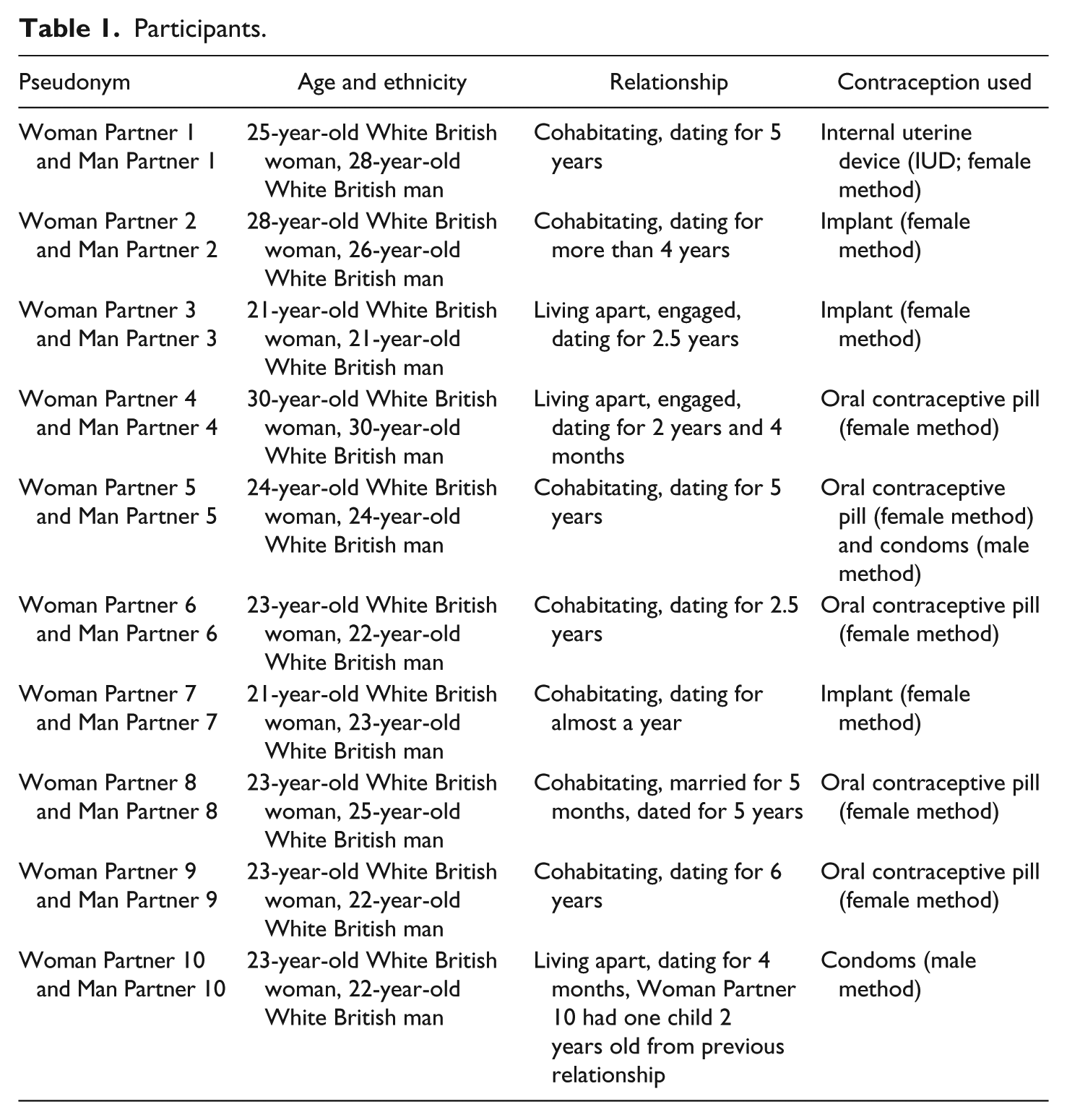
Couples were between the ages 21 and 30 and identified as White British. The relationships were considered committed by the couples and ranged from 4 months to 6 years. There were various levels of commitment among the couples; they identified as dating, engaged, or married. They also disclosed whether they were cohabitating or living apart, with the majority of the couples cohabitating versus living apart. The couples all reported currently using one method of contraception, with one couple using two. Most couples relied on a method for women, commonly the oral contraceptive pill, with two men partners currently using condoms. Nine of the couples were choosing to delay pregnancy, with one of the woman partners having an unplanned child from a previous relationship. Couples were asked to define family planning in their own words during the interviews. Once couples had provided their definition, the WHO’s definition was agreed upon and used throughout the interviews by the couples. This was to assure all parties were referencing their responses to the same definition.
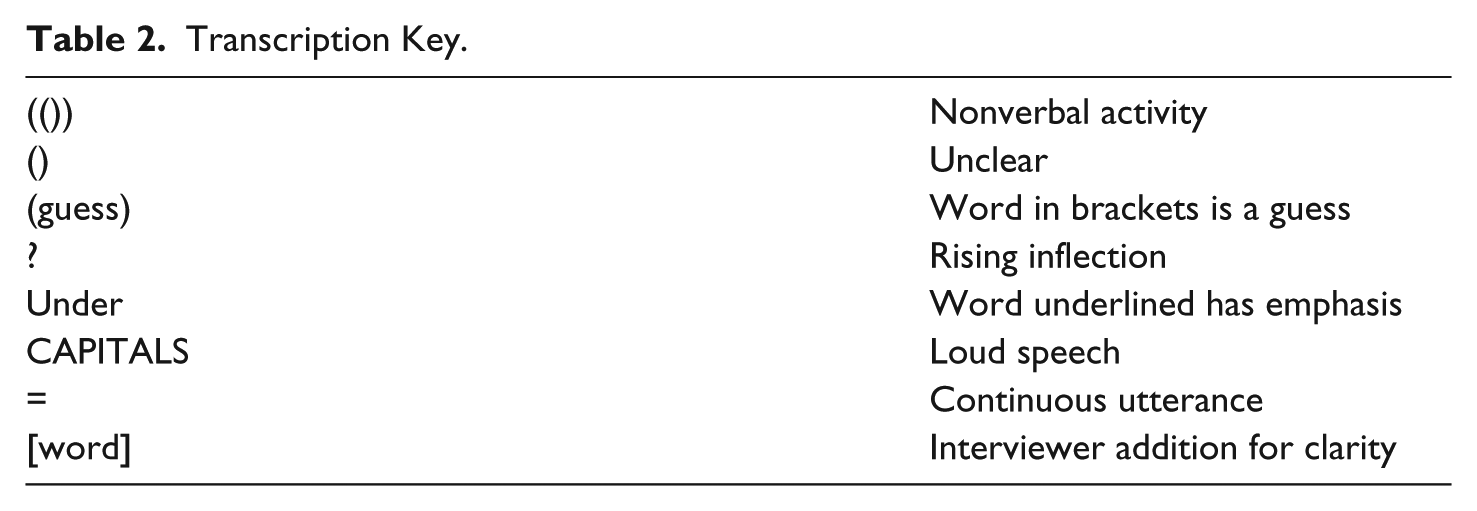
The data from the interviews were transcribed to allow for analysis. Table 2 acts as a key to the transcript symbols in the “Results” section:
Transcription Key.
The analysis was conducted using an eclectic approach to discourse analysis that combines Foucauldian Discourse Analysis (see Parker, 1990) and Constructivist Grounded Analysis (see Henwood & Pidgeon, 1992). This approach acknowledges both structural power and the social construction of knowledge emerging from theory and data. Combining top-down and bottom-up approaches has been used in psychological research on critical masculinities (see Gough, 1998; Willott & Griffin, 1997) and in research on men and family planning (see Wilson et al., 2018). Furthermore, the research was conducted through the political lens of reproductive justice (Chrisler, 2014) when analyzing the interview transcripts. For transparency, the steps to analysis are discussed step-by-step. First, the transcript texts were divided into sections, with Interview 1 being one section and Interview 2 being a separate section, and so forth. Once the texts were divided, each section was coded using a process of in vivo themes, similar to grounded theory (Glaser & Strauss, 1967). Themes were coded starting with Section 1 and revised and added as appropriate in the subsequent sections of texts. Once all themes were determined, they were again revised to combine similar themes, forming superordinate categories. When finalized, the different talk used to describe each theme was identified. Talk was then analyzed to form reoccurring patterns of discourse within the transcripts. Reflexivity, in the form of investigator triangulation, occurred during the analysis to account for bias (Denzin, 1978).
From the analysis, three dominant discourses emerged: “Men’s role as partners is perceived differently within the couple”; “As partners men do not like their options for procuring condoms”; and “Family planning services are for women partners.” The first discourse, “Men’s role as partners is perceived differently within the couple,” shows how the couple understands man partners’ practices in family planning. The second discourse, “As partners men do not like their options for procuring condoms,” discusses man partners’ ability to take primary responsibility for contraception. The third discourse, “Family planning services are for women partners,” describes how family planning services shape and influence man partners’ practices. Together, these discourses reflect both the informal support (e.g., within the couple) and the formal support couples experienced from health services (e.g., pharmacy, general practitioners, clinics). The following results represent these dominant themes and discourses that emerged from analysis of the interview transcripts.
Results
Discourse 1—Men’s Role as Partners Is Perceived Differently Within the Couple
Woman partners described men partners as equal when engaging in family planning decisions. In contrast, men partners referred to themselves as supportive rather than embracing their partners’ notion of an equal partnership:
It is a joint decision, you [her partner] should be involved and you, = should be asking questions you know ((pff)). You’re the other bit effectively.
I said it was your decision but that I would support it, that I still have, I still keep conventional contraceptives [condoms] just in case you know.
A “joint decision” made sense to women partners, Woman Partner 1 indicated this by using “should be” twice to emphasize the importance of including her partner. She made the sound “Pff” to further express frustration that her partner was not currently more included. Men partners used talk that suggested they felt limited to supporting their partners’ decisions. Man Partner 9 positioned himself as supportive; this is seen in the I/you divide within his statement. He explained that he still kept condoms, but there was no discussion of a shared decision; it was his partners’ decision which contraceptive method was used. Man Partner 9, thus, minimized his part; he procured condoms and was willing to take primary responsibility if instructed.
Differences also existed in how men and women partners defined family planning. When asked to define family planning in their own words, men partners responded predominantly citing financial concerns. Women partners, however, defined family planning as timing and spacing pregnancy to achieve their ideal number of children:
How would you both define family planning in your own words?
((Um))
Well so far it’s been ((um)) been family avoiding, ((laughs))
((laughs))
And ((um)) I guess we have a vague plan about when we both really would want to have children but not yet.
Yeah
But mostly avoiding.
Yeah, = we = you know we put fiscal planning in with family planning. I think, so the sensible side of things takes over, we think about how much, you know what kind of things would we need in place before we start thinking about having a family.
I guess, ((um)), if you discussed family planning its sort of setting, timing of what you perceive for your family for the future.
Yeah, = we’re very similar, we want specific goals we don’t [want] to just ((um)) have a kid when we can’t, we want to have actually a stable background, with money not a problem), ( ) before we actually have kids.
Man Partner 2 added a “fiscal” dimension in response to his partner’s definition of “family avoiding” or waiting to be parents. His use of “sensible side of things take over” and what they would “need in place before we start thinking about having a family” indicated foresight. Man Partner 6 echoed Man Partner 2’s sentiment: he would like a “stable background, with money not a problem.” His partner’s response is more future-focused; it is about “timing” when to have a family, rather than financial. Both man partners did use “we” statements several times; however, they were still building on their partners’ definition, indicating this is their personal expectation.
Discourse 2—As Partners Men Do Not Like Their Options for Procuring Condoms
In an effort to understand men as partners’ contraceptive responsibility, those who had previously used condoms, or currently used condoms, were asked to describe their experiences procuring them. Men partners were opposed to the cost of condoms:
Before you would go around, ((laughs)) nab them [condoms] from work
((laughs))
Do you have free condoms then that you offer at your work?
Yeah, all the kids and that.
Yeah ((laughs))
((laughs))
They just, they said someone is coming in to deliver most talks, she mentioned there was going to be a room that were full of like family planning stuff and I nearly ran. I was just like WE DON’T HAVE TO BUY THEM ANYMORE.
((laughs))
Not from embarrassment, its cost.
Man Partner 4 worked with adolescents in a charity and could access free condoms when available. When SRH talks were given, which provided “family planning stuff,” Man Partner 4 was ecstatic, he “almost ran.” In the interview, he stated, “WE DON’T HAVE TO BUY THEM ANYMORE!” Man Partner 4’s talk is written in capital letters to express the inflection in his voice, which he used to indicate importance.
Due to the cost of condoms, some couples sought free condoms from services. Men partners described obtaining free condoms as dispiriting, disengaging both partners:
I think there is a lot of ((um)) ( ) emotionally small; there are a lot of barriers for men for information and for resources. I don’t think there are a lot of men that would actually put in the effort to get past those barriers. I think like oh no, wait now, =. All my friends would not want to talk ((um)) like what the girls were doing or anything like that they just presume they can’t it’s not a man’s problems ( ) they would just presume they can’t, which I think is kind of [expletive].
Can you give me an example of some of the barriers that you’re referring to?
Yeah, just like ((em)), this may, might not be fully representative, might just be where we’re from (). The family planning thing, as a bloke were told basically to wait outside, or here’s some condoms piss off.
Literally, here’s a paper bag of condoms.
It was literally like just a big bag of condoms.
Or, unless your cock is hanging off and you wanted looking at that’s pretty much it.
Yeah, even then they’re like do we have to do something?
In the above quote, Man Partner 1 suggested there are “a lot of barriers” to men engaging; health professionals wanted him to “piss off,” he should “wait outside,” he was just handed a “big bag of condoms,” all of which made him feel disregarded. Woman Partner 1 and Man Partner 1 both used the word “literally” for emphasis. Woman Partner 1 agreed; she stated health professionals would only engage with men if they are emasculated and in critical condition—their “cock is hanging off.” Even then, both partners envision health professionals hesitating. This talk showed significant discouragement on both partners’ behalf, with Man Partner 1 suggesting very few men “would actually put in the effort to get past those barriers,” of which there were “a lot.”
Free condoms were largely met with reservations, with men partners preferring store-bought condoms. They were potentially open to obtaining them for free from a general practice in the future:
That kind of, I don’t know, reassurance.
So, do you mainly buy condoms then?
Yeah
Okay, would you want access to free condoms from general practices?
Yes.
I guess if I am thinking financially yeah.
Yeah
I’ve always bought.
Yeah
I’ve known and had opportunities to get free ones, ((laughs)). I don’t know, there is something personally not satisfying, but I bought them so they’re fine, where as if it’s a freebie,
((laughs))
I always be a bit like where did they come from?
Yeah like the ones handed out in Uni[versity] are a little bit dubious about them.
I’ve always bought, ((um)) but no I am aware that there are places you can go and clinics.
Being “free” was associated with condoms being “unsafe”; however, this stigma was removed when they were purchased. Man Partner 5 “always bought” but suggested “financially yeah” he might benefit from free condoms if provided by a general practice. This would provide “reassurance” that free condoms were safe. Man Partner 5 thought about where the condoms came from, “freebie,” and Woman Partner 5 agreed that free ones could be “dubious,” such as from universities or clinics. In the two quotes, Woman Partner 4 used “you” statements and Man Partner 5 used “I” statements, suggesting a gendered nature to procuring condoms. In general, couples reported that if they used condoms, it was the responsibility of men partners to obtain them.
Discourse 3—Family Planning Services Are for Women Partners
Overall, men partners felt that in their interactions with health professionals, they were stereotyped. Talk included financial references with clinics feeling woman-centric to man partners:
I suppose they’re not given as much information about kind of about family planning services etc., they normally have very limited knowledge of what contraception is out there, ((um)) if there is anything to do if you’re planning on having a baby, you just kind of start having sex without condoms I suppose [. . . ] I don’t really know what I think the barriers that stops men from being as involved.
I think it’s a gender role thing personally.
Yeah because obviously there is probably quite a lot of men who are actually willing to be somewhat involved, ((um)) it’s not so much that, there just kind of in the background and they just kind of got use to leaving it to the woman to kind of take care of.
We’re stigmatised though as just breadwinners really.
Yeah.
Yeah, I think that’s what it is really.
And it, = was all very sort of, I don’t know, it did quite feel sort of aimed at girls. I understand why cause they’re the ones that get pregnant but it just wasn’t, didn’t seemed that interested in us.
Can you tell me a little bit more what signals you were getting that it was aimed towards girls?
All the posters were aimed at girls.
Okay.
Like obviously not a lot of the male ones, even then when I went in she must have talked to me about prostates for like 40 minutes, but there wasn’t a single prostate poster about that, it was all like HPV, vaccines for girls and stuff like that.
Alright.
And then the poster thingy.
Yeah, OH even the gonorrhoea poster was about women. So I was just sat there and like oh so that’s what happens when a girl gets gonorrhoea and nothing was aimed at men it was all, I don’t know, it sounds silly, but everyone that was working there was a woman.
Okay, yeah.
So when I was getting advice from someone it sort of felt a bit like, I don’t know just a bit strange. I think there was one man working there and he was only there for about ten minutes, and then left so it just felt, one side, a bit one sided.
Man Partner 10 explains that he feels the barriers were related to this masculine role he is supposed to play as the “breadwinner.” He also used the words “just” and “really” to emphasize the stigmatization. His use of “personally” suggests this is something he has experienced from services. Man Partner 3 agreed that services should be geared toward women; however, he depicts services as not interested in “us,” indicating he is speaking for all men to emphasize the importance. The posters in the clinic appointment rooms acted as a signifier to Man Partner 3—diagrams of women and how sexually transmitted infections (STIs) affect women, but “nothing was aimed at men.” The man health professional talked to Man Partner 3 about prostates but there is not a picture for Man Partner 3 to understand what the professional is saying. Man Partner 3 noted there was only one man who worked at the clinic and that he was not in the waiting area long, making the family planning clinic feel “a lot strange” and “one-sided.”
The discouragement and absence of men left couples unaware that men partners could attend services without their partner. Furthermore, men partners were currently uncomfortable attending alone. Both partners saw a benefit for retaining information when accessing services as a couple, rather than individually:
Everything with family planning will have to be done with [his partner]. I can’t imagine going on my own or taking the initiative on this at all without [his partner] being fully aware of it and fully co-operative, ((laughs)), rather difficult for me to make a family on my own.
I suppose contraceptive for women is more of an official thing, you go to the, you have to actually go to the doctors and talk about it and it’s a lot more of a process . . . I would imagine if sort of couples, I think yeah, I think yeah it would be nice to seek out that kind of help together [. . .] You wouldn’t want maybe one party to be more informed than the other. It’s probably more supportive that way but it’s scary to go it alone. Yeah, so, I guess if there was a service it would be nice if it was aimed at couples.
You had some trouble with your skin at one point, cause of the hormones, and I think at one point it took a while to twig on to that, for a while you were thinking what is this? What is the problem?
Yeah, I thought I was just really dirty.
Yeah, what’s this problem? And I think that if we had more support and we went together and we spoke to someone about that, they could be like yeah this could happen and you know if one of, one of us missed that piece of information, we could = pick up on that.
Yeah, that’s true, it’s easier.
Oh it’s probably because you changed your pill recently and that’s,
Yeah it’s easier for the person who’s not the patient to hear the information I think.
Absolutely.
Man Partner 8 felt he could not engage in family planning on his own and take “initiative”; it is “difficult for me to make a family on my own” as pregnancy occurs to woman partners. He needs his partners’ cooperation to engage in family planning; the word “fully” is used twice for emphasis. Man Partner 7 compared women obtaining contraceptives with buying condoms; with women it is “more of an official thing.” His talk though is tentative, he supposes, “I suppose,” suggesting he may be unaware of what actually occurs when his woman partner uses services. Man Partner 7 had never used services himself or with his partner; he can “imagine” using services with his partner because attending services alone would be “scary”; she may feel better going as a couple. Listening to family planning information and remembering information is a tangible act that Man Partner 2 could partake in. Woman Partner 2 had “trouble with” her skin due to the hormones. According to Man Partner 2, she “missed that piece of information”; as her partner at the appointment, he could remind her of that information. Man Partner 2 used “we” when talking about who would pick up information, suggesting a joint practice both partners could engage in. Woman Partner 2 stated that “it’s easier for the person who’s not the patient to hear the information,” and Man Partner 2 agreed strongly using the word “absolutely.” In general, couples expressed a desire for services that were created with the couple in mind.
Discussion
The above results suggest that men as partners were able to take some responsibility for family planning despite the barriers that existed to their engagement as attendees of family planning services. Within the couple, men partners were viewed as supportive; however, couples felt services disengaged men partners by failing to provide free, credible condoms and by stereotyping them. These discourses construct a social structure where men who are partners learn their role is restricted in taking responsibility for family planning practices, resulting in women continuing to carry the burden of family planning. The above results have further implications in terms of policy, particularly challenging men’s identity within the “new fatherhood” and “the breadwinner” discourses. There are also implications for practice in terms of access to condoms and increasing men partners’ service use (as part of a couple).
The perceived barrier to reproductive decision making drew on masculine identities such as the “breadwinner” and “new” fatherhood. The “breadwinner” identity is defined as having traditional masculine attributes, where both employment and earning an income are most valued (Thébaud, 2010). As seen in the talk by Man Partner 10, “I think it’s a gender role thing personally” and “we’re stigmatised though as just breadwinners really.” Although this traditional masculine role was used to explain why men in the interviews felt family planning services were not available for them, it was a discursive resource that absolved them from using services currently and from taking responsibility for family planning. Women partners agreed, if men were viewed by services as “breadwinners,” this limited men partners as in the “background,” “leaving it to the woman to take care of.” Men partners also positioned themselves within this breadwinner identity when defining what family planning meant to them. To men partners, it was not just pregnancy prevention; family planning included being able to financially support a family, the “fiscal,” “sensible side of things.” Woman partners viewed men partners as equal in decision making, similar to research by Tuomainen, Cross-Bardell, Bhoday, Qureshi, and Kai (2013) that found woman partners feel their men partners are equally important to family planning; they were considered “joint” partners. Both partners’ desire for men to be involved in family planning could be explained by the shift in discourse around fathering, where there is now pressure for men to position themselves within “new” fatherhood (Dermott & Miller, 2015). The “new” fatherhood identity is described as a father who is involved, with stigma attached to being an absent or “deadbeat” father (Gregory & Milner, 2011). Men partners in the study positioned themselves in a way that distanced them from men who disengaged; it was always “other” men. Man Partner 1 used an expletive as a discursive practice to distance himself from “emotionally small” men who disengaged in family planning: “they would just presume they can’t, which I think is kind of [expletive].”
The “new” fatherhood identity, however, can be problematic; it suggests that men partners who get involved in family are in a sense “heroic,” where women’s involvement is not heroic because it is expected, resulting in a form of tourism of gender (Burman, 1989; Burman, 1990; Moore, 1988). The risk with heroism is that then all men’s engagement in family is recognized as “heroic,” regardless of the significance (Gerson, 2009). Being included as part of a couple when using services was framed as heroic, Man Partner 2 suggested men could remember information, “it’s easier,” and Man Partner 7’s talk suggested it could be “scary to go it alone.” Again, this talk was used as a discursive practice to position men partners as supportive. This study provides some support that discourses about men in the procreative realm are shifting from traditionally associating men with the breadwinner to associating men as supportive partners within family planning (Marsiglio, Lohan, & Culley, 2013). More so, it is woman partners’ talk that appears to be shifting away from the breadwinner identity toward “new” fatherhood, whereas men partners’ talk is still largely influenced by the breadwinner identity. These multiple, interchanging identities challenge a categorical understanding of masculinity as singular, instead suggesting that there is diversity within masculine identity (Connell, 2012). However, although men partners’ identities were diverse, the “new” fatherhood and “breadwinner” identities both limited the part men partners could play currently, restricting their engagement to prescribe to and reproduce dominant, “heroic” masculine norms.
In the interviews, men discussed how they did not like the options they had for procuring condoms. Men partners were not brought into the clinic, they did not get to sit down in a private room, and they did not get the opportunity to talk to a health professional. The notorious “big bag of condoms” was given to men partners, with an emphasis on “big” by Man Partner 1 suggesting he would not need to go back any time soon. Men partners who sought condoms from clinics also described that the bag of condoms was given without education, which affected how likely the couple were to perceive these services as a resource in the future. This position of being “unwanted” in clinics is in opposition to research in the U.K. that looks at nurses’ experiences of men as family planning patients. Nurses’ experiences show concern that men are not only absent from services but also, because they are absent, they are not using condoms correctly (Wilson, 2018). In this study, men partners wanted the opportunity to be educated, which could address nurses’ concerns regarding correct condom use; however, the couples missed the opportunity to receive a consultation to further educate them on condom efficacy. Engaging men as they procure condoms is important; this is when men are actively conscious of their reproductive abilities, providing clinical staff the opportunity to improve reproductive self-awareness (Marsiglio, 2003). In addition, men as partners were suspicious of free condoms; Man Partner 5 bought “so they’re fine.” Within the U.K., there is a history of men being suspicious of condoms due to condom regulation not being introduced by the government until 1964, whereas other countries, such as America have regulated condoms since 1938 (Cook, 2004). Both expressing a desire to take responsibility for contraception, like Man Partner 9 who kept condoms “just in case,” and being concerned whether free condoms are safe suggest men partners are capable of taking contraceptive responsibility. This supports research findings that men as partners are capable of taking responsibility for family planning and contraception (Greene & Biddlecom, 2000) and that men are knowledgeable health consumers (Wilson, 2018b); instead, it is others who assume that men are incapable of reproductive responsibility (Ochsner, 2012). Further research is needed to explore couples’ experience of contraceptive efficacy.
With the inequity of cost of contraception, best expressed by Man Partner 4’s talk of how he “nearly ran” for credible free condoms; some men may feel they have no choice but to rely on free female methods, and in return, their part is absent or limited. The free condom scheme in the U.K. is restricted to anyone below the age of 25 (Sadler et al., 2017) to support young men in improving their condom use (Stone et al., 2018). There is a gap in research to understand heterosexual British men’s experiences of condoms above the age of 25 (Wilson, 2018b); research instead focuses on condoms being for sexual health (Bailey et al., 2016). Particularly the theory of planned behavior as applied to condom use states the intention to use a condom is measured by the goal of preventing STIs (Sheeran & Abraham, 2017). This approach fails to consider the goal of men partners from this study, where the goal was preventing pregnancy until financially able to support a family, not preventing STIs. If the goal were modified, the intentions would then reflect how men partners faced goal conflict by needing to subvert costs of condoms and the influence of access on the intention to obtain condoms. Further research is needed to explore condom use outside of sexual health; research is also needed to understand couples’ trust of contraception and to explore the impact of the inequity of contraception on couples’ contraceptive decisions. Although men partners wanted to be educated and receive, free, credible condoms, further research is also needed as to whether this is a real or perceived barrier for men to act as partners in family planning. The talk from men partners suggested they did not like their current options for procuring condoms, which again acted as a discursive resource justifying men partners’ reliance on female methods of contraception to achieve family planning goals.
Known barriers to engaging men include staff requiring training to engage men, restricted resources, majority women staff, negative attitudes toward men from staff, clinics as woman-centered, and that women (not men) are required to engage in routine reproductive care from an early age (Schulte & Sonenstein, 1995). Couples in this study affirmed some of these barriers, including negative attitudes, majority women staff, and clinics as woman-centric, which prevented men partners from using clinics for family planning needs. Clinics have been criticized for being inaccessible by couples, with men often told to stay in the waiting room, even if the woman would like her partner to attend the appointment with her. Recommendations to improve the accessibility of couples include providing clinic hours in the evening, that there is a possibility children will need to be present in the appointment if child care cannot be arranged, and that to address coercion, practitioners will need to adapt their practices (Becker & Robinson, 1998). In general, men partners were given little information that was man-centric, as Man Partner 3 identified it was a “bit one-sided” because women get pregnant. However, this affected both partners’ understanding of men’s reproductive health. Although men as partners positioned themselves in the interviews as breadwinners, at the same time they responded that they felt trapped by health practitioners stereotyping them within traditional masculine roles. In general, discourses around men and health construct men as lacking interest in their own health, with masculinity blamed for reinforcing men’s negative health behaviors (Gough, 2006). Stereotypes can prescribe to men the behavior that is expected when it comes to their health. These stereotypes have profound constrictions on masculine identity (Lee & Owens, 2002). If men who prescribe to hegemonic norm are more likely to adopt unhealthy behaviors (Courtenay, 2000), then it is logical that men who are stereotyped within the hegemonic domain will underutilize a health service and have poorer health outcomes (Smith, Braunack-Mayer, & Wittert, 2006). How gender stereotypes can be addressed and challenged both within the couple and by health practitioners is a point for future research.
In this study, couples felt service providers created an unwelcoming environment, where men as partners were treated as disengaged accessories. As summarized by Man Partner 8, he could not imagine using family planning services on his own or taking “initiative” for family planning. Instead, couples would have liked the opportunity to attend services together; Man Partner 2 felt as a couple they needed more support. He used “we” statements as a discursive practice to suggest this: “we had more support and we went together and we spoke to someone about that.” Similar to Swanson (1984) and Becker (1996), couples in this study felt that men partners played an important role within family planning and saw tangible benefits to including men in family planning consultations. However, there was little encouragement from service providers to do so. Although these studies are dated, there is a gap in the current literature around programming for couples’ use of family planning services in high-income countries (Marcell et al., 2016). However, these studies show that over time family planning services have failed in adapting services that attract couples, despite research that shows the benefit to this approach. The theoretical framework for equity has been a central organizing principle of the NHS (Goddard & Smith, 2001). Couples’ talk in this study suggests there still exists inequity in accessing family planning services. Working with both men and women can address inequity in three ways. One, by working with the couple together, gendered interactions can be explored and challenged to reconstruct interactions. Two, addressing inequity creates men as agents of change where masculine identities can be challenged. Three, within male-dominated structures, involving men can result in male allies who challenge systematic patriarchy (Comrie-Thomson et al., 2015). In this study, men partners’ talk, such as “aimed at girls” and “contraceptive for women is more of an official thing,” acts as a discursive resource to suggest inequities still exist. Further research is needed to explore how to address these inequities; it is important to note, though, men partners did not discuss wanting individual services, but couples services.
Recommendations for Policy and Practices
The future of men partners’ practices within family planning needs further exploration to ensure men as partners are incorporated not only to improve their own health but also to improve their partner’s reproductive health. When creating family planning services to engage men, policy makers should be careful not to reinstitute gender role norms as research suggests this can negatively affect both men and women’s family planning service use (Hardee et al., 2017). Gender norms are often a result of policy makers and programs assuming gender means woman, with little emphasis on man-centric policies that challenge stereotypes within men’s health (Baker et al., 2014). When reconstructing men’s family planning practices, consideration should be made for how to engage men supportively in the reproductive equation while being mindful of the impact this will have on woman partners, ensuring men’s practices do not become “heroic.” This study uses a relational understanding of masculinities (Connell, 2012), challenging the idea that discourse fails to address forms of power within economic processes, organizational life, and material interests. Couples’ experiences have been captured in relation to both formal and informal support systems, exploring the micro and macro levels of how economic pressures, family planning services, and various stakeholders’ interests shape men partners within the procreative realm.
Research recommendations to improve men partners’ attendance at clinics include more men staff, men-based programming, and a need to distribute more than one brand of condom to provide different types and sizes (Forrest, 1986). Programming for men partners was not support in this study rather couples services should be available, with leaflets and diagrams that are man-centric. These leaflets should be provided not only to men partners but also to couples. Information for couples should be available regarding men’s pre-conception health too. Although suspicious of free condoms from certain venues, men partners in the interviews were potentially open to procuring and using free, reliable condoms from general practices. Procuring condoms is a barrier that could be addressed by general practices, offering free condoms to allow a wide range of ages the ability to take contraceptive responsibility. Health practitioners could also explain how to check whether a condom is safe to improve condom efficacy. By failing to provide all men free condoms, of various shapes and sizes, the NHS could be inadvertently encouraging traditional gender norms, thus deterring heterosexual men from considering condoms as a primary form of contraception and placing the burden for family planning on their woman partner(s).
Limitations
This information from the couple’s interviews begins to provide an understanding of how family planning is practiced within the couple. Limitations to the study include the research focuses on heterosexual couple’s experiences. The couples who participated were also all White British. Future research should explore whether differences exist between a diverse ranges of sociocultural factors, such as sexuality, ethnicity, and socioeconomic class. The study was further limited to couples in a northern city; regional differences among couples should also be a point of future research.
Footnotes
Acknowledgements
I would like to acknowledge Professor Brendan Gough and Dr. Fiona Fylan for their technical and general support with the original data. This study was conducted at Leeds Beckett University.
Declaration of Conflicting Interests
The author(s) declared no potential conflicts of interest with respect to the research, authorship, and/or publication of this article.
Funding
The author(s) received no financial support for the research, authorship, and/or publication of this article.
