







Abstract
In this article, four researchers from Australia and South Africa consider why it is important for primary schools to include both male and female teachers. The authors refute previous calls directed by public and political discourse, for male teachers to enhance boy’s educational outcomes or to act as role models or father figures. Instead, the authors present a theoretical framework that justifies calls for male teachers at four levels: the child level, the classroom level, the organizational level, and the societal level. While complex barriers may continue to limit male teacher representation, the authors hope that this interdisciplinary framework might stimulate further international scholarly discussions about the interactions between teacher-gender, education, and culture.
Although a shortage of male primary school teachers has emerged as an international issue (Organisation for Economic Co-operation and Development, 2011), collaborations between scholars in different countries researching the topic are rare. Consequently, there are limited discussions between researchers in different countries about the role of teacher gender in schooling (e.g., Martino & Rezai-Rashti, 2012; McDowell & Klattenberg, 2018). In our previous work, for example, we have described how a focus on male teachers in Australia intensified in the early 2000s, when attention was given to boys’ educational “underachievement” (McGrath & Sinclair, 2013). This denoted a shift in policy focus that, for the previous 25 years, had targeted the educational needs of girls. This differs to South Africa, where in separate work we have described how the need for more male primary school teachers exemplifying caring and nurturing traits has arisen from historical processes of colonialism and apartheid, cultural norms, and structural inequalities in which male dominance is sustained through violence and aggression (Bhana & Moosa, 2016). In this context, and in response to the Department of Social Development’s call for male involvement in the lives of children, male representation in the teaching profession is sought to provide alternate, non-violent portrayals of masculinity (Moosa & Bhana, 2017). Although we have reported a consistent decline in male teacher representation in Australia over the last 50 years (McGrath & Van Bergen, 2017), it is unclear if this is also true in South Africa (see UNESCO Institute for Statistics, 2017). Male teacher representation is currently greater in South African primary schools (21.54%) than in Australian primary schools (18.25%) (McGrath & Van Bergen, 2017), although male teachers are nonetheless underrepresented in both countries.
Given that our previous and separate research on the topic took place in culturally, historically, and politically different environments, in the present article we explore our convergent views on why primary schools should include both male and female teachers. Importantly, we seek to advance research investigating a shortage of male teachers by critiquing long-standing justifications for male teachers that have been perpetuated by public and political discourse and adopted by researchers, and detailing contemporary rationalizations that are grounded in theory from multiple disciplines. Our argument therefore denotes a shift in this field of enquiry from being largely directed by public and political discourse, to being informed by an interdisciplinary theoretical framework. Given the absence of any other such theoretical framework to guide research investigating a gender-divided education labor market, the framework described herein may represent a pivotal juncture for future research in this area.
Below, we describe the factors believed to be contributing to a shortage of male 1 primary school teachers in Australia and South Africa before reviewing long-standing reasons given to advocate for more male teachers. We then present our own justifications for addressing a shortage of male primary school teachers, which we have grounded in research and theory. 2 We present these justifications at four levels: the child, the classroom, the organization, and society. In doing so, this article contributes the first interdisciplinary and multileveled theoretical framework for researching a shortage of male teachers.
Male Primary School Teachers and “Women’s Work”
Although there have been several scholarly criticisms of Australian policies and documents relating to the need for male teachers (e.g., Martino & Kehler, 2006; Mills, Martino, & Lingard, 2004), surprisingly little is known about the factors that deter men from the Australian teaching profession. Instead, Australian rhetoric is often informed by research conducted in other countries within the British Commonwealth. Furthermore, information about the factors which may deter men from the profession have come from men who have nonetheless chosen to become teachers and may not reflect the views of men who did not make this choice. Research conducted with male trainee primary teachers in England (Pollitt & Oldfield, 2017) and male primary teachers in New Zealand (Cushman, 2005), for example, suggests that men may be deterred from primary teaching because of the perceived low salary and status of the profession, loneliness and isolation, negative perceptions of others, and uncertainties regarding physical contact with children. Unfortunately, as Cushman (2007) explains, these factors are linked and “as long as teaching continues to be viewed as a female-dominated profession and women’s work continues to be undervalued, the status of teaching will be unlikely to improve” (p. 89). Indeed, “women’s work” is often used as a pejorative remark to denigrate the teaching profession and mark it as a low-status career. Given evidence that Australian high school students typically pursue gender-stereotypical occupations (Watt et al., 2012), the perception that teaching is more suitable for women than men may be deeply entrenched (see also Carrington, 2002; Martino, 2008).
The perception that teaching is “women’s work” (i.e., a low-status career that is better suited to women) is also persistent in South Africa (Moosa & Bhana, 2018; Petersen, 2014). In this context, teaching is equated to childrearing (Bhana & Moosa, 2016; Petersen, 2014), and childrearing often falls solely to the mother or a female head of the household, with 42.50% of all children under the age of 5 years living without a biological father (Statistics South Africa, 2013). This situation is reflective of historical and cultural factors that have contributed to the sustenance of a male provider role. More specifically, the injustices of apartheid meant that African men in rural areas of South Africa were compelled to work over extended periods of time in faraway urban areas. Under such conditions, family life was disrupted and economic necessity resulted in the dominance of a provider masculinity: a father who provides material goods rather than care (Hunter, 2010). Such constructions of fatherhood and masculinity have persisted in postapartheid South Africa, with socioeconomic factors continuing to drive high numbers of absent fathers (Patel & Mavungu, 2016).
In both Australia and South Africa, the construction of teaching as “women’s work” has particularly damaging consequences for those men who do choose to teach young children. In both contexts, the plight of the male teacher has become one in which their masculinity is policed, questioned, and scrutinized. For example, men who teach young children are frequently marginalized, and may be automatically viewed as effeminate or labeled “gay”—regardless of their masculinity or sexuality (Bhana & Moosa, 2016; Carrington & Skelton, 2003; Moosa & Bhana, 2018). Such social forces work to deter some men who choose to become primary teachers by assigning gender roles and sexual orientations that may not represent them as individuals. In the same way that children reprove inappropriate gender behavior in their peers (Bussey & Bandura, 1999), male teachers inadvertently invite criticism of their choice to pursue “women’s work”—activating social mechanisms and stereotyping that are used to enact the policing of hegemonic masculinity. At the extreme end of this scrutiny, men who choose to teach young children may be perceived as potential pedophiles (Carrington & Skelton, 2003; Martino, 2008). Thus, a false continuum is created between gender identity, sexual identity, and sexual perversion. This situation may be intensified by the strong media attention given to allegations of child abuse in schools (Cushman, 2005, 2007; McGrath, 2019a), which may elevate concerns that all male teachers are potentially harmful.
Getting It Wrong: Flagging Faulty Arguments
Over and above the perception that teaching young children is better suited to women, there are three faulty arguments that are often used to call for male teachers. We refute each in turn. First, male teachers have been sought to redress boys’ perceived educational disadvantage (Weaver-Hightower, 2003). In Australia, this includes the submissions and recommendations of the Australian parliamentary inquiry Boys: Getting It Right (House of Representative Standing Committee on Education and Training, 2002). Implicit in such discourse is the notion that underachieving boys will perform better with male teachers. Undermining this assumption, research indicates that teacher gender has no direct effect on students’ academic outcomes (Cho, 2012; Winters, Haight, Swaim, & Pickering, 2013). Indeed, we maintain that quality teaching and positive relations based on gender sensitivity are more important than a teacher’s own gender.
Second is the notion that male teachers are needed to provide boys with positive role models. In this way, male teachers are identified as necessary in rebuilding masculinity that is threatened by feminized education systems (Francis & Skelton, 2001; Skelton, 2002). However, besides a “role model” being a somewhat ambiguous concept, research suggests that the characteristics sought of a male role model may not be gender specific (Brownhill, 2014; Hutchings et al., 2008). For example, female teachers can readily model masculine attributes. Other researchers have also criticized the simplicity of tying teacher influence solely to gender (Martino & Rezai-Rashti, 2012). Furthermore, not all male teachers welcome being labeled as role models (Skelton, 2012). Indeed, in many cases, children’s role models will not be teachers. Instead, in most cases, they are likely to be peers or relatives (Ashley, 2003; Bricheno & Thornton, 2007), suggesting there is no deficit of role models for children.
Third, there is a popularized notion that male teachers are needed to act as father figures, particularly for children from single-parent families. Yet there exists scant evidence that “fatherless” children require compensatory male teachers (Martino & Kehler, 2006). Importantly, the role of a teacher differs to that of a parent in scope, intensity, and duration. In most school systems, a child’s teacher changes every year. For this reason, expecting a teacher to fulfill the role of an absent parent without making the short-term nature of the relationship clear may place the child at risk of reliving the experience of abandonment. Indeed, optimal parenting requires greater intimacy and emotional attunement with the individual child. We further problematize the call for male teachers to act as father figures by considering the need for both a male and a female parent. In Australia, for example, same-sex couples with children are predominantly female couples (Australian Bureau of Statistics, 2013), and there is no evidence that children from loving same-sex families suffer any adverse psychological outcomes (Short, 2007). In South Africa, there are additional cultural reasons why male teachers should not be considered father figures. Here, fathers are commonly understood to be the head of a household, who merit generational respect (Ratele, Shefer, & Clowes, 2012), and this respect manifests in ways that are incongruent with quality pedagogy and with the democratization of relations between teachers (both male and female) and students (see also Martino & Rezai-Rashti, 2012). More specifically, cultural norms such as inhlonipha (respect) have effects for how boys and girls are positioned by and position themselves within familial interactions which, when conflated with classroom dynamics, circumscribe opportunities for girls to negotiate with, or speak directly to, male teachers—in turn restricting academic support for girls (see Hunter, 2019).
Toward an Interdisciplinary and Multileveled Theoretical Framework
Although we contest the need for male teachers to improve students’ academic outcomes, or to act as role models or father figures, we maintain that male teachers are needed for psychological (McGrath & Van Bergen, 2017), social (McGrath & Sinclair, 2013), and societal reasons (Bhana & Moosa, 2016). To facilitate a comprehensive analysis of these reasons, we present a theoretical framework for researching a shortage of male teachers. This framework is necessarily interdisciplinary, as such an approach is believed to provide a superior epistemological format to examine complex educational and social phenomena and to articulate multidimensional accounts (Strandbrink, 2017). Drawing upon research across several disciplines (including cognitive science, network research, political science, and sociology), we analyze the need for male teachers at four levels: the child, the classroom, the organization, and broader society. In addition to being interdisciplinary, we intend for the present framework to be intracultural: contextualized by the sociopolitical, cultural, and economic conditions research is conducted in. Figure 1 is intended to help the reader conceptualize how the following rationalizations coexist simultaneously, and how these levels interact with one another in complex and bidirectional ways. We acknowledge other system-level models which inspired this approach (Bronfenbrenner, 1979; O’Connor, 2010; Pianta & Walsh, 1996). While similarly identifying concomitant systems, we focus specifically on the role of teacher gender at four levels and identify theories that may be used to inform research at each. Although research applying such an intracultural, multileveled, and interdisciplinary theoretical framework to gender and education has not yet been undertaken, we hope that our views might help guide future research and that such research might, in turn, add further precision to this framework.
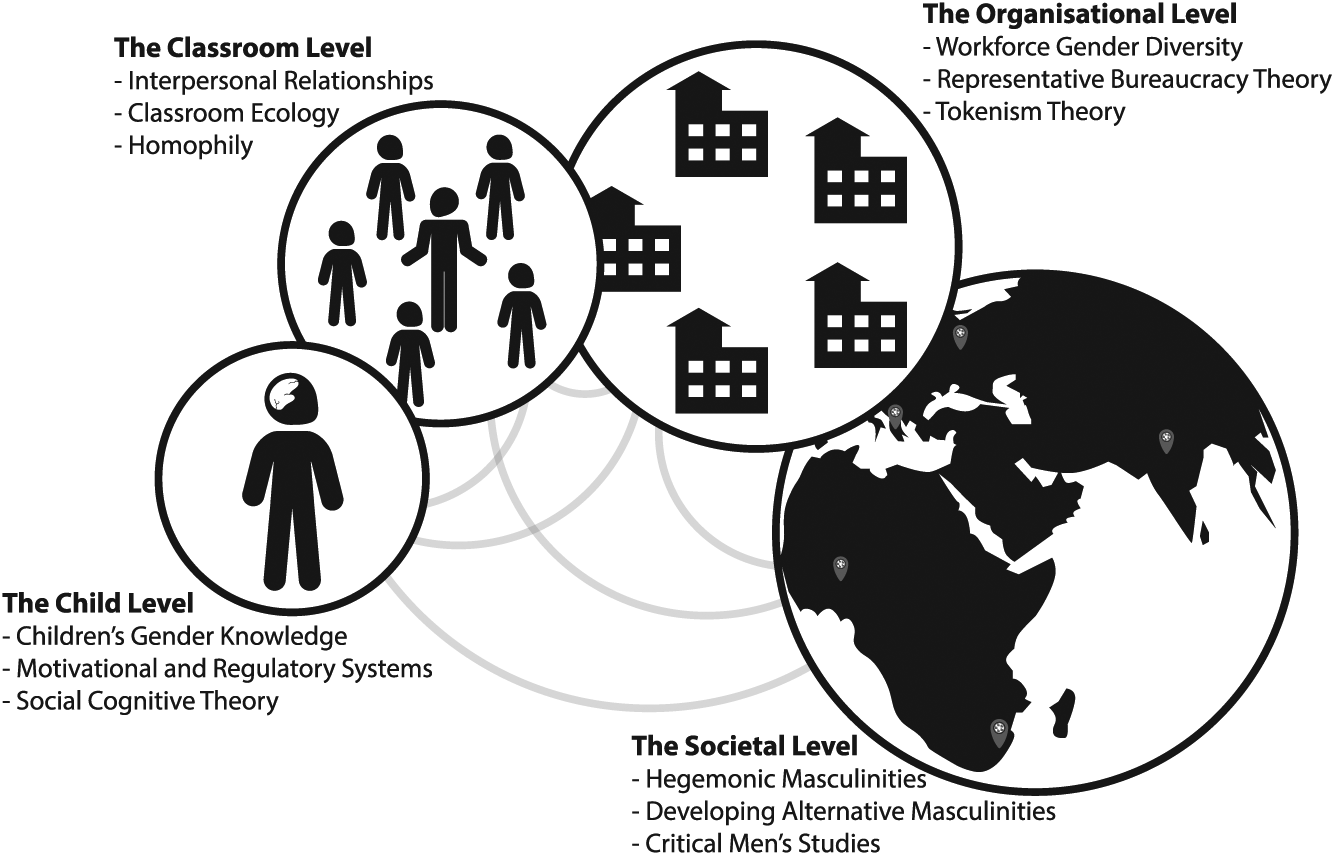
An intracultural, interdisciplinary, multileveled theoretical framework for researching a shortage of male school teachers.
The Child Level: Children’s Gender Knowledge
Schools provide important sites where children develop gendered identities and come to understand what it is to be male, female, trans-gender, or intersex, heterosexual, homosexual, or bisexual, and where they fit within those continuums. Social cognitive theory, and its focus on gender development and differentiation (Bussey & Bandura, 1999), provides a useful foundation for researchers interested in how teachers contribute to individual children’s gender knowledge. According to social cognitive theory, gender is a product of complex interactions between the social construction of gender knowledge and individual motivational and regulatory systems. One aspect of this development includes how boys and girls learn preferred gender-specific interactional styles through their observations of others (Martin, Ruble, & Szkrybalo, 2002). A potential implication, therefore, is that limited observations of men in schools may promote children’s erroneous generalization of all teacher characteristics as female-specific traits: thus perpetuating the view that the teaching profession (and by association, education) is better suited to women than men.
Although female teachers alone can model both “feminine” and “masculine” traits, children’s gender knowledge is extended when they observe men also demonstrating these traits. Hence, the underrepresentation of male teachers limits the range of observable gender performances for young children (Riddell & Tett, 2010). Schools should be representative of a range of masculinities, femininities, and alternative gender identities both between and within genders. It is important that students do not see their own gender as a defining or limiting characteristic but become aware of the range of gendered identities.
Diversifying children’s perceptions of men at school may be particularly beneficial for students who do not have access to positive and diverse male gender representations in other contexts. With rising concerns about how witnessing domestic violence affects children’s behavioral and emotional well-being (Holt, 2015), for example, the presence of men in schools may allow children to see men who are caring and nonviolent, and whose interactions with women are positive (Bhana, de Lange, & Mitchell, 2009). In addition, observing male teachers working under female leadership may challenge persistent beliefs about male dominance.
The Classroom Level: Interpersonal Relationships
While teacher gender plays a role in the construction of children’s gender knowledge, it is also tied to classroom dynamics and ecology. At the classroom level, the influence of teacher gender manifests in dyadic relationships, the classroom climate, and attitudes and beliefs. For example, female teachers tend to report closer relationships with girls, whereas male teachers report similarly close relationships with boys and girls (Spilt, Koomen, & Jak, 2012). Male teachers are more likely than female teachers to view boys as being academically capable (Mullola et al., 2012), and may also be more forgiving of boys’ externalizing behaviors (Bosacki, Woods, & Coplan, 2015).
Although these classroom-level differences are likely reflective of interactions with other levels which shape gendered beliefs and attitudes, including societal perceptions and gender knowledge (see Figure 1), teacher gender also appears to be important to students themselves. In our previous research, for example, Australian girls in sixth grade expressed a need for more male teachers to understand how to interact with men outside of their families, while boys claimed that male teachers understood them better than did female teachers (McGrath & Sinclair, 2013). Notably, both boys and girls reported that it was easier to relate to a teacher of the same gender. These findings raise the possibility that, like other classroom relationships (Farmer & Farmer, 1996), some student–teacher relationships may be homophilous.
The principle of homophily is the tendency to be drawn to and associate with people who have similar social and demographic characteristics to one’s self (McPherson, Smith-Lovin, & Cook, 2001). More commonly applied in network research, evidence of this principle is frequently observable in children’s friendships; peer relationships that form around commonalities such as age, gender, or ethnicity are typically more stable than other peer relationships (Farmer & Farmer, 1996; McPherson et al., 2001). By applying this principle to student–teacher relationships at the classroom level, we raise the possibility that teacher gender facilitates a sense of school belonging for students who are male, or who identify more closely with males, by providing opportunities to form relationships with teachers perceived as being similar to themselves (see also Hutchings et al., 2008). While boys tend to report lower school belonging than do girls (see Gillen-O’Neel & Fuligni, 2012), further research is needed to examine associations between school belonging and teacher gender.
The Organizational Level: Workforce Gender Diversity
While a gender-diverse teaching workforce is typically discussed in educational literature in terms of benefits for students, gender diversity is a goal in numerous industries internationally. Workforce diversity (of age, gender, ethnicity, and religion) is frequently pursued to foster an inclusive workplace and to ensure that an organization is reflective of the broader community it serves (McCuiston, Ross Wooldridge, & Pierce, 2004). Notably, such efforts have been found to positively impact employees’ job satisfaction and performance (Pitts, 2009).
Providing a useful foundation for research in this area is representative bureaucracy theory. Representative bureaucracy theory describes how the demographic composition of a workforce drives policy development and outcomes (Bradbury & Kellough, 2011; Grissom, Rodriguez, & Kern, 2017). While research directly applying representative bureaucracy to education is limited (being more commonly used by political scientists), research conducted in the United States has identified connections between the demographic composition of the staff body and students’ disciplinary outcomes, academic outcomes, enrolment in gifted programs, and referral to special education settings (see Grissom, Kern, & Rodriguez, 2015 for a review). Instead of focusing on the effects of individual teacher characteristics, these findings indicate school-level effects based on the composition of the teaching staff as a whole. For example, greater representation of female secondary teachers has been associated with academic outcomes for girls (Keiser, Wilkins, Meier, & Holland, 2002), and increased enrolments in tertiary courses where women are typically underrepresented (Stearns et al., 2016).
In addition to understanding how workforce diversity impacts policy output, and student outcomes, it is important to consider how workforce gender composition shapes the experiences of teachers (and preservice teachers) at the organizational level. Although now more than 40 years old, the ideas of Kanter (1977) may hold important information about how a lack of gender diversity might impact male teachers. According to Kanter (1977), where a proportional imbalance exists within a group, interactional experiences are fundamentally different. Focusing on the underrepresentation of women in male-dominated workplaces, Kanter identified a “token” group as one in which women make up less than 20% of the workforce. Kanter describes three perceptual phenomena that are experienced by token members: token visibility (tokens receive greater awareness than do dominant members of the group), polarization (differences between the tokens and the dominant members are exaggerated), and token assimilation (perceptions of tokens are distorted to fit generalizations). According to Roth (2004), these phenomena may be by-products of homophily processes. Thus, because of their minority status, male teachers are likely to have more heterophilous relationships with colleagues than are female teachers (see McPherson et al., 2001), placing them at risk of feelings of isolation and difference. Increasing gender diversity within the teaching workforce may therefore protect male teachers from such negative feelings, while also enhancing policy development and outcomes (e.g., disciplinary outcomes and referrals to special education settings).
The Societal Level: Alternative Masculinities
Extending beyond individual, classroom, and organizational reasons for schools to include both male and female teachers, we argue that there exist benefits to having male teachers that lie in the broader societal realm. At this level, male teachers are not simply important for workforce-balance reasons, but to destigmatize the participation of men in the lives of young children (Elliott, 2015). Indeed, although the pursuit of a gender-balanced teacher workforce may appear to reflect assumptions of heteronormative maternal and paternal gender roles, male teacher representation affords opportunities for stereotypical gender roles to be challenged by men acting outside of the boundaries of dominant masculine performances—to embody caring and nurturing traits and to normalize the participation of men in children’s lives (Warin, 2019).
A critical men’s studies approach (Connell, 1995) provides a useful foundation for research at this level. Based on this approach, masculinities (and femininities) are not rigid, but socially constructed. In this way, how masculinities manifest in schools is both a product and process of broader societal constructions. Connell described a hierarchy of masculinities: hegemonic, complicit, marginalized, and subordinate. At the top of this hierarchy, hegemonic masculinities legitimize male dominance, and are glorified and reinforced via elusive social perceptions and cultural conditions. Taking a critical men’s studies approach therefore provides a lens through which to understand the representation of male school principals in Australia, South Africa, and elsewhere, suggesting that the perception of male teachers as atypical does not extend to male principals because they occupy a position of greater power (Connell, 1987; McGrath, 2019b; also see status expectations theories and homophily in Roth, 2004, p. 193).
This lens is also particularly useful for understanding why fewer men may choose to teach young children. The reinforcing of hegemonic masculinity at the societal level pressures male primary teachers to uphold dominant forms of masculinity—even if they cannot, or do not want to—which consequently deters some men from entering the profession (Mills, Haase, & Charlton, 2008). Men who fail to adhere to hegemonic constructions of masculinities may place themselves at risk of becoming marginalized and depicted as abnormal (Mills, 2004), and are therefore unlikely to want to enter a profession where men, by virtue of being a token group, receive a disproportionate awareness share. For men who are homosexual, this may be particularly problematic (King, 2004). Homosexual men are often portrayed as feminized-men, regardless of individual characteristics (Connell, 1995), and discourse erroneously conflating homosexuality with pedophilia has amplified the “pedophilic threat” surrounding men who want to teach young children (Berrill & Martino, 2002; Cushman, 2008). In this way, rhetoric about pedophilia has become a gatekeeping mechanism to deter all men, but particularly those who do not represent hegemonic versions of masculinities, from the teaching profession (King, 2004; McGrath, 2019a; Moosa & Bhana, 2019). Although it may be increasingly difficult to do so, encouraging diverse groups of men to work as school teachers may promote the acceptance of alternative masculinities while legitimizing the role of men in children’s lives.
A Dynamic Framework
Thus far, the theoretical framework described identifies possible areas for future research investigating a shortage of male teachers at four levels. We note, however, that these levels coexist and are interrelated (see Figure 1). Although it is beyond the scope of the present article to detail every possible relationship, attention to the interrelatedness of these levels is necessary to ensure a comprehensive interpretation of novel findings. Above, for example, we identify that interpersonal relationships at the classroom level are guided by gender knowledge, and that this gender knowledge is developed at the child level (via children’s observations of teachers) and constructed at the societal level (via a hierarchy of masculinities). In addition, we recognize that the construction of masculinities at the societal level aids in understanding the positioning of men at the organizational level and their performance of gender at the classroom level.
To further understand the interrelatedness of these levels, one must consider how “time” transcends and binds these levels (see Bronfenbrenner, 1986; Pianta & Walsh, 1996). The inclusion of time (or history) as an element of the present framework suggests that a shortage of male teachers cannot be entirely understood by present circumstances. For example, we have described that education policies and political discourse in Australia and the racial segregation of apartheid in South Africa each aided the construction of teaching as “women’s work” over time. The passage of time also adds a cyclical layer to the framework. At the child level, children develop a cognitive framework for gender and use this information, together with their own motivational and regulatory systems, to guide their behavior and to anticipate responses from others. This framework carries into adult life and employment, contributing to the broader societal realm and, for those who become teachers, having subsequent effects on the child, classroom, and organizational levels.
Notwithstanding such a cyclical process, the inclusion of time also raises the possibility that each level is susceptible to instability and change. Given the nested nature of these levels, change at one level may instigate change at other levels. The susceptibility to change is tied to transitional processes such as beginning at a new school or with a different teacher, or the introduction of workforce diversity policies in a school system. For the individual student, such processes may also include migration. In Australia, for example, where 29.40% of the population were born in other countries, people from South Africa make up the seventh largest overseas-born group (Australian Bureau of Statistics, 2019). Children from South Africa (and other migrant backgrounds) who attend school in Australia negotiate additional cultural layers of gender knowledge and may therefore perceive or interact with male teachers in different ways to other students. For these students, feelings of school belonging may also be closely tied to teacher ethnicity or language background, highlighting a need for future research to consider intersectional characteristics of teachers and students.
Conclusion
The present article provides the first interdisciplinary and multileveled theoretical framework to advance research investigating a shortage of male primary school teachers. At the child level, we suggest that male teacher representation plays a role in children’s gender knowledge, and that this may be particularly important for some students. At the classroom level, we suggest that the presence of both male and female teachers appeals to diverse groups of students, facilitating a sense of belonging by providing opportunities to form relationships with teachers who students perceive as being similar to themselves. At the organizational level, we identify the role of teacher gender diversity in shaping policy output, student outcomes, and teachers’ experiences of the profession. At this level, we suggest that teacher gender diversity fosters an inclusive workforce that is reflective of the broader community. At the societal level we identify how the representation of male primary school teachers plays a role in developing alternative and equitable masculinities. Finally, we recognize the interrelatedness of these levels and the potential for change across and within these levels over time. Taken together, the theoretical framework presented herein provides a strong rationale for future research investigating a shortage of male teachers to encompass interdisciplinary perspectives and to identify interactions between teacher-gender, education, and culture across multiple domains.
Male participation in the teaching profession may continue to be limited, however, by competing social forces. On one hand, these social forces function to protect the masculine hegemony while simultaneously devaluing the predominantly female teaching profession. On the other hand, these forces function to assert and demonstrate female authority and competence in the near absence of men, preventing male teachers from becoming positioned as “rescuers” whose presence may be perceived to improve the status and effectiveness of the teaching profession. Taken together, these social forces may produce a self-perpetuating decline of male primary school teachers, whereby with lower representation there are fewer opportunities for young males to see teaching as a suitable career choice and fewer possibilities to challenge stereotypical gender roles. To increase men’s participation in the profession, in both Australia and South Africa, powerful intervention and support is therefore needed from those who hold political power. Strategic interventions are essential to increase the representation of male primary school teachers who are able to challenge gendered divisions by visibly promoting alternate, caring, and gender-equitable versions of masculinities. To effect change within the gendered contours of primary school teaching, such initiatives will require steadfast support and commitment from all school stakeholders.
Footnotes
Declaration of Conflicting Interests
The author(s) declared no potential conflicts of interest with respect to the research, authorship, and/or publication of this article.
Funding
The author(s) received no financial support for the research, authorship, and/or publication of this article.
