






Abstract
Despite clear recommendations for identifying and intervening with smokers, clinical preventive practice is inconsistent in primary care. Use of electronic health records could facilitate improvement. Community health centers treating low-income and Medicaid recipients with greater smoking prevalence than the general population were recruited for a pilot program. Key design elements used to engage centers’ participation include designating a project champion at each organization, confirming ability to transmit data for reporting and participation, and offering money to facilitate initial engagement; however, financial incentives did not motivate all organizations. Other methods to elicit participation and to motivate practice change included building on centers’ previous experiences with similar programs, utilizing existing relationships with state cessation centers, and harnessing the “competitive” spirit—sharing both good news and areas for improvement to stimulate action. These experiences and observations may assist others in designing programs to improve clinical interventions with smokers.
Keywords
In the past 10 years, New York City (NYC) has experienced a substantial decline in smoking rates, from 21.5% in 2002 1 to 14.8% in 2011. 2 This 31% decline is attributed to a comprehensive tobacco control program that included the following: cigarette tax increases for both the city and the state; legislation and regulation, such as requiring almost all workplaces, bars and restaurants, and parks, beaches, and pedestrian plazas to be smoke free; providing cessation services via the New York State Quit line and an annual large-scale nicotine patch and gum giveaway; educating the public about harmful health effects from both smoking and secondhand smoke through hard-hitting media campaigns and other activities; and evaluating tobacco control efforts to understand what strategies are the most effective. 3 However, more recently, reductions in rates of smoking have slowed and new strategies are being developed to further drive cessation rates.
In 2010, the Bureau of Tobacco Control within the NYC Department of Health and Mental Hygiene (DOHMH) received a Communities Putting Prevention to Work grant from the Centers for Disease Control and Prevention to implement innovative and multifaceted approaches to further reduce smoking rates. 4 One of the approaches was a pilot pay-for-improvement program with community health centers (CHCs) to improve primary care providers’ documentation and delivery of cessation interventions.
Research has demonstrated that providers’ advice to quit can be an important motivating influence for patients’ cessation attempts.5-7 Furthermore, evidence shows that delivering both counseling and medication, such as nicotine replacement therapy or other prescription drugs, produces the highest rates of success in assisting smokers interested in quitting. 8 However, research also demonstrates that providers do not regularly ask about or subsequently document patients’ smoking status, 9 leading to a lack of understanding of and a missed opportunity to reduce smoking prevalence.
Consequently, researchers have explored whether rates of quit attempts and successful quits may be increased by incentivizing providers to document smoking status and offer advice on cessation support and treatment. 10 A randomized study of Midwestern multispecialty clinics found that modest financial incentives to document patients’ smoking status resulted in improved documentation rates. 11 Pay-for-performance studies in the United Kingdom demonstrated improved documentation of smoking status, 12 increased provision of counseling (especially when financial rewards were greater), 13 and reduced smoking prevalence among patients with diabetes. 14
Electronic health records (EHRs) are becoming a common tool in the primary care setting. 15 Use of EHRs to facilitate documentation, reporting and review of data for clinical care, quality improvement, and performance offers an ideal opportunity to improve smoking cessation interventions in the primary care setting. 16 Including a clinical decision-support (CDS) tool and patient registry to identify smokers within the EHR may improve delivery of preventive services. 17 Recognition of the importance of documentation is demonstrated in stage 1 of the Meaningful Use (MU) standards, which requires smoking status documentation as a core element to receive Centers for Medicare and Medicaid Services incentives. 18
NYC DOHMH established the Primary Care Information Project (PCIP) in 2005 to support widespread EHR adoption and use among primary care practices that treat underserved populations, as a means to improve population health. The multifaceted approach by PCIP focused on (1) enabling health information systems at the point of care, (2) incorporating the routine use of health information by practices across their patient panel, and (3) maximizing payment for preventive services.19,20 Since 2005, more than 600 independent practices representing 9000 clinicians have been assisted by PCIP. This article describes the design process, implementation, and lessons learned from Health eQuits, a PCIP-administered pay-for-improvement program aimed at increasing smoking cessation interventions documented in EHRs in primary care practices. As a target, Health eQuits sought to increase identification and treatment of tobacco users by 25% and promote the treatment of 18 000 additional smokers in NYC over a 2-year period.
Methods
Target Population
The Health eQuits program targeted EHR-enabled organizations, particularly CHCs; most centers were designated as federally qualified health centers or included such sites. Centers were recruited from traditionally underserved neighborhoods with a higher prevalence of smoking or from those with a high proportion of Medicaid recipients because smoking prevalence among Medicaid recipients is higher than that of the general population (18.9% vs 14.8%).2,21 Additionally, in New York State, Medicaid coverage of cessation services includes reimbursement for counseling and prescription cessation aids for up to 6 months. To be eligible for Health eQuits, practices had to have been using an EHR system successfully for at least 1 year and had to be able to transmit aggregated EHR data to PCIP for program evaluation and reporting. PCIP identified 35 eligible health centers, and a project manager from PCIP contacted each eligible CHC’s senior leader(s) to introduce the project and explain goals, timelines, and data submission requirements. Leaders at each CHC were asked to create a program team to facilitate the Health eQuits activities. Though 22 CHCs initially enrolled in Health eQuits, only 19 were able to participate fully.
Selected Measures and Data Collection
PCIP originally designed Health eQuits to generate annual reports and payments. However, based on previous experience, quarterly reporting and payments were incorporated to generate immediacy as well as to allow quicker feedback to practices and more frequent improvement cycles. Quarterly, several key measures were collected as part of program participation: (1) number of patient visits, (2) documentation of patients’ smoking status, (3) smoking prevalence for each practice (calculated as current smokers/total patients), and (4) the number of current smokers receiving at least 1 cessation intervention (Table 1). An intervention was defined as whether a physician counseled the smoker for 3 or more minutes, provided a prescription for cessation medications, or issued a referral to the New York State Fax-to-Quit hotline. Incentives for participating CHCs were based on individual improvement in cessation intervention numbers over baseline. All participants were required to establish a baseline rate for each of the measures using data from the practice’s EHR 1 year prior to the program’s start. Incentive payments were $20 per additional patient intervention over baseline. Data were collected quarterly, and reports were generated to show practices their trends on each of the measures as well as the amount they earned each quarter. Total incentive amounts per CHC participant were capped at $20 000 for practices with 1 or 2 sites and at $50 000 for practices with 3 or more sites. Data from each CHC were either automatically transmitted to PCIP through preestablished connections through EHR vendors or manually extracted. For manual extraction, PCIP staff remotely logged into CHC data servers and performed queries to retrieve quality measure data on smoking status and cessation interventions. The process required a 2- to 3-hour appointment and up to 3 weeks to collect data from all participants. Data were de-identified and aggregated before uploading to PCIP. All data files were transmitted to PCIP in a secured file transfer format and uploaded into a set query language database for further processing.
Quality Measures Used in Health eQuits.

Technical Assistance and Reports
In addition to offering incentive payments for improvement, participants were offered additional training and resources for integrating cessation strategies. Among these were optimizing the clinical workflow by utilizing a CDS tool, training on billing and procedural codes to facilitate reimbursement from Medicaid or other payments for smoking cessation counseling, and training on motivational interviewing or additional education to assist providers in intervening with smokers.
Improving Clinical Workflow and Coding
The EHR of each participating practice utilized a CDS function designed to prioritize the preventive services associated with NYC DOHMH initiatives. 22 Specifically, the CDS utilized in most of the practices is part of the eClinicalWorks EHR software solution (eClinicalWorks, Westborough, MA) and generates passive preventive medicine alerts based on the patient’s demographics and medical history. The CDS prompts providers to order tests or to ask patients pertinent questions regarding health concerns related to chronic disease management. A detailed explanation of the CDS is provided in a report by Amirfar et al. 22 In short, data entered by a provider into the CDS-generated structured data fields are captured and subsequently become a part of the patient’s record, which may trigger other CDS alerts, and are stored in the EHR’s database that can be queried. For smoking cessation purposes, the CDS documents the smoking status and any subsequent interventions a provider performs with a few clicks of a mouse. PCIP staff presented first to the executive directors of CHCs on a practice-by-practice basis, describing how the incentive payments would be calculated and disbursed and demonstrating proper EHR documentation procedures. With feedback from the executive directors, PCIP developed group training sessions for clinicians, which included a program overview, demonstrations on how to correctly capture smoking-related structured data, and evidence-based training on tobacco dependence treatment. Centers were given on-site training by clinical quality specialists from PCIP; orientation and training sessions were tailored to the needs of each individual site. Emphasis was placed on using the CDS to capture providers’ actions, which were then used to calculate incentive payments and trends on quality measures.
Cessation Centers
PCIP referred practices to the New York State Cessation Centers (NYSCC) to deliver additional tobacco dependence treatment training, which included topics such as pharmacotherapy, coaching strategies, motivational interviewing, and working with special populations. The NYSCC training sessions were delivered separately from the standard Health eQuits training, if participant centers conveyed interest. In addition, the Health eQuits program manager also brought in experts in MU measures as another point of engagement and discussed how practices could leverage their EHR to achieve the standards set by MU. Two of the MU measures include smoking status documentation and cessation intervention with a smoker.
The following results are based on PCIP staff observations and informal feedback from participating centers as well as their experiences with the program. Additionally, program administrative data were used to assess participation and patterns for engagement. Data collected for program evaluation and progress on documenting patients’ smoking status and cessation interventions with smokers are being analyzed and drafted as a separate report.
Results
Enrollment: Participant Characteristics
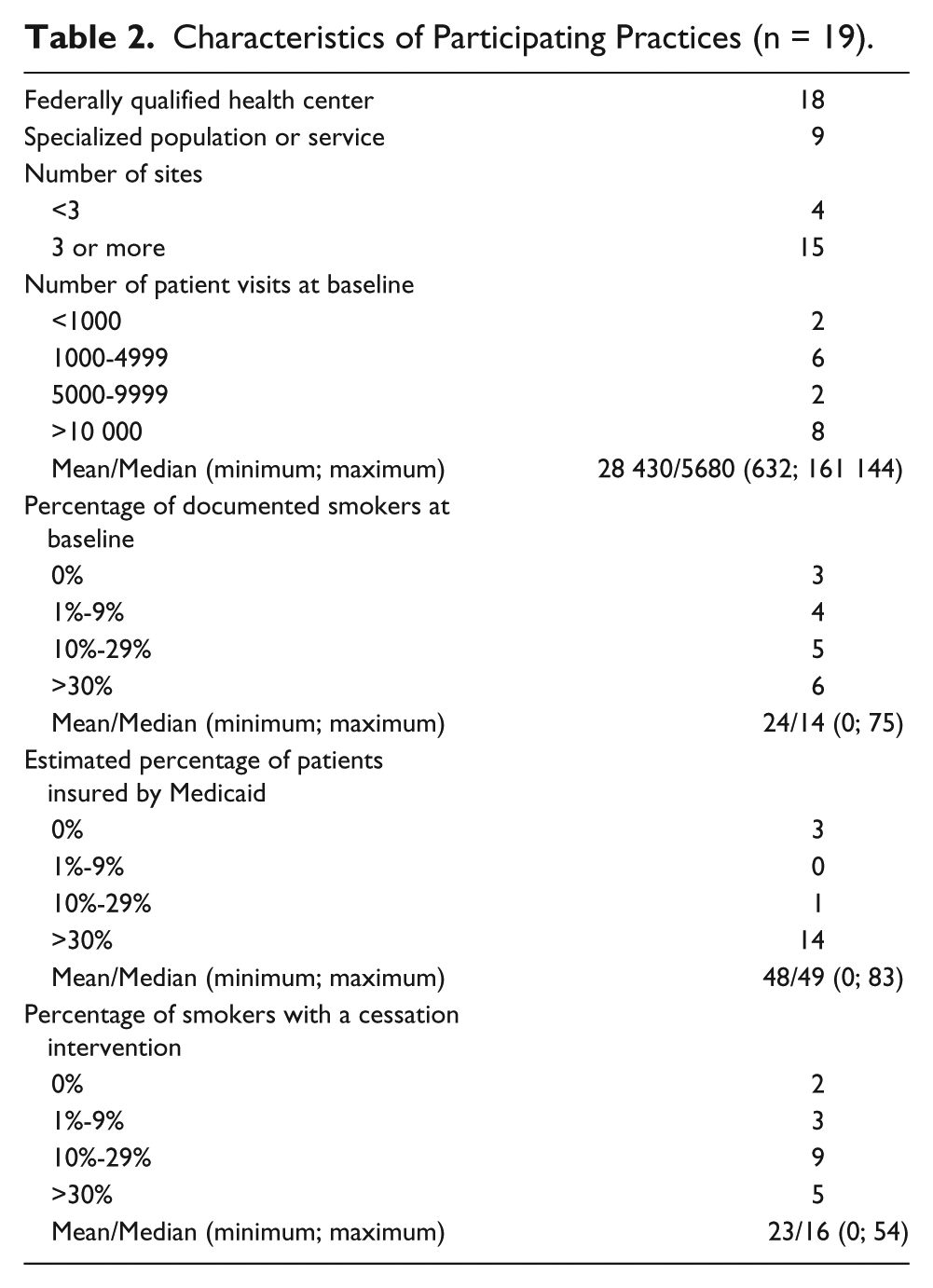
For this study, 35 practices were deemed eligible to participate in Health eQuits; 15 of these enrolled within the first quarter, and 7 enrolled in the second quarter for a total of 22. However, 3 of those 22 practices were not able to transmit data effectively and did not receive reports or incentives, thus effectively dropping participation to 19 practices. Characteristics of these 19 participating practices are listed in Table 2. The 13 practices that chose not to participate cited lack of interest, the perceived burden of a large time commitment, lack of resources to meet required objectives, and an inability to extract or transmit data as reasons. One practice decided that the maximum incentive payment available was not sufficient compensation for the effort to implement the program. With the exception of 2 CHCs, leaders of participating CHCs expressed interest in earning the maximum $20 000 to $50 000 in incentives. Practices differed greatly in size and patient population, with some focused specifically on the homeless, substance abuse populations, or women’s health.
Characteristics of Participating Practices (n = 19).
The engagement of senior leadership or assignment of a program champion varied by CHC. Some sites also had a dedicated manager and EHR technical staff. Even though practice executives were required to sign a contract that specified information technology (IT) involvement as well as a project time frame, sites with engaged senior leadership or program champions were more likely to be responsive and ensure that resources were allocated for improving documentation and practice changes to increase cessation intervention.
Data Collection and Measurement
Once collected, data were analyzed, and quarterly reports were generated to establish performance trends and incentive payments (Figure 1). PCIP staff worked to complete the reports and share them with the practices within a month after the end of a quarter. Timely reporting was important for engaging practices, raising their awareness of progress, and defining opportunities to implement workflow changes as needed (Figure 2).

Health eQuits program administration timeline.

Sample Health eQuits quarterly progress report.
Total annual visits for the 19 participating practices ranged from a little more than 600 to more than 120 000, and all were able to submit baseline data for the quality measures (Table 2). Smoking documentation rates among the practices ranged from 0% to 75% at the start of the pilot, and 10 practices had documented smoking rates that were lower than the city’s overall smoking prevalence of 14.8%. These data helped practices and their leaders become aware of the disparity between their practice’s presumed smoking prevalence compared with actual EHR documentation rates. Initial cessation rates recorded in the EHR ranged from 0% to 54% among the centers. Reviewing these data with practice administrators provided a teachable moment or tip-off that documentation as well as smoking cessation interventions needed improvement.
Use of Technical Assistance and Reports
Smaller CHCs, those with only 1 site, allowed for 1-on-1 EHR training with providers, whereas larger CHCs required group training and the utilization of “train-the-trainer” techniques to pass knowledge on to satellite clinics. These training sessions were completed on a rolling basis as practices joined the program. After the launch of Health eQuits, PCIP staff worked with practices on an ongoing, site-by-site basis to optimize clinical work flows to ensure that clinicians were implementing cessation interventions effectively and efficiently while minimizing the impact on the length of encounter per patient. PCIP also provided on-call technical assistance related to CDS alerts and other aspects of the Health eQuits program. These ongoing activities were viewed as a means to strengthen relationships between PCIP and participating practices by providing further information and motivating leadership and staff.
Once the reports became available, PCIP representatives collected ongoing qualitative feedback from CHC leadership concerning the usefulness of these reports. The final design, illustrated by the hypothetical example in Figure 2, incorporated suggestions from CHC staff to demonstrate results visually and show improvement over time. Reports with provider-specific information, rather than a summary of overall CHC performance, were often requested. Reporting on missed opportunities for incentive payment, as shown in the text accompanying the figure, was used to motivate some CHCs.
Discussion
The design of Health eQuits adopted several pay-for-performance program elements, described by Young et al, 23 for engaging and motivating CHCs to focus on quality improvement. With health IT, Health eQuits further emphasized the importance of timely data and valid measurement to track progress and identify areas for practice change. Observations from the experience of implementing Health eQuits are provided in the following sections.
Key Contacts and Accountability
Having a designated and accountable practice champion with commitment from senior leadership facilitated communication about Health eQuits and implementation of necessary practice change to meet program goals. For participants with clear champions, the champions mediated conversations with practice support staff (eg, information technician, data programmer) and helped identify solutions when issues arose (eg, data transmission failure, lower-than-expected counts of patients). In retrospect, establishing several key contacts at each organization prior to the start of the program, including a technical staff person knowledgeable about the practice’s EHR and a physician liaison to communicate the importance of recommended guides, would have smoothed several challenges that were encountered in the first year of the program. Ideally, practice executives who have signed the participation agreement would designate the contacts as well as agree to specify time frames for meeting program administrative goals. Some sites were difficult to engage because leadership had left or the assigned contact went on leave. Having multiple formally designated contacts on the agreement would have helped avoid delays in reengaging new leadership or reestablishing relationships with key practice contacts.
Data Availability and Validation
Many of the initial challenges to launching Health eQuits were related to establishing data transmissions or extractions for generating the core smoking status and cessation intervention metrics to help track progress. Where practical, Health eQuits was operated to be inclusive of all CHCs that had recently adopted an EHR. This presented an additional challenge of working with multiple different EHR systems and accommodating multiple formats for receiving data. In addition, the different EHR software had different locations or workflows for entering documentation. If resources are limited, future programs may consider using only 1 EHR software vendor or ensuring that there is a common data standard across multiple EHRs to ease data extraction and transmission processes.
Use of Incentives and the Business Case for Change
The use of $20 for each additional cessation intervention above the practice baseline was met with mixed reaction. Practice leaders appeared to be more motivated by the maximum possible amount of $20 000 to $50 000. However, for a few practices that received small payments for a quarter (eg, less than $500), the incentive was more discouraging than motivating; the reaction from the practices was that the amount of incentive was not worth the amount of effort needed to make practice changes. Separately, the state cessation center resources also provided referring CHCs with tips on how to code appropriately to receive reimbursement for counseling and referral for cessation programs and highlighted, where applicable, additional health plan coverage and incentives for cessation aides or intervention. Providing information on how to obtain appropriate reimbursement within existing billing policies may have had a more lasting influence on practice change than the offer of limited monetary incentives.
Facilitating Practice Change
Several factors observed in Health eQuits facilitated practice change. These were as follows: (1) sharing progress and trends on a routine basis, (2) harnessing the natural tendency to compete and be the best, and (3) making it easy to change documentation habits. Providing quarterly reports for review with practices, along with their observed trends and a comparison to a Health eQuits average, was eye opening to many practice leaders. This motivated them to get results, and improvement became a matter of pride and reputation. Taking advantage of the competitive spirit of both leaders and practice staff also helped identify solutions to practice change (eg, recognize an employee of the month, host contests between providers per quarter for the most improved). Developing and offering in-depth training and ongoing technical assistance to address the challenges at each site help to engage all levels of the clinical staff and practice administration, ensuring staff attention and interest in Health eQuits. Because not all issues could be addressed within a 2- to 3-hour on-site training, Health eQuits provided “on-call” staff to respond to immediate challenges and concerns raised by the practice; this person would assist the practice even if the issues were not directly related to Health eQuits. The availability of this person generated trust for the program; practices would be more open to identifying additional ways to improve their performance.
Limitations
This program focused on CHCs that recently adopted an EHR. The design of this program may not be useful to practices that have not adopted an EHR or that have already adopted an EHR and conduct quality improvement activities. In addition, much of PCIP’s team interactions were with leaders or managers of the centers. Health eQuits had less direct engagement with providers. It is unclear whether the program goals or incentives were communicated directly to providers across the practices.
Several limitations to the work are presented here. First, although most of the participating CHCs utilized the same EHR vendor, a few were using different platforms that required modified queries specific to their EHR, and these queries had to be run by their own IT staff. This presents challenges with regard to standardization of information and will be addressed during the evaluation of the project. Second, there are limitations to reporting only from structured fields. Although providers were encouraged to document smoking status or cessation interventions in the structured data fields, providers may document with free text in a progress note section, which is not a part of queries to extract data for reporting; this may have been a contributing factor to the low smoking documentation and prevalence seen in the baseline data of many practices. Additionally, the level of experience with data extraction among CHC IT staff varied widely, which required tailoring relationships to their individual levels of expertise. Finally, data collection, analysis, and reporting occurring every quarter established a very short time frame in which to analyze data, share results with practices, and assist them with improvement efforts before the next quarter’s data extraction (Figure 1).
Conclusions
Improving the delivery of clinical cessation interventions has the potential to reach smokers who are least likely to quit on their own. The program design of Health eQuits focused on increasing practices’ and clinicians’ awareness of their patient panel’s smoking status, capitalizing on data easily captured in the EHR. Key elements of the program included ensuring the availability of timely data to track trends and identify areas for improvement, and continued and persistent communication with either the practice leader, manager, or a clinical champion. Sharing quarterly reports and including an overall program average for the percentage of patients with a recorded smoking status and smokers with a documented intervention helped stimulate a competitive spirit among providers and centers. Though the amount of financial incentives offered was small per additional intervention, the potential to earn the maximum amount of $20 000 or $50 000 was important to engage center leaders. Communities seeking to improve their clinical cessation interventions can utilize some of the lessons learned from the implementation of Health eQuits.
Footnotes
Declaration of Conflicting Interests
The authors declared no conflicts of interest with respect to the research, authorship, and/or publication of this article.
Funding
The authors received the following financial support for the research, authorship, and/or publication of this article: This publication was supported in part by the New York City Department of Health and Mental Hygiene and by Cooperative Agreement Number 1U58DP002419-01 from The Centers for Disease Control and Prevention–Communities Putting Prevention to Work. The contents are solely the responsibility of the authors and do not necessarily represent the official views of the Centers for Disease Control and Prevention.