







Abstract
The competitions among manufacturing include development style, method, and procedure. Product design is a kind of high-level thinking activity which has the characteristics of multi-object and without explicit operator. While concurrent engineering can realize product development mode transformation, due to the complexity of concurrent engineering, designer cannot distinguish ontology connotation from denotation. So, it will inevitably encounter various conflicts during collaborative work, such as time conflict, function conflict, quality conflict, and fund conflict. Based on concept view, this article studies the distinguishability of concept ontology. The conceptual level reasons of conflict are analyzed, and standardized descriptions to resource organization and resource utilization are also given. Then, task decomposition, scheduling, and conflict resolution model are presented with constraints of time, resource, and task. Finally, design structure matrix is used to represent concurrent task structure and optimized by row–column transformation. The model is demonstrated with an example from motorcycle engine design, and the results demonstrate that the proposed model is feasible and will help for conflict resolution and task scheduling in concurrent engineering.
Introduction
With the rapid development of economy and globalization of market, the manufacturing environment has dramatically changed in the last few years. Worldwide competitions and new technologies have contributed to manufacturing industries (Zeng and Wan, 2006). Thus, it will stimulate rapid changes in manufacturing industries, causing a significant shift in design, manufacture, and delivery. Compared with traditional sequential method, concurrent engineering is considered to be the best practice in product development mode transformation (Valle and Vázquez-Bustelo, 2009; Yan and Wu, 2001), which focus on the organization and management of entire product development cycle, and requires developers consider the impact of process planning, manufacture, assembly, experiment, maintenance, and other phases of product life cycle at the beginning of project (Saaksvuori and Immonen, 2008). Concurrent engineering approach to product design and development has two major steps: establishing the product realization process, or taxonomy, and applying it to design and develop the total product system (Prasad, 1996). Then, the purpose of shorter time, lower cost, and higher quality can come true. Concurrent engineering brings some competitive advantage for enterprise; however, it also brings some challenges, such as proper task granularity, reasonable task priority, effective information interaction, and proper decomposition of resource. Effective decomposition and scheduling process, reducing conflict, managing resources, shortening time, and improving quality are key to concurrent engineering research.
Some researchers have proposed different types of methods on task decomposition and scheduling strategy. An estimated and optimized cost method has been proposed to obtain proper cost (Downlatshhai and Ashok, 1997). In uncertain iteration projects, Lagrangian method (LR) and Scheduling of Design Projects (SDP) methods have been used to solve task-scheduling problem by Luh et al. (1999). Based on task priority, genetic algorithm (Todd and Sen, 1999), RABCR algorithm (Kolish, 1996), and dynamical scheduling algorithm (Huang et al., 2002) were utilized for task scheduling and allocation. In concurrent engineering decision, an information management strategy among various activities was proposed (Nicoletti and Nicolo, 1998). An alternate framework called concurrent function deployment (CFD) was proposed for a workgroup-based engineering design process (Prasad, 2000). Concurrent degree (Xie et al., 2001) was proposed to describe the relationship between interaction information and cost. In order to obtain successful activities overlapping, some special principles (Zeng and Wan, 2006) and the better understanding about task precedence and technology structure (Krishnan et al., 1997) were also utilized. In knowledge representation and reasoning, the following methods were used to model product development process, descriptive matrix (Zadnik et al., 2012), and generic integration framework with a semantic feature model (Liu et al., 2010).
Except for elimination of coupling during decomposition, the concurrency of tasks is also an important issue. Fundamental principles for achieving best concurrency and simultaneity in concurrent engineering were presented (Prasad, 1999). An n-T looping methodology was implemented for complexity product. The methodologies of 3-T looping and three-level team structure were especially tested (Duhovnik et al., 2003). A two-level organization is more suitable for small companies (Duhovnik et al., 2001).
The above research are confined to the analysis and coordination of some specific conflict phenomenon, lack of systematic analysis from the perspective of product life cycle, so it is difficult to understand the conflict and thus resolve them. In this article, the conflict reasons are analyzed from the perspective of cognitive law of human cognition, which provides an effective guarantee for the design of the system.
Conflict description
Product design is a kind of high-level thinking activity which has characteristics of multi-object and without explicit operator. Due to the complexity of concurrent engineering, some conflicts, such as time conflict, function conflict, quality conflict, and fund conflict, will be inevitable. Conflict refers to the phenomenon of inconsistent, discordant, or unstable in some interrelated objects. There are many objective and subjective reasons for conflict, such as complexity of task, insufficient cognition, uncertainty of knowledge, unreasonable decomposition, and scheduling.
The implementation of concurrent tasks is the process which utilities all kinds of knowledge and improves them continuously, along with the emergence of conflict and then to be eliminated, therefore, better understanding and description of the nature of conflict will guarantee smooth implementation of concurrent engineering. In the cognitive process, people will obtain some concepts which have two basic features, connotation and denotation, and then sentence will be formed with concept in accordance with grammar. Finally, corresponding knowledge will be formed through appropriate reasoning. Base on concept view, this article analyses reason of conflict and its resolution method.
The ontology model of conflict and conflict resolution
The concept-ontology model is a kind of knowledge representation model which is proposed with combination of mathematical logic and set theory, and mainly includes the definition of representation model and operation model. In the representation model, the connotation and denotation of the concept are expressed as ontology and variant of resource, respectively. At the same time, the constant part is described by propositional logic, while the variable part is described by the Cartesian space within constraints of constant part. The constant and variable parts describe concept from different sides, and only the organic combination of two parts can give complete description to concept.
While in operation model, the accumulation of designer’s knowledge is a process of ontology’s improvement and variant’s reification, which includes some operation such as selection, union, migration, decomposition, and evolution. Design concepts are abstract and vague at initial stage of concurrent engineering. Along with continuous improvement of abstract concept ontology by some operation, relatively abstract concept will come into being. Relatively abstract concept is the combination of abstract concept ontology with some constraint facts, that is

In fact, relatively abstract concept ontology inherits abstract concept ontology, and then confirms facts through proper reasoning.
Definition 1: Conflict
If the coupled relationships among resources lead to ambiguity of concept decomposition and emergence of contradictory propositions, then the validity of result proposition cannot be guaranteed, which is called conflict.
Definition 2: Concept tree
During concurrent design process, designers will meet different abstraction levels of resources. While abstract concept ontology is constantly improved, variant is constantly specified, thus relatively abstract concept will be formed. According to relationship of connotation and denotation, different abstract concepts will form a kind of hierarchical structure, which is known as resource tree.
Theorem 1
In the construction process of tree, if variables in two or more operations are dependent variables, then those operations performed simultaneously will result in conflicts.
Proof
Suppose that ni represents the number of independent variables of i-th operation and N represents the number of independent variables in node variant.
If variables in two operations are mutually coupled, then number of independent variables contained in node ni will exceed N. That is

where k represents the operation number in node.
Therefore, it is beyond the scope of node variant’s constraint, so validity of proposition cannot be guaranteed within current constraints and result in conflicts.
Definition 3: Conflict resolution
The coupled variables are deleted by fidelity operation so as to obtain independent ones, refine and improve concept tree, which is called conflict resolution.
Theorem 2
If the number of independent variables in node ni is less than or equal to what is contained in node N, which means there are no coupled variables in concept tree, then the conflicts are successfully resolved.
Proof
In order to obtain independent variables, fidelity operations are used to remove extra coupled ones within node ontology constraints, and then, the number of independent variables within the operation will be less than or equal to what is contained in node variant. That is

According to theorem 1 and definition 3, the proposition can be proved. Based on theorems 1 and 2, fidelity operation can be used to delete coupling variables within conflict node. Along with concept ontology constantly improving, some conflicts can be eliminated.
Task decomposition based on design structure matrix
The decomposition and scheduling of concurrent task need to use and improve reasonable resource so as to avoid and reduce conflict, so task duration will also be reduced. In a sense, conflicts occur and can be solved continuously during concurrent task implementation, which presents characteristics of spiral type. The way means that there is continuous improvement in development process, technology innovation, resource constraints, and improving concept ontology in a higher level. Finally, designer’s ability of understanding essence of matter improves continuously.
Decomposition can reduce complexity and possibility of conflict, and also provides support to concurrent task. The degree of decomposition will directly affect the relation between dependence and parallel implementation degree. So, the following principles need to be considered during task decomposition process.
The independence of task. Coupling among tasks will cause conflict and resources iteration, which will increase time and cost of project. So, it needs to ensure the decomposed task is independent as far as possible.
The solvability of task. The decomposed tasks have characteristics of solvability and convergence under existing resource constraints. If the task has better independence and requires fewer resources, then its solvability is higher, and conversely, low solvability.
The granularity of task. The decomposed task has characteristics of strong relevance within task and low coupling among tasks. Large granularity task will have strong independence and delayed information, so its parallelism is lower, solvability is poor, and duration will increase; on the contrary, inconvenient management will happen among small granularity tasks.
Design structure matrix (DSM; Danilovic and Browning, 2007; Steward and Donald, 1981) is a kind of n-order matrix which is used to describe interaction between various elements of the matrix, shown in Figure 1. So, it is beneficial for visualizing complex project and provides effective support for reasonable task sequence and iterative strategy. Element aij in matrix is indicated by a blank or •, if relationship between the i-th row and the j-th column is (i ≠ j), the element aij is •, otherwise, aij is blank, and elements aij in main diagonal (i = j) does not indicate any information.
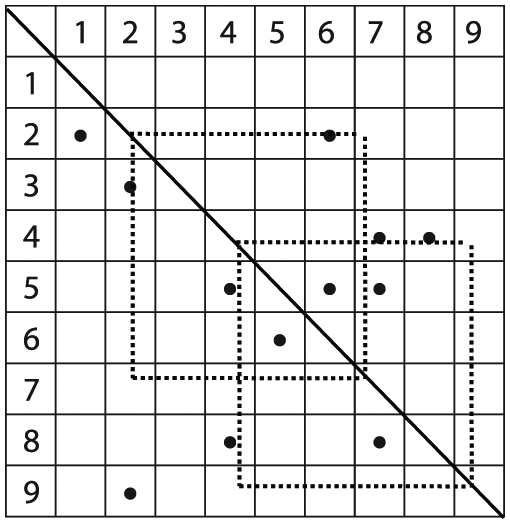
Design structure matrix.
In concurrent engineering, dependent tasks are difficult to be represented by single DSM. In order to minimize coupling among tasks, it needs to be represented by multilayer DSM through decomposition. The matrix is decomposed into a diagonal matrix or triangular matrix, while diagonal matrix represents coupling among tasks and triangular matrix is a kind of decoupling design. Obviously, elements in lower triangular matrix can be executed sequentially. However, it is impossible to get a pure lower triangular matrix because there are more or less interactions among elements, so it is better to get matrix block as minimal as possible.
In order to get minimal matrix block, we need to turn the DSM into a lower triangular matrix for less interaction. The best way is to move elements to diagonal as closer as possible, which will show iterative elements clearly and weaken process information conflict. So, elements are divided into composite tasks according to diagonal, while precursor elements are arranged in front of composite task.
The decomposition and combination procedure is as follows:
Step 1. Identify independent tasks. That is to find all elements in rows and columns that are blank. At first, the row and column of independent tasks need to be removed, and then add them to the front of DSM after finished.
Step 2. Determine source task and end task. Source task, which means that row elements in matrix are all indicated by blank or zero, need not require any feedforward information to perform. Information generated in end task, which means that column element in matrix are all indicated by blank or zero, is not required for any other one.
Step 3. Row–column transformation. Transfer • from the upper location of diagonal to lower location, and then determine task sequence gradually according to source task.
Step 4. Confirm task sequence. When it is difficult to determine task sequence, they need to be marked in one box. Through corresponding transform, the box is moved to diagonal as closer as possible, and then the independent tasks are placed in front of DSM.
Step 5. Group task. Based on the above steps and three principles of decomposition, task sequences are divided into different groups for schedule.
Decomposition can get some task sequence, in which coupling degree is relatively small, so they can be performed in parallel mode. Coupling degree among sequence is larger, so they can be performed in sequential mode. In this way, resources can be used reasonably, conflicts are avoided or reduced to some extent, possibilities of iteration are reduced to lower level, and hence time is shortened and cost is reduced.
Conflict resolution based on task scheduling
In order to improve parallelism, some methods must be performed, such as continuously improving concept’s connotation and denotation, reducing uncertain concept factors, and carrying on effective decomposition and scheduling.
Beyond that, interfaces across decomposed tasks should be given to address issues. As parallelism degree increases, large amount of interaction information among subtasks need to be processed timely, which include manufacture data among different phases and different teams, consistency of heterogeneous databases, and data exchange between different communication protocols. So, some clear object for task decomposition and service discovery can be obtained by concept ontology, resource sharing, and collaboration of information can be realized by web service technology without changing the structure of business logic. The relationship between time, capital, and parallelism is shown in Figure 2, which shows that interaction information is not the more, the better; concurrent degree is not the bigger, the better, in which point M presents a balance between interaction information and parallelism, namely, the minimum cost point.
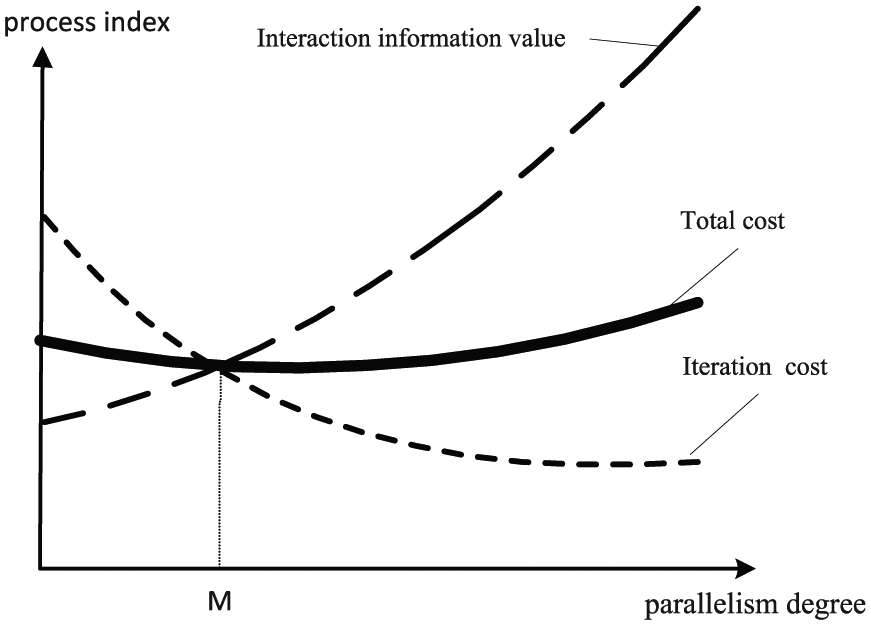
Qualitative relation between process index and parallelism.
Under certain restriction, many tasks can be executed in different operating spaces, which have different difficult levels, resource consumption condition, duration time, and other factors. The scheduling is preformed according to task priority, which mainly takes following factors into account:
The estimated finish time ti. In essence, concurrent process is an iterative process. If a task iterates repeatedly for a longer time, the whole project will be delayed. Therefore, longer the time, the more important the task.
The length of task chain. The length of task chain refers to number of tasks which are affected by specific one from beginning to end, denoted by li. Longer the chain, the more closer to the top task, and the more important it is.
The difficultly of task. The difficulty is denoted by di. Within same condition, the difficult task should be performed before the easier one. It is necessary to find the more difficult or cannot-solved task as soon as possible, so as to modify the program.
The degree of resource confirmation. Some design parameters and function factors have characteristics of uncertainty, fuzziness, and so on, which will be transferred to other phases along with design procedure. In the meantime, those uncertainty factors will lead to instability of concurrent task. More clear the connotation description, the more definite the denotation division, and higher confirmation of resource. The degree of resource confirmation is denoted by qi.
The priority Pi of task is defined by the following

where λ1, λ2, λ3, and λ4 represent different weight factors, respectively, which are determined by experienced knowledge of domain experts.
With deeper understanding and utilization to resources, scheduling and implementation of concurrent tasks is in progress. Considering resource integrity, reliability, priority, and other factors, the scheduling model is shown as follows
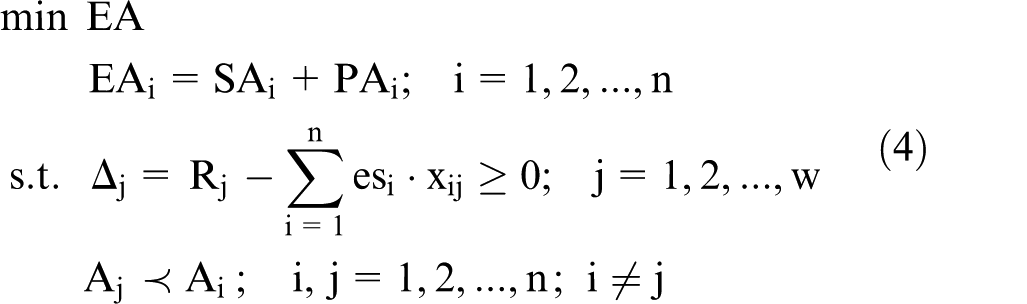
where Ai denotes the concurrent task i, SAi denotes the start time of task Ai, EAi denotes the end time of task Ai, PAi denotes the duration of task Ai, ES is an n-dimensional vector in which esi denotes the status of task i, X denotes the task-resource matrix in which xij is the number of resource j meets to task i,
In scheduling process, the task whose upstream tasks have finished acts as current one to be executed. When many ones can be executed in parallel, a conflict is likely to appear because of some resource constraints. If existing resources cannot meet the current task, it will not be started. So, it is necessary to schedule task so as to find other one that meets the resource constraints. The process of task scheduling is shown in Figure 3.
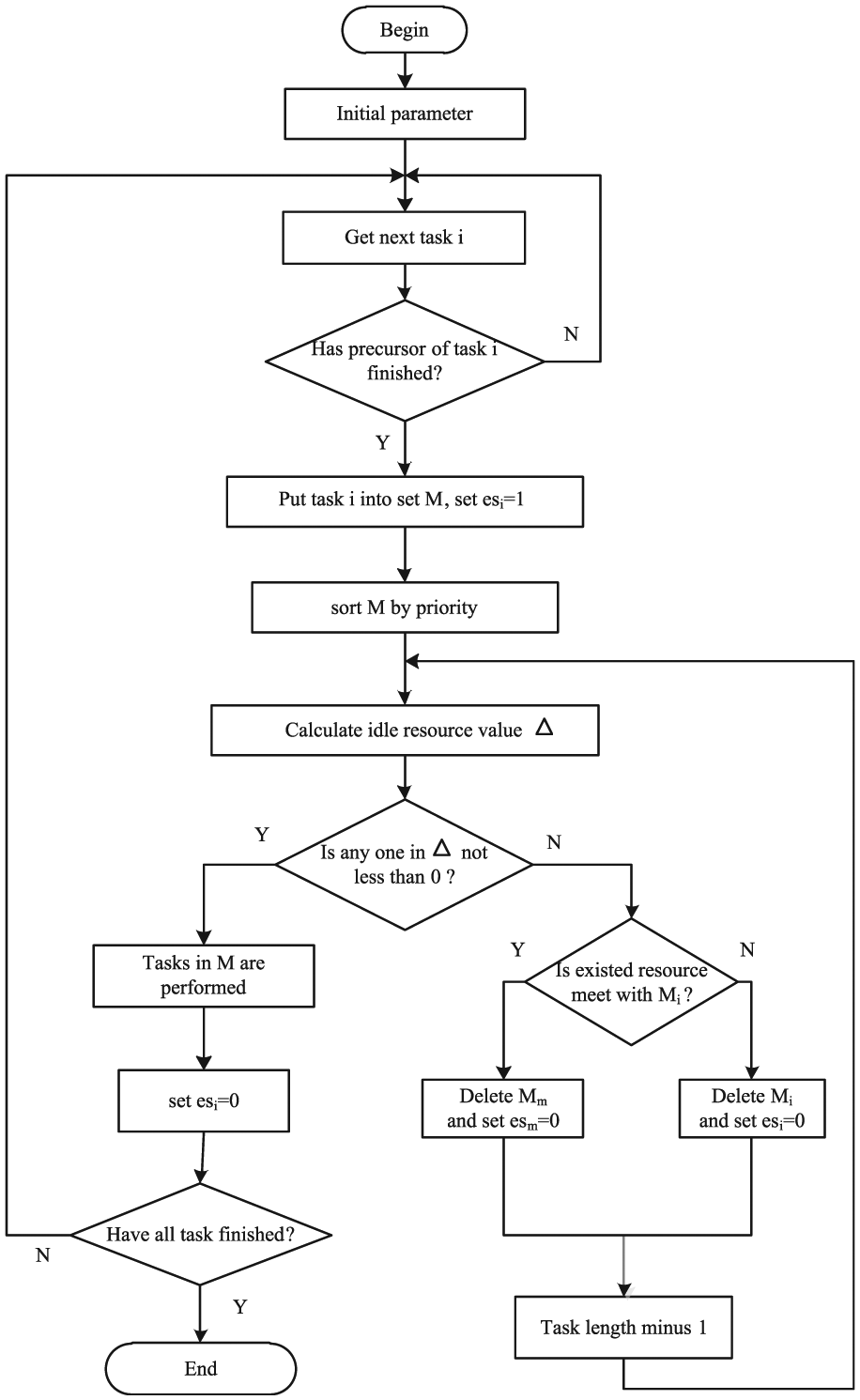
The process of task scheduling.
As mentioned above, task decomposition and scheduling are equivalent to decomposition and adjustment of tree node. All subtrees of a node can be performed in parallel, and the relation between the precursor and the successor nodes is sequential in time. In order to reduce the overall duration time, we should get successor of each node as much as possible, namely, higher parallelism. The division of resource tree should be balanced so as to get the minimum depth, thus whole task can be completed within a short time. During conflict resolution process, task priority and idle resource principle should be taken into account.
Scheduling based on task priority
The objective of this principle is to finish the task as early as possible, and resource allocation mainly takes the following factors into account:
Task intensity priority. The task intensity is the ratio of the successor task number to the total task number, denoted by CI. Task intensity evaluates the impact of a task on its successor; the bigger the task intensity, the more priority the resource.
Delayed task priority. The delayed task may postpone the total project. So, they should be given priority to resource allocation.
Earliest start task priority. The output information of earliest start task effect on successor; the more early the start time, the more important the task.
Longest duration task priority. Concurrent design is an iterative process in essence. If a task iterates repeatedly for a long duration, the whole project will be delayed. Therefore, long duration task is important.
Scheduling based on idle resource adjustment
Some resources may be used full time or part time in concurrent task. If task released some resources midway, then a kind of semi-parallel and semi-sequential status will emerge. So, it is necessary to adjust task status according to the amount of idle resource. The relation between the resource j and the task i is shown as follows

where
Within resource constraints, decomposition and scheduling of concurrent task is an iterative process with selection, operation, reselection, and reoperation. According to the principle of maximum resource distribution, it is required to calculate the amount of resources for each task. First, resources are distributed to task with highest priority. If it cannot meet the resources’ requirement, namely,
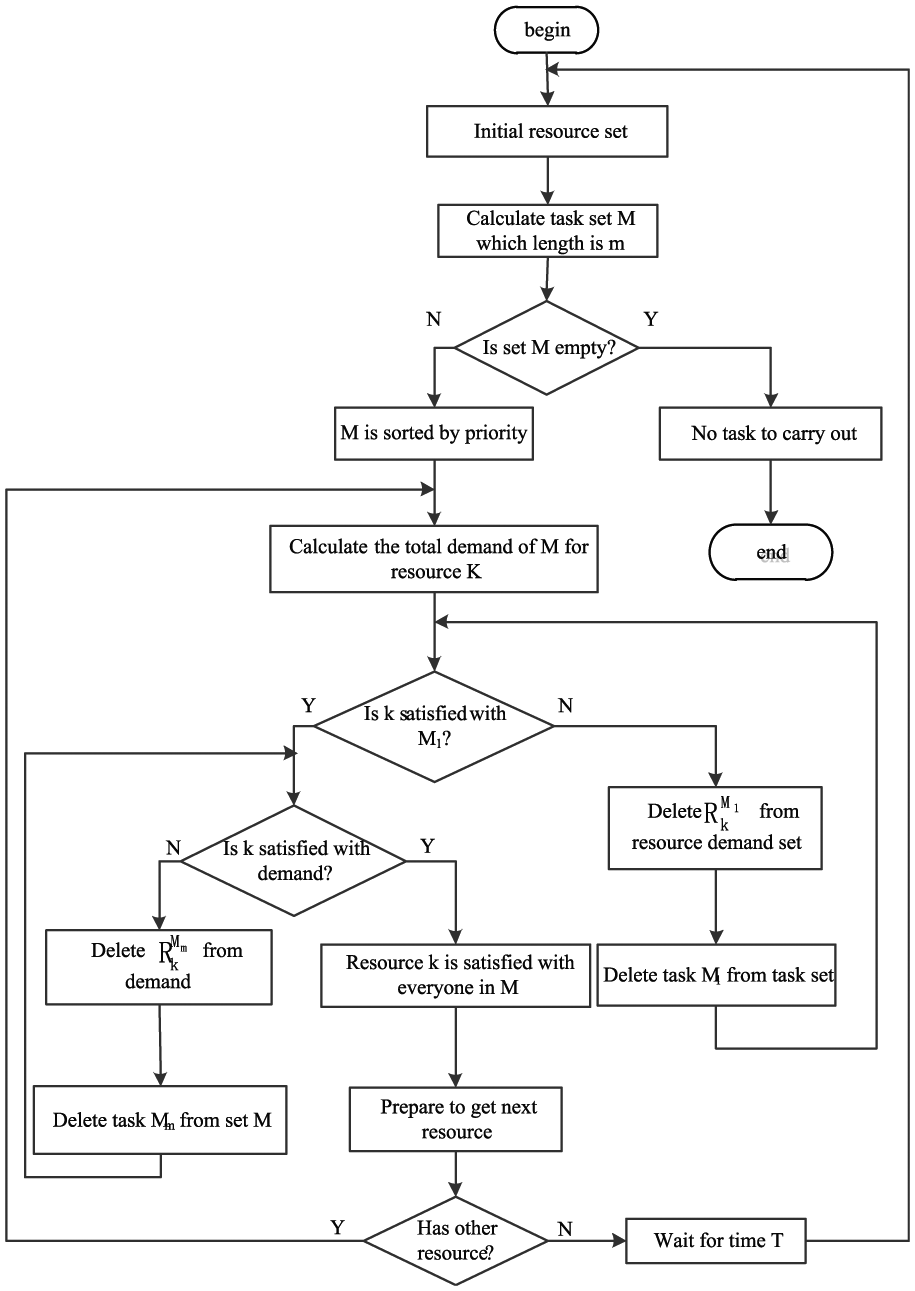
The process of conflict decomposition.
Application example
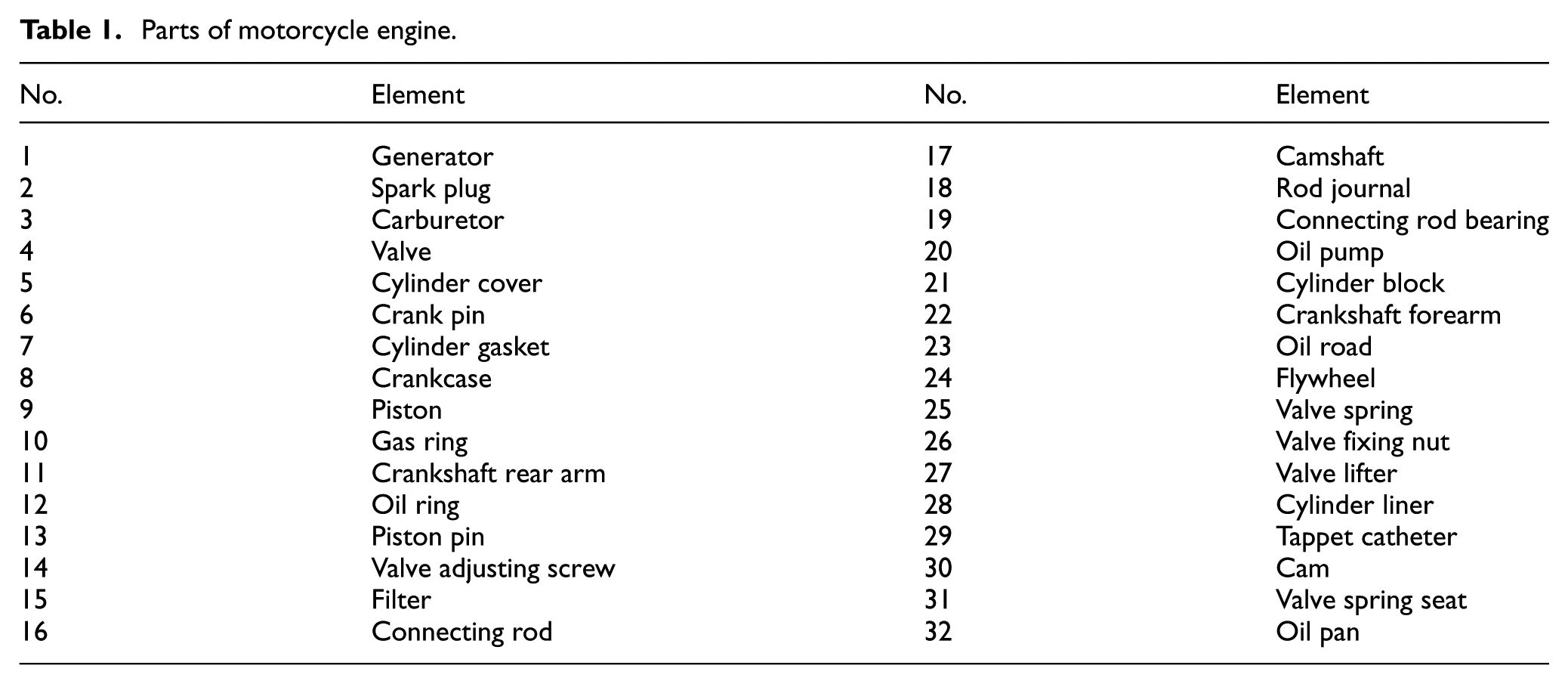
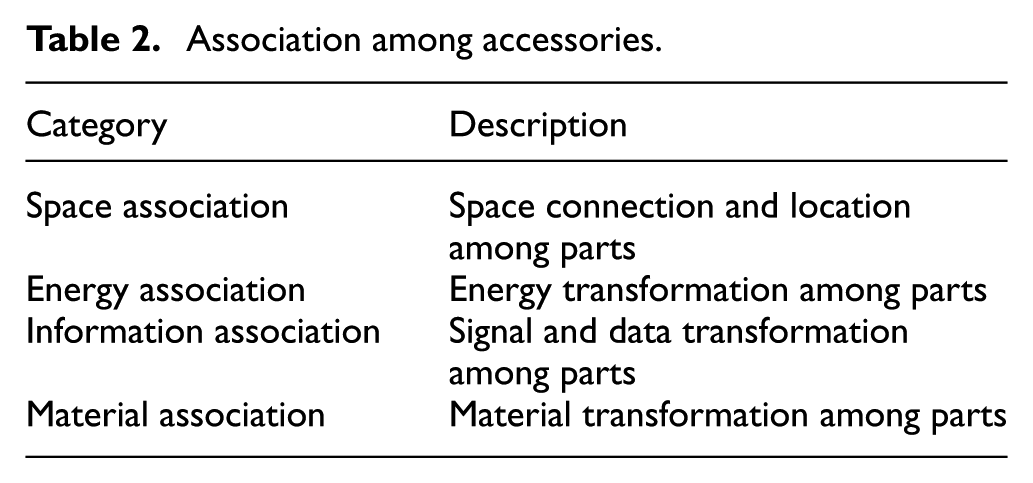
The example based on a certain type of motorcycle engine development is given, which needs to schedule the assembly sequence of different parts. Motorcycle engine is composed of many components, which is a complex technology engineering. In engine manufacturing process, department structure, multifunction team, and resources deployment are re-planned to ensure manufacturing process with a proper parallelism and effective conflict resolution, which is shown in Figure 5. The parts of engine are shown in Table 1, and the product structure matrix is shown in Figure 6. Table 2 shows the relationship among accessories.
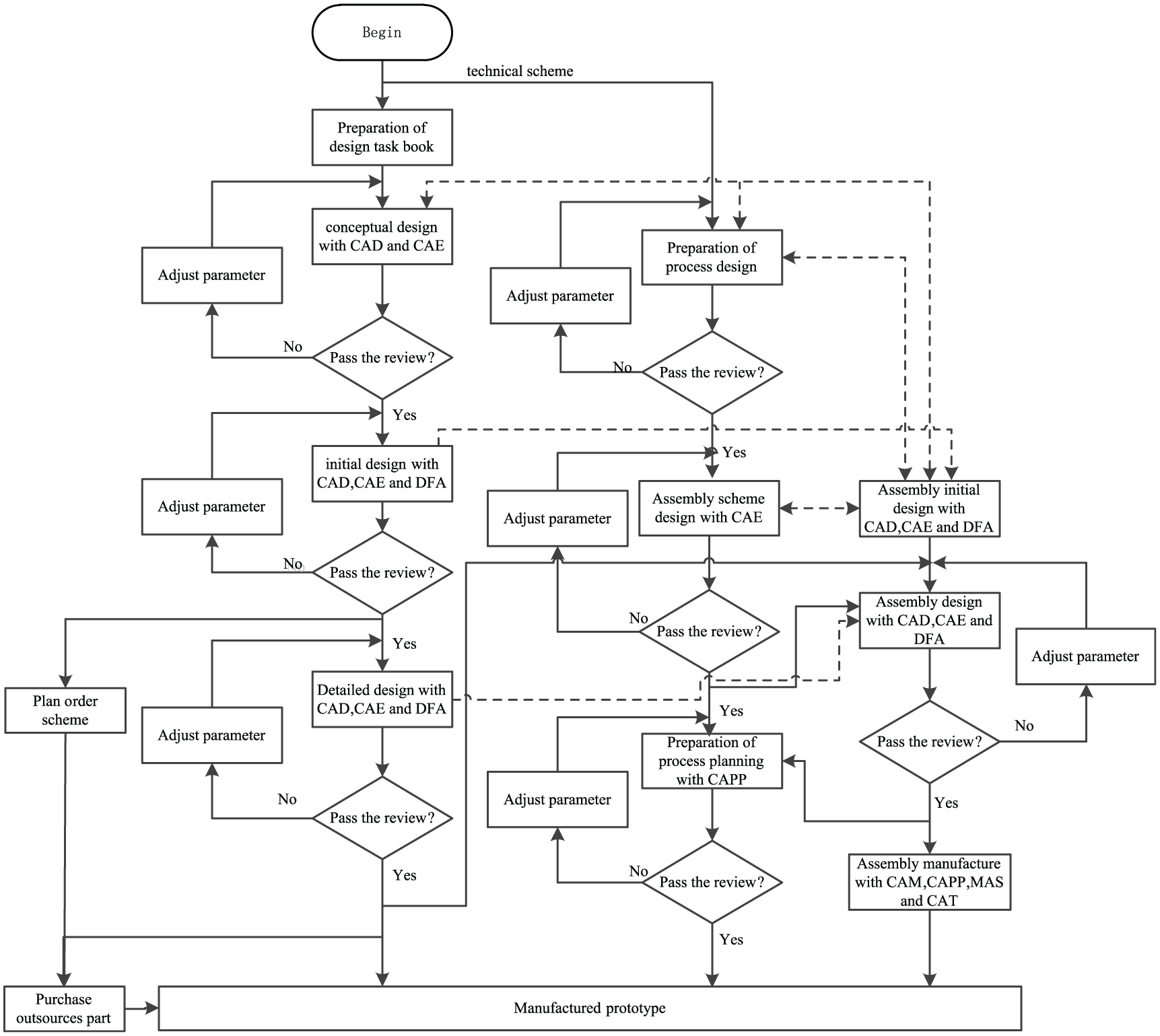
The concurrent development flowchart of motorcycle engine.
Parts of motorcycle engine.
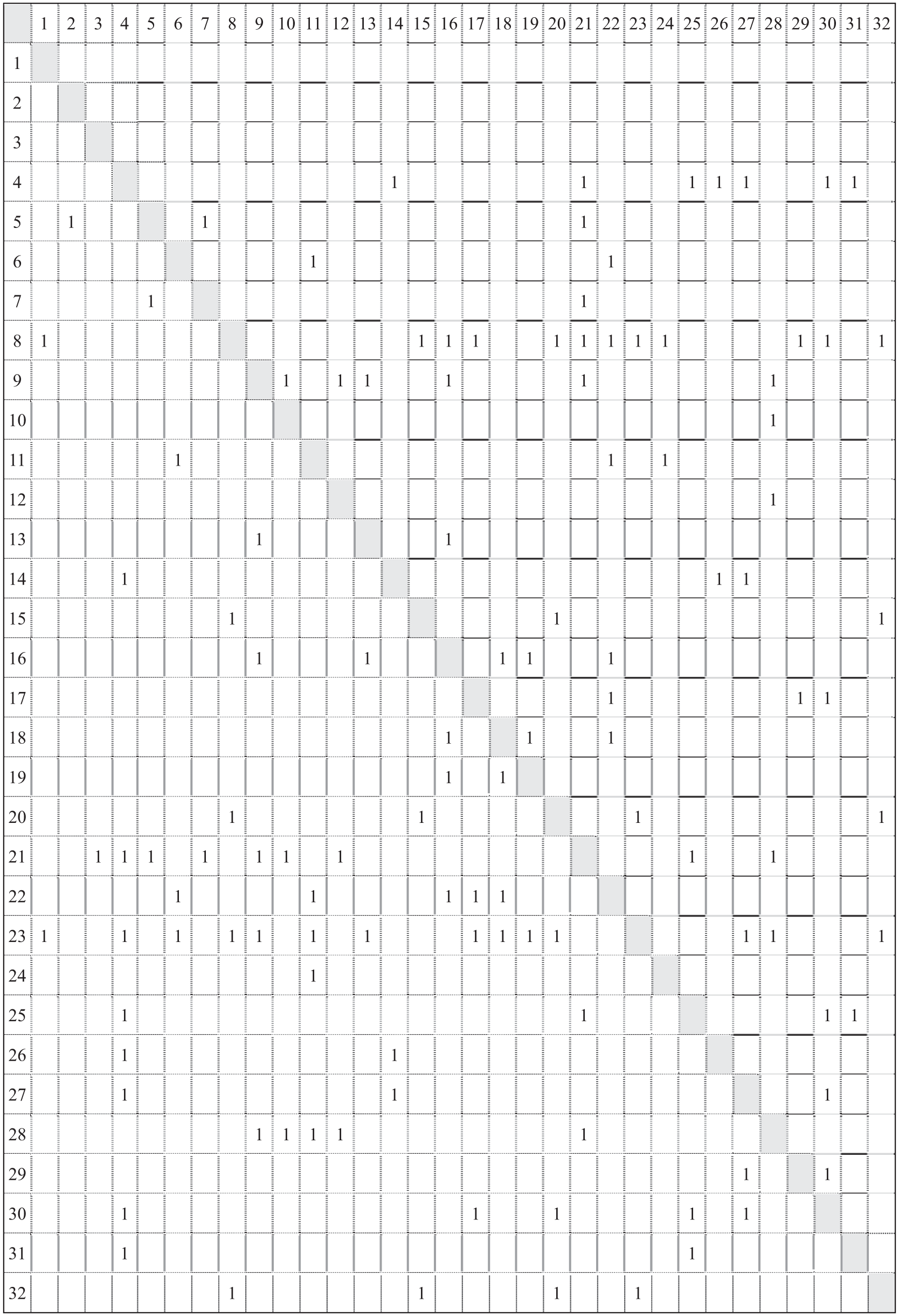
The DSM of motorcycle engine.
Association among accessories.
In Figure 6, links between elements are scattered in DSM model. According to this sequence, resource conflict will become more frequent and it is difficult to find a good grouping scheme. Even if successful task decomposition takes place, it is difficult to form a better task scheduling because of some interactive tasks. So, DSM should be optimized further so as to find a better decomposition scheme.
Figure 7 is the optimized result after row–column transformation, from which we can draw a kind of grouping result marked by shadow box. Tasks 1, 2, and 3 are independent tasks which can be performed separately, and the remaining sequences have strong coupled relationships which can be performed by combined task, respectively. Those 32 tasks are divided into eight optimized sequence, as shown in Table 3.
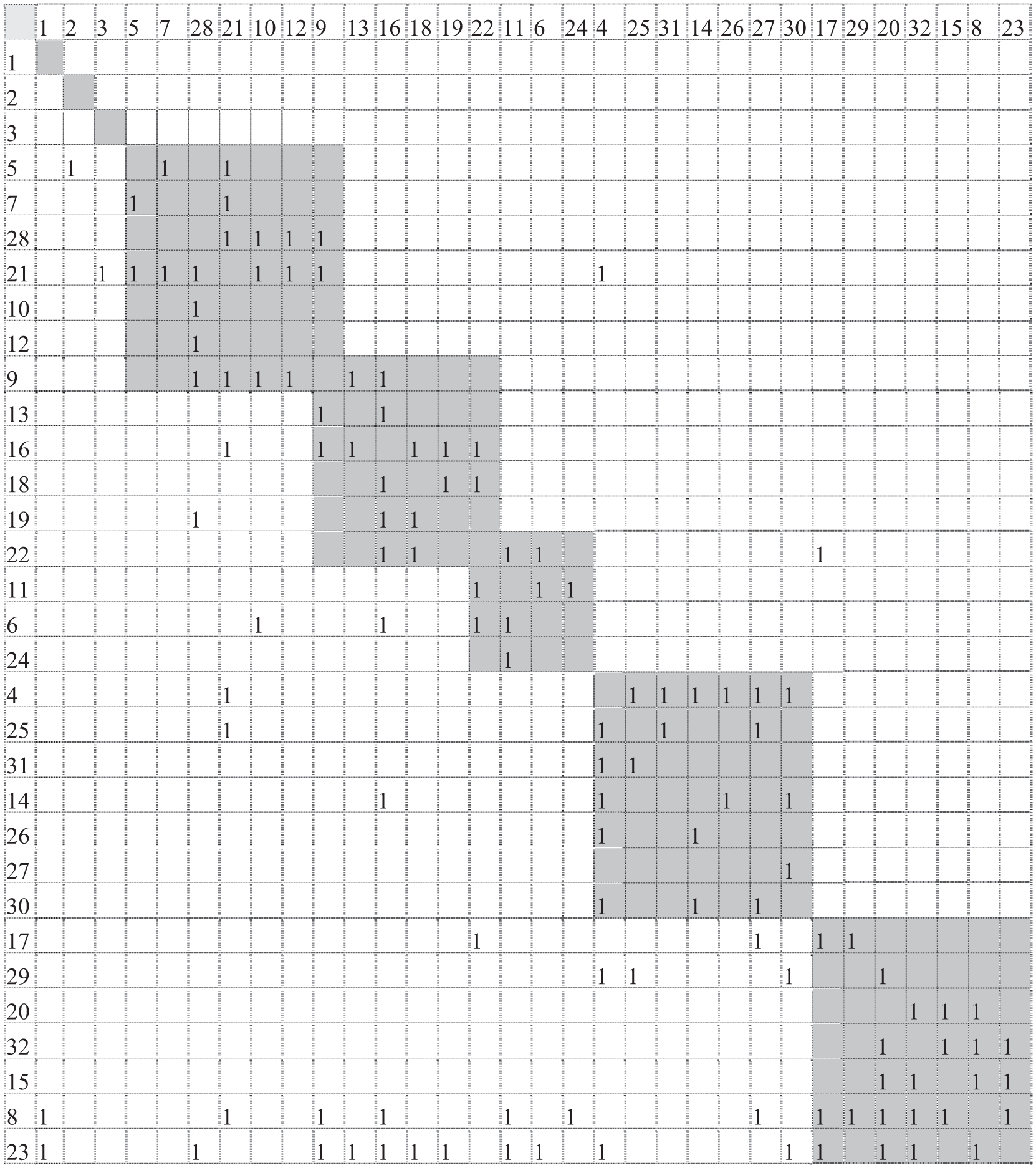
Optimized DSM.
Decomposition of combination task.

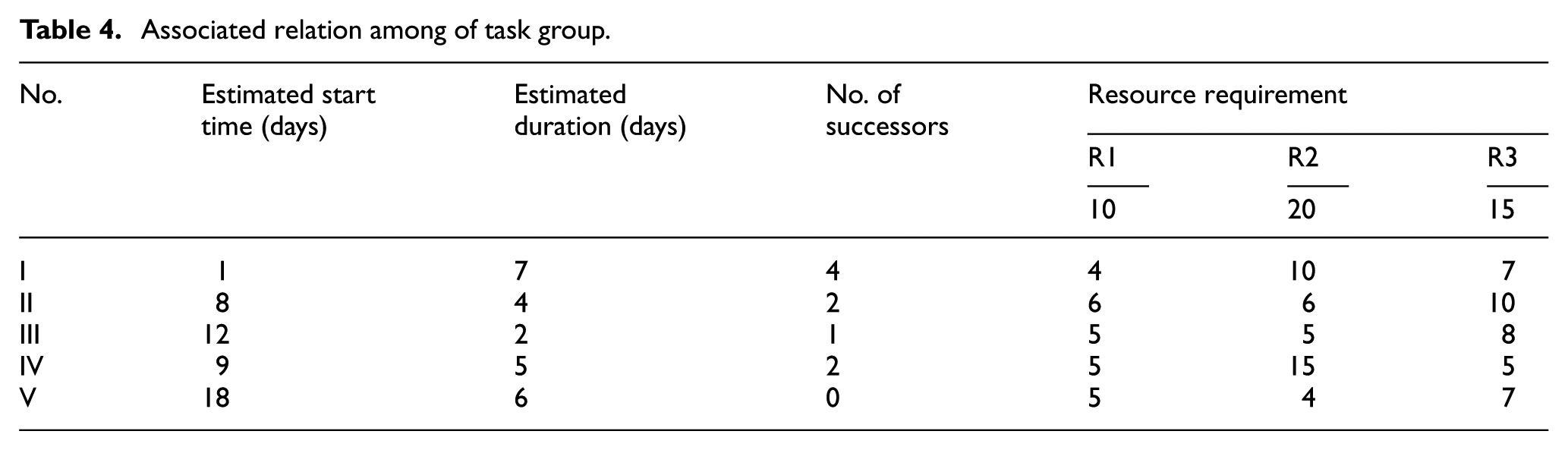
The associated parameters are shown in Table 4, in which the total duration of project is 24 days in sequential ways. According to Figures 3 and 4, we can obtain several strong cohesive teams. Then, the total duration are reduced to 22 days after proper task scheduling and conflict resolution. This indicates that decomposition and scheduling can help reduce the complexity and cost in concurrent engineering.
Associated relation among of task group.
Conclusion
In concurrent engineering, appropriate decomposition provides possibility to parallel implementation, effective scheduling provides guarantee on process, and proper conflict resolution promotes better understanding to new resources. The rethinking and reuse of resources lead to innovative ideas and methods. To some extent, resolution of old conflict provides possibility to emergence of new conflict, which promotes technological innovation. Therefore, correct understanding and effective use of resources, such as demand, time, money, experiment, management, equipment, and design method are important to concurrent engineering.
This article gives description to concept connotation, denotation, and their relation based on concept–ontology model. Dependence among task can be reduced by appropriate division, perfect concept description among downstream tasks, and reduced uncertain factors among tasks. DSM is used to represent concurrent task structure and optimized by row–column transformation. Task scheduling and conflict resolution scheme are presented so as to eliminate or weaken resource conflict. The model is demonstrated with an example of motorcycle engine design, and the proposed model can help designer to schedule the proper development sequences.
In future research, duration, cost, and other factors are used to optimize the decomposition and scheduling sequence, and thereby build a decision support system to evaluate the impact of scheduling strategy from a systematic viewpoint.
Footnotes
Acknowledgements
The authors would like to thank all of their colleagues and reviewers for their valuable comments and suggestions.
Declaration of conflicting interests
The author(s) declared no potential conflicts of interest with respect to the research, authorship, and/or publication of this article.
Funding
The author(s) received no financial support for the research, authorship, and/or publication of this article.