






Abstract
Due to the current and highly competitive industrial scenario, the technology-oriented organizations have been making routine adjustments to the conventional IPDP, in order to seek more profitable business models. Identifying the product functions, as well as its importance - perceived by the consumer - and being able to associate this information with manufacturability and assembly aspects, is fundamental to achieve more competitive, low-cost and higher quality products. This article objective is to evaluate this method concept, applying it in an industrial project. In order to assess the method within the complete integrated product development process (IPDP), the activities related to the conceptual and preliminary phases of the project delineated this article limits. This study selected a subgroup of the white goods industry, where first the traditional models of VE were applied in the conceptual design phase. Subsequently, the classic DFA models were applied in the preliminary design phase. Thus, it was possible to apply the proposed iterative method, where the alternatives generated with the DFA were cyclically re-evaluated, function by function, in the previous stage of value analysis. With this, this study came to the method assessment, its gains and limitations. Then, the original design was compared with the solution after the proposal application, without the method used. Finally, this study verified the influence of the method on the balance between the value and the cost of each function, in addition to the direct comparison of the solution final cost with the version without the method application. Among the results, this article presents a report showing the method viability, its particularities, impacts, and limitations.
Keywords
Introduction
Assessing the functions of a product and associating them with the manufacturability aspects is crucial to reducing the manufacturing cost. Similarly, delivering project solutions with real costs, compatible with the values perceived by the final customer, becomes a relevant aspect for the success of a new launch. Even in a Concurrent Engineering (CE) environment, there are no relevant tools that associate the value engineering (VE) concepts, when each function importance is measured, with cost optimization models in Design for Assembly (DFA). Setti (2021) suggests a method that iteratively associates VE with DFA.
However, this is a complex and non-trivial process since all the information from these multiple perspectives must be shared simultaneously, effectively, and efficiently among all the agents involved in the product life cycle, where the representatives of all company areas should work in a CE environment (Szejka et al., 2017). These limits between the various departments of technology companies have collapsed for some time; on the other hand, even in a CE environment, we can perceive that some steps are still treated alone. Fundamental discussions for a product definition, conducted in previous stages, are avoided from being brought to light. For example, there is no further discussion of the functions of new development, after moving from the conceptual design phase to the preliminary design phase, where, formally, IPDP tools are used with a focus on solutions.
According to Rivière (2015), many progressive companies are interested and investing in methodological proposals to produce high-quality products at a lower net cost of production (Prasad, 2016). Many successes are being achieved in isolated steps, and little has been documented about the interface of the phases of an IPDP, including the nonlinear processing of events and design decisions. According to Mattioda et al. (2013), the design decisions under the concurrent approach is aimed at improving every aspect of the so-called “cost-quality-time” triangle and provides an effective design of product, process, and manufacturing. However, some studies show the application of integrating methods to assist in the design of products acting in isolation. One can cite as an example the VE and the DFA, where the second contributes to operationalize the concepts proposed by the first, making a contributory composition for the triangle issue “cost-quality-time,” however, in general, they do not act in an integrated way in the IPDP (Garcia, 2018; Kim, 2016).
In general, these two methods are strategically applied in two phases of the IPDP: conceptual design (EV) and preliminary design (DFA), resulting in final decisions in the detailed design phase, with all technical specifications, prototypes and tests. Therefore, this research seeks to answer questions related to the first two stages: conceptual design phase and preliminary design phase. In the conceptual project the designer seeks the functions of the product that satisfy the consumer, analyzing the following questions: for who is the product, what is the product, what does it do, how much is each function worth and how much does each cost. In the preliminary project, solutions and combinations are developed, which must meet the previously defined functions.
It is getting closer to the limits between the two initial phases of design—conceptual and preliminary. This work tried to find studies that could stimulate the creation of alternatives to cycles between these phases within the same project. However, no appropriate methods were found that could integrate these two phases or assess the effect of one on the other, beyond what was proposed by Setti (2014), which suggests a cyclical link between the two phases, using the current models of value analysis and the DFA concepts as links. However, the validation of this method, which seeks to achieve a balance between the perceived value of the final customers and the actual costs of production, has not yet been completed.
Therefore, this article objective is to explore the concept of the method proposed by Setti et al. (2021) in an industrial field through a real project. This study presented the theoretical bases of the elements involved in the method, as well as the construction steps of the application process of this method in a current subset of the white goods industry and the results achieved.
Integrated product development process
A product design (PD) is a series of tasks with clear objectives, limited time and resources, and inherent uncertainties. Within the various steps of a new product, from design to disposal, the initial design steps are those that promote the most significant impact on its economic, social, and environmental outcomes. Within the design step, the integration between all the areas involved throughout the product life cycle has been a trend. Among the methodologies that aim to implement the integrated product development process (IPDP), we have the CE, which was formalized in the 1980’s and has been adopted in technology companies until today. According to Winner (1988), This systematization has transformed product design (PD) into an integrated activity, resulting in integrated product development (IPD). As the activities cease to happen in series and must be developed in parallel in this new approach, the concurrent work of a multidisciplinary team becomes fundamental.
In the same way, the integrated product development (IPD) must be understood as a management approach to improving the product development performance through overlapping management, parallel execution, and concurrent activity workflow (Sommer et al., 2014). According to Shen (2017), the in-depth assessment of alternatives in a systemic way becomes essential to help engineers and other members of a project team decide on the best configuration.
Canciglieri Junior and Young (2010) shows that the development of a new project is a complex task that involves all the functional areas of a company and requires the concurrent work of a multidisciplinary team. It is valid for both an individual product and a product family, where one of the critical tasks in this complex problem is the determination of optimized architectures of product families, and the product architecture is the arrangement of functional elements that must be predicted in each one of the IPDP formal steps (Ma and Kim, 2016)
According to Souder (1997), each design method used in each step of the IPDP phases must be structured through discussions among the area representatives, creating a CE environment. It must be a systematic approach to the integrated and simultaneous design of products and their related processes, including manufacturing and support. This approach intends to encourage developers to consider all the elements present in the product lifecycle, from design to disposal, including user requirements, quality level, functions, value, solutions, costs, and schedule.
Concurrent engineering in IPDP context
For product development (PD) to be considered as an integrated development process (IPDP), it must structure its activities in a CE environment, where the parallel work of the various members of a multidisciplinary team becomes indispensable. Thus, the product designs must be seen as temporary organizations; that is, each new development is structured with members from the most diverse areas. They meet for a determined period and according to the technological inventory available in the company. Due to its demand for this type of organization, the companies that use the CE as a foundation for development apply the Design Structure Matrix in their organizations.
According to Chen (2018), the integrated development process of new products is complicated because of the broad areas of expertise that need to work together to achieve the best results. They are the most varied points of view of the representatives of all areas involved in the life cycle of a new product, fundamental to make up the standard configuration of the functions and solutions of this development, and that need to be analyzed. Therefore, each decision must be taken collegially, that is, with the participation and discussion of all the characters that will be part of the whole life cycle of this new product—in other words, the representatives of all key areas of the innovation developer company. Excellent product design may require years of work experience, in addition to inspiration glimpses from a design engineer. These years of experience and knowledge of the PDIP members of a development team will be the differential for reducing the failure probability of a new product (Pahl et al., 2007).
Some researchers have argued that this concurrent way of working clear improves the stability of the design process (Chen et al., 2007). In this sense, Prasad (2016) argues that from day to day, a more significant number of companies are discovering that the actual increase in productivity starts with factors such as clean and efficient processes, good communication infrastructure, CE, collaboration, and teamwork. The CE methodology is applied in the early stages of the development of new products, in various sectors of modern industry, and is combined with multidisciplinary project optimization. The formalization of the activities at each IPDP phase and step makes the development process faster, and the results obtained more secure in terms of the investment protection, as it aims at minimizing errors and losses of opportunities.
The ultimate goal of the CE is the integration of research and development, product design, process planning, manufacturing, assembly, and marketing into a shared activity. At the heart of the CE, the process is the design/production joint team that coordinates the comments and redesign the suggestions of each of the field specialists. This approach has shown comment on the design concerning its area of expertise (Shenas, 1994). These specialists have to conceptualize the product and optimize it until a consensus is achieved on design compliance, functionality, productivity, and cost estimates. The functions and solutions are discussed among the specialized agents in each domain area. All agents suggest changes in functions and solutions in order to meet these requirements (Kim, 2016; Meng et al., 2016; Rauniar et al., 2017). Therefore, the project tools to systematize these discussions must be elaborated and used in order to organize the decision-making process. At each IPDP stage, the decision-making must be collegiate, creating a CE environment between the areas and between the development phases. With this, the opportunity for innovation and technological synergy is greatly increased by exchanging information on heterogeneous competencies of the different agents. According to Prasad (2000), Duhovnik et al. (2009) and Setti and Canciglieri Junior (2018) the concurrent engineering philosophy replaces the outdated “over the wall” approach by an integrated manufacturing approach with parallel and less interdependent processes. Thus, it is possible to meet the demands of both the consumers and the internal customers of the company, providing a fast information flow along with the product design, from the conceptual phase to its delivery.
Stages of integrated product development process
The traditional PD projects are implemented within the strict limits of time and resources. The technological changes accelerate by the intensified global competition, which rapidly changes the customer’s preferences and shortens the product life cycles (Lu et al., 2017). This way, since PD is just one of the inherent activities of every life cycle, it is important to visualize it within this context. For this, Labuschagne and Brent (2005) proposes that this cycle be divided into seven generic phases that can be adapted to meet the needs of individual projects. These phases are Idea Generation, Pre-feasibility, Feasibility, Development and Implementation (PD), Commissioning, Release and Post-implementation Review. For clarification, a short description of each product life cycle phases can be briefed as: (i) idea generation—Generation of new design ideas (population research, technological prospecting, an initial proposal describing the business needs); and (ii) pre-feasibility—Evaluate the existing proposal in terms of financial, operational, and technical feasibility.
Check overlap or synergy with other designs. Research in patent bases, similar and competitors: (i) feasibility—Identify and define requirements to meet business needs; (ii) definition of the client—where all areas should be heard and its needs evaluated to determine the risks and concerns; (iii) development and execution of PD—it involves the design, development, functions definition, solution creation, and construction; (iv) commissioning—test the solution in an operating environment in order to validate the acceptance and resources of the solution; (v) launch—deliver the project to manufacturing and put it into the operating environment defining the logistic movement among the business units, start operating support, sending, and delivering the product on the market; and (vi) post Implementation review—define the after-sales strategies and technical assistance service.
Other approaches, such as that one advocated by Yu and Sangiorgi (2018), divide the product cycle into only two phases, planning and execution. However, the detailed activities are the same and occur in the same sequence listed in the previous approach and a continuous cycle between projects. It can be observed that the most recent studies avoid closing the “boxes.” Both stages of the product life cycle are addressed by this article, whose focus is within the design and development (PD) stage. These same current studies, such as the one presented by Unger (2011), besides opening these “boxes,” propose cyclical assessments among them. This spiral PDP proposal repeats the regular steps, including the concept development, system-level design, detailed design, and integration and testing. The process is flexible; the actual number and range of loops may vary.
Therefore, in an extended planning horizon, with well-defined stages within each phase, we can allow more simultaneity in the activities, making the decisions collegiate. However, we must observe that the concept of the checkpoint, used by many companies to complete each step, makes the decision-making process linear, which can result in the loss of improvement opportunity due to the lack of information feedback. In this context, it is critical to define that the limits of these development activities must be a two-way street, with the IPDP flow of information and decisions in both directions, developing mental pictures that must be activated cyclically (Harvey, 2018). Thus, more than one name for each stage, phase, and step, this article aims to discuss this information content and reflect on this information flow in IPDP. More specifically, in the moments where the topics related to the functions added value during the conception are discussed and when the solutions that generate specific costs for their industrialization are defined. This study aims to focus on the boundary between the conceptual design and the preliminary design phases. Within these phases, the steps that form this study’s links are those of added value analysis of the functions (intrinsic to the conceptual phase) and cost analysis (intrinsic to the preliminary phase). Figure 1 represents the control volume within which the method proposed in this article is contained. The detail “A” in Figure 1 shows exactly the limits of the contextualized design problems within which the method explored in this article was developed.
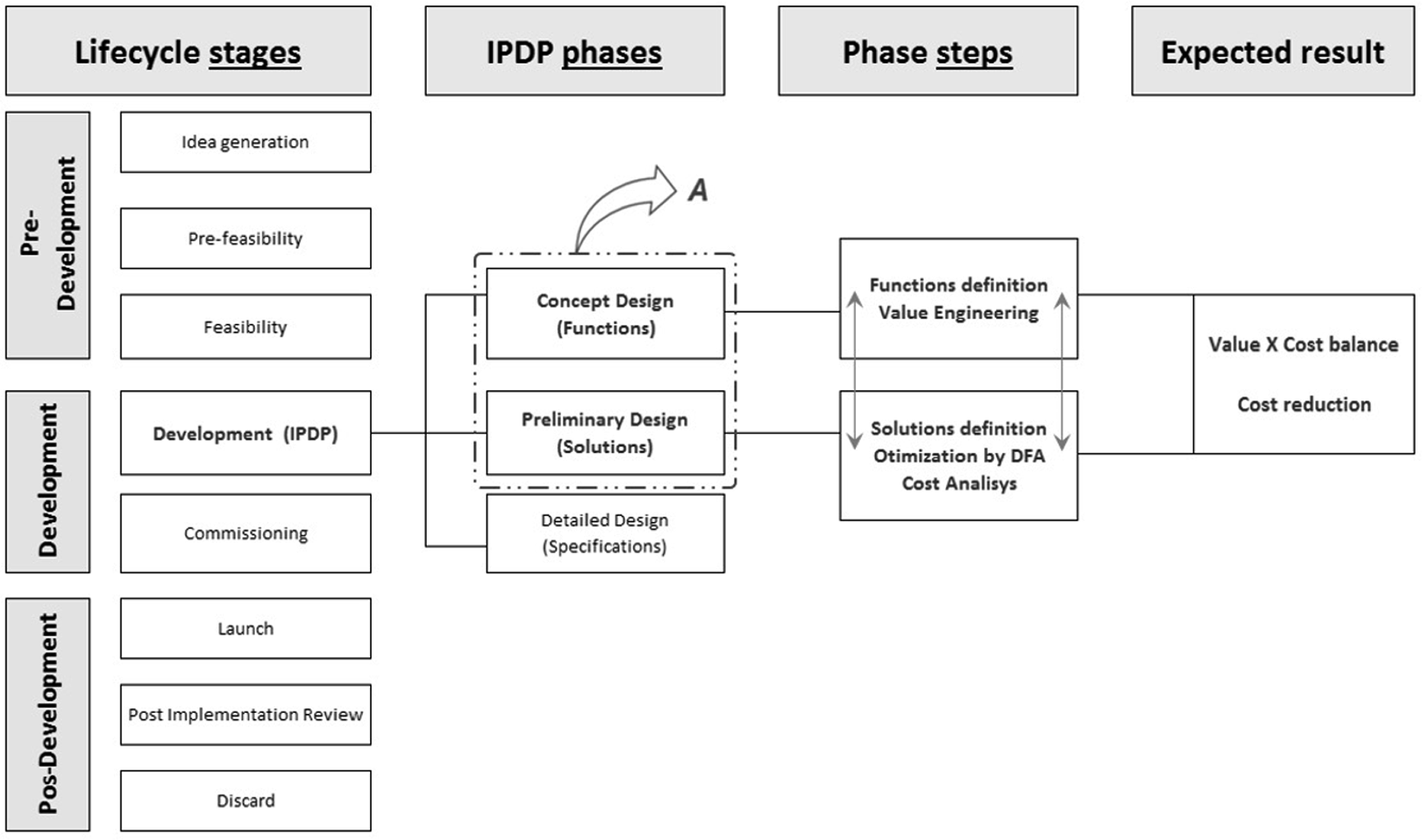
Definition of the research location throughout a product cycle of life.
To summarize, the starting point in the IPDP is always a requirements analysis. This analysis is then used in conceptual design, that is, to develop a concept that meets the requirements through functions. The selected concept is then designed to prepare maps of possible solutions throughout the preliminary project. After selecting the best combination and solutions, the design is detailed. As the method proposed in this article is located at the boundary between the conceptual design and preliminary design phases and uses the VE and cost analysis steps as a link.
Conceptual design
At the beginning of new development, the first step is to seek the product conceptualization that, according to Marshall (2002), is based on the representation of an imagined object, through its general characteristics. Therefore, the concept is an abstraction that depends on stimuli to be extracted from the core of the human brain connections. However, in defining the formal methods and steps at this initial phase, we can guarantee an intellectual and practical production, independent of the personal inspiration of each member in the project team. It stimulates the use of the knowledge inventory of the elements involved in the new development. According to Ma et al. (2013), during the conceptual design process, it is necessary to know about different domains to obtain a creative and innovative design. With the focus on integrated product development, we can state that the “concepts” are each of the benefits that the consumer can acquire, that is, the overall intention of the product or the service, seen from the consumer’s perspective. Sousa-Zomer (2017) stated it is necessary to consider “what should be offered to the customer” and “how to make this offer.”
That is the moment of development that involves objectivity and rationality. Nevertheless, it also subjectivity and abstraction in the generation of the functions to be aggregated into the product. Subjectivity is necessary to instigate the creative process, allowing the search for innovative concepts and functions, outside the conventional solutions. In another sense, the process systematization becomes fundamental to consider the large volume of the information generated. The good or bad result of this phase is directly related to the extent of the balance between reason and abstraction, and it will be decisive to increase the chances of success of the new product since every decision made at this point of development results in significant changes in the final product.
At the end of this conceptual phase, the answers to the following questions must be achieved: “What does the product do?”“How much is each of the product actions worth?” and, “How much does each product action cost?” Strictly speaking, this phase would have a qualitative and subjective approach, without the use of the product development tools; however, with its applications, a much more pragmatic approach is achieved, stimulating the freedom of creation at the right moment. Analyzing these approaches, we can see that most of them are dedicated to the concept phase of the product development process. We can observe that the product modularity arises from the initial stages of the design (Kong et al., 2009).
The beginning of the conceptual design phase is the moment in which the functions of the new development is defined, what the product will do, and its actions when it is in use. Since we can say that functions are the product objectives or the system operating in a prescribed way, they can be defined as anything that makes the item work, that is, what the new consumer good must perform. The product features serve a purpose, meet a need, and make the product work and sell. However, without the concept application and the design methods, several disorganization problems of the creative phase come out, due to the lack of a method to measure the value that the client perceives for each function.
As the central pillar of this phase is the “functions,” it becomes crucial to conceptualize them. We can define “function” as an action performed by a material object to change an attribute of another material object or to maintain the attribute of another material object (Ko, 2011). Thus, a function is an action performing by the product, and it must always be treated as a verb. This way, the purpose of functional analysis is to identify and evaluate the functional advantages and disadvantages of the engineering system or product. Therefore, the conceptual design extends to the point where all the functions are present in the new product are defined. Besides, when the added value of each one is calculated, from the final consumer’s point of view.
According to Park et al. (2017), the generation of ideas during the value study may become inefficient when using only conventional techniques of free creation, such as Brainstorming, and too much time can be consumed unnecessarily to understand the essential functions of the study areas visually. In order to address these problems, several studies have considered the development of the database management system to retrieve and reuse the past VE data between projects, as well as provide a decision support system during the value analysis. Its balance value of the product or its function of the product is not limited exclusively to the cost reduction of its solutions. In some cases, the product value can even be expanded by increasing the functions and, consequently, increasing the cost of such a function specifically. Only the cost reduction of the components does not effectively guarantee the increase of the market value of a product.
Preliminary design
The product preliminary design works quantitatively on the best design developed, to configure the items that characterize the product in its geometry and shapes. At this stage of integrated product development, we can observe the transition of the subjective entities from the conceptual project to a rational state, where academic knowledge and professional training will be fundamental for success. At this design stage, it is necessary to use all possible creativity in the decision-making process, but rationally and thoughtfully. The search can be intuitively or tacitly. It is a systematic way where each function is unfolded in decisions, and several solutions are listed for each decision. This method allows encouraging the creative process in the search for alternative solutions that, besides organizing a map of solutions in the best visual way possible, facilitates the assembly of combinations of technically possible solutions, which assists the decision-making process.
The solution analysis examines all possible combinations between the elements of a component or product. Ma et al. (2017) highlights that the basic rules for analyzing the combination of the solutions are: the problem to be solved must be described with great precision; it is necessary to identify the variables that characterize the problem and this depends on the analyst’s knowledge and skills; each variable must be subdivided into distinct classes, types or stages—if the variable is continuous, it must be divided into certain ranges or schemes; the possible solutions are sought in the combinations between classes. At the end of this preliminary step, we must have the answer to the following questions: (i) What are the solutions to each decision?; (ii) Which combination of solutions has the best balance between value and cost of functions?; (iii) What is the final configuration of the product?
The generation of alternative solutions for the same functions is a central element in engineering design. The search for solutions using the morphological matrix explores it and encourages the designer to identify new combinations of principles of existing solutions (Ölvander et al., 2009). According to Ma et al. (2017), the solutions that advocate the morphological matrix usage after the conceptual phase in order to organize the solutions generation and proposal combinations. Their study’s approach aims to rationalize these steps in the preliminary design, using the morphological matrix based in the organization of the proposed solutions, but guiding the decision-making in the elementary needs of the manufacturing and the assembly process. The DFA is the preliminary project philosophy that will serve as a link for the proposed method consolidation.
Design for assembly
Design for Assembly (DFA) is aiming to guide the design team toward a product with an optimum number of parts and solutions that could reduce the assembly operations. DFA concept would be the foremost step of the preliminary design for the desired reduction of the total product cost and for the search for a balance between the individual costs of the solutions and the perceived value of each function of the new consumer good to be developed. The methods for efficient DFA are well-known techniques and widely used in many large industries, where its tools and principles provide a structured approach in order to obtain simplified solutions for products that can be manufactured more effectively. They help quantify assembly problems and identify opportunities for innovative solutions. Although they require an initial extra effort, it can be compared to more conventional design strategies. In addition to an excellent integration among members of the most diverse areas involved in the CE environment, the overall effect is to generate benefits that include significant savings cost and reduced time to market (Bogue, 2012). It is mostly due to reduced engineering changes, fewer parts in the solution, less documentation and purchasing, and a simplified product with improved assembly and manufacturing features. According to Bahubalendruni et al. (2015), the part concatenation method has two variants; the first one is to generate all set of feasible assembly sequences by considering each assembly predicate and, the second variant is to obtain the optimal feasible assembly sequences for user-defined objectives such as total assembly time and cost.
Thus, Favi et al. (2018) proposed the DFA methodologies were developed to support the designer, generating feedback on the consequences of the design decisions in the product assembly. The goal is to help the designer to produce an efficient and cost-effective solution. The DFA application guides the designer toward a product with an optimal number of parts that require economic and straightforward assembly operations and the most appropriate manufacturing processes and materials for its components. Other approaches investigate the product assembly capacity from the product functional decomposition (Stone et al., 2004). As mentioned by the authors, the main scope of the DFA conceptual approach is to minimize the assembly time and costs by reducing the number of components before designing a detailed product model (Boothroyd et al., 2010). However, the implementation of a CE environment is required, where the different areas represented in the project team expose their needs and the decisions taken in a collegial manner. The immediate result of these methods application is the reduction of parts and search for more straightforward solutions. According to Canciglieri Junior and Young (2003), this result is ultimately a particular financial gain in terms of cost reduction in the product maintenance or, often, the quality improvement and consequent increase in financial return for the company or the investor. Thus, the use of the DFA philosophy in the preliminary design phase has the potential to shorten the development time, reduce the product final cost, and balance the cost of the solutions with the value of the functions.
According to Bala Murali et al. (2017), the DFA plays a crucial role in the manufacturing industry to minimize assembly cost by optimize the assembly process and to reduce the number of parts during assembly. In general, the bibliographic analysis showed that the cyclical tools between the conceptual design and the preliminary design are still at an intermediate stage of development, proposing an activity of significant importance in the initial stages of designing a new product. Besides, the gaps identified in the current literature emphasize a large amount of research still needed to develop an efficient cyclical design methodology without a rigid boundary between its three stages. It can be Analyzed the conceptual foundations listed in the bibliographic review, and there was a distancing between themes that, in essence, would have much synergy. These themes would be the conceptual models of Value Engineering, formally worked on in the conceptual design to ponder the importance of each function in the new product, and the DFA models usually elaborated in the preliminary design phase for optimization of solutions.
The purpose of the IPDP is to organize the design process toward a more balanced product in terms of perceived value by the customer and the actual cost (industrialization of each function). It can be increased the likelihood of commercial success of a new product to be launched (Jugend et al., 2014); thus, the proposed method uses these concepts described in the bibliographic review as links that seek the balance between value and cost.
Integrated product development method proposed
Toi et al. (2019) suggested an integrative design method of product architecture and assembly process plan by introducing a matrix-based modelling and analysis scheme. The aim of the method showed in this study is to balance the value and cost of project functions and reduce the final product cost through the application of VE concepts, in addition to the concepts of DFA in an integrated and cyclical environment of CE. Setti et al. (2021) proposed the integrated product development method based on the value of engineering and design for assembly. The research aimed to allow the solutions alternatives generated that can be assessed according to the strategies defined in the DFA and CE. It generates design proposals aimed at the balanced development between value and cost and simultaneously meeting the requirements of the various areas involved throughout the product cycle of life, including Marketing, Design, Product Engineering, Manufacturing, Logistics, Quality, Sales and Technical Assistance. The method intention is to organize the decision-making process so that ideas can go beyond the involuntary stimuli throughout the developmental routine and become stimulated throughout the application of the method in a systematized way. The proposal is composed of five steps, as step by step below:
Step 1—Definition of mechanical assemblies—the assemblies must be chosen given the more significant potential of cost reduction in raw material, without reducing quality, as well as those that present many assembly operations or logistical movements during the industrialization process.
Step 2—Definition of value engineering strategies—the analysis on the use of VE tools will have the purpose of identifying the recommendations for the improvement of solutions that aim at balancing the functions listed in the value × cost chart. The “value” data, which are the percentage levels of importance perceived by the consuming public, will come from the Mudge diagram. On the other hand, the data on the “costs” of the same functions will come from the matrix of cost reduction.
Step 3—Definition of DFA strategies—for the practical application of the DFA concepts, it will initially be necessary to create a multidisciplinary team with representatives of product engineering, industrial design, logistics and manufacturing, who can work together in all decision making. This requirement should be met through in-person meetings.
The DFA methods aim to improve the project, looking for shorter times and costs; thus, this activity will use methods that allow the number of components involved in each assembly to be minimized and verifying the real need of each one. As a case, the method proposed by Boothroyd et al. (2010) was used, in which three simple questions are proposed verifying the real necessity of a component: (i) does the piece, component or part under analysis have movements related to its surroundings?; (ii) does the piece, component or part under analysis require a different material for its function/functionality?; (iii) does the piece, component or part under analysis need to be disassembled/removed for the repair of another one? If all the answers are “NO,” we can propose the unification of components and materials for reducing the cost of raw material and labor.
Step 4—Definition of the Interface Tools—in order to minimize any uncertainties in the processes of creation and selection of concepts and functions, which are per se a subjective task, it is necessary to map the boundary conditions associated with the project problem. Therefore, we must search for the steps that lie at the frontiers of the conceptual design and preliminary design phases, which will be the differentials for the successful application of the method. Thus, the iterative application of the value × cost comparative where, at each cycle, the concept of DFA giving applied the interface. According to Bahubalendruni et al. (2015), obtaining a suitable assembly sequence for any product is a challenging task so far, due to multiple assembly predicate tests and a huge number of possible assembly sequences.
Step 5—Definition of the design recommendations—the purpose of this step is to compare the initial condition of the chosen mechanical assembly with the result achieved after the cycle between the steps. Besides, it verifies the possible configuration in terms of the balance between the value and cost of the functions and the lowest final cost considering all industrial impacts.
The flowchart shown in Figure 2 presents the activities order, considering the five steps mentioned. The first step corresponds to field 1 of the flowchart, where the functions are defined according to the mechanical assembly characteristics. The second step involves fields 2, 3, 4, 5, and 6 of the flowcharts, where value engineering strategies are used to balance the function’s value and cost. The third step of the proposed method is related directly to field 8 of the flowcharts with DFA techniques application. The fourth step occurs when the sum of the modules of the differences between the value and the cost of the functions is greater than 20%. And the final step corresponds to field 9 of the flowchart, where the solution combination recommendations are approved to be sent to the detailed design phase.

Flowchart of integrated product development method proposed.
With the application of the methods, it was intended to achieve the objective of stimulating the creative process in a systematized way, identifying the opportunities for the solutions improvement and innovation, so that a new product could perform its activities at a lower cost and with more excellent perceived value possible.
Method application
As an idea for an exploratory study to verify the method efficacy, this study used as a reference the assembly time optimization and the total solution cost of the lower structural base of refrigerators, a general mechanical assembly and a solution not very discussed in the industry, as shown in Figure 3(a). In this case, the traditional value and cost assessment tools were applied to each of the functions involved, using all of the Mudge function diagrams for the numerical weighting of the value of the functions and the cost apportionment method, for cost distribution among the functions. In a CE environment, these tools are extremely useful in weighing and quantifying these two quantities—value and cost. Thus, paying attention to the details of the subset of the lower structural base of refrigerator chosen, this study defined a comparison of the value and cost charts, before and after the method application. Figure 3(b) shows the original design conditions, according to current practices, listing the parts involved in the assembly and their respective raw material costs (direct material—DM), as well as the direct labor cost (direct labor—DL).

Lower structure of household refrigerators: (a) The refrigerator front and back views, (b) Asembly parts, (c) Mudge diagram, (d) Cost apportionment applied at current practice.
For the set of solutions contained in the original condition of production, this work elaborated a functional analysis, where the following functions of this set were listed: “
The Mudge method was applied to analyze the value of functions in terms of percentage importance after defining the functions. It resulted in the diagram shown in Figure 3(c). When analyzing the Mudge diagram, it is possible to observe that the “D” and “B” functions are the most important, with 40.3% and 20.9%, respectively. It shows the conceptual robustness of the results, as these are the main functions of the assembly—structuring the enclosure and sealing the insulating foam. At the other extreme, we see the “G” function with 0% of perceived importance, because it deals with the fixing of the box of the electronic board. After defining the functions and formalizing the parts list, as well as elaborating the individual quotations, it was possible to apply the cost apportionment method to analyze the absolute and percentage cost of each function, by transposing the costs of the parts into function costs. It resulted in the apportionment matrix shown in Figure 3(d). Analyzing the cost apportionment, we can observe that the functions with the highest percentage cost are “B” and “D” sealing the insulating foam and structuring the cabinet, respectively with 26.5% and 24.5% of the total cost.
On the other hand, we can observe that the “A” and “C” functions are those with the lowest percentage cost, with 5.5% each. It shows the consistency of the tool since its functions are related to the positioning of the power grid and cooling system pipes. With the results from the Mudge Diagram and the Cost Apportionment Matrix, we can define the Value × Cost comparison chart from the original concept of the product, shown in Figure 4(a).

Comparison of costs between the current solution and after each cycle of the method: (a) Current solution, (b) After the first Iteration, (c) After the second Iteration.
In order to assemble the chart, the functions were listed on the horizontal axis, and the percentages were presented on the vertical axis. Thus, the percentage value, derived from the Mudge diagram, and the percentage cost, derived from the cost apportionment, can be compared function by function.
With this combination of current solutions, there is a significant distance between value and costs in some functions, such as B, D, E, G, and H. Adding the modules of the differences between value and cost of all functions, we come to 43.4%, as shown in Figure 4(a).
The actions that the project team takes from that point on will be aimed at optimizing the solutions, which only changes the cost graph. As the functions remain the same to meet design requirements, the value chart does not change. As recommended in the method presentation, the next step, already in the preliminary phase, was the DFA strategies usage, in order to seek the optimization of the solution set. For this, the classic Boothroyd-Dewhurst method was applied, in which the following three questions are proposed, verifying the real necessity of a component: i) does the piece, component or part under analysis have movements related to its surroundings?; ii) does the piece, component or part under analysis require a differentiated material for its function/functionality?; iii) does the piece, component or part under analysis need to be disassembled/removed for the repair of another one? (Boothroyd et al., 2010).
As some assemblies had all the answers as “NO,” we can propose the unification of components and materials for reducing the cost of raw materials and labor. The results in the proposal shown in Figure 4, where the combination of solutions achieved a cost reduction of US$ 2.22, which represents US$ 25.5 in savings in the final set configuration, maintaining the quality perceived by the consumer. The significant differential of the proposed method is precisely the iterative cycle between the phases; with this, it returns to the conceptual design phase and re-evaluates the balance between value and cost, which resulted in the chart shown in Figure 4(b). In this chart, we can see an approximation of the value and cost points in each function, as well as the mentioned cost reduction, which shows the balance value × cost improvement.
Comparing the graphs of the original solution with those of the solution after the first method iteration, we can observe the approximation of the points of value and cost per function. Comparing the Figure 4(a) and (b), we observe that the sum of the modules of the differences between value and cost decreases, which increases the balance between the value perception and the industrialization cost, increasing the success probability of the project.
The results obtained already showed a significant improvement in the final cost; however, the proposed method suggests the iteration in the concept application. Thus, the three issues were applied again, at the end of which a proposal for a solution never presented in previous discussions was achieved. In this new overall design, we observed a new improvement in cost results—a reduction of over US$ 1.61, which represented an additional of 18.5% in extra savings, as shown in Figure 4(c). Thus, through the comparisons of the value × cost graphs observed in Figure 4 (details a, b and c). It was clear that the third option, after the second iteration of the application of the DFA method, presented a better balance graph, in addition to presenting a lower final cost in the combination of solutions. This balance was observed due to the more excellent proximity of the points of each function in the direct comparison. In Figure 4, we can observe how the functions do not change, and their value charts remain unchanged; however, the cost charts are adjusted by approaching the points of value and cost, function by function. However, in addition to this improvement in the value × cost equilibrium, the significant gain came in the total cost of the solution, with significant declines.
Proposed method assessment
Analyzing the results quantitatively, we observed a total reduction of US$ 3.83 per product. It corresponds to a total savings of 44% in the proposed solution of this studied mechanical set. The general costs comparison in each iteration can be observed in Figure 4, where this method of relevance is evident. However, in addition to this quantitative analysis of general costs, a qualitative improvement can be seen in terms of the balance between value and cost in each function when comparing each cycle of application of the method. In Figure 4, we can observe that the sum of the differences in the value and cost percentage, function by function, decreased with each iteration.
In general, it can be observed that the proposed method presents significant qualitative advantages since a better balance between value and cost increases the design success probability. Similarly, the quantitative gains for this white goods product are clear when considered an annual production of 230,000 units. Thus, with this individual reduction of costs, obtained at US$ 3.83 per product, we achieved an annual savings of around US$ 880,000.00. Other iterations could be realized from that point on. However, the results could converge to the same point, and the efforts of the multidisciplinary design team would bring much smaller gains than those presented in the two iterations.
Final considerations
This article assessed an Integrated Product Development method to integrate the Conceptual Design and Preliminary Design phases, in order to improve the relationship between value and cost of the functions defined for a new product. Finally, it was verified, through the literature review, that the product development process requires cost models: (i) take into account the complete product life cycle; (ii) can be used in the early stages of design; (iii) may provide advance information to designers so that it can be understood and used. Efforts should be made to provide the multidisciplinary project group with information on costs during the preliminary design process and to feedback the conceptual project information, seeking the value × cost balance. The initial development decisions mainly determine the product result in the field. However, designers do not know the costs incurred in the subsequent phases of the life cycle in the initial stage of the traditional conceptual design.
Such a model allowed the alternatives generated for the problem solutions could be assessed according to the type of product in development and the established criteria for the DFA and Value Engineering strategies. Consequently, the model generated design alternatives aimed at the balanced development between value and cost, while taking into account the requirements of the most diverse areas involved throughout the product’s life cycle (Marketing, Design, Product Engineering, Manufacturing, Logistics, Quality, Sales and Technical Assistance). As a result, this study verified that this method resulted in cost reduction, reduced development time and reduced rework requirements. It also resulted in the information feedback between projects, demonstrating that the existence of a defined and structured process is one of the main factors of success of the company. Analyzing the financial result of the case study, there was a significant improvement in the value × cost balance and a considerable reduction in the total cost of the product, resulting in savings of more than US$ 880,000.00 per year. Further reductions in this product family can be expected by expanding this analysis to the other subsets.
As a suggestion for future work is the suggestion of analysis of environmental impacts, recyclability and remanufacturing indexes that applications of solutions such as polypropylene as an alternative material to stainless steel can generate. As well as, this method should be used in products from other types of industries, such as automotive, food industry, cosmetics and, why not say, in the service sector. Since in this study the focus was on economic effects, other points to be evaluated would be the effect of the application of this method on the other two supports of the economic-environmental-social tripod.
Footnotes
Declaration of conflicting interests
The author(s) declared no potential conflicts of interest with respect to the research, authorship, and/or publication of this article.
Funding
The author(s) received no financial support for the research, authorship, and/or publication of this article.

Author biographies
With over 20 years of experience developing products in consumer goods industries,